

Evidence for the utility of quantum computing before fault tolerance
Open accessThe DOI matches its Crossref record; 43 of the 43 references it cites were found in a registry or an index.
Abstract
Quantum computing promises to offer substantial speed-ups over its classical counterpart for certain problems. However, the greatest impediment to realizing its full potential is noise that is inherent to these systems. The widely accepted solution to this challenge is the implementation of fault-tolerant quantum circuits, which is out of reach for current processors. Here we report experiments on a noisy 127-qubit processor and demonstrate the measurement of accurate expectation values for circuit volumes at a scale beyond brute-force classical computation. We argue that this represents evidence for the utility of quantum computing in a pre-fault-tolerant era. These experimental results are enabled by advances in the coherence and calibration of a superconducting processor at this scale and the ability to characterize 1 and controllably manipulate noise across such a large device. We establish the accuracy of the measured expectation values by comparing them with the output of exactly verifiable circuits. In the regime of strong entanglement, the quantum computer provides correct results for which leading classical approximations such as pure-state-based 1D (matrix product states, MPS) and 2D (isometric tensor network states, isoTNS) tensor network methods 2,3 break down. These experiments demonstrate a foundational tool for the realization of near-term quantum applications 4,5 .
Overview
The claims and statistics of this paper haven’t been checked yet.
Free: it reads the open-access text and checks the first 5 claims that cite a source we can check. Create a free account to check every claim.
Integrity signals
Registry
Cites
Statistics
Figures
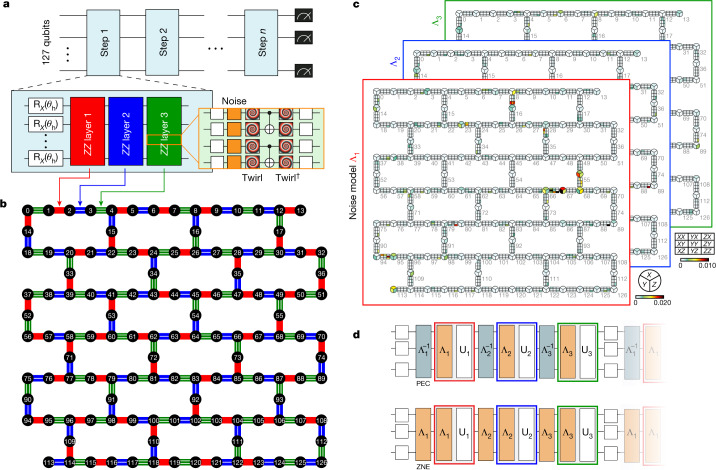
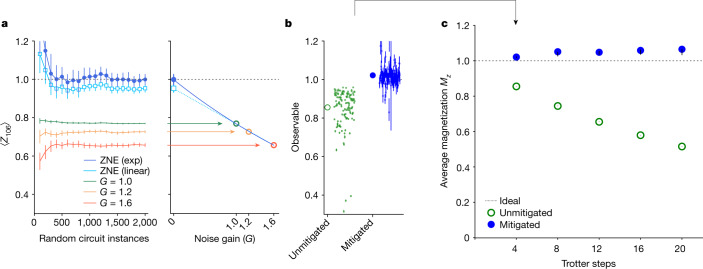
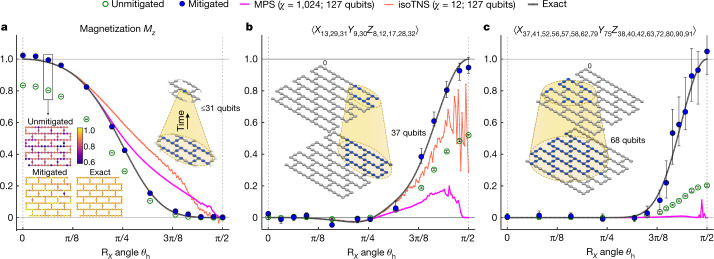
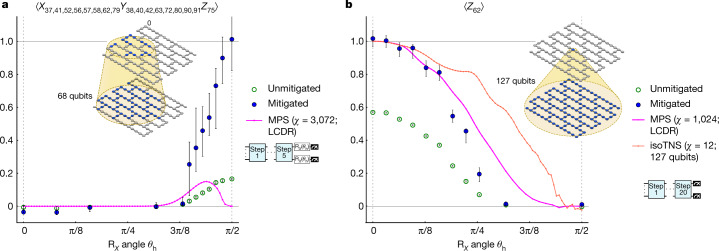
Verification
Claims the paper makes
The claims and statistics of this paper haven’t been checked yet.
Free: it reads the open-access text and checks the first 5 claims that cite a source we can check. Create a free account to check every claim.
Claims other papers make about this one
Each is checked against this paper’s own text: does it say what the citing paper says it does?
The cited source says what the claim attributes to it.
In the citing paper
“However, mobile qubit architectures, such as QCCD and optical tweezers24,25, can distribute resources more efficiently than stationary qubit architectures26–28, because qubits flow through the QPU like bits in a classical processor, with separated memory structures, data buses and logic units, each optimized for their purpose12.”
From A 98-qubit trapped-ion quantum computer with all-to-all connectivity (2026) · cites this paper as [26]
Self-check
Percentages, sums and reported differences re-computed from the paper’s own numbers.
The self-check needs the paper’s full text.
Citations
Cites
Quantum Computing in the NISQ era and beyond
Preskill, J. (2018) · Quantum · doi:10.22331/q-2018-08-06-79 · Cited by 8,830
Quantum supremacy using a programmable superconducting processor
Arute, F., Arya, K., Babbush, R., Bacon, D., Bardin, J. C., Barends, R., Biswas, R., Boixo, S., Brandao, F. G. S. L., Buell, D. A., et al. (2019) · Nature · doi:10.1038/s41586-019-1666-5 · Cited by 7,720
The density-matrix renormalization group in the age of matrix product states
Schollwöck, U. (2011) · Annals of Physics · doi:10.1016/j.aop.2010.09.012 · Cited by 4,818 · cited 2×
“Tensor networks have been widely used to approximate and compress quantum state vectors that arise in the study of the low-energy eigenstates of and time evolution by local Hamiltonians 2,32,33 and, more recently, have been successfully used to simulate low-depth noisy quantum circuits 34–36 .”
MethodCharge-insensitive qubit design derived from the Cooper pair box
Koch, J., Yu, T. M., Gambetta, J., Houck, A. A., Schuster, D. I., Majer, J., Blais, A., Devoret, M. H., Girvin, S. M., & Schoelkopf, R. J. (2007) · Physical Review A · doi:10.1103/physreva.76.042319 · Cited by 3,351 · cited 1×
“For the experimental implementation, we primarily used the IBM Eagle processor ibm_kyiv, composed of 127 fixed-frequency transmon qubits 15 with heavy-hex connectivity and median T 1 and T 2 times of 288 μs and 127 μs, respectively.”
MethodPurification of Noisy Entanglement and Faithful Teleportation via Noisy Channels
Bennett, C. H., Brassard, G., Popescu, S., Schumacher, B., Smolin, J. A., & Wootters, W. K. (1996) · Physical Review Letters · doi:10.1103/physrevlett.76.722 · Cited by 2,961 · cited 1×
“…restricting to jump operators acting on local pairs of qubits yields a sparse noise model that can be efficiently learned for many qubits and that accurately captures the noise associated with layers of two-qubit Clifford gates, including crosstalk, when combined with random Pauli twirls 23,24 .”
BackgroundNoisy intermediate-scale quantum algorithms
Bharti, K., Cervera-Lierta, A., Kyaw, T. H., Haug, T., Alperin-Lea, S., Anand, A., Degroote, M., Heimonen, H., Kottmann, J. S., Menke, T., et al. (2022) · Reviews of Modern Physics · doi:10.1103/revmodphys.94.015004 · Cited by 2,231
Improved simulation of stabilizer circuits
Aaronson, S., & Gottesman, D. (2004) · Physical Review A · doi:10.1103/physreva.70.052328 · Cited by 1,515 · cited 1×
“Clifford circuits serve as useful benchmarks of estimates produced by error mitigation, as they can be efficiently simulated classically 29 .”
BackgroundError Mitigation for Short-Depth Quantum Circuits
Temme, K., Bravyi, S., & Gambetta, J. M. (2017) · Physical Review Letters · doi:10.1103/physrevlett.119.180509 · Cited by 1,379 · cited 2×
“based on pulse stretching 9,17,18 or subcircuit repetition 20–22 have circum-vented the need for precise noise learning, while relying on simplistic assumptions about the device noise.”
BackgroundSelf-citationEvolution of entanglement entropy in one-dimensional systems
Calabrese, P., & Cardy, J. (2005) · Journal of Statistical Mechanics: Theory and Experiment · doi:10.1088/1742-5468/2005/04/p04010 · Cited by 1,295 · cited 1×
“As entanglement (bond dimension) of a generic state grows linearly (exponentially) with time evolution until it saturates the volume law, deep quantum circuits are inherently difficult for tensor networks 37 .”
BackgroundError mitigation extends the computational reach of a noisy quantum processor
Kandala, A., Temme, K., Córcoles, A. D., Mezzacapo, A., Chow, J. M., & Gambetta, J. M. (2019) · Nature · doi:10.1038/s41586-019-1040-7 · Cited by 871 · cited 2×
“based on pulse stretching 9,17,18 or subcircuit repetition 20–22 have circum-vented the need for precise noise learning, while relying on simplistic assumptions about the device noise.”
BackgroundSelf-citation
Research works printed but not linked: 5
- Shor, P. W. in Proc. 35th Annual Symposium on Foundations of Computer Science 124–134 (IEEE, 1994).
- Kitaev, A. Y. Quantum measurements and the Abelian Stabilizer Problem. Preprint at https://arxiv.org/abs/quant-ph/9511026 (1995). · arXiv
- Li Y Benjamin SC Efficient variational quantum simulator incorporating active error minimization Phys. Rev. X 2017 7 021050
- Endo S Benjamin SC Li Y Practical quantum error mitigation for near-future applications Phys. Rev. X 2018 8 031027
- Zhou Y Stoudenmire EM Waintal X What limits the simulation of quantum computers? Phys. Rev. X 2020 10 041038
Cited by
Items 801–900 of 1,005
Readout-Induced Degradation of Transmon Lifetimes: Interplay of TLSs and Qubit Spectral Reshaping
Huang, Z., Hung, J. S. C., Raha, M., Chou, M.-H., Levine, H., Retzker, A., Hann, C. T., Hover, D. J., Brandão, F. G. S. L., Clerk, A. A., et al. (2026) · PRX Quantum · doi:10.1103/y5ty-bd4y · Cited by 7
“However, many modern superconducting qubit architectures operate at larger | χ | /κ ratios [9, 10, 21–23], where the simple Lorentzian broadening model is insufficient and a bath spec.”
A review of variational quantum algorithms: Insights into fault-tolerant quantum computing
Wang, Z., Huang, J., Ye, R., Li, Q., Ding, Q.-M., Huang, Y., Zhang, T., Zeng, Y., Gao, J., Yuan, X., et al. (2026) · Frontiers of Physics · doi:10.15302/frontphys.2027.023301 · Cited by 7
“The maturity of this domain was recently underscored by the demonstration that advanced probabilistic error cancellation, utilizing sparse Pauli-Lindblad noise models [92], enables accurate estimation on large-scale processors beyond the reach of brute-force classical simulation [129].”
Bae, J., Yoo, G., Nakamura, S., Ohnishi, S., & Kim, D. S. (2024) · Quantum Information Processing · doi:10.1007/s11128-024-04458-y · Cited by 7
Low depth virtual distillation of quantum circuits by deterministic circuit decomposition
Karim, A., Zhang, S., & Usman, M. (2024) · Physical Review Research · doi:10.1103/physrevresearch.6.033223 · Cited by 7
“However, this can lead to a biased estimator depending on the noise amplification method [18].”
MethodSolinas, P., & Gherardini, S. (2025) · Physical Review A · doi:10.1103/physreva.111.052217 · Cited by 7
“For example, it can be used (i) to characterize the quantum-to-classical transition [36–39], (ii) to monitor the stability and robustness against noise of quantum devices and computers subject to decoherence process [16, 40, 41], or (iii) to certify quantum random number generator [42].”
Simulating adiabatic quantum computing with parameterized quantum circuits
Kolotouros, I., Petrongonas, I., Prokop, M., & Wallden, P. (2024) · Quantum Science and Technology · doi:10.1088/2058-9565/ad80c0 · Cited by 7
“We are currently transversing from the “Noisy Intermediate-Scale Quantum devices” (NISQ) era [1] to the early fault-tolerant era where small quantum computers of size O (100) are beginning to achieve useful results [2, 3].”
Constant runtime error mitigation via restricted evolution
Saxena, G., & Kyaw, T. H. (2026) · npj Quantum Information · doi:10.1038/s41534-026-01284-1 · Cited by 7
“Hence, the term “quantum utility era” [28].”
Cryogenic optical-to-microwave conversion using Si photonic integrated circuit Ge photodiodes
Julien-Neitzert, D., Leung, E. K., Islam, N., Khorev, S. V., Shekhar, S., Chrostowski, L., Young, J. F., & Salfi, J. (2024) · APL Photonics · doi:10.1063/5.0223360 · Cited by 7
Short-time simulation of quantum dynamics by Pauli measurements
Faehrmann, P. K., Eisert, J., Kieferová, M., & Kueng, R. (2025) · Physical Review A · doi:10.1103/6ggs-y392 · Cited by 7
“Recent years have seen unprecedented advances in the size (qubit number) and accuracy (gate fidelities) of such quantum hardware platforms, be it for universal quantum devices (e.g., [1–4]) or subuniversal quantum simulators (e.g., [5,6]).”
Transversal cnot gate with multicycle error correction
Kim, Y., Sevior, M. E., & Usman, M. (2025) · Physical Review Applied · doi:10.1103/physrevapplied.23.024074 · Cited by 7
“…flag qubit can be introduced to detect multi-qubit errors in the data resulting from a single fault during the execution of the syndrome extraction circuit [23, 34, 35, 40], or to address hardware limitations in connectivity [49–53], such as IBM’s heavy-hexagon quantum hardware structure [2].”
Self-citationExploring design patterns in quantum software: a case study
Fernández-Osuna, M., Pérez‐Castillo, R., Cruz-Lemus, J. A., Bączyk, M., & Piattini, M. G. (2025) · Computing · doi:10.1007/s00607-025-01467-2 · Cited by 7
Application of zero-noise-extrapolation-based quantum error mitigation to a silicon spin qubit
Sohn, H., Jung, J., Park, J., Jang, H., Stehouwer, L. E. A., Esposti, D. D., Scappucci, G., & Kim, D. (2025) · Physical Review A · doi:10.1103/925y-b4s1 · Cited by 7
Probing Quantum Anomalous Heat Flow Using Mid‐Circuit Measurements
Mallik, A. V., Cangemi, L. M., Levy, A., & Torre, E. G. D. (2025) · Advanced Quantum Technologies · doi:10.1002/qute.202500328 · Cited by 7
“Mitigation techniques have found important applications in the simulation of interesting quantum many-body effects, such as, time crystals [2], relativistic wormholes [3], and the dynamics of spin models [4], and many more [5].”
Capturing the Page curve and entanglement dynamics of black holes in quantum computers
Chowdhury, T. A., Yu, K., Asaduzzaman, M., & Sufian, R. S. (2025) · Nuclear Physics B · doi:10.1016/j.nuclphysb.2025.117112 · Cited by 7
“Subsequently, one measures the qubits on the computational basis ( Z -basis).”
Efficient Berry phase calculation via adaptive variational quantum computing approach
Mootz, M., & Yao, Y. (2026) · APL Quantum · doi:10.1063/5.0294540 · Cited by 7
On the fundamental resource for exponential advantage in quantum channel learning
Kim, M., & Oh, C. (2026) · Nature Communications · doi:10.1038/s41467-026-68532-y · Cited by 7
“Especially, quantum channel learning has attracted increasing attention due to its utility in learning errors of quantumdevices 26,27 and mitigating noise 28 – 30 for quantumcomputing.”
Symmetry-enhanced counterdiabatic quantum algorithm for qudits
Bottarelli, A., de Andoin, M. G., Chandarana, P., Paul, K., Chen, X., Sanz, M., & Hauke, P. (2025) · Physical Review Research · doi:10.1103/6ldg-3w1f · Cited by 7
“However, achieving practical quantum utility remains challenging in the current noisy intermediate scale quantum (NISQ) [1, 10] era, despite several attempts [6, 11].”
Nakamura, K., & Ankerhold, J. (2026) · Physical Review Research · doi:10.1103/b5jp-s6t2 · Cited by 7
Spin-Chain Multichannel Kondo Model via Image Impurity Boundary Condition
Gaines, J., Li, G., & Väyrynen, J. I. (2025) · Physical Review Letters · doi:10.1103/wj75-tg3z · Cited by 7
“Therefore, the model can be experimentally realized in quantum computers and simulators [32, 69–78] where the scaling of impurity total spin, Eq.”
Quantum Teleportation over Thermal Microwave Network
Yam, W. K., Gandorfer, S., Fesquet, F., Handschuh, M., Honasoge, K., Marx, A., Gross, R., & Fedorov, K. G. (2026) · Physical Review Letters · doi:10.1103/n8j9-63mz · Cited by 7
Neutrino thermalization via randomization on a quantum processor
Kiss, O., Tavernelli, I., Tacchino, F., Lacroix, D., & Roggero, A. (2026) · Communications Physics · doi:10.1038/s42005-026-02697-2 · Cited by 7
“The phenomenology of collective neutrino oscillations has been traditionally explored by means of mean-fi eld methods (see 13 – 15 for reviews) but in recent years a renewed interestintheroleplayedbyquantumcorrelationshaveemerged(see 16 – 18 for recent reviews).”
Noise-assisted feedback control of open quantum systems for ground state properties
Swain, K. R., Malla, R. K., & del Campo, A. (2026) · npj Quantum Information · doi:10.1038/s41534-026-01319-7 · Cited by 7
“These error probabilities { λ } of noisy intermediate-scale quantum (NISQ) devices can be learned e ffi ciently, as demonstrated in recent experiments [42–44 Once the noise is learned, we add an additional noise map Λ ′ s via the PLQT or the QPD method [34, 38].”
Variational quantum thermalizers based on weakly-symmetric nonunitary multi-qubit operations
Zapusek, E., Kirova, K., Hahn, W., Marthaler, M., & Reiter, F. (2026) · Quantum Science and Technology · doi:10.1088/2058-9565/ae2886 · Cited by 7
“A popular ansatz for the Heisenberg model consists of initializing in the ground state for pairs of qubits and then evolving with even and odd terms in an alternating fashion.”
Tedeschi, L. O. (2025) · Journal of Animal Science · doi:10.1093/jas/skaf445 · Cited by 7
Large-Scale Implementation of Quantum Subspace Expansion with Classical Shadows
Fischer, L. E., Bultrini, D., Dao, T. K. L., Tavernelli, I., & Tacchino, F. (2026) · Physical Review Letters · doi:10.1103/2w21-qs38 · Cited by 7
Robust and efficient quantum reservoir computing with a discrete time crystal
Zhang, D., Li, X., Guo, Y., Yu, H., Jin, Y., & Yin, Z. (2026) · Physical Review Applied · doi:10.1103/w2w9-c944 · Cited by 7
Observing quantum many-body scars in random quantum circuits
Andrade, B., Bhattacharya, U., Chhajlany, R. W., Graß, T., & Lewenstein, M. (2024) · Physical Review A · doi:10.1103/physreva.109.052602 · Cited by 7
“Moreover, recent quantum computing experiments, such as IBM’s 127 -qubit experiment on noise characterization [26] and Google’s 67 -qubit experiment on phase transitions [27], were performed by implementing randomized quantum circuits.”
MethodA Cryo-CMOS DAC-Based 40-Gb/s PAM4 Wireline Transmitter for Quantum Computing
Fakkel, N., Mortazavi, M., Overwater, R. W. J., Sebastiano, F., & Babaie, M. (2024) · IEEE Journal of Solid-State Circuits · doi:10.1109/jssc.2024.3364968 · Cited by 7
“small-scale processors comprising up to a 100 quantum bits (qubits), simple algorithms can already outperform a classical computer [1], [2].”
BackgroundDuh, U., & Žnidarič, M. (2024) · Physical Review Research · doi:10.1103/physrevresearch.6.023068 · Cited by 7
“In light of experimental advances in noisy quantum simulations [6–8] it pays off to consider systems where the basic building block is a nearest-neighbor gate rather than the local Hamiltonian (applying two-site gates is also simpler in classical numerical simulations [9]).”
BackgroundHigh-fidelity dimer excitations using quantum hardware
Eassa, N. M., Gibbs, J., Holmes, Z., Sornborger, A. T., Cincio, Ł., Hester, G., Kairys, P., Motta, M., Cohn, J., & Banerjee, A. (2024) · Physical review. B./Physical review. B · doi:10.1103/physrevb.110.184414 · Cited by 7
HamilToniQ: An Open-Source Benchmark Toolkit for Quantum Computers
Xu, X., Chen, K., & Wille, R. (2024) · IEEE International Conference on Quantum Computing and Engineering (QCE) · doi:10.1109/qce60285.2024.10384 · Cited by 7
“…Noise Extrapolation (ZNE) [30], Probabilistic Error Cancellation (PEC) [31], as well as dynamic decoupling (DD) techniques, are available on platforms like the IBM Quantum Hub to enhance the accuracy of algorithms on NISQ devices, with these improvements validated by multiple studies [32]–[34].”
MethodQuantum radio astronomy: Quantum linear solvers for redundant baseline calibration
Renaud, N., Rodríguez-Sánchez, P., Hidding, J., & Broekema, P. C. (2024) · Astronomy and Computing · doi:10.1016/j.ascom.2024.100803 · Cited by 7
Benchmarking digital–analog quantum computation for the inhomogeneous two-body Ising model
Pina-Canelles, V., Algaba, M. G., Heimonen, H., Papič, M., Ponce-Martinez, M., Rönkkö, J., Thapa, M., de Vega, I., & Auer, A. (2025) · Quantum Science and Technology · doi:10.1088/2058-9565/add8b6 · Cited by 7
Quantum simulation of highly-oscillatory many-body Hamiltonians for near-term devicesPreprint
Chen, G., Foroozandeh, M., Budd, C. J., & Singh, P. (2023) · arXiv (Cornell University) · doi:10.48550/arxiv.2312.08310 · Cited by 7
Ito, K., & Fujii, K. (2023) · arXiv (Cornell University) · doi:10.48550/arxiv.2312.15791 · Cited by 7
“However, to obtain an accurate result, we finally need to remove the effects of the hardware noise at least for the evaluation of the final outputs after the optimization, highlighting the need for QEM in real devices [6, 133, 139].”
BackgroundResource-aware scheduling of multiple quantum circuits on a hardware devicePreprint
Bhoumik, D., Majumdar, R., & Sur‐Kolay, S. (2024) · arXiv (Cornell University) · doi:10.48550/arxiv.2407.08930 · Cited by 7
Google uncovers how quantum computers can beat today’s best supercomputers
Garisto, D. (2024) · Nature · doi:10.1038/d41586-024-03288-3 · Cited by 7
Exponentially Decaying Quantum Simulation Error with Noisy DevicesPreprint
Xu, J., Zhao, C., Fan, J., & Zhao, Q. (2025) · arXiv (Cornell University) · doi:10.48550/arxiv.2504.10247 · Cited by 7
Régent, F.-M. L. (2025) · arXiv (Cornell University) · doi:10.48550/arxiv.2507.03678 · Cited by 7
“Our analysis reveals remarkable advances: physical-qubit coherence and gate fidelity have improved by orders of magnitude, while processor scale has grown exponentially, enabling access to hundreds and even thousands of qubits [68, 112].”
Simulation and Benchmarking of Real Quantum HardwarePreprint
Piskor, T., Schöndorf, M., Bauer, M., Smith, D., Ayral, T., Pogorzalek, S., Auer, A., & Papič, M. (2025) · Research Square · doi:10.21203/rs.3.rs-7805606/v1 · Cited by 7
Multiplexed double-transmon coupler scheme in scalable superconducting quantum processorPreprint
Cai, T., Chen, C.-T., Bu, K., Huai, S., Yang, X., Zong, Z., Li, Y., Zhang, Z., Zheng, Y.-C., & Zhang, S. (2025) · arXiv (Cornell University) · doi:10.48550/arxiv.2511.02249 · Cited by 7
“Approaches include frequency-division multiplexing of readout lines [15–17], multiplexed con-trol lines shared among multiple qubits [18–23], and the use of fixed-frequency qubits to eliminate Z con-trol lines for frequency tuning [5].”
Hardness of classically sampling quantum chemistry circuitsPreprint
Hafid, A., Iwakiri, H., Tsubouchi, K., Yoshioka, N., & Kohda, M. (2025) · arXiv (Cornell University) · doi:10.48550/arxiv.2504.12893 · Cited by 7
“…fault tolerance for large-scale simulation, there are anticipations that near-term noisy quantum computers [8], possibly with early-fault tolerance, could still provide quantum advantage in some tasks including dynamics simulation [9] and a sampling-based configuration interaction (CI) method [10].”
High-precision Quantum Phase Estimation on a Trapped-ion Quantum ComputerPreprint
Tranter, A., Gowland, D., Yamamoto, K., Sze, M., & Ramo, D. M. (2025) · arXiv (Cornell University) · doi:10.48550/arxiv.2506.17207 · Cited by 7
Gravier, O., Ayral, T., Vermersch, B., Meunier, T., & Savin, V. (2025) · arXiv (Cornell University) · doi:10.48550/arxiv.2507.08713 · Cited by 7
Data-Efficient Error Mitigation for Physical and Algorithmic Errors in a Hamiltonian SimulationPreprint
Hakkaku, S., Suzuki, Y., Tokunaga, Y., & Endo, S. (2025) · arXiv (Cornell University) · doi:10.48550/arxiv.2503.05052 · Cited by 7
“Although most such algorithms are beyond the capacity of the current quantum computers, the Trotter-based Hamiltonian simulation algorithm has already been performed in the current quantum device by an IBM team, with the utility of quantum devices being investigated [1].”
The EU Quantum Flagship's Key Performance Indicators for Quantum ComputingPreprint
Zimborás, Z., Portik, A., Aguirre, D., Peña, R., Svastits, D., Pályi, A., Márton, Á., Asbóth, J. K., Kockum, A. F., Sanz, M., et al. (2025) · arXiv (Cornell University) · doi:10.48550/arxiv.2512.19653 · Cited by 7
“Furthermore, considering the different technologies available for implementing quantum computing today [7–12, 14– 17 ], Taking these considerations into account, we have developed benchmarks for the Quantum Flagship program of the European Union as a suite of key performance indicators (KPIs).”
Machine Failure Detection Based on Projected Quantum ModelsPreprint
Bowden, L., Chu, Q., Cena, B., Ohno, K., Parney, B., Sharma, D., & Takeori, M. (2026) · arXiv (Cornell University) · doi:10.48550/arxiv.2601.15641 · Cited by 7
“This paper explores the integration of quantum computing with machine learning to engineer a superior failure detection algorithm tailored for industrial applications, in the light of the recent remarkable progress in the field of quantum computing [6]–[9].”
Quantum Deep Learning: A Comprehensive ReviewPreprint
Ji, Y., Chen, Z.-Y., Roth, M., Kreplin, D. A., Schiffer, C., King, M., Anton, O., Alam, M. S., Krutzik, M., Willsch, D., et al. (2026) · arXiv (Cornell University) · doi:10.48550/arxiv.2603.06644 · Cited by 7
Dias, B., Bosse, J. L., & Seddon, J. R. (2026) · arXiv (Cornell University) · doi:10.48550/arxiv.2603.18869 · Cited by 7
Scalable Fluxonium Quantum Processors via Tunable-Coupler ArchitecturePreprint
Zhan, Z., Li, Z., Wang, F., Lan, W., Pan, X., Xiang, L., Dou, X., Gao, R., Gong, G., Guo, Y., et al. (2026) · arXiv (Cornell University) · doi:10.48550/arxiv.2604.13363 · Cited by 7
Tensor Networks with Belief Propagation Cannot Feasibly Simulate Google's Quantum Echoes ExperimentPreprint
Bermejo, P., Villalonga, B., Ware, B., Vidal, G., & Szasz, A. (2026) · arXiv (Cornell University) · doi:10.48550/arxiv.2604.15427 · Cited by 7
“On the other hand, reproducible quantities are generally averages over many repetitions of a local measurement on the final state, and several previous experiments measuring potentially beyond-classical local observables [10, 11, 14] have proven to be classically simula-ble [16, 17, 23, 34, 35].”
Tensor network surrogate models for variational quantum computationPreprint
Watanabe, R., Sels, D., & Tindall, J. (2026) · arXiv (Cornell University) · doi:10.48550/arxiv.2604.20180 · Cited by 7
“A large body of literature has recently focused on demonstrating the notion of quantum “advantage” or “utility” [5–8], creating a “tug-of-war” between quantum and classical methods over which approach is favorable [9– 12].”
Improved Quantum Approximate Optimization Algorithm for Low‐Density Parity‐Check Channel Decoding
Zeng, H., Meng, F., Luan, T., Yu, X., & Zhang, Z. (2024) · Advanced Quantum Technologies · doi:10.1002/qute.202300262 · Cited by 6
Effects of topological boundary conditions on Bell nonlocality
Emonts, P., Hu, M., Aloy, A., & Tura, J. (2024) · Physical Review A · doi:10.1103/physreva.110.032201 · Cited by 6
Resource-efficient quantum algorithm for linear systems of equations
Ghisoni, F., Scala, F., Bajoni, D., & Gerace, D. (2026) · Physical Review A · doi:10.1103/gwzg-4pls · Cited by 6
“This result is due to the available hardware’s inaccuracy in performing large controlled operations [27] rather than the available number of qubits, which can be in the tens [28] to hundreds [29] of qubits depending on the architecture.”
Echo-evolution data generation for quantum error mitigation via neural networks
Валерьевич, Б. Д. (2024) · Quantum Information Processing · doi:10.1007/s11128-024-04603-7 · Cited by 6
“01 which correspond to state-of-the-art quantum computing capabilities [2].”
InfluentialC3-VQA: Cryogenic Counter-Based Coprocessor for Variational Quantum Algorithms
Ueno, Y., Imamura, S., Tomida, Y., Tanimoto, T., Tanaka, M., Tabuchi, Y., Inoue, K., & Nakamura, H. (2024) · IEEE Transactions on Quantum Engineering · doi:10.1109/tqe.2024.3521442 · Cited by 6
“NISQ machines with approximately 100 qubits have the capability to perform computations at a scale beyond classical brute-force methods [13].”
Baron, D., Patil, H. P., & Zhou, H. (2024) · IEEE International Conference on Quantum Computing and Engineering (QCE) · doi:10.1109/qce60285.2024.00024 · Cited by 6
“However, as we move to quantum circuits of hundreds of qubits and beyond in the noisy intermediate scale quantum (NISQ) era [6], we must pay close attention to the number of shots required and the computational complexity of the error mitigation method.”
Mitigating errors in analog quantum simulation by Hamiltonian reshaping or Hamiltonian rescaling
Guo, R.-C., Gu, Y., & Liu, D. E. (2025) · npj Quantum Information · doi:10.1038/s41534-025-00969-3 · Cited by 6
“However, most QEM methods are designed for digital quantum computers and require advanced spatial-temporal control.”
Generation and optimization of entanglement between atoms chirally coupled to spin cavities
You, J.-B., Kong, J. F., Aghamalyan, D., Mok, W., Lim, K. H., Ye, J., Png, C. E., & García-Vidal, F. J. (2025) · Physical Review Research · doi:10.1103/physrevresearch.7.l012058 · Cited by 6
“[44] and its Supplementary Information, the device’s coherence times are reported to be around 200-300 µ s for energy relaxation ( T 1 ) and approximately 100-200 µ s for dephasing ( T 2 ).”
Exponential optimization of adiabatic quantum-state preparation
Cugini, D., Nigro, D., Bruno, M., & Gerace, D. (2025) · Physical Review Research · doi:10.1103/physrevresearch.7.l012074 · Cited by 6
“Restricting to the realm of digital quantum processors satisfying the DiVincenzo criteria [2], typically 30 all-to-all connected qubits are available in trapped ions quantum processors [3] and more than 100 in superconducting quantum circuits with next-neighbor coupling [4].”
Noise-Aware Detectable Byzantine Agreement for Consensus-based Distributed Quantum Computing
Chen, K., Prest, M. T., Burt, F., Yu, S., & Leung, K. K. (2025) · International Conference on Quantum Communications, Networking, and Computing (QCNC) · doi:10.1109/qcnc64685.2025.00042 · Cited by 7
Comparison of encoding schemes for quantum computing of S > 1 / 2 spin chains
Lötstedt, E., & Yamanouchi, K. (2025) · Physical Review A · doi:10.1103/7mvy-zq7j · Cited by 6
Tsai, Z.-L., Wang, H., & Chen, H. (2025) · New Journal of Physics · doi:10.1088/1367-2630/adfe89 · Cited by 6
Practical fidelity limits of Toffoli gates in superconducting quantum processors
AbuGhanem, M. (2026) · The European Physical Journal Plus · doi:10.1140/epjp/s13360-026-08168-5 · Cited by 6
“While superconducting quantum processors [27] have demonstrated remarkable progress in one-and two-qubit gate fidelities [9–11, 28], In this work, we present a comprehensive experimental study of the Toffoli gate [24] performance on state-of-the-art superconducting processors from IBM Quantum ( ibm…”
A Review of Quantum Scientific Computing Algorithms Relevant to Computational Mechanics
Raisuddin, O. M., & De, S. (2025) · Archives of Computational Methods in Engineering · doi:10.1007/s11831-025-10321-9 · Cited by 6
“In the NISQ era, the search for variational algorithms for quantum advantage [163] or quantum utility [164] is likely to dominate the field.”
Xu, H.-Z., Chai, X., Hu, M., Wang, Z., Feng, Y.-L., Chen, Y., Zhang, X., Wang, J., Zhuang, W.-F., Jin, Y., et al. (2025) · Research · doi:10.34133/research.0947 · Cited by 7
Sample-efficient quantum error mitigation via classical learning surrogates
Liao, W.-Y., Yan, G., Song, Y., Tian, T.-C., Zhu, W.-M., Jiang, D.-T., Du, Y., & Huang, H.-L. (2026) · Communications Physics · doi:10.1038/s42005-026-02827-w · Cited by 7
Remote Entanglement Generation Via Enhanced Quantum State Transfer
Wang, T.-L., Wang, P., Zhao, Z., Zhang, S., Zhao, R.-Z., Yang, X., Zhang, H., Li, Z., Wu, Y. S., Guo, L.-L., et al. (2026) · PRX Quantum · doi:10.1103/4x8d-cmyx · Cited by 6
Self-citationMachine learning non-Markovian two-level quantum noise spectroscopy
Scarpetta, J. M., Reina, J. H., & Hjorth-Jensen, M. (2025) · Physical Review Research · doi:10.1103/2lzl-vpjd · Cited by 6
“Several studies have sought to improve our understanding of this process, proposing efficient ways to control its effects [7–9, 11, 12].”
Doublon bound states in the continuum through giant atoms
Rieck, W., Kockum, A. F., & Chen, G. (2026) · Physical Review Research · doi:10.1103/1zkl-j8tk · Cited by 6
Treespilation: architecture- and state-optimised fermion-to-qubit mappings
Miller, A., Glos, A., & Zimborás, Z. (2026) · npj Quantum Information · doi:10.1038/s41534-025-01170-2 · Cited by 7
Ajmi, N. A. A., & Shoaib, M. (2026) · Computers · doi:10.3390/computers15020102 · Cited by 6
Vukšić, M., Ćelić, J., & Cuculić, A. (2026) · IEEE Access · doi:10.1109/access.2026.3670749 · Cited by 6
“Maintaining the sub-20 millikelvin environment necessary for coherent qubit operation requires highly efficient cryogenic infrastructure and materials with low thermal conductivity yet high electromagnetic compatibility [6], [17].”
InfluentialQuantum algorithms for scheduling problems: a survey
Werner, T., & Ullinger, F. (2026) · EPJ Quantum Technology · doi:10.1140/epjqt/s40507-026-00494-y · Cited by 7
HiMA: Hierarchical quantum microarchitecture for qubit-scaling and quantum process-level parallelism
Zhou, Q., Mei, Z.-H., Shi, H.-Q., Guo, L.-L., Yang, X., Wang, Y.-J., Xu, X.-F., Xue, C., Kong, W.-C., Wang, J.-C., et al. (2026) · Future Generation Computer Systems · doi:10.1016/j.future.2026.108484 · Cited by 6
Self-citationParks, Z. P., Carignan-Dugas, A., Gustafson, E., Meurice, Y., & Dreher, P. (2024) · Physical review. D/Physical review. D. · doi:10.1103/physrevd.109.014505 · Cited by 6
Quantum error mitigation in the regime of high noise using deep neural network: Trotterized dynamics
Zhukov, A., & Pogosov, W. V. (2024) · Quantum Information Processing · doi:10.1007/s11128-024-04296-y · Cited by 6
“The Trotterized time evolution is an important circuit benchmark, which was very recently used to demonstrate the utility of quantum computing with NISQ devices [2].”
Noise-driven quantum-circuit refrigeration
Kivijärvi, H., Viitanen, A., Mörstedt, T., & Möttönen, M. (2026) · Physical Review Research · doi:10.1103/bpsd-r79j · Cited by 6
The Ising dual-reflection interface: $\mathbb{Z}_4$ symmetry and Majorana strong zero modes
Graf, J., Surace, F. M., Berg, M., & Moroz, S. (2026) · SciPost Physics Core · doi:10.21468/scipostphyscore.9.3.048 · Cited by 6
“With the new notation, both R XX and U J 0 could be decomposed into the product of a single-qubit gate and a controlled unitary [ 43 ] .”
Resilience–runtime tradeoff relations for quantum algorithms
García-Pintos, L. P., O’Leary, T., Biswas, T., Bringewatt, J., Cincio, Ł., Brady, L. T., & Liu, Y.-K. (2025) · Reports on Progress in Physics · doi:10.1088/1361-6633/adac8b · Cited by 7
Jones, E. B., Winkleblack, C. J., Campbell, C., Rotello, C., Dahl, E. D., Reynolds, M. R., Graf, P. A., & Jones, W. B. (2025) · Physical Review Research · doi:10.1103/physrevresearch.7.023186 · Cited by 6
“Moreover, quantum processors remain relatively small and noisy, with the largest processors ranging from dozens to hundreds of qubits with typical two-qubit gate infidelities on the orders of .1% to 1% [6–8].”
BackgroundHe, G. P. (2026) · Frontiers of Physics · doi:10.15302/frontphys.2026.083201 · Cited by 6
Quantum-inspired dynamical models on quantum and classical annealers
Hanussek, P., Pawłowski, J., Mzaouali, Z., & Gardas, B. (2026) · Physical Review Applied · doi:10.1103/rrf3-jm5m · Cited by 6
Wang, J., Wu, S., Hou, L., Mi, C., Shi, X., & Gao, X. (2024) · Results in Physics · doi:10.1016/j.rinp.2024.107356 · Cited by 6
Adaptive variational ground state preparation for spin-1 models on qubit-based architectures
Getelina, J. C., Wang, C., Iadecola, T., Yao, Y., & Orth, P. P. (2024) · Physical review. B./Physical review. B · doi:10.1103/physrevb.109.085128 · Cited by 6
Quantum multi-programming for maximum likelihood amplitude estimation
Rao, P., Choi, S., & Yu, K. (2024) · Quantum Computing, Communication, and Simulation · doi:10.1117/12.3002854 · Cited by 6
Concatenated Steane code with single-flag syndrome checks
Pató, B., Tansuwannont, T., & Brown, K. R. (2024) · Physical Review A · doi:10.1103/physreva.110.032411 · Cited by 6
“However, for the weight-12 stabilizer generators, the single-flag scheme imposes degree 13 connectivity on the ancilla qubits, which is much higher than the currently available devices [14, 15].”
BackgroundVandelli, M., Lignarolo, A., Cavazzoni, C., & Dragoni, D. (2024) · Quantum Information Processing · doi:10.1007/s11128-024-04560-1 · Cited by 6
“In real devices, the number of applicable gates is currently limited to a few thousand and only in cases when the problem can be directly mapped on the quantum processor [62].”
InfluentialGeometric representations of braid and Yang–Baxter gates
Zhang, K., Hao, K., Yu, K., Korepin, V. E., & Yang, W. (2024) · Journal of Physics A Mathematical and Theoretical · doi:10.1088/1751-8121/ad85b2 · Cited by 6
Robust and parallel control of many qubits
Anonymous, & Choi, S. (2026) · Physical Review Research · doi:10.1103/n2hz-8zy2 · Cited by 6
Scalable Quantum Computation of Highly Excited Eigenstates with Spectral TransformsPreprint
Chiew, S.-H., & Kwek, L. C. (2023) · arXiv (Cornell University) · doi:10.48550/arxiv.2302.06638 · Cited by 6
Improved Digital Quantum Simulation by Non-Unitary ChannelsPreprint
Gong, W., Kharkov, Y., Tran, M. C., Bienias, P., & Gorshkov, A. V. (2023) · arXiv (Cornell University) · doi:10.48550/arxiv.2307.13028 · Cited by 6
“Near-term quantum computational devices possess the potential to simulate the dynamics of many-body quantum systems beyond the capability of classical computers [1].”
BackgroundMulti-mode Cavity Centric Architectures for Quantum SimulationPreprint
Stein, S., Hua, F., Liu, C., Guinn, C. R., Ang, J., Zhang, E. Z., Chakram, S., Ding, Y., & Li, A. (2023) · arXiv (Cornell University) · doi:10.48550/arxiv.2309.15994 · Cited by 6
“This was evident in IBM’s recent Advantage experiment [30], where the targeted Hamiltonian was tailored to interact locally, a key strategy behind quantum tensor networks’ spoofing.”
BackgroundMethodPelofske, E., Bärtschi, A., & Eidenbenz, S. (2023) · arXiv (Cornell University) · doi:10.48550/arxiv.2311.01657 · Cited by 6
“[9], instead quantum annealing can directly perform a simulation of the system as an analog computation.”
BackgroundMethodResultInfluentialThe hardness of quantum spin dynamicsPreprint
Park, C.-Y., Casares, P. A. M., Arrazola, J. M., & Huh, J. (2023) · arXiv (Cornell University) · doi:10.48550/arxiv.2312.07658 · Cited by 6
“A recent experiment [27] and follow-up classical simulation results [28–30] demonstrate that lots of subtleties exist in proving quantum computational advantage and why a concrete theoretical guide is vital.”
BackgroundReport for the ASCR Workshop on Basic Research Needs in Quantum Computing and Networking - 2023
Lougovski, P., Parekh, O., Broz, J., Byrd, M., Chapman, J. C., Chembo, Y. K., de Jong, W. A., Figueroa, E. V., Humble, T. S., Larson, J. M., et al. (2023) · OSTI OAI (U.S. Department of Energy Office of Scientific and Technical Information) · doi:10.2172/2001045 · Cited by 6
From Quantum Mechanics to Quantum Software Engineering: A Historical ReviewPreprint
Bisicchia, G., García-Alonso, J. M., Murillo, J. M., & Brogi, A. (2024) · arXiv (Cornell University) · doi:10.48550/arxiv.2404.19428 · Cited by 6
“…in the quantum race was set in 2023 by IBM, which announced evidence for the utility of quantum computing even with noisy hardware, showing how it is possible to produce reliable results even without fault-tolerant quantum computers and at a scale beyond brute-force classical computation [54].”
BackgroundScaling the Variational Quantum Eigensolver for Dynamic Portfolio OptimizationPreprint
Nodar, Á., De León, I., Arias, D., Mamedaliev, E., Molina, M. E., Martín-Cordero, M., Hernández-Santana, S., Serrano, P., Arranz, M., Mentxaka, O., et al. (2024) · arXiv (Cornell University) · doi:10.48550/arxiv.2412.19150 · Cited by 6
“To overcome the 100 qubit frontier [2], we systematically enhance the most challenging aspects of the scalability of the VQE.”
Hamiltonian Simulation via Stochastic Zassenhaus ExpansionsPreprint
Peetz, J., & Narang, P. (2025) · arXiv (Cornell University) · doi:10.48550/arxiv.2501.13922 · Cited by 6
Metadata
- Authors
- Kim, Y., Eddins, A., Anand, S., Wei, K. X., van den Berg, E., Rosenblatt, S., Nayfeh, H., Wu, Y., Zaletel, M., Temme, K., & Kandala, A.
- Affiliations
- IBM Research - Cambridge (United States) (US)
- University of California, Berkeley (US)
- IBM (United States) (US)
- RIKEN (JP)
- Lawrence Berkeley National Laboratory (US)
- Corresponding author
- Eddins, Andrew
- Kandala, Abhinav
- ORCID
- Venue
- Nature
- Published
- 2023-06-14
- Volume
- 618
- Issue
- 7965
- Pages
- 500-505
- ISSN
- 0028-0836 (ISSN-L)
- 1476-4687
- PMC
- PMC10266970
- OpenAlex
- W4380627387
- Semantic Scholar
- f9253a3e2627f1c2a0a7e2cea320a4ec4e4d2ff9
- Cited by
- 1,050
- References
- 41
- Citations by year
- 2026: 226 · 2025: 399 · 2024: 358 · 2023: 67
- FWCI
- 98.85
- Type
- journal article
- Language
- en
- Open access
- hybrid
- doi.org
- Licence
- cc-by
- creativecommons.org/licenses/by/4.0 (tdm)
- creativecommons.org/licenses/by/4.0 (vor)
- Locations
- Nature (publishedVersion, cc-by)
- PubMed Central (publishedVersion, cc-by)
- PubMed (publishedVersion)
- eScholarship (California Digital Library) (submittedVersion, cc-by)
- OSTI OAI (U.S. Department of Energy Office of Scientific and Technical Information) (submittedVersion)
- RePEc: Research Papers in Economics (submittedVersion)
- Funders
- National Science Foundation (DEAC02-05CH11231, 2137603, 2138259, 2138296, 2138307, 2138286)
- U.S. Department of Energy (-AC02-05CH11231, 05CH11231, DE AC02 05CH11231, DESC0022716, DE-AC02-)
- National Energy Research Scientific Computing Center (DE–AC02–05CH11231, 05CH11231, AC02-05CH11231)
- Office of Science (DEAC02–05CH11231, AC02-05CH11231, DE-AC02)
- Office of Advanced Cyberinfrastructure (#2138286, #2138296, 2138259, #2138307, 2137603)
- Basic Energy Sciences (DE-AC02, DE-AC02-05CH11231., AC02–05CH11231)
- Lawrence Berkeley National Laboratory (AC02‐05CH11231, DE-AC02-05CH11231, 05CH11231)
- Topics
- Physical Sciences › Computer Science › Artificial Intelligence › Quantum Computing Algorithms and Architecture
- Physical Sciences › Physics and Astronomy › Atomic and Molecular Physics, and Optics › Quantum Information and Cryptography
- Physical Sciences › Physics and Astronomy › Atomic and Molecular Physics, and Optics › Quantum many-body systems
- Keywords
- quantum computing, NISQ devices, superconducting qubits, noise characterization, tensor network states, matrix product states, entanglement, quantum advantage
About these checks
Registry, retraction, Cites and statistics results are computed, not judged, with one exception: a printed reference that no index lists is read once by a model before it counts as a citation error. Claims are extracted by a model and kept only when their quote appears verbatim in the text; each cited source is then checked, with a model’s help, for whether it says what the claim relies on. Those verdicts can be wrong — read the claim’s quote and the cited source before relying on one.
Statistics and arithmetic are recomputed, not judged.
Confidence bands are shown only for fields calibrated on our annotated test set. None is calibrated yet, so no band is shown.
What counts as a claim ›How we measure confidence ›How we check this ›
Are you an author, or do you see a problem with this page? Request a review
Data sources
Bibliographic data: Semantic Scholar, OpenAlex, Crossref.
Contains information from the Semantic Scholar Academic Graph Datasets, made available under the ODC Attribution License (ODC-BY 1.0).
Semantic Scholar’s data is described in: Kinney, R., et al. (2023). The Semantic Scholar Open Data Platform. arXiv:2301.10140.
