

Evidence for the utility of quantum computing before fault tolerance
Open accessThe DOI matches its Crossref record; 43 of the 43 references it cites were found in a registry or an index.
Abstract
Quantum computing promises to offer substantial speed-ups over its classical counterpart for certain problems. However, the greatest impediment to realizing its full potential is noise that is inherent to these systems. The widely accepted solution to this challenge is the implementation of fault-tolerant quantum circuits, which is out of reach for current processors. Here we report experiments on a noisy 127-qubit processor and demonstrate the measurement of accurate expectation values for circuit volumes at a scale beyond brute-force classical computation. We argue that this represents evidence for the utility of quantum computing in a pre-fault-tolerant era. These experimental results are enabled by advances in the coherence and calibration of a superconducting processor at this scale and the ability to characterize 1 and controllably manipulate noise across such a large device. We establish the accuracy of the measured expectation values by comparing them with the output of exactly verifiable circuits. In the regime of strong entanglement, the quantum computer provides correct results for which leading classical approximations such as pure-state-based 1D (matrix product states, MPS) and 2D (isometric tensor network states, isoTNS) tensor network methods 2,3 break down. These experiments demonstrate a foundational tool for the realization of near-term quantum applications 4,5 .
Overview
The claims and statistics of this paper haven’t been checked yet.
Free: it reads the open-access text and checks the first 5 claims that cite a source we can check. Create a free account to check every claim.
Integrity signals
Registry
Cites
Statistics
Figures
Verification
Claims the paper makes
The claims and statistics of this paper haven’t been checked yet.
Free: it reads the open-access text and checks the first 5 claims that cite a source we can check. Create a free account to check every claim.
Claims other papers make about this one
Each is checked against this paper’s own text: does it say what the citing paper says it does?
The cited source says what the claim attributes to it.
In the citing paper
“However, mobile qubit architectures, such as QCCD and optical tweezers24,25, can distribute resources more efficiently than stationary qubit architectures26–28, because qubits flow through the QPU like bits in a classical processor, with separated memory structures, data buses and logic units, each optimized for their purpose12.”
From A 98-qubit trapped-ion quantum computer with all-to-all connectivity (2026) · cites this paper as [26]
Self-check
Percentages, sums and reported differences re-computed from the paper’s own numbers.
The self-check needs the paper’s full text.
Citations
Cites
Quantum Computing in the NISQ era and beyond
Preskill, J. (2018) · Quantum · doi:10.22331/q-2018-08-06-79 · Cited by 8,830
Quantum supremacy using a programmable superconducting processor
Arute, F., Arya, K., Babbush, R., Bacon, D., Bardin, J. C., Barends, R., Biswas, R., Boixo, S., Brandao, F. G. S. L., Buell, D. A., et al. (2019) · Nature · doi:10.1038/s41586-019-1666-5 · Cited by 7,720
The density-matrix renormalization group in the age of matrix product states
Schollwöck, U. (2011) · Annals of Physics · doi:10.1016/j.aop.2010.09.012 · Cited by 4,818 · cited 2×
“Tensor networks have been widely used to approximate and compress quantum state vectors that arise in the study of the low-energy eigenstates of and time evolution by local Hamiltonians 2,32,33 and, more recently, have been successfully used to simulate low-depth noisy quantum circuits 34–36 .”
MethodCharge-insensitive qubit design derived from the Cooper pair box
Koch, J., Yu, T. M., Gambetta, J., Houck, A. A., Schuster, D. I., Majer, J., Blais, A., Devoret, M. H., Girvin, S. M., & Schoelkopf, R. J. (2007) · Physical Review A · doi:10.1103/physreva.76.042319 · Cited by 3,351 · cited 1×
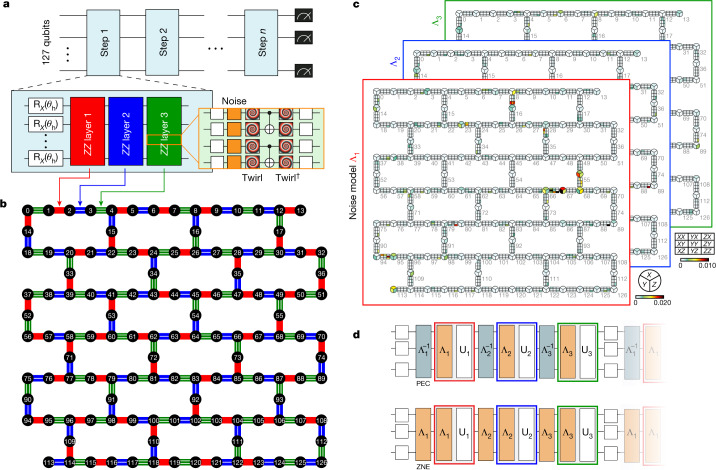
“For the experimental implementation, we primarily used the IBM Eagle processor ibm_kyiv, composed of 127 fixed-frequency transmon qubits 15 with heavy-hex connectivity and median T 1 and T 2 times of 288 μs and 127 μs, respectively.”
MethodPurification of Noisy Entanglement and Faithful Teleportation via Noisy Channels
Bennett, C. H., Brassard, G., Popescu, S., Schumacher, B., Smolin, J. A., & Wootters, W. K. (1996) · Physical Review Letters · doi:10.1103/physrevlett.76.722 · Cited by 2,961 · cited 1×
“…restricting to jump operators acting on local pairs of qubits yields a sparse noise model that can be efficiently learned for many qubits and that accurately captures the noise associated with layers of two-qubit Clifford gates, including crosstalk, when combined with random Pauli twirls 23,24 .”
BackgroundNoisy intermediate-scale quantum algorithms
Bharti, K., Cervera-Lierta, A., Kyaw, T. H., Haug, T., Alperin-Lea, S., Anand, A., Degroote, M., Heimonen, H., Kottmann, J. S., Menke, T., et al. (2022) · Reviews of Modern Physics · doi:10.1103/revmodphys.94.015004 · Cited by 2,231
Improved simulation of stabilizer circuits
Aaronson, S., & Gottesman, D. (2004) · Physical Review A · doi:10.1103/physreva.70.052328 · Cited by 1,515 · cited 1×
“Clifford circuits serve as useful benchmarks of estimates produced by error mitigation, as they can be efficiently simulated classically 29 .”
BackgroundError Mitigation for Short-Depth Quantum Circuits
Temme, K., Bravyi, S., & Gambetta, J. M. (2017) · Physical Review Letters · doi:10.1103/physrevlett.119.180509 · Cited by 1,379 · cited 2×
“based on pulse stretching 9,17,18 or subcircuit repetition 20–22 have circum-vented the need for precise noise learning, while relying on simplistic assumptions about the device noise.”
BackgroundSelf-citationEvolution of entanglement entropy in one-dimensional systems
Calabrese, P., & Cardy, J. (2005) · Journal of Statistical Mechanics: Theory and Experiment · doi:10.1088/1742-5468/2005/04/p04010 · Cited by 1,295 · cited 1×
“As entanglement (bond dimension) of a generic state grows linearly (exponentially) with time evolution until it saturates the volume law, deep quantum circuits are inherently difficult for tensor networks 37 .”
BackgroundError mitigation extends the computational reach of a noisy quantum processor
Kandala, A., Temme, K., Córcoles, A. D., Mezzacapo, A., Chow, J. M., & Gambetta, J. M. (2019) · Nature · doi:10.1038/s41586-019-1040-7 · Cited by 871 · cited 2×
“based on pulse stretching 9,17,18 or subcircuit repetition 20–22 have circum-vented the need for precise noise learning, while relying on simplistic assumptions about the device noise.”
BackgroundSelf-citation
Research works printed but not linked: 5
- Shor, P. W. in Proc. 35th Annual Symposium on Foundations of Computer Science 124–134 (IEEE, 1994).
- Kitaev, A. Y. Quantum measurements and the Abelian Stabilizer Problem. Preprint at https://arxiv.org/abs/quant-ph/9511026 (1995). · arXiv
- Li Y Benjamin SC Efficient variational quantum simulator incorporating active error minimization Phys. Rev. X 2017 7 021050
- Endo S Benjamin SC Li Y Practical quantum error mitigation for near-future applications Phys. Rev. X 2018 8 031027
- Zhou Y Stoudenmire EM Waintal X What limits the simulation of quantum computers? Phys. Rev. X 2020 10 041038
Cited by
Items 301–400 of 1,005
QuCLEAR: Clifford Extraction and Absorption for Quantum Circuit Optimization
Liu, J., Gonzales, A., Huang, B., Saleem, Z. H., & Hovland, P. (2025) · IEEE International Symposium on High-Performance Computer Architecture (HPCA) · doi:10.1109/hpca61900.2025.00023 · Cited by 23
“For instance, the recent demonstration of quantum utility [26] is also based on this concept.”
Variational quantum multiobjective optimization
Ekstrøm, L., Wang, H., & Schmitt, S. (2025) · Physical Review Research · doi:10.1103/physrevresearch.7.023141 · Cited by 24
“Over the past few years, quantum computing experiments have indicated that the threshold of practically useful NISQ quantum computation might be nearing [1, 2].”
BackgroundSun, J., Cheng, L., & Zhang, S. (2025) · Quantum · doi:10.22331/q-2025-06-24-1782 · Cited by 24
“However, its disadvantage is that it might break the locality of the Hamiltonian and cause additional overhead on the hardware that cannot support nonlocal operations [90, 91].”
Minami, S., Nakaji, K., Suzuki, Y., Aspuru‐Guzik, A., & Kadowaki, T. (2025) · Digital Discovery · doi:10.1039/d5dd00138b · Cited by 24
Shaping photons: Quantum information processing with bosonic cQED
Copetudo, A., Fontaine, C. Y., Valadares, F., & Gao, Y. Y. (2024) · Applied Physics Letters · doi:10.1063/5.0183022 · Cited by 24
Quantum Circuits for Stabilizer Error Correcting Codes: A Tutorial
Mondal, A., & Parhi, K. K. (2024) · IEEE Circuits and Systems Magazine · doi:10.1109/mcas.2024.3349668 · Cited by 24
“Quantum computers have the potential to achieve exponential speedups over their classical counterparts [1], [2].”
BackgroundHuber, G. B. P., Roy, F. A., Koch, L., Tsitsilin, I., Schirk, J., Glaser, N. J., Bruckmoser, N., Schweizer, C., Romeiro, J. H., Krylov, G., et al. (2025) · PRX Quantum · doi:10.1103/9shv-l4cx · Cited by 24
Multimodal Deep Representation Learning for Quantum Cross-Platform Verification
Qian, Y., Du, Y., He, Z., Hsieh, M.-H., & Tao, D. (2024) · Physical Review Letters · doi:10.1103/physrevlett.133.130601 · Cited by 24
Scalable quantum dynamics compilation via quantum machine learning
Zhang, Y., Wiersema, R., Carrasquilla, J., Cincio, Ł., & Kim, Y. B. (2026) · Physical Review Research · doi:10.1103/wswv-nq6d · Cited by 25
Self-citationDemonstration of Algorithmic Quantum Speedup for an Abelian Hidden Subgroup Problem
Singkanipa, P., Kasatkin, V., Zhou, Z., Quiroz, G., & Lidar, D. A. (2025) · Physical Review X · doi:10.1103/physrevx.15.021082 · Cited by 24
“A variety of such demonstrations have been reported [15–25], but all are subject to various caveats such as relying on computational complexity conjectures or being limited to an advantage over a restricted set of classical algorithms.”
Performant near-term quantum combinatorial optimizationPreprint
Morris, T., Kaushik, A., Roetteler, M., & Lotshaw, P. C. (2024) · arXiv · doi:10.48550/arxiv.2404.16135 · Cited by 24
Site-specific electric-field tuning of two-level system defects in superconducting qubit arrays
Chen, L., Lee, K.-H., Liu, C. H., Marinelli, B., Naik, R., Kang, Z., Goss, N., Mudi, S. R., Santiago, D. I., Santiago, D., et al. (2026) · PRX Quantum · doi:10.48550/arxiv.2503.04702 · Cited by 24
“These advances have enabled demonstrations of quantum advantage [3– 5], implementations of error-corrected quantum memories beyond break-even [6], and simulations of quantum many-body systems [7].”
Ansatz-Free Learning of Lindbladian Dynamics In SituPreprint
Ivashkov, P., Romanov, N., Gong, W., Gu, A., Hu, H.-Y., & Yelin, S. F. (2026) · arXiv (Cornell University) · doi:10.48550/arxiv.2603.05492 · Cited by 24
van Dam, J., Avis, G., Propp, T. B., da Silva, F. F., Slater, J. A., Northup, T. E., & Wehner, S. (2024) · Quantum Science and Technology · doi:10.1088/2058-9565/ad6eb2 · Cited by 23
Entanglement-enhanced learning of quantum processes at scale
Seif, A., Chen, S., Majumder, S., Liao, H., Wang, D. S., Malekakhlagh, M., Javadi-Abhari, A., Jiang, L., & Minev, Z. (2026) · Nature Communications · doi:10.1038/s41467-026-75553-0 · Cited by 23
“Pauli channels are now routinely used in state-of-the-art benchmarking and characterization 19,20 , error mitigation 1 – 3, 21 , and In this work, we show theoretically and experimentally that an entanglement-induced sampling advantage persists for learning Pauli channels under noisy auxiliary…”
Floquet evolution of the q -deformed SU ( 3 ) 1 Yang-Mills theory on a two-leg ladder
Hayata, T., & Hidaka, Y. (2025) · Physical review. D/Physical review. D. · doi:10.1103/physrevd.111.034513 · Cited by 23
Disambiguating Pauli Noise in Quantum Computers
Chen, E. H., Chen, S., Fischer, L. E., Eddins, A., Govia, L. C. G., Mitchell, B., He, A., Kim, Y., Jiang, L., & Seif, A. (2026) · PRX Quantum · doi:10.1103/69wc-gzl6 · Cited by 24
“The first model represents the previous state-of-the-art [3,9,19] which imposes the symmetry assumption between conjugate Pauli eigenvalues and assumes ideal state preparation for readout error mitigation.”
InfluentialSelf-citationOptimized Noise Suppression for Quantum Circuits
Wagner, F., Egger, D. J., & Liers, F. (2024) · INFORMS journal on computing · doi:10.1287/ijoc.2024.0551 · Cited by 25
“Error mitigation and suppression therefore allow noisy quantum computers to deliver meaningful results at scale [15].”
BackgroundEvaluation of phase shifts for nonrelativistic elastic scattering using quantum computers
Turro, F., Wendt, K., Quaglioni, S., Pederiva, F., & Roggero, A. (2024) · Physical Review C · doi:10.1103/physrevc.110.054604 · Cited by 23
Survey on Computational Applications of Tensor-Network Simulations
García, M. D., & Romero, A. M. (2024) · IEEE Access · doi:10.1109/access.2024.3519676 · Cited by 23
“Another attempt to empirically show a quantum advantage was conducted in 2023 for computing expectation energy values of a two-dimensional transverse-field Ising Hamiltonian model [72].”
BackgroundVirtual- Z Gates and Symmetric Gate Compilation
Vezvaee, A., Tripathi, V., Kowsari, D., Levenson-Falk, E. M., & Lidar, D. A. (2025) · PRX Quantum · doi:10.1103/prxquantum.6.020348 · Cited by 24
“…for future research is the impact of our results on twirling-based experiments, e.g., in the context of Probabilistic Error Cancellation [64, 65], where we expect VZ gate-based compilations based on real Y gates to lead to more efficient suppression of off-diagonal terms in noise channels.”
Diffusion-inspired quantum noise mitigation in parameterized quantum circuits
Nguyen, H.-Q., Nguyen, X.-B., Chen, S. Y.-C., Churchill, H., Borys, N. J., Khan, S. U., & Luu, K. (2025) · Quantum Machine Intelligence · doi:10.1007/s42484-025-00276-2 · Cited by 23
“Moreover, prior experiments represent evidence for the utility of quantum computing on NISQ devices (Kim et al. 2023).”
Gradient-descent methods for fast quantum state tomography
Gaikwad, A., Torres, M. S., Ahmed, S., & Kockum, A. F. (2025) · Quantum Science and Technology · doi:10.1088/2058-9565/ae0baa · Cited by 23
Concurrent VQE for Simulating Excited States of the Schwinger ModelPreprint
Guo, Y., Angelides, T., Jansen, K., & Kühn, S. (2024) · arXiv (Cornell University) · doi:10.48550/arxiv.2407.15629 · Cited by 23
“Although current noisy intermediate-scale quantum computers still suffer from a considerable level of noise [41, 42], quantum computers promise to generate highly entangled states with high fidelity [43, 44] and to efficiently simulate out-of-equilibrium dynamics [45, 46].”
BackgroundLightcone shading for classically accelerated quantum error mitigationPreprint
Eddins, A., Tran, M. C., & Rall, P. (2024) · arXiv (Cornell University) · doi:10.48550/arxiv.2409.04401 · Cited by 23
“For experimental compatibility, R ZZ ( − π/ 2) gates are compiled using a CNOT as in [2], modeling the Pauli noise as immediately following each CNOT layer, which effectively rotates the noise layer by single-qubit Cliffords compared to the definition in Fig.”
BackgroundMethodInfluentialSelf-citationQuantum computing with atomic qubit arrays: confronting the cost of connectivityPreprint
Saffman, M. (2025) · arXiv (Cornell University) · doi:10.48550/arxiv.2505.11218 · Cited by 23
“As a consequence performing logic with qubits that may be physically far apart is not trivial and significantly adds to the challenge of scaling up quantum computers.”
Performance Stabilization of High-Coherence Superconducting QubitsPreprint
Dane, A. E., Balakrishnan, K., Wacaser, B. A., Hung, L.-W., Mamin, H. J., Rugar, D., Shelby, R. M., Murray, C., Rodbell, K. P., & Sleight, J. W. (2025) · arXiv (Cornell University) · doi:10.48550/arxiv.2503.12514 · Cited by 23
Quantum Cellular Automata on a Dual-Species Rydberg ProcessorPreprint
White, R., Ramesh, V., Impertro, A., Anand, S., Cesa, F., Giudici, G., Iadecola, T., Pichler, H., & Bernien, H. (2026) · arXiv (Cornell University) · doi:10.48550/arxiv.2601.16257 · Cited by 23
“For example, the Graph State QCA acts as a stroboscopic implementation of the kicked Ising model [46–48]; different phases of this model could be explored by tuning the “kick” strength (given by the Cs single-qubit rotations) and the Ising interaction strength (given by the phase of our mediated…”
Self-citationBenchmarking quantum simulation with neutron-scattering experimentsPreprint
Lee, Y.-T., Kumaran, K., Pokharel, B., Scheie, A. O., Sarkis, C. L., Tennant, D. M., Humble, T. S., Schleife, A., Kandala, A., & Banerjee, A. (2026) · arXiv (Cornell University) · doi:10.48550/arxiv.2603.15608 · Cited by 23
Self-citationEfficient Magic State Distillation by Zero-Level Distillation
Itogawa, T., Takada, Y., Hirano, Y., & Fujii, K. (2025) · PRX Quantum · doi:10.1103/thxx-njr6 · Cited by 22
“Among these, the superconducting system is one of the most promising candidates, and systems with 50-100 qubits have already been experimentally demonstrated [4, 5].”
A quantum computing concept for 1-D elastic wave simulation with exponential speedup
Schade, M., Bösch, C., Hapla, V., & Fichtner, A. (2024) · Geophysical Journal International · doi:10.1093/gji/ggae160 · Cited by 22
“Recent advances in quantum error correction (e.g., Sivak et al., 2023; Kim et al., 2023; Bravyi et al., 2023) and the design of larger, more modular QCs (e.g., Gibney, 2019; Gambetta, 2020; Sevilla and Riedel, 2020) are promising developments, suggesting the feasibility of quantum computation for…”
BackgroundInitial-State Typicality in Quantum Relaxation
Bao, R. (2026) · Physical Review Letters · doi:10.1103/wgr5-lb6b · Cited by 25
“For our purpose, an approximate 2-design, implementable via scalable random circuits [97–99], is sufficient [84].”
Tensor-programmable quantum circuits for solving differential equations
Siegl, P., Reese, G. S., Hashizume, T., van Hülst, N.-L., & Jaksch, D. (2025) · Physical Review Research · doi:10.1103/2qzh-yf49 · Cited by 22
“While noisy hardware can limit the accuracy of VQAs [36], noisy optimization is possible [37–39] and strategies like circuit recompilation [40, 41] can significantly reduce the sensitivity to noise [42].”
Critical behavior of the Ising model by preparing the thermal state on a quantum computer
Wang, X., Feng, X., Hartung, T., Jansen, K., & Stornati, P. (2023) · Physical Review A · doi:10.1103/physreva.108.022612 · Cited by 22
“The error mitigation techniques reduce the systematic deviations of the noisy results to the noiseless ones and shed light on the real applications of NISQ devices [41, 42].”
BackgroundWulff, A., Chen, B., Steinberg, M., Tang, Y., Möller, M., & Feld, S. (2024) · Computer Methods in Applied Mechanics and Engineering · doi:10.1016/j.cma.2024.117380 · Cited by 22
“The objective then becomes identifying the ground-state of the Hamiltonian, a task addressable by various quantum algorithms [6, 11, 62–72].”
BackgroundMethodInverted-circuit zero-noise extrapolation for quantum-gate error mitigation
Koenig, K. F., Reinecke, F., Hahn, W., & Wellens, T. (2024) · Physical Review A · doi:10.1103/physreva.110.042625 · Cited by 22
“Another powerful approach is ZNE with Probabilistic Error Amplification (PEA) [16].”
BackgroundSimulating open quantum systems with giant atoms
Chen, G., & Kockum, A. F. (2025) · Quantum Science and Technology · doi:10.1088/2058-9565/adb2bd · Cited by 23
Bernal, D. E., Brown, R., Sathe, P., Wudarski, F., Pavone, M., Rieffel, E. G., & Venturelli, D. (2025) · Quantum Machine Intelligence · doi:10.1007/s42484-025-00311-2 · Cited by 22
“Existing techniques to address this issue, such as error mitigation, primarily focus on enhancing the quality of scalar observables, such as the expectation values of functions, rather than correcting the algorithm’s output (bitstrings) (Kim et al. 2023).”
Cutting is All You Need: Execution of Large-Scale Quantum Neural Networks on Limited-Qubit Devices
Marchisio, A., Sychiuco, E., Kashif, M., & Shafique, M. (2025) · IEEE International Conference on Quantum Artificial Intelligence (QAI) · doi:10.1109/qai63978.2025.00058 · Cited by 22
Observation of Robust and Coherent Non-Abelian Hadron Dynamics on Noisy Quantum ProcessorsPreprint
Ilcic, F., Majumdar, R., Mathew, E., Ali, M. O., Earnest, N., & Raychowdhury, I. (2026) · arXiv (Cornell University) · doi:10.48550/arxiv.2602.18080 · Cited by 22
“To date, a scalable and immediately implementable algo-rithm for non-Abelian gauge theories has remained absent, even in the era of utility-scale quantum hardware [29].”
Machine learning on quantum experimental data toward solving quantum many-body problems
Cho, G., & Kim, D. (2024) · Nature Communications · doi:10.1038/s41467-024-51932-3 · Cited by 21
“Moreover, investigating the non-equilibrium properties using ML based on data obtained from dynamical simulations of quantum systems 51 would be a promising generalization of our work.”
MethodMitigation of quantum crosstalk in cross-resonance-based qubit architectures
Zhao, P. (2023) · Physical Review Applied · doi:10.1103/physrevapplied.20.054033 · Cited by 21
Quantum ensemble learning with a programmable superconducting processor
Chen, J., Wu, Y., Yang, Z. Y., Xu, S., Ye, X., Li, D., Wang, K., Zhang, C., Jin, F., Zhu, X., et al. (2025) · npj Quantum Information · doi:10.1038/s41534-025-01037-6 · Cited by 21
Self-citationLearning Mixed Quantum States in Large-Scale Experiments
Votto, M., Ljubotina, M., Lancien, C., Cirac, J. I., Zoller, P., Serbyn, M., Piroli, L., & Vermersch, B. (2026) · Physical Review Letters · doi:10.1103/rbg2-f61m · Cited by 21
Designing quantum blockchain system integrated with 6G network
Saini, R. K., Bera, A., Behera, B. K., Ahmed, E. A., Jamjoom, M. M., & Farouk, A. (2023) · Journal of King Saud University - Computer and Information Sciences · doi:10.1016/j.jksuci.2023.101847 · Cited by 21
Successive data injection in conditional quantum GAN applied to time series anomaly detection
Kalfon, B., Cherkaoui, S., Laprade, J., Ahmad, O. S., & Wang, S. (2024) · IET Quantum Communication · doi:10.1049/qtc2.12088 · Cited by 21
Long, C. K., Dalton, K., Barnes, C. H. W., Arvidsson-Shukur, D. R. M., & Mertig, N. (2024) · Physical Review A · doi:10.1103/physreva.109.042413 · Cited by 21
Michel, A., Henriet, L., Domain, C., Browaeys, A., & Ayral, T. (2024) · Physical review. B./Physical review. B · doi:10.1103/physrevb.109.174409 · Cited by 21
“…connectivity of the experiments, making tensor network approaches difficult [56], and the correlation lengths that can be attained experimentally in a similar context (up to 7 lattice sites, [28], i.e 49 spins) also raise the bar for approaches that rely on a smaller effective size [57–59].”
BackgroundArtificial neural network syndrome decoding on IBM quantum processors
Hall, B., Gicev, S., & Usman, M. (2024) · Physical Review Research · doi:10.1103/physrevresearch.6.l032004 · Cited by 21
Forecasting long-time dynamics in quantum many-body systems by dynamic mode decomposition
Kaneko, R., Imada, M., Kabashima, Y., & Ohtsuki, T. (2025) · Physical Review Research · doi:10.1103/physrevresearch.7.013085 · Cited by 21
Dilution of Error in Digital Hamiltonian Simulation
Granet, E., & Dreyer, H. (2025) · PRX Quantum · doi:10.1103/prxquantum.6.010333 · Cited by 21
Error mitigation thresholds in noisy random quantum circuits
Niroula, P., Gopalakrishnan, S., & Gullans, M. J. (2025) · Physical review. B./Physical review. B · doi:10.1103/qsmz-9kkh · Cited by 22
Hardware-aware Toffoli gate decomposition via echoed cross-resonance gates
AbuGhanem, M. (2025) · Quantum Studies Mathematics and Foundations · doi:10.1007/s40509-025-00369-4 · Cited by 21
“As quantum computing advances toward practical utility [114], addressing the limitations of NISQ devices becomes increasingly critical [4].”
IBM quantum computer passes calculation milestone
Castelvecchi, D. (2023) · Nature · doi:10.1038/d41586-023-01965-3 · Cited by 21
Machine learning on quantum experimental data toward solving quantum many-body problems
Kim, D., & Cho, G. (2023) · doi:10.21203/rs.3.rs-3674601/v1 · Cited by 21
Space-Time Correlations in Monitored Kinetically Constrained Discrete-Time Quantum Dynamics
Cech, M., Cea, M., Bañuls, M. C., Lesanovsky, I., & Carollo, F. (2025) · Physical Review Letters · doi:10.1103/2lxs-wccj · Cited by 21
Variational Quantum Algorithms in the era of Early Fault Tolerance
Dangwal, S., Vittal, S., Seifert, L. M., Chong, F. T., & Ravi, G. S. (2025) · Proceedings - International Symposium on Computer Architecture/Proceedings · doi:10.1145/3695053.3731112 · Cited by 20
Vovrosh, J., Julià-Farré, S., Krinitsin, W., Kaicher, M., Hayes, F. J., Gottlob, E., Kshetrimayum, A., Bidzhiev, K., Jäger, S. B., Schmitt, M., et al. (2026) · Physical Review Research · doi:10.1103/x4gs-g63p · Cited by 21
“QPUs in digital mode have allowed for the large-scale quantum simulation of the kicked Ising model [3] and for the prethermalization study of the digitized Ising model [4].”
InfluentialClassical Algorithms for Estimating Expectation Values in Linear Optical Circuits
Anonymous, & Oh, C. (2026) · Physical Review Letters · doi:10.1103/bl9r-2gyb · Cited by 21
Multiqubit time-varying quantum channels for NISQ-era superconducting quantum processors
Martínez, J. E., Fuentes, P., iOlius, A. D., Garcia‐Frias, J., Fonollosa, J. R., & Crespo, P. M. (2023) · Physical Review Research · doi:10.1103/physrevresearch.5.033055 · Cited by 20
Experimental demonstration of a high-fidelity virtual two-qubit gate
Singh, A. P., Mitarai, K., Suzuki, Y., Heya, K., Tabuchi, Y., Fujii, K., & Nakamura, Y. (2024) · Physical Review Research · doi:10.1103/physrevresearch.6.013235 · Cited by 20
“The recent experimental demonstrations of quantum computation with over 50 qubits [9–12] have motivated the practical interest in solving large problems using smaller quantum devices, despite the trade-off of utilizing more classical resources.”
BackgroundTheory of quantum error mitigation for non-Clifford gates
Layden, D., Mitchell, B., & Siva, K. (2026) · Quantum · doi:10.22331/q-2026-02-10-2003 · Cited by 20
“For CNOTs, principled guesses for f i and f j , given a measured value of f i f j , have led to very effective error mitigation [9, 10].”
InfluentialSimulation of Chemical Reactions on a Quantum Computer
Kale, S. S., & Kais, S. (2024) · The Journal of Physical Chemistry Letters · doi:10.1021/acs.jpclett.4c01100 · Cited by 20
“1,2 Central to the efficacy of such algorithms exist fundamental quantum properties, including superposition, entanglement, coherence, and interference.”
BackgroundSiegl, P., Wassing, S., Mieth, D. M., Langer, S., & Bekemeyer, P. (2024) · CEAS Aeronautical Journal · doi:10.1007/s13272-024-00774-2 · Cited by 21
“However, taking into account that Kim et al. [70] present first successfully experiments on a 127 qubit quantum computer from IBM, the required circuit sizes for more complex problems will probably be in reach within the next years.”
Quantum computer error structure probed by quantum error correction syndrome measurements
Gicev, S., Hollenberg, L. C. L., & Usman, M. (2024) · Physical Review Research · doi:10.1103/physrevresearch.6.043249 · Cited by 20
Tensor-based quantum phase difference estimation for large-scale demonstration
Kanno, S., Sugisaki, K., Nakamura, H., Yamauchi, H., Sakuma, R., Kobayashi, T., Gao, Q., & Yamamoto, N. (2025) · Proceedings of the National Academy of Sciences · doi:10.1073/pnas.2425026122 · Cited by 22
“The two-qubit gate count in the circuit in the final iteration is 2984/2274, where hereafter we regard the gate count value before and after slash as the value before and after the error suppression, respectively.”
Solving Large‐Scale Linear Systems of Equations by a Quantum Hybrid Algorithm
Perelshtein, M. R., Pakhomchik, A. I., Мельников, А. А., Novikov, A. A., Glatz, A., Paraoanu, G. S., Vinokur, V. M., & Lesovik, G. B. (2022) · Annalen der Physik · doi:10.1002/andp.202200082 · Cited by 20
Defining Best Practices for Quantum Benchmarks
Amico, M., Zhang, H., Jurcevic, P., Bishop, L. S., Nation, P., Wack, A., & McKay, D. C. (2023) · IEEE International Conference on Quantum Computing and Engineering (QCE) · doi:10.1109/qce57702.2023.00084 · Cited by 20
“Many other error mitigation protocol exists [39], some of which extend PEC to lower the sampling overhead [40], [41], [42].”
BackgroundDistributed Scheduling of Quantum Circuits with Noise and Time OptimizationPreprint
Bhoumik, D., Majumdar, R., Saha, A., & Sur‐Kolay, S. (2023) · arXiv (Cornell University) · doi:10.48550/arxiv.2309.06005 · Cited by 20
“Therefore, methods to suppress [19, 33] or mitigate [13, 18, 29, 31, 32] the effect of noise are widely studied for near-term quantum devices.”
BackgroundMethodStrategic Plan for Neutral Atom Quantum ComputationPreprint
Menssen, A. J., Wang, T. T., Gullans, M. J., Manovitz, T., Taylor, J. M., Cong, J., Sinclair, J., Aqua, Z., Blumenthal, D. J., Ataides, J. P. B., et al. (2026) · arXiv (Cornell University) · doi:10.48550/arxiv.2607.21554 · Cited by 22
Chowdhury, T. A., Korepin, V. E., Pascuzzi, V. R., & Yu, K. (2026) · Applied Physics Reviews · doi:10.1063/5.0306069 · Cited by 19
Zhang, Y.-Q., Yang, Y., Martin, W. R., Lin, K., Wang, Z., Lu, C.-C., Jiang, W.-W., Nussinov, R., Loscalzo, J., Guan, Q., et al. (2025) · Advancement of science · doi:10.1002/advs.202513641 · Cited by 15
“Meanwhile, recent research provides further evidence that non-fault-tolerant quantum devices still possess sufficient performance to address utility tasks [58, 59].”
Bruschi, M., Gallina, F., & Fresch, B. (2024) · The Journal of Physical Chemistry Letters · doi:10.1021/acs.jpclett.3c03499 · Cited by 19
Quantum-circuit refrigeration of a superconducting microwave resonator well below a single quantum
Viitanen, A., Mörstedt, T., Teixeira, W. S., Tiiri, M., Räbinä, J., Silveri, M., & Möttönen, M. (2024) · Physical Review Research · doi:10.1103/physrevresearch.6.023262 · Cited by 19
Exponential qubit reduction in optimization for financial transaction settlement
Huber, E. X., Tan, B. Y. L., Griffin, P., & Angelakis, D. G. (2024) · EPJ Quantum Technology · doi:10.1140/epjqt/s40507-024-00262-w · Cited by 20
The Localized Active Space Method with Unitary Selective Coupled Cluster
Mitra, A., D’Cunha, R., Wang, Q., Hermes, M. R., Alexeev, Y., Gray, S. K., Otten, M., & Gagliardi, L. (2024) · Journal of Chemical Theory and Computation · doi:10.1021/acs.jctc.4c00528 · Cited by 19
“42 43–48 This progress includes the development of various ansatzes such as the UCC ansatz, 49–51 hardware efficient ansatzes, 52 adaptive structure anzatzes, 53 and qubit coupled-cluster ansatzes 54–56 for variational quantum eigensolver (VQE) simulations, 57 which is currently the most practical…”
MethodOptimal-order Trotter–Suzuki decomposition for quantum simulation on noisy quantum computers
Avtandilyan, A. A., & Pogosov, W. V. (2024) · Quantum Information Processing · doi:10.1007/s11128-024-04627-z · Cited by 19
“The probability of correct execution of the quantum circuit is exp ( − r ( g ) 1 ) , resulting in a probability of incorrect execution equal to r ( g ) 1 in linear approximation.”
Sparse Probabilistic Synthesis of Quantum Operations
Koczor, B. (2024) · PRX Quantum · doi:10.1103/prxquantum.5.040352 · Cited by 19
LLM-generated tips rival expert-created tips in helping students answer quantum-computing questions
Krupp, L., Bley, J., Gobbi, I., Geng, A., Müller, S., Suh, S., Moghiseh, A., Medina, A. C., Bartsch, V., Widera, A., et al. (2025) · EPJ Quantum Technology · doi:10.1140/epjqt/s40507-025-00334-5 · Cited by 19
Solving the traveling salesman problem via different quantum computing architectures
Padmasola, V. A., li, Z., Chatterjee, R., & Dyk, W. (2025) · International Journal of Quantum Information · doi:10.1142/s0219749925400039 · Cited by 19
Recent Developments in Quantum‐Circuit Refrigeration
Mörstedt, T., Viitanen, A. J., Vadimov, V., Sevriuk, V., Partanen, M., Hyyppä, E., Catelani, G., Silveri, M., Tan, K. Y., & Möttönen, M. (2022) · Annalen der Physik · doi:10.1002/andp.202100543 · Cited by 19
Practical limitations on robustness and scalability of quantum Internet
Sadhu, A., Somayajula, M. A., Horodecki, K., & Das, S. (2026) · Quantum Information Processing · doi:10.1007/s11128-026-05312-z · Cited by 19
“…with fewer users at small distances [88–90], however, the short lifetime of physical qubits (in some coherent states or quantum correlations) [91–94], the high loss experienced during the distribution of quantum systems across different channels [13, 95–99], and the use of imperfect measurement…”
BackgroundRapid exchange cooling with trapped ions
Fallek, S. D., Sandhu, V. S., McGill, R. A., Gray, J. M., Tinkey, H. N., Clark, C. R., & Brown, K. R. (2024) · Nature Communications · doi:10.1038/s41467-024-45232-z · Cited by 21
“Response to Reviewers for ‘Rapid Exchange Cooling with Trapped Ions’ Manuscript NCOMMS-23-44961-T Dear Editor, Below we respond point-by-point to the comments of the referees.”
BackgroundCiceri, A., Cottrell, A., Freeland, J., Fry, D., Hirai, H., Intallura, P. M., Kang, H., Lee, C., Mitra, A., Ohno, K., et al. (2025) · arXiv (Cornell University) · doi:10.48550/arxiv.2509.17715 · Cited by 19
“Given the emergence of first commercially available quantum computers, although still limited by their inherent noise with respective mitigation [3] but fast approaching fault tolerant scale [4], these emerging devices are starting to allow us to experimentally probe new ideas, inspire novel…”
Merkel, S., Proctor, T. J., Ferracin, S., Hines, J., Barron, S. V., Govia, L. C. G., & McKay, D. C. (2025) · arXiv (Cornell University) · doi:10.48550/arxiv.2503.05943 · Cited by 19
Bias-field digitized counterdiabatic quantum algorithm for higher-order binary optimization
Romero, S. V., Visuri, A.-M., Cadavid, A. G., Simen, A., Solano, E., & Hegade, N. N. (2025) · Communications Physics · doi:10.1038/s42005-025-02270-3 · Cited by 18
“The recent kicked-Ising-model experiment of IBM on a 127-qubit device 28 – 32 and D-Wave ’ s simulation of quantum quench dynamics across a spin-glass phase transition 33,34 highlighted the interplay of quantum simulations and TNs.”
Quantum machine learning early opportunities for the energy industry: a scoping review
Strata, F., Migliori, L., Gebran, N., Guarino, N., Colombo, G. C., Pezzuolo, S., & Luzietti, E. (2025) · Frontiers in Quantum Science and Technology · doi:10.3389/frqst.2025.1653104 · Cited by 18
An engineering guide to superconducting quantum circuit shielding
Malevannaya, E. I., Polozov, V. I., Ivanov, А. I., Matanin, A. R., Smirnov, N. S., Echeistov, V. V., Moskalev, D. O., Mikhalin, D. A., Shirokov, D. E., Panfilov, Y. V., et al. (2025) · Applied Physics Reviews · doi:10.1063/5.0250262 · Cited by 18
Photonic hybrid quantum computing
Lee, J., Omkar, S., Teo, Y. S., Lee, S.-H., Kwon, H., Kim, M. S., & Jeong, H. (2025) · Newton · doi:10.1016/j.newton.2025.100359 · Cited by 18
Efficient Quantum Gibbs Sampling with Local Circuits
Hahn, D., Sweke, R., Deshpande, A., & Shtanko, O. (2026) · PRX Quantum · doi:10.1103/m5zb-z4nn · Cited by 18
“Quantum computers, originally envisioned by Feynman as simulators for these complex systems [2, 3], are now becoming a viable platform for tackling such challenges as advances in quantum hardware accelerate rapidly [4].”
Linear cross-entropy benchmarking with Clifford circuits
Chen, J., Ding, D., Huang, C., & Kong, L. (2023) · Physical Review A · doi:10.1103/physreva.108.052613 · Cited by 18
Venkatesha, S., & Parthasarathi, R. (2024) · ACM Computing Surveys · doi:10.1145/3663672 · Cited by 18
Energy landscapes for the quantum approximate optimization algorithm
Boy, C., & Wales, D. J. (2024) · Physical Review A · doi:10.1103/physreva.109.062602 · Cited by 18
Why consider quantum instead classical pattern recognition techniques?
Barreto, A. G., Fanchini, F. F., Papa, J. P., & de Albuquerque, V. H. C. (2024) · Applied Soft Computing · doi:10.1016/j.asoc.2024.112096 · Cited by 18
Bilayer Crystals of Trapped Ions for Quantum Information Processing
Hawaldar, S., Shahi, P., Carter, A. L., Rey, A. M., Bollinger, J. J., & Shankar, A. (2024) · Physical Review X · doi:10.1103/physrevx.14.031030 · Cited by 18
“Such systems have now been realized on a wide variety of platforms, including but not restricted to trapped ions [2], neutral atoms in tweezers and optical lattices [3], quantum dots [4], and superconducting quantum circuits [5], to name but a few.”
Measuring Trotter error and its application to precision-guaranteed Hamiltonian simulations
Ikeda, T. N., Kono, H., & Fujii, K. (2024) · Physical Review Research · doi:10.1103/physrevresearch.6.033285 · Cited by 18
Pseudo twirling mitigation of coherent errors in non-Clifford gates
Santos, J. P., Bar, B., & Uzdin, R. (2024) · npj Quantum Information · doi:10.1038/s41534-024-00889-8 · Cited by 18
Confinement in the Transverse Field Ising Model on the Heavy Hex Lattice
Tindall, J., & Sels, D. (2024) · Physical Review Letters · doi:10.1103/physrevlett.133.180402 · Cited by 18
“Finally, exceptionally slow thermalising behaviour and the growth of entanglement was recently observed in discrete-time realisations of the transverse field Ising dynamics on a heavy-hexagon quantum processor [32, 39].”
BackgroundMethodInfluentialDistributed quantum machine learning via classical communication
Hwang, K., Lim, H., Kim, Y., Park, D. K., & Kim, Y. (2024) · Quantum Science and Technology · doi:10.1088/2058-9565/ad9cb9 · Cited by 18
Self-citationNoise robust detection of quantum phase transitions
Lively, K., Bode, T., Szangolies, J., Zhu, J., & Fauseweh, B. (2024) · Physical Review Research · doi:10.1103/physrevresearch.6.043254 · Cited by 19
“When performing TREX or Twirling we use 16 circuit instantiations, which has been credited as being sufficient for many applications [4, 67] and used 100,000 shots distributed across the 16 circuits.”
Metadata
- Authors
- Kim, Y., Eddins, A., Anand, S., Wei, K. X., van den Berg, E., Rosenblatt, S., Nayfeh, H., Wu, Y., Zaletel, M., Temme, K., & Kandala, A.
- Affiliations
- IBM Research - Cambridge (United States) (US)
- University of California, Berkeley (US)
- IBM (United States) (US)
- RIKEN (JP)
- Lawrence Berkeley National Laboratory (US)
- Corresponding author
- Eddins, Andrew
- Kandala, Abhinav
- ORCID
- Venue
- Nature
- Published
- 2023-06-14
- Volume
- 618
- Issue
- 7965
- Pages
- 500-505
- ISSN
- 0028-0836 (ISSN-L)
- 1476-4687
- PMC
- PMC10266970
- OpenAlex
- W4380627387
- Semantic Scholar
- f9253a3e2627f1c2a0a7e2cea320a4ec4e4d2ff9
- Cited by
- 1,050
- References
- 41
- Citations by year
- 2026: 226 · 2025: 399 · 2024: 358 · 2023: 67
- FWCI
- 98.85
- Type
- journal article
- Language
- en
- Open access
- hybrid
- doi.org
- Licence
- cc-by
- creativecommons.org/licenses/by/4.0 (tdm)
- creativecommons.org/licenses/by/4.0 (vor)
- Locations
- Nature (publishedVersion, cc-by)
- PubMed Central (publishedVersion, cc-by)
- PubMed (publishedVersion)
- eScholarship (California Digital Library) (submittedVersion, cc-by)
- OSTI OAI (U.S. Department of Energy Office of Scientific and Technical Information) (submittedVersion)
- RePEc: Research Papers in Economics (submittedVersion)
- Funders
- National Science Foundation (DEAC02-05CH11231, 2137603, 2138259, 2138296, 2138307, 2138286)
- U.S. Department of Energy (-AC02-05CH11231, 05CH11231, DE AC02 05CH11231, DESC0022716, DE-AC02-)
- National Energy Research Scientific Computing Center (DE–AC02–05CH11231, 05CH11231, AC02-05CH11231)
- Office of Science (DEAC02–05CH11231, AC02-05CH11231, DE-AC02)
- Office of Advanced Cyberinfrastructure (#2138286, #2138296, 2138259, #2138307, 2137603)
- Basic Energy Sciences (DE-AC02, DE-AC02-05CH11231., AC02–05CH11231)
- Lawrence Berkeley National Laboratory (AC02‐05CH11231, DE-AC02-05CH11231, 05CH11231)
- Topics
- Physical Sciences › Computer Science › Artificial Intelligence › Quantum Computing Algorithms and Architecture
- Physical Sciences › Physics and Astronomy › Atomic and Molecular Physics, and Optics › Quantum Information and Cryptography
- Physical Sciences › Physics and Astronomy › Atomic and Molecular Physics, and Optics › Quantum many-body systems
- Keywords
- quantum computing, NISQ devices, superconducting qubits, noise characterization, tensor network states, matrix product states, entanglement, quantum advantage
About these checks
Registry, retraction, Cites and statistics results are computed, not judged, with one exception: a printed reference that no index lists is read once by a model before it counts as a citation error. Claims are extracted by a model and kept only when their quote appears verbatim in the text; each cited source is then checked, with a model’s help, for whether it says what the claim relies on. Those verdicts can be wrong — read the claim’s quote and the cited source before relying on one.
Statistics and arithmetic are recomputed, not judged.
Confidence bands are shown only for fields calibrated on our annotated test set. None is calibrated yet, so no band is shown.
What counts as a claim ›How we measure confidence ›How we check this ›
Are you an author, or do you see a problem with this page? Request a review
Data sources
Bibliographic data: Semantic Scholar, OpenAlex, Crossref.
Contains information from the Semantic Scholar Academic Graph Datasets, made available under the ODC Attribution License (ODC-BY 1.0).
Semantic Scholar’s data is described in: Kinney, R., et al. (2023). The Semantic Scholar Open Data Platform. arXiv:2301.10140.
