

Evidence for the utility of quantum computing before fault tolerance
Open accessThe DOI matches its Crossref record; 43 of the 43 references it cites were found in a registry or an index.
Abstract
Quantum computing promises to offer substantial speed-ups over its classical counterpart for certain problems. However, the greatest impediment to realizing its full potential is noise that is inherent to these systems. The widely accepted solution to this challenge is the implementation of fault-tolerant quantum circuits, which is out of reach for current processors. Here we report experiments on a noisy 127-qubit processor and demonstrate the measurement of accurate expectation values for circuit volumes at a scale beyond brute-force classical computation. We argue that this represents evidence for the utility of quantum computing in a pre-fault-tolerant era. These experimental results are enabled by advances in the coherence and calibration of a superconducting processor at this scale and the ability to characterize 1 and controllably manipulate noise across such a large device. We establish the accuracy of the measured expectation values by comparing them with the output of exactly verifiable circuits. In the regime of strong entanglement, the quantum computer provides correct results for which leading classical approximations such as pure-state-based 1D (matrix product states, MPS) and 2D (isometric tensor network states, isoTNS) tensor network methods 2,3 break down. These experiments demonstrate a foundational tool for the realization of near-term quantum applications 4,5 .
Overview
The claims and statistics of this paper haven’t been checked yet.
Free: it reads the open-access text and checks the first 5 claims that cite a source we can check. Create a free account to check every claim.
Integrity signals
Registry
Cites
Statistics
Figures
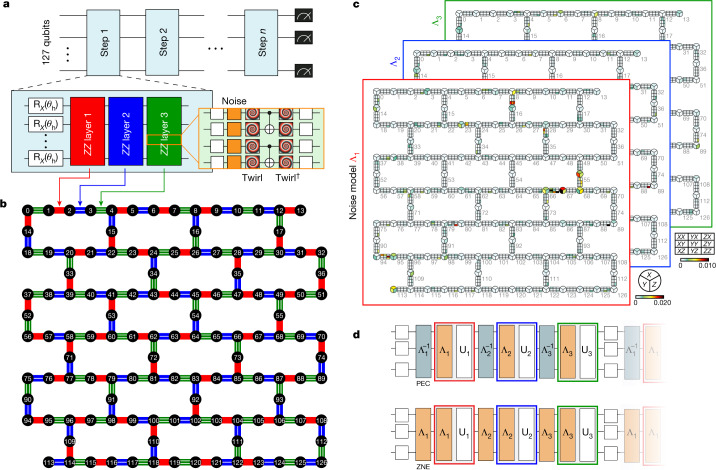
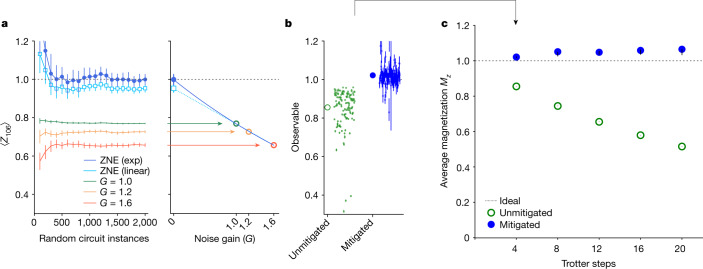
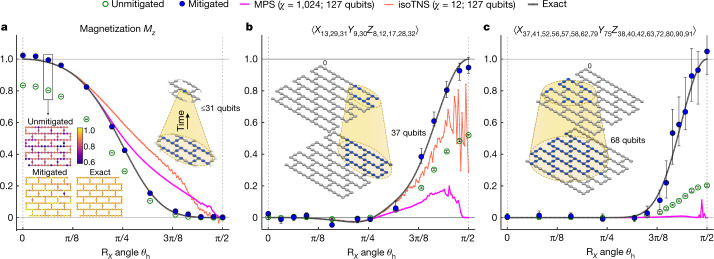
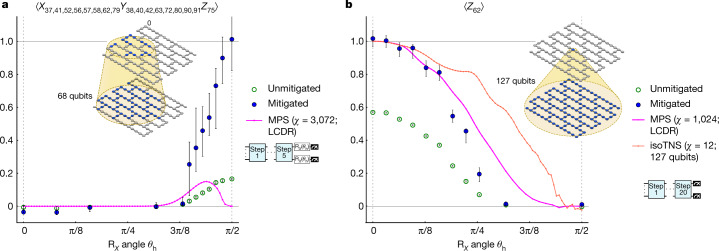
Verification
Claims the paper makes
The claims and statistics of this paper haven’t been checked yet.
Free: it reads the open-access text and checks the first 5 claims that cite a source we can check. Create a free account to check every claim.
Claims other papers make about this one
Each is checked against this paper’s own text: does it say what the citing paper says it does?
The cited source says what the claim attributes to it.
In the citing paper
“However, mobile qubit architectures, such as QCCD and optical tweezers24,25, can distribute resources more efficiently than stationary qubit architectures26–28, because qubits flow through the QPU like bits in a classical processor, with separated memory structures, data buses and logic units, each optimized for their purpose12.”
From A 98-qubit trapped-ion quantum computer with all-to-all connectivity (2026) · cites this paper as [26]
Self-check
Percentages, sums and reported differences re-computed from the paper’s own numbers.
The self-check needs the paper’s full text.
Citations
Cites
Quantum Computing in the NISQ era and beyond
Preskill, J. (2018) · Quantum · doi:10.22331/q-2018-08-06-79 · Cited by 8,830
Quantum supremacy using a programmable superconducting processor
Arute, F., Arya, K., Babbush, R., Bacon, D., Bardin, J. C., Barends, R., Biswas, R., Boixo, S., Brandao, F. G. S. L., Buell, D. A., et al. (2019) · Nature · doi:10.1038/s41586-019-1666-5 · Cited by 7,720
The density-matrix renormalization group in the age of matrix product states
Schollwöck, U. (2011) · Annals of Physics · doi:10.1016/j.aop.2010.09.012 · Cited by 4,818 · cited 2×
“Tensor networks have been widely used to approximate and compress quantum state vectors that arise in the study of the low-energy eigenstates of and time evolution by local Hamiltonians 2,32,33 and, more recently, have been successfully used to simulate low-depth noisy quantum circuits 34–36 .”
MethodCharge-insensitive qubit design derived from the Cooper pair box
Koch, J., Yu, T. M., Gambetta, J., Houck, A. A., Schuster, D. I., Majer, J., Blais, A., Devoret, M. H., Girvin, S. M., & Schoelkopf, R. J. (2007) · Physical Review A · doi:10.1103/physreva.76.042319 · Cited by 3,351 · cited 1×
“For the experimental implementation, we primarily used the IBM Eagle processor ibm_kyiv, composed of 127 fixed-frequency transmon qubits 15 with heavy-hex connectivity and median T 1 and T 2 times of 288 μs and 127 μs, respectively.”
MethodPurification of Noisy Entanglement and Faithful Teleportation via Noisy Channels
Bennett, C. H., Brassard, G., Popescu, S., Schumacher, B., Smolin, J. A., & Wootters, W. K. (1996) · Physical Review Letters · doi:10.1103/physrevlett.76.722 · Cited by 2,961 · cited 1×
“…restricting to jump operators acting on local pairs of qubits yields a sparse noise model that can be efficiently learned for many qubits and that accurately captures the noise associated with layers of two-qubit Clifford gates, including crosstalk, when combined with random Pauli twirls 23,24 .”
BackgroundNoisy intermediate-scale quantum algorithms
Bharti, K., Cervera-Lierta, A., Kyaw, T. H., Haug, T., Alperin-Lea, S., Anand, A., Degroote, M., Heimonen, H., Kottmann, J. S., Menke, T., et al. (2022) · Reviews of Modern Physics · doi:10.1103/revmodphys.94.015004 · Cited by 2,231
Improved simulation of stabilizer circuits
Aaronson, S., & Gottesman, D. (2004) · Physical Review A · doi:10.1103/physreva.70.052328 · Cited by 1,515 · cited 1×
“Clifford circuits serve as useful benchmarks of estimates produced by error mitigation, as they can be efficiently simulated classically 29 .”
BackgroundError Mitigation for Short-Depth Quantum Circuits
Temme, K., Bravyi, S., & Gambetta, J. M. (2017) · Physical Review Letters · doi:10.1103/physrevlett.119.180509 · Cited by 1,379 · cited 2×
“based on pulse stretching 9,17,18 or subcircuit repetition 20–22 have circum-vented the need for precise noise learning, while relying on simplistic assumptions about the device noise.”
BackgroundSelf-citationEvolution of entanglement entropy in one-dimensional systems
Calabrese, P., & Cardy, J. (2005) · Journal of Statistical Mechanics: Theory and Experiment · doi:10.1088/1742-5468/2005/04/p04010 · Cited by 1,295 · cited 1×
“As entanglement (bond dimension) of a generic state grows linearly (exponentially) with time evolution until it saturates the volume law, deep quantum circuits are inherently difficult for tensor networks 37 .”
BackgroundError mitigation extends the computational reach of a noisy quantum processor
Kandala, A., Temme, K., Córcoles, A. D., Mezzacapo, A., Chow, J. M., & Gambetta, J. M. (2019) · Nature · doi:10.1038/s41586-019-1040-7 · Cited by 871 · cited 2×
“based on pulse stretching 9,17,18 or subcircuit repetition 20–22 have circum-vented the need for precise noise learning, while relying on simplistic assumptions about the device noise.”
BackgroundSelf-citation
Research works printed but not linked: 5
- Shor, P. W. in Proc. 35th Annual Symposium on Foundations of Computer Science 124–134 (IEEE, 1994).
- Kitaev, A. Y. Quantum measurements and the Abelian Stabilizer Problem. Preprint at https://arxiv.org/abs/quant-ph/9511026 (1995). · arXiv
- Li Y Benjamin SC Efficient variational quantum simulator incorporating active error minimization Phys. Rev. X 2017 7 021050
- Endo S Benjamin SC Li Y Practical quantum error mitigation for near-future applications Phys. Rev. X 2018 8 031027
- Zhou Y Stoudenmire EM Waintal X What limits the simulation of quantum computers? Phys. Rev. X 2020 10 041038
Cited by
Items 901–1,000 of 1,005
Quantum Computing from GraphsPreprint
Khesin, A. B. (2025) · arXiv (Cornell University) · doi:10.48550/arxiv.2501.17959 · Cited by 6
Rosanowski, E. O., Eisinger, J., Funcke, L., Poschinger, U., & Schmidt‐Kaler, F. (2025) · arXiv (Cornell University) · doi:10.48550/arxiv.2510.26951 · Cited by 6
“…to classical simulation, while ensuring convergence when the initial state has a polynomial overlap with the true ground state, meaning that the initial state’s overlap with the ground state does not shrink exponentially with system size but instead decreases only as an inverse polynomial [24, 25].”
Efficient three-qubit gates with giant atomsPreprint
Chen, G., & Kockum, A. F. (2025) · arXiv (Cornell University) · doi:10.48550/arxiv.2510.04545 · Cited by 6
Agarwal, A., Lindoy, L. P., Lall, D., de Graaf, S. E., Lindström, T., & Rungger, I. (2025) · arXiv (Cornell University) · doi:10.48550/arxiv.2505.23622 · Cited by 6
“In superconducting qubits [6–8] typical coherence times have increased from 1 − 10 µ s in the late 2000’s [6] to > 100 µ s coherence times available in publicly accessible devices today [9], and even greater than 1 ms coherence times in certain qubits [10, 11].”
A Unified Frequency Principle for Quantum and Classical Machine LearningPreprint
Lu, R., Zhang, R., Li, W., Wei, Z., Deng, D.-L., & Liu, Z. (2026) · arXiv (Cornell University) · doi:10.48550/arxiv.2601.03169 · Cited by 6
“Compared with the commonly used noise model of local depolarizing noise with a constant noise rate [54, 55, 68], the noise we consider is weaker but commonly considered [69–71].”
Flux-noise-resilient transmon qubit via a doubly-connected gradiometric designPreprint
Fu, J. B., Wang, D., Ren, B., Yang, Z. H., Hu, S., Huang, G. Y., Cao, S. H., Liu, D. D., Zhang, X. M., Fu, X., et al. (2026) · arXiv (Cornell University) · doi:10.48550/arxiv.2601.02137 · Cited by 6
“Transmon-based quantum processors have achieved quantum computational advantage [6–9], demonstrated error correction below the fault-tolerance threshold [10, 11], and are now advancing toward practical quantum advantage [12, 13].”
Riccardi, M., Moshe, A. G., Menichetti, G., Aiudi, R., Cosenza, C., Abedi, A., Menta, R., Ahmad, H. G., Orfatti, D. N., Cioni, F., et al. (2026) · arXiv (Cornell University) · doi:10.48550/arxiv.2601.11714 · Cited by 6
Classical Simulation Healed by Quantum EntanglementPreprint
Xu, J., Zhao, C., Zhang, X., Zhu, S., & Zhao, Q. (2026) · arXiv (Cornell University) · doi:10.48550/arxiv.2601.15770 · Cited by 6
Kerschbaum, M., Wagner, F., Ognjanović, U., Vio, G., Knapp, K., Zanuz, D. C., Flasby, A., Panah, M. B., Wallraff, A. J., & Besse, J.-C. (2026) · arXiv (Cornell University) · doi:10.48550/arxiv.2602.05806 · Cited by 6
“Improvements in the coherence times of superconducting qubits have enabled increasingly complex experiments, scaling up both the number of qubits used and the number of gates executed [1, 2].”
Beta Tantalum Transmon Qubits with Quality Factors Approaching 10 MillionPreprint
Joshi, A., Jindal, A., Prestegaard, P. H., Bahrami, F., Hedrick, E., Bland, M. P., Gerg, T., Cheng, G., Yao, N., Cava, R. J., et al. (2026) · arXiv (Cornell University) · doi:10.48550/arxiv.2603.13174 · Cited by 6
Quantum Enhanced Pauli PropagationPreprint
Majumder, S., Garrison, J. R., Luo, L., Mitchell, B., Amico, M., Seif, A., Tran, M., Sharma, K. A., van den Berg, E., Minev, Z., et al. (2026) · arXiv (Cornell University) · doi:10.48550/arxiv.2603.14485 · Cited by 6
“With the advent of utility-scale quantum computers [1], quantum error mitigation (QEM) has attracted great attention as a building block towards quantum advantage on near-term systems.”
Energy efficiency of quantum computersPreprint
Carrasco-Codina, M., Escofet, P., Hilaire, P., Soret, A., Nerenberg, S., Champain, V., Milburn, G. J., Theophilo, K., Li, S. H., Bautista, I., et al. (2026) · arXiv (Cornell University) · doi:10.48550/arxiv.2605.15090 · Cited by 6
Efficient classical simulation of large-scale unitary cluster Jastrow circuitsPreprint
Belagali, H., Camp, T. V., Pradeep, R., Das, S. R., Anand, N., & LaRose, R. (2026) · arXiv (Cornell University) · doi:10.48550/arxiv.2607.21337 · Cited by 6
Efficient computation of real-time correlators using Pauli PropagationPreprint
Kemper, A. F., Jha, R. G., Bachhar, A., Toga, G. C., Perez, M. G., & Mayhall, N. J. (2026) · arXiv (Cornell University) · doi:10.48550/arxiv.2607.24924 · Cited by 6
Noise-resilient and resource-efficient hybrid algorithm for robust quantum gap estimation
Lee, W., Myers, N. M., & Scarola, V. W. (2025) · Physical Review A · doi:10.1103/physreva.111.022421 · Cited by 5
“Currently available quantum computers are noisy and limited in both qubit counts (circuit width) and gate operations (circuit depth) which pose significant challenges for conclusive demonstrations of quantum advantage in quantum simulation [31–35].”
Thermalization of a flexible microwave stripline measured by a superconducting qubit
Paluch, P., Spiecker, M., Gosling, N., Adam, V., Kammhuber, J., Vermeulen, K., Bouman, D., Wernsdorfer, W., & Pop, I. M. (2025) · Applied Physics Letters · doi:10.1063/5.0243116 · Cited by 5
A scalable routing method for superconducting quantum processor
Yang, T., Liang, C., Wang, W., Zhao, B., Wang, L., Xiong, Q., Feng, X., & Shan, Z. (2025) · EPJ Quantum Technology · doi:10.1140/epjqt/s40507-025-00320-x · Cited by 5
Exploring entanglement in finite-size quantum systems with degenerate ground state
Okatev, V. S., Sotnikov, O. M., & Mazurenko, V. V. (2025) · Physical review. B./Physical review. B · doi:10.1103/physrevb.111.054443 · Cited by 5
A Quantum Computational Method for Corrosion Inhibition
Jain, N., & Felice, R. D. (2025) · Journal of Chemical Theory and Computation · doi:10.1021/acs.jctc.5c00469 · Cited by 5
Exploring new variational quantum circuit ansatzes for solving SU(2) matrix models
Dao, H. L. (2025) · The European Physical Journal C · doi:10.1140/epjc/s10052-025-14322-7 · Cited by 5
Correcting and Extending Trotterized Quantum Many-Body Dynamics
Gentinetta, G., Metz, F., & Carleo, G. (2025) · PRX Quantum · doi:10.1103/1nqt-x5xh · Cited by 5
“Solving the time-dependent Schr¨odinger equation for quantum many-body systems is an important piece in the puzzle of understanding nature at a microscopic scale [1– 6].”
Lumped-element broadband SNAIL parametric amplifier with on-chip pump filter for multiplexed readout
Joshi, V., Hazra, S., Ding, A. Z., Miano, A., Dai, W., Umasankar, G., Koottandavida, A., Liu, G., Frunzio, L., & Devoret, M. (2025) · Physical Review Applied · doi:10.1103/5l86-pw21 · Cited by 5
Bayesian mitigation of measurement errors in multiqubit experiments
Cosco, F., Plastina, F., & Gullo, N. L. (2025) · Physical Review A · doi:10.1103/d65d-x8lt · Cited by 5
“Some specialised techniques aim to target specific sources of errors, such as measurement error mitigation strategies.”
Spin systems as quantum field theories in inflationary universe: A study with Unruh-DeWitt detectors
Kinoshita, S., Murata, K., Yamamoto, D., & Yoshii, R. (2025) · Physical Review Research · doi:10.1103/s3qb-n94w · Cited by 5
Mitarai, H., Tadokoro, Y., & Tanaka, H. (2026) · Physical Review Applied · doi:10.1103/fmqf-w6ht · Cited by 5
Q-Cluster: Quantum Error Mitigation Through Noise-Aware Unsupervised Learning
Patil, H. P., Baron, D., & Zhou, H. (2025) · IEEE International Conference on Quantum Computing and Engineering (QCE) · doi:10.1109/qce65121.2025.00097 · Cited by 5
Efficient Characterization of Coherent and Correlated Low-Degree Noise in Layers of Gates
Crupi, M., Cirac, J. I., & Baccari, F. (2025) · PRX Quantum · doi:10.1103/8ng1-4c1k · Cited by 5
“Understanding the main sources of imperfections in quantum operations is essential for designing effective error mitigation and correction techniques [1–4], as well as for assessing the capabilities of quantum hardware [5, 6].”
Addressing ecological challenges from a quantum computing perspective
Clenet, M., Dion, M., & Blanchet, F. G. (2026) · Methods in Ecology and Evolution · doi:10.1111/2041-210x.70236 · Cited by 5
“To address these limitations, the concept of quantum utility has been proposed, which marks the point where an algorithm or experiment demonstrates a practical quantum advantage for near-term applications (Kim et al., 2023).”
Doyle, L., Seifollahi, F., & Singh, C. (2026) · European Journal of Physics · doi:10.1088/1361-6404/ae3ae6 · Cited by 5
“I’m always personally amused when they have a picture of the wrong kind of quantum computer, like when it’s an article about an ion trap [14] and they have a picture of an IBM fridge [105, 106], or when...[it is] an IBM fridge they’re talking about, they have a picture of an ion trap.”
Diabatic quantum annealing for training energy-based generative models
Kim, G., Gyhm, J.-Y., & Park, D. K. (2026) · Physical review. E · doi:10.1103/2g6m-whm2 · Cited by 5
“Moreover, the extensive toolbox of error mitigation techniques developed for gate-based devices [34– 38] can be directly applied in this framework.”
Parameter Analysis and Optimization of Layer Fidelity for Quantum Processor Benchmarking at Scale
Palacio, M. J. L., Nayfeh, H. M., Ware, M., & McKay, D. C. (2026) · IEEE Transactions on Quantum Engineering · doi:10.1109/tqe.2026.3668098 · Cited by 5
“TLS defects are known to significantly impact qubit coherence [3], [10], [22] and gate errors [18], [19], and this effect is directly captured by the layer fidelity benchmark.”
Self-citationBadami, S. (2026) · IEEE Access · doi:10.1109/access.2026.3679234 · Cited by 5
“Contemporary processors provide tens to hundreds of qubits with high gate fidelities [26], [27].”
Zeno-enhanced probabilistic error cancellation with quantum error detection codes
Yuan, Y., Zhao, Y., & Liu, D. E. (2026) · Quantum Science and Technology · doi:10.1088/2058-9565/aeb3ad · Cited by 5
“…is already visible: utility-scale NISQ experiments have produced expectation-value estimates whose evaluation is beyond exact classical simulation [3], while early logical processors built from superconducting [4, 5], trapped-ion [6], and reconfigurable neutral-atom [7, 8] platforms have…”
Noise-Resilient Heisenberg-Limited Quantum Sensing via Indefinite-Causal-Order Error Correction
Xu, H., Deng, X., Zheng, Z., Xiao, T., & Zeng, G. (2026) · Physical Review Letters · doi:10.1103/9mjc-nhxx · Cited by 5
Quantum approximate optimization algorithm with fixed number of parameters
Saavedra-Pino, S., Quispe, R. B., Barrios, G. A., Solano, E., Retamal, J. C., & Albarrán-Arriagada, F. (2026) · EPJ Quantum Technology · doi:10.1140/epjqt/s40507-026-00548-1 · Cited by 5
Post-Quantum Security Measures for the Internet of Things
Şafak, I., Alagöz, F., & Anarım, E. (2024) · Advances in information quality and management · doi:10.4018/978-1-6684-7366-5.ch075 · Cited by 5
Feynman’s “Simulating Physics with Computers”
Alsing, P. M., Cafaro, C., & Mancini, S. (2024) · International Journal of Theoretical Physics · doi:10.1007/s10773-024-05653-4 · Cited by 5
“For instance, a recent experiment on IBM’s superconducting quantum processor with 127 qubits claiming a quantum advantage [38] was outperformed by tensor network methods shortly after [39] in terms of accuracy and precision in simulating a kicked Ising quantum system.”
Heat-based circuits using quantum rectification
Poulsen, K., & Zinner, N. T. (2024) · Physical Review A · doi:10.1103/physreva.109.052223 · Cited by 5
“We keep the rate of decay and dephasing the same similar to platforms such as superconducting circuits [37].”
MethodPurity‐Assisted Zero‐Noise Extrapolation for Quantum Error Mitigation
Jin, T., Shi, Y., Wang, Z., Li, T., Xu, K., & Fan, H. (2024) · Advanced Quantum Technologies · doi:10.1002/qute.202400150 · Cited by 5
Automatic architecture design for distributed quantum computing
Luo, T.-Y., Zheng, Y.-Z., Fu, X., & Deng, Y. (2024) · Chinese Physics B · doi:10.1088/1674-1056/ad7c2c · Cited by 5
Environment-mediated long-ranged correlations in many-body system
Xu, M., Stockburger, J. T., & Ankerhold, J. (2024) · The Journal of Chemical Physics · doi:10.1063/5.0225375 · Cited by 5
“Experimental implementations of the transverse field Ising model, including artificial spin ice (ASI) array 69 , trapped atomic ions 70 and therein, neutral atoms 71 , and superconducting circuits 72 , etc., act as platforms for quantum simulation, albeit under the assumption of an isolated system.”
Principal Trotter observation error with truncated commutators
Li, L. (2024) · Physical Review A · doi:10.1103/physreva.110.062614 · Cited by 5
State-Dependent Mobility Edge in Kinetically Constrained Models
Badbaria, M., Pancotti, N., Singh, R., Marino, J., & Valencia-Tortora, R. J. (2024) · PRX Quantum · doi:10.1103/prxquantum.5.040348 · Cited by 5
“In the era of noisy intermediate scale quantum (NISQ) devices [1], a natural task that could display quantum advantage over classical computers is the simulation of quantum many-body dynamics itself [2–5].”
Daka, C., & Bhattacharyya, S. (2025) · Physica Scripta · doi:10.1088/1402-4896/ada58d · Cited by 5
Uotila, V. (2024) · IEEE International Conference on Quantum Computing and Engineering (QCE) · doi:10.1109/qce60285.2024.00053 · Cited by 5
“Demonstrating the usefulness and superiority of quantum computing compared to the best-known classical algorithms is notoriously challenging [4].”
Comparing Algorithms for Loading Classical Datasets into Quantum Memory
Miranskyy, A. V., Khan, M., & Mendes, U. C. (2024) · IEEE International Conference on Quantum Computing and Engineering (QCE) · doi:10.1109/qce60285.2024.10284 · Cited by 5
“Quantum computers are rapidly evolving, demonstrating utility even before reaching the stage of fault-tolerant devices [1], [2].”
BackgroundAnalog simulation of noisy quantum circuits
Granet, E., Hémery, K., & Dreyer, H. (2025) · Physical Review Research · doi:10.1103/physrevresearch.7.013213 · Cited by 5
Impact of Surface Roughness on Consistent Resonator Performance
Karuppannan, S. K., Kommanaboina, N. M., Utama, A. N., & Mukherjee, M. (2025) · Advanced Materials Interfaces · doi:10.1002/admi.202500020 · Cited by 5
Multiclass portfolio optimization via variational quantum Eigensolver with Dicke state ansatz
Scursulim, J. V. S., Langeloh, G. M., Beltran, V. L., & Brito, S. (2026) · Scientific Reports · doi:10.1038/s41598-026-36333-4 · Cited by 6
Quantum-enhanced neural exchange-correlation functionals
Sokolov, I. O., Both, G., Bochevarov, A. D., Dub, P. A., Levine, D. S., Brown, C. T., Acheche, S., Barkoutsos, P. K., & Elfving, V. E. (2025) · Physical Review A · doi:10.1103/m51l-fys2 · Cited by 5
Entropy density benchmarking of near-term quantum circuits
Anonymous, Mills, J. K., Hammam, K., & García−Patrón, R. (2026) · Physical Review A · doi:10.1103/swvt-3pkh · Cited by 5
“Whether quantum advantage can be achieved in the near term on practical tasks remains a question of scientific debate, as seen after the recent simulation of the behavior of a magnetic material on a 127-qubit quantum processor [15] and its subsequent rebuttals (see, e.g., Refs.”
Accurate harmonic vibrational frequencies for diatomic molecules via quantum computing
Chou, S.-K., Chou, J., Hu, A., Cheng, Y., & Goan, H. (2023) · Physical Review Research · doi:10.1103/physrevresearch.5.043216 · Cited by 5
“Thus, VQE quantum computations of these molecules using our proposed approach are promisingly realizable on the NISQ devices given the recent advance on quantum utility demonstration [49] and the projected achievement of the so-called 100 × 100 Challenge in 2024 [50].”
MethodDigital quantum simulation of gravitational optomechanics with IBM quantum computers
Rufo, P. G. C., Mazumdar, A., Bose, S., & Sabín, C. (2024) · EPJ Quantum Technology · doi:10.1140/epjqt/s40507-024-00242-0 · Cited by 5
“In this context, a quantum simulation in a quantum computer [5, 6] could be helpful by informing the ongoing experimental efforts, leveraging the experimental amenability and tunability of modern quantum platforms [7–9].”
MethodNon-parametric Greedy Optimization of Parametric Quantum Circuits
Phalak, K., & Ghosh, S. (2024) · International Symposium on Quality Electronic Design (ISQED) · doi:10.1109/isqed60706.2024.10528696 · Cited by 5
Characterization of overparametrization in the simulation of realistic quantum systems
Duschenes, M., Carrasquilla, J., & Laflamme, R. (2024) · Physical Review A · doi:10.1103/physreva.109.062607 · Cited by 6
“Techniques used other implementations [3] that also generally have origins in NMR techniques and their proof of principle quantum algorithm experiments [18, 38], including zero-noise extrapolation [44], dynamical decoupling [47], and refocusing procedures [38].”
BackgroundMethodInfluentialBeyond full statevector simulation with Qibo
Pasquale, A., Papaluca, A., Farias, R. M. S., Robbiati, M., Pedicillo, E., & Carrazza, S. (2024) · Archivio Istituzionale della Ricerca (Universita Degli Studi Di Milano) · doi:10.48550/arxiv.2408.00384 · Cited by 5
“With the significant achievements reached by quantum technologies [1–3], the interest towards quantum computing is consistently growing.”
BackgroundqIDS: Sistema de Detecção de Ataques baseado em Aprendizado de Máquina Quântico Híbrido
Abreu, D. M. D., Rothenberg, C. R. E., & Abelém, A. (2024) · doi:10.5753/sbrc.2024.1353 · Cited by 5
Diamond-shaped quantum circuit for real-time quantum dynamics in one dimension
Miyakoshi, S., Sugimoto, T., Shirakawa, T., Yunoki, S., & Ueda, H. (2024) · Physical Review Research · doi:10.1103/physrevresearch.6.043318 · Cited by 5
“Such a quantum dynamics process poses a canonical problem in attaining quantum acceleration [23, 24].”
Gover, L., Wimalaweera, V., Azad, F., DeCross, M. P., Foss‐Feig, M., & Green, A. G. (2026) · Quantum · doi:10.22331/q-2026-05-20-2109 · Cited by 5
“The competition between quantum algorithms and classical tensor network simulations has been a potent driver of this scientific advance [41, 42, 43, 44, 45, 46, 47].”
Szasz, A., Younis, E., & de Jong, W. A. (2025) · Quantum · doi:10.22331/q-2025-04-09-1704 · Cited by 5
“Standard methods include zero noise extrapolation [88–93], especially via Richardson extrapolation [94], dynamical decoupling [95, 96], and probabilistic error cancellation [89, 93].”
Quantum state compression shadow
Huang, H.-L., & Ding, C. (2025) · The European Physical Journal Special Topics · doi:10.1140/epjs/s11734-025-01715-8 · Cited by 5
“A notable example is the successful simulation of a 127-qubit transverse-field Ising model achieved through error mitigation techniques [21].”
Concurrent fermionic simulation gate
Jiang, Z., & Ansari, M. H. (2025) · Physical Review Applied · doi:10.1103/m5z3-jgk8 · Cited by 5
“This approach enhances gate versatility, opening pathways for more efficient quantum computing.”
Annealing Quantum Computing: An OverviewPreprint
da Silva, R. P. (2023) · SSRN Electronic Journal · doi:10.2139/ssrn.4501788 · Cited by 5
“” In the context of quantum computing, those counter-intuitive phenomena are now being leveraged on quantum computers (Kim et al., 2023).”
BackgroundComparative study of decoding the surface code using simulated annealing under depolarizing noisePreprint
Takeuchi, Y., Takada, Y., Sakashita, T., Fujisaki, J., Oshima, H., Sato, S., & Fujii, K. (2023) · arXiv (Cornell University) · doi:10.48550/arxiv.2311.07973 · Cited by 5
“Quantum computers on the scale of 100 qubits are becoming a reality [2, 3], and demonstration experiments of error correction [4], the most crucial building block of fault-tolerant quantum computers are underway.”
BackgroundExponential acceleration of macroscopic quantum tunneling in a Floquet Ising modelPreprint
Grattan, G., Barton, B., Feeney, S., Mossi, G., Patnaik, P., Sagal, J., Carr, L. D., Oganesyan, V., & Kapit, E. (2023) · arXiv (Cornell University) · doi:10.48550/arxiv.2311.17814 · Cited by 5
Exploiting Maximally Mixed States for Spectral Estimation by Time EvolutionPreprint
Ferris, K., Wang, Z., Hen, I., Kalev, A., Bronn, N. T., & Vlček, V. (2023) · arXiv (Cornell University) · doi:10.48550/arxiv.2312.00687 · Cited by 5
Li, Y., Wang, T., Hu, J., Li, D., & An, S. (2023) · arXiv (Cornell University) · doi:10.48550/arxiv.2312.06405 · Cited by 5
Speed limits of two-qubit gates with quditsPreprint
Basyildiz, B., Jameson, C., & Gong, Z. (2023) · arXiv (Cornell University) · doi:10.48550/arxiv.2312.09218 · Cited by 5
Treespilation: Architecture- and State-Optimised Fermion-to-Qubit MappingsPreprint
Miller, A., Glos, A., & Zimborás, Z. (2024) · Research Square · doi:10.21203/rs.3.rs-4343077/v1 · Cited by 5
$N$-Party Hadamard Test for Distributed Quantum ComputationPreprint
Yamamoto, K., Matsuzaki, Y., Suzuki, Y., Tokunaga, Y., & Endo, S. (2024) · arXiv (Cornell University) · doi:10.48550/arxiv.2411.10024 · Cited by 5
Quantum decision trees with information entropyPreprint
Li, Z., & Terashi, K. (2025) · arXiv (Cornell University) · doi:10.48550/arxiv.2502.11412 · Cited by 5
Simulating quantum circuits with restricted quantum computersPreprint
Piveteau, C. (2025) · arXiv (Cornell University) · doi:10.3929/ethz-b-000727956 · Cited by 5
Finite-dimensional Lie algebras in bosonic quantum dynamics: The single-mode casePreprint
Heib, T., Goia, A. S., Baghiyan, S., Zeier, R., & Bruschi, D. E. (2025) · JuSER (Forschungszentrum Jülich) · doi:10.48550/arxiv.2511.06940 · Cited by 5
Hamiltonian Dynamics Learning: A Scalable Approach to Quantum Process CharacterizationPreprint
Wu, Y., Zhang, Y., Wang, C., & Yuan, X. (2025) · arXiv (Cornell University) · doi:10.48550/arxiv.2503.24171 · Cited by 5
“As quantum hardware continues to scale in size and complexity, the ability to characterize quantum processes becomes critical for advancing quantum error correction code [6–8], quantum error mitigation [9, 10], and quantum algorithms [2, 11–14].”
Self-citationNoise-Robust Estimation of Quantum Observables in Noisy HardwarePreprint
Hosseinkhani, A., Šimkovic, F., Calzona, A., Godínez, C. E., Pina-Canelles, V., Liu, T., Guimarães, J. D., Auer, A., & de Vega, I. (2025) · arXiv (Cornell University) · doi:10.48550/arxiv.2503.06695 · Cited by 5
“A prominent example is zero-noise extrapolation (ZNE) [7, 14, 15], which estimates noiseless expectation values by amplifying noise and extrapolating to the zero-noise limit.”
InfluentialGalatsanos-Dueck, J. (2024) · DSpace@MIT (Massachusetts Institute of Technology) · Cited by 5
Trade-offs between Quantum and Classical Resources in the Linear Combination of UnitariesPreprint
Wada, K., Harada, H., Suzuki, Y., Tokunaga, Y., Yamamoto, N., & Endo, S. (2025) · arXiv (Cornell University) · doi:10.48550/arxiv.2512.06260 · Cited by 5
“Due to the emergence of large-scale quantum computers and early error-corrected quantum devices [23, 24], many quantum algorithms tailored for the early fault-tolerant era [25–27] have also been proposed to address various problems of interest in addition to real-time simulation [20, 22, 28–34].”
Probing many-body localization crossover in quasiperiodic Floquet circuits on a quantum processorPreprint
Nagao, K., Shirakawa, T., Sun, R., Prelovšek, P., & Yunoki, S. (2026) · arXiv (Cornell University) · doi:10.48550/arxiv.2603.12675 · Cited by 5
“Recent advances in quantum processors have opened utility-scale applications to computationally challenging many-body problems [41–44], including MBL [45–48].”
Hardware-Tailored Resource Estimation for Magic-State Distillation on Silicon Spin QubitsPreprint
Yang, S., Long, C. K., Otxoa, R. M., Murali, P., Barnes, C. H. W., & Arvidsson-Shukur, D. R. M. (2026) · arXiv (Cornell University) · doi:10.48550/arxiv.2605.28936 · Cited by 5
“This task is one of the smallest scientifically meaningful problems believed to be intractable for classical computers [199].”
Li, X. (2026) · arXiv (Cornell University) · doi:10.48550/arxiv.2606.01270 · Cited by 5
“Recent milestones include noisy intermediate-scale demonstrations of quantum utility on large superconducting processors, below-threshold logical memory experiments, and manufacturable photonic quantum-computing modules [27, 1, 35].”
Setting angles in quantum approximate optimization at utility-scalePreprint
Guo, M., Diaz, J. J., Ramesh, A., Haupt, C. J., Baiardi, A., Athanasakos, D., Şahin, M. E., Wallis, O., Pennington, G., Arenz, C., et al. (2026) · arXiv (Cornell University) · doi:10.48550/arxiv.2606.05311 · Cited by 6
“The expectation value ⟨ H C ⟩ can be error mitigated with methods such as probabilistic error cancellation [92] or amplification [93] or even machine learning [94].”
Quantum Optimization Benchmarking Library - The Intractable Decathlon
Koch, T., Neira, D. E. B., Chen, Y., Cortiana, G., Egger, D. J., Heese, R., Hegade, N. N., Cadavid, A. G., Huang, R., Itoko, T., et al. (2025) · arXiv · doi:10.48550/arxiv.2504.03832 · Cited by 5
“With recent advances in quantum hardware 4 , systematic benchmarking of quantum optimization algorithms and comparison with classical solvers have become feasible.”
Simulation of IBM's kicked Ising experiment with Projected Entangled Pair Operator
Liao, H.-J., Wang, K., Zhou, Z.-S., Zhang, P., & Xiang, T. (2023) · arXiv · doi:10.48550/arxiv.2308.03082 · Cited by 4
“4a in Ref [1]) as a benchmark.”
BackgroundMethodResultInfluentialSWAP-less Implementation of Quantum Algorithms
Klaver, B., Rombouts, S., Fellner, M., Messinger, A., Ender, K., Ludwig, K., & Lechner, W. (2024) · arXiv · doi:10.48550/arxiv.2408.10907 · Cited by 4
Superconducting Titanium Nitride in Through-Silicon Vias for 3D Integration of Qubits
Schewski, A., Schaber, U., & Klumpp, A. (2024) · IEEE International D Systems Integration Conference · doi:10.1109/3dic63395.2024.10830265 · Cited by 4
“Superconducting qubits are at the forefront of this technological revolution, evolving from prototype systems to architectures comprising hundreds of qubits [1]-[3].”
Many-body computing on Field Programmable Gate Arrays
Lv, S., Liang, Y., Meng, Y., Yao, X., Xu, J., Liu, Y., Zheng, Q., & Zou, H. (2025) · Communications Physics · doi:10.1038/s42005-025-02050-z · Cited by 4
“While the ultimate solution to the exponential wall problem in many-body systems will eventually rely on quantum computers [19], the full utilization of classical algorithms and hardware remains meaningful at present.”
SparQSim: An Efficient Quantum Algorithm Simulator Leveraging State Sparsity
Sun, T., Wang, Y., Chen, Z., Xue, C., Liu, H., Zhuang, X., Xu, X., Wu, Y.-C., & Guo, G. (2026) · Chinese Physics B · doi:10.1088/1674-1056/ae43ce · Cited by 4
Self-citationAQUA: Hardware-Agnostic Qubit Allocation for Quantum Multi-Programming
Piao, X., Shim, J., Kim, J., & Kim, J. (2025) · IEEE International Parallel and Distributed Processing Symposium (IPDPS) · doi:10.1109/ipdps64566.2025.00022 · Cited by 4
“In particular, IBM has announced that it will provide quantum computers consisting of thousands of qubits [12].”
Li, Z., Guo, X., Wu, H., Yu, J., Chen, H., Gao, Y., Huang, X., & Pan, Y. (2025) · Neurocomputing · doi:10.1016/j.neucom.2025.131380 · Cited by 4
Optimizing Parameters of Quantum Circuits with Sparsity-Inducing Coordinate Descent
Raymond, R., & He, Z. (2025) · International Joint Conference on Artificial Intelligence · doi:10.24963/ijcai.2025/680 · Cited by 4
“Nevertheless, near-term quantum devices are already promising to deliver quantum advantage for non-trivial tasks in sampling [Arute et al. , 2019] and quantum simulation [Kim et al. , 2023] via their capabilities to execute quantum circuits with parameterized quantum gates.”
Kwon, O., Kwon, S., Jung, T. H., & Alimamy, S. (2025) · International Journal of Information Management · doi:10.1016/j.ijinfomgt.2025.102978 · Cited by 4
Guo, Y., Schneider, M., Angelides, T., Jansen, K., Lin, C.-J. D., & Su, Y. T. (2025) · Desy publication database (The Deutsches Elektronen-Synchrotron) · doi:10.3204/pubdb-2025-04269 · Cited by 4
Benchmarking Quantum Solvers in Noisy Digital Simulations for Financial Portfolio Optimization
Shen, R., Hao, Z., & Lee, C. H. (2026) · Entropy · doi:10.3390/e28080916 · Cited by 4
YOUTIAO: Hybrid Multiplexing with Dynamic Qubit Grouping for Low-cost and Scalable Quantum Wiring
Tian, W., Lu, L., Tan, S., Li, S., Li, H., Chu, T., Zhang, X., Chen, M., & Yin, J. (2025) · IEEE/ACM International Symposium on Microarchitecture (MICRO) · doi:10.1145/3725843.3756061 · Cited by 4
Schüßler, P., Chandavar, R. A., Borjeni, S. I. A., Kinast, A., Reinold, A., Geleilate, F. G., Weisser, M., van Gulik, R. J. J., Dominicus, S., Kammhuber, J., et al. (2026) · Review of Scientific Instruments · doi:10.1063/5.0302131 · Cited by 4
Controlled- Z gates with giant atoms in structured waveguides
Rieck, W., Soro, A., Kockum, A. F., & Chen, G. (2026) · Physical Review A · doi:10.1103/yfm3-qmqq · Cited by 2
Inoue, S., Li, R., Kubo, K., Ho, Y., Nakamura, Y., & Goto, H. (2026) · PRX Quantum · doi:10.48550/arxiv.2604.27679 · Cited by 4
TuniQ: Autotuning Compilation Passes for Quantum Workloads at Scale for Effectiveness and Efficiency
Hasanat, M. A., Ludmir, J., Patel, T., & Roy, R. B. (2026) · International Conference on Supercomputing · doi:10.1145/3797905.3807862 · Cited by 4
“At the same time, current quantum hardware is noisy [35].”
Counterdiabatic ADAPT-VQE for Molecular Simulation
Tancara, D., Díaz-Moraga, H., & Goyeneche, D. (2026) · Journal of Chemical Theory and Computation · doi:10.1021/acs.jctc.6c00197 · Cited by 4
Metadata
- Authors
- Kim, Y., Eddins, A., Anand, S., Wei, K. X., van den Berg, E., Rosenblatt, S., Nayfeh, H., Wu, Y., Zaletel, M., Temme, K., & Kandala, A.
- Affiliations
- IBM Research - Cambridge (United States) (US)
- University of California, Berkeley (US)
- IBM (United States) (US)
- RIKEN (JP)
- Lawrence Berkeley National Laboratory (US)
- Corresponding author
- Eddins, Andrew
- Kandala, Abhinav
- ORCID
- Venue
- Nature
- Published
- 2023-06-14
- Volume
- 618
- Issue
- 7965
- Pages
- 500-505
- ISSN
- 0028-0836 (ISSN-L)
- 1476-4687
- PMC
- PMC10266970
- OpenAlex
- W4380627387
- Semantic Scholar
- f9253a3e2627f1c2a0a7e2cea320a4ec4e4d2ff9
- Cited by
- 1,050
- References
- 41
- Citations by year
- 2026: 226 · 2025: 399 · 2024: 358 · 2023: 67
- FWCI
- 98.85
- Type
- journal article
- Language
- en
- Open access
- hybrid
- doi.org
- Licence
- cc-by
- creativecommons.org/licenses/by/4.0 (tdm)
- creativecommons.org/licenses/by/4.0 (vor)
- Locations
- Nature (publishedVersion, cc-by)
- PubMed Central (publishedVersion, cc-by)
- PubMed (publishedVersion)
- eScholarship (California Digital Library) (submittedVersion, cc-by)
- OSTI OAI (U.S. Department of Energy Office of Scientific and Technical Information) (submittedVersion)
- RePEc: Research Papers in Economics (submittedVersion)
- Funders
- National Science Foundation (DEAC02-05CH11231, 2137603, 2138259, 2138296, 2138307, 2138286)
- U.S. Department of Energy (-AC02-05CH11231, 05CH11231, DE AC02 05CH11231, DESC0022716, DE-AC02-)
- National Energy Research Scientific Computing Center (DE–AC02–05CH11231, 05CH11231, AC02-05CH11231)
- Office of Science (DEAC02–05CH11231, AC02-05CH11231, DE-AC02)
- Office of Advanced Cyberinfrastructure (#2138286, #2138296, 2138259, #2138307, 2137603)
- Basic Energy Sciences (DE-AC02, DE-AC02-05CH11231., AC02–05CH11231)
- Lawrence Berkeley National Laboratory (AC02‐05CH11231, DE-AC02-05CH11231, 05CH11231)
- Topics
- Physical Sciences › Computer Science › Artificial Intelligence › Quantum Computing Algorithms and Architecture
- Physical Sciences › Physics and Astronomy › Atomic and Molecular Physics, and Optics › Quantum Information and Cryptography
- Physical Sciences › Physics and Astronomy › Atomic and Molecular Physics, and Optics › Quantum many-body systems
- Keywords
- quantum computing, NISQ devices, superconducting qubits, noise characterization, tensor network states, matrix product states, entanglement, quantum advantage
About these checks
Registry, retraction, Cites and statistics results are computed, not judged, with one exception: a printed reference that no index lists is read once by a model before it counts as a citation error. Claims are extracted by a model and kept only when their quote appears verbatim in the text; each cited source is then checked, with a model’s help, for whether it says what the claim relies on. Those verdicts can be wrong — read the claim’s quote and the cited source before relying on one.
Statistics and arithmetic are recomputed, not judged.
Confidence bands are shown only for fields calibrated on our annotated test set. None is calibrated yet, so no band is shown.
What counts as a claim ›How we measure confidence ›How we check this ›
Are you an author, or do you see a problem with this page? Request a review
Data sources
Bibliographic data: Semantic Scholar, OpenAlex, Crossref.
Contains information from the Semantic Scholar Academic Graph Datasets, made available under the ODC Attribution License (ODC-BY 1.0).
Semantic Scholar’s data is described in: Kinney, R., et al. (2023). The Semantic Scholar Open Data Platform. arXiv:2301.10140.
