

Evidence for the utility of quantum computing before fault tolerance
Open accessThe DOI matches its Crossref record; 43 of the 43 references it cites were found in a registry or an index.
Abstract
Quantum computing promises to offer substantial speed-ups over its classical counterpart for certain problems. However, the greatest impediment to realizing its full potential is noise that is inherent to these systems. The widely accepted solution to this challenge is the implementation of fault-tolerant quantum circuits, which is out of reach for current processors. Here we report experiments on a noisy 127-qubit processor and demonstrate the measurement of accurate expectation values for circuit volumes at a scale beyond brute-force classical computation. We argue that this represents evidence for the utility of quantum computing in a pre-fault-tolerant era. These experimental results are enabled by advances in the coherence and calibration of a superconducting processor at this scale and the ability to characterize 1 and controllably manipulate noise across such a large device. We establish the accuracy of the measured expectation values by comparing them with the output of exactly verifiable circuits. In the regime of strong entanglement, the quantum computer provides correct results for which leading classical approximations such as pure-state-based 1D (matrix product states, MPS) and 2D (isometric tensor network states, isoTNS) tensor network methods 2,3 break down. These experiments demonstrate a foundational tool for the realization of near-term quantum applications 4,5 .
Overview
The claims and statistics of this paper haven’t been checked yet.
Free: it reads the open-access text and checks the first 5 claims that cite a source we can check. Create a free account to check every claim.
Integrity signals
Registry
Cites
Statistics
Figures
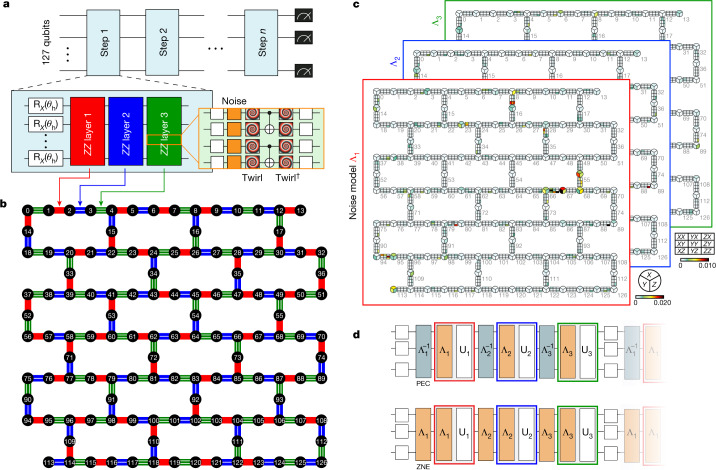
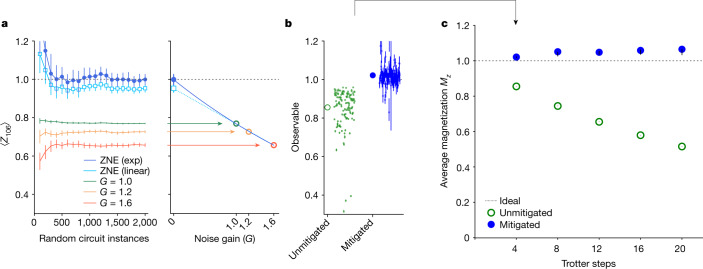
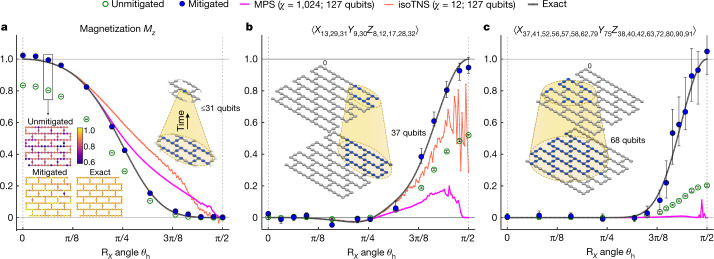
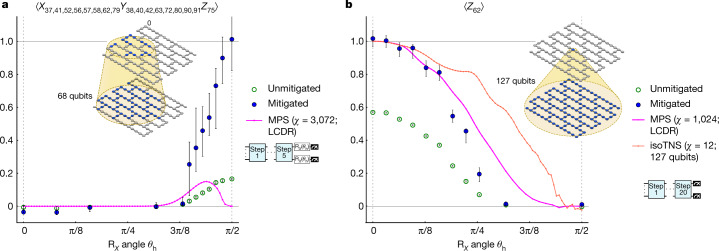
Verification
Claims the paper makes
The claims and statistics of this paper haven’t been checked yet.
Free: it reads the open-access text and checks the first 5 claims that cite a source we can check. Create a free account to check every claim.
Claims other papers make about this one
Each is checked against this paper’s own text: does it say what the citing paper says it does?
The cited source says what the claim attributes to it.
In the citing paper
“However, mobile qubit architectures, such as QCCD and optical tweezers24,25, can distribute resources more efficiently than stationary qubit architectures26–28, because qubits flow through the QPU like bits in a classical processor, with separated memory structures, data buses and logic units, each optimized for their purpose12.”
From A 98-qubit trapped-ion quantum computer with all-to-all connectivity (2026) · cites this paper as [26]
Self-check
Percentages, sums and reported differences re-computed from the paper’s own numbers.
The self-check needs the paper’s full text.
Citations
Cites
Quantum Computing in the NISQ era and beyond
Preskill, J. (2018) · Quantum · doi:10.22331/q-2018-08-06-79 · Cited by 8,830
Quantum supremacy using a programmable superconducting processor
Arute, F., Arya, K., Babbush, R., Bacon, D., Bardin, J. C., Barends, R., Biswas, R., Boixo, S., Brandao, F. G. S. L., Buell, D. A., et al. (2019) · Nature · doi:10.1038/s41586-019-1666-5 · Cited by 7,720
The density-matrix renormalization group in the age of matrix product states
Schollwöck, U. (2011) · Annals of Physics · doi:10.1016/j.aop.2010.09.012 · Cited by 4,818 · cited 2×
“Tensor networks have been widely used to approximate and compress quantum state vectors that arise in the study of the low-energy eigenstates of and time evolution by local Hamiltonians 2,32,33 and, more recently, have been successfully used to simulate low-depth noisy quantum circuits 34–36 .”
MethodCharge-insensitive qubit design derived from the Cooper pair box
Koch, J., Yu, T. M., Gambetta, J., Houck, A. A., Schuster, D. I., Majer, J., Blais, A., Devoret, M. H., Girvin, S. M., & Schoelkopf, R. J. (2007) · Physical Review A · doi:10.1103/physreva.76.042319 · Cited by 3,351 · cited 1×
“For the experimental implementation, we primarily used the IBM Eagle processor ibm_kyiv, composed of 127 fixed-frequency transmon qubits 15 with heavy-hex connectivity and median T 1 and T 2 times of 288 μs and 127 μs, respectively.”
MethodPurification of Noisy Entanglement and Faithful Teleportation via Noisy Channels
Bennett, C. H., Brassard, G., Popescu, S., Schumacher, B., Smolin, J. A., & Wootters, W. K. (1996) · Physical Review Letters · doi:10.1103/physrevlett.76.722 · Cited by 2,961 · cited 1×
“…restricting to jump operators acting on local pairs of qubits yields a sparse noise model that can be efficiently learned for many qubits and that accurately captures the noise associated with layers of two-qubit Clifford gates, including crosstalk, when combined with random Pauli twirls 23,24 .”
BackgroundNoisy intermediate-scale quantum algorithms
Bharti, K., Cervera-Lierta, A., Kyaw, T. H., Haug, T., Alperin-Lea, S., Anand, A., Degroote, M., Heimonen, H., Kottmann, J. S., Menke, T., et al. (2022) · Reviews of Modern Physics · doi:10.1103/revmodphys.94.015004 · Cited by 2,231
Improved simulation of stabilizer circuits
Aaronson, S., & Gottesman, D. (2004) · Physical Review A · doi:10.1103/physreva.70.052328 · Cited by 1,515 · cited 1×
“Clifford circuits serve as useful benchmarks of estimates produced by error mitigation, as they can be efficiently simulated classically 29 .”
BackgroundError Mitigation for Short-Depth Quantum Circuits
Temme, K., Bravyi, S., & Gambetta, J. M. (2017) · Physical Review Letters · doi:10.1103/physrevlett.119.180509 · Cited by 1,379 · cited 2×
“based on pulse stretching 9,17,18 or subcircuit repetition 20–22 have circum-vented the need for precise noise learning, while relying on simplistic assumptions about the device noise.”
BackgroundSelf-citationEvolution of entanglement entropy in one-dimensional systems
Calabrese, P., & Cardy, J. (2005) · Journal of Statistical Mechanics: Theory and Experiment · doi:10.1088/1742-5468/2005/04/p04010 · Cited by 1,295 · cited 1×
“As entanglement (bond dimension) of a generic state grows linearly (exponentially) with time evolution until it saturates the volume law, deep quantum circuits are inherently difficult for tensor networks 37 .”
BackgroundError mitigation extends the computational reach of a noisy quantum processor
Kandala, A., Temme, K., Córcoles, A. D., Mezzacapo, A., Chow, J. M., & Gambetta, J. M. (2019) · Nature · doi:10.1038/s41586-019-1040-7 · Cited by 871 · cited 2×
“based on pulse stretching 9,17,18 or subcircuit repetition 20–22 have circum-vented the need for precise noise learning, while relying on simplistic assumptions about the device noise.”
BackgroundSelf-citation
Research works printed but not linked: 5
- Shor, P. W. in Proc. 35th Annual Symposium on Foundations of Computer Science 124–134 (IEEE, 1994).
- Kitaev, A. Y. Quantum measurements and the Abelian Stabilizer Problem. Preprint at https://arxiv.org/abs/quant-ph/9511026 (1995). · arXiv
- Li Y Benjamin SC Efficient variational quantum simulator incorporating active error minimization Phys. Rev. X 2017 7 021050
- Endo S Benjamin SC Li Y Practical quantum error mitigation for near-future applications Phys. Rev. X 2018 8 031027
- Zhou Y Stoudenmire EM Waintal X What limits the simulation of quantum computers? Phys. Rev. X 2020 10 041038
Cited by
Items 101–200 of 1,005
Uncovering local integrability in quantum many-body dynamics
Shtanko, O., Wang, D. S., Zhang, H., Harle, N., Seif, A., Movassagh, R., & Minev, Z. (2025) · Nature Communications · doi:10.1038/s41467-025-57623-x · Cited by 68
“Their exponentially numerous levels, vanishing inter-levelspacings,andsubstantialcomputationalandresourcecosts 1 render this approachimpractical.”
A hybrid quantum computing pipeline for real world drug discovery
Li, W., Yin, Z., Li, X., Ma, D., Yi, S., Zhang, Z., Zou, C., Bu, K., Dai, M., Yue, J., et al. (2024) · Scientific Reports · doi:10.1038/s41598-024-67897-8 · Cited by 67
Sack, S. H., & Egger, D. J. (2024) · Physical Review Research · doi:10.1103/physrevresearch.6.013223 · Cited by 40
“This is why large experiments resort to Probabilistic Error Amplification (PEA), a form of ZNE in which the learnt error channels are amplified [15].”
BackgroundQuantum Optimization: Potential, Challenges, and the Path Forward
Abbas, A., (NNSA), U. N. N. S. A., Ambainis, A., Augustino, B., Bärtschi, A., Buhrman, H., Coffrin, C., Cortiana, G., Dunjko, V., Egger, D., et al. (2023) · OSTI OAI (U.S. Department of Energy Office of Scientific and Technical Information) · doi:10.2172/2229681 · Cited by 67
Piccinelli, S., Baiardi, A., Barison, S., Rossmannek, M., Vazquez, A. C., Tacchino, F., Mensa, S., Altamura, E., Alavi, A., Motta, M., et al. (2025) · arXiv (Cornell University) · doi:10.48550/arxiv.2508.02578 · Cited by 71
Scaling whole-chip QAOA for higher-order ising spin glass models on heavy-hex graphs
Pelofske, E., Bärtschi, A., Cincio, Ł., Golden, J. K., & Eidenbenz, S. (2024) · npj Quantum Information · doi:10.1038/s41534-024-00906-w · Cited by 68
“For example, a Hamiltonian dynamics simulation was performed on a 127 qubit heavy-hex IBM Quantum device [55], the experiments for which were then classically simulated efficiently using a number of different approaches [56–65].”
MethodMarxer, F., Mrożek, J., Andersson, J., Abdurakhimov, L. V., Ádám, J., Bergholm, V., Beriwal, R., Chan, C. F., Dahl, S., Das, S. R., et al. (2026) · PRX Quantum · doi:10.1103/n86s-2b88 · Cited by 69
A Framework for Quantum AdvantagePreprint
Lanes, O., Beji, M., Corcoles, A. D., Dalyac, C., Gambetta, J., Henriet, L., Javadi-Abhari, A., Kandala, A., Mezzacapo, A., Porter, C., et al. (2025) · arXiv (Cornell University) · doi:10.48550/arxiv.2506.20658 · Cited by 68
Self-citationUniversal high-fidelity quantum gates for spin qubits in diamond
Bartling, H. P., Yun, J., Schymik, K.-N., van Riggelen, M., Enthoven, L., van Ommen, H. B., Babaie, M., Sebastiano, F., Markham, M., Twitchen, D. J., et al. (2025) · Physical Review Applied · doi:10.1103/physrevapplied.23.034052 · Cited by 67
Quantum computing for chemistry and physics applications from a Monte Carlo perspective
Mazzola, G. (2024) · The Journal of Chemical Physics · doi:10.1063/5.0173591 · Cited by 64
“13 exist However, there error mitigation methods that can be applied to obtain unbiased estimates of expectation values.”
BackgroundResultInfluentialAdvanced CMOS manufacturing of superconducting qubits on 300 mm wafers
Van Damme, J., Massar, S., Acharya, R., Ivanov, T., Perez Lozano, D., Canvel, Y., Demarets, M., Vangoidsenhoven, D., Hermans, Y., Lai, J. G., et al. (2024) · Nature · doi:10.1038/s41586-024-07941-9 · Cited by 63
“The development of superconducting qubit technology has shown great potential for the construction of practical quantum computers 1,2 .”
BackgroundEfficient tensor network simulation of IBM's largest quantum processors
Patra, S., Jahromi, S. S., Singh, S., & Orús, R. (2024) · Physical Review Research · doi:10.1103/physrevresearch.6.013326 · Cited by 63
Molecular docking via quantum approximate optimization algorithm
Ding, Q.-M., Huang, Y., & Yuan, X. (2024) · Physical Review Applied · doi:10.1103/physrevapplied.21.034036 · Cited by 63
How can quantum computing be applied in clinical trial design and optimization?
Doğa, H., Bose, A., Sahin, M. E., Bettencourt‐Silva, J. H., Pham, A., Kim, E., Andress, A., Saxena, S., Parida, L., Robertus, J. L., et al. (2024) · Trends in Pharmacological Sciences · doi:10.1016/j.tips.2024.08.005 · Cited by 64
Scalable microwave-to-optical transducers at the single-photon level with spins
Xie, T., Fukumori, R., Li, J., & Faraon, A. (2025) · Nature Physics · doi:10.1038/s41567-025-02884-y · Cited by 65
“From the calibrated gain and added noise of the output chain, we extract N th,out from resonator thermometry, which roughly matches the detected noise photons in the SNSPD measurements (Supplementary Sections 1 and 8 and Extended Data Fig.”
InfluentialQuantum approximate multi-objective optimization
Kotil, A., Pelofske, E., Riedmüller, S., Egger, D. J., Eidenbenz, S., Koch, T., & Woerner, S. (2025) · Nature Computational Science · doi:10.1038/s43588-025-00873-y · Cited by 64
Classical benchmarking of zero noise extrapolation beyond the exactly-verifiable regimePreprint
Anand, S., Temme, K., Kandala, A., & Zaletel, M. P. (2023) · arXiv (Cornell University) · doi:10.48550/arxiv.2306.17839 · Cited by 63
Self-citationVasques, X., Paik, H., & Cif, L. (2023) · Scientific Reports · doi:10.1038/s41598-023-38558-z · Cited by 62
“A recent paper published by Kim et al. 39 in Nature presents an experimental demonstration of the remarkable potential of quantum computers to surpass classical simulations by effectively leveraging error learning and mitigation techniques within the system.”
BackgroundA synthetic magnetic vector potential in a 2D superconducting qubit array
Rosen, I. T., Muschinske, S. E., Barrett, C. N., Chatterjee, A., Hays, M., DeMarco, M. A., Karamlou, A. H., Rower, D. A., Das, R. N., Kim, D. K., et al. (2024) · Nature Physics · doi:10.1038/s41567-024-02661-3 · Cited by 65
“At scale, these devices will operate in a regime that is intractable for classical computers, possibly providing scientific utility before quantum error correction enables general-purpose digital simulation [7–10].”
Modular Quantum Processor with an All-to-All Reconfigurable Router
Wu, X., Yan, H., Andersson, G., Anferov, A., Chou, M.-H., Conner, C. R., Grebel, J., Joshi, Y. J., Li, S., Miller, J. M., et al. (2024) · Physical Review X · doi:10.1103/physrevx.14.041030 · Cited by 62
Characterizing Grover search algorithm on large-scale superconducting quantum computers
AbuGhanem, M. (2025) · Scientific Reports · doi:10.1038/s41598-024-80188-6 · Cited by 63
Signal Crosstalk in a Flip-Chip Quantum Processor
Kosen, S., Li, H.-X., Rommel, M., Rehammar, R., Caputo, M., Grönberg, L., Fernández-Pendás, J., Kockum, A. F., Biznárová, J., Chen, L., et al. (2024) · PRX Quantum · doi:10.1103/prxquantum.5.030350 · Cited by 61
Xu, Y., Huang, G., Fruitwala, N., Vora, N. R., Rajagopala, A. D., Hashim, A., Chen, L., Goss, N., Nowrouzi, K., Naik, R., et al. (2023) · arXiv (Cornell University) · doi:10.48550/arxiv.2309.10333 · Cited by 60
“In recent years, quantum computing sparked the development of groundbreaking advances in science [3], [4].”
Quantum Machine Learning: A Hands-on Tutorial for Machine Learning Practitioners and ResearchersPreprint
Du, Y., Wang, X., Guo, N., Yu, Z., Yang, Q., Zhang, K., Hsieh, M.-H., Rebentrost, P., & Tao, D. (2025) · arXiv · doi:10.48550/arxiv.2502.01146 · Cited by 61
Tight Bounds on Pauli Channel Learning without Entanglement
Chen, S., Oh, C., Zhou, S., Huang, H.-Y., & Jiang, L. (2024) · Physical Review Letters · doi:10.1103/physrevlett.132.180805 · Cited by 59
Superconducting quantum computers: who is leading the future?
AbuGhanem, M. (2025) · EPJ Quantum Technology · doi:10.1140/epjqt/s40507-025-00405-7 · Cited by 61
A comparative analysis and noise robustness evaluation in quantum neural networks
Ahmed, T., Kashif, M., Marchisio, A., & Shafique, M. (2025) · Scientific Reports · doi:10.1038/s41598-025-17769-6 · Cited by 60
Programmable digital quantum simulation of 2D Fermi-Hubbard dynamics using 72 superconducting qubitsPreprint
Alam, F., Bosse, J. L., Čepaitė, I., Chapman, A., Clinton, L., Crichigno, M., Crosson, E., Cubitt, T. S., Derby, C., Dowinton, O., et al. (2025) · arXiv (Cornell University) · doi:10.48550/arxiv.2510.26845 · Cited by 60
Unveiling clean two-dimensional discrete time crystals on a digital quantum computer
Shinjo, K., Seki, K., Shirakawa, T., Sun, R.-Y., & Yunoki, S. (2026) · npj Quantum Information · doi:10.1038/s41534-026-01193-3 · Cited by 57
Pauli path simulations of noisy quantum circuits beyond average case
González-García, G., Cirac, J. I., & Trivedi, R. (2025) · Quantum · doi:10.22331/q-2025-05-05-1730 · Cited by 58
“Following the recent quantum advantage experiments [19–21], there has been widespread interest in the classical simulation of both noisy and noiseless quantum circuits [1, 22–32].”
InfluentialA primer for quantum computing and its applications to healthcare and biomedical research
Durant, T. J. S., Knight, E., Nelson, B. G., Dudgeon, S. N., Lee, S. J., Walliman, D., Young, H. P., Ohno-Machado, L., & Schulz, W. L. (2024) · Journal of the American Medical Informatics Association · doi:10.1093/jamia/ocae149 · Cited by 56
Challenges and opportunities for quantum information hardware
Awschalom, D. D., Bernien, H., Hanson, R., Oliver, W. D., & Vučković, J. (2025) · Science · doi:10.1126/science.adz8659 · Cited by 56
Simulating unsteady flows on a superconducting quantum processor
Meng, Z., Zhong, J., Xu, S., Wang, K., Chen, J., Jin, F., Zhu, X., Gao, Y., Wu, Y., Zhang, C., et al. (2024) · Communications Physics · doi:10.1038/s42005-024-01845-w · Cited by 54
“Inthissimulation,a fl uid fl owismappedtoaquantumsystem, which can then be evolved and detected on a quantum processor without invoking intermediate quantum state measurement and re-initialization.”
Self-citationQuantum Information Processing, Sensing, and Communications: Their Myths, Realities, and Futures
Hanzo, L., Babar, Z., Cai, Z., Chandra, D., Djordjević, I. B., Koczor, B., Ng, S. X., Razavi, M., & Simeone, O. (2025) · Proceedings of the IEEE · doi:10.1109/jproc.2024.3510394 · Cited by 54
QuantumNetSec: Quantum Machine Learning for Network Security
Abreu, D. M. D., Moura, D., Rothenberg, C. E., & Abelém, A. (2025) · International Journal of Network Management · doi:10.1002/nem.70018 · Cited by 54
Gaussian decomposition of magic states for matchgate computationsPreprint
Cudby, J., & Strelchuk, S. (2023) · arXiv (Cornell University) · doi:10.48550/arxiv.2307.12654 · Cited by 54
“Performing a task that would be prohibitively expensive on a classical computer, taking years or centuries say, would achieve the lofty goal of quantum supremacy [4, 5, 6].”
Kong, I., Janssen, M., & Bharosa, N. (2023) · Government Information Quarterly · doi:10.1016/j.giq.2023.101884 · Cited by 56
“One of the latest breakthroughs includes a 127-qubit Eagle quantum computer doing quantum calculations that classical computers could not manage (Daley et al., 2022; Kim et al., 2023).”
Current numbers of qubits and their uses
Ichikawa, T., Hakoshima, H., Inui, K., Ito, K., Matsuda, R., Mitarai, K., Miyamoto, K., Mizukami, W., Mizuta, K., Mōri, T., et al. (2024) · Nature Reviews Physics · doi:10.1038/s42254-024-00725-0 · Cited by 53
“Recent work by the IBM group 9 has moved into areas that are even more difficult to simulate classically without considering the characteristic features of the system implemented.”
BackgroundMethodDemonstrating quantum error mitigation on logical qubits
Zhang, A., Xie, H., Gao, Y., Yang, J., Bao, Z., Zhu, Z., Chen, J., Wang, N., Zhang, C., Zhong, J., et al. (2025) · Nature Communications · doi:10.1038/s41467-025-67768-4 · Cited by 53
“In a recent experiment, ZNE demonstrated substantial error suppression on a superconducting system with more than a hundred physical qubits 9 , making it the only error mitigation technique successfully applied at this scale to date.”
Self-citationA Perspective on Quantum Computing Applications in Quantum Chemistry Using 25–100 Logical Qubits
Alexeev, Y., Batista, V. S., Bauman, N. P., Bertels, L. W., Claudino, D., Dutta, R., Gagliardi, L., Godwin, S., Govind, N., Head‐Gordon, M., et al. (2025) · Journal of Chemical Theory and Computation · doi:10.1021/acs.jctc.5c01038 · Cited by 53
Constructive interference at the edge of quantum ergodic dynamicsPreprint
Abanin, D. A., Acharya, R., Beni, L. A., Aigeldinger, G., Ajoy, A., Alcaraz, R., Aleǐner, I. L., Andersen, T. I., Ansmann, M., Arute, F., et al. (2025) · arXiv (Cornell University) · doi:10.48550/arxiv.2506.10191 · Cited by 54
Wei, K. X., Lauer, I., Pritchett, E., Shanks, W., McKay, D. C., & Javadi-Abhari, A. (2024) · PRX Quantum · doi:10.1103/prxquantum.5.020338 · Cited by 53
“Fixed-frequency transmons with fixed-couplings have performed quantum simulations with great success using cross-resonance (CR) gates [1], whose fidelities have increased steadily over time [2–5].”
BackgroundSelf-citationChowdhury, T. A., Yu, K., Shamim, M. A., Kabir, M. L., & Sufian, R. S. (2024) · Physical Review Research · doi:10.1103/physrevresearch.6.033107 · Cited by 52
“IV C) gates rather than applying the folding to all gates since the two-qubit gate is more than ten times noisier than single qubit gates. proved in previous studies [21, 22].”
BackgroundMethodInfluentialAlgorithmic Shadow Spectroscopy
Chan, H. H. S., Meister, R., Goh, M. L., & Koczor, B. (2025) · PRX Quantum · doi:10.1103/prxquantum.6.010352 · Cited by 53
Efficient and practical Hamiltonian simulation from time-dependent product formulas
Bosse, J. L., Childs, A. M., Derby, C., Gambetta, F. M., Montanaro, A., & Santos, R. A. (2025) · Nature Communications · doi:10.1038/s41467-025-57580-5 · Cited by 52
“3 on real hardware are within the reach of current quantum devices 33 .”
Li, Z., Grabowska, D. M., & Savage, M. J. (2025) · Quantum · doi:10.22331/q-2025-09-29-1865 · Cited by 52
“…of systems with a small number of error-corrected logical qubits [103–105] and promising results from simulations that used more than 100 qubits [106– 113], NISQ-era digital quantum computers remain limited in the quality of their entangling gates and the circuit depths that can be executed…”
Scalability of quantum error mitigation techniques: from utility to advantagePreprint
Filippov, S. N., Maniscalco, S., & García-Pérez, G. (2024) · arXiv (Cornell University) · doi:10.48550/arxiv.2403.13542 · Cited by 53
“8% [1] and ε = 0 .”
BackgroundMethodInfluentialSingh, H., Majumder, S., & Mishra, S. (2023) · The Journal of Chemical Physics · doi:10.1063/5.0161057 · Cited by 51
Approximate Quantum Compiling for Quantum Simulation: A Tensor Network Based Approach
Robertson, N., Akhriev, A., Vala, J., & Zhuk, S. M. (2025) · ACM Transactions on Quantum Computing · doi:10.1145/3731251 · Cited by 51
“The depth of a “staircase circuit” scales linearly with the number of qubits, thus the minimum depth of even the least expressive 100-qubit parametric circuit of this type would already be deeper than some of the deepest circuits that have been executed to date [15].”
On the Importance of Error Mitigation for Quantum ComputationPreprint
Aharonov, D., Alberton, O., Arad, I., Atia, Y., Bairey, E., Brakerski, Z., Cohen, I., Golan, O., Gurwich, I., Kenneth, O., et al. (2025) · arXiv (Cornell University) · doi:10.48550/arxiv.2503.17243 · Cited by 52
Group-theoretic error mitigation enabled by classical shadows and symmetries
Zhao, A., & Miyake, A. (2024) · npj Quantum Information · doi:10.1038/s41534-024-00854-5 · Cited by 50
“In the meantime, there have been considerable theoretical and experimental efforts probing the beyond-classical potential of NISQ computers 24 – 46 .”
Efficient implementation of arbitrary two-qubit gates using unified control
Chen, Z., Liu, W., Ma, Y., Sun, W., Wang, R., Wang, H., Xu, H., Xue, G., Yan, H., Yang, Z., et al. (2025) · Nature Physics · doi:10.1038/s41567-025-02990-x · Cited by 52
Microwave-multiplexed qubit controller using adiabatic superconductor logic
Takeuchi, N., Yamae, T., Yamashita, T., Yamamoto, T., & Yoshikawa, N. (2024) · npj Quantum Information · doi:10.1038/s41534-024-00849-2 · Cited by 49
“Currently, superconducting QPs 10,11 (including hundreds of qubits at the most 12 ) use the brute-force scheme to control qubits, in which microwave pulses generated by room-temperature electronics are applied to each qubit via coaxial cables between 300-”
Entanglement Structure and Information Protection in Noisy Hybrid Quantum Circuits
Liu, S., Li, M.-R., Zhang, S., & Jian, S.-K. (2024) · Physical Review Letters · doi:10.1103/physrevlett.132.240402 · Cited by 48
“The theoretical prediction for this timescale is crucial for a better understanding of the effects of quantum noises on information protection and is potentially relevant for quantum error corrections and quantum error mitigations [66–70].”
BackgroundQuantum state tomography with locally purified density operators and local measurements
Guo, Y., & Yang, S. (2024) · Communications Physics · doi:10.1038/s42005-024-01813-4 · Cited by 50
“https://doi.org/10.1038/s42005-024-01813-4 Quantum state tomography with locally puri fi ed density operators and local measurements”
InfluentialSuppressing Correlated Noise in Quantum Computers via Context-Aware Compiling
Seif, A., Liao, H., Tripathi, V., Krsulich, K., Malekakhlagh, M., Amico, M., Jurcevic, P., & Javadi-Abhari, A. (2024) · Proceedings - International Symposium on Computer Architecture/Proceedings · doi:10.1109/isca59077.2024.00031 · Cited by 48
“[14].”
MethodFault-Tolerant Quantum Computation by Hybrid Qubits with Bosonic Cat Code and Single Photons
Lee, J., Kang, N., Lee, S.-H., Jeong, H., Jiang, L., & Lee, S.-W. (2024) · PRX Quantum · doi:10.1103/prxquantum.5.030322 · Cited by 47
“Towards fully fault-tolerant quantum computing, various physical platforms such as photons [1–3], superconductors [4–6], trapped ions [7, 8], nitrogen-vacancies in diamonds [9–11], and quantum dots [12, 13] have been explored and considered as the building block for scalable quantum systems.”
Hardware-efficient ansatz without barren plateaus in any depthPreprint
Park, C.-Y., Kang, M., & Huh, J. (2024) · arXiv (Cornell University) · doi:10.48550/arxiv.2403.04844 · Cited by 33
Transforming the Hybrid Cloud for Emerging AI WorkloadsPreprint
Chen, D., Youssef, A., Pendse, R., Schleife, A., Clark, B. K., Hamann, H. F., He, J., Laino, T., Varshney, L. R., Wang, Y.-X., et al. (2024) · arXiv (Cornell University) · doi:10.48550/arxiv.2411.13239 · Cited by 47
Enabling large-scale and high-precision fluid simulations on near-term quantum computers
Chen, Z., Ma, T.-Y., Ye, C.-C., Xu, L., Bai, W., Zhou, L., Tan, M.-Y., Zhuang, X., Xu, X., Wang, Y., et al. (2024) · Computer Methods in Applied Mechanics and Engineering · doi:10.1016/j.cma.2024.117428 · Cited by 47
“Error suppression methods, such as quantum error mitigation (QEM) [27], are therefore crucial for practical quantum applications [28].”
MethodSelf-citationRealization of High-Fidelity Perfect Entanglers between Remote Superconducting Quantum Processors
Song, J., Yang, S., Liu, P., Zhang, H., Xue, G., Mi, Z., Zhang, W.-G., Yan, F., Jin, Y., & Yu, H. (2025) · Physical Review Letters · doi:10.1103/npr7-b7kq · Cited by 49
Computational Power of Random Quantum Circuits in Arbitrary Geometries
(2025) · doi:10.1103/physrevx.15.021052 · Cited by 45
The computational power of random quantum circuits in arbitrary geometries
DeCross, M., Haghshenas, R., Liu, M., Rinaldi, E., Gray, J., Alexeev, Y., Baldwin, C. H., Bartolotta, J. P., Bohn, M., Chertkov, E., et al. (2024) · arXiv · doi:10.48550/arxiv.2406.02501 · Cited by 45
Probabilistic Interpolation of Quantum Rotation Angles
Koczor, B., Morton, J. J. L., & Benjamin, S. C. (2024) · Physical Review Letters · doi:10.1103/physrevlett.132.130602 · Cited by 45
“In this approach one increases the noise level ϵ of the gates ˜ R j ( ϵ ) (for example via the previously learned noise models [55]) to measure expectation values at increasing error rates; One then extrapolates the expected values to zero error to effectively obtain the expectation value one would…”
BackgroundMethodExperimental error suppression in Cross-Resonance gates via multi-derivative pulse shaping
Li, B., Calarco, T., & Motzoi, F. (2024) · npj Quantum Information · doi:10.1038/s41534-024-00863-4 · Cited by 45
“Despite the strong impetus and a plethora of research, experimental demonstration of error suppression on these multi-qubit devices remains challenging, primarily due to the wide distribution of qubit parameters and the demanding calibration process required for advanced control methods.”
Techniques for learning sparse Pauli-Lindblad noise models
van den Berg, E., & Wocjan, P. (2024) · Quantum · doi:10.22331/q-2024-12-10-1556 · Cited by 45
“Indeed, noise amplification based on the sparse Pauli-Lindblad noise model was used to great effect in this manner to mitigate noise in a 127-qubit Ising model in [15].”
Martinez, V., Angrisani, A., Pankovets, E., Fawzi, O., & França, D. S. (2025) · Physical Review Letters · doi:10.1103/j1gg-s6zb · Cited by 46
Stabilizer Tensor Networks with Magic State Injection
Nakhl, A. C., Harper, B., West, M. T., Dowling, N., Sevior, M. E., Quella, T., & Usman, M. (2025) · Physical Review Letters · doi:10.1103/physrevlett.134.190602 · Cited by 45
Huang, J., Qian, X., & Qin, M. (2025) · Physical Review A · doi:10.1103/gxdn-zwrw · Cited by 45
Error mitigation with stabilized noise in superconducting quantum processors
Kim, Y., Govia, L. C. G., Dane, A. E., van den Berg, E., Zajac, D. M., Mitchell, B., Liu, Y., Balakrishnan, K., Keefe, G., Stabile, A., et al. (2025) · Nature Communications · doi:10.1038/s41467-025-62820-9 · Cited by 46
“Previousexperimentshaveshownthatnoiseonourdevicescan be tailored in such a way that a sparse Pauli – Lindblad (SPL) model 8 accurately captures the noiseand facilitates the estimationof accurate observable values using PEC, and even enables ZNE experiments exceeding 100 qubits 7 .”
InfluentialSelf-citationQuantum algorithms for scientific computing
Au-Yeung, R., Camino, B., Rathore, O., & Kendon, V. M. (2024) · Reports on Progress in Physics · doi:10.1088/1361-6633/ad85f0 · Cited by 44
Schwerdt, D., Peleg, L., Shapira, Y., Priel, N., Florshaim, Y., Gross, A., Zalic, A., Afek, G., Akerman, N., Stern, A., et al. (2024) · Physical Review X · doi:10.1103/physrevx.14.041017 · Cited by 47
“Indeed, numerous quantum systems have recently implemented impressive demonstrations of quantum simulations [33–35].”
BackgroundIncompressible Navier–Stokes solve on noisy quantum hardware via a hybrid quantum–classical scheme
Song, Z., Deaton, R., Gard, B., & Bryngelson, S. H. (2024) · Computers & Fluids · doi:10.1016/j.compfluid.2024.106507 · Cited by 45
“With the rapid development of hardware platforms and algorithms [1–5], quantum computing has gained enormous attention due to its potential to solve many large and complex problems faster than classical methods.”
What can unitary sequences tell us about multi-time physics?
White, G. A. L., Pollock, F. A., Hollenberg, L. C. L., Hill, C. D., & Modi, K. K. (2025) · Quantum · doi:10.22331/q-2025-04-08-1695 · Cited by 44
Comprehensive explanation of ZZ coupling in superconducting qubitsPreprint
Fors, S. P., Fernández-Pendás, J., & Kockum, A. F. (2024) · arXiv (Cornell University) · doi:10.48550/arxiv.2408.15402 · Cited by 44
Quantifying the effect of gate errors on variational quantum eigensolvers for quantum chemistry
Dalton, K., Long, C. K., Yordanov, Y. S., Smith, C. G., Barnes, C. H. W., Mertig, N., & Arvidsson-Shukur, D. R. M. (2024) · npj Quantum Information · doi:10.1038/s41534-024-00808-x · Cited by 43
“Although current noisy intermediate-scale quantum devices 24 – 26 have suf fi ciently many qubits to run VQEs for molecules with more than 100 spin-orbitals 13 , their gate-error rates are too high.”
BackgroundMethodAdvancements in Quantum Computing—Viewpoint: Building Adoption and Competency in Industry
Pfaendler, S. M.-L., Konson, K., & Greinert, F. (2024) · Datenbank-Spektrum · doi:10.1007/s13222-024-00467-4 · Cited by 43
Minev, Z., Najafi, K., Majumder, S., Wang, J., Stern, A., Kim, E.-A., Jian, C., & Zhu, G. (2025) · Nature Communications · doi:10.1038/s41467-025-61493-8 · Cited by 43
Superconducting penetration depth of aluminum thin films
López-Núñez, D., Torras-Coloma, A., Portell-Montserrat, Q., Bertoldo, E., Cozzolino, L., Ummarino, G. A., Zaccone, A., Rius, G., Martínez, M., & Forn-Díaz, P. (2025) · Superconductor Science and Technology · doi:10.1088/1361-6668/adf360 · Cited by 43
Variational Quantum Simulators Based on Waveguide QED
Tabares, C., Heras, A. M. D. L., Tagliacozzo, L., Porras, D., & González-Tudela, A. (2023) · Physical Review Letters · doi:10.1103/physrevlett.131.073602 · Cited by 44
Hamiltonian and Liouvillian learning in weakly-dissipative quantum many-body systems
Olsacher, T., Kraft, T., Kokail, C., Kraus, B., & Zoller, P. (2025) · Quantum Science and Technology · doi:10.1088/2058-9565/ad9ed5 · Cited by 43
“…analog simulation, a target Hamiltonian finds a natural implementation on a quantum device, exemplified by ultracold bosonic and fermionic atoms in optical lattices as Hubbard models [5–8], or spin models with trapped ions [9–12], Rydberg tweezer arrays [13–16], and superconducting qubits [17–19].”
Sato, Y., Tezuka, H., Kondo, R., & Yamamoto, N. (2025) · Physical Review Applied · doi:10.1103/physrevapplied.23.014063 · Cited by 43
“The typical system Hamiltonian includes Ising Hamiltonians [13, 14] and molecular Hamiltonians [15].”
Lee, K., Mulligan, J. D., Ringer, F., & Yao, X. (2023) · Physical review. D/Physical review. D. · doi:10.1103/physrevd.108.094518 · Cited by 42
“While these simulations pose computational challenges, especially in higher dimensions, recent advancements in quantum computing and error correction [1,2] offer the potential to eventually enable large-scale simulations [3 – 8].”
Simulation of Quantum Computers: Review and Acceleration Opportunities
Cicero, A., Maleki, M. A., Azhar, M. W., Kockum, A. F., & Trancoso, P. (2025) · ACM Transactions on Quantum Computing · doi:10.1145/3762672 · Cited by 44
Simulating and sampling from quantum circuits with 2D tensor networks
Rudolph, M. S., & Tindall, J. (2026) · npj Quantum Information · doi:10.1038/s41534-026-01372-2 · Cited by 42
“As a result, even quantum states generated from fixed-depth quantum circuits on these architectures require resources growing exponentially with the number of qubits to capture with an MPS ansatz [8, 10, 11].”
Systematic benchmarking of quantum computers: status and recommendationsPreprint
Lorenz, J. M., Monz, T., Eisert, J., Reitzner, D., Schopfer, F., Barbaresco, F., Kurowski, K., van der Schoot, W., Strohm, T., Sénellart, J., et al. (2025) · arXiv (Cornell University) · doi:10.48550/arxiv.2503.04905 · Cited by 41
“In 2023, a team of IBM suggested having reached the regime of quantum utility [13], which constitutes a regime where quantum computers are comparable to classical computers.”
Identification of an X-Band Clock Transition in Cp′3Pr–Enabled by a 4f25d1Configuration
Smith, P. W., Hrubý, J., Evans, W. J., Hill, S., & Minasian, S. G. (2024) · Journal of the American Chemical Society · doi:10.1021/jacs.3c12725 · Cited by 40
A cryogenic on-chip microwave pulse generator for large-scale superconducting quantum computing
Bao, Z., Li, Y., Wang, Z., Wang, J., Yang, J., Xiong, H., Song, Y., Wu, Y., Zhang, H., & Duan, L.-M. (2024) · Nature Communications · doi:10.1038/s41467-024-50333-w · Cited by 40
“For superconducting quantum computing, it is believed that millions of qubits are required to achieve fault tolerance [1–5].”
Self-citationCMOS compatibility of semiconductor spin qubits
Stuyck, N. D., Saraiva, A., Gilbert, W., Pardo, J. C., Li, R., Escott, C. C., Greve, K. D., Voinigescu, S. P., Reilly, D. J., & Dzurak, A. S. (2026) · Nature Reviews Electrical Engineering · doi:10.1038/s44287-026-00283-w · Cited by 42
“Although impressive, demonstrations of quantum supremacy using NISQ algorithms have quickly motivated classical solutions that match their quantum counterparts 139–141 .”
Blueprint for All-to-All-Connected Superconducting Spin Qubits
Pita‐Vidal, M., Wesdorp, J. J., & Andersen, C. K. (2025) · PRX Quantum · doi:10.1103/prxquantum.6.010308 · Cited by 40
“Besides applications in quantum annealing, this system can be used to explore the Ising spin dynamics without the need for Trotterization [5].”
Hybrid Tree Tensor Networks for Quantum Simulation
Schuhmacher, J., Ballarin, M., Baiardi, A., Magnifico, G., Tacchino, F., Montangero, S., & Tavernelli, I. (2025) · PRX Quantum · doi:10.1103/prxquantum.6.010320 · Cited by 40
Unifying Non-Markovian Characterization with an Efficient and Self-Consistent Framework
White, G. A. L., Jurcevic, P., Hill, C. D., & Modi, K. K. (2025) · Physical Review X · doi:10.1103/physrevx.15.021047 · Cited by 42
Hardware-tailored diagonalization circuits
Miller, D., Fischer, L. E., Levi, K., Kuehnke, E. J., Sokolov, I. O., Barkoutsos, P. K., Eisert, J., & Tavernelli, I. (2024) · npj Quantum Information · doi:10.1038/s41534-024-00901-1 · Cited by 41
“Published in partnership with The University of New South Wales https://doi.org/10.1038/s41534-024-00901-1”
InfluentialCombining matrix product states and noisy quantum computers for quantum simulation
Martin, B. A., Ayral, T., Jamet, F., Rančić, M. J., & Simon, P. (2024) · Physical Review A · doi:10.1103/physreva.109.062437 · Cited by 39
“More recently, the interplay between quantum simulations and tensor networks was highlighted by IBM’s kicked-Ising simulation on a 127-qubit device [23], where tensor networks proved to be powerful tools to verify the experiment’s results in nontrivial regimes and provided valuable insights on the…”
Kar, A. K., He, W., Payton, F. C., Grover, V., Al-Busaidi, A. S., & Dwivedi, Y. K. (2024) · International Journal of Information Management · doi:10.1016/j.ijinfomgt.2024.102776 · Cited by 39
A hybrid quantum–classical algorithm for mixed-integer optimization in power systems
Ellinas, P., Chevalier, S., & Chatzivasileiadis, S. (2024) · Electric Power Systems Research · doi:10.1016/j.epsr.2024.110835 · Cited by 21
Loop series expansions for tensor networks
Evenbly, G., Pancotti, N., Milsted, A., Gray, J., & Chan, G. K. (2026) · Physical Review Research · doi:10.1103/vqks-cr6x · Cited by 37
“In recent times the application of BP towards TNs has generated much interest 49–58 , and produced a notable success 21 of simulating a quantum experiment performed on IBMs 127-qubit Eagle processor 59 , a problem that was seen to be intractable for other 2 D TN algorithms 60 .”
Comparative study of quantum error correction strategies for the heavy-hexagonal lattice
Benito, C., López, E., Peropadre, B., & Bermúdez, A. (2025) · Quantum · doi:10.22331/q-2025-02-06-1623 · Cited by 37
“…power of current noisy intermediate-scale quantum (NISQ) devices [15], and will likely be crucial in the demonstration of quantum advantage in various other more relevant problems, entering into the quantum utility era as evidenced by recent QEM-enhanced simulations of many-body systems [16].”
Applying quantum autoencoders for time series anomaly detection
Frehner, R., & Stockinger, K. (2025) · Quantum Machine Intelligence · doi:10.1007/s42484-025-00285-1 · Cited by 38
Liu, Z., Zhang, X., Fei, Y.-Y., & Cai, Z. (2025) · PRX Quantum · doi:10.1103/prxquantum.6.020325 · Cited by 37
Metadata
- Authors
- Kim, Y., Eddins, A., Anand, S., Wei, K. X., van den Berg, E., Rosenblatt, S., Nayfeh, H., Wu, Y., Zaletel, M., Temme, K., & Kandala, A.
- Affiliations
- IBM Research - Cambridge (United States) (US)
- University of California, Berkeley (US)
- IBM (United States) (US)
- RIKEN (JP)
- Lawrence Berkeley National Laboratory (US)
- Corresponding author
- Eddins, Andrew
- Kandala, Abhinav
- ORCID
- Venue
- Nature
- Published
- 2023-06-14
- Volume
- 618
- Issue
- 7965
- Pages
- 500-505
- ISSN
- 0028-0836 (ISSN-L)
- 1476-4687
- PMC
- PMC10266970
- OpenAlex
- W4380627387
- Semantic Scholar
- f9253a3e2627f1c2a0a7e2cea320a4ec4e4d2ff9
- Cited by
- 1,050
- References
- 41
- Citations by year
- 2026: 226 · 2025: 399 · 2024: 358 · 2023: 67
- FWCI
- 98.85
- Type
- journal article
- Language
- en
- Open access
- hybrid
- doi.org
- Licence
- cc-by
- creativecommons.org/licenses/by/4.0 (tdm)
- creativecommons.org/licenses/by/4.0 (vor)
- Locations
- Nature (publishedVersion, cc-by)
- PubMed Central (publishedVersion, cc-by)
- PubMed (publishedVersion)
- eScholarship (California Digital Library) (submittedVersion, cc-by)
- OSTI OAI (U.S. Department of Energy Office of Scientific and Technical Information) (submittedVersion)
- RePEc: Research Papers in Economics (submittedVersion)
- Funders
- National Science Foundation (DEAC02-05CH11231, 2137603, 2138259, 2138296, 2138307, 2138286)
- U.S. Department of Energy (-AC02-05CH11231, 05CH11231, DE AC02 05CH11231, DESC0022716, DE-AC02-)
- National Energy Research Scientific Computing Center (DE–AC02–05CH11231, 05CH11231, AC02-05CH11231)
- Office of Science (DEAC02–05CH11231, AC02-05CH11231, DE-AC02)
- Office of Advanced Cyberinfrastructure (#2138286, #2138296, 2138259, #2138307, 2137603)
- Basic Energy Sciences (DE-AC02, DE-AC02-05CH11231., AC02–05CH11231)
- Lawrence Berkeley National Laboratory (AC02‐05CH11231, DE-AC02-05CH11231, 05CH11231)
- Topics
- Physical Sciences › Computer Science › Artificial Intelligence › Quantum Computing Algorithms and Architecture
- Physical Sciences › Physics and Astronomy › Atomic and Molecular Physics, and Optics › Quantum Information and Cryptography
- Physical Sciences › Physics and Astronomy › Atomic and Molecular Physics, and Optics › Quantum many-body systems
- Keywords
- quantum computing, NISQ devices, superconducting qubits, noise characterization, tensor network states, matrix product states, entanglement, quantum advantage
About these checks
Registry, retraction, Cites and statistics results are computed, not judged, with one exception: a printed reference that no index lists is read once by a model before it counts as a citation error. Claims are extracted by a model and kept only when their quote appears verbatim in the text; each cited source is then checked, with a model’s help, for whether it says what the claim relies on. Those verdicts can be wrong — read the claim’s quote and the cited source before relying on one.
Statistics and arithmetic are recomputed, not judged.
Confidence bands are shown only for fields calibrated on our annotated test set. None is calibrated yet, so no band is shown.
What counts as a claim ›How we measure confidence ›How we check this ›
Are you an author, or do you see a problem with this page? Request a review
Data sources
Bibliographic data: Semantic Scholar, OpenAlex, Crossref.
Contains information from the Semantic Scholar Academic Graph Datasets, made available under the ODC Attribution License (ODC-BY 1.0).
Semantic Scholar’s data is described in: Kinney, R., et al. (2023). The Semantic Scholar Open Data Platform. arXiv:2301.10140.
