

Evidence for the utility of quantum computing before fault tolerance
Open accessThe DOI matches its Crossref record; 43 of the 43 references it cites were found in a registry or an index.
Abstract
Quantum computing promises to offer substantial speed-ups over its classical counterpart for certain problems. However, the greatest impediment to realizing its full potential is noise that is inherent to these systems. The widely accepted solution to this challenge is the implementation of fault-tolerant quantum circuits, which is out of reach for current processors. Here we report experiments on a noisy 127-qubit processor and demonstrate the measurement of accurate expectation values for circuit volumes at a scale beyond brute-force classical computation. We argue that this represents evidence for the utility of quantum computing in a pre-fault-tolerant era. These experimental results are enabled by advances in the coherence and calibration of a superconducting processor at this scale and the ability to characterize 1 and controllably manipulate noise across such a large device. We establish the accuracy of the measured expectation values by comparing them with the output of exactly verifiable circuits. In the regime of strong entanglement, the quantum computer provides correct results for which leading classical approximations such as pure-state-based 1D (matrix product states, MPS) and 2D (isometric tensor network states, isoTNS) tensor network methods 2,3 break down. These experiments demonstrate a foundational tool for the realization of near-term quantum applications 4,5 .
Overview
The claims and statistics of this paper haven’t been checked yet.
Free: it reads the open-access text and checks the first 5 claims that cite a source we can check. Create a free account to check every claim.
Integrity signals
Registry
Cites
Statistics
Figures
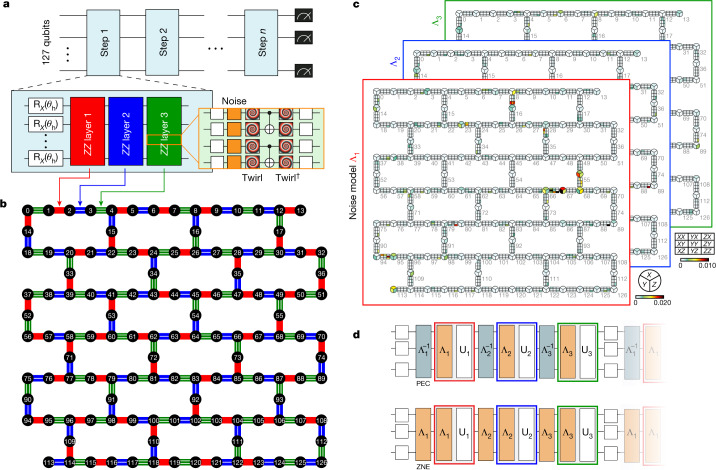
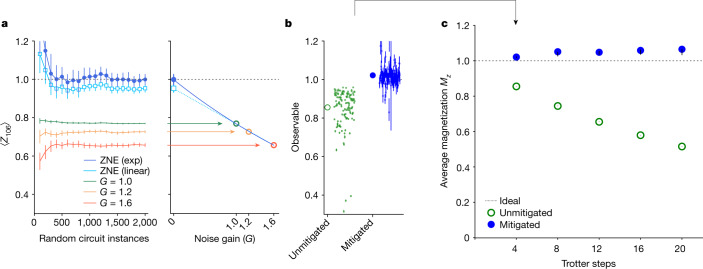
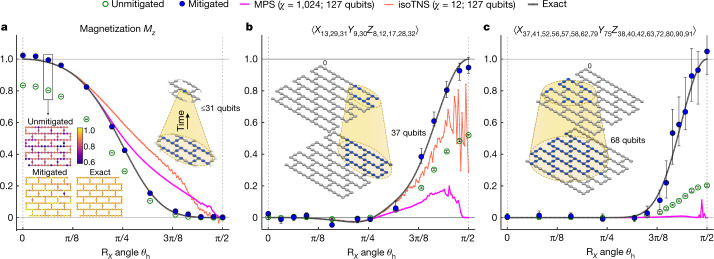
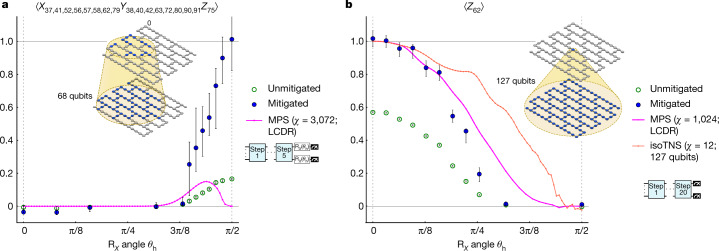
Verification
Claims the paper makes
The claims and statistics of this paper haven’t been checked yet.
Free: it reads the open-access text and checks the first 5 claims that cite a source we can check. Create a free account to check every claim.
Claims other papers make about this one
Each is checked against this paper’s own text: does it say what the citing paper says it does?
The cited source says what the claim attributes to it.
In the citing paper
“However, mobile qubit architectures, such as QCCD and optical tweezers24,25, can distribute resources more efficiently than stationary qubit architectures26–28, because qubits flow through the QPU like bits in a classical processor, with separated memory structures, data buses and logic units, each optimized for their purpose12.”
From A 98-qubit trapped-ion quantum computer with all-to-all connectivity (2026) · cites this paper as [26]
Self-check
Percentages, sums and reported differences re-computed from the paper’s own numbers.
The self-check needs the paper’s full text.
Citations
Cites
Quantum Computing in the NISQ era and beyond
Preskill, J. (2018) · Quantum · doi:10.22331/q-2018-08-06-79 · Cited by 8,830
Quantum supremacy using a programmable superconducting processor
Arute, F., Arya, K., Babbush, R., Bacon, D., Bardin, J. C., Barends, R., Biswas, R., Boixo, S., Brandao, F. G. S. L., Buell, D. A., et al. (2019) · Nature · doi:10.1038/s41586-019-1666-5 · Cited by 7,720
The density-matrix renormalization group in the age of matrix product states
Schollwöck, U. (2011) · Annals of Physics · doi:10.1016/j.aop.2010.09.012 · Cited by 4,818 · cited 2×
“Tensor networks have been widely used to approximate and compress quantum state vectors that arise in the study of the low-energy eigenstates of and time evolution by local Hamiltonians 2,32,33 and, more recently, have been successfully used to simulate low-depth noisy quantum circuits 34–36 .”
MethodCharge-insensitive qubit design derived from the Cooper pair box
Koch, J., Yu, T. M., Gambetta, J., Houck, A. A., Schuster, D. I., Majer, J., Blais, A., Devoret, M. H., Girvin, S. M., & Schoelkopf, R. J. (2007) · Physical Review A · doi:10.1103/physreva.76.042319 · Cited by 3,351 · cited 1×
“For the experimental implementation, we primarily used the IBM Eagle processor ibm_kyiv, composed of 127 fixed-frequency transmon qubits 15 with heavy-hex connectivity and median T 1 and T 2 times of 288 μs and 127 μs, respectively.”
MethodPurification of Noisy Entanglement and Faithful Teleportation via Noisy Channels
Bennett, C. H., Brassard, G., Popescu, S., Schumacher, B., Smolin, J. A., & Wootters, W. K. (1996) · Physical Review Letters · doi:10.1103/physrevlett.76.722 · Cited by 2,961 · cited 1×
“…restricting to jump operators acting on local pairs of qubits yields a sparse noise model that can be efficiently learned for many qubits and that accurately captures the noise associated with layers of two-qubit Clifford gates, including crosstalk, when combined with random Pauli twirls 23,24 .”
BackgroundNoisy intermediate-scale quantum algorithms
Bharti, K., Cervera-Lierta, A., Kyaw, T. H., Haug, T., Alperin-Lea, S., Anand, A., Degroote, M., Heimonen, H., Kottmann, J. S., Menke, T., et al. (2022) · Reviews of Modern Physics · doi:10.1103/revmodphys.94.015004 · Cited by 2,231
Improved simulation of stabilizer circuits
Aaronson, S., & Gottesman, D. (2004) · Physical Review A · doi:10.1103/physreva.70.052328 · Cited by 1,515 · cited 1×
“Clifford circuits serve as useful benchmarks of estimates produced by error mitigation, as they can be efficiently simulated classically 29 .”
BackgroundError Mitigation for Short-Depth Quantum Circuits
Temme, K., Bravyi, S., & Gambetta, J. M. (2017) · Physical Review Letters · doi:10.1103/physrevlett.119.180509 · Cited by 1,379 · cited 2×
“based on pulse stretching 9,17,18 or subcircuit repetition 20–22 have circum-vented the need for precise noise learning, while relying on simplistic assumptions about the device noise.”
BackgroundSelf-citationEvolution of entanglement entropy in one-dimensional systems
Calabrese, P., & Cardy, J. (2005) · Journal of Statistical Mechanics: Theory and Experiment · doi:10.1088/1742-5468/2005/04/p04010 · Cited by 1,295 · cited 1×
“As entanglement (bond dimension) of a generic state grows linearly (exponentially) with time evolution until it saturates the volume law, deep quantum circuits are inherently difficult for tensor networks 37 .”
BackgroundError mitigation extends the computational reach of a noisy quantum processor
Kandala, A., Temme, K., Córcoles, A. D., Mezzacapo, A., Chow, J. M., & Gambetta, J. M. (2019) · Nature · doi:10.1038/s41586-019-1040-7 · Cited by 871 · cited 2×
“based on pulse stretching 9,17,18 or subcircuit repetition 20–22 have circum-vented the need for precise noise learning, while relying on simplistic assumptions about the device noise.”
BackgroundSelf-citation
Research works printed but not linked: 5
- Shor, P. W. in Proc. 35th Annual Symposium on Foundations of Computer Science 124–134 (IEEE, 1994).
- Kitaev, A. Y. Quantum measurements and the Abelian Stabilizer Problem. Preprint at https://arxiv.org/abs/quant-ph/9511026 (1995). · arXiv
- Li Y Benjamin SC Efficient variational quantum simulator incorporating active error minimization Phys. Rev. X 2017 7 021050
- Endo S Benjamin SC Li Y Practical quantum error mitigation for near-future applications Phys. Rev. X 2018 8 031027
- Zhou Y Stoudenmire EM Waintal X What limits the simulation of quantum computers? Phys. Rev. X 2020 10 041038
Cited by
Items 701–800 of 1,005
Superconducting Quantum Simulation for Many-Body Physics beyond Equilibrium
Yao, Y., & Xiang, L. (2024) · Entropy · doi:10.3390/e26070592 · Cited by 9
Prolonging a discrete time crystal by quantum-classical feedback
Camacho, G., & Fauseweh, B. (2024) · Physical Review Research · doi:10.1103/physrevresearch.6.033092 · Cited by 10
“Recent experiments performed on quantum computers suggest that error mitigation techniques can successfully push the applicability of current NISQ devices to perform quantum simulations [18], while the long-term goal for achieving full quantum error correction [19] is still under investigation.”
BackgroundTwo-dimensional correlation propagation dynamics with a cluster discrete phase-space method
Nagao, K., & Yunoki, S. (2025) · Physical Review A · doi:10.1103/physreva.111.023315 · Cited by 10
Efficient learning of Sparse Pauli Lindblad models for fully connected qubit topologyPreprint
Jaloveckas, J. E., Nguyen, M. T. P., Palackal, L., Lorenz, J. M., & Ehm, H. (2023) · arXiv (Cornell University) · doi:10.48550/arxiv.2311.11639 · Cited by 9
“…through the utilisation of Probabilistic Error Cancellation (PEC) and Zero-Noise Extrapo-lation (ZNE) with sparse Pauli–Lindblad (SPL) models [11, 12], on superconducting quantum processors with fixed-frequency transmon qubits and topology patterns of heavy-hexagon lattices, by employing…”
BackgroundMethodInfluentialGharibyan, H., Su, V., & Tepanyan, H. (2023) · arXiv (Cornell University) · doi:10.48550/arxiv.2311.12929 · Cited by 9
“Quantum hardware advancements, including superconducting qubits by IBM and Google [1, 2], neutral atoms by Pasqal and QuEra [3], and photonic quantum computers by PsiQuantum and Xanadu [4], have created systems surpassing 100 qubits.”
MethodScalable Quantum Algorithms for Noisy Quantum Computers
Gacon, J. (2024) · arXiv (Cornell University) · doi:10.5075/epfl-thesis-11132 · Cited by 9
Kasatkin, V., Mozgunov, E., Ezzell, N., & Lidar, D. A. (2024) · arXiv (Cornell University) · doi:10.48550/arxiv.2408.03418 · Cited by 9
Adversarial Data Poisoning Attacks on Quantum Machine Learning in the NISQ EraPreprint
Kundu, S., & Ghosh, S. (2024) · arXiv (Cornell University) · doi:10.48550/arxiv.2411.14412 · Cited by 9
“Researchers have already begun leveraging current noisy intermediate-scale quantum (NISQ) machines to demonstrate practical utility in this pre-fault-tolerant era [16].”
Physics-inspired Machine Learning for Quantum Error MitigationPreprint
Xu, X., Xue, X., Chen, T., Ding, C., Tian, L., Zhou, H., Huang, H.-L., & Bao, W. (2025) · arXiv (Cornell University) · doi:10.48550/arxiv.2501.04558 · Cited by 9
Complexity and hardness of random peaked circuitsPreprint
Zhang, Y. (2025) · arXiv (Cornell University) · doi:10.48550/arxiv.2510.00132 · Cited by 10
A Practical Guide to using Pauli Path Simulators for Utility-Scale Quantum ExperimentsPreprint
Gharibyan, H., Hariprakash, S., Mullath, M. Z., & Su, V. P. (2025) · arXiv (Cornell University) · doi:10.48550/arxiv.2507.10771 · Cited by 10
Hybrid Sequential Quantum ComputingPreprint
Chandarana, P., Romero, S. V., Cadavid, A. G., Simen, A., Solano, E., & Hegade, N. N. (2025) · arXiv (Cornell University) · doi:10.48550/arxiv.2510.05851 · Cited by 9
“[54], we identify sets of mutually non-overlapping two-and three-qubit interactions that are compatible with the hardware constraints and can be executed in parallel.”
State Similarity in Modular Superconducting Quantum Processors with Classical CommunicationsPreprint
Wu, B., Xie, C., Mi, P., Wu, Z., Guo, Z., Huang, P., Huang, W., Sun, X., Zhang, J., Zhang, L., et al. (2025) · arXiv · doi:10.48550/arxiv.2506.01657 · Cited by 9
Amer, H., Piliouras, E., Barnes, E., & Economou, S. E. (2025) · arXiv (Cornell University) · doi:10.48550/arxiv.2504.09767 · Cited by 9
“This demand also extends to the recent non-fault tolerant quantum utility approaches [2, 3].”
Kirmani, A. A., Pelofske, E., Bärtschi, A., Eidenbenz, S., & Zhu, J. (2025) · arXiv (Cornell University) · doi:10.48550/arxiv.2505.22932 · Cited by 9
“Recently, large-scale simulations of a type of hardware-compatible TFIMs were successfully performed on IBM superconducting-qubit NISQ computer [10] with the extensive use of error mitigation techniques.”
Classically Sampling Noisy Quantum Circuits in Quasi-Polynomial Time under Approximate MarkovianityPreprint
Zhang, Y., Lee, S.-U., Jiang, L., & Gopalakrishnan, S. (2025) · arXiv (Cornell University) · doi:10.48550/arxiv.2510.06324 · Cited by 9
Limitations of Noisy Geometrically Local Quantum CircuitsPreprint
Nelson, J., Rajakumar, J., & Gullans, M. J. (2025) · arXiv (Cornell University) · doi:10.48550/arxiv.2510.06346 · Cited by 9
“However, for quantum devices that do not operate in these fault-tolerant regimes, it remains unclear what computational tasks they can efficiently perform in the presence of noise.”
Robust Lindbladian Estimation for Quantum DynamicsPreprint
Liu, Y., Seddon, J. R., Kohler, T., Onorati, E., & Cubitt, T. S. (2025) · arXiv (Cornell University) · doi:10.48550/arxiv.2507.07912 · Cited by 10
Quantum circuit simulation with a local time-dependent variational principlePreprint
Eisert, J., Sander, A., Fröhlich, M., Ali, M., Eigel, M., Hintermüller, M., Mendl, C. B., Milbradt, R. M., & Wille, R. (2025) · Research Square · doi:10.21203/rs.3.rs-8196476/v1 · Cited by 10
Optimizing Ansatz Design in Quantum Generative Adversarial Networks Using Large Language ModelsPreprint
Ueda, K., & Matsuo, A. (2025) · arXiv (Cornell University) · doi:10.48550/arxiv.2503.12884 · Cited by 9
“Despite these challenges, researchers are actively exploring ways to optimize the use of existing quantum computers [3].”
Qibocal: an open-source framework for calibration of self-hosted quantum devicesPreprint
Pasquale, A., Pedicillo, E., Cereijo, J., Ramos-Calderer, S., Candido, A., Palazzo, G., Carobene, R., Gobbo, M., Efthymiou, S., Tan, Y. P., et al. (2024) · arXiv (Cornell University) · doi:10.48550/arxiv.2410.00101 · Cited by 9
“Recent developments in quantum technologies have demonstrated promising applications of quantum algorithms on hardware [1].”
A Monte Carlo approach to bound Trotter errorPreprint
Blunt, N. S., Ivanov, A. V., & Bay-Smidt, A. J. (2025) · arXiv (Cornell University) · doi:10.48550/arxiv.2510.11621 · Cited by 9
“Even on current quantum devices with high error rates, Trotterization can be used to obtain re-sults at the frontier of state-of-the-art classical methods [13, 14].”
Frozonium: Freezing anharmonicity in Floquet superconducting circuits
Lewellen, K., Mukherjee, R., Guo, H., Roy, S., Fatemi, V., & Chowdhury, D. (2026) · Newton · doi:10.1016/j.newton.2026.100434 · Cited by 8
“The transmon regime of capacitively coupled Josephson junctions has been of great practical significance in recent times in the implementation of large arrays of qubits [2, 7, 8].”
Report on reproducibility in condensed matter physics
Akrap, A., Bordelon, D., Chatterjee, S., Dahlberg, E. D., Devaty, R. P., Frolov, S., Gould, C., Greene, L. H., Guchhait, S., Hamlin, J. J., et al. (2026) · Physical review. B./Physical review. B · doi:10.1103/27h6-yghn · Cited by 8
Pedagogical Approach for Quantum Computing in Engineering Education
Orts, F. J. (2025) · Computer Applications in Engineering Education · doi:10.1002/cae.70004 · Cited by 9
Hu, C.-K., Xie, G., Poulsen, K., Zhou, Y., Chu, J., Liu, C. L., Zhou, R., Yuan, H., Shen, Y., Liu, S., et al. (2025) · Nature Communications · doi:10.1038/s41467-025-57812-8 · Cited by 8
“To quantify their impact, we characterize the system based on the relaxation times, dephasing times, and gate fidelity presented in Supplementary Table I.”
High-density wiring solution for 500-qubit scale superconducting quantum processors
Tian, J.-Y., Song, Y., Liu, P., Zhang, W. G., Yu, H., & Jin, Y. (2025) · Review of Scientific Instruments · doi:10.1063/5.0287659 · Cited by 8
Towards practical quantum neural network diagnostics with neural tangent kernels
Scala, F., Zoufal, C., Gerace, D., & Tacchino, F. (2026) · npj Quantum Information · doi:10.1038/s41534-026-01280-5 · Cited by 8
“Published in partnership with The University of New South Wales https://doi.org/10.1038/s41534-026-01280-5 Towards practical quantum neural network diagnostics with neural tangent kernels”
InfluentialNon-Gaussian Noise Magnetometry Using Local Spin Qubits
Curtis, J. B., Yacoby, A., & Demler, E. (2026) · Quantum · doi:10.22331/q-2026-08-27-2197 · Cited by 8
“…and error processes [114, 115, 116, 117, 59, 118], or even connections to questions of sampling complexity, negative Wigner distributions [106], thermalization [28, 119, 120, 121, 122, 123] or quantum error correction [124, 125] and how these processes may present in dynamical noise signatures.”
Zhang, Y., Yang, Y., Lu, C.-C., Jiang, W., Cheng, F., Fang, B., & Guan, Q. (2025) · International Conference for High Performance Computing, Networking, Storage and Analysis (SC) · doi:10.1145/3712285.3759799 · Cited by 8
“In prior studies, utility-level quantum processors have exhibited relatively low sensitivity to noise in protein structure prediction tasks [28].”
Cech, M., Fazio, C. D., Cea, M., Bañuls, M. C., Lesanovsky, I., & Carollo, F. (2026) · Physical Review A · doi:10.1103/flpc-1sls · Cited by 10
Faster Randomized Dynamical Decoupling
Yi, C., Kim, L., & Marvian, M. (2026) · Physical Review Letters · doi:10.1103/fk7j-y1vl · Cited by 9
Layered KIK quantum error mitigation for dynamic circuits
Bar, B., Santos, J. P., & Uzdin, R. (2026) · npj Quantum Information · doi:10.1038/s41534-026-01207-0 · Cited by 8
Accelerating qubit reset through the Mpemba effect
Lejeune, T., Papič, M., Goold, J., Binder, F. C., Damanet, F., & Moroder, M. (2026) · Journal of Physics A Mathematical and Theoretical · doi:10.1088/1751-8121/ae7b8e · Cited by 10
“This is especially relevant in today’s noisy intermediate-scale quantum era, where error mitigation techniques are required to suppress the noise of current devices at the cost of an exponential overhead in the number of required shots [20, 33, 34].”
Fast and perfect state transfer in superconducting circuit with tunable coupler
张, C. 驰. Z., Wang, T.-L., 赵, Z.-A. 泽. Z., Yang, X., 郭, L.-L. 亮. G., Jia, Z.-L., 段, P. 鹏. D., & Guo, G. (2023) · Chinese Physics B · doi:10.1088/1674-1056/acf496 · Cited by 8
Trusted Distributed Artificial Intelligence (TDAI)
Ağca, M. A., Faye, S., & Khadraoui, D. (2023) · IEEE Access · doi:10.1109/access.2023.3322568 · Cited by 9
“This is also true for AI products that are distributed by system characteristic requirements [7], [18], [20], [21].”
BackgroundDynamic optimization on quantum hardware: Feasibility for a process industry use case
Nenno, D. M., & Caspari, A. (2024) · Computers & Chemical Engineering · doi:10.1016/j.compchemeng.2024.108704 · Cited by 8
“As such, qubit count is not the sole factor in assessing the computational power or versatility of these different quantum computing paradigms [12,13].”
BackgroundGeometric Algebra Jordan–Wigner Transformation for Quantum Simulation
Veyrac, G., & Toffano, Z. (2024) · Entropy · doi:10.3390/e26050410 · Cited by 8
“Quantum computers and quantum simulation are today a major research subject, involving private companies such as IBM [11], Google [12], Quantinuum [13], and Pasqal [14], along with universities all around the world.”
BackgroundVirtual mitigation of coherent non-adiabatic transitions by echo verification
Schiffer, B. F., van Vreumingen, D., Tura, J., & Polla, S. (2024) · Quantum · doi:10.22331/q-2024-05-14-1346 · Cited by 8
“This allows measuring the k th degree purified observable ⟨ O ⟩ ( k ) which yields a lower bias than evaluating the state directly after the adiabatic preparation ⟨ O ⟩ ad . observables [3–5].”
BackgroundOptimal compression of constrained quantum time evolution
Tepaske, M. S. J., Luitz, D. J., & Hahn, D. (2024) · Physical review. B./Physical review. B · doi:10.1103/physrevb.109.205134 · Cited by 8
“Recent work has shown that a combination of quantum simulation and quantum error mitigation gives competitive results for the time evolution of quantum systems [23, 24].”
BackgroundDeterministic Ansätze for the measurement-based variational quantum eigensolver
Schroeder, A. K., Heller, M., & Gachechiladze, M. (2024) · New Journal of Physics · doi:10.1088/1367-2630/ad51e5 · Cited by 8
“[63].”
PCQ: Parallel Compact Quantum Circuit Simulation
Liang, S., Lu, Y., Guo, C., Luk, W. W., & Kelly, P. H. J. (2024) · IEEE International Symposium on Field-Programmable Custom Computing Machines (FCCM) · doi:10.1109/fccm60383.2024.00013 · Cited by 8
“Decades later, during the 2020s, numerous research institutions have successfully developed quantum device prototypes, such as IBM [6], [7], Google [8], and D-Wave [9], [10].”
BackgroundLearning symmetry-protected topological order from trapped-ion experiments
Sadoune, N., Pogorelov, I., Edmunds, C., Giudici, G., Giudice, G., Marciniak, C. D., Ringbauer, M., Monz, T., & Pollet, L. (2026) · Quantum · doi:10.22331/q-2026-05-12-2100 · Cited by 8
“Various hardware platforms are being concurrently developed, based e. g. on superconducting qubits [2–5], neutral atoms [6–9], and trapped ions [10–13].”
Integration of IoT and Quantum Computing: Revolutionizing Manufacturing
Sonavane, A. S., & Aylani, A. (2024) · Advances in computer and electrical engineering book series · doi:10.4018/979-8-3693-3940-4.ch016 · Cited by 8
Heralding entangled optical photons from a microwave quantum processor
Haug, T. H., Kockum, A. F., & Laer, R. V. (2024) · Physical Review Applied · doi:10.1103/physrevapplied.22.034068 · Cited by 8
Mootz, M., Iadecola, T., & Yao, Y. (2024) · Journal of Chemical Theory and Computation · doi:10.1021/acs.jctc.4c00874 · Cited by 8
Continuously tunable single-photon level nonlinearity with Rydberg state wave-function engineering
Xu, B., Ye, G.-S., Chang, Y., Shi, T., & Li, L. (2024) · Reports on Progress in Physics · doi:10.1088/1361-6633/ad847e · Cited by 8
In situ mixer calibration for superconducting quantum circuits
Wu, N., Lin, J., Xie, C., Guo, Z., Huang, W., Zhang, L., Zhou, Y., Sun, X., Zhang, J., Guo, W., et al. (2024) · Applied Physics Letters · doi:10.1063/5.0234579 · Cited by 8
Artificial Intelligence in Cancer Immunotherapy: Navigating Challenges and Unlocking Opportunities
Xiang, W., Yu, L., Chen, X. S., & Herold, M. J. (2024) · Engineering · doi:10.1016/j.eng.2024.12.014 · Cited by 8
Noise-tolerant Grover's algorithm via success-probability prediction
Leng, J., Yang, F., & Wang, X. (2025) · Physical Review Research · doi:10.1103/physrevresearch.7.l012017 · Cited by 9
Classical and quantum algorithms for many-body problems
Ayral, T. (2025) · Comptes Rendus Physique · doi:10.5802/crphys.229 · Cited by 8
Stasino, V., Mastrovito, P., Cosenza, C., Levochkina, A., Esposito, M., Montemurro, D., Pepe, G. P., Bruno, A., Tafuri, F., Massarotti, D., et al. (2025) · Journal of Superconductivity and Novel Magnetism · doi:10.1007/s10948-025-06968-x · Cited by 8
“Dipartimento di Ingegneria Elettrica e delle Tecnologie dell’Informazione, Università degli Studi di Napoli Federico II, 80125 Napoli, Italy Superconducting Quantum Processing Units (sQPU) provide encoding and manipulation of quantum information in single superconducting quantum bits and allow to implement up to thous…”
MIMO Quantum Communication in Correlated Pure-Loss Channels
Rehman, J. U., Rizvi, S. M. A., Koudia, S., Chatzinotas, S., & Shin, H. (2025) · IEEE Communications Letters · doi:10.1109/lcomm.2025.3567246 · Cited by 8
“In recent years, there has been a growing interest in quantum information sciences, especially in the domain of computing [3], [4] and communications [5], [6], [7].”
Simulating the Fermi-Hubbard model with long-range hopping on a quantum computer
Bespalova, T. A., Delić, K., Pupillo, G., Tacchino, F., & Tavernelli, I. (2025) · Physical Review A · doi:10.1103/physreva.111.052619 · Cited by 8
Kanasugi, S., Hidaka, Y., Nakagawa, Y. O., Tsutsui, S., Matsumoto, N., Maruyama, K., Oshima, H., & Sato, S. (2025) · Physical Review Research · doi:10.1103/kb94-tf7t · Cited by 8
Detecting errors in a quantum network with Pauli checks
Gonzales, A., Dilley, D., Li, B., Jiang, L., & Saleem, Z. H. (2025) · Physical Review A · doi:10.1103/physreva.111.052629 · Cited by 8
“However, meeting the requirements for fault tolerance is a demanding task [8, 9].”
Nonlinear multimode photonics on‐chip
Vitali, V., Bucio, T. D., Liu, H., Haines, J., Naik, P. U., Guasoni, M., Gardes, F. Y., Pavesi, L., Cristiani, I., Lacava, C., et al. (2025) · Nanophotonics · doi:10.1515/nanoph-2025-0105 · Cited by 8
“Multi-photon experiments at this scale are expected to enter computationally interesting regimes where quantum machines can compete and sur-pass classical supercomputers [96], [97].”
Sugawara, M., & Satoh, T. (2025) · IEEE Transactions on Quantum Engineering · doi:10.1109/tqe.2025.3585413 · Cited by 8
“…the competition to improve the performance of noisy intermediate-scale quantum (NISQ) devices has made significant progress toward the realization of early fault-tolerant quantum computers [1], and quantum devices with more than 100 qubits have emerged in superconducting systems [2], [3], [4].”
Zhang, X., Zhang, X., Chen, C. H., Tang, K., Yi, K., Luo, K., Xie, Z., Chen, Y., & Yan, T. (2025) · Physical Review Applied · doi:10.1103/wgqf-8rcy · Cited by 8
“Among the various architectures belonging to this platform [3, 4], those containing tunable couplers have been extensively explored, achieving impressive progress in recent years [4–7].”
Certified random number generation using quantum computers
Nath, P. P., Sinha, A., & Sinha, U. (2025) · Frontiers in Quantum Science and Technology · doi:10.3389/frqst.2025.1661544 · Cited by 8
“Recent research [4] has demonstrated that quantum computers have entered the era of quantum utility, where they can perform reliable computations on a scale that exceeds classical brute-force methods, offering exact solutions to complex computational problems.”
Neural-Network-Assisted Monte Carlo Sampling Trained by Quantum Approximate Optimization Algorithm
Nakano, Y., Okada, K. N., & Fujii, K. (2026) · PRX Quantum · doi:10.1103/9nhx-5pym · Cited by 8
Symmetric Channel Verification for Purifying Noisy Quantum Channels
Tsubouchi, K., Mitsuhashi, Y., Takagi, R., & Yoshioka, N. (2025) · PRX Quantum · doi:10.1103/jcd6-lft3 · Cited by 8
“Moreover, the quantum error mitigation [11–14] technique known as symmetry verification [15, 16] leverages problem-specific symmetry to filter out the effects of symmetry-breaking noise.”
Žnidarič, M. (2026) · Physical Review X · doi:10.1103/69d7-83xh · Cited by 8
“This is an important theoretical question, that is moreover very relevant for noisy quantum computers and simulators, whose best-case present use [7] is to simulate [8] other quantum systems [9–13], including the prethermalization regime [14] that we shall discuss.”
Nirmal, M. R., Khandelwal, A., Nambiar, M. K., & Yamijala, S. S. R. K. C. (2025) · The Journal of Physical Chemistry A · doi:10.1021/acs.jpca.5c04605 · Cited by 9
“With the recent demonstration of potential advantage and utility of near-term quantum computers, 1–4 the field of quantum computation has at-tracted immense research interest across various scientific domains.”
Ground-state reachability for variational quantum eigensolvers: a Rydberg-atom case study
Singh, J., Kruckenhauser, A., van Bijnen, R., & Zeier, R. (2026) · Quantum Science and Technology · doi:10.1088/2058-9565/ae7b7b · Cited by 8
Path Matters: Industrial Data Meet Quantum Optimization
Schmidbauer, L., Riofrío, C. A., Heinrich, F., Junk, V., Schwenk, U., Husslein, T., & Mauerer, W. (2025) · IEEE International Conference on Quantum Computing and Engineering (QCE) · doi:10.1109/qce65121.2025.00230 · Cited by 8
“For specific topologies there have been advances [43], in particular for the heavy-hex topology [44].”
Digital Zero-Noise Extrapolation with Quantum Circuit Unoptimization
Pelofske, E., & Russo, V. (2025) · IEEE International Conference on Quantum Computing and Engineering (QCE) · doi:10.1109/qce65121.2025.00020 · Cited by 8
“The second is by stretching the pulse-level waveforms on the hardware [5, 34] that are implementing the circuit-level instructions—in particular, by still implementing the same operations, but over longer timescales, which thus creates more noise due to the limited qubit coherence times and an…”
Multilayer cycle benchmarking for high-accuracy error characterization
Calzona, A., Papič, M., Figueroa–Romero, P., & Auer, A. (2026) · Physical Review Research · doi:10.1103/4hbl-hpl3 · Cited by 8
“Such dense configurations are useful for a variety of applications, including simulating the dynamics of lattice models [15] and implementing variational quantum algorithms [44].”
InfluentialResource-Efficient Cross-Platform Verification with Modular Superconducting Devices
Dalton, K., Knörzer, J., Hoehne, F., Song, Y., Flasby, A., Zanuz, D. C., Panah, M. B., Besedin, I. S., Besse, J.-C., & Wallraff, A. J. (2025) · PRX Quantum · doi:10.1103/czph-xpzs · Cited by 8
“To alleviate these limitations, the largest devices use 3D-integration technologies such as flip-chip bonding [45–47].”
Scalable quantum simulator with an extended gate set in giant atoms
Chen, G., & Kockum, A. F. (2025) · Quantum · doi:10.22331/q-2026-01-30-1992 · Cited by 7
Optimisation and synthesis of quantum circuits with global gates
Villoria, A., Basold, H., & Laarman, A. (2025) · Quantum Science and Technology · doi:10.1088/2058-9565/ae3029 · Cited by 8
“Current candidates for qubit implementations are superconducting qubits [21], trapped ions [14], nitrogen-vacancy centres [17], and neutral atoms [19], to name a few.”
Energy-participation-ratio analysis for very anharmonic superconducting circuits
YILMAZ, F., Singh, S., Zwanenburg, M. F. S., Hu, J., Stefanski, T. V., & Andersen, C. K. (2026) · Physical Review Applied · doi:10.1103/1rbn-c4xf · Cited by 8
Quantum games and economics through teleportation
Ikeda, K. (2026) · Quantum Information Processing · doi:10.1007/s11128-026-05341-8 · Cited by 8
Improving Probabilistic Error Cancellation in the Presence of Nonstationary Noise
Dasgupta, S., & Humble, T. S. (2024) · IEEE Transactions on Quantum Engineering · doi:10.1109/tqe.2024.3435757 · Cited by 8
“In this section, we provide background for the quantum error mitigation method called PEC [38], [40], [41], which aims”
MethodGenerating hard Ising instances with planted solutions using post-quantum cryptographic protocols
Mandrà, S., Munoz-Bauza, H., Mossi, G., & Rieffel, E. G. (2025) · Future Generation Computer Systems · doi:10.1016/j.future.2025.107721 · Cited by 8
Effectiveness of the syndrome extraction circuit with flag qubits on IBM quantum hardware
Kim, Y., Kim, H., Kang, J., Choi, W., & Kwon, Y. (2025) · Quantum · doi:10.22331/q-2025-10-23-1893 · Cited by 8
“This architecture is designed to optimize the fidelity of physical gate operations by minimizing crosstalk at the expense of qubit connectivity [16, 17].”
Self-citationQuantum Computing for Climate Change Detection, Climate Modeling, and Climate Digital TwinPreprint
Otgonbaatar, S., Nurmi, O., Johansson, M. P., Mäkelä, J., kocman, T., Gawron, P., Puchała, Z., Mielzcarek, J., Miroszewski, A., & Dumitru, C. O. (2023) · TechRxiv · doi:10.36227/techrxiv.24478663 · Cited by 8
Hybrid Quantum Neural Network in High-dimensional Data ClassificationPreprint
Chen, H.-Y., Chang, Y.-J., Liao, S.-W., & Chang, C. (2023) · Research Square · doi:10.21203/rs.3.rs-3695278/v1 · Cited by 6
Purification and correction of quantum channels by commutation-derived quantum filtersPreprint
Das, S., Sun, J., Hanks, M., Koczor, B., & Kim, M. S. (2024) · arXiv (Cornell University) · doi:10.48550/arxiv.2407.20173 · Cited by 8
“The Pauli filter protocol can be applied as an alternative to QEM in the near-term or early fault-tolerant quantum computation [102–104], with the advantage of recovering the quantum state, not just the expectation values.”
Security Concerns in Quantum Machine Learning as a ServicePreprint
Kundu, S., & Ghosh, S. (2024) · arXiv (Cornell University) · doi:10.48550/arxiv.2408.09562 · Cited by 8
“Researchers have already begun using these noisy intermediate-scale quantum (NISQ) machines to demonstrate practical utility in this pre-fault-tolerant era [33].”
Applying Quantum Autoencoders for Time Series Anomaly DetectionPreprint
Frehner, R., & Stockinger, K. (2024) · Zürcher Hochschule für Angewandte Wissenschaften digital collection (Zurich University of Applied Sciences) · doi:10.48550/arxiv.2410.04154 · Cited by 8
Clifford Perturbation Approximation for Quantum Error MitigationPreprint
Zhang, R., Shao, Y., Wei, F., Cheng, S., Wei, Z., & Liu, Z. (2024) · arXiv (Cornell University) · doi:10.48550/arxiv.2412.09518 · Cited by 8
Transmon qutrit-based simulation of spin-1 AKLT systemsPreprint
Kumaran, K., Alam, F., Eassa, N. M., Ferris, K., Xiao, X., Cincio, Ł., Bronn, N. T., & Banerjee, A. (2024) · arXiv · doi:10.48550/arxiv.2412.19786 · Cited by 8
“Noisy Intermediate-Scale Quantum (NISQ) [1] computers are now actively used to simulate physical systems, with growing impact as they approach practical utility for large-scale problems [2–6].”
Xie, S., Sarkar, A., & Feld, S. (2025) · arXiv (Cornell University) · doi:10.48550/arxiv.2504.08310 · Cited by 8
“The current state of the art in quantum computing is exemplified by breakthroughs from quantum processor manufacturers in qubits with better fidelity, scalability, real-time control, and error-correction [2, 3, 4].”
Faster Probabilistic Error CancellationPreprint
Chen, Y.-H. (2025) · arXiv (Cornell University) · doi:10.48550/arxiv.2506.04468 · Cited by 8
“Quantum error mitigation has been an essential part of near-term quantum computing where it helps to recover the correct answer even in the presence of hardware errors [9, 11].”
A Pathway to Practical Quantum Advantage in Solving Navier-Stokes EquationsPreprint
Zhuang, X., Chen, Z., Tan, M.-Y., Zhang, J., Ye, C.-C., Wei, T.-H., Ma, T.-Y., Xue, C., Liu, H., Li, Q.-S., et al. (2025) · arXiv (Cornell University) · doi:10.48550/arxiv.2509.08807 · Cited by 8
Self-citationQuantum Algorithm Software for Condensed Matter PhysicsPreprint
Farajollahpour, T. (2025) · arXiv (Cornell University) · doi:10.48550/arxiv.2506.09308 · Cited by 8
“Demonstrating robust quantum advantage requires outperforming the best available classical algorithms, including specialized heuristics, not just generic or brute-force classical meth-ods [66–68].”
Sabharwal, S., Gohlke, M., Skrzypczyk, P., & Shannon, N. (2025) · arXiv (Cornell University) · doi:10.48550/arxiv.2511.15144 · Cited by 8
“Ninety years later, entanglement is no longer seen as a philosophical curiosity, but rather a technological resource [3], with quantum advantage sought in the entanglement of scores of qubits [4, 5].”
Quantum advantages for syndrome-aware noisy logical observable estimationPreprint
Tsubouchi, K., Kwon, H., Jiang, L., & Yoshioka, N. (2026) · arXiv (Cornell University) · doi:10.48550/arxiv.2603.05145 · Cited by 8
Quantum Advantage: a Tensor Network PerspectivePreprint
Kshetrimayum, A., Jahromi, S. S., Singh, S., & Orús, R. (2026) · arXiv (Cornell University) · doi:10.48550/arxiv.2603.18825 · Cited by 8
“The authors in [13] employed matrix product states (MPS) and isometric 2D tensor networks with bond dimensions χ = 1024 and χ = 12, respectively, to benchmark the full 127-qubit circuit.”
InfluentialHunting for quantum advantage in electronic structure calculations is a highly non-trivial taskPreprint
Legeza, Ö., Menczer, A., Werner, M. A., Xantheas, S. S., Neese, F., Ganahl, M., Brower, C., Bernabeu, S. R., Hammond, J., & Gunnels, J. A. (2026) · arXiv (Cornell University) · doi:10.48550/arxiv.2603.28648 · Cited by 8
“Introduction: Over the past decades, major developments in both classical and quantum computation have brought the question of the realization of quantum advantage in real-life problems into the focus of modern science [1–13].”
String dynamics of a (2+1)D U(1) quantum link model on a digital quantum computerPreprint
Gandon, A., Mariani, A., Banerjee, D., Huffman, E., Kanwar, G., Tacchino, F., Wiese, U. ‐., & Tavernelli, I. (2026) · arXiv (Cornell University) · doi:10.48550/arxiv.2606.19601 · Cited by 8
“Importantly, the topology of this dual representation matches the “heavy hex” connectivity graph of the IBM quantum computers, which are the experimental quantum platform used in this work [60].”
Quantum Computing in Civil Engineering: Potentials and Limitations
Ploennigs, J., Berger, M., Mevissen, M., & Smarsly, K. (2025) · Lecture Notes in Civil Engineering · doi:10.1007/978-3-031-87364-5_2 · Cited by 7
Efficient estimation and sequential optimization of cost functions in variational quantum algorithms
Umer, M., Mastorakis, E., & Angelakis, D. G. (2025) · Quantum Science and Technology · doi:10.1088/2058-9565/add55e · Cited by 7
“These algorithms, however, require fault-tolerant quantum computation [5–8], which remains beyond the capabilities of present-day Noisy Intermediate-Scale Quantum (NISQ) devices.”
Quantum simulation of scattering amplitudes and interferences in perturbative QCD
Chawdhry, H. A., Pellen, M., & Williams, S. (2026) · The European Physical Journal C · doi:10.1140/epjc/s10052-026-16121-0 · Cited by 7
Digital quantum simulation of many-body localization crossover in a disordered kicked Ising model
Hayata, T., Shinjo, K., Seki, K., & Yunoki, S. (2026) · npj Quantum Information · doi:10.1038/s41534-026-01342-8 · Cited by 7
“[19].”
Quantum sequel of neural network training
Zhang, H., & Kamenev, A. (2025) · Communications Physics · doi:10.1038/s42005-025-02384-8 · Cited by 7
Robust quality factor assessment of high-coherence superconducting qubits
Dane, A. E., Balakrishnan, K., Wacaser, B. A., Hung, L.-W., Mamin, H. J., Rugar, D., Shelby, R. M., Murray, C. E., Rodbell, K. P., & Sleight, J. W. (2026) · npj Quantum Information · doi:10.1038/s41534-026-01199-x · Cited by 7
Rubín-Osanz, M., Bersani, L., Chicco, S., Allodi, G., Renzi, R. D., Mavromagoulos, A., Roy, M. D., Piligkos, S., Garlatti, E., & Carretta, S. (2026) · Nature Communications · doi:10.1038/s41467-026-72390-z · Cited by 7
“Most demonstrations have focused on qubit-based architectures such as superconducting circuits 1–3 , trapped ions 4–6 , and semiconductor quantum dots 7–9 , prompting the second quantum revolution.”
Mechanical resonator–based quantum computing
Yang, Y., Kladarić, I., Skrabulis, M., Eichenberger, M., Marti, S., Storz, S., Esche, J., Garcia-Belles, R., Kern, M.-E., Omahen, A., et al. (2026) · Science · doi:10.1126/science.aef4139 · Cited by 7
“Among the various platforms proposed for the realization of QIP, superconducting circuits have recently shown crucial developments in system scaling and quantum error correction ( 7,8 ).”
Metadata
- Authors
- Kim, Y., Eddins, A., Anand, S., Wei, K. X., van den Berg, E., Rosenblatt, S., Nayfeh, H., Wu, Y., Zaletel, M., Temme, K., & Kandala, A.
- Affiliations
- IBM Research - Cambridge (United States) (US)
- University of California, Berkeley (US)
- IBM (United States) (US)
- RIKEN (JP)
- Lawrence Berkeley National Laboratory (US)
- Corresponding author
- Eddins, Andrew
- Kandala, Abhinav
- ORCID
- Venue
- Nature
- Published
- 2023-06-14
- Volume
- 618
- Issue
- 7965
- Pages
- 500-505
- ISSN
- 0028-0836 (ISSN-L)
- 1476-4687
- PMC
- PMC10266970
- OpenAlex
- W4380627387
- Semantic Scholar
- f9253a3e2627f1c2a0a7e2cea320a4ec4e4d2ff9
- Cited by
- 1,050
- References
- 41
- Citations by year
- 2026: 226 · 2025: 399 · 2024: 358 · 2023: 67
- FWCI
- 98.85
- Type
- journal article
- Language
- en
- Open access
- hybrid
- doi.org
- Licence
- cc-by
- creativecommons.org/licenses/by/4.0 (tdm)
- creativecommons.org/licenses/by/4.0 (vor)
- Locations
- Nature (publishedVersion, cc-by)
- PubMed Central (publishedVersion, cc-by)
- PubMed (publishedVersion)
- eScholarship (California Digital Library) (submittedVersion, cc-by)
- OSTI OAI (U.S. Department of Energy Office of Scientific and Technical Information) (submittedVersion)
- RePEc: Research Papers in Economics (submittedVersion)
- Funders
- National Science Foundation (DEAC02-05CH11231, 2137603, 2138259, 2138296, 2138307, 2138286)
- U.S. Department of Energy (-AC02-05CH11231, 05CH11231, DE AC02 05CH11231, DESC0022716, DE-AC02-)
- National Energy Research Scientific Computing Center (DE–AC02–05CH11231, 05CH11231, AC02-05CH11231)
- Office of Science (DEAC02–05CH11231, AC02-05CH11231, DE-AC02)
- Office of Advanced Cyberinfrastructure (#2138286, #2138296, 2138259, #2138307, 2137603)
- Basic Energy Sciences (DE-AC02, DE-AC02-05CH11231., AC02–05CH11231)
- Lawrence Berkeley National Laboratory (AC02‐05CH11231, DE-AC02-05CH11231, 05CH11231)
- Topics
- Physical Sciences › Computer Science › Artificial Intelligence › Quantum Computing Algorithms and Architecture
- Physical Sciences › Physics and Astronomy › Atomic and Molecular Physics, and Optics › Quantum Information and Cryptography
- Physical Sciences › Physics and Astronomy › Atomic and Molecular Physics, and Optics › Quantum many-body systems
- Keywords
- quantum computing, NISQ devices, superconducting qubits, noise characterization, tensor network states, matrix product states, entanglement, quantum advantage
About these checks
Registry, retraction, Cites and statistics results are computed, not judged, with one exception: a printed reference that no index lists is read once by a model before it counts as a citation error. Claims are extracted by a model and kept only when their quote appears verbatim in the text; each cited source is then checked, with a model’s help, for whether it says what the claim relies on. Those verdicts can be wrong — read the claim’s quote and the cited source before relying on one.
Statistics and arithmetic are recomputed, not judged.
Confidence bands are shown only for fields calibrated on our annotated test set. None is calibrated yet, so no band is shown.
What counts as a claim ›How we measure confidence ›How we check this ›
Are you an author, or do you see a problem with this page? Request a review
Data sources
Bibliographic data: Semantic Scholar, OpenAlex, Crossref.
Contains information from the Semantic Scholar Academic Graph Datasets, made available under the ODC Attribution License (ODC-BY 1.0).
Semantic Scholar’s data is described in: Kinney, R., et al. (2023). The Semantic Scholar Open Data Platform. arXiv:2301.10140.
