

Evidence for the utility of quantum computing before fault tolerance
Open accessThe DOI matches its Crossref record; 43 of the 43 references it cites were found in a registry or an index.
Abstract
Quantum computing promises to offer substantial speed-ups over its classical counterpart for certain problems. However, the greatest impediment to realizing its full potential is noise that is inherent to these systems. The widely accepted solution to this challenge is the implementation of fault-tolerant quantum circuits, which is out of reach for current processors. Here we report experiments on a noisy 127-qubit processor and demonstrate the measurement of accurate expectation values for circuit volumes at a scale beyond brute-force classical computation. We argue that this represents evidence for the utility of quantum computing in a pre-fault-tolerant era. These experimental results are enabled by advances in the coherence and calibration of a superconducting processor at this scale and the ability to characterize 1 and controllably manipulate noise across such a large device. We establish the accuracy of the measured expectation values by comparing them with the output of exactly verifiable circuits. In the regime of strong entanglement, the quantum computer provides correct results for which leading classical approximations such as pure-state-based 1D (matrix product states, MPS) and 2D (isometric tensor network states, isoTNS) tensor network methods 2,3 break down. These experiments demonstrate a foundational tool for the realization of near-term quantum applications 4,5 .
Overview
The claims and statistics of this paper haven’t been checked yet.
Free: it reads the open-access text and checks the first 5 claims that cite a source we can check. Create a free account to check every claim.
Integrity signals
Registry
Cites
Statistics
Figures
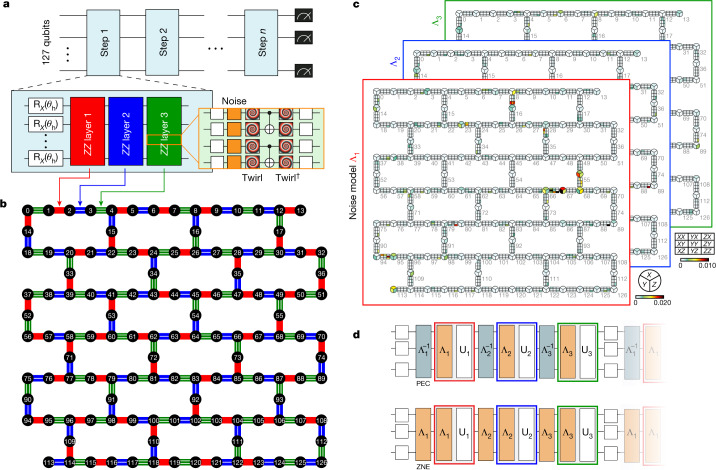
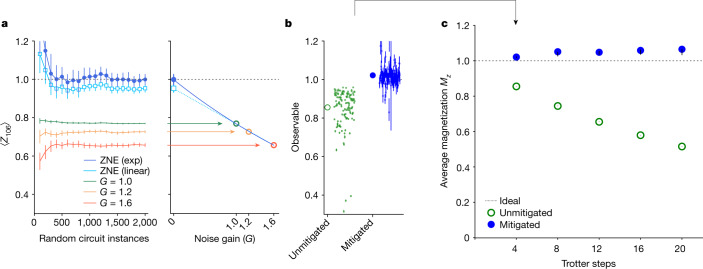
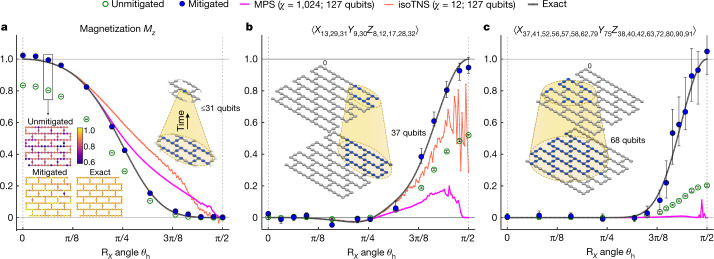
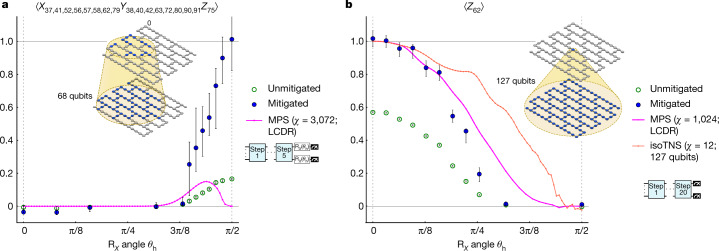
Verification
Claims the paper makes
The claims and statistics of this paper haven’t been checked yet.
Free: it reads the open-access text and checks the first 5 claims that cite a source we can check. Create a free account to check every claim.
Claims other papers make about this one
Each is checked against this paper’s own text: does it say what the citing paper says it does?
The cited source says what the claim attributes to it.
In the citing paper
“However, mobile qubit architectures, such as QCCD and optical tweezers24,25, can distribute resources more efficiently than stationary qubit architectures26–28, because qubits flow through the QPU like bits in a classical processor, with separated memory structures, data buses and logic units, each optimized for their purpose12.”
From A 98-qubit trapped-ion quantum computer with all-to-all connectivity (2026) · cites this paper as [26]
Self-check
Percentages, sums and reported differences re-computed from the paper’s own numbers.
The self-check needs the paper’s full text.
Citations
Cites
Quantum Computing in the NISQ era and beyond
Preskill, J. (2018) · Quantum · doi:10.22331/q-2018-08-06-79 · Cited by 8,830
Quantum supremacy using a programmable superconducting processor
Arute, F., Arya, K., Babbush, R., Bacon, D., Bardin, J. C., Barends, R., Biswas, R., Boixo, S., Brandao, F. G. S. L., Buell, D. A., et al. (2019) · Nature · doi:10.1038/s41586-019-1666-5 · Cited by 7,720
The density-matrix renormalization group in the age of matrix product states
Schollwöck, U. (2011) · Annals of Physics · doi:10.1016/j.aop.2010.09.012 · Cited by 4,818 · cited 2×
“Tensor networks have been widely used to approximate and compress quantum state vectors that arise in the study of the low-energy eigenstates of and time evolution by local Hamiltonians 2,32,33 and, more recently, have been successfully used to simulate low-depth noisy quantum circuits 34–36 .”
MethodCharge-insensitive qubit design derived from the Cooper pair box
Koch, J., Yu, T. M., Gambetta, J., Houck, A. A., Schuster, D. I., Majer, J., Blais, A., Devoret, M. H., Girvin, S. M., & Schoelkopf, R. J. (2007) · Physical Review A · doi:10.1103/physreva.76.042319 · Cited by 3,351 · cited 1×
“For the experimental implementation, we primarily used the IBM Eagle processor ibm_kyiv, composed of 127 fixed-frequency transmon qubits 15 with heavy-hex connectivity and median T 1 and T 2 times of 288 μs and 127 μs, respectively.”
MethodPurification of Noisy Entanglement and Faithful Teleportation via Noisy Channels
Bennett, C. H., Brassard, G., Popescu, S., Schumacher, B., Smolin, J. A., & Wootters, W. K. (1996) · Physical Review Letters · doi:10.1103/physrevlett.76.722 · Cited by 2,961 · cited 1×
“…restricting to jump operators acting on local pairs of qubits yields a sparse noise model that can be efficiently learned for many qubits and that accurately captures the noise associated with layers of two-qubit Clifford gates, including crosstalk, when combined with random Pauli twirls 23,24 .”
BackgroundNoisy intermediate-scale quantum algorithms
Bharti, K., Cervera-Lierta, A., Kyaw, T. H., Haug, T., Alperin-Lea, S., Anand, A., Degroote, M., Heimonen, H., Kottmann, J. S., Menke, T., et al. (2022) · Reviews of Modern Physics · doi:10.1103/revmodphys.94.015004 · Cited by 2,231
Improved simulation of stabilizer circuits
Aaronson, S., & Gottesman, D. (2004) · Physical Review A · doi:10.1103/physreva.70.052328 · Cited by 1,515 · cited 1×
“Clifford circuits serve as useful benchmarks of estimates produced by error mitigation, as they can be efficiently simulated classically 29 .”
BackgroundError Mitigation for Short-Depth Quantum Circuits
Temme, K., Bravyi, S., & Gambetta, J. M. (2017) · Physical Review Letters · doi:10.1103/physrevlett.119.180509 · Cited by 1,379 · cited 2×
“based on pulse stretching 9,17,18 or subcircuit repetition 20–22 have circum-vented the need for precise noise learning, while relying on simplistic assumptions about the device noise.”
BackgroundSelf-citationEvolution of entanglement entropy in one-dimensional systems
Calabrese, P., & Cardy, J. (2005) · Journal of Statistical Mechanics: Theory and Experiment · doi:10.1088/1742-5468/2005/04/p04010 · Cited by 1,295 · cited 1×
“As entanglement (bond dimension) of a generic state grows linearly (exponentially) with time evolution until it saturates the volume law, deep quantum circuits are inherently difficult for tensor networks 37 .”
BackgroundError mitigation extends the computational reach of a noisy quantum processor
Kandala, A., Temme, K., Córcoles, A. D., Mezzacapo, A., Chow, J. M., & Gambetta, J. M. (2019) · Nature · doi:10.1038/s41586-019-1040-7 · Cited by 871 · cited 2×
“based on pulse stretching 9,17,18 or subcircuit repetition 20–22 have circum-vented the need for precise noise learning, while relying on simplistic assumptions about the device noise.”
BackgroundSelf-citation
Research works printed but not linked: 5
- Shor, P. W. in Proc. 35th Annual Symposium on Foundations of Computer Science 124–134 (IEEE, 1994).
- Kitaev, A. Y. Quantum measurements and the Abelian Stabilizer Problem. Preprint at https://arxiv.org/abs/quant-ph/9511026 (1995). · arXiv
- Li Y Benjamin SC Efficient variational quantum simulator incorporating active error minimization Phys. Rev. X 2017 7 021050
- Endo S Benjamin SC Li Y Practical quantum error mitigation for near-future applications Phys. Rev. X 2018 8 031027
- Zhou Y Stoudenmire EM Waintal X What limits the simulation of quantum computers? Phys. Rev. X 2020 10 041038
Cited by
Items 401–500 of 1,005
Exploring nontrivial topology at quantum criticality on a superconducting processor
Tan, Z., Wang, K., Yang, S., Shen, F., Jin, F., Zhu, X., Ji, Y., Xu, S., Chen, J., Wu, Y., et al. (2026) · Communications Physics · doi:10.1038/s42005-026-02569-9 · Cited by 19
Self-citationAccelerating quantum imaginary-time evolution with random measurements
Kolotouros, I., Joseph, D., & Narayanan, A. K. (2025) · Physical Review A · doi:10.1103/physreva.111.012424 · Cited by 21
“We are currently entering the early fault-tolerant era , where quantum hardware improves at a fast pace, the (still small in number) qubits achieve error-correction [1, 2], and indications of useful quantum results [3] start to appear.”
BackgroundEfficient Quantum Cooling Algorithm for Fermionic Systems
Marti, L., Mansuroglu, R., & Hartmann, M. J. (2025) · Quantum · doi:10.22331/q-2025-02-18-1635 · Cited by 18
Parity-dependent state transfer for direct entanglement generation
Roy, F., Romeiro, J. H., Koch, L., Tsitsilin, I., Schirk, J., Glaser, N. J., Bruckmoser, N., Singh, M., Haslbeck, F. X., Huber, G. B. P., et al. (2025) · Nature Communications · doi:10.1038/s41467-025-57818-2 · Cited by 19
Yu, H., & Wei, T.-C. (2025) · Quantum · doi:10.22331/q-2025-05-05-1724 · Cited by 18
“In current superconducting quantum computers [20], the errors of single-qubit gates are around 10 − 4 while the SPAM error of qubits can be 10 − 2 .”
Subharmonic Control of a Fluxonium Qubit via a Purcell-Protected Flux Line
Schirk, J., Wallner, F., Huang, L., Tsitsilin, I., Bruckmoser, N., Koch, L., Bunch, D., Glaser, N. J., Huber, G. B. P., Knudsen, M., et al. (2025) · PRX Quantum · doi:10.1103/yx15-jyl7 · Cited by 18
“This potential has been enabled by collective efforts in improving circuits based on transmon qubits [4], culminating in demonstrating quantum algorithms close to practical utility [5].”
Quantum enhanced stratification of breast cancer: exploring quantum expressivity for real omics data
Repetto, V., Ceroni, E. G., Buonaiuto, G., & D’Aurizio, R. (2025) · Quantum Machine Intelligence · doi:10.1007/s42484-025-00289-x · Cited by 18
“Nevertheless is important to note that NISQ devices now available are rapidly evolving and have reached higher accuracy level, compared to the QPU used in this work [48].”
Fast quantum measurement tomography with optimal error bounds
Zambrano, L., Ramos-Calderer, S., & Kueng, R. (2026) · Quantum · doi:10.22331/q-2026-07-15-2162 · Cited by 18
“Among the different noise sources, measurement errors play a particularly important role, especially in superconducting qubit platforms where readout is often noisier than gate operations [4].”
Digital quantum simulation of non-perturbative dynamics of open systems with orthogonal polynomials
Guimarães, J. D., Vasilevskiy, M. I., & Barbosa, L. S. (2024) · Quantum · doi:10.22331/q-2024-02-05-1242 · Cited by 18
“Recently, quantum simulations of medium-large quantum systems [70, 71, 72] have been performed on superconducting quantum devices, demonstrating that more complex simulations than the ones realized in this work (see Section 4) are possible on near-term quantum devices by optimizing the quantum…”
BackgroundPłodzień, M., Wasak, T., Witkowska, E., Lewenstein, M., & Chwedeńczuk, J. (2024) · Physical Review Research · doi:10.1103/physrevresearch.6.023050 · Cited by 19
Classification of Quantum Computer Fault Injection AttacksPreprint
Xu, C., Erata, F., & Szefer, J. M. (2023) · arXiv (Cornell University) · doi:10.48550/arxiv.2309.05478 · Cited by 18
“Already, some studies have shown quantum supremacy before fault-tolerant [4, 15], though such an assertion may be controversial at this point.”
BackgroundError mitigation for logical circuits using decoder confidencePreprint
Dincă, M., Chan, T., & Benjamin, S. C. (2025) · arXiv (Cornell University) · doi:10.48550/arxiv.2512.15689 · Cited by 19
Kiss, O., Teplitskiy, D., Grossi, M., & Mandarino, A. (2025) · Quantum Science and Technology · doi:10.1088/2058-9565/addf75 · Cited by 17
“Nonetheless, recent experiments, have successfully demonstrated the practical utility of digital quantum computing [21–25], using instead quantum error mitigation [26] strategies.”
Toward scalable fault-tolerant photonic quantum computers
AbuGhanem, M. (2026) · The Journal of Supercomputing · doi:10.1007/s11227-025-08132-7 · Cited by 17
Influence of pinholes and weak-points in aluminum-oxide Josephson junctions
Bayros, K., Cyster, M. J., Smith, J. S., & Cole, J. H. (2024) · Physical Review Materials · doi:10.1103/physrevmaterials.8.046202 · Cited by 17
Adaptive projected variational quantum dynamics
Linteau, D., Barison, S., Lindner, N. H., & Carleo, G. (2024) · Physical Review Research · doi:10.1103/physrevresearch.6.023130 · Cited by 18
Quantum dynamical Hamiltonian Monte Carlo
Lockwood, O., Weiß, P., Aronshtein, F., & Verdon, G. (2024) · Physical Review Research · doi:10.1103/physrevresearch.6.033142 · Cited by 17
“Fueled by the success of machine learning (ML) [1] and recent developments in quantum computing hardware [2–7], substantial interest has developed at the intersection of these fields [8–10].”
BackgroundScalable Spin Squeezing from Critical Slowing Down in Short-Range Interacting Systems
Roscilde, T., Caleca, F., Angelone, A., & Mezzacapo, F. (2024) · Physical Review Letters · doi:10.1103/physrevlett.133.210401 · Cited by 17
Scalable Parameter Design for Superconducting Quantum Circuits with Graph Neural Networks
Ai, H., & Liu, Y.-X. (2025) · Physical Review Letters · doi:10.1103/yr9d-7z8k · Cited by 17
“S6(a), where three frequency-adjustable transmons [9] are capacitively coupled in pairs.”
Operating Semiconductor Qubits without Individual Barrier Gates
Ivlev, A., Crielaard, D. R., Meyer, M., Lawrie, W. I. L., Hendrickx, N. W., Sammak, A., Matsumoto, Y., Vandersypen, L. M. K., Scappucci, G., Déprez, C., et al. (2025) · Physical Review X · doi:10.1103/xhq3-4jxz · Cited by 17
“While various platforms are scaling to tens and even hundreds of qubits [1–4], a similar increase in the number of qubits with gate-defined quantum dots has remained challenging [5–7].”
Scaling up to problem sizes: an environmental life cycle assessment of quantum computing
Cordier, S., Thibault, K., Arpin, M.-L., & Amor, B. (2025) · Quantum Science and Technology · doi:10.1088/2058-9565/adc0ba · Cited by 17
“However, scaling to solve industrially relevant problems requires fault tolerance through QEC [12].”
Calculating the Energy Profile of an Enzymatic Reaction on a Quantum Computer
Ettenhuber, P., Hansen, M. B., Poier, P. P., Shaik, I., Rasmussen, S. E., Madsen, N. K., Majland, M., Jensen, F., Olsen, L., & Zinner, N. T. (2025) · Journal of Chemical Theory and Computation · doi:10.1021/acs.jctc.5c00022 · Cited by 17
“25 Recently, the question was raised whether NISQ devices were able to perform useful work beyond the reach of classical devices, 27 coining the expression quantum utility .”
Simulation of open quantum systems on universal quantum computers
Liu, H., Lin, X., Chen, Z., Xue, C., Sun, T., Li, Q.-S., Zhuang, X., Wang, Y.-J., Wu, Y.-C., Gong, M., et al. (2025) · Quantum · doi:10.22331/q-2025-06-05-1765 · Cited by 17
“With efficient implementable unitary quantum gates, simulating quantum systems with these hardware has become a stirring research forefront [3, 8, 10, 11, 12].”
Self-citationEfficient Lindblad synthesis for noise model construction
Malekakhlagh, M., Seif, A., Puzzuoli, D., Govia, L. C. G., & van den Berg, E. (2025) · npj Quantum Information · doi:10.1038/s41534-025-01139-1 · Cited by 17
Quantum Computing for Climate Change Detection, Climate Modeling, and Climate Digital TwinPreprint
Otgonbaatar, S., Nurmi, O., Johansson, M. P., Mäkelä, J., kocman, T., Gawron, P., Puchała, Z., Mielzcarek, J., Miroszewski, A., & Dumitru, C. O. (2023) · doi:10.36227/techrxiv.24478663.v1 · Cited by 17
Electron-beam annealing of Josephson junctions for frequency tuning of quantum processorsPreprint
Balaji, Y., Acharya, N., Armstrong, R., Crawford, K. G., Danilin, S., Dixon, T., Kennedy, O. W., Pothuraju, R. D., Shahbazi, K., & Shelly, C. D. (2024) · arXiv (Cornell University) · doi:10.48550/arxiv.2402.17395 · Cited by 17
“The pursuit of fault-tolerant quantum computers with effective error mitigation resulted in recent demonstrations showcasing a quantum advantage over classical computers [2–4].”
BackgroundIceberg Beyond the Tip: Co-Compilation of a Quantum Error Detection Code and a Quantum AlgorithmPreprint
Jin, Y., He, Z., Hao, T., Omanakuttan, S., Amaro, D., Tannu, S., Shaydulin, R., & Pistoia, M. (2025) · arXiv (Cornell University) · doi:10.48550/arxiv.2504.21172 · Cited by 19
“These methods, including probabilistic error cancellation [38], [73], typically involve repeated execution of modified circuits and have demonstrated practical success, even for circuits with more than 100 qubits.”
A 98-qubit trapped-ion quantum computer with all-to-all connectivity
Ransford, A., Allman, M. S., Arkinstall, J., Campora, J. P., Cooper, S. F., Delaney, R. D., Dreiling, J. M., Estey, B., Figgatt, C., Hall, A., et al. (2026) · Nature · doi:10.1038/s41586-026-10676-4 · Cited by 16
“As well as the mirrored random circuits run to assess RCS performance, we also directly sampled the output of a single (unmirrored) random circuit of depth d = 26.”
InfluentialDigital Quantum Simulation of Spin Transport
Lee, Y.-T., Pokharel, B., Cohn, J., Schleife, A., & Banerjee, A. (2026) · Physical Review Letters · doi:10.1103/mx9k-kdlj · Cited by 16
Buchs, G., Beck, T. L., Bennink, R. S., Claudino, D., Delgado, A., Fadel, N. A., Groszkowski, P., Hamilton, K. E., Humble, T. S., Kumar, N., et al. (2026) · Future Generation Computer Systems · doi:10.1016/j.future.2026.108487 · Cited by 16
“As previously outlined in section 4.1, a more practically relevant milestone is quantum utility [345, 346], which focuses on the ability of a quantum computer to generate computational value that exceeds its cost [127], as an intermediate step towards a tangible quantum advantage for solving…”
InfluentialEngineering Arbitrary Hamiltonians in Phase Space
Guo, L., & Peano, V. (2024) · Physical Review Letters · doi:10.1103/physrevlett.132.023602 · Cited by 16
Experimental Virtual Distillation of Entanglement and Coherence
Zhang, T., Zhang, Y., Liu, L., Fang, X., Zhang, Q., Yuan, X., & Lu, H. (2024) · Physical Review Letters · doi:10.1103/physrevlett.132.180201 · Cited by 16
Gate operations for superconducting qubits and non-Markovianity
Nakamura, K., & Ankerhold, J. (2024) · Physical Review Research · doi:10.1103/physrevresearch.6.033215 · Cited by 16
“…progress in developing quantum computing platforms, in particular based on superconducting circuits: Coherence times [1, 2] as well as gate fidelities [3–5] have been substantially increased, and multiqubit architectures have demonstrated quantum supremacy under specific conditions [6–8].”
BackgroundQuantum topological data analysis via the estimation of the density of states
Scali, S., Umeano, C., & Kyriienko, O. (2024) · Physical Review A · doi:10.1103/physreva.110.042616 · Cited by 16
“We stress that this has been achieve with no standard error mitigation techniques [42], which could be implemented to further improve performance on hardware [43].”
MethodDigitized counterdiabatic quantum algorithms for logistics scheduling
Dalal, A., Montalban, I., Hegade, N. N., Cadavid, A. G., Solano, E., Awasthi, A., Vodola, D., Jones, C. R., Weiß, H., & Füchsel, G. (2024) · Physical Review Applied · doi:10.1103/physrevapplied.22.064068 · Cited by 16
“On the other hand, claims of “quantum supremacy” and “quantum utility” have been established using NISQ devices for non-industry-relevant problems [4–6].”
BackgroundUmer, M., Mastorakis, E., Evangelou, S., & Angelakis, D. G. (2025) · Physical Review A · doi:10.1103/physreva.111.012626 · Cited by 16
Enhanced feature encoding and classification on distributed quantum hardware
Moretti, R., Giachero, A., Radescu, V. A. M., & Grossi, M. (2025) · Machine Learning Science and Technology · doi:10.1088/2632-2153/adb4bc · Cited by 16
“The ongoing advancements of quantum computing hardware, in the era of quantum utility [1, 2], are driving significant interest in leveraging intermediate-scale quantum devices available today across many research fields.”
Hacking Cryptographic Protocols with Advanced Variational Quantum Attacks
Aizpurua, B., Bermejo, P., Martínez, J. E., & Orús, R. (2025) · ACM Transactions on Quantum Computing · doi:10.1145/3718349 · Cited by 16
“This also motivates the exploration of more complex structures within the quantum circuit to enhance the update of variational parameters.”
Imaginary Hamiltonian variational Ansatz for combinatorial optimization problems
Wang, X., Chai, Y., Feng, X., Guo, Y., Jansen, K., & Tüysüz, C. (2025) · Physical Review A · doi:10.1103/physreva.111.032612 · Cited by 16
“…meas[53]meas[54]meas[55]meas[56]meas[57]meas[58]meas[59]meas[60]meas[61]meas[62]meas[63]meas[64] meas[65]meas[66]meas[67]meas[68]meas[69]meas[70]meas[71]meas[72]meas[73]meas[74]meas[75]meas _ expectation Var( H MC ⟩ ).”
Ding, Q., Oppenheim, A. V., Boufounos, P. T., Gustavsson, S., Grover, J. A., Baran, T. A., & Oliver, W. D. (2025) · Physical Review Applied · doi:10.1103/yskp-mfcr · Cited by 16
“Over the past decades, superconducting qubits have emerged as a leading platform for quantum computing, with several advances in terms of gate fidelity, extensibility, and use-case demonstrations [6–8].”
Liao, H., Hartnett, G. S., Kakkar, A., Tan, A. T. K., Hush, M., Mundada, P., Biercuk, M. J., & Baum, Y. (2025) · PRX Quantum · doi:10.1103/prxquantum.6.020331 · Cited by 16
Tensor Network Enhanced Dynamic Multiproduct Formulas
Robertson, N., Pokharel, B., Fuller, B., Switzer, E. D., Shtanko, O., Amico, M., Byrne, A., D'Urbano, A., Hayes-Shuptar, S., Akhriev, A., et al. (2025) · PRX Quantum · doi:10.1103/8bzc-dlgt · Cited by 16
“In turn, this allows us to model the device noise as a sparse Pauli-Lindblad model of the form Here K correspond to single and two-qubit Pauli terms on the qubits on which gates are being actively applied [32].”
MethodSuppressing Spurious Transitions Using Spectrally Balanced Pulse
Wang, R., Feng, Y., Zhang, Y., Ding, J., Li, B., Motzoi, F., Gao, Y., Xu, H., Yang, Z., Nuerbolati, W., et al. (2025) · Physical Review Letters · doi:10.1103/h4xf-vq2l · Cited by 16
“Introduction — Quantum information processing technologies have made significant progress, achieving coherent control over systems with about 100 qubits [1–6].”
Wadhwa, C., Lewis, L., Kashefi, E., & Doosti, M. (2025) · PRX Quantum · doi:10.1103/q2nb-zg9m · Cited by 16
Quantum computing for automotive applications
Riofrío, C. A., Klepsch, J., Finžgar, J. R., Kiwit, F. J., Hölscher, L., Erdmann, M., Müller, L., Kumar, C., Berrada, Y. A., & Luckow, A. (2025) · Elsevier eBooks · doi:10.1016/b978-0-44-330259-6.00020-7 · Cited by 16
Low crosstalk in a scalable superconducting quantum lattice
Alghadeer, M., Cao, S., Fasciati, S. D., Piscitelli, M., Gow, P. C., Gates, J. C., Bakr, M. S., & Leek, P. (2026) · EPJ Quantum Technology · doi:10.1140/epjqt/s40507-026-00465-3 · Cited by 16
“Realizing large-scale superconducting quantum circuits containing individually addressable, high-coherence qubits remains a significant hardware challenge toward utility-scale quantum computing 1,2 .”
Quantum Information with Integrated Photonics
Piergentili, P., Amanti, F., Andrini, G., Armani, F., Bellani, V., Bonaiuto, V., Cammarata, S., Campostrini, M., Cornia, S., Dao, T. H., et al. (2023) · Applied Sciences · doi:10.3390/app14010387 · Cited by 16
Towards near-term quantum simulation of materialsPreprint
Clinton, L., Cubitt, T. S., Flynn, B., Gambetta, F. M., Klassen, J., Montanaro, A., Piddock, S., Santos, R. A., & Sheridan, E. (2022) · arXiv (Cornell University) · doi:10.48550/arxiv.2205.15256 · Cited by 16
“Furthermore, IBM has run accurate Hamiltonian simulation experiments involving approximately 3000 two-qubit gates 69 .”
Quantum HyperNetworks: Training Binary Neural Networks in Quantum SuperpositionPreprint
Carrasquilla, J., Hibat-Allah, M., Inack, E. M., Makhzani, A., Neklyudov, K., Taylor, G. W., & Torlai, G. (2023) · arXiv (Cornell University) · doi:10.48550/arxiv.2301.08292 · Cited by 16
“Out a heavy-hexagon lattice with 127 qubits, such as the one in the IBM Eagle processor [30], it is possible to use 109 qubits arranged in a one dimensional fashion.”
Multiplexed control scheme for scalable quantum information processing with superconducting qubitsPreprint
Shi, P., Yuan, J., Yan, F., & Yu, H. (2023) · arXiv (Cornell University) · doi:10.48550/arxiv.2312.06911 · Cited by 16
Quantum simulation of Fermi-Hubbard model based on transmon qudit interactionPreprint
Vezvaee, A., Earnest, N., & Najafi, K. (2024) · arXiv (Cornell University) · doi:10.48550/arxiv.2402.01243 · Cited by 16
Syndrome aware mitigation of logical errorsPreprint
Aharonov, D., Atia, Y., Bairey, E., Brakerski, Z., Cohen, I., Golan, O., Gurwich, I., Lindner, N. H., & Shutman, M. (2025) · arXiv (Cornell University) · doi:10.48550/arxiv.2512.23810 · Cited by 16
“It is expected that QPUs paired with EM protocols will soon provide the first useful finite QAs [30, 39–42], and there are already claims that EM has reliably estimated the output of ideal quantum circuits that cannot be simulated with super-computers in reasonable time [43–46].”
Helios: A 98-qubit trapped-ion quantum computer
Ransford, A., & Bohnet, J. (2025) · doi:10.21203/rs.3.rs-8130124/v1 · Cited by 16
FTCircuitBench: A Benchmark Suite for Fault-Tolerant Quantum Compilation and Architecture
Harkness, A., Kan, S., Liu, C., Wang, M., Martyn, J. M., Xu, S., Chamaki, D., Decker, E., Mao, Y., Zuluaga, L. F., et al. (2026) · ACM Transactions on Quantum Computing · doi:10.1145/3858421 · Cited by 16
Scalable quantum measurement error mitigation via conditional independence and transfer learning
Lee, C., & Park, D. K. (2023) · Machine Learning Science and Technology · doi:10.1088/2632-2153/ad1007 · Cited by 15
“In fact, QEM plays a crucial role in the Noisy Intermediate-Scale Quantum (NISQ) era [17], as it maximizes the utilization of limited quantum resources and expands the capacity of quantum systems for solving real-world problems [18, 19].”
BackgroundUniversal imaginary-time critical dynamics on a quantum computer
Zhang, S., & Yin, S. (2024) · Physical review. B./Physical review. B · doi:10.1103/physrevb.109.134309 · Cited by 15
Machine learning of reduced quantum channels on noisy intermediate-scale quantum devices
Cemin, G., Cech, M., Weiss, E., Sołtan, S., Braun, D., Lesanovsky, I., & Carollo, F. (2024) · Physical Review A · doi:10.1103/physreva.110.052418 · Cited by 17
“This is possible even with relatively small data sets, which is important for applications such as calibration and error mitigation [19, 43–47].”
BackgroundHexagonal Boron Nitride Quantum Simulator: Prelude to Spin and Photonic Qubits
Cobarrubia, A., Schottle, N., Suliman, D., Gomez-Barron, S., Patino, C. R., Kiefer, B., & Behura, S. K. (2024) · ACS Nano · doi:10.1021/acsnano.4c04240 · Cited by 15
Alvarez, P. H., Chowdhury, F. T., Smith, L. D., Brokowski, T. J., Aiello, C. D., Kattnig, D. R., & de Oliveira, M. C. (2024) · APL Quantum · doi:10.1063/5.0213120 · Cited by 15
Localized Virtual Purification
Hakoshima, H., Endo, S., Yamamoto, K., Matsuzaki, Y., & Yoshioka, N. (2024) · Physical Review Letters · doi:10.1103/physrevlett.133.080601 · Cited by 16
Efficient Decoupling of a Nonlinear Qubit Mode from Its Environment
Pfeiffer, F., Werninghaus, M., Schweizer, C., Bruckmoser, N., Koch, L., Glaser, N. J., Huber, G. B. P., Bunch, D., Haslbeck, F. X., Knudsen, M., et al. (2024) · Physical Review X · doi:10.1103/physrevx.14.041007 · Cited by 15
M2CS: A microwave measurement and control system for large-scale superconducting quantum processors
Zhang, J., Sun, X., Guo, Z., Yuan, Y., Zhang, Y., Chu, J., Huang, W., Liang, Y., Qiu, J., 孙, D. 大. S., et al. (2024) · Chinese Physics B · doi:10.1088/1674-1056/ad8a49 · Cited by 15
Direct probe of topology and geometry of quantum states on the IBM Q quantum processor
Chen, T., Ding, H.-T., Shen, R.-Z., Zhu, S.-L., & Gong, J. (2024) · Physical review B · doi:10.1103/physrevb.110.205402 · Cited by 8
Simulating the Landau–Zener sweep in deeply sub-Ohmic environments
Kahlert, F., Link, V., Hartmann, R., & Strunz, W. T. (2024) · The Journal of Chemical Physics · doi:10.1063/5.0235741 · Cited by 15
McFadden, A., Goswami, A., Zhao, T., van Schijndel, T. A. J., Larson, T. F. Q., Sahu, S., Gill, S. J., Lecocq, F., Simmonds, R. W., & Palmstrøm, C. J. (2025) · npj Quantum Information · doi:10.1038/s41534-025-00967-5 · Cited by 15
Umeano, C., Jamet, F., Lindoy, L. P., Rungger, I., & Kyriienko, O. (2025) · Physical Review Materials · doi:10.1103/physrevmaterials.9.034401 · Cited by 15
Partitioned Quantum Subspace Expansion
O’Leary, T., Anderson, L. W., Jaksch, D., & Kiffner, M. (2025) · Quantum · doi:10.22331/q-2025-05-05-1726 · Cited by 15
“This assumption can be motivated by considering applying this technique in either i) the regime where quantum error mitigation can still be effectively applied, but classical simulation is not possible [34]; ii) the regime of fault tolerant quantum computing.”
Practicality of training a quantum-classical machine in the noisy intermediate-scale quantum era
Dutta, T., Jin, A., Huihong, C. L., Latorre, J. I., & Mukherjee, M. (2025) · iScience · doi:10.1016/j.isci.2025.113058 · Cited by 15
Quantum-computer-based verification of quantum thermodynamic uncertainty relation
Ishida, N., & Hasegawa, Y. (2025) · Physical review. E · doi:10.1103/9xpz-62cw · Cited by 15
“5b, we present results obtained using the previous-generation “Eagle” processor [63, 65, 72].”
Noisy HQNNs: A Comprehensive Analysis of Noise Robustness in Hybrid Quantum Neural Networks
Ahmed, T., Marchisio, A., Kashif, M., & Shafique, M. (2025) · International Joint Conference on Neural Networks (IJCNN) · doi:10.1109/ijcnn64981.2025.11229153 · Cited by 16
Hardware-Efficient Quantum Phase Estimation via Local Control
Schiffer, B. F., Wild, D. S., Maskara, N., Lukin, M. D., & Cirac, J. I. (2025) · PRX Quantum · doi:10.1103/zlp8-rz9n · Cited by 16
“For instance, the method also applies to Floquet dynamics with large time steps, where an explicit Hamiltonian representation may not be available [27, 28].”
Computing n -Time Correlation Functions without Ancilla Qubits
Wang, X., Xiong, L., Cai, X., & Yuan, X. (2025) · Physical Review Letters · doi:10.1103/z126-zdqj · Cited by 15
SWAP-less implementation of quantum algorithms
Klaver, B., Rombouts, S. M. A., Fellner, M., Messinger, A., Ender, K., Ludwig, K., & Lechner, W. (2025) · Physical Review A · doi:10.1103/2wzk-fnhx · Cited by 15
Khan, S. A., Prabhu, S., Wright, L. G., & McMahon, P. L. (2026) · npj Quantum Information · doi:10.1038/s41534-026-01235-w · Cited by 15
Classical simulation of noisy quantum circuits via locally entanglement-optimal unravelings
Cichy, S., Faehrmann, P. K., Bittel, L., Eisert, J., & Pashayan, H. (2026) · Physical Review A · doi:10.1103/jj2r-y777 · Cited by 16
Li, H.-X., Shiri, D., Kosen, S., Rommel, M., Chayanun, L., Nylander, A., Rehammar, R., Tancredi, G., Caputo, M., Grigoras, K., et al. (2023) · IEEE Transactions on Quantum Engineering · doi:10.1109/tqe.2023.3302371 · Cited by 15
“Flip-chip integration technology has been demonstrated to be compatible with high-quality qubits [3], [4], [5], [6], [7], [8], [9].”
BackgroundConvergence of digitized-counterdiabatic QAOA: circuit depth versus free parameters
Vizzuso, M., Passarelli, G., Cantele, G., & Lucignano, P. (2024) · New Journal of Physics · doi:10.1088/1367-2630/ad1536 · Cited by 15
Dellios, A. S., Opanchuk, B., Goodman, N., Reid, M. D., & Drummond, P. D. (2025) · Physics Letters A · doi:10.1016/j.physleta.2025.130529 · Cited by 15
“Verification of large gate-based quantum computers is currently restricted to sub-classes of programs that allow benchmarking, or else uses extrapolation to larger sizes than can be verified directly [7].”
Quantum Error Mitigation for Sampling AlgorithmsPreprint
Liu, K., & Cai, Z. (2025) · arXiv (Cornell University) · doi:10.48550/arxiv.2502.11285 · Cited by 16
GroverGPT: A Large Language Model with 8 Billion Parameters for Quantum SearchingPreprint
Wang, H., Li, P., Chen, M., Cheng, J., Liu, J., & Chen, T. (2026) · Research Square · doi:10.21203/rs.3.rs-8816953/v1 · Cited by 15
Observable Estimation in the Absence of Classical VerificationPreprint
Barron, S. V., Mitchell, B., Tripathi, V., Grieco, F., Rosen, I. T., Pietracaprina, F., Materia, D., Seif, A., Wanisch, D., Panadés‐Barrueta, R. L., et al. (2026) · arXiv (Cornell University) · doi:10.48550/arxiv.2607.25998 · Cited by 15
Self-citationmRNA Secondary Structure Prediction Using Utility-Scale Quantum Computers
Alevras, D., Metkar, M., Yamamoto, T., Kumar, V., Friedhoff, T., Park, J.-E., Takeori, M., LaDue, M., Davis, W., & Galda, A. (2024) · 2024 IEEE International Conference on Quantum Computing and Engineering (QCE) · doi:10.1109/qce60285.2024.00064 · Cited by 14
“In order to keep the error mitigation overhead to “minimal”, we do not consider mitigation schemes like ZNE [23], [66], [67] and PEC [68] in this work.”
Huang, J. L. L., & Emeakaroha, V. C. (2024) · SN Computer Science · doi:10.1007/s42979-024-02761-0 · Cited by 14
“A good number of researches use quantum computers from one CSP to perform calculations based on hybrid algorithms, for example [5, 6].”
Mitigating photon loss in linear optical quantum circuits
Mills, J., & Mezher, R. (2026) · Quantum · doi:10.22331/q-2026-03-16-2030 · Cited by 14
Quantum-centric high performance computing for quantum chemistry
Liu, J., Ma, H., Shang, H., Li, Z., & Yang, J. (2024) · Physical Chemistry Chemical Physics · doi:10.1039/d4cp00436a · Cited by 14
Increasing the Measured Effective Quantum Volume with Zero Noise Extrapolation
Pelofske, E., Russo, V., LaRose, R., Mari, A., Strano, D., Bärtschi, A., Eidenbenz, S., & Zeng, W. J. (2024) · ACM Transactions on Quantum Computing · doi:10.1145/3680290 · Cited by 14
“Zero-Noise Extrapolation (ZNE) [14, 16, 20, 22–24, 26, 31, 39, 44, 45] is a general-purpose error mitigation algorithm that uses expectation values computed at different noise levels so as to extrapolate the computation to its zero-noise limit.”
A brief history of quantum vs classical computational advantage
LaRose, R. (2026) · Quantum · doi:10.22331/q-2026-09-01-2198 · Cited by 16
“On Jun 14 2023, researchers from IBM report quantum simulation of the transverse field Ising model [17] defined by H = − J ⟨ i,j ⟩ Z i Z j + h i X i , on an n = 127 qubit processor with two-dimensional connectivity ⟨ i, j ⟩ .”
Quantum Hardware Roofline: Evaluating the Impact of Gate Expressivity on Quantum Processor Design
Kalloor, J., Weiden, M., Younis, E., Kubiatowicz, J. D., Jong, B. D., & Iancu, C. (2024) · IEEE International Conference on Quantum Computing and Engineering (QCE) · doi:10.1109/qce60285.2024.00100 · Cited by 14
“While existing hardware offerings are not mature enough to provide realistic quantum advantage [1] or quantum utility [21], they can be used as a good indicator of the future.”
QuaCK-TSF: Quantum-Classical Kernelized Time Series Forecasting
Aaraba, A., Cherkaoui, S., Ahmad, O. S., Laprade, J., Nahman-Lévesque, O., Vieloszynski, A., & Wang, S. (2024) · IEEE International Conference on Quantum Computing and Engineering (QCE) · doi:10.1109/qce60285.2024.00190 · Cited by 14
“Quantum computing is poised to revolutionize both scientific research and industrial applications [1]–[4], driven by rapid hardware advancements [5]–[7] and significant algorithmic developments aimed at harnessing quantum advantage beyond basic demonstrations [8]–[11].”
Cut&Shoot: Cutting & Distributing Quantum Circuits Across Multiple NISQ Computers
Bisicchia, G., Bocci, A., García-Alonso, J. M., Murillo, J. M., & Brogi, A. (2024) · IEEE International Conference on Quantum Computing and Engineering (QCE) · doi:10.1109/qce60285.2024.10276 · Cited by 14
QuaLITi: Quantum Machine Learning Hardware Selection for Inferencing with Top-Tier Performance
Phalak, K., & Ghosh, S. (2025) · International Conference on VLSI Design · doi:10.1109/vlsid64188.2025.00064 · Cited by 14
“…of superposition, entanglement, and quantum interference, offers unprecedented computational advantages, promising revolutionary breakthroughs [2], [3] in various disciplines, including cryptography [4], finance [5], [6], chemistry and material science [7], and healthcare [8]. time (A) Brisbane 5h…”
Seifert, L. M., Dangwal, S., Chong, F. T., & Ravi, G. S. (2024) · International Conference on Architectural Support for Programming Languages and Operating Systems (ASPLOS) · doi:10.1145/3622781.3674178 · Cited by 14
“Despite these limitations, there is potential for near-term quantum advantage in certain tasks such as optimization [15], physics [27], and chemistry [35].”
Adversarial Data Poisoning Attack on Quantum Machine Learning in the NISQ Era
Kundu, S., & Ghosh, S. (2025) · ACM Great Lakes Symposium on VLSI (GLSVLSI) · doi:10.1145/3716368.3735244 · Cited by 14
Distributing Quantum Computations, Shot-Wise
Bisicchia, G., Clemente, G., García-Alonso, J. M., Murillo, J. M., D’Elia, M., & Brogi, A. (2025) · Future Internet · doi:10.3390/fi17110507 · Cited by 15
A circuit-differentiation framework for Green's functions on quantum computers
Piccinelli, S., Tacchino, F., Tavernelli, I., & Carleo, G. (2026) · Quantum · doi:10.22331/q-2026-04-13-2060 · Cited by 14
“…computational paradigm to address this class of problems [1, 2, 3], and recent demonstrations of quantum simulations at the so-called quantum utility scale [4] have opened the way to the use of digital quantum Samuele Piccinelli: samuele.piccinelli@ibm.com Francesco Tacchino: fta@zurich.ibm.com .”
Experimentally informed decoding of stabilizer codes based on syndrome correlations
Remm, A., Lacroix, N., Bödeker, L., Genois, É., Hellings, C., Swiadek, F., Norris, G. J., Eichler, C., Blais, A., Müller, M., et al. (2026) · Physical Review Research · doi:10.1103/z1ng-wg3k · Cited by 15
Dispatching Shots Among Multiple Quantum Computers: An Architectural Proposal
Bisicchia, G., García-Alonso, J. M., Murillo, J. M., & Brogi, A. (2023) · IEEE International Conference on Quantum Computing and Engineering (QCE) · doi:10.1109/qce57702.2023.10210 · Cited by 14
“Research in Quantum Computing is accelerating and new promising results are published every day [1].”
BackgroundTeixeira, W. S., Mörstedt, T., Viitanen, A., Kivijärvi, H., Gunyhó, A., Tiiri, M., Kundu, S., Sah, A., Vadimov, V., & Möttönen, M. (2024) · Scientific Reports · doi:10.1038/s41598-024-64496-5 · Cited by 14
Guimarães, J. D., Ruiz-Molero, A., Lim, J., Vasilevskiy, M. I., Huelga, S. F., & Plenio, M. B. (2024) · Physical Review A · doi:10.1103/physreva.109.052224 · Cited by 14
Designing complex concentrated alloys with quantum machine learning and language modeling
Pei, Z., Gong, Y., Liu, X., & Yin, J. (2024) · Matter · doi:10.1016/j.matt.2024.05.035 · Cited by 14
“It is meaningful to explore fault tolerance applications of the noisy hardware 61 .”
Background
Metadata
- Authors
- Kim, Y., Eddins, A., Anand, S., Wei, K. X., van den Berg, E., Rosenblatt, S., Nayfeh, H., Wu, Y., Zaletel, M., Temme, K., & Kandala, A.
- Affiliations
- IBM Research - Cambridge (United States) (US)
- University of California, Berkeley (US)
- IBM (United States) (US)
- RIKEN (JP)
- Lawrence Berkeley National Laboratory (US)
- Corresponding author
- Eddins, Andrew
- Kandala, Abhinav
- ORCID
- Venue
- Nature
- Published
- 2023-06-14
- Volume
- 618
- Issue
- 7965
- Pages
- 500-505
- ISSN
- 0028-0836 (ISSN-L)
- 1476-4687
- PMC
- PMC10266970
- OpenAlex
- W4380627387
- Semantic Scholar
- f9253a3e2627f1c2a0a7e2cea320a4ec4e4d2ff9
- Cited by
- 1,050
- References
- 41
- Citations by year
- 2026: 226 · 2025: 399 · 2024: 358 · 2023: 67
- FWCI
- 98.85
- Type
- journal article
- Language
- en
- Open access
- hybrid
- doi.org
- Licence
- cc-by
- creativecommons.org/licenses/by/4.0 (tdm)
- creativecommons.org/licenses/by/4.0 (vor)
- Locations
- Nature (publishedVersion, cc-by)
- PubMed Central (publishedVersion, cc-by)
- PubMed (publishedVersion)
- eScholarship (California Digital Library) (submittedVersion, cc-by)
- OSTI OAI (U.S. Department of Energy Office of Scientific and Technical Information) (submittedVersion)
- RePEc: Research Papers in Economics (submittedVersion)
- Funders
- National Science Foundation (DEAC02-05CH11231, 2137603, 2138259, 2138296, 2138307, 2138286)
- U.S. Department of Energy (-AC02-05CH11231, 05CH11231, DE AC02 05CH11231, DESC0022716, DE-AC02-)
- National Energy Research Scientific Computing Center (DE–AC02–05CH11231, 05CH11231, AC02-05CH11231)
- Office of Science (DEAC02–05CH11231, AC02-05CH11231, DE-AC02)
- Office of Advanced Cyberinfrastructure (#2138286, #2138296, 2138259, #2138307, 2137603)
- Basic Energy Sciences (DE-AC02, DE-AC02-05CH11231., AC02–05CH11231)
- Lawrence Berkeley National Laboratory (AC02‐05CH11231, DE-AC02-05CH11231, 05CH11231)
- Topics
- Physical Sciences › Computer Science › Artificial Intelligence › Quantum Computing Algorithms and Architecture
- Physical Sciences › Physics and Astronomy › Atomic and Molecular Physics, and Optics › Quantum Information and Cryptography
- Physical Sciences › Physics and Astronomy › Atomic and Molecular Physics, and Optics › Quantum many-body systems
- Keywords
- quantum computing, NISQ devices, superconducting qubits, noise characterization, tensor network states, matrix product states, entanglement, quantum advantage
About these checks
Registry, retraction, Cites and statistics results are computed, not judged, with one exception: a printed reference that no index lists is read once by a model before it counts as a citation error. Claims are extracted by a model and kept only when their quote appears verbatim in the text; each cited source is then checked, with a model’s help, for whether it says what the claim relies on. Those verdicts can be wrong — read the claim’s quote and the cited source before relying on one.
Statistics and arithmetic are recomputed, not judged.
Confidence bands are shown only for fields calibrated on our annotated test set. None is calibrated yet, so no band is shown.
What counts as a claim ›How we measure confidence ›How we check this ›
Are you an author, or do you see a problem with this page? Request a review
Data sources
Bibliographic data: Semantic Scholar, OpenAlex, Crossref.
Contains information from the Semantic Scholar Academic Graph Datasets, made available under the ODC Attribution License (ODC-BY 1.0).
Semantic Scholar’s data is described in: Kinney, R., et al. (2023). The Semantic Scholar Open Data Platform. arXiv:2301.10140.
