

Evidence for the utility of quantum computing before fault tolerance
Open accessThe DOI matches its Crossref record; 43 of the 43 references it cites were found in a registry or an index.
Abstract
Quantum computing promises to offer substantial speed-ups over its classical counterpart for certain problems. However, the greatest impediment to realizing its full potential is noise that is inherent to these systems. The widely accepted solution to this challenge is the implementation of fault-tolerant quantum circuits, which is out of reach for current processors. Here we report experiments on a noisy 127-qubit processor and demonstrate the measurement of accurate expectation values for circuit volumes at a scale beyond brute-force classical computation. We argue that this represents evidence for the utility of quantum computing in a pre-fault-tolerant era. These experimental results are enabled by advances in the coherence and calibration of a superconducting processor at this scale and the ability to characterize 1 and controllably manipulate noise across such a large device. We establish the accuracy of the measured expectation values by comparing them with the output of exactly verifiable circuits. In the regime of strong entanglement, the quantum computer provides correct results for which leading classical approximations such as pure-state-based 1D (matrix product states, MPS) and 2D (isometric tensor network states, isoTNS) tensor network methods 2,3 break down. These experiments demonstrate a foundational tool for the realization of near-term quantum applications 4,5 .
Overview
The claims and statistics of this paper haven’t been checked yet.
Free: it reads the open-access text and checks the first 5 claims that cite a source we can check. Create a free account to check every claim.
Integrity signals
Registry
Cites
Statistics
Figures
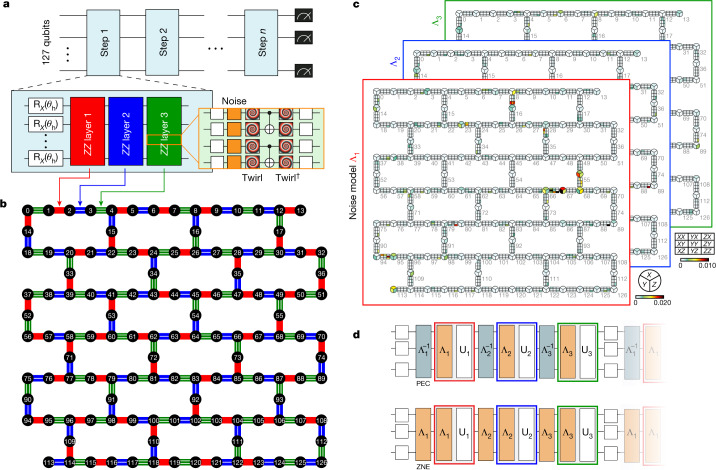
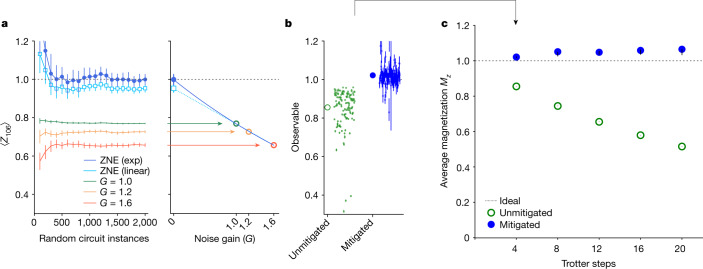
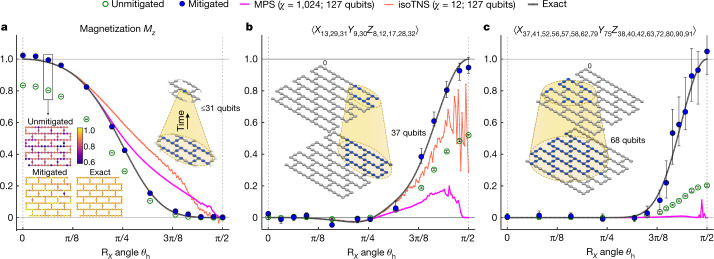
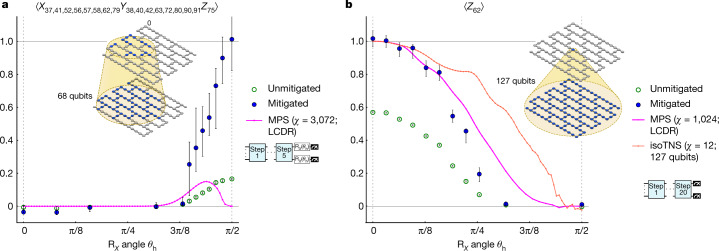
Verification
Claims the paper makes
The claims and statistics of this paper haven’t been checked yet.
Free: it reads the open-access text and checks the first 5 claims that cite a source we can check. Create a free account to check every claim.
Claims other papers make about this one
Each is checked against this paper’s own text: does it say what the citing paper says it does?
The cited source says what the claim attributes to it.
In the citing paper
“However, mobile qubit architectures, such as QCCD and optical tweezers24,25, can distribute resources more efficiently than stationary qubit architectures26–28, because qubits flow through the QPU like bits in a classical processor, with separated memory structures, data buses and logic units, each optimized for their purpose12.”
From A 98-qubit trapped-ion quantum computer with all-to-all connectivity (2026) · cites this paper as [26]
Self-check
Percentages, sums and reported differences re-computed from the paper’s own numbers.
The self-check needs the paper’s full text.
Citations
Cites
Quantum Computing in the NISQ era and beyond
Preskill, J. (2018) · Quantum · doi:10.22331/q-2018-08-06-79 · Cited by 8,830
Quantum supremacy using a programmable superconducting processor
Arute, F., Arya, K., Babbush, R., Bacon, D., Bardin, J. C., Barends, R., Biswas, R., Boixo, S., Brandao, F. G. S. L., Buell, D. A., et al. (2019) · Nature · doi:10.1038/s41586-019-1666-5 · Cited by 7,720
The density-matrix renormalization group in the age of matrix product states
Schollwöck, U. (2011) · Annals of Physics · doi:10.1016/j.aop.2010.09.012 · Cited by 4,818 · cited 2×
“Tensor networks have been widely used to approximate and compress quantum state vectors that arise in the study of the low-energy eigenstates of and time evolution by local Hamiltonians 2,32,33 and, more recently, have been successfully used to simulate low-depth noisy quantum circuits 34–36 .”
MethodCharge-insensitive qubit design derived from the Cooper pair box
Koch, J., Yu, T. M., Gambetta, J., Houck, A. A., Schuster, D. I., Majer, J., Blais, A., Devoret, M. H., Girvin, S. M., & Schoelkopf, R. J. (2007) · Physical Review A · doi:10.1103/physreva.76.042319 · Cited by 3,351 · cited 1×
“For the experimental implementation, we primarily used the IBM Eagle processor ibm_kyiv, composed of 127 fixed-frequency transmon qubits 15 with heavy-hex connectivity and median T 1 and T 2 times of 288 μs and 127 μs, respectively.”
MethodPurification of Noisy Entanglement and Faithful Teleportation via Noisy Channels
Bennett, C. H., Brassard, G., Popescu, S., Schumacher, B., Smolin, J. A., & Wootters, W. K. (1996) · Physical Review Letters · doi:10.1103/physrevlett.76.722 · Cited by 2,961 · cited 1×
“…restricting to jump operators acting on local pairs of qubits yields a sparse noise model that can be efficiently learned for many qubits and that accurately captures the noise associated with layers of two-qubit Clifford gates, including crosstalk, when combined with random Pauli twirls 23,24 .”
BackgroundNoisy intermediate-scale quantum algorithms
Bharti, K., Cervera-Lierta, A., Kyaw, T. H., Haug, T., Alperin-Lea, S., Anand, A., Degroote, M., Heimonen, H., Kottmann, J. S., Menke, T., et al. (2022) · Reviews of Modern Physics · doi:10.1103/revmodphys.94.015004 · Cited by 2,231
Improved simulation of stabilizer circuits
Aaronson, S., & Gottesman, D. (2004) · Physical Review A · doi:10.1103/physreva.70.052328 · Cited by 1,515 · cited 1×
“Clifford circuits serve as useful benchmarks of estimates produced by error mitigation, as they can be efficiently simulated classically 29 .”
BackgroundError Mitigation for Short-Depth Quantum Circuits
Temme, K., Bravyi, S., & Gambetta, J. M. (2017) · Physical Review Letters · doi:10.1103/physrevlett.119.180509 · Cited by 1,379 · cited 2×
“based on pulse stretching 9,17,18 or subcircuit repetition 20–22 have circum-vented the need for precise noise learning, while relying on simplistic assumptions about the device noise.”
BackgroundSelf-citationEvolution of entanglement entropy in one-dimensional systems
Calabrese, P., & Cardy, J. (2005) · Journal of Statistical Mechanics: Theory and Experiment · doi:10.1088/1742-5468/2005/04/p04010 · Cited by 1,295 · cited 1×
“As entanglement (bond dimension) of a generic state grows linearly (exponentially) with time evolution until it saturates the volume law, deep quantum circuits are inherently difficult for tensor networks 37 .”
BackgroundError mitigation extends the computational reach of a noisy quantum processor
Kandala, A., Temme, K., Córcoles, A. D., Mezzacapo, A., Chow, J. M., & Gambetta, J. M. (2019) · Nature · doi:10.1038/s41586-019-1040-7 · Cited by 871 · cited 2×
“based on pulse stretching 9,17,18 or subcircuit repetition 20–22 have circum-vented the need for precise noise learning, while relying on simplistic assumptions about the device noise.”
BackgroundSelf-citation
Research works printed but not linked: 5
- Shor, P. W. in Proc. 35th Annual Symposium on Foundations of Computer Science 124–134 (IEEE, 1994).
- Kitaev, A. Y. Quantum measurements and the Abelian Stabilizer Problem. Preprint at https://arxiv.org/abs/quant-ph/9511026 (1995). · arXiv
- Li Y Benjamin SC Efficient variational quantum simulator incorporating active error minimization Phys. Rev. X 2017 7 021050
- Endo S Benjamin SC Li Y Practical quantum error mitigation for near-future applications Phys. Rev. X 2018 8 031027
- Zhou Y Stoudenmire EM Waintal X What limits the simulation of quantum computers? Phys. Rev. X 2020 10 041038
Cited by
Items 601–700 of 1,005
Sebastiano, F. (2025) · IEEE Solid-State Circuits Magazine · doi:10.1109/mssc.2025.3581166 · Cited by 11
Certifying Localizable Quantum Properties with Constant Sample Complexity
Du, Z., Liu, J., Huber, E. X., Liu, Z.-W., & Ma, X. (2026) · Physical Review X · doi:10.1103/rkl6-hfrn · Cited by 11
Differentiable Quantum Computing for Large-scale Linear Control
Clayton, C., Leng, J., Yang, G., Qiao, Y.-L., Lin, M. C., & Wu, X. (2024) · neural information processing systems · doi:10.52202/079017-1173 · Cited by 11
Comparative Benchmarking of Utility-Scale Quantum Emulators
Leonteva, A. O., Masella, G., Outteryck, M., Orioli, A. P., & Whitlock, S. (2025) · ACM Transactions on Quantum Computing · doi:10.1145/3776567 · Cited by 11
“To achieve these objectives we selected seven utility-scale emulators from six leading frameworks focusing on the most relevant numerical methods, applied across 13 circuit classes scalable from 4 to 1,024 qubits.”
Joven, K. J., Das, E. R., Bierman, J., Majumdar, A., Heris, M. H., & Liu, Y. (2026) · APL Computational Physics · doi:10.1063/5.0312254 · Cited by 13
Quantum-Assisted Automatic Path-Planning for Robotic Quality Inspection in Industry 4.0
Osaba, E., Garrote, E., Miranda-Rodriguez, P., Ciacco, A., Cabanes, I., & Mancisidor, A. (2025) · IEEE International Conference on Quantum Computing and Engineering (QCE) · doi:10.1109/qce65121.2025.10359 · Cited by 11
“Advances in quantum computing are enabling problem-solving capabilities at a scale beyond brute-force classical simulation [1].”
Generative flow-based warm start of the variational quantum eigensolver
Zou, H., Rahm, M., Kockum, A. F., & Olsson, S. (2025) · npj Quantum Information · doi:10.1038/s41534-025-01159-x · Cited by 8
“The advent of noisy intermediate-scale quantum (NISQ) 1 computers 2 – 4 hasspurredsigni fi cantinterestinhybridquantum-classicalalgorithms 5 – 8 .”
Eight-qubit operation of a 300 mm SiMOS foundry-fabricated device
Nickl, A., Stuyck, N. D., Steinacker, P., Cifuentes, J. D., Serrano, S., Feng, M., Vahapoglu, E., Hudson, F. E., Chan, K. W., Kubicek, S., et al. (2026) · Nature Communications · doi:10.1038/s41467-026-74597-6 · Cited by 11
Towards quantum computing enhanced general computational homogenization without readout problem
Xu, Y., Kuang, Z., Li, L., Huang, Q., Yang, J., Huang, K., Wang, Z., Fan, H., & Hu, H. (2026) · International Journal of Mechanical Sciences · doi:10.1016/j.ijmecsci.2026.111214 · Cited by 11
Generating Compilers for Qubit Mapping and Routing
Molavi, A., Xu, A., Cecchetti, E., Tannu, S., & Albarghouthi, A. (2026) · Proceedings of the ACM on Programming Languages · doi:10.1145/3776720 · Cited by 12
“To enable execution of a quantum circuit on a target qpu, a compiler must find a mapping from circuit qubits to physical locations on the qpu and plan the routing of quantum instructions (gates) in a way that is compliant with the qpu’s physical and logical constraints.”
Hybrid Quantum Recurrent Neural Network for Remaining Useful Life Prediction of Turbofan Engines
Tsurkan, O., Konstantinova, A., Senokosov, A., Sagingalieva, A., & Melnikov, A. A. (2026) · Algorithms · doi:10.3390/a19080663 · Cited by 12
“…four-qubit circuits studied here are already within reach of noisy superconducting and trapped-ion devices when combined with error mitigation: utility-scale experiments have extracted accurate expectation values from ∼ 100-qubit processors running circuits substantially larger than ours [81].”
Comparison of current quantum devices for quantum computing of Heisenberg spin chain dynamics
Lötstedt, E., & Yamanouchi, K. (2023) · Chemical Physics Letters · doi:10.1016/j.cplett.2023.140975 · Cited by 11
Relation Between Quantum Advantage in Supervised Learning and Quantum Computational Advantage
Pérez-Guijarro, J., Pagés-Zamora, A., & Fonollosa, J. R. (2023) · IEEE Transactions on Quantum Engineering · doi:10.1109/tqe.2023.3347476 · Cited by 12
“Other experiments, such as the ones in [13], show the utility of current NISQ devices to measure expectation values accurately.”
MethodQubit dynamics beyond Lindblad: Non-Markovianity versus rotating wave approximation
Nakamura, K., & Ankerhold, J. (2024) · Physical review. B./Physical review. B · doi:10.1103/physrevb.109.014315 · Cited by 11
“…has been achieved in the last decade in terms of coherence times [1, 2] and gate fidelities [3– 5] but particularly for implementations on solid state platforms such as superconducting circuits and semiconducting devices, larger arrays of qubits still suffer from residual noise sources [6–8].”
BackgroundLi, Y. H., Al-Khalili, J., & Stevenson, P. D. (2024) · Physical Review C · doi:10.1103/physrevc.109.044322 · Cited by 11
Maximizing quantum-computing expressive power through randomized circuits
Yang, Y., Zhang, Z., Wang, A., Xu, X., Wang, X., & Li, Y. (2024) · Physical Review Research · doi:10.1103/physrevresearch.6.023098 · Cited by 11
“Notably, VQAs are well suited for today’s NISQ technologies, leading to rapid progress in their experimental implementations [2, 4, 33– 35].”
Baglio, J. (2026) · AIP Advances · doi:10.1063/5.0322308 · Cited by 12
Variational protocols for emulating digital gates using analog control with always-on interactions
Chevallier, C., Vovrosh, J., de Hond, J., Dagrada, M., Dauphin, A., & Elfving, V. E. (2024) · Physical Review A · doi:10.1103/physreva.109.062604 · Cited by 11
Charge-parity switching effects and optimisation of transmon-qubit design parameters
Papič, M., Tuorila, J., Auer, A., de Vega, I., & Hosseinkhani, A. (2024) · npj Quantum Information · doi:10.1038/s41534-024-00860-7 · Cited by 11
“The dependence of the transmon parameters on the parity and offset charge is not explicitly shown in Eq.”
Learning a Quantum Computer's Capability
Hothem, D., Young, K. C., Catanach, T., & Proctor, T. J. (2024) · IEEE Transactions on Quantum Engineering · doi:10.1109/tqe.2024.3430215 · Cited by 11
“The information processing capabilities of modern quantum computers are limited by a wide variety of hardware and implementation errors [1–17].”
BackgroundQuantum error cancellation in photonic systems: Undoing photon losses
Taylor, A., Bressanini, G., Kwon, H., & Kim, M. S. (2024) · Physical Review A · doi:10.1103/physreva.110.022622 · Cited by 11
“Consequently, these noisy devices are suitable to execute limited classes of quantum algorithms, including variational quantum algorithms [12–14] and quantum simulations [15–17].”
BackgroundMethodMitra, A., Albash, T., Blocher, P. D., Takahashi, J., Miyake, A., Biedermann, G. W., & Deutsch, I. (2025) · New Journal of Physics · doi:10.1088/1367-2630/ada84f · Cited by 11
“Approaches based on truncating Pauli paths has been successfully realized [157–159] to reproduce the results of a recent experiment of Floquet dynamics on a gate-based quantum device [57].”
QuantumAnnealing: A Julia Package for Simulating Dynamics of Transverse Field Ising Models
Morrell, Z., Vuffray, M., Misra, S., & Coffrin, C. (2024) · IEEE International Conference on Quantum Computing and Engineering (QCE) · doi:10.1109/qce60285.2024.00096 · Cited by 11
Complexity of Local Quantum Circuits under Nonunital Noise
Shtanko, O., & Sharma, K. (2025) · PRX Quantum · doi:10.1103/xwz2-wfr4 · Cited by 11
Density matrix representation of hybrid tensor networks for noisy quantum devices
Harada, H., Suzuki, Y., Yang, B., Tokunaga, Y., & Endo, S. (2025) · Quantum · doi:10.22331/q-2025-08-07-1823 · Cited by 11
“One of the significant problems is the scalability of quantum computers: the largest number of integrated qubits is restricted to the order of 10 2 [1, 19], and we need technical leaps to scale quantum computers beyond.”
Toward efficient quantum computation of molecular ground‐state energies
Sorourifar, F., Rouabah, M. T., Belaloui, N. E., Louamri, M. M., Chamaki, D., Gustafson, E., Tubman, N. M., Paulson, J. A., & Bernal, D. E. (2025) · AIChE Journal · doi:10.1002/aic.18887 · Cited by 11
Jafarizadeh, A., Pollmann, F., & Gammon-Smith, A. (2025) · Physical Review Research · doi:10.1103/physrevresearch.7.043018 · Cited by 11
“4 we show two possible embeddings for a square lattice (employed by e.g. Google [1]), and one for a heavy-honeycomb lattice (employed by e.g. IBM [6]).”
Manabe, H., Suzuki, Y., & Darmawan, A. S. (2025) · New Journal of Physics · doi:10.1088/1367-2630/ae1529 · Cited by 13
“While MPS is a 1D ansatz, it is often applied to study two-dimensional (2D) systems by snaking the MPS through a 2D lattice e.g. [47, 55] .”
Towards quantum utility for NMR quantum simulation on a NISQ computerPreprint
Burov, A., Nagl, O., & Javerzac‐Galy, C. (2024) · arXiv (Cornell University) · doi:10.48550/arxiv.2404.17548 · Cited by 11
Large-scale quantum annealing simulation with tensor networks and belief propagationPreprint
Luchnikov, I. A., Tiunov, E., Haug, T., & Aolita, L. (2024) · arXiv (Cornell University) · doi:10.48550/arxiv.2409.12240 · Cited by 11
“This corresponds to an estimated approximation ratio for GTQA’s solution [77], where we ignore the that have no loops passing through them. of α = > 0 .”
BackgroundMethodQuantum-Classical Computing via Tensor NetworksPreprint
Tornow, N., Mendl, C. B., & Bhatotia, P. (2024) · arXiv (Cornell University) · doi:10.48550/arxiv.2410.15080 · Cited by 11
“Quantum computing could enable exponential speedups in certaincomputationssuchasquantumsimulationoroptimiza-tion[1,2].”
MethodCombining Error Detection and Mitigation: A Hybrid Protocol for Near-Term Quantum SimulationPreprint
Zhong, D., Munizzi, W., Chen, H., & de Jong, W. A. (2025) · arXiv (Cornell University) · doi:10.48550/arxiv.2510.01181 · Cited by 11
Quantum-enhanced Markov Chain Monte Carlo for Combinatorial Optimization
Marshall, K. V., Egger, D. J., Garn, M., Schiavello, F., Brandhofer, S., Zoufal, C., & Woerner, S. (2026) · Physical Review Research · doi:10.48550/arxiv.2602.06171 · Cited by 11
“Today’s quantum devices–despite inherent noise–have achieved a scale, speed, and fidelity that enable computations beyond the reach of exact classical simulation [13].”
Analog-Digital Quantum Computing with Quantum Annealing ProcessorsPreprint
Deshpande, R., Kheirkhah, M., Rich, C. C., Harris, R., Raymond, J., Hoskinson, E., Sathe, P., Berkley, A. J., Paul, S., Barch, B., et al. (2026) · arXiv (Cornell University) · doi:10.48550/arxiv.2603.15534 · Cited by 11
“Recent studies have demonstrated the utility of analog Hamiltonian evolution within gate-based systems [7, 10, 13]; this paradigm avoids the overhead and inaccuracy associated with Trotterizing analog evolution into a set of discrete gates [1, 6, 8].”
Uvarov, A., Rabinovich, D., Lakhmanskaya, O., Lakhmanskiy, K., Biamonte, J., & Adhikary, S. (2024) · Physical Review A · doi:10.1103/physreva.110.012404 · Cited by 10
SoK Paper: Security Concerns in Quantum Machine Learning as a Service
Kundu, S., & Ghosh, S. (2024) · Hardware and Architectural Support for Security and Privacy · doi:10.1145/3696843.3696846 · Cited by 10
“Researchers have already begun using these noisy intermediate-scale quantum (NISQ) machines to demonstrate practical utility in this pre-fault-tolerant era [33].”
General Framework for Error Interference in Quantum Simulation
Chen, B., Xu, J., Yuan, X., & Zhao, Q. (2026) · Physical Review Letters · doi:10.1103/g2n5-qdxh · Cited by 10
Adaptive variational quantum dynamics simulations with compressed circuits and fewer measurements
Zhang, F., Wang, C., Iadecola, T., Orth, P. P., & Yao, Y. (2025) · Physical review. B./Physical review. B · doi:10.1103/physrevb.111.094310 · Cited by 10
“…the partial classical evaluation of the M -matrix, will help boost AVQDS(T) simulations to large-size systems for showcasing quantum utility [62, 63]. can be interpreted as a modified Tikhonov regularization, where the uniform shift of the eigenvalues of M by εI is replaced with a partial shift…”
Quantum Computing for Photosensitizer Design in Photodynamic Therapy
Zehr, H., Baiardi, A., Tacchino, F., Gandon, A., Fischer, L. E., Xu, Y., DiFilippo, F. P., Guidoni, L., Haase, P. A. B., Talarico, N. W., et al. (2025) · Annual Review of Biomedical Data Science · doi:10.1146/annurev-biodatasci-103123-095644 · Cited by 10
Quantum Computing for Quantum Chemistry
Schleich, P., Calderón, L. M., Sun, C., Bagherimehrab, M., Aldossary, A., Kottmann, J. S., & Aspuru‐Guzik, A. (2025) · ACS in focus · doi:10.1021/acsinfocus.7e9012 · Cited by 11
Quantum Computing in Spin-Adapted Representations for Efficient Simulations of Spin Systems
Gandon, A., Baiardi, A., Rossmannek, M., Dobrautz, W., & Tavernelli, I. (2025) · PRX Quantum · doi:10.1103/dbnd-sl4j · Cited by 10
Demonstration of efficient predictive surrogates for large-scale quantum processors
Liao, W.-Y., Du, Y., Wang, X., Tian, T.-C., Luo, Y., Du, B., Tao, D., & Huang, H.-L. (2026) · Nature Communications · doi:10.1038/s41467-026-72506-5 · Cited by 12
Kumaran, K., Sajjan, M., Pokharel, B., Wang, K., Gibbs, J., Cohn, J., Jones, B., Mostame, S., Kais, S., & Banerjee, A. (2026) · Physical review. B./Physical review. B · doi:10.1103/j971-h796 · Cited by 10
“However, even before fault tolerance, quantum simulators are already being used to solve utilitarian QMB problems [4– 9].”
AppQSim: Application-oriented benchmarks for Hamiltonian simulation on a quantum computer
Granet, E., & Dreyer, H. (2025) · Physical Review Research · doi:10.1103/qt55-7d6r · Cited by 10
Probing entanglement dynamics in the SYK model using quantum computers
Chowdhury, T. A., Yu, K., & Sufian, R. S. (2025) · Results in Physics · doi:10.1016/j.rinp.2025.108526 · Cited by 10
“To address this, we apply various quantum error mitigation (QEM) techniques that have been developed and demonstrate their e ff ectiveness in practical applications [47, 48, 49, 50].”
Quantum utility-scale error mitigation for quantum quench dynamics in Heisenberg spin chains
Choi, S., Chowdhury, T. A., & Yu, K. (2026) · Physica Scripta · doi:10.1088/1402-4896/ae37a8 · Cited by 10
Towards utility-scale electronic structure with sample-based quantum bootstrap embedding
Bierman, J., & Liu, Y. (2026) · Digital Discovery · doi:10.1039/d5dd00416k · Cited by 11
Engineering Discrete Local Dynamics in Globally Driven Dual-Species Atom Arrays
Cesa, F., Fini, A. D., Korbany, D. A., Tricarico, R., Bernien, H., Pichler, H., & Piroli, L. (2026) · PRX Quantum · doi:10.1103/r726-r5xr · Cited by 11
Quantifying Quantum Computational Advantage on a Processor of Ultracold Atoms
Zheng, Y.-G., Shen, Y.-C., Zhang, W.-Y., Luo, A., Liu, Y., He, M.-G., Zhang, H., Wan, L., Wang, H.-Y., Zhu, Z., et al. (2026) · Physical Review X · doi:10.1103/5mqb-3by1 · Cited by 10
“Here, quantum simulations of various physics models are considered as utilizable applications of quantum computers [12, 18].”
Park, S. H., Choi, G., Kim, G., Jo, J., Lee, B., Kim, G., Park, K., Lee, Y., & Hahn, S. (2024) · Applied Physics Letters · doi:10.1063/5.0182642 · Cited by 10
Henderson, J. M., Kath, J., Golden, J. K., Percus, A. G., & O’Malley, D. (2024) · Scientific Reports · doi:10.1038/s41598-024-52759-0 · Cited by 10
Radiatively cooled quantum microwave amplifiers
Xu, M., Wu, Y., Dai, W., & Tang, H. X. (2024) · Applied Physics Letters · doi:10.1063/5.0206845 · Cited by 10
Self-citationError mitigation, optimization, and extrapolation on a trapped-ion testbed
Maupin, O. G., Burch, A. D., Ruzic, B., Yale, C. G., Russo, A., Lobser, D., Revelle, M., Chow, M. N. H., Clark, S., Landahl, A. J., et al. (2024) · Physical Review A · doi:10.1103/physreva.110.032416 · Cited by 10
“Zero noise extrapolation has been used to great effect recently on larger superconducting systems [14, 43–45], using methods such as unitary folding.”
BackgroundMethodDeng, C., Wu, S., Liu, C., Peng, Y., Law, M. K., Yin, J., Martins, R. P., & Mak, P. (2024) · IEEE Transactions on Circuits and Systems I Regular Papers · doi:10.1109/tcsi.2024.3507783 · Cited by 10
“In the current stage of quantum computing, where small-scale processors consist of up to 100 qubits, even simple algorithms can already outperform classical computers [2].”
Code generation for classical-quantum software systems modeled in UML
Jiménez-Navajas, L., Pérez‐Castillo, R., & Piattini, M. G. (2025) · Software & Systems Modeling · doi:10.1007/s10270-024-01259-w · Cited by 11
“Despite we are in the Noisy intermediate-scale quantum (NISQ) era [6], there are evidence of the utility of QC even before fault tolerance is fully achieved [7].”
Biased estimator channels for classical shadows
Cai, Z., Chapman, A., Jnane, H., & Koczor, B. (2025) · Physical Review A · doi:10.1103/physreva.111.l030402 · Cited by 10
Choi, M., & Ryu, H. (2025) · New Journal of Physics · doi:10.1088/1367-2630/add8b4 · Cited by 10
Quantum smoothed particle hydrodynamics algorithm inspired by quantum walks
Au-Yeung, R., Kendon, V. M., & Lind, S. (2025) · Physics of Fluids · doi:10.1063/5.0268240 · Cited by 10
Spin systems as quantum simulators of quantum field theories in curved spacetimes
Kinoshita, S., Murata, K., Yamamoto, D., & Yoshii, R. (2025) · Physical Review Research · doi:10.1103/physrevresearch.7.023197 · Cited by 10
“Additionally, we provide a clear interpretation of the Unruh effect from the perspective of the spin model, based on the exact expression of the entanglement Hamiltonian of the transverse-field Ising chain.”
High dimensional counterdiabatic quantum computing
Tancara, D., & Albarrán-Arriagada, F. (2025) · npj Quantum Information · doi:10.1038/s41534-025-01070-5 · Cited by 10
“Several experiments in quantum computing have claimed quantum advantage [1–5], that is a computational problem where a quantum computer outperforms its classical counterpart.”
Hardware-level Interfaces for Hybrid Quantum-Classical Computing Systems
Rallis, K., Liliopoulos, I., Tsipas, E., Varsamis, G. D., Melissourgos, N., Karafyllidis, I. G., Sirakoulis, G. C., & Dimitrakis, P. (2025) · International Conference in Electronic Engineering & Information Technology (EEITE) · doi:10.1109/eeite65381.2025.11166221 · Cited by 10
“In its current state, QC technology is being developed mainly by international technology firms that provide access to quantum resources, in most cases via the cloud, with continuous improvements in terms of qubit scalability, availability, and computational resilience [4]–[6].”
Optimization via quantum preconditioning
Dupont, M., Oberoi, T., & Sundar, B. (2025) · Physical Review Applied · doi:10.1103/9prw-684p · Cited by 10
Solvable Quantum Circuits in Tree + 1 Dimensions
Breach, O., Placke, B., Claeys, P. W., & Parameswaran, S. A. (2025) · PRX Quantum · doi:10.1103/fbgh-rq3l · Cited by 10
“These platforms include both analog devices such as ultracold atom simulators [1], Rydberg arrays [2], and trapped ion devices [3], as well as digital platforms such as superconducting qubit arrays [4, 5] where discrete operations may be performed on sets of qubits.”
Distributed Quantum Simulation
Anonymous, Xu, J., Yu, W., Ye, Z., Yao, P., & Zhao, Q. (2026) · Physical Review Letters · doi:10.1103/zh7p-f7tc · Cited by 10
Quantum computer scales up by mitigating errors
Wendin, G. P., & Bylander, J. (2023) · Nature · doi:10.1038/d41586-023-01884-3 · Cited by 10
Constructive plaquette compilation for the parity architecture
ter Hoeven, R., Niehoff, B. E., Kale, S., & Lechner, W. (2024) · Quantum Science and Technology · doi:10.1088/2058-9565/ad5a36 · Cited by 10
Equivalence Classes of Quantum Error-Correcting CodesPreprint
Khesin, A. B., & Li, A. D. Q. (2024) · arXiv (Cornell University) · doi:10.48550/arxiv.2406.12083 · Cited by 10
Wang, Q., Zhukas, L. A., Miao, Q., Dalvi, A. S., Love, P. J., Monroe, C. R., Chong, F. T., & Ravi, G. S. (2024) · arXiv (Cornell University) · doi:10.48550/arxiv.2408.06482 · Cited by 10
Complementing the transmon by integrating a geometric shunt inductorPreprint
Fasciati, S. D., Shteynas, B., Campanaro, G., Bakr, M. S., Cao, S., Chidambaram, V., Wills, J., & Leek, P. (2024) · arXiv (Cornell University) · doi:10.48550/arxiv.2410.10416 · Cited by 10
Hybrid quantum optimization in the context of minimizing traffic congestionPreprint
Villanueva, J., Mooney, G. J., Bardhan, B. R., Ghosh, J., Hill, C. D., & Hollenberg, L. C. L. (2025) · arXiv (Cornell University) · doi:10.48550/arxiv.2504.08275 · Cited by 10
Error-structure-tailored early fault-tolerant quantum computingPreprint
Zeng, P., Zheng, G. Y., Xu, Q., & Jiang, L. (2025) · arXiv (Cornell University) · doi:10.48550/arxiv.2511.19983 · Cited by 10
Drift-resilient mid-circuit measurement and state preparation error mitigation for dynamic circuitsPreprint
Santos, J. P., & Uzdin, R. (2025) · arXiv (Cornell University) · doi:10.48550/arxiv.2506.11270 · Cited by 10
Fast convergence of Majorana Propagation for weakly interacting fermionsPreprint
Facelli, G., Fawzi, H., & Fawzi, O. (2026) · arXiv (Cornell University) · doi:10.48550/arxiv.2601.05226 · Cited by 10
“Simulating the time evolution of a quantum system is one of the most promising applications of quantum computers [Fey82, Llo96] and today’s intermediate-scale quantum computers are already achieving remarkable performance [KEA + 23, ABČ + 25a, ABČ + 25b] with limited error correction mechanisms.”
Observation of feedback-directed quantum dynamics in large-scale quantum processorsPreprint
Shen, R., & Lee, C. H. (2026) · arXiv (Cornell University) · doi:10.48550/arxiv.2604.11900 · Cited by 10
Simulating Condensed Matter Physics on Quantum HardwarePreprint
Shen, R., Chen, T., Tai, T., Koh, J. M., Ghaemi, P., & Lee, C. H. (2026) · arXiv (Cornell University) · doi:10.48550/arxiv.2606.02721 · Cited by 12
Sachdeva, N., Hartnett, G. S., Maity, S., Marsh, S., Wang, Y., Winick, A., Dougherty, R., Canuto, D., Chong, Y. Q., Cox, G. A., et al. (2026) · New Journal of Physics · doi:10.1088/1367-2630/ae7150 · Cited by 9
Thermalization is typical in large classical and quantum harmonic systems
Cattaneo, M., Baldovin, M., Lucente, D., Muratore-Ginanneschi, P., & Vulpiani, A. (2025) · Physical Review Research · doi:10.1103/h9fj-ylgm · Cited by 9
“(12) can describe many different physical systems of interest, such as a collection of interacting harmonic oscillators, or an ensemble of superconducting qubits [56] coupled in a structured way (e.g., in the topology of a quantum computer [57]), or interacting with a spin bath [58].”
Averting Multi-Qubit Burst Errors in Surface Code Magic State Factories
Chadwick, J. D., Kang, C., Viszlai, J., Lin, S. F., & Chong, F. T. (2024) · IEEE International Conference on Quantum Computing and Engineering (QCE) · doi:10.1109/qce60285.2024.00128 · Cited by 10
“…superconducting platforms, gate error rates, readout error rates, and coherence times can vary by orders of magnitude across physical qubits [11], [13] and experience significant drifts in error rates on the timescale of hours or even minutes [14], [15]; these nonuniform errors pose significant…”
BackgroundImpact of time-retarded noise on dynamical decoupling schemes for qubits
Nakamura, K., & Ankerhold, J. (2025) · Physical review. B./Physical review. B · doi:10.1103/physrevb.111.064503 · Cited by 9
“While remarkable progress in quantum computing has been made in the last decade [1–8], decoherence remains one of the main obstacles to further improvement.”
PAC-learning of free-fermionic states is NP-hard
Bittel, L., Mele, A. A., Eisert, J., & Leone, L. (2025) · Quantum · doi:10.22331/q-2025-03-20-1665 · Cited by 9
“Data obtained from these quantum experiments are now starting to be utilized as benchmarks for numerical simulations [2, 4–8]; at the same time, these developments come along with challenging demands concerning the benchmarking and verification of those quantum devices [9, 10].”
Nguyen, A. (2025) · Law Technology and Humans · doi:10.5204/lthj.3777 · Cited by 9
Three-mode tunable coupler for superconducting two-qubit gates
Egorova, E. Y., Kazmina, A. S., Simakov, I. A., Moskalenko, I. N., Abramov, N. N., Kalacheva, D. A., Lubsanov, V. B., Bolgar, A. N., Maleeva, N., & Besedin, I. S. (2025) · Physical Review Applied · doi:10.1103/2h4m-mg2p · Cited by 9
Adiabatic preparation of thermal states and entropy-noise relation on noisy quantum computers
Granet, E., & Dreyer, H. (2026) · npj Quantum Information · doi:10.1038/s41534-026-01320-0 · Cited by 9
Classical Algorithms for Measurement-Adaptive Gaussian Circuits
Oh, C., & Lim, Y. (2026) · PRX Quantum · doi:10.1103/rpl7-ylg8 · Cited by 9
“[46, 47]).”
Noise-Agnostic Unbiased Quantum Error Mitigation for Logical Qubits
Xie, H., Yoshioka, N., Tsubouchi, K., & Li, Y. (2026) · Physical Review Letters · doi:10.1103/2n23-4qg8 · Cited by 9
“However, PEC critically depends on an accurate characterization of the underlying noise, typically obtained through benchmarking methods such as gate set tomography [16, 18, 19] or sparse Pauli-Lindblad learning [17, 20].”
InfluentialA fast and frugal Gaussian boson sampling emulator
Dodd, T., Martínez-Cifuentes, J., Brown, O. T., Quesada, N., & García-Patrón, R. (2026) · Science Advances · doi:10.1126/sciadv.aef8431 · Cited by 9
“…these range from random circuit sampling on quantum superconducting devices [1, 2], Gaussian or single-photon boson sampling on photonic hardware [3–7] and atomic ensembles [8], respectively, or the estimation of dynamical observables in trapped ions [9] and superconducting circuits [10].”
Universal Sample Complexity Bounds in Quantum Learning Theory via Fisher Information Matrix
Kwon, H., Lie, S. H., & Jiang, L. (2026) · PRX Quantum · doi:10.1103/8k5v-ddtw · Cited by 9
Controlled parity of cooper pair tunneling in a hybrid superconducting qubit
Feldstein-Bofill, D., Jakobsen, L. U., Shagalov, K., Sun, Z., Wied, C., Singh, S., Kringhøj, A., Hastrup, J., Gyenis, A., Flensberg, K., et al. (2026) · Nature Communications · doi:10.1038/s41467-026-76160-9 · Cited by 9
Yang, T., Wang, W., Wang, L., Zhao, B., Liang, C., & Shan, Z. (2023) · Results in Physics · doi:10.1016/j.rinp.2023.106944 · Cited by 9
Deep Bayesian experimental design for quantum many-body systems
Sarra, L., & Marquardt, F. (2023) · Machine Learning Science and Technology · doi:10.1088/2632-2153/ad020d · Cited by 9
Linear Decomposition of Approximate Multicontrolled Single Qubit Gates
Silva, J. D. S., Azevedo, T. M. D., Araujo, I. F., & da Silva, A. J. (2024) · IEEE Transactions on Computer-Aided Design of Integrated Circuits and Systems · doi:10.1109/tcad.2024.3471905 · Cited by 9
“A more efficient quantum device is crucial for practical quantum computing applications [2].”
Problem-tailored Simulation of Energy Transport on Noisy Quantum Computers
Chen, I.-C., Pollock, K., Yao, Y., Orth, P. P., & Iadecola, T. (2024) · Quantum · doi:10.22331/q-2024-12-03-1545 · Cited by 9
“Quantum error mitigation on the algorithmic level [30] such as zero noise extrapolation (ZNE) [31–36] and probabilistic error cancellation (PEC) [32, 37–39] are widely used for quantum simulations on hardware.”
Qubit-efficient quantum combinatorial-optimization solver
Sundar, B., & Dupont, M. (2026) · Physical Review Applied · doi:10.1103/s5jv-jh24 · Cited by 9
“…generic methods to break down a large quantum circuit into an equivalent set of smaller quantum circuits that can be executed on current devices [26–30], and have been used to solve large optimization problems with more variables than qubits [31, 32]—at the expense of large computational time…”
MethodComparison of Superconducting NISQ Architectures
Rempfer, B., & Obenland, K. (2024) · IEEE International Conference on Quantum Computing and Engineering (QCE) · doi:10.1109/qce60285.2024.00074 · Cited by 9
“Only recently have companies begun to run experiments with dozens or even a hundred qubits [2] [3].”
BackgroundTsukayama, D., Shirakashi, J., Shibuya, T., & Imai, H. (2025) · AIP Advances · doi:10.1063/5.0236028 · Cited by 9
Grover's search meets Ising models: A quantum algorithm for finding low-energy states
Zhukov, A. A., Lebedev, A. V., & Pogosov, W. V. (2025) · Computer Physics Communications · doi:10.1016/j.cpc.2025.109627 · Cited by 9
Kattemölle, J. (2025) · Journal of Mathematical Physics · doi:10.1063/5.0243007 · Cited by 9
Tools and Techniques for Quantum Business
Cuomo, M. T., & Foroudi, P. (2025) · Big and integrated artificial intelligence · doi:10.1007/978-3-031-92052-3_5 · Cited by 9
Shortcuts to adiabatic topological pumping
Liu, W., Ke, Y., & Lee, C. (2025) · Physical Review A · doi:10.1103/pl6r-xmbq · Cited by 9
On the equivalence between classically verifiable position verification and certified randomness
Kaleoglu, F., Liu, M., Cui, D., Amer, O., Pistoia, M., Lim, C. C. W., & Chakraborty, K. (2026) · Nature Communications · doi:10.1038/s41467-026-70628-4 · Cited by 9
“We refer to Supplementary Theorem 3 for a more detailed analysis.”
Influential
Metadata
- Authors
- Kim, Y., Eddins, A., Anand, S., Wei, K. X., van den Berg, E., Rosenblatt, S., Nayfeh, H., Wu, Y., Zaletel, M., Temme, K., & Kandala, A.
- Affiliations
- IBM Research - Cambridge (United States) (US)
- University of California, Berkeley (US)
- IBM (United States) (US)
- RIKEN (JP)
- Lawrence Berkeley National Laboratory (US)
- Corresponding author
- Eddins, Andrew
- Kandala, Abhinav
- ORCID
- Venue
- Nature
- Published
- 2023-06-14
- Volume
- 618
- Issue
- 7965
- Pages
- 500-505
- ISSN
- 0028-0836 (ISSN-L)
- 1476-4687
- PMC
- PMC10266970
- OpenAlex
- W4380627387
- Semantic Scholar
- f9253a3e2627f1c2a0a7e2cea320a4ec4e4d2ff9
- Cited by
- 1,050
- References
- 41
- Citations by year
- 2026: 226 · 2025: 399 · 2024: 358 · 2023: 67
- FWCI
- 98.85
- Type
- journal article
- Language
- en
- Open access
- hybrid
- doi.org
- Licence
- cc-by
- creativecommons.org/licenses/by/4.0 (tdm)
- creativecommons.org/licenses/by/4.0 (vor)
- Locations
- Nature (publishedVersion, cc-by)
- PubMed Central (publishedVersion, cc-by)
- PubMed (publishedVersion)
- eScholarship (California Digital Library) (submittedVersion, cc-by)
- OSTI OAI (U.S. Department of Energy Office of Scientific and Technical Information) (submittedVersion)
- RePEc: Research Papers in Economics (submittedVersion)
- Funders
- National Science Foundation (DEAC02-05CH11231, 2137603, 2138259, 2138296, 2138307, 2138286)
- U.S. Department of Energy (-AC02-05CH11231, 05CH11231, DE AC02 05CH11231, DESC0022716, DE-AC02-)
- National Energy Research Scientific Computing Center (DE–AC02–05CH11231, 05CH11231, AC02-05CH11231)
- Office of Science (DEAC02–05CH11231, AC02-05CH11231, DE-AC02)
- Office of Advanced Cyberinfrastructure (#2138286, #2138296, 2138259, #2138307, 2137603)
- Basic Energy Sciences (DE-AC02, DE-AC02-05CH11231., AC02–05CH11231)
- Lawrence Berkeley National Laboratory (AC02‐05CH11231, DE-AC02-05CH11231, 05CH11231)
- Topics
- Physical Sciences › Computer Science › Artificial Intelligence › Quantum Computing Algorithms and Architecture
- Physical Sciences › Physics and Astronomy › Atomic and Molecular Physics, and Optics › Quantum Information and Cryptography
- Physical Sciences › Physics and Astronomy › Atomic and Molecular Physics, and Optics › Quantum many-body systems
- Keywords
- quantum computing, NISQ devices, superconducting qubits, noise characterization, tensor network states, matrix product states, entanglement, quantum advantage
About these checks
Registry, retraction, Cites and statistics results are computed, not judged, with one exception: a printed reference that no index lists is read once by a model before it counts as a citation error. Claims are extracted by a model and kept only when their quote appears verbatim in the text; each cited source is then checked, with a model’s help, for whether it says what the claim relies on. Those verdicts can be wrong — read the claim’s quote and the cited source before relying on one.
Statistics and arithmetic are recomputed, not judged.
Confidence bands are shown only for fields calibrated on our annotated test set. None is calibrated yet, so no band is shown.
What counts as a claim ›How we measure confidence ›How we check this ›
Are you an author, or do you see a problem with this page? Request a review
Data sources
Bibliographic data: Semantic Scholar, OpenAlex, Crossref.
Contains information from the Semantic Scholar Academic Graph Datasets, made available under the ODC Attribution License (ODC-BY 1.0).
Semantic Scholar’s data is described in: Kinney, R., et al. (2023). The Semantic Scholar Open Data Platform. arXiv:2301.10140.
