

Evidence for the utility of quantum computing before fault tolerance
Open accessThe DOI matches its Crossref record; 43 of the 43 references it cites were found in a registry or an index.
Abstract
Quantum computing promises to offer substantial speed-ups over its classical counterpart for certain problems. However, the greatest impediment to realizing its full potential is noise that is inherent to these systems. The widely accepted solution to this challenge is the implementation of fault-tolerant quantum circuits, which is out of reach for current processors. Here we report experiments on a noisy 127-qubit processor and demonstrate the measurement of accurate expectation values for circuit volumes at a scale beyond brute-force classical computation. We argue that this represents evidence for the utility of quantum computing in a pre-fault-tolerant era. These experimental results are enabled by advances in the coherence and calibration of a superconducting processor at this scale and the ability to characterize 1 and controllably manipulate noise across such a large device. We establish the accuracy of the measured expectation values by comparing them with the output of exactly verifiable circuits. In the regime of strong entanglement, the quantum computer provides correct results for which leading classical approximations such as pure-state-based 1D (matrix product states, MPS) and 2D (isometric tensor network states, isoTNS) tensor network methods 2,3 break down. These experiments demonstrate a foundational tool for the realization of near-term quantum applications 4,5 .
Overview
The claims and statistics of this paper haven’t been checked yet.
Free: it reads the open-access text and checks the first 5 claims that cite a source we can check. Create a free account to check every claim.
Integrity signals
Registry
Cites
Statistics
Figures
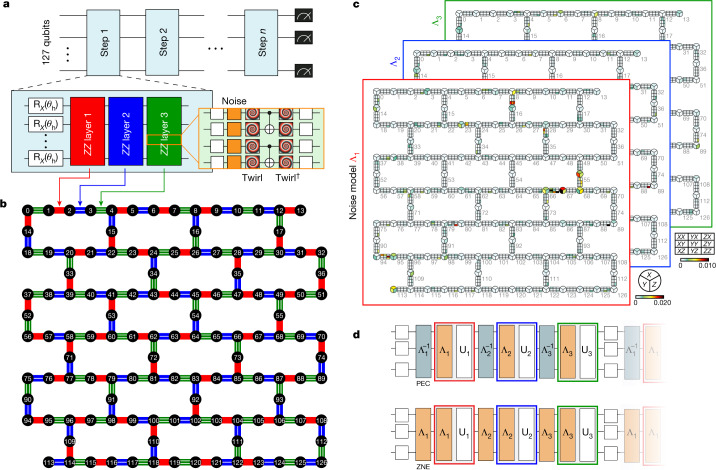
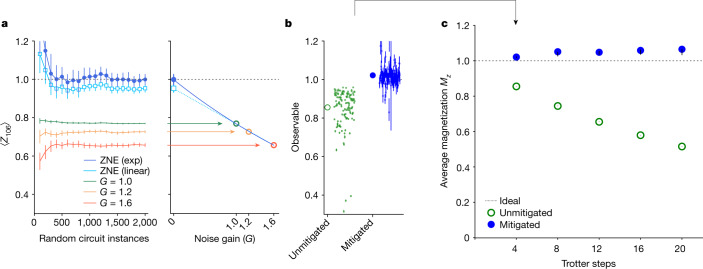
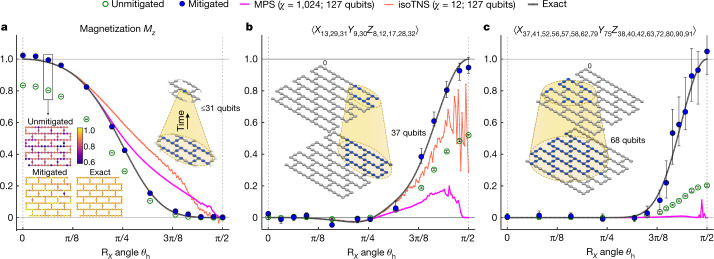
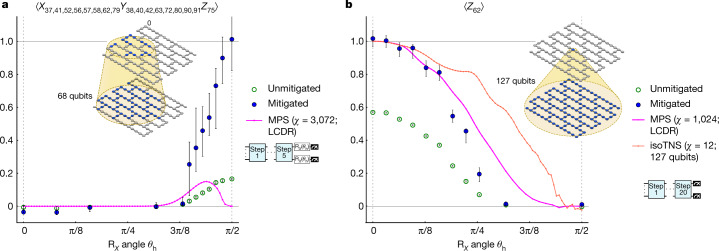
Verification
Claims the paper makes
The claims and statistics of this paper haven’t been checked yet.
Free: it reads the open-access text and checks the first 5 claims that cite a source we can check. Create a free account to check every claim.
Claims other papers make about this one
Each is checked against this paper’s own text: does it say what the citing paper says it does?
The cited source says what the claim attributes to it.
In the citing paper
“However, mobile qubit architectures, such as QCCD and optical tweezers24,25, can distribute resources more efficiently than stationary qubit architectures26–28, because qubits flow through the QPU like bits in a classical processor, with separated memory structures, data buses and logic units, each optimized for their purpose12.”
From A 98-qubit trapped-ion quantum computer with all-to-all connectivity (2026) · cites this paper as [26]
Self-check
Percentages, sums and reported differences re-computed from the paper’s own numbers.
The self-check needs the paper’s full text.
Citations
Cites
Quantum Computing in the NISQ era and beyond
Preskill, J. (2018) · Quantum · doi:10.22331/q-2018-08-06-79 · Cited by 8,830
Quantum supremacy using a programmable superconducting processor
Arute, F., Arya, K., Babbush, R., Bacon, D., Bardin, J. C., Barends, R., Biswas, R., Boixo, S., Brandao, F. G. S. L., Buell, D. A., et al. (2019) · Nature · doi:10.1038/s41586-019-1666-5 · Cited by 7,720
The density-matrix renormalization group in the age of matrix product states
Schollwöck, U. (2011) · Annals of Physics · doi:10.1016/j.aop.2010.09.012 · Cited by 4,818 · cited 2×
“Tensor networks have been widely used to approximate and compress quantum state vectors that arise in the study of the low-energy eigenstates of and time evolution by local Hamiltonians 2,32,33 and, more recently, have been successfully used to simulate low-depth noisy quantum circuits 34–36 .”
MethodCharge-insensitive qubit design derived from the Cooper pair box
Koch, J., Yu, T. M., Gambetta, J., Houck, A. A., Schuster, D. I., Majer, J., Blais, A., Devoret, M. H., Girvin, S. M., & Schoelkopf, R. J. (2007) · Physical Review A · doi:10.1103/physreva.76.042319 · Cited by 3,351 · cited 1×
“For the experimental implementation, we primarily used the IBM Eagle processor ibm_kyiv, composed of 127 fixed-frequency transmon qubits 15 with heavy-hex connectivity and median T 1 and T 2 times of 288 μs and 127 μs, respectively.”
MethodPurification of Noisy Entanglement and Faithful Teleportation via Noisy Channels
Bennett, C. H., Brassard, G., Popescu, S., Schumacher, B., Smolin, J. A., & Wootters, W. K. (1996) · Physical Review Letters · doi:10.1103/physrevlett.76.722 · Cited by 2,961 · cited 1×
“…restricting to jump operators acting on local pairs of qubits yields a sparse noise model that can be efficiently learned for many qubits and that accurately captures the noise associated with layers of two-qubit Clifford gates, including crosstalk, when combined with random Pauli twirls 23,24 .”
BackgroundNoisy intermediate-scale quantum algorithms
Bharti, K., Cervera-Lierta, A., Kyaw, T. H., Haug, T., Alperin-Lea, S., Anand, A., Degroote, M., Heimonen, H., Kottmann, J. S., Menke, T., et al. (2022) · Reviews of Modern Physics · doi:10.1103/revmodphys.94.015004 · Cited by 2,231
Improved simulation of stabilizer circuits
Aaronson, S., & Gottesman, D. (2004) · Physical Review A · doi:10.1103/physreva.70.052328 · Cited by 1,515 · cited 1×
“Clifford circuits serve as useful benchmarks of estimates produced by error mitigation, as they can be efficiently simulated classically 29 .”
BackgroundError Mitigation for Short-Depth Quantum Circuits
Temme, K., Bravyi, S., & Gambetta, J. M. (2017) · Physical Review Letters · doi:10.1103/physrevlett.119.180509 · Cited by 1,379 · cited 2×
“based on pulse stretching 9,17,18 or subcircuit repetition 20–22 have circum-vented the need for precise noise learning, while relying on simplistic assumptions about the device noise.”
BackgroundSelf-citationEvolution of entanglement entropy in one-dimensional systems
Calabrese, P., & Cardy, J. (2005) · Journal of Statistical Mechanics: Theory and Experiment · doi:10.1088/1742-5468/2005/04/p04010 · Cited by 1,295 · cited 1×
“As entanglement (bond dimension) of a generic state grows linearly (exponentially) with time evolution until it saturates the volume law, deep quantum circuits are inherently difficult for tensor networks 37 .”
BackgroundError mitigation extends the computational reach of a noisy quantum processor
Kandala, A., Temme, K., Córcoles, A. D., Mezzacapo, A., Chow, J. M., & Gambetta, J. M. (2019) · Nature · doi:10.1038/s41586-019-1040-7 · Cited by 871 · cited 2×
“based on pulse stretching 9,17,18 or subcircuit repetition 20–22 have circum-vented the need for precise noise learning, while relying on simplistic assumptions about the device noise.”
BackgroundSelf-citation
Research works printed but not linked: 5
- Shor, P. W. in Proc. 35th Annual Symposium on Foundations of Computer Science 124–134 (IEEE, 1994).
- Kitaev, A. Y. Quantum measurements and the Abelian Stabilizer Problem. Preprint at https://arxiv.org/abs/quant-ph/9511026 (1995). · arXiv
- Li Y Benjamin SC Efficient variational quantum simulator incorporating active error minimization Phys. Rev. X 2017 7 021050
- Endo S Benjamin SC Li Y Practical quantum error mitigation for near-future applications Phys. Rev. X 2018 8 031027
- Zhou Y Stoudenmire EM Waintal X What limits the simulation of quantum computers? Phys. Rev. X 2020 10 041038
Cited by
Items 501–600 of 1,005
Quantum subspace expansion in the presence of hardware noise
Getelina, J. C., Sharma, P., Iadecola, T., Orth, P. P., & Yao, Y. (2024) · APL Quantum · doi:10.1063/5.0217294 · Cited by 14
“[9], we expect that PIQAE can provide accurate estimates of the ground state energy and other ground state observables for large model sizes that are not accessible by classical computational approaches.”
BackgroundMethodAutomated Reasoning in Quantum Circuit Compilation
Thanos, D., Villoria, A., Brand, S., Quist, A.-J., Mei, J., Coopmans, T. J., & Laarman, A. (2024) · Lecture notes in computer science · doi:10.1007/978-3-031-66149-5_6 · Cited by 14
“However, despite progress [6, 89], quantum supremacy for useful problems remains elusive.”
BackgroundIno, Y., Yonekawa, M., Yuzawa, H., Minato, Y., & Sugisaki, K. (2024) · Physical Chemistry Chemical Physics · doi:10.1039/d4cp03454f · Cited by 14
“Currently the available quantum hardware is, however, noisy and of intermediate scale one, and its application to real-world problems is quite challenging.”
Dissipative mean-field theory of IBM utility experimentPreprint
Torre, E. G. D., & Roses, M. M. (2023) · arXiv (Cornell University) · doi:10.48550/arxiv.2308.01339 · Cited by 14
Prest, M. T., & Chen, K. (2023) · arXiv (Cornell University) · doi:10.48550/arxiv.2311.03097 · Cited by 14
Fast Universal Entangling Gate for Superconducting Quantum ComputersPreprint
AbuGhanem, M., Homid, A. H., Hendy, A. S., Obada, A. ‐. F., & Eleuch, H. (2024) · SSRN Electronic Journal · doi:10.2139/ssrn.4726035 · Cited by 14
Treespilation: Architecture- and State-Optimised Fermion-to-Qubit MappingsPreprint
Miller, A., Glos, A., & Zimborás, Z. (2024) · arXiv (Cornell University) · doi:10.48550/arxiv.2403.03992 · Cited by 14
Optimal quantum state tomography with local informationally complete measurementsPreprint
Jameson, C., Qin, Z., Goldar, A., Wakin, M. B., Zhu, Z., & Gong, Z. (2024) · arXiv (Cornell University) · doi:10.48550/arxiv.2408.07115 · Cited by 14
Improved fluxonium readout through dynamic flux pulsingPreprint
Stefanski, T. V., Yilmaz, F., Huang, E. Y., Zwanenburg, M. F. S., Singh, S., Wang, S., Splitthoff, L. J., & Andersen, C. K. (2024) · arXiv (Cornell University) · doi:10.48550/arxiv.2411.13437 · Cited by 14
Benchmarking bosonic and fermionic dynamicsPreprint
Wilkens, J., Ioannou, M., Derbyshire, E., Eisert, J., Hangleiter, D., Roth, I., & Haferkamp, J. (2024) · arXiv (Cornell University) · doi:10.48550/arxiv.2408.11105 · Cited by 14
“Particularly prominent examples of quantum simulations investigate bosonic Hamiltonians such as the Bose-Hubbard model which describes cold-atoms in optical lattices [1–6] and certain superconducting-qubit systems [7–10].”
BackgroundConnectivity-aware Synthesis of Quantum AlgorithmsPreprint
Dreier, F., Fleckenstein, C., Aigner, G., Fellner, M., Aumann, P., Stahn, R., Lanthaler, M., & Lechner, W. (2025) · arXiv (Cornell University) · doi:10.48550/arxiv.2501.14020 · Cited by 14
“Recently, both quantum hardware and software experienced enormous leaps of improvements putting modern quantum hardware in the range of state-of-the art classical computing systems for specialized tasks [3, 5].”
Benchmarking Quantum Reinforcement LearningPreprint
Meyer, N., Ufrecht, C., Yammine, G., Kontes, G. D., Mutschler, C., & Scherer, D. D. (2025) · arXiv (Cornell University) · doi:10.48550/arxiv.2501.15893 · Cited by 14
Overcoming the entanglement barrier with sampled tensor networksPreprint
Carignano, S., Lami, G., Nardis, J. D., & Tagliacozzo, L. (2025) · arXiv (Cornell University) · doi:10.48550/arxiv.2505.09714 · Cited by 14
A full-stack analog optical quantum computing platform with one hundred inputsPreprint
Yokoyama, S., Sakaguchi, A., Asavanant, W., Takase, K., Chen, Y.-R., Nagayoshi, H., Yoshikawa, J.-I., Kashiwazaki, T., Inoue, A., Umeki, T., et al. (2025) · arXiv (Cornell University) · doi:10.48550/arxiv.2506.16147 · Cited by 14
Circuit compression for 2D quantum dynamicsPreprint
D’Anna, M., Zhang, Y., Wiersema, R., Rudolph, M. S., & Carrasquilla, J. (2025) · arXiv (Cornell University) · doi:10.48550/arxiv.2507.01883 · Cited by 14
“Despite this potential of VQC, many recent quantum simulation re-sults [29, 33] still rely heavily on traditional Trotteriza-tion methods [18, 19].”
Enabling Technologies for Scalable Superconducting Quantum ComputingPreprint
Croot, X., Nowrouzi, K., Spitzer, C., Almudéver, C. G., Blais, A., Carroll, M., Chow, J., Friedman, D., Tokunari, M., Charbon, E., et al. (2025) · arXiv (Cornell University) · doi:10.48550/arxiv.2512.15001 · Cited by 14
“Such an approach requires measuring the error model for each cycle, eg via cycle error reconstruction, and post-processing leading to evidence of utility [72].”
Lindblad-like quantum tomography for non-Markovian quantum dynamical maps
Varona, S., Müller, M., & Bermúdez, A. (2025) · npj Quantum Information · doi:10.1038/s41534-025-01044-7 · Cited by 15
Dynamic acoustic optimization of pulse tube refrigerators for rapid cooldown
Snodgrass, R., Kotsubo, V., Backhaus, S., & Ullom, J. N. (2024) · Nature Communications · doi:10.1038/s41467-024-47561-5 · Cited by 13
“More importantly, with the anticipated scale-up in sub-kelvin cooling for quantum computing, the authors’ claim regarding the importance of the findings is legitimate.”
Mitigating Errors on Superconducting Quantum Processors Through Fuzzy Clustering
Ahmad, H. G., Schiattarella, R., Mastrovito, P., Chiatto, A., Levochkina, A., Esposito, M., Montemurro, D., Pepe, G. P., Bruno, A., Tafuri, F., et al. (2024) · Advanced Quantum Technologies · doi:10.1002/qute.202300400 · Cited by 13
Fakkel, N., Enthoven, L., Yun, J., van Riggelen, M., van Ommen, H. B., Schymik, K.-N., Bartling, H. P., Katranara, E. T., Vollmer, R., Taminiau, T. H., et al. (2024) · IEEE Journal of Solid-State Circuits · doi:10.1109/jssc.2024.3459392 · Cited by 13
“[1], [2], [3], [4], [5].”
Subspace-Search Quantum Imaginary Time Evolution for Excited State Computations
Cianci, C., dos Santos, L. F., & Batista, V. S. (2024) · Journal of Chemical Theory and Computation · doi:10.1021/acs.jctc.4c00915 · Cited by 13
“…ansatz | ψ ( τ McLachlan’s variational principle can be leveraged, which states Applying this principle to the optimization of the variational parameters θ ⃗ that define U ( θ ⃗ ( τ )) results in the following linear system of ordinary differential equations: 13,14 = A C j ij j i (6) where and”
BackgroundQuantum computing with error mitigation for data-driven computational homogenization
Kuang, Z., Xu, Y., Huang, Q., Yang, J., Kihal, C. E., & Hu, H. (2024) · Composite Structures · doi:10.1016/j.compstruct.2024.118625 · Cited by 13
“Second, we might explore new extrapolation methods [29, 49], or even different error mitigation techniques like probabilistic error cancellation (PEC) [26].”
BackgroundMethodQuantum Algorithms for the Physical Layer: Potential Applications to Physical Layer Security
Matsumine, T., Ochiai, H., & Shikata, J. (2025) · IEEE Access · doi:10.1109/access.2025.3528443 · Cited by 15
Zhang, Z., Gokhale, P., & Larson, J. M. (2025) · Physical Review A · doi:10.1103/physreva.111.012619 · Cited by 13
“Superconducting (SC) quantum processors have led to significant progress in numerous domains, including demonstrations of quantum advantage [1, 2], quantum error correction [3, 4], variational methods [5–8], and analog simulations [9, 10].”
Realization of two-dimensional discrete time crystals with anisotropic Heisenberg coupling
Switzer, E. D., Robertson, N., Keenan, N., Rodríguez-Alcaraz, Á., D'Urbano, A., Pokharel, B., Rahman, T. S., Shtanko, O., Zhuk, S. M., & Lorente, N. (2026) · Nature Communications · doi:10.1038/s41467-025-67787-1 · Cited by 13
“57.”
Extracting the spin excitation spectrum of a fermionic system using a quantum processor
Vilchez-Estevez, L., Santos, R. A., Wang, S. Y., & Gambetta, F. M. (2025) · Physical review. B./Physical review. B · doi:10.1103/ydfw-k83n · Cited by 13
“Moreover, the two-qubit gate depth and count of the circuits we considered are not far from state-of-the-art experiments implementing sophisticated error mitigation techniques [99, 100].”
Observable-driven speed-ups in quantum simulations
Yu, W., Xu, J., & Zhao, Q. (2025) · Communications Physics · doi:10.1038/s42005-025-02260-5 · Cited by 13
Uotila, V. (2025) · Frontiers in Computer Science · doi:10.3389/fcomp.2025.1649354 · Cited by 13
Efficient Benchmarking of Logical Magic State
Lee, S.-U., Yuan, M., Chen, S., Tsubouchi, K., & Jiang, L. (2026) · Physical Review Letters · doi:10.1103/fwjt-mw2c · Cited by 13
Quantum and quantum-inspired computing in civil engineering
Ploennigs, J., Smarsly, K., Berger, M., Dragos, K., & Kliesch, M. (2025) · Advanced Engineering Informatics · doi:10.1016/j.aei.2025.103960 · Cited by 13
Utility-Scale Quantum State Preparation: Classical Training using Pauli Path Simulation
Lin, C.-J., Gharibyan, H., & Su, V. P. (2026) · Quantum · doi:10.22331/q-2026-03-09-2014 · Cited by 13
“Among potential applications, quantum simulation is arguably the most promising avenue for these devices to demonstrate practical advantages over classical meth-ods [2–4].”
Efficient online quantum circuit learning with no upfront training
O’Leary, T., Czarnik, P., Pelofske, E., Sornborger, A. T., McKerns, M. M., & Cincio, Ł. (2025) · Communications Physics · doi:10.1038/s42005-025-02423-4 · Cited by 13
Construction and simulability of quantum circuits with free fermions in disguise
Szász-Schagrin, D., Cristani, D., Piroli, L., & Vernier, E. (2026) · Quantum Science and Technology · doi:10.1088/2058-9565/ae390d · Cited by 13
“Now, the emergence of quantum processors of increasingly large scales [9–12] motivates the search and study of additional simulable models.”
Order from chaos with adaptive circuits on quantum hardware
Pokharel, B., Pan, H., Aziz, K., Govia, L. C. G., Ganeshan, S., Iadecola, T., Wilson, J. H., Jones, B., Deshpande, A., Pixley, J. H., et al. (2026) · Nature Physics · doi:10.1038/s41567-026-03470-6 · Cited by 13
Detecting entanglement from few partial transpose moments and their decay via weight enumerators
Miller, D. J., & Eisert, J. (2026) · Journal of Physics A Mathematical and Theoretical · doi:10.1088/1751-8121/ae98c6 · Cited by 13
Pauli Propagation Enables Fast Classical Simulation of Strongly Correlated Quantum Systems
Shrikhande, C., Bachhar, A., Rodríguez-Jiménez, J. A., Valeev, E. F., & Mayhall, N. J. (2026) · PRX Quantum · doi:10.1103/kq3v-whcq · Cited by 14
“The 2023 IBM Eagle experiment [32], which claimed evidence for quantum utility in simulating kicked Ising dynamics, sparked rapid development of classical methods that ultimately matched or exceeded the quantum results [35–37].”
Nonergodic Measurements of Qubit Frequency Noise
Wudarski, F., Zhang, Y., & Dykman, M. I. (2023) · Physical Review Letters · doi:10.1103/physrevlett.131.230201 · Cited by 13
Limitations of probabilistic error cancellation for open dynamics beyond sampling overhead
Ma, Y., & Kim, M. S. (2024) · Physical Review A · doi:10.1103/physreva.109.012431 · Cited by 13
“Indeed, different quantum error mitigation methods have been applied to different implementations of quantum computers to simulate unitary dynamics [5–9], with the possible potential of showing quantum advantages over classical computers.”
BackgroundImplementation of the Projective Quantum Eigensolver on a Quantum Computer
Misiewicz, J. P., & Evangelista, F. A. (2024) · The Journal of Physical Chemistry A · doi:10.1021/acs.jpca.3c07429 · Cited by 13
From Quantum Software Handcrafting to Quantum Software Engineering
Bisicchia, G., García-Alonso, J. M., Murillo, J. M., & Brogi, A. (2024) · IEEE International Conference on Software Analysis, Evolution and Reengineering - Companion (SANER-C) · doi:10.1109/saner-c62648.2024.00026 · Cited by 13
“Pursuing the desire to be able to explore, control and ultimately exploit this puzzling technology, scientists soon made Quantum Computing an active, prolific hot topic [2].”
BackgroundQuantum Informative Analysis in Smart Power Distribution
Ahanger, T. A., Bhatia, M., & Aldaej, A. (2024) · ACM Transactions on Intelligent Systems and Technology · doi:10.1145/3691350 · Cited by 13
“To effectively address the current electricity demand, it is crucial to continuously assess the electricity requirements, timing, and capacity of electricity substations [16].”
de Oliveira, M., Subramanian, S., Mendes, L. R. D. S., & Hsieh, M.-H. (2025) · Nature Communications · doi:10.1038/s41467-025-58545-4 · Cited by 13
Uotila, V. (2025) · IEEE International Conference on Quantum Computing and Engineering (QCE) · doi:10.1109/qce65121.2025.00259 · Cited by 13
Quantum long short-term memory for drug discovery
Zhang, L., Xu, Y., Wu, M., Wang, L., & Xu, H. (2026) · EPJ Quantum Technology · doi:10.1140/epjqt/s40507-026-00467-1 · Cited by 13
5 Year Update to the Next Steps in Quantum ComputingPreprint
Brown, K. R., Chong, F. T., Smith, K. N., Conte, T. M., Adams, A. S., Dalvi, A. S., Kang, C., & Viszlai, J. (2024) · arXiv (Cornell University) · doi:10.48550/arxiv.2403.08780 · Cited by 13
Classically Computing Performance Bounds on Depolarized Quantum Circuits
Mishra, S. D., Frías-Pérez, M., & Trivedi, R. (2024) · PRX Quantum · doi:10.1103/prxquantum.5.020317 · Cited by 12
“[7] Youngseok Kim, Andrew Eddins, Sajant Anand, Ken Xuan Wei, et al.”
BackgroundDirect estimation of the density of states for fermionic systems
Goh, M. L., & Koczor, B. (2026) · Physical Review Research · doi:10.1103/h8l5-87zt · Cited by 12
“For these reasons, a broad range of quantum algorithms have been proposed using shallow quantum circuits and quantum error mitigation for the purposes of using early, noisy quantum devices in quantum simulation tasks [11–22].”
Fast, universal scheme for calibrating microwave crosstalk in superconducting circuits
Yang, X., Zhang, H.-F., Du, L., Tao, H.-R., Guo, L.-L., Wang, T.-L., Jia, Z.-L., Kong, W., Chen, Z., Duan, P., et al. (2024) · Applied Physics Letters · doi:10.1063/5.0211159 · Cited by 12
Gated InAs quantum dots embedded in surface acoustic wave cavities for low-noise optomechanics
Wang, Z., DeCrescent, R. A., Imany, P., Bush, J. T., Reddy, D. V., Nam, S. W., Mirin, R. P., & Silverman, K. L. (2024) · Optics Express · doi:10.1364/oe.538480 · Cited by 12
“They bridge the gap between microwave frequencies that are characteristic of superconducting [3, 4] or spin-based [5, 6] quantum processors and optical frequencies that are ideal for transmitting quantum information over long distances [7, 8].”
BackgroundRate-fidelity tradeoff in cavity-based remote entanglement generation
Tanji, K., Takahashi, H., Roga, W., & Takeoka, M. (2024) · Physical Review A · doi:10.1103/physreva.110.042405 · Cited by 12
Cryogenic quantum computer control signal generation using high-electron-mobility transistors
Ferraris, A., Cha, E., Müeller, P. R., Moselund, K. E., & Zota, C. B. (2024) · Communications Engineering · doi:10.1038/s44172-024-00293-2 · Cited by 12
Choi, S., & Lee, W. (2024) · AIMS Mathematics · doi:10.3934/math.20241493 · Cited by 12
An overview of quantum software engineering in Latin America
Aparicio-Morales, Á. M., Moguel, E., Bibbó, L. M., Fernández, A., García-Alonso, J. M., & Murillo, J. M. (2024) · Quantum Information Processing · doi:10.1007/s11128-024-04586-5 · Cited by 12
Digital quantum simulation of cosmological particle creation with IBM quantum computers
Maceda, M., & Sabín, C. (2025) · Scientific Reports · doi:10.1038/s41598-025-87015-6 · Cited by 12
“Despite the large amount of gates, we show that the use of zero-noise extrapolation [21] allows us to reach interesting predictions even in the actual quantum devices with their current levels of noise.”
BackgroundMethodInfluentialMulti-FPGA Synchronization and Data Communication for Quantum Control and Measurement
Xu, Y., Rajagopala, A., Fruitwala, N., & Huang, G. (2025) · IEEE International Symposium on Field-Programmable Custom Computing Machines (FCCM) · doi:10.1109/fccm62733.2025.00075 · Cited by 12
“…on one board and feedforward on a second board using data communication 1 OPENQASM 3.0; 2 bit[2] c; #Initialize two classical registers 3 qubit[2] q; #Initialize two qubits We tested the data communication functionality on two boards with an MCM and feed-forward quantum circuit on a…”
InfluentialPost-variational classical quantum transfer learning for binary classification
Yogaraj, K., Quanz, B., Vikas, T., Mondal, A., & Mondal, S. (2025) · Scientific Reports · doi:10.1038/s41598-025-08887-2 · Cited by 12
Korhonen, K. T., Vappula, H., Glos, A., Cattaneo, M., Zimborás, Z., Borrelli, E.-M., Rossi, M. A. C., García-Pérez, G., & Cavalcanti, D. (2025) · npj Quantum Information · doi:10.1038/s41534-025-01066-1 · Cited by 12
Reduced Sampling Overhead for Probabilistic Error Cancellation by Pauli Error Propagation
Scheiber, T., Haubenwallner, P., & Heller, M. (2025) · Quantum · doi:10.22331/q-2025-08-29-1840 · Cited by 13
Scalable projected entangled-pair state representation of random quantum circuit states
Lee, S., Choi, H. R., Ohm, D. D., & Lee, S. B. (2025) · Physical Review Research · doi:10.1103/rzgm-cywf · Cited by 12
Test and Characterization of Multilayer Ion Traps on Fused Silica
Dietl, M., Valentini, M., Anmasser, F., Zesar, A., Auchter, S., van Mourik, M. W., Monz, T., Blatt, R., Rössler, C., & Schindler, P. (2025) · Advanced Quantum Technologies · doi:10.1002/qute.202500412 · Cited by 12
Towards Supporting QIR: Steps for Adopting the Quantum Intermediate Representation
Stade, Y., Burgholzer, L., & Wille, R. (2025) · International Conference for High Performance Computing, Networking, Storage and Analysis (SC) · doi:10.1145/3731599.3767546 · Cited by 13
Transmon Qubit Modeling and Characterization for Dark Matter Search
Moretti, R., Labranca, D., Campana, P., Carobene, R., Gobbo, M., Castellanos-Beltran, M. A., Olaya, D. I., Hopkins, P. F., Banchi, L., Borghesi, M., et al. (2025) · IEEE Transactions on Quantum Engineering · doi:10.1109/tqe.2025.3633176 · Cited by 12
“Progress in quantum sensing is closely tied to developments in quantum computer engineering, which has propelled us into the era of quantum utility [12], [13], driven by the collective efforts of private companies, research institutions, and universities.”
Efficient Quantum Gradient and Higher-Order Derivative Estimation Via Generalized Hadamard Test
Li, D., Dulal, D., Ohorodnikov, M., Wang, H., & Ding, Y. (2025) · IEEE International Conference on Quantum Computing and Engineering (QCE) · doi:10.1109/qce65121.2025.00024 · Cited by 12
“Our simulation uses a transverse-field Ising model, motivated by and directly applicable to hardware-native Hamiltonians on superconducting devices [63] and QuEra’s Aquila neutral atom system [64]: with first-order Trotterization: We set k = 2 and use 3 qubits.”
Advances in Josephson Junction Materials and Processes Toward Practical Quantum Computing
Kim, H. L., Jang, G., Jin, S., An, J., Shin, H., Shin, H., Luo, J., Hashim, A., Siddiqi, I. A., Kim, Y., et al. (2026) · Advanced Science · doi:10.1002/advs.78427 · Cited by 12
“There is considerable effort to achieve a meaningful computational speedup over classical computing for practical applications, a critical benchmark often referred to as quantum utility [ 92 ].”
Self-citationNear-term fermionic simulation with subspace noise tailored quantum error mitigation
Papič, M., Algaba, M. G., Godínez, C. E., de Vega, I., Auer, A., Šimkovic, F., & Calzona, A. (2026) · npj Quantum Information · doi:10.1038/s41534-026-01248-5 · Cited by 12
“Notably, this region includes the range of 10 5 − 10 6 shots per observable, which is currently used in QEM experiments on superconducting hardware [8, 12, 19].”
InfluentialScalable simulation of quantum many-body dynamics with or-represented quantum algebra
Anonymous, Sun, R.-Y., & Yunoki, S. (2026) · Physical Review Applied · doi:10.1103/y8ft-m61w · Cited by 12
Error-robust quantum signal processing using Rydberg atoms
Zeytinoǧlu, S., & Sugiura, S. (2024) · Physical Review Research · doi:10.1103/physrevresearch.6.013003 · Cited by 12
Iterative method to improve the precision of the quantum-phase-estimation algorithm
Li, J. (2024) · Physical Review A · doi:10.1103/physreva.109.032606 · Cited by 12
Cappelli, L., Tacchino, F., Murante, G., Borgani, S., & Tavernelli, I. (2024) · Physical Review Research · doi:10.1103/physrevresearch.6.013282 · Cited by 12
“In particular, noise mitigation schemes such as probabilistic error cancellation [54] (PEC) and probabilistic error amplification [55] (PEA) only require additional single qubit operations to implement Pauli twirling [54] (for the conversion of coherent to incoherent noise) and dynamical…”
BackgroundOptimization of algorithmic errors in analog quantum simulations
Zemlevskiy, N. A., Froland, H., & Caspar, S. (2024) · Physical Review A · doi:10.1103/physreva.109.052425 · Cited by 12
Finite temperature tensor network algorithm for frustrated two-dimensional quantum materials
Schmoll, P., Balz, C., Lake, B., Eisert, J., & Kshetrimayum, A. (2024) · Physical review. B./Physical review. B · doi:10.1103/physrevb.109.235119 · Cited by 12
Quantum Network Routing Based on Surface Code Error Correction
Hu, T., Wu, J., & Li, Q. (2024) · IEEE International Conference on Distributed Computing Systems (ICDCS) · doi:10.1109/icdcs60910.2024.00117 · Cited by 12
“However, the inherent nature of qubits being in superposition also makes them highly susceptible to instability [33], [34], vulnerable to environmental noise, and prone to random collapse.”
Sun, R.-Y., Shirakawa, T., & Yunoki, S. (2024) · Physical review. B./Physical review. B · doi:10.1103/physrevb.110.085149 · Cited by 12
“The central challenge in near-term development of quantum computing is determining efficient strategies for utilizing NISQ devices to achieve a practical quantum advantage in meaningful computational tasks [6, 9–11].”
BackgroundMethodThe Role of Collaboration and Networking in the Digital Age: Students’ Perspectives
Gqwabaza, N., & Maqoqa, T. T. (2024) · E-Journal of Humanities Arts and Social Sciences · doi:10.38159/ehass.202451111 · Cited by 12
Can quantum computers do nothing?
Nico-Katz, A., Keenan, N., & Goold, J. (2024) · npj Quantum Information · doi:10.1038/s41534-024-00918-6 · Cited by 12
“…advent of the noisy intermediate-scale quantum (NISQ) era in the form of accessible quantum processors containing some tens to hundreds of qubits [3–6], out-of-the-box error mitigation [7], and the nascent implementation of simple error correction [8–10], this new paradigm is now being mapped out…”
Quantum Control without Quantum States
Orozco-Ruiz, M., Le, N. H., & Mintert, F. (2024) · PRX Quantum · doi:10.1103/prxquantum.5.040346 · Cited by 12
“While the benefits of this scaling have inspired tremendous efforts towards the development of quantum technological devices [6, 8–11], the scaling also has disastrous implications on our abilities to simulate the dynamics of quantum systems [12].”
STIQ: Safeguarding Training and Inferencing of Quantum Neural Networks from Untrusted Cloud
Kundu, S., & Ghosh, S. (2025) · IEEE International Symposium on Hardware Oriented Security and Trust (HOST) · doi:10.1109/host64725.2025.11050015 · Cited by 12
“As the states produced by a qubit rotation along any axis will repeat in 2 𝜋 intervals, features are generally scaled within 0 to 2 𝜋 (or - 𝜋 to 𝜋 ) in a data pre-processing step.”
A framework of partial error correction for intermediate-scale quantum computers
Koukoulekidis, N., Wang, S., O’Leary, T., Bultrini, D., Cincio, Ł., & Czarnik, P. (2026) · npj Quantum Information · doi:10.1038/s41534-026-01301-3 · Cited by 12
“Naturally, this suits low-depth algorithms such as variational quantum algorithms [3, 88], Trotterized dynamics simulations [89], and subspace-based quantum algorithms [90, 91].”
Clifford Assisted Optimal Pass Selection for Quantum TranspilationPreprint
Dangwal, S., Ravi, G. S., Seifert, L. M., Das, P., Sud, J., & Chong, F. T. (2023) · arXiv (Cornell University) · doi:10.48550/arxiv.2306.15020 · Cited by 12
“Today, quantum computers with only a few dozen qubits can outperform the state-of-the-art supercomputers for some specific sampling tasks [1], [2].”
Synergy of machine learning with quantum computing and communicationPreprint
Bhoumik, D., Sur‐Kolay, S., J, L. K. K., & Iyengar, S. S. (2023) · arXiv (Cornell University) · doi:10.48550/arxiv.2310.03434 · Cited by 12
“Recently, experiments on circuits having 127 qubits and gate depth of 60 [5], with single qubit gates in the range of thousands, and two-qubit gates in the range of hundreds [4], as well as circuits with 433 qubits have been carried out.”
BackgroundMethodQuantum Machine Learning for Remote Sensing: Exploring potential and challengesPreprint
Miroszewski, A., Nalepa, J., Saux, B. L., & B, J. M. A. (2023) · arXiv (Cornell University) · doi:10.48550/arxiv.2311.07626 · Cited by 12
Error Mitigation for Thermodynamic ComputingPreprint
Aifer, M., Melanson, D., Donatella, K., Crooks, G. E., Ahle, T. D., & Coles, P. J. (2024) · arXiv (Cornell University) · doi:10.48550/arxiv.2401.16231 · Cited by 12
“These error mitigation methods are central to obtaining quantum advantage in era before fault-tolerant quantum computing [11, 12].”
An Empirical Analysis on the Effectiveness of the Variational Quantum Linear SolverPreprint
Turati, G., Marruzzo, A., Dacrema, M. F., & Cremonesi, P. (2024) · arXiv (Cornell University) · doi:10.48550/arxiv.2409.06339 · Cited by 12
Quon Classical Simulation: Unifying Cliffords, Matchgates and EntanglementPreprint
Feng, Z., Liu, Z., Lu, F., & Wang, N. (2025) · arXiv (Cornell University) · doi:10.48550/arxiv.2505.07804 · Cited by 12
Error mitigation of shot-to-shot fluctuations in analog quantum simulatorsPreprint
Steckmann, T., Luo, D., Wang, Y.-X., Muleady, S. R., Seif, A., Monroe, C., Gullans, M. J., Gorshkov, A. V., Katz, O., & Schuckert, A. (2025) · arXiv (Cornell University) · doi:10.48550/arxiv.2506.16509 · Cited by 12
“However, due to the practical considerations of Richardson instability and sampling overhead in suppressing the sampling error ν , ZNE is typically performed by fitting to low-order polynomials or families of exponential functions [38, 45, 51, 52].”
Variational Quantum Algorithms in the era of Early Fault TolerancePreprint
Dangwal, S., Vittal, S., Seifert, L. M., Chong, F. T., & Ravi, G. S. (2025) · arXiv (Cornell University) · doi:10.48550/arxiv.2503.20963 · Cited by 12
Hybrid digital-analog protocols for simulating quantum multi-body interactionsPreprint
Katz, O., Schuckert, A., Wang, T., Crane, E., Gorshkov, A. V., & Cetina, M. (2025) · arXiv (Cornell University) · doi:10.48550/arxiv.2512.21385 · Cited by 12
“While formally exact in the limit of infinitely many steps, achieving high accuracy requires a polynomially large number of gates, resulting in long circuits that limit evolution to relatively short times and increase susceptibility to errors [3–5].”
Observation of Improved Accuracy over Classical Sparse Ground-State Solvers using a Quantum ComputerPreprint
Kirby, W., Pokharel, B., Moreno, J. R., Smith, K. C., Bravyi, S. B., Deshpande, A., Evangelinos, C., Fuller, B., Garrison, J. R., Jaderberg, B., et al. (2026) · arXiv (Cornell University) · doi:10.48550/arxiv.2603.03496 · Cited by 13
Resolving Structure in Prethermal Floquet Dynamics with Precision Quantum ComputationPreprint
Leviatan, E., Watad, T., Perry, R., Broers, L., Mullath, M. Z., Alberton, O., Arad, I., Atia, Y., Bairey, E., Barkan, S., et al. (2026) · arXiv (Cornell University) · doi:10.48550/arxiv.2607.24937 · Cited by 14
“Alternatively, QP distributions can be used to construct noise-reduced or noise-amplified estimators, enabling heuristic but often lower-overhead zero-noise extrapolation (ZNE) [32, 35, 50].”
Self-citationQuantum state reconstruction in a noisy environment via deep learning
Morgillo, A. R., Mangini, S., Piastra, M., & Macchiavello, C. (2024) · Quantum Machine Intelligence · doi:10.1007/s42484-024-00168-x · Cited by 11
Cantori, S., Mari, A., Vitali, D., & Pilati, S. (2024) · EPJ Quantum Technology · doi:10.1140/epjqt/s40507-024-00256-8 · Cited by 11
“[4], despite employing a different circuit transpilation method.”
BackgroundMethodHardware-efficient variational quantum algorithm in a trapped-ion quantum computer
Zhuang, J.-Z., Wu, Y., & Duan, L.-M. (2024) · Physical Review A · doi:10.1103/physreva.110.062414 · Cited by 11
Self-citationSparse non-Markovian Noise Modeling of Transmon-Based Multi-Qubit Operations
Oda, Y., Schultz, K., Norris, L., Shehab, O., & Quiroz, G. (2026) · PRX Quantum · doi:10.1103/lx8x-z29x · Cited by 12
Experimental Test of Nonlocality Limits from Relativistic Independence
Atzori, F., Virzì, S., Rebufello, E., Avella, A., Piacentini, F., Cusini, I., Haka, H., Villa, F., Gramegna, M., Cohen, E., et al. (2024) · PRX Quantum · doi:10.1103/prxquantum.5.040351 · Cited by 11
One-Time Compilation of Device-Level Instructions for Quantum Subroutines
Dalvi, A. S., Whitlow, J., D’Onofrio, M., Riesebos, L., Chen, T., Phiri, S., Brown, K. R., & Baker, J. M. (2024) · IEEE International Conference on Quantum Computing and Engineering (QCE) · doi:10.1109/qce60285.2024.00107 · Cited by 11
“The figure indicates typical runtimes of superconducting (SC) [6], neutral atom (NA) [30] and trapped-ion (TI) [31] systems, with TI systems demonstrating the least advantage and SC the most. to the queue is targeting the same machine, they have an underlying shared structure of using the same…”
BackgroundGeneralized Quantum Data-Syndrome Codes and Belief Propagation Decoding for Phenomenological Noise
Kuo, K.-Y., & Lai, C. (2025) · IEEE Transactions on Information Theory · doi:10.1109/tit.2025.3529773 · Cited by 11
“However, quantum operations are imperfect, which presents a challenge in achieving practical quantum computation in current techniques [17]–[22].”
Perturbative framework for engineering arbitrary Floquet Hamiltonian
Xu, Y., & Guo, L. (2025) · Reports on Progress in Physics · doi:10.1088/1361-6633/adb072 · Cited by 11
“…[76, 77] with 4 JJs (one for each transmon qubit), the quantum-state-preservation superconducting circuit [78] with 9 trans-mons, the Google programmable superconducting processor Sycamore [79] with 54 transmon qubits and the recent IBM quantum processor Eagle [80] with 127 transmons qubit.”
From Problem to Solution: A General Pipeline to Solve Optimisation Problems on Quantum Hardware
Rohe, T., Grätz, S., Kölle, M., Zielinski, S., Stein, J., & Linnhoff–Popien, C. (2025) · Lecture notes in networks and systems · doi:10.1007/978-3-031-84460-7_2 · Cited by 11
Inhomogeneous SU(2) symmetries in homogeneous integrable U(1) circuits and transport
Žnidarič, M. (2025) · Nature Communications · doi:10.1038/s41467-025-59705-2 · Cited by 11
More buck-per-shot: Why learning trumps mitigation in noisy quantum sensing
Ijaz, A., Alderete, C. H., Sauvage, F., Cincio, Ł., Cerezo, M., & Goh, M. L. (2025) · Materials Today Quantum · doi:10.1016/j.mtquan.2025.100042 · Cited by 12
“[69].”
Metadata
- Authors
- Kim, Y., Eddins, A., Anand, S., Wei, K. X., van den Berg, E., Rosenblatt, S., Nayfeh, H., Wu, Y., Zaletel, M., Temme, K., & Kandala, A.
- Affiliations
- IBM Research - Cambridge (United States) (US)
- University of California, Berkeley (US)
- IBM (United States) (US)
- RIKEN (JP)
- Lawrence Berkeley National Laboratory (US)
- Corresponding author
- Eddins, Andrew
- Kandala, Abhinav
- ORCID
- Venue
- Nature
- Published
- 2023-06-14
- Volume
- 618
- Issue
- 7965
- Pages
- 500-505
- ISSN
- 0028-0836 (ISSN-L)
- 1476-4687
- PMC
- PMC10266970
- OpenAlex
- W4380627387
- Semantic Scholar
- f9253a3e2627f1c2a0a7e2cea320a4ec4e4d2ff9
- Cited by
- 1,050
- References
- 41
- Citations by year
- 2026: 226 · 2025: 399 · 2024: 358 · 2023: 67
- FWCI
- 98.85
- Type
- journal article
- Language
- en
- Open access
- hybrid
- doi.org
- Licence
- cc-by
- creativecommons.org/licenses/by/4.0 (tdm)
- creativecommons.org/licenses/by/4.0 (vor)
- Locations
- Nature (publishedVersion, cc-by)
- PubMed Central (publishedVersion, cc-by)
- PubMed (publishedVersion)
- eScholarship (California Digital Library) (submittedVersion, cc-by)
- OSTI OAI (U.S. Department of Energy Office of Scientific and Technical Information) (submittedVersion)
- RePEc: Research Papers in Economics (submittedVersion)
- Funders
- National Science Foundation (DEAC02-05CH11231, 2137603, 2138259, 2138296, 2138307, 2138286)
- U.S. Department of Energy (-AC02-05CH11231, 05CH11231, DE AC02 05CH11231, DESC0022716, DE-AC02-)
- National Energy Research Scientific Computing Center (DE–AC02–05CH11231, 05CH11231, AC02-05CH11231)
- Office of Science (DEAC02–05CH11231, AC02-05CH11231, DE-AC02)
- Office of Advanced Cyberinfrastructure (#2138286, #2138296, 2138259, #2138307, 2137603)
- Basic Energy Sciences (DE-AC02, DE-AC02-05CH11231., AC02–05CH11231)
- Lawrence Berkeley National Laboratory (AC02‐05CH11231, DE-AC02-05CH11231, 05CH11231)
- Topics
- Physical Sciences › Computer Science › Artificial Intelligence › Quantum Computing Algorithms and Architecture
- Physical Sciences › Physics and Astronomy › Atomic and Molecular Physics, and Optics › Quantum Information and Cryptography
- Physical Sciences › Physics and Astronomy › Atomic and Molecular Physics, and Optics › Quantum many-body systems
- Keywords
- quantum computing, NISQ devices, superconducting qubits, noise characterization, tensor network states, matrix product states, entanglement, quantum advantage
About these checks
Registry, retraction, Cites and statistics results are computed, not judged, with one exception: a printed reference that no index lists is read once by a model before it counts as a citation error. Claims are extracted by a model and kept only when their quote appears verbatim in the text; each cited source is then checked, with a model’s help, for whether it says what the claim relies on. Those verdicts can be wrong — read the claim’s quote and the cited source before relying on one.
Statistics and arithmetic are recomputed, not judged.
Confidence bands are shown only for fields calibrated on our annotated test set. None is calibrated yet, so no band is shown.
What counts as a claim ›How we measure confidence ›How we check this ›
Are you an author, or do you see a problem with this page? Request a review
Data sources
Bibliographic data: Semantic Scholar, OpenAlex, Crossref.
Contains information from the Semantic Scholar Academic Graph Datasets, made available under the ODC Attribution License (ODC-BY 1.0).
Semantic Scholar’s data is described in: Kinney, R., et al. (2023). The Semantic Scholar Open Data Platform. arXiv:2301.10140.
