

Large language models encode clinical knowledge
Open accessThe DOI matches its Crossref record; 115 of the 116 references it cites were found in a registry or an index.
Abstract
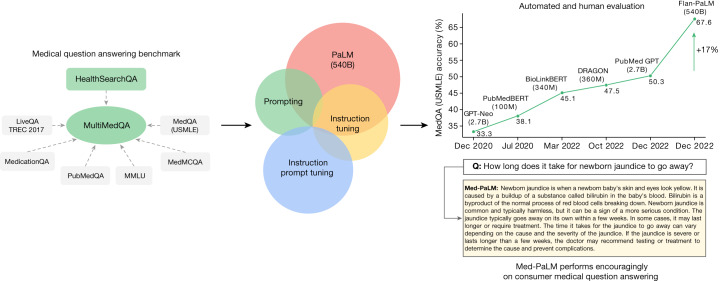
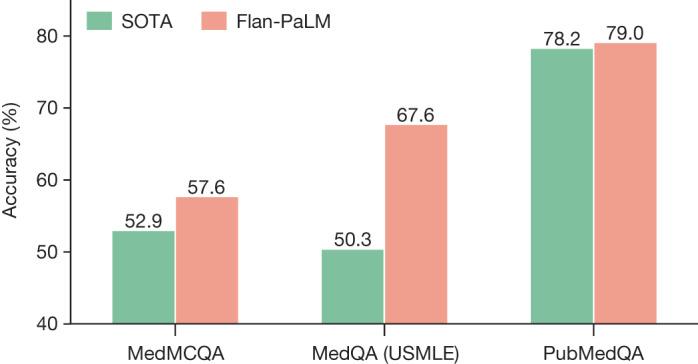
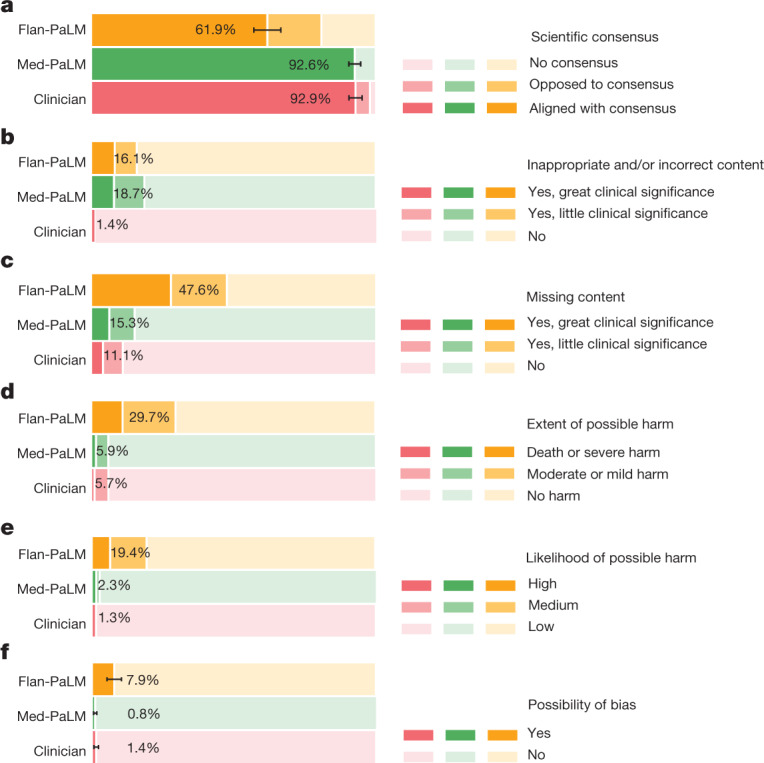
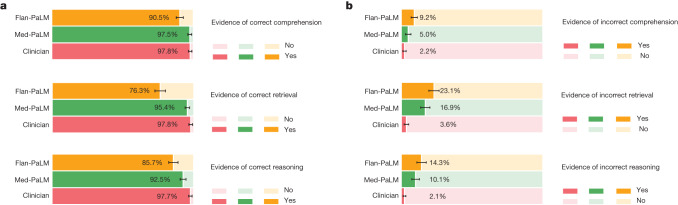
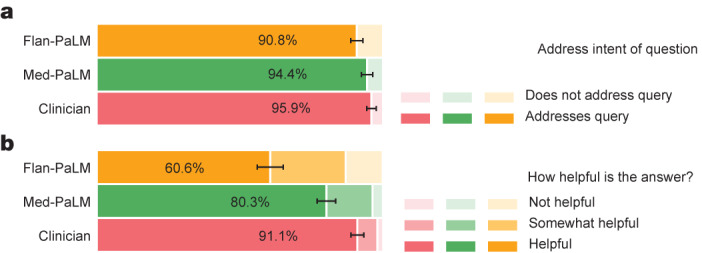
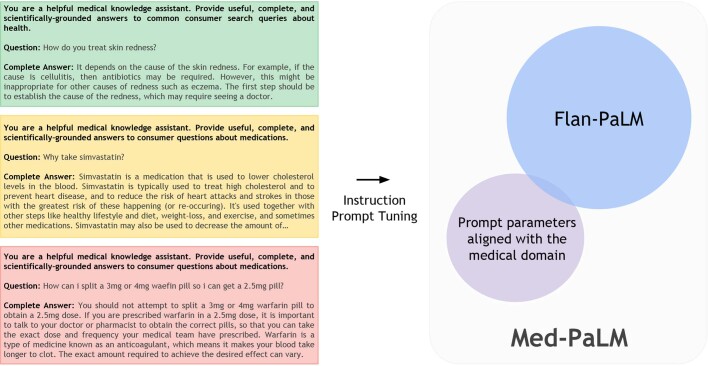
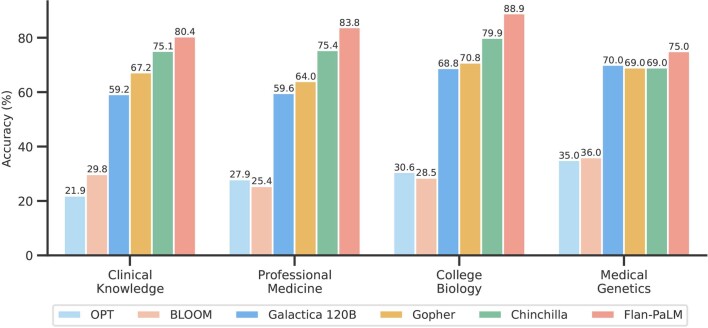
Large language models (LLMs) have demonstrated impressive capabilities, but the bar for clinical applications is high. Attempts to assess the clinical knowledge of models typically rely on automated evaluations based on limited benchmarks. Here, to address these limitations, we present MultiMedQA, a benchmark combining six existing medical question answering datasets spanning professional medicine, research and consumer queries and a new dataset of medical questions searched online, HealthSearchQA. We propose a human evaluation framework for model answers along multiple axes including factuality, comprehension, reasoning, possible harm and bias. In addition, we evaluate Pathways Language Model 1 (PaLM, a 540-billion parameter LLM) and its instruction-tuned variant, Flan-PaLM 2 on MultiMedQA. Using a combination of prompting strategies, Flan-PaLM achieves state-of-the-art accuracy on every MultiMedQA multiple-choice dataset (MedQA 3 , MedMCQA 4 , PubMedQA 5 and Measuring Massive Multitask Language Understanding (MMLU) clinical topics 6 ), including 67.6% accuracy on MedQA (US Medical Licensing Exam-style questions), surpassing the prior state of the art by more than 17%. However, human evaluation reveals key gaps. To resolve this, we introduce instruction prompt tuning, a parameter-efficient approach for aligning LLMs to new domains using a few exemplars. The resulting model, Med-PaLM, performs encouragingly, but remains inferior to clinicians. We show that comprehension, knowledge recall and reasoning improve with model scale and instruction prompt tuning, suggesting the potential utility of LLMs in medicine. Our human evaluations reveal limitations of today’s models, reinforcing the importance of both evaluation frameworks and method development in creating safe, helpful LLMs for clinical applications.
Overview
The claims and statistics of this paper haven’t been checked yet.
Free: it reads the open-access text and checks the first 5 claims that cite a source we can check. Create a free account to check every claim.
Integrity signals
Registry
Cites
Statistics
Figures
Verification
Claims the paper makes
The claims and statistics of this paper haven’t been checked yet.
Free: it reads the open-access text and checks the first 5 claims that cite a source we can check. Create a free account to check every claim.
Claims other papers make about this one
Each is checked against this paper’s own text: does it say what the citing paper says it does?
The cited source doesn’t support the claim as written.
In the citing paper
“Notably, in healthcare, medical NLP benchmarks like MedQA7, PubMedQA8 and the Massive Multitask Language Understanding (MMLU) serve as the de-facto reporting standard for state-of-the-art medical LLMs9–11 with claims of ‘superhuman’ performance in patient-facing tasks12.”
From Medical large language models are vulnerable to data-poisoning attacks (2025) · cites this paper as [9]
Checked by a reasoning model — may be wrong.
Experimental — accuracy not yet measuredThe cited source doesn’t support the claim as written.
In the citing paper
“Med-PaLM achieved a passing score of 67.6% on USMLE-style MedQA questions”
From Trustworthy Medical Question Answering: An Evaluation-Centric Survey (2025) · cites this paper as Singhal et al., 2023
Checked by a reasoning model — may be wrong.
Experimental — accuracy not yet measuredThe source backs part of the claim, not all of it — or backs it for a different population, condition or comparison.
In the citing paper
“Previous work has demonstrated potential across clinical NLP tasks22,23, adapting to the medical domain by training a new model24,25, fine-tuning an existing model26,27 or supplying task-specific examples in the model prompt27,28.”
From Adapted large language models can outperform medical experts in clinical text summarization (2024) · cites this paper as [24]
Experimental — accuracy not yet measuredThe source backs part of the claim, not all of it — or backs it for a different population, condition or comparison.
In the citing paper
“For example, Google’s Med-PaLM 2 demonstrated proficiency in medical question answering, achieving performance comparable to clinical experts on medical licensing examinations and performing better than generalist physicians in real-world medical questions.70”
From A foundational architecture for AI agents in healthcare (2025) · cites this paper as [70]
Experimental — accuracy not yet measuredThe source backs part of the claim, not all of it — or backs it for a different population, condition or comparison.
In the citing paper
“Large language models (LLMs) and multimodal foundation models now exhibit enhanced reasoning capabilities, natural language understanding, and the ability to interact with external tools such as calculators, databases, and application programming interfaces.”
From Medical AI Agents for Clinical Decision Support: Viewpoint Using the Planning, Action, Reflection, and Memory (PARM) Analytical Lens (2026) · cites this paper as [8]
Experimental — accuracy not yet measured
40 more claims about this paper
Create a free account to see every claim other papers make about this one.
Self-check
Percentages, sums and reported differences re-computed from the paper’s own numbers.
The self-check needs the paper’s full text.
Citations
Cites
Vaswani, A., Shazeer, N., Parmar, N., Uszkoreit, J., Jones, L., Gomez, A. N., Kaiser, L., & Polosukhin, I. (2017) · arXiv · doi:10.48550/arxiv.1706.03762 · Cited by 120,404 · cited 1×
“They owe their success to scaling up the training of transformer-based models [84].”
BackgroundExploring the Limits of Transfer Learning with a Unified Text-to-Text Transformer
Raffel, C., Shazeer, N., Roberts, A., Lee, K., Narang, S., Matena, M., Zhou, Y., Li, W., & Liu, P. J. (2019) · arXiv · doi:10.48550/arxiv.1910.10683 · Cited by 31,859 · cited 1×
“Large language models (LLMs) Over the past few years, LLMs have shown impressive performance on natural language processing (NLP) tasks [12, 14, 15, 30, 69, 70, 73, 89, 91, 99].”
BackgroundLanguage Models are Few-Shot Learners
Brown, T. B., Mann, B., Ryder, N., Subbiah, M., Kaplan, J., Dhariwal, P., Neelakantan, A., Shyam, P., Sastry, G., Askell, A., et al. (2020) · arXiv · doi:10.48550/arxiv.2005.14165 · Cited by 23,372
BLEU: a method for automatic evaluation of machine translation
Papineni, K., Roukos, S., Ward, T., & Zhu, W.-J. (2001) · Proceedings of the 40th Annual Meeting on Association for Computational Linguistics - ACL '02 · doi:10.3115/1073083.1073135 · Cited by 21,344
Decoupled Weight Decay Regularization
Loshchilov, I., & Hutter, F. (2017) · arXiv · doi:10.48550/arxiv.1711.05101 · Cited by 12,522
Scaling Laws for Neural Language Models
Kaplan, J., McCandlish, S., Henighan, T., Brown, T. B., Chess, B., Child, R., Gray, S., Radford, A., Wu, J., & Amodei, D. (2020) · arXiv · doi:10.48550/arxiv.2001.08361 · Cited by 9,550 · cited 1×
“It has been shown that model performance and data-efficiency scales with model size and dataset size [37].”
BioBERT: a pre-trained biomedical language representation model for biomedical text mining
Lee, J., Yoon, W., Kim, S., Kim, D., Kim, S., So, C. H., & Kang, J. (2020) · Bioinformatics · doi:10.1093/bioinformatics/btz682 · Cited by 7,218
Boateng, G. O., Neilands, T. B., Frongillo, E. A., Melgar-Quiñonez, H. R., & Young, S. L. (2018) · Frontiers in Public Health · doi:10.3389/fpubh.2018.00149 · Cited by 5,925
Chain-Of-Thought Prompting Elicits Reasoning in Large Language Models
Wei, J., Wang, X., Schuurmans, D., Bosma, M., Ichter, B., Xia, F., Chi, E., Le, Q. V., & Zhou, D. (2022) · Advances in Neural Information Processing Systems 35 · doi:10.52202/068431-1800 · Cited by 4,505
Self-citationLiu, P., Yuan, W., Fu, J., Jiang, Z., Hayashi, H., & Neubig, G. (2023) · ACM Computing Surveys · doi:10.1145/3560815 · Cited by 4,361
Liu, P., Yuan, W., Fu, J., Jiang, Z., Hayashi, H., & Neubig, G. (2021) · arXiv · doi:10.48550/arxiv.2107.13586 · Cited by 4,352
Chain-of-Thought Prompting Elicits Reasoning in Large Language Models
Wei, J., Wang, X., Schuurmans, D., Bosma, M., Ichter, B., Xia, F., Chi, E., Le, Q., & Zhou, D. (2022) · arXiv · doi:10.48550/arxiv.2201.11903 · Cited by 4,263 · cited 8×
“[91] demonstrated that CoT prompting can elicit reasoning abilities in sufficiently large language models and dramatically improve performance on tasks such as math problems [17].”
BackgroundMethodInfluentialSelf-citationTraining language models to follow instructions with human feedback
Ouyang, L., Wu, J., Jiang, X., Almeida, D., Wainwright, C. L., Mishkin, P., Zhang, C., Agarwal, S., Slama, K., Ray, A., et al. (2022) · arXiv · doi:10.48550/arxiv.2203.02155 · Cited by 4,208 · cited 1×
“[50] used Instruct GPT-3, an instruction-tuned LLM [63], and applied chain-of-thought prompting [91] on top to improve the results on the MedQA, MedMCQA, and PubMedQA datasets.”
MethodA learning algorithm for Boltzmann machines
Ackley, D. H., Hinton, G. E., & Sejnowski, T. J. (1985) · Cognitive Science · doi:10.1207/s15516709cog0901_7 · Cited by 3,402
The Power of Scale for Parameter-Efficient Prompt Tuning
Lester, B., Al-Rfou, R., & Constant, N. (2021) · Proceedings of the 2021 Conference on Empirical Methods in Natural Language Processing · doi:10.18653/v1/2021.emnlp-main.243 · Cited by 3,096 · cited 4×
“[45] introduced prompt tuning (in contrast to prompting / priming), a simple and computationally inexpensive”
BackgroundMethodInfluentialThe Power of Scale for Parameter-Efficient Prompt Tuning
Lester, B., Al-Rfou, R., & Constant, N. (2021) · arXiv · doi:10.48550/arxiv.2104.08691 · Cited by 3,092 · cited 4×
“[45] introduced prompt tuning (in contrast to prompting / priming), a simple and computationally inexpensive”
BackgroundMethodInfluentialModel Cards for Model Reporting
Mitchell, M., Wu, S., Zaldivar, A., Barnes, P., Vasserman, L., Hutchinson, B., Spitzer, E., Raji, I. D., & Gebru, T. (2019) · Proceedings of the Conference on Fairness, Accountability, and Transparency · doi:10.1145/3287560.3287596 · Cited by 2,681 · cited 1×
“Key principles include the use of participatory methods to design contextualized evaluations that reflect the values of patients that may benefit or be harmed, grounding the evaluation in one or more specific downstream clinical use cases [54, 71], and the use of dataset and model documentation frameworks for transpar…”
BackgroundOn the Opportunities and Risks of Foundation Models
Bommasani, R., Hudson, D. A., Adeli, E., Altman, R., Arora, S., von Arx, S., Bernstein, M. S., Bohg, J., Bosselut, A., Brunskill, E., et al. (2021) · arXiv · doi:10.48550/arxiv.2108.07258 · Cited by 2,676 · cited 2×
“Additional research will be needed to assess LLMs used in healthcare for homogenization and amplification of biases and security vulnerabilities inherited from base models [10, 11, 18, 39, 49].”
BackgroundPaLM: Scaling Language Modeling with Pathways
Chowdhery, A., Narang, S., Devlin, J., Bosma, M., Mishra, G., Roberts, A., Barham, P., Chung, H. W., Sutton, C., Gehrmann, S., et al. (2022) · arXiv · doi:10.48550/arxiv.2204.02311 · Cited by 2,590
Self-citationGebru, T., Morgenstern, J., Vecchione, B., Vaughan, J. W., Wallach, H., Daumé, H., & Crawford, K. (2018) · arXiv · doi:10.48550/arxiv.1803.09010 · Cited by 2,474
Prefix-Tuning: Optimizing Continuous Prompts for Generation
Li, X. L., & Liang, P. (2021) · Proceedings of the 59th Annual Meeting of the Association for Computational Linguistics and the 11th International Joint Conference on Natural Language Processing (Volume 1: Long Papers) · doi:10.18653/v1/2021.acl-long.353 · Cited by 2,473
Gebru, T., Morgenstern, J., Vecchione, B., Vaughan, J. W., Wallach, H., III, H. D., & Crawford, K. (2021) · Communications of the ACM · doi:10.1145/3458723 · Cited by 2,469
Raji, I. D., Smart, A., White, R. N., Mitchell, M., Gebru, T., Hutchinson, B., Smith-Loud, J., Theron, D., & Barnes, P. (2020) · Proceedings of the 2020 Conference on Fairness, Accountability, and Transparency · doi:10.1145/3351095.3372873 · Cited by 2,245
Domain-specific language model pretraining for biomedical natural language processing
Gu, Y., Tinn, R., Cheng, H., Lucas, M., Usuyama, N., Liu, X., Naumann, T., Gao, J., & Poon, H. (2022) · ACM Transactions on Computing for Healthcare · doi:10.1145/3458754 · Cited by 2,170 · cited 2×
“LLMs for science and biomedicine Recent studies, such as SciBERT [5], BioNLP [46], BioMegatron [76], BioBERT [44], PubMedBERT [25], DARE [66], ScholarBERT [31], and BioGPT [56], have demonstrated the effectiveness of using curated scientific and biomedical corpora for both discriminative and generative language modeli…”
BackgroundLarge Language Models are Zero-Shot Reasoners
Kojima, T., Gu, S. S., Reid, M., Matsuo, Y., & Iwasawa, Y. (2022) · arXiv · doi:10.48550/arxiv.2205.11916 · Cited by 2,013 · cited 1×
“abilities, which adapt these models to diverse tasks without gradient-based parameter updates [12, 40, 43, 89].”
BackgroundLarge language models are zero-shot reasoners
Kojima, T., Gu, S. (., Reid, M., Matsuo, Y., & Iwasawa, Y. (2022) · Advances in Neural Information Processing Systems 35 · doi:10.52202/068431-1613 · Cited by 2,013 · cited 1×
“abilities, which adapt these models to diverse tasks without gradient-based parameter updates [12, 40, 43, 89].”
BackgroundHidden in Plain Sight — Reconsidering the Use of Race Correction in Clinical Algorithms
Vyas, D. A., Eisenstein, L. G., & Jones, D. S. (2020) · New England Journal of Medicine · doi:10.1056/nejmms2004740 · Cited by 1,731
TriviaQA: A Large Scale Distantly Supervised Challenge Dataset for Reading Comprehension
Joshi, M., Choi, E., Weld, D., & Zettlemoyer, L. (2017) · Proceedings of the 55th Annual Meeting of the Association for Computational Linguistics (Volume 1: Long Papers) · doi:10.18653/v1/p17-1147 · Cited by 1,690 · cited 1×
“Several studies have shown that LLMs have the capacity to act as implicit knowledge bases [29, 35, 79].”
BackgroundTriviaQA: A Large Scale Distantly Supervised Challenge Dataset for Reading Comprehension
Joshi, M., Choi, E., Weld, D. S., & Zettlemoyer, L. (2017) · arXiv · doi:10.48550/arxiv.1705.03551 · Cited by 1,650 · cited 1×
“Several studies have shown that LLMs have the capacity to act as implicit knowledge bases [29, 35, 79].”
BackgroundScaling Instruction-Finetuned Language Models
Chung, H. W., Hou, L., Longpre, S., Zoph, B., Tay, Y., Fedus, W., Li, Y., Wang, X., Dehghani, M., Brahma, S., et al. (2022) · arXiv · doi:10.48550/arxiv.2210.11416 · Cited by 1,441 · cited 6×
“To assess LLMs using MultiMedQA, we build on PaLM, a 540-billion parameter LLM [14], and its instructiontuned variant Flan-PaLM [15].”
BackgroundMethodInfluentialSelf-citationDeep learning-enabled medical computer vision
Esteva, A., Chou, K., Yeung, S., Naik, N., Madani, A., Mottaghi, A., Liu, Y., Topol, E., Dean, J., & Socher, R. (2021) · npj Digital Medicine · doi:10.1038/s41746-020-00376-2 · Cited by 1,406 · cited 1×
“, classification, regression, segmentation), lacking expressivity and interactive capabilities [21, 81, 97].”
BackgroundSelf-citationShoemaker, S. J., Wolf, M. S., & Brach, C. (2014) · Patient Education and Counseling · doi:10.1016/j.pec.2014.05.027 · Cited by 1,322
Emergent Abilities of Large Language Models
Wei, J., Tay, Y., Bommasani, R., Raffel, C., Zoph, B., Borgeaud, S., Yogatama, D., Bosma, M., Zhou, D., Metzler, D., et al. (2022) · arXiv · doi:10.48550/arxiv.2206.07682 · Cited by 1,264 · cited 3×
“Further, the appearance of such CoT reasoning appears to be an emergent ability [90] of LLMs.”
BackgroundInfluentialSelf-citationBioGPT: generative pre-trained transformer for biomedical text generation and mining
Luo, R., Sun, L., Xia, Y., Qin, T., Zhang, S., Poon, H., & Liu, T.-Y. (2022) · Briefings in Bioinformatics · doi:10.1093/bib/bbac409 · Cited by 1,150
Finetuned Language Models Are Zero-Shot Learners
Wei, J., Bosma, M., Zhao, V. Y., Guu, K., Yu, A. W., Lester, B., Du, N., Dai, A. M., & Le, Q. V. (2021) · arXiv · doi:10.48550/arxiv.2109.01652 · Cited by 1,101 · cited 2×
“Large language models (LLMs) Over the past few years, LLMs have shown impressive performance on natural language processing (NLP) tasks [12, 14, 15, 30, 69, 70, 73, 89, 91, 99].”
BackgroundSelf-citationTraining Compute-Optimal Large Language Models
Hoffmann, J., Borgeaud, S., Mensch, A., Buchatskaya, E., Cai, T., Rutherford, E., Casas, D. D. L., Hendricks, L. A., Welbl, J., Clark, A., et al. (2022) · Advances in Neural Information Processing Systems 35 · doi:10.52202/068431-2176 · Cited by 932 · cited 1×
“Large language models (LLMs) Over the past few years, LLMs have shown impressive performance on natural language processing (NLP) tasks [12, 14, 15, 30, 69, 70, 73, 89, 91, 99].”
BackgroundTraining Compute-Optimal Large Language Models
Hoffmann, J., Borgeaud, S., Mensch, A., Buchatskaya, E., Cai, T., Rutherford, E., Casas, D. D. L., Hendricks, L. A., Welbl, J., Clark, A., et al. (2022) · arXiv · doi:10.48550/arxiv.2203.15556 · Cited by 929 · cited 1×
“Large language models (LLMs) Over the past few years, LLMs have shown impressive performance on natural language processing (NLP) tasks [12, 14, 15, 30, 69, 70, 73, 89, 91, 99].”
BackgroundLiu, X., Zheng, Y., Du, Z., Ding, M., Qian, Y., Yang, Z., & Tang, J. (2021) · arXiv · doi:10.48550/arxiv.2103.10385 · Cited by 908
Self-Consistency Improves Chain of Thought Reasoning in Language Models
Wang, X., Wei, J., Schuurmans, D., Le, Q., Chi, E., Narang, S., Chowdhery, A., & Zhou, D. (2022) · arXiv · doi:10.48550/arxiv.2203.11171 · Cited by 829 · cited 3×
“[88] under the name of "self-consistency".”
BackgroundSelf-citationLaMDA: Language Models for Dialog Applications
Thoppilan, R., De Freitas, D., Hall, J., Shazeer, N., Kulshreshtha, A., Cheng, H.-T., Jin, A., Bos, T., Baker, L., Du, Y., et al. (2022) · arXiv · doi:10.48550/arxiv.2201.08239 · Cited by 778
Jin, D., Pan, E., Oufattole, N., Weng, W.-H., Fang, H., & Szolovits, P. (2021) · Applied Sciences · doi:10.3390/app11146421 · Cited by 718
Jin, D., Pan, E., Oufattole, N., Weng, W.-H., Fang, H., & Szolovits, P. (2021) · doi:10.20944/preprints202105.0498.v1 · Cited by 718
PubMedQA: A Dataset for Biomedical Research Question AnsweringPreprint
Jin, Q., Dhingra, B., Liu, Z., Cohen, W. W., & Lu, X. (2019) · arXiv (Cornell University) · doi:10.48550/arxiv.1909.06146 · Cited by 714 · cited 4×
“These include datasets that assess professional medical knowledge such as medical exam questions [33, 64], questions that require medical research comprehension skills [34], and questions that require the ability to assess user intent and provide helpful answers to their medical information needs [1, 2].”
BackgroundMethodInfluentialEthical Machine Learning in Healthcare
Chen, I. Y., Pierson, E., Rose, S., Joshi, S., Ferryman, K., & Ghassemi, M. (2021) · Annual Review of Biomedical Data Science · doi:10.1146/annurev-biodatasci-092820-114757 · Cited by 645
Galactica: A Large Language Model for Science
Taylor, R., Kardas, M., Cucurull, G., Scialom, T., Hartshorn, A., Saravia, E., Poulton, A., Kerkez, V., & Stojnic, R. (2022) · arXiv · doi:10.48550/arxiv.2211.09085 · Cited by 605 · cited 11×
“SOTA results come from Galactica (MedMCQA) [79], PubMedGPT, and BioGPT [56]”
BackgroundResultInfluentialTsatsaronis, G., Balikas, G., Malakasiotis, P., Partalas, I., Zschunke, M., Alvers, M. R., Weissenborn, D., Krithara, A., Petridis, S., Polychronopoulos, D., et al. (2015) · BMC Bioinformatics · doi:10.1186/s12859-015-0564-6 · Cited by 598 · cited 1×
“We plan to expand the benchmark to other relevant datasets, such as those probing question answering ability from electronic medical records [65] or those requiring pre-clinical biomedical knowledge [83], in future work.”
BackgroundLiu, X., Zheng, Y., Du, Z., Ding, M., Qian, Y., Yang, Z., & Tang, J. (2024) · AI Open · doi:10.1016/j.aiopen.2023.08.012 · Cited by 596
Training Verifiers to Solve Math Word Problems
Cobbe, K., Kosaraju, V., Bavarian, M., Chen, M., Jun, H., Kaiser, L., Plappert, M., Tworek, J., Hilton, J., Nakano, R., et al. (2021) · arXiv · doi:10.48550/arxiv.2110.14168 · Cited by 575
Beyond the Imitation Game: Quantifying and extrapolating the capabilities of language models
Srivastava, A., Rastogi, A., Rao, A., Shoeb, A. A. M., Abid, A., Fisch, A., Brown, A. R., Santoro, A., Gupta, A., Garriga-Alonso, A., et al. (2022) · arXiv · doi:10.48550/arxiv.2206.04615 · Cited by 569 · cited 6×
“At the time of release, PaLM 540B achieved breakthrough performance, outperforming finetuned state-of-the-art models on a suite of multi-step reasoning tasks and exceeding average human performance on BIG-bench1,57.”
BackgroundInfluentialPPT: Pre-trained Prompt Tuning for Few-shot LearningPreprint
Gu, Y.-X., Han, X., Liu, Z.-Y., & Huang, M. (2021) · Annual Meeting of the Association for Computational Linguistics · doi:10.48550/arxiv.2109.04332 · Cited by 507
PTR: Prompt Tuning with Rules for Text Classification
Han, X., Zhao, W., Ding, N., Liu, Z., & Sun, M. (2021) · arXiv · doi:10.48550/arxiv.2105.11259 · Cited by 478
Ethical and social risks of harm from Language Models
Weidinger, L., Mellor, J., Rauh, M., Griffin, C., Uesato, J., Huang, P.-S., Cheng, M., Glaese, M., Balle, B., Kasirzadeh, A., et al. (2021) · arXiv · doi:10.48550/arxiv.2112.04359 · Cited by 477 · cited 1×
“The development of procedures for the evaluation of bias and fairnessrelated harms in large language models is ongoing [49, 92].”
PTR: Prompt Tuning with Rules for Text Classification
Han, X., Zhao, W., Ding, N., Liu, Z., & Sun, M. (2022) · AI Open · doi:10.1016/j.aiopen.2022.11.003 · Cited by 467
Socratic guiding questions in synthetic arithmetic data: matched LoRA runs (revision v2)
O'Grady, J., Gürhan, A. I., Chee, F. T., & Ramlan, E. I. (2026) · Zenodo (CERN European Organization for Nuclear Research) · doi:10.5281/zenodo.23236017 · Cited by 462
Least-to-Most Prompting Enables Complex Reasoning in Large Language Models
Zhou, D., Schärli, N., Hou, L., Wei, J., Scales, N., Wang, X., Schuurmans, D., Cui, C., Bousquet, O., Le, Q., et al. (2022) · arXiv · doi:10.48550/arxiv.2205.10625 · Cited by 380 · cited 1×
“The remarkable success of in-context few-shot learning has spurred the development of many prompting strategies including scratchpad [61], chain-of-thought [91], and least-to-most prompting [100], especially for multi-step computation and reasoning problems such as math problems [17].”
BackgroundSelf-citationSolving Quantitative Reasoning Problems with Language Models
Lewkowycz, A., Andreassen, A., Dohan, D., Dyer, E., Michalewski, H., Ramasesh, V., Slone, A., Anil, C., Schlag, I., Gutman-Solo, T., et al. (2022) · arXiv · doi:10.48550/arxiv.2206.14858 · Cited by 358 · cited 8×
“At the time of release, PaLM 540B achieved breakthrough performance, outperforming finetuned state-of-the-art models on a suite of multi-step reasoning tasks and exceeding average human performance on BIG-bench1,57.”
BackgroundMethodInfluential(2022) · doi:10.52202/068431-0278 · Cited by 358
Large language models are few-shot clinical information extractors
Agrawal, M., Hegselmann, S., Lang, H., Kim, Y., & Sontag, D. (2022) · Proceedings of the 2022 Conference on Empirical Methods in Natural Language Processing · doi:10.18653/v1/2022.emnlp-main.130 · Cited by 358
Can large language models reason about medical questions?
Liévin, V., Hother, C. E., Motzfeldt, A. G., & Winther, O. (2022) · arXiv · doi:10.48550/arxiv.2207.08143 · Cited by 343 · cited 2×
“[50] used Instruct GPT-3, an instruction-tuned LLM [63], and applied chain-of-thought prompting [91] on top to improve the results on the MedQA, MedMCQA, and PubMedQA datasets.”
BackgroundMethodCan large language models reason about medical questions?
Liévin, V., Hother, C. E., Motzfeldt, A. G., & Winther, O. (2024) · Patterns · doi:10.1016/j.patter.2024.100943 · Cited by 343 · cited 2×
“[50] used Instruct GPT-3, an instruction-tuned LLM [63], and applied chain-of-thought prompting [91] on top to improve the results on the MedQA, MedMCQA, and PubMedQA datasets.”
BackgroundMethodClark, J. H., Choi, E., Collins, M., Garrette, D., Kwiatkowski, T., Nikolaev, V., & Palomaki, J. (2020) · Transactions of the Association for Computational Linguistics · doi:10.1162/tacl_a_00317 · Cited by 342
PPT: Pre-trained Prompt Tuning for Few-shot Learning
Gu, Y., Han, X., Liu, Z., & Huang, M. (2022) · Proceedings of the 60th Annual Meeting of the Association for Computational Linguistics (Volume 1: Long Papers) · doi:10.18653/v1/2022.acl-long.576 · Cited by 335
GPT-Neo: Large Scale Autoregressive Language Modeling with Mesh-Tensorflow
Black, S., Leo, G., Wang, P., Leahy, C., & Biderman, S. (2021) · Zenodo · doi:10.5281/zenodo.5297715 · Cited by 324
Deep Bidirectional Language-Knowledge Graph PretrainingPreprint
Yasunaga, M., Bosselut, A., Ren, H., Zhang, X., Manning, C. D., Liang, P., & Leskovec, J. (2022) · Neural Information Processing Systems · doi:10.48550/arxiv.2210.09338 · Cited by 300
Predicting conversion to wet age-related macular degeneration using deep learning
Yim, J., Chopra, R., Spitz, T., Winkens, J., Obika, A., Kelly, C., Askham, H., Lukic, M., Huemer, J., Fasler, K., et al. (2020) · Nature Medicine · doi:10.1038/s41591-020-0867-7 · Cited by 297 · cited 1×
“, classification, regression, segmentation), lacking expressivity and interactive capabilities [21, 81, 97].”
BackgroundSelf-citationMeasuring Massive Multitask Language Understanding
Hendrycks, D., Burns, C., Basart, S., Zou, A., Mazeika, M., Song, D., & Steinhardt, J. (2020) · arXiv · doi:10.48550/arxiv.2009.03300 · Cited by 291 · cited 21×
“These include the MedQA [33], MedMCQA [64], PubMedQA [34], LiveQA [1], MedicationQA [2] and MMLU clinical topics [29] datasets.”
BackgroundMethodInfluentialPrefix-Tuning: Optimizing Continuous Prompts for Generation
Li, X. L., & Liang, P. (2021) · arXiv · doi:10.48550/arxiv.2101.00190 · Cited by 289
Liu, X., Glocker, B., McCradden, M. M., Ghassemi, M., Denniston, A. K., & Oakden-Rayner, L. (2022) · The Lancet Digital Health · doi:10.1016/s2589-7500(22)00003-6 · Cited by 266 · cited 1×
“Key principles include the use of participatory methods to design contextualized evaluations that reflect the values of patients that may benefit or be harmed, grounding the evaluation in one or more specific downstream clinical use cases [54, 71], and the use of dataset and model documentation frameworks for transpar…”
BackgroundControlling Linguistic Style Aspects in Neural Language Generation
Ficler, J., & Goldberg, Y. (2017) · Proceedings of the Workshop on Stylistic Variation · doi:10.18653/v1/w17-4912 · Cited by 265
Korngiebel, D. M., & Mooney, S. D. (2021) · npj Digital Medicine · doi:10.1038/s41746-021-00464-x · Cited by 259 · cited 1×
“While the medical domain is challenging, specific proposals for LLMs have already included examples as varied as augmenting non-critical clinical assessments to summarisation of complex medical communications [3, 41, 75].”
BackgroundHolistic Evaluation of Language Models
Liang, P., Bommasani, R., Lee, T., Tsipras, D., Soylu, D., Yasunaga, M., Zhang, Y., Narayanan, D., Wu, Y., Kumar, A., et al. (2022) · arXiv · doi:10.48550/arxiv.2211.09110 · Cited by 255
Scaling Language Models: Methods, Analysis & Insights from Training Gopher
Rae, J. W., Borgeaud, S., Cai, T., Millican, K., Hoffmann, J., Song, F., Aslanides, J., Henderson, S., Ring, R., Young, S., et al. (2021) · arXiv · doi:10.48550/arxiv.2112.11446 · Cited by 235 · cited 1×
“Large language models (LLMs) Over the past few years, LLMs have shown impressive performance on natural language processing (NLP) tasks [12, 14, 15, 30, 69, 70, 73, 89, 91, 99].”
BackgroundIdentifying Credible Sources of Health Information in Social Media: Principles and Attributes
Kington, R. S., Arnesen, S., Chou, W.-Y. S., Curry, S. J., Lazer, D., & Villarruel, A. M. (2021) · NAM Perspectives · doi:10.31478/202107a · Cited by 210
Counterfactual Fairness in Text Classification through Robustness
Garg, S., Perot, V., Limtiaco, N., Taly, A., Chi, E. H., & Beutel, A. (2019) · Proceedings of the 2019 AAAI/ACM Conference on AI, Ethics, and Society · doi:10.1145/3306618.3317950 · Cited by 198 · cited 1×
“For instance, depending on the context, it may be relevant to assess sensitivity of model outputs to perturbations of demographic identifiers in prompts designed deliberately such that the result should not change under the perturbation [23, 68, 98].”
BackgroundemrQA: A Large Corpus for Question Answering on Electronic Medical Records
Pampari, A., Raghavan, P., Liang, J., & Peng, J. (2018) · Proceedings of the 2018 Conference on Empirical Methods in Natural Language Processing · doi:10.18653/v1/d18-1258 · Cited by 191
Language Models (Mostly) Know What They Know
Kadavath, S., Conerly, T., Askell, A., Henighan, T., Drain, D., Perez, E., Schiefer, N., Hatfield-Dodds, Z., DasSarma, N., Tran-Johnson, E., et al. (2022) · arXiv · doi:10.48550/arxiv.2207.05221 · Cited by 187 · cited 1×
“While uncertainty measures over LLM output sequences remains an open area of research [36, 51], here we explored a simple proxy as an initial approach to measuring the relationship between LLM uncertainty and statement accuracy.”
Moving beyond “algorithmic bias is a data problem”
Hooker, S. (2021) · Patterns · doi:10.1016/j.patter.2021.100241 · Cited by 181 · cited 1×
“algorithmic design choices [32], and differences in behavior or performance of machine learning systems across populations and groups that introduce downstream harms when used to inform medical decision making [13].”
BackgroundRaji, I. D., Smart, A., White, R. N., Mitchell, M., Gebru, T., Hutchinson, B., Smith-Loud, J., Theron, D., & Barnes, P. (2020) · arXiv · doi:10.48550/arxiv.2001.00973 · Cited by 179
Lewis, P., Ott, M., Du, J., & Stoyanov, V. (2020) · Proceedings of the 3rd Clinical Natural Language Processing Workshop · doi:10.18653/v1/2020.clinicalnlp-1.17 · Cited by 167 · cited 2×
“LLMs for science and biomedicine Recent studies, such as SciBERT [5], BioNLP [46], BioMegatron [76], BioBERT [44], PubMedBERT [25], DARE [66], ScholarBERT [31], and BioGPT [56], have demonstrated the effectiveness of using curated scientific and biomedical corpora for both discriminative and generative language modeli…”
BackgroundCan language models learn from explanations in context?
Lampinen, A. K., Dasgupta, I., Chan, S. C. Y., Matthewson, K., Tessler, M. H., Creswell, A., McClelland, J. L., Wang, J. X., & Hill, F. (2022) · arXiv · doi:10.48550/arxiv.2204.02329 · Cited by 163
GLaM: Efficient Scaling of Language Models with Mixture-of-Experts
Du, N., Huang, Y., Dai, A. M., Tong, S., Lepikhin, D., Xu, Y., Krikun, M., Zhou, Y., Yu, A. W., Fırat, O., et al. (2021) · arXiv (Cornell University) · doi:10.48550/arxiv.2112.06905 · Cited by 157
MedMCQA : A Large-scale Multi-Subject Multi-Choice Dataset for Medical domain Question Answering
Pal, A., Umapathi, L. K., & Sankarasubbu, M. (2022) · arXiv · doi:10.48550/arxiv.2203.14371 · Cited by 157
Show Your Work: Scratchpads for Intermediate Computation with Language Models
Nye, M., Andreassen, A. J., Gur-Ari, G., Michalewski, H., Austin, J., Bieber, D., Dohan, D., Lewkowycz, A., Bosma, M., Luan, D., et al. (2021) · arXiv · doi:10.48550/arxiv.2112.00114 · Cited by 144 · cited 1×
“The remarkable success of in-context few-shot learning has spurred the development of many prompting strategies including scratchpad [61], chain-of-thought [91], and least-to-most prompting [100], especially for multi-step computation and reasoning problems such as math problems [17].”
BackgroundHealth inequities and the inappropriate use of race in nephrology
Eneanya, N. D., Boulware, L. E., Tsai, J., Bruce, M. A., Ford, C. L., Harris, C., Morales, L. S., Ryan, M. J., Reese, P. P., Thorpe, R. J., et al. (2022) · Nature Reviews Nephrology · doi:10.1038/s41581-021-00501-8 · Cited by 140 · cited 1×
“These harms derive from several sources, including the presence of patterns in training data that reflect disparities in health outcomes and access to care, the capability for medical question answering systems to reproduce racist misconceptions regarding the cause of racial health disparities [20, 85],”
BackgroundTomašev, N., Harris, N., Baur, S., Mottram, A., Glorot, X., Rae, J. W., Zielinski, M., Askham, H., Saraiva, A., Magliulo, V., et al. (2021) · Nature Protocols · doi:10.1038/s41596-021-00513-5 · Cited by 131 · cited 1×
“, classification, regression, segmentation), lacking expressivity and interactive capabilities [21, 81, 97].”
BackgroundSelf-citationSezgin, E., Sirrianni, J., & Linwood, S. L. (2022) · JMIR Medical Informatics · doi:10.2196/32875 · Cited by 127
Hurtful words: quantifying biases in clinical contextual word embeddings
Zhang, H., Lu, A. X., Abdalla, M., McDermott, M., & Ghassemi, M. (2020) · Proceedings of the ACM Conference on Health, Inference, and Learning · doi:10.1145/3368555.3384448 · Cited by 122
Perturbation Sensitivity Analysis to Detect Unintended Model Biases
Prabhakaran, V., Hutchinson, B., & Mitchell, M. (2019) · Proceedings of the 2019 Conference on Empirical Methods in Natural Language Processing and the 9th International Joint Conference on Natural Language Processing (EMNLP-IJCNLP) · doi:10.18653/v1/d19-1578 · Cited by 115 · cited 1×
“For instance, depending on the context, it may be relevant to assess sensitivity of model outputs to perturbations of demographic identifiers in prompts designed deliberately such that the result should not change under the perturbation [23, 68, 98].”
BackgroundDeep Bidirectional Language-Knowledge Graph Pretraining
Yasunaga, M., Bosselut, A., Ren, H., Zhang, X., Manning, C. D., Liang, P., & Leskovec, J. (2022) · neural information processing systems · doi:10.52202/068431-2704 · Cited by 103
DARE: Data Augmented Relation Extraction with GPT-2Preprint
Papanikolaou, Y., & Pierleoni, A. (2020) · arXiv (Cornell University) · doi:10.48550/arxiv.2004.13845 · Cited by 98 · cited 3×
“LLMs for science and biomedicine Recent studies, such as SciBERT [5], BioNLP [46], BioMegatron [76], BioBERT [44], PubMedBERT [25], DARE [66], ScholarBERT [31], and BioGPT [56], have demonstrated the effectiveness of using curated scientific and biomedical corpora for both discriminative and generative language modeli…”
BackgroundHealthsheet: Development of a Transparency Artifact for Health Datasets
Rostamzadeh, N., Mincu, D., Roy, S., Smart, A., Wilcox, L., Pushkarna, M., Schrouff, J., Amironesei, R., Moorosi, N., & Heller, K. (2022) · 2022 ACM Conference on Fairness Accountability and Transparency · doi:10.1145/3531146.3533239 · Cited by 72 · cited 1×
“Key principles include the use of participatory methods to design contextualized evaluations that reflect the values of patients that may benefit or be harmed, grounding the evaluation in one or more specific downstream clinical use cases [54, 71], and the use of dataset and model documentation frameworks for transpar…”
BackgroundCreel, K., & Hellman, D. (2022) · Canadian Journal of Philosophy · doi:10.1017/can.2022.3 · Cited by 67
Rethinking Explainability as a Dialogue: A Practitioner's Perspective
Lakkaraju, H., Slack, D., Chen, Y., Tan, C., & Singh, S. (2022) · arXiv · doi:10.48550/arxiv.2202.01875 · Cited by 62
Teaching Models to Express Their Uncertainty in Words
Lin, S., Hilton, J., & Evans, O. (2022) · arXiv · doi:10.48550/arxiv.2205.14334 · Cited by 59 · cited 1×
“While uncertainty measures over LLM output sequences remains an open area of research [36, 51], here we explored a simple proxy as an initial approach to measuring the relationship between LLM uncertainty and statement accuracy.”
The Reliability of AHRQ Common Format Harm Scales in Rating Patient Safety Events
Williams, T., Szekendi, M., Pavkovic, S., Clevenger, W., & Cerese, J. (2015) · Journal of Patient Safety · doi:10.1097/pts.0b013e3182948ef9 · Cited by 50 · cited 2×
“When answering this question, raters were asked to focus solely on physical/mental health-related harms, and evaluated both severity (in a format inspired by the AHRQ common formats for harm [93]) and likelihood, under the assumption that a consumer or physician based on the content of the answer might take actions.”
BackgroundLarge Language Models are Few-Shot Clinical Information ExtractorsPreprint
Agrawal, M., Hegselmann, S., Lang, H., et al. (2022) · arXiv (Cornell University) · doi:10.48550/arxiv.2205.12689 · Cited by 49
SciBERT: A Pretrained Language Model for Scientific Text
Beltagy, I., Lo, K., & Cohan, A. (2019) · arXiv · doi:10.48550/arxiv.1903.10676 · Cited by 41 · cited 3×
“Beltagy, I., Lo, K. & Cohan, A. SciBERT: a pretrained language model for scientific text.”
BackgroundPlex: Towards Reliability using Pretrained Large Model Extensions
Tran, D., Liu, J., Dusenberry, M. W., Phan, D., Collier, M. A., Ren, J., Han, K., Wang, Z., Mariet, Z., Hu, H., et al. (2022) · arXiv (Cornell University) · doi:10.48550/arxiv.2207.07411 · Cited by 35 · cited 1×
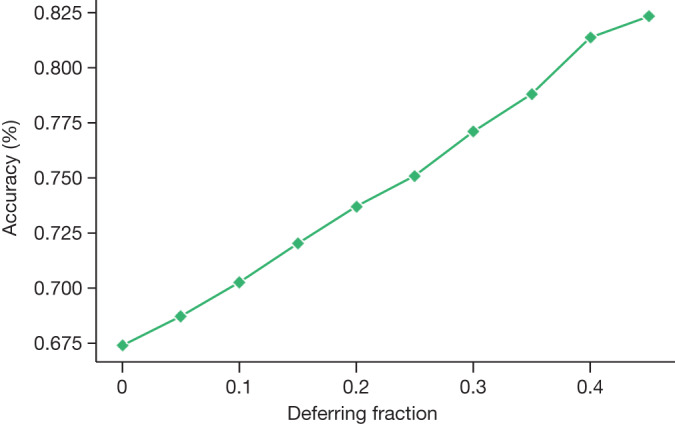
“We created a selective prediction task [82], using the number of decodes matching a given answer from self-consistency as a measure of uncertainty and used it to withhold the answer if the model was not appropriately confident.”
MethodSelf-citationPathways: Asynchronous Distributed Dataflow for ML
Barham, P., Chowdhery, A., Dean, J., Ghemawat, S., Hand, S., Hurt, D., Isard, M., Lim, H., Pang, R., Roy, S. K., et al. (2022) · arXiv (Cornell University) · doi:10.48550/arxiv.2203.12533 · Cited by 35
Self-citationThe Diminishing Returns of Masked Language Models to Science
Hong, Z., Ajith, A., Pauloski, J., Duede, E., Chard, K., & Foster, I. (2023) · Findings of the Association for Computational Linguistics: ACL 2023 · doi:10.18653/v1/2023.findings-acl.82 · Cited by 24
Morgado, F. F. D. R., Meireles, J. F. F., Neves, C. M., Amaral, A. C. S., & Ferreira, M. E. C. (2017) · Psicologia Reflexão e Crítica · doi:10.1186/s41155-017-0059-7 · Cited by 22
Measuring Harm in Health Care: Optimizing Adverse Event Review
Walsh, K. E., Harik, P., Mazor, K. M., Perfetto, D., Anatchkova, M., Biggins, C., Wagner, J., Schoettker, P. J., Firneno, C., Klugman, R., et al. (2017) · Medical Care · doi:10.1097/mlr.0000000000000679 · Cited by 20
CHARD: Clinical Health-Aware Reasoning Across Dimensions for Text Generation ModelsPreprint
Feng, S. Y., Khetan, V., Sacaleanu, B., Gershman, A., & Hovy, E. (2022) · Conference of the European Chapter of the Association for Computational Linguistics · doi:10.48550/arxiv.2210.04191 · Cited by 19
Overview of the Medical Question Answering Task at TREC 2017 LiveQA
Abacha, A. B., Agichtein, E., Pinter, Y., et al. (2017) · doi:10.6028/nist.sp.500-324.qa-overview · Cited by 18
CHARD: Clinical Health-Aware Reasoning Across Dimensions for Text Generation Models
Feng, S. Y., Khetan, V., Sacaleanu, B., Gershman, A. V., & Hovy, E. H. (2023) · Conference of the European Chapter of the Association for Computational Linguistics · doi:10.18653/v1/2023.eacl-main.24 · Cited by 17
BioMegatron: Larger Biomedical Domain Language ModelPreprint
Shin, H.-C., Zhang, Y., Bakhturina, E., Puri, R., Patwary, M. A., Shoeybi, M., & Mani, R. (2020) · arXiv (Cornell University) · doi:10.48550/arxiv.2010.06060 · Cited by 11
The Diminishing Returns of Masked Language Models to SciencePreprint
Hong, Z., Ajith, A., Pauloski, G., et al. (2022) · arXiv (Cornell University) · doi:10.48550/arxiv.2205.11342 · Cited by 11
emrQA: A Large Corpus for Question Answering on Electronic Medical RecordsPreprint
Pampari, A., Raghavan, P., Liang, J. J., et al. (2018) · arXiv (Cornell University) · doi:10.48550/arxiv.1809.00732 · Cited by 10
Healthsheet: Development of a Transparency Artifact for Health DatasetsPreprint
Rostamzadeh, N., Mincu, D., Roy, S., et al. (2022) · arXiv (Cornell University) · doi:10.48550/arxiv.2202.13028 · Cited by 10 · cited 1×
“Key principles include the use of participatory methods to design contextualized evaluations that reflect the values of patients that may benefit or be harmed, grounding the evaluation in one or more specific downstream clinical use cases [54, 71], and the use of dataset and model documentation frameworks for transpar…”
BackgroundRetrieval of Soft Prompt Enhances Zero-Shot Task GeneralizationPreprint
Ye, S., Jang, J., Kim, D., Jo, Y., & Seo, M. (2022) · arXiv.org · doi:10.48550/arxiv.2210.03029 · Cited by 10 · cited 1×
“Given the combination of soft prompt with hard prompt, instruction prompt tuning can be considered a type of "hard-soft hybrid prompt tuning" [52], alongside existing techniques that insert hard anchor tokens into a soft prompt [53], insert learned soft tokens into a hard prompt [28], or use a learned soft prompt as a…”
Ye, S., Jang, J., Kim, D., Jo, Y., & Seo, M. (2023) · Findings of the Association for Computational Linguistics: EMNLP (Findings of EMNLP) · doi:10.18653/v1/2023.findings-emnlp.822 · Cited by 10
Algorithmic monoculture and social welfare
(2023) · The Societal Impacts of Algorithmic Decision-Making · doi:10.1145/3603195.3603202 · cited 1×
“Additional research will be needed to assess LLMs used in healthcare for homogenization and amplification of biases and security vulnerabilities inherited from base models [10, 11, 18, 39, 49].”
BackgroundBLOOM: A 176B-Parameter Open-Access Multilingual Language Model
Workshop, B., :, Scao, T. L., Fan, A., Akiki, C., Pavlick, E., Ilić, S., Hesslow, D., Castagné, R., Luccioni, A. S., et al. (2022) · arXiv · doi:10.48550/arxiv.2211.05100
Self-citationOPT: Open Pre-trained Transformer Language Models
Zhang, S., Roller, S., Goyal, N., Artetxe, M., Chen, M., Chen, S., Dewan, C., Diab, M., Li, X., Lin, X. V., et al. (2022) · arXiv · doi:10.48550/arxiv.2205.01068 · cited 1×
“Large language models (LLMs) Over the past few years, LLMs have shown impressive performance on natural language processing (NLP) tasks [12, 14, 15, 30, 69, 70, 73, 89, 91, 99].”
BackgroundPerturbation Sensitivity Analysis to Detect Unintended Model Biases
Prabhakaran, V., Hutchinson, B., & Mitchell, M. (2019) · arXiv · doi:10.48550/arxiv.1910.04210 · cited 1×
“For instance, depending on the context, it may be relevant to assess sensitivity of model outputs to perturbations of demographic identifiers in prompts designed deliberately such that the result should not change under the perturbation [23, 68, 98].”
BackgroundControlling Linguistic Style Aspects in Neural Language Generation
Ficler, J., & Goldberg, Y. (2017) · arXiv · doi:10.48550/arxiv.1707.02633
Research works printed but not linked: 2
- Abacha, A. B. et al. in Studies in Health Technology and Informatics (eds Ohno-Machado, L. & Séroussi, B.) 25–29 (IOS Press, 2019).
- Matheny, M., Israni, S. T., Ahmed, M. & Whicher, D. eds. Artificial Intelligence in Health Care: The Hope, the Hype, the Promise, the Peril (National Academy of Medicine, 2022). 39146448
Cited by
A Survey on Evaluation of Large Language Models
Chang, Y., Wang, X., Wang, J., Wu, Y., Yang, L., Zhu, K., Chen, H., Yi, X., Wang, C., Wang, Y., et al. (2024) · ACM Transactions on Intelligent Systems and Technology · doi:10.1145/3641289 · Cited by 4,254
“, 2023c) Multilingual Multimodal Multilevel Specific downstream task Task-Specific Metrics MultiMedQA (Singhal et al., 2022) Medical Question Answering Specific downstream task Accuracy, Medical Knowledge, Reasoning SOCKET (Choi et al.”
BackgroundInfluentialLarge language models in medicine
Thirunavukarasu, A. J., Ting, D. S. J., Elangovan, K., Gutierrez, L., Tan, T. F., & Ting, D. S. W. (2023) · Nature Medicine · doi:10.1038/s41591-023-02448-8 · Cited by 3,944
“Performance is far from perfect even in medical student examinations, with no reported scores approaching 100% 14,15,38,43,44 .”
BackgroundA Survey on Evaluation of Large Language Models
Chang, Y., Wang, X., Wang, J., Wu, Y., Yang, L., Zhu, K., Chen, H., Yi, X., Wang, C., Wang, Y., et al. (2023) · arXiv · doi:10.48550/arxiv.2307.03109 · Cited by 3,159
Ayers, J. W., Poliak, A., Dredze, M., Leas, E. C., Zhu, Z., Kelley, J. B., Faix, D. J., Goodman, A. M., Longhurst, C. A., Hogarth, M., et al. (2023) · JAMA Internal Medicine · doi:10.1001/jamainternmed.2023.1838 · Cited by 2,613
A Survey of Large Language Models
Zhao, W. X., Zhou, K., Li, J., Tang, T., Dong, Z., Hou, Y., Zhang, B., Min, Y., Zhang, J., Liu, P., et al. (2026) · Frontiers of Computer Science · doi:10.1007/s11704-026-60308-3 · Cited by 2,093
Metadata
- Authors
- Singhal, K., Azizi, S., Tu, T., Mahdavi, S. S., Wei, J., Chung, H. W., Scales, N., Tanwani, A., Cole-Lewis, H., Pfohl, S., Payne, P., Seneviratne, M., Gamble, P., Kelly, C., Babiker, A., Schärli, N., Chowdhery, A., Mansfield, P., Demner-Fushman, D., Agüera y Arcas, B., Webster, D., Corrado, G. S., Matias, Y., Chou, K., Gottweis, J., Tomasev, N., Liu, Y., Rajkomar, A., Barral, J., Semturs, C., Karthikesalingam, A., & Natarajan, V.
- Affiliations
- Google (United States) (US)
- Corresponding author
- Singhal, Karan
- Azizi, Shekoofeh
- Karthikesalingam, Alan
- Natarajan, Vivek
- ORCID
- Singhal, Karan
- Azizi, Shekoofeh
- Mahdavi, S. Sara
- Chung, Hyung Won
- Tanwani, Ajay
- Cole-Lewis, Heather
- Seneviratne, Martin
- Kelly, Chris
- Chowdhery, Aakanksha
- Mansfield, Philip
- Webster, Dale
- Corrado, Greg S.
- Matias, Yossi
- Chou, Katherine
- Gottweis, Juraj
- Tomasev, Nenad
- Liu, Yun
- Rajkomar, Alvin
- Barral, Joelle
- Semturs, Christopher
- Karthikesalingam, Alan
- Natarajan, Vivek
- Venue
- Nature
- Published
- 2023-07-12
- Volume
- 620
- Issue
- 7972
- Pages
- 172-180
- ISSN
- 0028-0836 (ISSN-L)
- 1476-4687
- PMC
- PMC10396962
- OpenAlex
- W4384071683
- Semantic Scholar
- 6052486bc9144dc1730c12bf35323af3792a1fd0
- Cited by
- 4,083
- References
- 85
- Citations by year
- 2026: 1627 · 2025: 1275 · 2024: 933 · 2023: 247
- FWCI
- 162.53
- Type
- journal article
- Language
- en
- Update notices
- correction (2023-07-27)
- Open access
- hybrid
- doi.org
- Licence
- cc-by
- creativecommons.org/licenses/by/4.0 (tdm)
- creativecommons.org/licenses/by/4.0 (vor)
- Locations
- Nature (publishedVersion, cc-by)
- PubMed Central (publishedVersion, cc-by)
- PubMed (publishedVersion)
- arXiv (Cornell University) (submittedVersion)
- RePEc: Research Papers in Economics (submittedVersion)
- arXiv (Cornell University) (cc-by)
- Funders
- DeepMind
- U.S. National Library of Medicine
- Topics
- Health Sciences › Medicine › Health Informatics › Artificial Intelligence in Healthcare and Education
- Physical Sciences › Computer Science › Artificial Intelligence › Topic Modeling
- Physical Sciences › Computer Science › Artificial Intelligence › Machine Learning in Healthcare
- Keywords
- large language models, clinical knowledge, medical question answering, human evaluation, Arecaceae, MedQA, MedMCQA, PubMedQA, MMLU, clinical reasoning
- MeSH terms
- Clinical Competence, Computer Simulation, Humans, Licensure, Medicine, Natural Language Processing, Physicians, Bias, Knowledge, Benchmarking, Comprehension, Patient Safety, Datasets as Topic
About these checks
Registry, retraction, Cites and statistics results are computed, not judged, with one exception: a printed reference that no index lists is read once by a model before it counts as a citation error. Claims are extracted by a model and kept only when their quote appears verbatim in the text; each cited source is then checked, with a model’s help, for whether it says what the claim relies on. Those verdicts can be wrong — read the claim’s quote and the cited source before relying on one.
Statistics and arithmetic are recomputed, not judged.
Confidence bands are shown only for fields calibrated on our annotated test set. None is calibrated yet, so no band is shown.
What counts as a claim ›How we measure confidence ›How we check this ›
Are you an author, or do you see a problem with this page? Request a review
Data sources
Bibliographic data: Semantic Scholar, OpenAlex, Crossref.
Contains information from the Semantic Scholar Academic Graph Datasets, made available under the ODC Attribution License (ODC-BY 1.0).
Semantic Scholar’s data is described in: Kinney, R., et al. (2023). The Semantic Scholar Open Data Platform. arXiv:2301.10140.
