

Large language models encode clinical knowledge
Open accessThe DOI matches its Crossref record; 115 of the 116 references it cites were found in a registry or an index.
Abstract
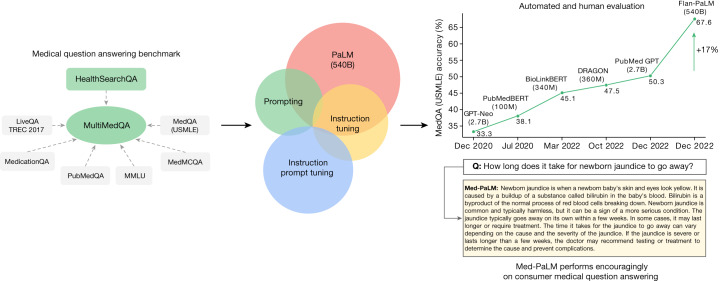
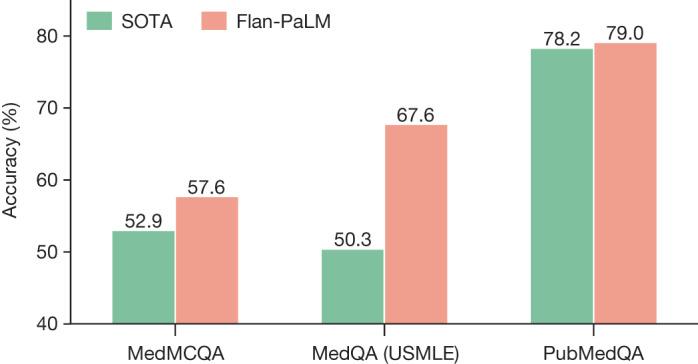
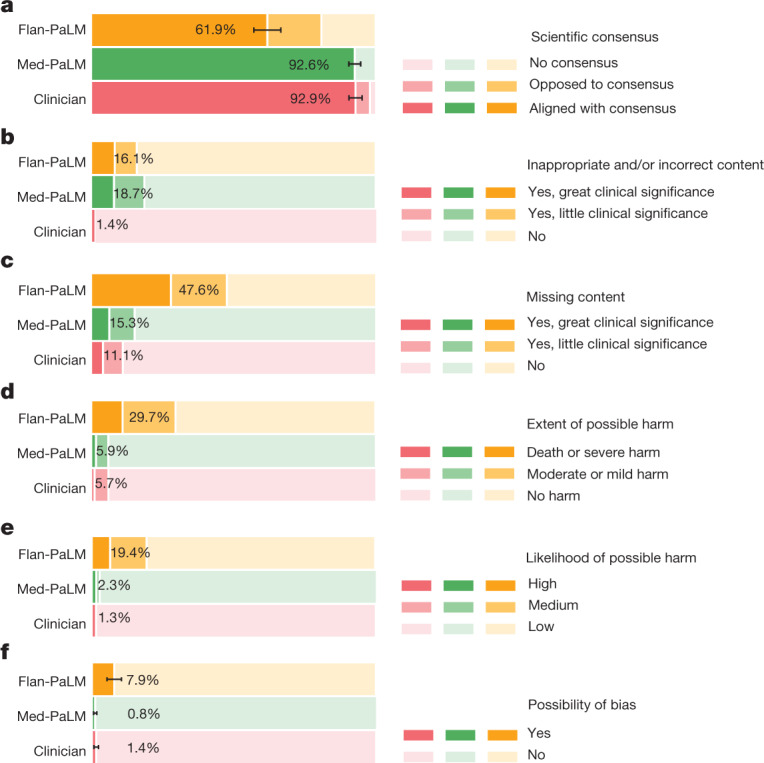
Large language models (LLMs) have demonstrated impressive capabilities, but the bar for clinical applications is high. Attempts to assess the clinical knowledge of models typically rely on automated evaluations based on limited benchmarks. Here, to address these limitations, we present MultiMedQA, a benchmark combining six existing medical question answering datasets spanning professional medicine, research and consumer queries and a new dataset of medical questions searched online, HealthSearchQA. We propose a human evaluation framework for model answers along multiple axes including factuality, comprehension, reasoning, possible harm and bias. In addition, we evaluate Pathways Language Model 1 (PaLM, a 540-billion parameter LLM) and its instruction-tuned variant, Flan-PaLM 2 on MultiMedQA. Using a combination of prompting strategies, Flan-PaLM achieves state-of-the-art accuracy on every MultiMedQA multiple-choice dataset (MedQA 3 , MedMCQA 4 , PubMedQA 5 and Measuring Massive Multitask Language Understanding (MMLU) clinical topics 6 ), including 67.6% accuracy on MedQA (US Medical Licensing Exam-style questions), surpassing the prior state of the art by more than 17%. However, human evaluation reveals key gaps. To resolve this, we introduce instruction prompt tuning, a parameter-efficient approach for aligning LLMs to new domains using a few exemplars. The resulting model, Med-PaLM, performs encouragingly, but remains inferior to clinicians. We show that comprehension, knowledge recall and reasoning improve with model scale and instruction prompt tuning, suggesting the potential utility of LLMs in medicine. Our human evaluations reveal limitations of today’s models, reinforcing the importance of both evaluation frameworks and method development in creating safe, helpful LLMs for clinical applications.
Overview
The claims and statistics of this paper haven’t been checked yet.
Free: it reads the open-access text and checks the first 5 claims that cite a source we can check. Create a free account to check every claim.
Integrity signals
Registry
Cites
Statistics
Figures
Verification
Claims the paper makes
The claims and statistics of this paper haven’t been checked yet.
Free: it reads the open-access text and checks the first 5 claims that cite a source we can check. Create a free account to check every claim.
Claims other papers make about this one
Each is checked against this paper’s own text: does it say what the citing paper says it does?
The cited source doesn’t support the claim as written.
In the citing paper
“Notably, in healthcare, medical NLP benchmarks like MedQA7, PubMedQA8 and the Massive Multitask Language Understanding (MMLU) serve as the de-facto reporting standard for state-of-the-art medical LLMs9–11 with claims of ‘superhuman’ performance in patient-facing tasks12.”
From Medical large language models are vulnerable to data-poisoning attacks (2025) · cites this paper as [9]
Checked by a reasoning model — may be wrong.
Experimental — accuracy not yet measuredThe cited source doesn’t support the claim as written.
In the citing paper
“Med-PaLM achieved a passing score of 67.6% on USMLE-style MedQA questions”
From Trustworthy Medical Question Answering: An Evaluation-Centric Survey (2025) · cites this paper as Singhal et al., 2023
Checked by a reasoning model — may be wrong.
Experimental — accuracy not yet measuredThe source backs part of the claim, not all of it — or backs it for a different population, condition or comparison.
In the citing paper
“Previous work has demonstrated potential across clinical NLP tasks22,23, adapting to the medical domain by training a new model24,25, fine-tuning an existing model26,27 or supplying task-specific examples in the model prompt27,28.”
From Adapted large language models can outperform medical experts in clinical text summarization (2024) · cites this paper as [24]
Experimental — accuracy not yet measuredThe source backs part of the claim, not all of it — or backs it for a different population, condition or comparison.
In the citing paper
“For example, Google’s Med-PaLM 2 demonstrated proficiency in medical question answering, achieving performance comparable to clinical experts on medical licensing examinations and performing better than generalist physicians in real-world medical questions.70”
From A foundational architecture for AI agents in healthcare (2025) · cites this paper as [70]
Experimental — accuracy not yet measuredThe source backs part of the claim, not all of it — or backs it for a different population, condition or comparison.
In the citing paper
“Large language models (LLMs) and multimodal foundation models now exhibit enhanced reasoning capabilities, natural language understanding, and the ability to interact with external tools such as calculators, databases, and application programming interfaces.”
From Medical AI Agents for Clinical Decision Support: Viewpoint Using the Planning, Action, Reflection, and Memory (PARM) Analytical Lens (2026) · cites this paper as [8]
Experimental — accuracy not yet measured
40 more claims about this paper
Create a free account to see every claim other papers make about this one.
Self-check
Percentages, sums and reported differences re-computed from the paper’s own numbers.
The self-check needs the paper’s full text.
Citations
Cites
Vaswani, A., Shazeer, N., Parmar, N., Uszkoreit, J., Jones, L., Gomez, A. N., Kaiser, L., & Polosukhin, I. (2017) · arXiv · doi:10.48550/arxiv.1706.03762 · Cited by 120,404 · cited 1×
“They owe their success to scaling up the training of transformer-based models [84].”
BackgroundExploring the Limits of Transfer Learning with a Unified Text-to-Text Transformer
Raffel, C., Shazeer, N., Roberts, A., Lee, K., Narang, S., Matena, M., Zhou, Y., Li, W., & Liu, P. J. (2019) · arXiv · doi:10.48550/arxiv.1910.10683 · Cited by 31,859 · cited 1×
“Large language models (LLMs) Over the past few years, LLMs have shown impressive performance on natural language processing (NLP) tasks [12, 14, 15, 30, 69, 70, 73, 89, 91, 99].”
BackgroundLanguage Models are Few-Shot Learners
Brown, T. B., Mann, B., Ryder, N., Subbiah, M., Kaplan, J., Dhariwal, P., Neelakantan, A., Shyam, P., Sastry, G., Askell, A., et al. (2020) · arXiv · doi:10.48550/arxiv.2005.14165 · Cited by 23,372
BLEU: a method for automatic evaluation of machine translation
Papineni, K., Roukos, S., Ward, T., & Zhu, W.-J. (2001) · Proceedings of the 40th Annual Meeting on Association for Computational Linguistics - ACL '02 · doi:10.3115/1073083.1073135 · Cited by 21,344
Decoupled Weight Decay Regularization
Loshchilov, I., & Hutter, F. (2017) · arXiv · doi:10.48550/arxiv.1711.05101 · Cited by 12,522
Scaling Laws for Neural Language Models
Kaplan, J., McCandlish, S., Henighan, T., Brown, T. B., Chess, B., Child, R., Gray, S., Radford, A., Wu, J., & Amodei, D. (2020) · arXiv · doi:10.48550/arxiv.2001.08361 · Cited by 9,550 · cited 1×
“It has been shown that model performance and data-efficiency scales with model size and dataset size [37].”
BioBERT: a pre-trained biomedical language representation model for biomedical text mining
Lee, J., Yoon, W., Kim, S., Kim, D., Kim, S., So, C. H., & Kang, J. (2020) · Bioinformatics · doi:10.1093/bioinformatics/btz682 · Cited by 7,218
Boateng, G. O., Neilands, T. B., Frongillo, E. A., Melgar-Quiñonez, H. R., & Young, S. L. (2018) · Frontiers in Public Health · doi:10.3389/fpubh.2018.00149 · Cited by 5,925
Chain-Of-Thought Prompting Elicits Reasoning in Large Language Models
Wei, J., Wang, X., Schuurmans, D., Bosma, M., Ichter, B., Xia, F., Chi, E., Le, Q. V., & Zhou, D. (2022) · Advances in Neural Information Processing Systems 35 · doi:10.52202/068431-1800 · Cited by 4,505
Self-citationLiu, P., Yuan, W., Fu, J., Jiang, Z., Hayashi, H., & Neubig, G. (2023) · ACM Computing Surveys · doi:10.1145/3560815 · Cited by 4,361
Research works printed but not linked: 2
- Abacha, A. B. et al. in Studies in Health Technology and Informatics (eds Ohno-Machado, L. & Séroussi, B.) 25–29 (IOS Press, 2019).
- Matheny, M., Israni, S. T., Ahmed, M. & Whicher, D. eds. Artificial Intelligence in Health Care: The Hope, the Hype, the Promise, the Peril (National Academy of Medicine, 2022). 39146448
Cited by
A Survey on Evaluation of Large Language Models
Chang, Y., Wang, X., Wang, J., Wu, Y., Yang, L., Zhu, K., Chen, H., Yi, X., Wang, C., Wang, Y., et al. (2024) · ACM Transactions on Intelligent Systems and Technology · doi:10.1145/3641289 · Cited by 4,254
“, 2023c) Multilingual Multimodal Multilevel Specific downstream task Task-Specific Metrics MultiMedQA (Singhal et al., 2022) Medical Question Answering Specific downstream task Accuracy, Medical Knowledge, Reasoning SOCKET (Choi et al.”
BackgroundInfluentialLarge language models in medicine
Thirunavukarasu, A. J., Ting, D. S. J., Elangovan, K., Gutierrez, L., Tan, T. F., & Ting, D. S. W. (2023) · Nature Medicine · doi:10.1038/s41591-023-02448-8 · Cited by 3,944
“Performance is far from perfect even in medical student examinations, with no reported scores approaching 100% 14,15,38,43,44 .”
BackgroundA Survey on Evaluation of Large Language Models
Chang, Y., Wang, X., Wang, J., Wu, Y., Yang, L., Zhu, K., Chen, H., Yi, X., Wang, C., Wang, Y., et al. (2023) · arXiv · doi:10.48550/arxiv.2307.03109 · Cited by 3,159
Ayers, J. W., Poliak, A., Dredze, M., Leas, E. C., Zhu, Z., Kelley, J. B., Faix, D. J., Goodman, A. M., Longhurst, C. A., Hogarth, M., et al. (2023) · JAMA Internal Medicine · doi:10.1001/jamainternmed.2023.1838 · Cited by 2,613
A Survey of Large Language Models
Zhao, W. X., Zhou, K., Li, J., Tang, T., Dong, Z., Hou, Y., Zhang, B., Min, Y., Zhang, J., Liu, P., et al. (2026) · Frontiers of Computer Science · doi:10.1007/s11704-026-60308-3 · Cited by 2,093
Foundation models for generalist medical artificial intelligence
Moor, M., Banerjee, O., Abad, Z. S. H., Krumholz, H. M., Leskovec, J., Topol, E. J., & Rajpurkar, P. (2023) · Nature · doi:10.1038/s41586-023-05881-4 · Cited by 2,028
“For example, by drawing on medical texts present within their training datasets, general-purpose models such as Flan-PaLM or ChatGPT can accurately answer medical questions, achieving passing scores on the United States Medical Licensing Exam 10,52,53 .”
BackgroundBenefits, Limits, and Risks of GPT-4 as an AI Chatbot for Medicine
Lee, P., Bubeck, S., & Petro, J. (2023) · New England Journal of Medicine · doi:10.1056/nejmsr2214184 · Cited by 1,738
Toward expert-level medical question answering with large language models
Singhal, K., Tu, T., Gottweis, J., Sayres, R., Wulczyn, E., Amin, M., Hou, L., Clark, K., Pfohl, S. R., Cole-Lewis, H., et al. (2025) · Nature Medicine · doi:10.1038/s41591-024-03423-7 · Cited by 1,734
Self-citationSparks of Artificial General Intelligence: Early experiments with GPT-4
Bubeck, S., Chandrasekaran, V., Eldan, R., Gehrke, J., Horvitz, E., Kamar, E., Lee, P., Lee, Y. T., Li, Y., Lundberg, S., et al. (2023) · arXiv · doi:10.48550/arxiv.2303.12712 · Cited by 1,526
Liu, X., Zheng, Y., Du, Z., Ding, M., Qian, Y., Yang, Z., & Tang, J. (2024) · AI Open · doi:10.1016/j.aiopen.2023.08.012 · Cited by 596
Dell’Acqua, F., McFowland, E., Mollick, E., Lifshitz, H., Kellogg, K. C., Rajendran, S., Krayer, L., Candelon, F., & Lakhani, K. R. (2026) · Organization Science · doi:10.1287/orsc.2025.21838 · Cited by 1,189
“Although trained as general models, LLMs demonstrate specialist knowledge and abilities as part of their training process and during normal use (Reed et al. 2022, Boiko et al. 2023, Moor et al. 2023, Singhal et al. 2023).”
The imperative for regulatory oversight of large language models (or generative AI) in healthcare
Meskó, B., & Topol, E. J. (2023) · npj Digital Medicine · doi:10.1038/s41746-023-00873-0 · Cited by 1,047
“Since then, GPT-4 could achieve an accuracy over 85% on the same exam 14 .”
The future landscape of large language models in medicine
Clusmann, J., Kolbinger, F. R., Muti, H. S., Carrero, Z. I., Eckardt, J.-N., Laleh, N. G., Löffler, C. M. L., Schwarzkopf, S.-C., Unger, M., Veldhuizen, G. P., et al. (2023) · Communications Medicine · doi:10.1038/s43856-023-00370-1 · Cited by 1,045
A foundation model for generalizable disease detection from retinal images
Zhou, Y., Chia, M. A., Wagner, S. K., Ayhan, M. S., Williamson, D. J., Struyven, R. R., Liu, T., Xu, M., Lozano, M. G., Woodward-Court, P., et al. (2023) · Nature · doi:10.1038/s41586-023-06555-x · Cited by 1,014
“Our comparison demonstrates that the combination of powerful network architecture and complex pretext tasks can produce effective and general-purpose medical foundation models, aligning with the insights derived from large language models in healthcare 49,50 .”
BackgroundLiu, X., Zheng, Y., Du, Z., Ding, M., Qian, Y., Yang, Z., & Tang, J. (2021) · arXiv · doi:10.48550/arxiv.2103.10385 · Cited by 908
Adapted large language models can outperform medical experts in clinical text summarization
Van Veen, D., Van Uden, C., Blankemeier, L., Delbrouck, J.-B., Aali, A., Bluethgen, C., Pareek, A., Polacin, M., Reis, E. P., Seehofnerová, A., et al. (2024) · Nature Medicine · doi:10.1038/s41591-024-02855-5 · Cited by 891
“Previous work has demonstrated potential across clinical NLP tasks 22,23 , adapting to the medical domain by training a new model 24,25 , fine-tuning an existing model 26,27 or supplying task-specific examples in the model prompt 27,28 .”
What ChatGPT and generative AI mean for science
Stokel-Walker, C., & Van Noorden, R. (2023) · Nature · doi:10.1038/d41586-023-00340-6 · Cited by 828
Evaluation and mitigation of the limitations of large language models in clinical decision-making
Hager, P., Jungmann, F., Holland, R., Bhagat, K., Hubrecht, I., Knauer, M., Vielhauer, J., Makowski, M., Braren, R., Kaissis, G., et al. (2024) · Nature Medicine · doi:10.1038/s41591-024-03097-1 · Cited by 798
Dell'Acqua, F., McFowland III, E., Mollick, E. R., Lifshitz-Assaf, H., Kellogg, K., Rajendran, S., Krayer, L., Candelon, F., & Lakhani, K. R. (2023) · SSRN Electronic Journal · doi:10.2139/ssrn.4573321 · Cited by 794
Large Language Model Influence on Diagnostic Reasoning: A Randomized Clinical Trial
Goh, E., Gallo, R., Hom, J., Strong, E., Weng, Y., Kerman, H., Cool, J. A., Kanjee, Z., Parsons, A. S., Ahuja, N., et al. (2024) · JAMA Network Open · doi:10.1001/jamanetworkopen.2024.40969 · Cited by 724
ChatGPT and the Rise of Large Language Models: The New AI-Driven Infodemic Threat in Public Health
De Angelis, L., Baglivo, F., Arzilli, G., Privitera, G. P., Ferragina, P., Tozzi, A. E., & Rizzo, C. (2023) · doi:10.2139/ssrn.4352931 · Cited by 708
ChatGPT and the rise of large language models: the new AI-driven infodemic threat in public health
De Angelis, L., Baglivo, F., Arzilli, G., Privitera, G. P., Ferragina, P., Tozzi, A. E., & Rizzo, C. (2023) · Frontiers in Public Health · doi:10.3389/fpubh.2023.1166120 · Cited by 708
The TRIPOD-LLM reporting guideline for studies using large language models
Gallifant, J., Afshar, M., Ameen, S., Aphinyanaphongs, Y., Chen, S., Cacciamani, G., Demner-Fushman, D., Dligach, D., Daneshjou, R., Fernandes, C., et al. (2025) · Nature Medicine · doi:10.1038/s41591-024-03425-5 · Cited by 615
Self-citationEvaluating the Performance of ChatGPT in Ophthalmology
Antaki, F., Touma, S., Milad, D., El-Khoury, J., & Duval, R. (2023) · Ophthalmology Science · doi:10.1016/j.xops.2023.100324 · Cited by 563
“There has been recent interest in evaluating the capabilities of LLMs for understanding and generating natural language in medicine 9 10 .”
BackgroundMethodResultInfluentialAntaki, F., Touma, S., Milad, D., El-Khoury, J., & Duval, R. (2023) · doi:10.1101/2023.01.22.23284882 · Cited by 563
The Flan Collection: Designing Data and Methods for Effective Instruction Tuning
Longpre, S., Hou, L., Vu, T., Webson, A., Chung, H. W., Tay, Y., Zhou, D., Le, Q. V., Zoph, B., Wei, J., et al. (2023) · arXiv · doi:10.48550/arxiv.2301.13688
“Further, Liu et al. (2022b), Vu et al. (2022), Wei et al. (2021), and Singhal et al. (2022) collectively show that both single-task and multi-task parameter-efficient tuning can be productively combined with instruction tuning, either before or after regular full-model instruction tuning.”
BackgroundSelf-citationCapabilities of GPT-4 on Medical Challenge Problems
Nori, H., King, N., McKinney, S. M., Carignan, D., & Horvitz, E. (2023) · arXiv · doi:10.48550/arxiv.2303.13375 · Cited by 509
“The benchmarks include MedQA, PubMedQA, MedMCQA, and medical components of MMLU.”
MethodPrompt engineering in consistency and reliability with the evidence-based guideline for LLMs
Wang, L., Chen, X., Deng, X., Wen, H., You, M., Liu, W., Li, Q., & Li, J. (2024) · npj Digital Medicine · doi:10.1038/s41746-024-01029-4 · Cited by 390
“For other LLMs, in the study by Karan et al. 8 , Med-PaLM, which is a version of Flan-PaLMthat has been instruction prompt-tuned and is not currently publicly available, was evaluated by a panel of clinicians.”
InfluentialTowards generalist foundation model for radiology by leveraging web-scale 2D&3D medical data
Wu, C., Zhang, X., Zhang, Y., Hui, H., Wang, Y., & Xie, W. (2025) · Nature Communications · doi:10.1038/s41467-025-62385-7 · Cited by 142
“Though in the context of the medical language-only models, great steps have been made, like Med-PALM series 23,24 , PMC-LLaMA 25 , Meditron-70b 26 , the development of multimodal medical arti fi cial intelligence is still in its nascent stages 5 .”
Towards Generalist Biomedical AI
Tu, T., Azizi, S., Driess, D., Schaekermann, M., Amin, M., Chang, P.-C., Carroll, A., Lau, C., Tanno, R., Ktena, I., et al. (2024) · NEJM AI · doi:10.1056/aioa2300138 · Cited by 483
Self-citationHarrer, S. (2023) · eBioMedicine · doi:10.1016/j.ebiom.2023.104512 · Cited by 480
“For example, Med-PaLM, an LLM custom developed by Google and DeepMind for the medical fi eld recently reported USMLE accuracy results which started to approach performance levels of human clinical experts 6 and were replicated by ChatGPT.”
MethodA multimodal generative AI copilot for human pathology
Lu, M. Y., Chen, B., Williamson, D. F. K., Chen, R. J., Zhao, M., Chow, A. K., Ikemura, K., Kim, A., Pouli, D., Patel, A., et al. (2024) · Nature · doi:10.1038/s41586-024-07618-3 · Cited by 461
Health system-scale language models are all-purpose prediction engines
Jiang, L. Y., Liu, X. C., Nejatian, N. P., Nasir-Moin, M., Wang, D., Abidin, A., Eaton, K., Riina, H. A., Laufer, I., Punjabi, P., et al. (2023) · Nature · doi:10.1038/s41586-023-06160-y · Cited by 460
“…Nature Portfolio reporting summaries, source data, extended data, supplementary information, acknowl-edgements, peer review information; details of author contributions and competing interests; and statements of data and code availability are available at https://doi.org/10.1038/s41586-023-06160-y.”
BackgroundMethodInfluentialThe current and future state of AI interpretation of medical images
Rajpurkar, P., & Lungren, M. P. (2023) · New England Journal of Medicine · doi:10.1056/nejmra2301725 · Cited by 443
Large Language Models in Medicine: The Potentials and Pitfalls: A Narrative Review
Omiye, J. A., Gui, H., Rezaei, S. J., Zou, J., & Daneshjou, R. (2024) · Annals of Internal Medicine · doi:10.7326/m23-2772 · Cited by 361
“Despite their versatility, LLMs ’ behaviors are poorly understood (7), and they have the potential to produce medically inaccurate outputs (11) and amplify existing biases (12, 13).”
BackgroundMethodInfluentialTam, T. Y. C., Sivarajkumar, S., Kapoor, S., Stolyar, A. V., Polanska, K., McCarthy, K. R., Osterhoudt, H., Wu, X., Visweswaran, S., Fu, S., et al. (2024) · npj Digital Medicine · doi:10.1038/s41746-024-01258-7 · Cited by 424
Almanac — Retrieval-Augmented Language Models for Clinical Medicine
Zakka, C., Shad, R., Chaurasia, A., Dalal, A. R., Kim, J. L., Moor, M., Fong, R., Phillips, C., Alexander, K., Ashley, E., et al. (2024) · NEJM AI · doi:10.1056/aioa2300068 · Cited by 424
Evaluating large language models on medical evidence summarization
Tang, L., Sun, Z., Idnay, B., Nestor, J. G., Soroush, A., Elias, P. A., Xu, Z., Ding, Y., Durrett, G., Rousseau, J. F., et al. (2023) · npj Digital Medicine · doi:10.1038/s41746-023-00896-7 · Cited by 423
A framework to assess clinical safety and hallucination rates of LLMs for medical text summarisation
Asgari, E., Montaña-Brown, N., Dubois, M., Khalil, S., Balloch, J., Yeung, J. A., & Pimenta, D. (2025) · npj Digital Medicine · doi:10.1038/s41746-025-01670-7 · Cited by 423
Evaluating Large Language Models on Medical Evidence Summarization
Tang, L., Sun, Z., Idnay, B., Nestor, J. G., Soroush, A., Elias, P. A., Xu, Z., Ding, Y., Durrett, G., Rousseau, J., et al. (2023) · doi:10.1101/2023.04.22.23288967 · Cited by 423
“These dimensions have been previously identified and serve as essential factors in evaluating the overall quality of generated summaries [15, 22, 23].”
Large language models in healthcare and medical domain: A review
Nazi, Z. A., & Peng, W. (2024) · Informatics · doi:10.3390/informatics11030057 · Cited by 415
The application of large language models in medicine: A scoping review
Meng, X., Yan, X., Zhang, K., Liu, D., Cui, X., Yang, Y., Zhang, M., Cao, C., Wang, J., Wang, X., et al. (2024) · iScience · doi:10.1016/j.isci.2024.109713 · Cited by 414
A study of generative large language model for medical research and healthcare
Peng, C., Yang, X., Chen, A., Smith, K. E., PourNejatian, N., Costa, A. B., Martin, C., Flores, M. G., Zhang, Y., Magoc, T., et al. (2023) · npj Digital Medicine · doi:10.1038/s41746-023-00958-w · Cited by 408
“…47 — a biomedical question answering dataset collected from PubMed abstracts, which requires answering questions with ‘ yes/no/maybe ’ ; MedMCQA 48 — a large-scale multi-choice question answering dataset designed to address real world medical entrance exam questions covering 2400 healthcare…”
InfluentialA survey on LLM-based multi-agent systems: Workflow, infrastructure, and challenges
Li, X., Wang, S., Zeng, S., Wu, Y., & Yang, Y. (2024) · Vicinagearth · doi:10.1007/s44336-024-00009-2 · Cited by 404
“Beyond text, visual, and audio data, LLMs often need to utilize specialized knowledge from specific domains such as scientific research [160, 161], medical information [162–164], or technical specifications [165–167].”
Haltaufderheide, J., & Ranisch, R. (2024) · npj Digital Medicine · doi:10.1038/s41746-024-01157-x · Cited by 396
“15 LLMs specifically trained on biomedical corpora forebode even further capacities for clinical application and patient care 16 in the foreseeable future.”
BackgroundCLIP-Driven Universal Model for Organ Segmentation and Tumor Detection
Liu, J., Zhang, Y., Chen, J.-N., Xiao, J., Lu, Y., Landman, B. A., Yuan, Y., Yuille, A., Tang, Y., & Zhou, Z. (2023) · 2023 IEEE/CVF International Conference on Computer Vision (ICCV) · doi:10.1109/iccv51070.2023.01934 · Cited by 333
“With the widespread success of large models in the field of language processing and understanding [4, 15, 53], large-scale pre-trained vision-language models (VLM), e.”
BackgroundEvaluating Large Language Models: A Comprehensive SurveyPreprint
Guo, Z., Jin, R., Chuang, L. I. U., Huang, Y., Shi, D., Supryadi, Yu, L., Liu, Y., Li, J., Xiong, B., et al. (2023) · arXiv (Cornell University) · doi:10.48550/arxiv.2310.19736 · Cited by 479
Self-citationMedical Hallucination in Foundation Models and Their Impact on Healthcare
Kim, Y., Jeong, H., Chen, S., Li, S. S., Park, C., Lu, M., Alhamoud, K., Mun, J., Grau, C., Jung, M., et al. (2025) · medRxiv · doi:10.1101/2025.02.28.25323115 · Cited by 136
MedAgents: Large Language Models as Collaborators for Zero-shot Medical Reasoning
Tang, X., Zou, A., Zhang, Z., Li, Z., Zhao, Y., Zhang, X., Cohan, A., & Gerstein, M. (2024) · Findings of the Association for Computational Linguistics ACL 2024 · doi:10.18653/v1/2024.findings-acl.33 · Cited by 376
Bhayana, R. (2024) · Radiology · doi:10.1148/radiol.232756 · Cited by 329
Towards conversational diagnostic artificial intelligence
Tu, T., Schaekermann, M., Palepu, A., Saab, K., Freyberg, J., Tanno, R., Wang, A., Li, B., Amin, M., Cheng, Y., et al. (2025) · Nature · doi:10.1038/s41586-025-08866-7 · Cited by 366
“The dataset used here consisted of expert-crafted long-form responses to 64 questions from HealthSearchQA, LiveQA and Medication QA in MultiMedQA 12 .”
InfluentialSelf-citationLarge language models in health care: Development, applications, and challenges
Yang, R., Tan, T. F., Lu, W., Thirunavukarasu, A. J., Ting, D. S. W., & Liu, N. (2023) · Health Care Science · doi:10.1002/hcs2.61 · Cited by 366
“Existing LLMs have been able to pass undergraduate and postgraduate medical examinations [19, 41, 42].”
BackgroundOpportunities and Challenges for ChatGPT and Large Language Models in Biomedicine and Health
Tian, S., Jin, Q., Yeganova, L., Lai, P.-T., Zhu, Q., Chen, X., Yang, Y., Chen, Q., Kim, W., Comeau, D. C., et al. (2023) · Briefings in Bioinformatics · doi:10.1093/bib/bbad493 · Cited by 359
BloombergGPT: A Large Language Model for Finance
Wu, S., Irsoy, O., Lu, S., Dabravolski, V., Dredze, M., Gehrmann, S., Kambadur, P., Rosenberg, D., & Mann, G. (2023) · arXiv · Cited by 357
“The few existing domain-specific LLMs are trained exclusively on domain-specific data sources (Luo et al., 2022; Bolton et al., 2023; Taylor et al., 2022), or adapt a very large general purpose model to domain-specific tasks (Singhal et al., 2022; Lewkowycz et al., 2022).”
BackgroundMethodMultimodal Large Language Models in Health Care: Applications, Challenges, and Future Outlook.
AlSaad, R., Abd-alrazaq, A., Boughorbel, S., Ahmed, A., Renault, M.-A., Damseh, R., & Sheikh, J. (2024) · Journal of medical Internet research · doi:10.2196/59505 · Cited by 349
“Subsequently, a series of medical BERT models were proposed to accelerate medical research [6,17-20].”
AgentClinic: a multimodal benchmark for tool-using clinical AI agents
Schmidgall, S., Ziaei, R., Harris, C., Kim, J. W., Reis, E. P., Jopling, J., & Moor, M. (2026) · npj Digital Medicine · doi:10.1038/s41746-026-02674-7 · Cited by 344
“Recently, LLMs have shown the ability to encode clinical knowledge 7,8 , retrieve relevant medical texts 9 , and perform accurate single-turn medical question-answering 3,10 – 12 .”
Can large language models reason about medical questions?
Liévin, V., Hother, C. E., Motzfeldt, A. G., & Winther, O. (2024) · Patterns · doi:10.1016/j.patter.2024.100943 · Cited by 343
“33,37 Throughoutthe development of this research, significant progress happened in the open-source world (Llama 2 38 ), and recently, there has been an investigation on both generalist and fine-tuned open-source LLMs applied to medical benchmarks.”
BackgroundCan large language models reason about medical questions?
Liévin, V., Hother, C. E., Motzfeldt, A. G., & Winther, O. (2022) · arXiv · doi:10.48550/arxiv.2207.08143 · Cited by 343
“33,37 Throughoutthe development of this research, significant progress happened in the open-source world (Llama 2 38 ), and recently, there has been an investigation on both generalist and fine-tuned open-source LLMs applied to medical benchmarks.”
BackgroundOn the challenges and perspectives of foundation models for medical image analysis
Zhang, S., & Metaxas, D. (2024) · Medical Image Analysis · doi:10.1016/j.media.2023.102996 · Cited by 274
A Survey of GPT-3 Family Large Language Models Including ChatGPT and GPT-4
Kalyan, K. S. (2024) · Natural Language Processing Journal · doi:10.1016/j.nlp.2023.100048 · Cited by 335
Multilingual Jailbreak Challenges in Large Language Models
Deng, Y., Zhang, W.-X., Pan, S. J., & Bing, L. (2023) · International Conference on Learning Representations · doi:10.48550/arxiv.2310.06474 · Cited by 317
Large Language Models: A Survey
Minaee, S., Mikolov, T., Nikzad, N., Chenaghlu, M., Socher, R., Amatriain, X., & Gao, J. (2024) · arXiv · doi:10.48550/arxiv.2402.06196 · Cited by 325
“Med-PaLM [76] is a domain-specific PaLM, and is designed to provide high-quality answers to medical questions.”
The shaky foundations of large language models and foundation models for electronic health records
Wornow, M., Xu, Y., Thapa, R., Patel, B., Steinberg, E., Fleming, S., Pfeffer, M. A., Fries, J., & Shah, N. H. (2023) · npj Digital Medicine · doi:10.1038/s41746-023-00879-8 · Cited by 324
“CLaMs that might impact clinical decisions should be evaluated much more rigorously than automated metrics can provide, across axes such as agreement with scienti fi c consensus, minimization of the extent and risk of harm, possibility of bias, and the clinical utility of the advice 29,82 .”
BackgroundEmpowering biomedical discovery with AI agents
Gao, S., Fang, A., Huang, Y., Giunchiglia, V., Noori, A., Schwarz, J. R., Ektefaie, Y., Kondic, J., & Zitnik, M. (2024) · Cell · doi:10.1016/j.cell.2024.09.022 · Cited by 315
The EU Artificial Intelligence Act (2024): Implications for healthcare
van Kolfschooten, H., & van Oirschot, J. (2024) · Health Policy · doi:10.1016/j.healthpol.2024.105152 · Cited by 314
Sengupta, N., Sahu, S. K., Jia, B., Katipomu, S., Li, H., Koto, F., Afzal, O. M., Kamboj, S., Pandit, O., Pal, R., et al. (2023) · arXiv.org · doi:10.48550/arxiv.2308.16149 · Cited by 98
Towards Accurate Differential Diagnosis with Large Language Models
McDuff, D., Schaekermann, M., Tu, T., Palepu, A., Wang, A., Garrison, J., Singhal, K., Sharma, Y., Azizi, S., Kulkarni, K., et al. (2023) · arXiv · doi:10.48550/arxiv.2312.00164 · Cited by 311
“From the Health-SearchQA, LiveQA and MedicationQA datasets we used expert-crafted long-form responses to 64 questions.”
Self-citationTowards accurate differential diagnosis with large language models
McDuff, D., Schaekermann, M., Tu, T., Palepu, A., Wang, A., Garrison, J., Singhal, K., Sharma, Y., Azizi, S., Kulkarni, K., et al. (2025) · Nature · doi:10.1038/s41586-025-08869-4 · Cited by 311
“From the Health-SearchQA, LiveQA and MedicationQA datasets we used expert-crafted long-form responses to 64 questions.”
Self-citationGenerative AI without guardrails can harm learning: Evidence from high school mathematics
Bastani, H., Bastani, O., Sungu, A., Ge, H., Kabakcı, Ö., & Mariman, R. (2025) · Proceedings of the National Academy of Sciences · doi:10.1073/pnas.2422633122 · Cited by 309
Sezgin, E. (2023) · DIGITAL HEALTH · doi:10.1177/20552076231186520 · Cited by 261
“Recently, the LLMs (PaLM, GPT) demonstrated their capabilities for the United States Medical Licensing Examination and several other medical question-answering tasks, showcasing the potential of AI in medicine.(10,11) The increased capabilities also spread concerning conversations.”
PMC-LLaMA: toward building open-source language models for medicine
Wu, C., Lin, W., Zhang, X., Zhang, Y., Xie, W., & Wang, Y. (2024) · Journal of the American Medical Informatics Association · doi:10.1093/jamia/ocae045 · Cited by 300
Vision-language models for medical report generation and visual question answering: a review
Hartsock, I., & Rasool, G. (2024) · Frontiers in Artificial Intelligence · doi:10.3389/frai.2024.1430984 · Cited by 229
“Pre-trained LLMs that are part of medical VLMs architecture are often fine-tuned using LoRA (e.g., Visual Med-Alpaca [Shu+23] and RaDialog [Pel+23]).”
Yu, P., Xu, H., Hu, X., & Deng, C. (2023) · Healthcare · doi:10.3390/healthcare11202776 · Cited by 257
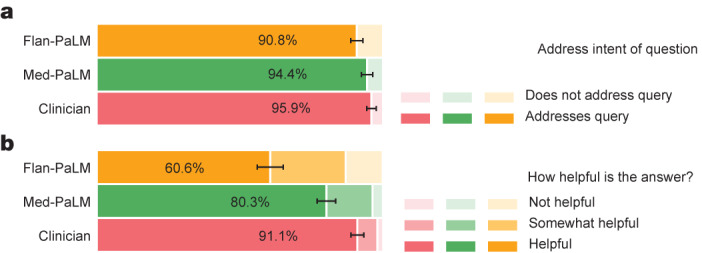
“The study also exposed areas where Med-PaLM underperformed clinicians [6], e.g., Med-PaLM lagged behind laypeople in generating helpful responses—achieving an 80.3% success rate compared to the laypeople’s 91.1%.”
BackgroundMethodResultInfluentialLarge language models empowered agent-based modeling and simulation: a survey and perspectives
Gao, C., Lan, X., Li, N., Yuan, Y., Ding, J., Zhou, Z., Xu, F., & Li, Y. (2024) · Humanities and Social Sciences Communications · doi:10.1057/s41599-024-03611-3 · Cited by 294
“Additionally, Med-PaLM (Singhal et al., 2023), an LLM for the medical fi eld, is trained based on a foundational model PaLM (Chowdhery et al., 2023).”
Exploring Large Language Model‐Based Intelligent Agents: Definitions, Methods, and Prospects
Cheng, Y.-H., Zhang, C., Zhang, Z.-W., Meng, X.-R., Hong, S.-R., Li, W.-H., Wang, Z., Wang, Z.-K., Yin, F., Zhao, J.-H., et al. (2024) · WIREs Data Mining and Knowledge Discovery · doi:10.1002/widm.70111 · Cited by 249
Prompt engineering for healthcare: Methodologies and applications
Wang, J., Shi, E., Yu, S., Wu, Z., Hu, H., Ma, C., Dai, H., Yang, Q., Kang, Y., Wu, J., et al. (2026) · Meta-Radiology · doi:10.1016/j.metrad.2025.100190 · Cited by 139
Self-citationMatching patients to clinical trials with large language models
Jin, Q., Wang, Z., Floudas, C. S., Chen, F., Gong, C., Bracken-Clarke, D., Xue, E., Yang, Y., Sun, J., & Lu, Z. (2024) · Nature Communications · doi:10.1038/s41467-024-53081-z · Cited by 287
Matching Patients to Clinical Trials with Large Language Models
Jin, Q., Wang, Z., Floudas, C. S., Chen, F., Gong, C., Bracken-Clarke, D., Xue, E., Yang, Y., Sun, J., & Lu, Z. (2023) · arXiv · doi:10.48550/arxiv.2307.15051 · Cited by 287
Large Language Models for Chatbot Health Advice Studies: A Systematic Review
Huo, B., Boyle, A., Marfo, N., Tangamornsuksan, W., Steen, J. P., McKechnie, T., Lee, Y., Mayol, J., Antoniou, S. A., Thirunavukarasu, A. J., et al. (2025) · JAMA Network Open · doi:10.1001/jamanetworkopen.2024.57879 · Cited by 283
Transformers and large language models in healthcare: A review
Nerella, S., Bandyopadhyay, S., Zhang, J., Contreras, M., Siegel, S., Bumin, A., Silva, B., Sena, J., Shickel, B., Bihorac, A., et al. (2024) · Artificial Intelligence in Medicine · doi:10.1016/j.artmed.2024.102900 · Cited by 197
“Scaled-up models such as ChatGPT, PaLM, PALM2, and GPT-4 have been shown to answer medical questions and successfully pass or achieve near-passing scores on medical licensing examinations [43, 46-49].”
BioMistral: A Collection of Open-Source Pretrained Large Language Models for Medical Domains
Labrak, Y., Bazoge, A., Morin, E., Gourraud, P.-A., Rouvier, M., & Dufour, R. (2024) · Findings of the Association for Computational Linguistics ACL 2024 · doi:10.18653/v1/2024.findings-acl.348 · Cited by 269
Thacharodi, A., Singh, P., Meenatchi, R., Tawfeeq Ahmed, Z. H., Kumar, R. R. S., V, N., Kavish, S., Maqbool, M., & Hassan, S. (2024) · Health Care Science · doi:10.1002/hcs2.115 · Cited by 201
“Nonetheless, newer iterations and models created specifically for medical use and trained on medical data demonstrate promising advancements in addressing these issues [59 – 61].”
MethodDatasets for large language models: a comprehensive survey
Liu, Y., Cao, J., Liu, C., Ding, K., & Jin, L. (2025) · Artificial Intelligence Review · doi:10.1007/s10462-025-11403-7 · Cited by 113
Self-citationLarge AI Models in Health Informatics: Applications, Challenges, and the Future
Qiu, J., Li, L., Sun, J., Peng, J., Shi, P., Zhang, R., Dong, Y., Lam, K., Lo, F. P.-W., Xiao, B., et al. (2023) · IEEE Journal of Biomedical and Health Informatics · doi:10.1109/jbhi.2023.3316750 · Cited by 233
“…named entity recognition, many different Biomedical LLMs that stem from their general LLM counterparts have been proposed, including ClinicalBERT [114], BioMegatron [115], BioMe-dRoBERTa [116], Med-BERT [102], BioELECTRA [117], Pub-MedBERT [118], BioLinkBERT [119], BioGPT [120], and Med-PaLM [121].”
BackgroundRetrieval augmented generation for large language models in healthcare: A systematic review
Amugongo, L. M., Mascheroni, P., Brooks, S., Doering, S., & Seidel, J. (2025) · PLOS Digital Health · doi:10.1371/journal.pdig.0000877 · Cited by 267
“To address this contextual need in medicine, Med-Palm was introduced demonstrating good performance in retrieving clinical knowledge and excelling in decision-making on several clinical tasks [11].”
Ganjavi, C., Eppler, M. B., Pekcan, A., Biedermann, B., Abreu, A., Collins, G. S., Gill, I. S., & Cacciamani, G. E. (2024) · BMJ · doi:10.1136/bmj-2023-077192 · Cited by 266
Savage, T., Nayak, A., Gallo, R., Rangan, E., & Chen, J. H. (2024) · npj Digital Medicine · doi:10.1038/s41746-024-01010-1 · Cited by 265
Bernstein, I. A., Zhang, Y. (., Govil, D., Majid, I., Chang, R. T., Sun, Y., Shue, A., Chou, J. C., Schehlein, E., Christopher, K. L., et al. (2023) · JAMA Network Open · doi:10.1001/jamanetworkopen.2023.30320 · Cited by 247
A Vision-Language Foundation Model for Precision Oncology
Xiang, J., Wang, X., Zhang, X., Xi, Y., Eweje, F., Chen, Y., Li, Y., Bergstrom, C., Gopaulchan, M., Kim, T., et al. (2025) · Nature · doi:10.1038/s41586-024-08378-w · Cited by 256
Retrieval-augmented generation for natural language processing: a survey
Wu, S.-Y., Xiong, Y., Cui, Y.-F., Wu, H.-L., Chen, C., Yuan, Y., Huang, L.-M., Liu, X., Kuo, T.-W., Guan, N., et al. (2024) · Artificial Intelligence Review · doi:10.1007/s10462-026-11605-7 · Cited by 197
Use of Artificial Intelligence Chatbots for Cancer Treatment Information
Chen, S., Kann, B. H., Foote, M. B., Aerts, H. J. W. L., Savova, G. K., Mak, R. H., & Bitterman, D. S. (2023) · JAMA Oncology · doi:10.1001/jamaoncol.2023.2954 · Cited by 251
Integrated image-based deep learning and language models for primary diabetes care
Li, J., Guan, Z., Wang, J., Cheung, C. Y., Zheng, Y., Lim, L.-L., Lim, C. C., Ruamviboonsuk, P., Raman, R., Corsino, L., et al. (2024) · Nature Medicine · doi:10.1038/s41591-024-03139-8 · Cited by 250
“However, previous LLMs did not provide specific and detailed management recommendations for patients Article https://doi.org/10.1038/s41591-024-03139-8 with common diseases 31,38,39 , such as diabetes.”
InfluentialLawyer LLaMA Technical ReportPreprint
Huang, Q., Tao, M., Zhang, C., An, Z., Jiang, C., Chen, Z., Wu, Z., & Feng, Y. (2023) · arXiv (Cornell University) · doi:10.48550/arxiv.2305.15062 · Cited by 336
“Med-PaLM (Singhal et al., 2022) and Med-PaLM 2 (Singhal et al.”
Akinci D’Antonoli, T., Stanzione, A., Bluethgen, C., Vernuccio, F., Ugga, L., Klontzas, M. E., Cuocolo, R., Cannella, R., & Koçak, B. (2024) · Diagnostic and Interventional Radiology · doi:10.4274/dir.2023.232417 · Cited by 227
“50 In .”
Large language models in medical and healthcare fields: applications, advances, and challenges
Wang, D., & Zhang, S. (2024) · Artificial Intelligence Review · doi:10.1007/s10462-024-10921-0 · Cited by 246
“Given the critical nature of medical and healthcare activities, which are inherently linked to patient life and health (Singhal et al. 2023a), the deployment of large prediction models for research, medical advice, and decision-support systems necessitates a heightened focus on safety, reliability,…”
Medical large language models are vulnerable to data-poisoning attacks
Alber, D. A., Yang, Z., Alyakin, A., Yang, E., Rai, S., Valliani, A. A., Zhang, J., Rosenbaum, G. R., Amend-Thomas, A. K., Kurland, D. B., et al. (2025) · Nature Medicine · doi:10.1038/s41591-024-03445-1 · Cited by 242
“Notably, in healthcare, medical NLP benchmarks like MedQA 7 , PubMedQA 8 and the Massive Multitask Language Understanding (MMLU) serve as the de-facto reporting standard for state-of-the-art medical LLMs 9–11 with claims of ‘superhuman’ performance in patient-facing tasks 12 .”
A Comprehensive Review on Synergy of Multi-Modal Data and AI Technologies in Medical Diagnosis
Xu, X., Li, J., Zhu, Z., Zhao, L., Wang, H., Song, C., Chen, Y., Zhao, Q., Yang, J., & Pei, Y. (2024) · Bioengineering · doi:10.3390/bioengineering11030219 · Cited by 242
LLaRA: Large Language-Recommendation Assistant
Liao, J., Li, S., Yang, Z., Wu, J., Yuan, Y., Wang, X., & He, X. (2024) · International ACM SIGIR Conference on Research and Development in Information Retrieval (SIGIR) · doi:10.1145/3626772.3657690 · Cited by 426
A Survey of Large Language Models in Medicine: Progress, Application, and Challenge
Zhou, H., Liu, F., Gu, B., Zou, X., Huang, J., Wu, J., Li, Y., Chen, S. S., Zhou, P., Liu, J., et al. (2023) · arXiv · doi:10.48550/arxiv.2311.05112 · Cited by 240
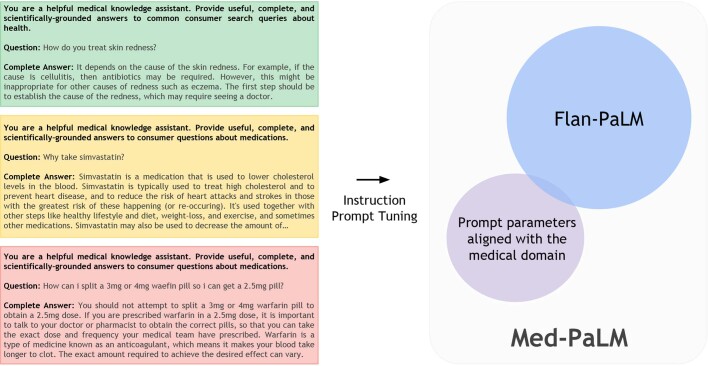
“Therefore, some works, e.g., MedPaLM [14], propose several “prompting” methods to efficiently align general LLMs, e.g., PaLM [3], to the medical domain without training any model parameters.”
BackgroundMethodInfluentialChatCAD: Interactive Computer-Aided Diagnosis on Medical Image using Large Language Models
Wang, S., Zhao, Z., Ouyang, X., Wang, Q., & Shen, D. G. (2023) · arXiv (Cornell University) · doi:10.48550/arxiv.2302.07257 · Cited by 69
“Recent advances in Transformer architecture [28] and computing power have enabled the training of large language models with billions of parameters, leading to a significant improvement in their ability to summarize, translate, predict and generate human-like text [3,23,25].”
BackgroundMethodInfluential
Metadata
- Authors
- Singhal, K., Azizi, S., Tu, T., Mahdavi, S. S., Wei, J., Chung, H. W., Scales, N., Tanwani, A., Cole-Lewis, H., Pfohl, S., Payne, P., Seneviratne, M., Gamble, P., Kelly, C., Babiker, A., Schärli, N., Chowdhery, A., Mansfield, P., Demner-Fushman, D., Agüera y Arcas, B., Webster, D., Corrado, G. S., Matias, Y., Chou, K., Gottweis, J., Tomasev, N., Liu, Y., Rajkomar, A., Barral, J., Semturs, C., Karthikesalingam, A., & Natarajan, V.
- Affiliations
- Google (United States) (US)
- Corresponding author
- Singhal, Karan
- Azizi, Shekoofeh
- Karthikesalingam, Alan
- Natarajan, Vivek
- ORCID
- Singhal, Karan
- Azizi, Shekoofeh
- Mahdavi, S. Sara
- Chung, Hyung Won
- Tanwani, Ajay
- Cole-Lewis, Heather
- Seneviratne, Martin
- Kelly, Chris
- Chowdhery, Aakanksha
- Mansfield, Philip
- Webster, Dale
- Corrado, Greg S.
- Matias, Yossi
- Chou, Katherine
- Gottweis, Juraj
- Tomasev, Nenad
- Liu, Yun
- Rajkomar, Alvin
- Barral, Joelle
- Semturs, Christopher
- Karthikesalingam, Alan
- Natarajan, Vivek
- Venue
- Nature
- Published
- 2023-07-12
- Volume
- 620
- Issue
- 7972
- Pages
- 172-180
- ISSN
- 0028-0836 (ISSN-L)
- 1476-4687
- PMC
- PMC10396962
- OpenAlex
- W4384071683
- Semantic Scholar
- 6052486bc9144dc1730c12bf35323af3792a1fd0
- Cited by
- 4,083
- References
- 85
- Citations by year
- 2026: 1627 · 2025: 1275 · 2024: 933 · 2023: 247
- FWCI
- 162.53
- Type
- journal article
- Language
- en
- Update notices
- correction (2023-07-27)
- Open access
- hybrid
- doi.org
- Licence
- cc-by
- creativecommons.org/licenses/by/4.0 (tdm)
- creativecommons.org/licenses/by/4.0 (vor)
- Locations
- Nature (publishedVersion, cc-by)
- PubMed Central (publishedVersion, cc-by)
- PubMed (publishedVersion)
- arXiv (Cornell University) (submittedVersion)
- RePEc: Research Papers in Economics (submittedVersion)
- arXiv (Cornell University) (cc-by)
- Funders
- DeepMind
- U.S. National Library of Medicine
- Topics
- Health Sciences › Medicine › Health Informatics › Artificial Intelligence in Healthcare and Education
- Physical Sciences › Computer Science › Artificial Intelligence › Topic Modeling
- Physical Sciences › Computer Science › Artificial Intelligence › Machine Learning in Healthcare
- Keywords
- large language models, clinical knowledge, medical question answering, human evaluation, Arecaceae, MedQA, MedMCQA, PubMedQA, MMLU, clinical reasoning
- MeSH terms
- Clinical Competence, Computer Simulation, Humans, Licensure, Medicine, Natural Language Processing, Physicians, Bias, Knowledge, Benchmarking, Comprehension, Patient Safety, Datasets as Topic
About these checks
Registry, retraction, Cites and statistics results are computed, not judged, with one exception: a printed reference that no index lists is read once by a model before it counts as a citation error. Claims are extracted by a model and kept only when their quote appears verbatim in the text; each cited source is then checked, with a model’s help, for whether it says what the claim relies on. Those verdicts can be wrong — read the claim’s quote and the cited source before relying on one.
Statistics and arithmetic are recomputed, not judged.
Confidence bands are shown only for fields calibrated on our annotated test set. None is calibrated yet, so no band is shown.
What counts as a claim ›How we measure confidence ›How we check this ›
Are you an author, or do you see a problem with this page? Request a review
Data sources
Bibliographic data: Semantic Scholar, OpenAlex, Crossref.
Contains information from the Semantic Scholar Academic Graph Datasets, made available under the ODC Attribution License (ODC-BY 1.0).
Semantic Scholar’s data is described in: Kinney, R., et al. (2023). The Semantic Scholar Open Data Platform. arXiv:2301.10140.
