

Logical quantum processor based on reconfigurable atom arrays
Open accessThe DOI matches its Crossref record; 127 of the 141 references it cites were found in a registry or an index; 126 of the 137 sources its claims cite were checked for support.
Abstract
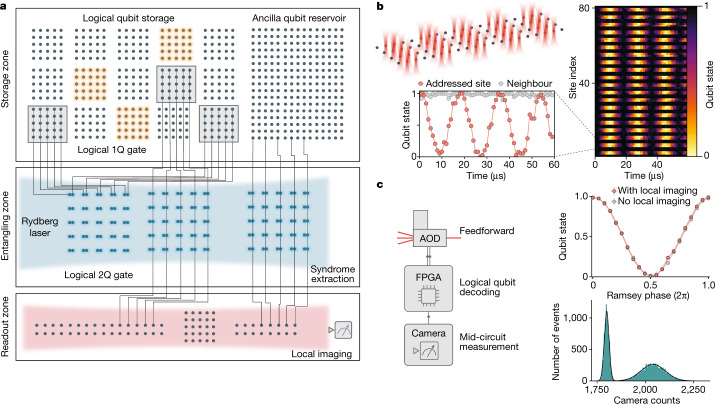
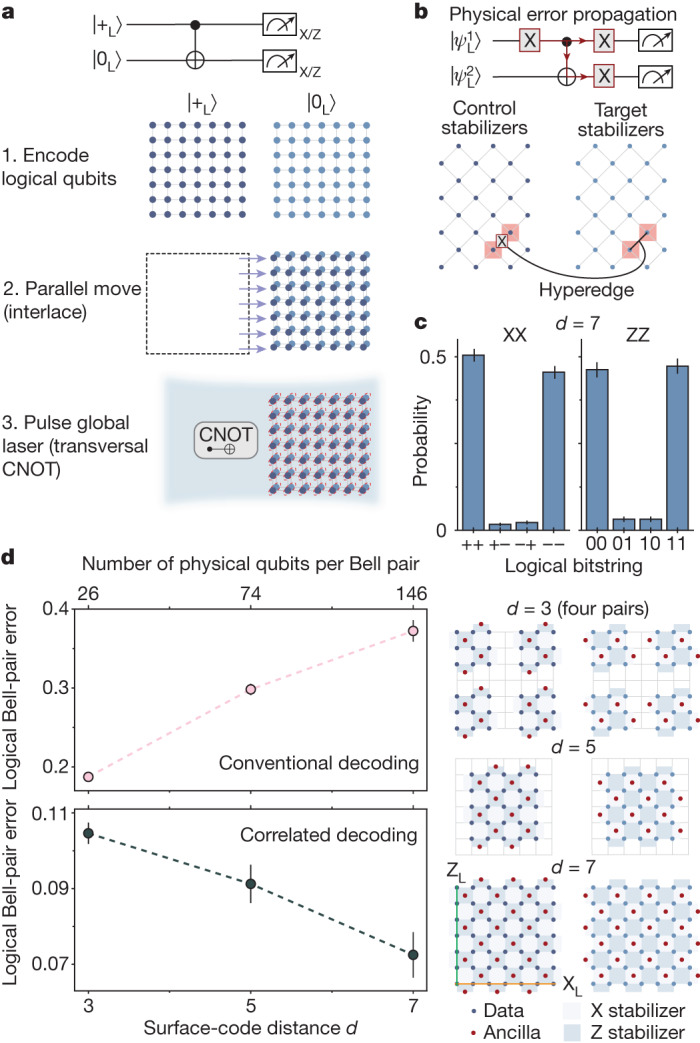
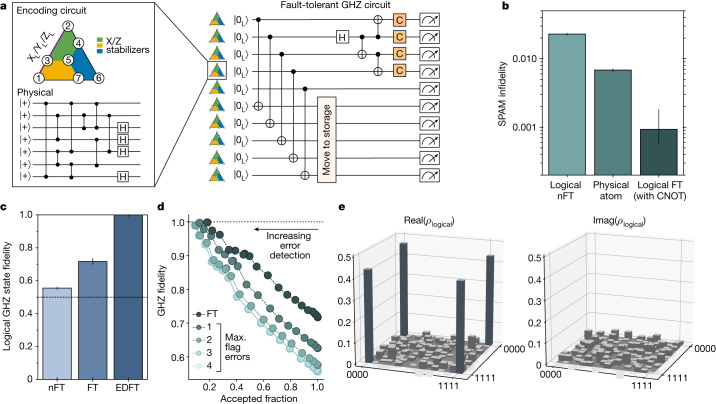
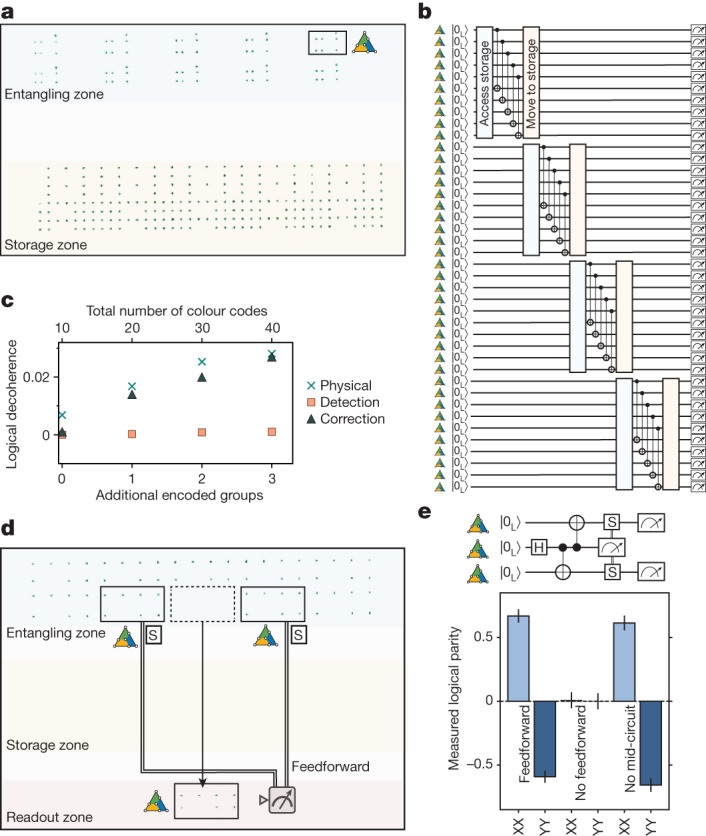
Abstract Suppressing errors is the central challenge for useful quantum computing 1 , requiring quantum error correction (QEC) 2–6 for large-scale processing. However, the overhead in the realization of error-corrected ‘logical’ qubits, in which information is encoded across many physical qubits for redundancy 2–4 , poses substantial challenges to large-scale logical quantum computing. Here we report the realization of a programmable quantum processor based on encoded logical qubits operating with up to 280 physical qubits. Using logical-level control and a zoned architecture in reconfigurable neutral-atom arrays 7 , our system combines high two-qubit gate fidelities 8 , arbitrary connectivity 7,9 , as well as fully programmable single-qubit rotations and mid-circuit readout 10–15 . Operating this logical processor with various types of encoding, we demonstrate improvement of a two-qubit logic gate by scaling surface-code 6 distance from d = 3 to d = 7, preparation of colour-code qubits with break-even fidelities 5 , fault-tolerant creation of logical Greenberger–Horne–Zeilinger (GHZ) states and feedforward entanglement teleportation, as well as operation of 40 colour-code qubits. Finally, using 3D [[8,3,2]] code blocks 16,17 , we realize computationally complex sampling circuits 18 with up to 48 logical qubits entangled with hypercube connectivity 19 with 228 logical two-qubit gates and 48 logical CCZ gates 20 . We find that this logical encoding substantially improves algorithmic performance with error detection, outperforming physical-qubit fidelities at both cross-entropy benchmarking and quantum simulations of fast scrambling 21,22 . These results herald the advent of early error-corrected quantum computation and chart a path towards large-scale logical processors.
Overview
CoChat Summary
TL;DR
The paper reports a programmable logical quantum processor built from reconfigurable neutral-atom arrays, operating with up to 280 physical qubits and using surface codes, colour codes, and 3D [[8,3,2]] codes. Across several demonstrations, logical encoding improved performance for entangling gates, GHZ-state preparation, feedforward teleportation, and complex sampling/quantum-simulation tasks compared with analogous physical-qubit circuits.
Key findings
- The processor used up to 280 physical qubits and demonstrated 40 colour-code qubits by repeating a ten-logical-qubit process four times.
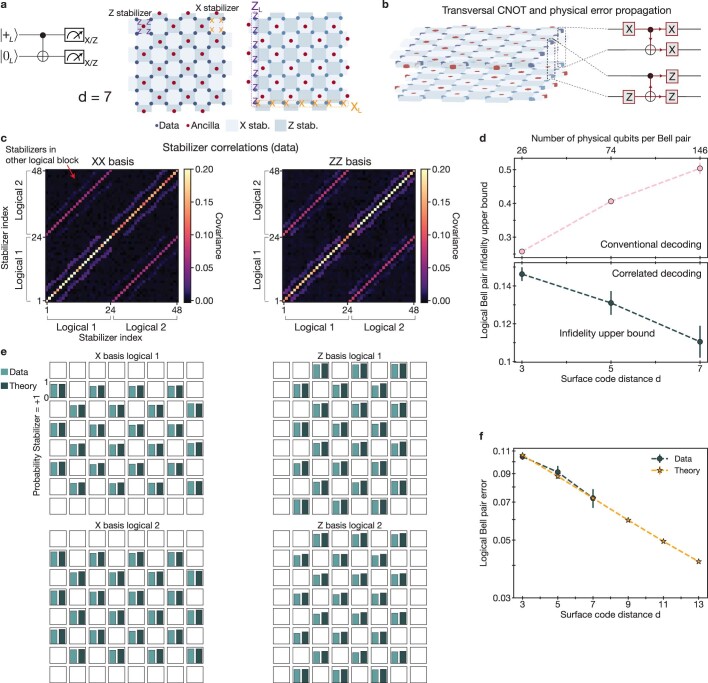
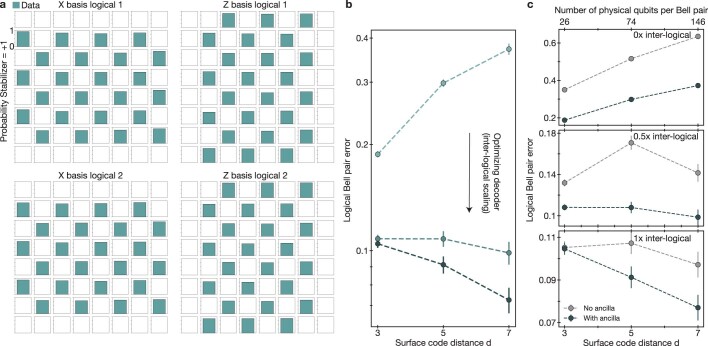
- For a surface-code transversal CNOT, increasing code distance from d = 3 to d = 7 improved the logical Bell pair; with correlated decoding, the authors report roughly 0.95 populations in the XLXL and ZLZL bases for entangled d = 7 logical qubits.
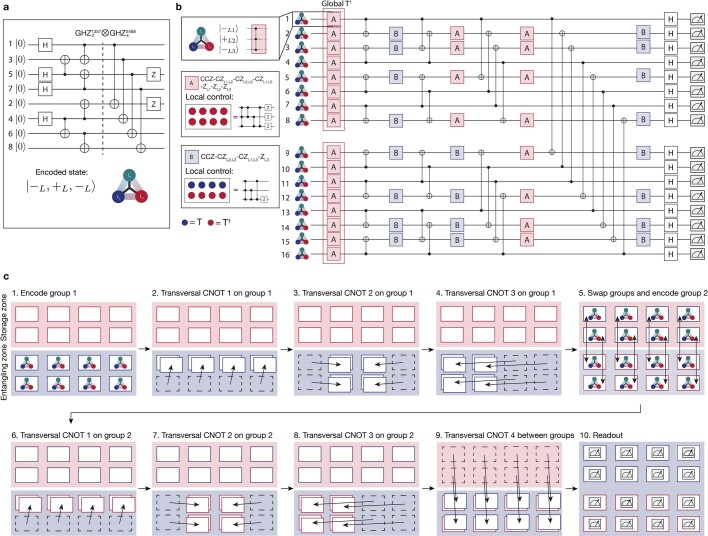
- For fault-tolerant colour-code GHZ preparation, the measured logical GHZ fidelity was 72(2)%; with error-detection/postselection it increased further, and the paper states that discarding 50% of the data improved GHZ fidelity to approximately 90%.
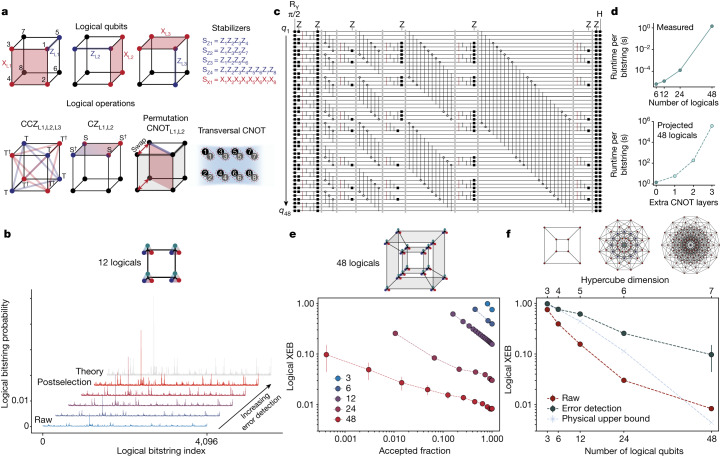
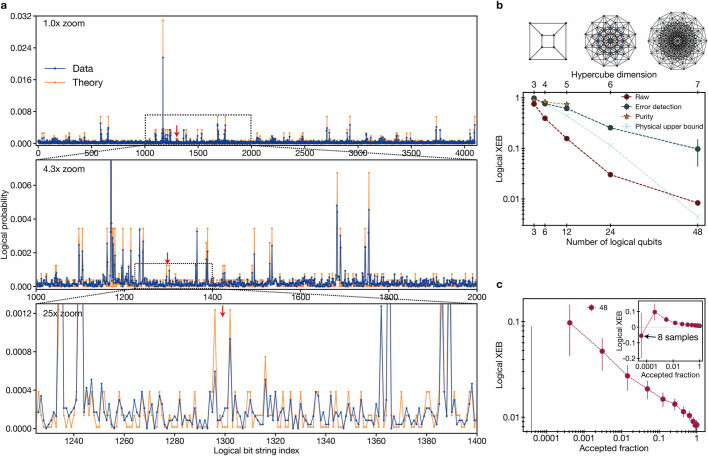
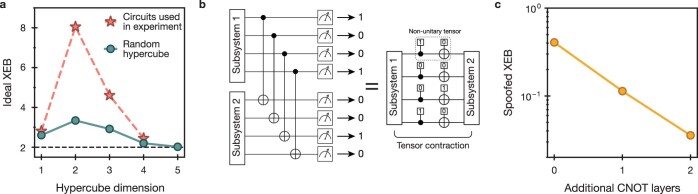
- In complex [[8,3,2]] sampling circuits, the authors realized up to 48 logical qubits, 228 logical two-qubit gates, and 48 logical CCZ gates; the reported XEB for 12 logical qubits increased from 0.156(2) to 0.616(7) with error detection, and for 48 logical qubits the XEB was approximately 0.1.
Methods
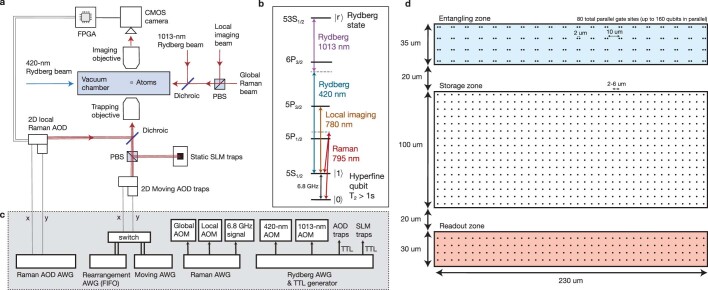
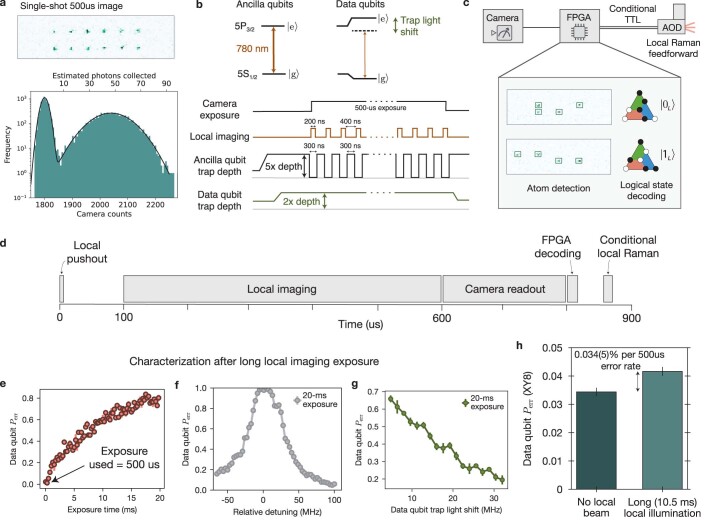
- Experimental platform: reconfigurable arrays of \(^{87}\)Rb atoms in optical tweezers, with zoned architecture for storage, entangling, and readout; the paper states operation with up to 280 atomic qubits, two-qubit gate fidelities of 99.3–99.5%, and local imaging fidelity of around 99.8%.
- Coding and circuits: rotated surface codes (including distance-7), d = 3 colour codes for Clifford algorithms, and 3D [[8,3,2]] codes for non-Clifford sampling circuits; all logical circuits after state preparation are built from transversal gates.
- Analysis: correlated decoding via a decoding hypergraph and mixed-integer programming solved with Gurobi; logical performance was benchmarked using direct fidelity estimation, full tomography, cross-entropy benchmarking (XEB), and two-copy Bell-basis measurements.
Limitations
- The paper states that state preparation is non-fault-tolerant for the d = 5, 7 surface codes and the [[8,3,2]] codes, because only a single round of stabilizer measurement is used.
- It also notes that deep circuits require repetitive error correction to keep benefiting from logical suppression, and that current mid-circuit readout/feedforward takes slightly less than 1 ms, with the authors saying it could be improved toward the 100-μs scale.
- Evident from the text: several reported gains rely on postselection / sliding-scale error detection, which improves fidelity at the cost of acceptance probability and measurement overhead.
Model-written summary. Check it against the paper before relying on it.
Integrity signals
Registry
Cites
Statistics
Figures
Verification
Claims the paper makes
69 Valid · 15 Not valid · 8 Not checked · 160 Own results and interpretations
At least one cited source doesn’t support this claim or points to a different paper, and none confirmed it — see the verdicts below.
In the paper
“However, executing large-scale, useful algorithms on quantum processors requires very low gate error rates (generally below about 10−10)23, far below those that will probably ever be achievable with any physical device2.”
§ Logical quantum processor based on reconfigurable atom arrays > Main
What the sources say
- Disputedcites [23] Gidney C Ekerå M How to factor 2048 bit RSA integers in 8 hours using 20 million noisy qubits Quantum 2021 5 433 10.22331/q-2021-04-15-433 sourceExperimental — accuracy not yet measured
The citation to this paper is attached to the claimed requirement for gate error rates below about 10⁻¹⁰, not to the following statement about what physical devices can achieve. Section 2.16 instead describes a physical gate error rate of 0.1% (10⁻³) as sufficient for surface-code error correction, and Section 2.13 uses that rate in its large-scale factoring estimate. The paper distinguishes physical gate errors from the much lower logical error rates produced by correction. (LLM, conf=0.88)
Checked by a reasoning model — may be wrong.
- Not matchedcites [2] Shor, P. W. in Proc. 37th Conference on Foundations of Computer Science 56–65 (IEEE, 1996).
Its entry has no title and year that we can search by.
hedgedstates a cause- Asserted: passes — The authors put it forward as true.
- Checkable: passes — It can be checked against evidence.
- Load-bearing: passes — The paper’s conclusions depend on it.
- Based: passes — The paper gives a reason why it holds.
- Disputed
At least one cited source doesn’t support this claim or points to a different paper, and none confirmed it — see the verdicts below.
In the paper
“Fully programmable local single-qubit rotations are realized through qubit-specific, parallel Raman excitation through an additional 2D AOD (ref. 34) (Fig. 1b and Extended Data Fig. 2).”
§ Logical quantum processor based on reconfigurable atom arrays > Logical processor based on atom arrays
What the sources say
- Disputedcites [34] Graham TM Multi-qubit entanglement and algorithms on a neutral-atom quantum computer Nature 2022 604 457 462 10.1038/s41586-022-04603-6 35444321 sourceExperimental — accuracy not yet measured
The Methods (p. 10) say site-selective single-qubit rotations combine global microwave rotations with local 459 nm Stark-shift phase gates, rather than using parallel Raman excitation. The Methods (p. 10) describe crossed AODs for pointing Rydberg beams at two sites simultaneously, not an additional 2D AOD for local Raman rotations. (LLM, conf=0.88)
Checked by a reasoning model — may be wrong.
plainstates a cause- Asserted: passes — The authors put it forward as true.
- Checkable: passes — It can be checked against evidence.
- Load-bearing: passes — The paper’s conclusions depend on it.
- Based: passes — The paper gives a reason why it holds.
- Disputed
The cited sources support only part of this claim — read each source’s verdict below.
In the paper
“Using logical-level control and a zoned architecture in reconfigurable neutral-atom arrays7, our system combines high two-qubit gate fidelities8, arbitrary connectivity7,9, as well as fully programmable single-qubit rotations and mid-circuit readout10–15.”
§ Logical quantum processor based on reconfigurable atom arrays > Abstract
What the sources say
- Supportedcites [10] Deist E Mid-circuit cavity measurement in a neutral atom array Phys. Rev. Lett. 2022 129 203602 10.1103/PhysRevLett.129.203602 36462020 source
The paper describes its method as mid-circuit readout in a neutral-atom array (p. 1). It also reports performing a mid-circuit measurement on one atom during a two-atom quantum circuit (p. 4), supporting the cited readout capability. (LLM, conf=0.92)
- Supportedcites [11] Singh K Mid-circuit correction of correlated phase errors using an array of spectator qubits Science 2023 380 1265 1269 10.1126/science.ade5337 37228222 source
The INTRODUCTION states that 'During logic operations on the data qubits, midcircuit readouts on the array of ~60 spectator qubits enable single-shot estimation of globally correlated phase errors,' with readouts that 'do not disturb the coherence of the data qubits.' The Methods section 'Mid-circuit readout of atomic qubits' and '3. Quantifying discrimination fidelity of the mid-circuit readout' report the 15 ms MCR with discrimination fidelity 0.989(5), and '2. Real-time processing and feedback' describes the real-time imaging and feedback chain, so the cited system demonstrably possesses mid-circuit readout. The DISCUSSION lists mid-circuit readout among the quantum-control techniques demonstrated, and also documents single-qubit manipulation via IQ-modulated global microwave pulses supporting the adjacent part of the sentence. (LLM, conf=0.90)
- Supportedcites [12] Graham, T. M. et al. Midcircuit measurements on a single-species neutral alkali atom quantum processor. Phys. Rev. X13, 041051 (2023). source
The paper’s “A. Midcircuit measurement” section describes a five-step procedure that includes state-selective readout of ancilla atoms during the circuit. It therefore supports the cited claim that mid-circuit readout is available in a neutral-atom processor. (LLM, conf=0.92)
- Partly supportedcites [13] Ma S High-fidelity gates and mid-circuit erasure conversion in an atomic qubit Nature 2023 622 279 284 10.1038/s41586-023-06438-1 37821593 sourceExperimental — accuracy not yet measured
The paper reports mid-circuit imaging to detect atoms that have decayed to the ground state (Abstract; page unavailable). But it says its demonstrated detection protocol *could be adapted* to mid-circuit qubit readout; it does not report demonstrating that readout. Thus it supports mid-circuit erasure detection, not the full readout attributed to it. (LLM, conf=0.87)
- Supportedcites [14] Lis, J. W. et al. Midcircuit operations using the omg architecture in neutral atom arrays. Phys. Rev. X13, 041035 (2023). source
The Introduction states that the paper demonstrates midcircuit state readout of ancilla qubits. This supports the cited claim that mid-circuit readout is a capability demonstrated in neutral-atom arrays. (LLM, conf=0.92)
- Supportedcites [15] Norcia, M. A. et al. Midcircuit qubit measurement and rearrangement in a 171Yb atomic array. Phys. Rev. X13, 041034 (2023). source
Section IV (Correction of Atom Loss) reports using the results of a midcircuit measurement to correct ancilla-qubit loss while maintaining data-qubit coherence. Appendix B also describes the array's midcircuit measurement results. These passages support the citation for mid-circuit readout. (LLM, conf=0.90)
plain- Asserted: passes — The authors put it forward as true.
- Checkable: passes — It can be checked against evidence.
- Load-bearing: passes — The paper’s conclusions depend on it.
- Based: passes — The paper gives a reason why it holds.
- Supported
The cited sources support only part of this claim — read each source’s verdict below.
In the paper
“Operating this logical processor with various types of encoding, we demonstrate improvement of a two-qubit logic gate by scaling surface-code6 distance from d = 3 to d = 7, preparation of colour-code qubits with break-even fidelities5, fault-tolerant creation of logical Greenberger–Horne–Zeilinger (GHZ) states and feedforward entanglement teleportation, as well as operation of 40 colour-code qubit”
§ Logical quantum processor based on reconfigurable atom arrays > Abstract
What the sources say
- Partly supportedcites [6] Google Quantum AI Suppressing quantum errors by scaling a surface code logical qubit Nature 2023 614 676 681 10.1038/s41586-022-05434-1 36813892 PMC9946823 sourceExperimental — accuracy not yet measured
The Main section reports improved logical-qubit performance when scaling a surface code from d = 3 to d = 5. The ‘Surface codes with superconducting qubits’ section says the experiment focuses on preserving logical memory; it does not report improving a two-qubit logical gate or scaling to d = 7. Page numbers are not available in our copy. (LLM, conf=0.88)
boostedstates a cause- Asserted: passes — The authors put it forward as true.
- Checkable: passes — It can be checked against evidence.
- Load-bearing: passes — The paper’s conclusions depend on it.
- Based: passes — The paper gives a reason why it holds.
- Partly supported
The cited sources support only part of this claim — read each source’s verdict below.
In the paper
“Operating this logical processor with various types of encoding, we demonstrate improvement of a two-qubit logic gate by scaling surface-code6 distance from d = 3 to d = 7, preparation of colour-code qubits with break-even fidelities5, fault-tolerant creation of logical Greenberger–Horne–Zeilinger (GHZ) states and feedforward entanglement teleportation, as well as operation of 40 colour-code qubit”
§ Logical quantum processor based on reconfigurable atom arrays > Abstract
What the sources say
- Partly supportedcites [5] Ryan-Anderson, C. et al. Implementing fault-tolerant entangling gates on the five-qubit code and the color code. Preprint at https://arxiv.org/abs/2208.01863 (2022). sourceExperimental — accuracy not yet measured
The opening summary (p. 1) reports that fault-tolerant colour-code state-preparation-and-measurement fidelities exceeded average physical-qubit SPAM fidelities. But Section III (p. 8) explicitly says the experiments did not achieve the break-even point; it describes the higher logical fidelity as a milestone toward it. The claim is supported as a comparison of preparation-and-measurement fidelities, not as a demonstration of break-even operation. (LLM, conf=0.86)
boosted- Asserted: passes — The authors put it forward as true.
- Checkable: passes — It can be checked against evidence.
- Load-bearing: passes — The paper’s conclusions depend on it.
- Based: passes — The paper gives a reason why it holds.
- Partly supported
130 more claims · 39 with their cited sources checked
Create a free account to see all 252 claims and to verify the 1 reference still open.
- It may state two separate claims as one. 89
- Probably not a substantial claim. 40
- The quote only partly states this claim. 2
Claims other papers make about this one
Each is checked against this paper’s own text: does it say what the citing paper says it does?
The cited source doesn’t support the claim as written.
In the citing paper
“Although many platforms have demonstrated different features of quantum error correction14–20, no quantum processor has definitively shown below-threshold performance.”
From Quantum error correction below the surface code threshold (2025) · cites this paper as [18]
Checked by a reasoning model — may be wrong.
Experimental — accuracy not yet measuredThe source backs part of the claim, not all of it — or backs it for a different population, condition or comparison.
In the citing paper
“As a result, error suppression by increasing the colour code size has not yet been demonstrated, to our knowledge, on any experimental platform.”
From Scaling and logic in the colour code on a superconducting quantum processor (2025) · cites this paper as [18]
Experimental — accuracy not yet measuredThe cited source says what the claim attributes to it.
In the citing paper
“Recently, QEC experiments have been performed in various hardware platforms, including superconducting quantum circuits25–28, trapped ions29 and neutral atoms30.”
From Hardware-efficient quantum error correction via concatenated bosonic qubits (2025) · cites this paper as [30]
The cited source says what the claim attributes to it.
In the citing paper
“The smallest instance of the colour code, the Steane code37, has been implemented with trapped ions11,12 and neutral atoms18, demonstrating logical operations and logical circuits13–19.”
From Scaling and logic in the colour code on a superconducting quantum processor (2025) · cites this paper as [18]
Citations
Cites
Quantum Computing in the NISQ era and beyond
Preskill, J. (2018) · Quantum · doi:10.22331/q-2018-08-06-79 · Cited by 8,830 · cited 1×
“The storage zone is used for dense qubit storage, free from entangling-gate errors and featuring long coherence times.”
BackgroundQuantum supremacy using a programmable superconducting processor
Arute, F., Arya, K., Babbush, R., Bacon, D., Bardin, J. C., Barends, R., Biswas, R., Boixo, S., Brandao, F. G. S. L., Buell, D. A., et al. (2019) · Nature · doi:10.1038/s41586-019-1666-5 · Cited by 7,720 · cited 3×
“70), has an improved Raman scattering contribution and is faster (roughly 1 μs duration).”
BackgroundMethodScheme for reducing decoherence in quantum computer memory
Shor, P. W. (1995) · Physical Review A · doi:10.1103/physreva.52.r2493 · Cited by 4,479 · cited 1×
“Distance-3 codes, which are of notable historical importance 3,87 , can correct any weight-1 error.”
BackgroundSurface codes: Towards practical large-scale quantum computation
Fowler, A. G., Mariantoni, M., Martinis, J. M., & Cleland, A. N. (2012) · Physical Review A · doi:10.1103/physreva.86.032324 · Cited by 3,059 · cited 10×
“Mid-circuit X-basis measurement of the middle logical creates by applying a logical S gate to the first and third logicals conditioned in real time on the state of the middle logical, akin to the magic-state-teleportation circuit 24 .”
BackgroundMethodInfluentialQuantum computational advantage using photons
Zhong, H.-S., Wang, H., Deng, Y.-H., Chen, M.-C., Peng, L.-C., Luo, Y.-H., Qin, J., Wu, D., Ding, X., Hu, Y., et al. (2020) · Science · doi:10.1126/science.abe8770 · Cited by 2,405
Dennis, E., Kitaev, A., Landahl, A., & Preskill, J. (2002) · Journal of Mathematical Physics · doi:10.1063/1.1499754 · Cited by 1,768 · cited 6×
“6, which can be understood as preparing two four-qubit GHZ states (corresponding to [[4,2,2]] codes 95 ), that is, GHZ ⊗GHZ , and subsequently entangling them as illustrated in Extended Data Fig.”
BackgroundInfluentialFast Quantum Gates for Neutral Atoms
Jaksch, D., Cirac, J. I., Zoller, P., Rolston, S. L., Côté, R., & Lukin, M. D. (2000) · Physical Review Letters · doi:10.1103/physrevlett.85.2208 · Cited by 1,540 · cited 2×
“Nota-bly, owing to the use of the Rydberg blockade 32,68 , the gate is largely independent of the exact distance between atoms.”
BackgroundMethodSelf-citationImproved simulation of stabilizer circuits
Aaronson, S., & Gottesman, D. (2004) · Physical Review A · doi:10.1103/physreva.70.052328 · Cited by 1,515 · cited 2×
“For instance, when using 2D codes such as the surface code, non-Clifford operations cannot be easily performed 37 , and relatively expensive techniques are required for nontrivial computation 24,43 , as Clifford circuits can be easily simulated 44 .”
BackgroundMethodDennis, E., Kitaev, A., Landahl, A., & Preskill, J. (2001) · CERN Document Server (European Organization for Nuclear Research) · Cited by 1,485
Multiple-particle interference and quantum error correction
(1996) · Proceedings of the Royal Society of London. Series A: Mathematical, Physical and Engineering Sciences · doi:10.1098/rspa.1996.0136 · Cited by 1,284 · cited 10×
“We use 2D d = 3 colour codes 3,37 , which are topological codes akin to the surface code, but with the useful capability of trans-versal operations of the full Clifford group: Hadamard (H), π/2 phase (S) gate and CNOT (ref.”
BackgroundMethodInfluential
Research works printed but not linked: 2
- Shor, P. W. in Proc. 37th Conference on Foundations of Computer Science 56–65 (IEEE, 1996).
- Patterson, D. A. & Hennessy, J. L. Computer Organization and Design: The Hardware/Software Interface. RISC-V Edition (Morgan Kaufmann, 2018).
Cited by
Items 301–400 of 1,108
Efficient Classical Shadow Tomography through Many-body Localization Dynamics
Zhou, T.-G., & Zhang, P. (2024) · Quantum · doi:10.22331/q-2024-09-11-1467 · Cited by 18
Training Computer Scientists for the Challenges of Hybrid Quantum-Classical Computing
Maio, V. D., Kanatbekova, M., Zilk, F., Friis, N., Guggemos, T., & Brandić, I. (2024) · IEEE/ACM International Symposium on Cluster, Cloud and Grid Computing (CCGrid) · doi:10.1109/ccgrid59990.2024.00075 · Cited by 14
Experimental demonstration of quantum continual learning with superconducting qubits
Zhang, C., Lu, Z., Zhao, L., Xu, S., Li, W., Wang, K., Chen, J., Wu, Y., Jin, F., Zhu, X., et al. (2026) · npj Quantum Information · doi:10.1038/s41534-025-01174-y · Cited by 17
Suppression of Motional Dephasing Using State Mapping
Jiao, Y., Li, C., Shi, X., Fan, J., Bai, J., Jia, S., Zhao, J., & Adams, C. S. (2025) · Physical Review Letters · doi:10.1103/physrevlett.134.053604 · Cited by 15
Modeling error correction with Lindblad dynamics and approximate channels
Schwartzman-Nowik, Z., Shirizly, L., & Landa, H. (2025) · Physical Review A · doi:10.1103/physreva.111.022613 · Cited by 17
Jen, H. H. (2025) · Quantum Science and Technology · doi:10.1088/2058-9565/adbb86 · Cited by 23
What can unitary sequences tell us about multi-time physics?
White, G. A. L., Pollock, F. A., Hollenberg, L. C. L., Hill, C. D., & Modi, K. K. (2025) · Quantum · doi:10.22331/q-2025-04-08-1695 · Cited by 44
Motion-insensitive time-optimal control of optical qubits
Damme, L. V., Zhang, Z., Devra, A., Glaser, S. J., & Alberti, A. (2025) · Quantum Science and Technology · doi:10.1088/2058-9565/add61c · Cited by 10
An Early Investigation of the HHL Quantum Linear Solver for Scientific Applications
Zheng, M., Liu, C., Stein, S., Li, X., Mülmenstädt, J., Chen, Y., & Li, A. (2025) · Algorithms · doi:10.3390/a18080491 · Cited by 18
Classical product code constructions for quantum Calderbank-Shor-Steane codes
Ostrev, D., Orsucci, D., Lázaro, F., & Matuz, B. (2024) · Quantum · doi:10.22331/q-2024-07-22-1420 · Cited by 27
Transversal Clifford and T -Gate Codes of Short Length and High Distance
Jain, S. P., & Albert, V. V. (2025) · IEEE Journal on Selected Areas in Information Theory · doi:10.1109/jsait.2025.3570832 · Cited by 8
Concatenate codes, save qubits
Yoshida, S., Tamiya, S., & Yamasaki, H. (2025) · npj Quantum Information · doi:10.1038/s41534-025-01035-8 · Cited by 67
Hashim, A., Yuan, M., Gokhale, P., Chen, L., Jünger, C., Fruitwala, N., Xu, Y., Huang, G., Nowrouzi, K., Jiang, L., et al. (2025) · APL Quantum · doi:10.1063/5.0291637 · Cited by 25
Symmetric Clifford twirling for cost-optimal quantum error mitigation in early FTQC regime
Tsubouchi, K., Mitsuhashi, Y., Sharma, K., & Yoshioka, N. (2025) · npj Quantum Information · doi:10.1038/s41534-025-01050-9 · Cited by 34
Scalable Parameter Design for Superconducting Quantum Circuits with Graph Neural Networks
Ai, H., & Liu, Y.-X. (2025) · Physical Review Letters · doi:10.1103/yr9d-7z8k · Cited by 17
Hardware-efficient variational quantum algorithm in a trapped-ion quantum computer
Zhuang, J.-Z., Wu, Y., & Duan, L.-M. (2024) · Physical Review A · doi:10.1103/physreva.110.062414 · Cited by 11
Lattice surgery realized on two distance-three repetition codes with superconducting qubits
Besedin, I. S., Kerschbaum, M., Knoll, J., Hesner, I., Bödeker, L., Colmenárez, L., Hofele, L., Lacroix, N., Hellings, C., Swiadek, F., et al. (2026) · Nature Physics · doi:10.1038/s41567-025-03090-6 · Cited by 67
Hamiltonian learning for 300 trapped ion qubits with long-range couplings
Guo, S., Wu, Y., Ye, J., Zhang, L., Wang, Y., Lian, W., Yao, R., Xu, Y., Zhang, C., Xu, Y., et al. (2025) · Science Advances · doi:10.1126/sciadv.adt4713 · Cited by 31
Optical levitation of arrays of microspheres
Siegel, B., Afek, G., Lowe, C., Wang, J., Tseng, Y.-H., Penny, T. W., & Moore, D. C. (2025) · Physical Review A · doi:10.1103/physreva.111.033514 · Cited by 13
Efficient learning for linear properties of bounded-gate quantum circuits
Du, Y., Hsieh, M.-H., & Tao, D. (2025) · Nature Communications · doi:10.1038/s41467-025-59198-z · Cited by 27
Resource Analysis of Low-Overhead Transversal Architectures for Reconfigurable Atom Arrays
Zhou, H., Duckering, C., Zhao, C., Bluvstein, D., Cain, M., Kubica, A., Wang, S.-T., & Lukin, M. D. (2025) · Proceedings - International Symposium on Computer Architecture/Proceedings · doi:10.1145/3695053.3731039 · Cited by 75
Self-citationUnlocking early fault-tolerant quantum computing with mitigated magic dilution
Luthra, S., Moylett, A. E., Browne, D. E., & Campbell, E. T. (2025) · Quantum Science and Technology · doi:10.1088/2058-9565/ae0aef · Cited by 14
Gradient-descent methods for fast quantum state tomography
Gaikwad, A., Torres, M. S., Ahmed, S., & Kockum, A. F. (2025) · Quantum Science and Technology · doi:10.1088/2058-9565/ae0baa · Cited by 23
Realization of a Fast Triple-Magic All-Optical Qutrit in ^{88}Sr.
Ammenwerth, M., Timme, H., Gyger, F., Tao, R., Bloch, I., & Zeiher, J. (2024) · Physical Review Letters · doi:10.1103/4kdl-xcwz · Cited by 17
Modular architectures and entanglement schemes for error-corrected distributed quantum computation
Singh, S., Gu, F., de Bone, S., Villaseñor, E., Elkouss, D., & Borregaard, J. (2025) · npj Quantum Information · doi:10.1038/s41534-025-01146-2 · Cited by 46
Fault-Tolerant Stabilizer Measurements in Surface Codes with Three-Qubit Gates
Old, J., Tasler, S., Hartmann, M. J., & Müller, M. (2025) · Physical Review Letters · doi:10.1103/sblg-fbq4 · Cited by 16
Buchs, G., Beck, T. L., Bennink, R. S., Claudino, D., Delgado, A., Fadel, N. A., Groszkowski, P., Hamilton, K. E., Humble, T. S., Kumar, N., et al. (2026) · Future Generation Computer Systems · doi:10.1016/j.future.2026.108487 · Cited by 16
Mesoscale atomic engineering in a crystal lattice
Klein, J., Roccapriore, K. M., Weile, M., Grytsiuk, S., Lupini, A. R., (1418794), Z. S., Pashov, D. L., van Schilfgaarde, M., Acharya, S., Rösner, M., et al. (2026) · Nature · doi:10.1038/s41586-026-10431-9 · Cited by 10
Spanning Tree Matching Decoder for Quantum Surface Codes
Forlivesi, D., Valentini, L., & Chiani, M. (2024) · IEEE Communications Letters · doi:10.1109/lcomm.2024.3396882 · Cited by 13
Old, J., Rispler, M., & Müller, M. (2024) · Quantum Science and Technology · doi:10.1088/2058-9565/ad5eb6 · Cited by 19
Digital quantum simulation of lattice fermion theories with local encoding
Ballarin, M., Cataldi, G., Magnifico, G., Jaschke, D., Liberto, M. F. D., Siloi, I., Montangero, S., & Silvi, P. (2024) · Quantum · doi:10.22331/q-2024-09-04-1460 · Cited by 9
Assessment of quantum phase estimation protocols for early fault-tolerant quantum computers
Nelson, J. S., & Baczewski, A. (2024) · Physical Review A · doi:10.1103/physreva.110.042420 · Cited by 24
Surf-Deformer: Mitigating Dynamic Defects on Surface Code via Adaptive Deformation
Yin, K., Fang, X., Humble, T. S., Li, A., Shi, Y., & Ding, Y. (2024) · IEEE/ACM International Symposium on Microarchitecture (MICRO) · doi:10.1109/micro61859.2024.00061 · Cited by 18
PARALLAX: A Compiler for Neutral Atom Quantum Computers under Hardware Constraints
Ludmir, J., & Patel, T. (2024) · International Conference for High Performance Computing, Networking, Storage and Analysis (SC) · doi:10.1109/sc41406.2024.00079 · Cited by 26
Time-Efficient Logical Operations on Quantum Low-Density Parity Check Codes
Zhang, G., & Li, Y. (2025) · Physical Review Letters · doi:10.1103/physrevlett.134.070602 · Cited by 56
Parity-dependent state transfer for direct entanglement generation
Roy, F., Romeiro, J. H., Koch, L., Tsitsilin, I., Schirk, J., Glaser, N. J., Bruckmoser, N., Singh, M., Haslbeck, F. X., Huber, G. B. P., et al. (2025) · Nature Communications · doi:10.1038/s41467-025-57818-2 · Cited by 19
He, Z., Shaydulin, R., Herman, D., Li, C., Raymond, R., Sureshbabu, S. H., & Pistoia, M. (2024) · doi:10.1145/3676536.3697128 · Cited by 27
Quantifying Quantum Computational Advantage on a Processor of Ultracold Atoms
Zheng, Y.-G., Shen, Y.-C., Zhang, W.-Y., Luo, A., Liu, Y., He, M.-G., Zhang, H., Wan, L., Wang, H.-Y., Zhu, Z., et al. (2026) · Physical Review X · doi:10.1103/5mqb-3by1 · Cited by 10
Anyon condensation and confinement transition in a Kitaev spin liquid bilayer
Hwang, K. (2024) · Physical review. B./Physical review. B · doi:10.1103/physrevb.109.134412 · Cited by 15
Polynomial-Time Classical Simulation of Noisy IQP Circuits with Constant Depth
Rajakumar, J., Watson, J. D., & Liu, Y.-K. (2025) · Proceedings of the 2025 Annual ACM-SIAM Symposium on Discrete Algorithms (SODA) · doi:10.1137/1.9781611978322.30 · Cited by 7
Kästner, M., Osterholz, P., & Groß, C. (2024) · Physical Review A · doi:10.1103/physreva.110.013303 · Cited by 8
Cryo-CMOS Dual-Qubit Homodyne Reflectometer Array With Degenerate Parametric Amplification
Geng, Y., Lin, H., Wang, B., & Wang, C. (2024) · IEEE Journal of Solid-State Circuits · doi:10.1109/jssc.2024.3430079 · Cited by 8
Time-Optimal Transfer of the Quantum State in Long Qubit Arrays
Stepanenko, A. A., Chernova, K. S., & Gorlach, M. A. (2025) · Physical Review Letters · doi:10.1103/mxrq-7rl4 · Cited by 15
Compact arbitrary optical waveform modulator with digital feedback
Yang, S., Masella, G., Moeini, V., Bellahsene, A., Li, C., Bienaimé, T., & Whitlock, S. (2025) · Physical Review Applied · doi:10.1103/physrevapplied.23.054009 · Cited by 12
Application of zero-noise-extrapolation-based quantum error mitigation to a silicon spin qubit
Sohn, H., Jung, J., Park, J., Jang, H., Stehouwer, L. E. A., Esposti, D. D., Scappucci, G., & Kim, D. (2025) · Physical Review A · doi:10.1103/925y-b4s1 · Cited by 7
Quantum ensemble learning with a programmable superconducting processor
Chen, J., Wu, Y., Yang, Z. Y., Xu, S., Ye, X., Li, D., Wang, K., Zhang, C., Jin, F., Zhu, X., et al. (2025) · npj Quantum Information · doi:10.1038/s41534-025-01037-6 · Cited by 21
Learning Topological States from Randomized Measurements Using Variational Tensor-Network Tomography
Teng, Y., Samajdar, R., Kirk, K. V., Wilde, F., Sachdev, S., Eisert, J., Sweke, R., & Najafi, K. (2025) · PRX Quantum · doi:10.1103/qm7q-w9qj · Cited by 14
A cavity QED system with defect-free single-atom array strongly coupled to an optical cavity
Wang, Z., Guan, S.-J., Teng, G., Yang, P., Zhang, P., Li, G., & Zhang, T. (2025) · Quantum Frontiers · doi:10.1007/s44214-025-00083-7 · Cited by 18
Verifying Fault-Tolerance of Quantum Error Correction Codes
Chen, K., Liu, Y., Fang, W. S., Paykin, J., Wu, X.-C., Schmitz, A. T., Zdancewic, S., & Li, G. (2025) · Lecture notes in computer science · doi:10.1007/978-3-031-98685-7_1 · Cited by 26
Efficiently Measuring d -Wave Pairing and Beyond in Quantum Gas Microscopes
Mark, D. K., Hu, H.-Y., Kwan, J., Kokail, C., Choi, S., & Yelin, S. F. (2025) · Physical Review Letters · doi:10.1103/dqyf-kl8x · Cited by 25
Quantum error correction near the coding theoretical bound
Komoto, D., & Kasai, K. (2025) · npj Quantum Information · doi:10.1038/s41534-025-01090-1 · Cited by 28
Stabilizer Rényi Entropy Encodes Fusion Rules of Topological Defects and Boundaries
Hoshino, M., & Ashida, Y. (2026) · Physical Review Letters · doi:10.1103/1tyr-rlbb · Cited by 39
Logical qubits with erasure conversion using metastable neutral atoms
Zhang, B., Liu, G., Bornet, G., Horvath, S. P., Peng, P., Ma, S., Huang, S., Puri, S., & Thompson, J. D. (2026) · Nature Physics · doi:10.1038/s41567-026-03309-0 · Cited by 57
Learning to decode logical circuits
Zhou, Y., Wan, C., Xu, Y., Zhou, J. P., Weinberger, K. Q., & Kim, E.-A. (2025) · Nature Computational Science · doi:10.1038/s43588-025-00897-4 · Cited by 15
Microsecond-Scale High-Survival and Number-Resolved Detection of Ytterbium Atom Arrays
Falconi, A. M., Panza, R., Sbernardori, S., Forti, R., Klemt, R., Karim, O. A., Marinelli, M., & Scazza, F. (2025) · Physical Review Letters · doi:10.1103/n3bg-7yw7 · Cited by 37
Logical multi-qubit entanglement with dual-rail superconducting qubits
Huang, W., Sun, X., Zhang, J., Guo, Z., Huang, P., Liang, Y., Liu, Y., Sun, D., Wang, Z., Xiong, Y., et al. (2026) · Nature Physics · doi:10.1038/s41567-026-03211-9 · Cited by 24
Quantum error correction for long chains of trapped ions
Ye, M., & Delfosse, N. (2025) · Quantum · doi:10.22331/q-2025-11-27-1920 · Cited by 43
Programmable nonlinear quantum photonic circuits
Nielsen, K. H., Wang, Y., Deacon, E. C. R., Sund, P. I., Liu, Z., Scholz, S., Wieck, A. D., Ludwig, A., Midolo, L., Sørensen, A. S., et al. (2025) · Nature Communications · doi:10.1038/s41467-025-66205-w · Cited by 33
Nonstabilizerness of neural quantum states
Sinibaldi, A., Mello, A. F., Collura, M., & Carleo, G. (2025) · Physical Review Research · doi:10.1103/v5tw-yn1f · Cited by 33
Running a Six-Qubit Quantum Circuit on a Silicon Spin-Qubit Array
de Fuentes, I. F., Raymenants, E., Undseth, B., Pietx-Casas, O., Philips, S. G. J., Mądzik, M. T., de Snoo, S. L., Amitonov, S. V., Tryputen, L., Schmitz, A. T., et al. (2026) · PRX Quantum · doi:10.1103/f285-l2v5 · Cited by 26
Efficient Self-Consistent Learning of Gate Set Pauli Noise
Chen, S., Zhang, Z., Jiang, L., & Flammia, S. T. (2026) · PRX Quantum · doi:10.1103/1pnv-t9px · Cited by 36
Scalable Photonic Quantum Interconnect Platform
Riedel, D., Graziosi, T., Wang, Z., De-Eknamkul, C., Abulnaga, A., Dietz, J. R., Mucchietto, A., Haas, M., Sutula, M., Barral, P., et al. (2026) · Physical Review X · doi:10.1103/nfrg-zsts · Cited by 18
Electron qubits surfing on acoustic waves: review of recent progress
Wang, J., Edlbauer, H., Jadot, B., Meunier, T., Takada, S., Bäuerle, C., & Sellier, H. (2024) · Journal of Physics D Applied Physics · doi:10.1088/1361-6463/ad6c5a · Cited by 11
Machine learning-enhanced optical tweezers for defect-free rearrangement
Lee, Y., & Chae, E. (2024) · Current Applied Physics · doi:10.1016/j.cap.2024.03.003 · Cited by 9
Deterministic generation of highly squeezed GKP states in ultracold atoms
Kendell, H. C. P., Ferranti, G., & Weidner, C. A. (2024) · APL Quantum · doi:10.1063/5.0197119 · Cited by 13
Hering, D.-B., Walther, M. R., Schmidt, K. P., et al. (2024) · Physical review. B./Physical review. B · doi:10.1103/physrevb.110.085115 · Cited by 6
Coherent errors in stabilizer codes caused by quasistatic phase damping
Pataki, D., Márton, Á., Asbóth, J. K., & Pályi, A. (2024) · Physical Review A · doi:10.1103/physreva.110.012417 · Cited by 10
Lattice holography on a quantum computer
Li, Y.-Y., Sajid, M. O., & Unmuth-Yockey, J. (2024) · Physical review. D/Physical review. D. · doi:10.1103/physrevd.110.034507 · Cited by 6
Active robustness against detuning error for Rydberg quantum gates
Hou, Q.-L., Wang, H., & Qian, J. (2024) · Physical Review Applied · doi:10.1103/physrevapplied.22.034054 · Cited by 6
Exponential Learning Advantages with Conjugate States and Minimal Quantum Memory
King, R., Wan, K., & McClean, J. R. (2024) · PRX Quantum · doi:10.1103/prxquantum.5.040301 · Cited by 17
Digital-analog quantum genetic algorithm using Rydberg-atom arrays
Llenas, A., & Lamata, L. (2024) · Physical Review A · doi:10.1103/physreva.110.042603 · Cited by 9
Efficient quantum circuits for machine learning activation functions including constant T-depth ReLU
Zi, W., Wang, S., Kim, H., Sun, X., Chattopadhyay, A., & Rebentrost, P. (2024) · Physical Review Research · doi:10.1103/physrevresearch.6.043048 · Cited by 13
Sparse Probabilistic Synthesis of Quantum Operations
Koczor, B. (2024) · PRX Quantum · doi:10.1103/prxquantum.5.040352 · Cited by 19
Optical routing via high-efficiency composite acoustic diffraction
Zhao, Y., Hu, J., Liu, R., Gao, R., Li, Y., Zhang, X., Zhu, H., & Wu, S. (2025) · Physical Review Applied · doi:10.1103/physrevapplied.23.014031 · Cited by 6
Low-overhead quantum error-correction codes with a cyclic topology
Simakov, I. A., & Besedin, I. S. (2025) · Physical Review A · doi:10.1103/physreva.111.012444 · Cited by 10
Low-Cost Noise Reduction for Clifford Circuits
Delfosse, N., & Tham, E. (2025) · Physical Review Letters · doi:10.1103/physrevlett.134.090603 · Cited by 21
Bounding the Systematic Error in Quantum Error Mitigation due to Model Violation
Govia, L. C. G., Majumder, S., Barron, S. V., Mitchell, B., Seif, A., Kim, Y., Wood, C. J., Pritchett, E., Merkel, S., & McKay, D. C. (2025) · PRX Quantum · doi:10.1103/prxquantum.6.010354 · Cited by 28
Geometric Structure and Transversal Logic of Quantum Reed–Muller Codes
Barg, A., Coble, N. J., Hangleiter, D., & Kang, C. (2025) · IEEE Transactions on Information Theory · doi:10.1109/tit.2025.3592631 · Cited by 20
Self-citationAnsatz-Free Hamiltonian Learning with Heisenberg-Limited Scaling
Hu, H.-Y., Ma, M., Gong, W., Ye, Q., Tong, Y., Flammia, S. T., & Yelin, S. F. (2025) · PRX Quantum · doi:10.1103/j7b8-pb77 · Cited by 73
Lattice Defects in Rydberg Atom Arrays
Wang, H., Li, C.-S., Li, X., Gu, Y.-F., & Liu, S. (2025) · Physical review. B./Physical review. B · doi:10.1103/zf2q-gxr1 · Cited by 9
Breaking and trapping Cooper pairs by Rydberg-molecule spectroscopy in atomic Fermi superfluids
Chien, C.-C., Mistakidis, S. I., & Sadeghpour, H. R. (2024) · Physical Review A · doi:10.1103/physreva.110.l051303 · Cited by 5
Ion-mediated interaction and controlled-phase-gate operation between two atomic qubits
Mudli, S., Mal, S., Rej, S. S., Dey, A., & Deb, B. (2024) · Physical Review A · doi:10.1103/physreva.110.062618 · Cited by 10
Plane-selective manipulations of nuclear spin qubits in a three-dimensional optical tweezer array
Kusano, T., Nakamura, Y., Yokoyama, R., Ozawa, N., Shibata, K., Takano, T., Takasu, Y., & Takahashi, Y. (2025) · Physical Review Research · doi:10.1103/physrevresearch.7.l022045 · Cited by 16
Berthusen, N. F., Tan, S. J. S., Huang, E., & Gottesman, D. (2025) · PRX Quantum · doi:10.1103/ps3r-wf84 · Cited by 18
Topology of Discrete Quantum Feedback Control
Nakagawa, M., & Ueda, M. (2025) · Physical Review X · doi:10.1103/physrevx.15.021016 · Cited by 17
Partitioned Quantum Subspace Expansion
O’Leary, T., Anderson, L. W., Jaksch, D., & Kiffner, M. (2025) · Quantum · doi:10.22331/q-2025-05-05-1726 · Cited by 15
Exact Decoding of Quantum Error-Correcting Codes
Cao, H., Zhao, S. J., Feng, D., Shen, Z., Yan, H., Su, T., Sun, W., Xu, H., Pan, F. P., Yu, H., et al. (2025) · Physical Review Letters · doi:10.1103/physrevlett.134.190603 · Cited by 21
Comparison of encoding schemes for quantum computing of S > 1 / 2 spin chains
Lötstedt, E., & Yamanouchi, K. (2025) · Physical Review A · doi:10.1103/7mvy-zq7j · Cited by 6
Kiss, O., Teplitskiy, D., Grossi, M., & Mandarino, A. (2025) · Quantum Science and Technology · doi:10.1088/2058-9565/addf75 · Cited by 17
Error-Corrected Fermionic Quantum Processors with Neutral Atoms
Ott, R., González-Cuadra, D., Zache, T. V., Zoller, P., Kaufman, A. M., & Pichler, H. (2025) · Physical Review Letters · doi:10.1103/zkpl-hh28 · Cited by 27
Measuring error rates of mid-circuit measurements
Hothem, D., Hines, J., Baldwin, C., Gresh, D., Blume-Kohout, R., & Proctor, T. (2025) · Nature Communications · doi:10.1038/s41467-025-60923-x · Cited by 5
A universal circuit set using the S3 quantum double
Chen, L., Ren, Y., Fan, R., & Jaffe, A. M. (2025) · npj Quantum Information · doi:10.1038/s41534-025-01063-4 · Cited by 21
Designing quantum error correction codes for practical spin qudit systems
Lim, S., & Ardavan, A. (2025) · Physical Review A · doi:10.1103/7q6l-d4qh · Cited by 9
Quantum Circuit Discovery for Fault-Tolerant Logical State Preparation with Reinforcement Learning
Zen, R. A. M., Ollé, J., Colmenárez, L., Puviani, M. B., Müller, M., & Marquardt, F. (2025) · Physical Review X · doi:10.1103/gqpr-dgz7 · Cited by 58
Zhang, J., Chen, Z., Wang, Y., Lu, B.-H., Zhang, H., Li, J., Duan, P., Wu, Y.-C., & Guo, G. (2025) · npj Quantum Information · doi:10.1038/s41534-025-01118-6 · Cited by 17
Power-Law Entanglement and Hilbert Space Fragmentation in Nonreciprocal Quantum Circuits
Klocke, K., Moore, J. E., & Buchhold, M. (2024) · Physical Review Letters · doi:10.1103/physrevlett.133.070401 · Cited by 8
Quantum Codes for Asymmetric Channels: ZZZY Surface Codes
Forlivesi, D., Valentini, L., & Chiani, M. (2024) · IEEE Communications Letters · doi:10.1109/lcomm.2024.3454804 · Cited by 6
Finite-temperature Rydberg arrays: Quantum phases and entanglement characterization
Reinić, N., Jaschke, D., Wanisch, D., Silvi, P., & Montangero, S. (2024) · Physical Review Research · doi:10.1103/physrevresearch.6.033322 · Cited by 7
Topological photon pumping in quantum optical systems
Svendsen, M. B. M., Cech, M., Schemmer, M., & Olmos, B. (2024) · Quantum · doi:10.22331/q-2024-10-02-1488 · Cited by 7
Generalized theory for optical cooling of a trapped atom with spin
Phatak, S. S., Blodgett, K. N., Peana, D., Chen, M. R., & Hood, J. D. (2024) · Physical Review A · doi:10.1103/physreva.110.043116 · Cited by 8
Metadata
- Authors
- Bluvstein, D., Evered, S. J., Geim, A. A., Li, S. H., Zhou, H., Manovitz, T., Ebadi, S., Cain, M., Kalinowski, M., Hangleiter, D., Bonilla Ataides, J. P., Maskara, N., Cong, I., Gao, X., Sales Rodriguez, P., Karolyshyn, T., Semeghini, G., Gullans, M. J., Greiner, M., Vuletić, V., & Lukin, M. D.
- Affiliations
- Harvard University (US)
- Joint Center for Quantum Information and Computer Science (US)
- QuEra Computing (United States) (US)
- Massachusetts Institute of Technology (US)
- Corresponding author
- Lukin, Mikhail D.
- ORCID
- Venue
- Nature
- Published
- 2023-12-06
- Volume
- 626
- Issue
- 7997
- Pages
- 58-65
- ISSN
- 0028-0836 (ISSN-L)
- 1476-4687
- PMC
- PMC10830422
- OpenAlex
- W4389373471
- Semantic Scholar
- 9cac672bb24d6216c2b5728f940e69395d188bdd
- Cited by
- 1,119
- References
- 141
- Citations by year
- 2026: 289 · 2025: 585 · 2024: 245
- FWCI
- 105.58
- Type
- journal article
- Language
- en
- Open access
- hybrid
- doi.org
- Licence
- cc-by
- creativecommons.org/licenses/by/4.0 (tdm)
- creativecommons.org/licenses/by/4.0 (vor)
- Locations
- Nature (publishedVersion, cc-by)
- PubMed Central (publishedVersion, cc-by)
- PubMed (publishedVersion)
- arXiv (Cornell University) (submittedVersion)
- OSTI OAI (U.S. Department of Energy Office of Scientific and Technical Information) (submittedVersion)
- Digital Access to Scholarship at Harvard (DASH) (Harvard University) (submittedVersion, cc-by)
- RePEc: Research Papers in Economics (submittedVersion)
- arXiv (Cornell University)
- Funders
- National Science Foundation (2120757, 1745303, W911NF-20-1-0082)
- U.S. Department of Defense
- U.S. Department of Energy (OMA-2120757, DESC0021110, DESC0020347)
- National Institute of Standards and Technology (OMA-2120757)
- Defense Advanced Research Projects Agency (W911NF2010021)
- Intelligence Advanced Research Projects Activity (W911NF-23-2-0219)
- National Defense Science and Engineering Graduate
- Multidisciplinary University Research Initiative (W911NF2010082)
- Center for Ultracold Atoms, Massachusetts Institute of Technology
- Army Research Office (W911NF-20-1-0082, W911NF2320219, W911NF)
- Topics
- Physical Sciences › Computer Science › Artificial Intelligence › Quantum Computing Algorithms and Architecture
- Physical Sciences › Physics and Astronomy › Atomic and Molecular Physics, and Optics › Quantum Information and Cryptography
- Physical Sciences › Physics and Astronomy › Atomic and Molecular Physics, and Optics › Cold Atom Physics and Bose-Einstein Condensates
- Keywords
- logical qubits, quantum error correction, surface code, color codes, neutral-atom quantum processors, entanglement teleportation, quantum scrambling, programmable quantum processors
About these checks
Registry, retraction, Cites and statistics results are computed, not judged, with one exception: a printed reference that no index lists is read once by a model before it counts as a citation error. Claims are extracted by a model and kept only when their quote appears verbatim in the text; each cited source is then checked, with a model’s help, for whether it says what the claim relies on. Those verdicts can be wrong — read the claim’s quote and the cited source before relying on one.
The claim verdicts this report counts are experimental: their accuracy is not yet measured.
A language model drew the claims from the paper on 2026-09-30, under version 3 of the claim definition (model deepseek-v4.1-flash, prompt extract-v3).
A second model labelled each claim on 2026-09-30 (model jev-1.13-20260917, definition revision gold-guideline-v0.2).
Cited sources are checked with a language model’s help (gpt-6-sol and qwen3.8-omni-flash).
Statistics and arithmetic are recomputed, not judged.
Confidence bands are shown only for fields calibrated on our annotated test set. None is calibrated yet, so no band is shown.
What counts as a claim ›How we measure confidence ›How we check this ›
Are you an author, or do you see a problem with this page? Request a review
Data sources
Bibliographic data: Semantic Scholar, OpenAlex, Crossref.
Contains information from the Semantic Scholar Academic Graph Datasets, made available under the ODC Attribution License (ODC-BY 1.0).
Semantic Scholar’s data is described in: Kinney, R., et al. (2023). The Semantic Scholar Open Data Platform. arXiv:2301.10140.
