

Logical quantum processor based on reconfigurable atom arrays
Open accessThe DOI matches its Crossref record; 127 of the 141 references it cites were found in a registry or an index; 126 of the 137 sources its claims cite were checked for support.
Abstract
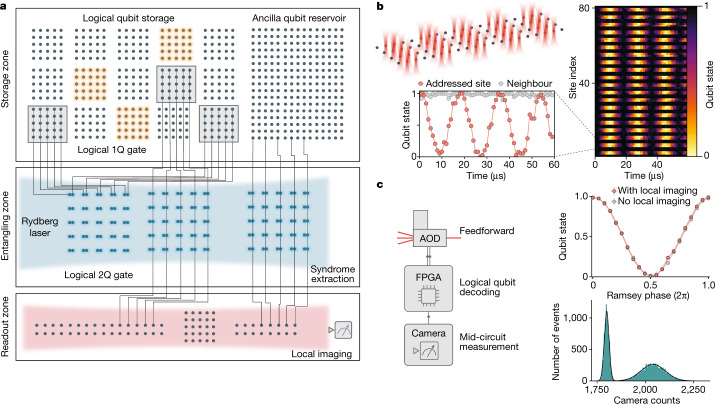
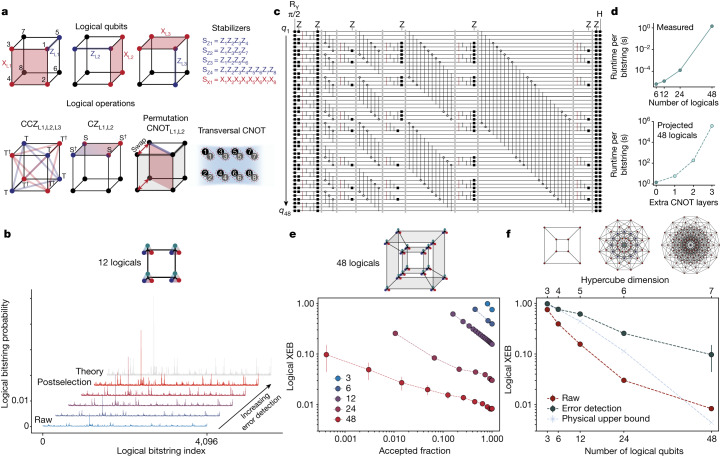
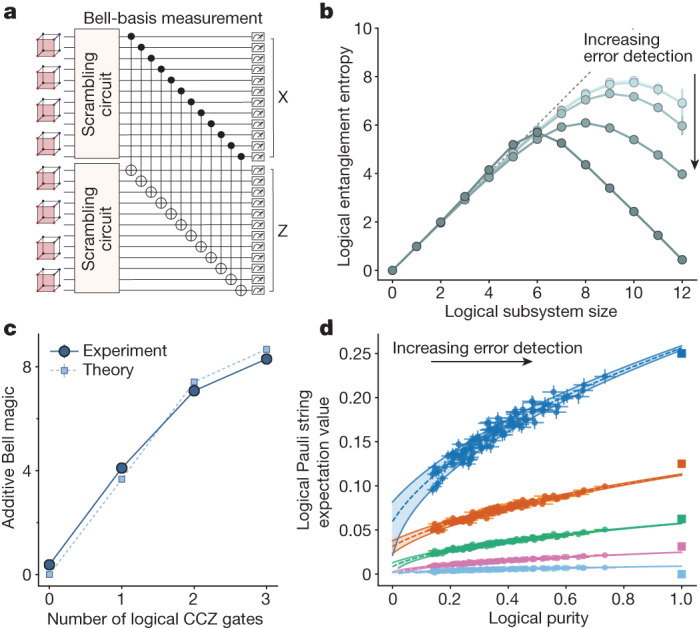
Abstract Suppressing errors is the central challenge for useful quantum computing 1 , requiring quantum error correction (QEC) 2–6 for large-scale processing. However, the overhead in the realization of error-corrected ‘logical’ qubits, in which information is encoded across many physical qubits for redundancy 2–4 , poses substantial challenges to large-scale logical quantum computing. Here we report the realization of a programmable quantum processor based on encoded logical qubits operating with up to 280 physical qubits. Using logical-level control and a zoned architecture in reconfigurable neutral-atom arrays 7 , our system combines high two-qubit gate fidelities 8 , arbitrary connectivity 7,9 , as well as fully programmable single-qubit rotations and mid-circuit readout 10–15 . Operating this logical processor with various types of encoding, we demonstrate improvement of a two-qubit logic gate by scaling surface-code 6 distance from d = 3 to d = 7, preparation of colour-code qubits with break-even fidelities 5 , fault-tolerant creation of logical Greenberger–Horne–Zeilinger (GHZ) states and feedforward entanglement teleportation, as well as operation of 40 colour-code qubits. Finally, using 3D [[8,3,2]] code blocks 16,17 , we realize computationally complex sampling circuits 18 with up to 48 logical qubits entangled with hypercube connectivity 19 with 228 logical two-qubit gates and 48 logical CCZ gates 20 . We find that this logical encoding substantially improves algorithmic performance with error detection, outperforming physical-qubit fidelities at both cross-entropy benchmarking and quantum simulations of fast scrambling 21,22 . These results herald the advent of early error-corrected quantum computation and chart a path towards large-scale logical processors.
Overview
CoChat Summary
TL;DR
The paper reports a programmable logical quantum processor built from reconfigurable neutral-atom arrays, operating with up to 280 physical qubits and using surface codes, colour codes, and 3D [[8,3,2]] codes. Across several demonstrations, logical encoding improved performance for entangling gates, GHZ-state preparation, feedforward teleportation, and complex sampling/quantum-simulation tasks compared with analogous physical-qubit circuits.
Key findings
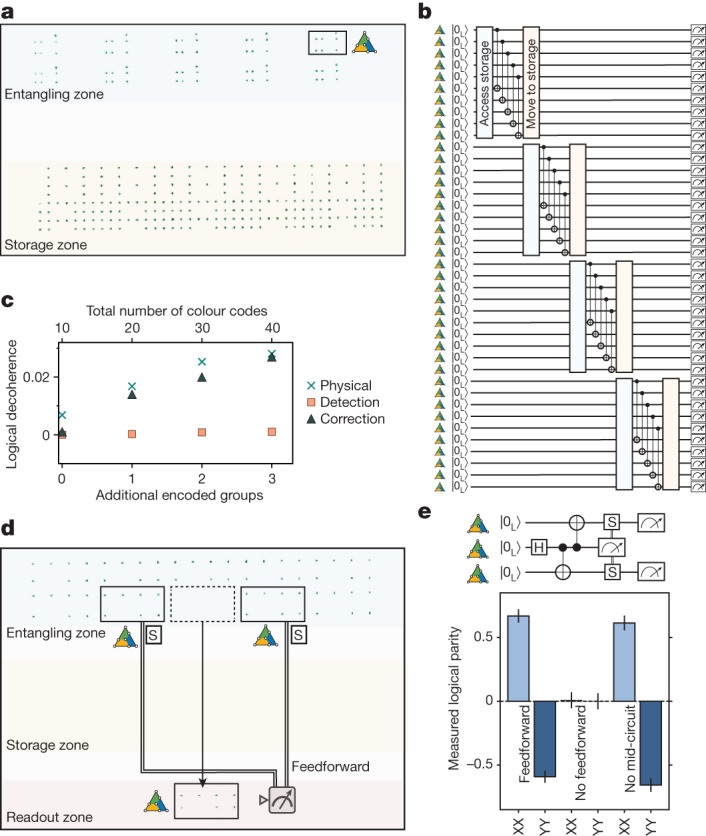
- The processor used up to 280 physical qubits and demonstrated 40 colour-code qubits by repeating a ten-logical-qubit process four times.
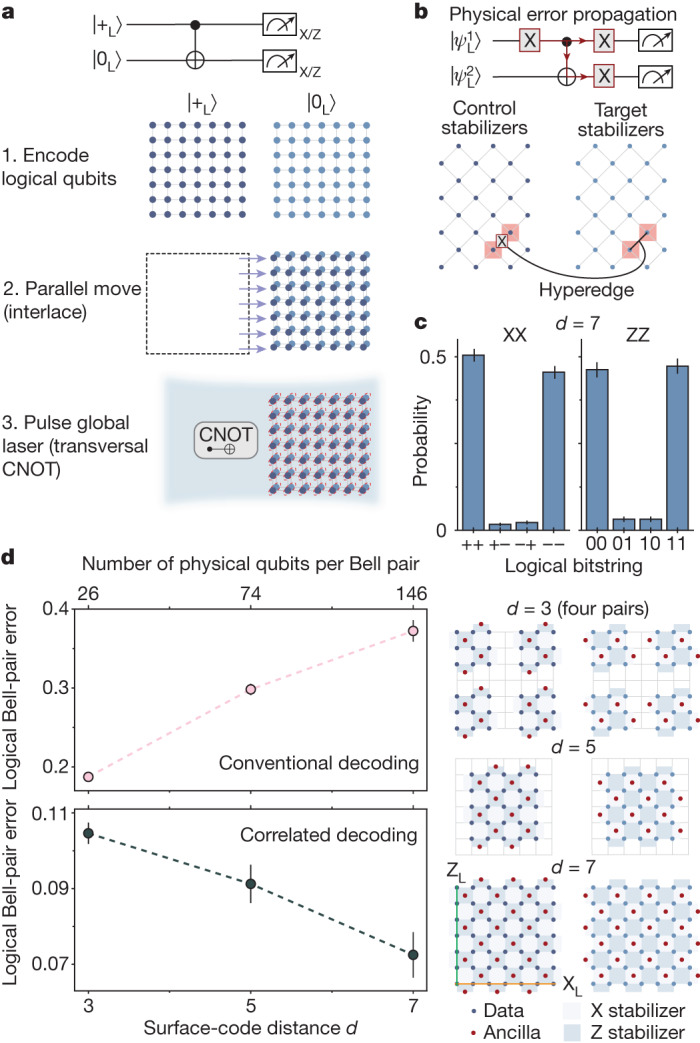
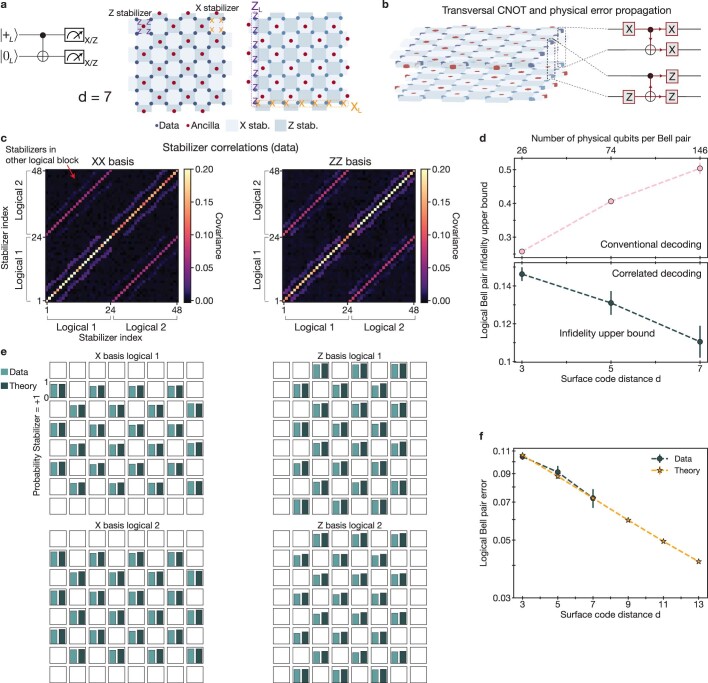
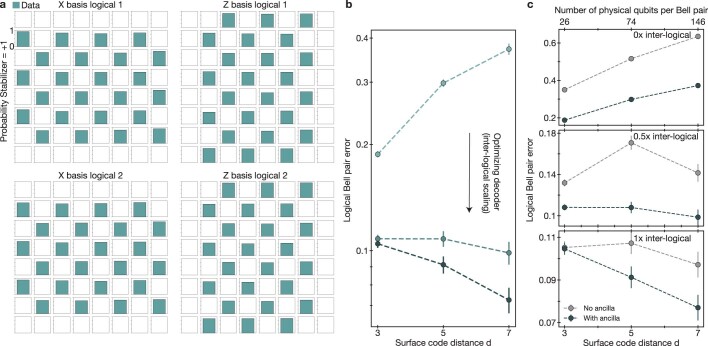
- For a surface-code transversal CNOT, increasing code distance from d = 3 to d = 7 improved the logical Bell pair; with correlated decoding, the authors report roughly 0.95 populations in the XLXL and ZLZL bases for entangled d = 7 logical qubits.
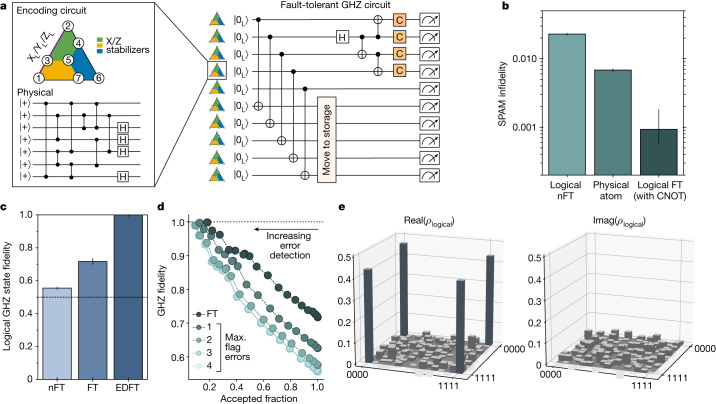
- For fault-tolerant colour-code GHZ preparation, the measured logical GHZ fidelity was 72(2)%; with error-detection/postselection it increased further, and the paper states that discarding 50% of the data improved GHZ fidelity to approximately 90%.
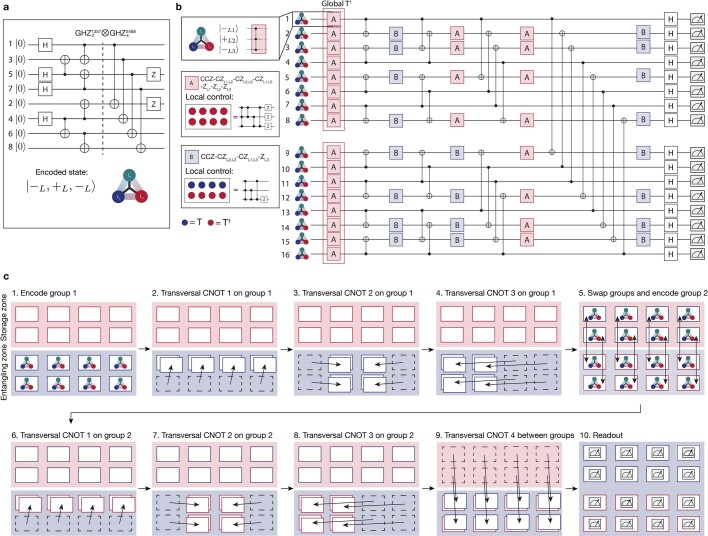
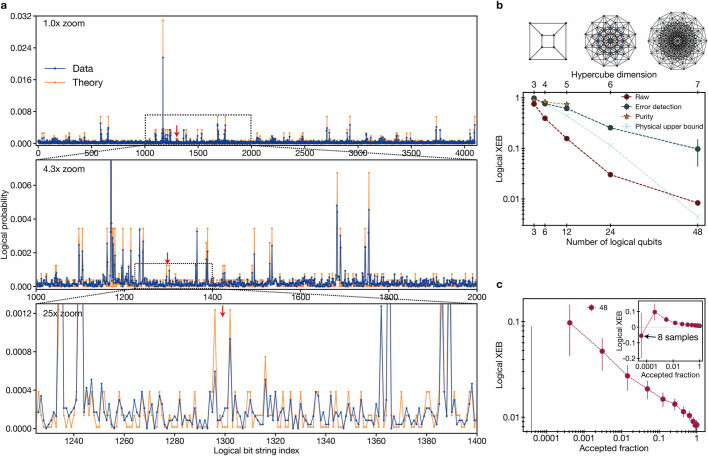
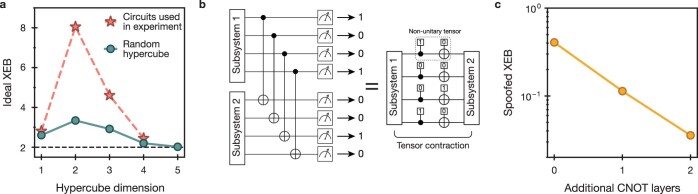
- In complex [[8,3,2]] sampling circuits, the authors realized up to 48 logical qubits, 228 logical two-qubit gates, and 48 logical CCZ gates; the reported XEB for 12 logical qubits increased from 0.156(2) to 0.616(7) with error detection, and for 48 logical qubits the XEB was approximately 0.1.
Methods
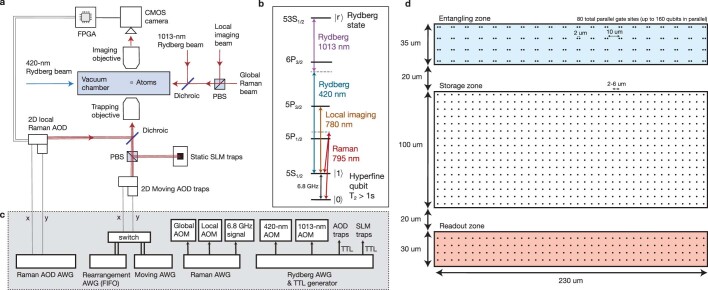
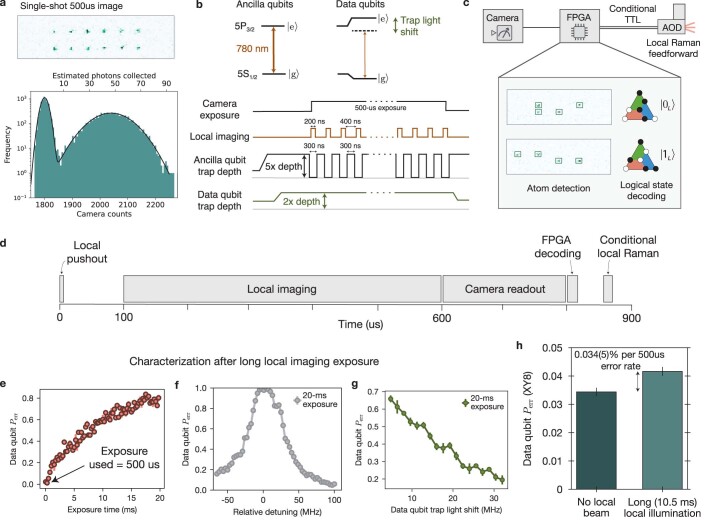
- Experimental platform: reconfigurable arrays of \(^{87}\)Rb atoms in optical tweezers, with zoned architecture for storage, entangling, and readout; the paper states operation with up to 280 atomic qubits, two-qubit gate fidelities of 99.3–99.5%, and local imaging fidelity of around 99.8%.
- Coding and circuits: rotated surface codes (including distance-7), d = 3 colour codes for Clifford algorithms, and 3D [[8,3,2]] codes for non-Clifford sampling circuits; all logical circuits after state preparation are built from transversal gates.
- Analysis: correlated decoding via a decoding hypergraph and mixed-integer programming solved with Gurobi; logical performance was benchmarked using direct fidelity estimation, full tomography, cross-entropy benchmarking (XEB), and two-copy Bell-basis measurements.
Limitations
- The paper states that state preparation is non-fault-tolerant for the d = 5, 7 surface codes and the [[8,3,2]] codes, because only a single round of stabilizer measurement is used.
- It also notes that deep circuits require repetitive error correction to keep benefiting from logical suppression, and that current mid-circuit readout/feedforward takes slightly less than 1 ms, with the authors saying it could be improved toward the 100-μs scale.
- Evident from the text: several reported gains rely on postselection / sliding-scale error detection, which improves fidelity at the cost of acceptance probability and measurement overhead.
Model-written summary. Check it against the paper before relying on it.
Integrity signals
Registry
Cites
Statistics
Figures
Verification
Claims the paper makes
69 Valid · 15 Not valid · 8 Not checked · 160 Own results and interpretations
At least one cited source doesn’t support this claim or points to a different paper, and none confirmed it — see the verdicts below.
In the paper
“However, executing large-scale, useful algorithms on quantum processors requires very low gate error rates (generally below about 10−10)23, far below those that will probably ever be achievable with any physical device2.”
§ Logical quantum processor based on reconfigurable atom arrays > Main
What the sources say
- Disputedcites [23] Gidney C Ekerå M How to factor 2048 bit RSA integers in 8 hours using 20 million noisy qubits Quantum 2021 5 433 10.22331/q-2021-04-15-433 sourceExperimental — accuracy not yet measured
The citation to this paper is attached to the claimed requirement for gate error rates below about 10⁻¹⁰, not to the following statement about what physical devices can achieve. Section 2.16 instead describes a physical gate error rate of 0.1% (10⁻³) as sufficient for surface-code error correction, and Section 2.13 uses that rate in its large-scale factoring estimate. The paper distinguishes physical gate errors from the much lower logical error rates produced by correction. (LLM, conf=0.88)
Checked by a reasoning model — may be wrong.
- Not matchedcites [2] Shor, P. W. in Proc. 37th Conference on Foundations of Computer Science 56–65 (IEEE, 1996).
Its entry has no title and year that we can search by.
hedgedstates a cause- Asserted: passes — The authors put it forward as true.
- Checkable: passes — It can be checked against evidence.
- Load-bearing: passes — The paper’s conclusions depend on it.
- Based: passes — The paper gives a reason why it holds.
- Disputed
At least one cited source doesn’t support this claim or points to a different paper, and none confirmed it — see the verdicts below.
In the paper
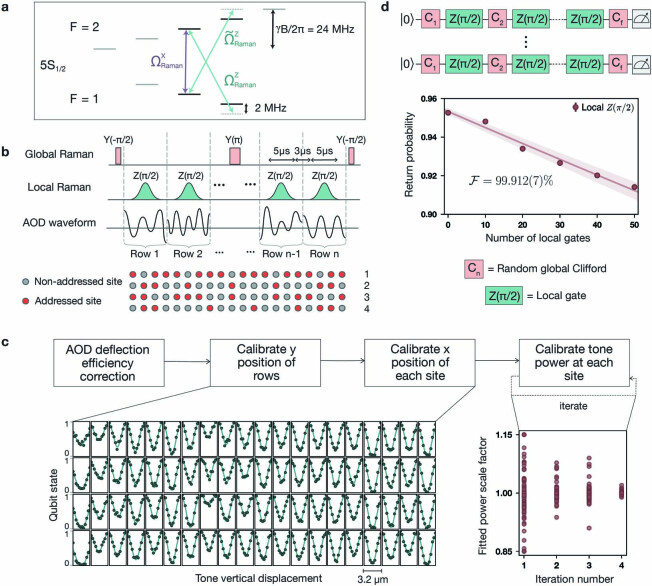
“Fully programmable local single-qubit rotations are realized through qubit-specific, parallel Raman excitation through an additional 2D AOD (ref. 34) (Fig. 1b and Extended Data Fig. 2).”
§ Logical quantum processor based on reconfigurable atom arrays > Logical processor based on atom arrays
What the sources say
- Disputedcites [34] Graham TM Multi-qubit entanglement and algorithms on a neutral-atom quantum computer Nature 2022 604 457 462 10.1038/s41586-022-04603-6 35444321 sourceExperimental — accuracy not yet measured
The Methods (p. 10) say site-selective single-qubit rotations combine global microwave rotations with local 459 nm Stark-shift phase gates, rather than using parallel Raman excitation. The Methods (p. 10) describe crossed AODs for pointing Rydberg beams at two sites simultaneously, not an additional 2D AOD for local Raman rotations. (LLM, conf=0.88)
Checked by a reasoning model — may be wrong.
plainstates a cause- Asserted: passes — The authors put it forward as true.
- Checkable: passes — It can be checked against evidence.
- Load-bearing: passes — The paper’s conclusions depend on it.
- Based: passes — The paper gives a reason why it holds.
- Disputed
The cited sources support only part of this claim — read each source’s verdict below.
In the paper
“Using logical-level control and a zoned architecture in reconfigurable neutral-atom arrays7, our system combines high two-qubit gate fidelities8, arbitrary connectivity7,9, as well as fully programmable single-qubit rotations and mid-circuit readout10–15.”
§ Logical quantum processor based on reconfigurable atom arrays > Abstract
What the sources say
- Supportedcites [10] Deist E Mid-circuit cavity measurement in a neutral atom array Phys. Rev. Lett. 2022 129 203602 10.1103/PhysRevLett.129.203602 36462020 source
The paper describes its method as mid-circuit readout in a neutral-atom array (p. 1). It also reports performing a mid-circuit measurement on one atom during a two-atom quantum circuit (p. 4), supporting the cited readout capability. (LLM, conf=0.92)
- Supportedcites [11] Singh K Mid-circuit correction of correlated phase errors using an array of spectator qubits Science 2023 380 1265 1269 10.1126/science.ade5337 37228222 source
The INTRODUCTION states that 'During logic operations on the data qubits, midcircuit readouts on the array of ~60 spectator qubits enable single-shot estimation of globally correlated phase errors,' with readouts that 'do not disturb the coherence of the data qubits.' The Methods section 'Mid-circuit readout of atomic qubits' and '3. Quantifying discrimination fidelity of the mid-circuit readout' report the 15 ms MCR with discrimination fidelity 0.989(5), and '2. Real-time processing and feedback' describes the real-time imaging and feedback chain, so the cited system demonstrably possesses mid-circuit readout. The DISCUSSION lists mid-circuit readout among the quantum-control techniques demonstrated, and also documents single-qubit manipulation via IQ-modulated global microwave pulses supporting the adjacent part of the sentence. (LLM, conf=0.90)
- Supportedcites [12] Graham, T. M. et al. Midcircuit measurements on a single-species neutral alkali atom quantum processor. Phys. Rev. X13, 041051 (2023). source
The paper’s “A. Midcircuit measurement” section describes a five-step procedure that includes state-selective readout of ancilla atoms during the circuit. It therefore supports the cited claim that mid-circuit readout is available in a neutral-atom processor. (LLM, conf=0.92)
- Partly supportedcites [13] Ma S High-fidelity gates and mid-circuit erasure conversion in an atomic qubit Nature 2023 622 279 284 10.1038/s41586-023-06438-1 37821593 sourceExperimental — accuracy not yet measured
The paper reports mid-circuit imaging to detect atoms that have decayed to the ground state (Abstract; page unavailable). But it says its demonstrated detection protocol *could be adapted* to mid-circuit qubit readout; it does not report demonstrating that readout. Thus it supports mid-circuit erasure detection, not the full readout attributed to it. (LLM, conf=0.87)
- Supportedcites [14] Lis, J. W. et al. Midcircuit operations using the omg architecture in neutral atom arrays. Phys. Rev. X13, 041035 (2023). source
The Introduction states that the paper demonstrates midcircuit state readout of ancilla qubits. This supports the cited claim that mid-circuit readout is a capability demonstrated in neutral-atom arrays. (LLM, conf=0.92)
- Supportedcites [15] Norcia, M. A. et al. Midcircuit qubit measurement and rearrangement in a 171Yb atomic array. Phys. Rev. X13, 041034 (2023). source
Section IV (Correction of Atom Loss) reports using the results of a midcircuit measurement to correct ancilla-qubit loss while maintaining data-qubit coherence. Appendix B also describes the array's midcircuit measurement results. These passages support the citation for mid-circuit readout. (LLM, conf=0.90)
plain- Asserted: passes — The authors put it forward as true.
- Checkable: passes — It can be checked against evidence.
- Load-bearing: passes — The paper’s conclusions depend on it.
- Based: passes — The paper gives a reason why it holds.
- Supported
The cited sources support only part of this claim — read each source’s verdict below.
In the paper
“Operating this logical processor with various types of encoding, we demonstrate improvement of a two-qubit logic gate by scaling surface-code6 distance from d = 3 to d = 7, preparation of colour-code qubits with break-even fidelities5, fault-tolerant creation of logical Greenberger–Horne–Zeilinger (GHZ) states and feedforward entanglement teleportation, as well as operation of 40 colour-code qubit”
§ Logical quantum processor based on reconfigurable atom arrays > Abstract
What the sources say
- Partly supportedcites [6] Google Quantum AI Suppressing quantum errors by scaling a surface code logical qubit Nature 2023 614 676 681 10.1038/s41586-022-05434-1 36813892 PMC9946823 sourceExperimental — accuracy not yet measured
The Main section reports improved logical-qubit performance when scaling a surface code from d = 3 to d = 5. The ‘Surface codes with superconducting qubits’ section says the experiment focuses on preserving logical memory; it does not report improving a two-qubit logical gate or scaling to d = 7. Page numbers are not available in our copy. (LLM, conf=0.88)
boostedstates a cause- Asserted: passes — The authors put it forward as true.
- Checkable: passes — It can be checked against evidence.
- Load-bearing: passes — The paper’s conclusions depend on it.
- Based: passes — The paper gives a reason why it holds.
- Partly supported
The cited sources support only part of this claim — read each source’s verdict below.
In the paper
“Operating this logical processor with various types of encoding, we demonstrate improvement of a two-qubit logic gate by scaling surface-code6 distance from d = 3 to d = 7, preparation of colour-code qubits with break-even fidelities5, fault-tolerant creation of logical Greenberger–Horne–Zeilinger (GHZ) states and feedforward entanglement teleportation, as well as operation of 40 colour-code qubit”
§ Logical quantum processor based on reconfigurable atom arrays > Abstract
What the sources say
- Partly supportedcites [5] Ryan-Anderson, C. et al. Implementing fault-tolerant entangling gates on the five-qubit code and the color code. Preprint at https://arxiv.org/abs/2208.01863 (2022). sourceExperimental — accuracy not yet measured
The opening summary (p. 1) reports that fault-tolerant colour-code state-preparation-and-measurement fidelities exceeded average physical-qubit SPAM fidelities. But Section III (p. 8) explicitly says the experiments did not achieve the break-even point; it describes the higher logical fidelity as a milestone toward it. The claim is supported as a comparison of preparation-and-measurement fidelities, not as a demonstration of break-even operation. (LLM, conf=0.86)
boosted- Asserted: passes — The authors put it forward as true.
- Checkable: passes — It can be checked against evidence.
- Load-bearing: passes — The paper’s conclusions depend on it.
- Based: passes — The paper gives a reason why it holds.
- Partly supported
130 more claims · 39 with their cited sources checked
Create a free account to see all 252 claims and to verify the 1 reference still open.
- It may state two separate claims as one. 89
- Probably not a substantial claim. 40
- The quote only partly states this claim. 2
Claims other papers make about this one
Each is checked against this paper’s own text: does it say what the citing paper says it does?
The cited source doesn’t support the claim as written.
In the citing paper
“Although many platforms have demonstrated different features of quantum error correction14–20, no quantum processor has definitively shown below-threshold performance.”
From Quantum error correction below the surface code threshold (2025) · cites this paper as [18]
Checked by a reasoning model — may be wrong.
Experimental — accuracy not yet measuredThe source backs part of the claim, not all of it — or backs it for a different population, condition or comparison.
In the citing paper
“As a result, error suppression by increasing the colour code size has not yet been demonstrated, to our knowledge, on any experimental platform.”
From Scaling and logic in the colour code on a superconducting quantum processor (2025) · cites this paper as [18]
Experimental — accuracy not yet measuredThe cited source says what the claim attributes to it.
In the citing paper
“Recently, QEC experiments have been performed in various hardware platforms, including superconducting quantum circuits25–28, trapped ions29 and neutral atoms30.”
From Hardware-efficient quantum error correction via concatenated bosonic qubits (2025) · cites this paper as [30]
The cited source says what the claim attributes to it.
In the citing paper
“The smallest instance of the colour code, the Steane code37, has been implemented with trapped ions11,12 and neutral atoms18, demonstrating logical operations and logical circuits13–19.”
From Scaling and logic in the colour code on a superconducting quantum processor (2025) · cites this paper as [18]
Citations
Cites
Quantum Computing in the NISQ era and beyond
Preskill, J. (2018) · Quantum · doi:10.22331/q-2018-08-06-79 · Cited by 8,830 · cited 1×
“The storage zone is used for dense qubit storage, free from entangling-gate errors and featuring long coherence times.”
BackgroundQuantum supremacy using a programmable superconducting processor
Arute, F., Arya, K., Babbush, R., Bacon, D., Bardin, J. C., Barends, R., Biswas, R., Boixo, S., Brandao, F. G. S. L., Buell, D. A., et al. (2019) · Nature · doi:10.1038/s41586-019-1666-5 · Cited by 7,720 · cited 3×
“70), has an improved Raman scattering contribution and is faster (roughly 1 μs duration).”
BackgroundMethodScheme for reducing decoherence in quantum computer memory
Shor, P. W. (1995) · Physical Review A · doi:10.1103/physreva.52.r2493 · Cited by 4,479 · cited 1×
“Distance-3 codes, which are of notable historical importance 3,87 , can correct any weight-1 error.”
BackgroundSurface codes: Towards practical large-scale quantum computation
Fowler, A. G., Mariantoni, M., Martinis, J. M., & Cleland, A. N. (2012) · Physical Review A · doi:10.1103/physreva.86.032324 · Cited by 3,059 · cited 10×
“Mid-circuit X-basis measurement of the middle logical creates by applying a logical S gate to the first and third logicals conditioned in real time on the state of the middle logical, akin to the magic-state-teleportation circuit 24 .”
BackgroundMethodInfluentialQuantum computational advantage using photons
Zhong, H.-S., Wang, H., Deng, Y.-H., Chen, M.-C., Peng, L.-C., Luo, Y.-H., Qin, J., Wu, D., Ding, X., Hu, Y., et al. (2020) · Science · doi:10.1126/science.abe8770 · Cited by 2,405
Dennis, E., Kitaev, A., Landahl, A., & Preskill, J. (2002) · Journal of Mathematical Physics · doi:10.1063/1.1499754 · Cited by 1,768 · cited 6×
“6, which can be understood as preparing two four-qubit GHZ states (corresponding to [[4,2,2]] codes 95 ), that is, GHZ ⊗GHZ , and subsequently entangling them as illustrated in Extended Data Fig.”
BackgroundInfluentialFast Quantum Gates for Neutral Atoms
Jaksch, D., Cirac, J. I., Zoller, P., Rolston, S. L., Côté, R., & Lukin, M. D. (2000) · Physical Review Letters · doi:10.1103/physrevlett.85.2208 · Cited by 1,540 · cited 2×
“Nota-bly, owing to the use of the Rydberg blockade 32,68 , the gate is largely independent of the exact distance between atoms.”
BackgroundMethodSelf-citationImproved simulation of stabilizer circuits
Aaronson, S., & Gottesman, D. (2004) · Physical Review A · doi:10.1103/physreva.70.052328 · Cited by 1,515 · cited 2×
“For instance, when using 2D codes such as the surface code, non-Clifford operations cannot be easily performed 37 , and relatively expensive techniques are required for nontrivial computation 24,43 , as Clifford circuits can be easily simulated 44 .”
BackgroundMethodDennis, E., Kitaev, A., Landahl, A., & Preskill, J. (2001) · CERN Document Server (European Organization for Nuclear Research) · Cited by 1,485
Multiple-particle interference and quantum error correction
(1996) · Proceedings of the Royal Society of London. Series A: Mathematical, Physical and Engineering Sciences · doi:10.1098/rspa.1996.0136 · Cited by 1,284 · cited 10×
“We use 2D d = 3 colour codes 3,37 , which are topological codes akin to the surface code, but with the useful capability of trans-versal operations of the full Clifford group: Hadamard (H), π/2 phase (S) gate and CNOT (ref.”
BackgroundMethodInfluential
Research works printed but not linked: 2
- Shor, P. W. in Proc. 37th Conference on Foundations of Computer Science 56–65 (IEEE, 1996).
- Patterson, D. A. & Hennessy, J. L. Computer Organization and Design: The Hardware/Software Interface. RISC-V Edition (Morgan Kaufmann, 2018).
Cited by
Items 401–500 of 1,108
Direct probe of topology and geometry of quantum states on the IBM Q quantum processor
Chen, T., Ding, H.-T., Shen, R.-Z., Zhu, S.-L., & Gong, J. (2024) · Physical review B · doi:10.1103/physrevb.110.205402 · Cited by 8
Efficient Beam Flattening for Planar-Integrated Magneto-Optical Traps
Huang, C.-J., Liu, H., Chen, L., Li, C., Guo, G., Zou, C., & Xiang, G. (2025) · Chinese Physics Letters · doi:10.1088/0256-307x/42/3/034203 · Cited by 6
Design of an efficient fault-tolerant quantum-computing circuit with quantum neural network learning
Lin, C., Xu, R., & Li, Y. (2025) · Engineering Applications of Artificial Intelligence · doi:10.1016/j.engappai.2025.110808 · Cited by 9
Accelerating two-dimensional electronic spectroscopy simulations with a probe qubit protocol
Guimarães, J. D., Lim, J., Vasilevskiy, M. I., Huelga, S. F., & Plenio, M. B. (2025) · Physical Review Research · doi:10.1103/physrevresearch.7.023130 · Cited by 8
Pilot-Quantum: A Middleware for Quantum-HPC Resource, Workload and Task Management
Mantha, P. K., Kiwit, F. J., Saurabh, N., Jha, S., & Luckow, A. (2025) · IEEE/ACM International Symposium on Cluster, Cloud and Grid Computing (CCGrid) · doi:10.1109/ccgrid64434.2025.00070 · Cited by 18
Scheme to Detect the Strong-to-Weak Symmetry Breaking via Randomized Measurements
Sun, N. G., Zhang, P., & Feng, L. (2025) · Physical Review Letters · doi:10.1103/7p5x-7yqb · Cited by 29
Single-shot and measurement-based quantum error correction via fault complexes
Hillmann, T., Dauphinais, G., Tzitrin, I., & Vasmer, M. (2025) · Physical Review A · doi:10.1103/cjb4-l57n · Cited by 44
Towards Supporting QIR: Steps for Adopting the Quantum Intermediate Representation
Stade, Y., Burgholzer, L., & Wille, R. (2025) · International Conference for High Performance Computing, Networking, Storage and Analysis (SC) · doi:10.1145/3731599.3767546 · Cited by 13
Limitations of noisy quantum devices in computing and entangling power
Yan, Y., Du, Z., Chen, J., & Ma, X. (2025) · npj Quantum Information · doi:10.1038/s41534-025-01136-4 · Cited by 25
Taming Recoil Effect in Cavity-Assisted Quantum Interconnects
Kikura, S., Inoue, R., Yamasaki, H., Goban, A., & Sunami, S. (2025) · PRX Quantum · doi:10.1103/njh8-q7gb · Cited by 12
Enhanced repetition codes for the cross-platform comparison of progress towards fault-tolerance
Liepelt, M., Peduzzi, T., & Wootton, J. R. (2024) · Journal of Physics A Mathematical and Theoretical · doi:10.1088/1751-8121/ad5085 · Cited by 8
Characterization of overparametrization in the simulation of realistic quantum systems
Duschenes, M., Carrasquilla, J., & Laflamme, R. (2024) · Physical Review A · doi:10.1103/physreva.109.062607 · Cited by 6
Tan, D. B., Ping, S., & Cong, J. (2024) · Design, Automation, and Test in Europe · doi:10.23919/date58400.2024.10546763 · Cited by 12
Cheng, L., Liu, S.-C., Peng, L.-Y., & Gong, Q. (2024) · Physical Review Applied · doi:10.1103/physrevapplied.22.034021 · Cited by 7
A modular entanglement-based quantum computer architecture
Riera-Sàbat, F., & Dür, W. (2024) · New Journal of Physics · doi:10.1088/1367-2630/ad9945 · Cited by 8
Robust Quantum Reservoir Learning for Molecular Property Prediction
Beaulieu, D., Kornjača, M., Krunic, Z., Stivaktakis, M., Chen, J., Ehmer, T., Wang, S.-T., & Pham, A. (2025) · Journal of Chemical Information and Modeling · doi:10.1021/acs.jcim.5c00958 · Cited by 20
Efficient fault-tolerant implementations of non-Clifford gates with reconfigurable atom arrays
Wang, Y., Wang, Y., Chen, Y.-A., Zhang, W., Zhang, T., Hu, J., Chen, W., Gu, Y., & Liu, Z.-W. (2024) · npj Quantum Information · doi:10.1038/s41534-024-00945-3 · Cited by 30
Bubble Clustering Decoder for Quantum Topological Codes
Forlivesi, D., Valentini, L., & Chiani, M. (2025) · IEEE Transactions on Communications · doi:10.1109/tcomm.2025.3558012 · Cited by 12
Optimal control in phase space applied to minimal-time transfer of thermal atoms in optical traps
Morandi, O., Nicoletti, S., Gavryusev, V., & Fallani, L. (2025) · Physical Review A · doi:10.1103/d857-7cwr · Cited by 9
Afiouni, F., Sabeh, R. E., Nishimura, N., Hajj, I. E., Mouawad, A. E., & Cooper, A. (2025) · Physical Review A · doi:10.1103/2rds-k4n9 · Cited by 10
Coprime Bivariate Bicycle Codes and Their Layouts on Cold Atoms
Wang, M., & Mueller, F. (2026) · Quantum · doi:10.22331/q-2026-02-23-2009 · Cited by 44
Degenerate quantum erasure decoding
Kuo, K.-Y., & Ouyang, Y. (2026) · npj Quantum Information · doi:10.1038/s41534-026-01212-3 · Cited by 16
Local vs Nonlocal Dynamics in Cavity-Coupled Rydberg Atom Arrays
Bacciconi, Z., Xavier, H. B., Marinelli, M., Bhakuni, D. S., & Dalmonte, M. (2025) · Physical Review Letters · doi:10.1103/physrevlett.134.213604 · Cited by 8
Individual-atom control in an array through phase modulation
Wang, G., Xu, W., Li, C., Vuletić, V., & Cappellaro, P. (2025) · Physical Review Applied · doi:10.1103/physrevapplied.23.024072 · Cited by 9
Self-citationExtractable energy from quantum superposition of current states
Perciavalle, F., Rossini, D., Polo, J., & Luigi Amico, A. (2025) · Quantum Science and Technology · doi:10.1088/2058-9565/adbf45 · Cited by 11
Invited: Coping with Interconnects
Cong, J. (2025) · International Symposium on Physical Design · doi:10.1145/3698364.3712622 · Cited by 3
Entanglement transfer of a Rydberg W-state to a multi-mode photonic state
Ramaswamy, A., & Malinovskaya, S. (2025) · Physical Review Research · doi:10.1103/physrevresearch.7.013288 · Cited by 6
Quantum Computing for Quantum Chemistry
Schleich, P., Calderón, L. M., Sun, C., Bagherimehrab, M., Aldossary, A., Kottmann, J. S., & Aspuru‐Guzik, A. (2025) · ACS in focus · doi:10.1021/acsinfocus.7e9012 · Cited by 11
Space-Time Correlations in Monitored Kinetically Constrained Discrete-Time Quantum Dynamics
Cech, M., Cea, M., Bañuls, M. C., Lesanovsky, I., & Carollo, F. (2025) · Physical Review Letters · doi:10.1103/2lxs-wccj · Cited by 21
Atomic-scale protuberance induced by AFM dynamic lithography
He, Y., & Fang, F. (2025) · International Journal of Mechanical Sciences · doi:10.1016/j.ijmecsci.2025.110451 · Cited by 4
Low-loss telecom-band nanofiber cavity for interfacing Yb atomic qubits
Horikawa, S., Kato, S., Inoue, R., Aoki, T., Goban, A., & Konishi, H. (2025) · Optics Letters · doi:10.1364/ol.570362 · Cited by 9
Cavity-Enabled Real-Time Observation of Individual Atomic Collisions
Peters, M. L., Wang, G., Spierings, D., Drucker, N., Hu, B., Chen, M.-W., Chen, Y.-T., & Vuletić, V. (2025) · Physical Review Letters · doi:10.1103/941q-5sdq · Cited by 22
Self-citationThresholds for Postselected Quantum Error Correction from Statistical Mechanics
English, L., Williamson, D. J., & Bartlett, S. D. (2025) · Physical Review Letters · doi:10.1103/nh49-52y2 · Cited by 25
Deterministic Nonlocal Quantum Gate with Room-Temperature Memory Modules
Lei, X., Li, J., Zhou, X., Yan, J., Ji, M., Yan, Z., Jia, X., Xie, C., & Peng, K. (2025) · Physical Review Letters · doi:10.1103/xt77-2gpw · Cited by 5
Test and Characterization of Multilayer Ion Traps on Fused Silica
Dietl, M., Valentini, M., Anmasser, F., Zesar, A., Auchter, S., van Mourik, M. W., Monz, T., Blatt, R., Rössler, C., & Schindler, P. (2025) · Advanced Quantum Technologies · doi:10.1002/qute.202500412 · Cited by 12
Error Mitigation and Circuit Division for Early Fault-Tolerant Quantum Phase Estimation
Dutkiewicz, A., Polla, S., Scheurer, M., Gogolin, C., Huggins, W. J., & O’Brien, T. E. (2025) · PRX Quantum · doi:10.1103/mlmy-yskj · Cited by 34
Volcano architecture for scalable quantum processor units
Ma, D.-Q., Jie, Q.-X., Hu, Y., Zhu, W., Zhang, Y., Fan, H.-J., Zhong, X.-K., Chen, G.-J., Zhang, Y., Zhang, T., et al. (2025) · Science China Physics Mechanics and Astronomy · doi:10.1007/s11433-025-2804-2 · Cited by 8
Astigmatism-free 3D optical tweezer control for rapid atom rearrangement
Lu, Y., Song, N., Xiang, T., Lee, T.-C., Ho, J., Yan, Z., & Stamper-Kurn, D. (2026) · Optica Quantum · doi:10.1364/opticaq.583554 · Cited by 17
Valentini, M., van Mourik, M. W., Butt, F., Wahl, J., Dietl, M., Pfeifer, M., Anmasser, F., Colombe, Y., Rössler, C., Holz, P. C., et al. (2025) · Physical Review X · doi:10.1103/b9s1-6r44 · Cited by 30
AppQSim: Application-oriented benchmarks for Hamiltonian simulation on a quantum computer
Granet, E., & Dreyer, H. (2025) · Physical Review Research · doi:10.1103/qt55-7d6r · Cited by 10
General, Efficient, and Robust Hamiltonian Engineering
Baßler, P., Heinrich, M., & Kliesch, M. (2025) · PRX Quantum · doi:10.1103/9yxv-tdqr · Cited by 9
Universal Adapters between Quantum Low-Density Parity Check Codes
Swaroop, E., Jochym-O'Connor, T., & Yoder, T. J. (2026) · PRX Quantum · doi:10.1103/1g44-jp62 · Cited by 103
Quantum Error Detection in Qubit-Resonator Star Architecture
Vigneau, F., Majumder, S., Rath, A., Parrado-Rodríguez, P., Pereira, F. R. F., Ku, H.-S., Šimkovic, F., Pogorzalek, S., Jones, T., Wurz, N., et al. (2025) · PRX Quantum · doi:10.1103/8m33-wn4g · Cited by 13
Ladder Operator Block-Encoding
Simon, W., Gustin, C. M., Serafin, K., Ralli, A., Goldstein, G. R., & Love, P. J. (2025) · Quantum · doi:10.22331/q-2025-12-22-1953 · Cited by 25
Quantum Snakes on a Plane: Mobile, Low-Dimensional Logical Qubits on a 2D Surface
Siegel, A., Cai, Z., Jnane, H., Koczor, B., Pexton, S., Strikis, A., & Benjamin, S. C. (2026) · PRX Quantum · doi:10.1103/494s-jd8h · Cited by 32
Recent advances in the combination of nonlinearity and exceptional points
Bai, K., Lin, C., Li, J.-Z., & Xiao, M. (2026) · Applied Physics Reviews · doi:10.1063/5.0306393 · Cited by 8
Hamilton-Jacobi-Bellman equations for Rydberg-blockade processes
Fromonteil, C., Tricarico, R., Cesa, F., & Pichler, H. (2024) · Physical Review Research · doi:10.1103/physrevresearch.6.033333 · Cited by 17
Heisenberg-limited Bayesian phase estimation with low-depth digital quantum circuits
Direkci, S., Finkelstein, R., Endres, M., & Gefen, T. (2026) · npj Quantum Information · doi:10.1038/s41534-025-01177-9 · Cited by 20
Unconditional quantum magic advantage in shallow circuit computation
Zhang, X., Pan, Z., & Liu, G. (2024) · Nature Communications · doi:10.1038/s41467-024-54864-0 · Cited by 13
Electric field control for experiments with atoms in Rydberg states
Panja, A., Wang, Y., Wang, X., Wang, J., Subhankar, S., & Liang, Q. (2024) · AIP Advances · doi:10.1063/5.0239165 · Cited by 8
Quantum memory assisted entangled state verification with local measurements
Chen, S., Xie, W., Xu, P., & Wang, K. (2025) · Physical Review Research · doi:10.1103/physrevresearch.7.013003 · Cited by 11
Fault-tolerant quantum memory using low-depth random circuit codes
Nelson, J., Bentsen, G. S., Flammia, S., & Gullans, M. (2023) · Physical Review Research · doi:10.1103/physrevresearch.7.013040 · Cited by 7
Self-citationRealization of Landau-Zener Rabi oscillations on an optical lattice clock
Tan, W., Liu, W., Chen, Y.-X., Zhou, C., Zhao, G.-D., Chang, H., Dai, J. W., & Wang, T. (2025) · Physical Review A · doi:10.1103/physreva.111.033102 · Cited by 4
Improved performance of the Bacon-Shor code with Steane's syndrome extraction method
Escobar-Arrieta, G., & Gutiérrez, M. (2025) · Physical Review A · doi:10.1103/physreva.111.032427 · Cited by 7
LSQCA: Resource-Efficient Load/Store Architecture for Limited-Scale Fault-Tolerant Quantum Computing
Kobori, T., Suzuki, Y., Ueno, Y., Tanimoto, T., Todo, S., & Tokunaga, Y. (2025) · IEEE International Symposium on High-Performance Computer Architecture (HPCA) · doi:10.1109/hpca61900.2025.00033 · Cited by 26
Zhang, L., Yang, F., Mølmer, K., & Pohl, T. (2025) · Optica Quantum · doi:10.1364/opticaq.545710 · Cited by 4
Parametrized multiqubit gates for neutral-atom quantum platforms
Mohan, M., de Hond, J., & Kokkelmans, S. J. J. M. F. (2025) · Physical Review Applied · doi:10.1103/physrevapplied.23.054074 · Cited by 10
Suppressing Spurious Transitions Using Spectrally Balanced Pulse
Wang, R., Feng, Y., Zhang, Y., Ding, J., Li, B., Motzoi, F., Gao, Y., Xu, H., Yang, Z., Nuerbolati, W., et al. (2025) · Physical Review Letters · doi:10.1103/h4xf-vq2l · Cited by 16
Architecture for a quantum repeater based on Rydberg-atom quantum processors
Zhang, Y., Jie, Q., Li, M., Wu, S.-H., Wang, Z.-B., Zou, X., Zhang, P., Li, G., Zhang, T., Guo, G.-C., et al. (2025) · Physical Review Applied · doi:10.1103/8rss-rqr2 · Cited by 7
Low-Depth Quantum Error Correction via Three-Qubit Gates in Rydberg Atom Arrays
Pecorari, L., Jandura, S., & Pupillo, G. (2025) · Physical Review Letters · doi:10.1103/yj1m-wj7f · Cited by 15
SWAP-less implementation of quantum algorithms
Klaver, B., Rombouts, S. M. A., Fellner, M., Messinger, A., Ender, K., Ludwig, K., & Lechner, W. (2025) · Physical Review A · doi:10.1103/2wzk-fnhx · Cited by 15
Multi-controlled Phase Gate Synthesis with ZX-calculus applied to Neutral Atom Hardware
Staudacher, K., Schmid, L., Zeiher, J., Wille, R., & Kranzlmüller, D. (2024) · QPL · doi:10.4204/eptcs.406.5 · Cited by 11
Near-resonant light scattering by an atom in a state-dependent trap
Karanikolaou, T. D., Bettles, R. J., & Chang, D. E. (2024) · New Journal of Physics · doi:10.1088/1367-2630/ad3775 · Cited by 6
Concatenated Steane code with single-flag syndrome checks
Pató, B., Tansuwannont, T., & Brown, K. R. (2024) · Physical Review A · doi:10.1103/physreva.110.032411 · Cited by 6
Chen, G.-J., Wang, J., Wang, Z.-B., Zhao, D. Y., Zhang, Y., Liu, A., Dong, C., Huang, K., Guo, G., & Zou, C. (2024) · Optics Express · doi:10.1364/oe.538445 · Cited by 4
Alignment and optimization of optical tweezers on trapped ions
Mazzanti, M., Pereira, C. R., Diepeveen, N. A., Gerritsen, B., Wu, Z., Ackerman, Z. E. D., Gallagher, L. P. H., Safavi-Naini, A., Gerritsma, R., & Schüssler, R. X. (2024) · Physical Review A · doi:10.1103/physreva.110.043105 · Cited by 4
Programming higher-order interactions of Rydberg atoms
Byun, A., Jeong, S., & Ahn, J. (2024) · Physical Review A · doi:10.1103/physreva.110.042612 · Cited by 9
Lei, Y., Li, Z., & Hosseini, M. (2025) · Physical Review Applied · doi:10.1103/physrevapplied.23.054076 · Cited by 5
Characterization of errors in a CNOT between surface code patches
Domokos, B., Márton, Á., & Asbóth, J. K. (2024) · Quantum · doi:10.22331/q-2024-12-27-1577 · Cited by 9
Calibrating quantum gates up to 52 qubits in a superconducting processor
Fan, D., Liu, G., Li, S., Gong, M., Wu, D., Zhang, Y., Zha, C., Chen, F., Cao, S., Ye, Y., et al. (2025) · npj Quantum Information · doi:10.1038/s41534-025-00983-5 · Cited by 19
Self-citationNishi, H., Takei, Y., Kosugi, T., Mieda, S., Natsume, Y., Aoyagi, T., & Matsushita, Y. (2025) · Physical Review Applied · doi:10.1103/physrevapplied.23.034016 · Cited by 11
Collective preparation of large quantum registers with high fidelity
Buffoni, L., & Campisi, M. (2024) · Quantum Science and Technology · doi:10.1088/2058-9565/adc3bb · Cited by 2
Queued quantum collision models
Fiusa, G., & Landi, G. T. (2025) · Physical Review A · doi:10.1103/physreva.111.032220 · Cited by 7
Tuning the Coherent Interaction of an Electron Qubit and a Nuclear Magnon
Shofer, N., Zaporski, L., Appel, M. H., Manna, S., da Silva, S. F. C., Ghorbal, A., Haeusler, U., Rastelli, A., Gall, C. L., Gawełczyk, M., et al. (2025) · Physical Review X · doi:10.1103/physrevx.15.021004 · Cited by 10
Low-overhead defect-adaptive surface code with bandage-like super-stabilizers
Wei, Z., He, T., Ye, Y., Wu, D., Zhang, Y., Zhao, Y., Lin, W., Huang, H.-L., Zhu, X., & Pan, J.-W. (2025) · npj Quantum Information · doi:10.1038/s41534-025-01023-y · Cited by 20
Reducing Quantum Error Correction Overhead With Versatile Flag-Sharing Syndrome Extraction Circuits
Liou, P.-H., & Lai, C. (2025) · IEEE Transactions on Quantum Engineering · doi:10.1109/tqe.2025.3572764 · Cited by 9
FQsun: A Configurable Wave Function-Based Quantum Emulator for Power-Efficient Quantum Simulations
Hai, V. T., Le, V. T. D., Pham, H. L., Nguyen, Q. C., & Nakashima, Y. (2025) · IEEE Access · doi:10.1109/access.2025.3573313 · Cited by 7
Mitigation of birefringence in cavity-based quantum networks using frequency-encoded photons
Zhang, C., Phillips, J., Monga, I., Saglamyurek, E., Wu, Q., & Haeffner, H. (2025) · Physical Review A · doi:10.1103/bckd-qzlp · Cited by 4
Synchronization for Fault-Tolerant Quantum Computers
Maurya, S., & Tannu, S. (2025) · Proceedings - International Symposium on Computer Architecture/Proceedings · doi:10.1145/3695053.3730991 · Cited by 20
Unitary-invariant method for witnessing nonstabilizerness in quantum processors
Wagner, R., Peres, F. C. R., Cruzeiro, E. Z., & Galvão, E. F. (2025) · Journal of Physics A Mathematical and Theoretical · doi:10.1088/1751-8121/ade9ff · Cited by 20
Warm-start adaptive-bias quantum approximate optimization algorithm
Yu, Y., Wang, X., Shannon, N., & Joynt, R. (2025) · Physical Review A · doi:10.1103/nt3w-j4mj · Cited by 12
Stabilizer configuration interaction: Finding molecular subspaces with error detection properties
Anand, A., & Brown, K. R. (2025) · Physical Review A · doi:10.1103/jkcp-6km5 · Cited by 11
Li, Z., Grabowska, D. M., & Savage, M. J. (2025) · Quantum · doi:10.22331/q-2025-09-29-1865 · Cited by 52
Optimal spatial searches with long-range tunneling
King, E. C., Linnebacher, M., Orth, P. P., Rizzi, M., & Morigi, G. (2025) · Physical Review Research · doi:10.1103/cv26-dk1q · Cited by 12
Behrends, J., & Béri, B. (2025) · PRX Quantum · doi:10.1103/gskb-t5ql · Cited by 30
Effectiveness of the syndrome extraction circuit with flag qubits on IBM quantum hardware
Kim, Y., Kim, H., Kang, J., Choi, W., & Kwon, Y. (2025) · Quantum · doi:10.22331/q-2025-10-23-1893 · Cited by 8
Feasibility of performing quantum chemistry calculations on quantum computers
Louvet, T., Ayral, T., & Waintal, X. (2026) · Physical review. B./Physical review. B · doi:10.1103/hpt6-9tnk · Cited by 21
Variational protocols for emulating digital gates using analog control with always-on interactions
Chevallier, C., Vovrosh, J., de Hond, J., Dagrada, M., Dauphin, A., & Elfving, V. E. (2024) · Physical Review A · doi:10.1103/physreva.109.062604 · Cited by 11
Exact results on finite size corrections for surface codes tailored to biased noise
Xiao, Y., Srivastava, B., & Granath, M. (2024) · Quantum · doi:10.22331/q-2024-09-11-1468 · Cited by 11
Codsi, J., & van de Wetering, J. (2025) · Physical Review A · doi:10.1103/physreva.111.012422 · Cited by 25
Mayer, K., Ryan-Anderson, C., Brown, N., Durso-Sabina, E., Baldwin, C. H., Hayes, D., Dreiling, J. M., Foltz, C., Gaebler, J. P., Gatterman, T. M., et al. (2024) · arXiv · doi:10.48550/arxiv.2404.08616 · Cited by 4
SWAP-less Implementation of Quantum Algorithms
Klaver, B., Rombouts, S., Fellner, M., Messinger, A., Ender, K., Ludwig, K., & Lechner, W. (2024) · arXiv · doi:10.48550/arxiv.2408.10907 · Cited by 4
Using detector likelihood for benchmarking quantum error correction
Hesner, I., Hetényi, B., & Wootton, J. R. (2025) · Physical Review A · doi:10.1103/physreva.111.052452 · Cited by 3
“Here the p eff simulation results are shown in blue, taking the average detector likelihood from the run with the most subrounds (16).”
Magneto-optical trap with a hollow grating and an additional retroreflected laser beam
Takamizawa, A., Hokari, R., Kagami, S., Le, T. H. H., Matsumoto, K., Takei, R., Hagimoto, K., & Yanagimachi, S. (2025) · Applied Physics Letters · doi:10.1063/5.0250597 · Cited by 5
Exploring nontrivial topology at quantum criticality on a superconducting processor
Tan, Z., Wang, K., Yang, S., Shen, F., Jin, F., Zhu, X., Ji, Y., Xu, S., Chen, J., Wu, Y., et al. (2026) · Communications Physics · doi:10.1038/s42005-026-02569-9 · Cited by 19
Towards efficient and secure quantum-classical communication networks
Zeng, P., Bandyopadhyay, D., Méndez, J. A. M., Bitner, N., Kolar, A., Solomon, M. T., Heremans, F. J., Awschalom, D. D., Jiang, L., & Liu, J. (2024) · IEEE International Conference on Trust, Privacy and Security in Intelligent Systems and Applications (TPS-ISA) · doi:10.1109/tps-isa62245.2024.00070 · Cited by 3
Bottom-up fabrication of 2D Rydberg exciton arrays in cuprous oxide
Barua, K., Peana, S., Keni, A. D., Mkhitaryan, V. K., Shalaev, V. M., Chen, Y. P., Boltasseva, A. E., & Alaeian, H. (2025) · Communications Materials · doi:10.1038/s43246-025-00742-1 · Cited by 4
Progress towards neutron-scattering simulation on an analog quantum processor
Bauer, N. M., Ale, V., Laurell, P., Huang, S., Watabe, S., Tennant, D. M., & Siopsis, G. (2025) · Physical Review A · doi:10.1103/physreva.111.022442 · Cited by 5
Efficiently Verifiable Quantum Advantage on Near-Term Analog Quantum Simulators
Liu, Z., Devulapalli, D., Hangleiter, D., Liu, Y.-K., Kollár, A. J., Gorshkov, A. V., & Childs, A. M. (2025) · PRX Quantum · doi:10.1103/prxquantum.6.010341 · Cited by 12
Self-citationVariational quantum metrology with the Loschmidt echo
Liu, R., Wu, Z., Yang, X., Li, Y., Zhou, H., Li, Z., Chen, Y., Yuan, H., & Peng, X. (2025) · National Science Review · doi:10.1093/nsr/nwaf091 · Cited by 12
Self-citation
Metadata
- Authors
- Bluvstein, D., Evered, S. J., Geim, A. A., Li, S. H., Zhou, H., Manovitz, T., Ebadi, S., Cain, M., Kalinowski, M., Hangleiter, D., Bonilla Ataides, J. P., Maskara, N., Cong, I., Gao, X., Sales Rodriguez, P., Karolyshyn, T., Semeghini, G., Gullans, M. J., Greiner, M., Vuletić, V., & Lukin, M. D.
- Affiliations
- Harvard University (US)
- Joint Center for Quantum Information and Computer Science (US)
- QuEra Computing (United States) (US)
- Massachusetts Institute of Technology (US)
- Corresponding author
- Lukin, Mikhail D.
- ORCID
- Venue
- Nature
- Published
- 2023-12-06
- Volume
- 626
- Issue
- 7997
- Pages
- 58-65
- ISSN
- 0028-0836 (ISSN-L)
- 1476-4687
- PMC
- PMC10830422
- OpenAlex
- W4389373471
- Semantic Scholar
- 9cac672bb24d6216c2b5728f940e69395d188bdd
- Cited by
- 1,119
- References
- 141
- Citations by year
- 2026: 289 · 2025: 585 · 2024: 245
- FWCI
- 105.58
- Type
- journal article
- Language
- en
- Open access
- hybrid
- doi.org
- Licence
- cc-by
- creativecommons.org/licenses/by/4.0 (tdm)
- creativecommons.org/licenses/by/4.0 (vor)
- Locations
- Nature (publishedVersion, cc-by)
- PubMed Central (publishedVersion, cc-by)
- PubMed (publishedVersion)
- arXiv (Cornell University) (submittedVersion)
- OSTI OAI (U.S. Department of Energy Office of Scientific and Technical Information) (submittedVersion)
- Digital Access to Scholarship at Harvard (DASH) (Harvard University) (submittedVersion, cc-by)
- RePEc: Research Papers in Economics (submittedVersion)
- arXiv (Cornell University)
- Funders
- National Science Foundation (2120757, 1745303, W911NF-20-1-0082)
- U.S. Department of Defense
- U.S. Department of Energy (OMA-2120757, DESC0021110, DESC0020347)
- National Institute of Standards and Technology (OMA-2120757)
- Defense Advanced Research Projects Agency (W911NF2010021)
- Intelligence Advanced Research Projects Activity (W911NF-23-2-0219)
- National Defense Science and Engineering Graduate
- Multidisciplinary University Research Initiative (W911NF2010082)
- Center for Ultracold Atoms, Massachusetts Institute of Technology
- Army Research Office (W911NF-20-1-0082, W911NF2320219, W911NF)
- Topics
- Physical Sciences › Computer Science › Artificial Intelligence › Quantum Computing Algorithms and Architecture
- Physical Sciences › Physics and Astronomy › Atomic and Molecular Physics, and Optics › Quantum Information and Cryptography
- Physical Sciences › Physics and Astronomy › Atomic and Molecular Physics, and Optics › Cold Atom Physics and Bose-Einstein Condensates
- Keywords
- logical qubits, quantum error correction, surface code, color codes, neutral-atom quantum processors, entanglement teleportation, quantum scrambling, programmable quantum processors
About these checks
Registry, retraction, Cites and statistics results are computed, not judged, with one exception: a printed reference that no index lists is read once by a model before it counts as a citation error. Claims are extracted by a model and kept only when their quote appears verbatim in the text; each cited source is then checked, with a model’s help, for whether it says what the claim relies on. Those verdicts can be wrong — read the claim’s quote and the cited source before relying on one.
The claim verdicts this report counts are experimental: their accuracy is not yet measured.
A language model drew the claims from the paper on 2026-09-30, under version 3 of the claim definition (model deepseek-v4.1-flash, prompt extract-v3).
A second model labelled each claim on 2026-09-30 (model jev-1.13-20260917, definition revision gold-guideline-v0.2).
Cited sources are checked with a language model’s help (gpt-6-sol and qwen3.8-omni-flash).
Statistics and arithmetic are recomputed, not judged.
Confidence bands are shown only for fields calibrated on our annotated test set. None is calibrated yet, so no band is shown.
What counts as a claim ›How we measure confidence ›How we check this ›
Are you an author, or do you see a problem with this page? Request a review
Data sources
Bibliographic data: Semantic Scholar, OpenAlex, Crossref.
Contains information from the Semantic Scholar Academic Graph Datasets, made available under the ODC Attribution License (ODC-BY 1.0).
Semantic Scholar’s data is described in: Kinney, R., et al. (2023). The Semantic Scholar Open Data Platform. arXiv:2301.10140.
