

Logical quantum processor based on reconfigurable atom arrays
Open accessThe DOI matches its Crossref record; 127 of the 141 references it cites were found in a registry or an index; 125 of the 137 sources its claims cite were checked for support.
Abstract
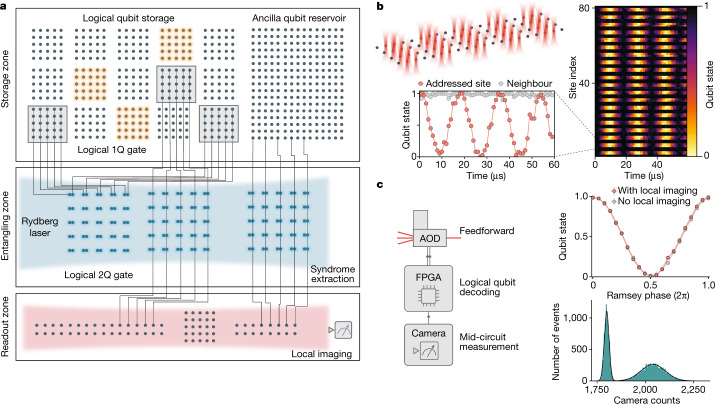
Abstract Suppressing errors is the central challenge for useful quantum computing 1 , requiring quantum error correction (QEC) 2–6 for large-scale processing. However, the overhead in the realization of error-corrected ‘logical’ qubits, in which information is encoded across many physical qubits for redundancy 2–4 , poses substantial challenges to large-scale logical quantum computing. Here we report the realization of a programmable quantum processor based on encoded logical qubits operating with up to 280 physical qubits. Using logical-level control and a zoned architecture in reconfigurable neutral-atom arrays 7 , our system combines high two-qubit gate fidelities 8 , arbitrary connectivity 7,9 , as well as fully programmable single-qubit rotations and mid-circuit readout 10–15 . Operating this logical processor with various types of encoding, we demonstrate improvement of a two-qubit logic gate by scaling surface-code 6 distance from d = 3 to d = 7, preparation of colour-code qubits with break-even fidelities 5 , fault-tolerant creation of logical Greenberger–Horne–Zeilinger (GHZ) states and feedforward entanglement teleportation, as well as operation of 40 colour-code qubits. Finally, using 3D [[8,3,2]] code blocks 16,17 , we realize computationally complex sampling circuits 18 with up to 48 logical qubits entangled with hypercube connectivity 19 with 228 logical two-qubit gates and 48 logical CCZ gates 20 . We find that this logical encoding substantially improves algorithmic performance with error detection, outperforming physical-qubit fidelities at both cross-entropy benchmarking and quantum simulations of fast scrambling 21,22 . These results herald the advent of early error-corrected quantum computation and chart a path towards large-scale logical processors.
Overview
CoChat Summary
TL;DR
The paper reports a programmable logical quantum processor built from reconfigurable neutral-atom arrays, operating with up to 280 physical qubits and using surface codes, colour codes, and 3D [[8,3,2]] codes. Across several demonstrations, logical encoding improved performance for entangling gates, GHZ-state preparation, feedforward teleportation, and complex sampling/quantum-simulation tasks compared with analogous physical-qubit circuits.
Key findings
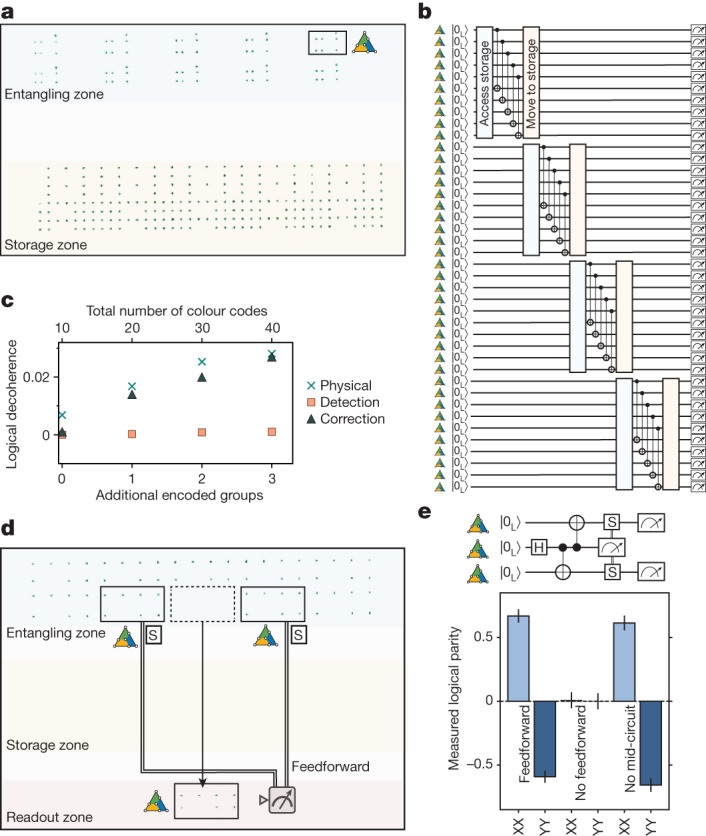
- The processor used up to 280 physical qubits and demonstrated 40 colour-code qubits by repeating a ten-logical-qubit process four times.
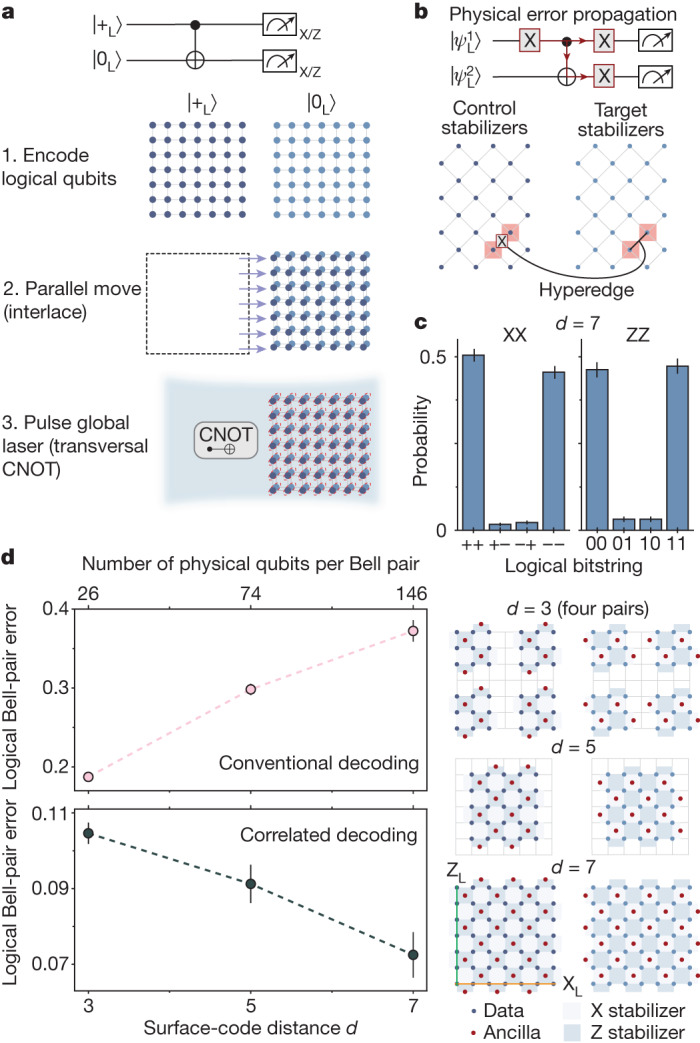
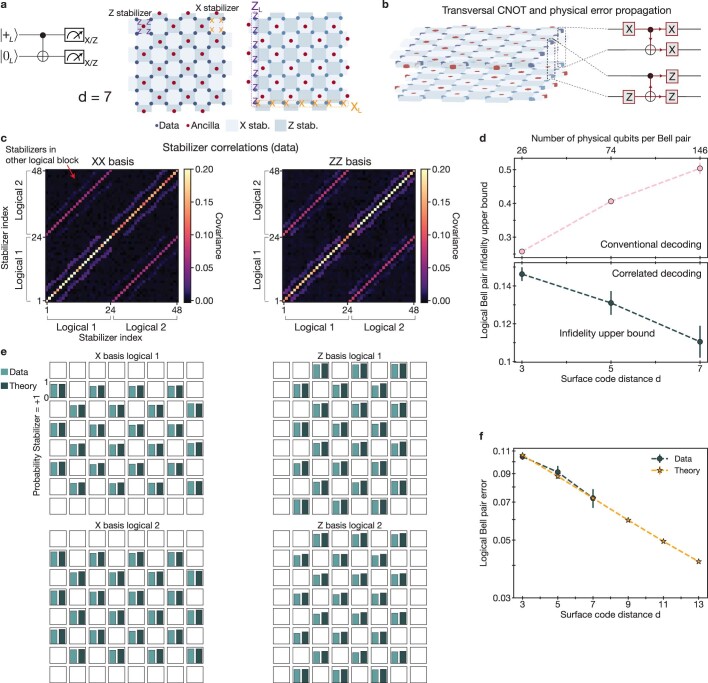
- For a surface-code transversal CNOT, increasing code distance from d = 3 to d = 7 improved the logical Bell pair; with correlated decoding, the authors report roughly 0.95 populations in the XLXL and ZLZL bases for entangled d = 7 logical qubits.
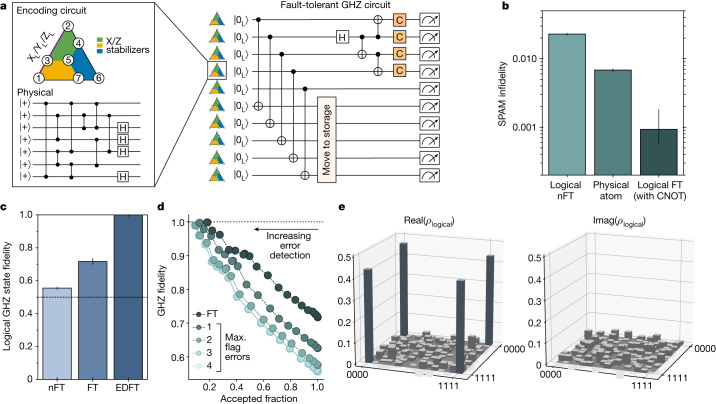
- For fault-tolerant colour-code GHZ preparation, the measured logical GHZ fidelity was 72(2)%; with error-detection/postselection it increased further, and the paper states that discarding 50% of the data improved GHZ fidelity to approximately 90%.
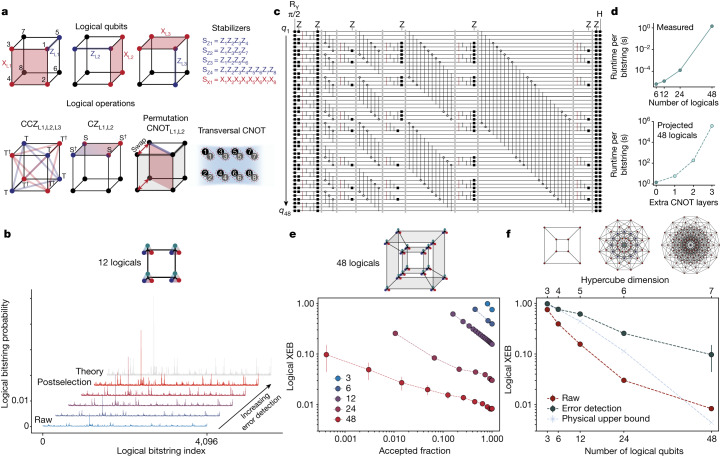
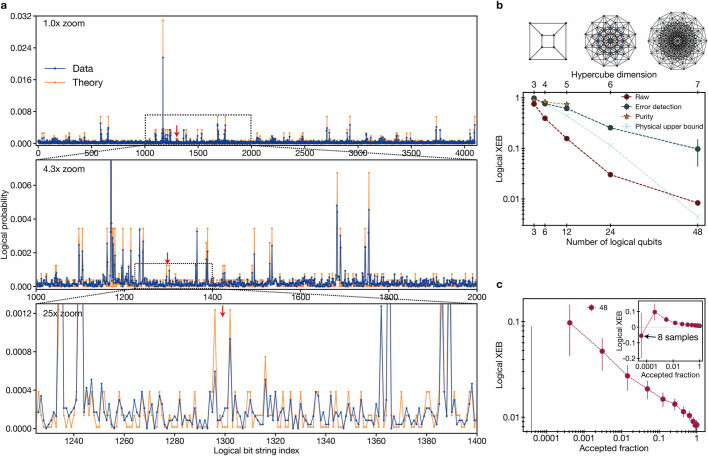
- In complex [[8,3,2]] sampling circuits, the authors realized up to 48 logical qubits, 228 logical two-qubit gates, and 48 logical CCZ gates; the reported XEB for 12 logical qubits increased from 0.156(2) to 0.616(7) with error detection, and for 48 logical qubits the XEB was approximately 0.1.
Methods
- Experimental platform: reconfigurable arrays of \(^{87}\)Rb atoms in optical tweezers, with zoned architecture for storage, entangling, and readout; the paper states operation with up to 280 atomic qubits, two-qubit gate fidelities of 99.3–99.5%, and local imaging fidelity of around 99.8%.
- Coding and circuits: rotated surface codes (including distance-7), d = 3 colour codes for Clifford algorithms, and 3D [[8,3,2]] codes for non-Clifford sampling circuits; all logical circuits after state preparation are built from transversal gates.
- Analysis: correlated decoding via a decoding hypergraph and mixed-integer programming solved with Gurobi; logical performance was benchmarked using direct fidelity estimation, full tomography, cross-entropy benchmarking (XEB), and two-copy Bell-basis measurements.
Limitations
- The paper states that state preparation is non-fault-tolerant for the d = 5, 7 surface codes and the [[8,3,2]] codes, because only a single round of stabilizer measurement is used.
- It also notes that deep circuits require repetitive error correction to keep benefiting from logical suppression, and that current mid-circuit readout/feedforward takes slightly less than 1 ms, with the authors saying it could be improved toward the 100-μs scale.
- Evident from the text: several reported gains rely on postselection / sliding-scale error detection, which improves fidelity at the cost of acceptance probability and measurement overhead.
Model-written summary. Check it against the paper before relying on it.
Integrity signals
Registry
Cites
Statistics
Figures
Verification
Claims the paper makes
69 Valid · 15 Not valid · 8 Not checked · 160 Own results and interpretations
At least one cited source doesn’t support this claim or points to a different paper, and none confirmed it — see the verdicts below.
In the paper
“However, executing large-scale, useful algorithms on quantum processors requires very low gate error rates (generally below about 10−10)23, far below those that will probably ever be achievable with any physical device2.”
§ Logical quantum processor based on reconfigurable atom arrays > Main
What the sources say
- Disputedcites [23] Gidney C Ekerå M How to factor 2048 bit RSA integers in 8 hours using 20 million noisy qubits Quantum 2021 5 433 10.22331/q-2021-04-15-433 sourceExperimental — accuracy not yet measured
The citation to this paper is attached to the claimed requirement for gate error rates below about 10⁻¹⁰, not to the following statement about what physical devices can achieve. Section 2.16 instead describes a physical gate error rate of 0.1% (10⁻³) as sufficient for surface-code error correction, and Section 2.13 uses that rate in its large-scale factoring estimate. The paper distinguishes physical gate errors from the much lower logical error rates produced by correction. (LLM, conf=0.88)
Checked by a reasoning model — may be wrong.
- Not matchedcites [2] Shor, P. W. in Proc. 37th Conference on Foundations of Computer Science 56–65 (IEEE, 1996).
Its entry has no title and year that we can search by.
hedgedstates a cause- Asserted: passes — The authors put it forward as true.
- Checkable: passes — It can be checked against evidence.
- Load-bearing: passes — The paper’s conclusions depend on it.
- Based: passes — The paper gives a reason why it holds.
- Disputed
At least one cited source doesn’t support this claim or points to a different paper, and none confirmed it — see the verdicts below.
In the paper
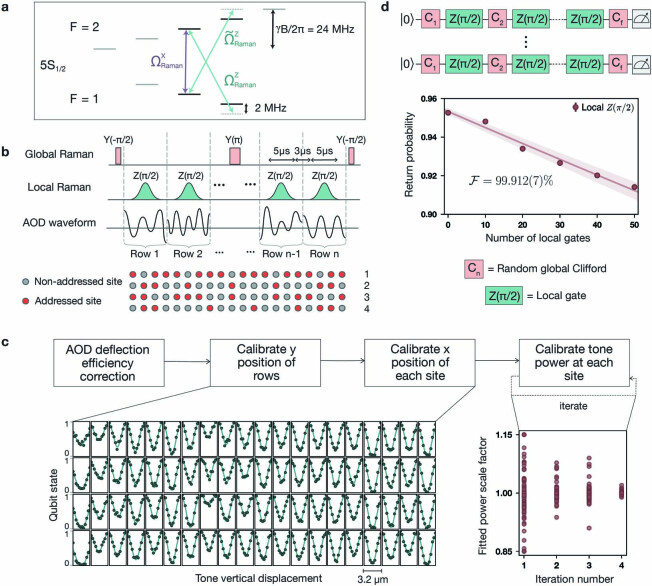
“Fully programmable local single-qubit rotations are realized through qubit-specific, parallel Raman excitation through an additional 2D AOD (ref. 34) (Fig. 1b and Extended Data Fig. 2).”
§ Logical quantum processor based on reconfigurable atom arrays > Logical processor based on atom arrays
What the sources say
- Disputedcites [34] Graham TM Multi-qubit entanglement and algorithms on a neutral-atom quantum computer Nature 2022 604 457 462 10.1038/s41586-022-04603-6 35444321 sourceExperimental — accuracy not yet measured
The Methods (p. 10) say site-selective single-qubit rotations combine global microwave rotations with local 459 nm Stark-shift phase gates, rather than using parallel Raman excitation. The Methods (p. 10) describe crossed AODs for pointing Rydberg beams at two sites simultaneously, not an additional 2D AOD for local Raman rotations. (LLM, conf=0.88)
Checked by a reasoning model — may be wrong.
plainstates a cause- Asserted: passes — The authors put it forward as true.
- Checkable: passes — It can be checked against evidence.
- Load-bearing: passes — The paper’s conclusions depend on it.
- Based: passes — The paper gives a reason why it holds.
- Disputed
The cited sources support only part of this claim — read each source’s verdict below.
In the paper
“Using logical-level control and a zoned architecture in reconfigurable neutral-atom arrays7, our system combines high two-qubit gate fidelities8, arbitrary connectivity7,9, as well as fully programmable single-qubit rotations and mid-circuit readout10–15.”
§ Logical quantum processor based on reconfigurable atom arrays > Abstract
What the sources say
- Supportedcites [10] Deist E Mid-circuit cavity measurement in a neutral atom array Phys. Rev. Lett. 2022 129 203602 10.1103/PhysRevLett.129.203602 36462020 source
The paper describes its method as mid-circuit readout in a neutral-atom array (p. 1). It also reports performing a mid-circuit measurement on one atom during a two-atom quantum circuit (p. 4), supporting the cited readout capability. (LLM, conf=0.92)
- Not checked yetcites [11] Singh K Mid-circuit correction of correlated phase errors using an array of spectator qubits Science 2023 380 1265 1269 10.1126/science.ade5337 37228222 source
Checked before — its earlier verdict is held back until a new check runs.
- Supportedcites [12] Graham, T. M. et al. Midcircuit measurements on a single-species neutral alkali atom quantum processor. Phys. Rev. X13, 041051 (2023). source
The paper’s “A. Midcircuit measurement” section describes a five-step procedure that includes state-selective readout of ancilla atoms during the circuit. It therefore supports the cited claim that mid-circuit readout is available in a neutral-atom processor. (LLM, conf=0.92)
- Partly supportedcites [13] Ma S High-fidelity gates and mid-circuit erasure conversion in an atomic qubit Nature 2023 622 279 284 10.1038/s41586-023-06438-1 37821593 sourceExperimental — accuracy not yet measured
The paper reports mid-circuit imaging to detect atoms that have decayed to the ground state (Abstract; page unavailable). But it says its demonstrated detection protocol *could be adapted* to mid-circuit qubit readout; it does not report demonstrating that readout. Thus it supports mid-circuit erasure detection, not the full readout attributed to it. (LLM, conf=0.87)
- Supportedcites [14] Lis, J. W. et al. Midcircuit operations using the omg architecture in neutral atom arrays. Phys. Rev. X13, 041035 (2023). source
The Introduction states that the paper demonstrates midcircuit state readout of ancilla qubits. This supports the cited claim that mid-circuit readout is a capability demonstrated in neutral-atom arrays. (LLM, conf=0.92)
- Supportedcites [15] Norcia, M. A. et al. Midcircuit qubit measurement and rearrangement in a 171Yb atomic array. Phys. Rev. X13, 041034 (2023). source
Section IV (Correction of Atom Loss) reports using the results of a midcircuit measurement to correct ancilla-qubit loss while maintaining data-qubit coherence. Appendix B also describes the array's midcircuit measurement results. These passages support the citation for mid-circuit readout. (LLM, conf=0.90)
plain- Asserted: passes — The authors put it forward as true.
- Checkable: passes — It can be checked against evidence.
- Load-bearing: passes — The paper’s conclusions depend on it.
- Based: passes — The paper gives a reason why it holds.
- Supported
The cited sources support only part of this claim — read each source’s verdict below.
In the paper
“Operating this logical processor with various types of encoding, we demonstrate improvement of a two-qubit logic gate by scaling surface-code6 distance from d = 3 to d = 7, preparation of colour-code qubits with break-even fidelities5, fault-tolerant creation of logical Greenberger–Horne–Zeilinger (GHZ) states and feedforward entanglement teleportation, as well as operation of 40 colour-code qubit”
§ Logical quantum processor based on reconfigurable atom arrays > Abstract
What the sources say
- Partly supportedcites [6] Google Quantum AI Suppressing quantum errors by scaling a surface code logical qubit Nature 2023 614 676 681 10.1038/s41586-022-05434-1 36813892 PMC9946823 sourceExperimental — accuracy not yet measured
The Main section reports improved logical-qubit performance when scaling a surface code from d = 3 to d = 5. The ‘Surface codes with superconducting qubits’ section says the experiment focuses on preserving logical memory; it does not report improving a two-qubit logical gate or scaling to d = 7. Page numbers are not available in our copy. (LLM, conf=0.88)
boostedstates a cause- Asserted: passes — The authors put it forward as true.
- Checkable: passes — It can be checked against evidence.
- Load-bearing: passes — The paper’s conclusions depend on it.
- Based: passes — The paper gives a reason why it holds.
- Partly supported
The cited sources support only part of this claim — read each source’s verdict below.
In the paper
“Operating this logical processor with various types of encoding, we demonstrate improvement of a two-qubit logic gate by scaling surface-code6 distance from d = 3 to d = 7, preparation of colour-code qubits with break-even fidelities5, fault-tolerant creation of logical Greenberger–Horne–Zeilinger (GHZ) states and feedforward entanglement teleportation, as well as operation of 40 colour-code qubit”
§ Logical quantum processor based on reconfigurable atom arrays > Abstract
What the sources say
- Partly supportedcites [5] Ryan-Anderson, C. et al. Implementing fault-tolerant entangling gates on the five-qubit code and the color code. Preprint at https://arxiv.org/abs/2208.01863 (2022). sourceExperimental — accuracy not yet measured
The opening summary (p. 1) reports that fault-tolerant colour-code state-preparation-and-measurement fidelities exceeded average physical-qubit SPAM fidelities. But Section III (p. 8) explicitly says the experiments did not achieve the break-even point; it describes the higher logical fidelity as a milestone toward it. The claim is supported as a comparison of preparation-and-measurement fidelities, not as a demonstration of break-even operation. (LLM, conf=0.86)
boosted- Asserted: passes — The authors put it forward as true.
- Checkable: passes — It can be checked against evidence.
- Load-bearing: passes — The paper’s conclusions depend on it.
- Based: passes — The paper gives a reason why it holds.
- Partly supported
130 more claims · 39 with their cited sources checked
Create a free account to see all 252 claims and to verify the 2 references still open.
- It may state two separate claims as one. 89
- Probably not a substantial claim. 40
- The quote only partly states this claim. 2
Claims other papers make about this one
Each is checked against this paper’s own text: does it say what the citing paper says it does?
The cited source doesn’t support the claim as written.
In the citing paper
“Although many platforms have demonstrated different features of quantum error correction14–20, no quantum processor has definitively shown below-threshold performance.”
From Quantum error correction below the surface code threshold (2025) · cites this paper as [18]
Checked by a reasoning model — may be wrong.
Experimental — accuracy not yet measuredThe source backs part of the claim, not all of it — or backs it for a different population, condition or comparison.
In the citing paper
“As a result, error suppression by increasing the colour code size has not yet been demonstrated, to our knowledge, on any experimental platform.”
From Scaling and logic in the colour code on a superconducting quantum processor (2025) · cites this paper as [18]
Experimental — accuracy not yet measuredThe cited source says what the claim attributes to it.
In the citing paper
“Recently, QEC experiments have been performed in various hardware platforms, including superconducting quantum circuits25–28, trapped ions29 and neutral atoms30.”
From Hardware-efficient quantum error correction via concatenated bosonic qubits (2025) · cites this paper as [30]
The cited source says what the claim attributes to it.
In the citing paper
“The smallest instance of the colour code, the Steane code37, has been implemented with trapped ions11,12 and neutral atoms18, demonstrating logical operations and logical circuits13–19.”
From Scaling and logic in the colour code on a superconducting quantum processor (2025) · cites this paper as [18]
Citations
Cites
Quantum Computing in the NISQ era and beyond
Preskill, J. (2018) · Quantum · doi:10.22331/q-2018-08-06-79 · Cited by 8,830 · cited 1×
“The storage zone is used for dense qubit storage, free from entangling-gate errors and featuring long coherence times.”
BackgroundQuantum supremacy using a programmable superconducting processor
Arute, F., Arya, K., Babbush, R., Bacon, D., Bardin, J. C., Barends, R., Biswas, R., Boixo, S., Brandao, F. G. S. L., Buell, D. A., et al. (2019) · Nature · doi:10.1038/s41586-019-1666-5 · Cited by 7,720 · cited 3×
“70), has an improved Raman scattering contribution and is faster (roughly 1 μs duration).”
BackgroundMethodScheme for reducing decoherence in quantum computer memory
Shor, P. W. (1995) · Physical Review A · doi:10.1103/physreva.52.r2493 · Cited by 4,479 · cited 1×
“Distance-3 codes, which are of notable historical importance 3,87 , can correct any weight-1 error.”
BackgroundSurface codes: Towards practical large-scale quantum computation
Fowler, A. G., Mariantoni, M., Martinis, J. M., & Cleland, A. N. (2012) · Physical Review A · doi:10.1103/physreva.86.032324 · Cited by 3,059 · cited 10×
“Mid-circuit X-basis measurement of the middle logical creates by applying a logical S gate to the first and third logicals conditioned in real time on the state of the middle logical, akin to the magic-state-teleportation circuit 24 .”
BackgroundMethodInfluentialQuantum computational advantage using photons
Zhong, H.-S., Wang, H., Deng, Y.-H., Chen, M.-C., Peng, L.-C., Luo, Y.-H., Qin, J., Wu, D., Ding, X., Hu, Y., et al. (2020) · Science · doi:10.1126/science.abe8770 · Cited by 2,405
Dennis, E., Kitaev, A., Landahl, A., & Preskill, J. (2002) · Journal of Mathematical Physics · doi:10.1063/1.1499754 · Cited by 1,768 · cited 6×
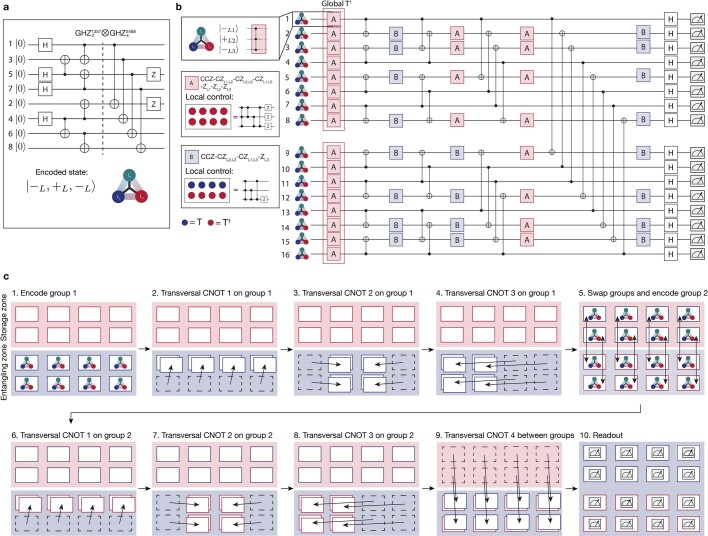
“6, which can be understood as preparing two four-qubit GHZ states (corresponding to [[4,2,2]] codes 95 ), that is, GHZ ⊗GHZ , and subsequently entangling them as illustrated in Extended Data Fig.”
BackgroundInfluentialFast Quantum Gates for Neutral Atoms
Jaksch, D., Cirac, J. I., Zoller, P., Rolston, S. L., Côté, R., & Lukin, M. D. (2000) · Physical Review Letters · doi:10.1103/physrevlett.85.2208 · Cited by 1,540 · cited 2×
“Nota-bly, owing to the use of the Rydberg blockade 32,68 , the gate is largely independent of the exact distance between atoms.”
BackgroundMethodSelf-citationImproved simulation of stabilizer circuits
Aaronson, S., & Gottesman, D. (2004) · Physical Review A · doi:10.1103/physreva.70.052328 · Cited by 1,515 · cited 2×
“For instance, when using 2D codes such as the surface code, non-Clifford operations cannot be easily performed 37 , and relatively expensive techniques are required for nontrivial computation 24,43 , as Clifford circuits can be easily simulated 44 .”
BackgroundMethodDennis, E., Kitaev, A., Landahl, A., & Preskill, J. (2001) · CERN Document Server (European Organization for Nuclear Research) · Cited by 1,485
Multiple-particle interference and quantum error correction
(1996) · Proceedings of the Royal Society of London. Series A: Mathematical, Physical and Engineering Sciences · doi:10.1098/rspa.1996.0136 · Cited by 1,284 · cited 10×
“We use 2D d = 3 colour codes 3,37 , which are topological codes akin to the surface code, but with the useful capability of trans-versal operations of the full Clifford group: Hadamard (H), π/2 phase (S) gate and CNOT (ref.”
BackgroundMethodInfluentialQuantum computing with realistically noisy devices
Knill, E. (2005) · Nature · doi:10.1038/nature03350 · Cited by 1,184 · cited 1×
“The duration of each row is 5–8 μs (corresponding to several tens of μs for an arbitrary pattern of rotations), which can be sped up considerably, as discussed in the next section.”
BackgroundCharacterizing quantum supremacy in near-term devices
Boixo, S., Isakov, S. V., Smelyanskiy, V. N., Babbush, R., Ding, N., Jiang, Z., Bremner, M. J., Martinis, J. M., & Neven, H. (2018) · Nature Physics · doi:10.1038/s41567-018-0124-x · Cited by 1,175 · cited 1×
“70), has an improved Raman scattering contribution and is faster (roughly 1 μs duration).”
BackgroundQuantum thermalization through entanglement in an isolated many-body system
Kaufman, A. M., Tai, M. E., Lukin, A., Rispoli, M., Schittko, R., Preiss, P. M., & Greiner, M. (2016) · Science · doi:10.1126/science.aaf6725 · Cited by 1,116 · cited 1×
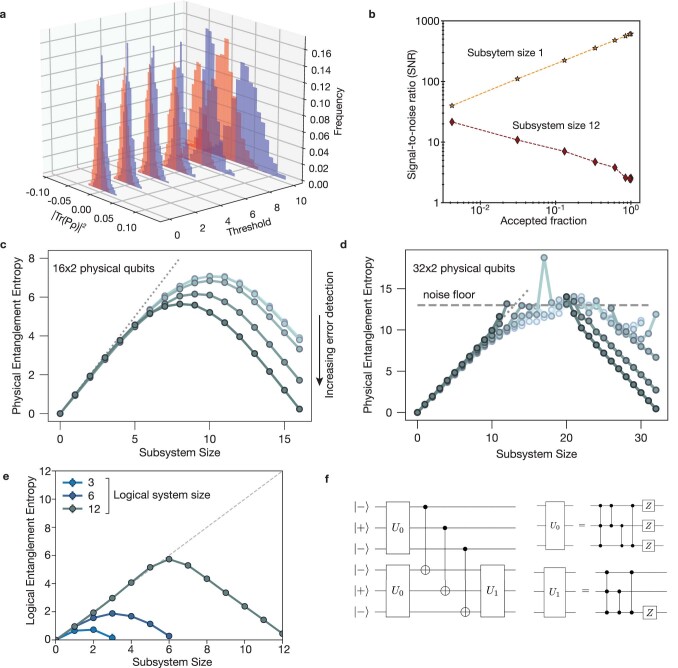
“First, we use these measurements to calculate the purity or entanglement entropy of the resulting state 7,21,52,112,113 .”
MethodSelf-citationSekino, Y., & Susskind, L. (2008) · Journal of High Energy Physics · doi:10.1088/1126-6708/2008/10/065 · Cited by 1,112
14-Qubit Entanglement: Creation and Coherence
Monz, T., Schindler, P., Barreiro, J. T., Chwalla, M., Nigg, D., Coish, W. A., Harlander, M., Hänsel, W., Hennrich, M., & Blatt, R. (2011) · Physical Review Letters · doi:10.1103/physrevlett.106.130506 · Cited by 1,110 · cited 1×
“The GHZ state studied here provides such an example, as conventional parity-oscillation measurements cannot be performed 84 .”
BackgroundSuppressing quantum errors by scaling a surface code logical qubit
Google Quantum, A. I., Acharya, R., Aleiner, I., Allen, R., Andersen, T. I., Ansmann, M., Arute, F., Arya, K., Asfaw, A., Atalaya, J., et al. (2023) · Nature · doi:10.1038/s41586-022-05434-1 · Cited by 1,103 · cited 7×
“The AOD tweezers are mobile but have several constraints 7,69 .”
BackgroundMethodInfluentialQuantum computational advantage with a programmable photonic processor
Madsen, L. S., Laudenbach, F., Askarani, M. F., Rortais, F., Vincent, T., Bulmer, J. F. F., Miatto, F. M., Neuhaus, L., Helt, L. G., Collins, M. J., et al. (2022) · Nature · doi:10.1038/s41586-022-04725-x · Cited by 1,101 · cited 1×
“70), has an improved Raman scattering contribution and is faster (roughly 1 μs duration).”
BackgroundStrong Quantum Computational Advantage Using a Superconducting Quantum Processor
Wu, Y., Bao, W.-S., Cao, S., Chen, F., Chen, M.-C., Chen, X., Chung, T.-H., Deng, H., Du, Y., Fan, D., et al. (2021) · Physical Review Letters · doi:10.1103/physrevlett.127.180501 · Cited by 1,059 · cited 2×
“70), has an improved Raman scattering contribution and is faster (roughly 1 μs duration).”
BackgroundSelf-citationEvidence for the utility of quantum computing before fault tolerance
Kim, Y., Eddins, A., Anand, S., Wei, K. X., van den Berg, E., Rosenblatt, S., Nayfeh, H., Wu, Y., Zaletel, M., Temme, K., et al. (2023) · Nature · doi:10.1038/s41586-023-06096-3 · Cited by 1,050 · cited 1×
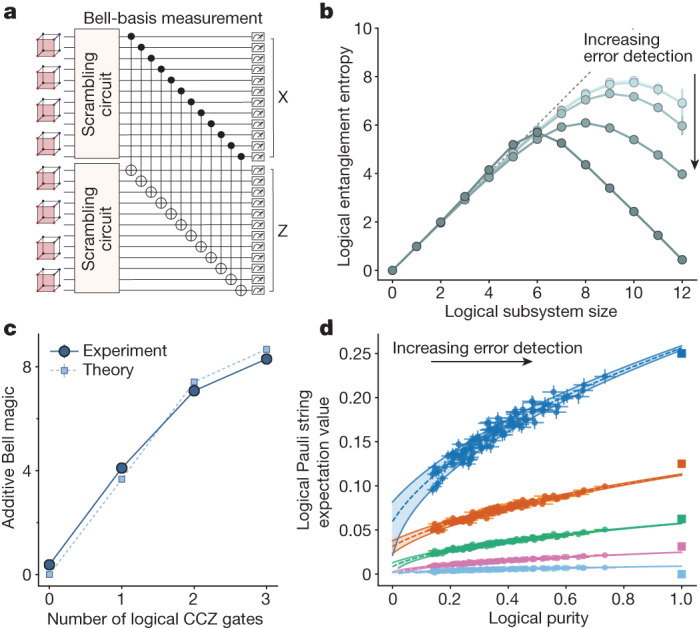
“Because in the two-copy measurements for each error-detection threshold we also measure the overall system purity, we can extrapolate our expectation values to the case of unit purity (zero noise) 54 .”
BackgroundQuantum phases of matter on a 256-atom programmable quantum simulator
Ebadi, S., Wang, T. T., Levine, H., Keesling, A., Semeghini, G., Omran, A., Bluvstein, D., Samajdar, R., Pichler, H., Ho, W. W., et al. (2021) · Nature · doi:10.1038/s41586-021-03582-4 · Cited by 995 · cited 18×
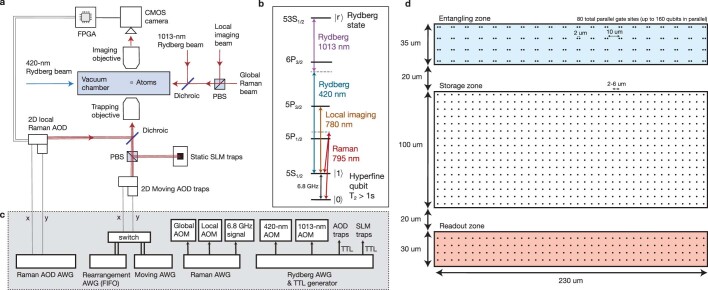
“We choose our entangling-zone profile, realized by 420-nm and 1,013-nm Rydberg ‘top-hat’ beams generated by SLM phase profiles 30 , to be homogeneous over a 35-μm-tall region.”
BackgroundMethodInfluentialSelf-citationQuantum Phases of Matter on a 256-Atom Programmable Quantum Simulator
Ebadi, S., Wang, T. T., Levine, H., Keesling, A., Semeghini, G., Omran, A., Bluvstein, D., Samajdar, R., Pichler, H., Ho, W. W., et al. (2020) · arXiv · doi:10.48550/arxiv.2012.12281 · Cited by 995
Self-citationAn atom-by-atom assembler of defect-free arbitrary two-dimensional atomic arrays
Barredo, D., de Léséleuc, S., Lienhard, V., Lahaye, T., & Browaeys, A. (2016) · Science · doi:10.1126/science.aah3778 · Cited by 860 · cited 2×
“…inside a glass vacuum cell, which are then loaded stochastically into programmable, static arrangements of 852-nm traps generated with a SLM and rearranged with a set of 850-nm moving traps generated by a pair of crossed AODs (DTSX-400, AA Opto-Electronic) to realize defect-free arrays 30,31,62 .”
BackgroundMethodHow to factor 2048 bit RSA integers in 8 hours using 20 million noisy qubits
Gidney, C., & Ekerå, M. (2021) · Quantum · doi:10.22331/q-2021-04-15-433 · Cited by 830 · cited 1×
“Similar techniques can be used to move logical degrees of freedom to implement nonlocal logical gates 23 .”
BackgroundQuantum phases of matter on a 256-atom programmable quantum simulator
Ebadi, S., Wang, T. T., Levine, H., Keesling, A., Semeghini, G., Omran, A., Bluvstein, D., Samajdar, R., Pichler, H., Ho, W. W., et al. (2020) · RePEc: Research Papers in Economics · Cited by 765
Self-citationStabilizer Codes and Quantum Error Correction
Gottesman, D. (1997) · arXiv · doi:10.48550/arxiv.quant-ph/9705052 · Cited by 753
K S, U. (2025) · Zenodo (CERN European Organization for Nuclear Research) · doi:10.5281/zenodo.18067974 · Cited by 733
Quantum simulation of 2D antiferromagnets with hundreds of Rydberg atoms
Scholl, P., Schuler, M., Williams, H. J., Eberharter, A. A., Barredo, D., Schymik, K.-N., Lienhard, V., Henry, L.-P., Lang, T. C., Lahaye, T., et al. (2021) · Nature · doi:10.1038/s41586-021-03585-1 · Cited by 688 · cited 2×
“This process realizes a high-fidelity, fault-tolerant transversal CNOT in a single parallel step.”
BackgroundRealizing repeated quantum error correction in a distance-three surface code
Krinner, S., Lacroix, N., Remm, A., Di Paolo, A., Genois, E., Leroux, C., Hellings, C., Lazar, S., Swiadek, F., Herrmann, J., et al. (2022) · Nature · doi:10.1038/s41586-022-04566-8 · Cited by 686 · cited 2×
“For this reason, deep circuits require repetitive error correction 6,88 to constantly remove errors and continuously benefit from, for example, the p 2 suppression.”
BackgroundProbing Rényi entanglement entropy via randomized measurements
Brydges, T., Elben, A., Jurcevic, P., Vermersch, B., Maier, C., Lanyon, B. P., Zoller, P., Blatt, R., & Roos, C. F. (2019) · Science · doi:10.1126/science.aau4963 · Cited by 611 · cited 1×
“See sections ‘Surface code and its implementation’ and ‘Correlated decoding in the surface code’ for further discussion on the surface code in particular.”
BackgroundParallel Implementation of High-Fidelity Multiqubit Gates with Neutral Atoms
Levine, H., Keesling, A., Semeghini, G., Omran, A., Wang, T. T., Ebadi, S., Bernien, H., Greiner, M., Vuletić, V., Pichler, H., et al. (2019) · Physical Review Letters · doi:10.1103/physrevlett.123.170503 · Cited by 604 · cited 1×
“Nota-bly, owing to the use of the Rydberg blockade 32,68 , the gate is largely independent of the exact distance between atoms.”
BackgroundSelf-citationSurface code quantum computing by lattice surgery
Horsman, D., Fowler, A. G., Devitt, S., & Meter, R. V. (2012) · New Journal of Physics · doi:10.1088/1367-2630/14/12/123011 · Cited by 598 · cited 1×
“Logic operations are implemented by changing stabilizer measurement patterns, enabling realization of techniques such as braiding 24 and lattice surgery 89 .”
MethodHigh-fidelity parallel entangling gates on a neutral atom quantum computer
Evered, S. J., Bluvstein, D., Kalinowski, M., Ebadi, S., Manovitz, T., Zhou, H., Li, S. H., Geim, A. A., Wang, T. T., Maskara, N., et al. (2023) · arXiv · doi:10.48550/arxiv.2304.05420 · Cited by 526 · cited 10×
“7,8,30, with key upgrades enabling universal digital operation.”
BackgroundMethodInfluentialSelf-citationHigh-fidelity parallel entangling gates on a neutral-atom quantum computer
Evered, S. J., Bluvstein, D., Kalinowski, M., Ebadi, S., Manovitz, T., Zhou, H., Li, S. H., Geim, A. A., Wang, T. T., Maskara, N., et al. (2023) · Nature · doi:10.1038/s41586-023-06481-y · Cited by 522 · cited 10×
“7,8,30, with key upgrades enabling universal digital operation.”
BackgroundMethodInfluentialSelf-citationQuantum advantage in learning from experiments
Huang, H.-Y., Broughton, M., Cotler, J., Chen, S., Li, J., Mohseni, M., Neven, H., Babbush, R., Kueng, R., Preskill, J., et al. (2022) · Science · doi:10.1126/science.abn7293 · Cited by 519 · cited 4×
“By making use of the full outcome distribution, we can also evaluate the absolute value of all 4 N Pauli strings, from a single dataset, in which N is the number of qubits involved in each copy of the state 22 .”
BackgroundMethodInfluentialMulti-qubit entanglement and algorithms on a neutral-atom quantum computer
Graham, T. M., Song, Y., Scott, J., Poole, C., Phuttitarn, L., Jooya, K., Eichler, P., Jiang, X., Marra, A., Grinkemeyer, B., et al. (2022) · Nature · doi:10.1038/s41586-022-04603-6 · Cited by 518 · cited 2×
“Local single-qubit gates 34,72 with the Raman AOD are realized in arbitrary positions in space on both AOD and SLM atoms.”
BackgroundMethodRestrictions on Transversal Encoded Quantum Gate Sets
Eastin, B., & Knill, E. (2009) · Physical Review Letters · doi:10.1103/physrevlett.102.110502 · Cited by 457 · cited 2×
“One important challenge in realizing complex algorithms with logical qubits is that universal computation cannot be implemented trans-versally 42 .”
BackgroundHigh-threshold and low-overhead fault-tolerant quantum memory
Bravyi, S., Cross, A. W., Gambetta, J. M., Maslov, D., Rall, P., & Yoder, T. J. (2024) · Nature · doi:10.1038/s41586-024-07107-7 · Cited by 456 · cited 1×
“5 | Complex logical circuits using 3D codes. a , [[8,3,2]] block codes can transversally realize {CCZ, CZ, Z, CNOT} gates within each block and transversal CNOTs between blocks.”
MethodDirect Fidelity Estimation from Few Pauli Measurements
Flammia, S. T., & Liu, Y.-K. (2011) · Physical Review Letters · doi:10.1103/physrevlett.106.230501 · Cited by 449 · cited 3×
“This is an exact measurement of the logical state fidelity 39 .”
BackgroundMethodInfluentialStim: a fast stabilizer circuit simulator
Gidney, C. (2021) · Quantum · doi:10.22331/q-2021-07-06-497 · Cited by 415 · cited 3×
“We start by constructing a decoding hypergraph based on a description of the logical algorithm, which describes how each physical error mechanism (for example, a Pauli-error channel after a two-qubit gate) propagates onto the measured stabilizers 76,81 .”
BackgroundMethodMeasuring Entanglement Growth in Quench Dynamics of Bosons in an Optical Lattice
Daley, A. J., Pichler, H., Schachenmayer, J., & Zoller, P. (2012) · Physical Review Letters · doi:10.1103/physrevlett.109.020505 · Cited by 393 · cited 2×
“During transversal CNOT operations, physical CNOT gates are applied between the corresponding data qubits of two logical qubits.”
BackgroundMethodPhase transitions in random circuit sampling
Morvan, A., Villalonga, B., Mi, X., Mandrà, S., Bengtsson, A., Klimov, P. V., Chen, Z., Hong, S., Erickson, C., Drozdov, I., et al. (2024) · Nature · doi:10.1038/s41586-024-07998-6 · Cited by 354
Fault-tolerant control of an error-corrected qubit
Egan, L., Debroy, D. M., Noel, C., Risinger, A., Zhu, D., Biswas, D., Newman, M., Li, M., Brown, K. R., Cetina, M., et al. (2021) · Nature · doi:10.1038/s41586-021-03928-y · Cited by 348 · cited 1×
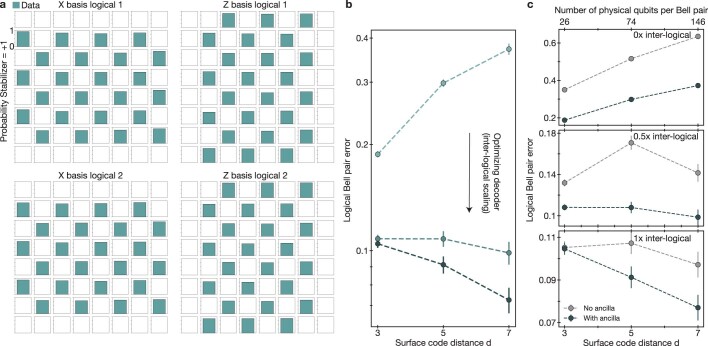
“We account for these correlations, arising from deterministic error propagation (as opposed to correlated error events), by adding edges and hyperedges that connect the decoding graphs of the two logical qubits. c , Populations of entangled d = 7 surface codes measured in the XX and ZZ basis. d ,…”
BackgroundActive Stabilization, Quantum Computation, and Quantum State Synthesis
Steane, A. M. (1997) · Physical Review Letters · doi:10.1103/physrevlett.78.2252 · Cited by 323 · cited 2×
“Next, we detail some design decisions made for the circuits used in this work.”
MethodBroadband, Narrowband, and Passband Composite Pulses for Use in Advanced NMR Experiments
Wimperis, S. (1994) · Journal of Magnetic Resonance, Series A · doi:10.1006/jmra.1994.1159 · Cited by 311 · cited 1×
“For our global decoupling pulses, we use both BB1 pulses 70 and SCROFULOUS pulses 71 .”
MethodClassical simulation of commuting quantum computations implies collapse of the polynomial hierarchy
Bremner, M. J., Jozsa, R., & Shepherd, D. J. (2011) · Proceedings of the Royal Society A: Mathematical, Physical and Engineering Sciences · doi:10.1098/rspa.2010.0301 · Cited by 308 · cited 2×
“IQP circuits are defined as initializing |+⟩ ⊗ n on n qubits, applying a diagonal entangling unitary such as those composed by {CCZ, CZ, Z} and then measuring in the X basis 20,98 .”
MethodSimulation of quantum circuits by low-rank stabilizer decompositions
Bravyi, S., Browne, D., Calpin, P., Campbell, E., Gosset, D., & Howard, M. (2019) · Quantum · doi:10.22331/q-2019-09-02-181 · Cited by 302 · cited 1×
“Simulation of such logical circuits is challenging because of the high connectivity (rendering tensor networks inefficient) and large numbers of non-Cliffords 50 .”
BackgroundAverage-Case Complexity Versus Approximate Simulation of Commuting Quantum Computations
Bremner, M. J., Montanaro, A., & Shepherd, D. J. (2016) · Physical Review Letters · doi:10.1103/physrevlett.117.080501 · Cited by 299 · cited 7×
“Sampling from the output distribution of such circuits is known to be classically hard in certain instances 20 , implying that a quantum device can be exponentially faster than a classical computer for this task.”
BackgroundMethodInfluentialDemonstration of fault-tolerant universal quantum gate operations
Postler, L., Heuβen, S., Pogorelov, I., Rispler, M., Feldker, T., Meth, M., Marciniak, C. D., Stricker, R., Ringbauer, M., Blatt, R., et al. (2022) · Nature · doi:10.1038/s41586-022-04721-1 · Cited by 287
On the complexity and verification of quantum random circuit sampling
Bouland, A., Fefferman, B., Nirkhe, C., & Vazirani, U. (2019) · Nature Physics · doi:10.1038/s41567-018-0318-2 · Cited by 287 · cited 2×
“Our implemented circuits are equivalent to IQP circuits 98 , which gives a theoretical basis for understanding why our circuits could be classically hard to simulate, for which we also provide numerical evidence of so-called anticoncentration 99,100 .”
BackgroundMethodInformation scrambling in quantum circuits
Mi, X., Roushan, P., Quintana, C., Mandrà, S., Marshall, J., Neill, C., Arute, F., Arya, K., Atalaya, J., Babbush, R., et al. (2021) · Science · doi:10.1126/science.abg5029 · Cited by 283 · cited 1×
“Even though Clifford circuits create superposition and entanglement between qubits, the N initial stabilizers of the state can simply be tracked as they propagate through the circuit (so-called operator spreading 94 ) and thereby simulation of the circuit can be easily accomplished.”
BackgroundEntanglement detection in the stabilizer formalism
Tóth, G., & Gühne, O. (2005) · Physical Review A · doi:10.1103/physreva.72.022340 · Cited by 281 · cited 1×
“Animations of all of our programmed circuits are attached as Supplementary Videos.”
MethodTackling systematic errors in quantum logic gates with composite rotations
Cummins, H. K., Llewellyn, G., & Jones, J. A. (2003) · Physical Review A · doi:10.1103/physreva.67.042308 · Cited by 249 · cited 1×
“For our global decoupling pulses, we use both BB1 pulses 70 and SCROFULOUS pulses 71 .”
MethodHigh-fidelity gates and mid-circuit erasure conversion in an atomic qubit
Ma, S., Liu, G., Peng, P., Zhang, B., Jandura, S., Claes, J., Burgers, A. P., Pupillo, G., Puri, S., & Thompson, J. D. (2023) · Nature · doi:10.1038/s41586-023-06438-1 · Cited by 228 · cited 1×
“…scaling will benefit from improving encoding efficiency, for example, by using quantum low-density-parity-check codes 55,56 , using erasure conversion 13,33,57 or noise bias 35 and optimizing the choice of (possibly several) atomic species 11,14,47 , as well as advanced optical controls 34 .”
MethodSimulation of quantum circuits by low-rank stabilizer decompositions
Bravyi, S. B., Browne, D. E., Calpin, P., Campbell, E. T., Gosset, D., & Howard, M. (2019) · White Rose Research Online (University of Leeds, The University of Sheffield, University of York) · Cited by 224
Gauge color codes: optimal transversal gates and gauge fixing in topological stabilizer codes
Bombín, H. (2015) · New Journal of Physics · doi:10.1088/1367-2630/17/8/083002 · Cited by 217 · cited 3×
“This transversal gate set can realize any Clifford circuit fault-tolerantly.”
BackgroundMethodLe Kien, F., Schneeweiss, P., & Rauschenbeutel, A. (2013) · The European Physical Journal D · doi:10.1140/epjd/e2013-30729-x · Cited by 216 · cited 1×
“63, preferentially drives σ ± hyperfine transitions rather than the desired π clock transition 73 .”
BackgroundErasure conversion for fault-tolerant quantum computing in alkaline earth Rydberg atom arrays
Wu, Y., Kolkowitz, S., Puri, S., & Thompson, J. D. (2022) · Nature Communications · doi:10.1038/s41467-022-32094-6 · Cited by 196 · cited 1×
“5 | Complex logical circuits using 3D codes. a , [[8,3,2]] block codes can transversally realize {CCZ, CZ, Z, CNOT} gates within each block and transversal CNOTs between blocks.”
MethodAchieving quantum supremacy with sparse and noisy commuting quantum computations
Bremner, M. J., Montanaro, A., & Shepherd, D. J. (2017) · Quantum · doi:10.22331/q-2017-04-25-8 · Cited by 191 · cited 1×
“The IQP circuits are a good setting for quantum-advantage-type experiments, as the bitstring distribution of IQP circuits with randomly applied {CCZ, CZ, Z} gates (random degree-3 polynomials) is known to be classically hard to simulate 20,101 .”
MethodTwo-dimensional transport and transfer of a single atomic qubit in optical tweezers
Beugnon, J., Tuchendler, C., Marion, H., Gaëtan, A., Miroshnychenko, Y., Sortais, Y. R. P., Lance, A. M., Jones, M. P. A., Messin, G., Browaeys, A., et al. (2007) · Nature Physics · doi:10.1038/nphys698 · Cited by 189 · cited 2×
“Transferring atoms between tweezers 9 presents further challenges.”
BackgroundMethodFault-tolerant quantum error detection
Linke, N. M., Gutierrez, M., Landsman, K. A., Figgatt, C., Debnath, S., Brown, K. R., & Monroe, C. (2017) · Science Advances · doi:10.1126/sciadv.1701074 · Cited by 172 · cited 1×
“Animations of all of our programmed circuits are attached as Supplementary Videos.”
MethodCorrecting coherent errors with surface codes
Bravyi, S., Englbrecht, M., König, R., & Peard, N. (2018) · npj Quantum Information · doi:10.1038/s41534-018-0106-y · Cited by 157 · cited 3×
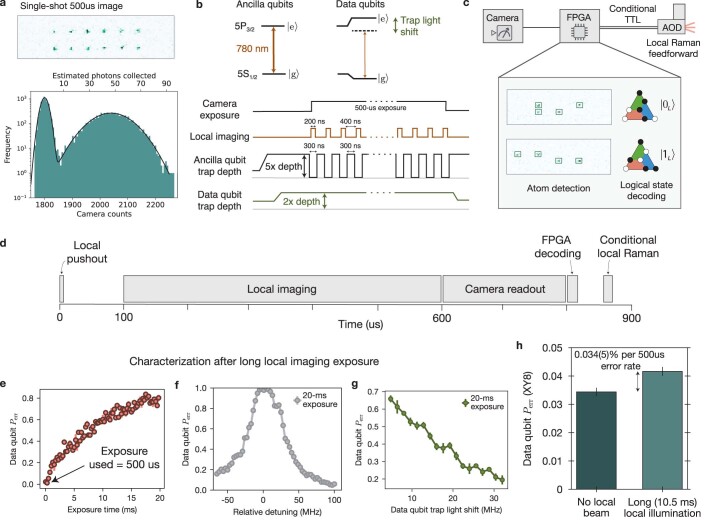
“1c, for the 500-μs mid-circuit imaging used in this work, we are able to achieve unchanged coherence (identical within the error bars) of the data qubits with the local imaging light on as without it.”
BackgroundMethodTime-Optimal Two- and Three-Qubit Gates for Rydberg Atoms
Jandura, S., & Pupillo, G. (2022) · Quantum · doi:10.22331/q-2022-05-13-712 · Cited by 149 · cited 1×
“Entangling gates (270-ns duration) between clock qubits are performed with fast two-photon excitation using 420-nm and 1,013-nm Rydberg beams to n = 53 Rydberg states, using a time-optimal two-qubit gate pulse 64,65 , detailed in ref.”
MethodKubica, A., Yoshida, B., & Pastawski, F. (2015) · New Journal of Physics · doi:10.1088/1367-2630/17/8/083026 · Cited by 148 · cited 2×
“Often portrayed in a triangular geometry, the colour codes used here are a tiling of three colours of weight-4 and weight-6 stabilizers, with X L and Z L operator strings running along the boundary of the code 91 .”
BackgroundSimulation of Quantum Circuits Using the Big-Batch Tensor Network Method
Pan, F., & Zhang, P. (2022) · Physical Review Letters · doi:10.1103/physrevlett.128.030501 · Cited by 146 · cited 1×
“The focused beam waist in the plane of the atoms is 1.9 μm, which is large enough to be robust to fluctuations in atomic positions and small enough to prevent cross-talk to neighbouring atoms separated by ≳6 μm.”
BackgroundInfluentialHardware-Efficient, Fault-Tolerant Quantum Computation with Rydberg Atoms
Cong, I., Levine, H., Keesling, A., Bluvstein, D., Wang, S.-T., & Lukin, M. D. (2022) · Physical Review X · doi:10.1103/physrevx.12.021049 · Cited by 144 · cited 3×
“To perform mid-circuit readout 10–15 of selected qubits without affecting the others, we use a local imaging beam focused on the readout zone that is roughly 100 μm spatially separated from the entangling zone 7,35 .”
BackgroundMethodSelf-citationErasure conversion in a high-fidelity Rydberg quantum simulator
Scholl, P., Shaw, A. L., Tsai, R. B.-S., Finkelstein, R., Choi, J., & Endres, M. (2023) · Nature · doi:10.1038/s41586-023-06516-4 · Cited by 141 · cited 2×
“This process realizes a high-fidelity, fault-tolerant transversal CNOT in a single parallel step.”
BackgroundMethodPhase transition in Random Circuit Sampling
Morvan, A., Villalonga, B., Mi, X., Mandrà, S., Bengtsson, A., Klimov, P. V., Chen, Z., Hong, S., Erickson, C., Drozdov, I. K., et al. (2023) · arXiv · doi:10.48550/arxiv.2304.11119 · Cited by 138
Temporally unstructured quantum computation
Shepherd, D., & Bremner, M. J. (2009) · Proceedings of the Royal Society A: Mathematical, Physical and Engineering Sciences · doi:10.1098/rspa.2008.0443 · Cited by 135
Universal transversal gates with color codes: A simplified approach
Kubica, A., & Beverland, M. E. (2015) · Physical Review A · doi:10.1103/physreva.91.032330 · Cited by 128 · cited 1×
“This has important consequences for the allowed transversal gate set 41,93 .”
BackgroundMid-circuit correction of correlated phase errors using an array of spectator qubits
Singh, K., Bradley, C. E., Anand, S., Ramesh, V., White, R., & Bernien, H. (2023) · Science · doi:10.1126/science.ade5337 · Cited by 119 · cited 2×
“…scaling will benefit from improving encoding efficiency, for example, by using quantum low-density-parity-check codes 55,56 , using erasure conversion 13,33,57 or noise bias 35 and optimizing the choice of (possibly several) atomic species 11,14,47 , as well as advanced optical controls 34 .”
BackgroundMethodError budgeting for a controlled-phase gate with strontium-88 Rydberg atoms
Pagano, A., Weber, S., Jaschke, D., Pfau, T., Meinert, F., Montangero, S., & Büchler, H. P. (2022) · Physical Review Research · doi:10.1103/physrevresearch.4.033019 · Cited by 119 · cited 1×
“Entangling gates (270-ns duration) between clock qubits are performed with fast two-photon excitation using 420-nm and 1,013-nm Rydberg beams to n = 53 Rydberg states, using a time-optimal two-qubit gate pulse 64,65 , detailed in ref.”
MethodAssembly and coherent control of a register of nuclear spin qubits
Barnes, K., Battaglino, P., Bloom, B. J., Cassella, K., Coxe, R., Crisosto, N., King, J. P., Kondov, S. S., Kotru, K., Larsen, S. C., et al. (2022) · Nature Communications · doi:10.1038/s41467-022-29977-z · Cited by 117 · cited 2×
“Specifically, they feature long qubit coherence times ( T 2 > 1 s ), which can be further increased to the scale of tens to hundreds of seconds with well-established techniques 72 .”
BackgroundMethodEntanglement transport and a nanophotonic interface for atoms in optical tweezers
Ðorđević, T., Samutpraphoot, P., Ocola, P. L., Bernien, H., Grinkemeyer, B., Dimitrova, I., Vuletić, V., & Lukin, M. D. (2021) · Science · doi:10.1126/science.abi9917 · Cited by 116 · cited 1×
“…L ⟩, performing layers of {CCZ, CZ, Z} alternated with inter-block CNOTs and measuring in the X basis, we realize classically hard sampling circuits with logical qubits. b , Measured sampling outcomes for a circuit with 12 logical qubits, eight logical CZs, 12 logical CNOTs and eight logical CCZs.”
BackgroundSelf-citationMidcircuit Operations Using the omg Architecture in Neutral Atom Arrays
Lis, J. W., Senoo, A., McGrew, W. F., Rönchen, F., Jenkins, A., & Kaufman, A. M. (2023) · Physical Review X · doi:10.1103/physrevx.13.041035 · Cited by 113 · cited 1×
“…scaling will benefit from improving encoding efficiency, for example, by using quantum low-density-parity-check codes 55,56 , using erasure conversion 13,33,57 or noise bias 35 and optimizing the choice of (possibly several) atomic species 11,14,47 , as well as advanced optical controls 34 .”
MethodLitinski, D., & Nickerson, N. (2022) · arXiv (Cornell University) · doi:10.48550/arxiv.2211.15465 · Cited by 109
Non-Abelian braiding of graph vertices in a superconducting processor
Collaborators, G. Q. A. A., Andersen, T. I., Lensky, Y. D., Kechedzhi, K., Drozdov, I. K., Bengtsson, A., Hong, S., Morvan, A., Mi, X., Opremcak, A., et al. (2023) · Nature · doi:10.1038/s41586-023-05954-4 · Cited by 108 · cited 1×
“We use systems of up to 280 atomic qubits, combining high-fidelity two-qubit gates 8 , enabled by fast excitation into atomic Rydberg states interacting through robust Rydberg blockade 32 , with arbitrary connectivity enabled by atom transport by means of 2D acousto-optic deflectors (AODs) 7 .”
MethodHigh-Fidelity Detection of Large-Scale Atom Arrays in an Optical Lattice
Tao, R., Ammenwerth, M., Gyger, F., Bloch, I., & Zeiher, J. (2024) · Physical Review Letters · doi:10.1103/physrevlett.133.013401 · Cited by 108 · cited 1×
“By increasing error detection, the measured distribution converges towards the ideal distribution. c , Circuit involving 48 logical qubits with 228 logical CZ/CNOT gates and 48 logical CCZs. d , Classical simulation runtime for calculating an individual bitstring probability; bottom plot is…”
BackgroundOpportunities and Challenges in Fault-Tolerant Quantum ComputationPreprint
Gottesman, D. (2022) · arXiv (Cornell University) · doi:10.48550/arxiv.2210.15844 · Cited by 107
Triangular color codes on trivalent graphs with flag qubits
Chamberland, C., Kubica, A., Yoder, T. J., & Zhu, G. (2020) · New Journal of Physics · doi:10.1088/1367-2630/ab68fd · Cited by 105 · cited 1×
“This d = 3 colour code is identical to the seven-qubit Steane code. we emphasize that the techniques used here directly apply to larger-distance colour codes 92 .”
MethodScalable Measures of Magic Resource for Quantum Computers
Haug, T., & Kim, M. S. (2023) · PRX Quantum · doi:10.1103/prxquantum.4.010301 · Cited by 104 · cited 2×
“They encode three logicals per block, feature d = 2 ( d = 4) in the Z basis (X basis), implying error-detection (error-correction) capabilities for Z (X) errors and can realize a trans-versal CNOT between blocks.”
BackgroundMid-Circuit Cavity Measurement in a Neutral Atom Array
Deist, E., Lu, Y.-H., Ho, J., Pasha, M. K., Zeiher, J., Yan, Z., & Stamper-Kurn, D. M. (2022) · Physical Review Letters · doi:10.1103/physrevlett.129.203602 · Cited by 94 · cited 10×
“Central to our approach of scalable control, AODs 10–15, 31, 33 use frequency The central aspect of our logical processor is the control of individual logical qubits as the fundamental units, instead of individual physical qubits.”
BackgroundInfluentialCompiling Quantum Circuits for Dynamically Field-Programmable Neutral Atoms Array Processors
Tan, D. B., Bluvstein, D., Lukin, M. D., & Cong, J. (2024) · Quantum · doi:10.22331/q-2024-03-14-1281 · Cited by 93 · cited 1×
“To view a copy of this licence, visit http://creativecommons.org/licenses/by/4.0/.”
BackgroundInfluentialSelf-citationBeverland, M. E., Kubica, A., & Svore, K. M. (2021) · PRX Quantum · doi:10.1103/prxquantum.2.020341 · Cited by 82 · cited 1×
“36) (Fig.”
Improved Decoding of Circuit Noise and Fragile Boundaries of Tailored Surface Codes
Higgott, O., Bohdanowicz, T. C., Kubica, A., Flammia, S. T., & Campbell, E. T. (2023) · Physical Review X · doi:10.1103/physrevx.13.031007 · Cited by 82
Midcircuit Measurements on a Single-Species Neutral Alkali Atom Quantum Processor
Graham, T. M., Phuttitarn, L., Chinnarasu, R., Song, Y., Poole, C., Jooya, K., Scott, J., Scott, A., Eichler, P., & Saffman, M. (2023) · Physical Review X · doi:10.1103/physrevx.13.041051 · Cited by 81 · cited 1×
“Exploring entangled systems of 3, 6, 12, 24 and 48 logical qubits, in all cases, we find a finite XEB score, which improves with increased error detection (Fig.”
BackgroundMid-circuit measurements on a single species neutral alkali atom quantum processor
Graham, T. M., Phuttitarn, L., Chinnarasu, R., Song, Y., Poole, C., Jooya, K., Scott, J., Scott, A., Eichler, P., & Saffman, M. (2023) · arXiv · doi:10.48550/arxiv.2303.10051 · Cited by 81 · cited 1×
“Exploring entangled systems of 3, 6, 12, 24 and 48 logical qubits, in all cases, we find a finite XEB score, which improves with increased error detection (Fig.”
BackgroundFault-tolerant quantum computing with color codes
Landahl, A. J., Anderson, J. T., & Rice, P. R. (2011) · arXiv · doi:10.48550/arxiv.1108.5738 · Cited by 79
Relaxing Hardware Requirements for Surface Code Circuits using Time-dynamics
McEwen, M., Bacon, D., & Gidney, C. (2023) · Quantum · doi:10.22331/q-2023-11-07-1172 · Cited by 78 · cited 1×
“Next, we detail some design decisions made for the circuits used in this work.”
MethodMidcircuit Qubit Measurement and Rearrangement in a Yb 171 Atomic Array
Norcia, M. A., Cairncross, W. B., Barnes, K., Battaglino, P., Brown, A., Brown, M. O., Cassella, K., Chen, C.-A., Coxe, R., Crow, D., et al. (2023) · Physical Review X · doi:10.1103/physrevx.13.041034 · Cited by 78 · cited 4×
“This process realizes a high-fidelity, fault-tolerant transversal CNOT in a single parallel step.”
BackgroundMethodInfluentialA fault-tolerant non-Clifford gate for the surface code in two dimensions
Brown, B. J. (2020) · Science Advances · doi:10.1126/sciadv.aay4929 · Cited by 77 · cited 1×
“For instance, when using 2D codes such as the surface code, non-Clifford operations cannot be easily performed 37 , and relatively expensive techniques are required for nontrivial computation 24,43 , as Clifford circuits can be easily simulated 44 .”
MethodDispersive optical systems for scalable Raman driving of hyperfine qubits
Levine, H., Bluvstein, D., Keesling, A., Wang, T. T., Ebadi, S., Semeghini, G., Omran, A., Greiner, M., Vuletić, V., & Lukin, M. D. (2022) · Physical Review A · doi:10.1103/physreva.105.032618 · Cited by 66
Self-citationFault-Tolerant Operation of a Quantum Error-Correction Code
Egan, L., Debroy, D. M., Noel, C., Risinger, A., Zhu, D., Biswas, D., Newman, M., Li, M., Brown, K. R., Cetina, M., et al. (2020) · arXiv · doi:10.48550/arxiv.2009.11482 · Cited by 65
Fast Preparation and Detection of a Rydberg Qubit Using Atomic Ensembles
Xu, W., Venkatramani, A. V., Cantú, S. H., Šumarac, T., Klüsener, V., Lukin, M. D., & Vuletić, V. (2021) · Physical Review Letters · doi:10.1103/physrevlett.127.050501 · Cited by 64 · cited 1×
“By increasing error detection, the measured distribution converges towards the ideal distribution. c , Circuit involving 48 logical qubits with 228 logical CZ/CNOT gates and 48 logical CCZs. d , Classical simulation runtime for calculating an individual bitstring probability; bottom plot is…”
BackgroundSelf-citationBenchmarking highly entangled states on a 60-atom analogue quantum simulator
Shaw, A. L., Chen, Z., Choi, J., Mark, D. K., Scholl, P., Finkelstein, R., Elben, A., Choi, S., & Endres, M. (2024) · Nature · doi:10.1038/s41586-024-07173-x · Cited by 64 · cited 2×
“To characterize the distribution overlap, we use the cross-entropy benchmark (XEB) 18,47 , which is a weighted sum between the measured probability distribution and the ideal calculated distribution, normalized such that XEB = 1 corresponds to perfectly reproducing the ideal distribution and XEB =…”
MethodFault-tolerant one-bit addition with the smallest interesting color code
Wang, Y., Simsek, S., Gatterman, T. M., Gerber, J. A., Gilmore, K., Gresh, D., Hewitt, N., Horst, C. V., Matheny, M., Mengle, T., et al. (2024) · Science Advances · doi:10.1126/sciadv.ado9024 · Cited by 64 · cited 2×
“Animations of all of our programmed circuits are attached as Supplementary Videos.”
BackgroundMethodMinimizing resource overheads for fault-tolerant preparation of encoded states of the Steane code
Goto, H. (2016) · Scientific Reports · doi:10.1038/srep19578 · Cited by 61 · cited 3×
“38, in which, instead of the eight-gate encoding circuit, we use a nine-gate encoding circuit that is more conveniently mapped to specific atom movements in our system (corresponding to graph-state preparation similar to ref.”
BackgroundMethodInfluentialCoherence in logical quantum channels
Iverson, J. K., & Preskill, J. (2020) · New Journal of Physics · doi:10.1088/1367-2630/ab8e5c · Cited by 61 · cited 2×
“Specifically, it seems that the logical circuit realizes inherently digital operation, for which the small coherent errors do not substantially shift/distort the bitstring distribution but just reduce the overall fidelity 49,110 (see, for example, the agreement in Extended Data Fig.”
BackgroundAnticoncentration theorems for schemes showing a quantum speedup
Hangleiter, D., Bermejo-Vega, J., Schwarz, M., & Eisert, J. (2018) · Quantum · doi:10.22331/q-2018-05-22-65 · Cited by 58 · cited 1×
“Our implemented circuits are equivalent to IQP circuits 98 , which gives a theoretical basis for understanding why our circuits could be classically hard to simulate, for which we also provide numerical evidence of so-called anticoncentration 99,100 .”
MethodSelf-citationEliminating light shifts for single atom trapping
Hutzler, N. R., Liu, L. R., Yu, Y., & Ni, K.-K. (2017) · New Journal of Physics · doi:10.1088/1367-2630/aa5a3b · Cited by 57 · cited 1×
“…cooling), we use deep (roughly 5-mK) traps (helping retain the atoms) and stroboscopically pulse them on and off out of phase of the local imaging light to avoid deleterious effects of the deep traps, such as inhomogeneous light shifts and fluctuating dipole force heating 74 (Extended Data Fig.”
MethodScalable architecture for quantum information processing with atoms in optical micro-structures
Schlosser, M., Tichelmann, S., Kruse, J., & Birkl, G. (2011) · Quantum Information Processing · doi:10.1007/s11128-011-0297-z · Cited by 55 · cited 1×
“During the computation, atoms are rearranged with the AOD traps to enable arbitrary connectivity 7,66,67 .”
Limitations of Linear Cross-Entropy as a Measure for Quantum Advantage
Gao, X., Kalinowski, M., Chou, C.-N., Lukin, M. D., Barak, B., & Choi, S. (2021) · arXiv · doi:10.48550/arxiv.2112.01657 · Cited by 54 · cited 2×
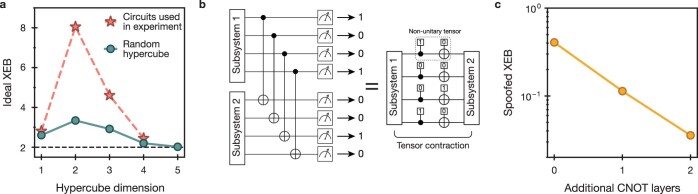
“5d). c , To understand the effects of finite XEB on required classical simulation time, we explore whether our circuit families can be ‘spoofed’ with a cheaper, approximate simulation that achieves moderately high XEB scores 102 , studied here for a 24-qubit system with full state-vector simulation.”
BackgroundSelf-citationLimitations of Linear Cross-Entropy as a Measure for Quantum Advantage
Gao, X., Kalinowski, M., Chou, C.-N., Lukin, M. D., Barak, B., & Choi, S. (2024) · PRX Quantum · doi:10.1103/prxquantum.5.010334 · Cited by 53
Self-citationAnticoncentration theorems for schemes showing a quantum speedup
Hangleiter, D., Bermejo-Vega, J., Schwarz, M., & Eisert, J. (2018) · Refubium (Universitätsbibliothek der Freien Universität Berlin) · doi:10.17169/refubium-250 · Cited by 48
Self-citationCoherent Transport of Atomic Quantum States in a Scalable Shift Register
Lengwenus, A., Kruse, J., Schlosser, M., Tichelmann, S., & Birkl, G. (2010) · Physical Review Letters · doi:10.1103/physrevlett.105.170502 · Cited by 45 · cited 1×
“During the computation, atoms are rearranged with the AOD traps to enable arbitrary connectivity 7,66,67 .”
Vasmer, M., & Kubica, A. (2022) · PRX Quantum · doi:10.1103/prxquantum.3.030319 · Cited by 39 · cited 2×
“We focus on small 3D [[8,3,2]] codes 16,17,26,27 (Fig.”
Implementing Fault-tolerant Entangling Gates on the Five-qubit Code and the Color Code
Ryan-Anderson, C., Brown, N. C., Allman, M. S., Arkin, B., Asa-Attuah, G., Baldwin, C., Berg, J., Bohnet, J. G., Braxton, S., Burdick, N., et al. (2022) · arXiv · doi:10.48550/arxiv.2208.01863 · Cited by 38 · cited 3×
“The AOD tweezers are mobile but have several constraints 7,69 .”
BackgroundMethodA small quantum computer is needed to optimize fault-tolerant protocols
Iyer, P., & Poulin, D. (2018) · Quantum Science and Technology · doi:10.1088/2058-9565/aab73c · Cited by 34 · cited 1×
“First, empirically, it seems that the logical circuit is much more tolerant to coherent errors 49,110,111 , and understanding the manifestations of this is a subject of continuing investigation.”
BackgroundFault-Tolerant One-Bit Addition with the Smallest Interesting Colour Code
Wang, Y., Simsek, S., Gatterman, T. M., Gerber, J. A., Gilmore, K., Gresh, D., Hewitt, N., Horst, C. V., Matheny, M., Mengle, T., et al. (2023) · arXiv · doi:10.48550/arxiv.2309.09893 · Cited by 32 · cited 2×
“Animations of all of our programmed circuits are attached as Supplementary Videos.”
BackgroundMethodProtecting expressive circuits with a quantum error detection code
Self, C. N., Benedetti, M., & Amaro, D. (2024) · Nature Physics · doi:10.1038/s41567-023-02282-2 · Cited by 31
Deterministic Fast Scrambling with Neutral Atom Arrays
Hashizume, T., Bentsen, G. S., Weber, S., & Daley, A. J. (2021) · Physical Review Letters · doi:10.1103/physrevlett.126.200603 · Cited by 31 · cited 1×
“Animations of all of our programmed circuits are attached as Supplementary Videos.”
MethodBell Sampling from Quantum Circuits
Hangleiter, D., & Gullans, M. J. (2024) · Physical Review Letters · doi:10.1103/physrevlett.133.020601 · Cited by 28 · cited 3×
“A powerful method to extract various quantities of interest are Bell-basis measurements between two copies of the same state 21,22,52 .”
BackgroundMethodSelf-citationShea, M. E., Baker, P. M., Joseph, J. A., Kim, J., & Gauthier, D. J. (2020) · Physical Review A · doi:10.1103/physreva.102.053101 · Cited by 21 · cited 1×
“The phase relationship between tones is chosen to minimize interference.”
BackgroundJia, Y., & Verbaarschot, J. J. M. (2020) · Journal of High Energy Physics · doi:10.1007/jhep11(2020)154 · Cited by 17 · cited 1×
“In our circuits, we alternate layers of in-block transversal entangling gates and out-block transversal CNOTs, entangling logical blocks on up to 4D hypercubes 19,96,97 (see Extended Data Fig.”
MethodMid-circuit correction of correlated phase errors using an array of spectator qubitsPreprint
Singh, K., Bradley, C. E., Anand, S., Ramesh, V., White, R., & Bernien, H. (2022) · arXiv (Cornell University) · doi:10.48550/arxiv.2208.11716 · Cited by 17 · cited 2×
“…scaling will benefit from improving encoding efficiency, for example, by using quantum low-density-parity-check codes 55,56 , using erasure conversion 13,33,57 or noise bias 35 and optimizing the choice of (possibly several) atomic species 11,14,47 , as well as advanced optical controls 34 .”
BackgroundMethodMid-circuit operations using the omg-architecture in neutral atom arraysPreprint
Lis, J. W., Senoo, A., McGrew, W. F., et al. (2023) · arXiv (Cornell University) · doi:10.48550/arxiv.2305.19266 · Cited by 14 · cited 1×
“…scaling will benefit from improving encoding efficiency, for example, by using quantum low-density-parity-check codes 55,56 , using erasure conversion 13,33,57 or noise bias 35 and optimizing the choice of (possibly several) atomic species 11,14,47 , as well as advanced optical controls 34 .”
MethodA quantum processor based on coherent transport of entangled atom arrays
Bluvstein, D., Levine, H., Semeghini, G., Wang, T. T., Ebadi, S., Kalinowski, M., Keesling, A., Maskara, N., Pichler, H., Greiner, M., et al. (2022) · Nature · doi:10.1038/s41586-022-04592-6 · Cited by 14 · cited 6×
“This process realizes a high-fidelity, fault-tolerant transversal CNOT in a single parallel step.”
BackgroundMethodInfluentialSelf-citationHigh-threshold and low-overhead fault-tolerant quantum memoryPreprint
Bravyi, S., Cross, A. W., Gambetta, J., et al. (2023) · arXiv (Cornell University) · doi:10.48550/arxiv.2308.07915 · Cited by 13 · cited 1×
“5 | Complex logical circuits using 3D codes. a , [[8,3,2]] block codes can transversally realize {CCZ, CZ, Z, CNOT} gates within each block and transversal CNOTs between blocks.”
MethodImplementing fault-tolerant non-Clifford gates using the [[8,3,2]] color code
Menendez, D. H., Ray, A., & Vasmer, M. (2023) · arXiv · doi:10.48550/arxiv.2309.08663 · Cited by 12
Entanglement transport and a nanophotonic interface for atoms in optical tweezersPreprint
Đorđević, T., Samutpraphoot, P., Ocola, P., Bernien, H., Grinkemeyer, B., Dimitrova, I., Vuletić, V., & Lukin, M. D. (2021) · DSpace@MIT (Massachusetts Institute of Technology) · Cited by 10
Self-citationSpacetime codes of Clifford circuits
Delfosse, N., & Paetznick, A. (2023) · arXiv · doi:10.48550/arxiv.2304.05943 · Cited by 10 · cited 2×
“For a given logical circuit, our correlated decoding procedure generates a decoding hypergraph, which we then solve using most likely error methods, which is done here for both surface-code and colour-code experiments, and can generically be applied to any stabilizer codes and Clifford circuits 79 .”
BackgroundMethodNon-Abelian braiding of graph vertices in a superconducting processorPreprint
Andersen, T. I., Lensky, Y. D., Kechedzhi, K., et al. (2022) · arXiv (Cornell University) · doi:10.48550/arxiv.2210.10255 · Cited by 9 · cited 1×
“We use systems of up to 280 atomic qubits, combining high-fidelity two-qubit gates 8 , enabled by fast excitation into atomic Rydberg states interacting through robust Rydberg blockade 32 , with arbitrary connectivity enabled by atom transport by means of 2D acousto-optic deflectors (AODs) 7 .”
MethodRobust sparse IQP sampling in constant depth
Paletta, L., Leverrier, A., Sarlette, A., Mirrahimi, M., & Vuillot, C. (2024) · Quantum · doi:10.22331/q-2024-05-06-1337 · Cited by 8 · cited 1×
“we find a similar Bell fidelity of 75(2)%, indicating high-fidelity performance of the readout and feedforward operations.”
BackgroundFault-tolerant quantum speedup from constant depth quantum circuits
Mezher, R., Ghalbouni, J., Dgheim, J., & Markham, D. (2020) · Physical Review Research · doi:10.1103/physrevresearch.2.033444 · Cited by 8 · cited 2×
“More specifically, these circuits can be mapped to instantaneous quantum polynomial (IQP) circuits 20,45,46 .”
BackgroundMethodConstant-Overhead Fault-Tolerant Quantum Computation with Reconfigurable Atom ArraysPreprint
Xu, Q., Ataides, J. P. B., Pattison, C. A., et al. (2023) · arXiv (Cornell University) · doi:10.48550/arxiv.2308.08648 · Cited by 7 · cited 1×
“Continued scaling will benefit from improving encoding efficiency, for example, by using quantum low-density-parity-check codes 55,56 , using erasure conversion 13,33,57 or noise bias 35 and optimizing the choice of (possibly several) atomic species 11,14,47 , as well as advanced optical controls…”
Self-citationErasure conversion in a high-fidelity Rydberg quantum simulatorPreprint
Scholl, P., Shaw, A. L., Tsai, R. B.-S., et al. (2023) · arXiv (Cornell University) · doi:10.48550/arxiv.2305.03406 · Cited by 7 · cited 2×
“This process realizes a high-fidelity, fault-tolerant transversal CNOT in a single parallel step.”
BackgroundMethodOnset of Scrambling as a Dynamical Transition in Tunable-Range Quantum Circuits
Kuriyattil, S., Hashizume, T., Bentsen, G., & Daley, A. J. (2023) · PRX Quantum · doi:10.1103/prxquantum.4.030325 · Cited by 5 · cited 3×
“In our circuits, we alternate layers of in-block transversal entangling gates and out-block transversal CNOTs, entangling logical blocks on up to 4D hypercubes 19,96,97 (see Extended Data Fig.”
BackgroundMethodA sharp phase transition in linear cross-entropy benchmarking
Ware, B., Deshpande, A., Hangleiter, D., Niroula, P., Fefferman, B., Gorshkov, A. V., & Gullans, M. J. (2023) · arXiv · doi:10.48550/arxiv.2305.04954 · Cited by 4 · cited 1×
“Moreover, the XEB turns out to be a better benchmark for IQP circuits than for generic random circuit sampling settings (such as Haar-random circuits) 102–104 .”
BackgroundSelf-citationBenchmarking highly entangled states on a 60-atom analog quantum simulatorPreprint
Shaw, A. L., Chen, Z., Choi, J., et al. (2023) · arXiv (Cornell University) · doi:10.48550/arxiv.2308.07914 · Cited by 3 · cited 2×
“To characterize the distribution overlap, we use the cross-entropy benchmark (XEB) 18,47 , which is a weighted sum between the measured probability distribution and the ideal calculated distribution, normalized such that XEB = 1 corresponds to perfectly reproducing the ideal distribution and XEB =…”
MethodRobust sparse IQP sampling in constant depth
Paletta, L., Leverrier, A., Sarlette, A., et al. (2023) · arXiv · doi:10.48550/arxiv.2307.10729
Compiling Quantum Circuits for Dynamically Field-Programmable Neutral Atoms Array Processors
Tan, D. B., Bluvstein, D., Lukin, M. D., et al. (2023) · arXiv · doi:10.48550/arxiv.2306.03487
Self-citationBell sampling from quantum circuits
Hangleiter, D., & Gullans, M. J. (2023) · arXiv · doi:10.48550/arxiv.2306.00083
Self-citation
Research works printed but not linked: 2
- Shor, P. W. in Proc. 37th Conference on Foundations of Computer Science 56–65 (IEEE, 1996).
- Patterson, D. A. & Hennessy, J. L. Computer Organization and Design: The Hardware/Software Interface. RISC-V Edition (Morgan Kaufmann, 2018).
Cited by
Quantum error correction below the surface code threshold
Collaborators, G. Q. A. A., Acharya, R., Abanin, D. A., Aghababaie-Beni, L., Aleiner, I., Andersen, T. I., Ansmann, M., Arute, F., Arya, K., Asfaw, A., et al. (2025) · Nature · doi:10.1038/s41586-024-08449-y · Cited by 778
“[18] and PyMatching [19].”
Computer Science Curricula 2023
Kumar, A. N., Raj, R. K., Aly, S. G., Anderson, M. D., Becker, B. A., Blumenthal, R. L., Eaton, E., Epstein, S. L., Goldweber, M., Jalote, P., et al. (2024) · ACM eBooks · doi:10.1145/3664191 · Cited by 223
Scaling and networking a modular photonic quantum computer
Aghaee Rad, H., Ainsworth, T., Alexander, R. N., Altieri, B., Askarani, M. F., Baby, R., Banchi, L., Baragiola, B. Q., Bourassa, J. E., Chadwick, R. S., et al. (2025) · Nature · doi:10.1038/s41586-024-08406-9 · Cited by 178
“Neutral atom-and ion-trap-based platforms 4,20,21 have demonstrated logical gate implementation with convincing evidence of subthreshold operation.”
Constant-overhead fault-tolerant quantum computation with reconfigurable atom arrays
Xu, Q., Bonilla Ataides, J. P., Pattison, C. A., Raveendran, N., Bluvstein, D., Wurtz, J., Vasić, B., Lukin, M. D., Jiang, L., & Zhou, H. (2024) · Nature Physics · doi:10.1038/s41567-024-02479-z · Cited by 157
“The smallest instances of these codes that we simulate, involving hundreds of physical qubits, are readily within reach with experimentally demonstrated system sizes 44 and control capabilities 22,23 , and larger instances can be realized with improvements in trap power.”
Self-citationPhase transition in Random Circuit Sampling
Morvan, A., Villalonga, B., Mi, X., Mandrà, S., Bengtsson, A., Klimov, P. V., Chen, Z., Hong, S., Erickson, C., Drozdov, I. K., et al. (2023) · arXiv · doi:10.48550/arxiv.2304.11119 · Cited by 138
Metadata
- Authors
- Bluvstein, D., Evered, S. J., Geim, A. A., Li, S. H., Zhou, H., Manovitz, T., Ebadi, S., Cain, M., Kalinowski, M., Hangleiter, D., Bonilla Ataides, J. P., Maskara, N., Cong, I., Gao, X., Sales Rodriguez, P., Karolyshyn, T., Semeghini, G., Gullans, M. J., Greiner, M., Vuletić, V., & Lukin, M. D.
- Affiliations
- Harvard University (US)
- Joint Center for Quantum Information and Computer Science (US)
- QuEra Computing (United States) (US)
- Massachusetts Institute of Technology (US)
- Corresponding author
- Lukin, Mikhail D.
- ORCID
- Venue
- Nature
- Published
- 2023-12-06
- Volume
- 626
- Issue
- 7997
- Pages
- 58-65
- ISSN
- 0028-0836 (ISSN-L)
- 1476-4687
- PMC
- PMC10830422
- OpenAlex
- W4389373471
- Semantic Scholar
- 9cac672bb24d6216c2b5728f940e69395d188bdd
- Cited by
- 1,119
- References
- 141
- Citations by year
- 2026: 289 · 2025: 585 · 2024: 245
- FWCI
- 105.58
- Type
- journal article
- Language
- en
- Open access
- hybrid
- doi.org
- Licence
- cc-by
- creativecommons.org/licenses/by/4.0 (tdm)
- creativecommons.org/licenses/by/4.0 (vor)
- Locations
- Nature (publishedVersion, cc-by)
- PubMed Central (publishedVersion, cc-by)
- PubMed (publishedVersion)
- arXiv (Cornell University) (submittedVersion)
- OSTI OAI (U.S. Department of Energy Office of Scientific and Technical Information) (submittedVersion)
- Digital Access to Scholarship at Harvard (DASH) (Harvard University) (submittedVersion, cc-by)
- RePEc: Research Papers in Economics (submittedVersion)
- arXiv (Cornell University)
- Funders
- National Science Foundation (2120757, 1745303, W911NF-20-1-0082)
- U.S. Department of Defense
- U.S. Department of Energy (OMA-2120757, DESC0021110, DESC0020347)
- National Institute of Standards and Technology (OMA-2120757)
- Defense Advanced Research Projects Agency (W911NF2010021)
- Intelligence Advanced Research Projects Activity (W911NF-23-2-0219)
- National Defense Science and Engineering Graduate
- Multidisciplinary University Research Initiative (W911NF2010082)
- Center for Ultracold Atoms, Massachusetts Institute of Technology
- Army Research Office (W911NF-20-1-0082, W911NF2320219, W911NF)
- Topics
- Physical Sciences › Computer Science › Artificial Intelligence › Quantum Computing Algorithms and Architecture
- Physical Sciences › Physics and Astronomy › Atomic and Molecular Physics, and Optics › Quantum Information and Cryptography
- Physical Sciences › Physics and Astronomy › Atomic and Molecular Physics, and Optics › Cold Atom Physics and Bose-Einstein Condensates
- Keywords
- logical qubits, quantum error correction, surface code, color codes, neutral-atom quantum processors, entanglement teleportation, quantum scrambling, programmable quantum processors
About these checks
Registry, retraction, Cites and statistics results are computed, not judged, with one exception: a printed reference that no index lists is read once by a model before it counts as a citation error. Claims are extracted by a model and kept only when their quote appears verbatim in the text; each cited source is then checked, with a model’s help, for whether it says what the claim relies on. Those verdicts can be wrong — read the claim’s quote and the cited source before relying on one.
The claim verdicts this report counts are experimental: their accuracy is not yet measured.
A language model drew the claims from the paper on 2026-09-30, under version 3 of the claim definition (model deepseek-v4.1-flash, prompt extract-v3).
A second model labelled each claim on 2026-09-30 (model jev-1.13-20260917, definition revision gold-guideline-v0.2).
Cited sources are checked with a language model’s help (gpt-6-sol).
Statistics and arithmetic are recomputed, not judged.
Confidence bands are shown only for fields calibrated on our annotated test set. None is calibrated yet, so no band is shown.
What counts as a claim ›How we measure confidence ›How we check this ›
Are you an author, or do you see a problem with this page? Request a review
Data sources
Bibliographic data: Semantic Scholar, OpenAlex, Crossref.
Contains information from the Semantic Scholar Academic Graph Datasets, made available under the ODC Attribution License (ODC-BY 1.0).
Semantic Scholar’s data is described in: Kinney, R., et al. (2023). The Semantic Scholar Open Data Platform. arXiv:2301.10140.
