

Logical quantum processor based on reconfigurable atom arrays
Open accessThe DOI matches its Crossref record; 127 of the 141 references it cites were found in a registry or an index; 126 of the 137 sources its claims cite were checked for support.
Abstract
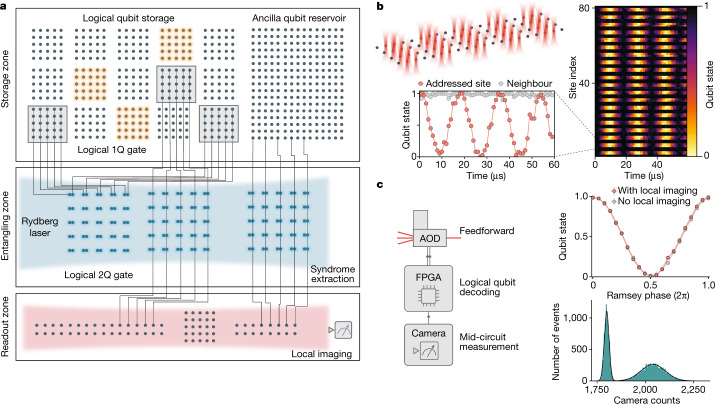
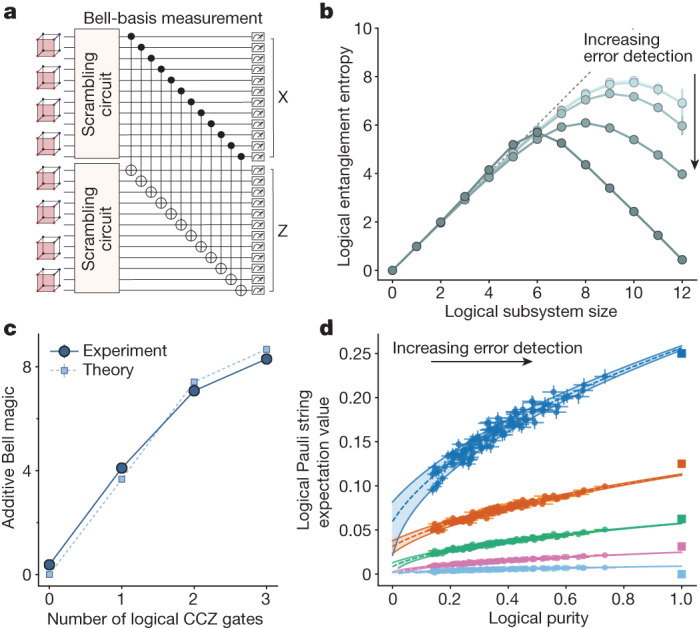
Abstract Suppressing errors is the central challenge for useful quantum computing 1 , requiring quantum error correction (QEC) 2–6 for large-scale processing. However, the overhead in the realization of error-corrected ‘logical’ qubits, in which information is encoded across many physical qubits for redundancy 2–4 , poses substantial challenges to large-scale logical quantum computing. Here we report the realization of a programmable quantum processor based on encoded logical qubits operating with up to 280 physical qubits. Using logical-level control and a zoned architecture in reconfigurable neutral-atom arrays 7 , our system combines high two-qubit gate fidelities 8 , arbitrary connectivity 7,9 , as well as fully programmable single-qubit rotations and mid-circuit readout 10–15 . Operating this logical processor with various types of encoding, we demonstrate improvement of a two-qubit logic gate by scaling surface-code 6 distance from d = 3 to d = 7, preparation of colour-code qubits with break-even fidelities 5 , fault-tolerant creation of logical Greenberger–Horne–Zeilinger (GHZ) states and feedforward entanglement teleportation, as well as operation of 40 colour-code qubits. Finally, using 3D [[8,3,2]] code blocks 16,17 , we realize computationally complex sampling circuits 18 with up to 48 logical qubits entangled with hypercube connectivity 19 with 228 logical two-qubit gates and 48 logical CCZ gates 20 . We find that this logical encoding substantially improves algorithmic performance with error detection, outperforming physical-qubit fidelities at both cross-entropy benchmarking and quantum simulations of fast scrambling 21,22 . These results herald the advent of early error-corrected quantum computation and chart a path towards large-scale logical processors.
Overview
CoChat Summary
TL;DR
The paper reports a programmable logical quantum processor built from reconfigurable neutral-atom arrays, operating with up to 280 physical qubits and using surface codes, colour codes, and 3D [[8,3,2]] codes. Across several demonstrations, logical encoding improved performance for entangling gates, GHZ-state preparation, feedforward teleportation, and complex sampling/quantum-simulation tasks compared with analogous physical-qubit circuits.
Key findings
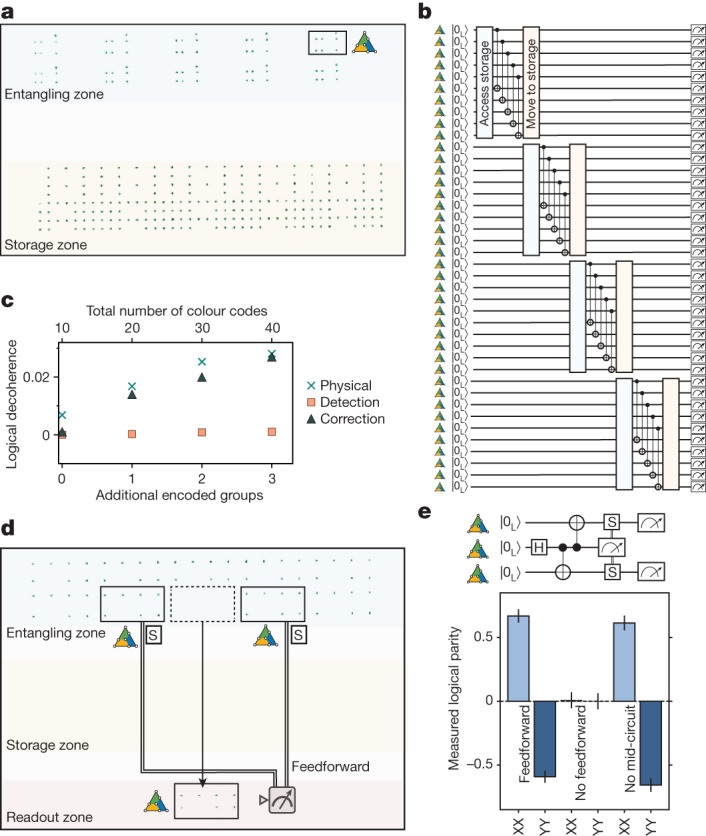
- The processor used up to 280 physical qubits and demonstrated 40 colour-code qubits by repeating a ten-logical-qubit process four times.
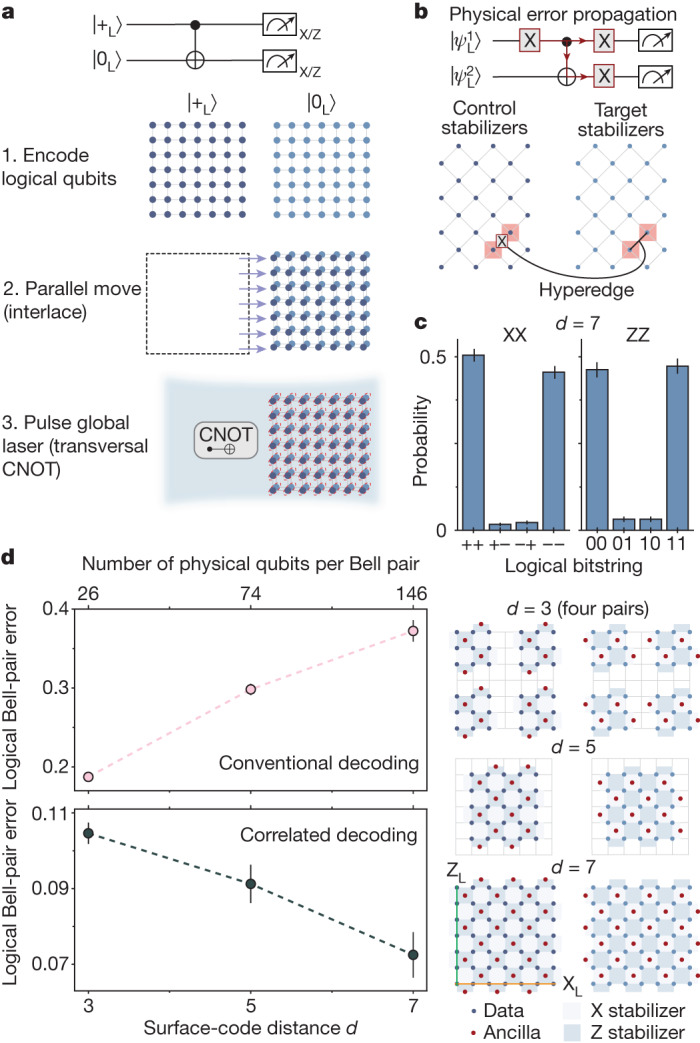
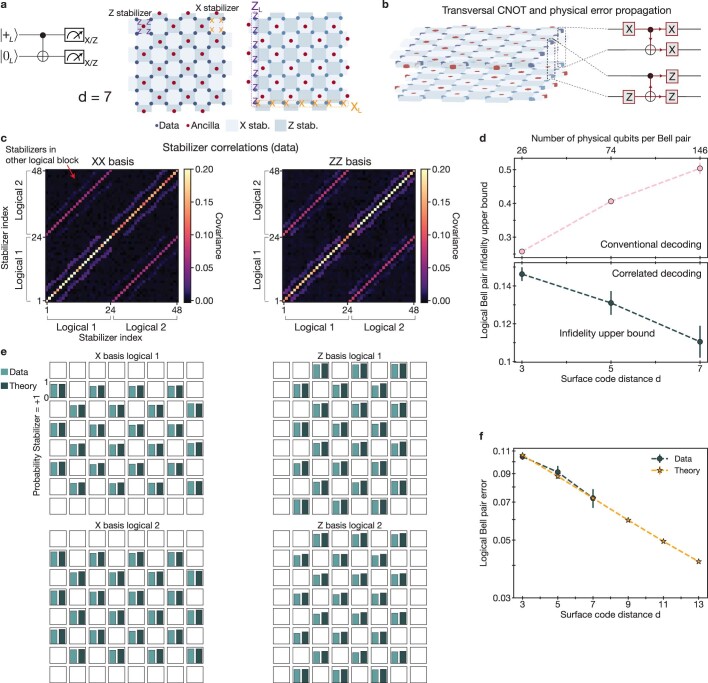
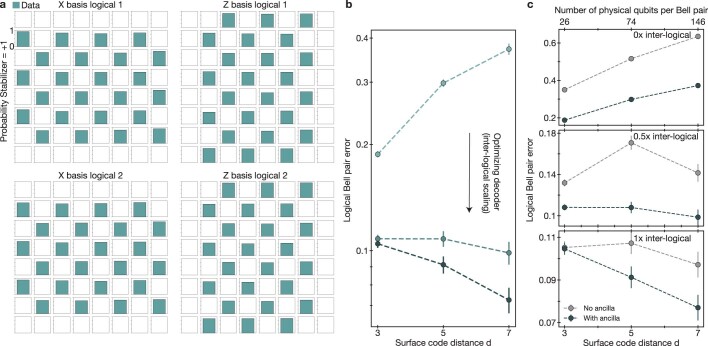
- For a surface-code transversal CNOT, increasing code distance from d = 3 to d = 7 improved the logical Bell pair; with correlated decoding, the authors report roughly 0.95 populations in the XLXL and ZLZL bases for entangled d = 7 logical qubits.
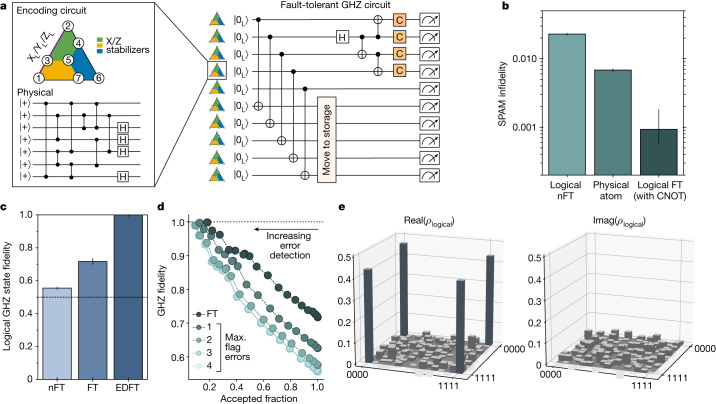
- For fault-tolerant colour-code GHZ preparation, the measured logical GHZ fidelity was 72(2)%; with error-detection/postselection it increased further, and the paper states that discarding 50% of the data improved GHZ fidelity to approximately 90%.
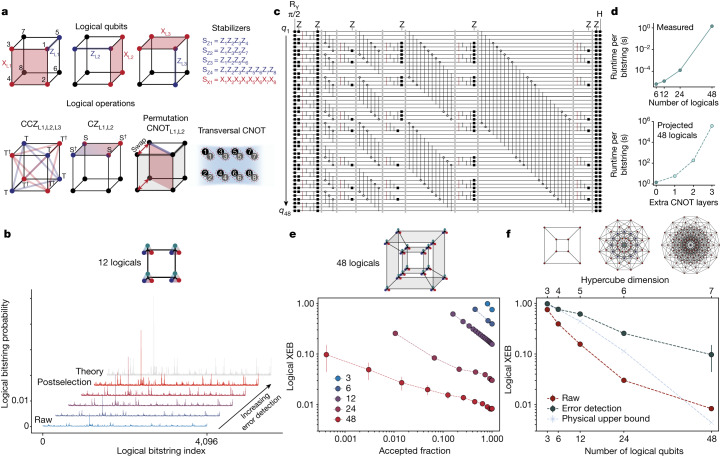
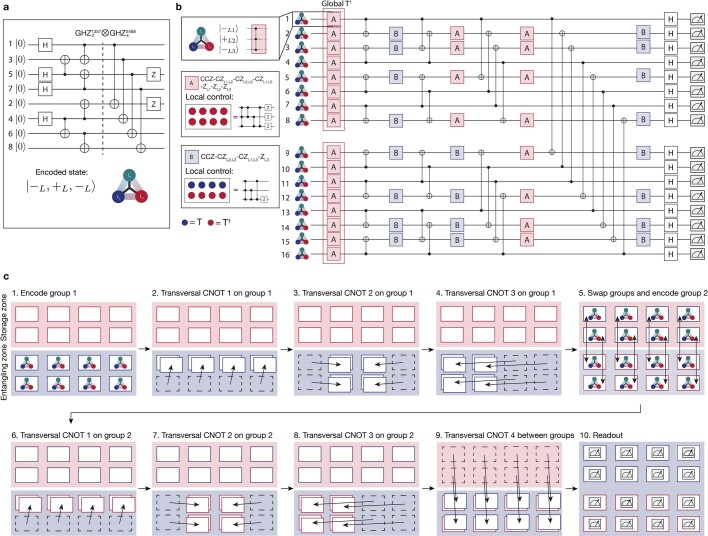
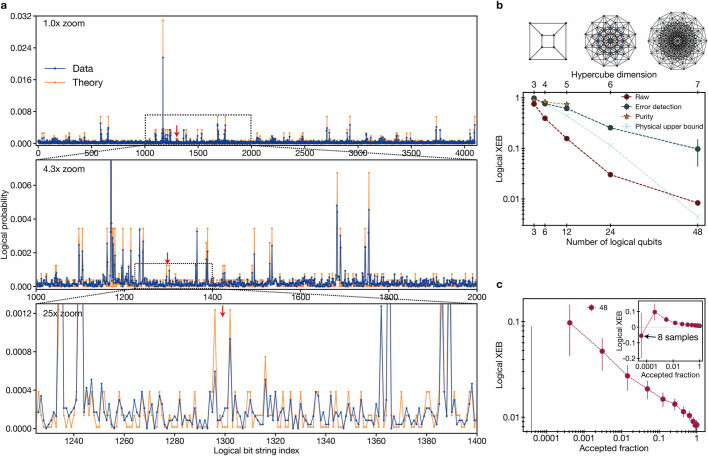
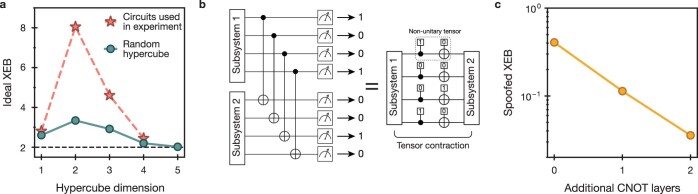
- In complex [[8,3,2]] sampling circuits, the authors realized up to 48 logical qubits, 228 logical two-qubit gates, and 48 logical CCZ gates; the reported XEB for 12 logical qubits increased from 0.156(2) to 0.616(7) with error detection, and for 48 logical qubits the XEB was approximately 0.1.
Methods
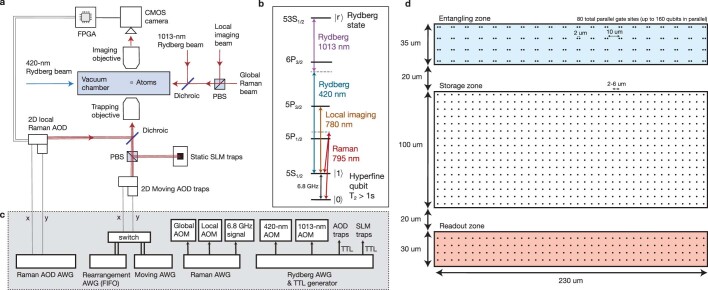
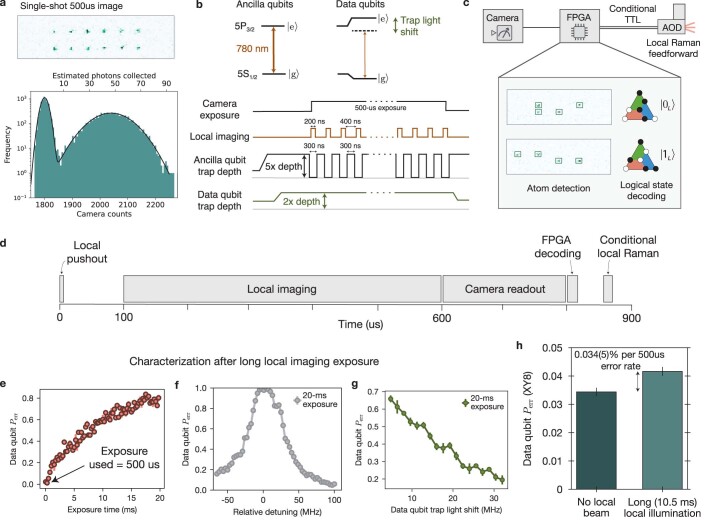
- Experimental platform: reconfigurable arrays of \(^{87}\)Rb atoms in optical tweezers, with zoned architecture for storage, entangling, and readout; the paper states operation with up to 280 atomic qubits, two-qubit gate fidelities of 99.3–99.5%, and local imaging fidelity of around 99.8%.
- Coding and circuits: rotated surface codes (including distance-7), d = 3 colour codes for Clifford algorithms, and 3D [[8,3,2]] codes for non-Clifford sampling circuits; all logical circuits after state preparation are built from transversal gates.
- Analysis: correlated decoding via a decoding hypergraph and mixed-integer programming solved with Gurobi; logical performance was benchmarked using direct fidelity estimation, full tomography, cross-entropy benchmarking (XEB), and two-copy Bell-basis measurements.
Limitations
- The paper states that state preparation is non-fault-tolerant for the d = 5, 7 surface codes and the [[8,3,2]] codes, because only a single round of stabilizer measurement is used.
- It also notes that deep circuits require repetitive error correction to keep benefiting from logical suppression, and that current mid-circuit readout/feedforward takes slightly less than 1 ms, with the authors saying it could be improved toward the 100-μs scale.
- Evident from the text: several reported gains rely on postselection / sliding-scale error detection, which improves fidelity at the cost of acceptance probability and measurement overhead.
Model-written summary. Check it against the paper before relying on it.
Integrity signals
Registry
Cites
Statistics
Figures
Verification
Claims the paper makes
69 Valid · 15 Not valid · 8 Not checked · 160 Own results and interpretations
At least one cited source doesn’t support this claim or points to a different paper, and none confirmed it — see the verdicts below.
In the paper
“However, executing large-scale, useful algorithms on quantum processors requires very low gate error rates (generally below about 10−10)23, far below those that will probably ever be achievable with any physical device2.”
§ Logical quantum processor based on reconfigurable atom arrays > Main
What the sources say
- Disputedcites [23] Gidney C Ekerå M How to factor 2048 bit RSA integers in 8 hours using 20 million noisy qubits Quantum 2021 5 433 10.22331/q-2021-04-15-433 sourceExperimental — accuracy not yet measured
The citation to this paper is attached to the claimed requirement for gate error rates below about 10⁻¹⁰, not to the following statement about what physical devices can achieve. Section 2.16 instead describes a physical gate error rate of 0.1% (10⁻³) as sufficient for surface-code error correction, and Section 2.13 uses that rate in its large-scale factoring estimate. The paper distinguishes physical gate errors from the much lower logical error rates produced by correction. (LLM, conf=0.88)
Checked by a reasoning model — may be wrong.
- Not matchedcites [2] Shor, P. W. in Proc. 37th Conference on Foundations of Computer Science 56–65 (IEEE, 1996).
Its entry has no title and year that we can search by.
hedgedstates a cause- Asserted: passes — The authors put it forward as true.
- Checkable: passes — It can be checked against evidence.
- Load-bearing: passes — The paper’s conclusions depend on it.
- Based: passes — The paper gives a reason why it holds.
- Disputed
At least one cited source doesn’t support this claim or points to a different paper, and none confirmed it — see the verdicts below.
In the paper
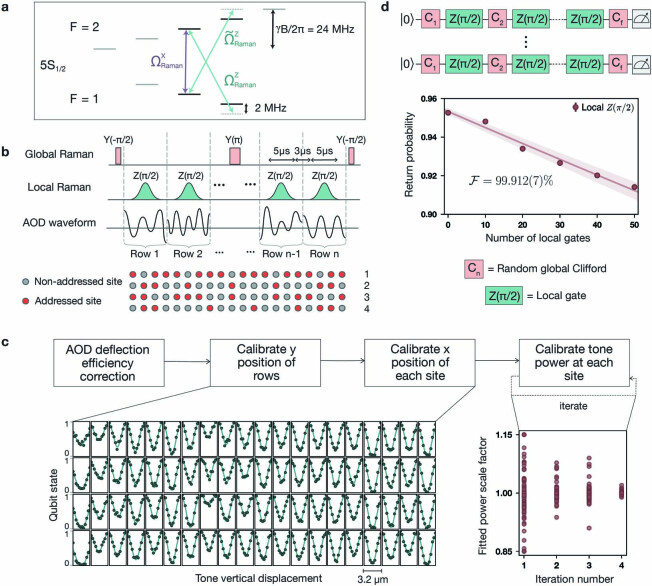
“Fully programmable local single-qubit rotations are realized through qubit-specific, parallel Raman excitation through an additional 2D AOD (ref. 34) (Fig. 1b and Extended Data Fig. 2).”
§ Logical quantum processor based on reconfigurable atom arrays > Logical processor based on atom arrays
What the sources say
- Disputedcites [34] Graham TM Multi-qubit entanglement and algorithms on a neutral-atom quantum computer Nature 2022 604 457 462 10.1038/s41586-022-04603-6 35444321 sourceExperimental — accuracy not yet measured
The Methods (p. 10) say site-selective single-qubit rotations combine global microwave rotations with local 459 nm Stark-shift phase gates, rather than using parallel Raman excitation. The Methods (p. 10) describe crossed AODs for pointing Rydberg beams at two sites simultaneously, not an additional 2D AOD for local Raman rotations. (LLM, conf=0.88)
Checked by a reasoning model — may be wrong.
plainstates a cause- Asserted: passes — The authors put it forward as true.
- Checkable: passes — It can be checked against evidence.
- Load-bearing: passes — The paper’s conclusions depend on it.
- Based: passes — The paper gives a reason why it holds.
- Disputed
The cited sources support only part of this claim — read each source’s verdict below.
In the paper
“Using logical-level control and a zoned architecture in reconfigurable neutral-atom arrays7, our system combines high two-qubit gate fidelities8, arbitrary connectivity7,9, as well as fully programmable single-qubit rotations and mid-circuit readout10–15.”
§ Logical quantum processor based on reconfigurable atom arrays > Abstract
What the sources say
- Supportedcites [10] Deist E Mid-circuit cavity measurement in a neutral atom array Phys. Rev. Lett. 2022 129 203602 10.1103/PhysRevLett.129.203602 36462020 source
The paper describes its method as mid-circuit readout in a neutral-atom array (p. 1). It also reports performing a mid-circuit measurement on one atom during a two-atom quantum circuit (p. 4), supporting the cited readout capability. (LLM, conf=0.92)
- Supportedcites [11] Singh K Mid-circuit correction of correlated phase errors using an array of spectator qubits Science 2023 380 1265 1269 10.1126/science.ade5337 37228222 source
The INTRODUCTION states that 'During logic operations on the data qubits, midcircuit readouts on the array of ~60 spectator qubits enable single-shot estimation of globally correlated phase errors,' with readouts that 'do not disturb the coherence of the data qubits.' The Methods section 'Mid-circuit readout of atomic qubits' and '3. Quantifying discrimination fidelity of the mid-circuit readout' report the 15 ms MCR with discrimination fidelity 0.989(5), and '2. Real-time processing and feedback' describes the real-time imaging and feedback chain, so the cited system demonstrably possesses mid-circuit readout. The DISCUSSION lists mid-circuit readout among the quantum-control techniques demonstrated, and also documents single-qubit manipulation via IQ-modulated global microwave pulses supporting the adjacent part of the sentence. (LLM, conf=0.90)
- Supportedcites [12] Graham, T. M. et al. Midcircuit measurements on a single-species neutral alkali atom quantum processor. Phys. Rev. X13, 041051 (2023). source
The paper’s “A. Midcircuit measurement” section describes a five-step procedure that includes state-selective readout of ancilla atoms during the circuit. It therefore supports the cited claim that mid-circuit readout is available in a neutral-atom processor. (LLM, conf=0.92)
- Partly supportedcites [13] Ma S High-fidelity gates and mid-circuit erasure conversion in an atomic qubit Nature 2023 622 279 284 10.1038/s41586-023-06438-1 37821593 sourceExperimental — accuracy not yet measured
The paper reports mid-circuit imaging to detect atoms that have decayed to the ground state (Abstract; page unavailable). But it says its demonstrated detection protocol *could be adapted* to mid-circuit qubit readout; it does not report demonstrating that readout. Thus it supports mid-circuit erasure detection, not the full readout attributed to it. (LLM, conf=0.87)
- Supportedcites [14] Lis, J. W. et al. Midcircuit operations using the omg architecture in neutral atom arrays. Phys. Rev. X13, 041035 (2023). source
The Introduction states that the paper demonstrates midcircuit state readout of ancilla qubits. This supports the cited claim that mid-circuit readout is a capability demonstrated in neutral-atom arrays. (LLM, conf=0.92)
- Supportedcites [15] Norcia, M. A. et al. Midcircuit qubit measurement and rearrangement in a 171Yb atomic array. Phys. Rev. X13, 041034 (2023). source
Section IV (Correction of Atom Loss) reports using the results of a midcircuit measurement to correct ancilla-qubit loss while maintaining data-qubit coherence. Appendix B also describes the array's midcircuit measurement results. These passages support the citation for mid-circuit readout. (LLM, conf=0.90)
plain- Asserted: passes — The authors put it forward as true.
- Checkable: passes — It can be checked against evidence.
- Load-bearing: passes — The paper’s conclusions depend on it.
- Based: passes — The paper gives a reason why it holds.
- Supported
The cited sources support only part of this claim — read each source’s verdict below.
In the paper
“Operating this logical processor with various types of encoding, we demonstrate improvement of a two-qubit logic gate by scaling surface-code6 distance from d = 3 to d = 7, preparation of colour-code qubits with break-even fidelities5, fault-tolerant creation of logical Greenberger–Horne–Zeilinger (GHZ) states and feedforward entanglement teleportation, as well as operation of 40 colour-code qubit”
§ Logical quantum processor based on reconfigurable atom arrays > Abstract
What the sources say
- Partly supportedcites [6] Google Quantum AI Suppressing quantum errors by scaling a surface code logical qubit Nature 2023 614 676 681 10.1038/s41586-022-05434-1 36813892 PMC9946823 sourceExperimental — accuracy not yet measured
The Main section reports improved logical-qubit performance when scaling a surface code from d = 3 to d = 5. The ‘Surface codes with superconducting qubits’ section says the experiment focuses on preserving logical memory; it does not report improving a two-qubit logical gate or scaling to d = 7. Page numbers are not available in our copy. (LLM, conf=0.88)
boostedstates a cause- Asserted: passes — The authors put it forward as true.
- Checkable: passes — It can be checked against evidence.
- Load-bearing: passes — The paper’s conclusions depend on it.
- Based: passes — The paper gives a reason why it holds.
- Partly supported
The cited sources support only part of this claim — read each source’s verdict below.
In the paper
“Operating this logical processor with various types of encoding, we demonstrate improvement of a two-qubit logic gate by scaling surface-code6 distance from d = 3 to d = 7, preparation of colour-code qubits with break-even fidelities5, fault-tolerant creation of logical Greenberger–Horne–Zeilinger (GHZ) states and feedforward entanglement teleportation, as well as operation of 40 colour-code qubit”
§ Logical quantum processor based on reconfigurable atom arrays > Abstract
What the sources say
- Partly supportedcites [5] Ryan-Anderson, C. et al. Implementing fault-tolerant entangling gates on the five-qubit code and the color code. Preprint at https://arxiv.org/abs/2208.01863 (2022). sourceExperimental — accuracy not yet measured
The opening summary (p. 1) reports that fault-tolerant colour-code state-preparation-and-measurement fidelities exceeded average physical-qubit SPAM fidelities. But Section III (p. 8) explicitly says the experiments did not achieve the break-even point; it describes the higher logical fidelity as a milestone toward it. The claim is supported as a comparison of preparation-and-measurement fidelities, not as a demonstration of break-even operation. (LLM, conf=0.86)
boosted- Asserted: passes — The authors put it forward as true.
- Checkable: passes — It can be checked against evidence.
- Load-bearing: passes — The paper’s conclusions depend on it.
- Based: passes — The paper gives a reason why it holds.
- Partly supported
130 more claims · 39 with their cited sources checked
Create a free account to see all 252 claims and to verify the 1 reference still open.
- It may state two separate claims as one. 89
- Probably not a substantial claim. 40
- The quote only partly states this claim. 2
Claims other papers make about this one
Each is checked against this paper’s own text: does it say what the citing paper says it does?
The cited source doesn’t support the claim as written.
In the citing paper
“Although many platforms have demonstrated different features of quantum error correction14–20, no quantum processor has definitively shown below-threshold performance.”
From Quantum error correction below the surface code threshold (2025) · cites this paper as [18]
Checked by a reasoning model — may be wrong.
Experimental — accuracy not yet measuredThe source backs part of the claim, not all of it — or backs it for a different population, condition or comparison.
In the citing paper
“As a result, error suppression by increasing the colour code size has not yet been demonstrated, to our knowledge, on any experimental platform.”
From Scaling and logic in the colour code on a superconducting quantum processor (2025) · cites this paper as [18]
Experimental — accuracy not yet measuredThe cited source says what the claim attributes to it.
In the citing paper
“Recently, QEC experiments have been performed in various hardware platforms, including superconducting quantum circuits25–28, trapped ions29 and neutral atoms30.”
From Hardware-efficient quantum error correction via concatenated bosonic qubits (2025) · cites this paper as [30]
The cited source says what the claim attributes to it.
In the citing paper
“The smallest instance of the colour code, the Steane code37, has been implemented with trapped ions11,12 and neutral atoms18, demonstrating logical operations and logical circuits13–19.”
From Scaling and logic in the colour code on a superconducting quantum processor (2025) · cites this paper as [18]
Citations
Cites
Quantum Computing in the NISQ era and beyond
Preskill, J. (2018) · Quantum · doi:10.22331/q-2018-08-06-79 · Cited by 8,830 · cited 1×
“The storage zone is used for dense qubit storage, free from entangling-gate errors and featuring long coherence times.”
BackgroundQuantum supremacy using a programmable superconducting processor
Arute, F., Arya, K., Babbush, R., Bacon, D., Bardin, J. C., Barends, R., Biswas, R., Boixo, S., Brandao, F. G. S. L., Buell, D. A., et al. (2019) · Nature · doi:10.1038/s41586-019-1666-5 · Cited by 7,720 · cited 3×
“70), has an improved Raman scattering contribution and is faster (roughly 1 μs duration).”
BackgroundMethodScheme for reducing decoherence in quantum computer memory
Shor, P. W. (1995) · Physical Review A · doi:10.1103/physreva.52.r2493 · Cited by 4,479 · cited 1×
“Distance-3 codes, which are of notable historical importance 3,87 , can correct any weight-1 error.”
BackgroundSurface codes: Towards practical large-scale quantum computation
Fowler, A. G., Mariantoni, M., Martinis, J. M., & Cleland, A. N. (2012) · Physical Review A · doi:10.1103/physreva.86.032324 · Cited by 3,059 · cited 10×
“Mid-circuit X-basis measurement of the middle logical creates by applying a logical S gate to the first and third logicals conditioned in real time on the state of the middle logical, akin to the magic-state-teleportation circuit 24 .”
BackgroundMethodInfluentialQuantum computational advantage using photons
Zhong, H.-S., Wang, H., Deng, Y.-H., Chen, M.-C., Peng, L.-C., Luo, Y.-H., Qin, J., Wu, D., Ding, X., Hu, Y., et al. (2020) · Science · doi:10.1126/science.abe8770 · Cited by 2,405
Dennis, E., Kitaev, A., Landahl, A., & Preskill, J. (2002) · Journal of Mathematical Physics · doi:10.1063/1.1499754 · Cited by 1,768 · cited 6×
“6, which can be understood as preparing two four-qubit GHZ states (corresponding to [[4,2,2]] codes 95 ), that is, GHZ ⊗GHZ , and subsequently entangling them as illustrated in Extended Data Fig.”
BackgroundInfluentialFast Quantum Gates for Neutral Atoms
Jaksch, D., Cirac, J. I., Zoller, P., Rolston, S. L., Côté, R., & Lukin, M. D. (2000) · Physical Review Letters · doi:10.1103/physrevlett.85.2208 · Cited by 1,540 · cited 2×
“Nota-bly, owing to the use of the Rydberg blockade 32,68 , the gate is largely independent of the exact distance between atoms.”
BackgroundMethodSelf-citationImproved simulation of stabilizer circuits
Aaronson, S., & Gottesman, D. (2004) · Physical Review A · doi:10.1103/physreva.70.052328 · Cited by 1,515 · cited 2×
“For instance, when using 2D codes such as the surface code, non-Clifford operations cannot be easily performed 37 , and relatively expensive techniques are required for nontrivial computation 24,43 , as Clifford circuits can be easily simulated 44 .”
BackgroundMethodDennis, E., Kitaev, A., Landahl, A., & Preskill, J. (2001) · CERN Document Server (European Organization for Nuclear Research) · Cited by 1,485
Multiple-particle interference and quantum error correction
(1996) · Proceedings of the Royal Society of London. Series A: Mathematical, Physical and Engineering Sciences · doi:10.1098/rspa.1996.0136 · Cited by 1,284 · cited 10×
“We use 2D d = 3 colour codes 3,37 , which are topological codes akin to the surface code, but with the useful capability of trans-versal operations of the full Clifford group: Hadamard (H), π/2 phase (S) gate and CNOT (ref.”
BackgroundMethodInfluential
Research works printed but not linked: 2
- Shor, P. W. in Proc. 37th Conference on Foundations of Computer Science 56–65 (IEEE, 1996).
- Patterson, D. A. & Hennessy, J. L. Computer Organization and Design: The Hardware/Software Interface. RISC-V Edition (Morgan Kaufmann, 2018).
Cited by
Items 601–700 of 1,108
Simulating topological order on quantum processors
Gammon-Smith, A., Knap, M., & Pollmann, F. (2026) · Nature Reviews Physics · doi:10.1038/s42254-025-00911-8 · Cited by 5
Light-assisted collisions in tweezer-trapped lanthanides
Grün, D. S., Giacomelli, L. B., Tashchilina, A., Donofrio, R., Borchers, F., Bland, T., Mark, M. J., & Ferlaino, F. (2026) · Physical Review Research · doi:10.1103/rkn3-8rc9 · Cited by 6
Tangent Space Excitation Ansatz for Quantum Circuits
Chen, J.-Y., Huang, B., Zhou, D. L., Schuch, N., Cao, C., & Yang, M. (2026) · Physical Review Letters · doi:10.1103/k2lc-v1hn · Cited by 4
Random Regular Graph States Are Complex at Almost Any Depth
Ghosh, S., Hangleiter, D., & Helsen, J. (2025) · PRX Quantum · doi:10.1103/52xz-3hpc · Cited by 12
Self-citationJoven, K. J., Das, E. R., Bierman, J., Majumdar, A., Heris, M. H., & Liu, Y. (2026) · APL Computational Physics · doi:10.1063/5.0312254 · Cited by 13
Mode Multiplexing for Scalable Cavity-Enhanced Operations in Neutral-Atom Arrays
Aqua, Z., Peters, M. L., Spierings, D., Wang, G., Bytyqi, E., Propson, T., & Vuletić, V. (2026) · PRX Quantum · doi:10.1103/4c33-b1dv · Cited by 9
Self-citationBhuiyan, A., Pan, H., & Jian, C. (2026) · Physical Review Research · doi:10.1103/nk38-ygyq · Cited by 8
Matching Generalized-Bicycle Codes to Neutral Atoms for Low-Overhead Fault-Tolerance
Viszlai, J., Yang, W., Lin, S. F., Liu, J., Nottingham, N., Baker, J. M., & Chong, F. T. (2025) · IEEE International Conference on Quantum Computing and Engineering (QCE) · doi:10.1109/qce65121.2025.00080 · Cited by 21
Measurement-Free Quantum Error Correction Optimized for Biased Noise
Brechtelsbauer, K., Butt, F., Locher, D. F., Higuera-Quintero, S., Weber, S., Müller, M., & Büchler, H. P. (2025) · PRX Quantum · doi:10.1103/wsnf-prwl · Cited by 8
Bezuglov, N. N., Beterov, I. I., Cinins, A., Miculis, K., Entin, V. M., Betleni, P. I., Suliman, G., Gromyko, V. V., Tretyakov, D. B., Yakshina, E. A., et al. (2025) · Physical Review A · doi:10.1103/s918-nqsp · Cited by 47
Behrends, J., & Béri, B. (2025) · PRX Quantum · doi:10.1103/psf5-b6j2 · Cited by 29
Information dynamics in decohered quantum memory with repeated syndrome measurements
Hauser, J., Bao, Y., Sang, S., Lavasani, A., Agrawal, U., & Fisher, M. P. A. (2025) · Physical review. B./Physical review. B · doi:10.1103/v5kq-7mn7 · Cited by 22
Generation of Motional Squeezed States for Neutral Atoms in Optical Tweezers
Lienhard, V., Martin, R., Chew, Y. T., Tomita, T., Ohmori, K., & de Léséleuc, S. (2025) · Physical Review Letters · doi:10.1103/3kwz-ny2h · Cited by 17
Characterizing Physical and Logical Errors in a Transversal CNOT Gate via Cycle Error Reconstruction
Fazio, N., Freund, R., Sannamoth, D., Steiner, A., Marciniak, C. D., Rispler, M., Harper, R., Monz, T., Emerson, J., & Bartlett, S. D. (2026) · Physical Review X · doi:10.1103/qfwc-584t · Cited by 9
Quantum computing for automotive applications
Riofrío, C. A., Klepsch, J., Finžgar, J. R., Kiwit, F. J., Hölscher, L., Erdmann, M., Müller, L., Kumar, C., Berrada, Y. A., & Luckow, A. (2025) · Elsevier eBooks · doi:10.1016/b978-0-44-330259-6.00020-7 · Cited by 16
Compact quantum dot models for analog microwave co-simulation
Peri, L., Gomez-Saiz, A., Ford, C. J. B., & Gonzalez-Zalba, M. F. (2025) · npj Quantum Information · doi:10.1038/s41534-025-01140-8 · Cited by 6
Photonic hybrid quantum computing
Lee, J., Omkar, S., Teo, Y. S., Lee, S.-H., Kwon, H., Kim, M. S., & Jeong, H. (2025) · Newton · doi:10.1016/j.newton.2025.100359 · Cited by 18
Ji, J.-W., Sunami, S., Kikura, S., Goban, A., & Simon, C. (2025) · Physical Review Applied · doi:10.1103/vcrh-hl73 · Cited by 7
Quo Vadis, Quantum Machine Learning?: Quantum kernel methods meet Earth observation
Miroszewski, A., Nalepa, J., Wijata, A. M., B, J. M. A., Saux, B. L., & Sebastianelli, A. (2026) · IEEE Geoscience and Remote Sensing Magazine · doi:10.1109/mgrs.2025.3596291 · Cited by 4
Demonstration of measurement-free universal logical quantum computation
Butt, F., Pogorelov, I., Freund, R., Steiner, A., Meyer, M., Monz, T., & Müller, M. (2026) · Nature Communications · doi:10.1038/s41467-026-68533-x · Cited by 2
Efimov effect in long-range quantum spin chains
Sun, N., Feng, L., & Zhang, P. (2026) · Communications Physics · doi:10.1038/s42005-026-02580-0 · Cited by 8
Advancing quantum machine learning from conceptual design to practical use
Tera, S. P., Chinthaginjala, R., Zhao, X., & Hamdi, M. (2026) · Expert Systems with Applications · doi:10.1016/j.eswa.2026.132127 · Cited by 5
Improving Variational Counterdiabatic Driving with Weighted Actions and Computer Algebra
Ohga, N., & Hatomura, T. (2026) · PRX Quantum · doi:10.1103/rmsy-nypw · Cited by 10
Extended Rydberg Lifetimes in a Cryogenic Atom Array
Jin, J., Shi, Y., Alaoui, Y. A., Deng, J., Lu, Y., Thompson, J. D., & Bakr, W. (2026) · PRX Quantum · doi:10.1103/96bx-rjwz · Cited by 16
Escaping local minima with quantum circuit coherent cooling
Feng, J.-J., & Wu, B. (2024) · Physical Review A · doi:10.1103/physreva.109.032405 · Cited by 4
Adams, M., Traub, M., Hoffmann, H.-D., Meinert, F., Ilzhöfer, P., Westphalen, T., Ludwig, K., Zhao, J., Scholz, A., Unnikrishnan, G., et al. (2024) · Quantum Computing, Communication, and Simulation · doi:10.1117/12.2692620 · Cited by 3
Minimizing readout-induced noise for early fault-tolerant quantum computers
Zheng, Y., & Kanno, K. (2023) · Physical Review Research · doi:10.1103/physrevresearch.6.023129 · Cited by 3
Wojciechowski, K., Kurowski, K., & Mazurek, C. (2024) · Postępy Biochemii · doi:10.18388/pb.2021_536 · Cited by 2
Local measurement strategies for multipartite entanglement quantification
Coffman, L., Seshadri, A., Smith, G., & Beckey, J. L. (2024) · Physical Review A · doi:10.1103/physreva.110.012454 · Cited by 8
Speeding Up Quantum Measurement Using Space-Time Trade-Off
Corlett, C., Čepaitė, I., Daley, A. J., Gustiani, C., Pelegrí, G., Pritchard, J. D., Linden, N., & Skrzypczyk, P. (2025) · Physical Review Letters · doi:10.1103/physrevlett.134.080801 · Cited by 9
The quest for a practical quantum advantage or the importance of applications for quantum computing
Lorenz, J. M. (2024) · Modern Physics Letters A · doi:10.1142/s0217732324300064 · Cited by 4
Pseudochaotic many-body dynamics as a pseudorandom state generator
Lee, W., Kwon, H., & Cho, G. Y. (2024) · Nature Communications · doi:10.1038/s41467-025-62081-6 · Cited by 4
Nishimura, K., Sakai, H., Ando, T., Tomita, T., & de Léséleuc, S. (2026) · Physical Review A · doi:10.1103/xhb8-jlxh · Cited by 9
QHDOPT: A Software for Nonlinear Optimization with Quantum Hamiltonian Descent
Kushnir, S., Leng, J., Peng, Y., Fan, L., & Wu, X. (2024) · INFORMS journal on computing · doi:10.1287/ijoc.2024.0587 · Cited by 16
Magic state injection on IBM quantum processors above the distillation threshold
Kim, Y., Sevior, M. E., & Usman, M. (2026) · Scientific Reports · doi:10.1038/s41598-026-40381-1 · Cited by 21
Quantum Algorithm for a Stochastic Multicloud Model
Ueno, K., & Miura, H. (2024) · SOLA · doi:10.2151/sola.2025-006 · Cited by 6
Entanglement-assisted fault-tolerant encoding and decoding for qudit stabilizer codes
Sharma, A. K., & Garani, S. S. (2024) · Physical Review A · doi:10.1103/physreva.110.062424 · Cited by 2
HamilToniQ: An Open-Source Benchmark Toolkit for Quantum Computers
Xu, X., Chen, K., & Wille, R. (2024) · IEEE International Conference on Quantum Computing and Engineering (QCE) · doi:10.1109/qce60285.2024.10384 · Cited by 7
Engineering Quantum States with Neutral Atoms
Balewski, J. T., Kornjača, M., Klymko, K., Darbha, S., Hirsbrunner, M. R., Lopes, P. L. S., Liu, F., & Camps, D. (2024) · IEEE International Conference on Quantum Computing and Engineering (QCE) · doi:10.1109/qce60285.2024.00144 · Cited by 13
Highly-entangled, highly-doped states that are efficiently cross-device verifiable
Denzler, J., Varona, S., Guaita, T., & Carrasco, J. (2025) · Physical Review Research · doi:10.1103/b6rb-yr6c · Cited by 7
Low-density parity-check representation of fault-tolerant quantum circuits
Li, Y. (2025) · Physical Review Research · doi:10.1103/physrevresearch.7.013115 · Cited by 8
Bounded light cone and robust topological order out of equilibrium
Zeng, Y., Hamma, A., Zhang, Y.-R., Cao, J.-P., Fan, H., & Liu, W.-M. (2025) · Physical Review A · doi:10.1103/physreva.111.022414 · Cited by 2
Transversal cnot gate with multicycle error correction
Kim, Y., Sevior, M. E., & Usman, M. (2025) · Physical Review Applied · doi:10.1103/physrevapplied.23.024074 · Cited by 7
Optimization of error signal lineshape for modulation-free robust laser frequency stabilization
Yadav, P., Ghosh, A., Singh, N., Yadav, V. K., Singh, D., Singh, K., & Santra, B. (2025) · Physica Scripta · doi:10.1088/1402-4896/adbf70 · Cited by 5
Experimental demonstration of reconstructing quantum states with generative models
Li, X., Jiang, W., Hua, Z., Wang, W., Pan, X., Cai, W., Lu, Z., Han, J., Wu, R.-B., Zou, C., et al. (2025) · Science Bulletin · doi:10.1016/j.scib.2025.03.007 · Cited by 5
Quantum Zeno Monte Carlo for computing observables
Han, M., Park, H., & Choi, S. (2025) · npj Quantum Information · doi:10.1038/s41534-025-01002-3 · Cited by 5
Biased estimator channels for classical shadows
Cai, Z., Chapman, A., Jnane, H., & Koczor, B. (2025) · Physical Review A · doi:10.1103/physreva.111.l030402 · Cited by 10
Time-optimal single-scalar control on a qubit of unitary dynamics
Lin, C., Ding, Q., Boufounos, P. T., Ma, Y., Wang, Y., Sels, D., & Chien, C.-C. (2025) · Physical Review A · doi:10.1103/physreva.111.042602 · Cited by 3
Han, S., Song, K., Zan, P., Yu, C., Li, A., Zhou, H., Qin, C., & Xiao, L. (2025) · Optics Express · doi:10.1364/oe.554525 · Cited by 2
Self-citationGrover's search meets Ising models: A quantum algorithm for finding low-energy states
Zhukov, A. A., Lebedev, A. V., & Pogosov, W. V. (2025) · Computer Physics Communications · doi:10.1016/j.cpc.2025.109627 · Cited by 9
Compact Cold-Atom Platform Based on Optical Grating and Planar Coil Chips
Huang, C.-J., Xu, L., Chen, L., Li, C., Guo, G., Zou, C., & Xiang, G. (2025) · Chinese Physics Letters · doi:10.1088/0256-307x/42/6/063102 · Cited by 2
Liao, H., Hartnett, G. S., Kakkar, A., Tan, A. T. K., Hush, M., Mundada, P., Biercuk, M. J., & Baum, Y. (2025) · PRX Quantum · doi:10.1103/prxquantum.6.020331 · Cited by 16
Optimal State Preparation for Logical Arrays on Zoned Neutral Atom Quantum Computers
Stade, Y., Schmid, L., Burgholzer, L., & Wille, R. (2024) · Design, Automation and Test in Europe · doi:10.23919/date64628.2025.10993241 · Cited by 12
Fast Real-Time Arbitrary Waveform Generation Using Graphic Processing Units
Tu, J., & Subhankar, S. (2025) · IEEE Transactions on Signal Processing · doi:10.1109/tsp.2025.3574958 · Cited by 4
Jiayi, 陈. C., Xin, 贾. J., Zhongxiao, 徐. X., & Heng, 申. S. (2025) · Laser & Optoelectronics Progress · doi:10.3788/lop250846 · Cited by 3
Effective Floquet Lindblad generators from spectral unwinding
Dinc, G. D., Eckardt, A., & Schnell, A. (2025) · Physical Review A · doi:10.1103/x2qh-12gg · Cited by 4
Ha, J., Kang, Y., Lee, J., & Heo, J. (2025) · Quantum Information Processing · doi:10.1007/s11128-025-04789-4 · Cited by 3
Introduction to Quantum Algorithms
Sharif, S. (2025) · American Mathematical Monthly · doi:10.1080/00029890.2025.2476369 · Cited by 2
Topological Order in Symmetric Blockade Structures
Maier, T. F., Büchler, H. P., & Lang, N. (2025) · PRX Quantum · doi:10.1103/dtlf-2q82 · Cited by 7
Parameter optimization for the unimon qubit
Duda, R., Hyyppä, E., Mukkula, O., Vadimov, V., & Möttönen, M. (2025) · Physical Review Research · doi:10.1103/7yvd-z6hk · Cited by 2
Santillan, F. D., & Hanke, A. (2024) · Physics Open · doi:10.1016/j.physo.2025.100292 · Cited by 1
Optimized readout strategies for neutral-atom quantum processors
Chen, L., Zhu, W., Chen, Z.-J., Wang, Z.-B., Hu, Y., Jie, Q., Guo, G.-C., & Zou, C. (2025) · Physical Review A · doi:10.1103/k2w2-83kc · Cited by 3
Efficient sparse state preparation via quantum walks
Gonzales, A., Herrman, R., Campbell, C., Gaidai, I., Liu, J., Tomesh, T., & Saleem, Z. H. (2025) · npj Quantum Information · doi:10.1038/s41534-025-01093-y · Cited by 14
Tailoring Fault-Tolerance to Quantum Algorithms
Chen, Z., & Rengaswamy, N. (2025) · IEEE Journal on Selected Areas in Information Theory · doi:10.1109/jsait.2025.3602446 · Cited by 11
Shi, Y. B., Patil, A., & Guha, S. (2025) · Physical Review Letters · doi:10.1103/2bp8-cdxc · Cited by 11
Kasai, K. (2025) · IEEE International Symposium on Information Theory (ISIT) · doi:10.1109/isit63088.2025.11195217 · Cited by 2
Hybrid spin-phonon architecture for scalable solid-state quantum nodes
Peng, R., Wu, X., Wang, Y., Zhang, J., Geng, J., Dasari, D. B. R., Cleland, A. N., & Wrachtrup, J. (2025) · npj Quantum Information · doi:10.1038/s41534-025-01138-2 · Cited by 8
Unified architecture for quantum lookup tables
Zhu, S., Sundaram, A., & Low, G. H. (2025) · Physical Review Research · doi:10.1103/d896-mktn · Cited by 18
Determining the 3 P 0 Excited-State Tune-Out Wavelength of 174 Yb in a Triple-Magic Lattice
Höhn, T. O., Villela, R. A., Zu, E., Bezzo, L., Kroeze, R. M., & Aidelsburger, M. (2025) · PRX Quantum · doi:10.1103/32q9-j82c · Cited by 11
OneAdapt: Resource-Adaptive Compilation of Measurement-Based Quantum Computing for Photonic Hardware
Zhang, H., Ruan, J., Tullsen, D. M., Ding, Y., Li, A., & Humble, T. (2025) · IEEE/ACM International Symposium on Microarchitecture (MICRO) · doi:10.1145/3725843.3756100 · Cited by 3
Expanding Hardware-Efficiently Manipulable Hilbert Space via Hamiltonian Embedding
Leng, J., Li, J., Peng, Y., & Wu, X. (2025) · Quantum · doi:10.22331/q-2025-09-11-1857 · Cited by 17
Evidence of scaling advantage on an NP-complete problem with enhanced quantum solvers
Lu, Q., Wei, S., Li, K., Gao, P., Yan, B., Zheng, M., Zhang, H., Zeng, J., & Long, G.-L. (2026) · Nature Computational Science · doi:10.1038/s43588-026-01007-8 · Cited by 1
“…algorithm (QAOA) 1 and the variational quantum eigensolver (VQE) 2 , are promising candidates for achieving quantum advantage in the noisy intermediate-scale quantum (NISQ) era 3 , which is characterized by limited qubit counts 4–6 and the absence of effective error correction mechanisms 7–10 .”
Harnessing quantum information to advance computing
(2024) · Nature Computational Science · doi:10.1038/s43588-024-00628-1 · Cited by 1
Quantum Bit Controllers: Enabling Practical Quantum Computing
Kurimoto, Y. (2024) · The Journal of the Institute of Electrical Engineers of Japan · doi:10.1541/ieejjournal.144.589 · Cited by 1
Parallel two-qubit entangling gates via a quantum nondemolition interaction controlled by rotation
Vashukevich, E. A., & Golubeva, T. Y. (2024) · Physical Review A · doi:10.1103/physreva.110.032616 · Cited by 2
Weakly fault-tolerant computation in a quantum error-detecting code
Gerhard, C., & Brun, T. A. (2026) · Physical Review A · doi:10.1103/7pv5-46nd · Cited by 9
Experimental measurement and a physical interpretation of quantum shadow enumerators
Miller, D., Levi, K., Postler, L., Steiner, A., Bittel, L., White, G. A. L., Tang, Y., Kuehnke, E. J., Mele, A. A., Khatri, S., et al. (2026) · Physical Review Research · doi:10.1103/8h3b-brg1 · Cited by 22
Ullah, A., Legge, S., Close, J. D., Haine, S. A., & Thomas, R. (2024) · Applied Optics · doi:10.1364/ao.540890 · Cited by 4
Type-Based Verification of Connectivity Constraints in Lattice Surgery
Wakizaka, R., Suzuki, Y., & Igarashi, A. (2024) · Lecture notes in computer science · doi:10.1007/978-981-97-8943-6_11 · Cited by 2
Chasing shadows with Gottesman-Kitaev-Preskill codes
Conrad, J., Eisert, J., & Flammia, S. T. (2026) · Quantum · doi:10.22331/q-2026-01-19-1973 · Cited by 5
Topological Stabilizer Models on Continuous Variables
de la Fuente, J. C. M., Ellison, T. D., Cheng, M., & Williamson, D. J. (2026) · Physical Review X · doi:10.1103/spsy-3k8q · Cited by 8
Short-time simulation of quantum dynamics by Pauli measurements
Faehrmann, P. K., Eisert, J., Kieferová, M., & Kueng, R. (2025) · Physical Review A · doi:10.1103/6ggs-y392 · Cited by 7
Yang, F., Wang, X., & Chen, T. (2025) · Physical review. B./Physical review. B · doi:10.1103/physrevb.111.064308 · Cited by 2
Bernier, S., & Agarwal, K. (2025) · Physical review. B./Physical review. B · doi:10.1103/physrevb.111.054311 · Cited by 3
Neutral atom quantum computers for the applications in condensed matter physics
Shweta, Kaur, I., Singh, N., Kanjilal, S., & Santra, B. (2025) · Journal of Physics Condensed Matter · doi:10.1088/1361-648x/adbb9b · Cited by 3
Model validation and error attribution for a drifting qubit
Gaye, M. A., Albrecht, D., Young, S. M., Albash, T., & Jacobson, N. T. (2025) · Physical review. B./Physical review. B · doi:10.1103/physrevb.111.115303 · Cited by 2
Threefold Way for Typical Entanglement
Yagi, H., Mochizuki, K., & Gong, Z. (2025) · Physical Review Letters · doi:10.1103/physrevlett.134.150401 · Cited by 2
Topical issue on quantum computing in low-energy nuclear theory
Ayral, T., Duguet, T., Lacroix, D., & Somà, V. (2025) · The European Physical Journal A · doi:10.1140/epja/s10050-025-01575-9 · Cited by 1
No-go theorem for environment-assisted invariance in non-unitary dynamics
Sone, A., Touil, A., Maeda, K., Cappellaro, P., & Deffner, S. (2025) · New Journal of Physics · doi:10.1088/1367-2630/ade46f · Cited by 4
CaliQEC: In-situ Qubit Calibration for Surface Code Quantum Error Correction
Fang, X., Yin, K., Zhu, Y., Ruan, J., Tullsen, D. M., Liang, Z., Sornborger, A. T., Li, A., Humble, T. S., Ding, Y., et al. (2025) · Proceedings - International Symposium on Computer Architecture/Proceedings · doi:10.1145/3695053.3731042 · Cited by 14
Refining quantum fidelity: approaches in quantum error correction
Thakur, V. S., Kumar, A., & Dev, K. (2025) · Quantum Information Processing · doi:10.1007/s11128-025-04809-3 · Cited by 3
Toward Quantum Analog Simulation of Many-Body Supersymmetry with Rydberg Atom Arrays
Sable, H., Myers, N. M., & Scarola, V. W. (2025) · Physical Review Letters · doi:10.1103/746s-fv7x · Cited by 4
Quantum Machine Learning for Identifying Transient Events in X-Ray Light Curves
Kawamuro, T., Yamada, S., Nagataki, S., Matsuura, S., Sakai, Y., & Yamada, S. (2025) · The Astrophysical Journal · doi:10.3847/1538-4357/adda43 · Cited by 1
Darmawan, Y. A., Yanagishima, T., Fuji, T., & Kudo, T. (2025) · Analytical Chemistry · doi:10.1021/acs.analchem.5c02185 · Cited by 2
Dynamic hologram generation with automatic differentiation
Zhang, X.-Y., Wang, Y., Du, A., Wang, H., Wang, L., & Liu, J.-G. (2025) · Physical Review Applied · doi:10.1103/6hs1-4gkw · Cited by 1
A Modeling approach based on Coloured Petri Nets for Quantum algorithm
Zhou, S., Zhou, S., Guo, X., et al. (2025) · Journal of Systems and Software · doi:10.1016/j.jss.2025.112567 · Cited by 1
Quantum Hamiltonian algorithms for maximum independent sets
Zhao, X., Ge, P., Yu, H., You, L., Wilczek, F. A., & Wu, B. (2025) · National Science Review · doi:10.1093/nsr/nwaf304 · Cited by 9
High-Precision Multi-Qubit Clifford+T Synthesis by Unitary Diagonalization
Weiden, M., Kalloor, J., Kubiatowicz, J. D., Younis, E., & Iancu, C. (2025) · Electronic Proceedings in Theoretical Computer Science · doi:10.4204/eptcs.426.8 · Cited by 11
Hardware-Informed Applications, Application-Informed Hardware
Gentile, A. A., Acheche, S., Ghosh, A., Kyriienko, O., & Henry, L.-P. (2025) · IEEE Nanotechnology Magazine · doi:10.1109/mnano.2025.3585999 · Cited by 5
GAN Decoder on a Quantum Toric Code for Noise‐Robust Quantum Teleportation
Li, J., Wang, Z., Ferrara, A., Gu, Y., & Franco, R. L. (2025) · Advanced Quantum Technologies · doi:10.1002/qute.202500257 · Cited by 2
Metadata
- Authors
- Bluvstein, D., Evered, S. J., Geim, A. A., Li, S. H., Zhou, H., Manovitz, T., Ebadi, S., Cain, M., Kalinowski, M., Hangleiter, D., Bonilla Ataides, J. P., Maskara, N., Cong, I., Gao, X., Sales Rodriguez, P., Karolyshyn, T., Semeghini, G., Gullans, M. J., Greiner, M., Vuletić, V., & Lukin, M. D.
- Affiliations
- Harvard University (US)
- Joint Center for Quantum Information and Computer Science (US)
- QuEra Computing (United States) (US)
- Massachusetts Institute of Technology (US)
- Corresponding author
- Lukin, Mikhail D.
- ORCID
- Venue
- Nature
- Published
- 2023-12-06
- Volume
- 626
- Issue
- 7997
- Pages
- 58-65
- ISSN
- 0028-0836 (ISSN-L)
- 1476-4687
- PMC
- PMC10830422
- OpenAlex
- W4389373471
- Semantic Scholar
- 9cac672bb24d6216c2b5728f940e69395d188bdd
- Cited by
- 1,119
- References
- 141
- Citations by year
- 2026: 289 · 2025: 585 · 2024: 245
- FWCI
- 105.58
- Type
- journal article
- Language
- en
- Open access
- hybrid
- doi.org
- Licence
- cc-by
- creativecommons.org/licenses/by/4.0 (tdm)
- creativecommons.org/licenses/by/4.0 (vor)
- Locations
- Nature (publishedVersion, cc-by)
- PubMed Central (publishedVersion, cc-by)
- PubMed (publishedVersion)
- arXiv (Cornell University) (submittedVersion)
- OSTI OAI (U.S. Department of Energy Office of Scientific and Technical Information) (submittedVersion)
- Digital Access to Scholarship at Harvard (DASH) (Harvard University) (submittedVersion, cc-by)
- RePEc: Research Papers in Economics (submittedVersion)
- arXiv (Cornell University)
- Funders
- National Science Foundation (2120757, 1745303, W911NF-20-1-0082)
- U.S. Department of Defense
- U.S. Department of Energy (OMA-2120757, DESC0021110, DESC0020347)
- National Institute of Standards and Technology (OMA-2120757)
- Defense Advanced Research Projects Agency (W911NF2010021)
- Intelligence Advanced Research Projects Activity (W911NF-23-2-0219)
- National Defense Science and Engineering Graduate
- Multidisciplinary University Research Initiative (W911NF2010082)
- Center for Ultracold Atoms, Massachusetts Institute of Technology
- Army Research Office (W911NF-20-1-0082, W911NF2320219, W911NF)
- Topics
- Physical Sciences › Computer Science › Artificial Intelligence › Quantum Computing Algorithms and Architecture
- Physical Sciences › Physics and Astronomy › Atomic and Molecular Physics, and Optics › Quantum Information and Cryptography
- Physical Sciences › Physics and Astronomy › Atomic and Molecular Physics, and Optics › Cold Atom Physics and Bose-Einstein Condensates
- Keywords
- logical qubits, quantum error correction, surface code, color codes, neutral-atom quantum processors, entanglement teleportation, quantum scrambling, programmable quantum processors
About these checks
Registry, retraction, Cites and statistics results are computed, not judged, with one exception: a printed reference that no index lists is read once by a model before it counts as a citation error. Claims are extracted by a model and kept only when their quote appears verbatim in the text; each cited source is then checked, with a model’s help, for whether it says what the claim relies on. Those verdicts can be wrong — read the claim’s quote and the cited source before relying on one.
The claim verdicts this report counts are experimental: their accuracy is not yet measured.
A language model drew the claims from the paper on 2026-09-30, under version 3 of the claim definition (model deepseek-v4.1-flash, prompt extract-v3).
A second model labelled each claim on 2026-09-30 (model jev-1.13-20260917, definition revision gold-guideline-v0.2).
Cited sources are checked with a language model’s help (gpt-6-sol and qwen3.8-omni-flash).
Statistics and arithmetic are recomputed, not judged.
Confidence bands are shown only for fields calibrated on our annotated test set. None is calibrated yet, so no band is shown.
What counts as a claim ›How we measure confidence ›How we check this ›
Are you an author, or do you see a problem with this page? Request a review
Data sources
Bibliographic data: Semantic Scholar, OpenAlex, Crossref.
Contains information from the Semantic Scholar Academic Graph Datasets, made available under the ODC Attribution License (ODC-BY 1.0).
Semantic Scholar’s data is described in: Kinney, R., et al. (2023). The Semantic Scholar Open Data Platform. arXiv:2301.10140.
