

Logical quantum processor based on reconfigurable atom arrays
Open accessThe DOI matches its Crossref record; 127 of the 141 references it cites were found in a registry or an index; 126 of the 137 sources its claims cite were checked for support.
Abstract
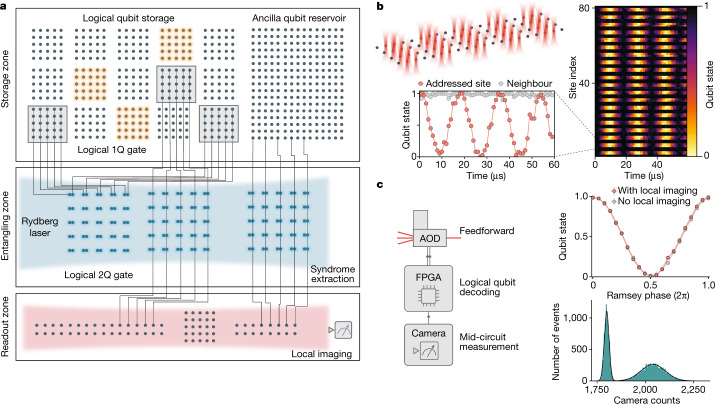
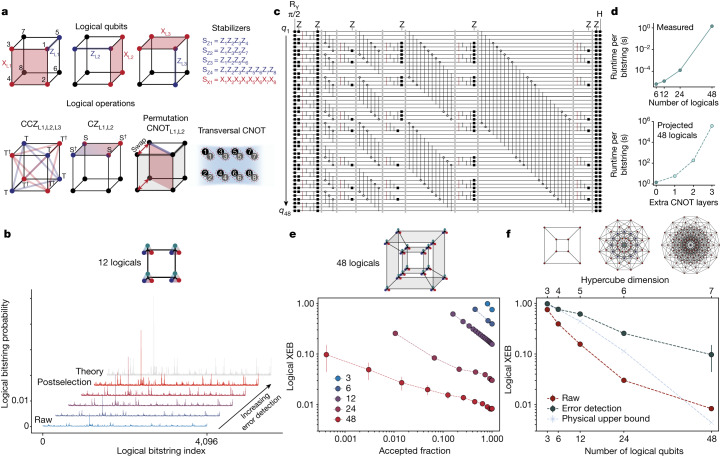
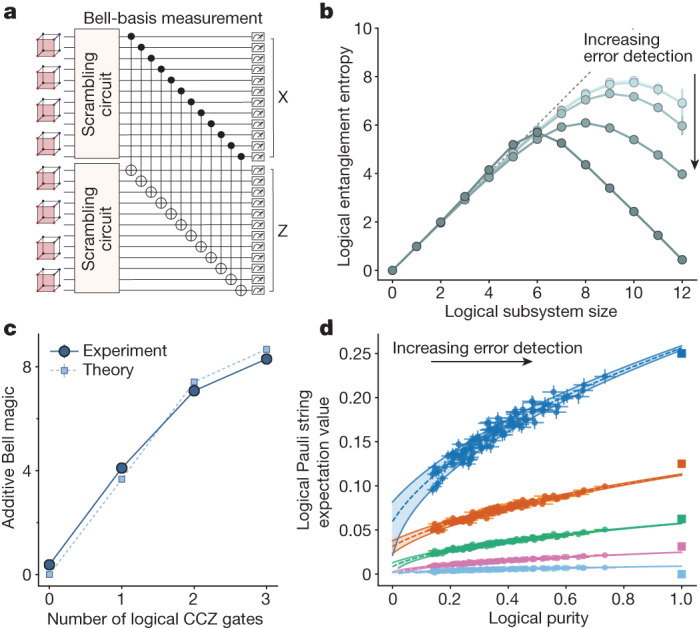
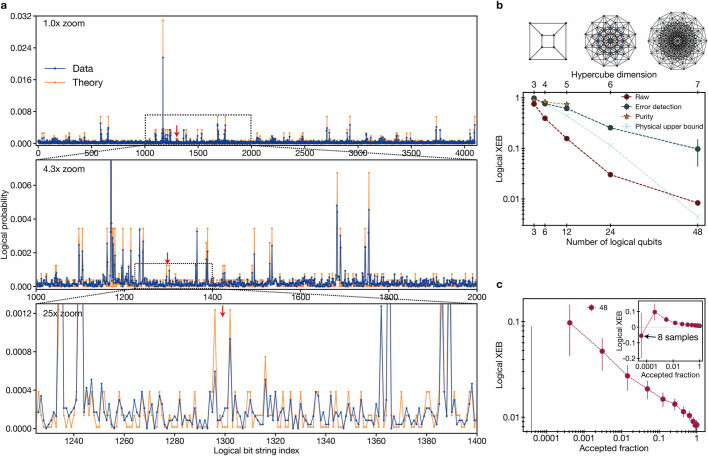
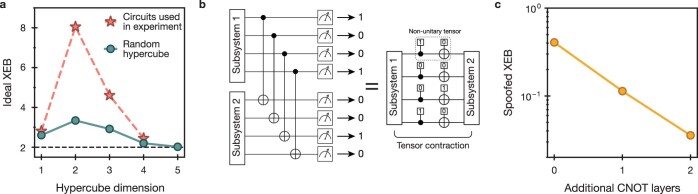
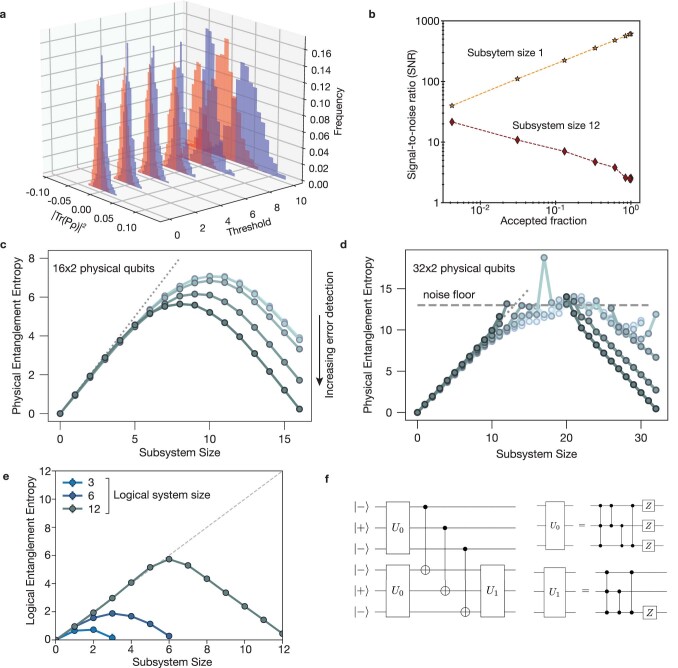
Abstract Suppressing errors is the central challenge for useful quantum computing 1 , requiring quantum error correction (QEC) 2–6 for large-scale processing. However, the overhead in the realization of error-corrected ‘logical’ qubits, in which information is encoded across many physical qubits for redundancy 2–4 , poses substantial challenges to large-scale logical quantum computing. Here we report the realization of a programmable quantum processor based on encoded logical qubits operating with up to 280 physical qubits. Using logical-level control and a zoned architecture in reconfigurable neutral-atom arrays 7 , our system combines high two-qubit gate fidelities 8 , arbitrary connectivity 7,9 , as well as fully programmable single-qubit rotations and mid-circuit readout 10–15 . Operating this logical processor with various types of encoding, we demonstrate improvement of a two-qubit logic gate by scaling surface-code 6 distance from d = 3 to d = 7, preparation of colour-code qubits with break-even fidelities 5 , fault-tolerant creation of logical Greenberger–Horne–Zeilinger (GHZ) states and feedforward entanglement teleportation, as well as operation of 40 colour-code qubits. Finally, using 3D [[8,3,2]] code blocks 16,17 , we realize computationally complex sampling circuits 18 with up to 48 logical qubits entangled with hypercube connectivity 19 with 228 logical two-qubit gates and 48 logical CCZ gates 20 . We find that this logical encoding substantially improves algorithmic performance with error detection, outperforming physical-qubit fidelities at both cross-entropy benchmarking and quantum simulations of fast scrambling 21,22 . These results herald the advent of early error-corrected quantum computation and chart a path towards large-scale logical processors.
Overview
CoChat Summary
TL;DR
The paper reports a programmable logical quantum processor built from reconfigurable neutral-atom arrays, operating with up to 280 physical qubits and using surface codes, colour codes, and 3D [[8,3,2]] codes. Across several demonstrations, logical encoding improved performance for entangling gates, GHZ-state preparation, feedforward teleportation, and complex sampling/quantum-simulation tasks compared with analogous physical-qubit circuits.
Key findings
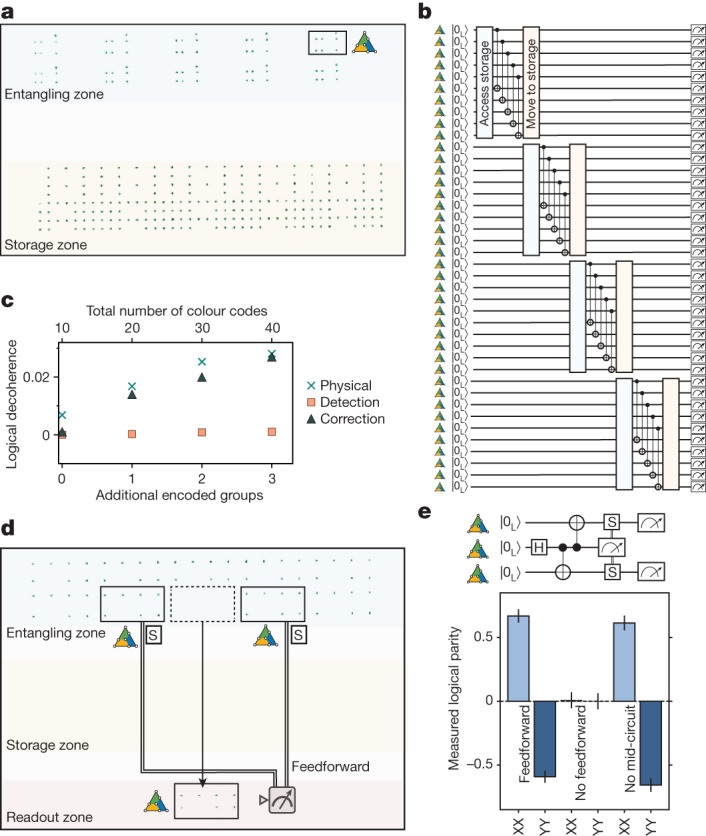
- The processor used up to 280 physical qubits and demonstrated 40 colour-code qubits by repeating a ten-logical-qubit process four times.
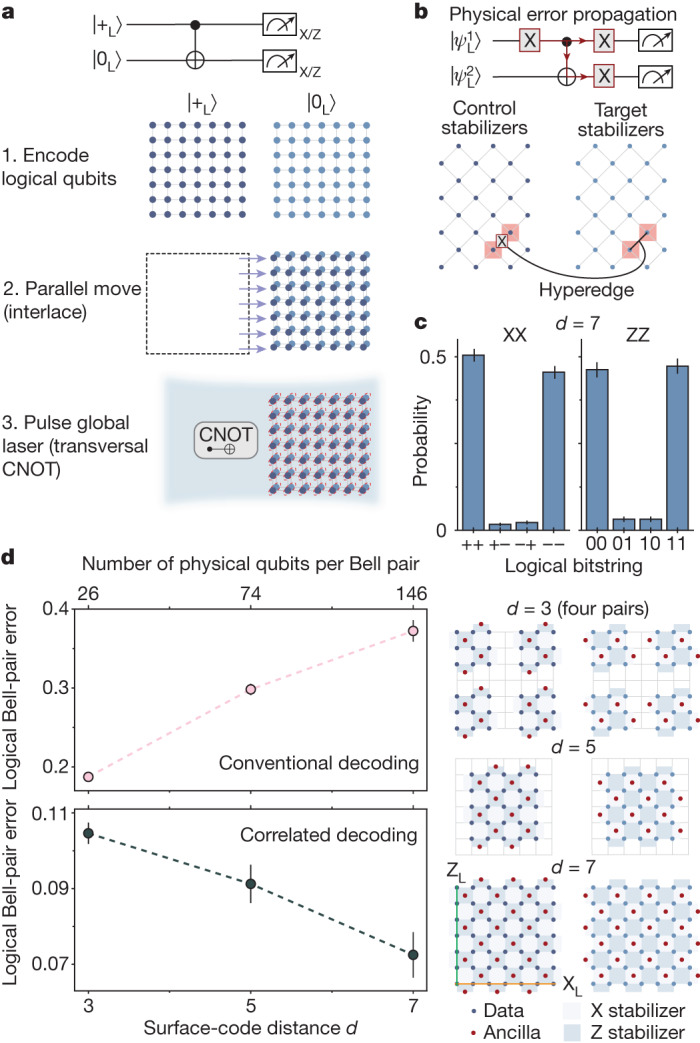
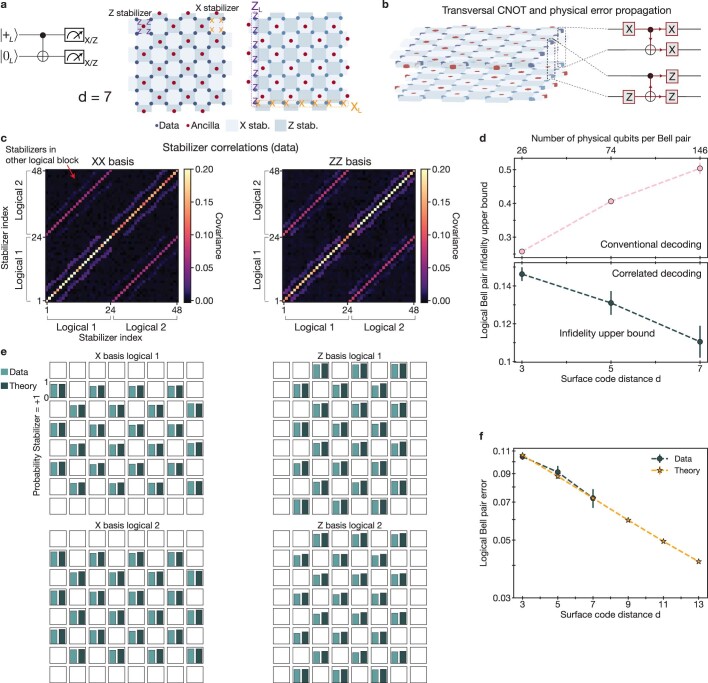
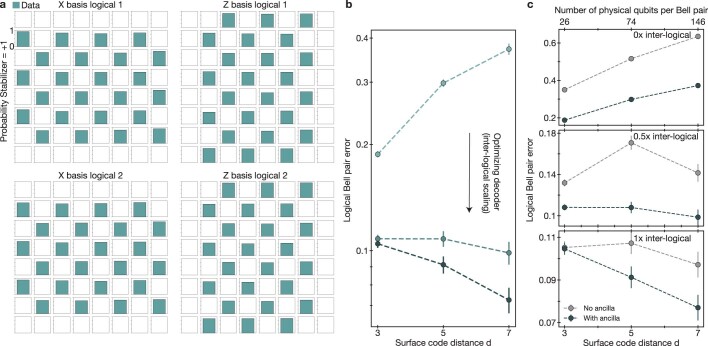
- For a surface-code transversal CNOT, increasing code distance from d = 3 to d = 7 improved the logical Bell pair; with correlated decoding, the authors report roughly 0.95 populations in the XLXL and ZLZL bases for entangled d = 7 logical qubits.
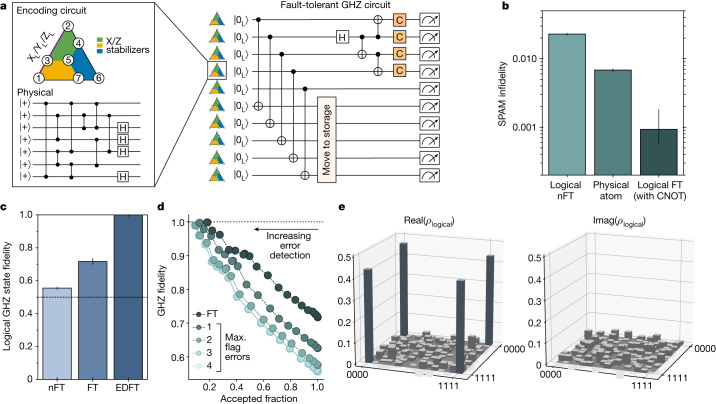
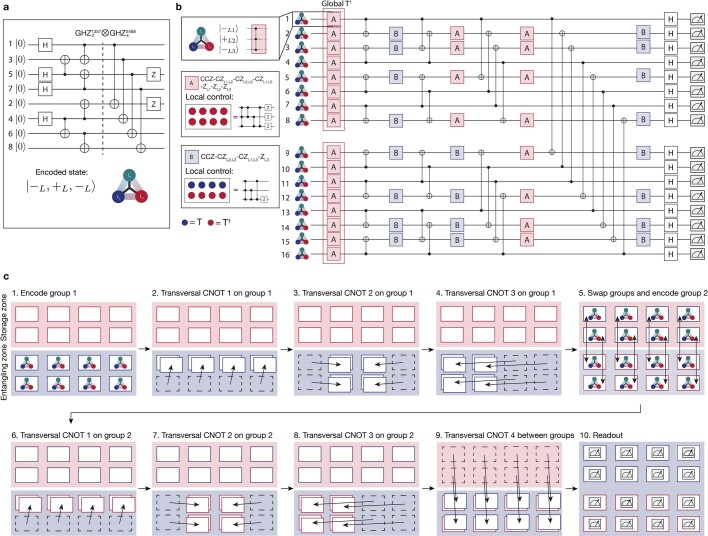
- For fault-tolerant colour-code GHZ preparation, the measured logical GHZ fidelity was 72(2)%; with error-detection/postselection it increased further, and the paper states that discarding 50% of the data improved GHZ fidelity to approximately 90%.
- In complex [[8,3,2]] sampling circuits, the authors realized up to 48 logical qubits, 228 logical two-qubit gates, and 48 logical CCZ gates; the reported XEB for 12 logical qubits increased from 0.156(2) to 0.616(7) with error detection, and for 48 logical qubits the XEB was approximately 0.1.
Methods
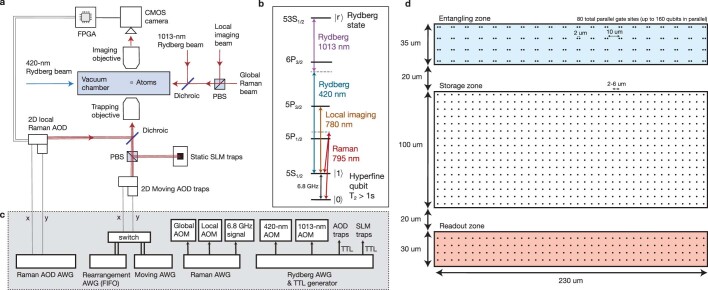
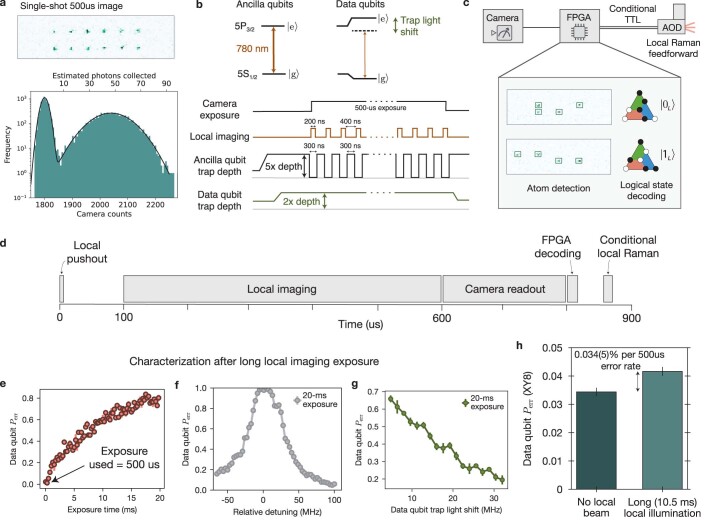
- Experimental platform: reconfigurable arrays of \(^{87}\)Rb atoms in optical tweezers, with zoned architecture for storage, entangling, and readout; the paper states operation with up to 280 atomic qubits, two-qubit gate fidelities of 99.3–99.5%, and local imaging fidelity of around 99.8%.
- Coding and circuits: rotated surface codes (including distance-7), d = 3 colour codes for Clifford algorithms, and 3D [[8,3,2]] codes for non-Clifford sampling circuits; all logical circuits after state preparation are built from transversal gates.
- Analysis: correlated decoding via a decoding hypergraph and mixed-integer programming solved with Gurobi; logical performance was benchmarked using direct fidelity estimation, full tomography, cross-entropy benchmarking (XEB), and two-copy Bell-basis measurements.
Limitations
- The paper states that state preparation is non-fault-tolerant for the d = 5, 7 surface codes and the [[8,3,2]] codes, because only a single round of stabilizer measurement is used.
- It also notes that deep circuits require repetitive error correction to keep benefiting from logical suppression, and that current mid-circuit readout/feedforward takes slightly less than 1 ms, with the authors saying it could be improved toward the 100-μs scale.
- Evident from the text: several reported gains rely on postselection / sliding-scale error detection, which improves fidelity at the cost of acceptance probability and measurement overhead.
Model-written summary. Check it against the paper before relying on it.
Integrity signals
Registry
Cites
Statistics
Figures
Verification
Claims the paper makes
69 Valid · 15 Not valid · 8 Not checked · 160 Own results and interpretations
At least one cited source doesn’t support this claim or points to a different paper, and none confirmed it — see the verdicts below.
In the paper
“However, executing large-scale, useful algorithms on quantum processors requires very low gate error rates (generally below about 10−10)23, far below those that will probably ever be achievable with any physical device2.”
§ Logical quantum processor based on reconfigurable atom arrays > Main
What the sources say
- Disputedcites [23] Gidney C Ekerå M How to factor 2048 bit RSA integers in 8 hours using 20 million noisy qubits Quantum 2021 5 433 10.22331/q-2021-04-15-433 sourceExperimental — accuracy not yet measured
The citation to this paper is attached to the claimed requirement for gate error rates below about 10⁻¹⁰, not to the following statement about what physical devices can achieve. Section 2.16 instead describes a physical gate error rate of 0.1% (10⁻³) as sufficient for surface-code error correction, and Section 2.13 uses that rate in its large-scale factoring estimate. The paper distinguishes physical gate errors from the much lower logical error rates produced by correction. (LLM, conf=0.88)
Checked by a reasoning model — may be wrong.
- Not matchedcites [2] Shor, P. W. in Proc. 37th Conference on Foundations of Computer Science 56–65 (IEEE, 1996).
Its entry has no title and year that we can search by.
hedgedstates a cause- Asserted: passes — The authors put it forward as true.
- Checkable: passes — It can be checked against evidence.
- Load-bearing: passes — The paper’s conclusions depend on it.
- Based: passes — The paper gives a reason why it holds.
- Disputed
At least one cited source doesn’t support this claim or points to a different paper, and none confirmed it — see the verdicts below.
In the paper
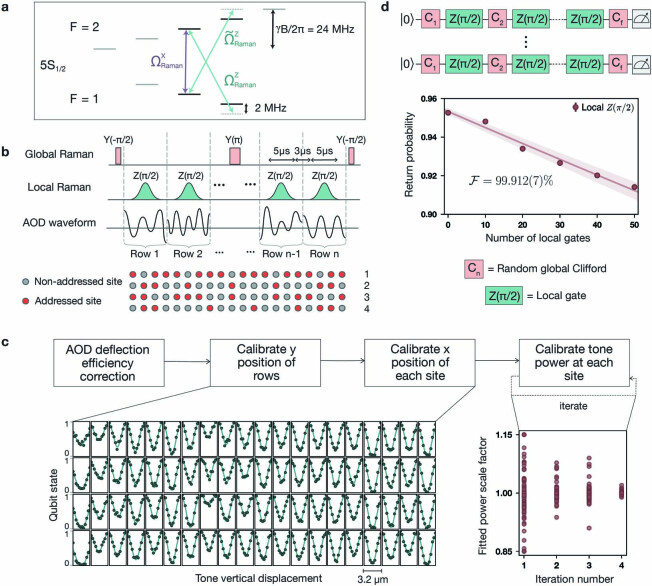
“Fully programmable local single-qubit rotations are realized through qubit-specific, parallel Raman excitation through an additional 2D AOD (ref. 34) (Fig. 1b and Extended Data Fig. 2).”
§ Logical quantum processor based on reconfigurable atom arrays > Logical processor based on atom arrays
What the sources say
- Disputedcites [34] Graham TM Multi-qubit entanglement and algorithms on a neutral-atom quantum computer Nature 2022 604 457 462 10.1038/s41586-022-04603-6 35444321 sourceExperimental — accuracy not yet measured
The Methods (p. 10) say site-selective single-qubit rotations combine global microwave rotations with local 459 nm Stark-shift phase gates, rather than using parallel Raman excitation. The Methods (p. 10) describe crossed AODs for pointing Rydberg beams at two sites simultaneously, not an additional 2D AOD for local Raman rotations. (LLM, conf=0.88)
Checked by a reasoning model — may be wrong.
plainstates a cause- Asserted: passes — The authors put it forward as true.
- Checkable: passes — It can be checked against evidence.
- Load-bearing: passes — The paper’s conclusions depend on it.
- Based: passes — The paper gives a reason why it holds.
- Disputed
The cited sources support only part of this claim — read each source’s verdict below.
In the paper
“Using logical-level control and a zoned architecture in reconfigurable neutral-atom arrays7, our system combines high two-qubit gate fidelities8, arbitrary connectivity7,9, as well as fully programmable single-qubit rotations and mid-circuit readout10–15.”
§ Logical quantum processor based on reconfigurable atom arrays > Abstract
What the sources say
- Supportedcites [10] Deist E Mid-circuit cavity measurement in a neutral atom array Phys. Rev. Lett. 2022 129 203602 10.1103/PhysRevLett.129.203602 36462020 source
The paper describes its method as mid-circuit readout in a neutral-atom array (p. 1). It also reports performing a mid-circuit measurement on one atom during a two-atom quantum circuit (p. 4), supporting the cited readout capability. (LLM, conf=0.92)
- Supportedcites [11] Singh K Mid-circuit correction of correlated phase errors using an array of spectator qubits Science 2023 380 1265 1269 10.1126/science.ade5337 37228222 source
The INTRODUCTION states that 'During logic operations on the data qubits, midcircuit readouts on the array of ~60 spectator qubits enable single-shot estimation of globally correlated phase errors,' with readouts that 'do not disturb the coherence of the data qubits.' The Methods section 'Mid-circuit readout of atomic qubits' and '3. Quantifying discrimination fidelity of the mid-circuit readout' report the 15 ms MCR with discrimination fidelity 0.989(5), and '2. Real-time processing and feedback' describes the real-time imaging and feedback chain, so the cited system demonstrably possesses mid-circuit readout. The DISCUSSION lists mid-circuit readout among the quantum-control techniques demonstrated, and also documents single-qubit manipulation via IQ-modulated global microwave pulses supporting the adjacent part of the sentence. (LLM, conf=0.90)
- Supportedcites [12] Graham, T. M. et al. Midcircuit measurements on a single-species neutral alkali atom quantum processor. Phys. Rev. X13, 041051 (2023). source
The paper’s “A. Midcircuit measurement” section describes a five-step procedure that includes state-selective readout of ancilla atoms during the circuit. It therefore supports the cited claim that mid-circuit readout is available in a neutral-atom processor. (LLM, conf=0.92)
- Partly supportedcites [13] Ma S High-fidelity gates and mid-circuit erasure conversion in an atomic qubit Nature 2023 622 279 284 10.1038/s41586-023-06438-1 37821593 sourceExperimental — accuracy not yet measured
The paper reports mid-circuit imaging to detect atoms that have decayed to the ground state (Abstract; page unavailable). But it says its demonstrated detection protocol *could be adapted* to mid-circuit qubit readout; it does not report demonstrating that readout. Thus it supports mid-circuit erasure detection, not the full readout attributed to it. (LLM, conf=0.87)
- Supportedcites [14] Lis, J. W. et al. Midcircuit operations using the omg architecture in neutral atom arrays. Phys. Rev. X13, 041035 (2023). source
The Introduction states that the paper demonstrates midcircuit state readout of ancilla qubits. This supports the cited claim that mid-circuit readout is a capability demonstrated in neutral-atom arrays. (LLM, conf=0.92)
- Supportedcites [15] Norcia, M. A. et al. Midcircuit qubit measurement and rearrangement in a 171Yb atomic array. Phys. Rev. X13, 041034 (2023). source
Section IV (Correction of Atom Loss) reports using the results of a midcircuit measurement to correct ancilla-qubit loss while maintaining data-qubit coherence. Appendix B also describes the array's midcircuit measurement results. These passages support the citation for mid-circuit readout. (LLM, conf=0.90)
plain- Asserted: passes — The authors put it forward as true.
- Checkable: passes — It can be checked against evidence.
- Load-bearing: passes — The paper’s conclusions depend on it.
- Based: passes — The paper gives a reason why it holds.
- Supported
The cited sources support only part of this claim — read each source’s verdict below.
In the paper
“Operating this logical processor with various types of encoding, we demonstrate improvement of a two-qubit logic gate by scaling surface-code6 distance from d = 3 to d = 7, preparation of colour-code qubits with break-even fidelities5, fault-tolerant creation of logical Greenberger–Horne–Zeilinger (GHZ) states and feedforward entanglement teleportation, as well as operation of 40 colour-code qubit”
§ Logical quantum processor based on reconfigurable atom arrays > Abstract
What the sources say
- Partly supportedcites [6] Google Quantum AI Suppressing quantum errors by scaling a surface code logical qubit Nature 2023 614 676 681 10.1038/s41586-022-05434-1 36813892 PMC9946823 sourceExperimental — accuracy not yet measured
The Main section reports improved logical-qubit performance when scaling a surface code from d = 3 to d = 5. The ‘Surface codes with superconducting qubits’ section says the experiment focuses on preserving logical memory; it does not report improving a two-qubit logical gate or scaling to d = 7. Page numbers are not available in our copy. (LLM, conf=0.88)
boostedstates a cause- Asserted: passes — The authors put it forward as true.
- Checkable: passes — It can be checked against evidence.
- Load-bearing: passes — The paper’s conclusions depend on it.
- Based: passes — The paper gives a reason why it holds.
- Partly supported
The cited sources support only part of this claim — read each source’s verdict below.
In the paper
“Operating this logical processor with various types of encoding, we demonstrate improvement of a two-qubit logic gate by scaling surface-code6 distance from d = 3 to d = 7, preparation of colour-code qubits with break-even fidelities5, fault-tolerant creation of logical Greenberger–Horne–Zeilinger (GHZ) states and feedforward entanglement teleportation, as well as operation of 40 colour-code qubit”
§ Logical quantum processor based on reconfigurable atom arrays > Abstract
What the sources say
- Partly supportedcites [5] Ryan-Anderson, C. et al. Implementing fault-tolerant entangling gates on the five-qubit code and the color code. Preprint at https://arxiv.org/abs/2208.01863 (2022). sourceExperimental — accuracy not yet measured
The opening summary (p. 1) reports that fault-tolerant colour-code state-preparation-and-measurement fidelities exceeded average physical-qubit SPAM fidelities. But Section III (p. 8) explicitly says the experiments did not achieve the break-even point; it describes the higher logical fidelity as a milestone toward it. The claim is supported as a comparison of preparation-and-measurement fidelities, not as a demonstration of break-even operation. (LLM, conf=0.86)
boosted- Asserted: passes — The authors put it forward as true.
- Checkable: passes — It can be checked against evidence.
- Load-bearing: passes — The paper’s conclusions depend on it.
- Based: passes — The paper gives a reason why it holds.
- Partly supported
130 more claims · 39 with their cited sources checked
Create a free account to see all 252 claims and to verify the 1 reference still open.
- It may state two separate claims as one. 89
- Probably not a substantial claim. 40
- The quote only partly states this claim. 2
Claims other papers make about this one
Each is checked against this paper’s own text: does it say what the citing paper says it does?
The cited source doesn’t support the claim as written.
In the citing paper
“Although many platforms have demonstrated different features of quantum error correction14–20, no quantum processor has definitively shown below-threshold performance.”
From Quantum error correction below the surface code threshold (2025) · cites this paper as [18]
Checked by a reasoning model — may be wrong.
Experimental — accuracy not yet measuredThe source backs part of the claim, not all of it — or backs it for a different population, condition or comparison.
In the citing paper
“As a result, error suppression by increasing the colour code size has not yet been demonstrated, to our knowledge, on any experimental platform.”
From Scaling and logic in the colour code on a superconducting quantum processor (2025) · cites this paper as [18]
Experimental — accuracy not yet measuredThe cited source says what the claim attributes to it.
In the citing paper
“Recently, QEC experiments have been performed in various hardware platforms, including superconducting quantum circuits25–28, trapped ions29 and neutral atoms30.”
From Hardware-efficient quantum error correction via concatenated bosonic qubits (2025) · cites this paper as [30]
The cited source says what the claim attributes to it.
In the citing paper
“The smallest instance of the colour code, the Steane code37, has been implemented with trapped ions11,12 and neutral atoms18, demonstrating logical operations and logical circuits13–19.”
From Scaling and logic in the colour code on a superconducting quantum processor (2025) · cites this paper as [18]
Citations
Cites
Quantum Computing in the NISQ era and beyond
Preskill, J. (2018) · Quantum · doi:10.22331/q-2018-08-06-79 · Cited by 8,830 · cited 1×
“The storage zone is used for dense qubit storage, free from entangling-gate errors and featuring long coherence times.”
BackgroundQuantum supremacy using a programmable superconducting processor
Arute, F., Arya, K., Babbush, R., Bacon, D., Bardin, J. C., Barends, R., Biswas, R., Boixo, S., Brandao, F. G. S. L., Buell, D. A., et al. (2019) · Nature · doi:10.1038/s41586-019-1666-5 · Cited by 7,720 · cited 3×
“70), has an improved Raman scattering contribution and is faster (roughly 1 μs duration).”
BackgroundMethodScheme for reducing decoherence in quantum computer memory
Shor, P. W. (1995) · Physical Review A · doi:10.1103/physreva.52.r2493 · Cited by 4,479 · cited 1×
“Distance-3 codes, which are of notable historical importance 3,87 , can correct any weight-1 error.”
BackgroundSurface codes: Towards practical large-scale quantum computation
Fowler, A. G., Mariantoni, M., Martinis, J. M., & Cleland, A. N. (2012) · Physical Review A · doi:10.1103/physreva.86.032324 · Cited by 3,059 · cited 10×
“Mid-circuit X-basis measurement of the middle logical creates by applying a logical S gate to the first and third logicals conditioned in real time on the state of the middle logical, akin to the magic-state-teleportation circuit 24 .”
BackgroundMethodInfluentialQuantum computational advantage using photons
Zhong, H.-S., Wang, H., Deng, Y.-H., Chen, M.-C., Peng, L.-C., Luo, Y.-H., Qin, J., Wu, D., Ding, X., Hu, Y., et al. (2020) · Science · doi:10.1126/science.abe8770 · Cited by 2,405
Dennis, E., Kitaev, A., Landahl, A., & Preskill, J. (2002) · Journal of Mathematical Physics · doi:10.1063/1.1499754 · Cited by 1,768 · cited 6×
“6, which can be understood as preparing two four-qubit GHZ states (corresponding to [[4,2,2]] codes 95 ), that is, GHZ ⊗GHZ , and subsequently entangling them as illustrated in Extended Data Fig.”
BackgroundInfluentialFast Quantum Gates for Neutral Atoms
Jaksch, D., Cirac, J. I., Zoller, P., Rolston, S. L., Côté, R., & Lukin, M. D. (2000) · Physical Review Letters · doi:10.1103/physrevlett.85.2208 · Cited by 1,540 · cited 2×
“Nota-bly, owing to the use of the Rydberg blockade 32,68 , the gate is largely independent of the exact distance between atoms.”
BackgroundMethodSelf-citationImproved simulation of stabilizer circuits
Aaronson, S., & Gottesman, D. (2004) · Physical Review A · doi:10.1103/physreva.70.052328 · Cited by 1,515 · cited 2×
“For instance, when using 2D codes such as the surface code, non-Clifford operations cannot be easily performed 37 , and relatively expensive techniques are required for nontrivial computation 24,43 , as Clifford circuits can be easily simulated 44 .”
BackgroundMethodDennis, E., Kitaev, A., Landahl, A., & Preskill, J. (2001) · CERN Document Server (European Organization for Nuclear Research) · Cited by 1,485
Multiple-particle interference and quantum error correction
(1996) · Proceedings of the Royal Society of London. Series A: Mathematical, Physical and Engineering Sciences · doi:10.1098/rspa.1996.0136 · Cited by 1,284 · cited 10×
“We use 2D d = 3 colour codes 3,37 , which are topological codes akin to the surface code, but with the useful capability of trans-versal operations of the full Clifford group: Hadamard (H), π/2 phase (S) gate and CNOT (ref.”
BackgroundMethodInfluential
Research works printed but not linked: 2
- Shor, P. W. in Proc. 37th Conference on Foundations of Computer Science 56–65 (IEEE, 1996).
- Patterson, D. A. & Hennessy, J. L. Computer Organization and Design: The Hardware/Software Interface. RISC-V Edition (Morgan Kaufmann, 2018).
Cited by
Items 701–800 of 1,108
High-fidelity and robust single-qubit gate on a neutral atom using transitionless quantum driving
Liu, P.-C., Guo, A.-L., Wu, H., Feng, G.-P., Song, T., Guo, L., Li, B., Xie, Q., Xiong, Z.-Y., Dong, Y., et al. (2025) · Zhongguó wùli xuékan · doi:10.1016/j.cjph.2025.09.008 · Cited by 1
Hardness of measuring magic resource
Garcia, R. J., Bhole, G., Bu, K., Chen, L., Arthanari, H., & Jaffe, A. (2025) · Physical Review Research · doi:10.1103/qcqv-3ym8 · Cited by 9
Photonic processor benchmarking for variational quantum process tomography
Galetsky, V., Kohl, P. R., & Nötzel, J. (2025) · New Journal of Physics · doi:10.1088/1367-2630/ae0ea9 · Cited by 2
Yamada, S., Kobayashi, T., Takahata, M., Nitta, H., Isobe, H., Kawakami, T., Yamanaka, S., Okumura, M., & Yamaguchi, K. (2025) · Chemistry · doi:10.3390/chemistry7050164 · Cited by 3
Fault-tolerant interfaces for modular quantum computing on diverse qubit platforms
Marqversen, F. K., Baranes, G., Sirotin, M. A., & Borregaard, J. (2026) · Physical Review Research · doi:10.1103/ds45-fm9n · Cited by 15
Attention to quantum complexity
Kim, H., Zhou, Y., Xu, Y., Varma, K., Karamlou, A. H., Rosen, I. T., Hoke, J. C., Wan, C., Zhou, J. P., Oliver, W. D., et al. (2025) · Science Advances · doi:10.1126/sciadv.adu0059 · Cited by 15
Transfer of quantum-enhanced information through a many-body system
Wysocki, P., Płodzień, M., & Chwedeńczuk, J. (2025) · Physical Review A · doi:10.1103/3z4c-svn1 · Cited by 1
Reciprocal Floquet thermalization in a one-dimensional Rydberg atom array
He, Y., Jiao, Y., Zhao, J., & Li, W. (2026) · Physical review. B./Physical review. B · doi:10.1103/3gpm-9psv · Cited by 2
Symmetric Channel Verification for Purifying Noisy Quantum Channels
Tsubouchi, K., Mitsuhashi, Y., Takagi, R., & Yoshioka, N. (2025) · PRX Quantum · doi:10.1103/jcd6-lft3 · Cited by 8
Unfolded distillation: very low-cost magic state preparation for biased-noise qubits
Ruiz, D., Guillaud, J., Vuillot, C., & Mirrahimi, M. (2026) · npj Quantum Information · doi:10.1038/s41534-026-01197-z · Cited by 20
Bell Sampling in Quantum Monte Carlo Simulations
Tarabunga, P. S., & Ding, Y.-M. (2025) · Physical Review Letters · doi:10.1103/fq8z-y55j · Cited by 7
Frequency-Noise-Insensitive Universal Control of Kerr-Cat Qubits
Seifert, L. M., Hann, C. T., & Noh, K. (2025) · Physical Review Letters · doi:10.1103/fyft-6kqg · Cited by 2
Bayesian mitigation of measurement errors in multiqubit experiments
Cosco, F., Plastina, F., & Gullo, N. L. (2025) · Physical Review A · doi:10.1103/d65d-x8lt · Cited by 5
Thapliyal, D., Das, I. K., & Wasan, A. (2025) · Physical Review A · doi:10.1103/4pzb-9nlg · Cited by 1
Scalable low-overhead superconducting nonlocal coupler for circuit connectivity enhancement
Xiong, H., Wang, J.-H., Song, J., Yang, J., Bao, Z., Li, Y., Mi, Z., Zhang, H., Yu, H., Song, Y., et al. (2026) · Physical Review Applied · doi:10.1103/kfy3-bwgr · Cited by 13
Planar Fault-Tolerant Circuits for Non-Clifford Gates on the 2D Color Code
Bauer, A., & de la Fuente, J. C. M. (2026) · PRX Quantum · doi:10.1103/p7c9-x1m9 · Cited by 29
Cloutman, M., Chilcott, M., Elliott, A., Otto, J. S., Deb, A. B., & Kjærgaard, N. (2026) · Physical Review Research · doi:10.1103/gcms-2yhg · Cited by 7
Post-measurement quantum Monte Carlo
Baweja, K., Luitz, D. J., & Garratt, S. J. (2025) · Physical review. B./Physical review. B · doi:10.1103/2tx2-7z18 · Cited by 13
Routing-Aware Placement for Zoned Neutral Atom-based Quantum Computing
Stade, Y., Lin, W.-H., Cong, J., & Wille, R. (2025) · 2025 IEEE/ACM International Conference On Computer Aided Design (ICCAD) · doi:10.1109/iccad66269.2025.11240721 · Cited by 20
decoder-bench: Benchmarking Decoders for Quantum Error Correction
Maurya, S., Viszlai, J., Raveendran, N., Das, P., & Tannu, S. (2025) · IEEE International Symposium on Workload Characterization · doi:10.1109/iiswc66894.2025.00032 · Cited by 8
Tailoring interaction ranges in atom arrays
Botzung, T., Creutzer, G., Sayrin, C., & Schachenmayer, J. (2026) · Physical Review Research · doi:10.1103/xk9t-jhq8 · Cited by 1
Mitarai, H., Tadokoro, Y., & Tanaka, H. (2026) · Physical Review Applied · doi:10.1103/fmqf-w6ht · Cited by 5
Quantum sequel of neural network training
Zhang, H., & Kamenev, A. (2025) · Communications Physics · doi:10.1038/s42005-025-02384-8 · Cited by 7
Superresolution optical trapping of multiple cold atoms
Lim, K. M. H., Mançois, V., Wu, H., Shen, Y., & Wilkowski, D. (2025) · Physical Review A · doi:10.1103/nj9v-gvzb · Cited by 2
Fault-tolerant quantum computation without distillation on a 2D device
Scruby, T. R., Nemoto, K., & Cai, Z. (2025) · npj Quantum Information · doi:10.1038/s41534-025-01133-7 · Cited by 8
Orchestrating Multi-Zone Shuttling in Trapped-Ion Quantum Computers
Schoenberger, D., & Wille, R. (2025) · IEEE International Conference on Quantum Computing and Engineering (QCE) · doi:10.1109/qce65121.2025.00119 · Cited by 7
Coniq: Enabling Concatenated Quantum Error Correction on Neutral Atom Arrays
Liu, P., Xu, M., Zhou, H.-Y., Wang, H., Acar, U. A., & Shi, Y. (2025) · International Conference on Quantum Computing and Engineering · doi:10.1109/qce65121.2025.00073 · Cited by 9
Self-citationQuantum Process Tomography with Digital Twins of Error Matrices
Huang, T., Gaikwad, A., Moskalenko, I. N., Aggarwal, A., Abad, T., Kuzmanović, M., Chang, Y.-H., Stanisavljević, O., Hogedal, E., Warren, C., et al. (2025) · Physical Review Letters · doi:10.1103/dpgy-rtxr · Cited by 11
Symplectic Rank of Non-Gaussian Quantum States
Mele, F. A., Oliviero, S. F. E., Upreti, V., & Chabaud, U. (2026) · PRX Quantum · doi:10.1103/1rtk-1jsn · Cited by 22
Multiqubit Rydberg Gates for Quantum Error Correction
Locher, D. F., Old, J., Brechtelsbauer, K., Holschbach, J., Büchler, H. P., Weber, S., & Müller, M. (2026) · PRX Quantum · doi:10.1103/j8fm-24cf · Cited by 11
Keller, T., Kikura, S., Asaoka, R., Suzuki, Y., Tokunaga, Y., & Aoki, T. (2026) · Journal of the Optical Society of America B · doi:10.1364/josab.578833 · Cited by 1
Fidelity relations in an array of neutral atom qubits: Experimental validation of control noise
van Rensburg, D. J., de Keijzer, R., Venderbosch, R., van der Werf, Y., Mellado, J. D. P., Lous, R. S., Vredenbregt, E. J. D., & Kokkelmans, S. J. J. M. F. (2025) · Physical Review A · doi:10.1103/66zh-yt9d · Cited by 2
Efficient and High-Fidelity Entanglement in Cavity QED without High Cooperativity
Goswami, S., Chien, C.-H., Sinclair, N., Grinkemeyer, B., Bennetts, S., Chen, Y.-C., & Jen, H. H. (2026) · Physical Review Letters · doi:10.1103/n9wg-k6q9 · Cited by 4
Generative flow-based warm start of the variational quantum eigensolver
Zou, H., Rahm, M., Kockum, A. F., & Olsson, S. (2025) · npj Quantum Information · doi:10.1038/s41534-025-01159-x · Cited by 8
Low-Crosstalk, Silicon-Fabricated Optical Waveguides for Laser Delivery to Matter Qubits
Craft, C. L., Barton, N. J., Klug, A., Scalzi, K., Wildemann, I., Asagodu, P., Broz, J. D., Porto, N. L., Macalík, M., Rizzo, A. J., et al. (2024) · Physical Review Applied · doi:10.1103/jgks-dss2 · Cited by 5
Toward Self-Correcting Quantum Codes for Neutral Atom Arrays
Guo, J., Hong, Y., Kaufman, A. M., & Lucas, A. (2026) · PRX Quantum · doi:10.1103/mfmt-fwkg · Cited by 13
Mittenbühler, M., Sturm, L., Schlosser, M., & Birkl, G. (2025) · Physical Review Applied · doi:10.1103/d3tx-3tg8 · Cited by 2
Universal Properties of Critical Mixed-States from Measurement and Feedback
Zhang, Z., Zou, Y., Hsieh, T. H., & Vijay, S. (2025) · PRX Quantum · doi:10.1103/66zv-8k1t · Cited by 11
Scalable Decoding Protocols for Fast Transversal Logic in the Surface Code
Turner, M. L., Campbell, E. T., Crawford, O., Gillespie, N. I., & Camps, J. (2026) · PRX Quantum · doi:10.1103/nx6p-hjqy · Cited by 28
Nonparaxial effects on laser-qubit operations
Gallagher, L. P. H., Mazzanti, M., Ackerman, Z. E. D., Safavi-Naini, A., Gerritsma, R., & Spreeuw, R. J. C. (2026) · Physical Review Research · doi:10.1103/4ylp-h3qr · Cited by 2
About Implementation of Magic State Injection in Heavy-Hexagon Structure
Kim, H., Choi, W., & Kwon, Y. (2025) · Mathematics · doi:10.3390/math13233874 · Cited by 2
Yu, Z. Y., Xu, J. P., Zhu, C. J., Bai, Z. Y., & Yang, Y. P. (2025) · Physical Review Research · doi:10.1103/3v2q-7g6r · Cited by 1
Fan, Q., Yang, P., Xu, D., Ren, C., Ren, P., Wang, Z., Zhang, P., Li, G., & Zhang, T. (2026) · Optics Express · doi:10.1364/oe.580705 · Cited by 2
Optimal compilation strategies for QFT circuits in neutral-atom quantum computing
Gao, D.-C., Li, Y.-M., Ying, S.-G., & Li, S. (2025) · Scientific Reports · doi:10.1038/s41598-025-32572-z · Cited by 4
Self-citationFragmented quantum phases in the antiblockade regime of a Rydberg atom array
Chen, H.-C., Zhang, Z. D., Zhou, M. R., Liu, X., Zhang, L.-H., Liu, B., Wang, L.-X., Ding, D.-S., & Shi, B.-S. (2026) · Physical review. B./Physical review. B · doi:10.1103/bnr2-77yc · Cited by 3
QUITS: A modular Qldpc code circUIT Simulator
Kang, M., Lin, Y., Yao, H., Gökduman, M., Meinking, A., & Brown, K. R. (2025) · Quantum · doi:10.22331/q-2025-12-05-1931 · Cited by 19
Non-Clifford Gates between Stabilizer Codes via Non-Abelian Topological Order
Sajith, R., Song, Z., Roberts, B., Menon, V., & Li, Y. (2026) · PRX Quantum · doi:10.1103/qttm-y8t1 · Cited by 19
Generating Compilers for Qubit Mapping and Routing
Molavi, A., Xu, A., Cecchetti, E., Tannu, S., & Albarghouthi, A. (2026) · Proceedings of the ACM on Programming Languages · doi:10.1145/3776720 · Cited by 12
Experimental study of magnetically insensitive transitions in an ultracold Fermi gas of 40
Shan, B., Huang, L.-H., Yang, Y.-J., Zhao, Y.-H., Shen, J.-H., Ye, Z.-X., Chen, L.-C., Meng, Z.-M., Wang, P.-J., Han, W.-F., et al. (2026) · Physical Review A · doi:10.1103/jk8m-snjw
Linear Array of Blue-Detuned Optical Nanotraps in a Dielectric Nanohole
Климов, В. В. (2025) · Journal of Experimental and Theoretical Physics Letters · doi:10.1134/s0021364025608681 · Cited by 1
High Rate Magic State Cultivation on the Surface Code
Vaknin, Y., Jacoby, S., Grimsmo, A. L., & Retzker, A. (2026) · PRX Quantum · doi:10.1103/p8tw-6kq9 · Cited by 67
Crystal Symmetry-Driven Spin-Optical Dynamics in Cr 3+ Molecular Spins
Wojnar, M. K., Johnson, D. A., Badding, C. K., Quan, Y., Dzikovski, B. G., & Freedman, D. E. (2026) · Inorganic Chemistry · doi:10.1021/acs.inorgchem.5c04986 · Cited by 1
Quantum benchmarking of high-fidelity noise-biased operations on a detuned Kerr-cat qubit
Qing, B., Hajr, A., Wang, K., Koolstra, G., Nguyen, L. B., Hines, J., Huang, I., Bhandari, B., Chen, L., Kang, Z., et al. (2026) · Proceedings of the National Academy of Sciences · doi:10.1073/pnas.2520479123 · Cited by 20
Chen, Z., Chen, M.-C., Lu, C., & Pan, J.-W. (2026) · Physical Review Letters · doi:10.1103/m7tq-9v3g · Cited by 46
No-Go Theorems for Universal Quantum State Purification via Classically Simulable Operations
He, K., Zhu, C., Yao, H., Liu, J.-G., Li, Y., & Wang, X. (2026) · Physical Review Letters · doi:10.1103/bdw8-k91v · Cited by 9
A Short Introduction to Quantum Error Correction
Guedes, T. (2026) · Brazilian Journal of Physics · doi:10.1007/s13538-026-02007-9 · Cited by 2
Detecting genuine multipartite entanglement in multi-qubit devices with restricted measurements
Li, N. K. H., Dai, X., Muñoz-Arias, M. H., Reuer, K., Huber, M., & Friis, N. (2026) · Nature Communications · doi:10.1038/s41467-026-69320-4 · Cited by 13
Auxiliary-Free Replica Shadows: Efficient Estimation of Multiple Nonlinear Quantum Properties
Liu, Q. Y., Li, Z., Yuan, X., Zhu, H., & Zhou, Y. (2026) · Physical Review Letters · doi:10.1103/5khs-7dyz · Cited by 25
Experimental Quantum Channel Purification
Fei, Y.-Y., Liu, Z., Zhang, R., Cai, Z., Yin, X.-F., Mao, Y., Li, L., Liu, N.-L., Chen, Y.-A., & Pan, J.-W. (2026) · Physical Review Letters · doi:10.1103/t8qx-hvz7 · Cited by 3
Simulating fermions with a digital quantum computer
Chien, R. W., Chiew, M., Harrison, B., Necaise, J., Wang, W., Mudassar, M., McLauchlan, C., Henderson, T. M., Scuseria, G. E., Strelchuk, S., et al. (2026) · Nature Reviews Physics · doi:10.1038/s42254-025-00914-5 · Cited by 12
Demonstration of high-fidelity entangled logical qubits using transmons
Vezvaee, A., Tripathi, V., Morford-Oberst, M., Butt, F., Kasatkin, V., & Lidar, D. A. (2026) · Nature Communications · doi:10.1038/s41467-026-70011-3 · Cited by 9
Error resilience of fracton codes and near saturation of code-capacity threshold in three dimensions
Canossa, G., Pollet, L., Martin-Delgado, M. A., Song, H., & Liu, K. (2026) · Physical review. B./Physical review. B · doi:10.1103/2y2z-hgfn · Cited by 5
Magic Tricycles: Efficient Magic-State Generation with Finite Block-Length Quantum LDPC Codes
Menon, V., Ataides, J. P. B., Mehta, R., Gu, A., Tan, D. B., & Lukin, M. D. (2026) · Physical Review X · doi:10.1103/ghhp-cytl · Cited by 45
Self-citationThe Path to Powerful Quantum Computers
Jaques, S. (2026) · IEEE Security and Privacy · doi:10.1109/msec.2026.3652646 · Cited by 1
Quantum Mpemba effect in long-ranged U(1)-symmetric random circuits
Li, H.-Z., Lee, C. H., Liu, S., Zhang, S., & Zhong, J. (2026) · Physical review. B./Physical review. B · doi:10.1103/l4xx-plmv · Cited by 22
Shallow Quantum Circuit for Generating Extremely Low-Entangled Approximate State Designs.
Lee, W., Hhan, M., Cho, G. Y., & Kwon, H. (2025) · Physical Review Letters · doi:10.1103/p966-lcgs
Programmable Assembly of Ground State Fermionic Tweezer Arrays
Jain, N., Zhang, J., Culemann, M., & Preiss, P. M. (2026) · Physical Review Letters · doi:10.1103/fsmh-dz71 · Cited by 13
Parallel Logical Measurements via Quantum Code Surgery
Cowtan, A., He, Z., Williamson, D. J., & Yoder, T. J. (2026) · PRX Quantum · doi:10.1103/gj8x-n5gg · Cited by 80
Fast quantum gates for neutral atoms separated by a few tens of micrometers
Bergonzoni, M., Riso, R. R., & Pupillo, G. (2026) · Physical Review Research · doi:10.1103/hjrh-4327 · Cited by 8
Fold-transversal surface code cultivation
Sahay, K., Tsai, P.-K., Chang, K., Su, Q. D., Smith, T. B., Singh, S., & Puri, S. (2026) · PRX Quantum · doi:10.1103/gpvl-lg4c · Cited by 92
Quantum Science with Arrays of Metastable Helium-3 Atoms
Li, Z., De, R., Sivakumar, R., Huie, W., Wei, H., Piel, J., Greene, C. H., Hazzard, K. R. A., Yan, Z. Z., & Covey, J. P. (2026) · PRX Quantum · doi:10.1103/hpnb-6ql3 · Cited by 5
Noisy monitored quantum circuits
Liu, S., Jian, S.-K., & Zhang, S. (2026) · Journal of Physics Condensed Matter · doi:10.1088/1361-648x/ae6a58 · Cited by 10
Benchmarking quantum devices beyond classical capabilities
Bistroń, R., Rudziński, M., Kukulski, R., & Życzkowski, K. (2026) · Physical Review A · doi:10.1103/dsjj-stkn · Cited by 3
Neutral atom quantum computing
Pritchard, J. D. (2026) · Contemporary Physics · doi:10.1080/00107514.2026.2675142 · Cited by 3
Improved quantum processor logical error rates via correction and detection
Paetznick, A., Reichardt, B. W., Silva, M. P. D., Ryan-Anderson, C., Aasen, D., Bello‐Rivas, J. M., Campora, J. P., Chao, R., Chernoguzov, A., van Dam, W., et al. (2026) · Nature · doi:10.1038/s41586-026-10628-y · Cited by 30
Device for MHz-rate rastering of arbitrary 2D optical potentials.
Bytyqi, E., Sinclair, J., Ramette, J., & Vuletić, V. (2026) · Optics Letters · doi:10.1364/ol.596039 · Cited by 7
Self-citationChaotic optical fiber communication systems: a comprehensive survey [Invited]
Jiang, L., Feng, J., Zhang, Q., et al. (2026) · Chinese Optics Letters · doi:10.3788/col202624.070003 · Cited by 2
Dynamics of antiferromagnetic dimers in Rydberg atom chains
Kuang, F.-Y., Li, L., & Li, W. (2026) · Physical Review A · doi:10.1103/7z6f-d8yf · Cited by 1
Kim, H., Kim, T., Kim, Y., Lee, H., & Shim, H. (2026) · ACS Nano · doi:10.1021/acsnano.6c05309 · Cited by 2
Robust and efficient quantum reservoir computing with a discrete time crystal
Zhang, D., Li, X., Guo, Y., Yu, H., Jin, Y., & Yin, Z. (2026) · Physical Review Applied · doi:10.1103/w2w9-c944 · Cited by 7
Singh, R., & Suseelan, A. D. (2026) · Electronics · doi:10.3390/electronics15132832 · Cited by 1
Efficient Entanglement Purification Circuit Design for Dual-Species Atom Arrays
Anonymous, Dilley, D., Gonzales, A., Hahn, T. A., White, R., Arnon-Friedman, R., Bernien, H., Saleem, Z. H., & Jiang, L. (2026) · PRX Quantum · doi:10.1103/6j15-7mty · Cited by 4
Singh, S., Kashiwagi, R., Tanji, K., Roga, W., Bhatti, D., Takeoka, M., & Elkouss, D. (2026) · Physical Review Applied · doi:10.1103/6mqy-sd3d · Cited by 6
El agente cuántico: automating quantum simulations
Gustín, I., Calderón, L., Pérez-Sánchez, J. B., Crebolder, C., Gonthier, J. F., Vakili, M. G., Nakamura, Y., Panicker, K., Ramprasad, M., Yin, A., et al. (2026) · Reports on Progress in Physics · doi:10.1088/1361-6633/ae8933 · Cited by 20
Utility-Scale Quantum Computational Chemistry
Castaldo, D., & Reiher, M. (2026) · The Journal of Physical Chemistry Letters · doi:10.1021/acs.jpclett.6c00888 · Cited by 5
Artificial intelligence for representing and characterizing quantum systems
Du, Y., Zhu, Y., Zhang, Y., Hsieh, M.-H., Rebentrost, P., Gao, W., You, Y., Eisert, J., Chiribella, G., Tao, D., et al. (2026) · Nature Reviews Physics · doi:10.1038/s42254-026-00962-5 · Cited by 21
Triboiontronic logic control via dynamic regulation of electrical double layers
Li, X., Kvarnström, C., Ivaska, A. U., & Wei, D. (2026) · Iontronics · doi:10.20517/iontronics.2026.19 · Cited by 2
Fast, continuous, and coherent atom reloading in a neutral-atom qubit array.
Li, Y.-Y., Bao, Y.-C., Peper, M., Li, C.-Y., & Thompson, J. D. (2025) · Science · doi:10.1126/science.adz9952 · Cited by 41
Error crafting in mixed quantum gate synthesis
Yoshioka, N., Akibue, S., Morisaki, H., Tsubouchi, K., & Suzuki, Y. (2025) · npj Quantum Information · doi:10.1038/s41534-025-01032-x · Cited by 10
Feng, T., Yang, P.-F., Fan, Q.-M., Ren, C.-Y., Zhang, P.-F., Li, G., & Zhang, T.-C. (2024) · Acta Optica Sinica · doi:10.3788/aos240573 · Cited by 1
Klusch, M., Lässig, J., & Wilhelm, F. K. (2024) · Künstliche Intell. · doi:10.1007/s13218-024-00873-6 · Cited by 1
Optimal number of stabilizer measurement rounds in an idling surface code patch
Márton, Á., & Asbóth, J. K. (2025) · Quantum · doi:10.22331/q-2025-06-12-1767 · Cited by 9
Near-term applications of superconducting digital quantum simulation
Yao, Y., & Wang, Z. (2024) · Journal of Zhejiang University. Science A · doi:10.1631/jzus.a2400397 · Cited by 1
Geometrical approach to logical qubit fidelities of neutral atom Calderbank–Shor–Steane codes
Postema, J. J., & Kokkelmans, S. J. J. M. F. (2025) · Academia quantum. · doi:10.20935/acadquant7467 · Cited by 4
Assessing the Requirements for Industry Relevant Quantum Computation
Krol, A. M., Erdmann, M., Munro, E., Luckow, A., & Al-Ars, Z. (2024) · IEEE International Conference on Quantum Computing and Engineering (QCE) · doi:10.1109/qce60285.2024.10280 · Cited by 2
Aberration correction of optical dipole-traps array utilizing phase-modulated holographic technique
Parkprom, P., Chattrapiban, N., & Thaicharoen, N. (2025) · Journal of Physics Conference Series · doi:10.1088/1742-6596/2934/1/012018 · Cited by 1
Modeling Musical Knowledge With Quantum Bayesian Networks
Krebs, F., Fürntratt, H., Unterberger, R., & Graf, F. (2024) · International Workshop on Content-Based Multimedia Indexing (CBMI) · doi:10.1109/cbmi62980.2024.10859245 · Cited by 1
Energy-saving fast-forward scaling
Hatomura, T. (2025) · SciPost Physics Core · doi:10.21468/scipostphyscore.8.1.019 · Cited by 3
Deterministic Photonic Entanglement Arising from Non-Abelian Quantum Holonomy
Bhattacharya, A., & Raman, C. (2025) · Physical Review Letters · doi:10.1103/physrevlett.134.080201 · Cited by 3
Quantum computing with trapped ions: principles, achievements, and prospects
Zalivako, I. V., Semenin, N. V., Zhadnov, N. O., Galstyan, K. P., Kamenskikh, P. A., Smirnov, V. N., Evgenyevich, K. A., Leonidovich, S. P., Borisenko, A. S., Anosov, Y. P., et al. (2024) · Uspekhi Fizicheskih Nauk · doi:10.3367/ufnr.2024.12.039884 · Cited by 1
Metadata
- Authors
- Bluvstein, D., Evered, S. J., Geim, A. A., Li, S. H., Zhou, H., Manovitz, T., Ebadi, S., Cain, M., Kalinowski, M., Hangleiter, D., Bonilla Ataides, J. P., Maskara, N., Cong, I., Gao, X., Sales Rodriguez, P., Karolyshyn, T., Semeghini, G., Gullans, M. J., Greiner, M., Vuletić, V., & Lukin, M. D.
- Affiliations
- Harvard University (US)
- Joint Center for Quantum Information and Computer Science (US)
- QuEra Computing (United States) (US)
- Massachusetts Institute of Technology (US)
- Corresponding author
- Lukin, Mikhail D.
- ORCID
- Venue
- Nature
- Published
- 2023-12-06
- Volume
- 626
- Issue
- 7997
- Pages
- 58-65
- ISSN
- 0028-0836 (ISSN-L)
- 1476-4687
- PMC
- PMC10830422
- OpenAlex
- W4389373471
- Semantic Scholar
- 9cac672bb24d6216c2b5728f940e69395d188bdd
- Cited by
- 1,119
- References
- 141
- Citations by year
- 2026: 289 · 2025: 585 · 2024: 245
- FWCI
- 105.58
- Type
- journal article
- Language
- en
- Open access
- hybrid
- doi.org
- Licence
- cc-by
- creativecommons.org/licenses/by/4.0 (tdm)
- creativecommons.org/licenses/by/4.0 (vor)
- Locations
- Nature (publishedVersion, cc-by)
- PubMed Central (publishedVersion, cc-by)
- PubMed (publishedVersion)
- arXiv (Cornell University) (submittedVersion)
- OSTI OAI (U.S. Department of Energy Office of Scientific and Technical Information) (submittedVersion)
- Digital Access to Scholarship at Harvard (DASH) (Harvard University) (submittedVersion, cc-by)
- RePEc: Research Papers in Economics (submittedVersion)
- arXiv (Cornell University)
- Funders
- National Science Foundation (2120757, 1745303, W911NF-20-1-0082)
- U.S. Department of Defense
- U.S. Department of Energy (OMA-2120757, DESC0021110, DESC0020347)
- National Institute of Standards and Technology (OMA-2120757)
- Defense Advanced Research Projects Agency (W911NF2010021)
- Intelligence Advanced Research Projects Activity (W911NF-23-2-0219)
- National Defense Science and Engineering Graduate
- Multidisciplinary University Research Initiative (W911NF2010082)
- Center for Ultracold Atoms, Massachusetts Institute of Technology
- Army Research Office (W911NF-20-1-0082, W911NF2320219, W911NF)
- Topics
- Physical Sciences › Computer Science › Artificial Intelligence › Quantum Computing Algorithms and Architecture
- Physical Sciences › Physics and Astronomy › Atomic and Molecular Physics, and Optics › Quantum Information and Cryptography
- Physical Sciences › Physics and Astronomy › Atomic and Molecular Physics, and Optics › Cold Atom Physics and Bose-Einstein Condensates
- Keywords
- logical qubits, quantum error correction, surface code, color codes, neutral-atom quantum processors, entanglement teleportation, quantum scrambling, programmable quantum processors
About these checks
Registry, retraction, Cites and statistics results are computed, not judged, with one exception: a printed reference that no index lists is read once by a model before it counts as a citation error. Claims are extracted by a model and kept only when their quote appears verbatim in the text; each cited source is then checked, with a model’s help, for whether it says what the claim relies on. Those verdicts can be wrong — read the claim’s quote and the cited source before relying on one.
The claim verdicts this report counts are experimental: their accuracy is not yet measured.
A language model drew the claims from the paper on 2026-09-30, under version 3 of the claim definition (model deepseek-v4.1-flash, prompt extract-v3).
A second model labelled each claim on 2026-09-30 (model jev-1.13-20260917, definition revision gold-guideline-v0.2).
Cited sources are checked with a language model’s help (gpt-6-sol and qwen3.8-omni-flash).
Statistics and arithmetic are recomputed, not judged.
Confidence bands are shown only for fields calibrated on our annotated test set. None is calibrated yet, so no band is shown.
What counts as a claim ›How we measure confidence ›How we check this ›
Are you an author, or do you see a problem with this page? Request a review
Data sources
Bibliographic data: Semantic Scholar, OpenAlex, Crossref.
Contains information from the Semantic Scholar Academic Graph Datasets, made available under the ODC Attribution License (ODC-BY 1.0).
Semantic Scholar’s data is described in: Kinney, R., et al. (2023). The Semantic Scholar Open Data Platform. arXiv:2301.10140.
