

Detecting hallucinations in large language models using semantic entropy
Open accessThe DOI matches its Crossref record; 57 of the 60 references it cites were found in a registry or an index; 14 of the 21 sources its claims cite were checked for support.
Abstract
Abstract Large language model (LLM) systems, such as ChatGPT 1 or Gemini 2 , can show impressive reasoning and question-answering capabilities but often ‘hallucinate’ false outputs and unsubstantiated answers 3,4 . Answering unreliably or without the necessary information prevents adoption in diverse fields, with problems including fabrication of legal precedents 5 or untrue facts in news articles 6 and even posing a risk to human life in medical domains such as radiology 7 . Encouraging truthfulness through supervision or reinforcement has been only partially successful 8 . Researchers need a general method for detecting hallucinations in LLMs that works even with new and unseen questions to which humans might not know the answer. Here we develop new methods grounded in statistics, proposing entropy-based uncertainty estimators for LLMs to detect a subset of hallucinations—confabulations—which are arbitrary and incorrect generations. Our method addresses the fact that one idea can be expressed in many ways by computing uncertainty at the level of meaning rather than specific sequences of words. Our method works across datasets and tasks without a priori knowledge of the task, requires no task-specific data and robustly generalizes to new tasks not seen before. By detecting when a prompt is likely to produce a confabulation, our method helps users understand when they must take extra care with LLMs and opens up new possibilities for using LLMs that are otherwise prevented by their unreliability.
Overview
CoChat Summary
TL;DR
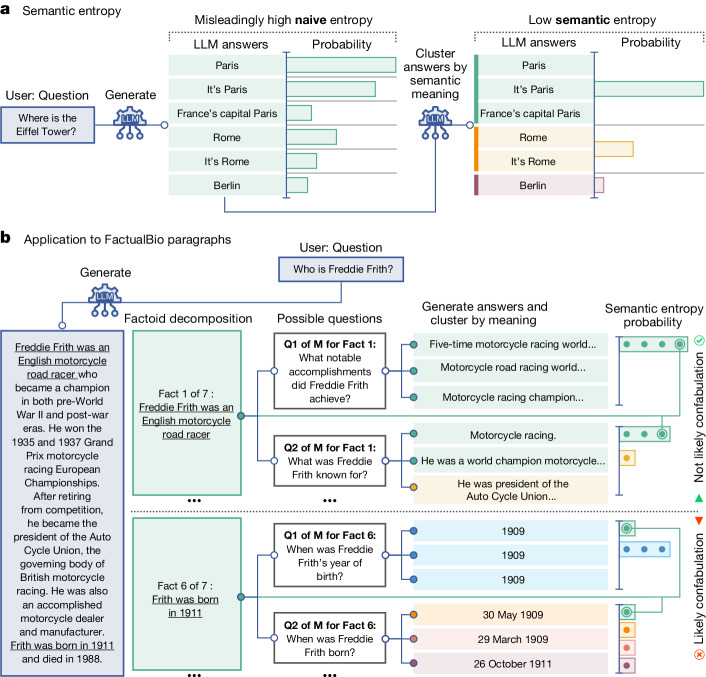
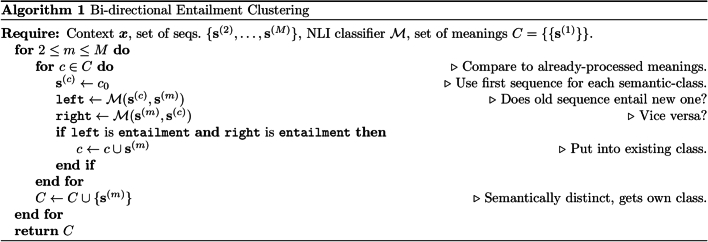
The paper introduces semantic entropy, an uncertainty estimator that clusters LLM generations by meaning via bidirectional entailment and computes entropy over those semantic clusters to detect confabulations. Across question-answering, math, and biography-generation tasks, semantic entropy outperforms naive entropy and supervised baselines without task-specific training data.
Key findings
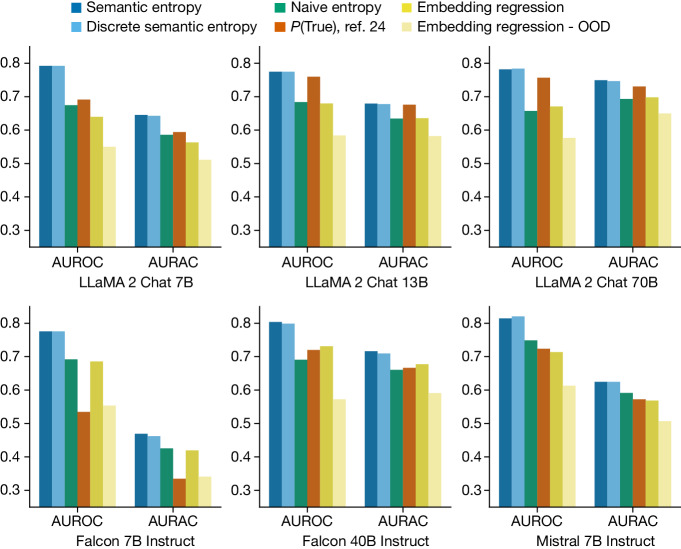
- Averaged across 30 task–model combinations, semantic entropy achieved the best AUROC of 0.790, compared with naive entropy (0.691), P(True) (0.698), and embedding regression (0.687); performance was stable between 0.78 and 0.81 across LLaMA, Falcon, and Mistral model families and scales from 7B to 70B parameters.
- Semantic entropy detects confabulations in sentence-length QA and math across TriviaQA, SQuAD 1.1, BioASQ, NQ-Open, and SVAMP, and its discrete variant performs similarly without requiring exact output probabilities.
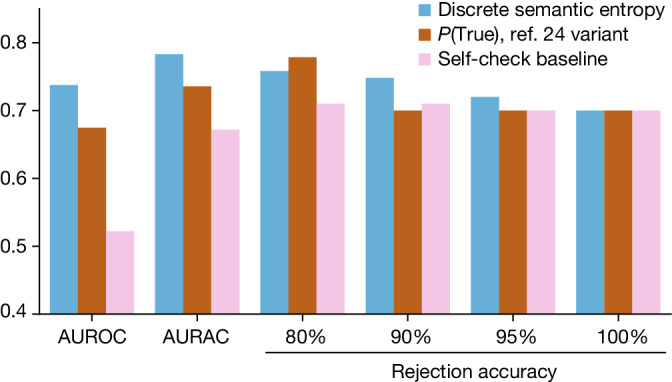
- On the GPT-4 biography dataset FactualBio—21 individuals, 150 factual claims, of which 45 were incorrect—the discrete semantic entropy variant outperformed a self-check baseline and an adapted P(True) baseline on AUROC and AURAC; P(True) had a narrow edge only after the top 20% of answers judged most likely to be confabulations were rejected.
- The method targets confabulations—arbitrary and incorrect generations sensitive to irrelevant details such as random seed—rather than all hallucinations, and it does not address systematically bad outputs.
Methods
- For each question, the method samples multiple generations from the LLM, clusters them by semantic equivalence using bidirectional entailment, and estimates semantic entropy over the meaning clusters; a discrete variant approximates cluster probabilities from generation frequencies when token probabilities are unavailable.
- Sentence-length experiments used LLaMA 2 Chat (7B, 13B, 70B), Falcon Instruct (7B, 40B), and Mistral Instruct (7B) on BioASQ, SQuAD 1.1, TriviaQA, SVAMP, and NQ-Open, with 400 train and 400 test examples per dataset; GPT-4 (v.0613) was used for FactualBio.
- Evaluation metrics were AUROC, rejection accuracy, and AURAC; sentence-length correctness was assessed automatically with GPT-4 against reference answers, validated against human judgement in the Supplementary Information.
Limitations
- The paper states that semantic entropy does not guarantee factuality and does not help when LLM outputs are systematically bad, including confident errors from training objectives, systematic reasoning failures, or misleading behaviour.
- The paper notes that semantic clustering can be overly sensitive to context: in one example, it distinguished a precise date from a year and treated the model as uncertain, even though the distinction was probably irrelevant in context.
- For FactualBio, the paper states that automatically generated questions are the main source of errors, and that GPT-4 did not expose output probabilities at the time, preventing computation of naive entropy, standard semantic entropy, and the embedding regression baseline for GPT-4.
Model-written summary. Check it against the paper before relying on it.
Integrity signals
Registry
Cites
Statistics
Figures
Verification
Claims the paper makes
8 Valid · 6 Not valid · 5 Not checked · 60 Own results and interpretations
The cited sources support only part of this claim — read each source’s verdict below.
In the paper
“Large language model (LLM) systems, such as ChatGPT1 or Gemini2, can show impressive reasoning and question-answering capabilities but often ‘hallucinate’ false outputs and unsubstantiated answers3,4.”
§ Detecting hallucinations in large language models using semantic entropy > Abstract
What the sources say
- Partly supportedcites [3] Xiao, Y. & Wang, W. Y. On hallucination and predictive uncertainty in conditional language generation. In Proc. 16th Conference of the European Chapter of the Association for Computational Linguistics 2734–2744 (Association for Computational Linguistics, 2021). sourceExperimental — accuracy not yet measured
The Introduction (p. 1) says neural generation models can produce content unsupported by their inputs, and §2.1 (p. 2) defines hallucination as false information unsupported by the input. The paper studies conditional generation, including image captioning and data-to-text, rather than establishing how often LLM systems such as ChatGPT or Gemini give unsubstantiated answers. (LLM, conf=0.84)
- Partly supportedcites [4] Rohrbach, A., Hendricks, L. A., Burns, K., Darrell, T. & Saenko, K. Object hallucination in image captioning. In Proc. 2018 Conference on Empirical Methods in Natural Language Processing (eds Riloff, E., Chiang, D., Hockenmaier, J. & Tsujii, J.) 4035–4045 (Association for Computational Linguistics, 2018). sourceExperimental — accuracy not yet measured
The Introduction describes image-captioning models generating objects absent from an image, and Section 3.2 reports hallucinated objects in 7.4%–17.7% of tested captions. This supports the general point that generated outputs can be false, but the paper does not establish how often LLM systems such as ChatGPT or Gemini produce unsubstantiated answers. Page numbers were not available in our copy. (LLM, conf=0.86)
plain- Asserted: passes — The authors put it forward as true.
- Checkable: passes — It can be checked against evidence.
- Load-bearing: passes — The paper’s conclusions depend on it.
- Based: passes — The paper gives a reason why it holds.
- Partly supported
The cited sources support only part of this claim — read each source’s verdict below.
In the paper
“High entropy corresponds to high uncertainty23–25—so semantic entropy is one way to estimate semantic uncertainties.”
§ Detecting hallucinations in large language models using semantic entropy > Main
What the sources say
- Not checked — no full text of the sourcecites [23] MacKay DJC Information-based objective functions for active data selection Neural Comput. 1992 4 590 604 10.1162/neco.1992.4.4.590 source
- Partly supportedcites [24] Kadavath, S. et al. Language models (mostly) know what they know. Preprint at https://arxiv.org/abs/2207.05221 (2022). sourceExperimental — accuracy not yet measured
Section B.2 (p. 29) hypothesizes that an unsure model produces a high-entropy answer distribution, and reports that entropy has some predictive power. But it also finds that larger models can give diverse correct answers and concludes that answer-distribution entropy is not a robust measure of whether a model knows the answer. The unqualified correspondence in the claim overstates the paper's finding. (LLM, conf=0.87)
- Supportedcites [25] Lindley DV On a measure of the information provided by an experiment Ann. Math. Stat. 1956 27 986 1005 10.1214/aoms/1177728069 source
The discussion on p. 4 explains that the measure uses Shannon’s function with the sign reversed: information is greatest when the distribution is concentrated on one value and falls as it spreads. This supports the cited background point that higher Shannon entropy corresponds to greater uncertainty; the later claim about semantic entropy is not attributed to this source. (LLM, conf=0.88)
plainstates an association- Asserted: passes — The authors put it forward as true.
- Checkable: passes — It can be checked against evidence.
- Load-bearing: passes — The paper’s conclusions depend on it.
- Based: passes — The paper gives a reason why it holds.
A result the paper states — it cites no source for it, so there is none to check. The quote shows it is in the paper.
In the paper
“Nevertheless, we significantly improve question-answering accuracy for state-of-the-art LLMs, revealing that confabulations are a great source of error at present.”
§ Detecting hallucinations in large language models using semantic entropy > Main
boostedstates a cause- Asserted: passes — The authors put it forward as true.
- Checkable: passes — It can be checked against evidence.
- Load-bearing: passes — The paper’s conclusions depend on it.
- Based: passes — The paper gives a reason why it holds.
- Rests on an assumption not shown here.
A result the paper reports from its own data — it cites no other source for it, so there is none to check. The quote shows it is in the paper.
In the paper
“We further show that semantic uncertainty can be used to improve model accuracy by refusing to answer questions when semantic uncertainty is high.”
§ Detecting hallucinations in large language models using semantic entropy > Methods > Detecting confabulations in QA and math
plainstates a cause- Asserted: passes — The authors put it forward as true.
- Checkable: passes — It can be checked against evidence.
- Load-bearing: passes — The paper’s conclusions depend on it.
- Based: passes — The paper gives a reason why it holds.
A result the paper reports from its own data — it cites no other source for it, so there is none to check. The quote shows it is in the paper.
In the paper
“In our experiments, we use semantic uncertainty to predict model accuracy, demonstrating that confabulations make up a notable fraction of model mistakes.”
§ Detecting hallucinations in large language models using semantic entropy > Methods > Detecting confabulations in QA and math
boosted- Asserted: passes — The authors put it forward as true.
- Checkable: passes — It can be checked against evidence.
- Load-bearing: passes — The paper’s conclusions depend on it.
- Based: passes — The paper gives a reason why it holds.
36 more claims
Create a free account to see all 79 claims and to verify the 2 references still open.
- Probably not a substantial claim. 30
- It may state two separate claims as one. 20
Claims other papers make about this one
Each is checked against this paper’s own text: does it say what the citing paper says it does?
The source backs part of the claim, not all of it — or backs it for a different population, condition or comparison.
In the citing paper
“However, LLMs exhibit hallucination and fabrication errors that are unacceptable for quantitative modeling [19, 20, 21].”
From Structured Schemas for Provenance‐Rich, LLM ‐Assisted QSP Model Calibration (2026) · cites this paper as [19]
Experimental — accuracy not yet measuredThe source backs part of the claim, not all of it — or backs it for a different population, condition or comparison.
In the citing paper
“Studies on hallucination, calibration, sycophancy, and cognitive bias indicate that failures often result not from a lack of capability but from unstable behavioral dispositions under uncertainty or pressure [8, 9, 10, 12, 15].”
From Machine Psychometrics: A Mathematical Psychology of Artificial Intelligence (2026) · cites this paper as [8]
Experimental — accuracy not yet measuredThe source backs part of the claim, not all of it — or backs it for a different population, condition or comparison.
In the citing paper
“AI-generated patient summaries also frequently contain errors that can be hard to detect12.”
From Multi-model assurance analysis showing large language models are highly vulnerable to adversarial hallucination attacks during clinical decision support (2025) · cites this paper as [12]
Experimental — accuracy not yet measuredThe source backs part of the claim, not all of it — or backs it for a different population, condition or comparison.
In the citing paper
“LLMs remain limited by the static knowledge encoded in their parameters.They are prone to hallucinations, factual inaccuracies, and out-of-date internal knowledge (Farquhar et al., 2024;Lewis et al., 2020).”
From Improving Amharic Information Retrieval with Translative and Multi-Agent Debate Retrieval Augmented Generation (2026) · cites this paper as Farquhar et al., 2024
Experimental — accuracy not yet measuredThe source backs part of the claim, not all of it — or backs it for a different population, condition or comparison.
In the citing paper
“This limitation can result in responses that lack coherence, contextual relevance, and even lead to hallucinations in extended dialogues or complex tasks [1], [2].”
From Memory-Augmented Architecture for Long-Term Context Handling in Large Language Models (2026) · cites this paper as [1]
Experimental — accuracy not yet measured
11 more claims about this paper
Create a free account to see every claim other papers make about this one.
Citations
Cites
Language Models are Few-Shot Learners
Brown, T. B., Mann, B., Ryder, N., Subbiah, M., Kaplan, J., Dhariwal, P., Neelakantan, A., Shyam, P., Sastry, G., Askell, A., et al. (2020) · arXiv · doi:10.48550/arxiv.2005.14165 · Cited by 23,372 · cited 1×
“57), which can predict entailment given suitable prompts.”
SQuAD: 100,000+ Questions for Machine Comprehension of Text
Rajpurkar, P., Zhang, J., Lopyrev, K., & Liang, P. (2016) · Proceedings of the 2016 Conference on Empirical Methods in Natural Language Processing · doi:10.18653/v1/d16-1264 · Cited by 6,208
Survey of Hallucination in Natural Language Generation
Ji, Z., Lee, N., Frieske, R., Yu, T., Su, D., Xu, Y., Ishii, E., Bang, Y. J., Madotto, A., & Fung, P. (2023) · ACM Computing Surveys · doi:10.1145/3571730 · Cited by 5,025 · cited 2×
“Hallucinations are often defined as LLMs generating “content that is nonsensical or unfaithful to the provided source content” 9–11 but they have come to include a vast array of failures of faithfulness and factuality.”
Survey of Hallucination in Natural Language Generation
Ji, Z., Lee, N., Frieske, R., Yu, T., Su, D., Xu, Y., Ishii, E., Bang, Y., Chen, D., Dai, W., et al. (2022) · arXiv · doi:10.48550/arxiv.2202.03629 · Cited by 4,981
A Broad-Coverage Challenge Corpus for Sentence Understanding through Inference
Williams, A., Nangia, N., & Bowman, S. (2018) · Proceedings of the 2018 Conference of the North American Chapter of the Association for Computational Linguistics: Human Language Technologies, Volume 1 (Long Papers) · doi:10.18653/v1/n18-1101 · Cited by 3,342 · cited 2×
“We rely on language models to predict entailment, such as DeBERTa-Large-MNLI 56 , which has been trained to predict entailment, or general-purpose LLMs such as GPT-3.”
Llama 2: Open Foundation and Fine-Tuned Chat Models
Touvron, H., Martin, L., Stone, K., Albert, P., Almahairi, A., Babaei, Y., Bashlykov, N., Batra, S., Bhargava, P., Bhosale, S., et al. (2023) · arXiv · doi:10.48550/arxiv.2307.09288 · Cited by 2,604 · cited 1×
“Our results for TriviaQA, SQuAD, BioASQ, NQ-Open and SVAMP are all evaluated context-free and involve sentence-length answers (96 ± 70 characters, mean ± s.d.) and use LLaMA 2 Chat (7B, 13B and 70B parameters) 38 , Falcon Instruct (7B and 40B) 39 and Mistral Instruct (7B) 40 .”
Aleatory or epistemic? Does it matter?
Kiureghian, A. D., & Ditlevsen, O. (2009) · Structural Safety · doi:10.1016/j.strusafe.2008.06.020 · Cited by 2,454 · cited 1×
“Researchers some-times separate aleatoric uncertainty (uncertainty in the underlying data distribution) from epistemic uncertainty (caused by having only limited information) 46 .”
Natural Questions: A benchmark for question answering research
Kwiatkowski, T., Palomaki, J., Redfield, O., Collins, M., Parikh, A., Alberti, C., Epstein, D., Polosukhin, I., Devlin, J., Lee, K., et al. (2019) · Transactions of the Association for Computational Linguistics · doi:10.1162/tacl_a_00276 · Cited by 2,069 · cited 2×
“33), life sciences (BioASQ 34 ) and open-domain natural questions (NQ-Open 35 ) derived from actual queries to Google Search 36 .”
TriviaQA: A Large Scale Distantly Supervised Challenge Dataset for Reading Comprehension
Joshi, M., Choi, E., Weld, D., & Zettlemoyer, L. (2017) · Proceedings of the 55th Annual Meeting of the Association for Computational Linguistics (Volume 1: Long Papers) · doi:10.18653/v1/p17-1147 · Cited by 1,690 · cited 5×
“TriviaQA is a trivia question-answering dataset.”
InfluentialTriviaQA: A Large Scale Distantly Supervised Challenge Dataset for Reading Comprehension
Joshi, M., Choi, E., Weld, D. S., & Zettlemoyer, L. (2017) · arXiv · doi:10.48550/arxiv.1705.03551 · Cited by 1,650
Research works printed but not linked: 8
- Xiao, T. Z., Gomez, A. N. & Gal, Y. Wat zei je? Detecting out-of-distribution translations with variational transformers. In Workshop on Bayesian Deep Learning at the Conference on Neural Information Processing Systems (NeurIPS, Vancouver, 2019).
- Negri, M., Bentivogli, L., Mehdad, Y., Giampiccolo, D. & Marchetti, A. Divide and conquer: crowdsourcing the creation of cross-lingual textual entailment corpora. In Proc. 2011 Conference on Empirical Methods in Natural Language Processing 670–679 (Association for Computational Linguistics, 2011).
- Malinin, A. & Gales, M. Uncertainty estimation in autoregressive structured prediction. In Proceedings of the International Conference on Learning Representations https://openreview.net/forum?id=jN5y-zb5Q7m (2021).
- Holtzman, A., Buys, J., Du, L., Forbes, M. & Choi, Y. The curious case of neural text degeneration. In Proceedings of the International Conference on Learning Representations https://openreview.net/forum?id=rygGQyrFvH (2020).
- Culicover PW Paraphrase generation and information retrieval from stored text Mech. Transl. Comput. Linguist. 1968 11 78 88
- He, P., Liu, X., Gao, J. & Chen, W. Deberta: decoding-enhanced BERT with disentangled attention. In International Conference on Learning Representations https://openreview.net/forum?id=XPZIaotutsD (2021).
- Socher, R., Huang, E., Pennin, J., Manning, C. D. & Ng, A. Dynamic pooling and unfolding recursive autoencoders for paraphrase detection. In Proceedings of the 24th Conference on Neural Information Processing Systems (eds Shawe-Taylor, J. et al.) (2011)
- Kane, H., Kocyigit, Y., Abdalla, A., Ajanoh, P. & Coulibali, M. Towards neural similarity evaluators. In Workshop on Document Intelligence at the 32nd conference on Neural Information Processing (2019).
Cited by
Items 301–400 of 888
Brain-inspired energy efficient technologies for next-generation artificial intelligence
Chiel, H. J., Coggan, J. S., Datta, G., Fellous, J., Nourse, W. R. P., Quinn, R. D., & Thomas, P. J. (2026) · Biological Cybernetics · doi:10.1007/s00422-026-01038-4 · Cited by 7
Ro, D. I. (2026) · NEJM AI · doi:10.1056/aip2501328 · Cited by 2
Ye, A., Wang, B.-Y., Cheng, Z., Dong, C., & Guo, F.-B. (2026) · Bioresource Technology · doi:10.1016/j.biortech.2026.134309 · Cited by 2
Liang, J., Xing, M., Xiang, P., Wang, G., Chen, M., Fang, Q., Zhou, T., Lu, Z., Leng, X., Huang, J., et al. (2026) · npj Digital Medicine · doi:10.1038/s41746-026-02537-1 · Cited by 5
Hallucination detection in LLM code generation: A sampling-based consensus verification approach
Huang, T., Ren, Z., Huang, Y., Chen, X., Liu, Y., & Zheng, Z. (2026) · Automated Software Engineering · doi:10.1007/s10515-026-00605-0 · Cited by 7
“Previous studies (Manakul et al. 2023 ; Farquhar et al. 2024 ) in hallucination detection has experimentally validated that LLMs generate semantically consistent outputs for known tasks–rooted in stable internal knowledge–while hallucinated outputs lack such grounding and thus show low consistency…”
Lu, X., Su, X., Feng, J., Zeng, K., Zhang, S., & Zhang, Y. (2026) · Information Processing & Management · doi:10.1016/j.ipm.2026.104762 · Cited by 4
Yacobson, E., Schleifer, Y., Bar-Dov, Z., Rap, S., Blonder, R., & Alexandron, G. (2026) · Journal of Science Education and Technology · doi:10.1007/s10956-026-10310-y · Cited by 8
“Ethical concerns have also been raised regarding bias (Feldman-Maggor et al., 2025 ; Resnik, 2025), reliability (Farquhar et al., 2024), and the safe use of LLMs in tasks such as experimental design, where incorrect guidance may have real-world consequences (Alasadi & Baiz, 2024).”
Du, X., Anna, N., Oates, M., Wang, Y., Wang, X., Plasek, J. M., Aronson, S., Lebo, M. S., & Zhou, L. (2026) · International Journal of Medical Informatics · doi:10.1016/j.ijmedinf.2026.106424 · Cited by 6
Brain-inspired warm-up training with random noise for uncertainty calibration
Cheon, J., & Paik, S. (2026) · Nature Machine Intelligence · doi:10.1038/s42256-026-01215-x · Cited by 7
Gao, Z., & Thebault-Spieker, J. (2026) · Proceedings of the ACM on Human-Computer Interaction · doi:10.1145/3788058 · Cited by 3
Generative Artificial Intelligence and Large Language Models in Clinical Oncology
Yu, Y., Zhao, Z., Wang, Z., Lin, R., Tan, Y., Chen, Y., Li, T., Baptista‐Hon, D. T., Zhang, X., Wu, C., et al. (2026) · MedComm · doi:10.1002/mco2.70833 · Cited by 4
“A further concern is the phenomenon of “hallucination,” wherein generative AI generate content that is factually incorrect or entirely fabricated [ 202 ].”
Understanding the Barriers to Translating Artificial Intelligence into the Clinical Laboratory
Neale, M. H., Wong, C., Kreuter, D., Taylor, J. G., & Sivapalaratnam, S. (2026) · European Journal of Internal Medicine · doi:10.1016/j.ejim.2026.107029 · Cited by 2
Fan, Y., Li, R., Zhang, G., Shi, C., & Wang, X. (2025) · IEEE International Conference on Acoustics Speech and Signal Processing · doi:10.1109/icassp49660.2025.10888877 · Cited by 7
“In detecting hallucinations, various methods [26, 38, 41, 42, 43] have been proposed for evaluating hallucination in LLMs.”
Codebreaker: Dynamic Extraction Attacks on Code Language Models
Han, C., Deng, Z., Ma, W., Zhu, X., Xue, M., Zhu, T., Wen, S., & Xiang, Y. (2025) · IEEE Symposium on Security and Privacy (S&P) · doi:10.1109/sp61157.2025.00124 · Cited by 2
“[11] model under three conditions: without using semantic entropy, using semantic entropy calculated with the original method proposed by Farquhar et al. [31], and using our optimized semantic entropy calculation.”
Balderas-Martínez, Y. I., Sánchez-Rojas, J. A., Téllez‐Velázquez, A., Martínez, F. J., Cruz‐Barbosa, R., Guzmán‐Ramírez, E., García, I., & Arroyo‐Fernández, I. (2025) · Big Data and Cognitive Computing · doi:10.3390/bdcc9060162 · Cited by 3
Spin-glass model of in-context learning
Li, Y., Bai, R., & Huang, H. (2025) · Physical review. E · doi:10.1103/5l5m-4nk5 · Cited by 8
“…explaining the chain-of-thought prompting [12], i.e., decomposition of a complex task into intermediate steps, and more challenging case of hallucination [38], i.e., the model could not distinguish the generated outputs from factual knowledge, or it could not understand what they generate [14].”
Santtila, P. O., Sun, Y., Kask, K., Järvilehto, L., & Xiu, J. (2025) · Acta Psychologica · doi:10.1016/j.actpsy.2025.105270 · Cited by 2
Building an Intelligent Data Exploring Assistant for Geoscientists
Widlansky, M. J., & Komar, N. (2025) · Journal of Geophysical Research Machine Learning and Computation · doi:10.1029/2025jh000649 · Cited by 5
Quantifying Calibration Error in Neural Networks Through Evidence-Based Theory
Ouattara, K. I., Krontiris, I., Dimitrakos, T., & Kargl, F. (2025) · International Conference on Information Fusion (FUSION) · doi:10.23919/fusion65864.2025.11124121 · Cited by 7
“Note that our work shares conceptual similarity with a paper on hallucination detection in LLMs using clustering of output entropy [3].”
Mittal, A., Tadi, G., & Madduri, S. (2025) · IEEE Annual Ubiquitous Computing, Electronics & Mobile Communication Conference (UEMCON) · doi:10.1109/uemcon67449.2025.11267527 · Cited by 3
“Semantic entropy achieves 79% AUROC by clustering semantically equivalent responses, reducing inference overhead by 95% [8].”
InfluentialChen, T., Liu, X., Zhu, J. L., Zhang, X., Zhang, J., Yu, H., Xu, Z. Z., Wang, D., Zhu, Y., Zhong, F., et al. (2025) · bioRxiv (Cold Spring Harbor Laboratory) · doi:10.1101/2025.02.22.639610 · Cited by 2
Can large language models reliably extract human disease genes from full-text scientific literature?Preprint
Yin, D.-Q., Leung, M., Pun, D. W. H., Chen, F. H., Kwon, J., Lin, X.-Y., & Ho, J. W. K. (2025) · bioRxiv · doi:10.1101/2025.07.27.667022
“Biomedical hallucination detectors that leverage output log-probability variance can effectively flag low-certainty candidates for human review (Farquhar et al., 2024), minimizing curation overhead.”
Post-Public AI: Research in Groups and Teams
Bezrukova, K., & Griffith, T. L. (2025) · Small Group Research · doi:10.1177/10464964251363458 · Cited by 5
“…of unexpected behaviors as teams grow more dynamic and AI advances: AI researchers describe hallucinations, such as credible but completely false references and confabulations, where the AI responds with arbitrary and incorrect information (Chelli et al., 2024; Farquhar et al., 2024; Jones, 2025).”
MedHallu: A Comprehensive Benchmark for Detecting Medical Hallucinations in Large Language Models
Pandit, S., Xu, J., Hong, J., Wang, Z., Chen, T., Xu, K., & Ding, Y. (2025) · arXiv · doi:10.48550/arxiv.2502.14302 · Cited by 31
Performance of Large Language Models on the Radiation and Cancer Biology Practice Exam
Bertschmann, J., Xu, Y., Bayley, C., Abdellatif, A., & Lee, S. L. (2024) · Frontiers in Oncology · doi:10.1016/j.ijrobp.2024.07.1347 · Cited by 1
Rocha, C. T., Hankala, I., Mekuria, L., et al. (2024) · Journal of the Society for Clinical Data Management · doi:10.47912/jscdm.363 · Cited by 1
Sood, A., Moyer, A., Jahangiri, P., Mar, D. A., Nitichaikulvatana, P., Ramreddy, N., Stolyar, L., & Lin, J. (2025) · JCR Journal of Clinical Rheumatology · doi:10.1097/rhu.0000000000002198 · Cited by 1
Internal Credit and External Blame: Self-Attribution in Operations and Supply Chain Performance
Niu, Y., Qiao, X., Wu, J., & Yang, X. (2026) · Manufacturing & Service Operations Management · doi:10.1287/msom.2025.0548 · Cited by 5
Ke, Y., Lin, H., Ruan, Y., Tang, J., & Li, L. (2025) · Mathematics · doi:10.3390/math13091538 · Cited by 8
Computational Approaches to Drug Discovery
Zanders, E. D. (2025) · Springer eBooks · doi:10.1007/978-3-031-93949-5_3 · Cited by 1
Hallucination Detection in Large Language Models Using Diversion Decoding
Abdeen, B., Siddiqui, S. M. T., Ahmed, M. T., Singhal, A., Khan, L. R., Modi, P. P., & Al-Shaer, E. S. (2025) · Lecture notes in computer science · doi:10.1007/978-3-031-96590-6_7 · Cited by 1
“Similar to recent studies [6,18], this work aims to use a proxy measure for the semantic uncertainty of an entire LLM-generated answer, beyond the uncertainty of individual tokens.”
InfluentialYan, M., Wang, Y., Jiang, X., Zhou, H. L., & Li, J. (2025) · Frontiers of Computer Science · doi:10.1007/s11704-025-41143-4 · Cited by 5
Artificial Intelligence and Cancer Immunotherapy
Shah, A., Bhat, A. A., Bhat, M. R., Assad, A., & Macha, M. A. (2025) · Springer eBooks · doi:10.1007/978-981-96-8176-1_16 · Cited by 1
Identifying large language model hallucinations in health communication
Galitsky, B. A. (2025) · Elsevier eBooks · doi:10.1016/b978-0-443-30046-2.00012-0 · Cited by 5
Hallucination Detection with Small Language Models
Cheung, M. (2025) · IEEE International Conference on Data Engineering Workshops (ICDEW) · doi:10.1109/icdew67478.2025.00033 · Cited by 3
“The research in [28] employs entropy and sentence splitting to generate multiple outputs.”
Entropy-Based Data Selection for Language Models
Li, H., Liu, Y., & Huang, C. (2025) · IEEE Access · doi:10.1109/access.2025.3605290 · Cited by 2
An Explanation Method Based on Interpretable Linear Model With Four Key Characteristics
Yuan, Y., Huang, Z. A., Li, P., Fu, Y., Zhao, X., Shi, C., Li, X., & Wu, X. (2025) · IEEE Transactions on Image Processing · doi:10.1109/tip.2025.3611593 · Cited by 1
“This indicates that the semantic information density of entity encoding can represent feature diversity and can be quantified [46].”
Artificial Intelligence Clinical Reasoning in Board-Style Clinical Vignettes: A Comparative Study
Gjunkshi, L., Gjunkshi, L., Quezada, K. A., Persaud, N. A., & Braun, J. (2025) · Cureus · doi:10.7759/cureus.94563 · Cited by 1
“Similar to other AI models, LLMs can learn and adapt based on the data used to train them [9,10].”
TECP: Token-Entropy Conformal Prediction for LLMs
Xu, B., & Lu, Y. (2025) · Mathematics · doi:10.3390/math13203351 · Cited by 14
DHCP: Detecting Hallucinations by Cross-modal Attention Pattern in Large Vision-Language Models
Zhang, Y., Xie, R., Sun, X., Huang, Y., Chen, J., Kang, Z., Wang, D., & Wang, Y. (2025) · ACM International Conference on Multimedia (ACM MM) · doi:10.1145/3746027.3755118 · Cited by 31
“Extensive research has been dedicated to hallucination detection in LLMs [1, 3, 7, 12, 40].”
Hu, J., Sun, L., & Liu, X. (2025) · doi:10.1145/3764915.3770719 · Cited by 6
Abumelha, M., ALGhamdi, A. S. A.-M., Fayoumi, A. G., & Ragab, M. (2025) · JMIR Medical Informatics · doi:10.2196/78432 · Cited by 4
“First, we applied length normalization to boost confidence scores for shorter outputs and reduce them for longer ones, correcting biases as shown by Murray and Chiang [48] and Farquhar et al [46].”
Ding, Y., Lyu, H., Cao, Y., Song, W., Tian, L., & Liu, S. (2025) · Chinese Journal of Electronics · doi:10.23919/cje.2025.00.042 · Cited by 4
Hè, H., & Apostolaki, M. (2025) · ACM Workshop on Hot Topics in Networks (HotNets) · doi:10.1145/3772356.3772406 · Cited by 7
“LLMs still hallucinate [11, 21, 41, 61], struggle to follow rules [3, 9, 23, 24], and are costly to train or fine-tune.”
Alterator, S., Maddox, A., Southerton, C., & Schutt, S. (2025) · British Journal of Sociology of Education · doi:10.1080/01425692.2025.2586732 · Cited by 3
Einsatz von Large Language Models (LLMs) in der Gefäßchirurgie: Möglichkeiten und Limitationen
Hatzl, J., Bartos, O., Behrendt, C., Dorweiler, B., Heckenkamp, J., Hoffmann, G., Reutersberg, B., Uhl, C., & Gefäßmedizin, K. K. I. U. D. T. D. D. G. F. G. U. (2025) · Gefässchirurgie · doi:10.1007/s00772-025-01285-y · Cited by 1
Clinician’s Guide to Artificial Intelligence
Schroeder, A. W., Tran, Z. K., Sexton, K. W., & Salzberg, A. D. (2025) · Medical Clinics of North America · doi:10.1016/j.mcna.2025.07.010 · Cited by 3
Can AI See the Unseen? Measuring the Perception Gap for Tibetan Cultural Symbols in AI-Generated Art
Liu, Y., Qiao, Y., Hu, A., Liu, Y., & Bai, L. (2025) · Electronics · doi:10.3390/electronics15010015 · Cited by 3
“Its principal advantage lies in not requiring prior task-specific knowledge or data, enabling it to directly assess the reliability of generated content from a semantic perspective and intuitively reflect the model’s confidence in its own outputs [108,109].”
Zheng, Y., Yuan, J., Liu, L., Zhao, W., & Wang, Z. (2025) · ACM International Joint Conference on Pervasive and Ubiquitous Computing (UbiComp) · doi:10.1145/3714394.3756275 · Cited by 1
“Semantic Uncertainty [12] introduced foundational concepts for reliability assessment in natural language generation, while semantic entropy detection frameworks [7] demonstrated robust hallucination identification across question-answering tasks.”
Envisioning generative artificial intelligence in cartography: mapmaking, map use, and ethics
Kang, Y., & Wang, C. (2026) · International Journal of Cartography · doi:10.1080/23729333.2025.2582231 · Cited by 8
“GenAI models sometimes produce outputs that appear fluent and plausible yet are fabricated, unsupported, or factually inaccurate, a phenomenon commonly referred to as confabulation (Farquhar et al., 2024).”
RISE: Rule-Driven SQL Dialect Translation via Query Reduction
Xie, X., Zhang, Y., Dou, W., Gao, Y., Cui, Z., Song, J., Yang, R., & Wei, J. (2026) · ACM/IEEE International Conference on Software Engineering: Companion Proceedings (ICSE-Companion) · doi:10.1145/3744916.3773257 · Cited by 3
Lv, Z., & Sun, J. (2026) · Neurocomputing · doi:10.1016/j.neucom.2026.132731 · Cited by 6
Walker, A. P., Gibbs, D., Banks, L., Lee, H. Y., Frazier, K. D., & Lee, J. (2026) · Social Work Education · doi:10.1080/02615479.2026.2617512 · Cited by 3
Xu, X., & Wu, J. (2026) · IEEE Transactions on Neural Networks and Learning Systems · doi:10.1109/tnnls.2026.3655508 · Cited by 10
“For the ablation study on N , following the setup from [16], we experimented with N ranging from 4 to 14.”
Chen, C., Xu, R., Xie, S., Guo, X., & Tao, Y. (2026) · Journal of Engineering Design · doi:10.1080/09544828.2026.2617801 · Cited by 1
RAG Chatbot Architecture for Law & Crime News Using Hybrid Retrieval and Small Language Model
Achyar, M. K. U., Widyawan, W., & Pratama, A. R. (2025) · International Conference on Intelligent Cybernetics Technology & Applications (ICICyTA) · doi:10.1109/icicyta68677.2025.11362566 · Cited by 1
“The impact of hallucination problem could cause spread of misinformation to the user [4].”
Dietary guidance for pregnant women using DeepSeek-R1 and ChatGPT-4.0: a comparative analysis
Gao, Z., Li, J., & Fang, W. (2026) · Frontiers in Public Health · doi:10.3389/fpubh.2026.1728954 · Cited by 2
Jo, B., Kim, S. J., Kim, M. J., Kim, N., Lee, A., Kim, H. Y., Lee, M., & Cho, J. (2026) · JMIR Cancer · doi:10.2196/81026 · Cited by 1
“Nevertheless, LLMs may generate plausible but inaccurate responses (“hallucinations”), necessitating rigorous reliability assessment and empirical validation prior to the clinical implementation of LLM-oriented health care chatbots [43].”
Song, Z., Kong, X., Bao, X., Zhou, Y., Jiao, J., Liu, S., Zhou, Y., & Qi, H. (2026) · Expert Systems with Applications · doi:10.1016/j.eswa.2026.131627 · Cited by 9
“Drawing inspiration from Semantic Entropy (SE) (Farquhar et al., 2024), which measures uncertainty via the entropy of semantically clustered outputs, we introduce the Maximum Semantic Cluster Proportion (MSCP) as a straightforward and efficient confidence metric for black-box LLMs.”
Gao, R., Huang, L., Wang, Z., & Cang, S. (2026) · Journal of Engineering Design · doi:10.1080/09544828.2026.2629762 · Cited by 1
Kriz, A., Janes, E. L., Shen, X., & Arbel, T. (2025) · IEEE International Conference on Computer Vision Workshops · doi:10.1109/iccvw69036.2025.00142 · Cited by 10
“Second, it is well-established that LLMs hallucinate, propagate bias, and produce harmful content [8, 10], often while presenting their inaccurate outputs as fact.”
Learning with large language models: beyond prompt engineering
Ding, L., O’Berry, R., Tallent, H., C., S. G. C. G., & Gapud, A. A. (2026) · Education and Information Technologies · doi:10.1007/s10639-026-13924-2 · Cited by 15
“This pattern is particularly concerning given that GenAI is prone to hallucinations (Farquhar et al., 2024), which means that students who do not critically assess the LLM responses risk internalizing incorrect information.”
Zhang, Y., Li, L., Kang, H., Liang, S., Niu, K., Rong, Y., & He, Z. (2026) · Computers and Electronics in Agriculture · doi:10.1016/j.compag.2026.111606 · Cited by 1
Adiwibowo, A. S., & Wahyuni, E. T. (2026) · Information Technology and Management · doi:10.1007/s10799-026-00488-3 · Cited by 1
Forero, D. A. (2026) · Current Genomics · doi:10.2174/0113892029403403260112075225 · Cited by 1
“A recent Nature paper, published in June 2024, by Farquhar et al. [57] also proposed the use of the confabulation term, mainly to differentiate from other types of errors generated by LLMs, such as those arising from training on erroneous data.”
Jain, A., & Merchant, Y. P. (2026) · Oral and Maxillofacial Surgery · doi:10.1007/s10006-026-01550-8 · Cited by 1
Learned Hallucination Detection in Black-Box LLMs Using Token-Level Entropy Production Rate
Moslonka, C., Randrianarivo, H., Garnier, A., & Malherbe, E. (2026) · Lecture notes in computer science · doi:10.1007/978-3-032-21289-4_8 · Cited by 8
Peng, Y., Wang, Z., Zhang, Y., Chang, P., He, Z., & Chen, M. (2026) · Journal of Manufacturing Systems · doi:10.1016/j.jmsy.2026.03.008 · Cited by 1
Uncertainty Quantification for Large Language Models
Panov, M., Shelmanov, A., Vashurin, R., Vazhentsev, A., Fadeeva, E., Rvanova, L., & Baldwin, T. (2026) · Lecture notes in computer science · doi:10.1007/978-3-032-21321-1_7 · Cited by 1
Chen, S., Wei, L., & Shi, L. (2026) · Decision Support Systems · doi:10.1016/j.dss.2026.114666 · Cited by 3
Dejenie, R. A., Gantt, B., Alexis, M. M., et al. (2026) · Plastic & Reconstructive Surgery Global Open · doi:10.1097/gox.0000000000007539 · Cited by 1
Abusaada, H., & Elshater, A. M. (2026) · Planning Practice and Research · doi:10.1080/02697459.2026.2646633 · Cited by 1
Uncertainty Calibration in Deep Learning: Methods, Emerging Challenges, and LLM Frontiers
Zhang, M.-L., & Wang, D.-B. (2026) · Journal of Computer Science and Technology · doi:10.1007/s11390-026-6426-z · Cited by 9
Ren, K., Weng, Q., Chen, Q., Li, H., Xie, D., Zeng, C., Wei, J., Lei, G., & Wang, Y. (2026) · Journal of Orthopaedic Surgery and Research · doi:10.1186/s13018-026-06844-x · Cited by 1
“A prominent limitation is that LLMs generate responses based on probabilistic predictions, which may generate inaccurate information and thereby undermine outputs’ reliability [24, 25].”
Engineering Reliable Retrieval-Augmented Generation for Regulatory and Compliance Systems
Kalyanasundaram, T., Bussari, S., Sundaram, D., & Sharma, K. (2026) · IEEE SoutheastCon · doi:10.1109/southeastcon63549.2026.11476340 · Cited by 2
“Notably, unsupported generations were observed even when relevant passages were retrieved, confirming that retrieval grounding alone is not sufficient and that validation must be handled explicitly at the generation layer [7], [8].”
InfluentialSemantic Reformulation Entropy for Robust Hallucination Detection in QA Tasks
Tong, C., Zhang, Q., Jiang, L., Liu, Y., Sun, N., & Li, W. (2026) · IEEE International Conference on Acoustics Speech and Signal Processing · doi:10.1109/icassp55912.2026.11460452 · Cited by 5
Self-Auditing LLMs for Bias and Hallucination Reduction Through Multi-Agent Frameworks
Anointina, Bamini, A. M. A., & Chitra, R. (2026) · International Conference on Expert Clouds and Applications (ICOECA) · doi:10.1109/icoeca68095.2026.11485555 · Cited by 2
“This gap was addressed by Farquhar et al., who introduced semantic entropy as a principled way to quantify uncertainty in LLM outputs [2].”
Considerations about the proliferation of large language model chatbots and youth mental health
Matthews, E., Cleary, F., & Firth, J. (2026) · Irish Journal of Psychological Medicine · doi:10.1017/ipm.2026.10195 · Cited by 4
Hildebrandt, M. (2026) · IEEE Conference on Cognitive and Computational Aspects of Situation Management (CogSIMA) · doi:10.1109/cogsima68896.2026.11481235 · Cited by 2
“This usage differs from Endsley's operational SA framework employed throughout this paper, Knowledge graphs can reduce but not eliminate hallucinations [11] [12].”
Qinjie, S. (2026) · Computers and Education Artificial Intelligence · doi:10.1016/j.caeai.2026.100601 · Cited by 6
Njock, P. G. A., Yin, Z., Xu, H.-R., & Zhang, N. (2026) · Canadian Geotechnical Journal · doi:10.1139/cgj-2025-0648 · Cited by 1
Tian, F., Ganguly, D., & Macdonald, C. (2026) · ACM Transactions on Information Systems · doi:10.1145/3815198 · Cited by 2
“However, zero-shot outputs from LLMs in QV generation task can be non-realistic and hallucinatory [14], in the sense that they may differ from the style of queries that human users can issue to a search engine.”
Spectral Sparsity: A Unifying Framework for Scalable Model Interpretability Using Codes
Kang, J., Tsui, D., Erginbas, Y. E., Butler, L., Aghazadeh, A., & Ramchandran, K. (2025) · IEEE BITS the Information Theory Magazine · doi:10.1109/mbits.2026.3692444 · Cited by 1
“This lack of interpretability hinders deployment in high-stakes applications, impedes scienti fi c insight, and presents barriers to trust, accountability, and actionable decision-making [7].”
Marini, N., Liang, Z., Rajaraman, S., Xue, Z., & Antani, S. (2026) · Journal of Biomedical Informatics · doi:10.1016/j.jbi.2026.105055 · Cited by 2
Zhao, Z., Tan, F., Xie, T., Chen, W., Yu, J., Ye, Y., Liao, Z., Xu, G., Lee, B., Jiang, Y., et al. (2026) · Materials & Design · doi:10.1016/j.matdes.2026.116250 · Cited by 2
Jiang, C., Zhang, H., & Ye, R. (2026) · Neurocomputing · doi:10.1016/j.neucom.2026.134000 · Cited by 2
Chow, J., & Patlas, M. N. (2026) · Japanese Journal of Radiology · doi:10.1007/s11604-026-02009-2 · Cited by 1
“LMMs are prone to hallucinations or confabulations, which are confident but incorrect outputs/statements [ 3, 46].”
“Hallucination” as M-misalignment: a structural account of generation and interpretation
Matsui, M. (2026) · AI and Ethics · doi:10.1007/s43681-026-01169-1 · Cited by 1
Detecting Hallucinations in Arabic Large Language Models Using Automatic Fact-Verification Signals
Alhawarat, M. O. (2026) · International Conference on Emerging Technologies and Engineering Systems (ICETES) · doi:10.1109/icetes68504.2026.11518602 · Cited by 1
“…approaches in retrieval based methods [8] against knowledge bases [18], [19], consistency-based methods on internal model behavior [20], [21] and uncertainty based methods on model confidence [22], [23], seem to be effective for English LLMs but not systematically evaluated for Arabic LLMs.”
Rethinking bioinformatics expertise in the era of artificial intelligence
Goh, W. W. B., Polster, A., Wong, L., & Cvijović, M. (2026) · npj Digital Medicine · doi:10.1038/s41746-026-02777-1 · Cited by 6
Know when to trust: Making AI scoring more reliable for educational assessment
Organisciak, P., & Acar, S. (2026) · Behavior Research Methods · doi:10.3758/s13428-026-03058-1 · Cited by 3
“Farquhar et al. (2024) introduced semantic entropy, which computes uncertainty over the semantic meaning of multiple generated responses rather than individual tokens.”
AI hallucinations in academic writing: implications for research integrity
Giray, L., Islam, M. E., & Glo, J. A. (2026) · Naunyn-Schmiedeberg s Archives of Pharmacology · doi:10.1007/s00210-026-05494-4 · Cited by 8
“Farquhar et al. (2024) developed semantic entropy methods that achieved strong performance across multiple datasets, identifying confabulations , which are a subset of hallucinations produced without prior domain knowledge.”
Saadé, A., & Sabri, O. (2026) · Journal of Innovation & Knowledge · doi:10.1016/j.jik.2026.101073 · Cited by 3
Wang, F., Shirmohammadi, S., & Hsu, C.-H. (2026) · IEEE International Symposium on Artificial Intelligence for Instrumentation and Measurement (AI4IM) · doi:10.1109/ai4im69129.2026.11558238 · Cited by 1
“Following the evaluation protocol of [2], we adopt a two-way entailment strategy combined with semantic clustering to assess answer correctness.”
InfluentialThe Pseudo-Confidence Paradox: The Epistemic Gap in Everyday AI Use
Kurmanbayeva, L. T., Tanabayeva, A., Doszhanova, A. I., Shashayeva, G. K., Bakarassov, D., & Knar, E. (2026) · Philosophies · doi:10.3390/philosophies11030097 · Cited by 2
“Contemporary research convincingly shows that even the most advanced systems can produce coherent yet incorrect answers—called hallucinations or confabulations [11].”
D’Antonoli, T. A., Adams, L. C., Lübberstedt, J., Graf, M. M., Mertens, C. J., Busch, F., Ziegelmayer, S., Makowski, M. R., Bressem, K. K., & Luiken, I. (2026) · European Radiology · doi:10.1007/s00330-026-12697-z · Cited by 2
Inaccuracies, omissions, and bullshit: 2024 U.S. elections through the eyes of ChatGPT
Jang, H., McGregor, S. C., & Neill, L. (2026) · Information Communication & Society · doi:10.1080/1369118x.2026.2685121 · Cited by 3
Yan, B., Zhang, R., Chen, L., Song, X. Z., Cao, Z., & Li, Y. (2026) · Journal of Medical Internet Research · doi:10.2196/96304 · Cited by 2
“Because LLMs predict the next token without verifying evidence, they remain prone to hallucinations that can erode trust and generate harmful or misleading recommendations [39,40].”
Zhang, H., Yan, X., Yang, Y., Jin, L., Yang, P., & Wang, J. (2026) · Journal of Dentistry · doi:10.1016/j.jdent.2026.106853 · Cited by 4
DGADS: A graph-based agentic decision support system for precision dental question answering
Xiong, Y., Chen, Y., Sun, Y., Lu, A.-J., Tang, W. D., & Liu, C. (2026) · Journal of Dentistry · doi:10.1016/j.jdent.2026.106875 · Cited by 2
Metadata
- Authors
- Farquhar, S., Kossen, J., Kuhn, L., & Gal, Y.
- Affiliations
- University of Oxford (GB)
- Corresponding author
- Farquhar, Sebastian
- Venue
- Nature
- Published
- 2024-06-19
- Volume
- 630
- Issue
- 8017
- Pages
- 625-630
- ISSN
- 0028-0836 (ISSN-L)
- 1476-4687
- PMC
- PMC11186750
- OpenAlex
- W4399803256
- Semantic Scholar
- f82f49c20c6acc69f884f05e3a9f1ceea91061ce
- Cited by
- 934
- References
- 60
- Citations by year
- 2026: 540 · 2025: 349 · 2024: 44
- FWCI
- 137.11
- Type
- journal article
- Language
- en
- Open access
- hybrid
- doi.org
- Licence
- cc-by
- creativecommons.org/licenses/by/4.0 (tdm)
- creativecommons.org/licenses/by/4.0 (vor)
- Locations
- Nature (publishedVersion, cc-by)
- PubMed Central (publishedVersion, cc-by)
- PubMed (publishedVersion)
- RePEc: Research Papers in Economics (submittedVersion)
- Funders
- Government of the United Kingdom
- UK Research and Innovation
- Topics
- Physical Sciences › Computer Science › Artificial Intelligence › Topic Modeling
- Physical Sciences › Computer Science › Artificial Intelligence › Adversarial Robustness in Machine Learning
- Physical Sciences › Computer Science › Artificial Intelligence › Natural Language Processing Techniques
- Keywords
- hallucination detection, large language models, semantic entropy, uncertainty estimation, confabulation, LLM reliability, generalization to unseen tasks, honesty
About these checks
Registry, retraction, Cites and statistics results are computed, not judged, with one exception: a printed reference that no index lists is read once by a model before it counts as a citation error. Claims are extracted by a model and kept only when their quote appears verbatim in the text; each cited source is then checked, with a model’s help, for whether it says what the claim relies on. Those verdicts can be wrong — read the claim’s quote and the cited source before relying on one.
The claim verdicts this report counts are experimental: their accuracy is not yet measured.
A language model drew the claims from the paper on 2026-10-10, under version 3 of the claim definition (model deepseek-v4.1-flash, prompt extract-v3).
A second model labelled each claim on 2026-10-10 (model jev-1.13-20260917, definition revision gold-guideline-v0.2).
Cited sources are checked with a language model’s help (gpt-6-sol).
Statistics and arithmetic are recomputed, not judged.
Confidence bands are shown only for fields calibrated on our annotated test set. None is calibrated yet, so no band is shown.
What counts as a claim ›How we measure confidence ›How we check this ›
Are you an author, or do you see a problem with this page? Request a review
Data sources
Bibliographic data: Semantic Scholar, OpenAlex, Crossref.
Contains information from the Semantic Scholar Academic Graph Datasets, made available under the ODC Attribution License (ODC-BY 1.0).
Semantic Scholar’s data is described in: Kinney, R., et al. (2023). The Semantic Scholar Open Data Platform. arXiv:2301.10140.
