

Detecting hallucinations in large language models using semantic entropy
Open accessThe DOI matches its Crossref record; 57 of the 60 references it cites were found in a registry or an index; 14 of the 21 sources its claims cite were checked for support.
Abstract
Abstract Large language model (LLM) systems, such as ChatGPT 1 or Gemini 2 , can show impressive reasoning and question-answering capabilities but often ‘hallucinate’ false outputs and unsubstantiated answers 3,4 . Answering unreliably or without the necessary information prevents adoption in diverse fields, with problems including fabrication of legal precedents 5 or untrue facts in news articles 6 and even posing a risk to human life in medical domains such as radiology 7 . Encouraging truthfulness through supervision or reinforcement has been only partially successful 8 . Researchers need a general method for detecting hallucinations in LLMs that works even with new and unseen questions to which humans might not know the answer. Here we develop new methods grounded in statistics, proposing entropy-based uncertainty estimators for LLMs to detect a subset of hallucinations—confabulations—which are arbitrary and incorrect generations. Our method addresses the fact that one idea can be expressed in many ways by computing uncertainty at the level of meaning rather than specific sequences of words. Our method works across datasets and tasks without a priori knowledge of the task, requires no task-specific data and robustly generalizes to new tasks not seen before. By detecting when a prompt is likely to produce a confabulation, our method helps users understand when they must take extra care with LLMs and opens up new possibilities for using LLMs that are otherwise prevented by their unreliability.
Overview
CoChat Summary
TL;DR
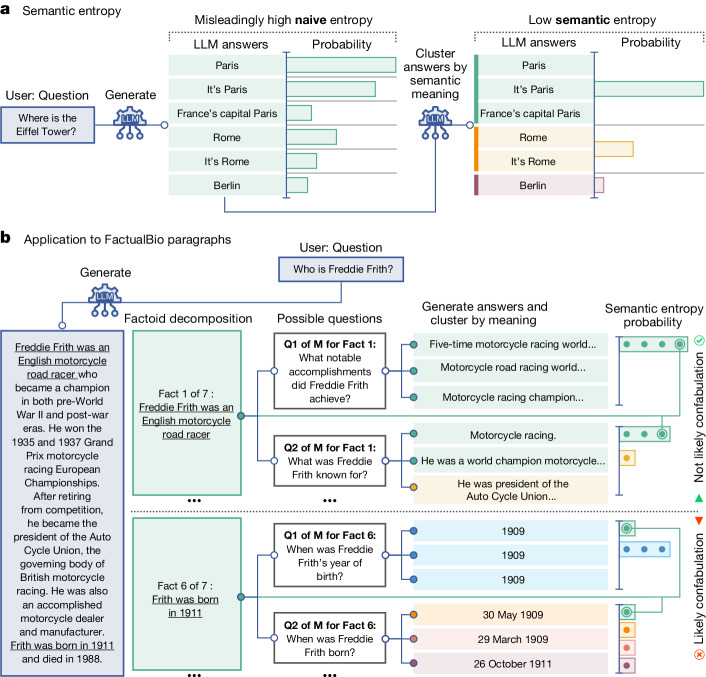
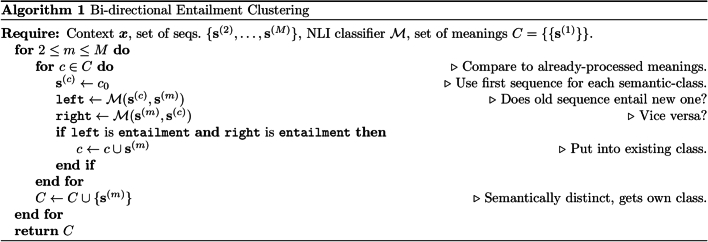
The paper introduces semantic entropy, an uncertainty estimator that clusters LLM generations by meaning via bidirectional entailment and computes entropy over those semantic clusters to detect confabulations. Across question-answering, math, and biography-generation tasks, semantic entropy outperforms naive entropy and supervised baselines without task-specific training data.
Key findings
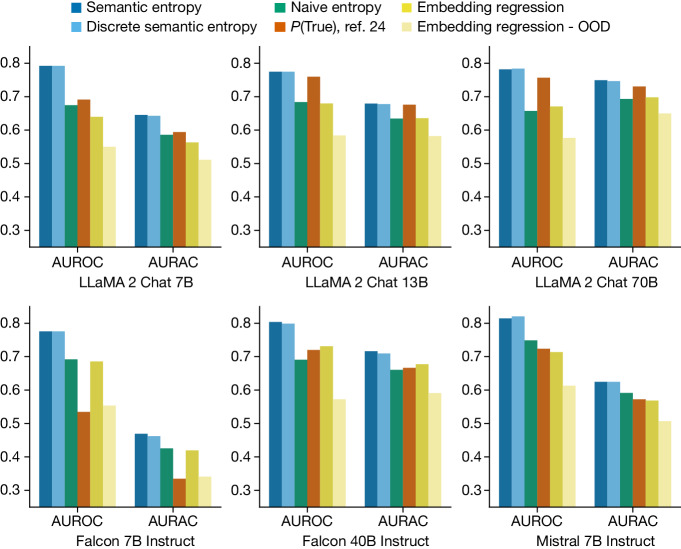
- Averaged across 30 task–model combinations, semantic entropy achieved the best AUROC of 0.790, compared with naive entropy (0.691), P(True) (0.698), and embedding regression (0.687); performance was stable between 0.78 and 0.81 across LLaMA, Falcon, and Mistral model families and scales from 7B to 70B parameters.
- Semantic entropy detects confabulations in sentence-length QA and math across TriviaQA, SQuAD 1.1, BioASQ, NQ-Open, and SVAMP, and its discrete variant performs similarly without requiring exact output probabilities.
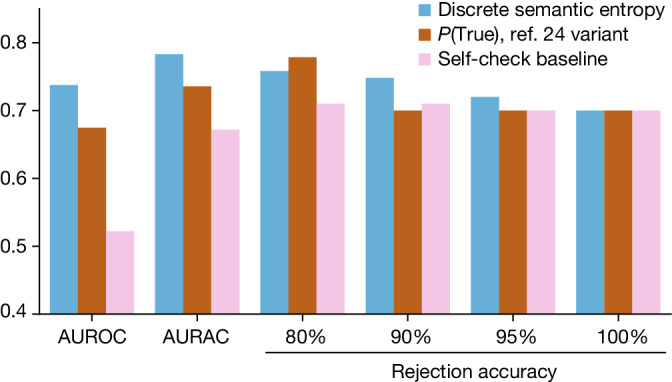
- On the GPT-4 biography dataset FactualBio—21 individuals, 150 factual claims, of which 45 were incorrect—the discrete semantic entropy variant outperformed a self-check baseline and an adapted P(True) baseline on AUROC and AURAC; P(True) had a narrow edge only after the top 20% of answers judged most likely to be confabulations were rejected.
- The method targets confabulations—arbitrary and incorrect generations sensitive to irrelevant details such as random seed—rather than all hallucinations, and it does not address systematically bad outputs.
Methods
- For each question, the method samples multiple generations from the LLM, clusters them by semantic equivalence using bidirectional entailment, and estimates semantic entropy over the meaning clusters; a discrete variant approximates cluster probabilities from generation frequencies when token probabilities are unavailable.
- Sentence-length experiments used LLaMA 2 Chat (7B, 13B, 70B), Falcon Instruct (7B, 40B), and Mistral Instruct (7B) on BioASQ, SQuAD 1.1, TriviaQA, SVAMP, and NQ-Open, with 400 train and 400 test examples per dataset; GPT-4 (v.0613) was used for FactualBio.
- Evaluation metrics were AUROC, rejection accuracy, and AURAC; sentence-length correctness was assessed automatically with GPT-4 against reference answers, validated against human judgement in the Supplementary Information.
Limitations
- The paper states that semantic entropy does not guarantee factuality and does not help when LLM outputs are systematically bad, including confident errors from training objectives, systematic reasoning failures, or misleading behaviour.
- The paper notes that semantic clustering can be overly sensitive to context: in one example, it distinguished a precise date from a year and treated the model as uncertain, even though the distinction was probably irrelevant in context.
- For FactualBio, the paper states that automatically generated questions are the main source of errors, and that GPT-4 did not expose output probabilities at the time, preventing computation of naive entropy, standard semantic entropy, and the embedding regression baseline for GPT-4.
Model-written summary. Check it against the paper before relying on it.
Integrity signals
Registry
Cites
Statistics
Figures
Verification
Claims the paper makes
8 Valid · 6 Not valid · 5 Not checked · 60 Own results and interpretations
The cited sources support only part of this claim — read each source’s verdict below.
In the paper
“Large language model (LLM) systems, such as ChatGPT1 or Gemini2, can show impressive reasoning and question-answering capabilities but often ‘hallucinate’ false outputs and unsubstantiated answers3,4.”
§ Detecting hallucinations in large language models using semantic entropy > Abstract
What the sources say
- Partly supportedcites [3] Xiao, Y. & Wang, W. Y. On hallucination and predictive uncertainty in conditional language generation. In Proc. 16th Conference of the European Chapter of the Association for Computational Linguistics 2734–2744 (Association for Computational Linguistics, 2021). sourceExperimental — accuracy not yet measured
The Introduction (p. 1) says neural generation models can produce content unsupported by their inputs, and §2.1 (p. 2) defines hallucination as false information unsupported by the input. The paper studies conditional generation, including image captioning and data-to-text, rather than establishing how often LLM systems such as ChatGPT or Gemini give unsubstantiated answers. (LLM, conf=0.84)
- Partly supportedcites [4] Rohrbach, A., Hendricks, L. A., Burns, K., Darrell, T. & Saenko, K. Object hallucination in image captioning. In Proc. 2018 Conference on Empirical Methods in Natural Language Processing (eds Riloff, E., Chiang, D., Hockenmaier, J. & Tsujii, J.) 4035–4045 (Association for Computational Linguistics, 2018). sourceExperimental — accuracy not yet measured
The Introduction describes image-captioning models generating objects absent from an image, and Section 3.2 reports hallucinated objects in 7.4%–17.7% of tested captions. This supports the general point that generated outputs can be false, but the paper does not establish how often LLM systems such as ChatGPT or Gemini produce unsubstantiated answers. Page numbers were not available in our copy. (LLM, conf=0.86)
plain- Asserted: passes — The authors put it forward as true.
- Checkable: passes — It can be checked against evidence.
- Load-bearing: passes — The paper’s conclusions depend on it.
- Based: passes — The paper gives a reason why it holds.
- Partly supported
The cited sources support only part of this claim — read each source’s verdict below.
In the paper
“High entropy corresponds to high uncertainty23–25—so semantic entropy is one way to estimate semantic uncertainties.”
§ Detecting hallucinations in large language models using semantic entropy > Main
What the sources say
- Not checked — no full text of the sourcecites [23] MacKay DJC Information-based objective functions for active data selection Neural Comput. 1992 4 590 604 10.1162/neco.1992.4.4.590 source
- Partly supportedcites [24] Kadavath, S. et al. Language models (mostly) know what they know. Preprint at https://arxiv.org/abs/2207.05221 (2022). sourceExperimental — accuracy not yet measured
Section B.2 (p. 29) hypothesizes that an unsure model produces a high-entropy answer distribution, and reports that entropy has some predictive power. But it also finds that larger models can give diverse correct answers and concludes that answer-distribution entropy is not a robust measure of whether a model knows the answer. The unqualified correspondence in the claim overstates the paper's finding. (LLM, conf=0.87)
- Supportedcites [25] Lindley DV On a measure of the information provided by an experiment Ann. Math. Stat. 1956 27 986 1005 10.1214/aoms/1177728069 source
The discussion on p. 4 explains that the measure uses Shannon’s function with the sign reversed: information is greatest when the distribution is concentrated on one value and falls as it spreads. This supports the cited background point that higher Shannon entropy corresponds to greater uncertainty; the later claim about semantic entropy is not attributed to this source. (LLM, conf=0.88)
plainstates an association- Asserted: passes — The authors put it forward as true.
- Checkable: passes — It can be checked against evidence.
- Load-bearing: passes — The paper’s conclusions depend on it.
- Based: passes — The paper gives a reason why it holds.
A result the paper states — it cites no source for it, so there is none to check. The quote shows it is in the paper.
In the paper
“Nevertheless, we significantly improve question-answering accuracy for state-of-the-art LLMs, revealing that confabulations are a great source of error at present.”
§ Detecting hallucinations in large language models using semantic entropy > Main
boostedstates a cause- Asserted: passes — The authors put it forward as true.
- Checkable: passes — It can be checked against evidence.
- Load-bearing: passes — The paper’s conclusions depend on it.
- Based: passes — The paper gives a reason why it holds.
- Rests on an assumption not shown here.
A result the paper reports from its own data — it cites no other source for it, so there is none to check. The quote shows it is in the paper.
In the paper
“We further show that semantic uncertainty can be used to improve model accuracy by refusing to answer questions when semantic uncertainty is high.”
§ Detecting hallucinations in large language models using semantic entropy > Methods > Detecting confabulations in QA and math
plainstates a cause- Asserted: passes — The authors put it forward as true.
- Checkable: passes — It can be checked against evidence.
- Load-bearing: passes — The paper’s conclusions depend on it.
- Based: passes — The paper gives a reason why it holds.
A result the paper reports from its own data — it cites no other source for it, so there is none to check. The quote shows it is in the paper.
In the paper
“In our experiments, we use semantic uncertainty to predict model accuracy, demonstrating that confabulations make up a notable fraction of model mistakes.”
§ Detecting hallucinations in large language models using semantic entropy > Methods > Detecting confabulations in QA and math
boosted- Asserted: passes — The authors put it forward as true.
- Checkable: passes — It can be checked against evidence.
- Load-bearing: passes — The paper’s conclusions depend on it.
- Based: passes — The paper gives a reason why it holds.
36 more claims
Create a free account to see all 79 claims and to verify the 2 references still open.
- Probably not a substantial claim. 30
- It may state two separate claims as one. 20
Claims other papers make about this one
Each is checked against this paper’s own text: does it say what the citing paper says it does?
The source backs part of the claim, not all of it — or backs it for a different population, condition or comparison.
In the citing paper
“However, LLMs exhibit hallucination and fabrication errors that are unacceptable for quantitative modeling [19, 20, 21].”
From Structured Schemas for Provenance‐Rich, LLM ‐Assisted QSP Model Calibration (2026) · cites this paper as [19]
Experimental — accuracy not yet measuredThe source backs part of the claim, not all of it — or backs it for a different population, condition or comparison.
In the citing paper
“Studies on hallucination, calibration, sycophancy, and cognitive bias indicate that failures often result not from a lack of capability but from unstable behavioral dispositions under uncertainty or pressure [8, 9, 10, 12, 15].”
From Machine Psychometrics: A Mathematical Psychology of Artificial Intelligence (2026) · cites this paper as [8]
Experimental — accuracy not yet measuredThe source backs part of the claim, not all of it — or backs it for a different population, condition or comparison.
In the citing paper
“AI-generated patient summaries also frequently contain errors that can be hard to detect12.”
From Multi-model assurance analysis showing large language models are highly vulnerable to adversarial hallucination attacks during clinical decision support (2025) · cites this paper as [12]
Experimental — accuracy not yet measuredThe source backs part of the claim, not all of it — or backs it for a different population, condition or comparison.
In the citing paper
“LLMs remain limited by the static knowledge encoded in their parameters.They are prone to hallucinations, factual inaccuracies, and out-of-date internal knowledge (Farquhar et al., 2024;Lewis et al., 2020).”
From Improving Amharic Information Retrieval with Translative and Multi-Agent Debate Retrieval Augmented Generation (2026) · cites this paper as Farquhar et al., 2024
Experimental — accuracy not yet measuredThe source backs part of the claim, not all of it — or backs it for a different population, condition or comparison.
In the citing paper
“This limitation can result in responses that lack coherence, contextual relevance, and even lead to hallucinations in extended dialogues or complex tasks [1], [2].”
From Memory-Augmented Architecture for Long-Term Context Handling in Large Language Models (2026) · cites this paper as [1]
Experimental — accuracy not yet measured
11 more claims about this paper
Create a free account to see every claim other papers make about this one.
Citations
Cites
Language Models are Few-Shot Learners
Brown, T. B., Mann, B., Ryder, N., Subbiah, M., Kaplan, J., Dhariwal, P., Neelakantan, A., Shyam, P., Sastry, G., Askell, A., et al. (2020) · arXiv · doi:10.48550/arxiv.2005.14165 · Cited by 23,372 · cited 1×
“57), which can predict entailment given suitable prompts.”
SQuAD: 100,000+ Questions for Machine Comprehension of Text
Rajpurkar, P., Zhang, J., Lopyrev, K., & Liang, P. (2016) · Proceedings of the 2016 Conference on Empirical Methods in Natural Language Processing · doi:10.18653/v1/d16-1264 · Cited by 6,208
Survey of Hallucination in Natural Language Generation
Ji, Z., Lee, N., Frieske, R., Yu, T., Su, D., Xu, Y., Ishii, E., Bang, Y. J., Madotto, A., & Fung, P. (2023) · ACM Computing Surveys · doi:10.1145/3571730 · Cited by 5,025 · cited 2×
“Hallucinations are often defined as LLMs generating “content that is nonsensical or unfaithful to the provided source content” 9–11 but they have come to include a vast array of failures of faithfulness and factuality.”
Survey of Hallucination in Natural Language Generation
Ji, Z., Lee, N., Frieske, R., Yu, T., Su, D., Xu, Y., Ishii, E., Bang, Y., Chen, D., Dai, W., et al. (2022) · arXiv · doi:10.48550/arxiv.2202.03629 · Cited by 4,981
A Broad-Coverage Challenge Corpus for Sentence Understanding through Inference
Williams, A., Nangia, N., & Bowman, S. (2018) · Proceedings of the 2018 Conference of the North American Chapter of the Association for Computational Linguistics: Human Language Technologies, Volume 1 (Long Papers) · doi:10.18653/v1/n18-1101 · Cited by 3,342 · cited 2×
“We rely on language models to predict entailment, such as DeBERTa-Large-MNLI 56 , which has been trained to predict entailment, or general-purpose LLMs such as GPT-3.”
Llama 2: Open Foundation and Fine-Tuned Chat Models
Touvron, H., Martin, L., Stone, K., Albert, P., Almahairi, A., Babaei, Y., Bashlykov, N., Batra, S., Bhargava, P., Bhosale, S., et al. (2023) · arXiv · doi:10.48550/arxiv.2307.09288 · Cited by 2,604 · cited 1×
“Our results for TriviaQA, SQuAD, BioASQ, NQ-Open and SVAMP are all evaluated context-free and involve sentence-length answers (96 ± 70 characters, mean ± s.d.) and use LLaMA 2 Chat (7B, 13B and 70B parameters) 38 , Falcon Instruct (7B and 40B) 39 and Mistral Instruct (7B) 40 .”
Aleatory or epistemic? Does it matter?
Kiureghian, A. D., & Ditlevsen, O. (2009) · Structural Safety · doi:10.1016/j.strusafe.2008.06.020 · Cited by 2,454 · cited 1×
“Researchers some-times separate aleatoric uncertainty (uncertainty in the underlying data distribution) from epistemic uncertainty (caused by having only limited information) 46 .”
Natural Questions: A benchmark for question answering research
Kwiatkowski, T., Palomaki, J., Redfield, O., Collins, M., Parikh, A., Alberti, C., Epstein, D., Polosukhin, I., Devlin, J., Lee, K., et al. (2019) · Transactions of the Association for Computational Linguistics · doi:10.1162/tacl_a_00276 · Cited by 2,069 · cited 2×
“33), life sciences (BioASQ 34 ) and open-domain natural questions (NQ-Open 35 ) derived from actual queries to Google Search 36 .”
TriviaQA: A Large Scale Distantly Supervised Challenge Dataset for Reading Comprehension
Joshi, M., Choi, E., Weld, D., & Zettlemoyer, L. (2017) · Proceedings of the 55th Annual Meeting of the Association for Computational Linguistics (Volume 1: Long Papers) · doi:10.18653/v1/p17-1147 · Cited by 1,690 · cited 5×
“TriviaQA is a trivia question-answering dataset.”
InfluentialTriviaQA: A Large Scale Distantly Supervised Challenge Dataset for Reading Comprehension
Joshi, M., Choi, E., Weld, D. S., & Zettlemoyer, L. (2017) · arXiv · doi:10.48550/arxiv.1705.03551 · Cited by 1,650
Research works printed but not linked: 8
- Xiao, T. Z., Gomez, A. N. & Gal, Y. Wat zei je? Detecting out-of-distribution translations with variational transformers. In Workshop on Bayesian Deep Learning at the Conference on Neural Information Processing Systems (NeurIPS, Vancouver, 2019).
- Negri, M., Bentivogli, L., Mehdad, Y., Giampiccolo, D. & Marchetti, A. Divide and conquer: crowdsourcing the creation of cross-lingual textual entailment corpora. In Proc. 2011 Conference on Empirical Methods in Natural Language Processing 670–679 (Association for Computational Linguistics, 2011).
- Malinin, A. & Gales, M. Uncertainty estimation in autoregressive structured prediction. In Proceedings of the International Conference on Learning Representations https://openreview.net/forum?id=jN5y-zb5Q7m (2021).
- Holtzman, A., Buys, J., Du, L., Forbes, M. & Choi, Y. The curious case of neural text degeneration. In Proceedings of the International Conference on Learning Representations https://openreview.net/forum?id=rygGQyrFvH (2020).
- Culicover PW Paraphrase generation and information retrieval from stored text Mech. Transl. Comput. Linguist. 1968 11 78 88
- He, P., Liu, X., Gao, J. & Chen, W. Deberta: decoding-enhanced BERT with disentangled attention. In International Conference on Learning Representations https://openreview.net/forum?id=XPZIaotutsD (2021).
- Socher, R., Huang, E., Pennin, J., Manning, C. D. & Ng, A. Dynamic pooling and unfolding recursive autoencoders for paraphrase detection. In Proceedings of the 24th Conference on Neural Information Processing Systems (eds Shawe-Taylor, J. et al.) (2011)
- Kane, H., Kocyigit, Y., Abdalla, A., Ajanoh, P. & Coulibali, M. Towards neural similarity evaluators. In Workshop on Document Intelligence at the 32nd conference on Neural Information Processing (2019).
Cited by
Items 501–600 of 888
Markov, I., & Sevov, A. (2025) · International Conference on Energy Efficiency and Agricultural Engineering (EE&AE) · doi:10.1109/eeae65901.2025.11273407
“Researchers are testing additional strategies: entropy-based estimators that flag confabulations [27]; metamorphic testing methods that detect contradictions with known facts [28]; and feedback loops - during training, during generation, or after the fact - that encourage self-correction [29].”
Shao, M., & Zhang, H. (2025) · npj Digital Medicine · doi:10.1038/s41746-025-02146-4 · Cited by 4
Venne, D. M., Hartley, D. M., Dorris, C. S., Torres, L. M., Malchione, M. D., Mitgang, E. A., & Goodman, J. L. (2025) · Discover Public Health · doi:10.1186/s12982-025-01245-7
“Moreover, LLMs may generate plausible but factually incorrect or fabricated content, called hallucinations, which may not be apparent to editors or users [87, 88].”
何, 明. (2025) · Artificial Intelligence and Robotics Research · doi:10.12677/airr.2025.146125
A study of popular science discourse in China and Russia using neural networks as informants
Haolin, Q. U., & Gorbatov, D. S. (2025) · Litera · doi:10.25136/2409-8698.2025.11.76033
Halperin, I. (2025) · SSRN Electronic Journal · doi:10.2139/ssrn.5858022
Research on the Application of LLM for Electric-carbon-specific Question and Answer System
Cuiling, J., Wan, Q., Liu, Z. P., Wang, H., Fu, C., Yao, Q. J., & Shi, X. (2025) · International Conference on Electrical Engineering and Computer Technology (IC2ECT) · doi:10.1109/ic2ect66838.2025.11290806
“As a result, the answers of such models are most of the time inaccurate and irrelevant [9].”
Chanrueang, S., Chormuan, S., Nakpomchin, S., & Sookplung, P. (2025) · International Computer Science and Engineering Conference · doi:10.1109/icsec67360.2025.11298019
“Recent studies highlight their transformative impact while also exposing persistent weaknesses in factual reliability and reasoning quality [1].”
Generating the Past: How Artificial Intelligence Summaries of Historical Events Affect Knowledge
Karell, D., Shu, M., Davidson, T., & Okura, K. (2025) · Social Science Computer Review · doi:10.1177/08944393251409744 · Cited by 2
AI in Orthopaedics: The Wisdom of “Should We?” Versus “Can We?”
Murphy, M. P., Weinstein, J. N., Guyton, G. P., & Porter, S. E. (2025) · Journal of Bone and Joint Surgery · doi:10.2106/jbjs.25.00829 · Cited by 2
Tan, C., Xu, X., & Ma, L. (2025) · SSRN Electronic Journal · doi:10.2139/ssrn.5995607
Improving IoT Cyber Threat Response with Multi-Agent LLMs and Semantic Retrieval
Williams, J., Gyawali, S., Jiang, Y., & Huang, J. (2025) · IEEE International Conference on Smart Internet of Things (SmartIoT) · doi:10.1109/smartiot66867.2025.00067
“5 or GPT-4 possess broad general knowledge, they are prone to hallucinations [1] and often lack detailed, device-specific knowledge critical for IoT security.”
Maaradji, A., Mehadjbia, A., & Djedidi, O. (2025) · IEEE/ACS International Conference on Computer Systems and Applications (AICCSA) · doi:10.1109/aiccsa66935.2025.11315450
“Farquhar et al. [3] introduced semantic entropy, an information-theoretic measure computed in embedding space that correlates with factual errors across tasks.”
Saßmannshausen, T. M., & Wagener, S. (2026) · Qeios · doi:10.32388/gag6kd
A Pragmatic Approach to using LLMs
Mays, T. (2025) · Journal of ExoTechnology and Education · doi:10.36615/dr5ynf77
Soft Prompt Improves Direct Search Responses
Sinhababu, N., Mitra, P., & Ganguly, D. (2025) · Annual Meeting of the Forum for Information Retrieval Evaluation (FIRE) · doi:10.1145/3777867.3777873 · Cited by 1
“However, IR remains a challenging task for most modern LLMs due to hallucination and ambiguity in generated output [15, 65].”
Cao, D., Shao, Y., Zhang, L., & Gao, F. (2025) · International Conference on Advanced Computing and Intelligent Robotics Applications (ACIRA) · doi:10.1109/acira67680.2025.11335016 · Cited by 1
“Large language models may provide harmful hallucinations for education purpose, since, given wrong learning, it creates wrong mental maps [17].”
From LLMs to the Global Brain: The Emergence of Planetary-Scale Artificial Intelligence
Schneider, S. M. (2024) · Disputatio · doi:10.2478/disp-2024-0005 · Cited by 1
Köse, U., & Uysal, İ. (2025) · Cyber Awareness and Research Symposium (CARS) · doi:10.1109/cars67163.2025.11337402 · Cited by 1
Wattad, A., Saadi, R., Bez, M., Loewenstein, A., & Goldstein, M. (2026) · Retina · doi:10.1097/iae.0000000000004779
Khan, T., Ansarullah, A., George, J., Tomalka, J. A., Sékaly, R., Palucka, K., & Chaussabel, D. (2026) · bioRxiv (Cold Spring Harbor Laboratory) · doi:10.64898/2026.01.22.701191
“General-purpose LLMs can summarize biomedical text but often exhibit inconsistent citation behavior, variable reasoning structure (Kontsioti, Maskell and Pirmohamed 2024; Qiu et al. 2025), and occasional hallucinations (Farquhar et al. 2024; Asgari et al. 2025; Omar et al. 2025; Shool et al. 2025).”
Lo, C.-H., Shi, K., Kafadarian, L. N., Bermudez, A. G., Diaz, J., Edwards, L., Hong, Y., Chen, Z., Hwang, H., Yan, W., et al. (2026) · bioRxiv (Cold Spring Harbor Laboratory) · doi:10.64898/2026.01.24.701539
“Consistent with previous studies, we demonstrate that model stochasticity is not merely noise, but a deconvolutable signal; high internal consensus across multiple reasoning paths indicates a semantic convergence on accurate biological mechanisms 62 .”
Wang, X., Huang, Y., Liu, T., & Peng, S. (2026) · Lecture notes in electrical engineering · doi:10.1007/978-981-95-3320-6_17
NoRMA: A Multi-agent Communication-Centric Dataset for Enhanced Customs Nomenclature Classification
Bouchtib, H., Karboub, K., Tabaa, M., & Hamlich, M. (2026) · Communications in computer and information science · doi:10.1007/978-3-032-15632-7_18
Integrating AI Agents with Classical Reliability Assessment via LLMs of Semiconductor Lasers
Zhang, J., Wang, T., & Jiang, J. (2025) · International Conference on System Reliability and Safety Engineering (SRSE) · doi:10.1109/srse67406.2025.11357401
HiGraphSum: Hierarchical Hypergraph-Based Dual-Stage Automatic Summarization of Discharge Summaries
Huang, Z., Chen, X., Li, T., Zhao, X., An, Y., & Wang, Y. (2025) · IEEE International Conference on Bioinformatics and Biomedicine (BIBM) · doi:10.1109/bibm66473.2025.11356655 · Cited by 2
“Recent research has explored alternative loss functions to encourage sharper and more confident predictions [31], [32], [33].”
NM-LLaVA: A Novel Large Language Model Assistant for Nuclear Medicine Imaging Analysis and Reporting
Wang, W., Yun, C., Miao, H., Feng, A., & Zhao, X. (2025) · IEEE International Conference on Bioinformatics and Biomedicine (BIBM) · doi:10.1109/bibm66473.2025.11357214
“Hallucinations refer to instances where model-generated content does not match real-world facts or user inputs, often caused by data deficiencies or low utilization rates of factual knowledge captured in the data [34].”
Improving LLM-Assisted Hydropower Operation Through Data Query Enhanced Agent
Luo, W., Zhang, F., Wang, L., Hu, S., Xu, B., & Zhao, J. (2026) · Lecture notes in civil engineering · doi:10.1007/978-981-95-4889-7_49 · Cited by 2
LLM Hallucinations for RAG and KG Enhancement
Anirudh, R., Soudagar, A. F., & L, C. M. (2025) · International Conference on Computational Intelligence and Communication Networks (CICN) · doi:10.1109/cicn67655.2025.11368193
Hamedani, M., Patel, R. P., Bizrah, M., Phylactou, M., & Din, N. (2026) · European Journal of Ophthalmology · doi:10.1177/11206721261419675
“27 Although the ChatGPT-generated PIL in this study contained only a minor error, ChatGPT has been shown to produce convincing but factually incorrect summaries of systematic reviews and provide false references, which could mislead readers if not properly 28 and to provide false references to…”
Devin, A. (2026) · SSRN Electronic Journal · doi:10.2139/ssrn.6135630 · Cited by 3
Architectural Laws And Derived Constraints Of Verification And Consequential AI ReliancePreprint
Devin, A. (2026) · SSRN Electronic Journal · doi:10.2139/ssrn.6135727 · Cited by 2
Detecting Silent Governance Failure: Semantic Entropy, Dissent Exhaustion, and Circuit BreakersPreprint
Sato, T. (2026) · SSRN Electronic Journal · doi:10.2139/ssrn.6066430
Proff, A., Salam, B., Hayawi, M., Kravchenko, D., Mesropyan, N., Aziz-Safaie, T., Dell, T., Theis, M., Pieper, C. C., Sprinkart, A. M., et al. (2026) · European Radiology · doi:10.1007/s00330-026-12329-6 · Cited by 4
“In this study, we restricted mitigation to iterative prompt re fi nement during study design to reduce avoidable hallucinations and enforce safety-oriented phrasing, and deliberately did not implement systematic pipelines within the evaluation [35, 36].”
Simeone, O. (2026) · Cambridge University Press eBooks · doi:10.1017/9781009579551.002
Simeone, O. (2026) · Cambridge University Press eBooks · doi:10.1017/9781009579551.006
Meng, X., & Yang, Y. (2025) · International Conference on Education Technology and Computer · doi:10.1109/icetc66579.2025.11387604
“Some responses may appear fluent and coherent but diverge semantically from the intended prompt—known as semantic drift or hallucination, which can mislead learners [5].”
Saßmannshausen, T. M., & Wagener, S. (2026) · Qeios · doi:10.32388/gag6kd.2
Kozyreva, A. B., Tikhomirov, I. A., Devyatkin, D. A., & Соченков, И. В. (2025) · Scientific and Technical Information Processing · doi:10.3103/s0147688225700546
“Similar approaches are also used to reduce the likelihood of synthesizing unreliable facts: the “hallucinations” of the model [40].”
Adeseye, A., & Isoaho, J. (2026) · IEEE International Conference on AI in Cybersecurity (ICAIC) · doi:10.1109/icaic67076.2026.11395814
“Studies have shown that LLMs also have several limitations; they hallucinate and produce wrong answers confidently [3], [4].”
LieToMe: A Multi-Agent System for Detecting Hallucinations in Large Language Models
Blitti, K. E. K., Tola, F. G., Shukla, M., Ladva, V., & Dholakia, N. H. (2026) · Communications in computer and information science · doi:10.1007/978-3-032-17834-3_29
Learning by Taking Notes: Memory-Guided Continual Learning for Generative Multimodal Models
Guo, Y., Guo, C., Gao, Y., & Sun, Y. (2025) · IEEE International Conference on Computer Vision Workshops · doi:10.1109/iccvw69036.2025.00456
“These generative models exhibit impressive reasoning and question-answering capabilities but often produce halluci-nated outputs [11].”
Luo, J., Ma, J., Zhan, D., Zhou, Y., Li, J., Zhang, L., & Wang, W. (2026) · Journal of Medical Internet Research · doi:10.2196/86502 · Cited by 1
“This trend echoes prior research: Alber et al [55] warned of data poisoning risks in medical corpora, underscoring the need for prudence, while Sebastian et al [56] systematically documented hallucinations in LLM-generated medical texts and emphasized risk evaluation mechanisms.”
Learned, Lagged, LLM-Splained: LLM Responses to End User Security Questions
Prakash, V., Lee, K., Bhattacharya, A., Huang, D. Y., & Staddon, J. (2025) · Annual Computer Security Applications Conference · doi:10.1109/acsac67867.2025.00092 · Cited by 8
“While there has been recent progress in computational approaches to predicting hallucinations [97], user-friendly heuristics are an important open problem.”
Menon, S. (2026) · SSRN Electronic Journal · doi:10.2139/ssrn.6305085
HAMZAH, A. B., & Teng, S. (2026) · Research Square · doi:10.21203/rs.3.rs-8929856/v1
Reimagining Reality: Innovations in AI Hallucination Management and Trustworthy Generation
Nag, A., & Chaudhuri, D. (2026) · Advances in computational intelligence and robotics book series · doi:10.4018/979-8-3373-7534-2.ch012 · Cited by 1
Zhou, H., & Jia, G. (2026) · SSRN Electronic Journal · doi:10.2139/ssrn.6329666
From Language to the City: LLM-Driven Cross-Modal Intelligence for Future Smart Urban Systems
Li, A. D., Min, J., Liu, Y., et al. (2025) · International Conference on Computer, Internet of Things and Smart City (CIoTSC) · doi:10.1109/ciotsc67482.2025.11413031
Urban Representative Term Summarization: A Semantic-Assessment Ontology Learning ApproachPreprint
Li, C., Yi, X., Qi, D., Huang, Z., Pan, Z., Zhang, J., & Zheng, Y. (2026) · SSRN Electronic Journal · doi:10.2139/ssrn.6344122
Explainable Topic Modeling for Tracking User Interests Related to Social Events
Le, H. H., Harakawa, R., & Iwahashi, M. (2026) · IEEE Access · doi:10.1109/access.2026.3670898
Matching Patients With Cell Surface–Targeted Clinical Trials Using Large Language Models
Callahan, S. C., Chrostek, M. R., Rydzewski, N. R., Bootsma, M. L., Helzer, K. T., Bakhtiar, H., Morris, Z. S., Kosoff, D., Lang, J. M., Ma, V. T.-L., et al. (2026) · JCO Precision Oncology · doi:10.1200/po-25-00757 · Cited by 1
ChatMicroscopy: A Perspective Review of Large Language Models for Next-Generation Optical Microscopy
Sancataldo, G. (2026) · Applied Sciences · doi:10.3390/app16052502
Probing LLM Hallucination from Within: Perturbation-Driven Method via Internal Knowledge
Lee, S., Hsu, H., Chen, C., & Chau, D. H. (2025) · BigData Congress [Services Society] · doi:10.1109/bigdata66926.2025.11402288 · Cited by 1
“Uncertainty estimation methods [20], [21], [36]–[41] often overlook hallucinations from randomness or token dependencies [26], [27], [42].”
Shrestha, M., & Kim, E. (2025) · IEEE International Conference on Big Data (BigData) · doi:10.1109/bigdata66926.2025.11401920 · Cited by 3
“Since the underlying corpora are uncurated and they often exhibit hallucination,producing fluent but factually incorrect or unverifiable statements [1]–[3].”
Jasem, A. N. A. A. (2026) · International Journal of Research · doi:10.26643/ijr/22
Vu, T. T., Bui, T.-D., Nguyen, T.-T., Nguyen, S., & Vo, H. (2026) · Journal of Systems and Software · doi:10.1016/j.jss.2026.112852 · Cited by 6
A Geometric Taxonomy of Hallucinations in LLMsPreprint
Marin, J. (2026) · Qeios · doi:10.32388/qyjyru
Rahman, M., & Chowdhury, M. (2026) · International Conference on Electrical, Computer & Telecommunication Engineering (ICECTE) · doi:10.1109/icecte69292.2026.11429437
“Healthcare, banking, law, and education are just a few of the fields that use LLM models extensively [1], [2], [3], [4].”
Bonifazi, G., Buratti, C., Marchetti, M., Parlapiano, F., Traini, D., Ursino, D., & Virgili, L. (2026) · ACM Transactions on Intelligent Systems and Technology · doi:10.1145/3803797 · Cited by 1
Large language models and their use in drug design
Oprea, T. I. (2026) · Elsevier eBooks · doi:10.1016/b978-0-443-29808-0.00085-6 · Cited by 1
Chen, Z., Du, M., Qian, C., & Yu, H. (2026) · Journal of Hazardous Materials · doi:10.1016/j.jhazmat.2026.141820 · Cited by 3
Rudra, A., & Agrawal, M. (2025) · IEEE International Conference on Advances in Data-Driven Analytics and Intelligent Systems (ADACIS) · doi:10.1109/adacis65663.2025.11436184 · Cited by 2
InterFeat: a pipeline for finding interesting scientific features
Ofer, D., Linial, M., & Shahaf, D. (2026) · Scientific Reports · doi:10.1038/s41598-026-43169-5 · Cited by 2
“However, their tendency to hallucinate unfeasible, or nonsensical ideas makes them insufficiently reliable to be a Great Automatic Grammatizator (Dahl, 1997) for ideas without manual validation (Farquhar et al., 2024).”
Literature Discovery and Synthesis With AI: Narrative, Scoping, and Systematic Reviews
(2026) · Advances in computational intelligence and robotics book series · doi:10.4018/979-8-3373-9340-7.ch003
Enhancing Code Generation Through Reliability-Aware Synthetic Contexts
Das, S. (2026) · Lecture notes in computer science · doi:10.1007/978-3-032-21324-2_46
APLR: A Semi-Supervised Learning Framework Based on Adaptive Pseudo-Label Refinement
魏妙琪 (2025) · IEEE International Conference of Safe Production and Informatization (IICSPI) · doi:10.1109/iicspi66775.2025.11437681
“Commonly used metrics for predicting uncertainty include Predictive Entropy [4], which measures the disorder of the output distribution and reflects the model’s confidence in its predictions; Predictive Variance or Confidence Interval, which is often combined with Bayesian deep learning [5]…”
A Sentence-Level Risk Estimator for Identifying Hallucinations in Generative AI
Gupta, V., Chakravarti, L., Akhtar, M. M., Maheshwari, P., Garg, P., & Tiwari, D. (2026) · International Conference on AI-Driven Smart Systems and Ubiquitous Computing (ICAUC) · doi:10.1109/icauc68182.2026.11441054 · Cited by 10
“Farquhar et al. [10] proposed semantic entropy to detect confabulations by computing uncertainty at the semantic level.”
Deterministic Hallucination Detection in Medical VQA via Confidence-Evidence Bayesian Gain
Asadi, M., Nedaee, T., O’Sullivan, J. W., Ashley, E. A., & Adeli, E. (2026) · Lecture notes in computer science · doi:10.1007/978-3-032-38059-3_13 · Cited by 1
Hallucination-aware Retrieval Augmented Generation with Evidence-based Semantic Clustering
Jin, C., Lu, Y., Nie, J., & Yu, S. (2026) · International Conference on Artificial Intelligence and Social Network Systems (AISNS) · doi:10.1109/aisns67921.2026.11440643
Farhad, M., Masud, M. M., Rasheed, A. S. A., & Musthfa, N. (2026) · doi:10.1145/3793638.3793643
Enhanced multi-tuple extraction for materials: integrating pointer networks and augmented attention
Hei, M., Zhang, Z., Liu, Q., Pan, Y., Zhao, X., Peng, Y., Ye, Y., Zhang, X., & Bai, S. (2026) · Journal of Materials Informatics · doi:10.20517/jmi.2025.75 · Cited by 1
Benchmarking Large Language Models Against Web of Science
Mangal, R. K., Jessup, M., Desai, A., Khandekar, A., Prasad, S., Tadisina, K. K., & Singh, D. P. (2026) · Annals of Plastic Surgery · doi:10.1097/sap.0000000000004730
HAMZAH, A. B., & Teng, S. (2026) · Research Square · doi:10.21203/rs.3.rs-9240163/v1
Dissanayake, S., & Wickramaarachchi, D. (2026) · International Conference on Advanced Research in Computing (ICARC) · doi:10.1109/icarc68737.2026.11454122
“Training methodology diversity [8] 5.”
InfluentialSrinivas, T. A. S., Gautam, P., Srujan, G., et al. (2026) · International Conference on Intelligent Data Communication Technologies and Internet of Things (IDCIoT) · doi:10.1109/idciot67589.2026.11455853
Balsa‐Barreiro, J., Rabbani, S., Difallah, D. E., Menéndez, M., & Cebrián, M. (2026) · Discover Data · doi:10.1007/s44248-026-00105-2 · Cited by 1
Artificial Intelligence in GI Interventions
McBride, A. F., & Wildenberg, J. C. (2026) · Springer eBooks · doi:10.1007/978-3-032-03935-4_2
Li, C., Chen, L., Tang, J., Bai, Y., Zhang, Y., Zheng, Z., Zhou, P., & Qu, Z. (2026) · International World Wide Web Conference (WWW) · doi:10.1145/3774904.3792550 · Cited by 1
Li, Y., Yan, B.-C., Zhang, R., Song, X. Z., Chen, L., & Cao, Z. (2026) · doi:10.2196/preprints.96304
Glanceable Verification Indicators for AI-Assisted Storytelling
Xu, M., Zhao, Z., Zeng, J., Wang, T. Y., Panetta, F., Fiebrink, R. A., Bryan–Kinns, N., & Grierson, M. (2026) · CHI Conference Extended Abstracts on Human Factors in Computing Systems (CHI EA) · doi:10.1145/3772363.3798491
“It is widely understood that LLMs hallucinate, generating plausible yet factually incorrect claims [5, 14, 21, 22].”
From Idea to Co-Creation: A Planner-Actor-Critic Framework for Agent Augmented 3D Modeling
Gao, J., & Juluri, S. (2026) · CHI Conference Extended Abstracts on Human Factors in Computing Systems (CHI EA) · doi:10.1145/3772363.3798904
“…of coding agents, particularly Claude Code (Anthropic, 2024), which maintains a structured plan within the context, maintain task continuity and mitigate issues such as context contamination and attention diffusion, which are common in long, multi-step generation tasks(Farquhar et al., 2024).”
Artificial Intelligence in Non-melanoma Skin Cancer
Sgouros, D., Theofili, M., & Pappa, G. (2026) · Springer eBooks · doi:10.1007/978-3-032-15614-3_6
Soft-Community Kernel Rényi Spectrum for Semantic Uncertainty Estimation in Large Language Models
Li, Z., & Du, J. (2026) · Entropy · doi:10.3390/e28040442
“To address this limitation, recent work has shifted attention toward semantic uncertainty estimation, where uncertainty is defined over the space of meanings expressed by multiple sampled generations rather than over individual tokens [10–12].”
InfluentialA Novel Approach for De-Biasing and Enhanced Hallucination Mitigation in LLM
Shamseera, M. K., & Durga, R. (2026) · Communications in computer and information science · doi:10.1007/978-3-032-17846-6_11
Semantic Information Theory and Method
Niu, K., Liang, Z., & Zhang, P. (2025) · doi:10.1109/apwdsit64675.2025.11478551
“We note that [22] also defines a similar semantic entropy form to detect hallucinations in large models.”
James, V., Caronia, C. G., & Savargaonkar, R. (2026) · Scientific Reports · doi:10.1038/s41598-026-48326-4 · Cited by 2
“…of mechanistic equivalence: just as humans experience performance degradation when extraneous cognitive demands exceed working memory capacity, LLMs exhibit attention collapse, context degradation, and increased hallucination rates when input sequences exceed optimal processing thresholds 9,25,26 .”
AFER: Adaptive Fact Selection via Entropy Reduction for Factual Long-Form Generation
Zhang, Y., He, R., & Wang, J. (2026) · IEEE International Conference on Acoustics Speech and Signal Processing · doi:10.1109/icassp55912.2026.11460476
Self-Chill: A Divergence-Convergence Framework for Multi-Path Generation in LLMs
Li, Y., Chen, Y., Li, D., Wang, W. B., & Zhang, Y. (2026) · IEEE International Conference on Acoustics Speech and Signal Processing · doi:10.1109/icassp55912.2026.11464445
Beyond Answers: Trajectory Semantic Entropy for Reliable Uncertainty Quantification in LLMs
Song, B., Feng, Z., Wang, S., & Zhou, Y. (2026) · IEEE International Conference on Acoustics Speech and Signal Processing · doi:10.1109/icassp55912.2026.11463008 · Cited by 2
GenAI as a Tool for Scientists and Researchers
Hadzhikoleva, S., Hadzhikolev, E. N., & Yotov, K. (2026) · International Symposium INFOTEH-JAHORINA (INFOTEH) · doi:10.1109/infoteh68759.2026.11477705
“This challenge has motivated the development of technologies and methods for detecting hallucinations in LLMs [34].”
Kang, D., Yuan, L., Feng, J., Grzybowski, A. E., & Jin, K. (2026) · Acta Ophthalmologica · doi:10.1111/aos.70136
Chen, Z., Zou, B., Kui, X., Lu, W., & Duan, J. (2026) · IEEE International Conference on Acoustics Speech and Signal Processing · doi:10.1109/icassp55912.2026.11460518
Roostaee, M. (2026) · Iranian Journal of Science and Technology Transactions of Electrical Engineering · doi:10.1007/s40998-026-01073-8
Large language models as a conduit for value shifts in contemporary China
Cao, L., & Dai, L. (2026) · Chinese Sociological Review · doi:10.1080/21620555.2026.2656193
Context Definition for Large Language Model Validation and Enhancement
Feng, B., & Ostrowski, D. A. (2026) · IEEE International Conference on Semantic Computing (ICSC) · doi:10.1109/icsc67292.2026.00058
Duah, P., & Awuah-Offei, K. (2026) · SSRN Electronic Journal · doi:10.2139/ssrn.6661422
A global data commons is needed to protect and govern Earth's soil
Cagnarini, C., GUERRA, M., Fiore, A., Pellis, G., Nanni, R., Napolitano, M., & Renella, G. (2026) · Pedosphere · doi:10.1016/j.pedsph.2026.05.001
Large Language Model for the Analysis of Enterprise Architecture Model
Hillmann, P., Heiland, E., Torres, D. V., & Karcher, A. (2025) · International Conference on Advanced Enterprise Information System (AEIS) · doi:10.1109/aeis68693.2025.00009
Metadata
- Authors
- Farquhar, S., Kossen, J., Kuhn, L., & Gal, Y.
- Affiliations
- University of Oxford (GB)
- Corresponding author
- Farquhar, Sebastian
- Venue
- Nature
- Published
- 2024-06-19
- Volume
- 630
- Issue
- 8017
- Pages
- 625-630
- ISSN
- 0028-0836 (ISSN-L)
- 1476-4687
- PMC
- PMC11186750
- OpenAlex
- W4399803256
- Semantic Scholar
- f82f49c20c6acc69f884f05e3a9f1ceea91061ce
- Cited by
- 934
- References
- 60
- Citations by year
- 2026: 540 · 2025: 349 · 2024: 44
- FWCI
- 137.11
- Type
- journal article
- Language
- en
- Open access
- hybrid
- doi.org
- Licence
- cc-by
- creativecommons.org/licenses/by/4.0 (tdm)
- creativecommons.org/licenses/by/4.0 (vor)
- Locations
- Nature (publishedVersion, cc-by)
- PubMed Central (publishedVersion, cc-by)
- PubMed (publishedVersion)
- RePEc: Research Papers in Economics (submittedVersion)
- Funders
- Government of the United Kingdom
- UK Research and Innovation
- Topics
- Physical Sciences › Computer Science › Artificial Intelligence › Topic Modeling
- Physical Sciences › Computer Science › Artificial Intelligence › Adversarial Robustness in Machine Learning
- Physical Sciences › Computer Science › Artificial Intelligence › Natural Language Processing Techniques
- Keywords
- hallucination detection, large language models, semantic entropy, uncertainty estimation, confabulation, LLM reliability, generalization to unseen tasks, honesty
About these checks
Registry, retraction, Cites and statistics results are computed, not judged, with one exception: a printed reference that no index lists is read once by a model before it counts as a citation error. Claims are extracted by a model and kept only when their quote appears verbatim in the text; each cited source is then checked, with a model’s help, for whether it says what the claim relies on. Those verdicts can be wrong — read the claim’s quote and the cited source before relying on one.
The claim verdicts this report counts are experimental: their accuracy is not yet measured.
A language model drew the claims from the paper on 2026-10-10, under version 3 of the claim definition (model deepseek-v4.1-flash, prompt extract-v3).
A second model labelled each claim on 2026-10-10 (model jev-1.13-20260917, definition revision gold-guideline-v0.2).
Cited sources are checked with a language model’s help (gpt-6-sol).
Statistics and arithmetic are recomputed, not judged.
Confidence bands are shown only for fields calibrated on our annotated test set. None is calibrated yet, so no band is shown.
What counts as a claim ›How we measure confidence ›How we check this ›
Are you an author, or do you see a problem with this page? Request a review
Data sources
Bibliographic data: Semantic Scholar, OpenAlex, Crossref.
Contains information from the Semantic Scholar Academic Graph Datasets, made available under the ODC Attribution License (ODC-BY 1.0).
Semantic Scholar’s data is described in: Kinney, R., et al. (2023). The Semantic Scholar Open Data Platform. arXiv:2301.10140.
