

Detecting hallucinations in large language models using semantic entropy
Open accessThe DOI matches its Crossref record; 57 of the 60 references it cites were found in a registry or an index; 14 of the 21 sources its claims cite were checked for support.
Abstract
Abstract Large language model (LLM) systems, such as ChatGPT 1 or Gemini 2 , can show impressive reasoning and question-answering capabilities but often ‘hallucinate’ false outputs and unsubstantiated answers 3,4 . Answering unreliably or without the necessary information prevents adoption in diverse fields, with problems including fabrication of legal precedents 5 or untrue facts in news articles 6 and even posing a risk to human life in medical domains such as radiology 7 . Encouraging truthfulness through supervision or reinforcement has been only partially successful 8 . Researchers need a general method for detecting hallucinations in LLMs that works even with new and unseen questions to which humans might not know the answer. Here we develop new methods grounded in statistics, proposing entropy-based uncertainty estimators for LLMs to detect a subset of hallucinations—confabulations—which are arbitrary and incorrect generations. Our method addresses the fact that one idea can be expressed in many ways by computing uncertainty at the level of meaning rather than specific sequences of words. Our method works across datasets and tasks without a priori knowledge of the task, requires no task-specific data and robustly generalizes to new tasks not seen before. By detecting when a prompt is likely to produce a confabulation, our method helps users understand when they must take extra care with LLMs and opens up new possibilities for using LLMs that are otherwise prevented by their unreliability.
Overview
CoChat Summary
TL;DR
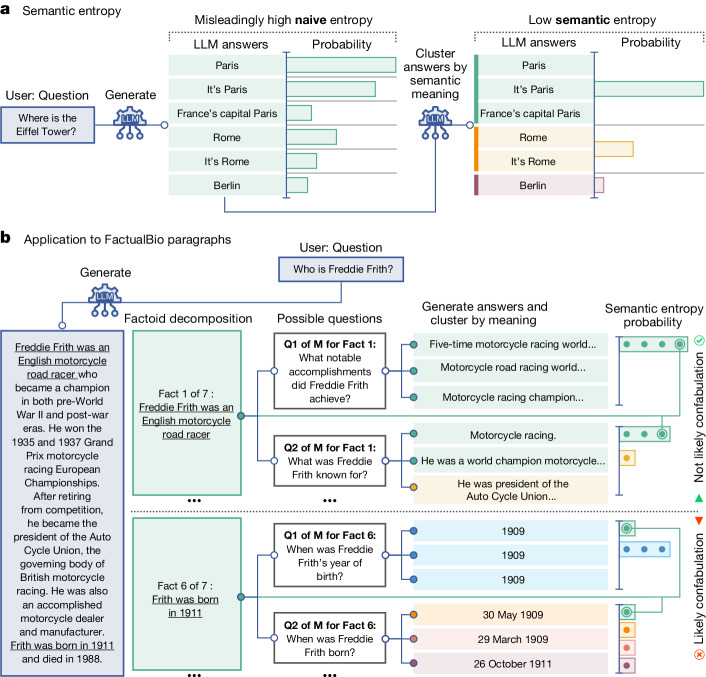
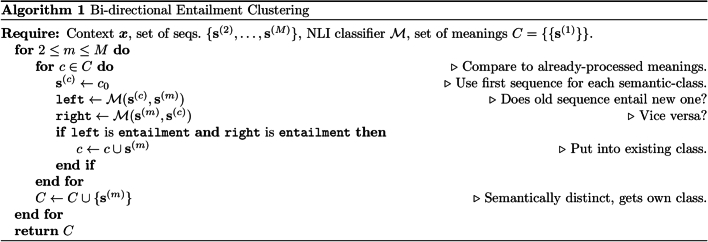
The paper introduces semantic entropy, an uncertainty estimator that clusters LLM generations by meaning via bidirectional entailment and computes entropy over those semantic clusters to detect confabulations. Across question-answering, math, and biography-generation tasks, semantic entropy outperforms naive entropy and supervised baselines without task-specific training data.
Key findings
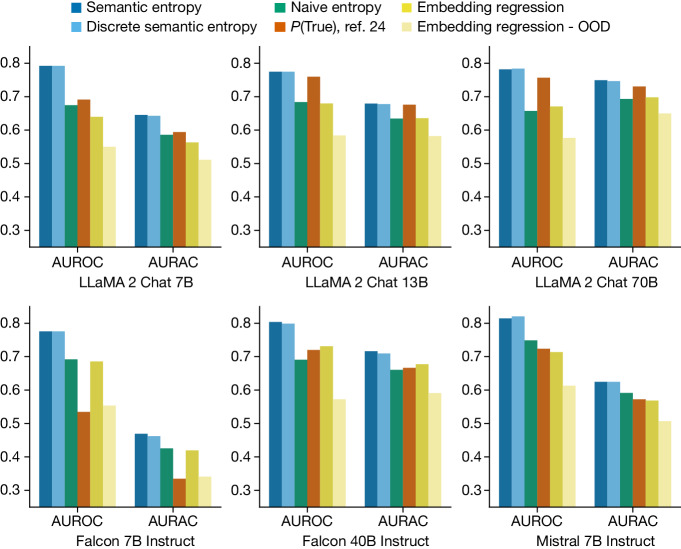
- Averaged across 30 task–model combinations, semantic entropy achieved the best AUROC of 0.790, compared with naive entropy (0.691), P(True) (0.698), and embedding regression (0.687); performance was stable between 0.78 and 0.81 across LLaMA, Falcon, and Mistral model families and scales from 7B to 70B parameters.
- Semantic entropy detects confabulations in sentence-length QA and math across TriviaQA, SQuAD 1.1, BioASQ, NQ-Open, and SVAMP, and its discrete variant performs similarly without requiring exact output probabilities.
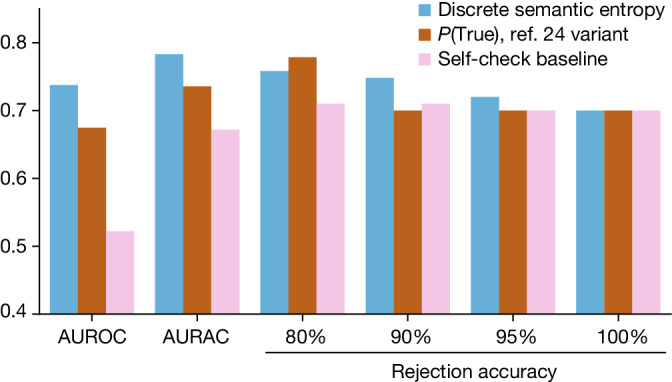
- On the GPT-4 biography dataset FactualBio—21 individuals, 150 factual claims, of which 45 were incorrect—the discrete semantic entropy variant outperformed a self-check baseline and an adapted P(True) baseline on AUROC and AURAC; P(True) had a narrow edge only after the top 20% of answers judged most likely to be confabulations were rejected.
- The method targets confabulations—arbitrary and incorrect generations sensitive to irrelevant details such as random seed—rather than all hallucinations, and it does not address systematically bad outputs.
Methods
- For each question, the method samples multiple generations from the LLM, clusters them by semantic equivalence using bidirectional entailment, and estimates semantic entropy over the meaning clusters; a discrete variant approximates cluster probabilities from generation frequencies when token probabilities are unavailable.
- Sentence-length experiments used LLaMA 2 Chat (7B, 13B, 70B), Falcon Instruct (7B, 40B), and Mistral Instruct (7B) on BioASQ, SQuAD 1.1, TriviaQA, SVAMP, and NQ-Open, with 400 train and 400 test examples per dataset; GPT-4 (v.0613) was used for FactualBio.
- Evaluation metrics were AUROC, rejection accuracy, and AURAC; sentence-length correctness was assessed automatically with GPT-4 against reference answers, validated against human judgement in the Supplementary Information.
Limitations
- The paper states that semantic entropy does not guarantee factuality and does not help when LLM outputs are systematically bad, including confident errors from training objectives, systematic reasoning failures, or misleading behaviour.
- The paper notes that semantic clustering can be overly sensitive to context: in one example, it distinguished a precise date from a year and treated the model as uncertain, even though the distinction was probably irrelevant in context.
- For FactualBio, the paper states that automatically generated questions are the main source of errors, and that GPT-4 did not expose output probabilities at the time, preventing computation of naive entropy, standard semantic entropy, and the embedding regression baseline for GPT-4.
Model-written summary. Check it against the paper before relying on it.
Integrity signals
Registry
Cites
Statistics
Figures
Verification
Claims the paper makes
8 Valid · 6 Not valid · 5 Not checked · 60 Own results and interpretations
The cited sources support only part of this claim — read each source’s verdict below.
In the paper
“Large language model (LLM) systems, such as ChatGPT1 or Gemini2, can show impressive reasoning and question-answering capabilities but often ‘hallucinate’ false outputs and unsubstantiated answers3,4.”
§ Detecting hallucinations in large language models using semantic entropy > Abstract
What the sources say
- Partly supportedcites [3] Xiao, Y. & Wang, W. Y. On hallucination and predictive uncertainty in conditional language generation. In Proc. 16th Conference of the European Chapter of the Association for Computational Linguistics 2734–2744 (Association for Computational Linguistics, 2021). sourceExperimental — accuracy not yet measured
The Introduction (p. 1) says neural generation models can produce content unsupported by their inputs, and §2.1 (p. 2) defines hallucination as false information unsupported by the input. The paper studies conditional generation, including image captioning and data-to-text, rather than establishing how often LLM systems such as ChatGPT or Gemini give unsubstantiated answers. (LLM, conf=0.84)
- Partly supportedcites [4] Rohrbach, A., Hendricks, L. A., Burns, K., Darrell, T. & Saenko, K. Object hallucination in image captioning. In Proc. 2018 Conference on Empirical Methods in Natural Language Processing (eds Riloff, E., Chiang, D., Hockenmaier, J. & Tsujii, J.) 4035–4045 (Association for Computational Linguistics, 2018). sourceExperimental — accuracy not yet measured
The Introduction describes image-captioning models generating objects absent from an image, and Section 3.2 reports hallucinated objects in 7.4%–17.7% of tested captions. This supports the general point that generated outputs can be false, but the paper does not establish how often LLM systems such as ChatGPT or Gemini produce unsubstantiated answers. Page numbers were not available in our copy. (LLM, conf=0.86)
plain- Asserted: passes — The authors put it forward as true.
- Checkable: passes — It can be checked against evidence.
- Load-bearing: passes — The paper’s conclusions depend on it.
- Based: passes — The paper gives a reason why it holds.
- Partly supported
The cited sources support only part of this claim — read each source’s verdict below.
In the paper
“High entropy corresponds to high uncertainty23–25—so semantic entropy is one way to estimate semantic uncertainties.”
§ Detecting hallucinations in large language models using semantic entropy > Main
What the sources say
- Not checked — no full text of the sourcecites [23] MacKay DJC Information-based objective functions for active data selection Neural Comput. 1992 4 590 604 10.1162/neco.1992.4.4.590 source
- Partly supportedcites [24] Kadavath, S. et al. Language models (mostly) know what they know. Preprint at https://arxiv.org/abs/2207.05221 (2022). sourceExperimental — accuracy not yet measured
Section B.2 (p. 29) hypothesizes that an unsure model produces a high-entropy answer distribution, and reports that entropy has some predictive power. But it also finds that larger models can give diverse correct answers and concludes that answer-distribution entropy is not a robust measure of whether a model knows the answer. The unqualified correspondence in the claim overstates the paper's finding. (LLM, conf=0.87)
- Supportedcites [25] Lindley DV On a measure of the information provided by an experiment Ann. Math. Stat. 1956 27 986 1005 10.1214/aoms/1177728069 source
The discussion on p. 4 explains that the measure uses Shannon’s function with the sign reversed: information is greatest when the distribution is concentrated on one value and falls as it spreads. This supports the cited background point that higher Shannon entropy corresponds to greater uncertainty; the later claim about semantic entropy is not attributed to this source. (LLM, conf=0.88)
plainstates an association- Asserted: passes — The authors put it forward as true.
- Checkable: passes — It can be checked against evidence.
- Load-bearing: passes — The paper’s conclusions depend on it.
- Based: passes — The paper gives a reason why it holds.
A result the paper states — it cites no source for it, so there is none to check. The quote shows it is in the paper.
In the paper
“Nevertheless, we significantly improve question-answering accuracy for state-of-the-art LLMs, revealing that confabulations are a great source of error at present.”
§ Detecting hallucinations in large language models using semantic entropy > Main
boostedstates a cause- Asserted: passes — The authors put it forward as true.
- Checkable: passes — It can be checked against evidence.
- Load-bearing: passes — The paper’s conclusions depend on it.
- Based: passes — The paper gives a reason why it holds.
- Rests on an assumption not shown here.
A result the paper reports from its own data — it cites no other source for it, so there is none to check. The quote shows it is in the paper.
In the paper
“We further show that semantic uncertainty can be used to improve model accuracy by refusing to answer questions when semantic uncertainty is high.”
§ Detecting hallucinations in large language models using semantic entropy > Methods > Detecting confabulations in QA and math
plainstates a cause- Asserted: passes — The authors put it forward as true.
- Checkable: passes — It can be checked against evidence.
- Load-bearing: passes — The paper’s conclusions depend on it.
- Based: passes — The paper gives a reason why it holds.
A result the paper reports from its own data — it cites no other source for it, so there is none to check. The quote shows it is in the paper.
In the paper
“In our experiments, we use semantic uncertainty to predict model accuracy, demonstrating that confabulations make up a notable fraction of model mistakes.”
§ Detecting hallucinations in large language models using semantic entropy > Methods > Detecting confabulations in QA and math
boosted- Asserted: passes — The authors put it forward as true.
- Checkable: passes — It can be checked against evidence.
- Load-bearing: passes — The paper’s conclusions depend on it.
- Based: passes — The paper gives a reason why it holds.
36 more claims
Create a free account to see all 79 claims and to verify the 2 references still open.
- Probably not a substantial claim. 30
- It may state two separate claims as one. 20
Claims other papers make about this one
Each is checked against this paper’s own text: does it say what the citing paper says it does?
The source backs part of the claim, not all of it — or backs it for a different population, condition or comparison.
In the citing paper
“However, LLMs exhibit hallucination and fabrication errors that are unacceptable for quantitative modeling [19, 20, 21].”
From Structured Schemas for Provenance‐Rich, LLM ‐Assisted QSP Model Calibration (2026) · cites this paper as [19]
Experimental — accuracy not yet measuredThe source backs part of the claim, not all of it — or backs it for a different population, condition or comparison.
In the citing paper
“Studies on hallucination, calibration, sycophancy, and cognitive bias indicate that failures often result not from a lack of capability but from unstable behavioral dispositions under uncertainty or pressure [8, 9, 10, 12, 15].”
From Machine Psychometrics: A Mathematical Psychology of Artificial Intelligence (2026) · cites this paper as [8]
Experimental — accuracy not yet measuredThe source backs part of the claim, not all of it — or backs it for a different population, condition or comparison.
In the citing paper
“AI-generated patient summaries also frequently contain errors that can be hard to detect12.”
From Multi-model assurance analysis showing large language models are highly vulnerable to adversarial hallucination attacks during clinical decision support (2025) · cites this paper as [12]
Experimental — accuracy not yet measuredThe source backs part of the claim, not all of it — or backs it for a different population, condition or comparison.
In the citing paper
“LLMs remain limited by the static knowledge encoded in their parameters.They are prone to hallucinations, factual inaccuracies, and out-of-date internal knowledge (Farquhar et al., 2024;Lewis et al., 2020).”
From Improving Amharic Information Retrieval with Translative and Multi-Agent Debate Retrieval Augmented Generation (2026) · cites this paper as Farquhar et al., 2024
Experimental — accuracy not yet measuredThe source backs part of the claim, not all of it — or backs it for a different population, condition or comparison.
In the citing paper
“This limitation can result in responses that lack coherence, contextual relevance, and even lead to hallucinations in extended dialogues or complex tasks [1], [2].”
From Memory-Augmented Architecture for Long-Term Context Handling in Large Language Models (2026) · cites this paper as [1]
Experimental — accuracy not yet measured
11 more claims about this paper
Create a free account to see every claim other papers make about this one.
Citations
Cites
Language Models are Few-Shot Learners
Brown, T. B., Mann, B., Ryder, N., Subbiah, M., Kaplan, J., Dhariwal, P., Neelakantan, A., Shyam, P., Sastry, G., Askell, A., et al. (2020) · arXiv · doi:10.48550/arxiv.2005.14165 · Cited by 23,372 · cited 1×
“57), which can predict entailment given suitable prompts.”
SQuAD: 100,000+ Questions for Machine Comprehension of Text
Rajpurkar, P., Zhang, J., Lopyrev, K., & Liang, P. (2016) · Proceedings of the 2016 Conference on Empirical Methods in Natural Language Processing · doi:10.18653/v1/d16-1264 · Cited by 6,208
Survey of Hallucination in Natural Language Generation
Ji, Z., Lee, N., Frieske, R., Yu, T., Su, D., Xu, Y., Ishii, E., Bang, Y. J., Madotto, A., & Fung, P. (2023) · ACM Computing Surveys · doi:10.1145/3571730 · Cited by 5,025 · cited 2×
“Hallucinations are often defined as LLMs generating “content that is nonsensical or unfaithful to the provided source content” 9–11 but they have come to include a vast array of failures of faithfulness and factuality.”
Survey of Hallucination in Natural Language Generation
Ji, Z., Lee, N., Frieske, R., Yu, T., Su, D., Xu, Y., Ishii, E., Bang, Y., Chen, D., Dai, W., et al. (2022) · arXiv · doi:10.48550/arxiv.2202.03629 · Cited by 4,981
A Broad-Coverage Challenge Corpus for Sentence Understanding through Inference
Williams, A., Nangia, N., & Bowman, S. (2018) · Proceedings of the 2018 Conference of the North American Chapter of the Association for Computational Linguistics: Human Language Technologies, Volume 1 (Long Papers) · doi:10.18653/v1/n18-1101 · Cited by 3,342 · cited 2×
“We rely on language models to predict entailment, such as DeBERTa-Large-MNLI 56 , which has been trained to predict entailment, or general-purpose LLMs such as GPT-3.”
Llama 2: Open Foundation and Fine-Tuned Chat Models
Touvron, H., Martin, L., Stone, K., Albert, P., Almahairi, A., Babaei, Y., Bashlykov, N., Batra, S., Bhargava, P., Bhosale, S., et al. (2023) · arXiv · doi:10.48550/arxiv.2307.09288 · Cited by 2,604 · cited 1×
“Our results for TriviaQA, SQuAD, BioASQ, NQ-Open and SVAMP are all evaluated context-free and involve sentence-length answers (96 ± 70 characters, mean ± s.d.) and use LLaMA 2 Chat (7B, 13B and 70B parameters) 38 , Falcon Instruct (7B and 40B) 39 and Mistral Instruct (7B) 40 .”
Aleatory or epistemic? Does it matter?
Kiureghian, A. D., & Ditlevsen, O. (2009) · Structural Safety · doi:10.1016/j.strusafe.2008.06.020 · Cited by 2,454 · cited 1×
“Researchers some-times separate aleatoric uncertainty (uncertainty in the underlying data distribution) from epistemic uncertainty (caused by having only limited information) 46 .”
Natural Questions: A benchmark for question answering research
Kwiatkowski, T., Palomaki, J., Redfield, O., Collins, M., Parikh, A., Alberti, C., Epstein, D., Polosukhin, I., Devlin, J., Lee, K., et al. (2019) · Transactions of the Association for Computational Linguistics · doi:10.1162/tacl_a_00276 · Cited by 2,069 · cited 2×
“33), life sciences (BioASQ 34 ) and open-domain natural questions (NQ-Open 35 ) derived from actual queries to Google Search 36 .”
TriviaQA: A Large Scale Distantly Supervised Challenge Dataset for Reading Comprehension
Joshi, M., Choi, E., Weld, D., & Zettlemoyer, L. (2017) · Proceedings of the 55th Annual Meeting of the Association for Computational Linguistics (Volume 1: Long Papers) · doi:10.18653/v1/p17-1147 · Cited by 1,690 · cited 5×
“TriviaQA is a trivia question-answering dataset.”
InfluentialTriviaQA: A Large Scale Distantly Supervised Challenge Dataset for Reading Comprehension
Joshi, M., Choi, E., Weld, D. S., & Zettlemoyer, L. (2017) · arXiv · doi:10.48550/arxiv.1705.03551 · Cited by 1,650
Research works printed but not linked: 8
- Xiao, T. Z., Gomez, A. N. & Gal, Y. Wat zei je? Detecting out-of-distribution translations with variational transformers. In Workshop on Bayesian Deep Learning at the Conference on Neural Information Processing Systems (NeurIPS, Vancouver, 2019).
- Negri, M., Bentivogli, L., Mehdad, Y., Giampiccolo, D. & Marchetti, A. Divide and conquer: crowdsourcing the creation of cross-lingual textual entailment corpora. In Proc. 2011 Conference on Empirical Methods in Natural Language Processing 670–679 (Association for Computational Linguistics, 2011).
- Malinin, A. & Gales, M. Uncertainty estimation in autoregressive structured prediction. In Proceedings of the International Conference on Learning Representations https://openreview.net/forum?id=jN5y-zb5Q7m (2021).
- Holtzman, A., Buys, J., Du, L., Forbes, M. & Choi, Y. The curious case of neural text degeneration. In Proceedings of the International Conference on Learning Representations https://openreview.net/forum?id=rygGQyrFvH (2020).
- Culicover PW Paraphrase generation and information retrieval from stored text Mech. Transl. Comput. Linguist. 1968 11 78 88
- He, P., Liu, X., Gao, J. & Chen, W. Deberta: decoding-enhanced BERT with disentangled attention. In International Conference on Learning Representations https://openreview.net/forum?id=XPZIaotutsD (2021).
- Socher, R., Huang, E., Pennin, J., Manning, C. D. & Ng, A. Dynamic pooling and unfolding recursive autoencoders for paraphrase detection. In Proceedings of the 24th Conference on Neural Information Processing Systems (eds Shawe-Taylor, J. et al.) (2011)
- Kane, H., Kocyigit, Y., Abdalla, A., Ajanoh, P. & Coulibali, M. Towards neural similarity evaluators. In Workshop on Document Intelligence at the 32nd conference on Neural Information Processing (2019).
Cited by
Items 601–700 of 888
Mitigating Intrinsic Hallucinations Using Orthogonal Fine-Tuning and Dirichlet Prior Calibration
Kaushal, S., Singh, C., Bijalwan, V., & Mohana, R. (2026) · World Conference on Computational Science and Technology (WcCST) · doi:10.1109/wccst67302.2026.11495718
“Supplementary work being done now with entropy-based detectors, and using semantic-entropy measures, have been able to successfully detect confabulations, but often require a large computational overhead [19].”
HalluciSafe: Entailment-Driven Hallucination Suppression in LLM-Assisted Manuscripts
Abirami, A., & Ponmaniraj, S. (2026) · World Conference on Computational Science and Technology (WcCST) · doi:10.1109/wccst67302.2026.11496072
“This is a major omission in the contemporary research findings; hallucination is not just an output-level issue but a prompt-based and control-level phenomenon that involves proactive intervention mechanisms [7].”
A Computational Analysis of AI Models in Recognizing Formal Languages
Hussain, S., Bai, A., Kumari, P., Kumar, K., Salman, A., Rasheed, K., & Yazdani, S. S. (2026) · International Journal of Innovations in Science and Technology · doi:10.33411/ijist/ojs1775
Playing Telephone with AI: How Uninformed Use of AI Tools May Distort Educational Outcomes
Ordoumpozanis, K., Konstantakis, M., Aliprantis, J., Angeioplastis, A., Varsamis, D., Caridakis, G., & Tsimpiris, A. (2026) · International Conference on Advances in Artificial Intelligence and Machine Learning (AAIML) · doi:10.1109/aaiml67890.2026.11498192
“Hallucinations persist even in frontier models, and uncertainty based detectors capture only a subset of fabricated content, necessitating human validation for factual or high-stakes ele ments of course materials [18].”
Hána, D. (2026) · GeoJournal · doi:10.1007/s10708-026-11643-2
“On the other, it produces variable responses to repeated queries and may generate “hallucinations” – “con-tent that is nonsensical or unfaithful to the provided source” (Farquhar et al., 2024: 625).”
Shiukashvili, N., Rochikashvili, M., Kupradze, V., Gonjilashvili, N., Gvajaia, N., Kutchava, L., Janikashvili, N., Tevzadze, N., Undilashvili, A., & Ekaladze, E. (2026) · Journal of Medical Education and Curricular Development · doi:10.1177/23821205261442106 · Cited by 3
“6,15,16 At the same time, LLM adoption is increasingly reported in clinical work-fl ows, including documentation support and clinical reasoning assistance, underscoring the need to prepare learners to verify and contextualize AI assistance rather than treat it as authoritative.”
McCarthy, C. J., Ramalingam, V., Barash, Y., Chadalavada, S. C., Wu, X., Kutsenko, O., Raskin, D., Sorin, V., & Sarwar, A. (2026) · Academic Radiology · doi:10.1016/j.acra.2026.04.021
Sami, A. A., Debnath, G., Dey, R., & Chowdhury, A. N. (2025) · International Conference on Computer and Information Technology (ICCIT) · doi:10.1109/iccit68739.2025.11491067 · Cited by 1
Open-weight language models for procedural impression generation
Jia, X., Zhu, W., & Huang, K. (2026) · European Radiology · doi:10.1007/s00330-026-12612-6
Method Distinction for Hallucination Detection
Gupta, B. P., Gayratovich, E. N., & Madaminov, B. (2026) · Advances in computational intelligence and robotics book series · doi:10.4018/979-8-3373-7320-1.ch007
Unveiling the Causes of AI Hallucination: A Case Study
Amahan, P. A. (2026) · International Conference on Software Engineering and Information Management (ICSIM) · doi:10.1145/3796315.3796340
Rui, J., & Gong, W. (2026) · Journal of Environmental Management · doi:10.1016/j.jenvman.2026.129895
Hallucination-Aware, Injection-Resistant LLMs for Scientific Text Integrity
Bhardwaj, N., Bhardwaj, A., & Garg, L. (2025) · International Conference on Sustainable Computing and Smart Systems (ICSCSS) · doi:10.1109/icscss64956.2025.11501150
“Farquhar et al. [27] used entropy across model logits to reach precision of 81.5%, recall of 77.9%, and AUC of 0.88.”
InfluentialDai, A. X. (2026) · International Journal of Human-Computer Interaction · doi:10.1080/10447318.2026.2667475
Hlaing, N. H. M. M., Park, K., Wan, Q., et al. (2026) · Journal of Dentistry · doi:10.1016/j.jdent.2026.106754
Adversarial Abductive Dialogue Framework with Reinforcement for Tackling LLM Hallucination
Galitsky, B. (2026) · Springer eBooks · doi:10.1007/978-3-032-16524-4_3
Zhang, J., Guo, P., Jiang, G., Zhou, M., Wei, G., & Ni, T. (2026) · bioRxiv (Cold Spring Harbor Laboratory) · doi:10.64898/2026.05.16.720484
VeriFlow: Multi-dimensional Verification of LLM-Generated Low-Code Workflows
Zuo, A. (2026) · Lecture notes in business information processing · doi:10.1007/978-3-032-26363-6_12
Alkhodari, M., Sattwika, P. D., Wilmes, N., Baktash, V., Lapidaire, W., Leeson, P., & Kart, T. (2026) · IEEE International Symposium on Biomedical Imaging (ISBI) · doi:10.1109/isbi61048.2026.11515888
“Faithfulness was estimated using a natural language inference (NLI)-based approach with ” RoBERTa-large-MNLI ” to detect hallucinations [24].”
Chong, A., Lim, C. H., Kim, D., Yun, M., Bom, H.-S. H., & Lee, S. H. (2026) · Nuclear Medicine and Molecular Imaging · doi:10.1007/s13139-026-01029-0 · Cited by 1
“…imaging literature showing that, despite promising performance in defined tasks, ChatGPT-era systems exhibit important limi - tations—including inconsistent factuality and susceptibility to confidently stated errors—that necessitate systematic human oversight before any clinical reliance [9 , 10].”
VIHD: Visual Intervention-Based Hallucination Detection for Medical Visual Question Answering
Chen, J., Ma, B., Liao, Z., Chong, W., George, Y., & Cai, J. (2026) · Lecture notes in computer science · doi:10.1007/978-3-032-38059-3_61 · Cited by 1
HallucinationX: Explainability-Guided Detection of Hallucinations in Large Language Models
Ranjan, S., -, S. B., Kumar, P. A., Rajvansh, P., & Bandyopadhyay, A. (2026) · International Conference on AI Innovations and Industry (ICAIII) · doi:10.1109/icaiii69475.2026.11521815
“Semantic entropy [3] measures uncertainty over semantic clusters of sampled outputs rather than over token sequences, and has shown strong performance for detecting confabulations.”
InfluentialCarmichael, A. F. B., Pate, L. A., Duncan, A. J., et al. (2026) · Veterinary Record Open · doi:10.1002/vro2.70035
“32, 33 In our framework, this risk was mitigated by grounding summaries in curated expert documents and reviewing outputs for accuracy to the original sources, but it remains an important consideration for future development and evaluation.”
Liu, Z., Wang, E., Kang, N., Xie, X., Li, J., & Wang, Z. (2026) · SSRN Electronic Journal · doi:10.2139/ssrn.6829418
A Stochastic Process Model for Predicting Hallucination Dynamics in Large Language Models
Sanghavi, H., & Jawale, A. (2026) · International Conference on Computing for Sustainable Global Development · doi:10.23919/indiacom70271.2026.11525672
Issah, A. T., Seidu, I., Adjei, E. A., Aman, M., & Biyabani, A. A. (2025) · IEEE AFRICON · doi:10.1109/africon66545.2025.11533830
“In healthcare, this directly impacts patient safety [6].”
Targeted Data Augmentation for Hallucination Mitigation and Faithfulness Enhancement in Compact LLMs
Prabakaran, A., Anvitha, T. S., & Harine, G. K. (2026) · International Conference on Computing for Sustainable Global Development · doi:10.23919/indiacom70271.2026.11526405
“Retrieval-augmented generation (RAG) is better grounded in facts but leads to latency and requires external data, making it unsuitable for offline usage [5].”
A Verification-Enhanced Large Model Framework for Diabetes Knowledge Graph Construction
Wu, K., Song, Y., Yuan, K., Li, X., Yu, B., Zheng, A., & Zhang, K. (2026) · Communications in computer and information science · doi:10.1007/978-981-95-7299-1_12
Automating the qualitative interview? Using Gen AI chatbots in social science research
Jack, T., Cooper, A., & Flower, L. (2026) · Methodological Innovations · doi:10.1177/20597991261448157 · Cited by 6
“The tendency of LLMs to “hallucinate” content remains an open problem, which presents serious risks to the AI-assisted researcher (Farquhar et al., 2024; Huang et al., 2025).”
Sadanandan, B., Karimi, A., Upadhayay, B., & Behzadan, V. (2026) · JMIR AI · doi:10.2196/preprints.102330
Performance Evaluation of Large Language Model Managing Clinical Trial-Related Adverse EventsPreprint
Cui, Y., Zhang, T., Zhang, K., Tan, X., Fu, D., Fang, B., Jiang, A., Ge, J., Zhang, Z., Zhang, S. W., et al. (2026) · Research Square · doi:10.21203/rs.3.rs-8972183/v1
Convergence Point: A Unified Explanatory Principle for Response Uncertainty in AI Language ModelsPreprint
Park, J.-H. (2026) · SSRN Electronic Journal · doi:10.2139/ssrn.6835518
Zhang, W., Cao, Y., Jin, Y., Luo, Z., Ma, J., & Yuan, W. (2026) · International Conference on Digital Management and Information Technology (DMIT) · doi:10.1145/3808707.3808839
Anomalies in AI Outputs Beyond Input Data Quality: The Significance of Reasoning
Royo, J. [. ]. A., Martín, Ó., Martínez, E., Montalvo, F. J. F., & Blanco‐Fernández, J. (2026) · Applied Sciences · doi:10.3390/app16115491
Chawla, R., Dahiya, S., Singh, G., & Fortino, G. (2026) · IEEE Transactions on Computational Social Systems · doi:10.1109/tcss.2026.3691181 · Cited by 1
“This formulation follows the uncertainty modeling framework proposed in [29], where semantic entropy is used as an information-theoretic measure of epistemic uncertainty.”
InfluentialKuzu, T. E., Esen, B. N., & Kurtaran, Z. (2026) · BMC Medical Education · doi:10.1186/s12909-026-09616-7
“It is generally known that LLMs can generate responses that are grammatically competent but contextually inappropriate [26, 27].”
Uryu, S. (2026) · Ecological Informatics · doi:10.1016/j.ecoinf.2026.103839 · Cited by 3
Text-conditioned irregular floorplan generation via composable inpainting diffusion
Zhang, H., Savov, A., & Dillenburger, B. (2026) · Automation in Construction · doi:10.1016/j.autcon.2026.107037 · Cited by 1
Shrivastava, T., Bajpai, A., & Mundotiya, R. K. (2026) · Lecture notes in computer science · doi:10.1007/978-981-92-1468-6_42 · Cited by 1
Zhu, Z., Nan, Z., & Yu, H. (2026) · Alexandria Engineering Journal · doi:10.1016/j.aej.2026.06.013
Han, C., Ye, X., & Manoharan, S. (2026) · IEEE World Engineering Education Conference (EDUNINE) · doi:10.1109/edunine62390.2026.11547103
“Our initial hypothesis attributed these failures to model hal-lucination, a phenomenon in which LLMs generate content inconsistent with the input context or factual information [11].”
Nurfadhilah, E., Aini, L. R., Santosa, A., Uliniansyah, M. T., Gunarso, G., Putra, P. K., Pebiana, S., Fajri, R., Hidayati, N. N., Prastowo, R. D., et al. (2026) · Advances in computational intelligence and robotics book series · doi:10.4018/979-8-3373-7862-6.ch003
Kumar, M., Patouillard, L., Donaldson, A., Cornago, S., Bartocci, P., Tu, Q., Wachter, H. D., Hübner, N., Dumont, M., Coroamă, V. C., et al. (2026) · The International Journal of Life Cycle Assessment · doi:10.21203/rs.3.rs-9984806/v1
Tuxanbayev, A., Yrymbayeva, N., Suleymen, B., Zhanbyrbaevna, T. M., Rakhimgaliyeva, P., & Serikbayeva, N. B. (2026) · Cogent Education · doi:10.1080/2331186x.2026.2684322 · Cited by 3
Evaluating LLMs for Explaining Insecure Code and Identifying Vulnerabilities in Java and Python
Mahmud, A., Rawajfih, Y., & Wu, F. (2026) · Communications in computer and information science · doi:10.1007/978-3-032-22211-4_12
Peters, D., Espinoza, F., Re, M. D., Ivetta, G., Benotti, L., & Calvo, R. A. (2026) · AI and Ethics · doi:10.1007/s43681-026-01196-y · Cited by 8
“In particular, we wanted to keep open the possibility that digital technology would not be appropriate and so designed the workshop activities to stimulate storytelling around health conversations broadly before introducing the notion of a chatbot into ideation.”
Legal-TREND: Uncertainty Trend Modeling with Domain-Aware Retrieval for Legal Question Answering
Shu, S., Zhong, J., Fang, J., & Li, J. (2026) · International Seminar on Artificial Intelligence, Networking and Information Technology (AINIT) · doi:10.1109/ainit70033.2026.11557610
“Independent work on entropy-based uncertainty quantification supports this direction [14], [15].”
Xiang, J., Blanco‐Davis, E., Xin, X., Wang, J., & Yang, Z. (2026) · Reliability Engineering & System Safety · doi:10.1016/j.ress.2026.113048
Stenzl, A., Rogers, E., Ananiadou, S., Wang, Y., Armstrong, A. J., Sboner, A., Cacciamani, G. E., Schijvenaars, B. J. A., Ahmed, K. R., Thomsen, H., et al. (2026) · JAMIA Open · doi:10.1093/jamiaopen/ooag078 · Cited by 1
“9,22 26 To effectively monitor hallucinations, concrete measures such as involving humans in the loop for supervision, utilizing domain-specific metrics and methods for confidence estimation, training AI models with complex and diverse datasets to avoid bias, improving model architecture, prompt…”
Ethical Considerations in Personal Health Large Language Models
Liu, J., & Liu, S. (2026) · Journal of Medical Internet Research · doi:10.2196/92240 · Cited by 2
“PH-LLMs should incorporate a sequential safety pipeline that combines input filtering, retrieval-augmented generation from curated authoritative sources, output checking against structured medical knowledge resources, and uncertainty signaling where technically feasible [85,116-118].”
Set-Valued Prediction for Large Language Models with Feasibility-Aware Coverage GuaranteesPreprint
Li, Y., Hu, A., Ye, Y., Tong, S., Wang, Z., & Fu, B. (2026) · SSRN Electronic Journal · doi:10.2139/ssrn.6959674
Mustafa, M. A., Ahmed, K., Mahmood, Z., Hassan, M. U., Mehmood, I., & Khan, H. (2026) · Buildings · doi:10.3390/buildings16122401 · Cited by 2
Stalp, J. L., Schneider, J. A., STEINKASSERER, L., Hachenberg, J., Jentschke, M., Hillemanns, P., Wolff, D., & Denecke, A. (2026) · Archives of Gynecology and Obstetrics · doi:10.1007/s00404-026-08498-w
Hallucination Detection and Correction in Medical VLMs via Counter-Evidence Verification
Zhou, N., Zou, K., Liu, M. Y., He, L., Zhu, J., Zhang, Y., Chen, H., & Fu, H. (2026) · Lecture notes in computer science · doi:10.1007/978-3-032-38059-3_18 · Cited by 3
AI Incident Auditor: A Retrieval-Augmented Framework for Post-Hoc Forensics of LLM Outputs
Chandel, Y. S., Varshney, S., Joshi, V., & Mahesh, G. (2026) · International Conference on Innovations in Computational Intelligence (ICICI) · doi:10.1109/icici68867.2026.11565049
“conf is well-calibrated and reflects true uncertainty [2].”
InfluentialYou, X., Yu, Z., Wu, D., Shi, L., Wang, G., Cao, Z., Jiang, Q., Yan, X., Zhong, W., & Huang, B. (2026) · Digital Chemical Engineering · doi:10.1016/j.dche.2026.100318
Navigating maritime emergencies with large models: A lifecycle-oriented review
Xu, J., Yang, Q., Yang, Z., Gao, Y., Yang, K., & Jiang, J. (2026) · Engineering Applications of Artificial Intelligence · doi:10.1016/j.engappai.2026.115411 · Cited by 2
Blanchard, S. J., Garvey, A. M., & O'Laughlin, L. (2026) · Current Opinion in Psychology · doi:10.1016/j.copsyc.2026.102427
Wilkinson, B. D., & Brown, A. M. (2026) · The Journal of Humanistic Counseling · doi:10.1002/johc.70048
Feng, X., Li, H., & Xu, L. (2026) · International Conference on Artificial Intelligence and Industrial Technology Applications (AIITA) · doi:10.1109/aiita69518.2026.11567060
“[3], [4], [5].”
Walsh, C., & Ivan, R. (2026) · Lecture notes in computer science · doi:10.1007/978-3-032-29755-6_43
Lin, H.-W., & Sie, Z.-F. (2026) · Publications of the Astronomical Society of the Pacific · doi:10.1088/1538-3873/ae768e
“Our approach builds on the semantic entropy framework (S. Farquhar et al. 2024), which addresses the challenge of semantic equivalence.”
Confidence Estimation in Automatic Short Answer Grading with LLMs
Cong, L., Hahn, S., Gombert, S., Camus, L., Drachsler, H., & Kroehne, U. (2026) · Lecture notes in computer science · doi:10.1007/978-3-032-29755-6_8 · Cited by 3
Generative score inference for multimodal data
Tian, X., & Shen, X. (2026) · The Annals of Applied Statistics · doi:10.1214/26-aoas2198
Zhao, L., Hao, Y., & Cao, L. (2026) · International Journal of Human-Computer Interaction · doi:10.1080/10447318.2026.2689523
Using generative AI to support clinical reasoning coaching: a theory-informed approach
Sharma, A., Dreicer, J. J., & Parsons, A. S. (2026) · Diagnosis · doi:10.1515/dx-2026-0013 · Cited by 2
“Responses may appear fl uent and clinically plausible while containing factual inaccuracies, incomplete reasoning, outdated information, or fabricated content (hallucinations) [49].”
Zhang, H.-Z., Wang, T., Xu, X.-Q., & Hou, J. (2025) · International Conference on Computer Applications Technology · doi:10.1109/ccat68690.2025.00045
“…occasionally incorporating language-aware selection; (ii) supervised discriminators that are fine-tuned on labeled data pairs; and (iii) uncertainty-based estimators, such as those using entropy or confidence metrics, to identify confabulations in the absence of ground-truth data [16], [17].”
Pragmatic cohabitation: how Türkiye’s digital publics negotiate the meaning of generative AI
Yıldızgörür, M. R., & Salman, G. (2026) · AI & Society · doi:10.1007/s00146-026-03199-z
Rong, J., Liang, M., Wang, Z., Ye, Z., Luo, J., & Liang, Y. I. X. I. U. (2026) · Digital Health · doi:10.1177/20552076261464997 · Cited by 1
“The biggest problem is that they might create hallucinatory information, 8 which is unacceptable in the medical field because it appears plausible but is false or fabricated.”
Generative AI for data-oriented communications
Dai, J., & Qin, X. (2026) · Elsevier eBooks · doi:10.1016/b978-0-44-341497-8.00019-5
Liang, X., Zhang, R., Quan, X., & Guan, Q. (2026) · Applied Geography · doi:10.1016/j.apgeog.2026.104094
Benning, L., Hirsch, A., Gröschel, M., Roeschl, T., Spott, M., Hans, F. P., Urban, T., Busch, H. J., Meyer, A., & Madrid, J. (2026) · Research Square · doi:10.21203/rs.3.rs-9727564/v1
Zhang, J., Tang, J., Li, S., Wang, K., & Wang, T. (2026) · Communications in computer and information science · doi:10.1007/978-981-95-8525-0_12
Ghebreab, S., & Dignum, V. (2026) · AI & Society · doi:10.1007/s00146-026-03166-8
Zhang, C., Wang, M., You, X., & Gu, Z. (2026) · Research in Veterinary Science · doi:10.1016/j.rvsc.2026.106318
PromptFishing: Active Hallucination Inducement to Distinguish LLMs From Humans
Chen, B., Li, G., Wu, J., Li, J., & Fang, H. (2026) · IEEE Transactions on Information Forensics and Security · doi:10.1109/tifs.2026.3709099
“Farquhar et al. [31] introduced semantic entropy as a novel uncertainty metric to detect arbitrary generations.”
Narayankeri, S., Sapar, N., Buchade, A., Taralekar, S. S., & Nalavade, J. E. (2026) · International Conference on Computing, Communication and Green Engineering (CCGE) · doi:10.1109/ccge67142.2026.11581753
“For instance, methods like semantic density, Kernel Language Entropy, and Semantic Entropy capture uncertainty through changes in semantic embeddings, similarity relationships, or grouped responses [1], [2], [3], [4].”
Li, P., Li, L., & Kuang, J. (2026) · Internet Research · doi:10.1108/intr-09-2025-1539
Choudhary, Y., & Sharaff, A. (2026) · Lecture notes in networks and systems · doi:10.1007/978-3-032-22289-3_4
Karpov, O. E., Kuc, A. K., Smirnov, N. M., Zamyatin, M. N., Osipov, A. V., Kilnik, A. I., Kurkin, S., Maksachuk, A. P., & Hramov, A. E. (2026) · The European Physical Journal Special Topics · doi:10.1140/epjs/s11734-026-02476-8 · Cited by 2
Shen, Y., Chen, Y., Li, M., Gu, X., & Zhuang, A. (2026) · Frontiers in Medicine · doi:10.3389/fmed.2026.1885204
“Second, although structured teacher supervision was implemented throughout the intervention, the possibility of inaccurate, incomplete, or hallucinated outputs generated by ChatGPT cannot be fully excluded (40, 41).”
Bungum, L., Huang, C. Y., & Kashar, A. (2026) · Lecture notes in computer science · doi:10.1007/978-3-032-29532-3_6
Ma, Z., Liu, H., Li, N., Hu, X., Zhang, S., Liu, Y., Lv, L., Tai, W., Xiao, Y., Chen, S., et al. (2026) · Expert Systems with Applications · doi:10.1016/j.eswa.2026.133516
Hunt, D., & Miceli, M. D. (2026) · American Journal of STEM Education · doi:10.32674/tfptev94 · Cited by 1
DCHD: Density clustering-based hallucination detection in large language models
Chen, J., Wu, Q., Du, K., Jiang, W., Wang, C., Gu, K., & Du, X. (2026) · Knowledge-Based Systems · doi:10.1016/j.knosys.2026.116607
A Decoupled Reasoning Model based on Knowledge Graph for Complex Tool Use in LLMs
Feng, J., Yuan, X., Liu, Y., Zhang, J., & Lv, Z. (2026) · International Conference on Computer Supported Cooperative Work in Design (CSCWD) · doi:10.1109/cscwd68734.2026.11582471
RBOE: Role-Based Orthogonal Experts for Industrial Metaverse Collaborative Design
Zhang, J., Lü, M., Deng, Y., & Wang, Q. (2026) · International Conference on Computer Supported Cooperative Work in Design (CSCWD) · doi:10.1109/cscwd68734.2026.11582030
“At scale, Semantic Entropy is the measurable proxy for that risk [4].”
Duah, P., & Awuah-Offei, K. (2026) · SoftwareX · doi:10.1016/j.softx.2026.102819
A Framework for AI Integration and Human Intervention in Human-Centered Design Pedagogy
Furber, M., Levesque, H., & Sun, Y. (2026) · Lecture notes in computer science · doi:10.1007/978-3-032-30089-8_3
Hallucination Detection in Large Language Models using Self Consistency Signals
Goyal, A., Sharma, A., Majumder, S., Kapoor, A., & Saini, M. L. (2026) · International conference Computer Networks and Inventive Communication Technologies · doi:10.1109/iccnct68477.2026.11590608
“Semantic Entropy, a method for finding hallucinations like confabulations, looks at the link between internal states and meaning-level uncertainty is discussed in [5].”
A Cognitive Multi-Agent System for Formula 1 Sports Analytics
Marir, N., Moathen, A., Alshareef, S., & Ishaq, S. (2026) · Learning and Technology Conference (L&T) · doi:10.1109/lt68265.2026.11592545
“The Critic implements a five-stage CoVe pipeline [15] enhanced with semantic entropy [12].”
InfluentialWhen structure predicts hallucination: Aligning LLMs with knowledge graph features
Ali, U., Lynden, S. J., Matono, A., & AMAGASA, T. (2026) · Data & Knowledge Engineering · doi:10.1016/j.datak.2026.102630 · Cited by 1
Wang, C., Li, C., Wang, P., Zhang, L., Liu, S., 祁吉, Hu, J., Cai, Y., Zhao, H., & Pu, R. (2026) · Information Processing & Management · doi:10.1016/j.ipm.2026.104997 · Cited by 2
Hatoum, C., Combes, C., Fresse, V., Gravier, C., & Orzalesi, M. (2026) · Communications in computer and information science · doi:10.1007/978-3-032-31141-2_13
Adaptive DoLA-Enhanced LVLM for Power Safety Violation Detection
Wen, T., Wang, Y., Tan, Y., Zhang, G., & Mo, W. (2026) · IEEE International Conference on Electrical Power Systems and Intelligent Control (EPSIC) · doi:10.1109/epsic70071.2026.11590211
“Li et al. [8] proposed the POPE benchmark to systematically evaluate object hallucination phenomena in LVLMs. Kuhn et al. [27] explored using semantic entropy to detect hallucinations in LLMs.”
From Chatbots to Chemists: Autonomous Agents for Heterogeneous Catalysis
Jin, M., Liao, C., Xu, Z., Song, Y., He, R., Zhang, Y., Hu, X., & Shen, Z. (2026) · ACS Catalysis · doi:10.1021/acscatal.6c02268 · Cited by 4
Cuarto, P. M. (2026) · Research Square · doi:10.21203/rs.3.rs-10300970/v1
Binh, N. V. (2026) · Research Square · doi:10.21203/rs.3.rs-10303665/v1
Jotie, A. A., & Mitra, P. (2026) · International ACM SIGIR Conference on Research and Development in Information Retrieval (SIGIR) · doi:10.1145/3805712.3808532
“They are prone to hallucinations, factual inaccuracies, and out-of-date internal knowledge ( Farquhar et al., 2024; Lewis et al., 2020).”
Benedict, F., Ineza, I., Nchongboh, M. B., Gebreegziabher, B. G., Gueye, A., Chacha, L., & Barros, J. (2026) · Lecture notes in networks and systems · doi:10.1007/978-3-032-24804-6_7
Metadata
- Authors
- Farquhar, S., Kossen, J., Kuhn, L., & Gal, Y.
- Affiliations
- University of Oxford (GB)
- Corresponding author
- Farquhar, Sebastian
- Venue
- Nature
- Published
- 2024-06-19
- Volume
- 630
- Issue
- 8017
- Pages
- 625-630
- ISSN
- 0028-0836 (ISSN-L)
- 1476-4687
- PMC
- PMC11186750
- OpenAlex
- W4399803256
- Semantic Scholar
- f82f49c20c6acc69f884f05e3a9f1ceea91061ce
- Cited by
- 934
- References
- 60
- Citations by year
- 2026: 540 · 2025: 349 · 2024: 44
- FWCI
- 137.11
- Type
- journal article
- Language
- en
- Open access
- hybrid
- doi.org
- Licence
- cc-by
- creativecommons.org/licenses/by/4.0 (tdm)
- creativecommons.org/licenses/by/4.0 (vor)
- Locations
- Nature (publishedVersion, cc-by)
- PubMed Central (publishedVersion, cc-by)
- PubMed (publishedVersion)
- RePEc: Research Papers in Economics (submittedVersion)
- Funders
- Government of the United Kingdom
- UK Research and Innovation
- Topics
- Physical Sciences › Computer Science › Artificial Intelligence › Topic Modeling
- Physical Sciences › Computer Science › Artificial Intelligence › Adversarial Robustness in Machine Learning
- Physical Sciences › Computer Science › Artificial Intelligence › Natural Language Processing Techniques
- Keywords
- hallucination detection, large language models, semantic entropy, uncertainty estimation, confabulation, LLM reliability, generalization to unseen tasks, honesty
About these checks
Registry, retraction, Cites and statistics results are computed, not judged, with one exception: a printed reference that no index lists is read once by a model before it counts as a citation error. Claims are extracted by a model and kept only when their quote appears verbatim in the text; each cited source is then checked, with a model’s help, for whether it says what the claim relies on. Those verdicts can be wrong — read the claim’s quote and the cited source before relying on one.
The claim verdicts this report counts are experimental: their accuracy is not yet measured.
A language model drew the claims from the paper on 2026-10-10, under version 3 of the claim definition (model deepseek-v4.1-flash, prompt extract-v3).
A second model labelled each claim on 2026-10-10 (model jev-1.13-20260917, definition revision gold-guideline-v0.2).
Cited sources are checked with a language model’s help (gpt-6-sol).
Statistics and arithmetic are recomputed, not judged.
Confidence bands are shown only for fields calibrated on our annotated test set. None is calibrated yet, so no band is shown.
What counts as a claim ›How we measure confidence ›How we check this ›
Are you an author, or do you see a problem with this page? Request a review
Data sources
Bibliographic data: Semantic Scholar, OpenAlex, Crossref.
Contains information from the Semantic Scholar Academic Graph Datasets, made available under the ODC Attribution License (ODC-BY 1.0).
Semantic Scholar’s data is described in: Kinney, R., et al. (2023). The Semantic Scholar Open Data Platform. arXiv:2301.10140.
