

Detecting hallucinations in large language models using semantic entropy
Open accessThe DOI matches its Crossref record; 57 of the 60 references it cites were found in a registry or an index; 14 of the 21 sources its claims cite were checked for support.
Abstract
Abstract Large language model (LLM) systems, such as ChatGPT 1 or Gemini 2 , can show impressive reasoning and question-answering capabilities but often ‘hallucinate’ false outputs and unsubstantiated answers 3,4 . Answering unreliably or without the necessary information prevents adoption in diverse fields, with problems including fabrication of legal precedents 5 or untrue facts in news articles 6 and even posing a risk to human life in medical domains such as radiology 7 . Encouraging truthfulness through supervision or reinforcement has been only partially successful 8 . Researchers need a general method for detecting hallucinations in LLMs that works even with new and unseen questions to which humans might not know the answer. Here we develop new methods grounded in statistics, proposing entropy-based uncertainty estimators for LLMs to detect a subset of hallucinations—confabulations—which are arbitrary and incorrect generations. Our method addresses the fact that one idea can be expressed in many ways by computing uncertainty at the level of meaning rather than specific sequences of words. Our method works across datasets and tasks without a priori knowledge of the task, requires no task-specific data and robustly generalizes to new tasks not seen before. By detecting when a prompt is likely to produce a confabulation, our method helps users understand when they must take extra care with LLMs and opens up new possibilities for using LLMs that are otherwise prevented by their unreliability.
Overview
CoChat Summary
TL;DR
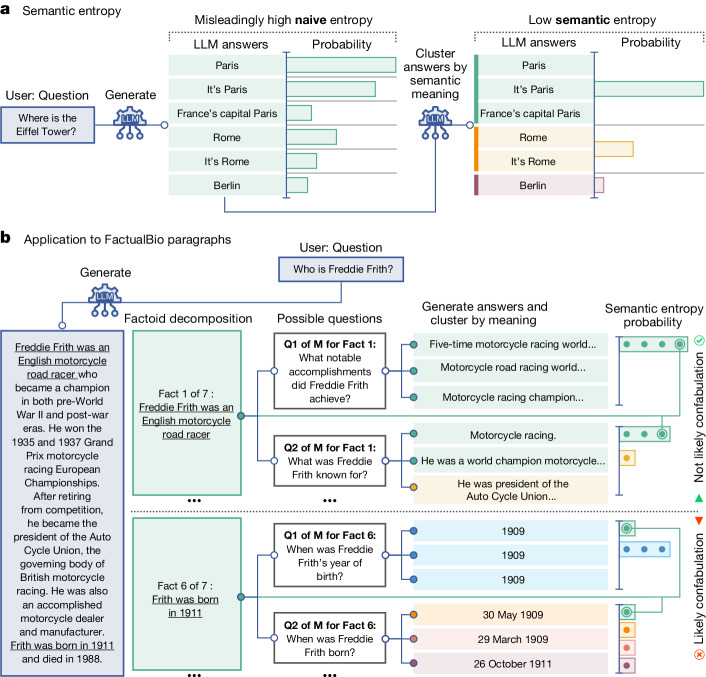
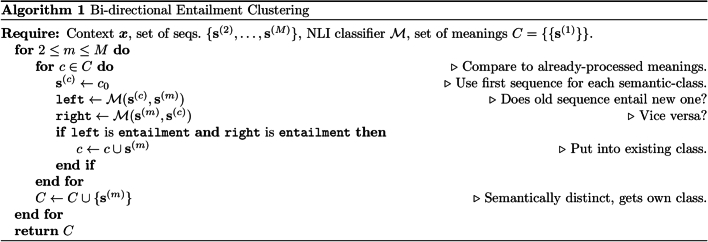
The paper introduces semantic entropy, an uncertainty estimator that clusters LLM generations by meaning via bidirectional entailment and computes entropy over those semantic clusters to detect confabulations. Across question-answering, math, and biography-generation tasks, semantic entropy outperforms naive entropy and supervised baselines without task-specific training data.
Key findings
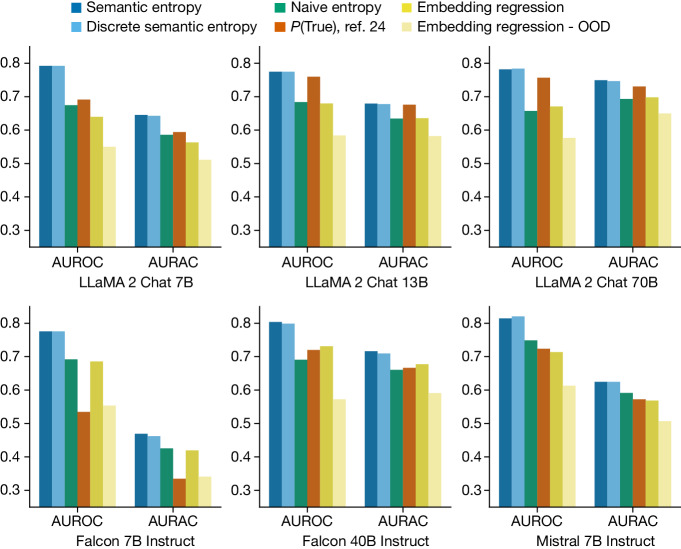
- Averaged across 30 task–model combinations, semantic entropy achieved the best AUROC of 0.790, compared with naive entropy (0.691), P(True) (0.698), and embedding regression (0.687); performance was stable between 0.78 and 0.81 across LLaMA, Falcon, and Mistral model families and scales from 7B to 70B parameters.
- Semantic entropy detects confabulations in sentence-length QA and math across TriviaQA, SQuAD 1.1, BioASQ, NQ-Open, and SVAMP, and its discrete variant performs similarly without requiring exact output probabilities.
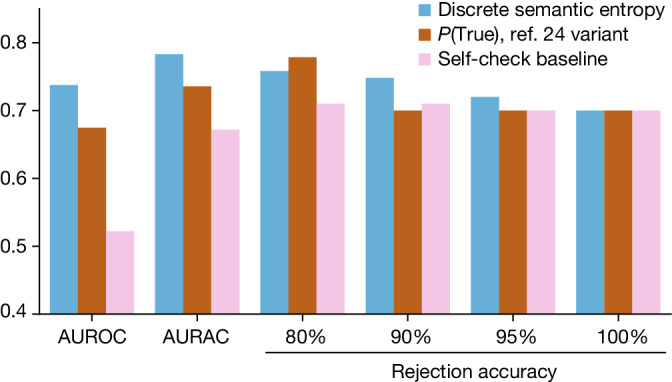
- On the GPT-4 biography dataset FactualBio—21 individuals, 150 factual claims, of which 45 were incorrect—the discrete semantic entropy variant outperformed a self-check baseline and an adapted P(True) baseline on AUROC and AURAC; P(True) had a narrow edge only after the top 20% of answers judged most likely to be confabulations were rejected.
- The method targets confabulations—arbitrary and incorrect generations sensitive to irrelevant details such as random seed—rather than all hallucinations, and it does not address systematically bad outputs.
Methods
- For each question, the method samples multiple generations from the LLM, clusters them by semantic equivalence using bidirectional entailment, and estimates semantic entropy over the meaning clusters; a discrete variant approximates cluster probabilities from generation frequencies when token probabilities are unavailable.
- Sentence-length experiments used LLaMA 2 Chat (7B, 13B, 70B), Falcon Instruct (7B, 40B), and Mistral Instruct (7B) on BioASQ, SQuAD 1.1, TriviaQA, SVAMP, and NQ-Open, with 400 train and 400 test examples per dataset; GPT-4 (v.0613) was used for FactualBio.
- Evaluation metrics were AUROC, rejection accuracy, and AURAC; sentence-length correctness was assessed automatically with GPT-4 against reference answers, validated against human judgement in the Supplementary Information.
Limitations
- The paper states that semantic entropy does not guarantee factuality and does not help when LLM outputs are systematically bad, including confident errors from training objectives, systematic reasoning failures, or misleading behaviour.
- The paper notes that semantic clustering can be overly sensitive to context: in one example, it distinguished a precise date from a year and treated the model as uncertain, even though the distinction was probably irrelevant in context.
- For FactualBio, the paper states that automatically generated questions are the main source of errors, and that GPT-4 did not expose output probabilities at the time, preventing computation of naive entropy, standard semantic entropy, and the embedding regression baseline for GPT-4.
Model-written summary. Check it against the paper before relying on it.
Integrity signals
Registry
Cites
Statistics
Figures
Verification
Claims the paper makes
8 Valid · 6 Not valid · 5 Not checked · 60 Own results and interpretations
The cited sources support only part of this claim — read each source’s verdict below.
In the paper
“Large language model (LLM) systems, such as ChatGPT1 or Gemini2, can show impressive reasoning and question-answering capabilities but often ‘hallucinate’ false outputs and unsubstantiated answers3,4.”
§ Detecting hallucinations in large language models using semantic entropy > Abstract
What the sources say
- Partly supportedcites [3] Xiao, Y. & Wang, W. Y. On hallucination and predictive uncertainty in conditional language generation. In Proc. 16th Conference of the European Chapter of the Association for Computational Linguistics 2734–2744 (Association for Computational Linguistics, 2021). sourceExperimental — accuracy not yet measured
The Introduction (p. 1) says neural generation models can produce content unsupported by their inputs, and §2.1 (p. 2) defines hallucination as false information unsupported by the input. The paper studies conditional generation, including image captioning and data-to-text, rather than establishing how often LLM systems such as ChatGPT or Gemini give unsubstantiated answers. (LLM, conf=0.84)
- Partly supportedcites [4] Rohrbach, A., Hendricks, L. A., Burns, K., Darrell, T. & Saenko, K. Object hallucination in image captioning. In Proc. 2018 Conference on Empirical Methods in Natural Language Processing (eds Riloff, E., Chiang, D., Hockenmaier, J. & Tsujii, J.) 4035–4045 (Association for Computational Linguistics, 2018). sourceExperimental — accuracy not yet measured
The Introduction describes image-captioning models generating objects absent from an image, and Section 3.2 reports hallucinated objects in 7.4%–17.7% of tested captions. This supports the general point that generated outputs can be false, but the paper does not establish how often LLM systems such as ChatGPT or Gemini produce unsubstantiated answers. Page numbers were not available in our copy. (LLM, conf=0.86)
plain- Asserted: passes — The authors put it forward as true.
- Checkable: passes — It can be checked against evidence.
- Load-bearing: passes — The paper’s conclusions depend on it.
- Based: passes — The paper gives a reason why it holds.
- Partly supported
The cited sources support only part of this claim — read each source’s verdict below.
In the paper
“High entropy corresponds to high uncertainty23–25—so semantic entropy is one way to estimate semantic uncertainties.”
§ Detecting hallucinations in large language models using semantic entropy > Main
What the sources say
- Not checked — no full text of the sourcecites [23] MacKay DJC Information-based objective functions for active data selection Neural Comput. 1992 4 590 604 10.1162/neco.1992.4.4.590 source
- Partly supportedcites [24] Kadavath, S. et al. Language models (mostly) know what they know. Preprint at https://arxiv.org/abs/2207.05221 (2022). sourceExperimental — accuracy not yet measured
Section B.2 (p. 29) hypothesizes that an unsure model produces a high-entropy answer distribution, and reports that entropy has some predictive power. But it also finds that larger models can give diverse correct answers and concludes that answer-distribution entropy is not a robust measure of whether a model knows the answer. The unqualified correspondence in the claim overstates the paper's finding. (LLM, conf=0.87)
- Supportedcites [25] Lindley DV On a measure of the information provided by an experiment Ann. Math. Stat. 1956 27 986 1005 10.1214/aoms/1177728069 source
The discussion on p. 4 explains that the measure uses Shannon’s function with the sign reversed: information is greatest when the distribution is concentrated on one value and falls as it spreads. This supports the cited background point that higher Shannon entropy corresponds to greater uncertainty; the later claim about semantic entropy is not attributed to this source. (LLM, conf=0.88)
plainstates an association- Asserted: passes — The authors put it forward as true.
- Checkable: passes — It can be checked against evidence.
- Load-bearing: passes — The paper’s conclusions depend on it.
- Based: passes — The paper gives a reason why it holds.
A result the paper states — it cites no source for it, so there is none to check. The quote shows it is in the paper.
In the paper
“Nevertheless, we significantly improve question-answering accuracy for state-of-the-art LLMs, revealing that confabulations are a great source of error at present.”
§ Detecting hallucinations in large language models using semantic entropy > Main
boostedstates a cause- Asserted: passes — The authors put it forward as true.
- Checkable: passes — It can be checked against evidence.
- Load-bearing: passes — The paper’s conclusions depend on it.
- Based: passes — The paper gives a reason why it holds.
- Rests on an assumption not shown here.
A result the paper reports from its own data — it cites no other source for it, so there is none to check. The quote shows it is in the paper.
In the paper
“We further show that semantic uncertainty can be used to improve model accuracy by refusing to answer questions when semantic uncertainty is high.”
§ Detecting hallucinations in large language models using semantic entropy > Methods > Detecting confabulations in QA and math
plainstates a cause- Asserted: passes — The authors put it forward as true.
- Checkable: passes — It can be checked against evidence.
- Load-bearing: passes — The paper’s conclusions depend on it.
- Based: passes — The paper gives a reason why it holds.
A result the paper reports from its own data — it cites no other source for it, so there is none to check. The quote shows it is in the paper.
In the paper
“In our experiments, we use semantic uncertainty to predict model accuracy, demonstrating that confabulations make up a notable fraction of model mistakes.”
§ Detecting hallucinations in large language models using semantic entropy > Methods > Detecting confabulations in QA and math
boosted- Asserted: passes — The authors put it forward as true.
- Checkable: passes — It can be checked against evidence.
- Load-bearing: passes — The paper’s conclusions depend on it.
- Based: passes — The paper gives a reason why it holds.
36 more claims
Create a free account to see all 79 claims and to verify the 2 references still open.
- Probably not a substantial claim. 30
- It may state two separate claims as one. 20
Claims other papers make about this one
Each is checked against this paper’s own text: does it say what the citing paper says it does?
The source backs part of the claim, not all of it — or backs it for a different population, condition or comparison.
In the citing paper
“However, LLMs exhibit hallucination and fabrication errors that are unacceptable for quantitative modeling [19, 20, 21].”
From Structured Schemas for Provenance‐Rich, LLM ‐Assisted QSP Model Calibration (2026) · cites this paper as [19]
Experimental — accuracy not yet measuredThe source backs part of the claim, not all of it — or backs it for a different population, condition or comparison.
In the citing paper
“Studies on hallucination, calibration, sycophancy, and cognitive bias indicate that failures often result not from a lack of capability but from unstable behavioral dispositions under uncertainty or pressure [8, 9, 10, 12, 15].”
From Machine Psychometrics: A Mathematical Psychology of Artificial Intelligence (2026) · cites this paper as [8]
Experimental — accuracy not yet measuredThe source backs part of the claim, not all of it — or backs it for a different population, condition or comparison.
In the citing paper
“AI-generated patient summaries also frequently contain errors that can be hard to detect12.”
From Multi-model assurance analysis showing large language models are highly vulnerable to adversarial hallucination attacks during clinical decision support (2025) · cites this paper as [12]
Experimental — accuracy not yet measuredThe source backs part of the claim, not all of it — or backs it for a different population, condition or comparison.
In the citing paper
“LLMs remain limited by the static knowledge encoded in their parameters.They are prone to hallucinations, factual inaccuracies, and out-of-date internal knowledge (Farquhar et al., 2024;Lewis et al., 2020).”
From Improving Amharic Information Retrieval with Translative and Multi-Agent Debate Retrieval Augmented Generation (2026) · cites this paper as Farquhar et al., 2024
Experimental — accuracy not yet measuredThe source backs part of the claim, not all of it — or backs it for a different population, condition or comparison.
In the citing paper
“This limitation can result in responses that lack coherence, contextual relevance, and even lead to hallucinations in extended dialogues or complex tasks [1], [2].”
From Memory-Augmented Architecture for Long-Term Context Handling in Large Language Models (2026) · cites this paper as [1]
Experimental — accuracy not yet measured
11 more claims about this paper
Create a free account to see every claim other papers make about this one.
Citations
Cites
Language Models are Few-Shot Learners
Brown, T. B., Mann, B., Ryder, N., Subbiah, M., Kaplan, J., Dhariwal, P., Neelakantan, A., Shyam, P., Sastry, G., Askell, A., et al. (2020) · arXiv · doi:10.48550/arxiv.2005.14165 · Cited by 23,372 · cited 1×
“57), which can predict entailment given suitable prompts.”
SQuAD: 100,000+ Questions for Machine Comprehension of Text
Rajpurkar, P., Zhang, J., Lopyrev, K., & Liang, P. (2016) · Proceedings of the 2016 Conference on Empirical Methods in Natural Language Processing · doi:10.18653/v1/d16-1264 · Cited by 6,208
Survey of Hallucination in Natural Language Generation
Ji, Z., Lee, N., Frieske, R., Yu, T., Su, D., Xu, Y., Ishii, E., Bang, Y. J., Madotto, A., & Fung, P. (2023) · ACM Computing Surveys · doi:10.1145/3571730 · Cited by 5,025 · cited 2×
“Hallucinations are often defined as LLMs generating “content that is nonsensical or unfaithful to the provided source content” 9–11 but they have come to include a vast array of failures of faithfulness and factuality.”
Survey of Hallucination in Natural Language Generation
Ji, Z., Lee, N., Frieske, R., Yu, T., Su, D., Xu, Y., Ishii, E., Bang, Y., Chen, D., Dai, W., et al. (2022) · arXiv · doi:10.48550/arxiv.2202.03629 · Cited by 4,981
A Broad-Coverage Challenge Corpus for Sentence Understanding through Inference
Williams, A., Nangia, N., & Bowman, S. (2018) · Proceedings of the 2018 Conference of the North American Chapter of the Association for Computational Linguistics: Human Language Technologies, Volume 1 (Long Papers) · doi:10.18653/v1/n18-1101 · Cited by 3,342 · cited 2×
“We rely on language models to predict entailment, such as DeBERTa-Large-MNLI 56 , which has been trained to predict entailment, or general-purpose LLMs such as GPT-3.”
Llama 2: Open Foundation and Fine-Tuned Chat Models
Touvron, H., Martin, L., Stone, K., Albert, P., Almahairi, A., Babaei, Y., Bashlykov, N., Batra, S., Bhargava, P., Bhosale, S., et al. (2023) · arXiv · doi:10.48550/arxiv.2307.09288 · Cited by 2,604 · cited 1×
“Our results for TriviaQA, SQuAD, BioASQ, NQ-Open and SVAMP are all evaluated context-free and involve sentence-length answers (96 ± 70 characters, mean ± s.d.) and use LLaMA 2 Chat (7B, 13B and 70B parameters) 38 , Falcon Instruct (7B and 40B) 39 and Mistral Instruct (7B) 40 .”
Aleatory or epistemic? Does it matter?
Kiureghian, A. D., & Ditlevsen, O. (2009) · Structural Safety · doi:10.1016/j.strusafe.2008.06.020 · Cited by 2,454 · cited 1×
“Researchers some-times separate aleatoric uncertainty (uncertainty in the underlying data distribution) from epistemic uncertainty (caused by having only limited information) 46 .”
Natural Questions: A benchmark for question answering research
Kwiatkowski, T., Palomaki, J., Redfield, O., Collins, M., Parikh, A., Alberti, C., Epstein, D., Polosukhin, I., Devlin, J., Lee, K., et al. (2019) · Transactions of the Association for Computational Linguistics · doi:10.1162/tacl_a_00276 · Cited by 2,069 · cited 2×
“33), life sciences (BioASQ 34 ) and open-domain natural questions (NQ-Open 35 ) derived from actual queries to Google Search 36 .”
TriviaQA: A Large Scale Distantly Supervised Challenge Dataset for Reading Comprehension
Joshi, M., Choi, E., Weld, D., & Zettlemoyer, L. (2017) · Proceedings of the 55th Annual Meeting of the Association for Computational Linguistics (Volume 1: Long Papers) · doi:10.18653/v1/p17-1147 · Cited by 1,690 · cited 5×
“TriviaQA is a trivia question-answering dataset.”
InfluentialTriviaQA: A Large Scale Distantly Supervised Challenge Dataset for Reading Comprehension
Joshi, M., Choi, E., Weld, D. S., & Zettlemoyer, L. (2017) · arXiv · doi:10.48550/arxiv.1705.03551 · Cited by 1,650
Research works printed but not linked: 8
- Xiao, T. Z., Gomez, A. N. & Gal, Y. Wat zei je? Detecting out-of-distribution translations with variational transformers. In Workshop on Bayesian Deep Learning at the Conference on Neural Information Processing Systems (NeurIPS, Vancouver, 2019).
- Negri, M., Bentivogli, L., Mehdad, Y., Giampiccolo, D. & Marchetti, A. Divide and conquer: crowdsourcing the creation of cross-lingual textual entailment corpora. In Proc. 2011 Conference on Empirical Methods in Natural Language Processing 670–679 (Association for Computational Linguistics, 2011).
- Malinin, A. & Gales, M. Uncertainty estimation in autoregressive structured prediction. In Proceedings of the International Conference on Learning Representations https://openreview.net/forum?id=jN5y-zb5Q7m (2021).
- Holtzman, A., Buys, J., Du, L., Forbes, M. & Choi, Y. The curious case of neural text degeneration. In Proceedings of the International Conference on Learning Representations https://openreview.net/forum?id=rygGQyrFvH (2020).
- Culicover PW Paraphrase generation and information retrieval from stored text Mech. Transl. Comput. Linguist. 1968 11 78 88
- He, P., Liu, X., Gao, J. & Chen, W. Deberta: decoding-enhanced BERT with disentangled attention. In International Conference on Learning Representations https://openreview.net/forum?id=XPZIaotutsD (2021).
- Socher, R., Huang, E., Pennin, J., Manning, C. D. & Ng, A. Dynamic pooling and unfolding recursive autoencoders for paraphrase detection. In Proceedings of the 24th Conference on Neural Information Processing Systems (eds Shawe-Taylor, J. et al.) (2011)
- Kane, H., Kocyigit, Y., Abdalla, A., Ajanoh, P. & Coulibali, M. Towards neural similarity evaluators. In Workshop on Document Intelligence at the 32nd conference on Neural Information Processing (2019).
Cited by
Items 401–500 of 888
Chaudhary, N., Uddin, S. M. J., & Jin, Z. (2026) · Computer Applications in Engineering Education · doi:10.1002/cae.70231 · Cited by 1
Li, X., Wang, L., Wang, L., & Tong, R. (2026) · Journal of Loss Prevention in the Process Industries · doi:10.1016/j.jlp.2026.106101 · Cited by 2
Verifiable Reasoning for LLM-based Generative Recommendation
Lin, X., Zeng, H., Yu, H., Xia, Y., Zhang, J. J., Singh, A., Liu, F., Wang, W., Feng, F., Chua, T., et al. (2026) · International ACM SIGIR Conference on Research and Development in Information Retrieval (SIGIR) · doi:10.1145/3805712.3809622 · Cited by 8
“However, the 𝑃 ∗ is unknown for real-time recommendation, we thus utilize the entropy to estimate the preference alignment as: The entropy typically indicates the model certainty and is widely used to measure the level of confidence [6, 7, 21].”
Agentic genomics: From pipeline automation to autonomous validation
Corpas, M., Guio, H., & Fatumo, S. (2026) · Cell Genomics · doi:10.1016/j.xgen.2026.101305 · Cited by 6
“27 In genomics, hallucination takes particularly insidious forms: an agent might cite a non-existent gene-disease association, fabricate a reference, or generate a variant annotation that conflates unrelated genetic loci.”
Kath, H., Gouvêa, T. S., & Sonntag, D. (2026) · Methods in Ecology and Evolution · doi:10.1111/2041-210x.70373 · Cited by 2
“Solutions to mitigate this type of hallucination include estimating model certainty, for example by leveraging the model's internal entropy (Farquhar et al., 2024 ), or by training an audio-language model using a hierarchical approach.”
Naser, M. Z. (2026) · Language Resources and Evaluation · doi:10.1007/s10579-026-09938-4 · Cited by 3
Wang, Z., Liao, M., & Zhang, J. (2026) · Neurocomputing · doi:10.1016/j.neucom.2026.134859 · Cited by 1
Developing trustworthy AI for climate services at scale
Williams, H. T. P., Abele, A., Biswas, A., et al. (2026) · npj Climate Action · doi:10.1038/s44168-026-00420-z · Cited by 1
CoRe: A Collaborative and Reflective Language Model Framework for Flexible Job Shop Scheduling
Peng, M., Yang, J., Huang, J., et al. (2026) · IEEE Transactions on Automation Science and Engineering · doi:10.1109/tase.2026.3727075 · Cited by 1
“While uncertainty estimation [27] and self-reflection [28] from the broader NLP community can improve LLM output reliability, they cannot provide the deterministic feasibility guarantees required by industrial scheduling.”
Qiao, J. C. (2026) · Vox Sanguinis · doi:10.1111/vox.70362 · Cited by 1
On-premise medical AI agents for reliable clinical decision-making
Zhang, L., Wölflein, G., Ferber, D., Liang, J., Carrero, Z. I., Wu, X., Vibert, J., Clusmann, J., Möhrmann, L., Möhrmann, E. E., et al. (2026) · Nature Medicine · doi:10.1038/s41591-026-04609-x · Cited by 3
Ktokolwiek widział, ktokolwiek wie! Ukradziono Nagrodę Nobla z fizyki!
Dawid, A. (2024) · Postępy Fizyki · doi:10.61947/uw.pf.2024.75.3-4.12-16 · Cited by 1
“Ła-two za to „halucynować” [14] i dochodzić przez to do błędnych (w wersji pesymistycznej) lub zaskakujących (w wersji optymistycznej) wniosków na temat świata.”
Li, B., Zhu, J., & Zhao, X. (2025) · Reliability Engineering & System Safety · doi:10.1016/j.ress.2025.111044 · Cited by 1
Towards a Probabilistic Framework for Analyzing and Improving LLM-Enabled Software
Baldonado, J. M., Bonomo, F., & Braberman, V. A. (2025) · IEEE International Conference on Software Testing, Verification and Validation Workshops (ICSTW) · doi:10.1109/icstw64639.2025.10962470 · Cited by 2
“…be based on both the identification of constituent “transference models” (TMs) –LLM-powered software components transforming inputs into outputs–, and the modeling and analysis of the underlying distribution over classes that comprise (transference)-equivalent outputs (i.e., “meaning classes” [4]).”
InfluentialBilingualism: Not all we know now is old news
Dijkstra, T., & Peeters, D. (2025) · Brain and Language · doi:10.1016/j.bandl.2025.105592 · Cited by 1
“Because their processing is purely statistically incremental, their performance suffers from bias, hallucinations, and mathematical errors (Falquhar et al., 2024).”
KG-UQ: Knowledge Graph-Based Uncertainty Quantification for Long Text in Large Language Models
Yuan, Y., Tao, L., Lu, H., Khushi, M., Razzak, I., Dras, M., Yang, J. Y., & Naseem, U. (2025) · International World Wide Web Conference (WWW) · doi:10.1145/3701716.3717660 · Cited by 5
“Another approach [12] involves decomposing LLM responses into factoids and clustering these factoids by meaning to evaluate factuality.”
Shakhbazau, A. (2025) · Molecular Diversity · doi:10.1007/s11030-025-11226-2 · Cited by 3
Gong, H., Wang, Y., Kong, Q., Li, X., Li, L., Wan, B., Zhao, Y., Zhang, J., Chen, G., Chen, J., et al. (2025) · bioRxiv (Cold Spring Harbor Laboratory) · doi:10.1101/2025.04.29.641945 · Cited by 3
“Besides, LLM’s hallucination [35, 36] can lead to unreliable results.”
Du, X., Nagy, A. A., Oates, M., Wang, Y., Wang, X., Plasek, J. M., Aronson, S., Lebo, M. S., & Zhou, L. N. (2025) · medRxiv · doi:10.1101/2025.06.09.25329279 · Cited by 1
Jack, T., Cooper, A., & Flower, L. (2025) · SSRN Electronic Journal · doi:10.2139/ssrn.5299982 · Cited by 1
InterFeat: An Automated Pipeline for Finding Interesting Hypotheses in Structured Biomedical DataPreprint
Ofer, D., Linial, M., & Shahaf, D. (2025) · SSRN Electronic Journal · doi:10.2139/ssrn.5342565 · Cited by 3
Du, X., Nagy, A. A., Oates, M., Wang, Y., Wang, X., Plasek, J. M., Aronson, S., Lebo, M. S., & Zhou, L. N. (2025) · SSRN Electronic Journal · doi:10.2139/ssrn.5385545 · Cited by 4
3D Guard-Layer: An Integrated Agentic AI Safety System for Edge Artificial IntelligencePreprint
Kurshan, E., Xie, Y., & Franzon, P. D. (2025) · SSRN Electronic Journal · doi:10.2139/ssrn.5384401 · Cited by 2
The fools are certain; the wise are doubtful: Exploring LLM confidence in code completion
Kotti, Z., Dritsa, K., Spinellis, D. D., & Λουρίδας, Π. (2026) · Automated Software Engineering · doi:10.21203/rs.3.rs-7302683/v1 · Cited by 3
“In contrast, intrinsic metrics are simple, versatile, and universal across LLMs and tasks (Huyen, 2019; Farquhar et al, 2024).”
Semantic Grounding Index: Geometric Bounds on Context Engagement in RAG SystemsPreprint
Marin, J. (2025) · Qeios · doi:10.32388/1pq8it · Cited by 1
StoryReasoning Dataset: Using Chain-of-Thought for Scene Understanding and Grounded Story GenerationPreprint
de Oliveira, D. F. V., & de Matos, D. M. (2026) · SSRN Electronic Journal · doi:10.2139/ssrn.6172566 · Cited by 1
Park, S., Lee, T. Y., & Lee, W. (2026) · CHI Conference on Human Factors in Computing Systems · doi:10.1145/3772318.3790271
“Recently, researchers have begun surfacing model-level judgments to users—such as confidence scores [44, 52], uncertainty visualizations [3], and systems that detect and explain hallucinations [19, 43]—to raise awareness of potential errors and calibrate trust.”
Detecting Hallucinated and Suspicious Citations: What Current Tools Can and Cannot Do
Badalova, F., & Mayr, P. (2026) · arXiv · doi:10.48550/arxiv.2607.22693 · Cited by 2
“These generated references may be hallucinated, fabricated, or bibliographically problematic, posing an increasingly serious risk to scholarly communication [9, 10, 11, 14].”
From Fluent to Verifiable: Claim-Level Auditability for Deep Research Agents
Rasheed, R. A., Banerjee, S., Mukherjee, A., & Hazra, R. (2026) · arXiv · doi:10.48550/arxiv.2602.13855 · Cited by 1
Structured Schemas for Provenance-Rich, LLM-Assisted QSP Model Calibration
Eliason, J., & Popel, A. S. (2026) · bioRxiv (Cold Spring Harbor Laboratory) · doi:10.64898/2026.03.05.709623
“However, LLMs exhibit hallucination and fabrication errors that are unaccept-58 able for quantitative modeling 19,20,21 .”
Suzgen, E. E., Şahin, M. E., Bakir, M., Arisoy, Ç., Ulutaş, E. G., Günay, R. B., Yildiz, G., & Ulutaş, H. (2026) · 2026 2nd International Symposium on AI-Driven Engineering Systems (ISADES) · doi:10.1109/isades69945.2026.11608117
“Farquhar et al.[10] propose semantic entropy as a complementary approach, measuring uncertainty at the semantic rather than token level.”
Niimi, J. (2025) · arXiv · doi:10.48550/arxiv.2510.25378 · Cited by 7
“Hallucination in LLMs has been examined from diverse perspectives [2, 4, 13, 14, 15].”
Han, Z., Battaglia, F., Mansuria, K., Heyman, Y., & Terlecky, S. R. (2024) · Research Square · doi:10.21203/rs.3.rs-5084169/v1
AI coupled to pharmacometric modelling to tailor malaria and tuberculosis treatment in AfricaPreprint
Turón, G., Mulubwa, M., Montaner, A., Njoroge, M., Chibale, K., & Duran‐Frigola, M. (2024) · medRxiv · doi:10.1101/2024.11.07.24316884
Hitchhiker's Introduction to Model RiskPreprint
Jadoon, A. (2024) · SSRN Electronic Journal · doi:10.2139/ssrn.4997231
Probing the Reasoning Abilities of Llms in Blocks WorldPreprint
Zhao, K. Z., & Macbeth, J. (2024) · SSRN Electronic Journal · doi:10.2139/ssrn.5038600
Llm Ability to Predict Child Performance in Experiments Assessing Memory and SuggestibilityPreprint
Santtila, P. O., Sun, Y., Kask, K., Järvilehto, L., & Xiu, J. (2025) · SSRN Electronic Journal · doi:10.2139/ssrn.5071878
Collaborative intelligence in AI: Evaluating the performance of a council of AIs on the USMLEPreprint
Shaikh, Y., Asiya, Z., Jeelani, M. M., et al. (2025) · medRxiv · doi:10.1101/2025.02.17.25322388
Revolutionizing Market Research with Artificial Intelligence
Teutloff, J. K. (2025) · IGI Global eBooks · doi:10.4018/979-8-3693-6437-6.ch018
Talent Supply and Demand Matching Based on Prompt Learning and the Pre-Trained Language Model
Li, K., Liu, J., & Zhuang, C. (2025) · Applied Sciences · doi:10.3390/app15052536 · Cited by 2
Kanabar, V., & Kaloyanova, K. (2025) · Lecture notes of the Institute for Computer Sciences, Social Informatics and Telecommunications Engineering · doi:10.1007/978-3-031-84312-9_23
A Double Thinking Enabled Visual Language Model for Open-Set Construction Site Safety InspectionsPreprint
Tang, Y., Yan, H., Gao, Z., Zhang, Z., & Luo, X. (2025) · SSRN Electronic Journal · doi:10.2139/ssrn.5179874
Navigating the CISO’s Mind by Integrating GenAI for Strategic Cyber Resilience
Grigaliūnas, Š., Brūzgienė, R., Driaunys, K., Danielienė, R., Veitaitė, I., Astromskis, P., Nemickienė, Ž., Vengalienė, D., Lopata, A., Andrijauskaitė, I., et al. (2025) · Electronics · doi:10.3390/electronics14071342 · Cited by 1
What will the future role for large language models (LLMs) be in managing patients with glaucoma?
Tavakoli, K., Hallaj, S., & Baxter, S. L. (2025) · Expert Review of Ophthalmology · doi:10.1080/17469899.2025.2487532
“A notable challenge is ‘hallucinations,’ where LLMs generate incorrect or misleading information [4].”
Künstliche Intelligenz in der chirurgischen Weiterbildung: Ein Überblick
Deichsel, A., Oettl, F. C., Pawelczyk, J., Usov, L., & Haffer, H. P. H. (2025) · Die Unfallchirurgie · doi:10.1007/s00113-025-01558-x
Inam, R., Singh, V., Chawla, A., & Bosneag, A.-M. (2025) · Elsevier eBooks · doi:10.1016/b978-0-44-329135-7.00013-8 · Cited by 1
Quantifying Uncertainty in Deep Learning: Methods, Challenges, and Future Directions
Alaba, S. Y., & Motai, Y. (2026) · IEEE Transactions on Emerging Topics in Computational Intelligence · doi:10.1109/tetci.2026.3684025 · Cited by 3
Machine ‘Hallucination’ as Sensory Deprivation and ‘AGI’ as an Oxymoron
Wallace, R. (2025) · Studies in applied philosophy, epistemology and rational ethics · doi:10.1007/978-3-031-83709-8_15
Data Optimization for LLMs: A Survey
Wu, O. (2026) · ACM Transactions on Knowledge Discovery from Data · doi:10.36227/techrxiv.174776562.20873028/v1 · Cited by 4
Liu, P., Zhang, Y., Yisheng, Y. A. N. G., et al. (2025) · SSRN Electronic Journal · doi:10.2139/ssrn.5263696
Tariciotti, L., Zohdy, Y. M., Riva, M., Levi, R., Pessina, F., & Pradilla, G. (2025) · Springer eBooks · doi:10.1007/978-3-031-81850-9_21
Cloud-Base Retrieval Augmented Language Models in Multi-Hop QA Task: A Meta-Analysis
Xu, Z., Jiang, P., Gao, Y., & You, J. (2025) · International Conference on Advanced Algorithms and Control Engineering (ICAACE) · doi:10.1109/icaace65325.2025.11019854 · Cited by 1
“SPRING (Zhu et al.[13]) presents a parameter-efficient solution by fine-tuning only the embeddings of virtual tokens to enhance retrieval integration without altering the core LLM. hallucinations[5].”
Callaghan, J. P., Freimane, K. Z., Brown, R. M., Cratchley, A. L., & Kendall, T. J. (2025) · The Journal of Pathology Clinical Research · doi:10.1002/2056-4538.70032
Huang, X., & Gu, T. (2025) · PubMed
Vojičić, N., Sekulski, D., & Urošević, V. (2025) · Smart innovation, systems and technologies · doi:10.1007/978-981-96-3077-6_25 · Cited by 1
Large Language Models in Stroke Management: A Review of the LiteraturePreprint
Soffer, S., Mudrik, A., Efros, O., Omar, M., Nadkarni, G. N., & Klang, E. (2025) · medRxiv · doi:10.1101/2025.06.28.25330477 · Cited by 2
SESP: Semantic Entropy-based Self-play Security Alignment Mechanism for Large Language ModelsPreprint
Sun, H., Cao, L., Zhao, Z., Du, X., Liu, A., Sang, W., & Li, Y. (2025) · SSRN Electronic Journal · doi:10.2139/ssrn.5332865
Su, F.-Y., Ngo, G.-H., Phan, B., & Chiang, J.-H. (2025) · Database · doi:10.1093/database/baaf025 · Cited by 3
Machine-Human Boundary: A Systematic Survey of Machine-Generated Text Detection
Zhang, Q. (2025) · International Conference on Communications, Information System and Computer Engineering (CISCE) · doi:10.1109/cisce65916.2025.11065851
“Entropy [31].”
Hallucination Detection in LLMs via Beam Search Sampling and Semantic Consistency Analysis
Bouchekir, R., Faghih, F., & Beyene, T. A. (2025) · International Conference on Dependable Systems and Networks workshops · doi:10.1109/dsn-w65791.2025.00076 · Cited by 3
“Following [6], we implement the semantic entropy approach and use BSS to generate the answers.”
Bu, K., Wang, Z., Zhu, P., Isaev, P., Chen, W., Xu, T., & Liu, J. (2025) · Communications in computer and information science · doi:10.1007/978-981-96-9946-9_10
Wolfartsberger, J., & Niedermayr, D. (2025) · International Conference on Artificial Intelligence, Robotics and Control (AIRC) · doi:10.1109/airc64931.2025.11077511 · Cited by 1
“Answering unreliably (“hallucinations”) or without the necessary information prevents adoption in diverse fields [4].”
Shen, J., Huang, R., Min, D., Che, H., Li, B., Liu, L., Zhang, Z., Cheng, J., & Wang, S. (2025) · Chinese Science Bulletin (Chinese Version) · doi:10.1360/tb-2025-0185 · Cited by 2
Qin, Y. W., Zhang, C., & Xu, W. X. (2025) · Lecture notes in computer science · doi:10.1007/978-981-96-9914-8_25 · Cited by 1
BiCoT: Enhancing Large Language Model Reasoning Through Bidirectional Correction of Thought
Wu, Q., Chen, J., Wang, Y., & Gu, J. N. (2025) · Lecture notes in computer science · doi:10.1007/978-981-95-0020-8_20 · Cited by 1
WildVideo: Benchmarking LMMs for Understanding Video-Language Interaction
Yang, S., Yu, W., Yang, W., Liu, X., Tan, H., Lan, L., & Xiao, N. (2025) · IEEE Transactions on Pattern Analysis and Machine Intelligence · doi:10.1109/tpami.2025.3592831 · Cited by 8
4D Semantic Coupling: A Mathematical Framework for Measuring Cognitive Complexity in AI DialoguePreprint
Morgoulis, D. (2025) · Authorea · doi:10.22541/au.175407708.84149988/v1 · Cited by 1
A free probabilistic framework for analyzing the transformer-based language models
Das, S. (2025) · Statistics & Probability Letters · doi:10.1016/j.spl.2025.110516 · Cited by 3
Khatiwada, H. (2025) · Research Square · doi:10.21203/rs.3.rs-7338701/v1
Eine Suche nach intelligentem Leben
Domainko, W. F. (2025) · Springer eBooks · doi:10.1007/978-3-662-71577-2_7
Kubesch, J., Kiesling, E., Ekaputra, F. J., Serles, U., Toma, I., & Havas, C. R. (2025) · Communications in computer and information science · doi:10.1007/978-3-032-02003-1_1
Das Potenzial von künstlicher Intelligenz in der Diabetologie: Ein Überblick
Tan, S., Lee-Barkey, Y. H., Kulzer, B., Hermanns, N., & Ehrmann, D. (2025) · Die Diabetologie · doi:10.1007/s11428-025-01362-6 · Cited by 1
Translating Gyoyang Beyond Semantic Entropy in Korean Higher Education
Park, H.-J. (2025) · The Korean Association of General Education · doi:10.46392/kjge.2025.19.4.115
“This difficulty can contribute to semantic entropy — an increasing tendency towards inconsistent interpretations and the gradual erosion of shared conceptual coherence over time (Farquhar et al., 2024, pp. 625-626).”
Query Augmented Generation (QAG) from the Genomic Data Commons for Accurate Variant StatisticsPreprint
Venkat, A., Wysocki, W. P., Lukowski, M., Song, S., Subramanyam, A., Zhang, Z., & Grossman, R. L. (2025) · bioRxiv (Cold Spring Harbor Laboratory) · doi:10.1101/2025.09.02.673797
Granberg, R. E., Goldberg, J. M., Antes, A. L., Bereitschaft, C., Bourgeois, F. C., DuBois, J. M., & Sisk, B. A. (2025) · JMIR Pediatrics and Parenting · doi:10.2196/72134
“Additionally, LLMs can provide inaccurate information or generate “hallucinations,” which “include a vast array of failures of faithfulness and factuality” of the LLM [23].”
Li, Z., Chen, H., Tan, H., Lan, L., Sui, Y., & Ren, J. (2025) · Lecture notes in computer science · doi:10.1007/978-3-032-06078-5_16 · Cited by 1
Interconnected Autonomous Systems
Stefan, I. L., & Dumitrache, I. (2025) · International Conference on Control Systems and Computer Science · doi:10.1109/cscs66924.2025.00030
“Another issue with generative AI that exists in the present is that they sometimes generate “hallucinations” [9], these consist in plausible responses which are actually false.”
Moosa, M., Malumi, O., Chinedu, S., Okah, W., Ogboye, A., Abiakam, C., Onyenemerem, P., Etuk, I., & Mobisson, N. (2025) · doi:10.12688/verixiv.2125.1
Holst, C., Wiegräbe, F., Redecker, C., & Lohweg, V. (2025) · Springer eBooks · doi:10.1007/978-3-658-48573-3_11 · Cited by 2
Sun, Z., Yan, C., & Zeng, Y. (2025) · Proceedings of the Association for Information Science and Technology · doi:10.1002/pra2.1345 · Cited by 1
“…to effectively identify a group of low-redundant semantic samples that form the MLLM ’ s demonstration set, since previous studies have confirmed that diversity features have a good effect on significantly reducing the ICL illusion effect of large models (Farquhar et al., 2024; Wang et al., 2025).”
Recognizing "Conformity Bias" in Large Language Models: A New Risk for Clinical UsePreprint
Nowroozzadeh, M. H., & Salari, R. (2025) · Research Square · doi:10.1101/2025.10.19.25338293
“[3, 4] Hallucination poses serious risks in medical contexts, where inaccurate information can lead to diagnostic errors, inappropriate treatments, or misinformation being integrated into clinical records.”
Leveraging Social Media and AI for Early Community Mental Health Support
Bunch, K., Nguyen, D., Kozel, G., Doan, T. V., & Lin, E. (2025) · Cureus · doi:10.7759/cureus.95047 · Cited by 1
“…relevant predicted mental health categories (e.g., anxiety and depression, for instance) are integrated into the LLM prompt to generate personalized mental health resources specific to the user’s text input and predicted categories, providing contextual grounding for confabulation-prone LLMs [27].”
Stewart, C. N., & Hahne, G. (2025) · Plant Cell Reports · doi:10.1007/s00299-025-03634-3
A word from our student editor
Fahad, H. (2025) · BDJ Student · doi:10.1038/s41406-025-1578-9
ENTROPY: A New Measure to Gauge Search Engine Optimisation
Aubakirov, S., & Akhmetov, I. (2025) · doi:10.1109/opcs67346.2025.11219388
“In LLM reasoning, entropy has been applied to prompt selection [22], hallucination scoring [23], [24], and decoding control [25]–[27].”
Mapping scientific literature with large language models and topic modeling
Smetana, M., & Khazanovich, L. (2026) · Scientometrics · doi:10.1007/s11192-026-05643-9 · Cited by 3
“…f ( · ) performs this reclassification by evaluating alignment between each abstract x i and the set of themes ( T tj , D tj ), resulting in a predicted category y ti : A structured reclassification protocol was implemented to enhance robustness and reduce susceptibility to hallucinations [52].”
Fabricated Citations in Peer Review: A Growing Threat to Scientific Integrity
Mishra, G., Verma, S., & Chitra, P. (2025) · The Journal of Indian Orthodontic Society · doi:10.1177/03015742251382325
The Narratives of Artificial Intelligence: A Critical View of an Emerging Tool
Pulis, A., & Mallia, M. (2025) · Malta Journal of Education · doi:10.62695/rrui1032 · Cited by 1
“Farquhar et al. (2024) explain that knowledge hallucinations might occur because the large language model was trained on data that was not correct; there might be a methodical failure in the reasoning of the model, or the model is “untruthful” because it is primarily driven to achieve what it…”
Softwarearchitektur – Das Unkontrollierbare kontrollieren
Pfattheicher, T., Rug, T., & Böhmer, F. (2025) · Springer eBooks · doi:10.1007/978-3-658-50100-6_8
Step-Aware Confidence Estimation in Natural Language Reasoning
Xia, C., Liu, Z., Chen, F., Zhou, H., & Wang, C. (2025) · International Joint Conference on Neural Networks (IJCNN) · doi:10.1109/ijcnn64981.2025.11228321
Ddog: optimizing multi-hop inference via dual-driven retrieval and reasoning path
Chen, Y., Gu, B., Gao, L., Fu, K., Qu, Y., & Cui, L. (2025) · Machine Learning · doi:10.1007/s10994-025-06917-8
“Furthermore, LLMs lack a step-by-step real-time verification mechanism during multi-hop inference, where errors in the early stages of reasoning can be progressively amplified as the reasoning chain extends (Farquhar et al., 2024), ultimately causing the overall answer to deviate from the facts.”
Application of Large Language Models in Product Management: A Systematic Literature Review
Serra, V. M., Bosch, J., & Olsson, H. H. (2025) · Lecture notes in computer science · doi:10.1007/978-3-032-12089-2_20
Xu, G., Chen, B., Guo, H., LeBlanc, D., Kusari, A., Yarbasi, E., Ahmed, A., Sun, Z., & Bao, S. (2026) · SAE International Journal of Transportation Safety · doi:10.4271/09-14-01-0033
Chai, Y., Huang, Y., & Li, D. (2025) · SSRN Electronic Journal · doi:10.2139/ssrn.5772230
Probing the reasoning abilities of LLMs in blocks world
Zhao, K. Z., & Macbeth, J. (2025) · Cognitive Systems Research · doi:10.1016/j.cogsys.2025.101421
Elbaghazaoui, B. E., Moudden, T. E., & Benabbes, K. (2025) · Advances in computational intelligence and robotics book series · doi:10.4018/979-8-3373-5616-7.ch009
Moradisani, H., Zarrinkalam, F., Noorian, Z., & Ensan, F. (2025) · Artificial Intelligence Review · doi:10.1007/s10462-025-11421-5
Hallucination filtering in radiology vision-language models using discrete semantic entropy
Wienholt, P., Caselitz, S., Siepmann, R. M., Bruners, P., Bressem, K. K., Kuhl, C. K., Kather, J. N., Nebelung, S., & Truhn, D. (2026) · European Radiology · doi:10.1007/s00330-026-12384-z · Cited by 5
“First, it measures semantic consistency, not factual correctness[14].”
InfluentialYan, B.-C., Zhang, R., Fan, Y., Li, Y., Chen, L., Song, X., Tang, Y., Tu, Y., Cao, Z., Shen, L., et al. (2025) · Research Square · doi:10.21203/rs.3.rs-7998391/v1
Metadata
- Authors
- Farquhar, S., Kossen, J., Kuhn, L., & Gal, Y.
- Affiliations
- University of Oxford (GB)
- Corresponding author
- Farquhar, Sebastian
- Venue
- Nature
- Published
- 2024-06-19
- Volume
- 630
- Issue
- 8017
- Pages
- 625-630
- ISSN
- 0028-0836 (ISSN-L)
- 1476-4687
- PMC
- PMC11186750
- OpenAlex
- W4399803256
- Semantic Scholar
- f82f49c20c6acc69f884f05e3a9f1ceea91061ce
- Cited by
- 934
- References
- 60
- Citations by year
- 2026: 540 · 2025: 349 · 2024: 44
- FWCI
- 137.11
- Type
- journal article
- Language
- en
- Open access
- hybrid
- doi.org
- Licence
- cc-by
- creativecommons.org/licenses/by/4.0 (tdm)
- creativecommons.org/licenses/by/4.0 (vor)
- Locations
- Nature (publishedVersion, cc-by)
- PubMed Central (publishedVersion, cc-by)
- PubMed (publishedVersion)
- RePEc: Research Papers in Economics (submittedVersion)
- Funders
- Government of the United Kingdom
- UK Research and Innovation
- Topics
- Physical Sciences › Computer Science › Artificial Intelligence › Topic Modeling
- Physical Sciences › Computer Science › Artificial Intelligence › Adversarial Robustness in Machine Learning
- Physical Sciences › Computer Science › Artificial Intelligence › Natural Language Processing Techniques
- Keywords
- hallucination detection, large language models, semantic entropy, uncertainty estimation, confabulation, LLM reliability, generalization to unseen tasks, honesty
About these checks
Registry, retraction, Cites and statistics results are computed, not judged, with one exception: a printed reference that no index lists is read once by a model before it counts as a citation error. Claims are extracted by a model and kept only when their quote appears verbatim in the text; each cited source is then checked, with a model’s help, for whether it says what the claim relies on. Those verdicts can be wrong — read the claim’s quote and the cited source before relying on one.
The claim verdicts this report counts are experimental: their accuracy is not yet measured.
A language model drew the claims from the paper on 2026-10-10, under version 3 of the claim definition (model deepseek-v4.1-flash, prompt extract-v3).
A second model labelled each claim on 2026-10-10 (model jev-1.13-20260917, definition revision gold-guideline-v0.2).
Cited sources are checked with a language model’s help (gpt-6-sol).
Statistics and arithmetic are recomputed, not judged.
Confidence bands are shown only for fields calibrated on our annotated test set. None is calibrated yet, so no band is shown.
What counts as a claim ›How we measure confidence ›How we check this ›
Are you an author, or do you see a problem with this page? Request a review
Data sources
Bibliographic data: Semantic Scholar, OpenAlex, Crossref.
Contains information from the Semantic Scholar Academic Graph Datasets, made available under the ODC Attribution License (ODC-BY 1.0).
Semantic Scholar’s data is described in: Kinney, R., et al. (2023). The Semantic Scholar Open Data Platform. arXiv:2301.10140.
