

Detecting hallucinations in large language models using semantic entropy
Open accessThe DOI matches its Crossref record; 57 of the 60 references it cites were found in a registry or an index; 14 of the 21 sources its claims cite were checked for support.
Abstract
Abstract Large language model (LLM) systems, such as ChatGPT 1 or Gemini 2 , can show impressive reasoning and question-answering capabilities but often ‘hallucinate’ false outputs and unsubstantiated answers 3,4 . Answering unreliably or without the necessary information prevents adoption in diverse fields, with problems including fabrication of legal precedents 5 or untrue facts in news articles 6 and even posing a risk to human life in medical domains such as radiology 7 . Encouraging truthfulness through supervision or reinforcement has been only partially successful 8 . Researchers need a general method for detecting hallucinations in LLMs that works even with new and unseen questions to which humans might not know the answer. Here we develop new methods grounded in statistics, proposing entropy-based uncertainty estimators for LLMs to detect a subset of hallucinations—confabulations—which are arbitrary and incorrect generations. Our method addresses the fact that one idea can be expressed in many ways by computing uncertainty at the level of meaning rather than specific sequences of words. Our method works across datasets and tasks without a priori knowledge of the task, requires no task-specific data and robustly generalizes to new tasks not seen before. By detecting when a prompt is likely to produce a confabulation, our method helps users understand when they must take extra care with LLMs and opens up new possibilities for using LLMs that are otherwise prevented by their unreliability.
Overview
CoChat Summary
TL;DR
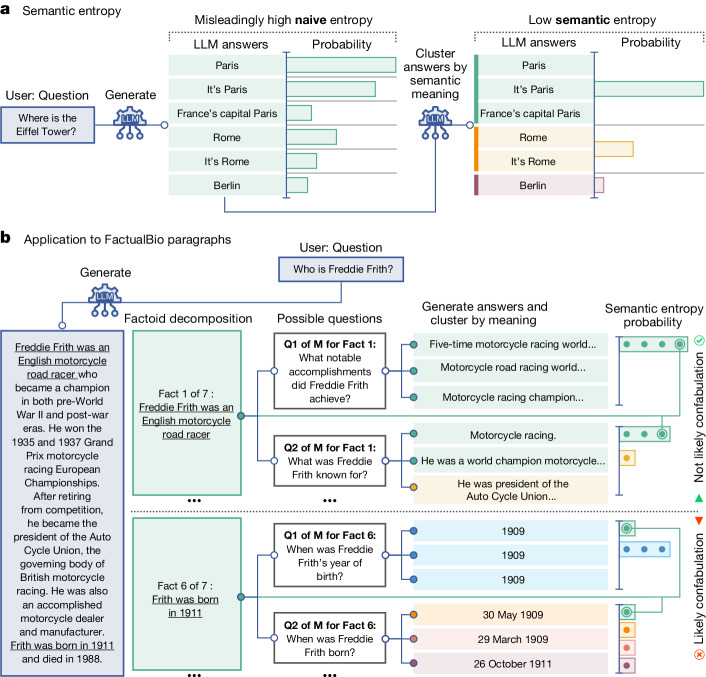
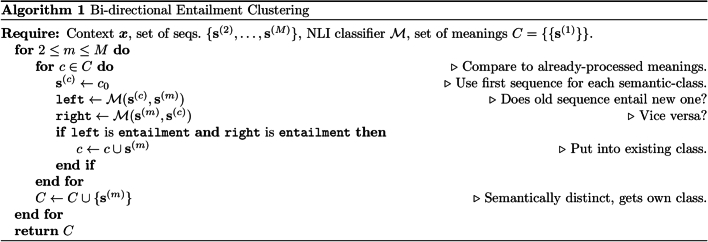
The paper introduces semantic entropy, an uncertainty estimator that clusters LLM generations by meaning via bidirectional entailment and computes entropy over those semantic clusters to detect confabulations. Across question-answering, math, and biography-generation tasks, semantic entropy outperforms naive entropy and supervised baselines without task-specific training data.
Key findings
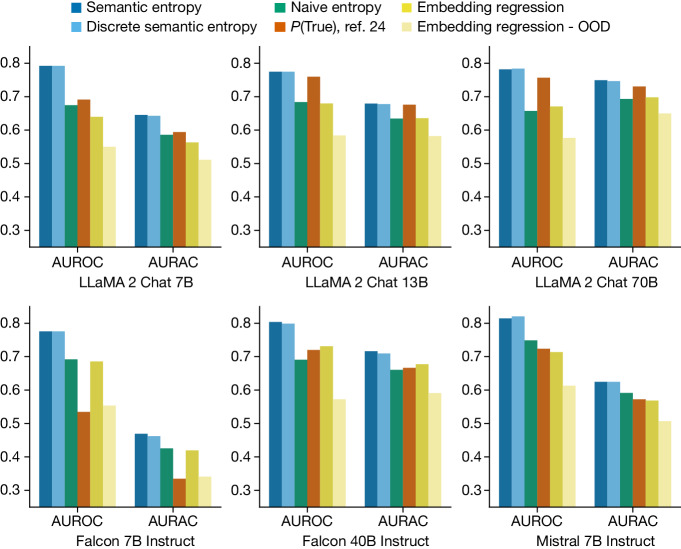
- Averaged across 30 task–model combinations, semantic entropy achieved the best AUROC of 0.790, compared with naive entropy (0.691), P(True) (0.698), and embedding regression (0.687); performance was stable between 0.78 and 0.81 across LLaMA, Falcon, and Mistral model families and scales from 7B to 70B parameters.
- Semantic entropy detects confabulations in sentence-length QA and math across TriviaQA, SQuAD 1.1, BioASQ, NQ-Open, and SVAMP, and its discrete variant performs similarly without requiring exact output probabilities.
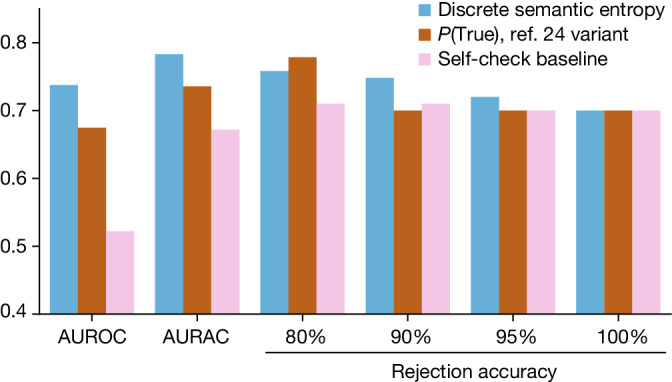
- On the GPT-4 biography dataset FactualBio—21 individuals, 150 factual claims, of which 45 were incorrect—the discrete semantic entropy variant outperformed a self-check baseline and an adapted P(True) baseline on AUROC and AURAC; P(True) had a narrow edge only after the top 20% of answers judged most likely to be confabulations were rejected.
- The method targets confabulations—arbitrary and incorrect generations sensitive to irrelevant details such as random seed—rather than all hallucinations, and it does not address systematically bad outputs.
Methods
- For each question, the method samples multiple generations from the LLM, clusters them by semantic equivalence using bidirectional entailment, and estimates semantic entropy over the meaning clusters; a discrete variant approximates cluster probabilities from generation frequencies when token probabilities are unavailable.
- Sentence-length experiments used LLaMA 2 Chat (7B, 13B, 70B), Falcon Instruct (7B, 40B), and Mistral Instruct (7B) on BioASQ, SQuAD 1.1, TriviaQA, SVAMP, and NQ-Open, with 400 train and 400 test examples per dataset; GPT-4 (v.0613) was used for FactualBio.
- Evaluation metrics were AUROC, rejection accuracy, and AURAC; sentence-length correctness was assessed automatically with GPT-4 against reference answers, validated against human judgement in the Supplementary Information.
Limitations
- The paper states that semantic entropy does not guarantee factuality and does not help when LLM outputs are systematically bad, including confident errors from training objectives, systematic reasoning failures, or misleading behaviour.
- The paper notes that semantic clustering can be overly sensitive to context: in one example, it distinguished a precise date from a year and treated the model as uncertain, even though the distinction was probably irrelevant in context.
- For FactualBio, the paper states that automatically generated questions are the main source of errors, and that GPT-4 did not expose output probabilities at the time, preventing computation of naive entropy, standard semantic entropy, and the embedding regression baseline for GPT-4.
Model-written summary. Check it against the paper before relying on it.
Integrity signals
Registry
Cites
Statistics
Figures
Verification
Claims the paper makes
8 Valid · 6 Not valid · 5 Not checked · 60 Own results and interpretations
The cited sources support only part of this claim — read each source’s verdict below.
In the paper
“Large language model (LLM) systems, such as ChatGPT1 or Gemini2, can show impressive reasoning and question-answering capabilities but often ‘hallucinate’ false outputs and unsubstantiated answers3,4.”
§ Detecting hallucinations in large language models using semantic entropy > Abstract
What the sources say
- Partly supportedcites [3] Xiao, Y. & Wang, W. Y. On hallucination and predictive uncertainty in conditional language generation. In Proc. 16th Conference of the European Chapter of the Association for Computational Linguistics 2734–2744 (Association for Computational Linguistics, 2021). sourceExperimental — accuracy not yet measured
The Introduction (p. 1) says neural generation models can produce content unsupported by their inputs, and §2.1 (p. 2) defines hallucination as false information unsupported by the input. The paper studies conditional generation, including image captioning and data-to-text, rather than establishing how often LLM systems such as ChatGPT or Gemini give unsubstantiated answers. (LLM, conf=0.84)
- Partly supportedcites [4] Rohrbach, A., Hendricks, L. A., Burns, K., Darrell, T. & Saenko, K. Object hallucination in image captioning. In Proc. 2018 Conference on Empirical Methods in Natural Language Processing (eds Riloff, E., Chiang, D., Hockenmaier, J. & Tsujii, J.) 4035–4045 (Association for Computational Linguistics, 2018). sourceExperimental — accuracy not yet measured
The Introduction describes image-captioning models generating objects absent from an image, and Section 3.2 reports hallucinated objects in 7.4%–17.7% of tested captions. This supports the general point that generated outputs can be false, but the paper does not establish how often LLM systems such as ChatGPT or Gemini produce unsubstantiated answers. Page numbers were not available in our copy. (LLM, conf=0.86)
plain- Asserted: passes — The authors put it forward as true.
- Checkable: passes — It can be checked against evidence.
- Load-bearing: passes — The paper’s conclusions depend on it.
- Based: passes — The paper gives a reason why it holds.
- Partly supported
The cited sources support only part of this claim — read each source’s verdict below.
In the paper
“High entropy corresponds to high uncertainty23–25—so semantic entropy is one way to estimate semantic uncertainties.”
§ Detecting hallucinations in large language models using semantic entropy > Main
What the sources say
- Not checked — no full text of the sourcecites [23] MacKay DJC Information-based objective functions for active data selection Neural Comput. 1992 4 590 604 10.1162/neco.1992.4.4.590 source
- Partly supportedcites [24] Kadavath, S. et al. Language models (mostly) know what they know. Preprint at https://arxiv.org/abs/2207.05221 (2022). sourceExperimental — accuracy not yet measured
Section B.2 (p. 29) hypothesizes that an unsure model produces a high-entropy answer distribution, and reports that entropy has some predictive power. But it also finds that larger models can give diverse correct answers and concludes that answer-distribution entropy is not a robust measure of whether a model knows the answer. The unqualified correspondence in the claim overstates the paper's finding. (LLM, conf=0.87)
- Supportedcites [25] Lindley DV On a measure of the information provided by an experiment Ann. Math. Stat. 1956 27 986 1005 10.1214/aoms/1177728069 source
The discussion on p. 4 explains that the measure uses Shannon’s function with the sign reversed: information is greatest when the distribution is concentrated on one value and falls as it spreads. This supports the cited background point that higher Shannon entropy corresponds to greater uncertainty; the later claim about semantic entropy is not attributed to this source. (LLM, conf=0.88)
plainstates an association- Asserted: passes — The authors put it forward as true.
- Checkable: passes — It can be checked against evidence.
- Load-bearing: passes — The paper’s conclusions depend on it.
- Based: passes — The paper gives a reason why it holds.
A result the paper states — it cites no source for it, so there is none to check. The quote shows it is in the paper.
In the paper
“Nevertheless, we significantly improve question-answering accuracy for state-of-the-art LLMs, revealing that confabulations are a great source of error at present.”
§ Detecting hallucinations in large language models using semantic entropy > Main
boostedstates a cause- Asserted: passes — The authors put it forward as true.
- Checkable: passes — It can be checked against evidence.
- Load-bearing: passes — The paper’s conclusions depend on it.
- Based: passes — The paper gives a reason why it holds.
- Rests on an assumption not shown here.
A result the paper reports from its own data — it cites no other source for it, so there is none to check. The quote shows it is in the paper.
In the paper
“We further show that semantic uncertainty can be used to improve model accuracy by refusing to answer questions when semantic uncertainty is high.”
§ Detecting hallucinations in large language models using semantic entropy > Methods > Detecting confabulations in QA and math
plainstates a cause- Asserted: passes — The authors put it forward as true.
- Checkable: passes — It can be checked against evidence.
- Load-bearing: passes — The paper’s conclusions depend on it.
- Based: passes — The paper gives a reason why it holds.
A result the paper reports from its own data — it cites no other source for it, so there is none to check. The quote shows it is in the paper.
In the paper
“In our experiments, we use semantic uncertainty to predict model accuracy, demonstrating that confabulations make up a notable fraction of model mistakes.”
§ Detecting hallucinations in large language models using semantic entropy > Methods > Detecting confabulations in QA and math
boosted- Asserted: passes — The authors put it forward as true.
- Checkable: passes — It can be checked against evidence.
- Load-bearing: passes — The paper’s conclusions depend on it.
- Based: passes — The paper gives a reason why it holds.
36 more claims
Create a free account to see all 79 claims and to verify the 2 references still open.
- Probably not a substantial claim. 30
- It may state two separate claims as one. 20
Claims other papers make about this one
Each is checked against this paper’s own text: does it say what the citing paper says it does?
The source backs part of the claim, not all of it — or backs it for a different population, condition or comparison.
In the citing paper
“However, LLMs exhibit hallucination and fabrication errors that are unacceptable for quantitative modeling [19, 20, 21].”
From Structured Schemas for Provenance‐Rich, LLM ‐Assisted QSP Model Calibration (2026) · cites this paper as [19]
Experimental — accuracy not yet measuredThe source backs part of the claim, not all of it — or backs it for a different population, condition or comparison.
In the citing paper
“Studies on hallucination, calibration, sycophancy, and cognitive bias indicate that failures often result not from a lack of capability but from unstable behavioral dispositions under uncertainty or pressure [8, 9, 10, 12, 15].”
From Machine Psychometrics: A Mathematical Psychology of Artificial Intelligence (2026) · cites this paper as [8]
Experimental — accuracy not yet measuredThe source backs part of the claim, not all of it — or backs it for a different population, condition or comparison.
In the citing paper
“AI-generated patient summaries also frequently contain errors that can be hard to detect12.”
From Multi-model assurance analysis showing large language models are highly vulnerable to adversarial hallucination attacks during clinical decision support (2025) · cites this paper as [12]
Experimental — accuracy not yet measuredThe source backs part of the claim, not all of it — or backs it for a different population, condition or comparison.
In the citing paper
“LLMs remain limited by the static knowledge encoded in their parameters.They are prone to hallucinations, factual inaccuracies, and out-of-date internal knowledge (Farquhar et al., 2024;Lewis et al., 2020).”
From Improving Amharic Information Retrieval with Translative and Multi-Agent Debate Retrieval Augmented Generation (2026) · cites this paper as Farquhar et al., 2024
Experimental — accuracy not yet measuredThe source backs part of the claim, not all of it — or backs it for a different population, condition or comparison.
In the citing paper
“This limitation can result in responses that lack coherence, contextual relevance, and even lead to hallucinations in extended dialogues or complex tasks [1], [2].”
From Memory-Augmented Architecture for Long-Term Context Handling in Large Language Models (2026) · cites this paper as [1]
Experimental — accuracy not yet measured
11 more claims about this paper
Create a free account to see every claim other papers make about this one.
Citations
Cites
Language Models are Few-Shot Learners
Brown, T. B., Mann, B., Ryder, N., Subbiah, M., Kaplan, J., Dhariwal, P., Neelakantan, A., Shyam, P., Sastry, G., Askell, A., et al. (2020) · arXiv · doi:10.48550/arxiv.2005.14165 · Cited by 23,372 · cited 1×
“57), which can predict entailment given suitable prompts.”
SQuAD: 100,000+ Questions for Machine Comprehension of Text
Rajpurkar, P., Zhang, J., Lopyrev, K., & Liang, P. (2016) · Proceedings of the 2016 Conference on Empirical Methods in Natural Language Processing · doi:10.18653/v1/d16-1264 · Cited by 6,208
Survey of Hallucination in Natural Language Generation
Ji, Z., Lee, N., Frieske, R., Yu, T., Su, D., Xu, Y., Ishii, E., Bang, Y. J., Madotto, A., & Fung, P. (2023) · ACM Computing Surveys · doi:10.1145/3571730 · Cited by 5,025 · cited 2×
“Hallucinations are often defined as LLMs generating “content that is nonsensical or unfaithful to the provided source content” 9–11 but they have come to include a vast array of failures of faithfulness and factuality.”
Survey of Hallucination in Natural Language Generation
Ji, Z., Lee, N., Frieske, R., Yu, T., Su, D., Xu, Y., Ishii, E., Bang, Y., Chen, D., Dai, W., et al. (2022) · arXiv · doi:10.48550/arxiv.2202.03629 · Cited by 4,981
A Broad-Coverage Challenge Corpus for Sentence Understanding through Inference
Williams, A., Nangia, N., & Bowman, S. (2018) · Proceedings of the 2018 Conference of the North American Chapter of the Association for Computational Linguistics: Human Language Technologies, Volume 1 (Long Papers) · doi:10.18653/v1/n18-1101 · Cited by 3,342 · cited 2×
“We rely on language models to predict entailment, such as DeBERTa-Large-MNLI 56 , which has been trained to predict entailment, or general-purpose LLMs such as GPT-3.”
Llama 2: Open Foundation and Fine-Tuned Chat Models
Touvron, H., Martin, L., Stone, K., Albert, P., Almahairi, A., Babaei, Y., Bashlykov, N., Batra, S., Bhargava, P., Bhosale, S., et al. (2023) · arXiv · doi:10.48550/arxiv.2307.09288 · Cited by 2,604 · cited 1×
“Our results for TriviaQA, SQuAD, BioASQ, NQ-Open and SVAMP are all evaluated context-free and involve sentence-length answers (96 ± 70 characters, mean ± s.d.) and use LLaMA 2 Chat (7B, 13B and 70B parameters) 38 , Falcon Instruct (7B and 40B) 39 and Mistral Instruct (7B) 40 .”
Aleatory or epistemic? Does it matter?
Kiureghian, A. D., & Ditlevsen, O. (2009) · Structural Safety · doi:10.1016/j.strusafe.2008.06.020 · Cited by 2,454 · cited 1×
“Researchers some-times separate aleatoric uncertainty (uncertainty in the underlying data distribution) from epistemic uncertainty (caused by having only limited information) 46 .”
Natural Questions: A benchmark for question answering research
Kwiatkowski, T., Palomaki, J., Redfield, O., Collins, M., Parikh, A., Alberti, C., Epstein, D., Polosukhin, I., Devlin, J., Lee, K., et al. (2019) · Transactions of the Association for Computational Linguistics · doi:10.1162/tacl_a_00276 · Cited by 2,069 · cited 2×
“33), life sciences (BioASQ 34 ) and open-domain natural questions (NQ-Open 35 ) derived from actual queries to Google Search 36 .”
TriviaQA: A Large Scale Distantly Supervised Challenge Dataset for Reading Comprehension
Joshi, M., Choi, E., Weld, D., & Zettlemoyer, L. (2017) · Proceedings of the 55th Annual Meeting of the Association for Computational Linguistics (Volume 1: Long Papers) · doi:10.18653/v1/p17-1147 · Cited by 1,690 · cited 5×
“TriviaQA is a trivia question-answering dataset.”
InfluentialTriviaQA: A Large Scale Distantly Supervised Challenge Dataset for Reading Comprehension
Joshi, M., Choi, E., Weld, D. S., & Zettlemoyer, L. (2017) · arXiv · doi:10.48550/arxiv.1705.03551 · Cited by 1,650
Research works printed but not linked: 8
- Xiao, T. Z., Gomez, A. N. & Gal, Y. Wat zei je? Detecting out-of-distribution translations with variational transformers. In Workshop on Bayesian Deep Learning at the Conference on Neural Information Processing Systems (NeurIPS, Vancouver, 2019).
- Negri, M., Bentivogli, L., Mehdad, Y., Giampiccolo, D. & Marchetti, A. Divide and conquer: crowdsourcing the creation of cross-lingual textual entailment corpora. In Proc. 2011 Conference on Empirical Methods in Natural Language Processing 670–679 (Association for Computational Linguistics, 2011).
- Malinin, A. & Gales, M. Uncertainty estimation in autoregressive structured prediction. In Proceedings of the International Conference on Learning Representations https://openreview.net/forum?id=jN5y-zb5Q7m (2021).
- Holtzman, A., Buys, J., Du, L., Forbes, M. & Choi, Y. The curious case of neural text degeneration. In Proceedings of the International Conference on Learning Representations https://openreview.net/forum?id=rygGQyrFvH (2020).
- Culicover PW Paraphrase generation and information retrieval from stored text Mech. Transl. Comput. Linguist. 1968 11 78 88
- He, P., Liu, X., Gao, J. & Chen, W. Deberta: decoding-enhanced BERT with disentangled attention. In International Conference on Learning Representations https://openreview.net/forum?id=XPZIaotutsD (2021).
- Socher, R., Huang, E., Pennin, J., Manning, C. D. & Ng, A. Dynamic pooling and unfolding recursive autoencoders for paraphrase detection. In Proceedings of the 24th Conference on Neural Information Processing Systems (eds Shawe-Taylor, J. et al.) (2011)
- Kane, H., Kocyigit, Y., Abdalla, A., Ajanoh, P. & Coulibali, M. Towards neural similarity evaluators. In Workshop on Document Intelligence at the 32nd conference on Neural Information Processing (2019).
Cited by
Items 101–200 of 888
From Illusion to Insight: A Taxonomic Survey of Hallucination Mitigation Techniques in LLMs
Kazlaris, I., Antoniou, E., Diamantaras, K., & Bratsas, C. (2025) · doi:10.20944/preprints202508.1942.v1 · Cited by 13
From Single to Multi: How LLMs Hallucinate in Multi-Document Summarization
Belem, C. G., Pezeshkpour, P., Iso, H., Maekawa, S., Bhutani, N., & Hruschka, E. (2024) · arXiv · doi:10.48550/arxiv.2410.13961 · Cited by 13
Ong, A. Y., Merle, D. A., Wagner, S. K., & Keane, P. A. (2025) · Journal of Medical Internet Research · doi:10.2196/75666 · Cited by 15
“…to detect hallucinations (eg, semantic entropy) or to limit them (eg, chain-of-thought or chain-of-verification reasoning) have been developed [8,9], ultimately, hallucinations are an inherent feature of LLM architectures and probably cannot be eliminated completely [10,11], raising the…”
Comparative performance of large language models for patient-initiated ophthalmology consultations
Huang, M., Wang, X., Zhou, S., Cui, X., Zhang, Z., Xu, Y., Yang, W., & Chi, W. (2025) · Frontiers in Public Health · doi:10.3389/fpubh.2025.1673045 · Cited by 17
CASSIA: a multi-agent large language model for automated and interpretable cell annotation
Xie, E., Cheng, L., Shireman, J. M., Cai, Y., Liu, J., Mohanty, C., Dey, M., & Kendziorski, C. M. (2025) · Nature Communications · doi:10.1038/s41467-025-67084-x · Cited by 38
“In addition, while generally accurate, LLMs are known to hallucinate, even in recent models like GPT-4o 20,21 .”
InfluentialLarge Language Models in Cancer Imaging: Applications and Future Perspectives
Tordjman, M., Bolger, I., Yuce, M., Restrepo, F., Liu, Z., Dercle, L., McGale, J., Meribout, A., Liu, M., Beddok, A., et al. (2025) · Journal of Clinical Medicine · doi:10.3390/jcm14103285 · Cited by 19
Yager, K. G. (2024) · Digital Discovery · doi:10.1039/d4dd00178h · Cited by 12
Generative AI: ensuring transparency and emphasising human intelligence and accountability
Bagenal, J., Biamis, C., Boillot, M., Brierley, R., Chew, M., Dehnel, T., Frankish, H., Grainger, E., Pope, J., Prowse, J., et al. (2024) · The Lancet · doi:10.1016/s0140-6736(24)02615-1 · Cited by 11
ComAI: The Convergence of Communication and Artificial Intelligence
Zhang, P., Niu, K., Wang, X., Liu, Y., Liang, Z., Dong, C., Dai, J., Xu, X., Xu, W., Zhang, Z., et al. (2025) · IEEE Communications Surveys & Tutorials · doi:10.1109/comst.2025.3608174 · Cited by 28
“…entropy is not only proposed by [181] to reveal characteristics of semantic information, but is also introduced by [183] to measure uncertainty of natural language generation models in question-answering scenarios and recognized in [184] for detecting hallucinations in large language models.”
Requirements Elicitation Follow-Up Question Generation
Shen, Y., Singhal, A., & Breaux, T. D. (2025) · IEEE International Requirements Engineering Conference (RE) · doi:10.1109/re63999.2025.00021 · Cited by 16
“In contrast, LLMs are prone to hallucination, i.e., generating fluent but incorrect or misleading content [20].”
When AI Is Fooled: Hidden Risks in LLM-Assisted Grading
Milani, A., Franzoni, V., Florindi, E., Omarbekova, A., Bekmanova, G., & Yergesh, B. (2025) · Education Sciences · doi:10.3390/educsci15111419 · Cited by 16
Kim, H. J., Yoon, P. W., Yoon, J. Y., Kim, H., Choi, Y. J., Park, S. H., & Moon, J. K. (2024) · Journal of Clinical Medicine · doi:10.3390/jcm13195971 · Cited by 12
“It is defined as the phenomenon whereby LMMs generate incorrect or non-sensical text regardless of the use of pre-trained data [22,23].”
BackgroundInfluentialEnhancing generative AI reliability via agentic AI in 6G-enabled edge computing
Ale, L., King, S. A., Zhang, N., & Xing, H. (2025) · Nature Reviews Electrical Engineering · doi:10.1038/s44287-025-00169-3 · Cited by 11
From Illusion to Insight: A Taxonomic Survey of Hallucination Mitigation Techniques in LLMs
Kazlaris, I., Antoniou, E. N., Diamantaras, K., & Bratsas, C. (2025) · AI · doi:10.3390/ai6100260 · Cited by 35
From humans to AI: understanding why AI is perceived as the preferred co-creation partner
Liu, Y., Yang, Y., & Xu, H. (2025) · Frontiers in Psychology · doi:10.3389/fpsyg.2025.1695532 · Cited by 10
“By contrast, although AI enjoys advantages in creativity and efficiency, its recommendations may at times misalign with subtle contextual needs or lack feasibility, necessitating additional screening and verification (Farquhar et al., 2024; Chen et al., 2024).”
Tarhini, A. A., & Naqa, I. E. (2025) · International Journal of Molecular Sciences · doi:10.3390/ijms26168002 · Cited by 13
“However, entropy-based estimators are being developed that can quantify when an LLM is likely to “hallucinate,” allowing for action to be taken to prevent negative societal impacts from these outputs [12].”
Lomas, A., & Broom, M. A. (2024) · International Journal of Obstetric Anesthesia · doi:10.1016/j.ijoa.2024.104249 · Cited by 12
Domain-Specific Question-Answering Systems: A Case Study of a Carbon Neutrality Knowledge Base
Liu, L., Zhou, Y., Ma, J., Zhang, Y., & He, L. (2025) · Sustainability · doi:10.3390/su17052192 · Cited by 25
Large Language Models for Transforming Healthcare: A Perspective on DeepSeek‐R1
Zhou, J., Cheng, Y., He, S., Chen, Y.-C., & Chen, H. (2025) · MedComm – Future Medicine · doi:10.1002/mef2.70021 · Cited by 16
Nitzl, C., Cyran, A., Krstanovic, S., & Borghoff, U. M. (2025) · Frontiers in Human Dynamics · doi:10.3389/fhumd.2025.1540450 · Cited by 18
Battle of the Bots: Solving Clinical Cases in Osteoarticular Infections With Large Language Models
Borgonovo, F., Matsuo, T., Petri, F., Amin Alavi, S. M., Mazudie Ndjonko, L. C., Gori, A., & Berbari, E. F. (2025) · Mayo Clinic Proceedings: Digital Health · doi:10.1016/j.mcpdig.2025.100230 · Cited by 10
Large Language Model in Materials Science: Roles, Challenges, and Strategic Outlook
Zhang, J., Chen, X., Ye, X., Yang, Y., & Ai, B. (2025) · Advanced Intelligent Discovery · doi:10.1002/aidi.202500085 · Cited by 23
ProCyon: A multimodal foundation model for protein phenotypesPreprint
Queen, O., Huang, Y., Calef, R., Giunchiglia, V., Chen, T., Dasoulas, G., Tai, L., Abbadessa, G., Howell, O. W., Li, M. M., et al. (2024) · bioRxiv (Cold Spring Harbor Laboratory) · doi:10.1101/2024.12.10.627665 · Cited by 24
Boretti, A. (2026) · Energy Research & Social Science · doi:10.1016/j.erss.2026.104720 · Cited by 10
LLM Post-Training: A Deep Dive into Reasoning Large Language Models
Kumar, K., Ashraf, T., Thawakar, O., Anwer, R. M., Cholakkal, H., Shah, M., Yang, M.-H., Torr, P. H. S., Khan, F. S., & Khan, S. (2025) · arXiv · doi:10.48550/arxiv.2502.21321 · Cited by 10
“They can generate misleading or fac-tually incorrect content (commonly referred to as “ hallucinations ”) and may struggle to maintain logical consistency throughout extended discourse [23], [24], [25], [26].”
A large-scale comparison of divergent creativity in humans and large language models
Wang, D., Huang, D., Shen, H., & Uzzi, B. (2025) · Nature Human Behaviour · doi:10.1038/s41562-025-02331-1 · Cited by 47
Król, K. (2025) · Applied Sciences · doi:10.3390/app15052292 · Cited by 10
Zero-shot detection of LLM-generated text via text reorder
Sun, J., & Lv, Z. (2025) · Neurocomputing · doi:10.1016/j.neucom.2025.129829 · Cited by 21
Sargeant, H., Izzidien, A., & Steffek, F. (2025) · Artificial Intelligence and Law · doi:10.1007/s10506-025-09434-0 · Cited by 28
“These deviations can be defined as “hallucinations”, a critical problem for natural language generation by LLMs, where the generated content is “unfaithful to the provided source content” (Ji et al. 2023; Farquhar et al. 2024).”
Lin, X., Xia, Y., Li, Y. G., Huang, Y., Liu, S., Zhang, J., & Gao, Y. Q. (2025) · Nature Communications · doi:10.1038/s41467-025-61323-x · Cited by 12
“However,paralleltootherGenAIs 23 ,3Dmolecules generated by AI may alsosuffer from various undesired hallucinations, among which researchers are particularly concerned with the following pathologies: (1) invalidity, (2) instability, and (3) violation of contextual conditions.”
Artificial Intelligence: Generative AI
Denning, P. J. (2025) · Ubiquity · doi:10.1145/3747356 · Cited by 14
Estimation of disciplinary similarity with large language models
Cantone, G. G., Zheng, E.-T., Tomaselli, V., & Nightingale, P. (2025) · Scientometrics · doi:10.1007/s11192-025-05385-0 · Cited by 14
“There is a risk that the software may “hallucinate” an inaccurate response: instead of providing an accurate answer, LLMs sometimes infer an answer from a set of principles that satisfy the query in a generic situation (Farquhar et al., 2024).”
Yuan, H. (2025) · iRadiology · doi:10.1002/ird3.115 · Cited by 13
“Therefore, they continue to suffer from hallucinations, a phenomenon where model‐generated content appears coherent and plausible but is factually incorrect, nonsensical, or unrelated to users' inputs [63].”
Han, Z., Battaglia, F., Mansuria, K., Heyman, Y., & Terlecky, S. R. (2025) · AI · doi:10.3390/ai6010012 · Cited by 18
Building Effective Safety Guardrails in AI Education Tools
Clark, H.-B., Benton, L., Searle, E., Dowland, M., Gregory, M., Gayne, W., & Roberts, J. (2025) · Communications in computer and information science · doi:10.1007/978-3-031-99261-2_12 · Cited by 12
“This is challenging due to the susceptibility of AI tools to bias, hallucinations, and inaccuracies and its ability to produce potentially harmful content (Farquhar et al., 2024; MIT Management, n.d.).”
Agha-Mir-Salim, L., Alberto, I. R. I., Alberto, N. R. I., Celi, L. A., Alfonso, P. G., Hicklen, R., Legaspi, K. E. Y., Menghrajani, R. H., Ng, F. Y. C., Pile, P. T., et al. (2025) · Journal of Medical Internet Research · doi:10.2196/70358 · Cited by 12
“Other reasons for the stagnant landscape of handover redesign could be the unintended consequences of more complex solutions, such as undetected confabulation or unchecked LLM implementations, though mitigation strategies are currently under development [75].”
The Financial, Operational, and Clinical Advantages of Generalist Radiology AI
Dogra, S., Zhang, X., Silva, E., & Rajpurkar, P. (2025) · Radiology · doi:10.1148/radiol.242362 · Cited by 12
CFDAgent: A language-guided, zero-shot multi-agent system for complex flow simulation
Xu, Z., wang, L., Wang, C., Chen, Y., Luo, Q. Z., Yao, H.-D., Wang, S., & He, G. (2025) · Physics of Fluids · doi:10.1063/5.0294696 · Cited by 33
“Despite their impressive capabilities, current standalone LLMs remain limited in tasks requiring extensive, precise, and systematic content generation—particularly in computational physics and simulation [7] due to persistent challenges such as hallu-cination [8].”
Luo, I., Graber‐Naidich, A., Zhang, M., Kaushik, R., Nieda, G. M., Chen, T., Gu, B., Choi, E., Ding, V. Y., Güntürkün, F., et al. (2025) · npj Digital Medicine · doi:10.1038/s41746-025-02009-y · Cited by 14
“Moreover, despite recognizing LLM hallucinations 26,27 as a source of error, prior works have not proposed any systematic mechanisms for identifying or correcting such errors across time points — limiting the clinical reliability of extracted smoking histories 23 .”
Large language models for spreading dynamics in complex systems
Jiang, S., Ren, H., Gao, Y., Zhang, Y., Li, Q., Xiao, D., Fan, J., Tang, R., & Wang, W. (2026) · Physics Reports · doi:10.1016/j.physrep.2026.01.006 · Cited by 11
The diffusion of large language models in published academic articles
Siler, K. (2026) · Proceedings of the National Academy of Sciences · doi:10.1073/pnas.2605754123 · Cited by 28
Krag, C. H., Balschmidt, T., Bruun, F. J., Brejnebøl, M. W., Xu, J. J., Boesen, M., Andersen, M. B., & Müller, F. C. (2024) · medRxiv · doi:10.1101/2024.10.01.24314702 · Cited by 17
“Potential problems with using LLMs for reviews are that some LLMs can confabulate and hallucinate 22,23 .”
Nguyen, Q., Nguyen, D.-A., Dang, K., Liu, S., Nguyen, K., Wang, S. Y., Woof, W. A., Thomas, P. B. M., Patel, P. J., Balaskas, K., et al. (2024) · medRxiv · doi:10.1101/2024.11.18.24317510 · Cited by 11
Ning, W., Li, M., Reimers, J. R., & Kobayashi, R. (2026) · Digital Discovery · doi:10.1039/d5dd00482a · Cited by 8
Wernly, B., Guidet, B., & Beil, M. (2024) · Intensive Care Medicine · doi:10.1007/s00134-024-07738-4 · Cited by 8
“Moreover, the trustworthiness of model outputs, which could represent recommendations after suitable prompting, is compromised by hallucinations which could only partially be contained so far [10].”
A Survey on Quality Evaluation of Instruction Fine-tuning Datasets for Large Language Models
Luo, Y., Liu, Y., Zhang, L., Gao, F., & Gu, J. (2025) · Data Intelligence · doi:10.3724/2096-7004.di.2025.0021 · Cited by 19
“Selecting appropriate instructions from large-scale instruction-tuning datasets presents numerous challenges, primarily stemming from the complexity of the selection process, diverse evaluation methods,”
Cui, C., Chamasemani, F. F., Reisinger, M., Imrich, P. J., Hartner, W., Robl, W. K., & Brunner, R. (2025) · npj Materials Degradation · doi:10.1038/s41529-025-00603-9 · Cited by 9
Schneider, S. M. (2025) · Social Epistemology · doi:10.1080/02691728.2025.2500030 · Cited by 15
“Efforts to stop hallucinations, such as retrieval-augmented generation (RAG), have only been partly successful, impacting the adoption of the technology in more high-stakes arenas, such as law and medicine (Farquhar et al. 2024).”
Adaptive Orchestration of Modular Generative Information Access Systems
Hoveyda, M., Oosterhuis, H., de Vries, A. P., de Rijke, M., & Hasibi, F. (2025) · International ACM SIGIR Conference on Research and Development in Information Retrieval (SIGIR) · doi:10.1145/3726302.3730351 · Cited by 11
“Such signals can serve as guidance on the efficiency-effectiveness trade-off of a system [20].”
Vision-Amplified Semantic Entropy for Hallucination Detection in Medical Visual Question Answering
Liao, Z., Hu, S., Zou, K., Fu, H., Zhen, L., & Xia, Y. (2025) · Lecture notes in computer science · doi:10.1007/978-3-032-04971-1_63 · Cited by 23
Oettl, F. C., Pruneski, J. A., Zsidai, B., Yu, Y., Cong, T., Tischer, T., Hirschmann, M. T., & Samuelsson, K. (2025) · Knee Surgery Sports Traumatology Arthroscopy · doi:10.1002/ksa.70145 · Cited by 11
“For LLMs, the risk of ‘ hallucination ’— where the AI generates con fi dent but factually incorrect information — poses a serious safety concern that necessitates rigorous human oversight [3, 13, 55, 67].”
Linguistic features of AI mis/disinformation and the detection limits of LLMs
Ma, Y., Zhang, X., Ren, J., Wang, R., Wang, M., & Chen, Y. (2025) · Nature Communications · doi:10.1038/s41467-025-67145-1 · Cited by 18
Lansiaux, É., Azzouz, R., Chazard, E., Vromant, A., & Wiel, É. (2026) · JMIR Medical Informatics · doi:10.2196/83318 · Cited by 11
“Recent studies on LLM hallucinations [13] and time-series forecasting [26] suggest potential mitigation strategies, including semantic entropy–based uncertainty quantification, prompt engineering, and backbone reprogramming—approaches that warrant investigation in future iterations.”
Do Prompt Patterns Affect Code Quality? A First Empirical Assessment of ChatGPT-Generated Code
Porta, A. D., Lambiase, S., & Palomba, F. (2025) · International Conference on Evaluation and Assessment in Software Engineering (EASE) · doi:10.1145/3756681.3756938 · Cited by 46
Bayesian Optimization of Catalysis with In-Context Learning
Ramos, M. C., Michtavy, S. S., White, A. D., & Porosoff, M. D. (2026) · ACS Central Science · doi:10.1021/acscentsci.5c02418 · Cited by 37
“We view adaptive k schedules (e.g., increasing k with | M | or conditioning on retrieval confidence/diversity) as a natural extension, but we do not study them here because long-context behavior varies across models and inference stacks.”
Artificial Intelligence in Cancer Immunotherapy: Navigating Challenges and Unlocking Opportunities
Xiang, W., Yu, L., Chen, X. S., & Herold, M. J. (2024) · Engineering · doi:10.1016/j.eng.2024.12.014 · Cited by 8
Jiang, X., Dong, Y., Tao, Y., Liu, H., Jin, Z. G., & Li, G. (2025) · ACM/IEEE International Conference on Software Engineering: Companion Proceedings (ICSE-Companion) · doi:10.1109/icse55347.2025.00133 · Cited by 42
Verma, R., Alsentzer, E., Strasser, Z. H., Chang, L., Roman, K., Gershanik, E., Hernandez, C., Linares, M. A., Rodriguez, J. A., Thakral, D., et al. (2026) · Journal of the American Medical Informatics Association · doi:10.1101/2025.06.02.25328807 · Cited by 16
Meyer, A., Karay, Y., Steinbicker, A. U., Streichert, T., & Overbeek, R. (2025) · JMIR Formative Research · doi:10.2196/77357 · Cited by 7
“In the context of large language models, such errors are commonly referred to as hallucinations , meaning the confident generation of factually incorrect or fabricated information that is not supported by the input or external knowledge [30].”
Contextualized Autonomous Drone Navigation Using LLMs Deployed in Edge-Cloud Computing
Chen, H., Tang, Y., Tsourdos, A., & Guo, W. (2025) · International Conference on Machine Learning and Autonomous Systems (ICMLAS) · doi:10.1109/icmlas64557.2025.10967934 · Cited by 10
“There are a number of evaluation criteria for error categories, each with different error sources [13]–[15].”
AI-driven design: powered by large language model and intelligent computation
Sa, G., Li, Z., Liu, Z., & Tan, J. (2025) · International Journal of Extreme Manufacturing · doi:10.1088/2631-7990/adea23 · Cited by 8
“…hallucinations (numerical generation beyond safe ranges), logical hallucinations (self-contradictory design solutions), and structural hallucinations (geometric features violating manufacturing feasibility) during reasoning processes, seriously reducing design accuracy and reliability [31,32] .”
Ten Natural Language Processing Tasks with Generative Artificial Intelligence
Golec, J., & Hachaj, T. (2025) · Applied Sciences · doi:10.3390/app15169057 · Cited by 19
Large language models for biological sequence analysis in infectious disease research
Luo, J., Cai, X., & Li, Y. (2025) · Biosafety and Health · doi:10.1016/j.bsheal.2025.09.007 · Cited by 9
Faulty Artificial Intelligence, or the Sleep of Reason
Wiest, G., & Turnbull, O. H. (2025) · NEJM AI · doi:10.1056/aip2500785 · Cited by 7
Turón, G., Mulubwa, M., Montaner, A., Njoroge, M., Chibale, K., & Duran‐Frigola, M. (2025) · Nature Communications · doi:10.1038/s41467-025-64304-2 · Cited by 7
“Speci fi cally, fi ne-tuning LLMsto explicitly include a corpus of scienti fi c literature related to PGx could increase the accuracy of predictions and reduce the risk of confabulation by the LLM 34 .”
Xia, M., Bayerlein, R., Chemli, Y., Liu, X., Ouyang, J., Lin, M., Fakhri, G. E., Badawi, R. D., Li, Q., & Liu, C. (2025) · Journal of Nuclear Medicine · doi:10.2967/jnumed.125.270653 · Cited by 19
“Additionally, Farquhar et al. ( 14 ) introduce a subset of hallucinations termed confabulations, referring to AIGC that are both incorrect and arbitrary.”
Kong, L., Zhong, X., Chen, J., Fu, H., & Wang, Y. (2025) · Frontiers of Information Technology & Electronic Engineering · doi:10.1631/fitee.2500180 · Cited by 13
“…‡ Corresponding author ORCID: Linggang KONG, https://orcid.org/0000-0002-2477-118X c (cid:2) Zhejiang University Press 2025 the most significant issues is hallucination (Zhang JX et al., 2023; Farquhar et al., 2024), wherein the contents generated by LLMs contradict real-world factual information.”
Application of DeepSeek-based AI teaching assistant in teaching anesthesiology theories
Hao, F., Du, W., Yan, J., & Jiang, H. (2025) · BMC Medical Education · doi:10.1186/s12909-025-08494-9 · Cited by 6
“Third, although AI “hallucinations” are unavoidable in large language models [13, 14], Deep-Seek minimizes such occurrences in the specialized field of anesthesiology by relying on a customized localized knowledge base.”
Singh, S., & Chandrasekhar, P. (2026) · Cureus · doi:10.7759/cureus.100845 · Cited by 8
“LLMs are known to fabricate references [7] or construct plausible but incorrect explanations [5,6].”
When trust collides: Exploring human-LLM cooperation intention through the prisoner’s dilemma
Jiang, G., Yang, S., Wang, Y., & Hui, P. (2026) · International Journal of Human-Computer Studies · doi:10.1016/j.ijhcs.2026.103740 · Cited by 22
Artificial intelligence in emergency medicine: a narrative review
Rego, A., Arango-Ibañez, J. P., Taylor, R. A., Smith, M. E., Jones, D. D., Pelletier, J., Colletti, J. E., Gottlieb, M. A., & Long, B. (2026) · The American Journal of Emergency Medicine · doi:10.1016/j.ajem.2026.01.028 · Cited by 9
PlantScience.ai: An LLM-powered virtual scientist for plant science
Yu, H., Zhou, S., Huang, M., Ding, L., Chen, Y., Wang, Y., Ren, Y., Cheng, N., Wang, X., Liang, J., et al. (2026) · Molecular Plant · doi:10.1016/j.molp.2026.03.010 · Cited by 11
Arzideh, K., Schäfer, H., Idrissi-Yaghir, A., Schmidt, C. S., Eryılmaz, B., Bahn, M., Turki, A. T., Pollok, O. B., Hartmann, E. M., Winnekens, P., et al. (2026) · Journal of Medical Internet Research · doi:10.2196/82997 · Cited by 12
“LLMs, including the SauerkrautLM-SOLAR-Instruct model used for data generation, are susceptible to hallucinations and may generate factually incorrect or clinically inappropriate content [40].”
Kim, S., Zhou, Y., Guo, Y., Xiao, C., & Zheng, K. (2026) · Journal of the American Medical Informatics Association · doi:10.1093/jamia/ocag045 · Cited by 8
Ding, S., Xu, F., Jie, C., Liang, S., Zhang, H., & Huang, W. (2026) · Progress in Materials Science · doi:10.1016/j.pmatsci.2026.101733 · Cited by 12
Learning Paradigms for Hybrid Decision-Making Systems
Punzi, C., Pellungrini, R., Setzu, M., Giannotti, F., & Pedreschi, D. (2026) · ACM Computing Surveys · doi:10.1145/3802522 · Cited by 25
Hamamoto, R., Komatsu, M., Yamada, M., Kobayashi, K., Takahashi, M., Miyake, M., Jinnai, S., Koyama, T., Kouno, N., Machino, H., et al. (2024) · Cancer Science · doi:10.1111/cas.16395 · Cited by 12
Williams, C. Y. K., Subramanian, C. R., Ali, S. S., Apolinario, M., Askin, E., Barish, P. N., Cheng, M., Deardorff, W. J., Donthi, N., Ganeshan, S., et al. (2024) · medRxiv · doi:10.1101/2024.09.29.24314562 · Cited by 6
Are We Tripping? The Mirage of AI HallucinationsPreprint
Mills, A., & Angell, N. (2025) · SSRN Electronic Journal · doi:10.2139/ssrn.5127162 · Cited by 10
Tripathi, A. G., Waqas, A., Venkatesan, K., Ullah, E., Khan, A., Khalil, F. K., Chen, W., Gahramanli, Z., Saeed‐Vafa, D., Bui, M. M., et al. (2025) · medRxiv · doi:10.1101/2025.04.22.25326217 · Cited by 5
“A major concern is hallucination, the tendency to produce plausible-sounding but factually incorrect or unsupported outputs [21, 22, 23].”
Vasilev, Y., Raznitsyna, I., Pamova, A., Burtsev, T., Bobrovskaya, T., Kosov, P., Vladzymyrskyy, A., Omelyanskaya, O., & Arzamasov, K. (2025) · Diagnostics · doi:10.3390/diagnostics16010003 · Cited by 10
“Methods for automated detection of hallucinations based on pre-trained models have been proposed [35–37].”
Learning Human Feedback from Large Language Models for Content Quality-aware Recommendation
Wang, H., Wu, C., Huang, Y., & Qi, T. (2025) · ACM Transactions on Information Systems · doi:10.1145/3727144 · Cited by 11
“However, there remains ongoing debate about whether LLMs can fully align with human expectations, particularly with respect to the phenomenon of hallucinations, where models generate fabricated or incorrect information [4, 18, 19, 28, 94].”
Visual hallucination detection in large vision-language models via evidential conflict
Huang, T., Liu, Z., Wang, R., Zhang, Y., & Jing, L. (2025) · International Journal of Approximate Reasoning · doi:10.1016/j.ijar.2025.109507 · Cited by 18
Loureiro, J., Petrella, L., Gil, P. S., Rocha, T., Paredes, S., & Henriques, J. M. O. (2025) · IEEE Transactions on Emerging Topics in Computational Intelligence · doi:10.1109/tetci.2025.3577486 · Cited by 9
“For a thorough discussion on uncertainty quantification methods for classification models, the reader is referred to [121], [122], [123], [124], [125], [126], [127].”
Lee, S., Lee, H., Lee, H., Yum, K. S., Baek, J., Khil, J., Lee, J. Y., Shin, S., Cho, M., Ahn, N. Y., et al. (2025) · Journal of the American Medical Informatics Association · doi:10.1093/jamia/ocaf099 · Cited by 4
Evaluating Large Language Models for Radiology Systematic Review Title and Abstract Screening
Dogra, S., Arabshahi, S., Wei, J., Hu, E., Saidenberg, L., Sharma, S., Gu, Z., Siriruchatanon, M., & Kang, S. K. (2025) · Academic Radiology · doi:10.1016/j.acra.2025.08.014 · Cited by 5
Metareasoning for Edge-Cloud Collaborative LLM Planning for Efficient Autonomous Navigation
Navardi, M., Gao, S., Walczak, M., Camacho, F., & Mohsenin, T. (2026) · ACM Transactions on Embedded Computing Systems · doi:10.1145/3765750 · Cited by 10
“Consequently, implementing safety checks is crucial, particularly in critical applications [40] suggests that LLMs can be utilized effectively for planning if their outputs are validated.”
Liu, Z., Kou, J., Zhang, W., Gu, C., Fang, X., Huang, Z., Hao, Y., Li, H., Lu, X., Yin, A., et al. (2024) · International Conference on Universal Village (UV) · doi:10.1109/uv63228.2024.11189137 · Cited by 12
Wang, R., & Ophir, Y. (2025) · Computers in Human Behavior · doi:10.1016/j.chb.2025.108872 · Cited by 10
Shingleton, J., & Basiri, A. (2025) · Journal of Location Based Services · doi:10.1080/17489725.2025.2594193 · Cited by 7
“Attempts have been made to construct hallucination detection frameworks (Farquhar et al. 2024; McKenna et al. 2023; Arteaga et al. 2024), however these are not geospatially specific.”
VLM-MPC: Model predictive controller augmented vision language model for autonomous driving
Long, K., Shi, H., Liu, J., Xiao, C., & Li, X. S. (2025) · Transportation Research Part C Emerging Technologies · doi:10.1016/j.trc.2025.105487 · Cited by 44
Lansiaux, É., Azzouz, R., Chazard, E., Vromant, A., & Wiel, É. (2025) · IEEE/ACM International Conference on Big Data Computing, Applications and Technologies (BDCAT) · doi:10.1145/3773276.3774289 · Cited by 5
“Improving URGENTIAPARSE’s generalization may require regularization, data augmentation, or model simplification, and addressing hallucinations could involve fine-tuning or prompt refinement [24], TimeLLM approaches [25], or backbone language models reprogrammation.”
Liu, Z., Hu, B., Feng, Y., Lu, C., & Tan, J. (2025) · Advanced Engineering Informatics · doi:10.1016/j.aei.2025.104264 · Cited by 11
Hu, H., Wang, L., Chen, L., Lin, H., Huang, L.-T., Wang, Z.-W., & Hou, X. (2026) · Journal of Medicinal Chemistry · doi:10.1021/acs.jmedchem.5c03511 · Cited by 5
Dehdab, R., Afat, S., Mankertz, F., Brendel, J. M., Maalouf, N., Werner, S., Brendlin, A., Herrmann, J., Nikolaou, K., Kloker, L. D., et al. (2026) · Journal of Cancer Research and Clinical Oncology · doi:10.1007/s00432-026-06432-w · Cited by 5
“A key issue is their tendency to produce hallucinations or confabulations, in which the model generates outputs that may sound clinically reasonable but are not actually supported by the provided data or current medical guidelines (Farquhar et al. 2024; Kalai et al. 2025).”
ChatGPT-5 versus other mainstream large language models in core diabetic retinopathy patient queries
Cang, X., MengXia, N., Song, C., Zhao, J., Guo, Y., Zou, Y., Zhang, Z., & Jiang, L. (2026) · Frontiers in Cell and Developmental Biology · doi:10.3389/fcell.2026.1754221 · Cited by 6
Yang, J. J., & Hwang, S. (2025) · Blood Research · doi:10.1007/s44313-025-00062-w · Cited by 11
“Although these advanced AI tools offer significant advantages in manuscript preparation and research synthesis, their outputs require careful systematic verification [34].”
Li, C., Xing, B., Huo, D., Zhou, Q., Xu, Z., & Wang, Y. (2025) · IEEE International Conference on Acoustics Speech and Signal Processing · doi:10.1109/icassp49660.2025.10889328 · Cited by 6
“At present, hallucination detection methods in the absence of external knowledge sources are mainly divided into two categories: internal state-based approaches and behavior-based † Dongdong Huo is the corresponding author. huodongdong@iie.ac.cn approaches [7].”
Herbst, R., Stille, D., Gwilliam, G. F., von Konrat, M., Campbell, T., Gaswick, W., Grewe, F., Hansen, K. J., Iacobelli, F., Jellema, K., et al. (2025) · Data Intelligence · doi:10.3724/2096-7004.di.2025.0011 · Cited by 6
Wang, T.-H., Jheng, J.-C., Tseng, Y.-T., Chen, L., & Chen, Y. (2025) · Journal of the Chinese Medical Association · doi:10.1097/jcma.0000000000001273 · Cited by 6
Metadata
- Authors
- Farquhar, S., Kossen, J., Kuhn, L., & Gal, Y.
- Affiliations
- University of Oxford (GB)
- Corresponding author
- Farquhar, Sebastian
- Venue
- Nature
- Published
- 2024-06-19
- Volume
- 630
- Issue
- 8017
- Pages
- 625-630
- ISSN
- 0028-0836 (ISSN-L)
- 1476-4687
- PMC
- PMC11186750
- OpenAlex
- W4399803256
- Semantic Scholar
- f82f49c20c6acc69f884f05e3a9f1ceea91061ce
- Cited by
- 934
- References
- 60
- Citations by year
- 2026: 540 · 2025: 349 · 2024: 44
- FWCI
- 137.11
- Type
- journal article
- Language
- en
- Open access
- hybrid
- doi.org
- Licence
- cc-by
- creativecommons.org/licenses/by/4.0 (tdm)
- creativecommons.org/licenses/by/4.0 (vor)
- Locations
- Nature (publishedVersion, cc-by)
- PubMed Central (publishedVersion, cc-by)
- PubMed (publishedVersion)
- RePEc: Research Papers in Economics (submittedVersion)
- Funders
- Government of the United Kingdom
- UK Research and Innovation
- Topics
- Physical Sciences › Computer Science › Artificial Intelligence › Topic Modeling
- Physical Sciences › Computer Science › Artificial Intelligence › Adversarial Robustness in Machine Learning
- Physical Sciences › Computer Science › Artificial Intelligence › Natural Language Processing Techniques
- Keywords
- hallucination detection, large language models, semantic entropy, uncertainty estimation, confabulation, LLM reliability, generalization to unseen tasks, honesty
About these checks
Registry, retraction, Cites and statistics results are computed, not judged, with one exception: a printed reference that no index lists is read once by a model before it counts as a citation error. Claims are extracted by a model and kept only when their quote appears verbatim in the text; each cited source is then checked, with a model’s help, for whether it says what the claim relies on. Those verdicts can be wrong — read the claim’s quote and the cited source before relying on one.
The claim verdicts this report counts are experimental: their accuracy is not yet measured.
A language model drew the claims from the paper on 2026-10-10, under version 3 of the claim definition (model deepseek-v4.1-flash, prompt extract-v3).
A second model labelled each claim on 2026-10-10 (model jev-1.13-20260917, definition revision gold-guideline-v0.2).
Cited sources are checked with a language model’s help (gpt-6-sol).
Statistics and arithmetic are recomputed, not judged.
Confidence bands are shown only for fields calibrated on our annotated test set. None is calibrated yet, so no band is shown.
What counts as a claim ›How we measure confidence ›How we check this ›
Are you an author, or do you see a problem with this page? Request a review
Data sources
Bibliographic data: Semantic Scholar, OpenAlex, Crossref.
Contains information from the Semantic Scholar Academic Graph Datasets, made available under the ODC Attribution License (ODC-BY 1.0).
Semantic Scholar’s data is described in: Kinney, R., et al. (2023). The Semantic Scholar Open Data Platform. arXiv:2301.10140.
