

Detecting hallucinations in large language models using semantic entropy
Open accessThe DOI matches its Crossref record; 57 of the 60 references it cites were found in a registry or an index; 14 of the 21 sources its claims cite were checked for support.
Abstract
Abstract Large language model (LLM) systems, such as ChatGPT 1 or Gemini 2 , can show impressive reasoning and question-answering capabilities but often ‘hallucinate’ false outputs and unsubstantiated answers 3,4 . Answering unreliably or without the necessary information prevents adoption in diverse fields, with problems including fabrication of legal precedents 5 or untrue facts in news articles 6 and even posing a risk to human life in medical domains such as radiology 7 . Encouraging truthfulness through supervision or reinforcement has been only partially successful 8 . Researchers need a general method for detecting hallucinations in LLMs that works even with new and unseen questions to which humans might not know the answer. Here we develop new methods grounded in statistics, proposing entropy-based uncertainty estimators for LLMs to detect a subset of hallucinations—confabulations—which are arbitrary and incorrect generations. Our method addresses the fact that one idea can be expressed in many ways by computing uncertainty at the level of meaning rather than specific sequences of words. Our method works across datasets and tasks without a priori knowledge of the task, requires no task-specific data and robustly generalizes to new tasks not seen before. By detecting when a prompt is likely to produce a confabulation, our method helps users understand when they must take extra care with LLMs and opens up new possibilities for using LLMs that are otherwise prevented by their unreliability.
Overview
CoChat Summary
TL;DR
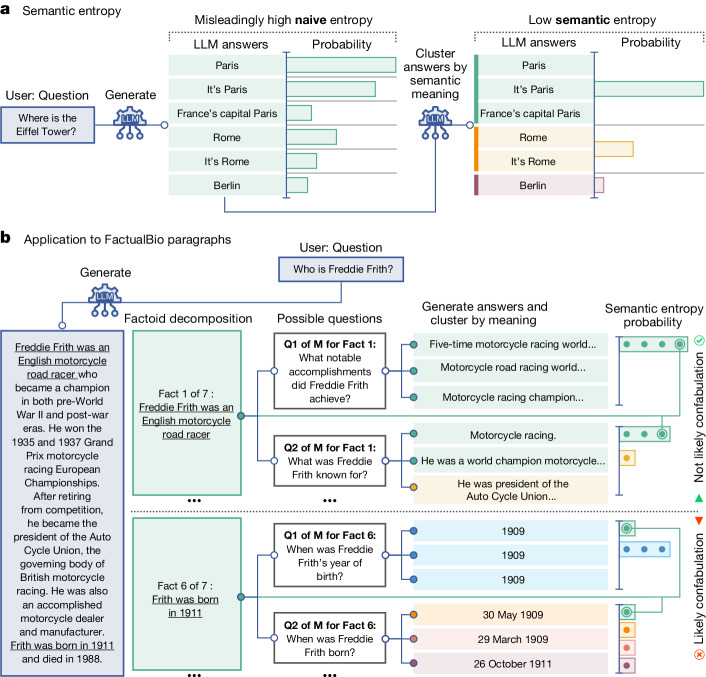
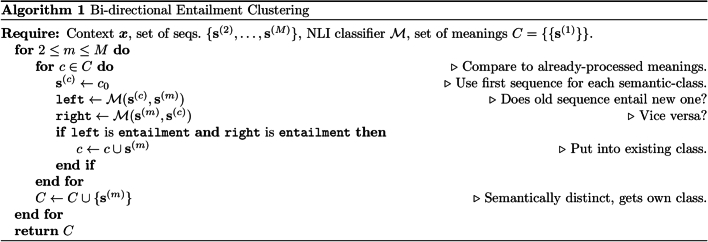
The paper introduces semantic entropy, an uncertainty estimator that clusters LLM generations by meaning via bidirectional entailment and computes entropy over those semantic clusters to detect confabulations. Across question-answering, math, and biography-generation tasks, semantic entropy outperforms naive entropy and supervised baselines without task-specific training data.
Key findings
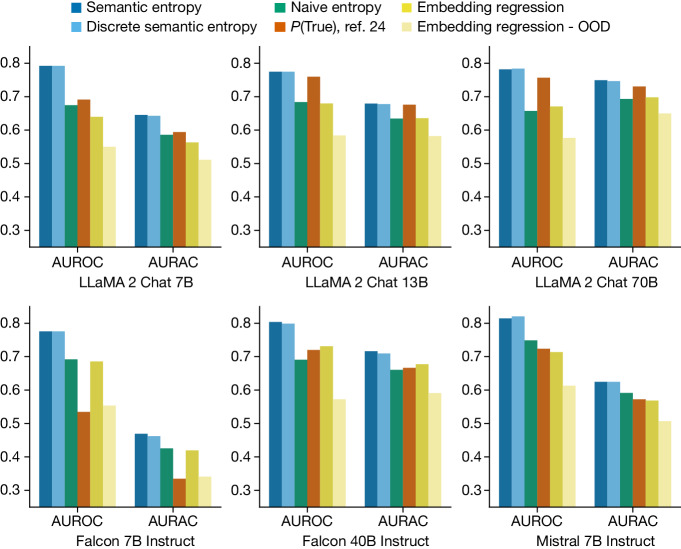
- Averaged across 30 task–model combinations, semantic entropy achieved the best AUROC of 0.790, compared with naive entropy (0.691), P(True) (0.698), and embedding regression (0.687); performance was stable between 0.78 and 0.81 across LLaMA, Falcon, and Mistral model families and scales from 7B to 70B parameters.
- Semantic entropy detects confabulations in sentence-length QA and math across TriviaQA, SQuAD 1.1, BioASQ, NQ-Open, and SVAMP, and its discrete variant performs similarly without requiring exact output probabilities.
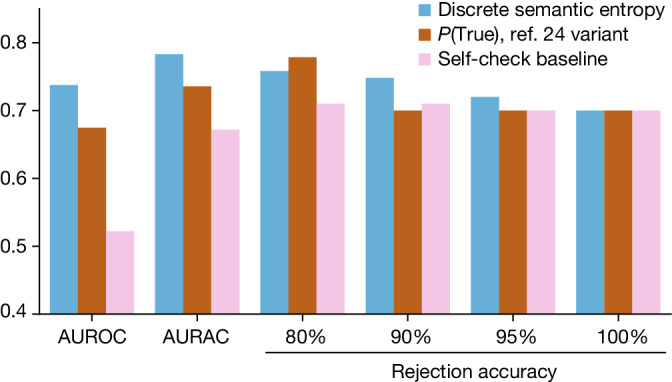
- On the GPT-4 biography dataset FactualBio—21 individuals, 150 factual claims, of which 45 were incorrect—the discrete semantic entropy variant outperformed a self-check baseline and an adapted P(True) baseline on AUROC and AURAC; P(True) had a narrow edge only after the top 20% of answers judged most likely to be confabulations were rejected.
- The method targets confabulations—arbitrary and incorrect generations sensitive to irrelevant details such as random seed—rather than all hallucinations, and it does not address systematically bad outputs.
Methods
- For each question, the method samples multiple generations from the LLM, clusters them by semantic equivalence using bidirectional entailment, and estimates semantic entropy over the meaning clusters; a discrete variant approximates cluster probabilities from generation frequencies when token probabilities are unavailable.
- Sentence-length experiments used LLaMA 2 Chat (7B, 13B, 70B), Falcon Instruct (7B, 40B), and Mistral Instruct (7B) on BioASQ, SQuAD 1.1, TriviaQA, SVAMP, and NQ-Open, with 400 train and 400 test examples per dataset; GPT-4 (v.0613) was used for FactualBio.
- Evaluation metrics were AUROC, rejection accuracy, and AURAC; sentence-length correctness was assessed automatically with GPT-4 against reference answers, validated against human judgement in the Supplementary Information.
Limitations
- The paper states that semantic entropy does not guarantee factuality and does not help when LLM outputs are systematically bad, including confident errors from training objectives, systematic reasoning failures, or misleading behaviour.
- The paper notes that semantic clustering can be overly sensitive to context: in one example, it distinguished a precise date from a year and treated the model as uncertain, even though the distinction was probably irrelevant in context.
- For FactualBio, the paper states that automatically generated questions are the main source of errors, and that GPT-4 did not expose output probabilities at the time, preventing computation of naive entropy, standard semantic entropy, and the embedding regression baseline for GPT-4.
Model-written summary. Check it against the paper before relying on it.
Integrity signals
Registry
Cites
Statistics
Figures
Verification
Claims the paper makes
8 Valid · 6 Not valid · 5 Not checked · 60 Own results and interpretations
The cited sources support only part of this claim — read each source’s verdict below.
In the paper
“Large language model (LLM) systems, such as ChatGPT1 or Gemini2, can show impressive reasoning and question-answering capabilities but often ‘hallucinate’ false outputs and unsubstantiated answers3,4.”
§ Detecting hallucinations in large language models using semantic entropy > Abstract
What the sources say
- Partly supportedcites [3] Xiao, Y. & Wang, W. Y. On hallucination and predictive uncertainty in conditional language generation. In Proc. 16th Conference of the European Chapter of the Association for Computational Linguistics 2734–2744 (Association for Computational Linguistics, 2021). sourceExperimental — accuracy not yet measured
The Introduction (p. 1) says neural generation models can produce content unsupported by their inputs, and §2.1 (p. 2) defines hallucination as false information unsupported by the input. The paper studies conditional generation, including image captioning and data-to-text, rather than establishing how often LLM systems such as ChatGPT or Gemini give unsubstantiated answers. (LLM, conf=0.84)
- Partly supportedcites [4] Rohrbach, A., Hendricks, L. A., Burns, K., Darrell, T. & Saenko, K. Object hallucination in image captioning. In Proc. 2018 Conference on Empirical Methods in Natural Language Processing (eds Riloff, E., Chiang, D., Hockenmaier, J. & Tsujii, J.) 4035–4045 (Association for Computational Linguistics, 2018). sourceExperimental — accuracy not yet measured
The Introduction describes image-captioning models generating objects absent from an image, and Section 3.2 reports hallucinated objects in 7.4%–17.7% of tested captions. This supports the general point that generated outputs can be false, but the paper does not establish how often LLM systems such as ChatGPT or Gemini produce unsubstantiated answers. Page numbers were not available in our copy. (LLM, conf=0.86)
plain- Asserted: passes — The authors put it forward as true.
- Checkable: passes — It can be checked against evidence.
- Load-bearing: passes — The paper’s conclusions depend on it.
- Based: passes — The paper gives a reason why it holds.
- Partly supported
The cited sources support only part of this claim — read each source’s verdict below.
In the paper
“High entropy corresponds to high uncertainty23–25—so semantic entropy is one way to estimate semantic uncertainties.”
§ Detecting hallucinations in large language models using semantic entropy > Main
What the sources say
- Not checked — no full text of the sourcecites [23] MacKay DJC Information-based objective functions for active data selection Neural Comput. 1992 4 590 604 10.1162/neco.1992.4.4.590 source
- Partly supportedcites [24] Kadavath, S. et al. Language models (mostly) know what they know. Preprint at https://arxiv.org/abs/2207.05221 (2022). sourceExperimental — accuracy not yet measured
Section B.2 (p. 29) hypothesizes that an unsure model produces a high-entropy answer distribution, and reports that entropy has some predictive power. But it also finds that larger models can give diverse correct answers and concludes that answer-distribution entropy is not a robust measure of whether a model knows the answer. The unqualified correspondence in the claim overstates the paper's finding. (LLM, conf=0.87)
- Supportedcites [25] Lindley DV On a measure of the information provided by an experiment Ann. Math. Stat. 1956 27 986 1005 10.1214/aoms/1177728069 source
The discussion on p. 4 explains that the measure uses Shannon’s function with the sign reversed: information is greatest when the distribution is concentrated on one value and falls as it spreads. This supports the cited background point that higher Shannon entropy corresponds to greater uncertainty; the later claim about semantic entropy is not attributed to this source. (LLM, conf=0.88)
plainstates an association- Asserted: passes — The authors put it forward as true.
- Checkable: passes — It can be checked against evidence.
- Load-bearing: passes — The paper’s conclusions depend on it.
- Based: passes — The paper gives a reason why it holds.
A result the paper states — it cites no source for it, so there is none to check. The quote shows it is in the paper.
In the paper
“Nevertheless, we significantly improve question-answering accuracy for state-of-the-art LLMs, revealing that confabulations are a great source of error at present.”
§ Detecting hallucinations in large language models using semantic entropy > Main
boostedstates a cause- Asserted: passes — The authors put it forward as true.
- Checkable: passes — It can be checked against evidence.
- Load-bearing: passes — The paper’s conclusions depend on it.
- Based: passes — The paper gives a reason why it holds.
- Rests on an assumption not shown here.
A result the paper reports from its own data — it cites no other source for it, so there is none to check. The quote shows it is in the paper.
In the paper
“We further show that semantic uncertainty can be used to improve model accuracy by refusing to answer questions when semantic uncertainty is high.”
§ Detecting hallucinations in large language models using semantic entropy > Methods > Detecting confabulations in QA and math
plainstates a cause- Asserted: passes — The authors put it forward as true.
- Checkable: passes — It can be checked against evidence.
- Load-bearing: passes — The paper’s conclusions depend on it.
- Based: passes — The paper gives a reason why it holds.
A result the paper reports from its own data — it cites no other source for it, so there is none to check. The quote shows it is in the paper.
In the paper
“In our experiments, we use semantic uncertainty to predict model accuracy, demonstrating that confabulations make up a notable fraction of model mistakes.”
§ Detecting hallucinations in large language models using semantic entropy > Methods > Detecting confabulations in QA and math
boosted- Asserted: passes — The authors put it forward as true.
- Checkable: passes — It can be checked against evidence.
- Load-bearing: passes — The paper’s conclusions depend on it.
- Based: passes — The paper gives a reason why it holds.
36 more claims
Create a free account to see all 79 claims and to verify the 2 references still open.
- Probably not a substantial claim. 30
- It may state two separate claims as one. 20
Claims other papers make about this one
Each is checked against this paper’s own text: does it say what the citing paper says it does?
The source backs part of the claim, not all of it — or backs it for a different population, condition or comparison.
In the citing paper
“However, LLMs exhibit hallucination and fabrication errors that are unacceptable for quantitative modeling [19, 20, 21].”
From Structured Schemas for Provenance‐Rich, LLM ‐Assisted QSP Model Calibration (2026) · cites this paper as [19]
Experimental — accuracy not yet measuredThe source backs part of the claim, not all of it — or backs it for a different population, condition or comparison.
In the citing paper
“Studies on hallucination, calibration, sycophancy, and cognitive bias indicate that failures often result not from a lack of capability but from unstable behavioral dispositions under uncertainty or pressure [8, 9, 10, 12, 15].”
From Machine Psychometrics: A Mathematical Psychology of Artificial Intelligence (2026) · cites this paper as [8]
Experimental — accuracy not yet measuredThe source backs part of the claim, not all of it — or backs it for a different population, condition or comparison.
In the citing paper
“AI-generated patient summaries also frequently contain errors that can be hard to detect12.”
From Multi-model assurance analysis showing large language models are highly vulnerable to adversarial hallucination attacks during clinical decision support (2025) · cites this paper as [12]
Experimental — accuracy not yet measuredThe source backs part of the claim, not all of it — or backs it for a different population, condition or comparison.
In the citing paper
“LLMs remain limited by the static knowledge encoded in their parameters.They are prone to hallucinations, factual inaccuracies, and out-of-date internal knowledge (Farquhar et al., 2024;Lewis et al., 2020).”
From Improving Amharic Information Retrieval with Translative and Multi-Agent Debate Retrieval Augmented Generation (2026) · cites this paper as Farquhar et al., 2024
Experimental — accuracy not yet measuredThe source backs part of the claim, not all of it — or backs it for a different population, condition or comparison.
In the citing paper
“This limitation can result in responses that lack coherence, contextual relevance, and even lead to hallucinations in extended dialogues or complex tasks [1], [2].”
From Memory-Augmented Architecture for Long-Term Context Handling in Large Language Models (2026) · cites this paper as [1]
Experimental — accuracy not yet measured
11 more claims about this paper
Create a free account to see every claim other papers make about this one.
Citations
Cites
Language Models are Few-Shot Learners
Brown, T. B., Mann, B., Ryder, N., Subbiah, M., Kaplan, J., Dhariwal, P., Neelakantan, A., Shyam, P., Sastry, G., Askell, A., et al. (2020) · arXiv · doi:10.48550/arxiv.2005.14165 · Cited by 23,372 · cited 1×
“57), which can predict entailment given suitable prompts.”
SQuAD: 100,000+ Questions for Machine Comprehension of Text
Rajpurkar, P., Zhang, J., Lopyrev, K., & Liang, P. (2016) · Proceedings of the 2016 Conference on Empirical Methods in Natural Language Processing · doi:10.18653/v1/d16-1264 · Cited by 6,208
Survey of Hallucination in Natural Language Generation
Ji, Z., Lee, N., Frieske, R., Yu, T., Su, D., Xu, Y., Ishii, E., Bang, Y. J., Madotto, A., & Fung, P. (2023) · ACM Computing Surveys · doi:10.1145/3571730 · Cited by 5,025 · cited 2×
“Hallucinations are often defined as LLMs generating “content that is nonsensical or unfaithful to the provided source content” 9–11 but they have come to include a vast array of failures of faithfulness and factuality.”
Survey of Hallucination in Natural Language Generation
Ji, Z., Lee, N., Frieske, R., Yu, T., Su, D., Xu, Y., Ishii, E., Bang, Y., Chen, D., Dai, W., et al. (2022) · arXiv · doi:10.48550/arxiv.2202.03629 · Cited by 4,981
A Broad-Coverage Challenge Corpus for Sentence Understanding through Inference
Williams, A., Nangia, N., & Bowman, S. (2018) · Proceedings of the 2018 Conference of the North American Chapter of the Association for Computational Linguistics: Human Language Technologies, Volume 1 (Long Papers) · doi:10.18653/v1/n18-1101 · Cited by 3,342 · cited 2×
“We rely on language models to predict entailment, such as DeBERTa-Large-MNLI 56 , which has been trained to predict entailment, or general-purpose LLMs such as GPT-3.”
Llama 2: Open Foundation and Fine-Tuned Chat Models
Touvron, H., Martin, L., Stone, K., Albert, P., Almahairi, A., Babaei, Y., Bashlykov, N., Batra, S., Bhargava, P., Bhosale, S., et al. (2023) · arXiv · doi:10.48550/arxiv.2307.09288 · Cited by 2,604 · cited 1×
“Our results for TriviaQA, SQuAD, BioASQ, NQ-Open and SVAMP are all evaluated context-free and involve sentence-length answers (96 ± 70 characters, mean ± s.d.) and use LLaMA 2 Chat (7B, 13B and 70B parameters) 38 , Falcon Instruct (7B and 40B) 39 and Mistral Instruct (7B) 40 .”
Aleatory or epistemic? Does it matter?
Kiureghian, A. D., & Ditlevsen, O. (2009) · Structural Safety · doi:10.1016/j.strusafe.2008.06.020 · Cited by 2,454 · cited 1×
“Researchers some-times separate aleatoric uncertainty (uncertainty in the underlying data distribution) from epistemic uncertainty (caused by having only limited information) 46 .”
Natural Questions: A benchmark for question answering research
Kwiatkowski, T., Palomaki, J., Redfield, O., Collins, M., Parikh, A., Alberti, C., Epstein, D., Polosukhin, I., Devlin, J., Lee, K., et al. (2019) · Transactions of the Association for Computational Linguistics · doi:10.1162/tacl_a_00276 · Cited by 2,069 · cited 2×
“33), life sciences (BioASQ 34 ) and open-domain natural questions (NQ-Open 35 ) derived from actual queries to Google Search 36 .”
TriviaQA: A Large Scale Distantly Supervised Challenge Dataset for Reading Comprehension
Joshi, M., Choi, E., Weld, D., & Zettlemoyer, L. (2017) · Proceedings of the 55th Annual Meeting of the Association for Computational Linguistics (Volume 1: Long Papers) · doi:10.18653/v1/p17-1147 · Cited by 1,690 · cited 5×
“TriviaQA is a trivia question-answering dataset.”
InfluentialTriviaQA: A Large Scale Distantly Supervised Challenge Dataset for Reading Comprehension
Joshi, M., Choi, E., Weld, D. S., & Zettlemoyer, L. (2017) · arXiv · doi:10.48550/arxiv.1705.03551 · Cited by 1,650
Research works printed but not linked: 8
- Xiao, T. Z., Gomez, A. N. & Gal, Y. Wat zei je? Detecting out-of-distribution translations with variational transformers. In Workshop on Bayesian Deep Learning at the Conference on Neural Information Processing Systems (NeurIPS, Vancouver, 2019).
- Negri, M., Bentivogli, L., Mehdad, Y., Giampiccolo, D. & Marchetti, A. Divide and conquer: crowdsourcing the creation of cross-lingual textual entailment corpora. In Proc. 2011 Conference on Empirical Methods in Natural Language Processing 670–679 (Association for Computational Linguistics, 2011).
- Malinin, A. & Gales, M. Uncertainty estimation in autoregressive structured prediction. In Proceedings of the International Conference on Learning Representations https://openreview.net/forum?id=jN5y-zb5Q7m (2021).
- Holtzman, A., Buys, J., Du, L., Forbes, M. & Choi, Y. The curious case of neural text degeneration. In Proceedings of the International Conference on Learning Representations https://openreview.net/forum?id=rygGQyrFvH (2020).
- Culicover PW Paraphrase generation and information retrieval from stored text Mech. Transl. Comput. Linguist. 1968 11 78 88
- He, P., Liu, X., Gao, J. & Chen, W. Deberta: decoding-enhanced BERT with disentangled attention. In International Conference on Learning Representations https://openreview.net/forum?id=XPZIaotutsD (2021).
- Socher, R., Huang, E., Pennin, J., Manning, C. D. & Ng, A. Dynamic pooling and unfolding recursive autoencoders for paraphrase detection. In Proceedings of the 24th Conference on Neural Information Processing Systems (eds Shawe-Taylor, J. et al.) (2011)
- Kane, H., Kocyigit, Y., Abdalla, A., Ajanoh, P. & Coulibali, M. Towards neural similarity evaluators. In Workshop on Document Intelligence at the 32nd conference on Neural Information Processing (2019).
Cited by
Items 801–888 of 888
Using Gemini Storybook in Management Classrooms
Sigdyal, P., & Choi, M.-G. (2026) · Management Teaching Review · doi:10.1177/23792981261479306
GPT-5 in medical imaging: Early evidence and the case for hybrid oncology workflows
Karunanayake, N. (2026) · Intelligent Oncology · doi:10.1016/j.intonc.2026.100087
Towards Reliable Multimodal Intelligence via Uncertainty-Aware Inference
Gong, T., Gao, S., Song, Q., Sun, Q., Zhou, H., Li, J., & Cao, Y. (2026) · Chinese Journal of Electronics · doi:10.23919/cje.2025.00.215 · Cited by 5
Assembling Topic Models: Material Political Economy and the Genealogy of an Algorithm
Zhang, B. (2026) · Social Studies of Science · doi:10.1177/03063127261469570
Munnee, M. M., Malumi, O., Chinedu, S., Okah, W., Ogboye, A., Abiakam, C., Duys, T., Lagos, K. J., Etuk, I., & Mobisson, N. (2026) · Journal of Medical Internet Research · doi:10.2196/86578
Yin, C., & Zhang, Y. (2026) · Research Square · doi:10.21203/rs.3.rs-10758357/v1
Ji, Q., Tang, J., Ye, L., & Wang, H. (2026) · Expert Systems with Applications · doi:10.1016/j.eswa.2026.134338
A Safety-Enhanced Reinforcement Learning Framework for Vision-Language Models in Autonomous Driving
Gao, S., Song, Q., Gong, T., Xu, R., Zhou, H., Li, C., Li, J., & Cao, Y. (2026) · Chinese Journal of Electronics · doi:10.23919/cje.2025.00.214
Stephen, S., & Vignesh, R. (2026) · Computers & Electrical Engineering · doi:10.1016/j.compeleceng.2026.111514
When Graph Structure Hurts: Lightweight Path Ranking for Dense Knowledge Graph RAG
Kumaar, P., Sutejas, K., Aithal, A., Bhat, A., & Das, B. (2026) · Lecture notes in networks and systems · doi:10.1007/978-3-032-31236-5_54
Do Vision Language Models Recognize Visual Ambiguity?
Huy, T. D., Nguyen, T., Chowdhury, T. F., Yadav, A., To, M., Liao, Z., Verjans, J. W. H., & Phan, V. M. H. (2026) · Lecture notes in computer science · doi:10.1007/978-3-032-36846-1_1
Large language model-based evaluation of the impact of gender in medical research
Yao, M. S. (2026) · JAMIA Open · doi:10.1093/jamiaopen/ooag173
Wang, T., Morrin, H., Majkic, N., Codling, D., Govind, R., Broadbent, M. T. M., Casetta, C., Kadra-Scalzo, G., Patel, R., Roberts, A., et al. (2026) · Research Square · doi:10.21203/rs.3.rs-10580263/v1
Yuan, H., Zhou, Z., Yang, C., Fan, B., Zhou, Q., Li, Z., & Li, X. (2026) · Smart Agricultural Technology · doi:10.1016/j.atech.2026.102565
LLM-based API Argument Completion with Knowledge-Augmented Prompts
Akram, W., Jiang, Y., Khan, H. A., Jalil, F., & Liu, H. (2026) · ACM/IEEE International Conference on Software Engineering: Companion Proceedings (ICSE-Companion) · doi:10.1145/3744916.3773158 · Cited by 1
Liu, Y., Han, L., Che, L., Dong, W., Zhang, T., & Guo, H. (2026) · Frontiers in Medicine · doi:10.3389/fmed.2026.1867722 · Cited by 2
Rojradtanasiri, P., & Tamura, J. (2026) · Urban Science · doi:10.3390/urbansci10090523
Proximity-Constrained Counterfactual Decoding for Hallucination-Robust Medical VQA
Mahapatra, D., Das, A., Pandey, M., Dhar, J., Roy, S., Ge, Z., Bozorgtabar, B., & Razzak, I. (2026) · Lecture notes in computer science · doi:10.1007/978-3-032-37335-9_23
A Cognitive Agentic AI Framework for Early-Phase Process Design and OptimizationPreprint
Trinh, T. N., Trubetskaya, A., Nguyen, T. T., Nguyen, D. T., & Tschentscher, R. (2026) · SSRN Electronic Journal · doi:10.2139/ssrn.7454690
Zhang, J., Zhang, J., Wu, P., Xu, J., & Wang, K. (2026) · Sensors · doi:10.3390/s26185789
Balancing Accuracy and Confidence in LLMs: Reinforcement Learning with Entropy-Calibrated Rewards
Kato, K., Chu, C., Murawaki, Y., & Kurohashi, S. (2026) · Lecture notes in networks and systems · doi:10.1007/978-3-032-32732-1_12 · Cited by 1
Rabbani, S. S., Nisa, S., El-Tanani, M., & Rabbani, S. A. (2026) · Information · doi:10.3390/info17090899
Möllenhoff, C., Uleberg, O., Bender, M., Neumuth, T., & Rockstroh, M. (2026) · Scandinavian Journal of Trauma Resuscitation and Emergency Medicine · doi:10.1186/s13049-026-01695-1
“While LLMs offer considerable advantages for scientific purposes, their probabilistic architecture inherently carries certain risks, including the amplification of biases present in the training data, hallucinations, indeterministic output and a limited understanding of nuanced contexts [41, 50–52].”
Light field detection in the age of artificial intelligence
Cai, W., Zhang, Y., Yang, E., Chen, Z., Song, Z., Chen, N., Jin, L., Yang, Z., Sun, Z., & Hasan, T. (2026) · Nature Reviews Electrical Engineering · doi:10.1038/s44287-026-00328-0
Kim, S., & Ko, B. (2026) · Applied Sciences · doi:10.3390/app16189190
Cross-layer manifold attack and projection for robust safety alignment of large language models
Peng, Z., Du, J., Zhou, Q., Zhu, J., & Li, J. (2026) · Neurocomputing · doi:10.1016/j.neucom.2026.135082
Reading between the Tokens: Entropy as a Predictor of Hallucinations in Small-Scale Language Models
Shetty, Y., Prabhanjana, G., Das, D., et al. (2026) · International Conference on Trends in Quantum Computing and Emerging Business Technologies (TQCEBT) · doi:10.1109/tqcebt67648.2026.11681169
“Prior work on adaptive sampling has shown that uncertainty-aware meth-ods can improve factual consistency and attribution [6], [7].”
Toward autonomous science with agentic artificial intelligence
Guo, L. Y., Ting, D. S. J., Su, X., Aliper, A., Zhavoronkov, A. A., & Ting, D. S. W. (2026) · Cell · doi:10.1016/j.cell.2026.08.052 · Cited by 2
Wilson, E., Jong, F. D., & Peters, L. (2026) · Annals of Pharmacy Practice and Pharmacotherapy · doi:10.51847/xt3dqdt8kp
Tayo-Ladega, O. T., Dada, O. S., Anih, D. C., & Okorocha, U. C. (2026) · Trends in Social Sciences · doi:10.21124/tss.2026.57.68
HalluBrainScan: Model-Agnostic Reference-Free Activation-Based LLM Hallucination Detection
Ferdinan, T., Kocoń, J., & Kazienko, P. (2026) · Communications in computer and information science · doi:10.1007/978-3-032-37933-7_14
Hazra, M., & Anandaram, H. (2026) · Frontiers in Pharmacology · doi:10.3389/fphar.2026.1915973 · Cited by 1
“Recent work using semantic entropy demonstrated that uncertainty at the level of meaning can identify a subset of LLM confabulations, but also showed that uncertainty estimation does not detect all systematic errors and therefore cannot itself guarantee factual reliability (Farquhar et al., 2024).”
InfluentialDetecting LLM Hallucinations via Anomaly Detection on Latent Representations
Malchiodi, D., Mas, L. D., Frasca, M., Rivolta, M. W., & Mazzon, I. (2026) · Lecture notes in computer science · doi:10.1007/978-3-032-37976-4_10
A Survey of Evaluation Methods for the Security and Trustworthiness of Large Language Models
Zhao, L., Xu, Z., Zhao, R., Li, C., Yang, B., & Feng, D. (2026) · International Conference on Machine Learning Technologies (ICMLT) · doi:10.1109/icmlt69916.2026.11689272
“Existing methods include semantic-entropy-based detection [55], LLM-as-a-judge methods such as GPTScore [56], G-Eval [32], and FAVA [57], as well as consistency-based methods such as SelfCheckGPT [59].”
Text Clustering Method Based on a Local Attention Mechanism
Li, T., Wen, Y., Li, H., Zeng, R., Qian, J., & Liu, B. (2026) · Lecture notes of the Institute for Computer Sciences, Social Informatics and Telecommunications Engineering · doi:10.1007/978-3-032-39125-4_13
Dritsas, E., & Τρίγκα, Μ. (2026) · Neurocomputing · doi:10.1016/j.neucom.2026.135207
Wei, H., Chai, Y., You, S., Jia, Y., Lu, W., & Sok, M. (2026) · International Conference on Artificial Intelligence, Internet of Things and Cloud Computing Technology (AIoTC) · doi:10.1109/aiotc71250.2026.11689071
“Retrieval-augmented generation (RAG) can ground generated language in external evidence, although retrieval does not remove the need for faithfulness evaluation [6]–[8].”
Paul, S. (2026) · IEEE International Conference on Instrumentation (INSTCon) · doi:10.1109/instcon69741.2026.11691738
“Additionally, OpenAI alongwith Farquhar et al. [13] argue that traditional Reinforcement Learning from Human Feedback (RLHF)[5] encourages ob-tainability of plausible answers rather than being factual.”
Kazmina, A., Venhoff, C., Wong, B., Hong, S., Xie, Y., & Yi, M. Y. (2026) · Lecture notes in computer science · doi:10.1007/978-3-032-38059-3_47
Kang, S. J., Lee, J., & Kang, S.-J. (2026) · Behavioral Sciences · doi:10.3390/bs16101717
Nursing, omics, and artificial intelligence: Precision health’s trifecta
Mewborn, E., Heinsberg, L. W., Herbst, C., Carr, K., Cho, M.-G., Kim, W., Lustyik, A. A., Oppong, R., & Conley, Y. P. (2026) · Nursing Outlook · doi:10.1016/j.outlook.2026.102897
Liang, Z., Liu, L., & Peng, T. (2026) · SSRN Electronic Journal · doi:10.2139/ssrn.7507204
Yang, S., Xu, Y., Jia, C., & Wang, Y. (2026) · Information Processing & Management · doi:10.1016/j.ipm.2026.105179
PrincipiaBlastFoam: Knowledge-Guided Multi-Agent Automation for Safety-Critical Blast Simulation
Lin, S., Yang, P., Xu, Z., Yang, H., & Peng, W. (2026) · International Conference on System Reliability and Safety Engineering (SRSE) · doi:10.1109/srse70977.2026.11694755
“Scientific LLM workflows face known risks: retrieved context may be incomplete, generated conclusions may look plausible without being correct, and multi-step agents may lose dependencies across tool calls [11]–[13].”
ConSeU: Semantic Uncertainty Estimation via Clustering for Reliable LLM Outputs
Mpia, H. N., Mystère, K. K., Moïse, K. K., & Kasereka, S. K. (2026) · Procedia Computer Science · doi:10.1016/j.procs.2026.08.436
Agentic AI in Marketing: Ontology-Driven Shifts and Toward the AI Journey Map
Jeon, Y. A., Rajabi, R., & Yoon, S. (2026) · Springer eBooks · doi:10.1007/978-3-031-75316-9_142-1
Zhang, H., Shen, X., Yi, B., & Xie, Y. (2026) · ACM Conference on Recommender Systems (RecSys) · doi:10.1145/3773078.3831763
Chen, L., Shan, X., Qian, C., Cai, F., Tu, Y., Yu, J., Wang, P., Jin, Z., Cui, Z., Xu, J., et al. (2026) · 中国科学通报:英文版 · doi:10.1016/j.scib.2026.09.077
Beyond Textual Accuracy: Evaluating RAG-Based Assistant for Novice Operators in Industrial Robotics
Botticella, E., Wu, Z., Aliev, K., & Bruno, G. (2026) · IFIP advances in information and communication technology · doi:10.1007/978-3-032-38618-2_7
López, J. F., Polanco, J. G. C., & Trujillo, E. R. (2026) · Nutrients · doi:10.3390/nu18193233 · Cited by 1
Allaf, F., & Özcan, M. (2026) · Diagnostics · doi:10.3390/diagnostics16193180
Hallucination Detection in Large Language Models
Kumari, S., Bagane, P., Waghmode, U., Shetty, S., Unawane, A., & Vidhate, A. V. (2026) · International Conference on Computing Communication Control and automation · doi:10.1109/iccubea69821.2026.11702324
“Although so effective, they often produce hallucinations (or answers that are not factual or do not have any logical consistency or empirical evidence)[1],[2].”
Vera, L., Craveiro, O., Malheiro, R., Dias, M., & Correia, R. (2026) · Machine Learning and Knowledge Extraction · doi:10.3390/make8100305
Herrero, A. C., & Murillo, F. J. (2026) · Edutec Revista Electrónica de Tecnología Educativa · doi:10.21556/edutec.2026.97.4527
Uncertainty-Aware Adaptive Debate for Robust and Efficient Large Language Model Reasoning
Liu, R., Guo, W., Liao, T., & Fang, X. (2026) · International Conference on Computer Vision and Data Mining (ICCVDM) · doi:10.1109/iccvdm71812.2026.11709092
“Black-box self-consistency can identify hallucinated statements [12], while semantic uncertainty groups meaning-equivalent generations [13] and detects confabulations better than surface-form entropy [14].”
The missing links in agentic AI autonomy
Omar, M., Abdulnour, R.-E. E., & Nadkarni, G. N. (2026) · Nature Medicine · doi:10.1038/s41591-026-04658-2
Guerschberg, L., & Gutierrez, Y. E. (2026) · Revista Multidisciplinar Epistemología de las Ciencias · doi:10.71112/gpqkd594
Lin, H. (2026) · Systems and Soft Computing · doi:10.1016/j.sasc.2026.200658
Rahman, M. H., Alam, N. B., Samimi, S., Wuest, T., Harik, R., & Ryu, J. (2026) · Manufacturing Letters · doi:10.1016/j.mfglet.2026.08.079
Fehring, L., Frings, J., Rust, P., Kempny, C., Thürmann, P., Tamerler, E., & Meister, S. (2026) · medRxiv · doi:10.64898/2026.10.01.26364479 · Cited by 1
Sulaima, M. F., Jyotsna, A., Herout, L., Gálvez, I. P., Krejcar, O., & Namazi, H. (2026) · Energy Nexus · doi:10.1016/j.nexus.2026.100870 · Cited by 1
Living with Risk: Folk Theories of AI Hallucinations Among Young Chinese Users
Liu, H., & Zhang, Y. (2026) · International Journal of Human-Computer Interaction · doi:10.1080/10447318.2026.2738104
Bacu, V. I., Nandra, C. I., Ştefănuţ, T., Sabou, A., Miok, K., Patoka, J., Graham, Z. A., Hartzell, S. M., Lieb, D. A., Huber, A. F., et al. (2026) · Ecological Informatics · doi:10.1016/j.ecoinf.2026.104075 · Cited by 1
Kanyadari, P. K. (2026) · Research Square · doi:10.21203/rs.3.rs-10840993/v1
Stępień, M., Strauchman, M., Siodłak, A., Marcin, S., & Błaszczyk, B. (2026) · Annales Academiae Medicae Silesiensis · doi:10.18794/aams/240194
R, P. B., & R, G. B. (2026) · IEEE World Conference on Applied Intelligence and Computing (AIC) · doi:10.1109/aic70896.2026.11716896
“Recent work has even proposed semantic entropy measures to capture meaning-level uncertainty [12].”
Orlovskyi, A., & Kyselov, G. (2026) · Інфокомунікаційні та комп’ютерні технології · doi:10.36994/2788-5518-2026-01-11-28
Evaluating Gemma 3 27B for local undergraduate physics tutoring
Völschow, M., Buczek, P., Riefer, P., Jasko, A., & Steinbach, P. (2026) · Discover Artificial Intelligence · doi:10.1007/s44163-026-02296-8
“Therefore, educators need to be able to determine when to consult a LLM and when to ask a classic search engine first and develop a habit of fact-checking [18].”
Multimodal semantic communications
Qin, Z., Ying, J., Tao, X., & Tong, W. (2026) · Nature Reviews Electrical Engineering · doi:10.1038/s44287-026-00336-0
Claim level graph reasoning for training free LLM hallucination mitigation
Wang, H., & Zhao, W. (2026) · Discover Computing · doi:10.1007/s10791-026-10667-z
Envidia: imitar, suplantar y aparentar
Forero, F. E. M. (2026) · doi:10.62486/978-9915-9928-6-0.ch04
Ira: utilizar la inteligencia artificial para dañar
Polanía, L. R. (2026) · doi:10.62486/978-9915-9928-6-0.ch06
Çetinkaya, A. (2026) · Information Processing & Management · doi:10.1016/j.ipm.2026.105225
Soberbia: creer que la inteligencia artificial lo sabe todo
de la Cruz, J. E. H., Polanía, L. R., & Castillo, V. S. (2026) · doi:10.62486/978-9915-9928-6-0.ch01
Pereza: delegar aquello que deberíamos aprender, pensar o decidir
Cano, C. A. G., & Pérez, J. E. P. (2026) · doi:10.62486/978-9915-9928-6-0.ch07
Lo, C.-H., Shi, K., Kafadarian, L. N., Bermudez, A. G., Diaz, J., Edwards, L., Hong, Y., Chen, Z., Hwang, H., Yan, W., et al. (2026) · Advanced Science · doi:10.1002/advs.78186
Lujuria: la fascinación desbordada por lo artificial
Gamboa, A. J. P. (2026) · doi:10.62486/978-9915-9928-6-0.ch03
Jotie, A. A., & Mitra, P. (2026) · Proceedings of the Language Resources and Evaluation Conference · doi:10.63317/3hbm9z4okcrx
A Meta-Synthesis of Factual Accuracy and Citation Hallucination in LLM Academic Assistants
Anantama, R., Bachtiar, M. I., & Rahman, Z. (2026) · Bulletin of Data Science · doi:10.47065/bulletinds.v5i3.10443
“…entropy to identify hallucinations in LLMs, offer promising avenues for developing automated, real-time warning systems within academic assistants[19] For educators and students, these results reaffirm that digital literacy must no longer focus solely on how to prompt but must shift toward a…”
Shi, X., Tian, Z., Tan, S., & Wang, X. (2026) · medRxiv · doi:10.64898/2026.04.02.26350091
Human-Clinical AI Agent Collaboration
Kadem, M., & Al-Khazraji, B. (2025) · Proceedings of the AAAI Symposium Series · doi:10.1609/aaaiss.v6i1.36060
“Designing effective AI-human interactions is particularly challenging due to the potential for unpredictable errors, hallucinations (Farquhar et al. 2024) and complex outputs of AI systems (Yang et al. 2020).”
Memory-Augmented Architecture for Long-Term Context Handling in Large Language Models
Shinwari, H. U. K., & Usama, M. (2026) · IEEE Transactions on Artificial Intelligence · doi:10.1109/tai.2026.3701680
“The resulting “context horizon” problem manifests as fragmented responses, contradictions, and an inability to track user preferences or maintain persistent dialogue state.”
Structured Schemas for Provenance‐Rich, LLM ‐Assisted QSP Model Calibration
Eliason, J., & Popel, A. S. (2026) · CPT: Pharmacometrics & Systems Pharmacology · doi:10.1002/psp4.70306
DeepResearch Bench II: Diagnosing Deep Research Agents via Rubrics from Expert Reports
Li, R., Du, M., Xu, B., Zhu, C., Wang, X., & Mao, Z. (2026) · arXiv · doi:10.48550/arxiv.2601.08536
“Self-Evaluation Iteration Since LLM generations are prone to hallucinations [Simhi et al., 2025, Huang et al., 2025]—especially in long-context settings [Farquhar et al., 2024, Liu et al., 2025]—we adopt a self-evaluation strategy to mitigate this issue.”
Machine Psychometrics: A Mathematical Psychology of Artificial Intelligence
Bogdan, A., & de Valois-Franklin, A. (2026) · arXiv · doi:10.48550/arxiv.2605.23952
“Existing research on hallucination, including semantic entropy methods [8] and broader hallucination surveys [10], frames the issue as a general failure category.”
The Surprising Universality of LLM Outputs: A Real-Time Verification Primitive
Bogdan, A., & de Valois-Franklin, A. (2026) · arXiv · doi:10.48550/arxiv.2604.25634
Metadata
- Authors
- Farquhar, S., Kossen, J., Kuhn, L., & Gal, Y.
- Affiliations
- University of Oxford (GB)
- Corresponding author
- Farquhar, Sebastian
- Venue
- Nature
- Published
- 2024-06-19
- Volume
- 630
- Issue
- 8017
- Pages
- 625-630
- ISSN
- 0028-0836 (ISSN-L)
- 1476-4687
- PMC
- PMC11186750
- OpenAlex
- W4399803256
- Semantic Scholar
- f82f49c20c6acc69f884f05e3a9f1ceea91061ce
- Cited by
- 934
- References
- 60
- Citations by year
- 2026: 540 · 2025: 349 · 2024: 44
- FWCI
- 137.11
- Type
- journal article
- Language
- en
- Open access
- hybrid
- doi.org
- Licence
- cc-by
- creativecommons.org/licenses/by/4.0 (tdm)
- creativecommons.org/licenses/by/4.0 (vor)
- Locations
- Nature (publishedVersion, cc-by)
- PubMed Central (publishedVersion, cc-by)
- PubMed (publishedVersion)
- RePEc: Research Papers in Economics (submittedVersion)
- Funders
- Government of the United Kingdom
- UK Research and Innovation
- Topics
- Physical Sciences › Computer Science › Artificial Intelligence › Topic Modeling
- Physical Sciences › Computer Science › Artificial Intelligence › Adversarial Robustness in Machine Learning
- Physical Sciences › Computer Science › Artificial Intelligence › Natural Language Processing Techniques
- Keywords
- hallucination detection, large language models, semantic entropy, uncertainty estimation, confabulation, LLM reliability, generalization to unseen tasks, honesty
About these checks
Registry, retraction, Cites and statistics results are computed, not judged, with one exception: a printed reference that no index lists is read once by a model before it counts as a citation error. Claims are extracted by a model and kept only when their quote appears verbatim in the text; each cited source is then checked, with a model’s help, for whether it says what the claim relies on. Those verdicts can be wrong — read the claim’s quote and the cited source before relying on one.
The claim verdicts this report counts are experimental: their accuracy is not yet measured.
A language model drew the claims from the paper on 2026-10-10, under version 3 of the claim definition (model deepseek-v4.1-flash, prompt extract-v3).
A second model labelled each claim on 2026-10-10 (model jev-1.13-20260917, definition revision gold-guideline-v0.2).
Cited sources are checked with a language model’s help (gpt-6-sol).
Statistics and arithmetic are recomputed, not judged.
Confidence bands are shown only for fields calibrated on our annotated test set. None is calibrated yet, so no band is shown.
What counts as a claim ›How we measure confidence ›How we check this ›
Are you an author, or do you see a problem with this page? Request a review
Data sources
Bibliographic data: Semantic Scholar, OpenAlex, Crossref.
Contains information from the Semantic Scholar Academic Graph Datasets, made available under the ODC Attribution License (ODC-BY 1.0).
Semantic Scholar’s data is described in: Kinney, R., et al. (2023). The Semantic Scholar Open Data Platform. arXiv:2301.10140.
