

Neuronal wiring diagram of an adult brain
Open accessPublished version of a preprint
The DOI matches its Crossref record; 175 of the 176 references it cites were found in a registry or an index, and 1 are not checked yet; 85 of the 110 sources its claims cite were checked for support.
Abstract
We present a neuronal wiring diagram of a whole brain containing 5 x 10^7 chemical synapses between 139,255 neurons reconstructed from an adult female Drosophila melanogaster.
Verified 2026-11-22 · 1 reference not checked yet
Overview
CoChat Summary
## TL;DR
This paper presents a whole-adult-fly-brain connectome for an adult female *Drosophila melanogaster*, reconstructed from electron microscopy images and annotated with cell types, neurotransmitter predictions, nerves, and hemilineages. The resource contains 139,255 neurons and 5 × 10^7 chemical synapses, and the authors use it to derive a projectome and analyze information flow from sensory inputs to motor, endocrine, and descending outputs.
## Key findings
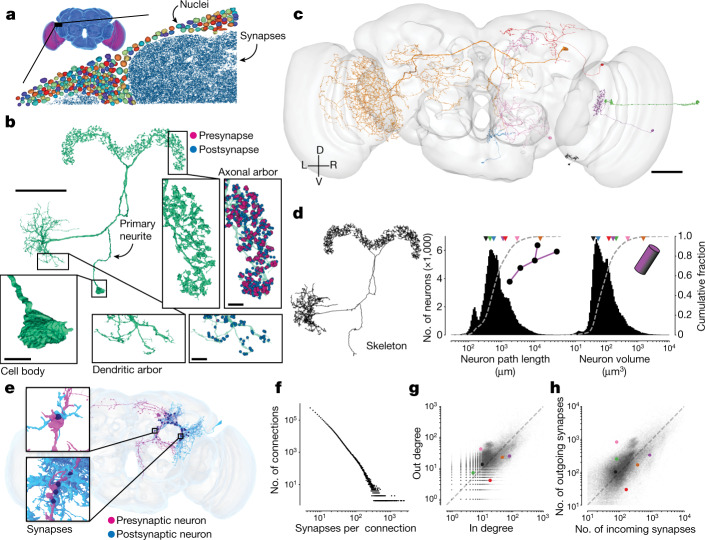
- The reconstructed whole brain contains 139,255 neurons and about 54.5 million synapses between these neurons; elsewhere the abstract describes it as 5 × 10^7 chemical synapses.
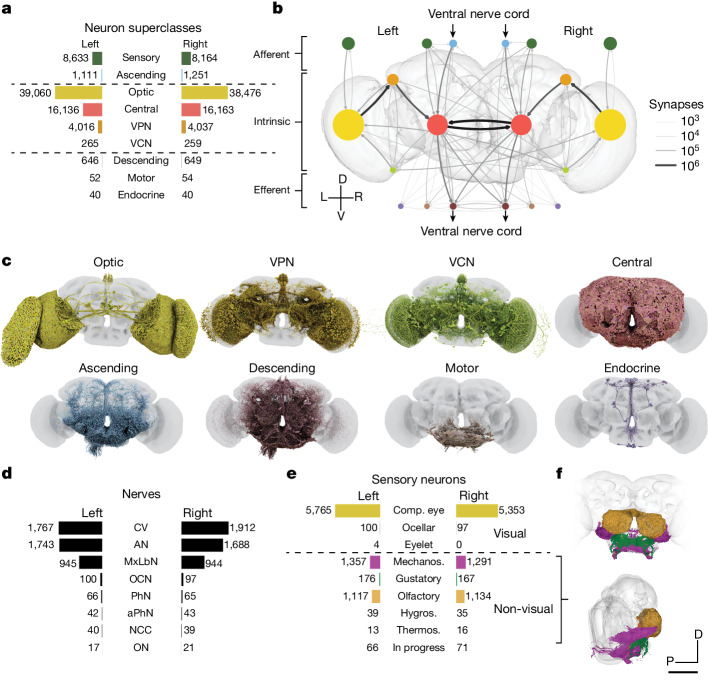
- Of the 139,255 proofread neurons, 118,501 are intrinsic to the brain, which the paper states is 85% of brain neurons.
- Using a connection threshold of >4 synapses (reported as five synapses for most analyses), the authors observed 2,700,513 strong connections between 134,181 identified neurons.
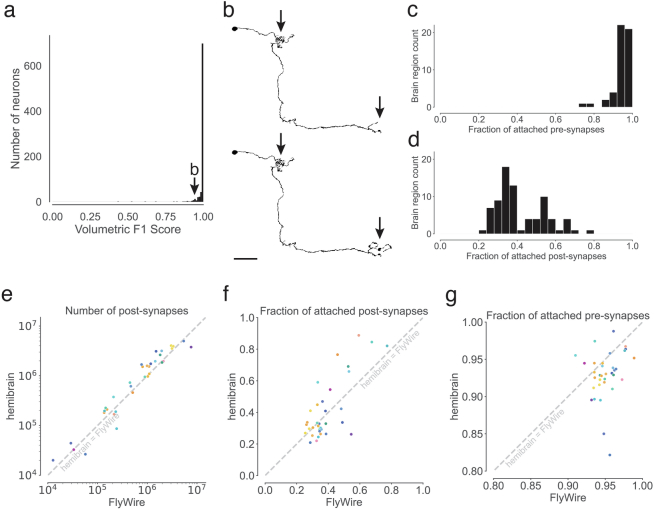
- Quality review of 826 neurons yielded an average reconstruction F1 score of 99.2% by volume; attachment rates were approximately 93.7% for presynapses and 44.7% for postsynapses.
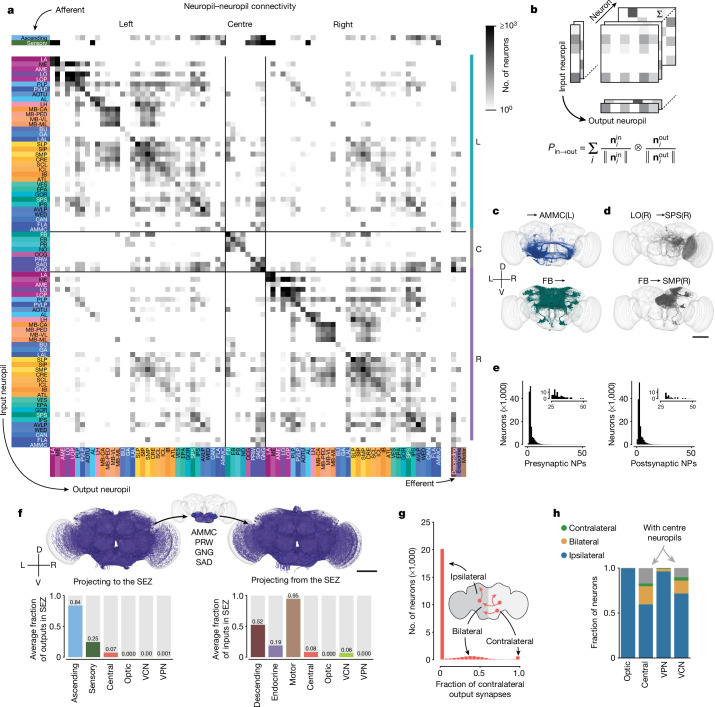
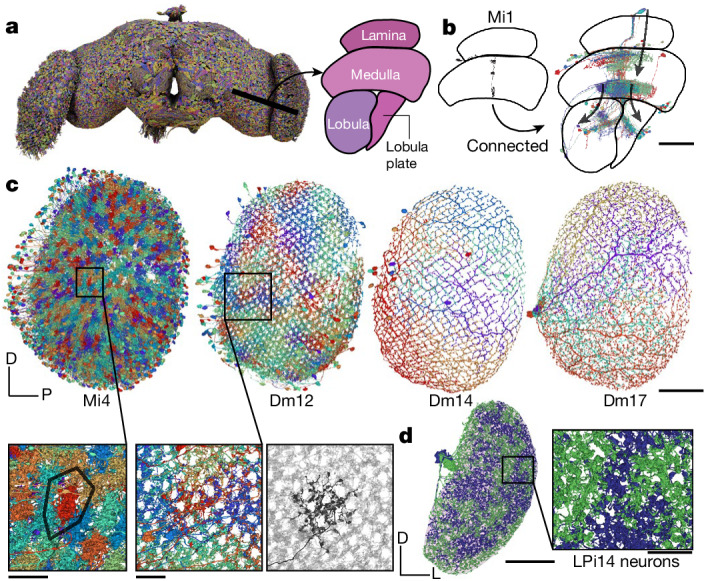
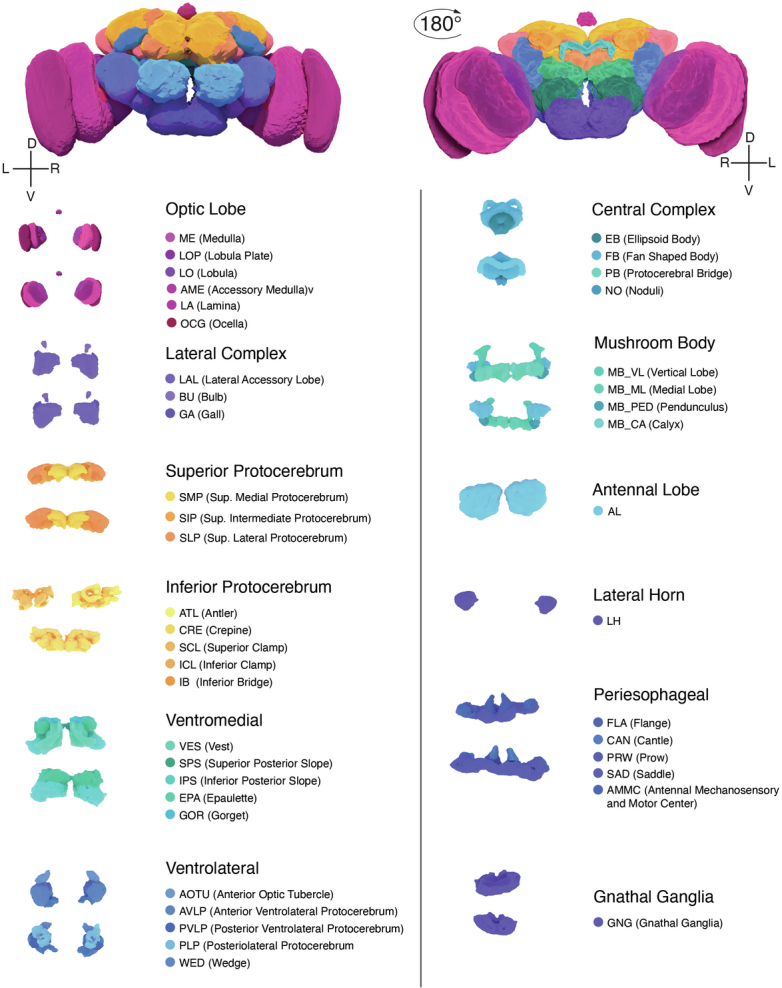
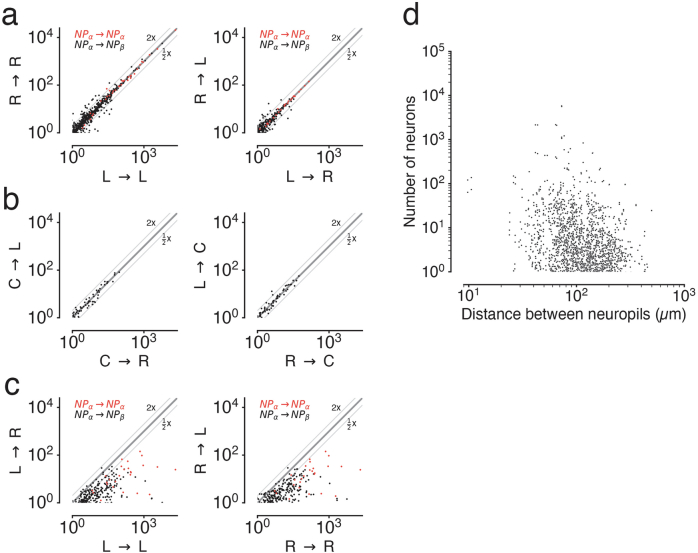
- The projectome analysis found that most projections are ipsilateral or within the same side of the brain, and that the SEZ accounts for 17.8% of central brain neuropil volume (0.0018 mm3 out of 0.0103 mm3).
## Methods
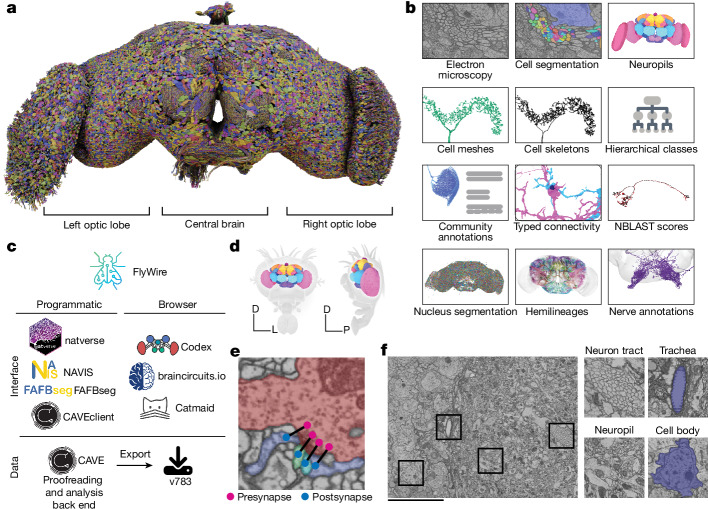
- The connectome was built from a previously acquired serial section transmission electron microscopy dataset of an adult female fly brain, which the authors realigned and automatically segmented, then proofread in FlyWire.
- Synapses were imported from prior automated prediction work, filtered, and mapped onto proofread segments; the paper states that for most analyses it used a >4 / 5-synapse threshold for defining connections.
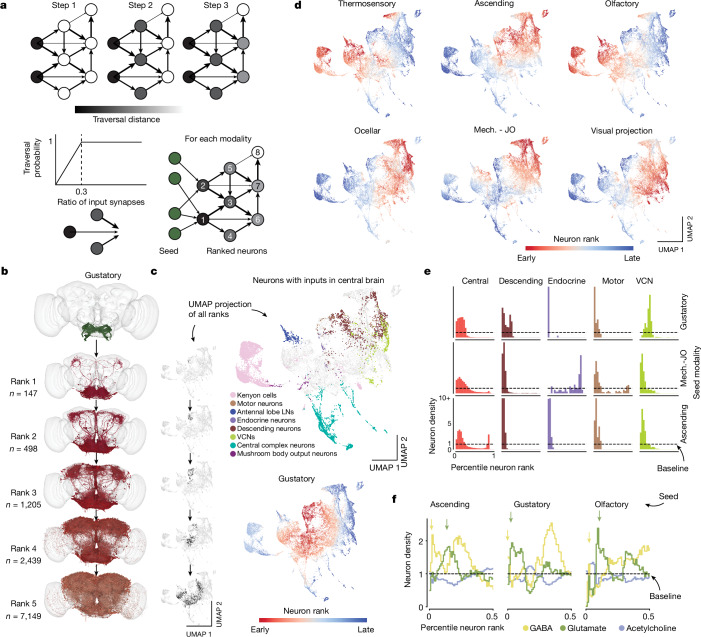
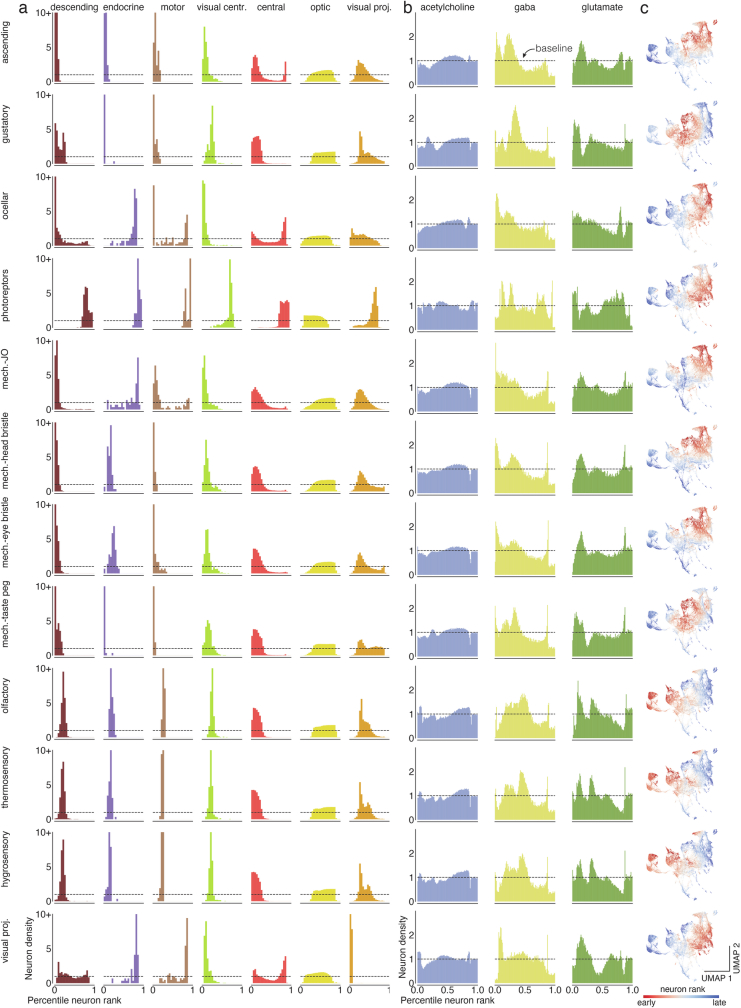
- The authors analyzed the dataset by constructing a projectome over 78 neuropils, and by using a probabilistic information-flow model seeded with afferent neuron classes to rank downstream neurons.
## Limitations
- The paper states that synapse counts underrepresent the actual number of synapses, and that some low-synapse connections remain undetected.
- It states that improved completeness will require better image acquisition, image alignment, and automated reconstruction, because further proofreading cannot substantially improve twig attachment rates.
- The reconstruction has an explicitly noted left-sided artifact: the left lamina was partially severed from the medulla, reducing reconstruction accuracy for some lamina neurons on one side.
- The text also makes clear that the connectome includes only chemical synapses, so electrical synapses are not captured; this is stated in the paper.
Model-written summary. Check it against the paper before relying on it.
Integrity signals
Registry
Cites
Statistics
Figures
Verification
Claims the paper makes
63 Valid · 6 Not valid · 16 Not checked · 212 Own results and interpretations
Some cited sources support this claim and some don’t — read each source’s verdict below.
In the paper
“Intrinsic neurons of the brain make up three-quarters of the adult fly nervous system54–56 and amount to 85% of brain neurons.”
§ Neuronal wiring diagram of an adult brain > Intrinsic neurons of the brain
What the sources say
- Disputedcites [54] Phelps, J. S. et al. Reconstruction of motor control circuits in adult Drosophila using automated transmission electron microscopy. Cell 184, 759–774.e18 (2021). 33400916 PMC8312698 sourceExperimental — accuracy not yet measured
The Discussion section, “A synapse-resolution adult Drosophila VNC dataset” (page unavailable), says the VNC contains about a third of the neurons in the adult central nervous system. That leaves about two-thirds for the brain, including its intrinsic neurons; the paper does not support their making up three-quarters of the larger, whole nervous system. (LLM, conf=0.82)
Checked by a reasoning model — may be wrong.
- Not matchedcites [55] Takemura, S.-Y. et al. A connectome of the male Drosophila ventral nerve cord. eLife13, RP97769 (2024).
Its entry has no title and year that we can search by.
- Partly supportedcites [56] Marin, E. C. et al. Systematic annotation of a complete adult male Drosophila nerve cord connectome reveals principles of functional organisation. Preprint at bioRxiv10.1101/2023.06.05.543407 (2023). sourceExperimental — accuracy not yet measured
The Results (p. 4) report at least 115,000 neurons in the full adult brain and 15,763 in the ventral nerve cord, supporting the broad point that brain neurons predominate. But the paper gives an intrinsic-to-sensory ratio only for the central brain, not a count of intrinsic neurons across the whole brain or a three-quarters estimate for the entire nervous system. (LLM, conf=0.78)
plain- Asserted: passes — The authors put it forward as true.
- Checkable: passes — It can be checked against evidence.
- Load-bearing: unclear — It is unclear whether the paper’s conclusions depend on it.
- Based: passes — The paper gives a reason why it holds.
- Disputed
The cited sources support only part of this claim — read each source’s verdict below.
In the paper
“In addition, principal neurons of the mushroom body, a brain structure required for olfactory learning and memory, show high variability12.”
§ Neuronal wiring diagram of an adult brain > Main
What the sources say
- Partly supportedcites [12] Schlegel, P. et al. Whole-brain annotation and multi-connectome cell typing of Drosophila. Nature10.1038/s41586-024-07686-5 (2024). PMC11446831 39358521 sourceExperimental — accuracy not yet measured
The 'Variability in the mushroom body' section reports that Kenyon-cell counts differ by 30% between the FlyWire and hemibrain datasets, with particularly large differences in some Kenyon-cell types. It also says other Kenyon-cell types have similar counts, so the evidence supports substantial variability in a subset of mushroom-body neurons, not a blanket claim about its principal neurons. (LLM, conf=0.83)
plain- Asserted: passes — The authors put it forward as true.
- Checkable: passes — It can be checked against evidence.
- Load-bearing: unclear — It is unclear whether the paper’s conclusions depend on it.
- Based: passes — The paper gives a reason why it holds.
- Partly supported
The sources with a verdict support this claim; the rest weren’t checked yet, have no full text we could read, or their verdicts aren’t rated yet.
In the paper
“VPNs target specific neuropils (for example, anterior optic tubercle (AOTU), posterior lateral protocerebrum (PLP) and posterior ventrolateral protocerebrum (PVLP)) or optic glomeruli60,61 in the central brain.”
§ Neuronal wiring diagram of an adult brain > Optic lobes and central brain
What the sources say
- Supportedcites [60] Wu, M. et al. Visual projection neurons in the Drosophila lobula link feature detection to distinct behavioral programs. eLife 5, e21022 (2016). 28029094 PMC5293491 source
The Results section, “LC neurons are the main visual inputs to optic glomeruli,” reports LC neuron targets in the PVLP, PLP and AOTu and identifies optic glomeruli as target regions. The Introduction describes these as cell-type-specific target regions in the central brain. Page numbers are not provided in our copy. (LLM, conf=0.93)
- Not checked — no full text of the sourcecites [61] Otsuna, H. & Ito, K. Systematic analysis of the visual projection neurons of Drosophila melanogaster. I. Lobula-specific pathways. J. Comp. Neurol. 497, 928–958 (2006). 16802334 source
plainstates a cause- Asserted: passes — The authors put it forward as true.
- Checkable: passes — It can be checked against evidence.
- Load-bearing: unclear — It is unclear whether the paper’s conclusions depend on it.
- Based: passes — The paper gives a reason why it holds.
- Supported
The cited sources support only part of this claim — read each source’s verdict below.
In the paper
“Our whole-brain reconstruction reveals many other aspects of VPN connectivity, such as their inputs in the medulla, lobula and lobula plate62.”
§ Neuronal wiring diagram of an adult brain > Optic lobes and central brain
What the sources say
- Partly supportedcites [62] Zhao, A. et al. A comprehensive neuroanatomical survey of the Drosophila lobula plate tangential neurons with predictions for their optic flow sensitivity. Preprint at bioRxiv10.1101/2023.10.16.562634 (2023). sourceExperimental — accuracy not yet measured
The Results section, “Brain-spanning network connectivity between LPTs” (page unavailable), describes synaptic connections involving lobula plate tangential neurons in the optic lobe and central brain. It supports lobula plate connectivity for this class of visual projection neurons, but does not establish the cited claim about VPN inputs in all three regions—the medulla, lobula, and lobula plate. The citing authors’ statement about what their own reconstruction reveals is not a finding attributed to this source. (LLM, conf=0.83)
plain- Asserted: passes — The authors put it forward as true.
- Checkable: passes — It can be checked against evidence.
- Load-bearing: unclear — It is unclear whether the paper’s conclusions depend on it.
- Based: passes — The paper gives a reason why it holds.
- Partly supported
The cited sources support only part of this claim — read each source’s verdict below.
In the paper
“Although afferents are truncated in our reconstruction, Schlegel et al.12 and other community members35,57 were able to determine the sensory organs corresponding to the 5,375 non-visual sensory neurons (Fig. 2e,f) on the basis of morphology and nerve assignments.”
§ Neuronal wiring diagram of an adult brain > Afferent and efferent neurons
What the sources say
- Partly supportedcites Schlegel et al.12 Schlegel, P. et al. Whole-brain annotation and multi-connectome cell typing of Drosophila. Nature10.1038/s41586-024-07686-5 (2024). PMC11446831 39358521 sourceExperimental — accuracy not yet measured
The Methods, ‘Cell typing’ section describes identifying several sensory-neuron groups using morphology, connectivity, and earlier identifications, which supports part of the attribution. The passages do not establish that sensory organs were determined for all 5,375 non-visual sensory neurons, or that nerve assignments were the basis for doing so. (LLM, conf=0.82)
- Partly supportedcites [35] Eichler, K. et al. Somatotopic organization among parallel sensory pathways that promote a grooming sequence in Drosophila. eLife12, RP87602 (2024). PMC11026096 38634460 sourceExperimental — accuracy not yet measured
Our copy does show Eichler et al. assigning reconstructed EM sensory neurons to their peripheral organs using exactly the criteria named: 'Manual categorization of the EM reconstructed sensory neurons revealed that they consist of BMNs, JONs, TPMNs, and GRNs' and matching 'based on NBLAST similarity scores… in conjunction with manual anatomical inspection of light microscopy images to assign the BMNs to specific bristle populations' (Matching EM reconstructed BMN projections…, p. 37), with nerve-based classification and cross-checks of neuron vs. bristle numbers (pp. 11, 13). However, the magnitude attributed is absent: the paper reports 705 BMNs plus 25 sensory neurons that could NOT be identified, together with JONs/TPMNs/GRNs from the head nerves — nowhere in our copy is a figure of 5,375 non-visual sensory neurons, and the authors note FAFB 'consists of a brain that was dissected from the head capsule, making it impossible to reconstruct BMNs all the way from their bristles' (p. 11). The 5,375-neuron tally and its assignment therefore belong to the other cited work (Schlegel et al.), not to this source; only the morphology-and-nerve-assignment approach for head bristle afferents is supported here. (LLM, conf=0.72)
- Partly supportedcites [57] Kim, H. et al. Wiring patterns from auditory sensory neurons to the escape and song-relay pathways in fruit flies. J. Comp. Neurol. 528, 2068–2098 (2020). 32012264 PMC7676477 sourceExperimental — accuracy not yet measured
The Methods section (“Tracing of JO neuron axons”; page unavailable) identifies Johnston’s organ sensory neurons using their trajectories and anatomical location, and describes their projections through the antennal nerve. The paper traces 45 neurons in each of two Johnston’s organ subgroups; it does not establish that sensory organs were determined for all 5,375 non-visual sensory neurons. (LLM, conf=0.86)
plainstates a cause- Asserted: passes — The authors put it forward as true.
- Checkable: passes — It can be checked against evidence.
- Load-bearing: unclear — It is unclear whether the paper’s conclusions depend on it.
- Based: passes — The paper gives a reason why it holds.
- Partly supported
161 more claims · 29 with their cited sources checked
Create a free account to see all 297 claims and to verify the 3 references still open.
- It may state two separate claims as one. 87
- Probably not a substantial claim. 56
Claims other papers make about this one
Each is checked against this paper’s own text: does it say what the citing paper says it does?
The cited source doesn’t support the claim as written.
In the citing paper
“This threshold is also consistent across our companion papers on the whole-brain Drosophila connectome3,5.”
From Network statistics of the whole-brain connectome of Drosophila (2024) · cites this paper as [3]
Checked by a reasoning model — may be wrong.
Experimental — accuracy not yet measuredThe cited source doesn’t support the claim as written.
In the citing paper
“It has only ∼ 200,000 neurons in its brain 24 (compared with ∼ 70 million in the mouse brain 25 and ∼ 80 billion in the human brain 26 ).”
From NeuroMechFly v2: simulating embodied sensorimotor control in adult Drosophila (2024) · cites this paper as [24]
Checked by a reasoning model — may be wrong.
Experimental — accuracy not yet measuredThe source backs part of the claim, not all of it — or backs it for a different population, condition or comparison.
In the citing paper
“This gives us a graph with 127,978 neurons and 2,613,129 connections3 (Fig. 1a and Methods).”
From Network statistics of the whole-brain connectome of Drosophila (2024) · cites this paper as [3]
Experimental — accuracy not yet measuredThe source backs part of the claim, not all of it — or backs it for a different population, condition or comparison.
In the citing paper
“The average connection consists of 12.6 synapses3, and the connection probability is 0.000161.”
From Network statistics of the whole-brain connectome of Drosophila (2024) · cites this paper as [3]
Experimental — accuracy not yet measuredThe source backs part of the claim, not all of it — or backs it for a different population, condition or comparison.
In the citing paper
“Most neurons are restricted to a single hemisphere—11% have inputs in both hemispheres and 11% have outputs in both hemispheres3 (Extended Data Fig. 4c).”
From Network statistics of the whole-brain connectome of Drosophila (2024) · cites this paper as [3]
Experimental — accuracy not yet measured
17 more claims about this paper
Create a free account to see every claim other papers make about this one.
Citations
Cites
UMAP: Uniform Manifold Approximation and Projection for Dimension Reduction
McInnes, L., Healy, J., & Melville, J. (2018) · arXiv · doi:10.48550/arxiv.1802.03426 · Cited by 7,101
The structure of the nervous system of the nematode Caenorhabditis elegans
White, J. G., Southgate, E., Thomson, J. N., & Brenner, S. (1986) · Philosophical Transactions of the Royal Society of London. B, Biological Sciences · doi:10.1098/rstb.1986.0056 · Cited by 5,589
The Human Connectome: A Structural Description of the Human Brain
Sporns, O., Tononi, G., & Kötter, R. (2005) · PLoS Computational Biology · doi:10.1371/journal.pcbi.0010042 · Cited by 3,260 · cited 3×
“Such maps have been called projectomes 79 or mesoscale connectomes 14 .”
BackgroundResultMesulam, M. (1998) · Brain · doi:10.1093/brain/121.6.1013 · Cited by 3,072
A mesoscale connectome of the mouse brain
Oh, S. W., Harris, J. A., Ng, L., Winslow, B., Cain, N., Mihalas, S., Wang, Q., Lau, C., Kuan, L., Henry, A. M., et al. (2014) · Nature · doi:10.1038/nature13186 · Cited by 2,612
Serial Block-Face Scanning Electron Microscopy to Reconstruct Three-Dimensional Tissue Nanostructure
Denk, W., & Horstmann, H. (2004) · PLoS Biology · doi:10.1371/journal.pbio.0020329 · Cited by 1,644 · cited 1×
“The hemibrain 1 was reconstructed from 8 × 8 × 8 nm 3 images acquired by focused ion beam scanning electron microscopy 102–104 (FIB-SEM), a form of block face electron microscopy 105,106 .”
MethodThe Human Genome Project: Lessons from Large-Scale Biology
Collins, F. S., Morgan, M., & Patrinos, A. (2003) · Science · doi:10.1126/science.1084564 · Cited by 1,284 · cited 1×
“The 1996 Bermuda Principles mandated daily release of Human Genome Project sequences into the public domain 117 .”
BackgroundRefinement of Tools for Targeted Gene Expression in Drosophila
Pfeiffer, B. D., Ngo, T.-T. B., Hibbard, K. L., Murphy, C., Jenett, A., Truman, J. W., & Rubin, G. M. (2010) · Genetics · doi:10.1534/genetics.110.119917 · Cited by 1,153
A connectome and analysis of the adult Drosophila central brain
Scheffer, L. K., Xu, C. S., Januszewski, M., Lu, Z., Takemura, S.-Y., Hayworth, K. J., Huang, G. B., Shinomiya, K., Maitlin-Shepard, J., Berg, S., et al. (2020) · eLife · doi:10.7554/elife.57443 · Cited by 1,128
Self-citationA Complete Electron Microscopy Volume of the Brain of Adult Drosophila melanogaster
Zheng, Z., Lauritzen, J. S., Perlman, E., Robinson, C. G., Nichols, M., Milkie, D., Torrens, O., Price, J., Fisher, C. B., Sharifi, N., et al. (2018) · Cell · doi:10.1016/j.cell.2018.06.019 · Cited by 1,050
Self-citation
Research works printed but not linked: 2
- Cheong, H. S. J. et al. Transforming descending input into behavior: the organization of premotor circuits in the Drosophila male adult nerve cord connectome. Preprint at bioRxiv10.1101/2023.06.07.543976 (2023). · doi:10.1101/2023.06.07.543976 · Paper page
- Braitenberg, V. Vehicles: Experiments in Synthetic Psychology (MIT Press, 1984).
Cited by
Whole-brain annotation and multi-connectome cell typing of Drosophila
Schlegel, P., Yin, Y., Bates, A. S., Dorkenwald, S., Eichler, K., Brooks, P., Han, D. S., Gkantia, M., dos Santos, M., Munnelly, E. J., et al. (2024) · Nature · doi:10.1038/s41586-024-07686-5 · Cited by 413
“The FlyWire brain connectome reported in our companion paper 1 is by some margin the largest and most complex yet obtained.”
BackgroundInfluentialEckstein, N., Bates, A. S., Champion, A., Du, M., Yin, Y., Schlegel, P., Lu, A. K.-Y., Rymer, T., Finley-May, S., Paterson, T., et al. (2024) · Cell · doi:10.1016/j.cell.2024.03.016 · Cited by 277
Self-citationFunctional connectomics spanning multiple areas of mouse visual cortex
The MICrONS Consortium, Bae, J. A., Baptiste, M., Baptiste, M. R., Bishop, C. A., Bodor, A. L., Brittain, D., Brooks, V., Buchanan, J., Bumbarger, D. J., et al. (2025) · Nature · doi:10.1038/s41586-025-08790-w · Cited by 190
Self-citationNetwork statistics of the whole-brain connectome of Drosophila
Lin, A., Yang, R., Dorkenwald, S., Matsliah, A., Sterling, A. R., Schlegel, P., Yu, S.-C., McKellar, C. E., Costa, M., Eichler, K., et al. (2024) · Nature · doi:10.1038/s41586-024-07968-y · Cited by 147
“…neurons, we filtered the intrinsic rich club neurons ( d tot > 37 ) for those which had an out-degree was at least 5 times higher than their in-degree: Similarly, we identified integrator neurons by filtering the intrinsic rich club neurons for those which had an in-degree was at least 5…”
InfluentialSelf-citationNetwork Statistics of the Whole-Brain Connectome of Drosophila
Lin, A., Yang, R., Dorkenwald, S., Matsliah, A., Sterling, A. R., Schlegel, P., Yu, S.-C., McKellar, C. E., Costa, M., Eichler, K., et al. (2023) · doi:10.1101/2023.07.29.551086 · Cited by 147
Self-citationWhole-brain annotation and multi-connectome cell typing quantifies circuit stereotypy in Drosophila
Schlegel, P., Yin, Y., Bates, A. S., Dorkenwald, S., Eichler, K., Brooks, P., Han, D. S., Gkantia, M., dos Santos, M., Munnelly, E. J., et al. (2023) · doi:10.1101/2023.06.27.546055 · Cited by 102
Self-citationSynaptic connectome of the Drosophila circadian clock
Reinhard, N., Fukuda, A., Manoli, G., Derksen, E., Saito, A., Möller, G., Sekiguchi, M., Rieger, D., Helfrich-Förster, C., Yoshii, T., et al. (2023) · doi:10.1101/2023.09.11.557222 · Cited by 110
A Drosophila computational brain model reveals sensorimotor processing
Shiu, P. K., Sterne, G. R., Spiller, N., Franconville, R., Sandoval, A., Zhou, J., Simha, N., Kang, C. H., Yu, S., Kim, J. S., et al. (2024) · Nature · doi:10.1038/s41586-024-07763-9 · Cited by 97
Self-citationSynaptic connectome of the Drosophila circadian clock
Reinhard, N., Fukuda, A., Manoli, G., Derksen, E., Saito, A., Möller, G., Sekiguchi, M., Rieger, D., Helfrich-Förster, C., Yoshii, T., et al. (2024) · Nature Communications · doi:10.1038/s41467-024-54694-0 · Cited by 103
“Brain mesh is from Dorkenwald et al., 2024. clock neurons using the normal threshold (Fig.”
InfluentialNeuronal parts list and wiring diagram for a visual system
Matsliah, A., Yu, S.-C., Kruk, K., Bland, D., Burke, A. T., Gager, J., Hebditch, J., Silverman, B., Willie, K. P., Willie, R., et al. (2024) · Nature · doi:10.1038/s41586-024-07981-1 · Cited by 85
“The brain of a single Drosophila adult female was reconstructed by the FlyWire Consortium 24,31 .”
BackgroundMethodInfluentialSelf-citationConnectome-driven neural inventory of a complete visual system
Nern, A., Loesche, F., Takemura, S.-Y., Burnett, L. E., Dreher, M., Gruntman, E., Hoeller, J., Huang, G. B., Januszewski, M., Klapoetke, N. C., et al. (2025) · Nature · doi:10.1038/s41586-025-08746-0 · Cited by 93
Self-citationNeural circuit mechanisms for steering control in walking Drosophila
Rayshubskiy, A., Holtz, S. L., Bates, A. S., Vanderbeck, Q. X., Capdevila, L. S., Rockwell, V., & Wilson, R. I. (2020) · doi:10.1101/2020.04.04.024703 · Cited by 64
Self-citationNested neural circuits generate distinct acoustic signals during Drosophila courtship
Lillvis, J. L., Wang, K., Shiozaki, H. M., Xu, M., Stern, D. L., & Dickson, B. J. (2024) · Current Biology · doi:10.1016/j.cub.2024.01.015 · Cited by 59
Self-citationMapping model units to visual neurons reveals population code for social behaviour
Cowley, B. R., Calhoun, A. J., Rangarajan, N., Ireland, E., Turner, M. H., Pillow, J. W., & Murthy, M. (2024) · Nature · doi:10.1038/s41586-024-07451-8 · Cited by 55
Self-citationFine-grained descending control of steering in walking Drosophila
Yang, H. H., Brezovec, L. E., Serratosa Capdevila, L., Vanderbeck, Q. X., Adachi, A., Mann, R. S., & Wilson, R. I. (2023) · doi:10.1101/2023.10.15.562426 · Cited by 55
Fine-grained descending control of steering in walking Drosophila
Yang, H. H., Brezovec, B. E., Serratosa Capdevila, L., Vanderbeck, Q. X., Adachi, A., Mann, R. S., & Wilson, R. I. (2024) · Cell · doi:10.1016/j.cell.2024.08.033 · Cited by 55
Light-microscopy-based connectomic reconstruction of mammalian brain tissue
Tavakoli, M. R., Lyudchik, J., Januszewski, M., Vistunou, V., Dueñas, N. A., Vorlaufer, J., Sommer, C., Kreuzinger, C., Oliveira, B., Cenameri, A., et al. (2025) · Nature · doi:10.1038/s41586-025-08985-1 · Cited by 114
Neural circuit mechanisms underlying context-specific halting in Drosophila
Sapkal, N., Mancini, N., Kumar, D. S., Spiller, N., Murakami, K., Vitelli, G., Bargeron, B., Maier, K., Eichler, K., Jefferis, G. S. X. E., et al. (2024) · Nature · doi:10.1038/s41586-024-07854-7 · Cited by 54
“Among the SEZ lines, we focused on three lines (SS40909, SS31326, SS31328) in which we could unambiguously identify the neurons as FG and BB both in the light microscopy 24 as well as electron microscopy 8,28,29,61 datasets.”
InfluentialSelf-citationNeural circuit mechanisms underlying context-specific halting in Drosophila
Sapkal, N., Mancini, N., Kumar, D. S., Spiller, N., Murakami, K., Vitelli, G., Bargeron, B., Maier, K., Eichler, K., Jefferis, G. S. X. E., et al. (2023) · doi:10.1101/2023.09.25.559438 · Cited by 54
Self-citationCAVE: Connectome Annotation Versioning Engine
Dorkenwald, S., Schneider-Mizell, C. M., Brittain, D., Halageri, A., Jordan, C., Kemnitz, N., Castro, M. A., Silversmith, W., Maitin-Shephard, J., Troidl, J., et al. (2025) · Nature Methods · doi:10.1038/s41592-024-02426-z · Cited by 78
“Proofreading an automated segmentation is 10–100× faster than purely manual reconstruction 16,25,38 , but proofreading of a large dataset may still go on for years.”
InfluentialSelf-citationMarin, E. C., Morris, B. J., Stürner, T., Champion, A. S., Krzeminski, D., Badalamente, G., Gkantia, M., Dunne, C. R., Eichler, K., Takemura, S.-Y., et al. (2024) · doi:10.7554/elife.97766.1 · Cited by 44
Self-citationComparative connectomics of Drosophila descending and ascending neurons
Stürner, T., Brooks, P., Serratosa Capdevila, L., Morris, B. J., Javier, A., Fang, S., Gkantia, M., Cachero, S., Beckett, I. R., Marin, E. C., et al. (2025) · Nature · doi:10.1038/s41586-025-08925-z · Cited by 43
Self-citationConnectome-driven neural inventory of a complete visual system
Nern, A., Loesche, F., Takemura, S.-Y., Burnett, L. E., Dreher, M., Gruntman, E., Hoeller, J., Huang, G. B., Januszewski, M., Klapoetke, N. C., et al. (2024) · doi:10.1101/2024.04.16.589741 · Cited by 98
Self-citationCAVE: Connectome Annotation Versioning Engine
Dorkenwald, S., Schneider-Mizell, C. M., Brittain, D., Halageri, A., Jordan, C., Kemnitz, N., Castro, M. A., Silversmith, W., Maitin-Shephard, J., Troidl, J., et al. (2023) · doi:10.1101/2023.07.26.550598 · Cited by 79
Self-citationThe fly connectome reveals a path to the effectome
Pospisil, D. A., Aragon, M. J., Dorkenwald, S., Matsliah, A., Sterling, A. R., Schlegel, P., Yu, S.-C., McKellar, C. E., Costa, M., Eichler, K., et al. (2024) · Nature · doi:10.1038/s41586-024-07982-0 · Cited by 36
“Here we show that the Flywire connectome 1–3 provides a feasible path to surmounting both barriers in the fly.”
Self-citationWhole-body physics simulation of fruit fly locomotion
Vaxenburg, R., Siwanowicz, I., Merel, J., Robie, A. A., Morrow, C. M., Novati, G., Stefanidi, Z., Both, G., Card, G. M., Reiser, M. B., et al. (2025) · Nature · doi:10.1038/s41586-025-09029-4 · Cited by 111
Descending control of motor sequences in Drosophila
Simpson, J. H. (2024) · Current Opinion in Neurobiology · doi:10.1016/j.conb.2023.102822 · Cited by 33
Marin, E. C., Morris, B. J., Stürner, T., Champion, A. S., Krzeminski, D., Badalamente, G., Gkantia, M., Dunne, C. R., Eichler, K., Takemura, S.-Y., et al. (2023) · doi:10.1101/2023.06.05.543407 · Cited by 33
Self-citationPredicting visual function by interpreting a neuronal wiring diagram
Seung, H. S. (2024) · Nature · doi:10.1038/s41586-024-07953-5 · Cited by 50
Self-citationMolecular and cellular mechanisms of teneurin signaling in synaptic partner matching
Xu, C., Li, Z., Lyu, C., Hu, Y., McLaughlin, C. N., Wong, K. K. L., Xie, Q., Luginbuhl, D. J., Li, H., Udeshi, N. D., et al. (2024) · Cell · doi:10.1016/j.cell.2024.06.022 · Cited by 33
Connectomic reconstruction predicts visual features used for navigation
Garner, D., Kind, E., Lai, J. Y. H., Nern, A., Zhao, A., Houghton, L., Sancer, G., Wolff, T., Rubin, G. M., Wernet, M. F., et al. (2024) · Nature · doi:10.1038/s41586-024-07967-z · Cited by 56
“We included results from both hemi-spheres in most analyses, but, where indicated, some detailed analyses were restricted to the right hemisphere because the left hemisphere had an incomplete lamina and (minor) EM image alignment issues 17,29,44 .”
NeuroMechFly v2: simulating embodied sensorimotor control in adult Drosophila
Wang-Chen, S., Stimpfling, V. A., Lam, T. K. C., Özdil, P. G., Genoud, L., Hurtak, F., & Ramdya, P. (2024) · Nature Methods · doi:10.1038/s41592-024-02497-y · Cited by 43
“Third, to facilitate implementing custom environmental features within the simulation, we expanded the interface for the fly model’s arena. yet it has been completely mapped in connectomes (that is, wiring diagrams) of the brain 24 and VNC 25,26 .”
Social state alters vision using three circuit mechanisms in Drosophila
Schretter, C. E., Hindmarsh Sten, T., Klapoetke, N., Shao, M., Nern, A., Dreher, M., Bushey, D., Robie, A. A., Taylor, A. L., Branson, K., et al. (2025) · Nature · doi:10.1038/s41586-024-08255-6 · Cited by 29
“As the hemibrain did not include the entire lobula, we also performed analyses in the recently completed and fully annotated male optic lobe connectome 53 (neuprint release: optic-lobe: v.1.0) and the Flywire 54 (v.783) analysis of the FAFB datasets 75 .”
InfluentialDistributed control circuits across a brain-and-cord connectome
Bates, A. S., Phelps, J. S., Kim, M., Yang, H. H., Matsliah, A., Ajabi, Z., Perlman, E., Delgado, K. M., Osman, M. A. M., Salmon, C. K., et al. (2026) · Nature · doi:10.1038/s41586-026-10735-w · Cited by 100
Self-citationPresynaptic inhibition selectively suppresses leg proprioception in behaving DrosophilaPreprint
Dallmann, C. J., Luo, Y., Agrawal, S., et al. (2023) · bioRxiv · doi:10.1101/2023.10.20.563322 · Cited by 15
Neural circuit mechanisms for steering control in walking Drosophila
Rayshubskiy, A., Holtz, S. L., Bates, A. S., Vanderbeck, Q. X., Serratosa Capdevila, L., Rockwell, V., & Wilson, R. (2025) · eLife · doi:10.7554/elife.102230 · Cited by 27
Self-citationOrganization of an ascending circuit that conveys flight motor state in Drosophila
Cheong, H. S. J., Boone, K. N., Bennett, M. M., Salman, F., Ralston, J. D., Hatch, K., Allen, R. F., Phelps, A. M., Cook, A. P., Phelps, J. S., et al. (2024) · Current Biology · doi:10.1016/j.cub.2024.01.071 · Cited by 26
Eichler, K., Hampel, S., Alejandro-García, A., Calle-Schuler, S. A., Santana-Cruz, A., Kmecova, L., Blagburn, J. M., Hoopfer, E. D., & Seeds, A. M. (2024) · eLife · doi:10.7554/elife.87602.3 · Cited by 5
Self-citationStürner, T., Brooks, P., Capdevila, L. S., Morris, B. J., Javier, A., Fang, S., Gkantia, M., Cachero, S., Beckett, I. R., Champion, A. S., et al. (2024) · bioRxiv (Cold Spring Harbor Laboratory) · doi:10.1101/2024.06.04.596633 · Cited by 24
Self-citationAn integrated anatomical, functional and evolutionary view of the Drosophila olfactory system
Benton, R., Mermet, J., Jang, A., Endo, K., Cruchet, S., & Menuz, K. (2025) · EMBO Reports · doi:10.1038/s44319-025-00476-8 · Cited by 37
Pratt, B. G., Lee, S.-Y. J., Chou, G. M., & Tuthill, J. C. (2024) · Current Biology · doi:10.1016/j.cub.2024.08.006 · Cited by 35
Perisomatic ultrastructure efficiently classifies cells in mouse cortex
Elabbady, L., Seshamani, S., Mu, S., Mahalingam, G., Schneider-Mizell, C. M., Bodor, Á. L., Bae, J. A., Brittain, D., Buchanan, J., Bumbarger, D. J., et al. (2025) · Nature · doi:10.1038/s41586-024-07765-7 · Cited by 45
Self-citationMutual coupling of neurons in the circadian master clock: What we can learn from fruit flies
Helfrich‐Förster, C., & Reinhard, N. (2025) · Neurobiology of Sleep and Circadian Rhythms · doi:10.1016/j.nbscr.2025.100112 · Cited by 22
Toward Principles of Brain Network Organization and Function
Kulkarni, S., & Bassett, D. S. (2025) · Annual Review of Biophysics · doi:10.1146/annurev-biophys-030722-110624 · Cited by 37
Molecular gradients shape synaptic specificity of a visuomotor transformation
Dombrovski, M., Zang, Y., Frighetto, G., Vaccari, A., Jang, H., Mirshahidi, P., Xie, F., Sanfilippo, P., Hina, B. W., Rehan, A., et al. (2025) · Nature · doi:10.1038/s41586-025-09037-4 · Cited by 24
Synaptic promiscuity in brain development
Wolterhoff, N., & Hiesinger, P. R. (2024) · Current Biology · doi:10.1016/j.cub.2023.12.037 · Cited by 20
Divergent neural circuits for proprioceptive and exteroceptive sensing of the Drosophila leg
Lee, S.-Y. J., Dallmann, C. J., Cook, A., Tuthill, J. C., & Agrawal, S. (2025) · Nature Communications · doi:10.1038/s41467-025-59302-3 · Cited by 26
“Here, we take advantage of two separate connectome datasets that together span the CNS of a fruit fl y, the Female Adult Nerve Cord (FANC) 8,14 and the FullAdultFly Brain (FAFB),which was reconstructed as part of FlyWire 7,15 .”
InfluentialCommunity modularity structure promotes the evolution of phase clusters and chimeralike states
Yu, D., Li, X., Wang, X., Huang, W., Hu, X., & Jia, Y. (2025) · Physical review. E · doi:10.1103/physreve.111.034311 · Cited by 20
A brief history of insect neuropeptide and peptide hormone research
Nässel, D. R. (2024) · Cell and Tissue Research · doi:10.1007/s00441-024-03936-0 · Cited by 29
“…variants thereof (Guo et al. 2019; Shearin et al. 2018; Talay et al. 2017; Timalsina et al. 2024), with chemoconnectomics tools (Deng et al. 2019), and also by electron microscopy of serial sections to assemble a complete synaptic connectome of the Drosophila brain [see (Dorkenwald et al. 2024)].”
Feng (2024) · doi:10.1101/2024.06.27.601106 · Cited by 18
Heterogeneity of synaptic connectivity in the fly visual system
Cornean, J., Molina-Obando, S., Gür, B., Bast, A., Ramos-Traslosheros, G., Chojetzki, J., Lörsch, L., Ioannidou, M., Taneja, R., Schnaitmann, C., et al. (2024) · Nature Communications · doi:10.1038/s41467-024-45971-z · Cited by 20
Connectomic analysis of taste circuits in Drosophila
Walker, S. R., Peña-Garcia, M., & Devineni, A. V. (2025) · Scientific Reports · doi:10.1038/s41598-025-89088-9 · Cited by 24
“We focused on tracing the outputs of GRNs in the left hemisphere (referred to in some previous papers 24,25 as the right hemisphere due to the left-right inversion of the brain volume that was discovered later 4,5 ), which have been more thoroughly annotated.”
Prediction of neural activity in connectome-constrained recurrent networks
Beiran, M., & Litwin-Kumar, A. (2024) · doi:10.1101/2024.02.22.581667 · Cited by 16
Overlap and divergence of neural circuits mediating distinct behavioral responses to sugar
Jacobs, R. V., Wang, C. X., Nguyen, L., Pruitt, T. J., Wang, P., Lozada-Perdomo, F. V., Deere, J. U., Liphart, H. A., & Devineni, A. V. (2024) · Cell Reports · doi:10.1016/j.celrep.2024.114782 · Cited by 13
Social state gates vision using three circuit mechanisms in DrosophilaPreprint
Schretter, C. E., Sten, T. H., Klapoetke, N. C., Shao, M., Nern, A., Dreher, M., Bushey, D., Robie, A. A., Taylor, A. L., Branson, K. M., et al. (2024) · bioRxiv (Cold Spring Harbor Laboratory) · doi:10.1101/2024.03.15.585289 · Cited by 14
A half-center oscillator encodes sleep pressurePreprint
Hasenhuetl, P. S., Sarnataro, R., Vrontou, E., Rorsman, H. O., Talbot, C. B., Brain, R., & Miesenböck, G. (2024) · bioRxiv (Cold Spring Harbor Laboratory) · doi:10.1101/2024.02.23.581780 · Cited by 14
ViMO - Visual Analysis of Neuronal Connectivity Motifs
Troidl, J., Warchol, S., Choi, J., Matelsky, J., Dhanyasi, N., Wang, X., Wester, B. A., Wei, D., Lichtman, J. W., Pfister, H., et al. (2023) · IEEE Transactions on Visualization and Computer Graphics · doi:10.1109/tvcg.2023.3327388 · Cited by 18
Zhao, A., Nern, A., Koskela, S., Dreher, M., Erginkaya, M., Laughland, C. W., Ludwigh, H., Thomson, A., Hoeller, J., Parekh, R., et al. (2023) · doi:10.1101/2023.10.16.562634 · Cited by 15
Self-citationAll-optical visualization of specific molecules in the ultrastructural context of brain tissue
M’Saad, O., Cairns, A., Gulcicek, J., Kasula, R., Liao, J., Kondratiuk, I., Bewersdorf, E. H., Kidd, P., Falahati, H., Gentile, J. E., et al. (2025) · Nature Biotechnology · doi:10.1038/s41587-025-02905-4 · Cited by 55
“In particular, labeling the plasma membrane, analogous to its successful use in EM-based connectomics 41,53 , holds great promise to facilitate segmentation and neuronal tracing algorithms for connectomics analysis of pan-ExM-t data.”
Universal consensus 3D segmentation of cells from 2D segmented stacks
Zhou, F., Marin, Z., Yapp, C., Zou, Q., Nanes, B. A., Daetwyler, S., Jamieson, A. R., Islam, M. T., Jenkins, E. M., Gihana, G. M., et al. (2025) · Nature Methods · doi:10.1038/s41592-025-02887-w · Cited by 39
“Replicating a densely labeled 3D dataset with comparable levels of cell diversity and numbers, given more complex microenvironments, more variable image quality, and more diverse morphologies and cell packing would be a formidable undertaking 20,21 .”
A multisynaptic spiking neuron for simultaneously encoding spatiotemporal dynamics
Fan, L., Shen, H., Lian, X., Li, Y., Yao, M., Li, G., & Hu, D. (2025) · Nature Communications · doi:10.1038/s41467-025-62251-6 · Cited by 33
“This structure, overlooked in current spiking neuron models, has been observed in biological brains, including those of Caenorhabditis elegans 22 , fl ies 23,24 , mice 25,26 , rats 27 , and humans 28 (Fig.”
New Synapse Detection in the Whole-Brain Connectome of DrosophilaPreprint
Yu, S.-C., Bae, J. A., Matsliah, A., Dorkenwald, S., Gager, J., Hebditch, J., Silverman, B., Willie, K. P., Willie, R., Burke, A., et al. (2025) · bioRxiv (Cold Spring Harbor Laboratory) · doi:10.1101/2025.07.11.664377 · Cited by 31
Self-citationA competitive disinhibitory network for robust optic flow processing in Drosophila
Erginkaya, M., Cruz, T. L., Brotas, M., Marques, A., Steck, K., Nern, A., Torrão, F., Varela, N., Bock, D. D., Reiser, M. B., et al. (2025) · Nature Neuroscience · doi:10.1038/s41593-025-01948-9 · Cited by 29
“4a) we regrouped right bIPS upstream partners from FlyWire based on their predicted neurotransmitter 40 .”
InfluentialLi, J., Dhaliwal, R., Stanley, M., Junca, P., & Gordon, M. D. (2025) · Current Biology · doi:10.1016/j.cub.2025.04.035 · Cited by 15
Fields, L. G., Dang, T. C., Tran, V. N. H., Ibarra, A. E., & Li, L. (2025) · ACS Chemical Neuroscience · doi:10.1021/acschemneuro.5c00053 · Cited by 18
The coming wave of confluent biosynthetic, bioinformational and bioengineering technologies
Pretorius, I. S., Dixon, T. A., Boers, M., Paulsen, I. T., & Johnson, D. L. (2025) · Nature Communications · doi:10.1038/s41467-025-58030-y · Cited by 21
“The recent FlyWire-related publications of a fruit fl y ’ s connectome — a 3D map of Drosophila melanogaster ’ s 139,255 neurons and the 54.5 million synaptic connections between them — offer an important step in this direction 20 – 23 .”
InfluentialNondestructive X-ray tomography of brain tissue ultrastructure
Bosch, C., Aidukas, T., Holler, M., Pacureanu, A. T. J., Müller, E. A., Peddie, C. J., Zhang, Y., Cook, P., Collinson, L., Bunk, O., et al. (2025) · Nature Methods · doi:10.1038/s41592-025-02891-0 · Cited by 44
“1 and Supplementary Tables 2 and 3).”
InfluentialPrediction of neural activity in connectome-constrained recurrent networks
Beirán, M., & Litwin-Kumar, A. (2025) · Nature Neuroscience · doi:10.1038/s41593-025-02080-4 · Cited by 39
“The scale of such datasets has increased rapidly, from the 302 neurons of the nematode Caenorhabditis elegans identified decades ago 6 to recently acquired volumes containing entire nervous systems of Drosophila larvae 7 and adults 8–10 and larval zebrafish 11 .”
Dimensionality reduction simplifies synaptic partner matching in an olfactory circuit
Lyu, C., Li, Z., Xu, C., Wong, K. K. L., Luginbuhl, D. J., McLaughlin, C. N., Xie, Q., Li, T., Li, H., & Luo, L. (2025) · Science · doi:10.1126/science.ads7633 · Cited by 11
Physical Network Constraints Define the Multiplicative Architecture of the Brain’s ConnectomePreprint
Piazza, B., Barabási, D. L., Menichetti, G., Castro, A. F., & Barabási, A.-Ĺ. (2025) · bioRxiv (Cold Spring Harbor Laboratory) · doi:10.1101/2025.02.27.640551 · Cited by 23
Play-like behavior exhibited by the vinegar fly Drosophila melanogaster
Triphan, T., Ferreira, C. H., & Huetteroth, W. (2025) · Current Biology · doi:10.1016/j.cub.2025.01.025 · Cited by 22
“51 The sustained boost in connectomic data availability for both the whole brain 52,53 and premotor circuits of the fly 54–57 will allow us to pinpoint these computational principles to identi-fied cellular components 58 and to assess how internal models are neuronally implemented.”
Salova, A., & Kovács, I. A. (2025) · Network Neuroscience · doi:10.1162/netn_a_00428 · Cited by 18
Brain bilateral asymmetry – insights from nematodes, zebrafish, and Drosophila
Lapraz, F., Fixary-Schuster, C., & Noselli, S. (2024) · Trends in Neurosciences · doi:10.1016/j.tins.2024.08.003 · Cited by 16
Visual feedback neurons fine-tune Drosophila male courtship via GABA-mediated inhibition
Mabuchi, Y., Cui, X., Xie, L., Kim, H., Jiang, T., & Yapici, N. (2023) · Current Biology · doi:10.1016/j.cub.2023.08.034 · Cited by 16
Nikhil, K. L., Singhal, B., Granados‐Fuentes, D., Li, J.-S., Kiss, I. Z., & Herzog, E. D. (2025) · Proceedings of the National Academy of Sciences · doi:10.1073/pnas.2520674122 · Cited by 12
Synaptic-resolution connectomics: towards large brains and connectomic screening
Helmstaedter, M. N. (2025) · Nature reviews. Neuroscience · doi:10.1038/s41583-025-00998-z · Cited by 31
Nonequilibrium physics of brain dynamics
Nartallo-Kaluarachchi, R., Kringelbach, M. L., Deco, G., Lambiotte, R., & Goriely, A. (2025) · Physics Reports · doi:10.1016/j.physrep.2025.10.003 · Cited by 35
“For example, the FlyWire project recently published a complete, directed wiring-diagram of the Drosophila brain [92].”
Infrequent strong connections constrain connectomic predictions of neuronal function
Currier, T. A., & Clandinin, T. R. (2025) · Cell · doi:10.1016/j.cell.2025.05.007 · Cited by 20
Statistical mechanics for networks of real neurons
Meshulam, L., & Bialek, W. (2025) · Reviews of Modern Physics · doi:10.1103/jcrn-3nrc · Cited by 32
Tian, X., Lin, T., Lin, P.-T., Tsai, M.-J., Chen, H., Chen, W., Lee, C.-M., Tu, C.-H., Hsu, J.-C., Hsieh, T., et al. (2024) · Nature Communications · doi:10.1038/s41467-024-55305-8 · Cited by 16
BIFROST: A method for registering diverse imaging datasets of the Drosophila brain
Brezovec, B. E., Berger, A. B., Hao, Y. A., Lin, A., Ahmed, O. M., Pacheco, D. A., Thiberge, S. Y., Murthy, M., & Clandinin, T. R. (2024) · Proceedings of the National Academy of Sciences · doi:10.1073/pnas.2322687121 · Cited by 17
Self-citationSynaptic connectome of a neurosecretory network in the Drosophila brain
McKim, T. H., Gera, J., Gayban, A. J. B., Christie, K., Shin, J., Reinhard, N., Manoli, G., Hilpert, S., Callaerts, P., van Breugel, F., et al. (2026) · eLife · doi:10.1101/2024.08.28.609616 · Cited by 22
What Drosophila can tell us about state-dependent peptidergic signaling in insects
Nässel, D. R. (2025) · Insect Biochemistry and Molecular Biology · doi:10.1016/j.ibmb.2025.104275 · Cited by 12
An artificial synapse capable of regulating signal transmission speed in a neuromorphic network
Sun, J., Li, X., Sun, Y., 熊, Z. 子. X., & 何, J. 计. H. (2025) · Chinese Physics B · doi:10.1088/1674-1056/ae1c2c · Cited by 13
The Deep Evolutionary Roots of the Nervous System
Sachkova, M. Y., Modepalli, V., & Kittelmann, M. (2025) · Annual Review of Neuroscience · doi:10.1146/annurev-neuro-112723-040945 · Cited by 15
Gutmann, D. H., Anastasaki, C., Gupta, A., Hou, Y., Morris, S. M., Payne, J. M., Raber, J., Tomchik, S. M., Aelst, L. V., Walker, J. A., et al. (2025) · Genes & Development · doi:10.1101/gad.352629.125 · Cited by 18
Boulanger-Weill, J., Kämpf, F., Schuhknecht, G. F. P., Schalek, R. L., Garza, R., Petkova, M. D., Vohra, S. K., Wu, Y., Savaliya, J. H., Tiller, R., et al. (2025) · bioRxiv (Cold Spring Harbor Laboratory) · doi:10.1101/2025.03.14.643363 · Cited by 11
Francés, R., Rabah, Y., Préat, T., & Plaçais, P.-Y. (2024) · Nature Communications · doi:10.1038/s41467-024-54778-x · Cited by 12
A complete wiring diagram of the fruit-fly brain
Devineni, A. V. (2024) · Nature · doi:10.1038/d41586-024-03029-6 · Cited by 13
Spatial transcriptomics in the adult Drosophila brain and bodyPreprint
Janssens, J., Mangeol, P. J. J., Hecker, N., Partel, G., Spanier, K. I., Ismail, J. N., Hulselmans, G. J., Aerts, S., & Schnorrer, F. (2025) · eLife · doi:10.7554/elife.92618 · Cited by 15
SmartEM: machine learning-guided electron microscopy
Meirovitch, Y., Chandok, I. S., Park, C. F., Potocek, P., Mi, L., Sawmya, S., Li, Y., Athey, T. L., Susoy, V., Karlupia, N., et al. (2025) · Nature Methods · doi:10.1038/s41592-025-02929-3 · Cited by 19
Neurobiology of mitochondrial dynamics in sleep
Sarnataro, R. (2025) · The Journal of Physiology · doi:10.1113/jp288054 · Cited by 12
Mapping and decoding neuropeptide signaling networks in nervous system function
Beets, I., & Watteyne, J. (2025) · Current Opinion in Neurobiology · doi:10.1016/j.conb.2025.103027 · Cited by 17
Venkatesh, K., Ripoll-Sánchez, L., Beets, I., & Schafer, W. R. (2025) · Journal of Biosciences · doi:10.1007/s12038-025-00513-7 · Cited by 12
Divergent neural circuits for proprioceptive and exteroceptive sensing of the Drosophila legPreprint
Lee, S.-Y. J., Dallmann, C. J., Cook, A., et al. (2024) · bioRxiv (Cold Spring Harbor Laboratory) · doi:10.1101/2024.04.23.590808 · Cited by 9
Babski, H., Codianni, M. G., & Bhandawat, V. (2024) · Heliyon · doi:10.1016/j.heliyon.2024.e29952 · Cited by 7
Endotaxis: A neuromorphic algorithm for mapping, goal-learning, navigation, and patrolling
Zhang, T., Rosenberg, M., Jing, Z., Perona, P., & Meister, M. (2024) · eLife · doi:10.7554/elife.84141 · Cited by 20
A high-resolution atlas of the brain predicts lineage and birth order underlying neuronal identity
Allen, A. M., Neville, M. C., Nojima, T., Alejevski, F., Agarwal, D., Sims, D., & Goodwin, S. F. (2025) · Cell Genomics · doi:10.1016/j.xgen.2025.101103 · Cited by 17
“To estimate our atlas’s cellular depth of coverage, we compared our annotated neuronal cell counts with anatomical estimates from the FlyWire connectome.”
InfluentialConnectome simulations identify a central pattern generator for fly walking
Pugliese, S. M., Chou, G. M., Abe, E. T. T., Turcu, D., Lancaster, J. K., Tuthill, J. C., & Brunton, B. W. (2026) · Nature · doi:10.1101/2025.09.12.675944 · Cited by 26
Neuropeptide-mediated synaptic plasticity regulates context-dependent mating behaviors in Drosophila
Zhang, T., Wu, Z., Song, Y., Ryu, T. H., Zhang, X., Li, W., Sun, Y., Wong, K., Schweizer, J., Nguyen, K.-N. H., et al. (2025) · PLoS Biology · doi:10.1371/journal.pbio.3003330 · Cited by 20
Metadata
- Authors
- Dorkenwald, S., Matsliah, A., Sterling, A. R., Schlegel, P., Yu, S.-C., McKellar, C. E., Lin, A., Costa, M., Eichler, K., Yin, Y., Silversmith, W., Schneider-Mizell, C., Jordan, C. S., Brittain, D., Halageri, A., Kuehner, K., Ogedengbe, O., Morey, R., Gager, J., Kruk, K., Perlman, E., Yang, R., Deutsch, D., Bland, D., Sorek, M., Lu, R., Macrina, T., Lee, K., Bae, J. A., Mu, S., Nehoran, B., Mitchell, E., Popovych, S., Wu, J., Jia, Z., Castro, M. A., Kemnitz, N., Ih, D., Bates, A. S., Eckstein, N., Funke, J., Collman, F., Bock, D. D., Jefferis, G. S. X. E., Seung, H. S., Murthy, M., The FlyWire Consortium, Lenizo, Z., Burke, A. T., Willie, K. P., Serafetinidis, N., Hadjerol, N., Willie, R., Silverman, B., Ocho, J. A., Bañez, J., Candilada, R. A., Kristiansen, A., Panes, N., Yadav, A., Tancontian, R., Serona, S., Dolorosa, J. I., Vinson, K. J., Garner, D., Salem, R., Dagohoy, A., Skelton, J., Lopez, M., Capdevila, L. S., Badalamente, G., Stocks, T., Pandey, A., Akiatan, D. J., Hebditch, J., David, C., Sapkal, D., Monungolh, S. M., Sane, V., Pielago, M. L., Albero, M., Laude, J., dos Santos, M., Vohra, Z., Wang, K., Gogo, A. M., Kind, E., Mandahay, A. J., Martinez, C., Asis, J. D., Nair, C., Patel, D., Manaytay, M., Tamimi, I. F. M., Lim, C. A., Ampo, P. L., Pantujan, M. D., Javier, A., Bautista, D., Rana, R., Seguido, J., Parmar, B., Saguimpa, J. C., Moore, M., Pleijzier, M. W., Larson, M., Hsu, J., Joshi, I., Kakadiya, D., Braun, A., Pilapil, C., Gkantia, M., Parmar, K., Vanderbeck, Q., Salgarella, I., Dunne, C., Munnelly, E., Kang, C. H., Lörsch, L., Lee, J., Kmecova, L., Sancer, G., Baker, C., Joroff, J., Calle, S., Patel, Y., Sato, O., Fang, S., Salocot, J., Salman, F., Molina-Obando, S., Brooks, P., Bui, M., Lichtenberger, M., Tamboboy, E., Molloy, K., Santana-Cruz, A. E., Hernandez, A., Yu, S., Diwan, A., Patel, M., Aiken, T. R., Morejohn, S., Koskela, S., Yang, T., Lehmann, D., Chojetzki, J., Sisodiya, S., Koolman, S., Shiu, P. K., Cho, S., Bast, A., Reicher, B., Blanquart, M., Houghton, L., Choi, H., Ioannidou, M., Collie, M., Eckhardt, J., Gorko, B., Guo, L., Zheng, Z., Poh, A., Lin, M., Taisz, I., Murfin, W., Díez, Á. S., Reinhard, N., Gibb, P., Patel, N., Kumar, S., Yun, M., Wang, M., Jones, D., Encarnacion-Rivera, L., Oswald, A., Jadia, A., Erginkaya, M., Drummond, N., Walter, L., Tastekin, I., Zhong, X., Mabuchi, Y., Figueroa Santiago, F. J., Verma, U., Byrne, N., Kunze, E., Crahan, T., Margossian, R., Kim, H., Georgiev, I., Szorenyi, F., Adachi, A., Bargeron, B., Stürner, T., Demarest, D., Gür, B., Becker, A. N., Turnbull, R., Morren, A., Sandoval, A., Moreno-Sanchez, A., Pacheco, D. A., Samara, E., Croke, H., Thomson, A., Laughland, C., Dutta, S. B., de Antón, P. G. A., Huang, B., Pujols, P., Haber, I., González-Segarra, A., Choe, D. T., Lukyanova, V., Mancini, N., Liu, Z., Okubo, T., Flynn, M. A., Vitelli, G., Laturney, M., Li, F., Cao, S., Manyari-Diaz, C., Yim, H., Duc Le, A., Maier, K., Yu, S., Nam, Y., Bąba, D., Abusaif, A., Francis, A., Gayk, J., Huntress, S. S., Barajas, R., Kim, M., Cui, X., Sterne, G. R., Li, A., Park, K., Dempsey, G., Mathew, A., Kim, J., Kim, T., Wu, G.-T., Dhawan, S., Brotas, M., Zhang, C.-H., Bailey, S., Del Toro, A., Yang, R., Gerhard, S., Champion, A., Anderson, D. J., Behnia, R., Bidaye, S. S., Borst, A., Chiappe, E., Colodner, K. J., Dacks, A., Dickson, B., Garcia, D., Hampel, S., Hartenstein, V., Hassan, B., Helfrich-Forster, C., Huetteroth, W., Kim, J., Kim, S. S., Kim, Y.-J., Kwon, J. Y., Lee, W.-C., Linneweber, G. A., Maimon, G., Mann, R., Noselli, S., Pankratz, M., Prieto-Godino, L., Read, J., Reiser, M., von Reyn, K., Ribeiro, C., Scott, K., Seeds, A. M., Selcho, M., Silies, M., Simpson, J., Waddell, S., Wernet, M. F., Wilson, R. I., Wolf, F. W., Yao, Z., Yapici, N., & Zandawala, M.
- Affiliations
- Princeton University (US)
- MRC Laboratory of Molecular Biology (GB)
- University of Cambridge (GB)
- Allen Institute for Brain Science (US)
- Harvard University (US)
- Howard Hughes Medical Institute (US)
- University of Vermont (US)
- University of California, Santa Barbara (US)
- Freie Universität Berlin (DE)
- Max Planck Institute for Biological Intelligence (DE)
- Sungkyunkwan University (KR)
- Johannes Gutenberg University Mainz (DE)
- University of Puerto Rico, Medical Sciences Campus (PR)
- Yale University (US)
- West Virginia University (US)
- Mount Holyoke College (US)
- University of California, Berkeley (US)
- The University of Queensland (AU)
- University of Würzburg (DE)
- Gwangju Institute of Science and Technology (KR)
- Stanford Medicine (US)
- Champalimaud Foundation (PT)
- Cornell University (US)
- Mortimer B. Zuckerman Mind Brain Behavior Institute (US)
- Max Planck Florida Institute for Neuroscience (US)
- University of Bonn (DE)
- Drexel University (US)
- Seoul National University (KR)
- Newcastle University (GB)
- RWTH Aachen University (DE)
- California Institute of Technology (US)
- Rockefeller University (US)
- The Francis Crick Institute (GB)
- University of California, Los Angeles (US)
- Leipzig University (DE)
- Centre National de la Recherche Scientifique (FR)
- University of Oxford (GB)
- University of California, Merced (US)
- University of Florida (US)
- Corresponding author
- Seung, H. Sebastian
- Murthy, Mala
- ORCID
- Dorkenwald, Sven
- Matsliah, Arie
- Sterling, Amy R.
- Schlegel, Philipp
- Yu, Szi-chieh
- McKellar, Claire E.
- Lin, Albert
- Costa, Marta
- Eichler, Katharina
- Yin, Yijie
- Schneider-Mizell, Casey
- Jordan, Chris S.
- Brittain, Derrick
- Halageri, Akhilesh
- Gager, Jay
- Kruk, Krzysztof
- Perlman, Eric
- Deutsch, David
- Sorek, Marissa
- Lu, Ran
- Macrina, Thomas
- Lee, Kisuk
- Bae, J. Alexander
- Mu, Shang
- Nehoran, Barak
- Mitchell, Eric
- Wu, Jingpeng
- Jia, Zhen
- Castro, Manuel A.
- Kemnitz, Nico
- Ih, Dodam
- Bates, Alexander Shakeel
- Eckstein, Nils
- Funke, Jan
- Collman, Forrest
- Bock, Davi D.
- Jefferis, Gregory S. X. E.
- Seung, H. Sebastian
- Murthy, Mala
- Hsu, Joseph
- Molina-Obando, Sebastian
- Koskela, Sanna
- Yang, Tansy
- Ioannidou, Maria
- Zheng, Zhihao
- Wang, Megan
- Erginkaya, Mert
- Tastekin, Ibrahim
- Adachi, Atsuko
- Gür, Burak
- Samara, Eleni
- Thomson, Alexander
- Laughland, Connor
- Dutta, Suchetana B.
- Flynn, Miriam A.
- Li, Feng
- Francis, Audrey
- Sterne, Gabriella R.
- Brotas, Margarida
- Bailey, Shanice
- Gerhard, Stephan
- Champion, Andrew
- Anderson, David J.
- Colodner, Kenneth J.
- Dacks, Andrew
- Dickson, Barry
- Hampel, Stefanie
- Huetteroth, Wolf
- Kim, Sung Soo
- Lee, Wei-Chung
- Linneweber, Gerit A.
- Maimon, Gaby
- Noselli, Stéphane
- Reiser, Michael
- Scott, Kristin
- Seeds, Andrew M.
- Selcho, Mareike
- Silies, Marion
- Simpson, Julie
- Waddell, Scott
- Wernet, Mathias F.
- Wilson, Rachel I.
- Venue
- Nature
- Published
- 2024-10-02
- Volume
- 634
- Issue
- 8032
- Pages
- 124-138
- ISSN
- 0028-0836 (ISSN-L)
- 1476-4687
- PMC
- PMC11446842
- OpenAlex
- W4403062911
- Cited by
- 570
- References
- 138
- Citations by year
- 2026: 211 · 2025: 257 · 2024: 89
- FWCI
- 97.07
- Type
- journal article
- Language
- en
- Open access
- hybrid
- doi.org
- Licence
- cc-by
- creativecommons.org/licenses/by/4.0 (tdm)
- creativecommons.org/licenses/by/4.0 (vor)
- Locations
- Nature (publishedVersion, cc-by)
- PubMed Central (publishedVersion, cc-by)
- PubMed (publishedVersion)
- HAL (submittedVersion)
- eScholarship (California Digital Library) (submittedVersion, cc-by)
- Funders
- Wellcome Trust (220343/Z/20/Z, 225192/Z/22/Z, 225192, 220343, 203261/Z/16/Z, 200846/Z/16/Z)
- Francis Crick Institute (CC2067)
- National Institutes of Health (1rf1ns121911-01)
- National Institute of Mental Health (RF1MH117815, RF1MH129268, RF1MH120679, RF1MH123400)
- National Eye Institute (DP2EY032737)
- National Institute of General Medical Sciences (R35GM133698)
- National Institute of Neurological Disorders and Stroke (RF1 NS121911, U24NS126935, R01NS121911, R35NS111580, R01NS054814)
- Topics
- Life Sciences › Neuroscience › Cellular and Molecular Neuroscience › Neurobiology and Insect Physiology Research
- Life Sciences › Neuroscience › Cellular and Molecular Neuroscience › Neuroscience and Neuropharmacology Research
- Life Sciences › Biochemistry, Genetics and Molecular Biology › Biophysics › Cell Image Analysis Techniques
- Keywords
- chemical synapses, cell type annotation, information flow, optic lobe, sensorimotor circuits
- MeSH terms
- Animals, Brain, Drosophila melanogaster, Efferent Pathways, Female, Neural Pathways, Neurons, Optic Lobe, Nonmammalian, Synapses, Photoreceptor Cells, Invertebrate, Neurotransmitter Agents, Feedback, Sensory, Connectome
About these checks
Registry, retraction, Cites and statistics results are computed, not judged, with one exception: a printed reference that no index lists is read once by a model before it counts as a citation error. Claims are extracted by a model and kept only when their quote appears verbatim in the text; each cited source is then checked, with a model’s help, for whether it says what the claim relies on. Those verdicts can be wrong — read the claim’s quote and the cited source before relying on one.
The claim verdicts this report counts are experimental: their accuracy is not yet measured.
A language model drew the claims from the paper on 2026-10-10, under version 3 of the claim definition (model deepseek-v4.1-flash, prompt extract-v3).
A second model labelled each claim on 2026-10-10 (model jev-1.13-20260917, definition revision gold-guideline-v0.2).
Cited sources are checked with a language model’s help (gpt-6-sol and qwen3.8-omni-flash).
Statistics and arithmetic are recomputed, not judged.
Confidence bands are shown only for fields calibrated on our annotated test set. None is calibrated yet, so no band is shown.
What counts as a claim ›How we measure confidence ›How we check this ›
Are you an author, or do you see a problem with this page? Request a review
Data sources
Bibliographic data: Semantic Scholar, OpenAlex, Crossref.
Contains information from the Semantic Scholar Academic Graph Datasets, made available under the ODC Attribution License (ODC-BY 1.0).
Semantic Scholar’s data is described in: Kinney, R., et al. (2023). The Semantic Scholar Open Data Platform. arXiv:2301.10140.
