

Neuronal wiring diagram of an adult brain
Open accessPublished version of a preprint
The DOI matches its Crossref record; 175 of the 176 references it cites were found in a registry or an index, and 1 are not checked yet; 85 of the 110 sources its claims cite were checked for support.
Abstract
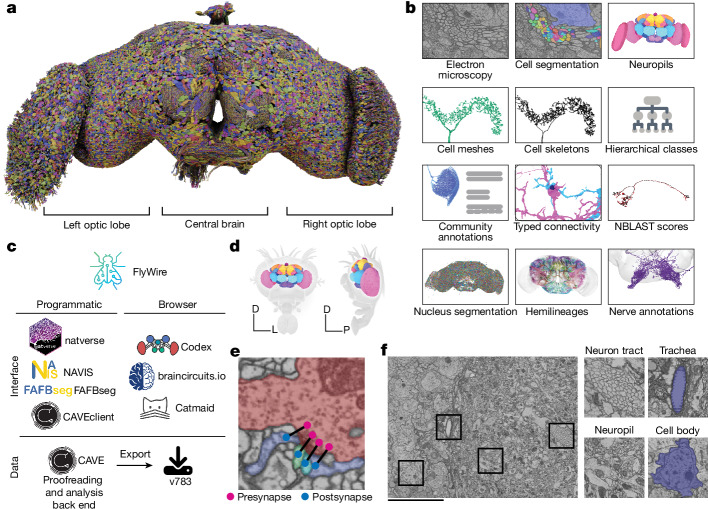
We present a neuronal wiring diagram of a whole brain containing 5 x 10^7 chemical synapses between 139,255 neurons reconstructed from an adult female Drosophila melanogaster.
Verified 2026-11-22 · 1 reference not checked yet
Overview
CoChat Summary
## TL;DR
This paper presents a whole-adult-fly-brain connectome for an adult female *Drosophila melanogaster*, reconstructed from electron microscopy images and annotated with cell types, neurotransmitter predictions, nerves, and hemilineages. The resource contains 139,255 neurons and 5 × 10^7 chemical synapses, and the authors use it to derive a projectome and analyze information flow from sensory inputs to motor, endocrine, and descending outputs.
## Key findings
- The reconstructed whole brain contains 139,255 neurons and about 54.5 million synapses between these neurons; elsewhere the abstract describes it as 5 × 10^7 chemical synapses.
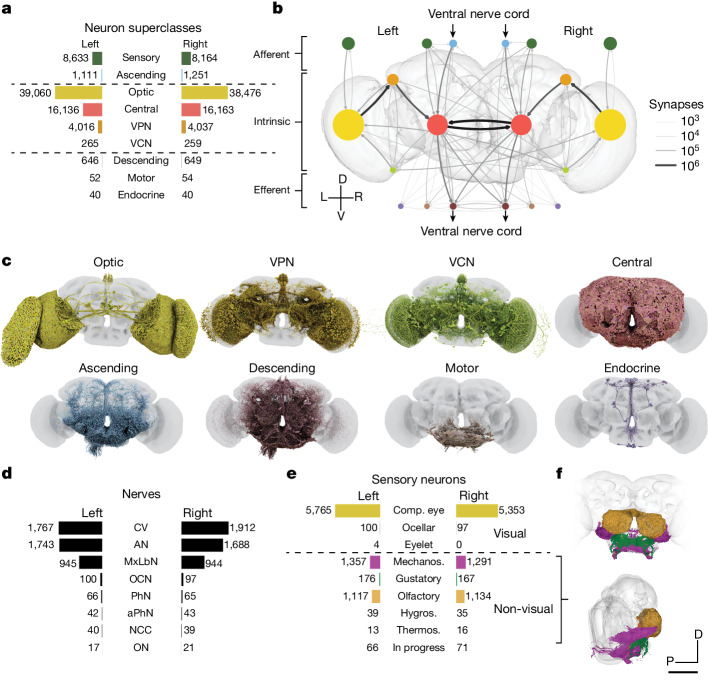
- Of the 139,255 proofread neurons, 118,501 are intrinsic to the brain, which the paper states is 85% of brain neurons.
- Using a connection threshold of >4 synapses (reported as five synapses for most analyses), the authors observed 2,700,513 strong connections between 134,181 identified neurons.
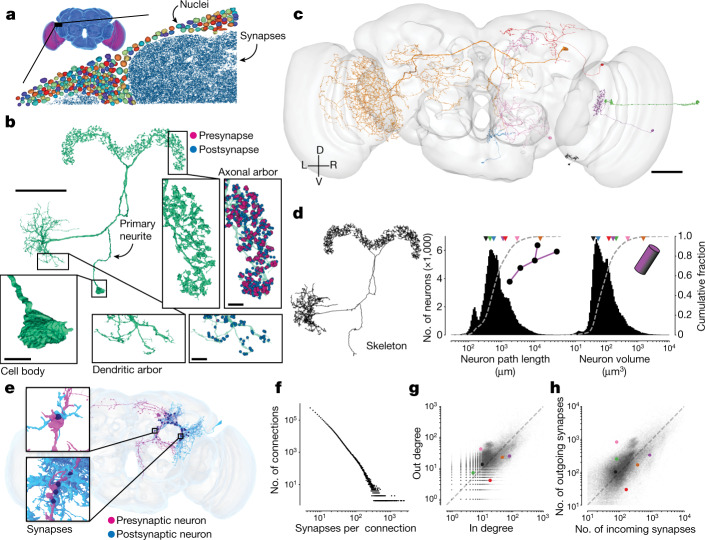
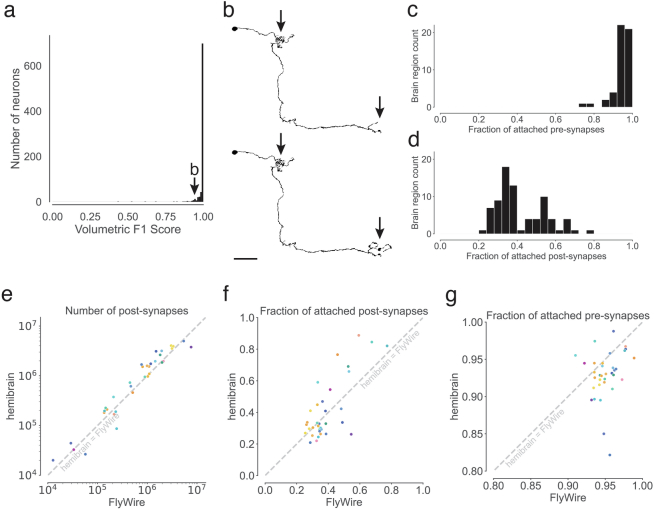
- Quality review of 826 neurons yielded an average reconstruction F1 score of 99.2% by volume; attachment rates were approximately 93.7% for presynapses and 44.7% for postsynapses.
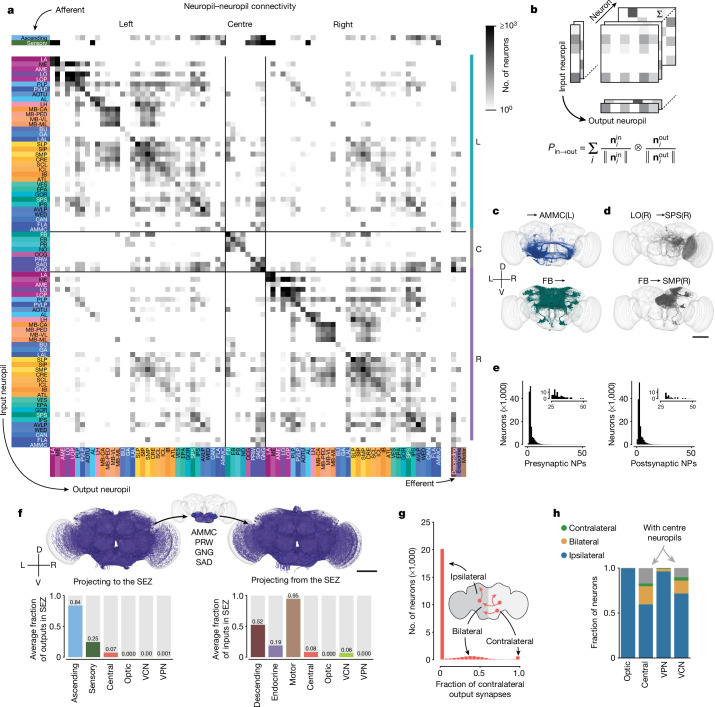
- The projectome analysis found that most projections are ipsilateral or within the same side of the brain, and that the SEZ accounts for 17.8% of central brain neuropil volume (0.0018 mm3 out of 0.0103 mm3).
## Methods
- The connectome was built from a previously acquired serial section transmission electron microscopy dataset of an adult female fly brain, which the authors realigned and automatically segmented, then proofread in FlyWire.
- Synapses were imported from prior automated prediction work, filtered, and mapped onto proofread segments; the paper states that for most analyses it used a >4 / 5-synapse threshold for defining connections.
- The authors analyzed the dataset by constructing a projectome over 78 neuropils, and by using a probabilistic information-flow model seeded with afferent neuron classes to rank downstream neurons.
## Limitations
- The paper states that synapse counts underrepresent the actual number of synapses, and that some low-synapse connections remain undetected.
- It states that improved completeness will require better image acquisition, image alignment, and automated reconstruction, because further proofreading cannot substantially improve twig attachment rates.
- The reconstruction has an explicitly noted left-sided artifact: the left lamina was partially severed from the medulla, reducing reconstruction accuracy for some lamina neurons on one side.
- The text also makes clear that the connectome includes only chemical synapses, so electrical synapses are not captured; this is stated in the paper.
Model-written summary. Check it against the paper before relying on it.
Integrity signals
Registry
Cites
Statistics
Figures
Verification
Claims the paper makes
63 Valid · 6 Not valid · 16 Not checked · 212 Own results and interpretations
Some cited sources support this claim and some don’t — read each source’s verdict below.
In the paper
“Intrinsic neurons of the brain make up three-quarters of the adult fly nervous system54–56 and amount to 85% of brain neurons.”
§ Neuronal wiring diagram of an adult brain > Intrinsic neurons of the brain
What the sources say
- Disputedcites [54] Phelps, J. S. et al. Reconstruction of motor control circuits in adult Drosophila using automated transmission electron microscopy. Cell 184, 759–774.e18 (2021). 33400916 PMC8312698 sourceExperimental — accuracy not yet measured
The Discussion section, “A synapse-resolution adult Drosophila VNC dataset” (page unavailable), says the VNC contains about a third of the neurons in the adult central nervous system. That leaves about two-thirds for the brain, including its intrinsic neurons; the paper does not support their making up three-quarters of the larger, whole nervous system. (LLM, conf=0.82)
Checked by a reasoning model — may be wrong.
- Not matchedcites [55] Takemura, S.-Y. et al. A connectome of the male Drosophila ventral nerve cord. eLife13, RP97769 (2024).
Its entry has no title and year that we can search by.
- Partly supportedcites [56] Marin, E. C. et al. Systematic annotation of a complete adult male Drosophila nerve cord connectome reveals principles of functional organisation. Preprint at bioRxiv10.1101/2023.06.05.543407 (2023). sourceExperimental — accuracy not yet measured
The Results (p. 4) report at least 115,000 neurons in the full adult brain and 15,763 in the ventral nerve cord, supporting the broad point that brain neurons predominate. But the paper gives an intrinsic-to-sensory ratio only for the central brain, not a count of intrinsic neurons across the whole brain or a three-quarters estimate for the entire nervous system. (LLM, conf=0.78)
plain- Asserted: passes — The authors put it forward as true.
- Checkable: passes — It can be checked against evidence.
- Load-bearing: unclear — It is unclear whether the paper’s conclusions depend on it.
- Based: passes — The paper gives a reason why it holds.
- Disputed
The cited sources support only part of this claim — read each source’s verdict below.
In the paper
“In addition, principal neurons of the mushroom body, a brain structure required for olfactory learning and memory, show high variability12.”
§ Neuronal wiring diagram of an adult brain > Main
What the sources say
- Partly supportedcites [12] Schlegel, P. et al. Whole-brain annotation and multi-connectome cell typing of Drosophila. Nature10.1038/s41586-024-07686-5 (2024). PMC11446831 39358521 sourceExperimental — accuracy not yet measured
The 'Variability in the mushroom body' section reports that Kenyon-cell counts differ by 30% between the FlyWire and hemibrain datasets, with particularly large differences in some Kenyon-cell types. It also says other Kenyon-cell types have similar counts, so the evidence supports substantial variability in a subset of mushroom-body neurons, not a blanket claim about its principal neurons. (LLM, conf=0.83)
plain- Asserted: passes — The authors put it forward as true.
- Checkable: passes — It can be checked against evidence.
- Load-bearing: unclear — It is unclear whether the paper’s conclusions depend on it.
- Based: passes — The paper gives a reason why it holds.
- Partly supported
The sources with a verdict support this claim; the rest weren’t checked yet, have no full text we could read, or their verdicts aren’t rated yet.
In the paper
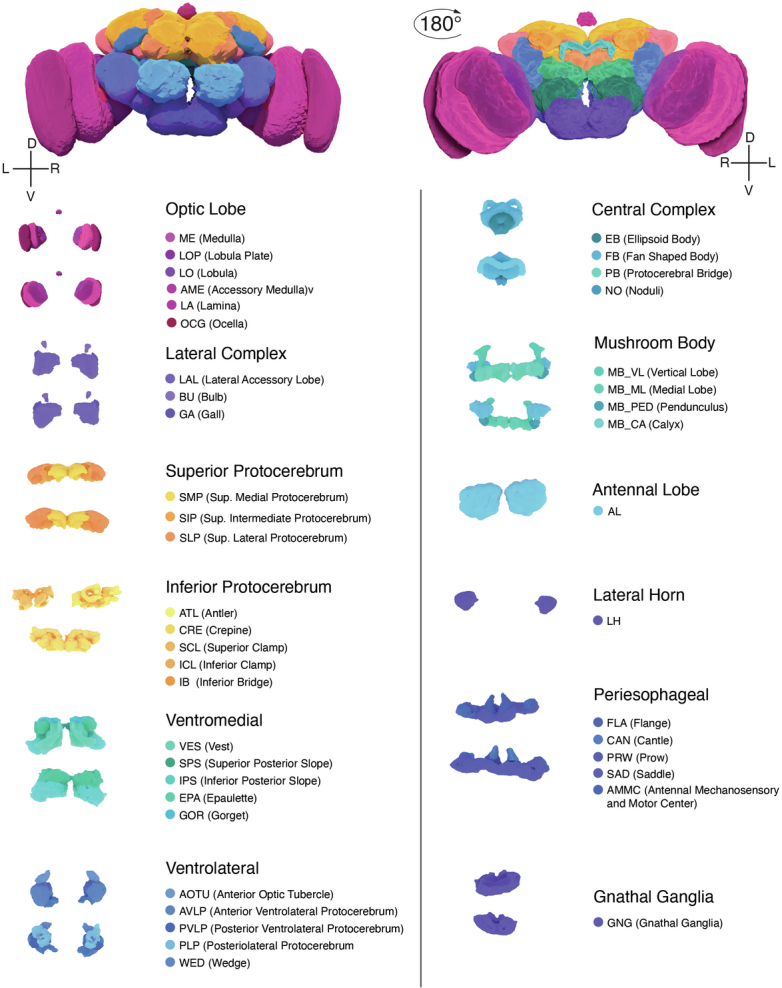
“VPNs target specific neuropils (for example, anterior optic tubercle (AOTU), posterior lateral protocerebrum (PLP) and posterior ventrolateral protocerebrum (PVLP)) or optic glomeruli60,61 in the central brain.”
§ Neuronal wiring diagram of an adult brain > Optic lobes and central brain
What the sources say
- Supportedcites [60] Wu, M. et al. Visual projection neurons in the Drosophila lobula link feature detection to distinct behavioral programs. eLife 5, e21022 (2016). 28029094 PMC5293491 source
The Results section, “LC neurons are the main visual inputs to optic glomeruli,” reports LC neuron targets in the PVLP, PLP and AOTu and identifies optic glomeruli as target regions. The Introduction describes these as cell-type-specific target regions in the central brain. Page numbers are not provided in our copy. (LLM, conf=0.93)
- Not checked — no full text of the sourcecites [61] Otsuna, H. & Ito, K. Systematic analysis of the visual projection neurons of Drosophila melanogaster. I. Lobula-specific pathways. J. Comp. Neurol. 497, 928–958 (2006). 16802334 source
plainstates a cause- Asserted: passes — The authors put it forward as true.
- Checkable: passes — It can be checked against evidence.
- Load-bearing: unclear — It is unclear whether the paper’s conclusions depend on it.
- Based: passes — The paper gives a reason why it holds.
- Supported
The cited sources support only part of this claim — read each source’s verdict below.
In the paper
“Our whole-brain reconstruction reveals many other aspects of VPN connectivity, such as their inputs in the medulla, lobula and lobula plate62.”
§ Neuronal wiring diagram of an adult brain > Optic lobes and central brain
What the sources say
- Partly supportedcites [62] Zhao, A. et al. A comprehensive neuroanatomical survey of the Drosophila lobula plate tangential neurons with predictions for their optic flow sensitivity. Preprint at bioRxiv10.1101/2023.10.16.562634 (2023). sourceExperimental — accuracy not yet measured
The Results section, “Brain-spanning network connectivity between LPTs” (page unavailable), describes synaptic connections involving lobula plate tangential neurons in the optic lobe and central brain. It supports lobula plate connectivity for this class of visual projection neurons, but does not establish the cited claim about VPN inputs in all three regions—the medulla, lobula, and lobula plate. The citing authors’ statement about what their own reconstruction reveals is not a finding attributed to this source. (LLM, conf=0.83)
plain- Asserted: passes — The authors put it forward as true.
- Checkable: passes — It can be checked against evidence.
- Load-bearing: unclear — It is unclear whether the paper’s conclusions depend on it.
- Based: passes — The paper gives a reason why it holds.
- Partly supported
The cited sources support only part of this claim — read each source’s verdict below.
In the paper
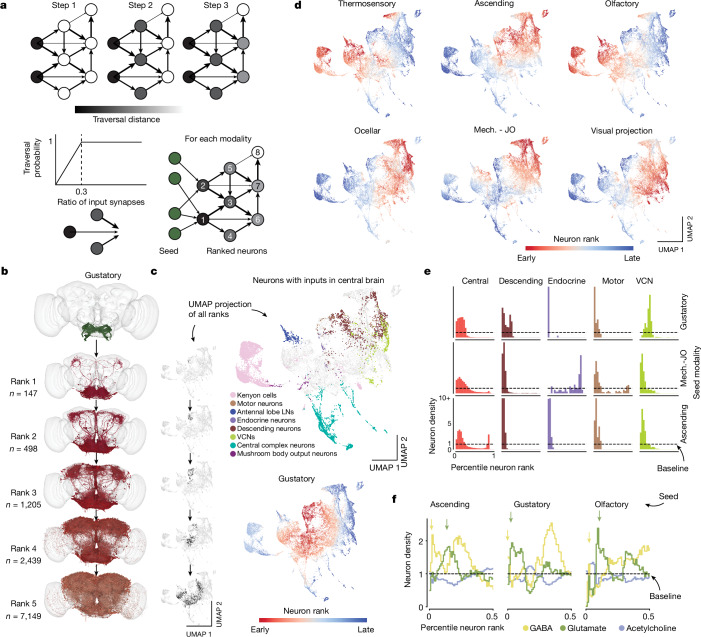
“Although afferents are truncated in our reconstruction, Schlegel et al.12 and other community members35,57 were able to determine the sensory organs corresponding to the 5,375 non-visual sensory neurons (Fig. 2e,f) on the basis of morphology and nerve assignments.”
§ Neuronal wiring diagram of an adult brain > Afferent and efferent neurons
What the sources say
- Partly supportedcites Schlegel et al.12 Schlegel, P. et al. Whole-brain annotation and multi-connectome cell typing of Drosophila. Nature10.1038/s41586-024-07686-5 (2024). PMC11446831 39358521 sourceExperimental — accuracy not yet measured
The Methods, ‘Cell typing’ section describes identifying several sensory-neuron groups using morphology, connectivity, and earlier identifications, which supports part of the attribution. The passages do not establish that sensory organs were determined for all 5,375 non-visual sensory neurons, or that nerve assignments were the basis for doing so. (LLM, conf=0.82)
- Partly supportedcites [35] Eichler, K. et al. Somatotopic organization among parallel sensory pathways that promote a grooming sequence in Drosophila. eLife12, RP87602 (2024). PMC11026096 38634460 sourceExperimental — accuracy not yet measured
Our copy does show Eichler et al. assigning reconstructed EM sensory neurons to their peripheral organs using exactly the criteria named: 'Manual categorization of the EM reconstructed sensory neurons revealed that they consist of BMNs, JONs, TPMNs, and GRNs' and matching 'based on NBLAST similarity scores… in conjunction with manual anatomical inspection of light microscopy images to assign the BMNs to specific bristle populations' (Matching EM reconstructed BMN projections…, p. 37), with nerve-based classification and cross-checks of neuron vs. bristle numbers (pp. 11, 13). However, the magnitude attributed is absent: the paper reports 705 BMNs plus 25 sensory neurons that could NOT be identified, together with JONs/TPMNs/GRNs from the head nerves — nowhere in our copy is a figure of 5,375 non-visual sensory neurons, and the authors note FAFB 'consists of a brain that was dissected from the head capsule, making it impossible to reconstruct BMNs all the way from their bristles' (p. 11). The 5,375-neuron tally and its assignment therefore belong to the other cited work (Schlegel et al.), not to this source; only the morphology-and-nerve-assignment approach for head bristle afferents is supported here. (LLM, conf=0.72)
- Partly supportedcites [57] Kim, H. et al. Wiring patterns from auditory sensory neurons to the escape and song-relay pathways in fruit flies. J. Comp. Neurol. 528, 2068–2098 (2020). 32012264 PMC7676477 sourceExperimental — accuracy not yet measured
The Methods section (“Tracing of JO neuron axons”; page unavailable) identifies Johnston’s organ sensory neurons using their trajectories and anatomical location, and describes their projections through the antennal nerve. The paper traces 45 neurons in each of two Johnston’s organ subgroups; it does not establish that sensory organs were determined for all 5,375 non-visual sensory neurons. (LLM, conf=0.86)
plainstates a cause- Asserted: passes — The authors put it forward as true.
- Checkable: passes — It can be checked against evidence.
- Load-bearing: unclear — It is unclear whether the paper’s conclusions depend on it.
- Based: passes — The paper gives a reason why it holds.
- Partly supported
161 more claims · 29 with their cited sources checked
Create a free account to see all 297 claims and to verify the 3 references still open.
- It may state two separate claims as one. 87
- Probably not a substantial claim. 56
Claims other papers make about this one
Each is checked against this paper’s own text: does it say what the citing paper says it does?
The cited source doesn’t support the claim as written.
In the citing paper
“This threshold is also consistent across our companion papers on the whole-brain Drosophila connectome3,5.”
From Network statistics of the whole-brain connectome of Drosophila (2024) · cites this paper as [3]
Checked by a reasoning model — may be wrong.
Experimental — accuracy not yet measuredThe cited source doesn’t support the claim as written.
In the citing paper
“It has only ∼ 200,000 neurons in its brain 24 (compared with ∼ 70 million in the mouse brain 25 and ∼ 80 billion in the human brain 26 ).”
From NeuroMechFly v2: simulating embodied sensorimotor control in adult Drosophila (2024) · cites this paper as [24]
Checked by a reasoning model — may be wrong.
Experimental — accuracy not yet measuredThe source backs part of the claim, not all of it — or backs it for a different population, condition or comparison.
In the citing paper
“This gives us a graph with 127,978 neurons and 2,613,129 connections3 (Fig. 1a and Methods).”
From Network statistics of the whole-brain connectome of Drosophila (2024) · cites this paper as [3]
Experimental — accuracy not yet measuredThe source backs part of the claim, not all of it — or backs it for a different population, condition or comparison.
In the citing paper
“The average connection consists of 12.6 synapses3, and the connection probability is 0.000161.”
From Network statistics of the whole-brain connectome of Drosophila (2024) · cites this paper as [3]
Experimental — accuracy not yet measuredThe source backs part of the claim, not all of it — or backs it for a different population, condition or comparison.
In the citing paper
“Most neurons are restricted to a single hemisphere—11% have inputs in both hemispheres and 11% have outputs in both hemispheres3 (Extended Data Fig. 4c).”
From Network statistics of the whole-brain connectome of Drosophila (2024) · cites this paper as [3]
Experimental — accuracy not yet measured
17 more claims about this paper
Create a free account to see every claim other papers make about this one.
Citations
Cites
UMAP: Uniform Manifold Approximation and Projection for Dimension Reduction
McInnes, L., Healy, J., & Melville, J. (2018) · arXiv · doi:10.48550/arxiv.1802.03426 · Cited by 7,101
The structure of the nervous system of the nematode Caenorhabditis elegans
White, J. G., Southgate, E., Thomson, J. N., & Brenner, S. (1986) · Philosophical Transactions of the Royal Society of London. B, Biological Sciences · doi:10.1098/rstb.1986.0056 · Cited by 5,589
The Human Connectome: A Structural Description of the Human Brain
Sporns, O., Tononi, G., & Kötter, R. (2005) · PLoS Computational Biology · doi:10.1371/journal.pcbi.0010042 · Cited by 3,260 · cited 3×
“Such maps have been called projectomes 79 or mesoscale connectomes 14 .”
BackgroundResultMesulam, M. (1998) · Brain · doi:10.1093/brain/121.6.1013 · Cited by 3,072
A mesoscale connectome of the mouse brain
Oh, S. W., Harris, J. A., Ng, L., Winslow, B., Cain, N., Mihalas, S., Wang, Q., Lau, C., Kuan, L., Henry, A. M., et al. (2014) · Nature · doi:10.1038/nature13186 · Cited by 2,612
Serial Block-Face Scanning Electron Microscopy to Reconstruct Three-Dimensional Tissue Nanostructure
Denk, W., & Horstmann, H. (2004) · PLoS Biology · doi:10.1371/journal.pbio.0020329 · Cited by 1,644 · cited 1×
“The hemibrain 1 was reconstructed from 8 × 8 × 8 nm 3 images acquired by focused ion beam scanning electron microscopy 102–104 (FIB-SEM), a form of block face electron microscopy 105,106 .”
MethodThe Human Genome Project: Lessons from Large-Scale Biology
Collins, F. S., Morgan, M., & Patrinos, A. (2003) · Science · doi:10.1126/science.1084564 · Cited by 1,284 · cited 1×
“The 1996 Bermuda Principles mandated daily release of Human Genome Project sequences into the public domain 117 .”
BackgroundRefinement of Tools for Targeted Gene Expression in Drosophila
Pfeiffer, B. D., Ngo, T.-T. B., Hibbard, K. L., Murphy, C., Jenett, A., Truman, J. W., & Rubin, G. M. (2010) · Genetics · doi:10.1534/genetics.110.119917 · Cited by 1,153
A connectome and analysis of the adult Drosophila central brain
Scheffer, L. K., Xu, C. S., Januszewski, M., Lu, Z., Takemura, S.-Y., Hayworth, K. J., Huang, G. B., Shinomiya, K., Maitlin-Shepard, J., Berg, S., et al. (2020) · eLife · doi:10.7554/elife.57443 · Cited by 1,128
Self-citationA Complete Electron Microscopy Volume of the Brain of Adult Drosophila melanogaster
Zheng, Z., Lauritzen, J. S., Perlman, E., Robinson, C. G., Nichols, M., Milkie, D., Torrens, O., Price, J., Fisher, C. B., Sharifi, N., et al. (2018) · Cell · doi:10.1016/j.cell.2018.06.019 · Cited by 1,050
Self-citationWhole-animal connectomes of both Caenorhabditis elegans sexes
Cook, S. J., Jarrell, T. A., Brittin, C. A., Wang, Y., Bloniarz, A. E., Yakovlev, M. A., Nguyen, K. C. Q., Tang, L. T.-H., Bayer, E. A., Duerr, J. S., et al. (2019) · Nature · doi:10.1038/s41586-019-1352-7 · Cited by 921
CONDUCTION VELOCITY AND DIAMETER OF NERVE FIBERS
Hursh, J. B. (1939) · American Journal of Physiology-Legacy Content · doi:10.1152/ajplegacy.1939.127.1.131 · Cited by 916
Structural Properties of the Caenorhabditis elegans Neuronal Network
Varshney, L. R., Chen, B. L., Paniagua, E., Hall, D. H., & Chklovskii, D. B. (2011) · PLoS Computational Biology · doi:10.1371/journal.pcbi.1001066 · Cited by 867
A Weighted and Directed Interareal Connectivity Matrix for Macaque Cerebral Cortex
Markov, N. T., Ercsey-Ravasz, M. M., Ribeiro Gomes, A. R., Lamy, C., Magrou, L., Vezoli, J., Misery, P., Falchier, A., Quilodran, R., Gariel, M. A., et al. (2014) · Cerebral Cortex · doi:10.1093/cercor/bhs270 · Cited by 857 · cited 1×
“For mammals, tracer injection studies have mapped the axonal projections between brain regions of mouse 74,75 and macaque 76 .”
BackgroundA Single-Cell Transcriptome Atlas of the Aging Drosophila Brain
Davie, K., Janssens, J., Koldere, D., De Waegeneer, M., Pech, U., Kreft, Ł., Aibar, S., Makhzami, S., Christiaens, V., Bravo González-Blas, C., et al. (2018) · Cell · doi:10.1016/j.cell.2018.05.057 · Cited by 840
Neural Networks of the Mouse Neocortex
Zingg, B., Hintiryan, H., Gou, L., Song, M. Y., Bay, M., Bienkowski, M. S., Foster, N. N., Yamashita, S., Bowman, I., Toga, A. W., et al. (2014) · Cell · doi:10.1016/j.cell.2014.02.023 · Cited by 797 · cited 1×
“For mammals, tracer injection studies have mapped the axonal projections between brain regions of mouse 74,75 and macaque 76 .”
BackgroundHierarchical organization of cortical and thalamic connectivity
Harris, J. A., Mihalas, S., Hirokawa, K. E., Whitesell, J. D., Choi, H., Bernard, A., Bohn, P., Caldejon, S., Casal, L., Cho, A., et al. (2019) · Nature · doi:10.1038/s41586-019-1716-z · Cited by 785
Chiang, A.-S., Lin, C.-Y., Chuang, C.-C., Chang, H.-M., Hsieh, C.-H., Yeh, C.-W., Shih, C.-T., Wu, J.-J., Wang, G.-T., Chen, Y.-C., et al. (2011) · Current Biology · doi:10.1016/j.cub.2010.11.056 · Cited by 767 · cited 1×
“In the fly, large numbers of light microscopy reconstructions of single neurons have been aggregated to map projections between brain regions 77,78 .”
BackgroundSelf-citationThe optic lobe of Drosophila melanogaster. I. A Golgi analysis of wild-type structure
Fischbach, K.-F., & Dittrich, A. P. M. (1989) · Cell and Tissue Research · doi:10.1007/bf00218858 · Cited by 709 · cited 1×
“The neuropils have been finely subdivided into layers that are perpendicular to the columns 81 .”
BackgroundSerial section scanning electron microscopy of adult brain tissue using focused ion beam milling
Knott, G., Marchman, H., Wall, D., & Lich, B. (2008) · The Journal of Neuroscience · doi:10.1523/jneurosci.3189-07.2008 · Cited by 692 · cited 1×
“The hemibrain 1 was reconstructed from 8 × 8 × 8 nm 3 images acquired by focused ion beam scanning electron microscopy 102–104 (FIB-SEM), a form of block face electron microscopy 105,106 .”
MethodA visual motion detection circuit suggested by Drosophila connectomics
Takemura, S.-Y., Bharioke, A., Lu, Z., Nern, A., Vitaladevuni, S., Rivlin, P. K., Katz, W. T., Olbris, D. J., Plaza, S. M., Winston, P., et al. (2013) · Nature · doi:10.1038/nature12450 · Cited by 686 · cited 2×
“Wiring diagrams of other fly brain regions have been mapped and related to visual 2 , auditory 25 and olfactory 23,26 functions.”
BackgroundMethodA Systematic Nomenclature for the Insect Brain
Ito, K., Shinomiya, K., Ito, M., Armstrong, J. D., Boyan, G., Hartenstein, V., Harzsch, S., Heisenberg, M., Homberg, U., Jenett, A., et al. (2014) · Neuron · doi:10.1016/j.neuron.2013.12.017 · Cited by 611 · cited 3×
“The interior of the fly brain has been subdivided into hierarchical neuropil regions 80 (Fig.”
BackgroundMethodInfluentialNern, A., Pfeiffer, B. D., & Rubin, G. M. (2015) · Proceedings of the National Academy of Sciences · doi:10.1073/pnas.1506763112 · Cited by 584 · cited 1×
“These and other distal medullary cell types were previously characterized by multicolour light microscopy 82 .”
BackgroundA multimodal cell census and atlas of the mammalian primary motor cortex
BRAIN Initiative Cell Census Network (BICCN), BRAIN Initiative Cell Census Network (BICCN) Corresponding authors, Callaway, E. M., Dong, H.-W., Ecker, J. R., Hawrylycz, M. J., Huang, Z. J., Lein, E. S., Ngai, J., Osten, P., et al. (2021) · Nature · doi:10.1038/s41586-021-03950-0 · Cited by 522
Self-citationA multilevel multimodal circuit enhances action selection in drosophila
Ohyama, T., Schneider-Mizell, C. M., Fetter, R. D., Aleman, J. V., Franconville, R., Rivera-Alba, M., Mensh, B. D., Branson, K. M., Simpson, J. H., Truman, J. W., et al. (2015) · Nature · doi:10.1038/nature14297 · Cited by 502 · cited 1×
“First, a connection with many synapses is expected to be strong in a physiological sense, other things being equal 68 .”
BackgroundSelf-citationLuan, H., Peabody, N. C., Vinson, C. R., & White, B. H. (2006) · Neuron · doi:10.1016/j.neuron.2006.08.028 · Cited by 500
Space–time wiring specificity supports direction selectivity in the retina
EyeWirers, T., Kim, J. S., Greene, M. J., Zlateski, A., Lee, K., Richardson, M., Turaga, S. C., Purcaro, M., Balkam, M., Robinson, A., et al. (2014) · Nature · doi:10.1038/nature13240 · Cited by 450 · cited 1×
“The top 100 players from Eyewire, a gamified electron microscopy reconstruction platform that crowdsources reconstructions in mouse retina and zebrafish hindbrain 125 , received an invitation to beta test proofreading in FlyWire.”
MethodSelf-citationThe connectome of an insect brain
Winding, M., Pedigo, B. D., Barnes, C. L., Patsolic, H. G., Park, Y., Kazimiers, T., Fushiki, A., Andrade, I. V., Khandelwal, A., Valdes-Aleman, J., et al. (2023) · Science · doi:10.1126/science.add9330 · Cited by 435
Whole-brain annotation and multi-connectome cell typing of Drosophila
Schlegel, P., Yin, Y., Bates, A. S., Dorkenwald, S., Eichler, K., Brooks, P., Han, D. S., Gkantia, M., dos Santos, M., Munnelly, E. J., et al. (2024) · Nature · doi:10.1038/s41586-024-07686-5 · Cited by 413 · cited 10×
“Our companion paper 12 exhaustively identifies all afferent and efferent neurons contained in cross sections of nerves and the neck connective running between the brain and ventral nerve cord (VNC) (Fig.”
BackgroundMethodInfluentialEnhanced FIB-SEM systems for large-volume 3D imaging
Xu, C. S., Hayworth, K. J., Lu, Z., Grob, P., Hassan, A. M., García-Cerdán, J. G., Niyogi, K. K., Nogales, E., Weinberg, R. J., & Hess, H. F. (2017) · eLife · doi:10.7554/elife.25916 · Cited by 411
Connectomes across development reveal principles of brain maturation
Witvliet, D., Mulcahy, B., Mitchell, J. K., Meirovitch, Y., Berger, D. R., Wu, Y., Liu, Y., Koh, W. X., Parvathala, R., Holmyard, D., et al. (2021) · Nature · doi:10.1038/s41586-021-03778-8 · Cited by 393
Hulse, B. K., Haberkern, H., Franconville, R., Turner-Evans, D., Takemura, S.-Y., Wolff, T., Noorman, M., Dreher, M., Dan, C., Parekh, R., et al. (2021) · eLife · doi:10.7554/elife.66039 · Cited by 392
Hulse, B. K., Haberkern, H., Franconville, R., Turner-Evans, D. B., Takemura, S., Wolff, T., Noorman, M., Dreher, M., Dan, C., Parekh, R., et al. (2020) · doi:10.1101/2020.12.08.413955 · Cited by 392 · cited 2×
“9), highlighting that the central complex is dominated by internal computations 24 .”
BackgroundThe connectome of the adult Drosophila mushroom body provides insights into function
Li, F., Lindsey, J. W., Marin, E. C., Otto, N., Dreher, M., Dempsey, G., Stark, I., Bates, A. S., Pleijzier, M. W., Schlegel, P., et al. (2020) · eLife · doi:10.7554/elife.62576 · Cited by 388 · cited 2×
“Wiring diagrams of other fly brain regions have been mapped and related to visual 2 , auditory 25 and olfactory 23,26 functions.”
BackgroundSelf-citationHigh-precision automated reconstruction of neurons with flood-filling networks
Januszewski, M., Kornfeld, J., Li, P. H., Pope, A., Blakely, T., Lindsey, L., Maitin-Shepard, J., Tyka, M., Denk, W., & Jain, V. (2018) · Nature Methods · doi:10.1038/s41592-018-0049-4 · Cited by 380
Density of neurons and synapses in the cerebral cortex of the mouse
Schüz, A., & Palm, G. (1989) · Journal of Comparative Neurology · doi:10.1002/cne.902860404 · Cited by 376 · cited 1×
“This equates to 7.4 synapses per μm 3 , a much higher density than that of mammalian cortex 51,52 (less than 1 synapse per μm 3 ).”
BackgroundInfluentialConvolutional Networks Can Learn to Generate Affinity Graphs for Image Segmentation
Turaga, S. C., Murray, J. F., Jain, V., Roth, F., Helmstaedter, M., Briggman, K., Denk, W., & Seung, H. S. (2010) · Neural Computation · doi:10.1162/neco.2009.10-08-881 · Cited by 376 · cited 1×
“The hemibrain images were automatically segmented using flood-filling convolutional nets 109 , whereas FlyWire used the older, less computationally expensive approach of boundary-detecting convolutional nets 110,111 .”
MethodSelf-citationUpdate on connexins and gap junctions in neurons and glia in the mammalian nervous system
Nagy, J. I., Dudek, F. E., & Rash, J. E. (2004) · Brain Research Reviews · doi:10.1016/j.brainresrev.2004.05.005 · Cited by 375
The Big and the Small: Challenges of Imaging the Brain’s Circuits
Lichtman, J. W., & Denk, W. (2011) · Science · doi:10.1126/science.1209168 · Cited by 370 · cited 1×
“Scepti-cism has flourished largely owing to a lack of technologies that could reconstruct such wiring diagrams 16,17 , so obtaining such diagrams has remained hypothetical.”
BackgroundA petavoxel fragment of human cerebral cortex reconstructed at nanoscale resolution
Shapson-Coe, A., Januszewski, M., Berger, D. R., Pope, A., Wu, Y., Blakely, T., Schalek, R. L., Li, P. H., Wang, S., Maitin-Shepard, J., et al. (2024) · Science · doi:10.1126/science.adk4858 · Cited by 361 · cited 1×
“Technologies developed for FlyWire have already been applied to millimetre-scale chunks of mammalian brain 4,5 , which are more than 50 times larger in volume than a fly brain.”
MethodSelf-citationVolume electron microscopy for neuronal circuit reconstruction
Briggman, K. L., & Bock, D. D. (2012) · Current Opinion in Neurobiology · doi:10.1016/j.conb.2011.10.022 · Cited by 335 · cited 1×
“Scepti-cism has flourished largely owing to a lack of technologies that could reconstruct such wiring diagrams 16,17 , so obtaining such diagrams has remained hypothetical.”
BackgroundQuantitative neuroanatomy for connectomics in Drosophila
Schneider-Mizell, C. M., Gerhard, S., Longair, M., Kazimiers, T., Li, F., Zwart, M. F., Champion, A., Midgley, F. M., Fetter, R. D., Saalfeld, S., et al. (2016) · eLife · doi:10.7554/elife.12059 · Cited by 332 · cited 5×
“However, in general, a mixture of presynapses and postsynapses is found on all non-primary neurites 10,33,53,65 (Fig.”
BackgroundInfluentialSelf-citationElastic volume reconstruction from series of ultra-thin microscopy sections
Saalfeld, S., Fetter, R., Cardona, A., & Tomancak, P. (2012) · Nature Methods · doi:10.1038/nmeth.2072 · Cited by 329
Sexual Dimorphism in the Fly Brain
Cachero, S., Ostrovsky, A. D., Yu, J. Y., Dickson, B. J., & Jefferis, G. S. X. E. (2010) · Current Biology · doi:10.1016/j.cub.2010.07.045 · Cited by 325 · cited 1×
“between the brains of male and female flies 46 .”
BackgroundSelf-citationWu, M., Nern, A., Williamson, W. R., Morimoto, M. M., Reiser, M. B., Card, G. M., & Rubin, G. M. (2016) · eLife · doi:10.7554/elife.21022 · Cited by 304 · cited 2×
“VPNs target specific neuropils (for example, anterior optic tubercle (AOTU), posterior lateral protocerebrum (PLP) and posterior vent-rolateral protocerebrum (PVLP)) or optic glomeruli 60,61 in the central brain.”
BackgroundCellular diversity in the Drosophila midbrain revealed by single-cell transcriptomics
Croset, V., Treiber, C. D., & Waddell, S. (2018) · eLife · doi:10.7554/elife.34550 · Cited by 299
Glutamate is an inhibitory neurotransmitter in the Drosophila olfactory system
Liu, W. W., & Wilson, R. I. (2013) · Proceedings of the National Academy of Sciences · doi:10.1073/pnas.1220560110 · Cited by 297
The glia of the adult Drosophila nervous system
Kremer, M. C., Jung, C., Batelli, S., Rubin, G. M., & Gaul, U. (2017) · Glia · doi:10.1002/glia.23115 · Cited by 296 · cited 1×
“A small fraction of brain volume is made up of glial cells, which are categorized into six types 67 .”
BackgroundFlyWire: online community for whole-brain connectomics
Dorkenwald, S., McKellar, C. E., Macrina, T., Kemnitz, N., Lee, K., Lu, R., Wu, J., Popovych, S., Mitchell, E., Nehoran, B., et al. (2022) · Nature Methods · doi:10.1038/s41592-021-01330-0 · Cited by 289 · cited 8×
“We previously rea-ligned the electron microscopy images, automatically segmented all neurons in the images, created a computational system that allows interactive proofreading of the segmentation 50 , and assembled an online community 8 (FlyWire).”
BackgroundMethodInfluentialSelf-citationSynaptic Connectivity and Neuronal Morphology
Chklovskii, D. B. (2004) · Neuron · doi:10.1016/s0896-6273(04)00498-2 · Cited by 287
Cognigni, P., Felsenberg, J., & Waddell, S. (2018) · Current Opinion in Neurobiology · doi:10.1016/j.conb.2017.12.002 · Cited by 281 · cited 1×
“Flies engage in dynamic social interactions 18 , navigate over distances 19 and form long-term memories 20 .”
BackgroundEckstein, N., Bates, A. S., Champion, A., Du, M., Yin, Y., Schlegel, P., Lu, A. K.-Y., Rymer, T., Finley-May, S., Paterson, T., et al. (2024) · Cell · doi:10.1016/j.cell.2024.03.016 · Cited by 277 · cited 13×
“A number of validations suggest that the predictions are highly accurate in aggregate 10 , but for any given synapse the prediction could be wrong.”
BackgroundMethodInfluentialSelf-citationA genetic, genomic, and computational resource for exploring neural circuit function
Davis, F. P., Nern, A., Picard, S., Reiser, M. B., Rubin, G. M., Eddy, S. R., & Henry, G. L. (2020) · eLife · doi:10.7554/elife.50901 · Cited by 268
Phelps, J. S., Hildebrand, D. G. C., Graham, B. J., Kuan, A. T., Thomas, L. A., Nguyen, T. M., Buhmann, J., Azevedo, A. W., Sustar, A., Agrawal, S., et al. (2021) · Cell · doi:10.1016/j.cell.2020.12.013 · Cited by 265
Self-citationDigital Museum of Retinal Ganglion Cells with Dense Anatomy and Physiology
Bae, J. A., Mu, S., Kim, J. S., Turner, N. L., Tartavull, I., Kemnitz, N., Jordan, C. S., Norton, A. D., Silversmith, W. M., Prentki, R., et al. (2018) · Cell · doi:10.1016/j.cell.2018.04.040 · Cited by 263
Self-citationA connectomic study of a petascale fragment of human cerebral cortex
Shapson-Coe, A., Januszewski, M., Berger, D. R., Pope, A., Wu, Y., Blakely, T., Schalek, R. L., Li, P. H., Wang, S., Maitin-Shepard, J., et al. (2021) · doi:10.1101/2021.05.29.446289 · Cited by 243
Self-citationConnectomic comparison of mouse and human cortex
Loomba, S., Straehle, J., Gangadharan, V., Heike, N., Khalifa, A., Motta, A., Ju, N., Sievers, M., Gempt, J., Meyer, H. S., et al. (2022) · Science · doi:10.1126/science.abo0924 · Cited by 242 · cited 2×
“In recent years, this approach has been applied to chunks of brains to reconstruct local connectivity maps that are highly informative 1–6 , but nevertheless inadequate for understanding brain function more globally.”
BackgroundMethodNeuronal diversity and convergence in a visual system developmental atlas
Özel, M. N., Simon, F., Jafari, S., Holguera, I., Chen, Y.-C., Benhra, N., El-Danaf, R. N., Kapuralin, K., Malin, J. A., Konstantinides, N., et al. (2021) · Nature · doi:10.1038/s41586-020-2879-3 · Cited by 237
Otsuna, H., & Ito, K. (2006) · The Journal of Comparative Neurology · doi:10.1002/cne.21015 · Cited by 224
Common circuit design in fly and mammalian motion vision
Borst, A., & Helmstaedter, M. (2015) · Nature Neuroscience · doi:10.1038/nn.4050 · Cited by 220 · cited 1×
“The circuit organization revealed by these wiring diagrams show similarities to mammalian brains 27,28 .”
BackgroundSupervised Learning of Image Restoration with Convolutional Networks
Jain, V., Murray, J. F., Roth, F., Turaga, S., Zhigulin, V., Briggman, K. L., Helmstaedter, M. N., Denk, W., & Seung, H. S. (2007) · 2007 IEEE 11th International Conference on Computer Vision · doi:10.1109/iccv.2007.4408909 · Cited by 217 · cited 1×
“The hemibrain images were automatically segmented using flood-filling convolutional nets 109 , whereas FlyWire used the older, less computationally expensive approach of boundary-detecting convolutional nets 110,111 .”
MethodSelf-citationThe natverse, a versatile toolbox for combining and analysing neuroanatomical data
Bates, A. S., Manton, J. D., Jagannathan, S. R., Costa, M., Schlegel, P., Rohlfing, T., & Jefferis, G. S. (2020) · eLife · doi:10.7554/elife.53350 · Cited by 215
Self-citationFunctional connectomics spanning multiple areas of mouse visual cortex
The MICrONS Consortium, Bae, J. A., Baptiste, M., Bishop, C. A., Bodor, A. L., Brittain, D., Buchanan, J., Bumbarger, D. J., Castro, M. A., Celii, B., et al. (2021) · doi:10.1101/2021.07.28.454025 · Cited by 214
Self-citationThe comprehensive connectome of a neural substrate for ‘ON’ motion detection in Drosophila
Takemura, S.-Y., Nern, A., Chklovskii, D. B., Scheffer, L. K., Rubin, G. M., & Meinertzhagen, I. A. (2017) · eLife · doi:10.7554/elife.24394 · Cited by 210 · cited 1×
“Finally, the connectome now enables brain simulations—partial con-nectomes of the early visual system of the fly 3 had already inspired simulations of visual processing 85 .”
MethodConnectomics-Based Analysis of Information Flow in the Drosophila Brain
Shih, C.-T., Sporns, O., Yuan, S.-L., Su, T.-S., Lin, Y.-J., Chuang, C.-C., Wang, T.-Y., Lo, C.-C., Greenspan, R. J., & Chiang, A.-S. (2015) · Current Biology · doi:10.1016/j.cub.2015.03.021 · Cited by 200
Complex brain and optic lobes in an early Cambrian arthropod
Ma, X., Hou, X., Edgecombe, G. D., & Strausfeld, N. J. (2012) · Nature · doi:10.1038/nature11495 · Cited by 197 · cited 1×
“Although rudimentary nervous systems existed in more ancient animals, brains evolved around half a billion years ago 13 , and are essential for the generation of sophisticated behaviours.”
BackgroundSuperhuman Accuracy on the SNEMI3D Connectomics Challenge
Lee, K., Zung, J., Li, P. H., Jain, V., & Seung, H. S. (2017) · arXiv (Cornell University) · doi:10.48550/arxiv.1706.00120 · Cited by 196 · cited 1×
“We automatically segmented all cells in the dataset 8 using a neuronal boundary-detecting neural network 121 and mean affinity agglomeration 107,122 .”
MethodSelf-citationFunctional connectomics spanning multiple areas of mouse visual cortex
The MICrONS Consortium, Bae, J. A., Baptiste, M., Baptiste, M. R., Bishop, C. A., Bodor, A. L., Brittain, D., Brooks, V., Buchanan, J., Bumbarger, D. J., et al. (2025) · Nature · doi:10.1038/s41586-025-08790-w · Cited by 190
Self-citationInformation flow, cell types and stereotypy in a full olfactory connectome
Schlegel, P., Bates, A. S., Stürner, T., Jagannathan, S. R., Drummond, N., Hsu, J., Serratosa Capdevila, L., Javier, A., Marin, E. C., Barth-Maron, A., et al. (2021) · eLife · doi:10.7554/elife.66018 · Cited by 178 · cited 10×
“We therefore use a probabilistic model to estimate information flow in the connectome 26 , starting from a set of seed neurons (Fig.”
BackgroundMethodInfluentialSelf-citationAutomatic detection of synaptic partners in a whole-brain Drosophila electron microscopy data set
Buhmann, J., Sheridan, A., Malin-Mayor, C., Schlegel, P., Gerhard, S., Kazimiers, T., Krause, R., Nguyen, T. M., Heinrich, L., Lee, W.-C. A., et al. (2021) · Nature Methods · doi:10.1038/s41592-021-01183-7 · Cited by 175
Self-citationAbbott, L. F., Bock, D. D., Callaway, E. M., Denk, W., Dulac, C., Fairhall, A. L., Fiete, I., Harris, K. M., Helmstaedter, M., Jain, V., et al. (2020) · Cell · doi:10.1016/j.cell.2020.08.010 · Cited by 172
Self-citationDynamic sensory cues shape song structure in Drosophila
Coen, P., Clemens, J., Weinstein, A. J., Pacheco, D. A., Deng, Y., & Murthy, M. (2014) · Nature · doi:10.1038/nature13131 · Cited by 166 · cited 1×
“Flies engage in dynamic social interactions 18 , navigate over distances 19 and form long-term memories 20 .”
BackgroundSelf-citationTranscriptional Programs of Circuit Assembly in the Drosophila Visual System
Kurmangaliyev, Y. Z., Yoo, J., Valdes-Aleman, J., Sanfilippo, P., & Zipursky, S. L. (2020) · Neuron · doi:10.1016/j.neuron.2020.10.006 · Cited by 166
Testing Odor Response Stereotypy in the Drosophila Mushroom Body
Murthy, M., Fiete, I., & Laurent, G. (2008) · Neuron · doi:10.1016/j.neuron.2008.07.040 · Cited by 163 · cited 1×
“Some mushroom body connectivity patterns have even been found to be near random 47 , although deviations from randomness have since been identified 48 .”
BackgroundSelf-citationDirect neural pathways convey distinct visual information to Drosophila mushroom bodies
Vogt, K., Aso, Y., Hige, T., Knapek, S., Ichinose, T., Friedrich, A. B., Turner, G. C., Rubin, G. M., & Tanimoto, H. (2016) · eLife · doi:10.7554/elife.14009 · Cited by 155 · cited 15×
“The influence of VPNs can be very strong; 892 central neurons receive more than half their synapses from VPNs.”
BackgroundInfluentialNeural circuit mechanisms of sexual receptivity in Drosophila females
Wang, K., Wang, F., Forknall, N., Yang, T., Patrick, C., Parekh, R., & Dickson, B. J. (2021) · Nature · doi:10.1038/s41586-020-2972-7 · Cited by 152
Self-citationTransforming representations of movement from body- to world-centric space
Lu, J., Behbahani, A. H., Hamburg, L., Westeinde, E. A., Dawson, P. M., Lyu, C., Maimon, G., Dickinson, M. H., Druckmann, S., & Wilson, R. I. (2022) · Nature · doi:10.1038/s41586-021-04191-x · Cited by 152
Does Drosophila have seven eyes?
Hofbauer, A., & Buchner, E. (1989) · Naturwissenschaften · doi:10.1007/bf00368438 · Cited by 151 · cited 1×
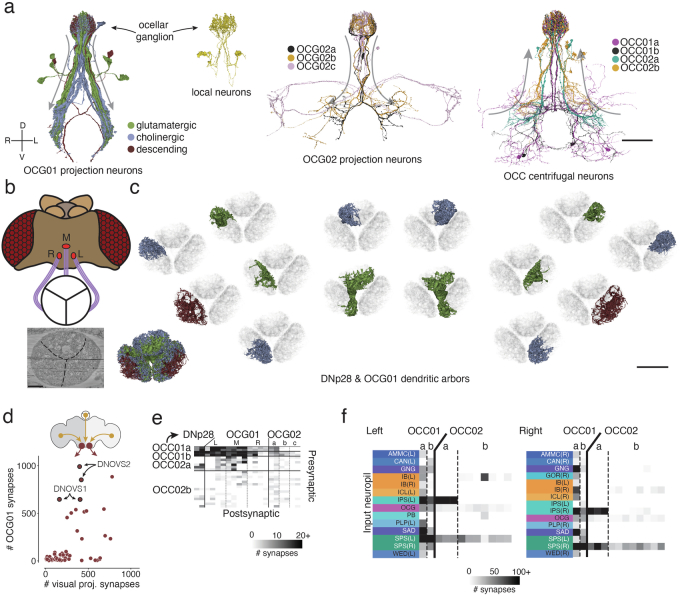
“In addition to the large compound eyes, flying insects have smaller visual sensory organs 89 , including the three ocelli on the dorsal surface of the head cuticle (Fig.”
BackgroundNetwork statistics of the whole-brain connectome of Drosophila
Lin, A., Yang, R., Dorkenwald, S., Matsliah, A., Sterling, A. R., Schlegel, P., Yu, S.-C., McKellar, C. E., Costa, M., Eichler, K., et al. (2024) · Nature · doi:10.1038/s41586-024-07968-y · Cited by 147 · cited 7×
“…in the central brain can be reached by starting from any modality—this ‘small world’ property of the network is covered in more detail by Lin et al. 49 Comparing orders revealed that almost all neurons in the central brain are reached early starting from some modality, with the exception of…”
InfluentialSelf-citationNetwork Statistics of the Whole-Brain Connectome of Drosophila
Lin, A., Yang, R., Dorkenwald, S., Matsliah, A., Sterling, A. R., Schlegel, P., Yu, S.-C., McKellar, C. E., Costa, M., Eichler, K., et al. (2023) · doi:10.1101/2023.07.29.551086 · Cited by 147
Self-citationComparisons between the ON- and OFF-edge motion pathways in the Drosophila brain
Shinomiya, K., Huang, G., Lu, Z., Parag, T., Xu, C. S., Aniceto, R., Ansari, N., Cheatham, N., Lauchie, S., Neace, E., et al. (2019) · eLife · doi:10.7554/elife.40025 · Cited by 140
Quantitative Predictions Orchestrate Visual Signaling in Drosophila
Kim, A. J., Fenk, L. M., Lyu, C., & Maimon, G. (2017) · Cell · doi:10.1016/j.cell.2016.12.005 · Cited by 139 · cited 1×
“As the ocelli transmit mainly information about light levels, the dense integration with motion direction signals from the compound eyes was not previously appreciated, but should aid in precision adjustments of head and body movements for gaze stabilization and flight control 96 .”
BackgroundAutomated synaptic connectivity inference for volume electron microscopy
Dorkenwald, S., Schubert, P. J., Killinger, M. F., Urban, G., Mikula, S., Svara, F., & Kornfeld, J. (2017) · Nature Methods · doi:10.1038/nmeth.4206 · Cited by 132 · cited 1×
“This equates to 7.4 synapses per μm 3 , a much higher density than that of mammalian cortex 51,52 (less than 1 synapse per μm 3 ).”
BackgroundInfluentialSelf-citationBinary and analog variation of synapses between cortical pyramidal neurons
Dorkenwald, S., Turner, N. L., Macrina, T., Lee, K., Lu, R., Wu, J., Bodor, A. L., Bleckert, A. A., Brittain, D., Kemnitz, N., et al. (2019) · doi:10.1101/2019.12.29.890319 · Cited by 130 · cited 1×
“CAVE’s proofreading system is the PyChunkedGraph which has been described in detail elsewhere 8,124 .”
MethodSelf-citationConnectome-constrained networks predict neural activity across the fly visual system
Lappalainen, J. K., Tschopp, F. D., Prakhya, S., McGill, M., Nern, A., Shinomiya, K., Takemura, S.-Y., Gruntman, E., Macke, J. H., & Turaga, S. C. (2024) · Nature · doi:10.1038/s41586-024-07939-3 · Cited by 128 · cited 3×
“Finally, the connectome now enables brain simulations—partial con-nectomes of the early visual system of the fly 3 had already inspired simulations of visual processing 85 .”
BackgroundMethodBinary and analog variation of synapses between cortical pyramidal neurons
Dorkenwald, S., Turner, N. L., Macrina, T., Lee, K., Lu, R., Wu, J., Bodor, A. L., Bleckert, A. A., Brittain, D., Kemnitz, N., et al. (2022) · eLife · doi:10.7554/elife.76120 · Cited by 128
Self-citationMeissner, G. W., Nern, A., Dorman, Z., DePasquale, G. M., Forster, K., Gibney, T., Hausenfluck, J. H., He, Y., Iyer, N. A., Jeter, J., et al. (2023) · eLife · doi:10.7554/elife.80660 · Cited by 127
Self-citationCell types and neuronal circuitry underlying female aggression in Drosophila
Schretter, C. E., Aso, Y., Robie, A. A., Dreher, M., Dolan, M.-J., Chen, N., Ito, M., Yang, T., Parekh, R., Branson, K. M., et al. (2020) · eLife · doi:10.7554/elife.58942 · Cited by 125 · cited 1×
“The resulting wiring diagrams of neural circuits have provided crucial insights into how the brain generates social 21,22 , memory-related 23 or navigation 24 behaviours.”
BackgroundAre mushroom bodies cerebellum-like structures?
Farris, S. M. (2011) · Arthropod Structure & Development · doi:10.1016/j.asd.2011.02.004 · Cited by 125 · cited 1×
“The circuit organization revealed by these wiring diagrams show similarities to mammalian brains 27,28 .”
BackgroundTEASAR: tree-structure extraction algorithm for accurate and robust skeletons
Sato, M., Bitter, I., Bender, M. A., Kaufman, A. E., & Nakajima, M. (2002) · Proceedings the Eighth Pacific Conference on Computer Graphics and Applications · doi:10.1109/pccga.2000.883951 · Cited by 122
Connectomic reconstruction of a female Drosophila ventral nerve cord
Azevedo, A., Lesser, E., Phelps, J. S., Mark, B., Elabbady, L., Kuroda, S., Sustar, A., Moussa, A., Khandelwal, A., Dallmann, C. J., et al. (2024) · Nature · doi:10.1038/s41586-024-07389-x · Cited by 120 · cited 1×
“In the meantime, it is already possible to establish correspondences between FlyWire and FANC 36 , a reconstruction of a VNC from another female fly 54,59 .”
BackgroundSelf-citationSEM images of block faces, cut by a miniature microtome within the SEM - a technical note.
Leighton, S. B. (1981) · PubMed · Cited by 118
Heinrich, L., Funke, J., Pape, C., Nunez-Iglesias, J., & Saalfeld, S. (2018) · Lecture Notes in Computer Science · doi:10.1007/978-3-030-00934-2_36 · Cited by 117 · cited 3×
“Of the 139,255 proofread neurons in FlyWire (Supplementary Video 1), 118,501 are intrinsic to the brain (Fig.”
BackgroundMethodSelf-citationA multi-scale brain map derived from whole-brain volumetric reconstructions
Brittin, C. A., Cook, S. J., Hall, D. H., Emmons, S. W., & Cohen, N. (2021) · Nature · doi:10.1038/s41586-021-03284-x · Cited by 116 · cited 1×
“Of the 302 CNS neurons, 180 make synapses in the brain 126 .”
BackgroundEckstein, N., Bates, A. S., Champion, A., Du, M., Yin, Y., Schlegel, P., Lu, A. K.-Y., Rymer, T., Finley-May, S., Paterson, T., et al. (2020) · doi:10.1101/2020.06.12.148775 · Cited by 115
Self-citationThe neural basis for a persistent internal state in Drosophila females
Deutsch, D., Pacheco, D., Encarnacion-Rivera, L., Pereira, T., Fathy, R., Clemens, J., Girardin, C., Calhoun, A., Ireland, E., Burke, A., et al. (2020) · eLife · doi:10.7554/elife.59502 · Cited by 115 · cited 1×
“The resulting wiring diagrams of neural circuits have provided crucial insights into how the brain generates social 21,22 , memory-related 23 or navigation 24 behaviours.”
BackgroundSelf-citationThe Neural Basis for a Persistent Internal State in Drosophila Females
Deutsch, D., Pacheco, D. A., Encarnacion-Rivera, L. J., Pereira, T., Fathy, R., Calhoun, A., Ireland, E. C., Burke, A. T., Dorkenwald, S., McKellar, C., et al. (2020) · doi:10.1101/2020.02.13.947952 · Cited by 115
Self-citationAn Array of Descending Visual Interneurons Encoding Self-Motion in Drosophila
Suver, M. P., Huda, A., Iwasaki, N., Safarik, S., & Dickinson, M. H. (2016) · The Journal of Neuroscience · doi:10.1523/jneurosci.2277-16.2016 · Cited by 110 · cited 1×
“For example, DNOVS1 is known to be activated by rotational optic flow fields across the compound eye, and projects to the neck motor system 94,95 .”
BackgroundKaruppudurai, T., Lin, T.-Y., Ting, C.-Y., Pursley, R., Melnattur, K. V., Diao, F., White, B. H., Macpherson, L. J., Gallio, M., Pohida, T., et al. (2014) · Neuron · doi:10.1016/j.neuron.2013.12.010 · Cited by 110 · cited 1×
“Tm5c is a columnar type (necessary for the preference of Drosophila for UV over visible light 64 ), with more than 10% of its inputs coming from VCNs.”
BackgroundSynaptic connectome of the Drosophila circadian clock
Reinhard, N., Fukuda, A., Manoli, G., Derksen, E., Saito, A., Möller, G., Sekiguchi, M., Rieger, D., Helfrich-Förster, C., Yoshii, T., et al. (2023) · doi:10.1101/2023.09.11.557222 · Cited by 110
Synaptic connectome of the Drosophila circadian clock
Reinhard, N., Fukuda, A., Manoli, G., Derksen, E., Saito, A., Möller, G., Sekiguchi, M., Rieger, D., Helfrich-Förster, C., Yoshii, T., et al. (2024) · Nature Communications · doi:10.1038/s41467-024-54694-0 · Cited by 103
Self-citationWhole-brain annotation and multi-connectome cell typing quantifies circuit stereotypy in Drosophila
Schlegel, P., Yin, Y., Bates, A. S., Dorkenwald, S., Eichler, K., Brooks, P., Han, D. S., Gkantia, M., dos Santos, M., Munnelly, E. J., et al. (2023) · doi:10.1101/2023.06.27.546055 · Cited by 102
Self-citationA functionally ordered visual feature map in the Drosophila brain
Klapoetke, N. C., Nern, A., Rogers, E. M., Rubin, G. M., Reiser, M. B., & Card, G. M. (2022) · Neuron · doi:10.1016/j.neuron.2022.02.013 · Cited by 98
A Drosophila computational brain model reveals sensorimotor processing
Shiu, P. K., Sterne, G. R., Spiller, N., Franconville, R., Sandoval, A., Zhou, J., Simha, N., Kang, C. H., Yu, S., Kim, J. S., et al. (2024) · Nature · doi:10.1038/s41586-024-07763-9 · Cited by 97 · cited 6×
“Also included are neurons that extend into the brain through the nerves and neck connective, which are essential for tracing sensorimotor pathways, as illustrated here and in the accompanying studies 11,12,34,36–45 .”
BackgroundInfluentialSelf-citationA biophysical account of multiplication by a single neuron
Groschner, L. N., Malis, J. G., Zuidinga, B., & Borst, A. (2022) · Nature · doi:10.1038/s41586-022-04428-3 · Cited by 94 · cited 1×
“For example, inhibition can be shunting rather than subtractive in some fly neurons 100 , and the conductance of an inhibitory synapse can be ten times higher than that of an excitatory synapse 101 .”
BackgroundSterne, G. R., Otsuna, H., Dickson, B. J., & Scott, K. (2021) · eLife · doi:10.7554/elife.71679 · Cited by 93 · cited 2×
“4f) is the ventral portion of the central brain, and has been shown to contribute to a variety of behaviours 58 .”
BackgroundSimultaneous Encoding of Odors by Channels with Diverse Sensitivity to Inhibition
Hong, E. J., & Wilson, R. I. (2015) · Neuron · doi:10.1016/j.neuron.2014.12.040 · Cited by 93
Integration of Lobula Plate Output Signals by DNOVS1, an Identified Premotor Descending Neuron
Haag, J., Wertz, A., & Borst, A. (2007) · The Journal of Neuroscience · doi:10.1523/jneurosci.4393-06.2007 · Cited by 92 · cited 1×
“For example, DNOVS1 is known to be activated by rotational optic flow fields across the compound eye, and projects to the neck motor system 94,95 .”
BackgroundMcCarthy, E. V., Wu, Y., deCarvalho, T., Brandt, C., Cao, G., & Nitabach, M. N. (2011) · The Journal of Neuroscience · doi:10.1523/jneurosci.2017-10.2011 · Cited by 87
Neuronal parts list and wiring diagram for a visual system
Matsliah, A., Yu, S.-C., Kruk, K., Bland, D., Burke, A. T., Gager, J., Hebditch, J., Silverman, B., Willie, K. P., Willie, R., et al. (2024) · Nature · doi:10.1038/s41586-024-07981-1 · Cited by 85 · cited 8×
“Matsliah et al. 11 analysed and typed all neurons intrinsic to the right optic lobe.”
BackgroundMethodInfluentialSelf-citationRepérant, J., Ward, R. M., Miceli, D., Rio, J. P., Medina, M. F., Kenigfest, N. B., & Vesselkin, N. P. (2006) · Brain Research Reviews · doi:10.1016/j.brainresrev.2005.11.008 · Cited by 84 · cited 1×
“Centrifugal inputs to the retina are found in many vertebrate species, including humans 63 .”
BackgroundKasthuri, N., & Lichtman, J. W. (2007) · Nature Methods · doi:10.1038/nmeth0407-307 · Cited by 84 · cited 1×
“Such maps have been called projectomes 79 or mesoscale connectomes 14 .”
BackgroundMiroschnikow, A., Schlegel, P., Schoofs, A., Hueckesfeld, S., Li, F., Schneider-Mizell, C. M., Fetter, R. D., Truman, J. W., Cardona, A., & Pankratz, M. J. (2018) · eLife · doi:10.7554/elife.40247 · Cited by 84
Self-citationAnisotropic imaging in the dragonfly median ocellus: a matched filter for horizon detection
G., S., S., S., J., C., & A., M. (2002) · Journal of Comparative Physiology A: Sensory, Neural, and Behavioral Physiology · doi:10.1007/s00359-002-0317-7 · Cited by 80
CAVE: Connectome Annotation Versioning Engine
Dorkenwald, S., Schneider-Mizell, C. M., Brittain, D., Halageri, A., Jordan, C., Kemnitz, N., Castro, M. A., Silversmith, W., Maitin-Shephard, J., Troidl, J., et al. (2023) · doi:10.1101/2023.07.26.550598 · Cited by 79 · cited 7×
“We previously rea-ligned the electron microscopy images, automatically segmented all neurons in the images, created a computational system that allows interactive proofreading of the segmentation 50 , and assembled an online community 8 (FlyWire).”
MethodInfluentialSelf-citationCAVE: Connectome Annotation Versioning Engine
Dorkenwald, S., Schneider-Mizell, C. M., Brittain, D., Halageri, A., Jordan, C., Kemnitz, N., Castro, M. A., Silversmith, W., Maitin-Shephard, J., Troidl, J., et al. (2025) · Nature Methods · doi:10.1038/s41592-024-02426-z · Cited by 78
Self-citationBRAIN 2.0: Transforming neuroscience
Ngai, J. (2022) · Cell · doi:10.1016/j.cell.2021.11.037 · Cited by 77
Structured sampling of olfactory input by the fly mushroom body
Zheng, Z., Li, F., Fisher, C., Ali, I. J., Sharifi, N., Calle-Schuler, S., Hsu, J., Masoodpanah, N., Kmecova, L., Kazimiers, T., et al. (2022) · Current Biology · doi:10.1016/j.cub.2022.06.031 · Cited by 75
Self-citationFlexible navigational computations in the Drosophila central complex
Fisher, Y. E. (2022) · Current Opinion in Neurobiology · doi:10.1016/j.conb.2021.12.001 · Cited by 74 · cited 1×
“Flies engage in dynamic social interactions 18 , navigate over distances 19 and form long-term memories 20 .”
BackgroundA Connectome of the Male Drosophila Ventral Nerve Cord
Takemura, S.-Y., Hayworth, K. J., Huang, G. B., Januszewski, M., Lu, Z., Marin, E. C., Preibisch, S., Xu, C. S., Bogovic, J., Champion, A. S., et al. (2023) · doi:10.1101/2023.06.05.543757 · Cited by 74
Self-citationFlyWire: Online community for whole-brain connectomicsPreprint
Dorkenwald, S., McKellar, C. E., Macrina, T., et al. (2020) · bioRxiv (Cold Spring Harbor Laboratory) · doi:10.1101/2020.08.30.274225 · Cited by 70
Self-citationWide-Field Feedback Neurons Dynamically Tune Early Visual Processing
Tuthill, J. C., Nern, A., Rubin, G. M., & Reiser, M. B. (2014) · Neuron · doi:10.1016/j.neuron.2014.04.023 · Cited by 70
Neuronal cell types in the fly: single-cell anatomy meets single-cell genomics
Bates, A. S., Janssens, J., Jefferis, G. S., & Aerts, S. (2019) · Current Opinion in Neurobiology · doi:10.1016/j.conb.2018.12.012 · Cited by 70
Self-citationExtreme Compartmentalization in a Drosophila Amacrine Cell
Meier, M., & Borst, A. (2019) · Current Biology · doi:10.1016/j.cub.2019.03.070 · Cited by 69
Gas cluster ion beam SEM for imaging of large tissue samples with 10 nm isotropic resolution
Hayworth, K. J., Peale, D., Januszewski, M., Knott, G. W., Lu, Z., Xu, C. S., & Hess, H. F. (2020) · Nature Methods · doi:10.1038/s41592-019-0641-2 · Cited by 68
Synaptic gradients transform object location to action
Dombrovski, M., Peek, M. Y., Park, J.-Y., Vaccari, A., Sumathipala, M., Morrow, C., Breads, P., Zhao, A., Kurmangaliyev, Y. Z., Sanfilippo, P., et al. (2023) · Nature · doi:10.1038/s41586-022-05562-8 · Cited by 67
Auditory activity is diverse and widespread throughout the central brain of Drosophila
Pacheco, D. A., Thiberge, S. Y., Pnevmatikakis, E., & Murthy, M. (2021) · Nature Neuroscience · doi:10.1038/s41593-020-00743-y · Cited by 66 · cited 1×
“However, recordings of Drosophila neural activity have revealed nearly brain-wide encoding of sensory 29 and motor 30 variables.”
BackgroundSelf-citationNeuronal circuits integrating visual motion information in Drosophila melanogaster
Shinomiya, K., Nern, A., Meinertzhagen, I. A., Plaza, S. M., & Reiser, M. B. (2022) · Current Biology · doi:10.1016/j.cub.2022.06.061 · Cited by 64
Electrophysiological characterization ofDrosophila ocelli
Hu, K. G., Reichert, H., & Stark, W. S. (1978) · Journal of Comparative Physiology ? A · doi:10.1007/bf01342646 · Cited by 63
Mapping the neural dynamics of locomotion across the Drosophila brain
Brezovec, B. E., Berger, A. B., Hao, Y. A., Chen, F., Druckmann, S., & Clandinin, T. R. (2024) · Current Biology · doi:10.1016/j.cub.2023.12.063 · Cited by 58
Neural network organization for courtship-song feature detection in Drosophila
Baker, C. A., McKellar, C., Pang, R., Nern, A., Dorkenwald, S., Pacheco, D. A., Eckstein, N., Funke, J., Dickson, B. J., & Murthy, M. (2022) · Current Biology · doi:10.1016/j.cub.2022.06.019 · Cited by 57
Self-citationConnectomic reconstruction predicts visual features used for navigation
Garner, D., Kind, E., Lai, J. Y. H., Nern, A., Zhao, A., Houghton, L., Sancer, G., Wolff, T., Rubin, G. M., Wernet, M. F., et al. (2024) · Nature · doi:10.1038/s41586-024-07967-z · Cited by 56
Taste quality and hunger interactions in a feeding sensorimotor circuit
Shiu, P. K., Sterne, G. R., Engert, S., Dickson, B. J., & Scott, K. (2022) · eLife · doi:10.7554/elife.79887 · Cited by 56
Petascale neural circuit reconstruction: automated methods
Macrina, T., Lee, K., Lu, R., Turner, N. L., Wu, J., Popovych, S., Silversmith, W., Kemnitz, N., Bae, J. A., Castro, M. A., et al. (2021) · doi:10.1101/2021.08.04.455162 · Cited by 55 · cited 2×
“Computational advances have now closed this gap 107 and FAFB images were accurately aligned with a new approach that leverages convolutional nets 108 .”
MethodSelf-citationWhole-animal connectome and cell-type complement of the three-segmented Platynereis dumerilii larva
Verasztó, C., Jasek, S., Gühmann, M., Shahidi, R., Ueda, N., Beard, J. D., Mendes, S., Heinz, K., Bezares-Calderón, L. A., Williams, E., et al. (2020) · doi:10.1101/2020.08.21.260984 · Cited by 54 · cited 1×
“A notable overlap is the use of neuroglancer 112 for browser-based 3D visualization.”
MethodNeural circuit mechanisms underlying context-specific halting in Drosophila
Sapkal, N., Mancini, N., Kumar, D. S., Spiller, N., Murakami, K., Vitelli, G., Bargeron, B., Maier, K., Eichler, K., Jefferis, G. S. X. E., et al. (2024) · Nature · doi:10.1038/s41586-024-07854-7 · Cited by 54
Self-citationCheong, H. S., Eichler, K., Stürner, T., Asinof, S. K., Champion, A. S., Marin, E. C., Oram, T. B., Sumathipala, M., Venkatasubramanian, L., Namiki, S., et al. (2026) · eLife · doi:10.7554/elife.96084 · Cited by 54 · cited 1×
“DNp28 projects to the intermediate, haltere, wing and neck tectula of the ventral nerve cord 55,93 .”
BackgroundSelf-citationNeural circuit mechanisms underlying context-specific halting in Drosophila
Sapkal, N., Mancini, N., Kumar, D. S., Spiller, N., Murakami, K., Vitelli, G., Bargeron, B., Maier, K., Eichler, K., Jefferis, G. S. X. E., et al. (2023) · doi:10.1101/2023.09.25.559438 · Cited by 54
Self-citationOf what use is connectomics? A personal perspective on the Drosophila connectome
Meinertzhagen, I. A. (2018) · Journal of Experimental Biology · doi:10.1242/jeb.164954 · Cited by 53
Lee, K., Turner, N., Macrina, T., Wu, J., Lu, R., & Seung, H. S. (2019) · Current Opinion in Neurobiology · doi:10.1016/j.conb.2019.04.001 · Cited by 52
Self-citationPredicting visual function by interpreting a neuronal wiring diagram
Seung, H. S. (2024) · Nature · doi:10.1038/s41586-024-07953-5 · Cited by 50
Self-citationMolina-Obando, S., Vargas-Fique, J. F., Henning, M., Gür, B., Schladt, T. M., Akhtar, J., Berger, T. K., & Silies, M. (2019) · eLife · doi:10.7554/elife.49373 · Cited by 49 · cited 1×
“As a rule, we assume that cholinergic neurons are excitatory and GABAergic and glutamatergic neurons are inhibitory 72,73 .”
BackgroundUltrastructure of the Ocellar Visual System in Normal and Mutant Drosophila Melanogaster
Stark, W. S., Sapp, R., & Carlson, S. D. (1989) · Journal of Neurogenetics · doi:10.3109/01677068909066203 · Cited by 46
Comparative connectomics of Drosophila descending and ascending neurons
Stürner, T., Brooks, P., Serratosa Capdevila, L., Morris, B. J., Javier, A., Fang, S., Gkantia, M., Cachero, S., Beckett, I. R., Marin, E. C., et al. (2025) · Nature · doi:10.1038/s41586-025-08925-z · Cited by 43
Self-citationUncovering the genetic blueprint of the C. elegans nervous system
Kovács, I. A., Barabási, D. L., & Barabási, A.-L. (2020) · Proceedings of the National Academy of Sciences · doi:10.1073/pnas.2009093117 · Cited by 42
Complex representation of taste quality by second-order gustatory neurons in Drosophila
Snell, N. J., Fisher, J. D., Hartmann, G. G., Zolyomi, B., Talay, M., & Barnea, G. (2022) · Current Biology · doi:10.1016/j.cub.2022.07.048 · Cited by 39 · cited 2×
“6b) match second-order projection neurons identified by Snell et al. 86 using trans -Tango.”
BackgroundMethodPetascale pipeline for precise alignment of images from serial section electron microscopy
Popovych, S., Macrina, T., Kemnitz, N., Castro, M., Nehoran, B., Jia, Z., Bae, J. A., Mitchell, E., Mu, S., Trautman, E. T., et al. (2024) · Nature Communications · doi:10.1038/s41467-023-44354-0 · Cited by 39
Self-citationThe fly connectome reveals a path to the effectome
Pospisil, D. A., Aragon, M. J., Dorkenwald, S., Matsliah, A., Sterling, A. R., Schlegel, P., Yu, S.-C., McKellar, C. E., Costa, M., Eichler, K., et al. (2024) · Nature · doi:10.1038/s41586-024-07982-0 · Cited by 36 · cited 3×
“6; see also Pospisil et al. 39 ).”
BackgroundMethodSelf-citationDiversity of visual inputs to Kenyon cells of the Drosophila mushroom body
Ganguly, I., Heckman, E. L., Litwin-Kumar, A., Clowney, E. J., & Behnia, R. (2024) · Nature Communications · doi:10.1038/s41467-024-49616-z · Cited by 36 · cited 2×
“37,38.”
BackgroundMarin, E. C., Morris, B. J., Stürner, T., Champion, A. S., Krzeminski, D., Badalamente, G., Gkantia, M., Dunne, C. R., Eichler, K., Takemura, S.-Y., et al. (2023) · doi:10.1101/2023.06.05.543407 · Cited by 33 · cited 2×
“Intrinsic neurons of the brain make up three-quarters of the adult fly nervous system 54–56 and amount to 85% of brain neurons.”
BackgroundSelf-citationMulti-object Segmentation of Head Bones
Kainmueller, D., Lamecker, H., Seim, H., & Zachow, S. (2009) · The MIDAS Journal · doi:10.54294/t2bzlq · Cited by 30
Wiring patterns from auditory sensory neurons to the escape and song-relay pathways in fruit flies
Kim, H., Horigome, M., Ishikawa, Y., Li, F., Lauritzen, J. S., Card, G., Bock, D. D., & Kamikouchi, A. (2020) · Journal of Comparative Neurology · doi:10.1002/cne.24877 · Cited by 27 · cited 1×
“Although afferents are truncated in our reconstruction, Schlegel et al. 12 and other community members 35,57 were able to determine the sensory organs corresponding to the 5,375 non-visual sensory neurons (Fig.”
BackgroundSelf-citationOlfactory stimuli and moonwalker SEZ neurons can drive backward locomotion in Drosophila
Israel, S., Rozenfeld, E., Weber, D., Huetteroth, W., & Parnas, M. (2022) · Current Biology · doi:10.1016/j.cub.2022.01.035 · Cited by 26
Asymmetric activity of NetrinB controls laterality of the Drosophila brain
Lapraz, F., Boutres, C., Fixary-Schuster, C., De Queiroz, B. R., Plaçais, P. Y., Cerezo, D., Besse, F., Préat, T., & Noselli, S. (2023) · Nature Communications · doi:10.1038/s41467-023-36644-4 · Cited by 25 · cited 1×
“A number of consortium members (A. Bates, P. Kandimalla and S. Noselli) alerted us that the FAFB imagery seemed to be left–right inverted based on the cell types innervating the asymmetric body 123 .”
BackgroundStürner, T., Brooks, P., Capdevila, L. S., Morris, B. J., Javier, A., Fang, S., Gkantia, M., Cachero, S., Beckett, I. R., Champion, A. S., et al. (2024) · bioRxiv (Cold Spring Harbor Laboratory) · doi:10.1101/2024.06.04.596633 · Cited by 24 · cited 7×
“In the meantime, it is already possible to establish correspondences between FlyWire and FANC 36 , a reconstruction of a VNC from another female fly 54,59 .”
BackgroundInfluentialSelf-citationStructured sampling of olfactory input by the fly mushroom body
Zheng, Z., Li, F., Fisher, C., Ali, I. J., Sharifi, N., Calle-Schuler, S., Hsu, J., Masoodpanah, N., Kmecova, L., Kazimiers, T., et al. (2020) · doi:10.1101/2020.04.17.047167 · Cited by 22 · cited 1×
“Some mushroom body connectivity patterns have even been found to be near random 47 , although deviations from randomness have since been identified 48 .”
BackgroundHue selectivity from recurrent circuitry in Drosophila
Christenson, M. P., Diez, A. S., Heath, S. L., Weisenhaus, M., Adachi, A., Nern, A., Abbott, L. F., & Behnia, R. (2024) · Nature Neuroscience · doi:10.1038/s41593-024-01640-4 · Cited by 22 · cited 1×
“This opens the possibility of a much richer understanding of optic lobe computations and is further explored by Christenson et al. 41 in investigating hue selectivity.”
Backgroundnavis-org/navis: Version 1.0.0
Schlegel, P., Barnes, C., Champion, A. S., dokato, Jagannathan, S. R., Court, R., Choi, J., Collman, F., Loesche, F., Berg, S., et al. (2021) · Zenodo (CERN European Organization for Nuclear Research) · doi:10.5281/zenodo.4699382 · Cited by 22
Self-citationAutomatic Detection of Synaptic Partners in a Whole-Brain Drosophila EM Dataset
Buhmann, J., Sheridan, A., Gerhard, S., Krause, R., Nguyen, T., Heinrich, L., Schlegel, P., Lee, W.-C. A., Wilson, R., Saalfeld, S., et al. (2019) · doi:10.1101/2019.12.12.874172 · Cited by 21
Self-citationLazar, A. A., Liu, T., Turkcan, M. K., & Zhou, Y. (2021) · eLife · doi:10.7554/elife.62362 · Cited by 21
3D reconstruction of cell nuclei in a full Drosophila brain
Mu, S., Yu, S.-C., Turner, N. L., McKellar, C. E., Dorkenwald, S., Collman, F., Koolman, S., Moore, M., Morejohn, S., Silverman, B., et al. (2021) · bioRxiv (Cold Spring Harbor Laboratory) · doi:10.1101/2021.11.04.467197 · Cited by 20 · cited 1×
“2), connectivity tags (such as rich club, broadcaster or highly reciprocal) 42 , neurotransmitter predictions 10 and left–right annotations for cell body location 88 , in addition to lineages or groups of neurons derived from a single neuroblast.”
BackgroundSelf-citationHeterogeneity of synaptic connectivity in the fly visual system
Cornean, J., Molina-Obando, S., Gür, B., Bast, A., Ramos-Traslosheros, G., Chojetzki, J., Lörsch, L., Ioannidou, M., Taneja, R., Schnaitmann, C., et al. (2024) · Nature Communications · doi:10.1038/s41467-024-45971-z · Cited by 20
Multilevel visual motion opponency in Drosophila
Ammer, G., Serbe-Kamp, E., Mauss, A. S., Richter, F. G., Fendl, S., & Borst, A. (2023) · Nature Neuroscience · doi:10.1038/s41593-023-01443-z · Cited by 17 · cited 1×
“For example, inhibition can be shunting rather than subtractive in some fly neurons 100 , and the conductance of an inhibitory synapse can be ten times higher than that of an excitatory synapse 101 .”
BackgroundLarge-scale image segmentation based on distributed clustering algorithmsPreprint
Lu, R., Zlateski, A., & Seung, H. S. (2021) · arXiv (Cornell University) · doi:10.48550/arxiv.2106.10795 · Cited by 17 · cited 1×
“We automatically segmented all cells in the dataset 8 using a neuronal boundary-detecting neural network 121 and mean affinity agglomeration 107,122 .”
MethodSelf-citationZhao, A., Nern, A., Koskela, S., Dreher, M., Erginkaya, M., Laughland, C. W., Ludwigh, H., Thomson, A., Hoeller, J., Parekh, R., et al. (2023) · doi:10.1101/2023.10.16.562634 · Cited by 15 · cited 1×
“Our whole-brain reconstruction reveals many other aspects of VPN connectivity, such as their inputs in the medulla, lobula and lobula plate 62 .”
MethodSelf-citationPetascale pipeline for precise alignment of images from serial section electron microscopyPreprint
Popovych, S., Macrina, T., Kemnitz, N., et al. (2022) · bioRxiv (Cold Spring Harbor Laboratory) · doi:10.1101/2022.03.25.485816 · Cited by 13
Mating-driven variability in olfactory local interneuron wiring
Chou, Y.-H., Yang, C.-J., Huang, H.-W., Liou, N.-F., Panganiban, M. R., Luginbuhl, D., Yin, Y., Taisz, I., Liang, L., Jefferis, G. S. X. E., et al. (2022) · Science Advances · doi:10.1126/sciadv.abm7723 · Cited by 9
Self-citationSerotonergic reinforcement of a complete swallowing circuit
Schoofs, A., Miroschnikow, A., Schlegel, P., Zinke, I., Schneider-Mizell, C. M., Cardona, A., & Pankratz, M. J. (2023) · doi:10.1101/2023.05.26.542464 · Cited by 7 · cited 1×
“This also has precedent in the C. elegans connectome 32 , which includes neuromuscular junctions, the Platynereis dumerilii larva 113 , and the 1st instar Drosophila larva for which a whole-animal electron microscopy dataset was recently published 114 .”
BackgroundSelf-citationEichler, K., Hampel, S., Alejandro-García, A., Calle-Schuler, S. A., Santana-Cruz, A., Kmecova, L., Blagburn, J. M., Hoopfer, E. D., & Seeds, A. M. (2024) · eLife · doi:10.7554/elife.87602.3 · Cited by 5
Self-citationTakemura, S.-Y., Nern, A., Chklovskii, D. B., Scheffer, L. K., Rubin, G. M., & Meinertzhagen, I. A. (2017) · doi:10.7554/elife.24394.013 · Cited by 5
Heterogeneity of synaptic connectivity in the fly visual systemPreprint
Cornean, J., Molina-Obando, S., Gür, B., et al. (2023) · bioRxiv (Cold Spring Harbor Laboratory) · doi:10.1101/2023.08.29.555204 · Cited by 4
Eichler, K., Hampel, S., Alejandro-García, A., Calle-Schuler, S. A., Santana-Cruz, A., Kmecova, L., Blagburn, J. M., Hoopfer, E. D., & Seeds, A. M. (2023) · doi:10.1101/2023.02.11.528119 · Cited by 4
Self-citationCostandi, J., Melone, M., & Rashid, S. (2011) · BENTHAM SCIENCE PUBLISHERS eBooks · doi:10.2174/978160805163211101010021 · Cited by 1
Author response: Information flow, cell types and stereotypy in a full olfactory connectome
Schlegel, P., Bates, A. S., Stürner, T., Jagannathan, S. R., Drummond, N., Hsu, J., Serratosa Capdevila, L., Javier, A., Marin, E. C., Barth-Maron, A., et al. (2021) · doi:10.7554/elife.66018.sa2 · Cited by 1
Self-citationSiamese Encoding and Alignment by Multiscale Learning with Self-Supervision
Mitchell, E., Keselj, S., Popovych, S., Buniatyan, D., & Seung, H. S. (2019) · arXiv · doi:10.48550/arxiv.1904.02643 · cited 1×
“1) using a neural network trained to predict pairwise displacement fields 108,120 .”
MethodSelf-citationnavis-org/navis: Version 1.5.0
Schlegel, P., Barnes, C., Champion, A., et al. (2023) · Zenodo · doi:10.5281/zenodo.8191725
Self-citation
Research works printed but not linked: 2
- Cheong, H. S. J. et al. Transforming descending input into behavior: the organization of premotor circuits in the Drosophila male adult nerve cord connectome. Preprint at bioRxiv10.1101/2023.06.07.543976 (2023). · doi:10.1101/2023.06.07.543976 · Paper page
- Braitenberg, V. Vehicles: Experiments in Synthetic Psychology (MIT Press, 1984).
Cited by
Whole-brain annotation and multi-connectome cell typing of Drosophila
Schlegel, P., Yin, Y., Bates, A. S., Dorkenwald, S., Eichler, K., Brooks, P., Han, D. S., Gkantia, M., dos Santos, M., Munnelly, E. J., et al. (2024) · Nature · doi:10.1038/s41586-024-07686-5 · Cited by 413
“The FlyWire brain connectome reported in our companion paper 1 is by some margin the largest and most complex yet obtained.”
BackgroundInfluentialEckstein, N., Bates, A. S., Champion, A., Du, M., Yin, Y., Schlegel, P., Lu, A. K.-Y., Rymer, T., Finley-May, S., Paterson, T., et al. (2024) · Cell · doi:10.1016/j.cell.2024.03.016 · Cited by 277
Self-citationFunctional connectomics spanning multiple areas of mouse visual cortex
The MICrONS Consortium, Bae, J. A., Baptiste, M., Baptiste, M. R., Bishop, C. A., Bodor, A. L., Brittain, D., Brooks, V., Buchanan, J., Bumbarger, D. J., et al. (2025) · Nature · doi:10.1038/s41586-025-08790-w · Cited by 190
Self-citationNetwork statistics of the whole-brain connectome of Drosophila
Lin, A., Yang, R., Dorkenwald, S., Matsliah, A., Sterling, A. R., Schlegel, P., Yu, S.-C., McKellar, C. E., Costa, M., Eichler, K., et al. (2024) · Nature · doi:10.1038/s41586-024-07968-y · Cited by 147
“…neurons, we filtered the intrinsic rich club neurons ( d tot > 37 ) for those which had an out-degree was at least 5 times higher than their in-degree: Similarly, we identified integrator neurons by filtering the intrinsic rich club neurons for those which had an in-degree was at least 5…”
InfluentialSelf-citationNetwork Statistics of the Whole-Brain Connectome of Drosophila
Lin, A., Yang, R., Dorkenwald, S., Matsliah, A., Sterling, A. R., Schlegel, P., Yu, S.-C., McKellar, C. E., Costa, M., Eichler, K., et al. (2023) · doi:10.1101/2023.07.29.551086 · Cited by 147
Self-citation
Metadata
- Authors
- Dorkenwald, S., Matsliah, A., Sterling, A. R., Schlegel, P., Yu, S.-C., McKellar, C. E., Lin, A., Costa, M., Eichler, K., Yin, Y., Silversmith, W., Schneider-Mizell, C., Jordan, C. S., Brittain, D., Halageri, A., Kuehner, K., Ogedengbe, O., Morey, R., Gager, J., Kruk, K., Perlman, E., Yang, R., Deutsch, D., Bland, D., Sorek, M., Lu, R., Macrina, T., Lee, K., Bae, J. A., Mu, S., Nehoran, B., Mitchell, E., Popovych, S., Wu, J., Jia, Z., Castro, M. A., Kemnitz, N., Ih, D., Bates, A. S., Eckstein, N., Funke, J., Collman, F., Bock, D. D., Jefferis, G. S. X. E., Seung, H. S., Murthy, M., The FlyWire Consortium, Lenizo, Z., Burke, A. T., Willie, K. P., Serafetinidis, N., Hadjerol, N., Willie, R., Silverman, B., Ocho, J. A., Bañez, J., Candilada, R. A., Kristiansen, A., Panes, N., Yadav, A., Tancontian, R., Serona, S., Dolorosa, J. I., Vinson, K. J., Garner, D., Salem, R., Dagohoy, A., Skelton, J., Lopez, M., Capdevila, L. S., Badalamente, G., Stocks, T., Pandey, A., Akiatan, D. J., Hebditch, J., David, C., Sapkal, D., Monungolh, S. M., Sane, V., Pielago, M. L., Albero, M., Laude, J., dos Santos, M., Vohra, Z., Wang, K., Gogo, A. M., Kind, E., Mandahay, A. J., Martinez, C., Asis, J. D., Nair, C., Patel, D., Manaytay, M., Tamimi, I. F. M., Lim, C. A., Ampo, P. L., Pantujan, M. D., Javier, A., Bautista, D., Rana, R., Seguido, J., Parmar, B., Saguimpa, J. C., Moore, M., Pleijzier, M. W., Larson, M., Hsu, J., Joshi, I., Kakadiya, D., Braun, A., Pilapil, C., Gkantia, M., Parmar, K., Vanderbeck, Q., Salgarella, I., Dunne, C., Munnelly, E., Kang, C. H., Lörsch, L., Lee, J., Kmecova, L., Sancer, G., Baker, C., Joroff, J., Calle, S., Patel, Y., Sato, O., Fang, S., Salocot, J., Salman, F., Molina-Obando, S., Brooks, P., Bui, M., Lichtenberger, M., Tamboboy, E., Molloy, K., Santana-Cruz, A. E., Hernandez, A., Yu, S., Diwan, A., Patel, M., Aiken, T. R., Morejohn, S., Koskela, S., Yang, T., Lehmann, D., Chojetzki, J., Sisodiya, S., Koolman, S., Shiu, P. K., Cho, S., Bast, A., Reicher, B., Blanquart, M., Houghton, L., Choi, H., Ioannidou, M., Collie, M., Eckhardt, J., Gorko, B., Guo, L., Zheng, Z., Poh, A., Lin, M., Taisz, I., Murfin, W., Díez, Á. S., Reinhard, N., Gibb, P., Patel, N., Kumar, S., Yun, M., Wang, M., Jones, D., Encarnacion-Rivera, L., Oswald, A., Jadia, A., Erginkaya, M., Drummond, N., Walter, L., Tastekin, I., Zhong, X., Mabuchi, Y., Figueroa Santiago, F. J., Verma, U., Byrne, N., Kunze, E., Crahan, T., Margossian, R., Kim, H., Georgiev, I., Szorenyi, F., Adachi, A., Bargeron, B., Stürner, T., Demarest, D., Gür, B., Becker, A. N., Turnbull, R., Morren, A., Sandoval, A., Moreno-Sanchez, A., Pacheco, D. A., Samara, E., Croke, H., Thomson, A., Laughland, C., Dutta, S. B., de Antón, P. G. A., Huang, B., Pujols, P., Haber, I., González-Segarra, A., Choe, D. T., Lukyanova, V., Mancini, N., Liu, Z., Okubo, T., Flynn, M. A., Vitelli, G., Laturney, M., Li, F., Cao, S., Manyari-Diaz, C., Yim, H., Duc Le, A., Maier, K., Yu, S., Nam, Y., Bąba, D., Abusaif, A., Francis, A., Gayk, J., Huntress, S. S., Barajas, R., Kim, M., Cui, X., Sterne, G. R., Li, A., Park, K., Dempsey, G., Mathew, A., Kim, J., Kim, T., Wu, G.-T., Dhawan, S., Brotas, M., Zhang, C.-H., Bailey, S., Del Toro, A., Yang, R., Gerhard, S., Champion, A., Anderson, D. J., Behnia, R., Bidaye, S. S., Borst, A., Chiappe, E., Colodner, K. J., Dacks, A., Dickson, B., Garcia, D., Hampel, S., Hartenstein, V., Hassan, B., Helfrich-Forster, C., Huetteroth, W., Kim, J., Kim, S. S., Kim, Y.-J., Kwon, J. Y., Lee, W.-C., Linneweber, G. A., Maimon, G., Mann, R., Noselli, S., Pankratz, M., Prieto-Godino, L., Read, J., Reiser, M., von Reyn, K., Ribeiro, C., Scott, K., Seeds, A. M., Selcho, M., Silies, M., Simpson, J., Waddell, S., Wernet, M. F., Wilson, R. I., Wolf, F. W., Yao, Z., Yapici, N., & Zandawala, M.
- Affiliations
- Princeton University (US)
- MRC Laboratory of Molecular Biology (GB)
- University of Cambridge (GB)
- Allen Institute for Brain Science (US)
- Harvard University (US)
- Howard Hughes Medical Institute (US)
- University of Vermont (US)
- University of California, Santa Barbara (US)
- Freie Universität Berlin (DE)
- Max Planck Institute for Biological Intelligence (DE)
- Sungkyunkwan University (KR)
- Johannes Gutenberg University Mainz (DE)
- University of Puerto Rico, Medical Sciences Campus (PR)
- Yale University (US)
- West Virginia University (US)
- Mount Holyoke College (US)
- University of California, Berkeley (US)
- The University of Queensland (AU)
- University of Würzburg (DE)
- Gwangju Institute of Science and Technology (KR)
- Stanford Medicine (US)
- Champalimaud Foundation (PT)
- Cornell University (US)
- Mortimer B. Zuckerman Mind Brain Behavior Institute (US)
- Max Planck Florida Institute for Neuroscience (US)
- University of Bonn (DE)
- Drexel University (US)
- Seoul National University (KR)
- Newcastle University (GB)
- RWTH Aachen University (DE)
- California Institute of Technology (US)
- Rockefeller University (US)
- The Francis Crick Institute (GB)
- University of California, Los Angeles (US)
- Leipzig University (DE)
- Centre National de la Recherche Scientifique (FR)
- University of Oxford (GB)
- University of California, Merced (US)
- University of Florida (US)
- Corresponding author
- Seung, H. Sebastian
- Murthy, Mala
- ORCID
- Dorkenwald, Sven
- Matsliah, Arie
- Sterling, Amy R.
- Schlegel, Philipp
- Yu, Szi-chieh
- McKellar, Claire E.
- Lin, Albert
- Costa, Marta
- Eichler, Katharina
- Yin, Yijie
- Schneider-Mizell, Casey
- Jordan, Chris S.
- Brittain, Derrick
- Halageri, Akhilesh
- Gager, Jay
- Kruk, Krzysztof
- Perlman, Eric
- Deutsch, David
- Sorek, Marissa
- Lu, Ran
- Macrina, Thomas
- Lee, Kisuk
- Bae, J. Alexander
- Mu, Shang
- Nehoran, Barak
- Mitchell, Eric
- Wu, Jingpeng
- Jia, Zhen
- Castro, Manuel A.
- Kemnitz, Nico
- Ih, Dodam
- Bates, Alexander Shakeel
- Eckstein, Nils
- Funke, Jan
- Collman, Forrest
- Bock, Davi D.
- Jefferis, Gregory S. X. E.
- Seung, H. Sebastian
- Murthy, Mala
- Hsu, Joseph
- Molina-Obando, Sebastian
- Koskela, Sanna
- Yang, Tansy
- Ioannidou, Maria
- Zheng, Zhihao
- Wang, Megan
- Erginkaya, Mert
- Tastekin, Ibrahim
- Adachi, Atsuko
- Gür, Burak
- Samara, Eleni
- Thomson, Alexander
- Laughland, Connor
- Dutta, Suchetana B.
- Flynn, Miriam A.
- Li, Feng
- Francis, Audrey
- Sterne, Gabriella R.
- Brotas, Margarida
- Bailey, Shanice
- Gerhard, Stephan
- Champion, Andrew
- Anderson, David J.
- Colodner, Kenneth J.
- Dacks, Andrew
- Dickson, Barry
- Hampel, Stefanie
- Huetteroth, Wolf
- Kim, Sung Soo
- Lee, Wei-Chung
- Linneweber, Gerit A.
- Maimon, Gaby
- Noselli, Stéphane
- Reiser, Michael
- Scott, Kristin
- Seeds, Andrew M.
- Selcho, Mareike
- Silies, Marion
- Simpson, Julie
- Waddell, Scott
- Wernet, Mathias F.
- Wilson, Rachel I.
- Venue
- Nature
- Published
- 2024-10-02
- Volume
- 634
- Issue
- 8032
- Pages
- 124-138
- ISSN
- 0028-0836 (ISSN-L)
- 1476-4687
- PMC
- PMC11446842
- OpenAlex
- W4403062911
- Cited by
- 570
- References
- 138
- Citations by year
- 2026: 211 · 2025: 257 · 2024: 89
- FWCI
- 97.07
- Type
- journal article
- Language
- en
- Open access
- hybrid
- doi.org
- Licence
- cc-by
- creativecommons.org/licenses/by/4.0 (tdm)
- creativecommons.org/licenses/by/4.0 (vor)
- Locations
- Nature (publishedVersion, cc-by)
- PubMed Central (publishedVersion, cc-by)
- PubMed (publishedVersion)
- HAL (submittedVersion)
- eScholarship (California Digital Library) (submittedVersion, cc-by)
- Funders
- Wellcome Trust (220343/Z/20/Z, 225192/Z/22/Z, 225192, 220343, 203261/Z/16/Z, 200846/Z/16/Z)
- Francis Crick Institute (CC2067)
- National Institutes of Health (1rf1ns121911-01)
- National Institute of Mental Health (RF1MH117815, RF1MH129268, RF1MH120679, RF1MH123400)
- National Eye Institute (DP2EY032737)
- National Institute of General Medical Sciences (R35GM133698)
- National Institute of Neurological Disorders and Stroke (RF1 NS121911, U24NS126935, R01NS121911, R35NS111580, R01NS054814)
- Topics
- Life Sciences › Neuroscience › Cellular and Molecular Neuroscience › Neurobiology and Insect Physiology Research
- Life Sciences › Neuroscience › Cellular and Molecular Neuroscience › Neuroscience and Neuropharmacology Research
- Life Sciences › Biochemistry, Genetics and Molecular Biology › Biophysics › Cell Image Analysis Techniques
- Keywords
- chemical synapses, cell type annotation, information flow, optic lobe, sensorimotor circuits
- MeSH terms
- Animals, Brain, Drosophila melanogaster, Efferent Pathways, Female, Neural Pathways, Neurons, Optic Lobe, Nonmammalian, Synapses, Photoreceptor Cells, Invertebrate, Neurotransmitter Agents, Feedback, Sensory, Connectome
About these checks
Registry, retraction, Cites and statistics results are computed, not judged, with one exception: a printed reference that no index lists is read once by a model before it counts as a citation error. Claims are extracted by a model and kept only when their quote appears verbatim in the text; each cited source is then checked, with a model’s help, for whether it says what the claim relies on. Those verdicts can be wrong — read the claim’s quote and the cited source before relying on one.
The claim verdicts this report counts are experimental: their accuracy is not yet measured.
A language model drew the claims from the paper on 2026-10-10, under version 3 of the claim definition (model deepseek-v4.1-flash, prompt extract-v3).
A second model labelled each claim on 2026-10-10 (model jev-1.13-20260917, definition revision gold-guideline-v0.2).
Cited sources are checked with a language model’s help (gpt-6-sol and qwen3.8-omni-flash).
Statistics and arithmetic are recomputed, not judged.
Confidence bands are shown only for fields calibrated on our annotated test set. None is calibrated yet, so no band is shown.
What counts as a claim ›How we measure confidence ›How we check this ›
Are you an author, or do you see a problem with this page? Request a review
Data sources
Bibliographic data: Semantic Scholar, OpenAlex, Crossref.
Contains information from the Semantic Scholar Academic Graph Datasets, made available under the ODC Attribution License (ODC-BY 1.0).
Semantic Scholar’s data is described in: Kinney, R., et al. (2023). The Semantic Scholar Open Data Platform. arXiv:2301.10140.
