

Altered brain activity and the effect of personality traits in excessive smartphone use during facial emotion processing
Open accessThe DOI matches its Crossref record; 79 of the 81 references it cites were found in a registry or an index.
Abstract
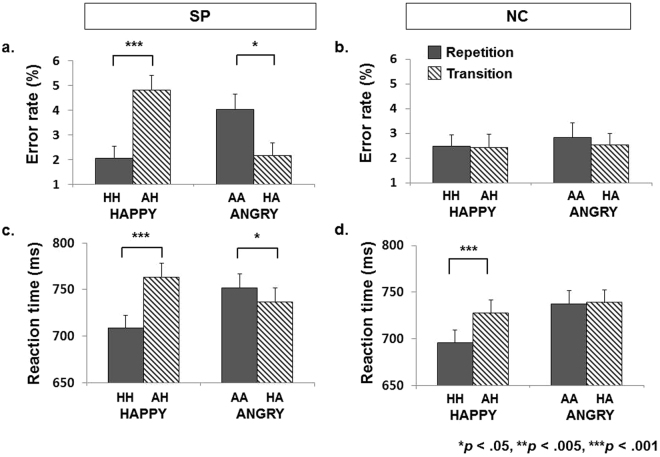
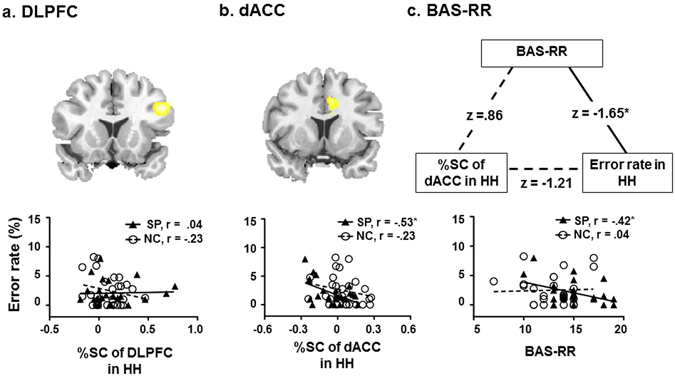
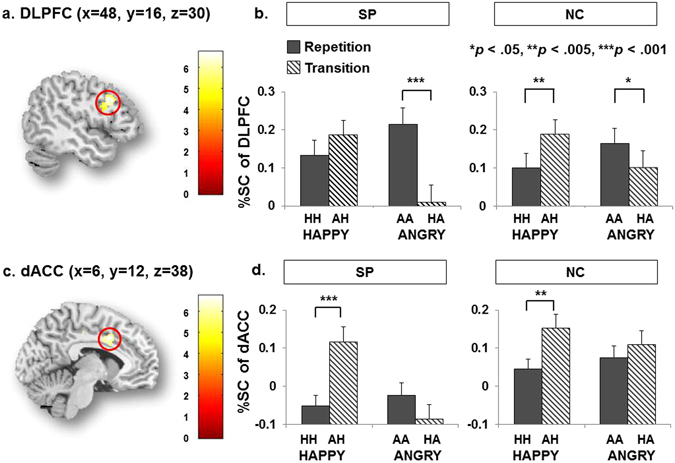
Excessive smartphone use is a phenomenon related to maladaptive smartphone use, leading to negative consequences. This study set out with the aim of assessing the effects of excessive smartphone use on behavioral and neural responses during facial emotional processing. We examined 25 excessive smartphone users and 27 normal control users using functional MRI during facial emotion processing and investigated Behavioral Inhibition System/Behavioral Activation System (BIS/BAS). The excessive smartphone use group (SP) showed neural deactivation in the dorsolateral prefrontal cortex (DLPFC) and dorsal anterior cingulate cortex (dACC) during the presentation of an angry face and emotional transition compared to that of the normal control group (NC). Additionally, the SP revealed neural deactivation of the superior temporal sulcus and temporo-parietal junction related to social interaction during emotional transition compared to the NC. We found that BAS-Reward Responsiveness level was correlated with behavioral responses during repeated happy faces related to emotional reward in SP compared to NC. It can thus be suggested that excessive smartphone use is likely to fail on cognitive control during emotional processing, and this impairment might be influenced on emotional processing related to social interaction.
Overview
The claims and statistics of this paper haven’t been checked yet.
Free: it reads the open-access text and checks the first 5 claims that cite a source we can check. Create a free account to check every claim.
Integrity signals
Registry
Cites
Statistics
Figures
Verification
Claims the paper makes
The claims and statistics of this paper haven’t been checked yet.
Free: it reads the open-access text and checks the first 5 claims that cite a source we can check. Create a free account to check every claim.
Claims other papers make about this one
Each is checked against this paper’s own text: does it say what the citing paper says it does?
The source backs part of the claim, not all of it — or backs it for a different population, condition or comparison.
In the citing paper
“Medical problems include sleep problems, reduced physical fitness, unhealthy eating habits, pain and migraines, reduced cognitive control and changes in the brain's gray matter volume.”
From Excessive Smartphone Use Is Associated With Health Problems in Adolescents and Young Adults (2021) · cites this paper as [82]
Experimental — accuracy not yet measuredThe source backs part of the claim, not all of it — or backs it for a different population, condition or comparison.
In the citing paper
“Excessive smartphone use is associated with difficulties in cognitive-emotion regulation, impulsivity, impaired cognitive function, addiction to social networking, shyness and low self-esteem.”
From Excessive Smartphone Use Is Associated With Health Problems in Adolescents and Young Adults (2021) · cites this paper as [82]
Experimental — accuracy not yet measuredThe source backs part of the claim, not all of it — or backs it for a different population, condition or comparison.
In the citing paper
“Recent studies have also shown an association between an excessive use of smartphones and abnormal activity of regions in the prefrontal cortex and in the networks that connect to these regions (29, 82).”
From Excessive Smartphone Use Is Associated With Health Problems in Adolescents and Young Adults (2021) · cites this paper as [82]
Experimental — accuracy not yet measured
Self-check
Percentages, sums and reported differences re-computed from the paper’s own numbers.
The self-check needs the paper’s full text.
Citations
Cites
The assessment and analysis of handedness: The Edinburgh inventory
Oldfield, R. C. (1971) · Neuropsychologia · doi:10.1016/0028-3932(71)90067-4 · Cited by 35,900
Carver, C. S., & White, T. L. (1994) · Journal of Personality and Social Psychology · doi:10.1037/0022-3514.67.2.319 · Cited by 7,306
The cognitive control of emotion
OCHSNER, K., & GROSS, J. (2005) · Trends in Cognitive Sciences · doi:10.1016/j.tics.2005.03.010 · Cited by 4,495
Conflict monitoring and anterior cingulate cortex: an update
Botvinick, M. M., Cohen, J. D., & Carter, C. S. (2004) · Trends in Cognitive Sciences · doi:10.1016/j.tics.2004.10.003 · Cited by 3,623
Anterior Cingulate Cortex, Error Detection, and the Online Monitoring of Performance
Carter, C. S., Braver, T. S., Barch, D. M., Botvinick, M. M., Noll, D., & Cohen, J. D. (1998) · Science · doi:10.1126/science.280.5364.747 · Cited by 3,273
Emotional processing in anterior cingulate and medial prefrontal cortex
Etkin, A., Egner, T., & Kalisch, R. (2011) · Trends in Cognitive Sciences · doi:10.1016/j.tics.2010.11.004 · Cited by 3,059
Anterior Cingulate Conflict Monitoring and Adjustments in Control
Kerns, J. G., Cohen, J. D., MacDonald, A. W., Cho, R. Y., Stenger, V. A., & Carter, C. S. (2004) · Science · doi:10.1126/science.1089910 · Cited by 2,891
Origins and functions of positive and negative affect: A control-process view.
Carver, C. S., & Scheier, M. F. (1990) · Psychological Review · doi:10.1037/0033-295x.97.1.19 · Cited by 2,726
Rethinking feelings: an fMRI study of the cognitive regulation of emotion
Ochsner, K. N., Bunge, S. A., Gross, J. J., & Gabrieli, J. D. E. (2002) · Journal of Cognitive Neuroscience · doi:10.1162/089892902760807212 · Cited by 2,520
People thinking about thinking peopleThe role of the temporo-parietal junction in “theory of mind”
Saxe, R., & Kanwisher, N. (2003) · NeuroImage · doi:10.1016/s1053-8119(03)00230-1 · Cited by 2,316
Ochsner, K. N., Ray, R. D., Cooper, J. C., Robertson, E. R., Chopra, S., Gabrieli, J. D. E., & Gross, J. J. (2004) · NeuroImage · doi:10.1016/j.neuroimage.2004.06.030 · Cited by 2,113
Conflict monitoring versus selection-for-action in anterior cingulate cortex
Botvinick, M., Nystrom, L. E., Fissell, K., Carter, C. S., & Cohen, J. D. (1999) · Nature · doi:10.1038/46035 · Cited by 2,044
Online Social Networking and Addiction—A Review of the Psychological Literature
Kuss, D. J., & Griffiths, M. D. (2011) · International Journal of Environmental Research and Public Health · doi:10.3390/ijerph8093528 · Cited by 2,038
Ochsner, K. N., Silvers, J. A., & Buhle, J. T. (2012) · Annals of the New York Academy of Sciences · doi:10.1111/j.1749-6632.2012.06751.x · Cited by 1,879
Neurobiology of emotion perception II: implications for major psychiatric disorders
Phillips, M. L., Drevets, W. C., Rauch, S. L., & Lane, R. (2003) · Biological Psychiatry · doi:10.1016/s0006-3223(03)00171-9 · Cited by 1,736
Psychological Predictors of Problem Mobile Phone Use
Bianchi, A., & Phillips, J. G. (2005) · CyberPsychology & Behavior · doi:10.1089/cpb.2005.8.39 · Cited by 1,514
Context, cortex, and dopamine: A connectionist approach to behavior and biology in schizophrenia.
Cohen, J. D., & Servan-Schreiber, D. (1992) · Psychological Review · doi:10.1037/0033-295x.99.1.45 · Cited by 1,479
Right hemispheric dominance of inhibitory control: An event-related functional MRI study
Garavan, H., Ross, T. J., & Stein, E. A. (1999) · Proceedings of the National Academy of Sciences · doi:10.1073/pnas.96.14.8301 · Cited by 1,394
Human neural systems for face recognition and social communication
Haxby, J. V., Hoffman, E. A., & Gobbini, M. I. (2002) · Biological Psychiatry · doi:10.1016/s0006-3223(01)01330-0 · Cited by 1,287
The neural bases of emotion regulation
Etkin, A., Büchel, C., & Gross, J. J. (2015) · Nature Reviews Neuroscience · doi:10.1038/nrn4044 · Cited by 1,244
Billieux, J., Maurage, P., Lopez-Fernandez, O., Kuss, D. J., & Griffiths, M. D. (2015) · Current Addiction Reports · doi:10.1007/s40429-015-0054-y · Cited by 1,205
Neural correlates of conscious self-regulation of emotion
Beauregard, M., Lévesque, J., & Bourgouin, P. (2001) · The Journal of Neuroscience · doi:10.1523/jneurosci.21-18-j0001.2001 · Cited by 1,033
Modification in the Proposed Diagnostic Criteria for Internet Addiction
Beard, K. W., & Wolf, E. M. (2001) · CyberPsychology & Behavior · doi:10.1089/109493101300210286 · Cited by 1,008 · cited 1×
“Post hoc tests for interactions and correlation analysis were performed on the a priori regions of interest (ROIs), which were defined as significant clusters within fronto-cingulate regions including the dACC [6, 10, 38] and DLPFC [48, 16, 32] related to cognitive control for emotional faces in group.”
MethodThe dark side of smartphone usage: Psychological traits, compulsive behavior and technostress
Lee, Y.-K., Chang, C.-T., Lin, Y., & Cheng, Z.-H. (2014) · Computers in Human Behavior · doi:10.1016/j.chb.2013.10.047 · Cited by 1,007
Situational coping and coping dispositions in a stressful transaction.
Carver, C. S., & Scheier, M. F. (1994) · Journal of Personality and Social Psychology · doi:10.1037//0022-3514.66.1.184 · Cited by 963
Making sense of another mind: The role of the right temporo-parietal junction
SAXE, R., & WEXLER, A. (2005) · Neuropsychologia · doi:10.1016/j.neuropsychologia.2005.02.013 · Cited by 926
Phan, K. L., Fitzgerald, D. A., Nathan, P. J., Moore, G. J., Uhde, T. W., & Tancer, M. E. (2005) · Biological Psychiatry · doi:10.1016/j.biopsych.2004.10.030 · Cited by 892
Affective style, psychopathology, and resilience: Brain mechanisms and plasticity
Davidson, R. J. (2000) · American Psychologist · doi:10.1037/0003-066x.55.11.1196 · Cited by 890
Perspectives on anxiety and impulsivity: A commentary
Gray, J. A. (1987) · Journal of Research in Personality · doi:10.1016/0092-6566(87)90036-5 · Cited by 832
Barker, V. (2009) · CyberPsychology & Behavior · doi:10.1089/cpb.2008.0228 · Cited by 781
Negative Affects Deriving From the Behavioral Approach System.
Carver, C. S. (2004) · Emotion · doi:10.1037/1528-3542.4.1.3 · Cited by 661
Anterior cingulate cortex, conflict monitoring, and levels of processing
van Veen, V., Cohen, J. D., Botvinick, M. M., Stenger, V. A., & Carter, C. S. (2001) · NeuroImage · doi:10.1006/nimg.2001.0923 · Cited by 656
Development and validation of the Smartphone Addiction Inventory (SPAI)
Lin, Y.-H., Chang, L.-R., Lee, Y.-H., Tseng, H.-W., Kuo, T. B. J., & Chen, S.-H. (2014) · PLoS ONE · doi:10.1371/journal.pone.0098312 · Cited by 611
The role of impulsivity in actual and problematic use of the mobile phone
Billieux, J., Van der Linden, M., & Rochat, L. (2008) · Applied Cognitive Psychology · doi:10.1002/acp.1429 · Cited by 604
Characterizing Dynamic Brain Responses with fMRI: A Multivariate Approach
Friston, K. J., Frith, C. D., Frackowiak, R. S. J., & Turner, R. (1995) · NeuroImage · doi:10.1006/nimg.1995.1019 · Cited by 568
McNaughton, N., & Gray, J. A. (2000) · Journal of Affective Disorders · doi:10.1016/s0165-0327(00)00344-x · Cited by 553
Inhibition in verbal working memory revealed by brain activation
Jonides, J., Smith, E. E., Marshuetz, C., Koeppe, R. A., & Reuter-Lorenz, P. A. (1998) · Proceedings of the National Academy of Sciences · doi:10.1073/pnas.95.14.8410 · Cited by 543
Prefrontal regions involved in keeping information in and out of mind
Bunge, S. A. (2001) · Brain · doi:10.1093/brain/124.10.2074 · Cited by 527
Personality and self reported mobile phone use
Butt, S., & Phillips, J. G. (2008) · Computers in Human Behavior · doi:10.1016/j.chb.2007.01.019 · Cited by 517
Fales, C. L., Barch, D. M., Rundle, M. M., Mintun, M. A., Snyder, A. Z., Cohen, J. D., Mathews, J., & Sheline, Y. I. (2008) · Biological Psychiatry · doi:10.1016/j.biopsych.2007.06.012 · Cited by 517
Personality and self-esteem as predictors of young people's technology use
Ehrenberg, A., Juckes, S., White, K. M., & Walsh, S. P. (2008) · CyberPsychology & Behavior · doi:10.1089/cpb.2008.0030 · Cited by 488
Choi, S.-W., Kim, D.-J., Choi, J.-S., Ahn, H., Choi, E.-J., Song, W.-Y., Kim, S., & Youn, H. (2015) · Journal of Behavioral Addictions · doi:10.1556/2006.4.2015.043 · Cited by 476
Self-citationAmodio, D. M., Master, S. L., Yee, C. M., & Taylor, S. E. (2008) · Psychophysiology · doi:10.1111/j.1469-8986.2007.00609.x · Cited by 463 · cited 1×
“Post hoc tests for interactions and correlation analysis were performed on the a priori regions of interest (ROIs), which were defined as significant clusters within fronto-cingulate regions including the dACC [6, 10, 38] and DLPFC [48, 16, 32] related to cognitive control for emotional faces in group.”
MethodAssociations between problematic mobile phone use and psychological parameters in young adults
Augner, C., & Hacker, G. W. (2012) · International Journal of Public Health · doi:10.1007/s00038-011-0234-z · Cited by 427 · cited 1×
“Post hoc tests for interactions and correlation analysis were performed on the a priori regions of interest (ROIs), which were defined as significant clusters within fronto-cingulate regions including the dACC [6, 10, 38] and DLPFC [48, 16, 32] related to cognitive control for emotional faces in group.”
MethodAddictive Personality and Problematic Mobile Phone Use
Takao, M., Takahashi, S., & Kitamura, M. (2009) · CyberPsychology & Behavior · doi:10.1089/cpb.2009.0022 · Cited by 423
Lopez-Fernandez, O. (2017) · Addictive Behaviors · doi:10.1016/j.addbeh.2015.11.013 · Cited by 358
Information processing in social phobia: A critical review
Heinrichs, N., & Hofmann, S. G. (2001) · Clinical Psychology Review · doi:10.1016/s0272-7358(00)00067-2 · Cited by 351
Dissociation between conflict detection and error monitoring in the human anterior cingulate cortex
Swick, D., & Turken, A. U. (2002) · Proceedings of the National Academy of Sciences · doi:10.1073/pnas.252521499 · Cited by 334
Billieux, J., Philippot, P., Schmid, C., Maurage, P., De Mol, J., & Van der Linden, M. (2015) · Clinical Psychology & Psychotherapy · doi:10.1002/cpp.1910 · Cited by 329
Text or Talk? Social Anxiety, Loneliness, and Divergent Preferences for Cell Phone Use
Reid, D. J., & Reid, F. J. M. (2007) · CyberPsychology & Behavior · doi:10.1089/cpb.2006.9936 · Cited by 317
Kerns, J. G. (2006) · NeuroImage · doi:10.1016/j.neuroimage.2006.06.012 · Cited by 311
Modulation of Amygdalar Activity by the Conscious Regulation of Negative Emotion
Schaefer, S. M., Jackson, D. C., Davidson, R. J., Aguirre, G. K., Kimberg, D. Y., & Thompson-Schill, S. L. (2002) · Journal of Cognitive Neuroscience · doi:10.1162/089892902760191135 · Cited by 306
Characteristics of excessive cellular phone use in Korean adolescents
Ha, J. H., Chin, B., Park, D.-H., Ryu, S.-H., & Yu, J. (2008) · CyberPsychology & Behavior · doi:10.1089/cpb.2008.0096 · Cited by 304
Lombardo, M. V., Chakrabarti, B., Bullmore, E. T., & Baron-Cohen, S. (2011) · NeuroImage · doi:10.1016/j.neuroimage.2011.02.067 · Cited by 275
Kwon, J.-H., Chung, C.-S., & Lee, J. (2011) · Community Mental Health Journal · doi:10.1007/s10597-009-9236-1 · Cited by 258
Factors influencing smartphone use and dependency in South Korea
Park, N., Kim, Y.-C., Shon, H. Y., & Shim, H. (2013) · Computers in Human Behavior · doi:10.1016/j.chb.2013.02.008 · Cited by 250
Kim, Y., Jeong, J.-E., Cho, H., Jung, D.-J., Kwak, M., Rho, M. J., Yu, H., Kim, D.-J., & Choi, I. Y. (2016) · PLOS ONE · doi:10.1371/journal.pone.0159788 · Cited by 227
Self-citationNeural Activation During Response Competition
Hazeltine, E., Poldrack, R., & Gabrieli, J. D. E. (2000) · Journal of Cognitive Neuroscience · doi:10.1162/089892900563984 · Cited by 225
Gray's model of personality and addiction
Franken, I. H. A., Muris, P., & Georgieva, I. (2006) · Addictive Behaviors · doi:10.1016/j.addbeh.2005.05.022 · Cited by 220
Addiction: Pulling at the Neural Threads of Social Behaviors
Volkow, N. D., Baler, R. D., & Goldstein, R. Z. (2011) · Neuron · doi:10.1016/j.neuron.2011.01.027 · Cited by 218
Affective personality differences in neural processing efficiency confirmed using fMRI
GRAY, J. R., BURGESS, G. C., SCHAEFER, A., YARKONI, T., LARSEN, R. J., & BRAVER, T. S. (2005) · Cognitive, Affective, & Behavioral Neuroscience · doi:10.3758/cabn.5.2.182 · Cited by 212
Lam, L. T.-M. (2014) · Current Psychiatry Reports · doi:10.1007/s11920-014-0508-2 · Cited by 202
Behavioral approach system (BAS) sensitivity predicts alcohol craving
Franken, I. H. A. (2002) · Personality and Individual Differences · doi:10.1016/s0191-8869(01)00030-7 · Cited by 187
Nonhuman Primate Models to Study Anxiety, Emotion Regulation, and Psychopathology
KALIN, N. H., & SHELTONA, S. E. (2003) · Annals of the New York Academy of Sciences · doi:10.1196/annals.1301.021 · Cited by 171
Song, S., Zilverstand, A., Song, H., d’Oleire Uquillas, F., Wang, Y., Xie, C., Cheng, L., & Zou, Z. (2017) · Scientific Reports · doi:10.1038/s41598-017-02266-2 · Cited by 160
Deficits in visual cognition and attention following bilateral anterior cingulotomy
Ochsner, K. N., Kosslyn, S. M., Cosgrove, G. R., Cassem, E. H., Price, B. H., Nierenberg, A. A., & Rauch, S. L. (2001) · Neuropsychologia · doi:10.1016/s0028-3932(00)00114-7 · Cited by 141
Wang, E. S.-T., & Wang, M. C.-H. (2013) · Cyberpsychology, Behavior, and Social Networking · doi:10.1089/cyber.2012.0557 · Cited by 134
Goossens, L., van Roekel, E., Verhagen, M., Cacioppo, J. T., Cacioppo, S., Maes, M., & Boomsma, D. I. (2015) · Perspectives on Psychological Science · doi:10.1177/1745691614564878 · Cited by 103
Ye, Y., & Lin, L. (2015) · Psychological Reports · doi:10.2466/07.09.pr0.116k14w3 · Cited by 94
Chou, W., Liu, T., Yang, P., Yen, C., & Hu, H. (2014) · Psychiatry Research · doi:10.1016/j.psychres.2014.11.003 · Cited by 88 · cited 1×
“Post hoc tests for interactions and correlation analysis were performed on the a priori regions of interest (ROIs), which were defined as significant clusters within fronto-cingulate regions including the dACC [6, 10, 38] and DLPFC [48, 16, 32] related to cognitive control for emotional faces in group.”
MethodWang, Y., Zou, Z., Song, H., Xu, X., Wang, H., d’Oleire Uquillas, F., & Huang, X. (2016) · Frontiers in Psychology · doi:10.3389/fpsyg.2016.00597 · Cited by 73
(2007) · Cited by 65
Zisserson, R. N., & Palfai, T. P. (2007) · Addictive Behaviors · doi:10.1016/j.addbeh.2007.02.016 · Cited by 60
Simons, J. S., Dvorak, R. D., & Lau-Barraco, C. (2009) · Psychology of Addictive Behaviors · doi:10.1037/a0015834 · Cited by 44
Development and Standardization of Extended ChaeLee Korean Facial Expressions of Emotions
Lee, K., Kim, J., Yeon, B., Kim, S., & Chae, J. (2013) · Psychiatry Investigation · doi:10.4306/pi.2013.10.2.155 · Cited by 40
Self-citationLangner, O., Becker, E. S., & Rinck, M. (2009) · Psychological Science · doi:10.1111/j.1467-9280.2009.02357.x · Cited by 40
Chun, J.-W., Choi, J., Cho, H. I., Lee, S., & Kim, D. J. (2015) · Translational Psychiatry · doi:10.1038/tp.2015.106 · Cited by 37
Self-citationGray, A. C., McLeod, J., & Clothier, R. H. (2007) · Alternatives to Laboratory Animals · doi:10.1177/026119290703500509 · Cited by 24
Contribution of fronto-striatal regions to emotional valence and repetition under cognitive conflict
Chun, J., Park, H., Kim, D., Kim, E., & Kim, J. (2017) · Brain Research · doi:10.1016/j.brainres.2017.04.018 · Cited by 9
Self-citation
Cited by
Excessive Smartphone Use Is Associated With Health Problems in Adolescents and Young Adults
Wacks, Y., & Weinstein, A. M. (2021) · Frontiers in Psychiatry · doi:10.3389/fpsyt.2021.669042 · Cited by 424
“Excessive smartphone users have shown impairment in cognitive control during emotional processing of angry faces and social interaction in fMRI (82).”
BackgroundStructural and functional correlates of smartphone addiction
Horvath, J., Mundinger, C., Schmitgen, M. M., Wolf, N. D., Sambataro, F., Hirjak, D., Kubera, K. M., Koenig, J., & Christian Wolf, R. (2020) · Addictive Behaviors · doi:10.1016/j.addbeh.2020.106334 · Cited by 190
Digital Addiction: Increased Loneliness, Anxiety, and Depression
Peper, E., & Harvey, R. (2018) · NeuroRegulation · doi:10.15540/nr.5.1.3 · Cited by 129
“In social situations, constant phone interruptions cause those involved to feel slighted and snubbed (Chun et al., 2017; Vaghefi & Lapointe, 2014).”
BackgroundRole of Frontostriatal Connectivity in Adolescents With Excessive Smartphone Use
Chun, J.-W., Choi, J., Cho, H., Choi, M.-R., Ahn, K.-J., Choi, J.-S., & Kim, D.-J. (2018) · Frontiers in Psychiatry · doi:10.3389/fpsyt.2018.00437 · Cited by 66
“Moreover, in a study using emotional faces, individuals with SP showed lower activity in frontocingulate regions compared with healthy individuals (57).”
BackgroundSelf-citationNeural correlates of cue reactivity in individuals with smartphone addiction
Schmitgen, M. M., Horvath, J., Mundinger, C., Wolf, N. D., Sambataro, F., Hirjak, D., Kubera, K. M., Koenig, J., & Wolf, R. C. (2020) · Addictive Behaviors · doi:10.1016/j.addbeh.2020.106422 · Cited by 79
Metadata
- Authors
- Chun, J.-W., Choi, J., Kim, J.-Y., Cho, H., Ahn, K.-J., Nam, J.-H., Choi, J.-S., & Kim, D.-J.
- Affiliations
- The Catholic University of Korea Seoul St. Mary's Hospital (KR)
- Seoul National University (KR)
- Catholic University of Korea (KR)
- Corresponding author
- Kim, Jin-Young
- Kim, Dai-Jin
- Venue
- Scientific Reports
- Published
- 2017-09-22
- Volume
- 7
- Issue
- 1
- Pages
- 12156-12156
- ISSN
- 2045-2322 (ISSN-L)
- PMC
- PMC5610339
- OpenAlex
- W2754218130
- Cited by
- 60
- References
- 81
- Citations by year
- 2026: 7 · 2025: 11 · 2024: 8 · 2023: 7 · 2022: 10 · 2021: 6 · 2020: 5 · 2019: 4 · 2018: 2
- FWCI
- 7.70
- Type
- journal article
- Language
- en
- Open access
- gold
- doi.org
- Licence
- cc-by
- creativecommons.org/licenses/by/4.0 (tdm)
- creativecommons.org/licenses/by/4.0 (vor)
- Locations
- Scientific Reports (publishedVersion, cc-by)
- Europe PMC (PubMed Central) (publishedVersion, cc-by)
- PubMed Central (publishedVersion, cc-by)
- PubMed (publishedVersion)
- Funders
- National Research Foundation
- National Research Foundation of Korea (NRF-2014M3C7A1062893, 2014M3C7A1062893)
- Topics
- Social Sciences › Sociology and Political Science › Impact of Technology on Adolescents
- Life Sciences › Neuroscience › Cognitive Neuroscience › Neural and Behavioral Psychology Studies
- Social Sciences › Psychology › Clinical Psychology › Historical and Modern Theater Studies
- Keywords
- smartphone overuse, emotional face processing, personality traits, behavioral inhibition system, behavioral activation system, reward responsiveness, dorsolateral prefrontal cortex, dorsal anterior cingulate cortex, superior temporal sulcus, temporoparietal junction, neural deactivation, cognitive control, emotional processing, social interaction
- MeSH terms
- Smartphone, Adult, Anger, Brain, Brain Mapping, Emotions, Facial Expression, Female, Humans, Interpersonal Relations, Magnetic Resonance Imaging, Male, Personality, Prefrontal Cortex, Young Adult
About these checks
Registry, retraction, Cites and statistics results are computed, not judged, with one exception: a printed reference that no index lists is read once by a model before it counts as a citation error. Claims are extracted by a model and kept only when their quote appears verbatim in the text; each cited source is then checked, with a model’s help, for whether it says what the claim relies on. Those verdicts can be wrong — read the claim’s quote and the cited source before relying on one.
Statistics and arithmetic are recomputed, not judged.
Confidence bands are shown only for fields calibrated on our annotated test set. None is calibrated yet, so no band is shown.
What counts as a claim ›How we measure confidence ›How we check this ›
Are you an author, or do you see a problem with this page? Request a review
Data sources
Bibliographic data: Semantic Scholar, OpenAlex, Crossref.
Contains information from the Semantic Scholar Academic Graph Datasets, made available under the ODC Attribution License (ODC-BY 1.0).
Semantic Scholar’s data is described in: Kinney, R., et al. (2023). The Semantic Scholar Open Data Platform. arXiv:2301.10140.
