

The DOI matches its Crossref record; 83 of the 83 references it cites were found in a registry or an index.
Gut microbiome alterations in Alzheimer’s disease
Open accessAbstract
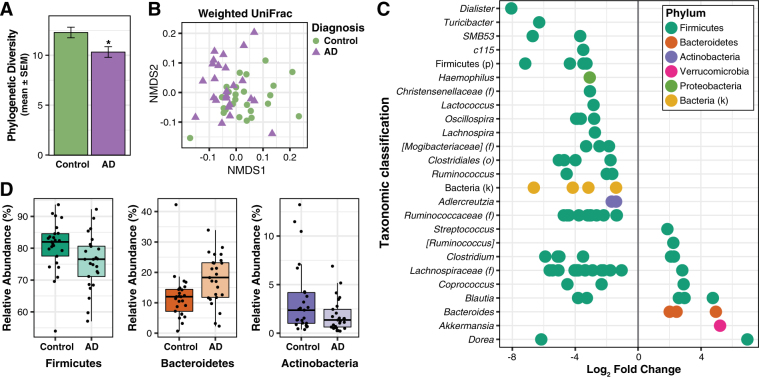
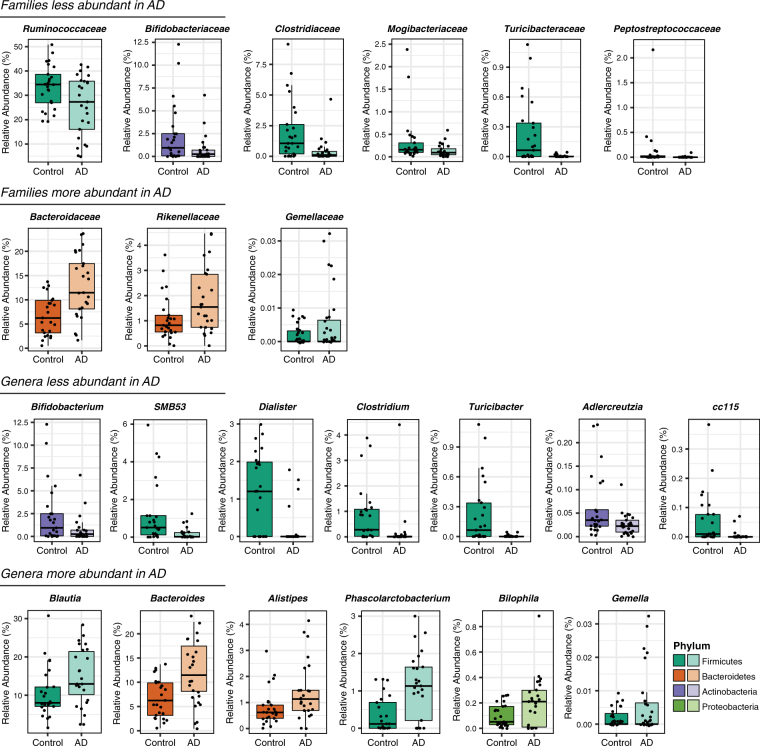
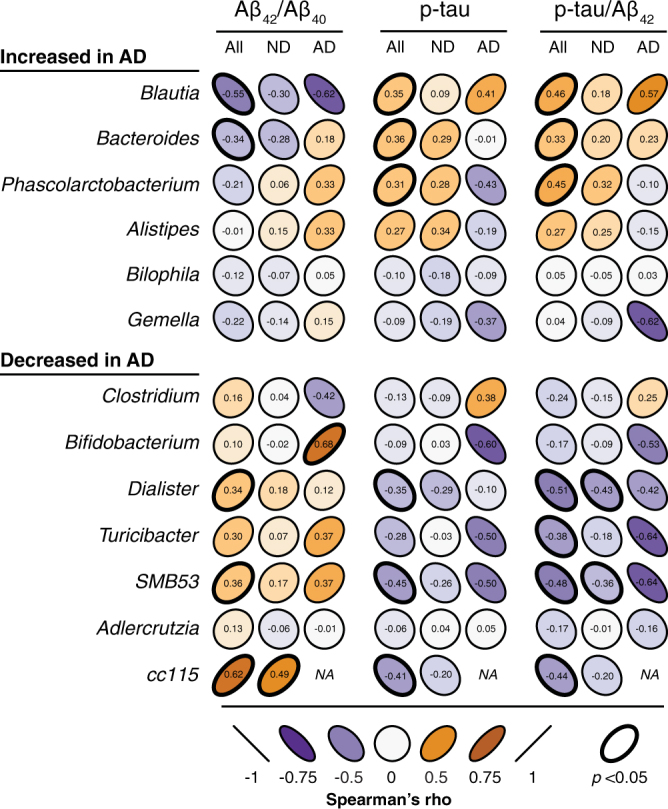
Alzheimer’s disease (AD) is the most common form of dementia. However, the etiopathogenesis of this devastating disease is not fully understood. Recent studies in rodents suggest that alterations in the gut microbiome may contribute to amyloid deposition, yet the microbial communities associated with AD have not been characterized in humans. Towards this end, we characterized the bacterial taxonomic composition of fecal samples from participants with and without a diagnosis of dementia due to AD. Our analyses revealed that the gut microbiome of AD participants has decreased microbial diversity and is compositionally distinct from control age- and sex-matched individuals. We identified phylum- through genus-wide differences in bacterial abundance including decreased Firmicutes, increased Bacteroidetes, and decreased Bifidobacterium in the microbiome of AD participants. Furthermore, we observed correlations between levels of differentially abundant genera and cerebrospinal fluid (CSF) biomarkers of AD. These findings add AD to the growing list of diseases associated with gut microbial alterations, as well as suggest that gut bacterial communities may be a target for therapeutic intervention.
Overview
The claims and statistics of this paper haven’t been checked yet.
Run the check — free, no account needed. It reads the open-access text and checks the sources it cites.
Integrity signals
Registry
Cites
Statistics
Figures
Verification
Claims the paper makes
The claims and statistics of this paper haven’t been checked yet.
Run the check — free, no account needed. It reads the open-access text and checks the sources it cites.
Claims other papers make about this one
Each is checked against this paper’s own text: does it say what the citing paper says it does?
The source backs part of the claim, not all of it — or backs it for a different population, condition or comparison.
In the citing paper
“A variety of genetic and environmental factors have been implicated in AD etiopathogenesis, including contributions from gut microbiota [13–15].”
From The gut microbiota-derived metabolite trimethylamine N-oxide is elevated in Alzheimer’s disease (2018) · cites this paper as [15]
Experimental — accuracy not yet measuredThe source backs part of the claim, not all of it — or backs it for a different population, condition or comparison.
In the citing paper
“Diseases of cognitive decline, such as Alzheimer's disease and vascular dementia, are associated with aberrant microbial compositions when compared with healthy controls (297).”
From Diet and the Microbiota–Gut–Brain Axis: Sowing the Seeds of Good Mental Health (2021) · cites this paper as [297]
Experimental — accuracy not yet measuredThe source backs part of the claim, not all of it — or backs it for a different population, condition or comparison.
In the citing paper
“These include reductions in beneficial genera such as Lactobacillus and Bifidobacterium, alongside increases in pro-inflammatory taxa like Enterobacteriaceae64.”
From Artificial intelligence-driven multi-omics approaches in Alzheimer's disease: Progress, challenges, and future directions (2025) · cites this paper as [64]
Experimental — accuracy not yet measuredThe source backs part of the claim, not all of it — or backs it for a different population, condition or comparison.
In the citing paper
“Studies using 16S rRNA gene sequencing and shotgun metagenomic sequencing have consistently identified significant changes in the gut microbiota composition of individuals with AD.”
From Artificial intelligence-driven multi-omics approaches in Alzheimer's disease: Progress, challenges, and future directions (2025) · cites this paper as [64]
Experimental — accuracy not yet measuredIn the citing paper
“Human studies show associations between gut microbiota and neurodegenerative diseases148.”
From Microglia in neurodegeneration (2018) · cites this paper as [148]
In the citing paper
“Human studies comparing the composition of the GM of elderly participants suffering from cognitive impairment with healthy individuals indicate significant changes in GM composition. Specifically, there is an increase in pro-inflammatory taxa and a reduction in anti-inflammatory taxa (104–109).”
From Signalling cognition: The gut microbiota and hypothalamic-pituitary-adrenal axis (2023) · cites this paper as [105]
In the citing paper
“Within the Firmicutes, the families Ruminococcaceae, Turicibacteraceae, and Clostridiaceae were all less abundant in AD patient (160).”
From The gut-brain axis: how microbiota and host inflammasome influence brain physiology and pathology (2020) · cites this paper as [160]
Self-check
Percentages, sums and reported differences re-computed from the paper’s own numbers.
The self-check needs the paper’s full text.
Citations
Cites
Moderated estimation of fold change and dispersion for RNA-seq data with DESeq2
Love, M. I., Huber, W., & Anders, S. (2014) · Genome Biology · doi:10.1186/s13059-014-0550-8 · Cited by 95,106
Schloss, P. D., Westcott, S. L., Ryabin, T., Hall, J. R., Hartmann, M., Hollister, E. B., Lesniewski, R. A., Oakley, B. B., Parks, D. H., Robinson, C. J., et al. (2009) · Applied and Environmental Microbiology · doi:10.1128/aem.01541-09 · Cited by 19,549
McKhann, G. M., Knopman, D. S., Chertkow, H., Hyman, B. T., Jack, C. R., Kawas, C. H., Klunk, W. E., Koroshetz, W. J., Manly, J. J., Mayeux, R., et al. (2011) · Alzheimer's & Dementia · doi:10.1016/j.jalz.2011.03.005 · Cited by 18,657
Metagenomic biomarker discovery and explanation
Segata, N., Izard, J., Waldron, L., Gevers, D., Miropolsky, L., Garrett, W. S., & Huttenhower, C. (2011) · Genome Biology · doi:10.1186/gb-2011-12-6-r60 · Cited by 16,192
Structure, function and diversity of the healthy human microbiome
The Human Microbiome Project Consortium (2012) · Nature · doi:10.1038/nature11234 · Cited by 11,726
Predictive functional profiling of microbial communities using 16S rRNA marker gene sequences
Langille, M. G. I., Zaneveld, J., Caporaso, J. G., McDonald, D., Knights, D., Reyes, J. A., Clemente, J. C., Burkepile, D. E., Vega Thurber, R. L., Knight, R., et al. (2013) · Nature Biotechnology · doi:10.1038/nbt.2676 · Cited by 9,116
A core gut microbiome in obese and lean twins
Turnbaugh, P. J., Hamady, M., Yatsunenko, T., Cantarel, B. L., Duncan, A., Ley, R. E., Sogin, M. L., Jones, W. J., Roe, B. A., Affourtit, J. P., et al. (2009) · Nature · doi:10.1038/nature07540 · Cited by 7,823
Kozich, J. J., Westcott, S. L., Baxter, N. T., Highlander, S. K., & Schloss, P. D. (2013) · Applied and Environmental Microbiology · doi:10.1128/aem.01043-13 · Cited by 7,246
Metabolic Endotoxemia Initiates Obesity and Insulin Resistance
Cani, P. D., Amar, J., Iglesias, M. A., Poggi, M., Knauf, C., Bastelica, D., Neyrinck, A. M., Fava, F., Tuohy, K. M., Chabo, C., et al. (2007) · Diabetes · doi:10.2337/db06-1491 · Cited by 6,638
Obesity alters gut microbial ecology
Ley, R. E., Bäckhed, F., Turnbaugh, P., Lozupone, C. A., Knight, R. D., & Gordon, J. I. (2005) · Proceedings of the National Academy of Sciences · doi:10.1073/pnas.0504978102 · Cited by 6,176
Cited by
Sorted by citations
Items 1,001–1,007 of 1,007
The endocannabinoid system: a bridge between alzheimer’s disease and gut microbiota
Bisogno, T., Lauritano, A., & Piscitelli, F. (2021) · Life · doi:10.3390/life11090934 · Cited by 16
Potential Role for Herpesviruses in Alzheimer’s Disease
Duggan, M. R., Torkzaban, B., Ahooyi, T. M., & Khalili, K. (2020) · Journal of Alzheimer's Disease · doi:10.3233/jad-200814 · Cited by 13
Clostridioides difficile and neurological disorders: new perspectives
Biazzo, M., Allegra, M., & Deidda, G. (2022) · Frontiers in Neuroscience · doi:10.3389/fnins.2022.946601 · Cited by 11
A reappraisal on amyloid cascade hypothesis: The role of chronic infection in Alzheimer’s disease
Phuna, Z. X., & Madhavan, P. (2023) · International Journal of Neuroscience · doi:10.1080/00207454.2022.2045290 · Cited by 12
Rode, J., Hutchinson, A. N., Chatzopoulou, M. S., Bleiel, S. B., Gebresenbet, R. F., Andersson, L., Persson, J., Daillère, R., Beitz, B., Ben Abdallah, B., et al. (2025) · Brain, Behavior, and Immunity · doi:10.1016/j.bbi.2025.106113 · Cited by 11
Song, M., & Fan, X. (2023) · International Journal of Molecular Sciences · doi:10.3390/ijms24098398 · Cited by 11
Dumitru, C. N., Dumitru, A. O., Popa, G. V., Marcu, T., Ursu, M., Nechita, A., & Matei, N. M. (2026) · Dentistry Journal · doi:10.3390/dj14050289 · Cited by 6
Metadata
- Authors
- Vogt, N. M., Kerby, R. L., Dill-McFarland, K. A., Harding, S. J., Merluzzi, A. P., Johnson, S. C., Carlsson, C. M., Asthana, S., Zetterberg, H., Blennow, K., Bendlin, B. B., & Rey, F. E.
- Affiliations
- University of Wisconsin–Madison (US)
- Sahlgrenska University Hospital (SE)
- Corresponding author
- Bendlin, Barbara B.
- Rey, Federico E.
- ORCID
- Venue
- Scientific Reports
- Published
- 2017-10-19
- Volume
- 7
- Issue
- 1
- Pages
- 13537-13537
- ISSN
- 2045-2322 (ISSN-L)
- PMC
- PMC5648830
- OpenAlex
- W2761210275
- Cited by
- 2,137
- References
- 83
- Citations by year
- 2026: 205 · 2025: 322 · 2024: 328 · 2023: 269 · 2022: 339 · 2021: 283 · 2020: 205 · 2019: 119 · 2018: 64 · 2017: 1
- FWCI
- 43.23
- Type
- journal article
- Language
- en
- Open access
- gold
- doi.org
- Locations
- Scientific Reports (publishedVersion, cc-by)
- PubMed Central (publishedVersion, cc-by)
- PubMed (publishedVersion)
- UCL Discovery (University College London) (submittedVersion, cc-by)
- DOAJ (DOAJ: Directory of Open Access Journals) (submittedVersion)
- Funders
- Alzheimer's Association (R01 AG027161, R01 AG037639, R01 AG021155)
- Torsten Söderbergs Stiftelse
- Rush University
- Georgia Clinical and Translational Science Alliance (UL1TR000427)
- Royal Swedish Academy of Sciences
- Vetenskapsrådet
- National Institutes of Health (UL1TR000427, NIH P50, AG027161, AG037639, NIH P50 AG033514, AG033514)
- Institute for Clinical and Translational Research, University of Wisconsin, Madison (UL1TR000427)
- National Institute on Aging (RF1AG027161, R01AG037639, P50AG033514, R01AG021155, R01AG027161, R56AG037639)
- National Institute of General Medical Sciences (T32GM008692)
- National Center for Advancing Translational Sciences
- Topics
- Life Sciences › Biochemistry, Genetics and Molecular Biology › Molecular Biology › Gut microbiota and health
- Life Sciences › Neuroscience › Cellular and Molecular Neuroscience › Alzheimer's disease research and treatments
- Health Sciences › Medicine › Psychiatry and Mental health › Dementia and Cognitive Impairment Research
- Keywords
- Alzheimer's disease, gut microbiota, dementia, fecal microbiota, microbial diversity, Firmicutes, Bacteroidetes, Bifidobacterium, cerebrospinal fluid biomarkers, amyloid deposition, gut-brain axis, therapeutic target
- MeSH terms
- Bacillota, Gastrointestinal Microbiome, Aged, Alzheimer Disease, Bifidobacterium, Feces, Female, Humans, Male, Biomarkers, Case-Control Studies, tau Proteins, Bacteroidetes
About these checks
Registry, retraction, Cites and statistics results are computed, not judged, with one exception: a printed reference that no index lists is read once by a model before it counts as a citation error. Claims are extracted by a model and kept only when their quote appears verbatim in the text; each cited source is then checked, with a model’s help, for whether it says what the claim relies on. Those verdicts can be wrong — read the claim’s quote and the cited source before relying on one.
Statistics and arithmetic are recomputed, not judged.
Confidence bands are shown only for fields calibrated on our annotated test set. None is calibrated yet, so no band is shown.
What counts as a claim ›How we measure confidence ›How we check this ›
Are you an author, or do you see a problem with this page? Request a review
