

Evidence that the Great Pacific Garbage Patch is rapidly accumulating plastic
Open accessThe DOI matches its Crossref record; 55 of the 56 references it cites were found in a registry or an index.
Abstract
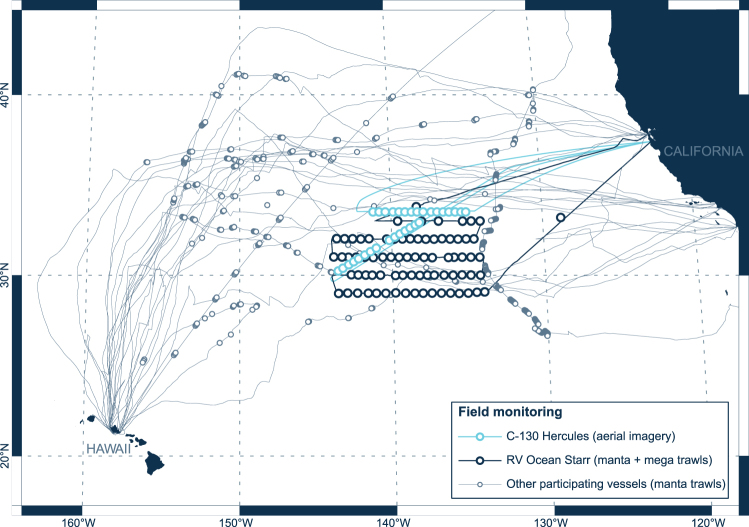
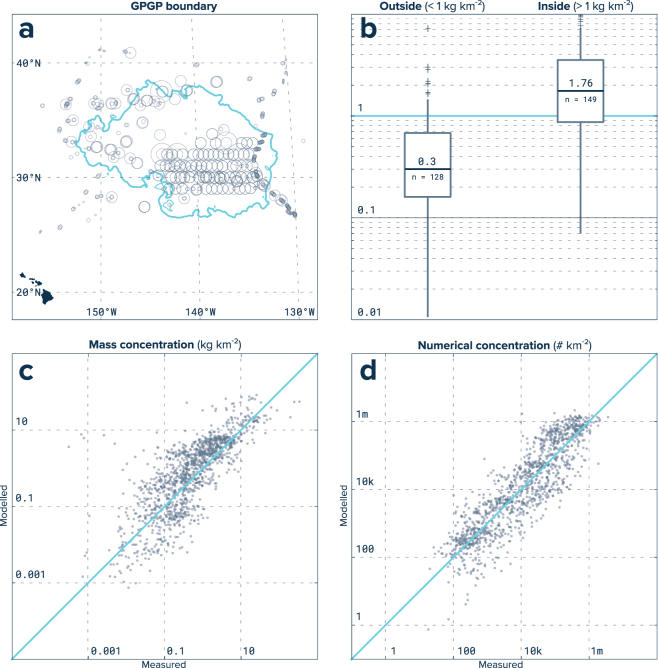
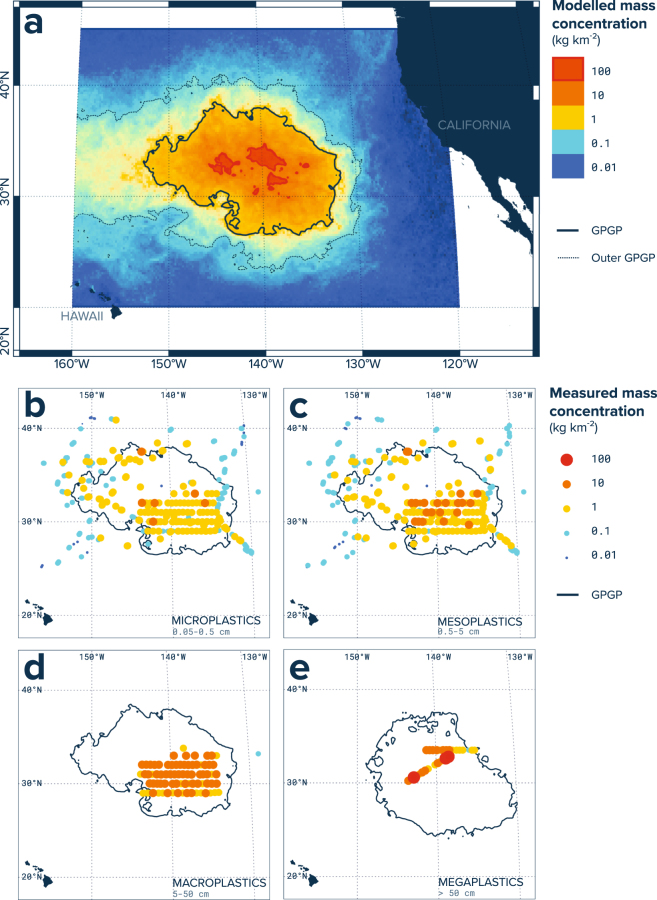
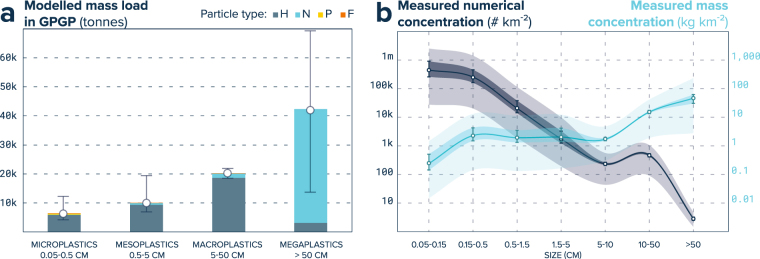
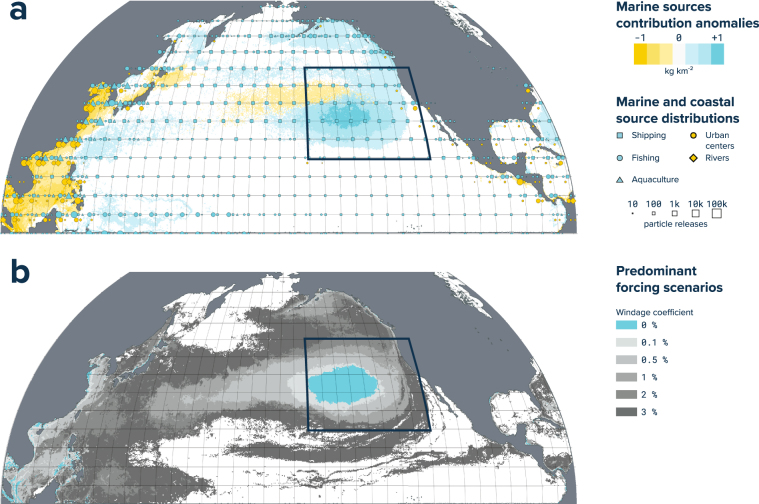
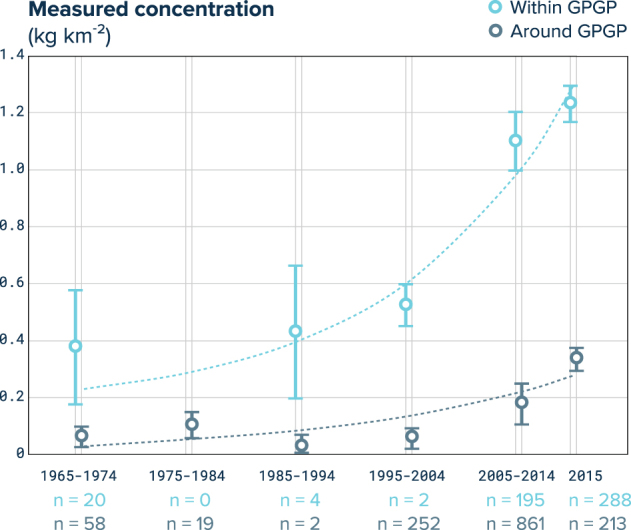
Ocean plastic can persist in sea surface waters, eventually accumulating in remote areas of the world’s oceans. Here we characterise and quantify a major ocean plastic accumulation zone formed in subtropical waters between California and Hawaii: The Great Pacific Garbage Patch (GPGP). Our model, calibrated with data from multi-vessel and aircraft surveys, predicted at least 79 (45–129) thousand tonnes of ocean plastic are floating inside an area of 1.6 million km 2 ; a figure four to sixteen times higher than previously reported. We explain this difference through the use of more robust methods to quantify larger debris. Over three-quarters of the GPGP mass was carried by debris larger than 5 cm and at least 46% was comprised of fishing nets. Microplastics accounted for 8% of the total mass but 94% of the estimated 1.8 (1.1–3.6) trillion pieces floating in the area. Plastic collected during our study has specific characteristics such as small surface-to-volume ratio, indicating that only certain types of debris have the capacity to persist and accumulate at the surface of the GPGP. Finally, our results suggest that ocean plastic pollution within the GPGP is increasing exponentially and at a faster rate than in surrounding waters.
Overview
The claims and statistics of this paper haven’t been checked yet.
Free: it reads the open-access text and checks the first 5 claims that cite a source we can check. Create a free account to check every claim.
Integrity signals
Registry
Cites
Statistics
Figures
Verification
Claims the paper makes
The claims and statistics of this paper haven’t been checked yet.
Free: it reads the open-access text and checks the first 5 claims that cite a source we can check. Create a free account to check every claim.
Claims other papers make about this one
Each is checked against this paper’s own text: does it say what the citing paper says it does?
In the citing paper
“Surface trawl observations may be underestimated by a factor of 4-16.55”
From The fate of plastic in the ocean environment – a minireview (2021) · cites this paper as [55]
Self-check
Percentages, sums and reported differences re-computed from the paper’s own numbers.
The self-check needs the paper’s full text.
Citations
Cites
The NCEP/NCAR 40-Year Reanalysis Project
Kalnay, E., Kanamitsu, M., Kistler, R., Collins, W., Deaven, D., Gandin, L., Iredell, M., Saha, S., White, G., Woollen, J., et al. (1996) · Bulletin of the American Meteorological Society · doi:10.1175/1520-0477(1996)077<0437:tnyrp>2.0.co;2 · Cited by 28,360 · cited 1×
“We sourced global sea surface currents (1993 to 2012) from the HYCOM + NCODA global 1/12° reanalysis (experiment 19.0 and 19.1 36–38 ), and wind (10 m above sea level) speed and direction data (1993 to 2012) from NCEP/NCAR global reanalysis 39 .”
MethodInfluentialProduction, use, and fate of all plastics ever made
Geyer, R., Jambeck, J. R., & Law, K. L. (2017) · Science Advances · doi:10.1126/sciadv.1700782 · Cited by 18,606
Plastic waste inputs from land into the ocean
Jambeck, J. R., Geyer, R., Wilcox, C., Siegler, T. R., Perryman, M., Andrady, A., Narayan, R., & Law, K. L. (2015) · Science · doi:10.1126/science.1260352 · Cited by 13,163 · cited 1×
“…were identically and continuously released in time from 1993 to 2012 following spatial distributions and amplitudes of significant ocean plastic sources on land (coastal population hotspots 23 and major rivers 24 ) as well as at sea (fishing 26,41 , aquaculture 42 and shipping industries 43 ).”
BackgroundMicroplastics in the marine environment
Andrady, A. L. (2011) · Marine Pollution Bulletin · doi:10.1016/j.marpolbul.2011.05.030 · Cited by 8,105 · cited 2×
“Buoyant plastic represents about 60% of the global plastic demand 10 , thus nearly half of the plastic input into the oceans should sink to the floor soon after release, accumulating in sediments 53 and underwater canyons 54 . rest may strand in coastlines 13,55,56 , be ingested by marine life 57…”
BackgroundLost at sea: where is all the plastic?
Thompson, R. C., Olsen, Y., Mitchell, R. P., Davis, A., Rowland, S. J., John, A. W. G., McGonigle, D., & Russell, A. E. (2004) · Science · doi:10.1126/science.1094559 · Cited by 7,765
A global map of human impact on marine ecosystems
Halpern, B. S., Walbridge, S., Selkoe, K. A., Kappel, C. V., Micheli, F., D'Agrosa, C., Bruno, J. F., Casey, K. S., Ebert, C., Fox, H. E., et al. (2008) · Science · doi:10.1126/science.1149345 · Cited by 6,627
Accumulation and fragmentation of plastic debris in global environments
Barnes, D. K. A., Galgani, F., Thompson, R. C., & Barlaz, M. (2009) · Philosophical Transactions of the Royal Society B: Biological Sciences · doi:10.1098/rstb.2008.0205 · Cited by 6,126 · cited 1×
“…it seems the bulk mass of material currently present in the GPGP is very unlikely to leave the area and may slowly degrade into increasingly smaller pieces that can eventually either sink to the seafloor 14 , or behave as water tracer due to its microscopic size and low Reynolds number 66 .”
BackgroundEriksen, M., Lebreton, L. C. M., Carson, H. S., Thiel, M., Moore, C. J., Borerro, J. C., Galgani, F., Ryan, P. G., & Reisser, J. (2014) · PLoS ONE · doi:10.1371/journal.pone.0111913 · Cited by 4,710 · cited 3×
“A dynamic GPGP model boundary allowed us to determine whether surface net tows from previous studies 17,21,22,46–49 were sampling inside or outside the GPGP. Average plastic mass concentration measured by net tows inside the GPGP boundary showed an exponential increase over the last decades, rising…”
ResultInfluentialSelf-citationRiver plastic emissions to the world’s oceans
Lebreton, L. C. M., van der Zwet, J., Damsteeg, J.-W., Slat, B., Andrady, A., & Reisser, J. (2017) · Nature Communications · doi:10.1038/ncomms15611 · Cited by 4,011 · cited 1×
“…were identically and continuously released in time from 1993 to 2012 following spatial distributions and amplitudes of significant ocean plastic sources on land (coastal population hotspots 23 and major rivers 24 ) as well as at sea (fishing 26,41 , aquaculture 42 and shipping industries 43 ).”
BackgroundSelf-citationPlastic debris in the open ocean
Cózar, A., Echevarría, F., González-Gordillo, J. I., Irigoien, X., Úbeda, B., Hernández-León, S., Palma, Á. T., Navarro, S., García-de-Lomas, J., Ruiz, A., et al. (2014) · Proceedings of the National Academy of Sciences · doi:10.1073/pnas.1314705111 · Cited by 3,133 · cited 1×
“Our plastic mass estimate for the GPGP (~79 k tonnes) was nearly sixteen times higher than a previous study (~4.8 k tonnes) that used net trawl data only 29 and four times higher than another assessment (~21 k tonnes) that combined net trawl data with vessel-based visual surveys 21 .”
ResultInfluential
Research works printed but not linked: 11
- Plastics Europe. Plastics - the facts 2016: an analysis of European plastics production, demand and waste data. Preprint at http://www.plasticseurope.org (2016).
- Weisskopf M Plastic reaps a grim harvest in the oceans of the world Smithsonian 1988 18 59
- American Plastics Council. Understanding plastic film: its uses, benefits and waste management options. Preprint at https://plastics.americanchemistry.com/Understanding-Plastic-Film/ (1996).
- Tolman HL The numerical model WAVEWATCH: a third-generation model for the hindcasting of wind waves on tides in shelf seas Communications on Hydraulic and Geotechnical Engineering, Delft Univ. of Techn. 1989 89 72
- FAO. The state of world fisheries and aquaculture 2014. Preprint at http://www.fao.org/3/a-i3720e.pdf (2014).
- NOAA. Detecting Japan tsunami marine debris at sea: a synthesis of efforts and lessons learned. Preprint at https://marinedebris.noaa.gov/sites/default/files/JTMD_Detection_Report.pdf (2015)
- U.S. EPA. Characterization of municipal solid waste in the United States: 1997 update. Preprint at https://archive.epa.gov/epawaste/nonhaz/municipal/web/pdf/msw97rpt.pdf (1998).
- International Coastal Cleanup. Tracking trash - 25 years of action for the ocean. Preprint at http://act.oceanconservancy.org/pdf/Marine_Debris_2011_Report_OC.pdf (2011).
- GESAMP. Sources, fate and effects of microplastics in the marine environment: part two of a global assessment (eds Kershaw, P. J. & Rochman, C. M.). (IMO/FAO/UNESCO-IOC/UNIDO/WMO/IAEA/UN/UNEP/UNDP Joint Group of Experts on the Scientific Aspects of Marine Environmental Protection). Rep. Stud. GESAMP, 93, 220 (2016).
- Maximenko, N. et al. Remote sensing of marine debris to study dynamics, balances and trends. Preprint at https://ecocast.arc.nasa.gov/las/Reports%20and%20Papers/Marine-Debris-Workshop-2017.pdf (2017).
- NASA. Satellite-respondent buoys identify ocean debris. Preprint at https://www.nasa.gov/offices/oct/home/tech_life_buoy.html (2010).
Cited by
Items 501–600 of 1,001
Reimagining plastics waste as energy solutions: challenges and opportunities
Tan, A. F. J., Yu, S., Wang, C., Yeoh, G. H., Teoh, W. Y., & Yip, A. C. K. (2024) · npj Materials Sustainability · doi:10.1038/s44296-024-00007-x · Cited by 47
“A sea area of ~1.6 million km 2 between Hawaii and California earned the moniker the “ Great Paci fi c Garbage Patch ” for trapping ~1.8 trillion pieces (or 80,000 tonnes) of plastics in the swirling ocean current 10 .”
InfluentialRedesigned Nylon 6 Variants with Enhanced Recyclability, Ductility, and Transparency
Tian, J. M., Liu, X., Ye, L., Zhang, Z., Quinn, E. C., Shi, C., Broadbelt, L. J., Marks, T. J., & Chen, E. Y. ‐. (2024) · Angewandte Chemie International Edition · doi:10.1002/anie.202320214 · Cited by 42
Liang, X., Zeng, Y., Zhang, P., Zhu, B., Feng, J., Deng, T., Fu, Z., Liu, C., Chen, C., & Zhang, Y. (2025) · Journal of Translational Medicine · doi:10.1186/s12967-025-06634-9 · Cited by 42
“Microplastics ( 5 mm) [8] and nanoplastics ( 1 µm) [9] are degrade from plastics through various processe [10] and are detected in freshwater [11], seawater [12], soil [13], and the atmosphere [14].”
Shaikh, I. V., & Shaikh, V. A. E. (2021) · The Science of The Total Environment · doi:10.1016/j.scitotenv.2021.146421 · Cited by 43
Strategies for Biosynthesis of C1 Gas-derived Polyhydroxyalkanoates: A review
Yoon, J., & Oh, M. (2021) · Bioresource Technology · doi:10.1016/j.biortech.2021.126307 · Cited by 42
Jackson, A. W., Mothe, S. R., Ang, P., Chennamaneni, L. R., van Herk, A. M., & Thoniyot, P. (2022) · Chemosphere · doi:10.1016/j.chemosphere.2021.133487 · Cited by 42
Marine Debris in the Beilun Estuary Mangrove Forest: Monitoring, Assessment and Implications
Li, D., Li, Z., Guo, Z., Yang, X., Deng, W., Zhong, H., & Zhou, P. (2021) · International Journal of Environmental Research and Public Health · doi:10.3390/ijerph182010826 · Cited by 44
Plastic leachate exposure drives antibiotic resistance and virulence in marine bacterial communities
Vlaanderen, E. J., Ghaly, T. M., Moore, L. R., Focardi, A., Paulsen, I. T., & Tetu, S. G. (2023) · Environmental Pollution · doi:10.1016/j.envpol.2023.121558 · Cited by 44
Pu, S., Bushnaq, H., Munro, C. J., Gibert, Y., Sharma, R. S., Mishra, V., & Dumée, L. F. (2024) · npj Clean Water · doi:10.1038/s41545-024-00410-w · Cited by 42
“However, high-density polymer MPs have been observed to more likely reachlandmassesunder increased windagecoef fi cients 161 , orsink tospeci fi c depths determined by density disparities between seawater and MPs, in fl uenced by salinity levels.”
InfluentialHaney, J. F., & Rochman, C. M. (2025) · Nature Ecology & Evolution · doi:10.1038/s41559-025-02678-8 · Cited by 41
“Moreover, plastic is not static in the environment; it is often transported far from its origin, which may increase connectivity between potentially suitable habitats 17,21 .”
Garaba, S. P., Acuña-Ruz, T., & Mattar, C. (2020) · Earth system science data · doi:10.5194/essd-12-2665-2020 · Cited by 40
“Global reports have already shown that there is a huge diversity in polymers, colours, sizes and shapes of plastic found in marine litter (GESAMP, 2015; Lebreton et al., 2018; Thevenon et al., 2014; Thiel et al., 2013).”
BackgroundLópez-Fernández, M. D. M., García, F. G., & Mariscal, A. J. F. (2021) · Journal of Chemical Education · doi:10.1021/acs.jchemed.1c00580 · Cited by 50
Garbage Patches and Their Environmental Implications in a Plastisphere
Filho, W. L., Hunt, J. D., & Kovaleva, M. (2021) · Journal of Marine Science and Engineering · doi:10.3390/jmse9111289 · Cited by 47
Analysis of the microplastic emission potential of a starch-based biodegradable plastic material
Innocenti, F. D., Barbale, M., Chinaglia, S., Esposito, E., Pecchiari, M., Razza, F., & Tosin, M. (2022) · Polymer Degradation and Stability · doi:10.1016/j.polymdegradstab.2022.109934 · Cited by 42
Wang, Y., Zhang, Y., Sun, X., Xu, S., & Xu, S. (2022) · Food and Chemical Toxicology · doi:10.1016/j.fct.2022.113315 · Cited by 43
Luque‐Urrutia, J. A., Ortiz-García, T., Solà, M., & Poater, A. (2023) · Inorganics · doi:10.3390/inorganics11020088 · Cited by 44
“This is an In addition, the enormous amounts of plastics dumped into the ocean are enough to create the Great Pacific garbage patch [10]. made entirely of plastic waste that is about 1.6 million square kilometers long, approximately twice the total length of France This is an island made entirely of…”
InfluentialGlobal Plastic Pollution and Informal Waste Pickers
Gutberlet, J. (2023) · Cambridge Prisms Plastics · doi:10.1017/plc.2023.10 · Cited by 62
“Southeast Asia is one of the top regions of plastic ocean pollution, particularly Indonesia, Malaysia, the Philippines, Thailand and Vietnam (in order of ranking), generate nearly 28% of the land-based marine plastic litter (Lebreton et al., 2017; Borongan and Na Ranong, 2022).”
BackgroundMLDet: Towards efficient and accurate deep learning method for Marine Litter Detection
Ma, D., Wei, J., Li, Y., Zhao, F., Chen, X., Hu, Y., Yu, S., He, T., Jin, R., Li, Z., et al. (2023) · Ocean & Coastal Management · doi:10.1016/j.ocecoaman.2023.106765 · Cited by 43
Microplastic Pollution in Water Systems: Characteristics and Control Methods
Ma, H., Chao, L., Wan, H., & Zhu, Q. (2024) · Diversity · doi:10.3390/d16010070 · Cited by 42
“For example, in “the North Pacific Garbage Patch”, located in the eastern part of the North Pacific subtropical circulation, there are 0.45105 to 1.29105 t of plastic floating matter, of which microplastics accounts for about 8%, and this number is increasing exponentially [34].”
BackgroundInfluentialMicroplastics in indoor deposition samples in university classrooms
Bhat, M. A. (2024) · Discover Environment · doi:10.1007/s44274-024-00054-0 · Cited by 39
“Based on their size, plastics can be classified into five major categories: nanoplastics ( 0.3 mm), microplastics (MPs) (< 5 mm), mesoplastics (5–50 mm), macroplastics (5–500 mm), and mega-plastics (> 500 mm) [4–6].”
InfluentialInvestigation of a zirconium compound for redox switchable ring opening polymerization
Dai, R., & Diaconescu, P. L. (2019) · Dalton Transactions · doi:10.1039/c9dt00212j · Cited by 41
Will it Float? Rising and Settling Velocities of Common Macroplastic Foils
Kuizenga, B., van Emmerik, T. V., Waldschläger, K., & Kooi, M. (2021) · ACS ES&T water · doi:10.1021/acsestwater.1c00467 · Cited by 35
Carbon Footprint of Single-Use Plastic Items and Their Substitution
Paolo, L. D., Abbate, S., Celani, E., Battista, D. D., & Candeloro, G. (2022) · Sustainability · doi:10.3390/su142416563 · Cited by 43
Coastal and marine plastic pollution in Vietnam: Problems and the way out
Veettil, B. K., Hua, N. T. A., Van, D. D., & Quảng, N. X. (2023) · Estuarine Coastal and Shelf Science · doi:10.1016/j.ecss.2023.108472 · Cited by 42
Plastic Waste: How Plastics Have Become Part of the Earth's Geological Cycle
Zalasiewicz, J., Gabbott, S. E., & Waters, C. N. (2019) · Elsevier eBooks · doi:10.1016/b978-0-12-815060-3.00023-2 · Cited by 45
Turrell, W. R. (2019) · Marine Pollution Bulletin · doi:10.1016/j.marpolbul.2019.110725 · Cited by 41
Aragaw, T. A., & Mekonnen, B. A. (2021) · Sustainable textiles · doi:10.1007/978-981-16-0297-9_3 · Cited by 46
Life-cycle environmental impact assessment and plastic pollution prevention measures of wet wipes
Yuting, Z., Wen, Z., Lin, W., Hu, Y., Kosajan, V., & Zhang, T. (2021) · Resources Conservation and Recycling · doi:10.1016/j.resconrec.2021.105803 · Cited by 44
Sustainable ethylene production: Recovery from plastic waste via thermochemical processes
Kim, S. W., Kim, Y. T., Tsang, Y. F., & Lee, J. (2023) · The Science of The Total Environment · doi:10.1016/j.scitotenv.2023.166789 · Cited by 41
Pseudomonas isolates degrade and form biofilms on polyethylene terephthalate (PET) plasticPreprint
Vague, M., Chan, G., Roberts, C. G., Swartz, N. A., & Mellies, J. L. (2019) · bioRxiv (Cold Spring Harbor Laboratory) · doi:10.1101/647321 · Cited by 55
Occurrence and Ecotoxicological Effects of Microplastics on Aquatic and Terrestrial Ecosystems
Prakash, V., Dwivedi, S., Gautam, K., Seth, M., & Anbumani, S. (2020) · The handbook of environmental chemistry · doi:10.1007/698_2020_456 · Cited by 38
Olam, M. (2023) · Environmental sciences · doi:10.5772/intechopen.110390 · Cited by 44
Impact of plastic pollution on ecosystems: a review of adverse effects and sustainable solutions
Shekh, M. R., & Kumar, V. (2025) · Environmental Monitoring and Assessment · doi:10.1007/s10661-025-13723-1 · Cited by 38
Böckers, M., Paul, N. W., & Efferth, T. (2020) · Toxicology and Applied Pharmacology · doi:10.1016/j.taap.2020.115030 · Cited by 41
Coady, K. K., Burgoon, L. D., Doskey, C. M., & Davis, J. W. (2020) · Environmental Toxicology and Chemistry · doi:10.1002/etc.4745 · Cited by 39
“Plastic waste in the aquatic environment is a global problem (Jambeck et al. 2015; Lebreton et al. 2018), and there is concern for potential adverse effects on exposed aquatic wildlife.”
BackgroundIm, J., Joo, S., Lee, Y.-R., Kim, B.-Y., & Kim, T. (2020) · Marine Pollution Bulletin · doi:10.1016/j.marpolbul.2020.111514 · Cited by 37
Moon, Y., Shim, W. J., Han, G. M., Jeong, J., Cho, Y., Kim, I.-H., Kim, M.-S., Lee, H.-R., & Hong, S. H. (2022) · Environmental Pollution · doi:10.1016/j.envpol.2022.118849 · Cited by 37
Laso, J., Ruiz‐Salmón, I., Margallo, M., Villanueva-Rey, P., Poceiro, L., Quinteiro, P. S. G. N., Dias, A. C., Almeida, C., Marques, A., Entrena-Barbero, E., et al. (2022) · Sustainability · doi:10.3390/su14053054 · Cited by 40
#OceanOptimism: Balancing the Narrative About the Future of the Ocean
Borja, Á., Elliott, M., Basurko, O. C., Fernández, A., Micheli, F., Zimmermann, F., & Knowlton, N. (2022) · Frontiers in Marine Science · doi:10.3389/fmars.2022.886027 · Cited by 38
“, patches, ocean gyres, and windrows) using, for example, Lagrangian particle tracking combined with trackers and validated with surface drifters or observations (van Sebille et al., 2012; Lebreton et al., 2018; Declerck et al., 2019); (ii) remote sensing to detect litter accumulations at sea and undertake beach mappi…”
MethodBelden, E. R., Rando, M. P., Ferrara, O. G., Himebaugh, E. T., Skangos, C. A., Kazantzis, N., Paffenroth, R. C., & Timko, M. T. (2022) · ACS Engineering Au · doi:10.1021/acsengineeringau.2c00038 · Cited by 41
Albazoni, H. J., Al-Haidarey, M. J. S., & Nasir, A. S. (2024) · Journal of Ecological Engineering · doi:10.12911/22998993/176802 · Cited by 43
“According to Lebreton et al. (2018), this area is estimated to extend over of 1.6 million km 2 surface area.”
BackgroundInfluentialYu, H., Zhao, Z., Li, H. Z., Han, Y., Li, H., Cui, C., Hu, Y., & Zhang, B. (2025) · Ecotoxicology and Environmental Safety · doi:10.1016/j.ecoenv.2025.118379 · Cited by 37
Significance of a Non-Thermal Plasma Treatment on LDPE Biodegradation with Pseudomonas Aeruginosa
Scally, L., Gulan, M., Weigang, L., Cullen, P. J., & Milosavljević, V. (2018) · Materials · doi:10.3390/ma11101925 · Cited by 39
Simkanin, C., Carlton, J. T., Steves, B., Fofonoff, P. W., Nelson, J. C., Murray, C. C., & Ruiz, G. M. (2019) · Global Ecology and Biogeography · doi:10.1111/geb.12878 · Cited by 42
Navigating Shifting Regimes of Ocean Governance
Spalding, A. K., & de Ycaza, R. (2020) · Environment and Society · doi:10.3167/ares.2020.110102 · Cited by 36
“Ocean governance was embedded in a global system that, at the time, was intent in shaping global development institutions, reconfi guring power relations between developed and developing nations, and had started to recognize the role of the environment in both these eff orts.”
InfluentialFrom maritime salvage to IMO 2020 strategy: Two actions to protect the environment
Álvarez, P. S. (2021) · Marine Pollution Bulletin · doi:10.1016/j.marpolbul.2021.112590 · Cited by 39
Anticipating the Future of the World's Ocean
O’Hara, C. C., & Halpern, B. S. (2022) · Annual Review of Environment and Resources · doi:10.1146/annurev-environ-120120-053645 · Cited by 36
Galli, M., Tepsich, P., Baini, M., Panti, C., Rosso, M., Vafeiadou, A., Pantelidou, M., Moulins, A., & Fossi, M. C. (2022) · Marine Pollution Bulletin · doi:10.1016/j.marpolbul.2022.113550 · Cited by 37
Kelly, M. R., Whitworth, P., Jamieson, A. J., & Burgess, J. G. (2022) · Environmental Pollution · doi:10.1016/j.envpol.2022.119314 · Cited by 38
Seuront, L., Zardi, G. I., Uguen, M., Bouchet, V. M. P., Delaeter, C., Henry, S., Spilmont, N., & Nicastro, K. R. (2022) · The Science of The Total Environment · doi:10.1016/j.scitotenv.2022.157187 · Cited by 41
“For instance, the ‘garbage patches’ found in the Atlantic Ocean (Ryan, 2014) and Pacific Ocean (Lebreton et al., 2018) ontaining the words ‘plastic’ and ‘pollution’ in their topic between 1950 and 2022 (A), ) as a function of the 25 most represented research areas. are some of the most infamous…”
BackgroundVaksmaa, A., Egger, M., Lüke, C., Martins, P. D., Rosselli, R., Asbun, A. A., & Niemann, H. (2022) · Marine Pollution Bulletin · doi:10.1016/j.marpolbul.2022.113949 · Cited by 36
Tropical sharks feasting on and swimming through microplastics: First evidence from Malaysia
Matupang, D. M., Zulkifli, H. I., Arnold, J., Lazim, А. M., Ghaffar, M. A., & Musa, S. M. (2023) · Marine Pollution Bulletin · doi:10.1016/j.marpolbul.2023.114762 · Cited by 38
Aslam, S., Khurram, A., Hussain, R., Qadir, A., & Ahmad, S. R. (2023) · Environmental Monitoring and Assessment · doi:10.1007/s10661-023-11242-5 · Cited by 37
Seasonality of marine plastic abundance in central Red Sea pelagic waters
Martin, C., Agustí, S., & Duarte, C. M. (2019) · The Science of The Total Environment · doi:10.1016/j.scitotenv.2019.06.240 · Cited by 36
Overview of factors influencing consumer engagement with plastic recycling
Ertz, M., Addar, W., Ouerghemmi, C., & Takaffoli, M. (2023) · Wiley Interdisciplinary Reviews Energy and Environment · doi:10.1002/wene.493 · Cited by 43
Lee, H., Im, J., Cho, H., Jung, S., Choi, H., Choi, D., Kim, J., Lee, J., & Kwon, E. E. (2024) · Chemical Engineering Journal · doi:10.1016/j.cej.2024.148741 · Cited by 35
Ocean plastic pollution: a human and biodiversity loop
Ayassamy, P. (2025) · Environmental Geochemistry and Health · doi:10.1007/s10653-025-02373-4 · Cited by 36
“These marine sources not only contribute to the accumulation of plastic waste but also pose serious threats to marine life and eco-systems (Lebreton et al., 2018).”
Contribution of Fermentation Technology to Building Blocks for Renewable Plastics
Lomwongsopon, P., & Varrone, C. (2022) · Fermentation · doi:10.3390/fermentation8020047 · Cited by 35
“Notably, more than 150 million tons of plastic waste leaked into the world’s oceans during the last decades [9] and almost 27 million tons accumulated in landfills in only a year (during 2018) [10].”
BackgroundSample size requirements for riverbank macrolitter characterization
de Lange, S. I., Mellink, Y. A. M., Vriend, P., Tasseron, P., Begemann, F., Hauk, R., Aalderink, H., Hamers, E., Jansson, P., Joosse, N., et al. (2023) · Frontiers in Water · doi:10.3389/frwa.2022.1085285 · Cited by 40
Ji, S. H., Seok, D. C., & Yoo, S. (2023) · Environmental Technology & Innovation · doi:10.1016/j.eti.2023.103449 · Cited by 37
George, M., Nallet, F., & Fabre, P. (2023) · Marine Pollution Bulletin · doi:10.1016/j.marpolbul.2023.116012 · Cited by 35
Srivastava, P., Saji, J., & Manickam, N. (2024) · Biodegradation · doi:10.1007/s10532-024-10070-9 · Cited by 34
Fu, Y., Zhu, L., Liu, B., Zhang, X., & Weng, Y. (2024) · Polymer · doi:10.1016/j.polymer.2024.127295 · Cited by 38
Microplastic distribution and its implications for human health through marine environments
Ho, C. M., Feng, W., Li, X., Ngien, S. K., Yu, X., Song, F., Yang, F., & Liao, H. (2025) · Journal of Environmental Management · doi:10.1016/j.jenvman.2025.125427 · Cited by 41
‘Nothing Goes to Waste’: A professional learning programme for early childhood centres
Boyd, W. (2019) · Australasian Journal of Early Childhood · doi:10.1177/1836939119885313 · Cited by 36
“Email: wendy.boyd@scu.edu.au the Pacific Ocean (Australian Broadcasting Commission (ABC), 2018a) and the ‘War on Waste’ television programme (ABC, 2018b).”
BackgroundInfluentialPlastic Pollution in the Coastal Oceans: Characterization and Modeling
Lermusiaux, P. F. J., Doshi, M. M., Kulkarni, C. S., Gupta, A., Haley, P. J., Mirabito, C., Trotta, F., Levang, S. J., Flierl, G. R., Marshall, J. C., et al. (2019) · MTS/IEEE OCEANS Conference (OCEANS) · doi:10.23919/oceans40490.2019.8962786 · Cited by 40
“[45] modeled and measured plastic concentration in the Great Pacific Garbage Patch (GPGP), and found evidence that the patch is rapidly accumulating plastic.”
BackgroundLeveraging carbon dioxide to control the H2/CO ratio in catalytic pyrolysis of fishing net waste
Choi, D., Jung, S., Lee, S. S., Lin, K. A., Park, Y., Kim, H., Tsang, Y. F., & Kwon, E. E. (2020) · Renewable and Sustainable Energy Reviews · doi:10.1016/j.rser.2020.110559 · Cited by 35
Exposure to nanoplastics affects the outcome of infectious disease in phytoplankton
Schampera, C., Wolinska, J., Bachelier, J. B., Machado, A. A. D. S., Rosal, R., González-Pleiter, M., & Agha, R. (2021) · Environmental Pollution · doi:10.1016/j.envpol.2021.116781 · Cited by 34
TOWARDS DETECTING FLOATING OBJECTS ON A GLOBAL SCALE WITH LEARNED SPATIAL FEATURES USING SENTINEL 2
Mifdal, J., Longépé, N., & Rußwurm, M. (2021) · ISPRS annals of the photogrammetry, remote sensing and spatial information sciences · doi:10.5194/isprs-annals-v-3-2021-285-2021 · Cited by 44
“Nonetheless, visual inspections and the use of statistical data analysis techniques are still used (Lebreton et al., 2018).”
BackgroundMethodAlava, J. J., Kazmiruk, T. N., Douglas, T. J., Schuerholz, G., Heath, B., Flemming, S. A., Bendell, L. I., & Drever, M. C. (2021) · Marine Pollution Bulletin · doi:10.1016/j.marpolbul.2021.113033 · Cited by 37
Model based estimate of transboundary litter pollution on Mediterranean coasts
Macias, D. M., Stips, A., & Hanke, G. (2021) · Marine Pollution Bulletin · doi:10.1016/j.marpolbul.2021.113121 · Cited by 36
Investigation of a novel poly (lactic acid) porous material toughened by thermoplastic polyurethane
Wu, Z., Zhang, Z., Wei, W., Yin, Y., Huang, C., Ding, J., & Duan, Q. (2022) · Journal of Materials Science · doi:10.1007/s10853-022-06951-0 · Cited by 36
“At present, the vast majority of plastic products are petroleum-based products, which are non-degradable; the following plastic pollution has posed a great threat to the environment, marine ecology and even human beings, such as the huge marine garbage in the Pacific [1] and the micro-plastics in human embryos [2].”
BackgroundInfluentialStanton, T. H., Chico, G., Carr, E. M., Cook, S., Gomes, R. L., Heard, E., Law, A., Wilson, H. L., & Johnson, M. F. (2022) · Journal of Hazardous Materials · doi:10.1016/j.jhazmat.2022.129118 · Cited by 36
“Hotspots of AL have been associated with socioeconomic variables including population and GDP (Vincent et al., 2017; Xu et al., 2021) and environmental variables such as proximity to river mouths (Lebreton et al., 2017) and ocean currents (Lebreton et al., 2018).”
A review of plastic and microplastic pollution towards the Malaysian marine environment
Tan, E., Jaafar, N. F., Tan, S., & Zanuri, N. B. M. (2022) · IOP Conference Series Earth and Environmental Science · doi:10.1088/1755-1315/1013/1/012012 · Cited by 38
“The buoyancy of plastics alleviates its impact as a pollutant because it can be easily windblown from land to the ocean and carried by the surface current [4].”
BackgroundXie, J., Zhang, G., Wu, Q., Luo, M., Chen, D., Zhang, Y., He, L., Li, Y., Zhang, Q., Lin, T., et al. (2022) · Journal of Hazardous Materials · doi:10.1016/j.jhazmat.2023.130974 · Cited by 35
Beck, A. J., Kaandorp, M., Hamm, T., Bogner, B., Kossel, E., Lenz, M., Haeckel, M., & Achterberg, E. P. (2023) · Analytical and Bioanalytical Chemistry · doi:10.1007/s00216-023-04634-6 · Cited by 35
Gilman, E. L., Antonelis, K., Drinkwin, J., Gorgin, S., Suuronen, P., Thomas, S. N., & Wilson, J. R. (2023) · Marine Policy · doi:10.1016/j.marpol.2023.105738 · Cited by 38
Viana, M., Tonin, F. S., & Ladeira, C. (2025) · Journal of Xenobiotics · doi:10.3390/jox15030075 · Cited by 34
Schiffer, J. M., Lyman, J., Byrd, D., Silverstein, H., & Halls, M. D. (2019) · Journal of Chemical Education · doi:10.1021/acs.jchemed.9b00249 · Cited by 35
The economics of recycling rate: New insights from waste electrical and electronic equipment
Fizaine, F. (2020) · Resources Policy · doi:10.1016/j.resourpol.2020.101675 · Cited by 33
“In this context, the “seventieth continent” of plastic in pacific is an astonishing illustration of the big challenge raises by the management of increasing solid wastes (Lebreton et al., 2018).”
BackgroundProcessing technologies for solid and flexible packaging materials from macroalgae
Schmidtchen, L., Roleda, M. Y., Majschak, J., & Mayser, M. (2021) · Algal Research · doi:10.1016/j.algal.2021.102300 · Cited by 34
Piskuła, P., & Astel, A. M. (2022) · Microplastics · doi:10.3390/microplastics1010011 · Cited by 35
“The main sources of microplastics in the aquatic environment include textile fibers, cosmetics, and detergents containing microplastics [9], styrene-butadiene dust from car tires [10], activities of ports, shipyards, and the nautical industry [11], paints and coatings [12], direct emission of synthetic waste, factory…”
BackgroundInsights into microbial diversity on plastisphere by multi-omics
Tiwari, N., Bansal, M., Santhiya, D., & Sharma, J. G. (2022) · Archives of Microbiology · doi:10.1007/s00203-022-02806-z · Cited by 35
van Duinen, B., Kaandorp, M., & van Sebille, E. (2022) · Geophysical Research Letters · doi:10.1029/2021gl097214 · Cited by 33
Zhao, X., Qiang, M., Yuan, Y., Zhang, M., Wu, W., Zhang, J., Gao, Z., Gu, X., Ma, S., Liu, Z., et al. (2023) · The Science of The Total Environment · doi:10.1016/j.scitotenv.2023.167431 · Cited by 35
Morrison, E. L., Shipman, A., Shrestha, S., Squier, E., & Whitney, K. S. (2019) · Case Studies in the Environment · doi:10.1525/cse.2018.001875 · Cited by 36
The Anthropocene, hyperobjects and the archaeology of the future past
Campbell, P. B. (2021) · Antiquity · doi:10.15184/aqy.2021.116 · Cited by 32
“The ‘Great Garbage Patch’ in the Pacific Ocean measures over 1.6 million km2 and is composed of ∼1.8 trillion plastic pieces (Lebreton et al. 2018).”
BackgroundInfluentialThe geography and geology of plastics
Gabbott, S. E., Key, S., Russell, C., Yonan, Y., & Zalasiewicz, J. (2020) · Elsevier eBooks · doi:10.1016/b978-0-12-817880-5.00003-7 · Cited by 40
“Make no little plans”: Impactful research to solve the next generation of transportation problems
Agatz, N. A. H., Hewitt, M., & Thomas, B. W. (2020) · Networks · doi:10.1002/net.22002 · Cited by 34
“between California and Hawaii and is often referred to as the “Great Pacific Garbage Patch” [103].”
BackgroundPlastics in our water: Fish microbiomes at risk?
Adamovský, O., Bisesi, J. H., & Martyniuk, C. J. (2021) · Comparative Biochemistry and Physiology Part D Genomics and Proteomics · doi:10.1016/j.cbd.2021.100834 · Cited by 37
Chemical upcycling of polymers
Stadler, B. M., & de Vries, J. G. (2021) · Philosophical Transactions of the Royal Society A Mathematical Physical and Engineering Sciences · doi:10.1098/rsta.2020.0341 · Cited by 37
“This waste eventually winds up in the rivers [4] and from there into the oceans [5], where it can form ‘islands’ that can reach three times the size of countries like France [6].”
BackgroundMoorton, Z., Kurt, Z., & Woo, W. L. (2022) · Marine Pollution Bulletin · doi:10.1016/j.marpolbul.2022.113853 · Cited by 37
“, 2015) that is continuing to rapidly expand (Lebreton et al., 2018).”
BackgroundUhrin, A. V., Hong, S., Burgess, H. K., Lim, S., & Dettloff, K. (2022) · Environmental Pollution · doi:10.1016/j.envpol.2022.119862 · Cited by 34
The African Marine Litter Outlook
Maes, T., & Preston-Whyte, F. (2022) · Springer eBooks · doi:10.1007/978-3-031-08626-7 · Cited by 35
Escalle, L., Mourot, J., Hamer, P., Hare, S. R., Phillip, N. B., & Pilling, G. M. (2023) · Marine Policy · doi:10.1016/j.marpol.2023.105500 · Cited by 32
Plastic Legacies: Pollution, Persistence, and Politics
Farrelly, T. A., Taffel, S., & Shaw, I. (2021) · Athabasca University Press eBooks · doi:10.15215/aupress/9781771993272.01 · Cited by 57
Singh, P., Lau, C. S. S., Siah, S. Y., Chua, K.-O., & Ting, A. S. Y. (2024) · Archives of Microbiology · doi:10.1007/s00203-024-03895-8 · Cited by 31
“The rapid increase in global plastic production from 1.5 million tons in the 1950s to 335 million tons in 2016 has generated enormous plastic waste (Lebreton et al. 2018).”
InfluentialHajji, A. L., & Lucas, K. N. (2024) · Marine Pollution Bulletin · doi:10.1016/j.marpolbul.2024.116557 · Cited by 35
Kumar, P., Kumar, A., Kumar, D., Prajapati, K. B., Mahajan, A. K., Pant, D., Yadav, A., Giri, A., Manda, S., Bhandari, S., et al. (2025) · Journal of Environmental Management · doi:10.1016/j.jenvman.2025.124249 · Cited by 32
Behavior and distribution of polystyrene foams on the shore of Tuul River in Mongolia
Battulga, B., Kawahigashi, M., & Oyuntsetseg, B. (2020) · Environmental Pollution · doi:10.1016/j.envpol.2020.113979 · Cited by 31
Metadata
- Authors
- Lebreton, L., Slat, B., Ferrari, F., Sainte-Rose, B., Aitken, J., Marthouse, R., Hajbane, S., Cunsolo, S., Schwarz, A., Levivier, A., Noble, K., Debeljak, P., Maral, H., Schoeneich-Argent, R., Brambini, R., & Reisser, J.
- Affiliations
- The Ocean Cleanup (NL)
- Centre National de la Recherche Scientifique (FR)
- Corresponding author
- Lebreton, L.
- Venue
- Scientific Reports
- Published
- 2018-03-22
- Volume
- 8
- Issue
- 1
- Pages
- 4666-4666
- ISSN
- 2045-2322 (ISSN-L)
- PMC
- PMC5864935
- OpenAlex
- W2791727655
- Semantic Scholar
- cbd6216cc4dd8bc948ba20943141090562992fab
- Cited by
- 1,839
- References
- 56
- Citations by year
- 2026: 152 · 2025: 242 · 2024: 252 · 2023: 257 · 2022: 289 · 2021: 272 · 2020: 193 · 2019: 141 · 2018: 40
- FWCI
- 60.53
- Type
- journal article
- Language
- en
- Open access
- gold
- doi.org
- Licence
- cc-by
- creativecommons.org/licenses/by/4.0 (tdm)
- creativecommons.org/licenses/by/4.0 (vor)
- Locations
- Scientific Reports (publishedVersion, cc-by)
- Europe PMC (PubMed Central) (publishedVersion, cc-by)
- PubMed Central (publishedVersion, cc-by)
- PubMed (publishedVersion)
- VBN Forskningsportal (Aalborg Universitet) (publishedVersion, cc-by)
- Roger Williams University - Digital Commons (Roger Williams University) (submittedVersion)
- HAL (submittedVersion, other-oa)
- DOAJ (DOAJ: Directory of Open Access Journals) (submittedVersion)
- Funders
- Technische Universiteit Delft
- Topics
- Physical Sciences › Environmental Science › Pollution › Microplastics and Plastic Pollution
- Physical Sciences › Environmental Science › Pollution › Oil Spill Detection and Mitigation
- Physical Sciences › Environmental Science › Waste Management and Disposal › Waste Management and Recycling
- Keywords
- Great Pacific Garbage Patch, marine plastic pollution, plastic accumulation, fishing nets, microplastics, debris size distribution, surface-to-volume ratio, subtropical gyre
- MeSH terms
- California, Environmental Monitoring, Garbage, Hawaii, Models, Theoretical, Pacific Ocean, Plankton, Plastics, Sampling Studies, Spectrophotometry, Infrared, Waste Products, Water Pollutants, Chemical, Water Pollution, Chemical, Wind, Satellite Imagery
About these checks
Registry, retraction, Cites and statistics results are computed, not judged, with one exception: a printed reference that no index lists is read once by a model before it counts as a citation error. Claims are extracted by a model and kept only when their quote appears verbatim in the text; each cited source is then checked, with a model’s help, for whether it says what the claim relies on. Those verdicts can be wrong — read the claim’s quote and the cited source before relying on one.
Statistics and arithmetic are recomputed, not judged.
Confidence bands are shown only for fields calibrated on our annotated test set. None is calibrated yet, so no band is shown.
What counts as a claim ›How we measure confidence ›How we check this ›
Are you an author, or do you see a problem with this page? Request a review
Data sources
Bibliographic data: Semantic Scholar, OpenAlex, Crossref.
Contains information from the Semantic Scholar Academic Graph Datasets, made available under the ODC Attribution License (ODC-BY 1.0).
Semantic Scholar’s data is described in: Kinney, R., et al. (2023). The Semantic Scholar Open Data Platform. arXiv:2301.10140.
