

Evidence that the Great Pacific Garbage Patch is rapidly accumulating plastic
Open accessThe DOI matches its Crossref record; 55 of the 56 references it cites were found in a registry or an index.
Abstract
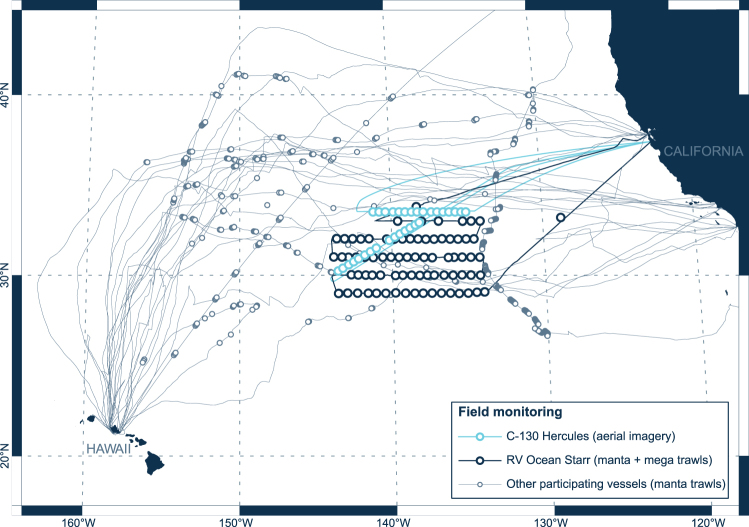
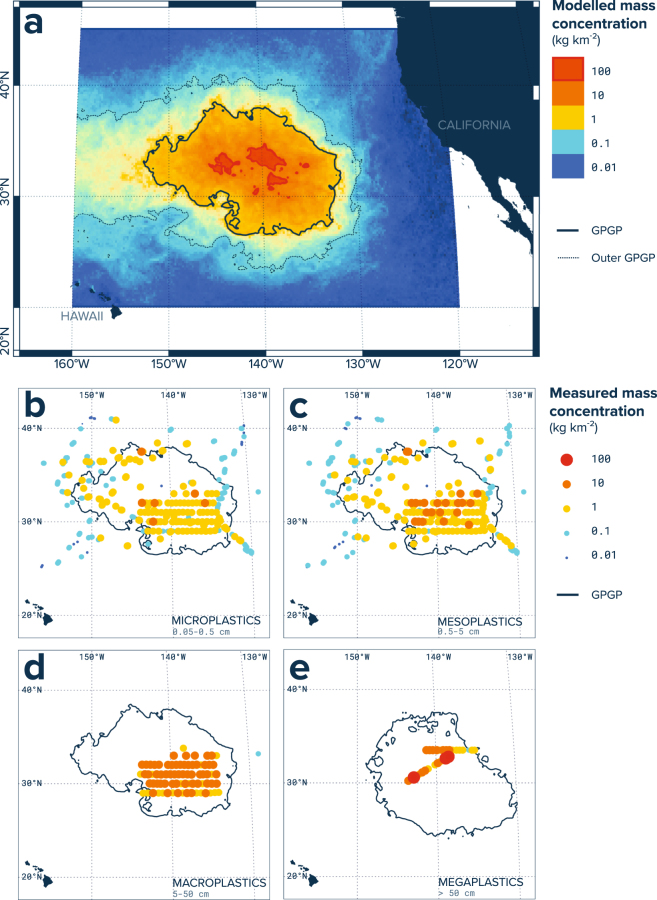
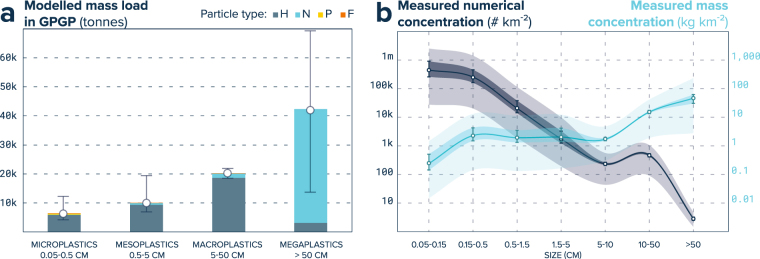
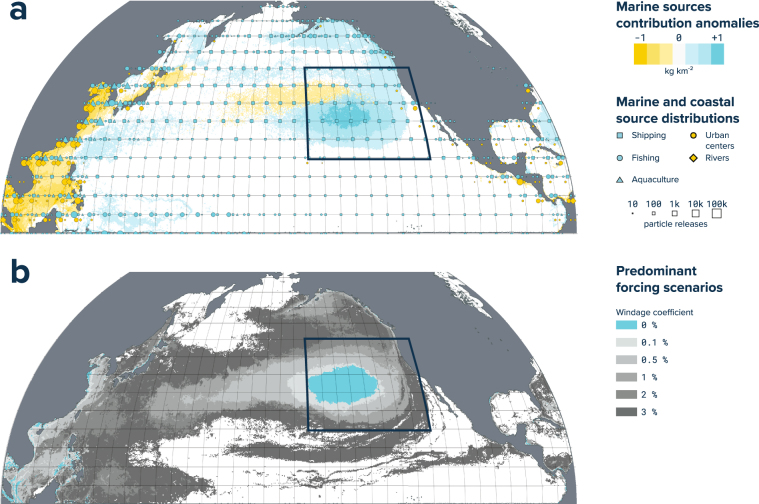
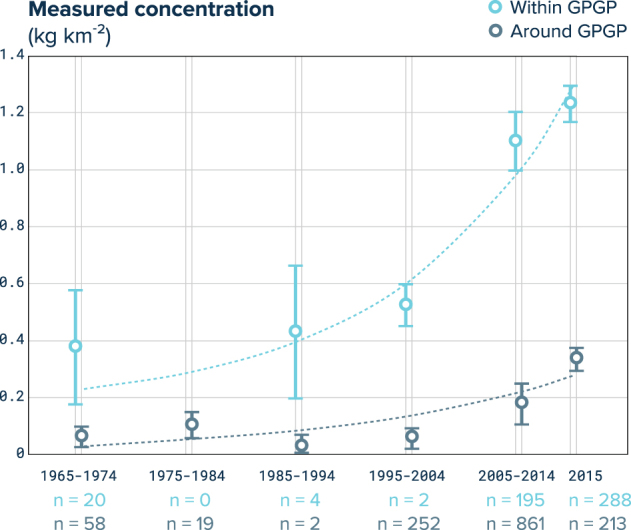
Ocean plastic can persist in sea surface waters, eventually accumulating in remote areas of the world’s oceans. Here we characterise and quantify a major ocean plastic accumulation zone formed in subtropical waters between California and Hawaii: The Great Pacific Garbage Patch (GPGP). Our model, calibrated with data from multi-vessel and aircraft surveys, predicted at least 79 (45–129) thousand tonnes of ocean plastic are floating inside an area of 1.6 million km 2 ; a figure four to sixteen times higher than previously reported. We explain this difference through the use of more robust methods to quantify larger debris. Over three-quarters of the GPGP mass was carried by debris larger than 5 cm and at least 46% was comprised of fishing nets. Microplastics accounted for 8% of the total mass but 94% of the estimated 1.8 (1.1–3.6) trillion pieces floating in the area. Plastic collected during our study has specific characteristics such as small surface-to-volume ratio, indicating that only certain types of debris have the capacity to persist and accumulate at the surface of the GPGP. Finally, our results suggest that ocean plastic pollution within the GPGP is increasing exponentially and at a faster rate than in surrounding waters.
Overview
The claims and statistics of this paper haven’t been checked yet.
Free: it reads the open-access text and checks the first 5 claims that cite a source we can check. Create a free account to check every claim.
Integrity signals
Registry
Cites
Statistics
Figures
Verification
Claims the paper makes
The claims and statistics of this paper haven’t been checked yet.
Free: it reads the open-access text and checks the first 5 claims that cite a source we can check. Create a free account to check every claim.
Claims other papers make about this one
Each is checked against this paper’s own text: does it say what the citing paper says it does?
In the citing paper
“Surface trawl observations may be underestimated by a factor of 4-16.55”
From The fate of plastic in the ocean environment – a minireview (2021) · cites this paper as [55]
Self-check
Percentages, sums and reported differences re-computed from the paper’s own numbers.
The self-check needs the paper’s full text.
Citations
Cites
The NCEP/NCAR 40-Year Reanalysis Project
Kalnay, E., Kanamitsu, M., Kistler, R., Collins, W., Deaven, D., Gandin, L., Iredell, M., Saha, S., White, G., Woollen, J., et al. (1996) · Bulletin of the American Meteorological Society · doi:10.1175/1520-0477(1996)077<0437:tnyrp>2.0.co;2 · Cited by 28,360 · cited 1×
“We sourced global sea surface currents (1993 to 2012) from the HYCOM + NCODA global 1/12° reanalysis (experiment 19.0 and 19.1 36–38 ), and wind (10 m above sea level) speed and direction data (1993 to 2012) from NCEP/NCAR global reanalysis 39 .”
MethodInfluentialProduction, use, and fate of all plastics ever made
Geyer, R., Jambeck, J. R., & Law, K. L. (2017) · Science Advances · doi:10.1126/sciadv.1700782 · Cited by 18,606
Plastic waste inputs from land into the ocean
Jambeck, J. R., Geyer, R., Wilcox, C., Siegler, T. R., Perryman, M., Andrady, A., Narayan, R., & Law, K. L. (2015) · Science · doi:10.1126/science.1260352 · Cited by 13,163 · cited 1×
“…were identically and continuously released in time from 1993 to 2012 following spatial distributions and amplitudes of significant ocean plastic sources on land (coastal population hotspots 23 and major rivers 24 ) as well as at sea (fishing 26,41 , aquaculture 42 and shipping industries 43 ).”
BackgroundMicroplastics in the marine environment
Andrady, A. L. (2011) · Marine Pollution Bulletin · doi:10.1016/j.marpolbul.2011.05.030 · Cited by 8,105 · cited 2×
“Buoyant plastic represents about 60% of the global plastic demand 10 , thus nearly half of the plastic input into the oceans should sink to the floor soon after release, accumulating in sediments 53 and underwater canyons 54 . rest may strand in coastlines 13,55,56 , be ingested by marine life 57…”
BackgroundLost at sea: where is all the plastic?
Thompson, R. C., Olsen, Y., Mitchell, R. P., Davis, A., Rowland, S. J., John, A. W. G., McGonigle, D., & Russell, A. E. (2004) · Science · doi:10.1126/science.1094559 · Cited by 7,765
A global map of human impact on marine ecosystems
Halpern, B. S., Walbridge, S., Selkoe, K. A., Kappel, C. V., Micheli, F., D'Agrosa, C., Bruno, J. F., Casey, K. S., Ebert, C., Fox, H. E., et al. (2008) · Science · doi:10.1126/science.1149345 · Cited by 6,627
Accumulation and fragmentation of plastic debris in global environments
Barnes, D. K. A., Galgani, F., Thompson, R. C., & Barlaz, M. (2009) · Philosophical Transactions of the Royal Society B: Biological Sciences · doi:10.1098/rstb.2008.0205 · Cited by 6,126 · cited 1×
“…it seems the bulk mass of material currently present in the GPGP is very unlikely to leave the area and may slowly degrade into increasingly smaller pieces that can eventually either sink to the seafloor 14 , or behave as water tracer due to its microscopic size and low Reynolds number 66 .”
BackgroundEriksen, M., Lebreton, L. C. M., Carson, H. S., Thiel, M., Moore, C. J., Borerro, J. C., Galgani, F., Ryan, P. G., & Reisser, J. (2014) · PLoS ONE · doi:10.1371/journal.pone.0111913 · Cited by 4,710 · cited 3×
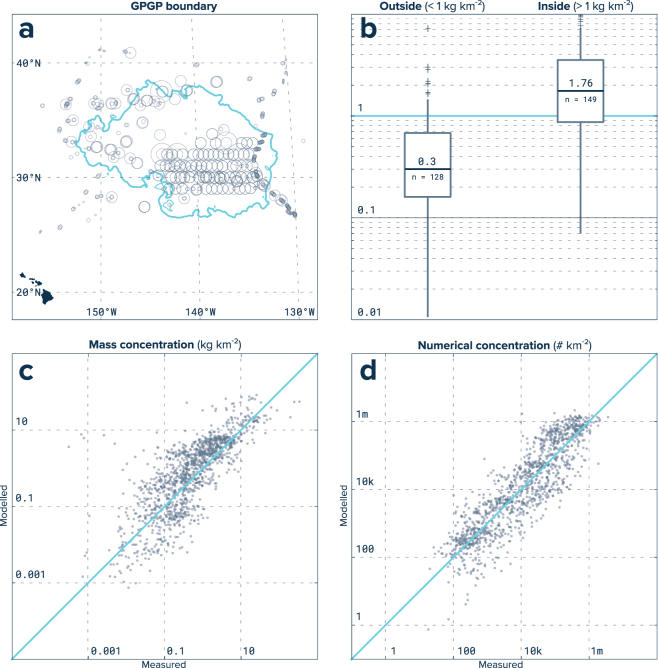
“A dynamic GPGP model boundary allowed us to determine whether surface net tows from previous studies 17,21,22,46–49 were sampling inside or outside the GPGP. Average plastic mass concentration measured by net tows inside the GPGP boundary showed an exponential increase over the last decades, rising…”
ResultInfluentialSelf-citationRiver plastic emissions to the world’s oceans
Lebreton, L. C. M., van der Zwet, J., Damsteeg, J.-W., Slat, B., Andrady, A., & Reisser, J. (2017) · Nature Communications · doi:10.1038/ncomms15611 · Cited by 4,011 · cited 1×
“…were identically and continuously released in time from 1993 to 2012 following spatial distributions and amplitudes of significant ocean plastic sources on land (coastal population hotspots 23 and major rivers 24 ) as well as at sea (fishing 26,41 , aquaculture 42 and shipping industries 43 ).”
BackgroundSelf-citationPlastic debris in the open ocean
Cózar, A., Echevarría, F., González-Gordillo, J. I., Irigoien, X., Úbeda, B., Hernández-León, S., Palma, Á. T., Navarro, S., García-de-Lomas, J., Ruiz, A., et al. (2014) · Proceedings of the National Academy of Sciences · doi:10.1073/pnas.1314705111 · Cited by 3,133 · cited 1×
“Our plastic mass estimate for the GPGP (~79 k tonnes) was nearly sixteen times higher than a previous study (~4.8 k tonnes) that used net trawl data only 29 and four times higher than another assessment (~21 k tonnes) that combined net trawl data with vessel-based visual surveys 21 .”
ResultInfluential
Research works printed but not linked: 11
- Plastics Europe. Plastics - the facts 2016: an analysis of European plastics production, demand and waste data. Preprint at http://www.plasticseurope.org (2016).
- Weisskopf M Plastic reaps a grim harvest in the oceans of the world Smithsonian 1988 18 59
- American Plastics Council. Understanding plastic film: its uses, benefits and waste management options. Preprint at https://plastics.americanchemistry.com/Understanding-Plastic-Film/ (1996).
- Tolman HL The numerical model WAVEWATCH: a third-generation model for the hindcasting of wind waves on tides in shelf seas Communications on Hydraulic and Geotechnical Engineering, Delft Univ. of Techn. 1989 89 72
- FAO. The state of world fisheries and aquaculture 2014. Preprint at http://www.fao.org/3/a-i3720e.pdf (2014).
- NOAA. Detecting Japan tsunami marine debris at sea: a synthesis of efforts and lessons learned. Preprint at https://marinedebris.noaa.gov/sites/default/files/JTMD_Detection_Report.pdf (2015)
- U.S. EPA. Characterization of municipal solid waste in the United States: 1997 update. Preprint at https://archive.epa.gov/epawaste/nonhaz/municipal/web/pdf/msw97rpt.pdf (1998).
- International Coastal Cleanup. Tracking trash - 25 years of action for the ocean. Preprint at http://act.oceanconservancy.org/pdf/Marine_Debris_2011_Report_OC.pdf (2011).
- GESAMP. Sources, fate and effects of microplastics in the marine environment: part two of a global assessment (eds Kershaw, P. J. & Rochman, C. M.). (IMO/FAO/UNESCO-IOC/UNIDO/WMO/IAEA/UN/UNEP/UNDP Joint Group of Experts on the Scientific Aspects of Marine Environmental Protection). Rep. Stud. GESAMP, 93, 220 (2016).
- Maximenko, N. et al. Remote sensing of marine debris to study dynamics, balances and trends. Preprint at https://ecocast.arc.nasa.gov/las/Reports%20and%20Papers/Marine-Debris-Workshop-2017.pdf (2017).
- NASA. Satellite-respondent buoys identify ocean debris. Preprint at https://www.nasa.gov/offices/oct/home/tech_life_buoy.html (2010).
Cited by
Items 701–800 of 1,001
Designing Unmanned Aerial Survey Monitoring Program to Assess Floating Litter Contamination
Almeida, S., Radeta, M., Kataoka, T., Canning‐Clode, J., Pais, M. P., Freitas, R., & Monteiro, J. G. (2022) · Remote Sensing · doi:10.3390/rs15010084 · Cited by 27
From source to sea: Floating macroplastic transport along the Rhine river
Kuizenga, B., Tasseron, P., Wendt‐Potthoff, K., & van Emmerik, T. H. M. (2023) · Frontiers in Environmental Science · doi:10.3389/fenvs.2023.1180872 · Cited by 24
“This results in an accumulation of plastic in terrestrial and aquatic ecosystems (Barnes et al., 2009; Lebreton et al., 2018; van Emmerik et al., 2022b).”
BackgroundPlastic Waste Management: A Bibliometric Analysis (1992–2022)
Rinanda, R., Sun, Y., Chang, K., Sulastri, R., Cui, X., Cheng, Z., Yan, B., & Chen, G. (2023) · Sustainability · doi:10.3390/su152416840 · Cited by 29
“This accumulation poses various risks to marine life, ecosystems, and even human well-being [38,48–52].”
BackgroundHajbane, S., Calmanovici, B., Reisser, J., Jolly, A., Summers, V., Ferrari, F. F., Ghadouani, A., & Pattiaratchi, C. B. (2021) · Frontiers in Marine Science · doi:10.3389/fmars.2021.613399 · Cited by 25
“They include air pollution, marine transport of invasive species, pathogens, and other pollutants, as well as damage to organisms via plastic entanglement and ingestion (Lemieux et al., 2004; Gregory, 2009; Wright et al., 2013; Zettler et al., 2013; Vethaak and Leslie, 2016; Viršek et al., 2017).”
BackgroundSelf-citationThe threat of microplastics and microbial degradation potential; a current perspective
Ullah, Z., Peng, L., Lodhi, A. F., Kakar, M. U., Mehboob, M. Z., & Iqbal, I. A. (2024) · The Science of The Total Environment · doi:10.1016/j.scitotenv.2024.177045 · Cited by 24
Rühs, S., van den Bremer, T. S., Clementi, E., Denes, M. C., Moulin, A., & van Sebille, E. (2025) · Ocean science · doi:10.5194/os-21-217-2025 · Cited by 24
“The supplement related to this article is available on-line at: https://doi.org/10.5194/os-21-217-2025-supplement.”
InfluentialGrand challenges for human factors and ergonomics
Karwowski, W., Salvendy, G., Endsley, M. R., Rouse, W. B., Salmon, P. M., Stanney, K. M., Thatcher, A., Andre, T., Yang, X. J., Ayaz, H., et al. (2025) · Theoretical Issues in Ergonomics Science · doi:10.1080/1463922x.2024.2431336 · Cited by 30
An Integrated Assessment of Microplastic Pollution in Coastal Surface Water and Sediment of Japan
Ramtahal, J. J., Sugimoto, K., Phan, S., Tara Jambio Microplastic Consortium, Patouillet, Y., Troublé, R., Luscombe, C. K., & Agostini, S. (2025) · Environmental Science & Technology · doi:10.1021/acs.est.5c02645 · Cited by 23
Miyazono, K., Yamashita, R., Miyamoto, H., Ishak, N. H. A., Tadokoro, K., Shimizu, Y., & Takahashi, K. (2021) · Marine Pollution Bulletin · doi:10.1016/j.marpolbul.2021.112631 · Cited by 26
Dynamics of Transport, Accumulation, and Export of Plastics at Oceanic Fronts
Suaria, G., Berta, M., Griffa, A., Molcard, A., Özgökmen, T. M., Zambianchi, E., & Aliani, S. (2021) · The handbook of environmental chemistry · doi:10.1007/698_2021_814 · Cited by 27
Zhou, W., Huang, D., Chen, S., Du, L., Wang, G., Li, R., & Xu, W. (2023) · Chemosphere · doi:10.1016/j.chemosphere.2023.139152 · Cited by 23
Polymer identification of floating derelict fishing gear from O'ahu, Hawai'i
Corniuk, R. N., Shaw, K. R., McWhirter, A., Lynch, H. W., Royer, S., & Lynch, J. M. (2023) · Marine Pollution Bulletin · doi:10.1016/j.marpolbul.2023.115570 · Cited by 23
Chen, R., Cheng, L., Gu, J., Yuan, H., & Chen, Y. (2023) · Energy Conversion and Management · doi:10.1016/j.enconman.2023.117983 · Cited by 23
Honorato‐Zimmer, D., Escobar-Sánchez, G., Deakin, K., Veer, D. D., Galloway, T. S., Guevara-Torrejón, V., Howard, J., Jones, J., Lewis, C. N., Ribeiro, F., et al. (2024) · Marine Pollution Bulletin · doi:10.1016/j.marpolbul.2024.116440 · Cited by 24
Rouf, T. B., Schmidt, G., Çakmak, M., & Kokini, J. L. (2019) · Journal of Materials Science · doi:10.1007/s10853-019-03817-w · Cited by 23
A Trip Upstream to Mitigate Marine Plastic Pollution – A Perspective Focused on the MSFD and WFD
Black, J., Köpke, K., & O’Mahony, C. (2019) · Frontiers in Marine Science · doi:10.3389/fmars.2019.00689 · Cited by 24
Chen, C., Lu, T., Yang, Y., & Liao, C. (2020) · Ecological Indicators · doi:10.1016/j.ecolind.2020.106915 · Cited by 24
Jemaa, S., Mahfouz, C., Kazour, M., Lteif, M., Hassoun, A. E. R., Ghsoub, M., Amara, R., Khalaf, G., & Fakhri, M. P. (2021) · Frontiers in Environmental Science · doi:10.3389/fenvs.2021.699343 · Cited by 25
“Macroplastics Density Floating macroplastics have been recognized as an ecological problem of global concern (Lebreton et al., 2018); however, knowledge regarding the abundance and distribution of floating objects in the Eastern Mediterranean is still limited compared to the substantial number of studies available for…”
BackgroundDeng, H., Fu, Y., Su, L., Chen, D., Deng, X., Hu, B. H., Chen, Y., & Deng, Y. (2025) · Journal of Hazardous Materials · doi:10.1016/j.jhazmat.2025.137537 · Cited by 23
Isachenko, I. A. (2020) · Marine Pollution Bulletin · doi:10.1016/j.marpolbul.2020.111464 · Cited by 23
Biodegradable Acetylated Kenaf Fiber Composites
Jung, J. S., Song, K. H., & Kim, S. H. (2021) · Fibers and Polymers · doi:10.1007/s12221-021-1237-x · Cited by 22
Vanstreels, R. E. T., Gallo, L., Serafini, P. P., Santos, A. P., Egert, L., & Uhart, M. (2021) · Marine Pollution Bulletin · doi:10.1016/j.marpolbul.2021.113046 · Cited by 22
Barrionuevo, J. M. R., Martín, E. V. R., Galindo‐Cardona, A., Malizia, A., Chalup, A. E., de Cristóbal, R. E., & Monmany-Garzia, A. C. (2022) · Environmental Science and Pollution Research · doi:10.1007/s11356-022-20534-1 · Cited by 24
“2017), given that plastic is not easily degraded naturally and persists relatively unaltered for centuries (Lebreton et al. 2018).”
BackgroundTang, C. N., Kuwahara, V. S., Leong, S. C. Y., Moh, P. Y., & Yoshida, T. (2023) · Marine Pollution Bulletin · doi:10.1016/j.marpolbul.2023.115182 · Cited by 22
Knowns and unknowns of plastic waste flows in the Netherlands
Lobelle, D., Shen, L., van Huet, B., van Emmerik, T. H. M., Kaandorp, M., Iattoni, G., Baldé, K., Law, K. L., & van Sebille, E. (2023) · Waste Management & Research The Journal for a Sustainable Circular Economy · doi:10.1177/0734242x231180863 · Cited by 26
“Although microplastics can have devastating impacts on the environment, their effect on the mass balance of plastic waste is likely minimal (Lebreton et al., 2018, Ryan et al., 2020).”
BackgroundCharacteristics of Plastic Debris Ingested by Sea Turtles: A Comprehensive Review
Moon, Y., Shim, W. J., & Hong, S. H. (2023) · Ocean Science Journal · doi:10.1007/s12601-023-00124-z · Cited by 22
“The high %FO of sea turtles in the North Central Pacific is in agreement with the findings of Lebreton et al. (2018), who reported a substantial quantity of plastic debris in the same region.”
ResultAdvancing deep learning-based detection of floating litter using a novel open dataset
Jia, T., Vallendar, A. J., de Vries, R., Kapelan, Z. S., & Taormina, R. (2023) · Frontiers in Water · doi:10.3389/frwa.2023.1298465 · Cited by 23
Hydrothermal liquefaction of plastic marine debris from the North Pacific Garbage Patch
dos Passos, J. S., Lorentz, C., Laurenti, D., Royer, S., Chontzoglou, I. E., & Biller, P. (2024) · Resources Conservation and Recycling · doi:10.1016/j.resconrec.2024.107822 · Cited by 24
Nivedita, V., Begum, S. S., Aldehim, G., Alashjaee, A. M., Arasi, M. A., Sikkandar, M. Y., Jayasankar, T., & Vivek, S. (2024) · Marine Pollution Bulletin · doi:10.1016/j.marpolbul.2024.117106 · Cited by 22
Suka, R., Huntington, B. E., Morioka, J., O’Brien, K., & Acoba, T. (2020) · Marine Pollution Bulletin · doi:10.1016/j.marpolbul.2020.111312 · Cited by 22
Schneider, F., Kunz, A., Hu, C.-S., Yen, N., & Lin, H.-T. (2021) · Sustainability · doi:10.3390/su13168765 · Cited by 23
Gao, S., Zheng, L., Wang, N., Lu, Y., & Zhang, S. (2021) · Marine Pollution Bulletin · doi:10.1016/j.marpolbul.2021.113112 · Cited by 22
Evolution of prokaryotic colonisation of greenhouse plastics discarded into the environment
Martínez-Campos, S., Pissaridou, P., Drakou, K., Shammas, C., Andreou, K., González-Pleiter, M., Fernández‐Piñas, F., Leganés, F., Rosal, R., Koutinas, M., et al. (2022) · Ecotoxicology and Environmental Safety · doi:10.1016/j.ecoenv.2022.113213 · Cited by 23
Variance and precision of microplastic sampling in urban rivers
Tanaka, M., Kataoka, T., & NIHEI, Y. (2022) · Environmental Pollution · doi:10.1016/j.envpol.2022.119811 · Cited by 22
Weideman, E. A., Perold, V., Donnarumma, V., Suaria, G., & Ryan, P. G. (2023) · Marine Pollution Bulletin · doi:10.1016/j.marpolbul.2023.114644 · Cited by 23
Lebreton, L., de Vries, R., Pham, Y., Wolter, H., van Vulpen, M., Puskic, P. S., Sainte-Rose, B., Royer, S., & Egger, M. (2024) · Environmental Research Letters · doi:10.1088/1748-9326/ad78ed · Cited by 21
Self-citationAbtew, M. A., Gebeyehu, E. K., Dejene, B. K., & Atalie, D. (2026) · Sustainability · doi:10.3390/su18052500 · Cited by 25
Transnational Plastics: An Australian Case for Global Action
Galaiduk, R., Lebreton, L., Techera, E., & Reisser, J. (2020) · Frontiers in Environmental Science · doi:10.3389/fenvs.2020.00115 · Cited by 23
Self-citationWater and Its Management: Dependence, Linkages and Challenges
Bogárdi, J. J., Bharati, L., Foster, S., & Dhaubanjar, S. (2021) · Springer eBooks · doi:10.1007/978-3-030-60147-8_3 · Cited by 23
Transforming the Plastic Production System Presents Opportunities to Tackle the Climate Crisis
Jankowska, E., Gorman, M. R., & Frischmann, C. J. (2022) · Sustainability · doi:10.3390/su14116539 · Cited by 24
Marine Litter Sources and Distribution Pathways
Chitaka, T. Y., Onianwa, P. C., & Nel, H. (2022) · Springer eBooks · doi:10.1007/978-3-031-08626-7_2 · Cited by 27
Kiruba-Sankar, R., Saravanan, K., Adamala, S., Selvam, K., Kumar, K. L., & Praveenraj, J. (2023) · Regional Studies in Marine Science · doi:10.1016/j.rsma.2023.102845 · Cited by 24
Tejaswini, M. S. S. R., & Pathak, P. (2023) · Sustainable Chemistry and Pharmacy · doi:10.1016/j.scp.2023.101320 · Cited by 21
Staker, J., Schott, S., Singh, R., Collier, K., Druschel, G. K., Siegel, A. P., & Andrés Tovar, A. (2024) · Polymers · doi:10.3390/polym16060751 · Cited by 21
“This pressing issue is exemplified by the shifting island of plastics in the Pacific Ocean and degraded microplastics in diverse ecosystems [2].”
BackgroundToughening Cellulose: Compatibilizing Polybutadiene and Cellulose Triacetate Blends
Arrington, K. J., Haag, J. V., French, E. V., Murayama, M., Edgar, K. J., & Matson, J. B. (2019) · ACS Macro Letters · doi:10.1021/acsmacrolett.9b00136 · Cited by 21
Biological and Ecological Impacts of Plastic Debris in Aquatic Ecosystems
Green, D. S. (2020) · The handbook of environmental chemistry · doi:10.1007/698_2020_509 · Cited by 24
Tracking flood debris using satellite-derived ocean color and particle-tracking modeling
Seo, S., Park, Y., & Kim, K. (2020) · Marine Pollution Bulletin · doi:10.1016/j.marpolbul.2020.111828 · Cited by 23
Spatiotemporal variability of solid waste on sandy beaches with different access restrictions
Abude, R. R. S., Augusto, M., Cardoso, R. S., & Cabrini, T. M. B. (2021) · Marine Pollution Bulletin · doi:10.1016/j.marpolbul.2021.112743 · Cited by 23
Advection without compounding errors through flow map composition
Kulkarni, C. S., & Lermusiaux, P. F. J. (2019) · Journal of Computational Physics · doi:10.1016/j.jcp.2019.108859 · Cited by 22
“and plume dispersal [34,35], marine pollution [48,65,59,103], and biogeochemical prediction [82,92] could substantially benefit from our composition based advection.”
BackgroundSummers, E. J., Du, J., Park, K., Wharton, M., & Kaiser, K. (2024) · Frontiers in Marine Science · doi:10.3389/fmars.2024.1414459 · Cited by 20
Microplastics in pelagic and demersal fishes from the Meghna River estuary, Bangladesh
Hossain, M. S., Bhuiyan, M. R. H., Uddin, M. N., & Sharifuzzaman, S. M. (2025) · Anthropocene Coasts · doi:10.1007/s44218-024-00066-6 · Cited by 22
“The annual influx of plastic waste is 4.8–12.7 million tons to the ocean that forms notable garbage patches in ocean water (Lebreton et al. 2018).”
InfluentialPlastic Waste in Marine Ecosystems: Identification Techniques and Policy Interventions
Das, T., Das, N., Zuthi, M. F. R., Pal, S. K., Kraft, E., Haupt, T., & Kühlewindt, S. (2025) · Water Air & Soil Pollution · doi:10.1007/s11270-025-08092-x · Cited by 22
Bleicher, J., & Kumar, P. (2025) · Sustainable Cities and Society · doi:10.1016/j.scs.2025.106577 · Cited by 21
Exploration of Bioplastics: A Review
Saharan, R., & Kharb, J. (2022) · Oriental Journal Of Chemistry · doi:10.13005/ojc/380403 · Cited by 21
Mani, T., Hawangchu, Y., Khamdahsag, P., Lohwacharin, J., Phihusut, D., Arsiranant, I., Junchompoo, C., & Piemjaiswang, R. (2023) · Environmental Pollution · doi:10.1016/j.envpol.2023.121124 · Cited by 21
Studying the concentration of polymers in blended microplastics using 2D and 3D Raman mapping
Choobbari, M. L., Ferguson, J., Brande, N. P. V. D., Smith, T., Chalyan, T., Meulebroeck, W., & Ottevaere, H. (2023) · Scientific Reports · doi:10.1038/s41598-023-35010-0 · Cited by 24
Omoyajowo, K. O., Raimi, M. O., Omoyajowo, K. A., Makengo, M. B., Adegboyo, S., Innocent, D. C., Oni, S., Oguntuyi, J., Oyediran, A., Ogunyebi, A. L., et al. (2024) · Journal of applied science and environmental management · doi:10.4314/jasem.v28i2.34 · Cited by 28
“Plastic entering the world's waters is predicted to rise to roughly 2.6 times its 2016 level by 2040 (Lebreton et al, 2020).”
BackgroundInfluentialEfficient plastic detection in coastal areas with selected spectral bands
Pérez-García, Á., van Emmerik, T. H. M., Mata, A., Tasseron, P., & Lopez, J. F. (2024) · Marine Pollution Bulletin · doi:10.1016/j.marpolbul.2024.116914 · Cited by 24
Distribution of Microplastics in the Marine Environment
Strafella, P., Correa, M. L., Pyko, I., Teichert, S., & Gomiero, A. (2020) · Springer eBooks · doi:10.1007/978-3-030-10618-8_43-1 · Cited by 26
Naik, R. K., Chakraborty, P., D’Costa, P. M., Anilkumar, N. P., Mishra, R. K., & Fernandes, V. (2021) · Environmental Pollution · doi:10.1016/j.envpol.2021.117070 · Cited by 23
Ochirbat, E., Zbonikowski, R., Sulicka, A., Bończak, B., Bonarowska, M., Łoś, M., Malinowska, E., Hołyst, R., & Paczesny, J. (2023) · Journal of Environmental Quality · doi:10.1002/jeq2.20459 · Cited by 19
Understanding who avoids single-use plastics and why: A cross-country mixed-method study
Herweyers, L., Moons, I., Barbarossa, C., Pelsmacker, P. D., & Bois, E. D. (2023) · Journal of Cleaner Production · doi:10.1016/j.jclepro.2023.137685 · Cited by 19
Microplastics and plastisphere at surface waters in the Southwestern Caribbean sea
Tigreros, P., -Rodríguez, L. G., Villarraga, G. H., Ochoa-Mogollón, J. D., Sarmiento-Sánchez, C., Rodríguez-Vargas, L. H., Torres, G. R., Ruiz, P. A. G., Sanjuan-Muñoz, A., & Franco-Herrera, A. (2024) · Journal of Environmental Management · doi:10.1016/j.jenvman.2024.120745 · Cited by 19
McMullen, K., Calle, P., Alvarado‐Cadena, O., Kowal, M. D., Espinoza, E., Domínguez, G. A., Tirapé, A., Vargas, F. H., Grant, E. R., Hunt, B. P. V., et al. (2024) · Environmental Toxicology and Chemistry · doi:10.1002/etc.5874 · Cited by 19
“…present study to micro-plastics per square kilometer or microplastics per cubic meter showed that microplastic abundance was over three orders of magnitude higher than microplastic hotspots like the Great Paci fi c Garbage Patch (Lebreton et al., 2018), based on unit conversions from Lusher (2015).”
BackgroundDetecting floating litter in freshwater bodies with semi-supervised deep learning
Jia, T., de Vries, R., Kapelan, Z. S., van Emmerik, T. H. M., & Taormina, R. (2024) · Water Research · doi:10.1016/j.watres.2024.122405 · Cited by 21
Crema, A., Dinelli, E., Fabbri, E., Galletti, P., Greggio, N., Lastella, V., Parodi, A., Pasteris, A., Pedrizzi, M., & Samorì, C. (2024) · The Science of The Total Environment · doi:10.1016/j.scitotenv.2024.177205 · Cited by 20
Teiba, I. I., El-Bilawy, E. H., Abouelsaad, I. A., Shehata, A. I., Alhoshy, M., Habib, Y. J., Abu‐Elala, N. M., El-Khateeb, N. M. M., Belal, E. B., & Hussain, W. A. M. (2024) · Environmental Science and Pollution Research · doi:10.1007/s11356-024-35520-y · Cited by 22
“Oceanic gyres, such as the widely recognized “Great Pacific Garbage Patch,” serve as areas where floating plastic gar‑ bage, particularly microplastics, accumulates extensively (Lebreton et al. 2018).”
Biodegradation of textile waste by marine bacterial communities enhanced by light
Girard, E. B., Kaliwoda, M., Schmahl, W. W., Wörheide, G., & Orsi, W. D. (2020) · Environmental Microbiology Reports · doi:10.1111/1758-2229.12856 · Cited by 19
“This might be related to the short experimental time; micropollutants and debris are otherwise accumulating over months and years in the ocean (Lebreton et al., 2018).”
BackgroundLebreton, L., Kooi, M., Mani, T., Mintenig, S. M., Tekman, M. B., van Emmerik, T. H. M., & Wolter, H. (2022) · Wiley eBooks · doi:10.1002/9781119768432.ch7 · Cited by 21
Self-citationCetacean sightings within the Great Pacific Garbage Patch
Gibbs, S. E., Kent, C. S., Slat, B., Morales, D., Fouda, L., & Reisser, J. (2019) · Marine Biodiversity · doi:10.1007/s12526-019-00952-0 · Cited by 19
“Edith Cowan University Research Online ECU Publications Post 2013 2019 Cetacean sightings within the Great Pacific Garbage Patch Susan E. Gibbs Chandra P. Salgado Kent Edith Cowan University, c.salgadokent@ecu.edu.au Boyan Slat Damien Morales Leila Fouda See next page for additional authors Follow this and additional…”
BackgroundMethodSelf-citationElements of a Planetary Emergency: Environment of Peace (Part 1)
Smith, D. J. B., Bell, N., Faller, J., Galaz, V., Norström, A. V., Pattison, C., & Queiroz, C. (2022) · doi:10.55163/mdeb4357 · Cited by 20
Varma, S., Duttaroy, A. K., & Basak, S. (2025) · The Science of The Total Environment · doi:10.1016/j.scitotenv.2025.179879 · Cited by 19
Fulke, A. B., Bhanushali, S., & Jadhav, H. S. (2025) · Continental Shelf Research · doi:10.1016/j.csr.2025.105578 · Cited by 25
Talbot, R., Cárdenas-Calle, M., Mair, J. M., López, F. I. L., Cárdenas, G., Pernía, B., Hartl, M. G. J., & Uyaguari, M. (2022) · Microplastics · doi:10.3390/microplastics1040045 · Cited by 18
“Based on our results both rivers are dominant pathways of litter and MPs, which are deposited in the ocean [63].”
Backgroundda Costa, I. D., Nunes, N. N. D. S., Costa, L. L., & Zalmon, I. R. (2022) · Marine and Freshwater Research · doi:10.1071/mf22109 · Cited by 18
Yalama, V., Yakovleva, O., Trandafilov, V. V., & Khmelniuk, M. (2022) · Polish Maritime Research · doi:10.2478/pomr-2022-0027 · Cited by 18
Isnain, M. N., & Mutaqin, B. W. (2022) · RENDICONTI LINCEI · doi:10.1007/s12210-022-01125-1 · Cited by 20
Simulating transport and distribution of marine macro-plastic in the Baltic Sea
Christensen, A., Murawski, J., She, J., & John, M. S. (2023) · PLoS ONE · doi:10.1371/journal.pone.0280644 · Cited by 19
“Land-based sources are believed to account for 70–80% of the marine litter [56, 57].”
Is the EU chemicals strategy for sustainability a green deal?
Bridges, J. W., Greim, H. A., van Leeuwen, K., Stegmann, R., Vermeire, T. G., & den Haan, K. H. (2023) · Regulatory Toxicology and Pharmacology · doi:10.1016/j.yrtph.2023.105356 · Cited by 18
Abeshev, K., & Koppenborg, F. (2023) · Waste Management · doi:10.1016/j.wasman.2023.02.026 · Cited by 18
A new hotspot of macro-litter in the Rutland Island, South Andaman, India: menace from IORC
Shankar, V. S., Purti, N., Ramakrishnan, S., Kaviarasan, T., Satyakeerthy, T. R., & Jacob, S. (2023) · Environmental Science and Pollution Research · doi:10.1007/s11356-023-28024-8 · Cited by 18
“Plastic litter may get stranded on open ocean Islands during this transport, and secluded island systems may serve as a prospective basin (Lavers and Bond 2017; Lebreton et al. 2018; Kaviarasan et al. 2020).”
BackgroundIonic Liquid‐Assisted Depolymerization of Condensation Polymers: A Review
Chaudhary, A., & Srivastava, R. (2023) · ChemistrySelect · doi:10.1002/slct.202301709 · Cited by 20
Omura, T., Tsujimoto, S., Kimura, S., Maehara, A., Kabe, T., & Iwata, T. (2023) · Frontiers in Bioengineering and Biotechnology · doi:10.3389/fbioe.2023.1303830 · Cited by 18
“Depending on the location, plastic debris from fi shing gear accounts for 10% – 90% of marine debris (Lebreton et al., 2018).”
BackgroundZong, C., Zhu, L., Jabeen, K., Li, C., Wei, N., Wang, X., Dong, X., & Li, D. (2024) · Journal of Hazardous Materials · doi:10.1016/j.jhazmat.2024.135722 · Cited by 18
Pharmaceuticals and micro(nano)plastics in the environment: Sorption and analytical challenges
Silva, A. L. P., Barceló, ., & Rocha‐Santos, T. (2024) · Trends in Environmental Analytical Chemistry · doi:10.1016/j.teac.2024.e00243 · Cited by 24
Falkenberg, L. J., Cornet, J. E., & Joyce, P. W. S. (2024) · The Science of The Total Environment · doi:10.1016/j.scitotenv.2024.177237 · Cited by 18
Comparative Review of Remote Sensing Methods for Ocean Plastic Litter Detection
Samuriwo, T. N., Babalola, O. P., Sparks, C. A. J., Davidson, I. E. A., & Dieng, L. (2024) · IEEE Access · doi:10.1109/access.2024.3494660 · Cited by 18
Delorme, A. E., Lebreton, L., Royer, S.-J., Kāne, K., Arhant, M., Gall, M. L., & Gac, P. L. (2025) · Microplastics and Nanoplastics · doi:10.1186/s43591-025-00128-7 · Cited by 18
“Furthermore, Hawai ʻ i, situated near the North Pacific Gar-bage Patch, is heavily impacted by floating ocean plastic pollution, with beaches receiving substantial amounts of highly weathered plastic [15–19].”
Self-citationNon-breaking Wave Effects on Buoyant Particle Distributions
DiBenedetto, M. H. (2020) · Frontiers in Marine Science · doi:10.3389/fmars.2020.00148 · Cited by 19
Hervy, M., Remy, D., Dufour, A., & Mauviel, G. (2021) · Waste and Biomass Valorization · doi:10.1007/s12649-021-01434-w · Cited by 18
Reichert, A. A., Beatrice, C. A. G., Fajardo, R., & de Oliveira, A. D. (2020) · JOURNAL OF RENEWABLE MATERIALS · doi:10.32604/jrm.2020.010291 · Cited by 18
Mentis, C., Maroulis, G., Latinopoulos, D., & Bithas, K. (2022) · Environment Development and Sustainability · doi:10.1007/s10668-022-02465-6 · Cited by 21
“Contemporary scientific evidence and data on a global level, coupled with the potential negative impacts on marine species and human health associated with plastic waste reinforce this view (Chauhan et al., 2021; Lebreton et al., 2018; Revel et al., 2018; Wright & Kelly, 2017; Xie et al., 2021).”
A review of microplastics pollution and its remediation methods: Current scenario and future aspects
Sutradhar, M. (2022) · Archives of Agriculture and Environmental Science · doi:10.26832/24566632.2022.0702019 · Cited by 18
Honorato‐Zimmer, D., Weideman, E. A., Ryan, P. G., & Thiel, M. (2022) · CRC Press eBooks · doi:10.1201/9781003288602-11 · Cited by 23
DHI-GHM: Real-time and forecasted hydrology for the entire planet
Murray, A. M., Jørgensen, G. H., Godiksen, P. N., Anthonj, J., & Madsen, H. (2023) · Journal of Hydrology · doi:10.1016/j.jhydrol.2023.129431 · Cited by 20
da Silva, E. A. R., & Júnior, M. D. M. (2023) · Journal of Environmental Analysis and Progress · doi:10.24221/jeap.8.4.2023.5862.272-284 · Cited by 17
“Uma parcela das crianças atuais, felizmente, deve ter ouvido falar das grandes manchas de lixo nos oceanos e tem uma compreensão sobre o tamanho enorme dessas manchas (Lebreton et al., 2018).”
BackgroundInfluentialGray, A., Gore, B., Gaesser, M., Sequeira, L. R., Thibodeau, T., Montgomery, A., Purvis, S., Ouimet, K., Dura, T., & Mayer, K. (2025) · Environmental Toxicology and Chemistry · doi:10.1093/etojnl/vgaf116 · Cited by 17
Yu, H., Jin, L., Zi, Y., Lu, J., Long, Y., Xiong, R., & Zhang, B. (2025) · Ecotoxicology and Environmental Safety · doi:10.1016/j.ecoenv.2025.119133 · Cited by 17
Marine pollution: the global challenge of ocean contaminants and mitigation efforts
Wijesinghe, S. M. K., Karunarathna, B. G. H. D., Kumarawansha, W. K. M. G., Liyanage, K. L. A. A. R., Pahathkumbura, P. H. M. S. R., Rajawardhana, A. G. M. I., Samaranayake, W. M. N. K., Sawmiya, M. I. F., Wetthasinghe, K. S., & Ratnayake, A. S. (2026) · Anthropocene Coasts · doi:10.1007/s44218-025-00107-8 · Cited by 21
“Some ghost fishing gear is also highly mobile and can accumulate significant quantities in remote areas following the ocean currents (Lebreton et al. 2018).”
Ma, W., Liang, X., Ding, C., Ye, Y., & Li, J. (2026) · Toxics · doi:10.3390/toxics14020120 · Cited by 18
“Subtropical gyres, with stable hydrodynamics, entrap debris over long periods, forming accumulation zones such as the Great Pacific Garbage Patch [62].”
Metadata
- Authors
- Lebreton, L., Slat, B., Ferrari, F., Sainte-Rose, B., Aitken, J., Marthouse, R., Hajbane, S., Cunsolo, S., Schwarz, A., Levivier, A., Noble, K., Debeljak, P., Maral, H., Schoeneich-Argent, R., Brambini, R., & Reisser, J.
- Affiliations
- The Ocean Cleanup (NL)
- Centre National de la Recherche Scientifique (FR)
- Corresponding author
- Lebreton, L.
- Venue
- Scientific Reports
- Published
- 2018-03-22
- Volume
- 8
- Issue
- 1
- Pages
- 4666-4666
- ISSN
- 2045-2322 (ISSN-L)
- PMC
- PMC5864935
- OpenAlex
- W2791727655
- Semantic Scholar
- cbd6216cc4dd8bc948ba20943141090562992fab
- Cited by
- 1,839
- References
- 56
- Citations by year
- 2026: 152 · 2025: 242 · 2024: 252 · 2023: 257 · 2022: 289 · 2021: 272 · 2020: 193 · 2019: 141 · 2018: 40
- FWCI
- 60.53
- Type
- journal article
- Language
- en
- Open access
- gold
- doi.org
- Licence
- cc-by
- creativecommons.org/licenses/by/4.0 (tdm)
- creativecommons.org/licenses/by/4.0 (vor)
- Locations
- Scientific Reports (publishedVersion, cc-by)
- Europe PMC (PubMed Central) (publishedVersion, cc-by)
- PubMed Central (publishedVersion, cc-by)
- PubMed (publishedVersion)
- VBN Forskningsportal (Aalborg Universitet) (publishedVersion, cc-by)
- Roger Williams University - Digital Commons (Roger Williams University) (submittedVersion)
- HAL (submittedVersion, other-oa)
- DOAJ (DOAJ: Directory of Open Access Journals) (submittedVersion)
- Funders
- Technische Universiteit Delft
- Topics
- Physical Sciences › Environmental Science › Pollution › Microplastics and Plastic Pollution
- Physical Sciences › Environmental Science › Pollution › Oil Spill Detection and Mitigation
- Physical Sciences › Environmental Science › Waste Management and Disposal › Waste Management and Recycling
- Keywords
- Great Pacific Garbage Patch, marine plastic pollution, plastic accumulation, fishing nets, microplastics, debris size distribution, surface-to-volume ratio, subtropical gyre
- MeSH terms
- California, Environmental Monitoring, Garbage, Hawaii, Models, Theoretical, Pacific Ocean, Plankton, Plastics, Sampling Studies, Spectrophotometry, Infrared, Waste Products, Water Pollutants, Chemical, Water Pollution, Chemical, Wind, Satellite Imagery
About these checks
Registry, retraction, Cites and statistics results are computed, not judged, with one exception: a printed reference that no index lists is read once by a model before it counts as a citation error. Claims are extracted by a model and kept only when their quote appears verbatim in the text; each cited source is then checked, with a model’s help, for whether it says what the claim relies on. Those verdicts can be wrong — read the claim’s quote and the cited source before relying on one.
Statistics and arithmetic are recomputed, not judged.
Confidence bands are shown only for fields calibrated on our annotated test set. None is calibrated yet, so no band is shown.
What counts as a claim ›How we measure confidence ›How we check this ›
Are you an author, or do you see a problem with this page? Request a review
Data sources
Bibliographic data: Semantic Scholar, OpenAlex, Crossref.
Contains information from the Semantic Scholar Academic Graph Datasets, made available under the ODC Attribution License (ODC-BY 1.0).
Semantic Scholar’s data is described in: Kinney, R., et al. (2023). The Semantic Scholar Open Data Platform. arXiv:2301.10140.
