

Evidence that the Great Pacific Garbage Patch is rapidly accumulating plastic
Open accessThe DOI matches its Crossref record; 55 of the 56 references it cites were found in a registry or an index.
Abstract
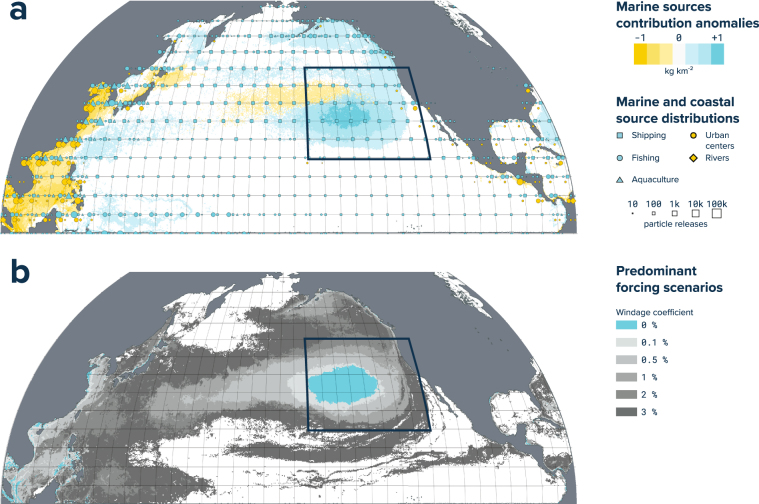
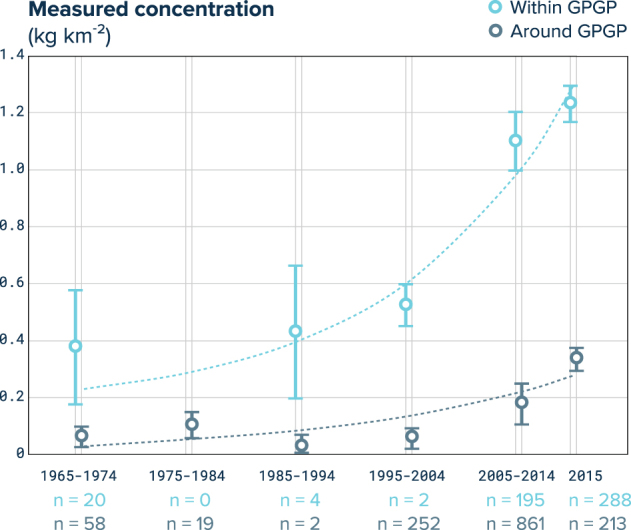
Ocean plastic can persist in sea surface waters, eventually accumulating in remote areas of the world’s oceans. Here we characterise and quantify a major ocean plastic accumulation zone formed in subtropical waters between California and Hawaii: The Great Pacific Garbage Patch (GPGP). Our model, calibrated with data from multi-vessel and aircraft surveys, predicted at least 79 (45–129) thousand tonnes of ocean plastic are floating inside an area of 1.6 million km 2 ; a figure four to sixteen times higher than previously reported. We explain this difference through the use of more robust methods to quantify larger debris. Over three-quarters of the GPGP mass was carried by debris larger than 5 cm and at least 46% was comprised of fishing nets. Microplastics accounted for 8% of the total mass but 94% of the estimated 1.8 (1.1–3.6) trillion pieces floating in the area. Plastic collected during our study has specific characteristics such as small surface-to-volume ratio, indicating that only certain types of debris have the capacity to persist and accumulate at the surface of the GPGP. Finally, our results suggest that ocean plastic pollution within the GPGP is increasing exponentially and at a faster rate than in surrounding waters.
Overview
The claims and statistics of this paper haven’t been checked yet.
Free: it reads the open-access text and checks the first 5 claims that cite a source we can check. Create a free account to check every claim.
Integrity signals
Registry
Cites
Statistics
Figures
Verification
Claims the paper makes
The claims and statistics of this paper haven’t been checked yet.
Free: it reads the open-access text and checks the first 5 claims that cite a source we can check. Create a free account to check every claim.
Claims other papers make about this one
Each is checked against this paper’s own text: does it say what the citing paper says it does?
In the citing paper
“Surface trawl observations may be underestimated by a factor of 4-16.55”
From The fate of plastic in the ocean environment – a minireview (2021) · cites this paper as [55]
Self-check
Percentages, sums and reported differences re-computed from the paper’s own numbers.
The self-check needs the paper’s full text.
Citations
Cites
The NCEP/NCAR 40-Year Reanalysis Project
Kalnay, E., Kanamitsu, M., Kistler, R., Collins, W., Deaven, D., Gandin, L., Iredell, M., Saha, S., White, G., Woollen, J., et al. (1996) · Bulletin of the American Meteorological Society · doi:10.1175/1520-0477(1996)077<0437:tnyrp>2.0.co;2 · Cited by 28,360 · cited 1×
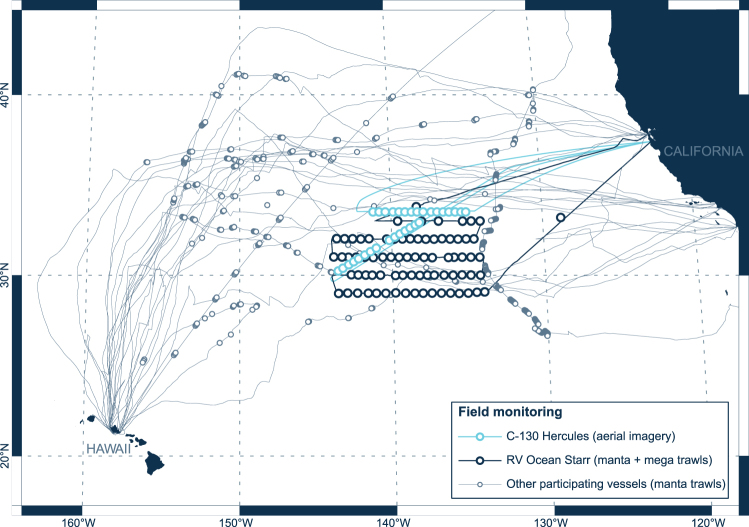
“We sourced global sea surface currents (1993 to 2012) from the HYCOM + NCODA global 1/12° reanalysis (experiment 19.0 and 19.1 36–38 ), and wind (10 m above sea level) speed and direction data (1993 to 2012) from NCEP/NCAR global reanalysis 39 .”
MethodInfluentialProduction, use, and fate of all plastics ever made
Geyer, R., Jambeck, J. R., & Law, K. L. (2017) · Science Advances · doi:10.1126/sciadv.1700782 · Cited by 18,606
Plastic waste inputs from land into the ocean
Jambeck, J. R., Geyer, R., Wilcox, C., Siegler, T. R., Perryman, M., Andrady, A., Narayan, R., & Law, K. L. (2015) · Science · doi:10.1126/science.1260352 · Cited by 13,163 · cited 1×
“…were identically and continuously released in time from 1993 to 2012 following spatial distributions and amplitudes of significant ocean plastic sources on land (coastal population hotspots 23 and major rivers 24 ) as well as at sea (fishing 26,41 , aquaculture 42 and shipping industries 43 ).”
BackgroundMicroplastics in the marine environment
Andrady, A. L. (2011) · Marine Pollution Bulletin · doi:10.1016/j.marpolbul.2011.05.030 · Cited by 8,105 · cited 2×
“Buoyant plastic represents about 60% of the global plastic demand 10 , thus nearly half of the plastic input into the oceans should sink to the floor soon after release, accumulating in sediments 53 and underwater canyons 54 . rest may strand in coastlines 13,55,56 , be ingested by marine life 57…”
BackgroundLost at sea: where is all the plastic?
Thompson, R. C., Olsen, Y., Mitchell, R. P., Davis, A., Rowland, S. J., John, A. W. G., McGonigle, D., & Russell, A. E. (2004) · Science · doi:10.1126/science.1094559 · Cited by 7,765
A global map of human impact on marine ecosystems
Halpern, B. S., Walbridge, S., Selkoe, K. A., Kappel, C. V., Micheli, F., D'Agrosa, C., Bruno, J. F., Casey, K. S., Ebert, C., Fox, H. E., et al. (2008) · Science · doi:10.1126/science.1149345 · Cited by 6,627
Accumulation and fragmentation of plastic debris in global environments
Barnes, D. K. A., Galgani, F., Thompson, R. C., & Barlaz, M. (2009) · Philosophical Transactions of the Royal Society B: Biological Sciences · doi:10.1098/rstb.2008.0205 · Cited by 6,126 · cited 1×
“…it seems the bulk mass of material currently present in the GPGP is very unlikely to leave the area and may slowly degrade into increasingly smaller pieces that can eventually either sink to the seafloor 14 , or behave as water tracer due to its microscopic size and low Reynolds number 66 .”
BackgroundEriksen, M., Lebreton, L. C. M., Carson, H. S., Thiel, M., Moore, C. J., Borerro, J. C., Galgani, F., Ryan, P. G., & Reisser, J. (2014) · PLoS ONE · doi:10.1371/journal.pone.0111913 · Cited by 4,710 · cited 3×
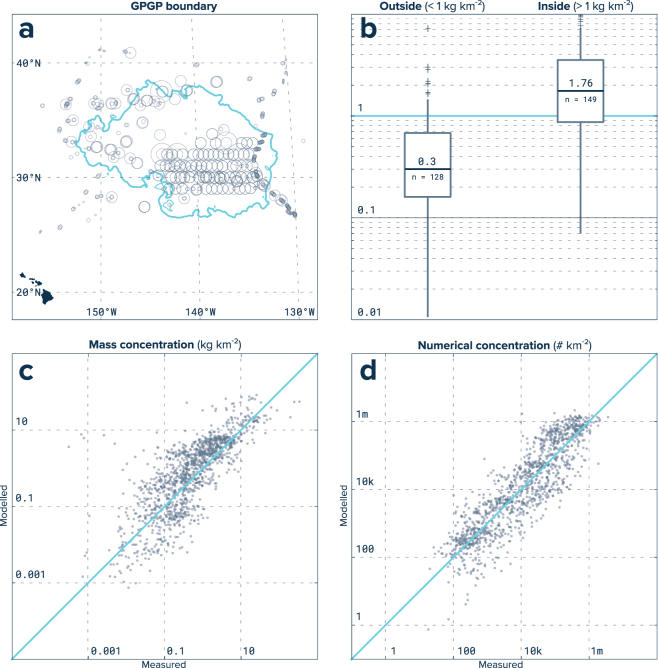
“A dynamic GPGP model boundary allowed us to determine whether surface net tows from previous studies 17,21,22,46–49 were sampling inside or outside the GPGP. Average plastic mass concentration measured by net tows inside the GPGP boundary showed an exponential increase over the last decades, rising…”
ResultInfluentialSelf-citationRiver plastic emissions to the world’s oceans
Lebreton, L. C. M., van der Zwet, J., Damsteeg, J.-W., Slat, B., Andrady, A., & Reisser, J. (2017) · Nature Communications · doi:10.1038/ncomms15611 · Cited by 4,011 · cited 1×
“…were identically and continuously released in time from 1993 to 2012 following spatial distributions and amplitudes of significant ocean plastic sources on land (coastal population hotspots 23 and major rivers 24 ) as well as at sea (fishing 26,41 , aquaculture 42 and shipping industries 43 ).”
BackgroundSelf-citationPlastic debris in the open ocean
Cózar, A., Echevarría, F., González-Gordillo, J. I., Irigoien, X., Úbeda, B., Hernández-León, S., Palma, Á. T., Navarro, S., García-de-Lomas, J., Ruiz, A., et al. (2014) · Proceedings of the National Academy of Sciences · doi:10.1073/pnas.1314705111 · Cited by 3,133 · cited 1×
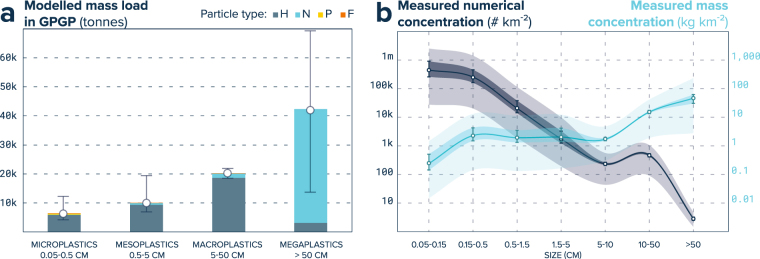
“Our plastic mass estimate for the GPGP (~79 k tonnes) was nearly sixteen times higher than a previous study (~4.8 k tonnes) that used net trawl data only 29 and four times higher than another assessment (~21 k tonnes) that combined net trawl data with vessel-based visual surveys 21 .”
ResultInfluential
Research works printed but not linked: 11
- Plastics Europe. Plastics - the facts 2016: an analysis of European plastics production, demand and waste data. Preprint at http://www.plasticseurope.org (2016).
- Weisskopf M Plastic reaps a grim harvest in the oceans of the world Smithsonian 1988 18 59
- American Plastics Council. Understanding plastic film: its uses, benefits and waste management options. Preprint at https://plastics.americanchemistry.com/Understanding-Plastic-Film/ (1996).
- Tolman HL The numerical model WAVEWATCH: a third-generation model for the hindcasting of wind waves on tides in shelf seas Communications on Hydraulic and Geotechnical Engineering, Delft Univ. of Techn. 1989 89 72
- FAO. The state of world fisheries and aquaculture 2014. Preprint at http://www.fao.org/3/a-i3720e.pdf (2014).
- NOAA. Detecting Japan tsunami marine debris at sea: a synthesis of efforts and lessons learned. Preprint at https://marinedebris.noaa.gov/sites/default/files/JTMD_Detection_Report.pdf (2015)
- U.S. EPA. Characterization of municipal solid waste in the United States: 1997 update. Preprint at https://archive.epa.gov/epawaste/nonhaz/municipal/web/pdf/msw97rpt.pdf (1998).
- International Coastal Cleanup. Tracking trash - 25 years of action for the ocean. Preprint at http://act.oceanconservancy.org/pdf/Marine_Debris_2011_Report_OC.pdf (2011).
- GESAMP. Sources, fate and effects of microplastics in the marine environment: part two of a global assessment (eds Kershaw, P. J. & Rochman, C. M.). (IMO/FAO/UNESCO-IOC/UNIDO/WMO/IAEA/UN/UNEP/UNDP Joint Group of Experts on the Scientific Aspects of Marine Environmental Protection). Rep. Stud. GESAMP, 93, 220 (2016).
- Maximenko, N. et al. Remote sensing of marine debris to study dynamics, balances and trends. Preprint at https://ecocast.arc.nasa.gov/las/Reports%20and%20Papers/Marine-Debris-Workshop-2017.pdf (2017).
- NASA. Satellite-respondent buoys identify ocean debris. Preprint at https://www.nasa.gov/offices/oct/home/tech_life_buoy.html (2010).
Cited by
Items 801–900 of 1,001
Perumal, K., & Muthuramalingam, S. (2023) · Regional Studies in Marine Science · doi:10.1016/j.rsma.2023.102863 · Cited by 18
Material flow analysis of commercial fishing gears in Taiwan
Su, C.-T., Schneider, F., Deshpande, P. C., Xiao, H.-Y., Su, T.-A., Yen, N., & Lin, H.-T. (2023) · Marine Pollution Bulletin · doi:10.1016/j.marpolbul.2023.114822 · Cited by 17
Risk assessment framework for microplastic in marine environments
Rubin, A. E., Gnaim, R., Levi, S., & Zucker, I. (2023) · The Science of The Total Environment · doi:10.1016/j.scitotenv.2023.166459 · Cited by 17
Large-area automatic detection of shoreline stranded marine debris using deep learning
Winans, W. R., Chen, Q., Qiang, Y., & Franklin, E. C. (2023) · International Journal of Applied Earth Observation and Geoinformation · doi:10.1016/j.jag.2023.103515 · Cited by 17
de Vries, R., Garaba, S. P., & Royer, S. (2023) · Earth system science data · doi:10.5194/essd-15-5575-2023 · Cited by 21
Mahmoud, A., & El-Sharkawy, Y. H. (2024) · Optical and Quantum Electronics · doi:10.1007/s11082-024-06564-8 · Cited by 17
“Finding plastic trash on beaches can assist in tracking the success of mitigation measures and provide information for upcoming initiatives to minimize plastic waste and enhance waste management procedures (Hirai et al. 2011; Lebreton et al. 2018; Suaria et al. 2016; Wagner et al. 2014).”
Nakajima, R., Nagano, A., Osafune, S., Tsuchiya, M., & Fujikura, K. (2024) · Ocean Dynamics · doi:10.1007/s10236-024-01635-6 · Cited by 19
“The maximum microplastic density found in the eddy center in this study (570 × 10 4 pieces/km 2 ) was also higher than any of the maximum records in the Kuroshio region published in previous studies (352 × 10 4 pieces/km 2 , (Yamashita and Tanimura 2007); 202 × 10 4 pieces/km 2 , (Thushari et al. 2023), but rather com…”
Rezania, S., Miri, S., Cho, J., Hur, J., Kamyab, H., Darajeh, N., Mohammadi, A. A., Molani, F., & Taghavijeloudar, M. (2025) · Journal of Contaminant Hydrology · doi:10.1016/j.jconhyd.2025.104496 · Cited by 19
Murphy-Hagan, C., Gray, A. B., Singh, S., Hapich, H., Cowger, W., Seeley, M. E., & Waldschläger, K. (2025) · Environmental Research · doi:10.1016/j.envres.2025.120908 · Cited by 19
Edward, J. K. P., Jayanthi, M., Einarsson, H. A., Kannan, R., Laju, R. L., Jeyasanta, K. I., Sathish, N., & Patterson, J. (2025) · Marine Pollution Bulletin · doi:10.1016/j.marpolbul.2025.117700 · Cited by 18
Role of microplastics in the tumor microenvironment (Review)
Chen, Y., Zhang, Z., Ji, K., Zhang, Q., Qian, L., & Yang, C. (2025) · Oncology Letters · doi:10.3892/ol.2025.14939 · Cited by 21
“These products can be further classified by size into nanoplastics (NPs; ≤0.1 µm), MPs (≤5 mm), medium plastics (0.5‑5 cm), megaplastics (5‑50 cm) and macroplastics (≥50 cm) (6).”
InfluentialLong-Term Changes in the Abundance, Size, and Morphotype of Marine Plastics in the North Pacific
Miyazono, K., Tadokoro, K., Thushari, G. G. N., Miyamoto, H., Takasuka, A., Watai, M., Yasuda, T., Sato, T., Yamashita, R., Kodama, T., et al. (2025) · Environmental Science & Technology · doi:10.1021/acs.est.4c09706 · Cited by 17
Ecotoxic Effects of the Plastic Waste on Marine Fauna: An Overview
Dar, M. A., Dhole, N. P., Pawar, K. D., Xie, R., Shahnawaz, M., Pandit, R. S., & Sun, J. (2022) · Springer eBooks · doi:10.1007/978-981-16-5403-9_15 · Cited by 21
Beijer, N. R. M., Dehaut, A., Carlier, M. P., Wolter, H., Versteegen, R. M., Pennings, J. L. A., de la Fonteyne, L. J. J., Niemann, H., Janssen, H. M., Timmermans, B. G., et al. (2022) · Frontiers in Water · doi:10.3389/frwa.2022.866732 · Cited by 22
“, nanoplastics down to a size of 20 nm (Ter Halle et al., 2017; Lebreton et al., 2018; Wagner and Reemtsma, 2019).”
BackgroundPae, J., Kim, M. O., Han, T. H., & Moon, J. (2022) · Journal of Building Engineering · doi:10.1016/j.jobe.2022.104829 · Cited by 19
Hoare, V., Atchison-Balmond, N., Hays, G. C., Jones, R., Koldewey, H. J., Laloë, J., Levy, E., Llewellyn, F., Morrall, H., & Esteban, N. (2022) · Marine Pollution Bulletin · doi:10.1016/j.marpolbul.2022.113868 · Cited by 19
Emerging plastic litter variants: A perspective on the latest global developments
Chowdhury, P. R., Medhi, H., Bhattacharyya, K. G., & Hussain, C. M. (2022) · The Science of The Total Environment · doi:10.1016/j.scitotenv.2022.159859 · Cited by 17
Sun-synchronous repeat ground tracks and other useful orbits for future space missions
Paek, S. W., Kim, S., Kronig, L., & de Weck, O. (2020) · The Aeronautical Journal · doi:10.1017/aer.2020.21 · Cited by 17
“The DGTs might also be useful for the real-time monitoring of ships and trash in the ocean(20,21).”
BackgroundSediment composition influences microplastic trapping in seagrass meadows
Greenshields, J., Irving, A. D., Anastasi, A., & Capper, A. (2025) · Environmental Pollution · doi:10.1016/j.envpol.2025.126090 · Cited by 16
Evaluating the environmental impact of cleaning the North Pacific Garbage Patch
Egger, M., Booth, A. M., Bosker, T., Everaert, G., Garrard, S. L., Havas, V., Huntley, H. S., Koelmans, A. A., Kvale, K., Lebreton, L., et al. (2025) · Scientific Reports · doi:10.1038/s41598-025-00619-w · Cited by 18
“Laboratory-based experiments on polyethylene and polypropylene (the two most common polymers found afloat in the NPGP 19,66,103 ) using virgin polymers and plastics collected from the NPGP showed that between 1.7 and 2.3% of their mass is degraded annually by solar UV radiation as encountered at…”
InfluentialSelf-citationDegradation of Plastic Waste in the Marine Environment
Li, W. C., Tse, H. F., Leung, H. M., & Yue, Y. (2022) · Springer eBooks · doi:10.1007/978-981-16-5403-9_8 · Cited by 16
Liu, Y., Shang, D., Yang, Y., Cui, P., & Sun, J. (2022) · Fishes · doi:10.3390/fishes7060338 · Cited by 18
GNSS-R Observations of Marine Plastic Litter in a Water Flume: An Experimental Study
Gonga, A., Pérez-Portero, A., Camps, A., Pascual, D., de Fockert, A., & de Maagt, P. (2023) · Remote Sensing · doi:10.3390/rs15030637 · Cited by 16
Managing plastic waste with nanotechnology: current sustainability prospects
Kandpal, A., Singh, A., Jain, D., Upadhyay, S. K., Siddiqui, A. J., Sharma, K., & Saxena, J. (2023) · Nanotechnology for Environmental Engineering · doi:10.1007/s41204-023-00346-5 · Cited by 18
“Now it is swiftly transforming into the hot spot of ocean plastic pollution [49].”
BackgroundYadav, D. K., & Kumar, R. (2023) · Frontiers in Ecology and Evolution · doi:10.3389/fevo.2023.1279589 · Cited by 18
Song, U., & Park, H. (2024) · Journal of Ecology and Environment · doi:10.5141/jee.23.083 · Cited by 18
Terrazas-López, R., Guzmán, P. G., Sujitha, S. B., Mendoza, L. A., & Ponniah, J. M. (2024) · Sustainability · doi:10.3390/su16145905 · Cited by 21
Høiberg, M. A., Stadler, K., & Verones, F. (2024) · The Science of The Total Environment · doi:10.1016/j.scitotenv.2024.175019 · Cited by 19
Hepatic and metabolic outcomes induced by sub-chronic exposure to polystyrene microplastics in mice
Lee, S.-H., Lin, T.-A., Yan, Y., Chien, C., & Cheng, T. (2024) · Archives of Toxicology · doi:10.1007/s00204-024-03847-7 · Cited by 19
“Numerous environmental studies have demonstrated that MPs are extensively distributed in the hydrosphere (Hurley et al. 2018; Kelly et al. 2020; Lebreton et al. 2018; Pohl et al. 2020), the atmosphere (Allen et al. 2019; Evangeliou et al. 2020), and terrestrial environments (Horton et al. 2017; Qi…”
Four decades of Hawaiian monk seal entanglement data reveal the benefits of plastic debris removal
Baker, J. D., Johanos, T. C., Ronco, H., Becker, B. L., Morioka, J., O’Brien, K. P., & Donohue, M. J. (2024) · Science · doi:10.1126/science.ado2834 · Cited by 16
Xu, S. (2024) · Frontiers in Marine Science · doi:10.3389/fmars.2024.1481635 · Cited by 16
Goddijn‐Murphy, L., Woolf, D. K., & James, N. A. (2025) · Marine Pollution Bulletin · doi:10.1016/j.marpolbul.2025.117528 · Cited by 17
Kumar, V., Kaur, A., Cao, D., Sindhwani, R., Mathiyazhagan, K., & Lin, B. (2025) · Energy Economics · doi:10.1016/j.eneco.2025.108408 · Cited by 18
Bilynets, I., & Cvelbar, L. K. (2020) · Economic and business review · doi:10.15458/ebr102 · Cited by 18
“…cases with global media coverage on the issue, such as the exponential growth of the amount of plastic in the ocean – the Great Pacific Garbage Patch (Lebreton et al., 2018), or reaching the point of no return for the glaciers melting (Marzeion et al., 2018), there is ample evidence about…”
BackgroundInfluentialShifting baselines of cetacean conservation in Europe
Bearzi, G., & Reeves, R. R. (2021) · ICES Journal of Marine Science · doi:10.1093/icesjms/fsab137 · Cited by 16
Material studies for the recycling of abandoned, lost or otherwise discarded fishing gear (ALDFG)
Weißbach, G., Gerke, G., Stolte, A., & Schneider, F. (2021) · Waste Management & Research The Journal for a Sustainable Circular Economy · doi:10.1177/0734242x211052850 · Cited by 19
“…oil–based polymers since the 1960s because of their long-lasting properties, and it contributes to between 30% and 50% of the plastic items found in the world’s oceans, for example, in the North-East Atlantic and the Pacific Garbage Patch, respectively (Lebreton et al., 2018; Pham et al., 2014).”
BackgroundThree-Dimensional Dispersion of Neutral “Plastic” Particles in a Global Ocean Model
Huck, T., Bajon, R., Grima, N., Portela, E., Molines, J., & Penduff, T. (2022) · Frontiers in Analytical Science · doi:10.3389/frans.2022.868515 · Cited by 17
Qiu, S., Huang, G., Li, X., Lei, D.-Q., Wang, C.-S., & Ying, G. (2022) · Journal of Hazardous Materials · doi:10.1016/j.jhazmat.2022.130700 · Cited by 17
Adeniji, A. O., Okaiyeto, K., Mohammed, J. N., Mabaleha, M., Tanor, E. B., & George, M. J. (2023) · International Journal of Environmental Science and Technology · doi:10.1007/s13762-023-04916-7 · Cited by 15
“…the chemical additives in MPs are the major contamination sources (especially to the water sources), as some of them are implicated in endocrine disruption, altering hormones and affecting the reproductive and metabolic processes adversely (Galloway et al. 2017; Lee and Kim 2018; Liu et al. 2019).”
BackgroundBelden, E. R., Kazantzis, N., Reddy, C. M., Kite-Powell, H. L., Timko, M. T., Italiani, E., & Herschbach, D. R. (2021) · Proceedings of the National Academy of Sciences · doi:10.1073/pnas.2107250118 · Cited by 17
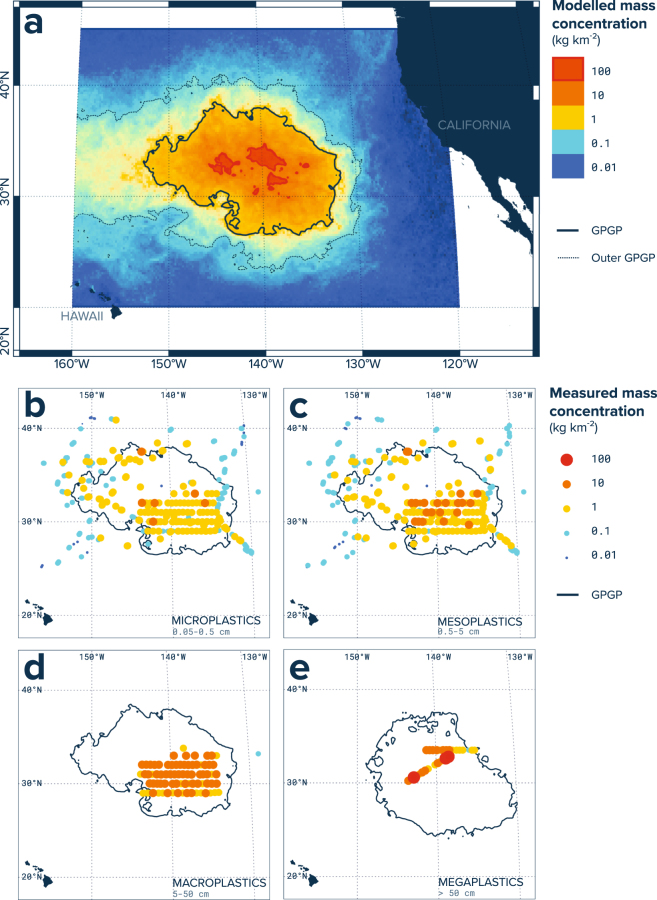
“* Surface concentration of plastic in the GPGP (1) for a fixed value of 79,000 tons of plastic contained in the GPGP(2).”
BackgroundMethodInfluentialKibria, G., Nugegoda, D., & Haroon, A. K. Y. (2022) · Emerging contaminants and associated treatment technologies · doi:10.1007/978-3-030-89220-3_7 · Cited by 20
Public perceptions of marine litter and impacts on coastal ecosystem services in Galicia (Spain)
Herrera, M., Pita, P., Castelo, D., Almeida, C. M. R., Ramos, S., & Villasante, S. (2023) · Marine Policy · doi:10.1016/j.marpol.2023.105742 · Cited by 15
Marine debris facilitates the long-distance dispersal of fish species
Benadon, C., Zabin, C. J., Haram, L. E., Carlton, J. T., Maximenko, N., Nelson, P., Crowley, M. E., & Ruiz, G. M. (2023) · Marine Biology · doi:10.1007/s00227-023-04365-3 · Cited by 15
“…around (adjacent, in, and under) anthropogenic debris items in the pelagic North Pacific Ocean, with a focus on the North Pacific Garbage Patch (NPGP), an accumulation of floating debris between 30–40° N and 135–165° W in the eastern North Pacific Subtropical Gyre (ENPSG, Lebreton et al. 2018).”
Measurements of the inherent optical properties of aqueous suspensions of microplastics
Koestner, D., Foster, R., El‐Habashi, A., & Cheatham, S. (2024) · Limnology and Oceanography Letters · doi:10.1002/lol2.10387 · Cited by 15
“…of microplastics in the Great Paci fi c Garbage Patch as approximately 2.5 kg km (cid:1) 2 (or SPM = 33 mg m (cid:1) 3 assuming half of the 15-cm Manta trawl was submerged), noting the microplastic size range was 0.5 – 5 mm and this refers mainly to buoyant material (Lebreton et al. 2018).”
InfluentialThermochemical recovery of propylene from plastic waste: A review
Kim, S. W., Kim, Y. T., & Lee, J. (2024) · Alexandria Engineering Journal · doi:10.1016/j.aej.2024.06.044 · Cited by 15
de Souza, A. M. D. C., Ferreira, G. V. B., Santos, C. B. D. L., Lucena‐Frédou, F., & Magalhães, K. M. (2024) · Marine Pollution Bulletin · doi:10.1016/j.marpolbul.2024.116799 · Cited by 16
Chambers, R. J., Rajput, B. S., Scofield, G. B., Reindel, J., O’Shea, K., Li, R. J., Simkovsky, R., Mayfield, S. P., Burkart, M. D., & Cai, S. (2024) · ACS Applied Polymer Materials · doi:10.1021/acsapm.4c01974 · Cited by 15
Beached Plastic Debris Index; a modern index for detecting plastics on beaches
Guffogg, J. A., Soto‐Berelov, M., Bellman, C. J., Jones, S., & Skidmore, A. K. (2024) · Marine Pollution Bulletin · doi:10.1016/j.marpolbul.2024.117124 · Cited by 17
Lomwongsopon, P., Martínez, B. M., Jiménez, A., Bardenshtein, A., Kusano, Y., Christiansen, J. D. C., & Varrone, C. (2025) · Chemosphere · doi:10.1016/j.chemosphere.2025.144151 · Cited by 15
Belmokhtar, Z., Cousin, P., Elkoun, S., & Robert, M. (2025) · Recycling · doi:10.3390/recycling10020059 · Cited by 15
“Studies indicate that such gear accounts for approximately 46% of the 79,000 metric tons of plastic waste in the Great Pacific Garbage Patch [3].”
The ghost nets phenomena from the chemical perspective
Dąbrowska, A., Łopata, I., & Osial, M. E. (2021) · Pure and Applied Chemistry · doi:10.1515/pac-2020-1102 · Cited by 17
Giles, R. K., Nguyen, C. A. T., Hồ, T. T. Y., Nguyến, C. V., Ngô, N. T., & Rochman, C. M. (2021) · Frontiers in Environmental Science · doi:10.3389/fenvs.2021.679530 · Cited by 15
Dong, Y., Gao, M., Qiu, W., & Song, Z. (2021) · Environmental Science and Pollution Research · doi:10.1007/s11356-021-15376-2 · Cited by 15
Park, S., Jeon, H., Choi, D. Y., & Oh, J. S. (2022) · Toxicology in Vitro · doi:10.1016/j.tiv.2022.105380 · Cited by 16
Franklin, E., Gavins, J., & Mehl, S. (2022) · Journal of World Languages · doi:10.1515/jwl-2022-0017 · Cited by 21
“…have made it a wonderfully cheap and reliable construction material for humans, have also endowed it with a lasting presence in ecosystems all around the world; some plastic has already occupied natural environments for decades beyond its original, typically fleeting, use (Lebreton et al. 2018).”
Scardino, G., Martella, R., Mastronuzzi, G., Rizzo, A., Borracesi, Q., Musolino, F., Romanelli, N., Zarcone, S., Cipriano, G., & Retucci, A. (2022) · Marine Pollution Bulletin · doi:10.1016/j.marpolbul.2022.114282 · Cited by 15
Cree, D. E., Owuamanam, S., & Soleimani, M. (2023) · Waste · doi:10.3390/waste1030044 · Cited by 17
Posidonia Spheroids Intercepting Plastic Litter: Implications for Beach Clean-Ups
Porcino, N., Bottari, T., Falco, F., Natale, S., & Mancuso, M. (2023) · Sustainability · doi:10.3390/su152215740 · Cited by 17
Matuštík, J., & Kočí, V. (2018) · The Science of The Total Environment · doi:10.1016/j.scitotenv.2018.07.233 · Cited by 18
Enhancing the durability of poly(lactic acid) composites by nucleated modification
Sun, C., Li, C., Tan, H., & Zhang, Y. (2019) · Polymer International · doi:10.1002/pi.5837 · Cited by 15
Uhrin, A. V., Walsh, W. A., & Brodziak, J. (2020) · Scientific Reports · doi:10.1038/s41598-020-64771-1 · Cited by 16
Marine litter footprint in the Azores Islands: A climatological perspective
Pieper, C., Loureiro, C. M., Law, K. L., Amaral‐Zettler, L., Quintino, V., Rodrigues, A. M., Ventura, M. A., & Martins, A. M. (2020) · The Science of The Total Environment · doi:10.1016/j.scitotenv.2020.143310 · Cited by 15
Cooper, E. N., Аверкиев, Б. Б., Day, V. W., & Sues, P. E. (2021) · Organometallics · doi:10.1021/acs.organomet.1c00400 · Cited by 15
Sinking microplastics in the water column: Simulations in the Mediterranean Sea
de la Fuente, R., Drótos, G., Hernández-García, E., López, C., van Sebille, E., Oceanography, S. P., & Research, M. A. A. (2021) · DIGITAL.CSIC (Spanish National Research Council (CSIC)) · Cited by 15
Nguyen, L. T., Bai, T., Lu, Z., Woo, N. Y. R., Goh, X. Y., Tran, A. D., Tran, C., & Duong, H. M. (2025) · Construction and Building Materials · doi:10.1016/j.conbuildmat.2025.143161 · Cited by 14
Pharmaceuticals in the marine environment: occurrence, fate, and biological effects
Fabbri, E., Valbonesi, P., & Moon, T. W. (2023) · Elsevier eBooks · doi:10.1016/b978-0-323-90297-7.00008-1 · Cited by 20
Marine Plastics: Innovative Solutions to Tackling Waste
Grimstad, S. M. F., Ottosen, L. M., & James, N. A. (2023) · Springer eBooks · doi:10.1007/978-3-031-31058-4 · Cited by 14
Feasibility of Radar-Based Detection of Floating Macroplastics at Microwave Frequencies
Felício, J. M., Costa, T. S. D., Vala, M., Leonor, N., Costa, J. R., Marques, P. A. C., Moreira, A. A., Caldeirinha, R. F. S., Matos, S. A., Fernandes, C. A., et al. (2024) · IEEE Transactions on Antennas and Propagation · doi:10.1109/tap.2023.3347031 · Cited by 14
“Over time, ocean currents pull plastic objects over long distances, allowing litter to drift around the oceans, eventually ending up in remote locations far away from its entry point, as, for instance, the Great Pacific Garbage Patch (GPGP) [2].”
BackgroundMethodInfluentialIndumathi, S. M., Vardhan, M. K. H., Kumar, R. S. R., Rohinth, M., Ahmed, Z. H. T., Prakash, P., & Kumar, J. A. (2024) · Environmental Quality Management · doi:10.1002/tqem.22186 · Cited by 15
Hibatullah, M. F., & Mutaqin, B. W. (2024) · Discover Geoscience · doi:10.1007/s44288-024-00033-1 · Cited by 15
“…that Drini beach has been designated as a tourist destination and fishing activities that might increase the abundance of marine debris may explain why the two beaches belong to the same type of beaches, namely non-pockets, but have different marine debris characteristics [8, 19, 43, 49, 60, 86].”
Calvert, R., Peytavin, A., Pham, Y., Duhamel, A., van der Zanden, J., van Essen, S., Sainte-Rose, B., & van den Bremer, T. S. (2024) · Journal of Geophysical Research Oceans · doi:10.1029/2023jc020661 · Cited by 15
Self-citationMaurya, A., Kumar, P., Kumar, B., & Singh, V. K. (2025) · Wiley eBooks · doi:10.1002/9781394318414.ch13 · Cited by 14
Microplastics in Water Resources: Threats and Challenges
Strojny, W., Gruca–Rokosz, R., & Cieśla, M. (2025) · Applied Sciences · doi:10.3390/app15084118 · Cited by 16
Buckingham, J., Capper, A., & Bell, M. (2020) · Marine Pollution Bulletin · doi:10.1016/j.marpolbul.2020.111364 · Cited by 14
The Life Cycle of Polymer Materials: Problems and Prospects
Yaroslavov, A. A., Arzhakov, M. S., & Khokhlov, A. R. (2022) · Herald of the Russian Academy of Sciences · doi:10.1134/s1019331622010087 · Cited by 14
“From there, the garbage is washed away by rains and melt water into rivers and then into the seas and oceans, forming giant garbage islands [6].”
BackgroundKim, S., Lee, S., Lee, H. S., Yang, W., & Lee, J. (2022) · Environmental Engineering Research · doi:10.4491/eer.2022.162 · Cited by 14
Khanashyam, A. C., Shanker, M. A., & Nirmal, N. P. (2022) · Advances in food and nutrition research · doi:10.1016/bs.afnr.2022.07.003 · Cited by 18
The need for a dedicated marine plastic litter satellite mission
Martínez-Vicente, V. (2022) · Nature Reviews Earth & Environment · doi:10.1038/s43017-022-00360-2 · Cited by 14
Estimating floating macroplastic flux in the Santa Ana River, California
Cowger, W., Gray, A. B., Brownlee, S., Hapich, H., Deshpande, A. D., & Waldschläger, K. (2022) · Journal of Hydrology Regional Studies · doi:10.1016/j.ejrh.2022.101264 · Cited by 20
“Macroplastic (> 5 mm) is known to make up most of the mass of plastic in the environment and break down to form many more abundant microplastics (particles < 5 mm) (Lebreton et al., 2018; Moore et al., 2011).”
BackgroundImpacts and Threats of Marine Litter in African Seas
Arabi, S., Neehaul, Y., & Sparks, C. A. J. (2022) · Springer eBooks · doi:10.1007/978-3-031-08626-7_3 · Cited by 18
Liu, G., Shi, K., Sun, H., Yang, B., & Weng, Y. (2023) · Polymers · doi:10.3390/polym15132811 · Cited by 14
“The depletion of fossil resources and increasing environmental awareness have let to research focusing on sustainability and renewability [1].”
BackgroundPignataro, E., Pini, F., Barbanente, A., Arnesano, F., Palazzo, A., & Marsano, R. M. (2024) · The Science of The Total Environment · doi:10.1016/j.scitotenv.2024.169942 · Cited by 14
Seasonality of Marine Litter Hotspots in the Wider Caribbean Region
Xu, X., Chassignet, E. P., Miron, P., & Zavala‐Romero, O. (2024) · Journal of Marine Science and Engineering · doi:10.3390/jmse12020319 · Cited by 16
“…found all over the world’s oceans [4–6]; see also a long list of recent observational efforts in qualifying the plastic waste in the Pacific Ocean [7], the Atlantic Ocean [8,9], the Indian Ocean [10,11], the Arctic Ocean [12–14], and even in the previously thought to be pristine Southern Ocean…”
BackgroundDegradation mechanisms in PBSAT nets immersed in seawater
Gué, L. L., Savina, E., Arhant, M., Davies, P., Gayet, N., & Vincent, B. (2024) · Polymer Degradation and Stability · doi:10.1016/j.polymdegradstab.2024.110788 · Cited by 16
The United States requires effective federal policy to reduce marine plastic pollution
Iverson, A. R. (2019) · Conservation Science and Practice · doi:10.1111/csp2.45 · Cited by 16
“However, more recent estimates based on the Great Pacific Garbage Patch suggest that the amount of plastic may be four to 16 times higher than previous estimates (Lebreton et al., 2018).”
BackgroundResultWhen one cannot bypass the byproducts: Plastic packaging waste embedded in production and export
Gao, X., Dall’erba, S., Ellison, B., Avelino, A. F. T., & Yang, C. (2022) · Journal of Industrial Ecology · doi:10.1111/jiec.13282 · Cited by 16
“…bottles, has attracted a growing interest recently because its impact on the environment and especially marine life (e.g., the “Great Pacific Garbage Patch” [Lebreton et al., 2018]) is visible and poses a significant challenge to solid waste management efforts (Brisson, 1993; Jambeck et al., 2015).”
BackgroundPlastics Pollution and the Planetary Boundaries frameworkPreprint
Villarrubia-Gómez, P., Cornell, S., Almroth, B. C., Ryberg, M. W., & Eriksen, M. (2022) · EarthArXiv (California Digital Library) · doi:10.31223/x5p05h · Cited by 16
Rynek, R., Tekman, M. B., Veit-Köhler, G., Wagner, S., Reemtsma, T., & Jahnke, A. (2025) · Environmental Science & Technology · doi:10.1021/acs.est.5c11358 · Cited by 13
Anthropogenic Microparticles in Sea-Surface Microlayer in Osaka Bay, Japan
Zhou, M., Yanai, H., Yap, C. K., Emmanouil, C., & Okamura, H. (2023) · Journal of Xenobiotics · doi:10.3390/jox13040044 · Cited by 13
“For instance, at least 79 thousand tons of ocean plastics are floating inside an area of 1.6 million km 2 at the Great Pacific Garbage Patch (GPGP), where microplastics account for 8% of the total mass [3].”
BackgroundInfluentialOnwuemezie, L., & Darabkhani, H. G. (2024) · Energy · doi:10.1016/j.energy.2024.131601 · Cited by 14
Jacquin, J., Budinich, M., Chaffron, S., Barbe, V., Lombard, F., Pedrotti, M. L., Gorsky, G., ter Halle, A., Bruzaud, S., Kedzierski, M., et al. (2024) · Environmental Science and Pollution Research · doi:10.1007/s11356-024-33847-0 · Cited by 13
“Vast accumulation zones of buoyant plastic were described in the five main oceanic gyres, including the most famous “Great Pacific garbage patch” in the North Pacific Ocean where up to the order of kilograms (or millions of pieces) per km 2 was found in the center of the gyre (Lebreton et al. 2018).”
X-Band Radar Detection of Small Garbage Islands in Different Sea State Conditions
Serafino, F., & Bianco, A. (2024) · Remote Sensing · doi:10.3390/rs16122101 · Cited by 14
Shettigar, N. A., Bi, Q., & Toorman, E. A. (2024) · Environmental Science & Technology · doi:10.1021/acs.est.4c02223 · Cited by 15
Hernández, I., Castro-Rosero, L. M., Espino, M., & Alsina, J. M. (2025) · Frontiers in Marine Science · doi:10.3389/fmars.2024.1534678 · Cited by 13
Mapping the Distribution and Discharge of Plastic Pollution in the Ganga River
Sharma, E., Ramachandran, A., Dobriyal, P., Badola, S., Koldewey, H. J., Hussain, S. A., & Badola, R. (2025) · Sustainability · doi:10.3390/su17114932 · Cited by 13
A poluição por plásticos e a Educação Ambiental como ferramenta de sensibilização
Carneiro, T. M. Q. A., da Silva, L. A., & Guenther, M. (2021) · Revista Brasileira de Educação Ambiental (RevBEA) · doi:10.34024/revbea.2021.v16.12347 · Cited by 13
Simulating the distribution of beached litter on the northwest coast of Scotland
Allison, N. L., Dale, A., Turrell, W. R., Aleynik, D. L., & Narayanaswamy, B. E. (2022) · Frontiers in Environmental Science · doi:10.3389/fenvs.2022.940892 · Cited by 13
“For example, the use of visual or trawl surveys (e.g., Suaria et al., 2015; Ruiz-Orejon et al., 2016; Lebreton et al., 2018), or citizenscience beach-clean survey methods (e.”
Microbial Technology in Bioplastic Production and Engineering
Francis, D., & Parayil, D. J. (2022) · Wiley eBooks · doi:10.1002/9781119160182.ch6 · Cited by 14
Chronic toxic effects of fragmented polyvinyl chloride on the water flea Moina macrocopa
Kim, J., Sim, Y., Jeong, J., Jung, J.-H., & Rhee, J. (2023) · Molecular & Cellular Toxicology · doi:10.1007/s13273-023-00372-z · Cited by 13
“Plastic debris tends to accumu‑ late in aquatic systems due to its slow rate of biodegradation (Lebreton et al. 2018).”
Uncovering the relationship between floating marine litter and human activities in watersheds
Luo, J., Luan, B., Xue, F., Qi, X., Zhu, M., Xu, P., & Zhang, L. H. (2023) · Marine Pollution Bulletin · doi:10.1016/j.marpolbul.2023.115893 · Cited by 13
Metadata
- Authors
- Lebreton, L., Slat, B., Ferrari, F., Sainte-Rose, B., Aitken, J., Marthouse, R., Hajbane, S., Cunsolo, S., Schwarz, A., Levivier, A., Noble, K., Debeljak, P., Maral, H., Schoeneich-Argent, R., Brambini, R., & Reisser, J.
- Affiliations
- The Ocean Cleanup (NL)
- Centre National de la Recherche Scientifique (FR)
- Corresponding author
- Lebreton, L.
- Venue
- Scientific Reports
- Published
- 2018-03-22
- Volume
- 8
- Issue
- 1
- Pages
- 4666-4666
- ISSN
- 2045-2322 (ISSN-L)
- PMC
- PMC5864935
- OpenAlex
- W2791727655
- Semantic Scholar
- cbd6216cc4dd8bc948ba20943141090562992fab
- Cited by
- 1,839
- References
- 56
- Citations by year
- 2026: 152 · 2025: 242 · 2024: 252 · 2023: 257 · 2022: 289 · 2021: 272 · 2020: 193 · 2019: 141 · 2018: 40
- FWCI
- 60.53
- Type
- journal article
- Language
- en
- Open access
- gold
- doi.org
- Licence
- cc-by
- creativecommons.org/licenses/by/4.0 (tdm)
- creativecommons.org/licenses/by/4.0 (vor)
- Locations
- Scientific Reports (publishedVersion, cc-by)
- Europe PMC (PubMed Central) (publishedVersion, cc-by)
- PubMed Central (publishedVersion, cc-by)
- PubMed (publishedVersion)
- VBN Forskningsportal (Aalborg Universitet) (publishedVersion, cc-by)
- Roger Williams University - Digital Commons (Roger Williams University) (submittedVersion)
- HAL (submittedVersion, other-oa)
- DOAJ (DOAJ: Directory of Open Access Journals) (submittedVersion)
- Funders
- Technische Universiteit Delft
- Topics
- Physical Sciences › Environmental Science › Pollution › Microplastics and Plastic Pollution
- Physical Sciences › Environmental Science › Pollution › Oil Spill Detection and Mitigation
- Physical Sciences › Environmental Science › Waste Management and Disposal › Waste Management and Recycling
- Keywords
- Great Pacific Garbage Patch, marine plastic pollution, plastic accumulation, fishing nets, microplastics, debris size distribution, surface-to-volume ratio, subtropical gyre
- MeSH terms
- California, Environmental Monitoring, Garbage, Hawaii, Models, Theoretical, Pacific Ocean, Plankton, Plastics, Sampling Studies, Spectrophotometry, Infrared, Waste Products, Water Pollutants, Chemical, Water Pollution, Chemical, Wind, Satellite Imagery
About these checks
Registry, retraction, Cites and statistics results are computed, not judged, with one exception: a printed reference that no index lists is read once by a model before it counts as a citation error. Claims are extracted by a model and kept only when their quote appears verbatim in the text; each cited source is then checked, with a model’s help, for whether it says what the claim relies on. Those verdicts can be wrong — read the claim’s quote and the cited source before relying on one.
Statistics and arithmetic are recomputed, not judged.
Confidence bands are shown only for fields calibrated on our annotated test set. None is calibrated yet, so no band is shown.
What counts as a claim ›How we measure confidence ›How we check this ›
Are you an author, or do you see a problem with this page? Request a review
Data sources
Bibliographic data: Semantic Scholar, OpenAlex, Crossref.
Contains information from the Semantic Scholar Academic Graph Datasets, made available under the ODC Attribution License (ODC-BY 1.0).
Semantic Scholar’s data is described in: Kinney, R., et al. (2023). The Semantic Scholar Open Data Platform. arXiv:2301.10140.
