

Crowdsourcing punishment: Individuals reference group preferences to inform their own punitive decisions
Open accessThe DOI matches its Crossref record; 47 of the 49 references it cites were found in a registry or an index; 19 of the 43 sources its claims cite were checked for support.
Abstract
Justice systems delegate punishment decisions to groups in the belief that the aggregation of individuals’ preferences facilitates judiciousness. However, group dynamics may also lead individuals to relinquish moral responsibility by conforming to the majority’s preference for punishment. Across five experiments (N = 399), we find Victims and Jurors tasked with restoring justice become increasingly punitive (by as much as 40%) as groups express a desire to punish, with every additional punisher augmenting an individual’s punishment rates. This influence is so potent that knowing about a past group’s preference continues swaying decisions even when they cannot affect present outcomes. Using computational models of decision-making, we test long-standing theories of how groups influence choice. We find groups induce conformity by making individuals less cautious and more impulsive, and by amplifying the value of punishment. However, compared to Victims, Jurors are more sensitive to moral violation severity and less readily swayed by the group. Conformity to a group’s punitive preference also extends to weightier moral violations such as assault and theft. Our results demonstrate that groups can powerfully shift an individual’s punitive preference across a variety of contexts, while additionally revealing the cognitive mechanisms by which social influence alters moral values.
Overview
CoChat Summary
TL;DR
Across five experiments, individuals’ punishment decisions were strongly swayed by group punitive preferences, with predicted punishment shifting by as much as 40 percentage points. Computational modeling showed this conformity arose from lowered decision thresholds and increased valuation of punishment, with differences between victims and jurors.
Key findings
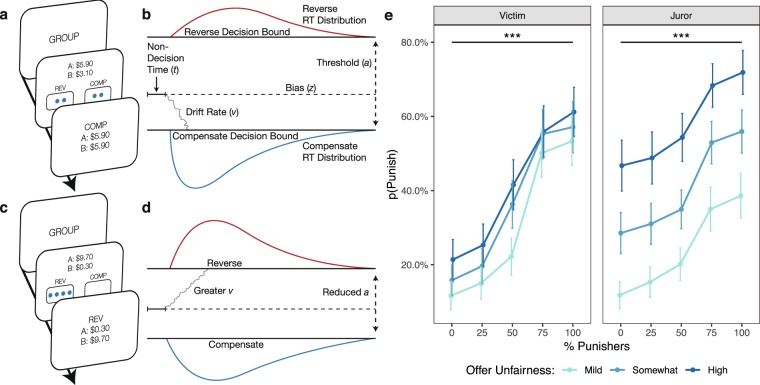
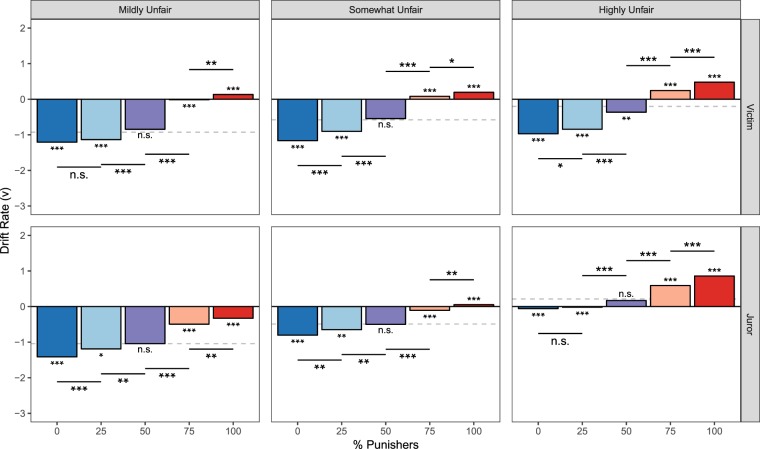
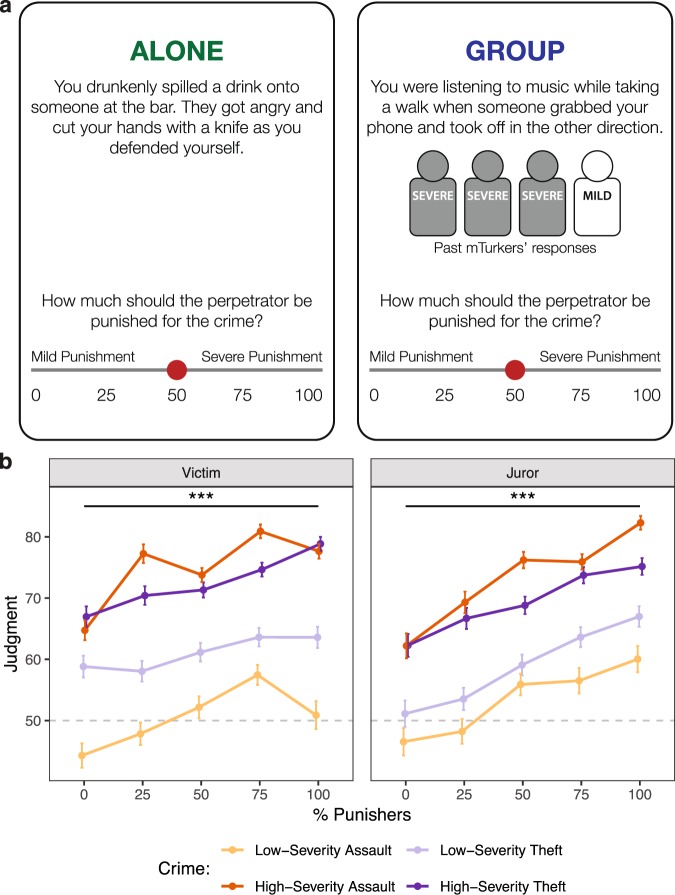
- Group punitive preferences increased punishment endorsement in every experiment: predicted punishment shifted by as much as 30 percentage points in Experiment 1, 40 percentage points in Experiment 3, nearly 30 percentage points in Experiment 4, and also modulated crime-severity judgments in Experiment 5.
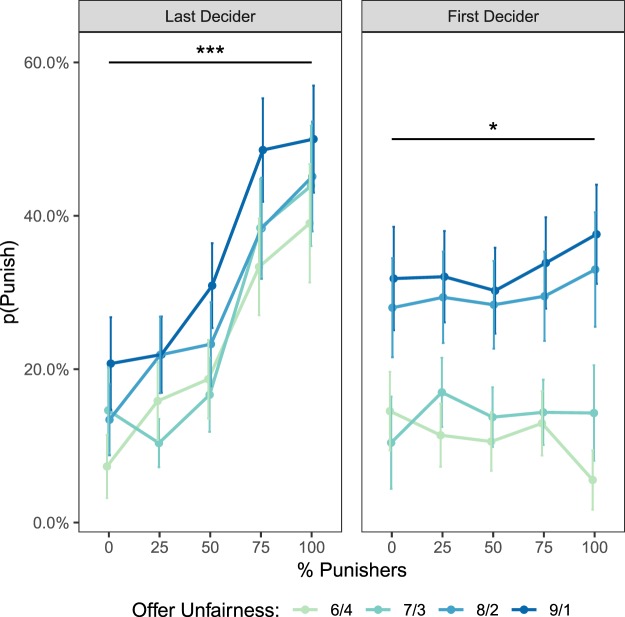
- Conformity scaled with the proportion of punishers in the group, and even a past group’s preferences influenced punishment when subjects decided first (Experiment 2), though this effect was attenuated relative to deciding last.
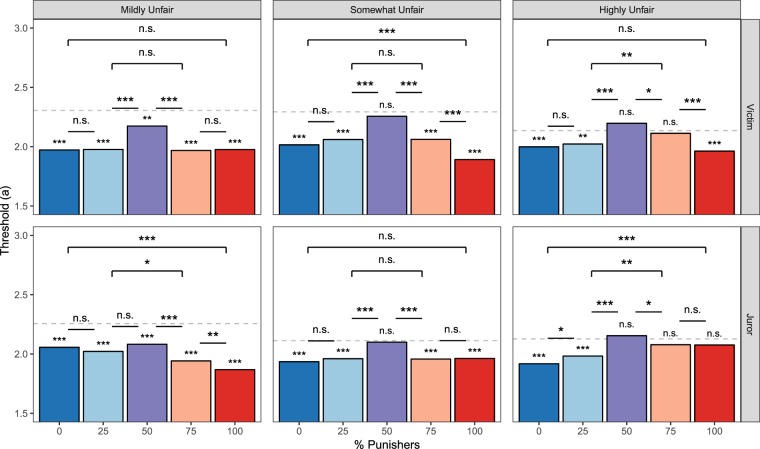
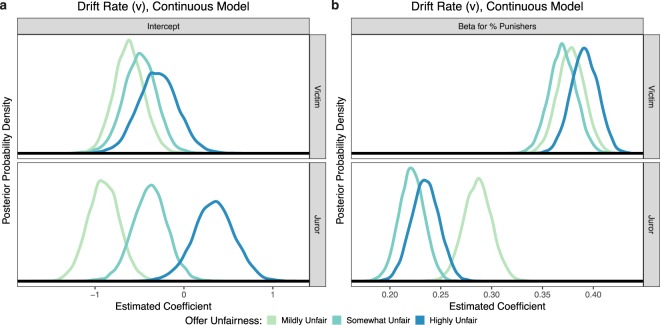
- In Experiments 3–4, group majority lowered decision thresholds (all posterior Ps < 0.001) and increased drift rate as the proportion of punishers rose, indicating greater valuation of punishment. Victims showed an overall bias toward compensation (average z = 0.42, 0.43, 0.44 for Mildly, Somewhat, Highly Unfair; all posterior Ps < 0.001), while Jurors were biased toward compensation only for Mildly Unfair offers (average z = 0.45, posterior P < 0.001).
- Victim versus Juror differences were mixed: Experiment 4 found conformity significantly weakened for Jurors relative to Victims (β = 0.50, SE = 0.13, z = −2.58, p = 0.010), whereas Experiment 5 found the overall conformity effect significantly stronger for Jurors than Victims (β = 2.06, SE = 0.69, z = 3.00, df = 224.00, p = 0.003).
Methods
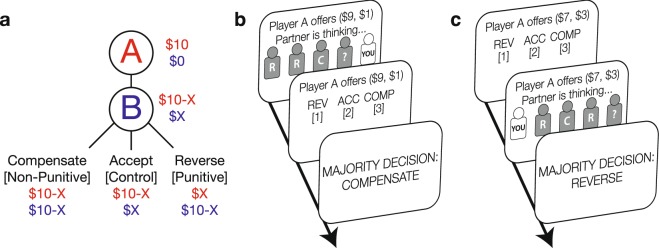
- Experiments 1–4 recruited 176 subjects from Brown University and the surrounding community. Final analyzed samples were 41 (Experiment 1), 48 (Experiment 2), 41 with one partial dataset (Experiment 3), and 43 (Experiment 4). Subjects completed a Justice Game in which Player B could Accept, Compensate, or Reverse unfair splits from Player A; Experiments 1–2 varied whether subjects decided last or first in a five-person group, and Experiments 3–4 used Victim and Juror versions suitable for drift diffusion modeling.
- Experiment 5 recruited 300 Amazon Mechanical Turk subjects, with final samples of 118 Victim-condition and 108 Juror-condition subjects after exclusions. Subjects read assault or theft vignettes crossed with high- versus low-intensity crime and rated punishment severity on a 100-point scale.
- Main analyses used mixed-effects logistic or linear regressions. Experiments 3–4 used hierarchical Bayesian estimation of the Drift Diffusion Model via HDDM, with model selection by Deviance Information Criterion, posterior predictive checks, and parameter recovery simulations.
Limitations
- The paper states that future work should examine repeated interactions with the same perpetrators, especially whether conformity ceases once a perpetrator is perceived as rehabilitated, and how social influence and attitude change operate as learning processes.
- The paper states that it is difficult to obtain field data quantifying how much conformity effects shift real jurors’ punitive inclinations, and notes that Experiment 5’s divergence from Experiments 3–4 may be due to hypothetical choices or to the vignettes involving more severe moral transgressions.
- Evident from the text: Experiments 1–4 relied on relatively small lab samples and computer-generated group responses under social deception, while Experiment 5 used hypothetical vignettes and excluded many MTurk responses for data-quality reasons; these features may limit generalizability to real-world punishment contexts.
Model-written summary. Check it against the paper before relying on it.
Integrity signals
Registry
Cites
Statistics
Figures
Verification
Claims the paper makes
13 Valid · 1 Not valid · 10 Not checked · 76 Own results and interpretations
A result the paper reports from its own data — it cites no other source for it, so there is none to check. The quote shows it is in the paper.
In the paper
“This preference for compensation did not significantly vary as a function of offer unfairness (all posterior Ps > 0.10).”
plain- Asserted: passes — The authors put it forward as true.
- Checkable: passes — It can be checked against evidence.
- Load-bearing: unclear — It is unclear whether the paper’s conclusions depend on it.
- Based: passes — The paper gives a reason why it holds.
A result the paper reports from its own data — it cites no other source for it, so there is none to check. The quote shows it is in the paper.
In the paper
“A formal comparison between Experiment 3 (Victim) and Experiment 4 (Juror) additionally finds that the conformity effect is significantly weakened for Jurors relative to Victims (β = 0.50, SE = 0.13, z = −2.58, p = 0.010; estimate and SE are in units of odds ratios).”
plain- Asserted: passes — The authors put it forward as true.
- Checkable: passes — It can be checked against evidence.
- Load-bearing: passes — The paper’s conclusions depend on it.
- Based: passes — The paper gives a reason why it holds.
A result the paper reports from its own data — it cites no other source for it, so there is none to check. The quote shows it is in the paper.
In the paper
“As in Experiment 1, results indicate that increasing the proportion of punishers within a group significantly enhances punishment endorsement rates, even when accounting for offer unfairness and baseline punitive preferences (Table 2 ; Fig. 2 ).”
hedgedstates a cause- Asserted: passes — The authors put it forward as true.
- Checkable: passes — It can be checked against evidence.
- Load-bearing: passes — The paper’s conclusions depend on it.
- Based: passes — The paper gives a reason why it holds.
A result the paper reports from its own data — it cites no other source for it, so there is none to check. The quote shows it is in the paper.
In the paper
“Behavioral results indicate that the group’s punitive preferences significantly modulates punishment (Table 4 ), shifting predicted punishment by nearly 30 percentage points.”
hedgedstates a cause- Asserted: passes — The authors put it forward as true.
- Checkable: passes — It can be checked against evidence.
- Load-bearing: passes — The paper’s conclusions depend on it.
- Based: passes — The paper gives a reason why it holds.
A result the paper reports from its own data — it cites no other source for it, so there is none to check. The quote shows it is in the paper.
In the paper
“We additionally find that individuals are generally less cautious and more impulsive when choosing within a group majority, relative to when they are choosing alone (Fig. 4 ).”
plainstates an association- Asserted: passes — The authors put it forward as true.
- Checkable: passes — It can be checked against evidence.
- Load-bearing: unclear — It is unclear whether the paper’s conclusions depend on it.
- Based: passes — The paper gives a reason why it holds.
45 more claims
Create a free account to see all 100 claims and every source verdict.
- Probably not a substantial claim. 38
- It may state two separate claims as one. 20
Statistics recomputed
Every reported test result, recomputed from its test statistic and degrees of freedom. A result shows as not adding up only once an independent check has confirmed it.
- Consistentz = -2.58reported p = .01 · recomputed p = .010
“z = −2.58, p = .010”
Self-check
Percentages, sums and reported differences re-computed from the paper’s own numbers.
Self-check results appear here once an independent check has confirmed them.
Citations
Cites
Random effects structure for confirmatory hypothesis testing: Keep it maximal
Barr, D. J., Levy, R., Scheepers, C., & Tily, H. J. (2013) · Journal of Memory and Language · doi:10.1016/j.jml.2012.11.001 · Cited by 10,328
The emotional dog and its rational tail: A social intuitionist approach to moral judgment.
Haidt, J. (2001) · Psychological Review · doi:10.1037/0033-295x.108.4.814 · Cited by 8,048
Altruistic punishment in humans
Fehr, E., & Gächter, S. (2002) · Nature · doi:10.1038/415137a · Cited by 5,616
A study of normative and informational social influences upon individual judgment.
Deutsch, M., & Gerard, H. B. (1955) · The Journal of Abnormal and Social Psychology · doi:10.1037/h0046408 · Cited by 4,819
Studies of independence and conformity: I. A minority of one against a unanimous majority
Asch, S. E. (1956) · Psychological Monographs: General and Applied · doi:10.1037/h0093718 · Cited by 4,267
The Diffusion Decision Model: Theory and Data for Two-Choice Decision Tasks
Ratcliff, R., & McKoon, G. (2008) · Neural Computation · doi:10.1162/neco.2008.12-06-420 · Cited by 3,059
Third-party punishment and social norms
Fehr, E., & Fischbacher, U. (2004) · Evolution and Human Behavior · doi:10.1016/s1090-5138(04)00005-4 · Cited by 2,417
The Chicago face database: a free stimulus set of faces and norming data
Ma, D. S., Correll, J., & Wittenbrink, B. (2015) · Behavior Research Methods · doi:10.3758/s13428-014-0532-5 · Cited by 1,788
Costly Punishment Across Human Societies
Henrich, J., McElreath, R., Barr, A., Ensminger, J., Barrett, C., Bolyanatz, A., Cardenas, J. C., Gurven, M., Gwako, E., Henrich, N., et al. (2006) · Science · doi:10.1126/science.1127333 · Cited by 1,771
Crafting Normative Messages to Protect the Environment
Cialdini, R. B. (2003) · Current Directions in Psychological Science · doi:10.1111/1467-8721.01242 · Cited by 1,553
Bayesian estimation supersedes the t-test
Kruschke, J. K. (2013) · Journal of Experimental Psychology: General · doi:10.1037/a0029146 · Cited by 1,530 · cited 1×
“We determined the statistical significance of DDM parameters using a Bayesian estimation method, which is similar to a frequentist t-test (Kruschke, 2013).”
MethodSocial Comparisons and Pro-social Behavior: Testing “Conditional Cooperation” in a Field Experiment
Frey, B. S., & Meier, S. (2004) · American Economic Review · doi:10.1257/0002828043052187 · Cited by 1,184
HDDM: Hierarchical Bayesian estimation of the Drift-Diffusion Model in Python
Wiecki, T. V., Sofer, I., & Frank, M. J. (2013) · Frontiers in Neuroinformatics · doi:10.3389/fninf.2013.00014 · Cited by 1,047 · cited 1×
“16 We performed hierarchical Bayesian parameter estimation using HDDM, a free and opensource software package (Wiecki et al., 2013).”
MethodThinking the unthinkable: sacred values and taboo cognitions
Tetlock, P. E. (2003) · Trends in Cognitive Sciences · doi:10.1016/s1364-6613(03)00135-9 · Cited by 915
Ratcliff, R., & Tuerlinckx, F. (2002) · Psychonomic Bulletin & Review · doi:10.3758/bf03196302 · Cited by 838
Cooperative behavior cascades in human social networks
Fowler, J. H., & Christakis, N. A. (2010) · Proceedings of the National Academy of Sciences · doi:10.1073/pnas.0913149107 · Cited by 767
Strohminger, N., & Nichols, S. (2014) · Cognition · doi:10.1016/j.cognition.2013.12.005 · Cited by 596
Reinforcement Learning Signal Predicts Social Conformity
Klucharev, V., Hytönen, K., Rijpkema, M., Smidts, A., & Fernández, G. (2009) · Neuron · doi:10.1016/j.neuron.2008.11.027 · Cited by 594
Interpreting the parameters of the diffusion model: An empirical validation
Voss, A., Rothermund, K., & Voss, J. (2004) · Memory & Cognition · doi:10.3758/bf03196893 · Cited by 568
Humans display a ‘cooperative phenotype’ that is domain general and temporally stable
Peysakhovich, A., Nowak, M. A., & Rand, D. G. (2014) · Nature Communications · doi:10.1038/ncomms5939 · Cited by 426
Sacred bounds on rational resolution of violent political conflict
Ginges, J., Atran, S., Medin, D., & Shikaki, K. (2007) · Proceedings of the National Academy of Sciences · doi:10.1073/pnas.0701768104 · Cited by 416
Social Influence Modulates the Neural Computation of Value
Zaki, J., Schirmer, J., & Mitchell, J. P. (2011) · Psychological Science · doi:10.1177/0956797611411057 · Cited by 359
How the Opinion of Others Affects Our Valuation of Objects
Campbell-Meiklejohn, D. K., Bach, D. R., Roepstorff, A., Dolan, R. J., & Frith, C. D. (2010) · Current Biology · doi:10.1016/j.cub.2010.04.055 · Cited by 339
What we say and what we do: The relationship between real and hypothetical moral choices
FeldmanHall, O., Mobbs, D., Evans, D., Hiscox, L., Navrady, L., & Dalgleish, T. (2012) · Cognition · doi:10.1016/j.cognition.2012.02.001 · Cited by 312
Self-citationNeural mechanisms of the influence of popularity on adolescent ratings of music
Berns, G. S., Capra, C. M., Moore, S., & Noussair, C. (2010) · NeuroImage · doi:10.1016/j.neuroimage.2009.10.070 · Cited by 312
A Neurocomputational Model of Altruistic Choice and Its Implications
Hutcherson, C. A., Bushong, B., & Rangel, A. (2015) · Neuron · doi:10.1016/j.neuron.2015.06.031 · Cited by 299
Resolving uncertainty in a social world
FeldmanHall, O., & Shenhav, A. (2019) · Nature Human Behaviour · doi:10.1038/s41562-019-0590-x · Cited by 274
Self-citationNo Compromise: Political Consequences of Moralized Attitudes
Ryan, T. J. (2017) · American Journal of Political Science · doi:10.1111/ajps.12248 · Cited by 273
Moralization in social networks and the emergence of violence during protests
Mooijman, M., Hoover, J., Lin, Y., Ji, H., & Dehghani, M. (2018) · Nature Human Behaviour · doi:10.1038/s41562-018-0353-0 · Cited by 229
Dennis, S. A., Goodson, B. M., & Pearson, C. A. (2020) · Behavioral Research in Accounting · doi:10.2308/bria-18-044 · Cited by 186
Prosocial Conformity: Prosocial Norms Generalize Across Behavior and Empathy
Nook, E. C., Ong, D. C., Morelli, S. A., Mitchell, J. P., & Zaki, J. (2016) · Personality and Social Psychology Bulletin · doi:10.1177/0146167216649932 · Cited by 186
The MR2: A multi-racial, mega-resolution database of facial stimuli
Strohminger, N., Gray, K., Chituc, V., Heffner, J., Schein, C., & Heagins, T. B. (2016) · Behavior Research Methods · doi:10.3758/s13428-015-0641-9 · Cited by 128
Differential neural circuitry and self-interest in realvshypothetical moral decisions
FeldmanHall, O., Dalgleish, T., Thompson, R., Evans, D., Schweizer, S., & Mobbs, D. (2012) · Social Cognitive and Affective Neuroscience · doi:10.1093/scan/nss069 · Cited by 121
Self-citationExperimental Research on Jury Decision-Making
MacCoun, R. J. (1989) · Science · doi:10.1126/science.244.4908.1046 · Cited by 117
Making it moral: Merely labeling an attitude as moral increases its strength
Luttrell, A., Petty, R. E., Briñol, P., & Wagner, B. C. (2016) · Journal of Experimental Social Psychology · doi:10.1016/j.jesp.2016.04.003 · Cited by 107
Van Bavel, J. J., Packer, D. J., Haas, I. J., & Cunningham, W. A. (2012) · PLoS ONE · doi:10.1371/journal.pone.0048693 · Cited by 107
Fairness violations elicit greater punishment on behalf of another than for oneself
FeldmanHall, O., Sokol-Hessner, P., Van Bavel, J. J., & Phelps, E. A. (2014) · Nature Communications · doi:10.1038/ncomms6306 · Cited by 106
Self-citationA HEAVY THUMB ON THE SCALE: THE EFFECT OF VICTIM IMPACT EVIDENCE ON CAPITAL DECISION MAKING*
Paternoster, R., & Deise, J. E. (2011) · Criminology · doi:10.1111/j.1745-9125.2010.00220.x · Cited by 105
Beyond conformity: Social influences on pain reports and physiology.
Koban, L., & Wager, T. D. (2016) · Emotion · doi:10.1037/emo0000087 · Cited by 92
Hans, V. P. (2008) · Annual Review of Law and Social Science · doi:10.1146/annurev.lawsocsci.4.110707.172319 · Cited by 85
Social Influence and Perceptual Decision Making: A Diffusion Model Analysis
Germar, M., Schlemmer, A., Krug, K., Voss, A., & Mojzisch, A. (2014) · Personality and Social Psychology Bulletin · doi:10.1177/0146167213508985 · Cited by 79
Dennis, S. A., Goodson, B. M., & Pearson, C. A. (2018) · SSRN Electronic Journal · doi:10.2139/ssrn.3233954 · Cited by 78
The Dynamics of Aggression: Biological and Social Processes in Dyads and Groups
(2013) · Psychology Press eBooks · doi:10.4324/9780203772317 · Cited by 66
Dealing with Witnesses in War Crime Trials: Lessons from the Yugoslav Tribunal
Wald, P. M. (2002) · bepress Legal Repository · Cited by 57
Learning moral values: Another’s desire to punish enhances one’s own punitive behavior.
FeldmanHall, O., Otto, A. R., & Phelps, E. A. (2018) · Journal of Experimental Psychology: General · doi:10.1037/xge0000405 · Cited by 51
Self-citationA Jury of One: Opinion Formation, Conformity, and Dissent on Juries
Waters, N. L., & Hans, V. P. (2009) · Journal of Empirical Legal Studies · doi:10.1111/j.1740-1461.2009.01152.x · Cited by 51
Is Diya a Form of ClemencyPreprint
Pascoe, D. (2015) · SSRN Electronic Journal · Cited by 2
Cited by
How peer influence shapes value computation in moral decision-making
Yu, H., Siegel, J. Z., Clithero, J. A., & Crockett, M. J. (2021) · Cognition · doi:10.1016/j.cognition.2021.104641 · Cited by 104
“Previous studies using the DDM to investigate the cognitive mechanisms underlying conformity primarily investigated conformity to a group’s consensus (Germar et al., 2014; Son et al., 2019; Tump et al., 2020) rather than compliance or emulation, which may rely on different cognitive mechanisms (Cialdini & Goldstein, 2…”
MethodPeople prefer coordinated punishment in cooperative interactions
Molleman, L., Kölle, F., Starmer, C., & Gächter, S. (2019) · Nature Human Behaviour · doi:10.1038/s41562-019-0707-2 · Cited by 64
Can Online Juries Make Consistent, Repeatable Decisions?
Hu, X. E., Whiting, M. E., & Bernstein, M. S. (2021) · CHI Conference on Human Factors in Computing Systems · doi:10.1145/3411764.3445433 · Cited by 65
“found that “over one-third of them would have reversed their jury’s decision if they had been given sole control over the trial’s outcome” [54].”
BackgroundDistinct neurocomputational mechanisms support informational and socially normative conformity
Mahmoodi, A., Nili, H., Bang, D., Mehring, C., & Bahrami, B. (2022) · PLoS Biology · doi:10.1371/journal.pbio.3001565 · Cited by 52
“These domains include perceptual decision-making [14,36]; value-based decision-making [37,38]; object preference [10,39]; moral decision-making [40]; charitable giving [41]; and social punishment [42].”
Computational Social Psychology
Cushman, F. A. (2023) · Annual Review of Psychology · doi:10.1146/annurev-psych-021323-040420 · Cited by 52
Metadata
- Authors
- Son, J.-Y., Bhandari, A., & FeldmanHall, O.
- Affiliations
- Brown University (US)
- Corresponding author
- FeldmanHall, Oriel
- Venue
- Scientific Reports
- Published
- 2019-08-12
- Volume
- 9
- Issue
- 1
- Pages
- 11625-11625
- ISSN
- 2045-2322 (ISSN-L)
- PMC
- PMC6690944
- OpenAlex
- W2968071192
- Cited by
- 37
- References
- 49
- Citations by year
- 2025: 10 · 2024: 7 · 2023: 5 · 2022: 7 · 2021: 4 · 2020: 2 · 2019: 2
- FWCI
- 2.18
- Type
- journal article
- Language
- en
- Open access
- gold
- doi.org
- Licence
- cc-by
- creativecommons.org/licenses/by/4.0 (tdm)
- creativecommons.org/licenses/by/4.0 (vor)
- Locations
- Scientific Reports (publishedVersion, cc-by)
- Europe PMC (PubMed Central) (publishedVersion, cc-by)
- PubMed Central (publishedVersion, cc-by)
- PubMed (publishedVersion)
- DOAJ (DOAJ: Directory of Open Access Journals) (submittedVersion)
- PsyArXiv (OSF Preprints) (submittedVersion, cc-by)
- PsyArXiv (OSF Preprints) (submittedVersion)
- OSF Preprints (OSF Preprints) (submittedVersion)
- Funders
- National Institute of General Medical Sciences (P20GM103645)
- Topics
- Life Sciences › Neuroscience › Cognitive Neuroscience › Psychology of Moral and Emotional Judgment
- Social Sciences › Law › Jury Decision Making Processes
- Social Sciences › Economics, Econometrics and Finance › Economics and Econometrics › Experimental Behavioral Economics Studies
- Keywords
- punishment, reference groups, social influence, conformity, moral responsibility, restorative justice, group decision making, impulsivity, computational models of decision making, jury members
- MeSH terms
- Decision Making, Female, Humans, Male, Punishment, Crowdsourcing
About these checks
Registry, retraction, Cites and statistics results are computed, not judged, with one exception: a printed reference that no index lists is read once by a model before it counts as a citation error. Claims are extracted by a model and kept only when their quote appears verbatim in the text; each cited source is then checked, with a model’s help, for whether it says what the claim relies on. Those verdicts can be wrong — read the claim’s quote and the cited source before relying on one.
The claim verdicts this report counts are experimental: their accuracy is not yet measured.
A language model drew the claims from the paper on 2026-09-29, under version 3 of the claim definition (model deepseek-v4.1-flash, prompt extract-v3).
A second model labelled each claim on 2026-09-29 (model jev-1.13-20260917, definition revision gold-guideline-v0.2).
Statistics and arithmetic are recomputed, not judged.
Confidence bands are shown only for fields calibrated on our annotated test set. None is calibrated yet, so no band is shown.
What counts as a claim ›How we measure confidence ›How we check this ›
Are you an author, or do you see a problem with this page? Request a review
Data sources
Bibliographic data: Semantic Scholar, OpenAlex, Crossref.
Contains information from the Semantic Scholar Academic Graph Datasets, made available under the ODC Attribution License (ODC-BY 1.0).
Semantic Scholar’s data is described in: Kinney, R., et al. (2023). The Semantic Scholar Open Data Platform. arXiv:2301.10140.
