

The developmental trajectories of executive function from adolescence to old age.
Open accessThe DOI matches its Crossref record; 116 of the 116 references it cites were found in a registry or an index.
Abstract
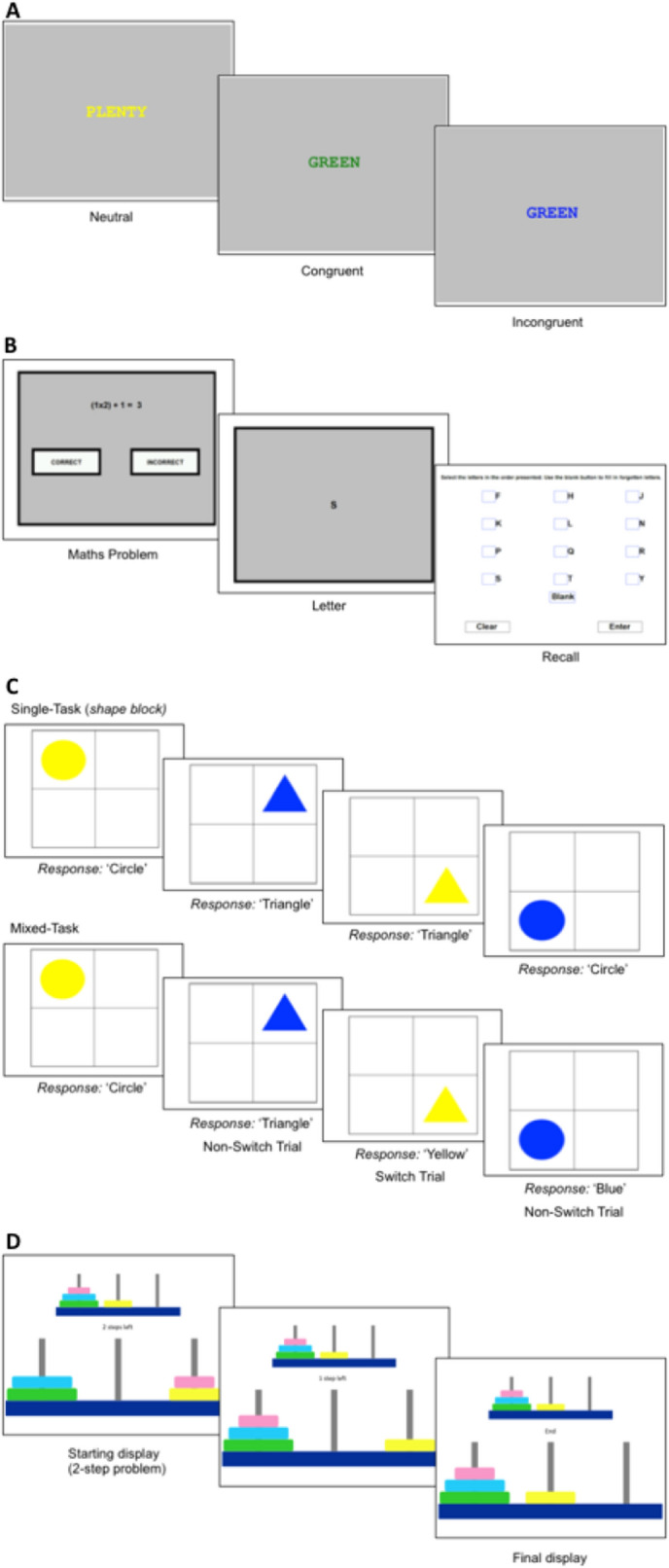
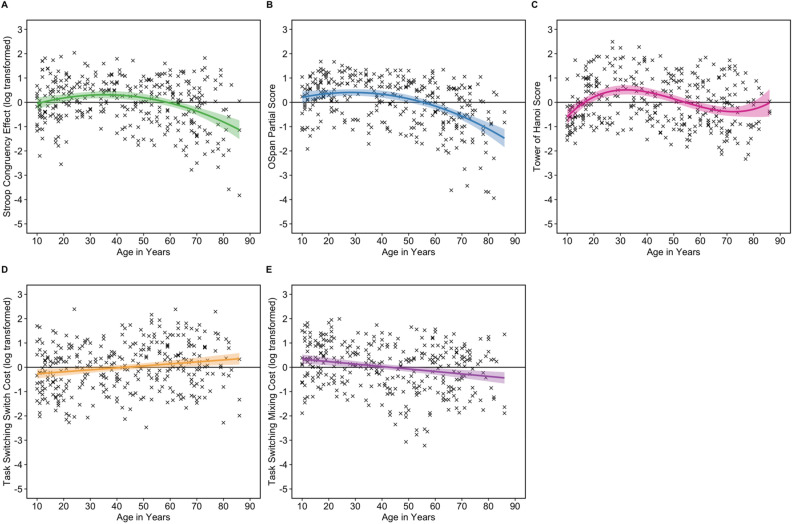
Executive functions demonstrate variable developmental and aging profiles, with protracted development into early adulthood and declines in older age. However, relatively few studies have specifically included middle-aged adults in investigations of age-related differences in executive functions. This study explored the age-related differences in executive function from late childhood through to old age, allowing a more informed understanding of executive functions across the lifespan. Three hundred and fifty participants aged 10 to 86 years-old completed a battery of tasks assessing the specific roles of inhibitory control, working memory, cognitive flexibility, and planning. Results highlighted continued improvement in working memory capacity across adolescence and into young adulthood, followed by declines in both working memory and inhibitory control, beginning from as early as 30–40 years old and continuing into older age. Analyses of planning abilities showed continued improvement across adolescence and into young adulthood, followed by a decline in abilities across adulthood, with a small (positive) change in older age. Interestingly, a dissociation was found for cognitive flexibility; switch costs decreased, yet mixing costs increased across the lifespan. The results provide a description of the developmental differences in inhibitory control, working memory, cognitive flexibility and planning, above any effects of IQ or SES, and highlight the importance of including middle-aged adults in studies seeking to establish a more comprehensive picture of age-related differences in executive function.
Overview
The claims and statistics of this paper haven’t been checked yet.
Free: it reads the open-access text and checks the first 5 claims that cite a source we can check. Create a free account to check every claim.
Integrity signals
Registry
Cites
Statistics
Figures
Verification
Claims the paper makes
The claims and statistics of this paper haven’t been checked yet.
Free: it reads the open-access text and checks the first 5 claims that cite a source we can check. Create a free account to check every claim.
Claims other papers make about this one
Each is checked against this paper’s own text: does it say what the citing paper says it does?
The cited source says what the claim attributes to it.
In the citing paper
“A recent study by (Ferguson et al., 2021) examined EF in a large, community-based sample aged from 10 to 86 years old, demonstrating that planning ability and WM capacity continue to develop throughout adolescence as well as in early adulthood.”
From Assessment of executive functions in school-aged children: A narrative review (2022) · cites this paper as Ferguson et al., 2021
Self-check
Percentages, sums and reported differences re-computed from the paper’s own numbers.
The self-check needs the paper’s full text.
Citations
Cites
Studies of interference in serial verbal reactions
Stroop, J. R. (1935) · Journal of Experimental Psychology · doi:10.1037/h0054651 · Cited by 18,622
Miyake, A., Friedman, N. P., Emerson, M. J., Witzki, A. H., Howerter, A., & Wager, T. D. (2000) · Cognitive Psychology · doi:10.1006/cogp.1999.0734 · Cited by 15,798
Diamond, A. (2013) · Annual Review of Psychology · doi:10.1146/annurev-psych-113011-143750 · Cited by 13,268
Dynamic mapping of human cortical development during childhood through early adulthood
Gogtay, N., Giedd, J. N., Lusk, L., Hayashi, K. M., Greenstein, D., Vaituzis, A. C., Nugent, T. F., Herman, D. H., Clasen, L. S., Toga, A. W., et al. (2004) · Proceedings of the National Academy of Sciences · doi:10.1073/pnas.0402680101 · Cited by 5,604
Wechsler Abbreviated Scale of Intelligence
Dumont, R., Willis, J. O., Veizel, K., & Zibulsky, J. (2014) · Encyclopedia of Special Education · doi:10.1002/9781118660584.ese2519 · Cited by 5,521
Wechsler Abbreviated Scale of Intelligence
Wechsler, D. (2012) · PsycTESTS Dataset · doi:10.1037/t15170-000 · Cited by 4,596
Miyake, A., & Friedman, N. P. (2012) · Current Directions in Psychological Science · doi:10.1177/0963721411429458 · Cited by 3,944
Costs of a predictible switch between simple cognitive tasks.
Rogers, R. D., & Monsell, S. (1995) · Journal of Experimental Psychology: General · doi:10.1037/0096-3445.124.2.207 · Cited by 3,170
Regional Brain Changes in Aging Healthy Adults: General Trends, Individual Differences and Modifiers
Raz, N., Lindenberger, U., Rodrigue, K. M., Kennedy, K. M., Head, D., Williamson, A., Dahle, C., Gerstorf, D., & Acker, J. D. (2005) · Cerebral Cortex · doi:10.1093/cercor/bhi044 · Cited by 2,875
Executive function in preschoolers: A review using an integrative framework.
Garon, N., Bryson, S. E., & Smith, I. M. (2008) · Psychological Bulletin · doi:10.1037/0033-2909.134.1.31 · Cited by 2,695
Research works printed but not linked: 3
- 41. Jacques S Marcovitch S Overton WF Development of executive function across the lifespan Cognition, Biology, and Methods Across the Lifespan. The Handbook of Life-Span Development 2010 Hoboken, NJ Wiley 431 466
- 46. Delis DC Kaplan E Kramer JH Delis–Kaplan Executive Function System (D-KEFS) 2001 San Antonio, TX The Psychological Corporation
- 73. Lawson GM Hook CJ Hackman DA Farah MJ Griffin JA Freund LS McCardle P Socioeconomic status and neurocognitive development: Executive function Executive Function in Preschool Children: Integrating Measurement, Neurodevelopment, and Translational Research 2016 Washington, DC American Psychological Association Press
Cited by
Items 401–500 of 774
Brezetić, S., & Ručević, S. (2024) · Psychological Reports · doi:10.1177/00332941241295981 · Cited by 1
“They include cognitive processes such as working memory, inhibition, mental fl exibility and planning abilities that consequently affect an individual ’ s behavior (Ferguson et al., 2021).”
Plueckebaum, H., Czernochowski, D., Lachmann, T., & Beck, A. (2025) · Biological Psychology · doi:10.1016/j.biopsycho.2025.109042 · Cited by 1
“Moreover, neural development appears relatively stable until around age 35 (for a review see Hedman et al., 2012), with inhibitory control plateauing in young adulthood and declining from age 30 (Ferguson et al., 2021).”
Gomes, R. V., dos Santos, J. P. R., do Nascimento, J. V. M., Alves, A. A., dos Santos, B. L., Bezerra, E. D. S., Barbosa, S. L. D. S., Tavares, V. D. D. O., Ramos, I. A., Cabral, L. L. P., et al. (2025) · Pensar en Movimiento Revista de Ciencias del Ejercicio y la Salud · doi:10.15517/pensarmov.v23i1.61044 · Cited by 1
“Considering that inhibitory control development significantly increases from 10 to 35 years old (Ferguson et al., 2021), adolescence emerges as a crucial phase in this process.”
Liang, H., Wei, X., Jiang, H., & Li, J. (2025) · International Journal of Mental Health and Addiction · doi:10.1007/s11469-025-01507-0 · Cited by 1
“Cognitive flexibility, a key component of executive functioning, continues to improve throughout adolescence (Ferguson et al., 2021; Tim-othy, 2008).”
Zeng, M., Huang, L., Jiao, T., & Yang, F. (2026) · Psychological Reports · doi:10.1177/00332941261473840 · Cited by 1
Cavve, B. S., Byrne, M. L., & Moore, J. K. (2025) · Psychoneuroendocrinology · doi:10.1016/j.psyneuen.2025.107555 · Cited by 1
Wilks, C. E. H., Foster, S. J., Dodd, M., Fletcher‐Watson, S., Lages, M., Ropar, D., Sasson, N. J., & Crompton, C. J. (2025) · PLoS ONE · doi:10.1371/journal.pone.0329825 · Cited by 1
“Within each chain, participants were placed into ascending age order to minimise any potential confounding effects of age-related memory and executive function decline which could affect ability to recall, plan and organise information [48].”
Mohanathas, N., Montanari, L., Downey, R., Li, K., Pichora-Fuller, M. K., Bherer, L., Lussier, M., Phillips, N. D., Wittich, W., St-Onge, N., et al. (2026) · PLoS ONE · doi:10.1371/journal.pone.0331276 · Cited by 1
Musical Creativity Across the Lifespan: An Analysis of the Works of 921 Jazz Artists
Abuhamdeh, S., & Kozbelt, A. (2025) · Empirical Studies of the Arts · doi:10.1177/02762374251368710 · Cited by 1
“These capacities have been shown to peak relatively early in adulthood (e.g., Ferguson et al., 2021; Salthouse, 2009), helping to explain why jazz artists often produce their most groundbreaking work in their late 20s or early 30s.”
Tsadok-Cohen, M., Rosenblum, S., Elimelech, O. C., Ferrante, S., & Meyer, S. (2025) · Behavioral Sciences · doi:10.3390/bs15091153 · Cited by 1
“For example, neurodegenerative changes decrease executive functions , higher-level cognitive abilities that enable goal-directed behavior (Ferguson et al., 2021).”
An online, updated battery for episodic memory and executive control composites in older adults
Jensen, A., Carton, S., Ardilliez, O., Hu, R., & Davidson, P. S. R. (2025) · Journal of Clinical and Experimental Neuropsychology · doi:10.1080/13803395.2025.2544730 · Cited by 1
“Relations between age and executive control, on the other hand, are less clear: Although some aspects of executive control may decline with age, others may not (De Luca et al., 2003; Ferguson et al., 2021; Treitz et al., 2007; Verhaeghen, 2011).”
Blakstad, E., Sneve, M. H., Dídac Vidal-piñeiro, A., Walhovd, K. B., Fjell, A. M., & Grydeland, H. (2026) · Imaging Neuroscience · doi:10.1162/imag.a.1312 · Cited by 1
“Lifespan studies of cognitive control have shown age-related differences cross-sectionally ( Ferguson et al., 2021) and longitudinally ( Ad ó lfsd ó ttir et al., 2017), including in a partially overlapping sample ( Fjell et al., 2017).”
Working Memory: MEG Study Of The Oscillatory Mechanisms For Working Memory Components
Mening, S. M., Fedele, T., & Otstavnov, N. S. (2025) · International Conference Neurotechnologies and Neurointerfaces (CNN) · doi:10.1109/cnn67635.2025.11177471 · Cited by 1
“The criteria required participants to be between 18 and 35 years old [9], have no history of neurological or psychiatric disorders, and possess normal or corrected-to-normal vision, demonstrate the performance for each condition not less than 70%.”
Gentile, A., Vivirito, S., Kirkar, M., Paschos, K., Tuđan, L., Kulhánek, J., Öztürk, P., & Alesi, M. (2025) · Frontiers in Public Health · doi:10.3389/fpubh.2025.1693026 · Cited by 1
The Virtual Supermarket Test: A New Tool for Assessing Planning in Adults From Buenos Aires
Seivane, M. S., & Brenlla, M. E. (2025) · Assessment · doi:10.1177/10731911251390381 · Cited by 1
Benitez, B., Juber, M. C., Macarilla, C. T., Robinson, Z. P., Pelland, J. C., Remmert, J. F., Hinson, S. R., Visavadiya, N. P., & Zourdos, M. C. (2025) · Biology · doi:10.3390/biology14121756 · Cited by 1
“Despite impaired cognition with aging [1,2], meta-analyses have demonstrated both aerobic (AT) [6] and resistance training (RT) [7] to attenuate the age-related decline in global cognition, memory, executive function, and processing speed.”
Peakspan: Defining, Quantifying and Extending the Boundaries of Peak Productive Lifespan
Zhavoronkov, A. A., Ying, K., & Wilczok, D. (2026) · Aging and Disease · doi:10.14336/ad.2026.0080 · Cited by 1
“Abilities linked to fluid intelligence, including processing speed, visual–spatial reasoning, reasoning, and working memory, follow a consistent pattern of early optimization and gradual decline starting in ages between 20 and 30 [7, 8].”
Risner, M., Katz, E. S., & Stamoulis, C. (2025) · SLEEP · doi:10.1093/sleep/zsaf392 · Cited by 1
Working Memory Across the Lifespan: Age and Gender Variations
Manzoor, R., Anwar, P., Ullah, H., Jahangir, A., Khalid, A., & Shaheen, N. (2025) · Journal of Asian Development Studies · doi:10.62345/jads.2025.14.3.128 · Cited by 1
Divandari, N., Bird, M., Zoghi, M., Vakili, F., & Jaberzadeh, S. (2025) · Neuroscience · doi:10.1016/j.neuroscience.2025.12.019 · Cited by 1
Goldschmidt, A. B., Ortega, A., Rooper, I. R., Obleada, K. T., Chapa, D. A. N., Silverberg, B., Stalvey, E., Camino, M. K., Levine, M. D., Yu, L., et al. (2025) · Contemporary Clinical Trials · doi:10.1016/j.cct.2025.108192 · Cited by 1
Xu, C., Li, C., Cui, T., Li, S., Han, X., Wen, B., & Wei, C. (2025) · GeroScience · doi:10.1007/s11357-025-02042-5 · Cited by 1
“This aligns with prior reports that executive functions such as working memory and inhibitory control reach their apex in the thirties before declining with age [84].”
Executive Function and Cognitive Control
Bedwell, S. A. (2025) · Cambridge University Press eBooks · doi:10.1017/9781009407946.003 · Cited by 1
Mair, A. (2025) · Consciousness and Cognition · doi:10.1016/j.concog.2025.103983 · Cited by 1
Filho, R. D. O. L., Bisneto, R. G. D. L., do Nascimento, B. S., Araujo‐Silva, H., de Medeiros, S. R. B., Rico, E. P., & Luchiari, A. C. (2026) · Progress in Neuro-Psychopharmacology and Biological Psychiatry · doi:10.1016/j.pnpbp.2026.111612 · Cited by 1
Pitigoi, I. C., Brien, D. C., Riek, H. C., Noyes, B. K., Yep, R., Calancie, O. G., Kirkpatrick, R. H., Coe, B. C., Morningstar, M. A., & Munoz, D. P. (2026) · Journal of Cognitive Neuroscience · doi:10.1162/jocn.a.2434 · Cited by 1
Cheng, Q., Mao, H., Liu, X., Liang, X., Wei, Y., Qi, T., & Liu, L. (2026) · Brain Structure and Function · doi:10.1007/s00429-026-03077-w · Cited by 1
“This inverted U-shaped pattern aligns with develop - mental and aging trajectories in cognitive functions, such as processing speed and executive function (Ferguson et al. 2021).”
Estrella-Ibarra, L. F., García-Noguez, L. R., Pedraza-Ortega, J. C., Ramos-Arreguín, J. M., & Tovar‐Arriaga, S. (2026) · AI · doi:10.3390/ai7020075 · Cited by 1
“…starting in the 30 s, which has been associated with gradual changes in neural efficiency, speech motor control, and cognitive-linguistic processing that may introduce increased variability in speech production and its neural representations, potentially affecting decoding performance [29,30].”
Impacts of social media use on youth mental health
Hogan, M. K., & Behar‐Horenstein, L. S. (2026) · The Nurse Practitioner · doi:10.1097/01.npr.0000000000000413 · Cited by 1
Comparing Semantic and Phonemic Fluency Performance in Adults Who Do and Do Not Stutter
Gkalitsiou, Z., & Werle, D. (2026) · Journal of Speech Language and Hearing Research · doi:10.1044/2025_jslhr-25-00437 · Cited by 1
Psychometric evidence of digital and online executive function tests: a systematic review
Neves-Teles, T., de Souza, J. B., Zanon, C., & de Almeida, R. M. M. (2026) · International Journal of Testing · doi:10.1080/15305058.2026.2639759 · Cited by 1
“These skills are essential for adaptive functioning across the lifespan and play a critical role in education, employment, social relationships, and mental health (Diamond, 2013; Ferguson et al., 2021; Zelazo, 2015; Zelazo & Carlson, 2023).”
A new framework about exercise, functionality and health: Brain Functional Training
Monteiro, M. R. P., Fortes, L. D. S., Santo, M. D., & Silva‐Grigoletto, M. E. D. (2026) · Acta Psychologica · doi:10.1016/j.actpsy.2026.106685 · Cited by 1
Choo, K. K., Wong, H. K., & Price, J. M. (2026) · Acta Psychologica · doi:10.1016/j.actpsy.2026.106706 · Cited by 1
Anderle, F., Venuti, P., & Bentenuto, A. (2026) · Research in Neurodiversity · doi:10.1016/j.rin.2026.100024 · Cited by 1
Macoir, J., & Hudon, C. (2026) · Aging Neuropsychology and Cognition · doi:10.1080/13825585.2026.2662239 · Cited by 1
“It also reinforces the view that inhibitory control is especially vulnerable in older age groups (Ferguson et al., 2021; Kang et al., 2022) and that tasks combining lexical retrieval with rule-based suppression (i.e., dual demand) accentuate such decline (Macoir & Hudon, 2023; Stolwyk et al., 2015).”
Aging and occupational reinforcement: Are older high-speed train drivers still capable of driving?
Wang, Z., Zheng, J., Li, Y., Ma, L., & Zhang, W. (2026) · International Journal of Industrial Ergonomics · doi:10.1016/j.ergon.2026.103960 · Cited by 1
Rad, N. R., Mahdavi, M., & Rabaniebrahimipour, K. (2026) · LLT Journal A Journal on Language and Language Teaching · doi:10.24071/llt.v29i1.325 · Cited by 1
Zhou, S., Feng, M., Li, Y., & Song, X. (2026) · Behavioral Sciences · doi:10.3390/bs16050711 · Cited by 1
“The findings support that working memory remains modifiable during early adult-hood (Ferguson et al., 2021).”
Tang, R., Elman, J. A., Hunt, J. R., Eyler, L. T., Bell, T. R., Buchholz, E. J., Fennema‐Notestine, C., Lyons, M. J., Panizzon, M. S., Reynolds, C. A., et al. (2026) · Health & Place · doi:10.1016/j.healthplace.2026.103690 · Cited by 1
Anderle, F., & Venuti, P. (2026) · Research in Autism · doi:10.1016/j.reia.2026.202961 · Cited by 1
Aging and metabolism contribute separately to brain–body health
Farahani, A., Liu, Z.-Q., Morys, F., Moqadam, R., Zeighami, Y., Dadar, M., Dagher, A., & Mišić, B. (2026) · PLoS Biology · doi:10.1371/journal.pbio.3003856 · Cited by 1
“We replicate well-known associations between aging and cognitive domains; in particular, we find the relationship between aging and diminished cognitive flexibility [204–207].”
Vranken, S., Geusens, F., Greene, K., & Beullens, K. (2026) · Health Communication · doi:10.1080/10410236.2026.2736560 · Cited by 1
Zeng, S., Guo, S., Zhou, Y., He, J., Ou, Y., Yang, T., Wang, J., Wensheng, Z. H. A. I., Li, B., Liu, J., et al. (2026) · iScience · doi:10.1016/j.isci.2026.117015 · Cited by 1
“24 The results showed that working memory capacity and planning ability continue to develop over adolescence and into early adulthood.”
Dash, G. F., Thomsen, K. R., Jensen, N. H., Squeglia, L. M., Kirkland, A., Pfeifer, J. H., Berger, E. L., Leventhal, A. M., & Ewing, S. W. F. (2026) · Neuroscience & Biobehavioral Reviews · doi:10.1016/j.neubiorev.2026.106935 · Cited by 1
Kourtesis, P., Denaxa, K., Asimakopoulou, L., Anastasopoulou, C., Ρούσσος, Π., Roussou, M., Beratis, I., & Nega, C. (2026) · Frontiers in Aging Neuroscience · doi:10.3389/fnagi.2026.1999869 · Cited by 1
Cognitive Aging Patterns in Autism: Parallel, Accelerated, or Safeguarded?
Bessé, M., Gomot, M., Capdeville, J., Prevost, P., Tuller, L., Bouazzaoui, B., Taconnat, L., Houy‐Durand, E., Angel, L., & Morel‐Kohlmeyer, S. (2026) · Journal of Autism and Developmental Disorders · doi:10.1007/s10803-026-07478-y · Cited by 1
Picture-and-text content reminders enhance prospective memory performance in 9-year-old children
Li, R., Gao, C., Li, J., Wu, M., Gan, J., & Guo, Y. (2026) · Cognitive Development · doi:10.1016/j.cogdev.2026.101785 · Cited by 1
Effects of Rumination on State Shame in Adolescents: An Online Experimental Investigation
McDermott, L., Cooper, M., & Lau‐Zhu, A. (2026) · Cognitive Therapy and Research · doi:10.1007/s10608-026-10768-5 · Cited by 1
“Given cognitive flexibility is still developing during adolescence (Dajani & Uddin, 2015; Ferguson et al., 2021), our participants may have had difficulty in flexibly engaging in qualitatively different styles of rumination, meaning all forms of rumination may have maintained shame irrespective of…”
Thanasetkorn, P., Saengsawang, T., & Kaewpirom, P. (2025) · Journal of Information and Learning · Cited by 1
Sala, J. I., & Carbonell, X. (2021) · Revista Española de Discapacidad · doi:10.5569/2340-5104.09.02.08 · Cited by 1
Cognitive development of imitation of intransitive gestures: an analysis of hand and finger errors
Lesourd, M., & Rey, A. E. (2022) · Journal of Cognitive Psychology · doi:10.1080/20445911.2022.2052886 · Cited by 1
“Similarly, working memory capacities continue to mature from school years to late adolescence (Cowan, 2016; Ferguson et al., 2021).”
BackgroundBay, A. A., Schindler, N., Wharton, W., Silverstein, H. A., Ni, L., Prusin, T., & Hackney, M. E. (2022) · Journal of the Neurological Sciences · doi:10.1016/j.jns.2022.120305 · Cited by 1
The Future of Research on Social Interaction
Bradford, E. E. F., Lillo, M. D., & Ferguson, H. J. (2021) · Oxford University Press eBooks · doi:10.1093/oso/9780198843290.003.0009 · Cited by 1
Self-citationTurtle Game Stop & Go: Un Edugame per promuovere le funzioni esecutive nei bambini con disabilità
Campitiello, L., Marras, A., Todino, M. D., & Tore, S. D. (2022) · Media Education · doi:10.36253/me-12662 · Cited by 1
Noori, S. Z. S., Hosseinkhanzadeh, A. A., Abolghasemi, A., & Shakerinia, I. (2022) · The Journal Of Psychological Science · doi:10.52547/jps.21.111.491 · Cited by 1
CLIL: Towards a Transdisciplinary and Literacy-Focused Approach to Language-Learning
Ting, Y. L. T. (2023) · Advances in early childhood and K-12 education · doi:10.4018/978-1-6684-6179-2.ch012 · Cited by 1
Younger, drunk, and fast: Paradoxical rapid reaction time in hazardous drinkers
Powell, A., Sumnall, H. R., & Montgomery, C. (2023) · Journal of Psychopharmacology · doi:10.1177/02698811231177216 · Cited by 1
“…age and gender were included as covariates, due to their associations with both alcohol use/consequences (Novier et al., 2015; Tovmasyan et al., 2022; White, 2020) and ECF (Best and Miller, 2010; Ferguson et al., 2021; Grissom and Reyes, 2019; Mitchell and Phillips, 2007; Zaninotto et al., 2018).”
MethodExecutive Function as a Predictor of Pain Perception in Healthy Young Adults
Garcia, S. M., Foster, E., Johnson, P., Thomas, B., & Askew, R. L. (2024) · Archives of Clinical Neuropsychology · doi:10.1093/arclin/acae009 · Cited by 1
Gómez, D., López, J. D., Cardona, L. S. G., Huepe, D., García, A. M., & Trujillo, N. (2024) · Political Psychology · doi:10.1111/pops.12972 · Cited by 1
Tunisian Adolescents at CHR for Psychosis: A Pilot Study of Cognitive Remediation in a LMIC
Abbes, Z. S., Taleb, S., Yahia, H. B., Hmidi, H., Hajri, M., Jelili, S., Halayem, S., Mrabet, A., Ventura, J., & Bouden, A. (2024) · Early Intervention in Psychiatry · doi:10.1111/eip.13614 · Cited by 1
“…children and adolescents with the development of skills related to teamwork, leadership, decision-making, working toward goals, critical thinking, adaptability and being aware of our own emotions as well as those of others (Crone, Peters, and Steinbeis 2017; Ferguson, Brunsdon, and Bradford 2021).”
Amoretti, G. (2024) · Geopolitical, Social Security and Freedom Journal · doi:10.2478/gssfj-2024-0003 · Cited by 1
Pratiwi, G. D., & Lucya, V. (2024) · Jurnal Abdimas Sains · doi:10.33755/jas.v1i3.24 · Cited by 1
Attentional modulation of stimulus-synchronized BOLD oscillations in the human visual cortex
Rafeh, R. W., Ngo, G. N., Muller, L., KHAN, A. R., Menon, R. S., Mur, M., & Schmitz, T. W. (2025) · Journal of Vision · doi:10.1167/jov.25.9.2115 · Cited by 2
Toalombo, M. G. G., Pazmiño, A. C. T., Parra, A. C. V., & Torres, A. (2025) · Revista Ciencia Innovadora · doi:10.64422/rci.v3n1.2025.1 · Cited by 1
Mansour, N. B., Jarraya, S., Masmoudi, L., Abdelkefi, I., Jallali, D., & Dahmen, R. (2026) · Research in Developmental Disabilities · doi:10.1016/j.ridd.2026.105253 · Cited by 1
Vierikko, E., Takio, F., & Rantanen, K. (2026) · Archives of Clinical Neuropsychology · doi:10.1093/arclin/acag028 · Cited by 1
“EFs develop from childhood through adolescence into early adulthood, exhibiting significant variability among individuals (Best & Miller, 2010; Ferguson et al., 2021; Zelazo et al., 2016).”
Do Conscious Thoughts Cause Behavior?
Baumeister, R. F. (2024) · Oxford University Press eBooks · doi:10.1093/oso/9780197693520.003.0009 · Cited by 1
Not All is Bad with Older Age: a Comprehensive Overview of Cognitive Control in Healthy AgingPreprint
Pue, S. D., Stuyck, H., Gillebert, C. R., Dierckx, E., & den Bussche, E. V. (2024) · PsyArXiv (OSF Preprints) · doi:10.31234/osf.io/vnkdq · Cited by 1
Abrams, T. C., Moore, R. D., Pesce, C., Meester, A. D., Brian, A., & Stodden, D. F. (2025) · Preprints.org · doi:10.20944/preprints202407.1790.v2 · Cited by 1
Frogner, E. R., Dahl, A., Kjelkenes, R., Moberget, T., Collins, A. G. E., Westlye, L. T., & Pedersen, M. L. (2025) · OSF Preprints (OSF Preprints) · doi:10.31219/osf.io/b826r_v2 · Cited by 1
Lepida, C., Nega, C., MacPherson, S. E., & Kourtesis, P. (2025) · PsyArXiv (OSF Preprints) · doi:10.31234/osf.io/w7j5t_v1 · Cited by 1
Recreational drug use and cognitive functions
Levent, A. (2023) · BIROn (Birkbeck, University of London) · doi:10.18743/pub.00050901 · Cited by 1
The Neuro-cognitive Profile of Theory of Mind in Healthy Ageing
Rahman, F. (2021) · Aston Publications Explorer (Aston University) · doi:10.48780/publications.aston.ac.uk.00043404 · Cited by 1
Characterizing the Influence of Perturbations in Global State on Working Memory
Garrett, J. (2024) · eScholarship (California Digital Library) · Cited by 1
Aryanto, C. B. (2024) · White Rose eTheses Online (University of Leeds, The University of Sheffield, University of York) · Cited by 1
Tremblay, M. (2024) · Le dépôt institutionnel (Université du Québec à Trois-Rivières) · Cited by 1
Wun, V. L. (2023) · University of Minnesota Digital Conservancy (University of Minnesota) · Cited by 1
SANTANA, A. N. D. (2024) · LA Referencia (Red Federada de Repositorios Institucionales de Publicaciones Científicas) · Cited by 1
Bartoletti, R. L. (2024) · theses.fr (ABES) · doi:10.70675/23edb3a4ze3aaz4381zb9b1zf09fdebe1bf0 · Cited by 1
Development and feasibility of a gaze-contingent eye-tracking battery for joint attention in autism
Yoon, C. D. (2024) · Illinois Digital Environment for Access to Learning and Scholarship (University of Illinois at Urbana-Champaign) · Cited by 1
Berg, V., Rogers, S., McMahon, M., Garrett, M. J., & Manley, D. (2022) · PsyArXiv (OSF Preprints) · doi:10.31234/osf.io/frq2h
Revista Española de Discapacidad
(2021) · Revista Española de Discapacidad · doi:10.5569/2340-5104.09.02
A lifespan perspective of cognitive control involvement during language comprehensionPreprint
Tiali, S. E. B., & Perrone‐Bertolotti, M. (2021) · PsyArXiv (OSF Preprints) · doi:10.31234/osf.io/r8y3d
Scherer, R., Siddiq, F., Howard, S. K., & Tondeur, J. (2022) · PsyArXiv (OSF Preprints) · doi:10.31234/osf.io/mvx8t
Desarrollo de un nuevo test de funciones ejecutivas libre de sesgo por escolaridad (Tele).
Ramos‐Henderson, M., Ledezma-Dames, A., Devia-Henríquez, C., & Hernandez-Gallardo, D. (2022) · Praxis Psy · doi:10.32995/praxispsy.v23i37.180
Making Purpose More Purposeful: Addressing Definitional, Measurement, and Testing ComplexitiesPreprint
Kashdan, T. B., Goodman, F. R., & McKnight, P. E. (2023) · PsyArXiv (OSF Preprints) · doi:10.31234/osf.io/9w3xa
An attempt to develop a tablet version of the Stroop Test: Examination of reliability and validity
Hatta, T., Hatta, T., Kimura, T., Shigemori, K., & Iwahara, A. (2023) · Journal of Human Environmental Studies · doi:10.4189/shes.21.19
Physical activity is associated with behavioral and neural changes across the lifespan
Kumar, G., Lacey, S., & Sathian, K. (2023) · Neuroscience Letters · doi:10.1016/j.neulet.2023.137355
Coelho, O. T., Trigueiro, M. J., de Melo, B. B. V., & Simões-Silva, V. (2023) · SSRN Electronic Journal · doi:10.2139/ssrn.4554049
Sidhom, M. B., & Souissi, N. (2023) · European Journal of Education Studies · doi:10.46827/ejes.v10i10.5052
“A recent study by (Ferguson et al., 2021) examined EF in a large, community-based sample aged from 10 to 86 years old, demonstrating that planning ability and WM capacity continue to develop throughout adolescence as well as in early adulthood.”
BackgroundMusich, M. L. (2023) · MOspace Institutional Repository (University of Missouri) · doi:10.32469/10355/97091
Verbal Recall in Aging: Effects of Stimulus Modality
Niharika, M. K., Rashmi, D. G., & Aishwarya, G. (2023) · Journal of The Indian Academy of Geriatrics · doi:10.4103/jiag.jiag_31_23
Shafaei, S., Mirzaian, B., & Hasanzadeh, R. (2022) · doi:10.61838/kman.aftj.3.4.1
Investigating changes in IQ scores over a decade in Brazil: factors at play
Soares, P. S. M., Wehrmeister, F. C., Menezes, A. M. B., Gonçalves, H., Horta, B. L., Motta, J. V. D. S., & Hartwig, F. P. (2024) · Social Psychiatry and Psychiatric Epidemiology · doi:10.1007/s00127-024-02623-3
Attention-Deficit/Hyperactivity Disorder in Older Adults: A Narrative Review and Clinical Insights
Mendonca, F., Mattos, P., & Sudo, F. K. (2024) · Advances in medical technologies and clinical practice book series · doi:10.4018/979-8-3693-0851-6.ch007
Tiali, S. E. B., & Tiali, B. (2022) · theses.fr (ABES) · doi:10.70675/fc0be2f8zf337z4551z9af4z021eda46ce59
فاعلية برنامج تدريبي لتحسين الوظائف التنفيذية للأطفال ذوي عُسر القراءة
الرحیم, و. ر. ع. (2024) · دراسات نفسية · doi:10.21608/psj.2024.245142.1080
Bopaeda, M. M. A., Al-Sadi, A. I., & Al-Abyad, A. M. A. L. (2024) · Journal of Learning and Development Studies · doi:10.32996/jlds.2024.4.1.7
Metadata
- Authors
- Ferguson, H. J., Brunsdon, V. E. A., & Bradford, E. E. F.
- Affiliations
- University of Kent (GB)
- University of Dundee (GB)
- Corresponding author
- Ferguson, Heather J.
- Venue
- Scientific Reports
- Published
- 2021-01-14
- Volume
- 11
- Issue
- 1
- Pages
- 1382-1382
- ISSN
- 2045-2322 (ISSN-L)
- PMC
- PMC7809200
- OpenAlex
- W3116908532
- Cited by
- 583
- References
- 116
- Citations by year
- 2026: 125 · 2025: 137 · 2024: 145 · 2023: 96 · 2022: 66 · 2021: 14
- FWCI
- 42.22
- Type
- journal article
- Language
- en
- Open access
- gold
- doi.org
- Licence
- cc-by
- creativecommons.org/licenses/by/4.0 (tdm)
- creativecommons.org/licenses/by/4.0 (vor)
- Locations
- Scientific Reports (publishedVersion, cc-by)
- PubMed Central (publishedVersion, cc-by)
- PubMed (publishedVersion)
- Kent Academic Repository (University of Kent) (acceptedVersion)
- St Andrews Research Repository (St Andrews Research Repository) (acceptedVersion, cc-by)
- Discovery Research Portal (University of Dundee) (submittedVersion, cc-by)
- DOAJ (DOAJ: Directory of Open Access Journals) (submittedVersion, cc-by-sa)
- OSF Preprints (OSF Preprints) (submittedVersion)
- Funders
- European Research Council (636458)
- Topics
- Life Sciences › Neuroscience › Cognitive Neuroscience › Neural and Behavioral Psychology Studies
- Social Sciences › Psychology › Experimental and Cognitive Psychology › Cognitive Abilities and Testing
- Social Sciences › Psychology › Experimental and Cognitive Psychology › Cognitive Functions and Memory
- Keywords
- executive function, lifespan development, aging, inhibitory control, working memory, cognitive flexibility, planning, switch costs, mixing costs, middle-aged adults, adolescence, cognitive decline
- MeSH terms
- Adolescent, Adult, Aged, Aged, 80 and over, Aging, Child, Female, Humans, Male, Memory, Short-Term, Middle Aged, Executive Function
About these checks
Registry, retraction, Cites and statistics results are computed, not judged, with one exception: a printed reference that no index lists is read once by a model before it counts as a citation error. Claims are extracted by a model and kept only when their quote appears verbatim in the text; each cited source is then checked, with a model’s help, for whether it says what the claim relies on. Those verdicts can be wrong — read the claim’s quote and the cited source before relying on one.
Statistics and arithmetic are recomputed, not judged.
Confidence bands are shown only for fields calibrated on our annotated test set. None is calibrated yet, so no band is shown.
What counts as a claim ›How we measure confidence ›How we check this ›
Are you an author, or do you see a problem with this page? Request a review
Data sources
Bibliographic data: Semantic Scholar, OpenAlex, Crossref.
Contains information from the Semantic Scholar Academic Graph Datasets, made available under the ODC Attribution License (ODC-BY 1.0).
Semantic Scholar’s data is described in: Kinney, R., et al. (2023). The Semantic Scholar Open Data Platform. arXiv:2301.10140.
