

The developmental trajectories of executive function from adolescence to old age.
Open accessThe DOI matches its Crossref record; 116 of the 116 references it cites were found in a registry or an index.
Abstract
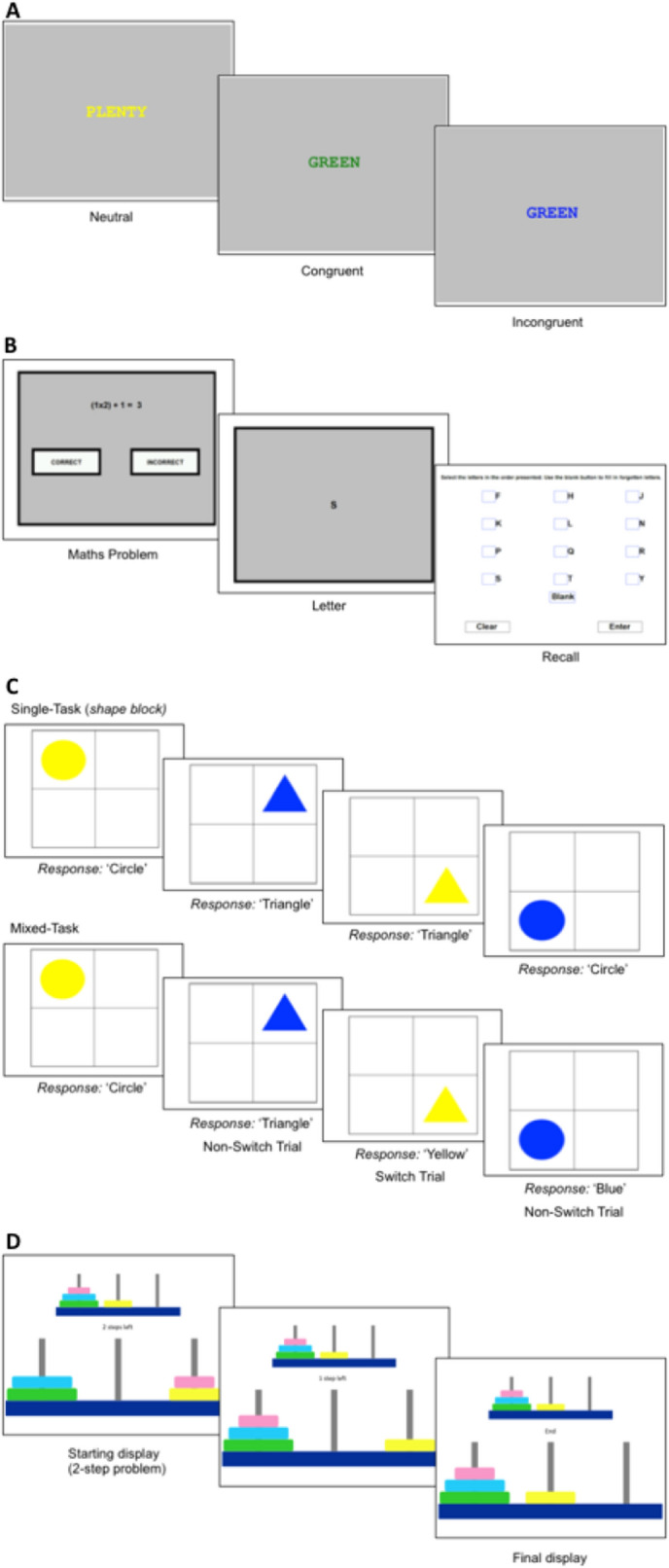
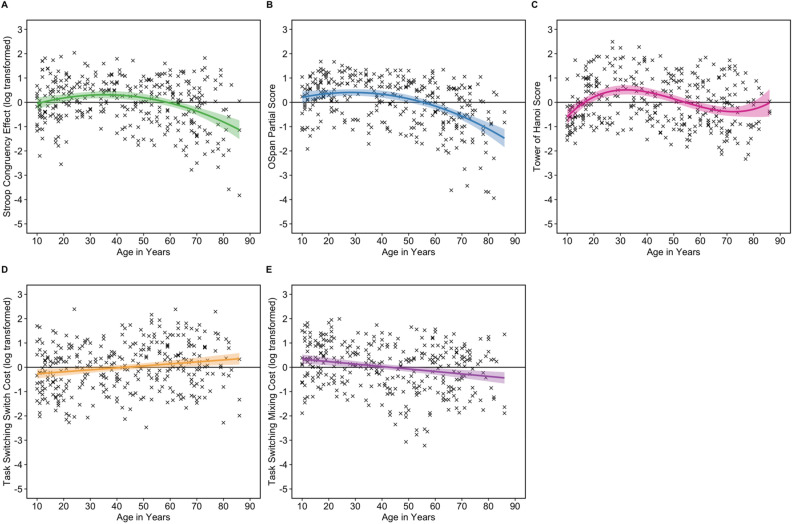
Executive functions demonstrate variable developmental and aging profiles, with protracted development into early adulthood and declines in older age. However, relatively few studies have specifically included middle-aged adults in investigations of age-related differences in executive functions. This study explored the age-related differences in executive function from late childhood through to old age, allowing a more informed understanding of executive functions across the lifespan. Three hundred and fifty participants aged 10 to 86 years-old completed a battery of tasks assessing the specific roles of inhibitory control, working memory, cognitive flexibility, and planning. Results highlighted continued improvement in working memory capacity across adolescence and into young adulthood, followed by declines in both working memory and inhibitory control, beginning from as early as 30–40 years old and continuing into older age. Analyses of planning abilities showed continued improvement across adolescence and into young adulthood, followed by a decline in abilities across adulthood, with a small (positive) change in older age. Interestingly, a dissociation was found for cognitive flexibility; switch costs decreased, yet mixing costs increased across the lifespan. The results provide a description of the developmental differences in inhibitory control, working memory, cognitive flexibility and planning, above any effects of IQ or SES, and highlight the importance of including middle-aged adults in studies seeking to establish a more comprehensive picture of age-related differences in executive function.
Overview
The claims and statistics of this paper haven’t been checked yet.
Free: it reads the open-access text and checks the first 5 claims that cite a source we can check. Create a free account to check every claim.
Integrity signals
Registry
Cites
Statistics
Figures
Verification
Claims the paper makes
The claims and statistics of this paper haven’t been checked yet.
Free: it reads the open-access text and checks the first 5 claims that cite a source we can check. Create a free account to check every claim.
Claims other papers make about this one
Each is checked against this paper’s own text: does it say what the citing paper says it does?
The cited source says what the claim attributes to it.
In the citing paper
“A recent study by (Ferguson et al., 2021) examined EF in a large, community-based sample aged from 10 to 86 years old, demonstrating that planning ability and WM capacity continue to develop throughout adolescence as well as in early adulthood.”
From Assessment of executive functions in school-aged children: A narrative review (2022) · cites this paper as Ferguson et al., 2021
Self-check
Percentages, sums and reported differences re-computed from the paper’s own numbers.
The self-check needs the paper’s full text.
Citations
Cites
Studies of interference in serial verbal reactions
Stroop, J. R. (1935) · Journal of Experimental Psychology · doi:10.1037/h0054651 · Cited by 18,622
Miyake, A., Friedman, N. P., Emerson, M. J., Witzki, A. H., Howerter, A., & Wager, T. D. (2000) · Cognitive Psychology · doi:10.1006/cogp.1999.0734 · Cited by 15,798
Diamond, A. (2013) · Annual Review of Psychology · doi:10.1146/annurev-psych-113011-143750 · Cited by 13,268
Dynamic mapping of human cortical development during childhood through early adulthood
Gogtay, N., Giedd, J. N., Lusk, L., Hayashi, K. M., Greenstein, D., Vaituzis, A. C., Nugent, T. F., Herman, D. H., Clasen, L. S., Toga, A. W., et al. (2004) · Proceedings of the National Academy of Sciences · doi:10.1073/pnas.0402680101 · Cited by 5,604
Wechsler Abbreviated Scale of Intelligence
Dumont, R., Willis, J. O., Veizel, K., & Zibulsky, J. (2014) · Encyclopedia of Special Education · doi:10.1002/9781118660584.ese2519 · Cited by 5,521
Wechsler Abbreviated Scale of Intelligence
Wechsler, D. (2012) · PsycTESTS Dataset · doi:10.1037/t15170-000 · Cited by 4,596
Miyake, A., & Friedman, N. P. (2012) · Current Directions in Psychological Science · doi:10.1177/0963721411429458 · Cited by 3,944
Costs of a predictible switch between simple cognitive tasks.
Rogers, R. D., & Monsell, S. (1995) · Journal of Experimental Psychology: General · doi:10.1037/0096-3445.124.2.207 · Cited by 3,170
Regional Brain Changes in Aging Healthy Adults: General Trends, Individual Differences and Modifiers
Raz, N., Lindenberger, U., Rodrigue, K. M., Kennedy, K. M., Head, D., Williamson, A., Dahle, C., Gerstorf, D., & Acker, J. D. (2005) · Cerebral Cortex · doi:10.1093/cercor/bhi044 · Cited by 2,875
Executive function in preschoolers: A review using an integrative framework.
Garon, N., Bryson, S. E., & Smith, I. M. (2008) · Psychological Bulletin · doi:10.1037/0033-2909.134.1.31 · Cited by 2,695
Research works printed but not linked: 3
- 41. Jacques S Marcovitch S Overton WF Development of executive function across the lifespan Cognition, Biology, and Methods Across the Lifespan. The Handbook of Life-Span Development 2010 Hoboken, NJ Wiley 431 466
- 46. Delis DC Kaplan E Kramer JH Delis–Kaplan Executive Function System (D-KEFS) 2001 San Antonio, TX The Psychological Corporation
- 73. Lawson GM Hook CJ Hackman DA Farah MJ Griffin JA Freund LS McCardle P Socioeconomic status and neurocognitive development: Executive function Executive Function in Preschool Children: Integrating Measurement, Neurodevelopment, and Translational Research 2016 Washington, DC American Psychological Association Press
Cited by
Items 501–600 of 774
Impact of Cognitive Ability and Self-Pacing on Occluded Quasi-Driving Task Performance
Mizobuchi, S., Chen, H.-Y. W., & Chignell, M. (2024) · IEEE International Conference on Human-Machine Systems (ICHMS) · doi:10.1109/ichms59971.2024.10555652
“Cognitive speed decreases with age ([26], [27]) as does working memory and executive functions ([2], [6], [7]).”
BackgroundWulandari, A., & Hendrawan, D. (2024) · Jurnal Kependidikan Jurnal Hasil Penelitian dan Kajian Kepustakaan di Bidang Pendidikan Pengajaran dan Pembelajaran · doi:10.33394/jk.v10i2.11657
Mathey, S. (2024) · theses.fr (ABES) · doi:10.70675/89b2808ez9369z4b3dz8b94z44433fb9b829
Zevedei, D.-E., Penelo, E., Navarro, J. B., de la Osa, N., & Ezpeleta, L. (2024) · Child Neuropsychology · doi:10.1080/09297049.2024.2380393
“Executive function performance is contingent on the development of the prefrontal cortex (Ferguson et al., 2021) and differences in this area have been linked to Oppositional Defiant Disorder (Noordermeer et al., 2016) and Obsessive-Compulsive Disorder (Malloy, 2019).”
Lower frequency range of auditory input facilitates stream segregation in older adults
Dinces, E., & Sussman, E. S. (2024) · Hearing Research · doi:10.1016/j.heares.2024.109095
How Free Will Operates, in Practice
Baumeister, R. F. (2024) · Oxford University Press eBooks · doi:10.1093/oso/9780197693520.003.0018
Baumeister, R. F. (2024) · Oxford University Press eBooks · doi:10.1093/oso/9780197693520.003.0021
Positive Psychology and Free Will
Baumeister, R. F. (2024) · Oxford University Press eBooks · doi:10.1093/oso/9780197693520.003.0020
Does Free Will Mean Random Action?
Baumeister, R. F. (2024) · Oxford University Press eBooks · doi:10.1093/oso/9780197693520.003.0006
Baumeister, R. F. (2024) · Oxford University Press eBooks · doi:10.1093/oso/9780197693520.003.0014
Baumeister, R. F. (2024) · Oxford University Press eBooks · doi:10.1093/oso/9780197693520.003.0011
Baumeister, R. F. (2024) · Oxford University Press eBooks · doi:10.1093/oso/9780197693520.003.0003
Free Will in the Flesh: Three Agents
Baumeister, R. F. (2024) · Oxford University Press eBooks · doi:10.1093/oso/9780197693520.003.0005
How Children Acquire Free Will
Baumeister, R. F. (2024) · Oxford University Press eBooks · doi:10.1093/oso/9780197693520.003.0016
Baumeister, R. F. (2024) · Oxford University Press eBooks · doi:10.1093/oso/9780197693520.003.0007
Baumeister, R. F. (2024) · Oxford University Press eBooks · doi:10.1093/oso/9780197693520.002.0004
What Should a Scientific Theory of Free Will Look Like?
Baumeister, R. F. (2024) · Oxford University Press eBooks · doi:10.1093/oso/9780197693520.003.0002
Baumeister, R. F. (2024) · Oxford University Press eBooks · doi:10.1093/oso/9780197693520.003.0012
How Conscious Thoughts Cause Behavior
Baumeister, R. F. (2024) · Oxford University Press eBooks · doi:10.1093/oso/9780197693520.003.0010
Desire to Have or Use Free Will? The Question of Innate Drive for Control
Baumeister, R. F. (2024) · Oxford University Press eBooks · doi:10.1093/oso/9780197693520.003.0019
Owning Your Actions as an Individual
Baumeister, R. F. (2024) · Oxford University Press eBooks · doi:10.1093/oso/9780197693520.003.0017
Whether People Believe in Free Will or Not
Baumeister, R. F. (2024) · Oxford University Press eBooks · doi:10.1093/oso/9780197693520.003.0015
The Time Dimension: Free Will Links Past, Present, and Future
Baumeister, R. F. (2024) · Oxford University Press eBooks · doi:10.1093/oso/9780197693520.003.0004
What Is Choice? Understanding the Multi-Maybe Future
Baumeister, R. F. (2024) · Oxford University Press eBooks · doi:10.1093/oso/9780197693520.003.0008
Baumeister, R. F. (2024) · Oxford University Press eBooks · doi:10.1093/oso/9780197693520.003.0001
Kahaki, F. (2024) · پویایی روانشناختی در اختلالهای خلقی. · doi:10.61838/kman.pdmd.3.1.18
Zawadzka, E., & Domańska, Ł. (2024) · Advances in Cognitive Psychology · doi:10.5709/acp-0441-4
Altuğ, Ş. D., & Ünal, A. (2024) · Sosyal Politika Çalışmaları Dergisi · doi:10.21560/spcd.vi.1484472
Teixeira, L. A. (2024) · Springer eBooks · doi:10.1007/978-3-031-74123-4_25
How Do Components of Executive Function Relate to Taiwanese Sixth Graders’ Mathematical Skills?
Shen, I., & Chen, C. (2025) · Perceptual and Motor Skills · doi:10.1177/00315125251320423 · Cited by 1
“WM follows a linear trajectory from preschool through adolescence (Best & Miller, 2010; Brocki & Bohlin, 2004; Ferguson et al., 2021).”
Kognitivne sposobnosti bolnikov na hemodializnem zdravljenju
Mesarič, K. K., Pajek, J., Pajek, M., Kodrič, J., & Bogataj, Š. (2025) · Psihološka obzorja · doi:10.20419/2025.34.602
Berg, V., Rogers, S., McMahon, M., Garrett, M. J., & Manley, D. (2022) · PsyArXiv (OSF Preprints) · doi:10.31234/osf.io/frq2h_v1
Inhibition Training in Middle Adulthood: Task-Specific Gains and Limited Transfer
Martinčević, M., Juras, L., & Vranić, A. (2025) · Journal of Cognitive Enhancement · doi:10.1007/s41465-025-00326-4
“While prior research has indicated that inhibitory abilities decline with age (Ferguson et al., 2021; Forte et al., 2024), suggesting that inhibition training might be beneficial at this stage, this study demonstrates the limited efficacy of inhibition training.”
Ipatyuk, O. V., & Kozunova, G. L. (2025) · S S Korsakov Journal of Neurology and Psychiatry · doi:10.17116/jnevro20251250517
Bonnier, R., Beames, J. R., Claes, L., Kirtley, O. J., de Thurah, L., Dennis, M. W. J., Uyttebroek, L., Luijsmans, M., Myin‐Germeys, I., & Kiekens, G. (2024) · PsyArXiv (OSF Preprints) · doi:10.31234/osf.io/d7x94_v3 · Cited by 1
Mickiewicz, M., & Szepietowska, E. M. (2025) · Psychiatria i Psychologia Kliniczna · doi:10.15557/pipk.2025.0008
A Comprehensive Study of Cognitive Control in Healthy AgingPreprint
Pue, S. D., Stuyck, H., Gillebert, C. R., Dierckx, E., & den Bussche, E. V. (2025) · PsyArXiv (OSF Preprints) · doi:10.31234/osf.io/vnkdq_v2
Patrones De Procesamiento Sensorial y su Asociación con Dificultades de Aprendizaje en Adolescentes
Armstrong-Gallegos, S. (2025) · Revista Enfoques Educacionales · doi:10.5354/2735-7279.2025.76618
Predicción del rendimiento en cursos STEM: Evidencia de un modelo de ecuaciones estructurales
Chaves-Ulate, C., Boza-Oreamuno, S., Herrera, B. M., & Montero-Rojas, E. (2025) · Innovaciones educativas · doi:10.22458/ie.v27i43.5562
Alkhaldi, A. A. H. (2025) · Applied Neuropsychology Child · doi:10.1080/21622965.2025.2541176
Grahek, I., Leng, X., Fengler, A., & Shenhav, A. (2025) · bioRxiv (Cold Spring Harbor Laboratory) · doi:10.1101/2025.08.27.672689
“…control in goal-varying vs. stable environments (which we term switching inflexibility ; Kray & Lindenberger, 2000; Cepeda et al., 2001; Mayr, 2001; Ferguson et al., 2021), and (2) decreases in levels of control adjustment for speed vs. accuracy goals (which we term configural inflexibility ;…”
Qin, H., Xu, J., wang, J., Wang, W., & Xu, H. (2025) · medRxiv · doi:10.1101/2025.09.03.25333003
“Notably, structural and functional plasticity of the brain network involved in cognitive control undergoes rapid and profound development during childhood and adolescence, making it a sensitive time window for adverse life events to influence EF development (Ferguson et al., 2021).”
زين, ن. ن. (2025) · مجلة الدراسات النفسیة المعاصرة جامعة بنى سویف · doi:10.21608/bshjo.2025.408512.1089
Gomes, R. V., dos Santos, J. P. R., do Nascimento, J. V. M., Alves, A. A., dos Santos, B. L., Bezerra, E. D. S., Barbosa, S. L. D. S., Tavares, V. D. D. O., Ramos, I. A., Cabral, L. L. P., et al. (2025) · Pensar en Movimiento Revista de Ciencias del Ejercicio y la Salud · doi:10.15517/2qzydc76
Parsing inhibitory and mnemonic contributions to age-related decline in cognitive flexibility.
Weichart, E. R., Francis, C. S., & Sederberg, P. B. (2026) · Psychology and Aging · doi:10.1037/pag0000996
Mair, A. (2025) · SSRN Electronic Journal · doi:10.2139/ssrn.5500147
Rodrigues, J. D. S., Pastor‐Valero, M., Maruyama, J. M., Munhoz, T. N., Santos, I. S., Barros, A. J. D., Tovo‐Rodrigues, L., & Matijasevich, A. (2025) · European Child & Adolescent Psychiatry · doi:10.1007/s00787-025-02844-0
Galli, R. M., Thams, F., Löwe, B., Cheng, B., Thomalla, G., Bieder, M., Petersen, E. L., Büchel, C., & Brassen, S. (2025) · GeroScience · doi:10.1007/s11357-025-01928-8
“While most studies on resilience and healthy aging have utilized extreme age-group designs, effective adaptation likely begins in midlife, when psychological and socioeconomic challenges intersect with physical, cognitive, and neural changes [12–16].”
Effects of Physical Activity and Purpose in Life in Cognitive Aging
Sadeghi, F. (2025) · The Research Repository @ WVU (West Virginia University) · doi:10.33915/etd.12940
Gryń, K., Kasperkowicz, N., Tatarnikava, D., Bober-Płonka, B., & Sikorska, I. (2025) · Psychologia Rozwojowa · doi:10.4467/20843879pr.24.010.21724
Pérez, L. (2025) · Investigo repository of University of Vigo (University of Vigo) · doi:10.35869/11093/10170
Alruwaili, R. F. (2025) · Open Education Studies · doi:10.1515/edu-2025-0105
Age-dependent modulation of inhibitory control: behavioral and EEG evidence from the Stroop paradigm
Fabbrocino, A., Cacciotti, A., Pappalettera, C., & Vecchio, F. (2025) · Exploration of Medicine · doi:10.37349/emed.2025.1001368
Aging of the brain systems supporting speech perception
Tremblay, P., Marion-Flamand, M.-A., Ratelle, D., & Sicard, A. (2025) · Elsevier eBooks · doi:10.1016/b978-0-443-29198-2.00001-1
Szitás, T. (2025) · SZTE Repository of Dissertations (University of Szeged) · doi:10.14232/phd.12477
Merchant, J. S., Purcell, J. J., Callow, D. D., Won, J., Kommula, Y., Rosenberg, S., Wei, Y., Woodard, J. L., Nielson, K. A., Rao, S. M., et al. (2025) · Human Brain Mapping · doi:10.1002/hbm.70404
“…function, which involves higher-level cognitive functions that control and coordinate thoughts and behaviors, including task switching and inhibitory control, begins to decline in adulthood between the ages of 30 and 40 years and continues to decline with increased age (Ferguson et al. 2021).”
Virtual Reality Game Effect on Healthy Young Adults′ Executive Functions: A Pilot Study
Gentile, A., Presti, L. L., Cascia, M. L., Simonetti, A. M., Bianco, A., & Alesi, M. (2025) · Human Behavior and Emerging Technologies · doi:10.1155/hbe2/6121499
المركز, إ. خ., & الصَّادي, أ. ع. (2025) · مجلة جامعة فزان العلمية · doi:10.64500/.v3i2.485
Assessing behavioral control across the adult lifespan using a novel outcome revaluation task
Franco, C. Y., & Knowlton, B. J. (2025) · Scientific Reports · doi:10.1038/s41598-025-29795-5
Vig, A. P., Vestberg, S., Evald, L., Mion, M., Segerström, M., Ullén, S., Årestedt, K., Nielsen, N., Cronberg, T., Lilja, G., et al. (2025) · Neuropsychological Rehabilitation · doi:10.1080/09602011.2025.2591784
“Given that a large portion of the sample consisted of older individuals – an age group typically associated with EF decline (De Luca et al., 2003; Ferguson et al., 2021) – these low scores were surprising.”
Pahor, A. (2025) · Physics of Life Reviews · doi:10.1016/j.plrev.2025.11.009
Monteiro, M. R. P., Villamil-Cabello, E., Luque‐Casado, A., Silva‐Grigoletto, M. E. D., & Fernández‐del‐Olmo, M. (2025) · Psychological Research · doi:10.1007/s00426-025-02214-0
“Age also seems to be an influential factor (Piccardi et al., 2013; Car-bone et al., 2021), with a decline in working memory performance beginning around the age of 30 (Ferguson et al., 2021).”
Autistic traits and cognitive functions: A cross-sectional study from younger to older adulthood
Besse, M., Morel‐Kohlmeyer, S., Capdeville, J., Prévost, P., Tuller, L., Bouazzaoui, B., Taconnat, L., Houy‐Durand, E., Gomot, M., & Angel, L. (2025) · Acta Psychologica · doi:10.1016/j.actpsy.2025.106092
Alshehri, M. A., Mosleet, A. F. B. S., Abdellatif, M. S., & Nemt-allah, M. A. (2025) · Research Journal in Advanced Humanities · doi:10.58256/b3atyz61
“EFs develop rapidly from early childhood through adolescence, with foundational skills emerging in preschool years and reaching adult levels by late adolescence (Ferguson et al., 2021; Tervo-Clemmens et al., 2023).”
Boelhouwer, I. G., HEIJDEN, B. I. J. M. V. D., & van Vuuren, T. (2025) · Edward Elgar Publishing eBooks · doi:10.4337/9781035330447.00013
Grossmann, J. A. (2024) · heiDOK (Heidelberg University) · doi:10.11588/heidok.00034270
Claybaugh, A. C. (2025) · Carolina Digital Repository (University of North Carolina at Chapel Hill) · doi:10.17615/8eb6-r316
Socio-affective influences on adolescent mental health problems
Minihan, S. (2024) · UNSWorks (UNSW Sydney) · doi:10.26190/unsworks/30269
Post overdose cognitive impairment in an acute hospital setting
Stewart, P. (2024) · UNSWorks (University of New South Wales, Sydney, Australia) · doi:10.26190/unsworks/30433
Variables que influyen en el rendimiento ejecutivo en población adulta mayor sana de Ecuador
Moscoso, A. F. O., & González, B. E. S. (2025) · South American Research Journal · doi:10.5281/zenodo.15490708
Heading in children and youth football (soccer)
Reeschke, R. (2025) · Amtliche Mitteilungen (Universitätsbibliothek Paderborn) · doi:10.17619/unipb/1-2195
Knight, R. (2023) · Apollo (University of Cambridge) · doi:10.17863/cam.108932
Vassiliu, C. (2023) · Apollo (University of Cambridge) · doi:10.17863/cam.108480
Exploring the Association between Paranormal Beliefs and Cognitive Deficits
Dean, C. E. (2023) · University of Hertfordshire Research Archive (University of Hertfordshire) · doi:10.18745/th.26479
Frau, L. (2025) · Liverpool John Moores University · doi:10.24377/ljmu.t.00023125
Contributions of Affective States and Traits to Autistic Features
Godfrey, K. J. (2024) · doi:10.11575/prism/43312
Hurley, R. (2025) · CLOK (University of Central Lancashire) · doi:10.17030/uclan.thesis.00054582
The Neural Correlates of Dual-Task Walking in People with Neurological Disorders
Kim, H. (2021) · uO Research (University of Ottawa) · doi:10.20381/ruor-27181
Affective and Cognitive Aging Revisited: The Role of Metacognition
Da Silva Coelho, C. (2023) · Archive ouverte UNIGE (University of Geneva) · doi:10.13097/archive-ouverte/unige:173769
Lifetime changes in body maps investigated with music
Tanaka, M., & Daikoku, T. (2026) · Translational Neuroscience · doi:10.1515/tnsci-2025-0407
“…– partially di ff ering from well-documented age-related reductions in interoceptive sensitivity [49, 50] – head-related sensations exhibited a non-monotonic pattern, increasing in middle adulthood (30s – 40s) in post hoc comparisons, consistent with the maturation of executive functions [51].”
LINKING MACHINE LEARNING-PREDICTED BRAIN AGING WITH ALCOHOL-RELATED PHENOTYPES
Battista, J. T. (2025) · Carolina Digital Repository (University of North Carolina at Chapel Hill) · doi:10.17615/0h09-zf66
Sharafabadi, M. M. (2022) · UWA Profiles and Research Repository (University of Western Australia) · doi:10.26182/0kzj-qe47
Memory precision across space and time in Alzheimer's disease
Toniolo, S. (2023) · Oxford University Research Archive (ORA) (University of Oxford) · doi:10.5287/ora-pzz6prj4e
Desclaux, B. (2024) · Hypotheses (OpenEdition) · doi:10.58079/12zog
Digilaitteiden ongelmakäytön vaikutukset nuorten toiminnanohjauksen kehittymiseen
Leppänen, L. (2023) · Jyväskylä University Digital Archive (University of Jyväskylä)
Regueiro, S. (2021) · Papyrus : Institutional Repository (Université de Montréal) · doi:10.71781/18530
Alotaibi, K. (2023) · Nottingham ePrints (University of Nottingham) · Cited by 1
Ferrari, C. G. (2024) · LA Referencia (Red Federada de Repositorios Institucionales de Publicaciones Científicas) · Cited by 1
Rocco, G. D. (2023) · Archivio istituzionale della ricerca (Alma Mater Studiorum Università di Bologna)
Neurobiological Mechanisms of Externalising in Adolescence
Smith, E. M. (2023) · UCL Discovery (University College London)
Relación entre las funciones ejecutivas y el rendimiento académico en adolescentes
Romero-Méndez, C. A. (2024) · El Repositorio Academico Digital de la UANL (Universidad Autónoma de Nuevo León)
Cohen, L. B. (2025) · ScholarWorks -A service of University of Vermont Libraries (University of Vermont)
Zevedei, D. (2023) · Tesis Doctorals en Xarxa (Consorci de Serveis Universitaris de Catalunya)
García, L. F. (2024) · Repositorio de Patentes de la Universidad de Almería (Universidad de Almería)
Gifuni, A. J. (2024) · eScholarship@McGill (McGill) · doi:10.82308/38828
Guasconi, E. (2023) · Archivio istituzionale della ricerca (Alma Mater Studiorum Università di Bologna)
Perry, R. C. (2024) · UCL Discovery (University College London)
Holt, J. (2023) · ORCA Online Research @Cardiff (Cardiff University)
Fritz, H. (2024) · Lund University Publications Student Papers (Lund University)
Metadata
- Authors
- Ferguson, H. J., Brunsdon, V. E. A., & Bradford, E. E. F.
- Affiliations
- University of Kent (GB)
- University of Dundee (GB)
- Corresponding author
- Ferguson, Heather J.
- Venue
- Scientific Reports
- Published
- 2021-01-14
- Volume
- 11
- Issue
- 1
- Pages
- 1382-1382
- ISSN
- 2045-2322 (ISSN-L)
- PMC
- PMC7809200
- OpenAlex
- W3116908532
- Cited by
- 583
- References
- 116
- Citations by year
- 2026: 125 · 2025: 137 · 2024: 145 · 2023: 96 · 2022: 66 · 2021: 14
- FWCI
- 42.22
- Type
- journal article
- Language
- en
- Open access
- gold
- doi.org
- Licence
- cc-by
- creativecommons.org/licenses/by/4.0 (tdm)
- creativecommons.org/licenses/by/4.0 (vor)
- Locations
- Scientific Reports (publishedVersion, cc-by)
- PubMed Central (publishedVersion, cc-by)
- PubMed (publishedVersion)
- Kent Academic Repository (University of Kent) (acceptedVersion)
- St Andrews Research Repository (St Andrews Research Repository) (acceptedVersion, cc-by)
- Discovery Research Portal (University of Dundee) (submittedVersion, cc-by)
- DOAJ (DOAJ: Directory of Open Access Journals) (submittedVersion, cc-by-sa)
- OSF Preprints (OSF Preprints) (submittedVersion)
- Funders
- European Research Council (636458)
- Topics
- Life Sciences › Neuroscience › Cognitive Neuroscience › Neural and Behavioral Psychology Studies
- Social Sciences › Psychology › Experimental and Cognitive Psychology › Cognitive Abilities and Testing
- Social Sciences › Psychology › Experimental and Cognitive Psychology › Cognitive Functions and Memory
- Keywords
- executive function, lifespan development, aging, inhibitory control, working memory, cognitive flexibility, planning, switch costs, mixing costs, middle-aged adults, adolescence, cognitive decline
- MeSH terms
- Adolescent, Adult, Aged, Aged, 80 and over, Aging, Child, Female, Humans, Male, Memory, Short-Term, Middle Aged, Executive Function
About these checks
Registry, retraction, Cites and statistics results are computed, not judged, with one exception: a printed reference that no index lists is read once by a model before it counts as a citation error. Claims are extracted by a model and kept only when their quote appears verbatim in the text; each cited source is then checked, with a model’s help, for whether it says what the claim relies on. Those verdicts can be wrong — read the claim’s quote and the cited source before relying on one.
Statistics and arithmetic are recomputed, not judged.
Confidence bands are shown only for fields calibrated on our annotated test set. None is calibrated yet, so no band is shown.
What counts as a claim ›How we measure confidence ›How we check this ›
Are you an author, or do you see a problem with this page? Request a review
Data sources
Bibliographic data: Semantic Scholar, OpenAlex, Crossref.
Contains information from the Semantic Scholar Academic Graph Datasets, made available under the ODC Attribution License (ODC-BY 1.0).
Semantic Scholar’s data is described in: Kinney, R., et al. (2023). The Semantic Scholar Open Data Platform. arXiv:2301.10140.
