

The developmental trajectories of executive function from adolescence to old age.
Open accessThe DOI matches its Crossref record; 116 of the 116 references it cites were found in a registry or an index.
Abstract
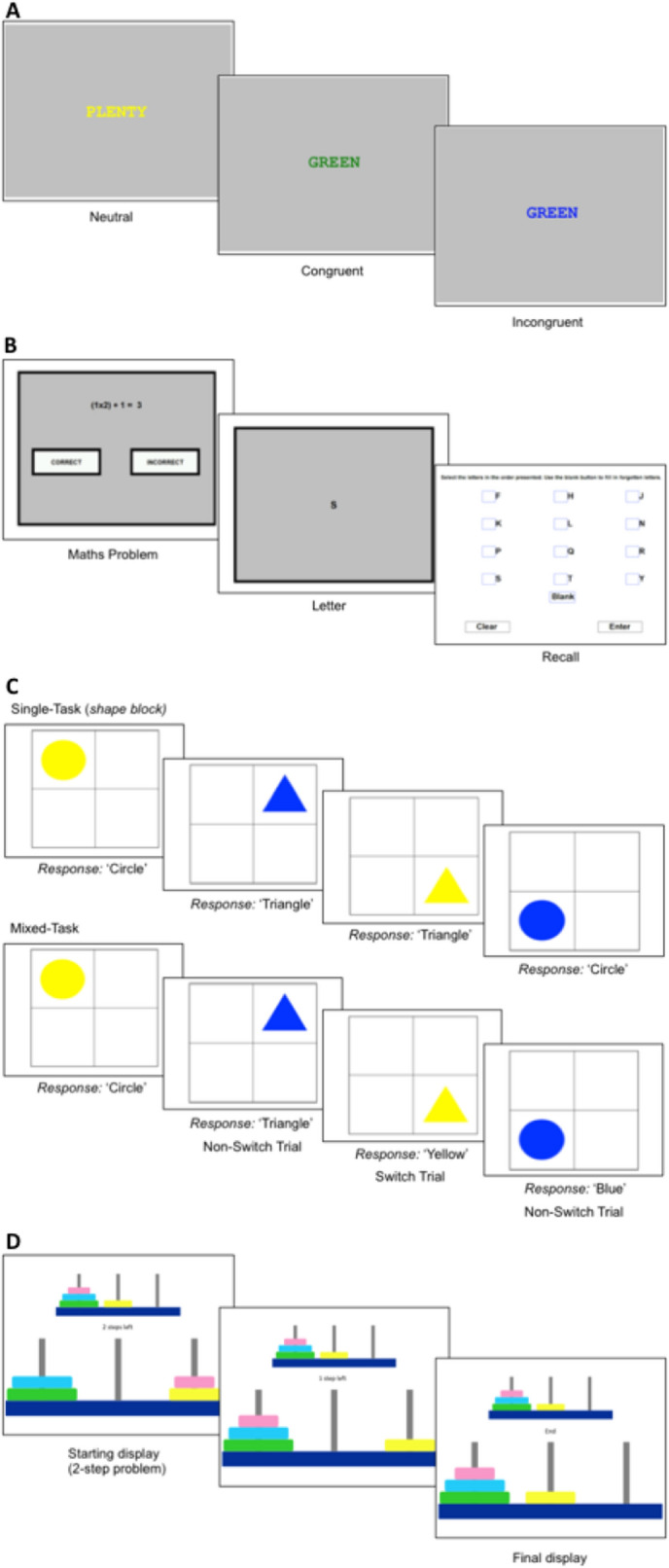
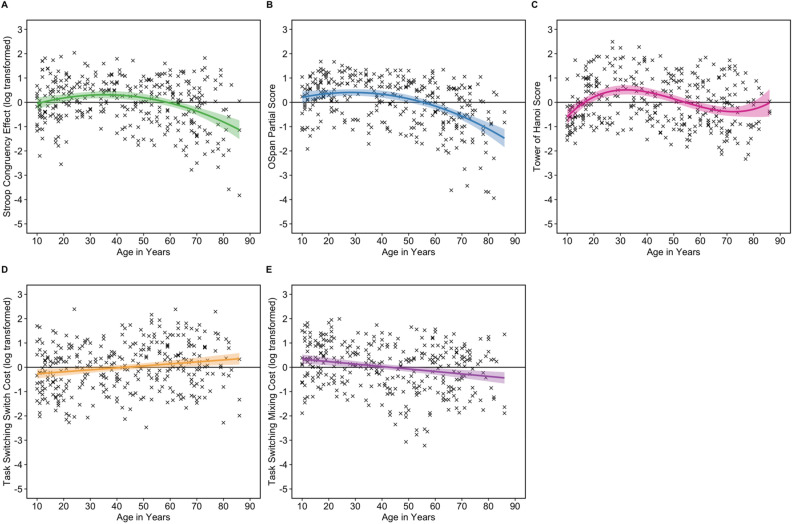
Executive functions demonstrate variable developmental and aging profiles, with protracted development into early adulthood and declines in older age. However, relatively few studies have specifically included middle-aged adults in investigations of age-related differences in executive functions. This study explored the age-related differences in executive function from late childhood through to old age, allowing a more informed understanding of executive functions across the lifespan. Three hundred and fifty participants aged 10 to 86 years-old completed a battery of tasks assessing the specific roles of inhibitory control, working memory, cognitive flexibility, and planning. Results highlighted continued improvement in working memory capacity across adolescence and into young adulthood, followed by declines in both working memory and inhibitory control, beginning from as early as 30–40 years old and continuing into older age. Analyses of planning abilities showed continued improvement across adolescence and into young adulthood, followed by a decline in abilities across adulthood, with a small (positive) change in older age. Interestingly, a dissociation was found for cognitive flexibility; switch costs decreased, yet mixing costs increased across the lifespan. The results provide a description of the developmental differences in inhibitory control, working memory, cognitive flexibility and planning, above any effects of IQ or SES, and highlight the importance of including middle-aged adults in studies seeking to establish a more comprehensive picture of age-related differences in executive function.
Overview
The claims and statistics of this paper haven’t been checked yet.
Free: it reads the open-access text and checks the first 5 claims that cite a source we can check. Create a free account to check every claim.
Integrity signals
Registry
Cites
Statistics
Figures
Verification
Claims the paper makes
The claims and statistics of this paper haven’t been checked yet.
Free: it reads the open-access text and checks the first 5 claims that cite a source we can check. Create a free account to check every claim.
Claims other papers make about this one
Each is checked against this paper’s own text: does it say what the citing paper says it does?
The cited source says what the claim attributes to it.
In the citing paper
“A recent study by (Ferguson et al., 2021) examined EF in a large, community-based sample aged from 10 to 86 years old, demonstrating that planning ability and WM capacity continue to develop throughout adolescence as well as in early adulthood.”
From Assessment of executive functions in school-aged children: A narrative review (2022) · cites this paper as Ferguson et al., 2021
Self-check
Percentages, sums and reported differences re-computed from the paper’s own numbers.
The self-check needs the paper’s full text.
Citations
Cites
Studies of interference in serial verbal reactions
Stroop, J. R. (1935) · Journal of Experimental Psychology · doi:10.1037/h0054651 · Cited by 18,622
Miyake, A., Friedman, N. P., Emerson, M. J., Witzki, A. H., Howerter, A., & Wager, T. D. (2000) · Cognitive Psychology · doi:10.1006/cogp.1999.0734 · Cited by 15,798
Diamond, A. (2013) · Annual Review of Psychology · doi:10.1146/annurev-psych-113011-143750 · Cited by 13,268
Dynamic mapping of human cortical development during childhood through early adulthood
Gogtay, N., Giedd, J. N., Lusk, L., Hayashi, K. M., Greenstein, D., Vaituzis, A. C., Nugent, T. F., Herman, D. H., Clasen, L. S., Toga, A. W., et al. (2004) · Proceedings of the National Academy of Sciences · doi:10.1073/pnas.0402680101 · Cited by 5,604
Wechsler Abbreviated Scale of Intelligence
Dumont, R., Willis, J. O., Veizel, K., & Zibulsky, J. (2014) · Encyclopedia of Special Education · doi:10.1002/9781118660584.ese2519 · Cited by 5,521
Wechsler Abbreviated Scale of Intelligence
Wechsler, D. (2012) · PsycTESTS Dataset · doi:10.1037/t15170-000 · Cited by 4,596
Miyake, A., & Friedman, N. P. (2012) · Current Directions in Psychological Science · doi:10.1177/0963721411429458 · Cited by 3,944
Costs of a predictible switch between simple cognitive tasks.
Rogers, R. D., & Monsell, S. (1995) · Journal of Experimental Psychology: General · doi:10.1037/0096-3445.124.2.207 · Cited by 3,170
Regional Brain Changes in Aging Healthy Adults: General Trends, Individual Differences and Modifiers
Raz, N., Lindenberger, U., Rodrigue, K. M., Kennedy, K. M., Head, D., Williamson, A., Dahle, C., Gerstorf, D., & Acker, J. D. (2005) · Cerebral Cortex · doi:10.1093/cercor/bhi044 · Cited by 2,875
Executive function in preschoolers: A review using an integrative framework.
Garon, N., Bryson, S. E., & Smith, I. M. (2008) · Psychological Bulletin · doi:10.1037/0033-2909.134.1.31 · Cited by 2,695
Research works printed but not linked: 3
- 41. Jacques S Marcovitch S Overton WF Development of executive function across the lifespan Cognition, Biology, and Methods Across the Lifespan. The Handbook of Life-Span Development 2010 Hoboken, NJ Wiley 431 466
- 46. Delis DC Kaplan E Kramer JH Delis–Kaplan Executive Function System (D-KEFS) 2001 San Antonio, TX The Psychological Corporation
- 73. Lawson GM Hook CJ Hackman DA Farah MJ Griffin JA Freund LS McCardle P Socioeconomic status and neurocognitive development: Executive function Executive Function in Preschool Children: Integrating Measurement, Neurodevelopment, and Translational Research 2016 Washington, DC American Psychological Association Press
Cited by
Items 701–774 of 774
The space fortress task: Psychometrics evidence and relationship with executive functions
Chenot, Q., & Scannella, S. (2026) · Heliyon · doi:10.1016/j.heliyon.2026.e45593
Guarneri, J. L. (2026) · Digital Commons - East Tennessee State University (East Tennessee State University)
Jacobsen, K. J., Ghazi, M. M., Nielsen, R. M., Ng, E. H. N., Shenton, N., Kristensen, L. S., Urdanibia-Centelles, O., Arvedsen, S. K., Larsson, H. B. W., Vestergaard, M. B., et al. (2026) · Frontiers in Aging · doi:10.3389/fragi.2026.1867663
Rolando, M., Gavazzi, G., Perasso, G. F., & Cocchi, E. (2026) · Frontiers in Developmental Psychology · doi:10.3389/fdpys.2026.1915996
Simon, S. S., Gal, M., Lee, S., Walker, M. D., Beeri, M. S., Bachmann, G. A., Lauriola, V., Sloan, R., Stern, Y., & Gazes, Y. (2026) · Journal of Alzheimer s Disease · doi:10.1177/13872877261471900
“These functions are essential for maintaining functional independence, 38 yet they are known to decline with aging 39 and are impacted by the menopausal process.”
When Predictive Outcomes Make Task Representations CostlyPreprint
Fuentes, L. J., Castillo, A., Parra, P., García-Hernández, M. D., Colzato, L. S., & Hommel, B. (2026) · Research Square · doi:10.21203/rs.3.rs-10438117/v1
Ma, Y., Zhang, D., & Xing, X. (2026) · Journal of Research on Adolescence · doi:10.1111/jora.70244
Udoratina, A., Maksimenko, V., & Gordleeva, S. (2026) · Frontiers in Aging Neuroscience · doi:10.3389/fnagi.2026.1906284
“…be associated with deterioration of brain functions that are closely related to the performance in PDM task, including executive control functions (Ferguson et al., 2021), attention (Wasylyshyn et al., 2011) [although some aspects may remain stable or even improve with age as demonstrated in…”
Interaction between mood disorder and aging in emotion processing
Gray, V. (2024) · Otago University Research Archive (University of Otago)
Jacobo, M. I., Sória, I. N., & Esteve-Faubel, J.-M. (2026) · Aposta · doi:10.23900/ra.v24i118.1681
Pothoven, C. (2026) · Aquila Digital Community (University of Southern Mississippi)
Specific Associations Between Psychopathology and Cognition in Youth: A Network Analysis
Kramer, E. L. (2025) · Digital Commons - DU (University of Denver) · doi:10.56902/etdcrp.2025.195
Parenting disabled children and teens.
Olkin, R. (2026) · American Psychological Association eBooks · doi:10.1037/0000514-010
Executive functioning in adults born with very low birth weight
Ingvaldsen, S. H., Weider, S., Heinonen, K., Benum, S. D., Aakvik, K. A. D., Räikkönen, K., Kajantie, E., & Evensen, K. A. I. (2026) · Scientific Reports · doi:10.1038/s41598-026-67104-w
The MAPme Project: Implementing a College-Based Study of Substance Use and Mental Wellness
Barfield-Steward, W. L., Xiang, Y., Najera, D. D., Ober-Oluoch, J., Benca‐Bachman, C. E., Derricott, H., Syed, R. A., Welsh, J. W., & Palmer, R. H. C. (2026) · International Journal of Environmental Research and Public Health · doi:10.3390/ijerph23081084
“A notably difference between the two cohorts in terms of personality traits is that males exhibited much greater levels of externalizing in the 2018–2024 cohort, which was expected given their younger age on average compared to the 2025+ cohort [45].”
Sandkühler, K., Thomas, A., Hofer, N. M., Herke, S., Levin, J., Schenk, T., & Loosli, S. V. (2026) · Developmental Review · doi:10.1016/j.dr.2026.101293
Heled, E., & Levi, O. (2026) · SSRN Electronic Journal · doi:10.2139/ssrn.7369866
Shenning, Z., Li, Y., & Luo, Y. (2026) · Mental health and physical activity · doi:10.1016/j.mhpa.2026.100823
Bіldіren, A., & Kavruk, S. Z. (2026) · Frontiers in Psychology · doi:10.3389/fpsyg.2026.1828497
“…is characterized by substantial cognitive development, during which improvements in cognitive flexibility, fluid reasoning, and executive functions have been reported in previous developmental research (Blake and Pope, 2008; Buttelmann and Karbach, 2017; Ferguson et al., 2021; Madanagopal, 2020).”
Revista de Psicología Vol. 20, Nº 40, 2024 (número completo)
(2024) · Repositorio Institucional UCA (Pontificia Universidad Católica Argentina)
The Neurocognitive Benefits of Martial Arts
Kayale, F. (2026) · IntechOpen eBooks · doi:10.5772/intechopen.1015479
Serafim, C. J., Sans, E., & Gunnoo, A. (2026) · Australian Journal of Psychology · doi:10.1080/00049530.2026.2726226
“Third, as the sample was restricted to adults (18+), findings may not capture developmental nuances in self-regulation and executive function during adolescence (Ferguson et al., 2021; Ma et al., 2026; Meredith & Silvers, 2024).”
Reid, K., Olson, S., Ferris, Z., Mathieu, M., Peloquin, V., Egorova, A., Zhang, P., & Ottmar, E. (2026) · Psychological Research · doi:10.1007/s00426-026-02373-8
“Particularly, Ferguson et al. ( 2021 ) found that college-age”
Schaerz, S., & McGregor, P. (2026) · Kinesiology Review · doi:10.1123/kr.2026-0014
Temporal Dynamics of Cognitive Change following Acute Aerobic Physical Activity in Emerging Adults
Pasupathi, P. A., O’Brokta, M. M., Cornwall, A. S., Herrera, B. M., Kehoe, A. R. D., & Drollette, E. S. (2026) · Journal of Cognitive Enhancement · doi:10.1007/s41465-026-00370-8
Frau, L., Bruno, D., & Cazzato, V. (2026) · Brain Research · doi:10.1016/j.brainres.2026.150546
Grégoire, C., Rauzy, S., & Champagne‐Lavau, M. (2026) · Journal of Adolescence · doi:10.1002/jad.70273
Alobaidy, A. A. A., Kindi, Q. A. A., Attabi, W. A., Al-Ghatrifi, U., & Mohammedallayla, I. D. J. (2026) · Journal of Neuropsychology · doi:10.1111/jnp.70079
Otzelberger, K. A., McDonald, K. M., Petro, N. M., Webert, L. K., Okelberry, H. J., Coutant, A. T., Glesinger, R. J., Garrison, G. M., John, J. A., Rice, D. L., et al. (2026) · npj Aging · doi:10.1038/s41514-026-00522-2
Magal, S. E., Tzemah-Shahar, R., Asraf, K., & Agmon, M. (2026) · GeroScience · doi:10.1007/s11357-026-02542-y
Li, Q., Zhang, L., Zhang, Y., Kong, M., Liu, S., Chu, C., Yang, S., Li, L., Zhang, W., & Zhu, Z.-R. (2026) · Scientific Reports · doi:10.1038/s41598-026-71937-w
The inhibitory control epidemic: A new framework for chronic disease prevention
Bigliassi, M., & Antonio, D. S. (2026) · New Ideas in Psychology · doi:10.1016/j.newideapsych.2026.101305
Introzzi, I. M., Musso, M., Aydmune, Y. S., Villaroia, M. G., Ferreyra, F. A., Punta, J. A. D., Gasaneo, G., & Richard’s, M. M. (2026) · Journal of Cognition and Development · doi:10.1080/15248372.2026.2735258
Evans, C., Kalman, D., Goodrich, J., Burgess, V., Tartar, J. L., Jiannine, L., Pereira, F., Ricci, A., Schwarz, A. V., Rojas, J., et al. (2026) · Nutrients · doi:10.3390/nu18193177
“Cognitive function is not static and can change with age, as well as lifestyle-related factors [1].”
Health and Wellness Among Grade 10 Learners
Pesiao, M. S. (2026) · Psychology and Education A Multidisciplinary Journal · doi:10.70838/pemj.630509
Ma, Y., Zhao, X., Fan, F., & Xing, X. (2026) · Research on Child and Adolescent Psychopathology · doi:10.1007/s10802-026-01511-5
“In contrast, core EFs, including inhibitory control, working memory, and cognitive flexibility, generally show linear or curvilinear improvements during this period, consistent with ongoing brain maturation (Ferguson et al., 2021).”
Su, X. (2026) · Frontiers in Psychology · doi:10.3389/fpsyg.2026.1932736
“Executive function refers to the regulation of cognition and behavior around task goals and commonly includes inhibitory control, working memory, cognitive flexibility, and executive attention (Ferguson et al., 2021).”
Dipshikha Baruah, D. N. K. S., Sharma, N. K., Rani, A., & Trikha, S. (2023) · Journal of Propulsion Technology
Cognitive changes during the menopause transition
Barnor, K. (2026) · Nottingham ePrints (University of Nottingham)
Bartoli, M. (n.d.) · Institutional Research Information System University of Turin (University of Turin)
Motaln, M. (2026) · University of Maribor digital library (University of Maribor)
Aswaria, A., Arini, G. A., & Wafik, A. Z. (2025) · Indonesian Development Economics and Localities · doi:10.59535/8jt6kf34
Artificial Minds: Boundaries, Evidence, and Possibilities
Moritz, E. (2026) · PhilPapers (PhilPapers Foundation)
Bw, S. H., & Pawito, P. (2026) · Jurnal Ilmiah Muqoddimah Jurnal Ilmu Sosial Politik dan Hummaniora · doi:10.31604/jim.v10i1.2026.572-579
Reparaz‐Escudero, I., Izquierdo, M., Ecay‐Torres, M., Altuna, M., López, C., Estanga, A., García‐Sebastián, M., de Arriba, M., Ros, N., Saldias, J., et al. (2026) · Journal of Cachexia Sarcopenia and Muscle · doi:10.1002/jcsm.70396
Greene, A. J. (2026) · University of Canterbury Research Repository (University of Canterbury) · doi:10.26021/16678
การพัฒนาตัวบ่งชี้การคิดเชิงบริหารของนักเรียนมัธยมศึกษาตอนปลาย
Onwang, K., Dudsdeemaytha, J., Chularut, P., & Yoonisil, W. (2026) · Journal of Education and Innovative Learning
Inhibitory control and mathematical problem-solving in low-achieving Moroccan sixth-grade students
Es-salmi, M., Hmamou, M., Kaddouri, H., & Ouessrar, M. (2026) · Applied Neuropsychology Child · doi:10.1080/21622965.2026.2742491
Pivk, M. (2026) · Repository of the University of Ljubljana (University of Ljubljana)
Elévate U: diseño y validación por jueces expertos de un programa de resiliencia universitaria
Prado-Guzmán, K., Anaya-López, S. D., & Toro-Tobar, R. (2026) · Hacia la Promoción de la Salud · doi:10.17151/hpsal.2026.31.3.3
VanTilburg, C. (2026) · ScholarWorks - GVSU (Grand Valley State University)
McCleary-Gaddy, A. T., Bachmann, A. M., Rejjal, N., Hsieh, P., & John, V. P. (2026) · Medical Science Educator · doi:10.1007/s40670-026-02912-3
Rightward saccades distort the scaffold of spatial working memory in ADHD
Moussaoui, S., Frost, A., & Niemeier, M. (2026) · Neuropsychologia · doi:10.1016/j.neuropsychologia.2026.109610
Color vocabulary declines despite compensation for optical aging
Sinkeviciute, A., Paramei, G., Ferguson, H., & Μυλωνάς, Δ. (2026) · Journal of the Optical Society of America A · doi:10.1364/josaa.611460
Self-citationGrajales, A. I. L. (2026) · Tesis Doctorals en Xarxa (Consorci de Serveis Universitaris de Catalunya)
Smarter Moves: Leveraging Physical Education to Nurture Executive Function Development in Students
Schaerz, S., & Bradford, B. D. (2026) · Journal of Physical Education Recreation & Dance · doi:10.1080/07303084.2026.2721276
Developmental Trajectories of Executive Function From 2 to 13 Years in Children Born Very Preterm
Ong, Z. Y., Spencer‐Smith, M. M., Kirk, H., Mainzer, R., Thompson, S. C. H., Corso, K., Thompson, D. K., Pascoe, L., Nguyen, T., Cheong, J. L. Y., et al. (2026) · PEDIATRICS · doi:10.1542/peds.2025-075284
sun, S., & Zhang, Z. (2026) · Frontiers in Psychology · doi:10.3389/fpsyg.2026.1960617
Wang, D., Bao, H., Qua, A. P. T., Hoong, G. Y. H., He, P. S., Ong, E. S. M., & Lee, E. W. J. (2026) · JMIR Aging · doi:10.2196/89817
“These align with prior research [68,69] and underscore how their absence magnifies existing barriers for older adults with lower socioeconomic status.”
Kınay, D., Aydın, E. P., Guney, O., Açıkgöz, S., & Namlı, S. (2026) · Journal of Psychopathology and Behavioral Assessment · doi:10.1007/s10862-026-10338-9
“Adolescence is a critical period for the maturation of executive functions and metacognitive processes (Ferguson et al., 2021; Tervo-Clemmens et al., 2023).”
How cognitive functions interact with the motor system to shape motor behavior
(2026) · Frontiers research topics · doi:10.3389/978-2-8325-8964-9
Wright, S. M., Antoniou, M., & Tyler, M. (2026) · Interspeech (USB) · doi:10.21437/interspeech.2026-3404
Children with ADHD recruit perceptual over meaningful memoryPreprint
Song, Y., Li, Y., Wang, C., Li, D., Zhang, Q., Kong, Y., Yu, Z., Mei, H., Jensen, O. B., & Dong, X. (2026) · Research Square · doi:10.21203/rs.3.rs-11442205/v1
Ma, C., Xu, H., & Zhao, X. (2026) · Experimental Aging Research · doi:10.1080/0361073x.2026.2759219
Lapointe, J. G., Ryan, N. C., Lynch, S. J., Watts, J. J., Didaskalou, M., & Conrod, P. (2026) · The Canadian Journal of Psychiatry · doi:10.1177/07067437261497468
Functional brain signatures of successful cognitive aging
Behrenbruch, N., Fischer, L., Kirschner, H., Harrison, T. M., & Maaß, A. (2026) · Trends in Neurosciences · doi:10.1016/j.tins.2026.10.004
Loyola-Navarro, R., Gomez, D. M., Lions, S., Antil, S., & Dartnell, P. (2026) · Education Sciences · doi:10.3390/educsci16111933
Supporting information 5 of Interleaved Pro/Anti-saccade Behavior Across the Lifespan
Yep, R., Smorenburg, M. L., Riek, H. C., Calancie, O. G., Kirkpatrick, R. H., Perkins, J. E., Huang, J., Coe, B. C., Brien, D. C., & Munoz, D. P. (2022) · doi:10.3389/fnagi.2022.842549.s005
O'Connor, E. J., Murphy, A., Kohler, M. J., Chan, R. W., & Immink, M. A. (2022) · doi:10.3389/fspor.2022.907654.s001
Pollé, S., Sankalaite, S., Huizinga, M., McClelland, M., Spilt, J. L., & Baeyens, D. (2025) · doi:10.3389/feduc.2025.1528805.s001
Rafikhah, M., & Pourmohamad, S. P. (2026) · Child Neuropsychology · doi:10.1080/09297049.2026.2765719
Nordine, A. (2025) · UWSpace (University of Waterloo)
Mendes, A., Guluzade, N. A., Miller, E. D. F. X., Zou, L., Keir, D. A., & Heath, M. D. (2026) · Experimental Physiology · doi:10.1113/ep094248
Metadata
- Authors
- Ferguson, H. J., Brunsdon, V. E. A., & Bradford, E. E. F.
- Affiliations
- University of Kent (GB)
- University of Dundee (GB)
- Corresponding author
- Ferguson, Heather J.
- Venue
- Scientific Reports
- Published
- 2021-01-14
- Volume
- 11
- Issue
- 1
- Pages
- 1382-1382
- ISSN
- 2045-2322 (ISSN-L)
- PMC
- PMC7809200
- OpenAlex
- W3116908532
- Cited by
- 583
- References
- 116
- Citations by year
- 2026: 125 · 2025: 137 · 2024: 145 · 2023: 96 · 2022: 66 · 2021: 14
- FWCI
- 42.22
- Type
- journal article
- Language
- en
- Open access
- gold
- doi.org
- Licence
- cc-by
- creativecommons.org/licenses/by/4.0 (tdm)
- creativecommons.org/licenses/by/4.0 (vor)
- Locations
- Scientific Reports (publishedVersion, cc-by)
- PubMed Central (publishedVersion, cc-by)
- PubMed (publishedVersion)
- Kent Academic Repository (University of Kent) (acceptedVersion)
- St Andrews Research Repository (St Andrews Research Repository) (acceptedVersion, cc-by)
- Discovery Research Portal (University of Dundee) (submittedVersion, cc-by)
- DOAJ (DOAJ: Directory of Open Access Journals) (submittedVersion, cc-by-sa)
- OSF Preprints (OSF Preprints) (submittedVersion)
- Funders
- European Research Council (636458)
- Topics
- Life Sciences › Neuroscience › Cognitive Neuroscience › Neural and Behavioral Psychology Studies
- Social Sciences › Psychology › Experimental and Cognitive Psychology › Cognitive Abilities and Testing
- Social Sciences › Psychology › Experimental and Cognitive Psychology › Cognitive Functions and Memory
- Keywords
- executive function, lifespan development, aging, inhibitory control, working memory, cognitive flexibility, planning, switch costs, mixing costs, middle-aged adults, adolescence, cognitive decline
- MeSH terms
- Adolescent, Adult, Aged, Aged, 80 and over, Aging, Child, Female, Humans, Male, Memory, Short-Term, Middle Aged, Executive Function
About these checks
Registry, retraction, Cites and statistics results are computed, not judged, with one exception: a printed reference that no index lists is read once by a model before it counts as a citation error. Claims are extracted by a model and kept only when their quote appears verbatim in the text; each cited source is then checked, with a model’s help, for whether it says what the claim relies on. Those verdicts can be wrong — read the claim’s quote and the cited source before relying on one.
Statistics and arithmetic are recomputed, not judged.
Confidence bands are shown only for fields calibrated on our annotated test set. None is calibrated yet, so no band is shown.
What counts as a claim ›How we measure confidence ›How we check this ›
Are you an author, or do you see a problem with this page? Request a review
Data sources
Bibliographic data: Semantic Scholar, OpenAlex, Crossref.
Contains information from the Semantic Scholar Academic Graph Datasets, made available under the ODC Attribution License (ODC-BY 1.0).
Semantic Scholar’s data is described in: Kinney, R., et al. (2023). The Semantic Scholar Open Data Platform. arXiv:2301.10140.
