

The developmental trajectories of executive function from adolescence to old age.
Open accessThe DOI matches its Crossref record; 116 of the 116 references it cites were found in a registry or an index.
Abstract
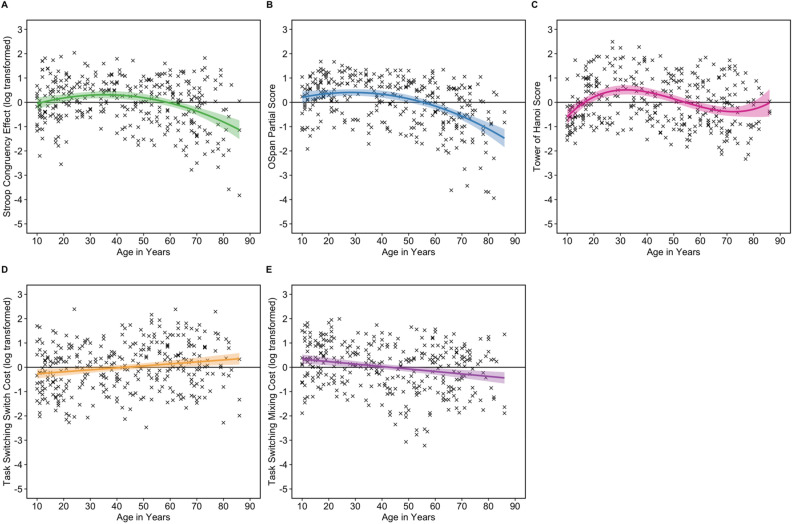
Executive functions demonstrate variable developmental and aging profiles, with protracted development into early adulthood and declines in older age. However, relatively few studies have specifically included middle-aged adults in investigations of age-related differences in executive functions. This study explored the age-related differences in executive function from late childhood through to old age, allowing a more informed understanding of executive functions across the lifespan. Three hundred and fifty participants aged 10 to 86 years-old completed a battery of tasks assessing the specific roles of inhibitory control, working memory, cognitive flexibility, and planning. Results highlighted continued improvement in working memory capacity across adolescence and into young adulthood, followed by declines in both working memory and inhibitory control, beginning from as early as 30–40 years old and continuing into older age. Analyses of planning abilities showed continued improvement across adolescence and into young adulthood, followed by a decline in abilities across adulthood, with a small (positive) change in older age. Interestingly, a dissociation was found for cognitive flexibility; switch costs decreased, yet mixing costs increased across the lifespan. The results provide a description of the developmental differences in inhibitory control, working memory, cognitive flexibility and planning, above any effects of IQ or SES, and highlight the importance of including middle-aged adults in studies seeking to establish a more comprehensive picture of age-related differences in executive function.
Overview
The claims and statistics of this paper haven’t been checked yet.
Free: it reads the open-access text and checks the first 5 claims that cite a source we can check. Create a free account to check every claim.
Integrity signals
Registry
Cites
Statistics
Figures
Verification
Claims the paper makes
The claims and statistics of this paper haven’t been checked yet.
Free: it reads the open-access text and checks the first 5 claims that cite a source we can check. Create a free account to check every claim.
Claims other papers make about this one
Each is checked against this paper’s own text: does it say what the citing paper says it does?
The cited source says what the claim attributes to it.
In the citing paper
“A recent study by (Ferguson et al., 2021) examined EF in a large, community-based sample aged from 10 to 86 years old, demonstrating that planning ability and WM capacity continue to develop throughout adolescence as well as in early adulthood.”
From Assessment of executive functions in school-aged children: A narrative review (2022) · cites this paper as Ferguson et al., 2021
Self-check
Percentages, sums and reported differences re-computed from the paper’s own numbers.
The self-check needs the paper’s full text.
Citations
Cites
Studies of interference in serial verbal reactions
Stroop, J. R. (1935) · Journal of Experimental Psychology · doi:10.1037/h0054651 · Cited by 18,622
Miyake, A., Friedman, N. P., Emerson, M. J., Witzki, A. H., Howerter, A., & Wager, T. D. (2000) · Cognitive Psychology · doi:10.1006/cogp.1999.0734 · Cited by 15,798
Diamond, A. (2013) · Annual Review of Psychology · doi:10.1146/annurev-psych-113011-143750 · Cited by 13,268
Dynamic mapping of human cortical development during childhood through early adulthood
Gogtay, N., Giedd, J. N., Lusk, L., Hayashi, K. M., Greenstein, D., Vaituzis, A. C., Nugent, T. F., Herman, D. H., Clasen, L. S., Toga, A. W., et al. (2004) · Proceedings of the National Academy of Sciences · doi:10.1073/pnas.0402680101 · Cited by 5,604
Wechsler Abbreviated Scale of Intelligence
Dumont, R., Willis, J. O., Veizel, K., & Zibulsky, J. (2014) · Encyclopedia of Special Education · doi:10.1002/9781118660584.ese2519 · Cited by 5,521
Wechsler Abbreviated Scale of Intelligence
Wechsler, D. (2012) · PsycTESTS Dataset · doi:10.1037/t15170-000 · Cited by 4,596
Miyake, A., & Friedman, N. P. (2012) · Current Directions in Psychological Science · doi:10.1177/0963721411429458 · Cited by 3,944
Costs of a predictible switch between simple cognitive tasks.
Rogers, R. D., & Monsell, S. (1995) · Journal of Experimental Psychology: General · doi:10.1037/0096-3445.124.2.207 · Cited by 3,170
Regional Brain Changes in Aging Healthy Adults: General Trends, Individual Differences and Modifiers
Raz, N., Lindenberger, U., Rodrigue, K. M., Kennedy, K. M., Head, D., Williamson, A., Dahle, C., Gerstorf, D., & Acker, J. D. (2005) · Cerebral Cortex · doi:10.1093/cercor/bhi044 · Cited by 2,875
Executive function in preschoolers: A review using an integrative framework.
Garon, N., Bryson, S. E., & Smith, I. M. (2008) · Psychological Bulletin · doi:10.1037/0033-2909.134.1.31 · Cited by 2,695
Research works printed but not linked: 3
- 41. Jacques S Marcovitch S Overton WF Development of executive function across the lifespan Cognition, Biology, and Methods Across the Lifespan. The Handbook of Life-Span Development 2010 Hoboken, NJ Wiley 431 466
- 46. Delis DC Kaplan E Kramer JH Delis–Kaplan Executive Function System (D-KEFS) 2001 San Antonio, TX The Psychological Corporation
- 73. Lawson GM Hook CJ Hackman DA Farah MJ Griffin JA Freund LS McCardle P Socioeconomic status and neurocognitive development: Executive function Executive Function in Preschool Children: Integrating Measurement, Neurodevelopment, and Translational Research 2016 Washington, DC American Psychological Association Press
Cited by
Items 601–700 of 774
Stickney-McDonald, J. A. (2024) · ScholarWorks (Walden University)
Relationship between working memory and cognitive flexibility in pre-school children
Graça, S. A. B. D. B. G. (2023) · Portuguese National Funding Agency for Science, Research and Technology (RCAAP Project by FCT)
Clinchard, C. (2023) · VTechWorks (Virginia Tech)
Garrido‐Chaves, R. (2024) · Repository of Digital Objects for Teaching Research and Culture (University of Valencia)
Uupumuksen ja masennusoireiden yhteydet kognitiiviseen suoritustasoon aikuisuudessa
Ketvel, L. (2021) · Helda - University of Helsinki Institutional Repository
The effects of an acute bout of cycling exercise on brain function in young adults and children
Dkaidek, T. S. (2025) · Brunel University Research Archive (BURA) (Brunel University London)
Gutiérrez-Capote, A. (2024) · Institutional Repository of the University of Granada (University of Granada)
Parents' executive functioning and parenting outcomes : a meta-analytic review
Salmazo, A. (2023) · Portuguese National Funding Agency for Science, Research and Technology (RCAAP Project by FCT)
Quinton, C. (2024) · UCL Discovery (University College London)
Salsali, M., Piri, H., Setarehdan, S. K., Soltanlou, M., Ghasemian, M., Sheikhhoseini, R., Abdollahi, S., & Soltani, F. (2026) · Physical Treatments - Specific Physical Therapy · doi:10.32598/ptj.16.1.292.7
Early Precursors of Theory of Mind in the Developing Brain
Schüler, C. (2024) · Qucosa (Saxon State and University Library Dresden)
Marras, A. (2025) · Directory of Open access Books (OAPEN Foundation) · doi:10.13125/unicapress.978-88-3312-195-6
Zhang, H. (2024) · Oxford University Research Archive (ORA) (University of Oxford) · doi:10.5287/ora-qqqxabazn
Oliveira, I. B. D. (2025) · Portuguese National Funding Agency for Science, Research and Technology (RCAAP Project by FCT)
Victal Gomes, R., Rodrigues dos Santos, J. P., Morais do Nascimento, J. V., Almeida Alves, A., Lins dos Santos, B., Souza Bezerra, E. D., Lira da Silva Barbosa, S., Deuel de O. Tavares, V., Almeida Ramos, I., Pereira Cabral, L. L., et al. (2025) · Dialnet (Universidad de la Rioja)
Het In Kaart Brengen van Cognitieve Controle in Gezond Verouderen
De Pue, S. (2025) · Lirias (KU Leuven)
Attention, Mind Wandering and Motivation: Effects of Perceptual Capacity and Cognitive Aging
Albrecht, V. (2025) · UCL Discovery (University College London)
Aging: Challenges and Opportunities for Inclusion and Active Participation
R. Bongelli, G. D. M., Bongelli, R., Del Moral, G., Fermani, A., Nicolini, P., Aleffi, C., & Guardabassi, V. (2025) · Frontiers research topics · doi:10.3389/978-2-8325-6899-6
Nonhuman primate model of mild cognitive impairment
Kohama, S. G., & Urbanski, H. F. (2025) · Elsevier eBooks · doi:10.1016/b978-0-443-29090-9.00005-2
A Review of Research on Executive Function Components and Their Assessment Methods
陈, 宗. (2025) · Advances in Psychology · doi:10.12677/ap.2025.1512643
Clarke, A. T. (2025) · University of Hertfordshire Research Archive (University of Hertfordshire) · doi:10.18745/00026227
Is 'Better' Always Better? Cognitive Performance in Children with Misophonia vs. Controls
Siepsiak, M., Turek, A., Michałowska, M., & Gambin, M. (2025) · Advances in Cognitive Psychology · doi:10.5709/acp-0467-2
Tse, C. K. (n.d.) · PolyU Institutional Research Archive (Hong Kong Polytechnic University)
Changes in Action Potential Properties in the Ferret Prefrontal Cortex During Adolescence
Keum, D., Mathur, B. N., & Medina, A. E. (2026) · The Journal of Comparative Neurology · doi:10.1002/cne.70121
Stringhetta-Villar, B. P. (2024) · LA Referencia (Red Federada de Repositorios Institucionales de Publicaciones Científicas)
Zhen, Q., Sun, R., Han, C., Wu, J., Song, L., & Gong, W. (2026) · Frontiers in Neurology · doi:10.3389/fneur.2026.1691856
Eye-Tracking the Production of Counterfactual Alternatives to Narrative Events in Autistic Adults
Ferguson, H. J., & Smith, M. (2026) · Quarterly Journal of Experimental Psychology · doi:10.1177/17470218261419775
“Importantly, this work suggests that online counterfactual understanding is undiminished or even enhanced among autistic adults compared to neuro-typical adults (Black et al., 2018, 2019; Ferguson et al., 2019, 2021; Wimmer & Ferguson, 2025).”
Self-citationSex difference in brain reserve of working memory among older adults
Xu, J.-J., Goddard, E., Dixon, R., Eramudugolla, R., Huang, R., Jiang, H.-X., & Anstey, K. J. (2026) · Neurobiology of Aging · doi:10.1016/j.neurobiolaging.2026.08.003
Early-life rural disadvantage and executive function in adulthood: The role of income and education
Sheffler, J., Bautista, A., Smith, H., Karter, H., & Meng, Z. (2026) · Journal of Public Health Research · doi:10.1177/22799036261418437
“6 Given the significant influence of early life conditions on adult EF and the known association between impaired EF and ADRDs, understanding the early life conditions that impact adult EF and its decline is imperative.”
Multitâche, attention et performance : heureux ménage à trois ?
Marion-Flamand, M.-A., & de Serres, L. (2024) · Bibliothèque et Archives nationales du Québec (Québec government)
Sex and age differences in brain metabolism and cognition in adolescents
Balaganesh, A., Zuleger, T. M., Liu, Z., Diekfuss, J. A., Dudley, J. A., Yuan, W., Foss, K. B., Cecil, K. M., Bonnette, S., Myer, G. D., et al. (2026) · Imaging Neuroscience · doi:10.1162/imag.a.1159
“Moreover, cognitive functioning follows age-related trajectories, with working memory capacity, executive function, processing speed, and pattern recognition steadily improving throughout adolescence ( Anokhin et al., 2022; Fandakova et al., 2014; Ferguson et al., 2021; Heiskanen et al., 2024).”
Torres, K. L. C., Maldonado, M. J. E., Criollo, M., & Aguilar, C. E. V. (2026) · Revista Científica de Salud y Desarrollo Humano · doi:10.61368/r.s.d.h.v6i4.948
Fatimah, A., Maqbool, S., Aman, M., Ullah, H., & Sabir, S. (2025) · Journal of Applied Linguistics and TESOL (JALT) · doi:10.63878/jalt1869
“Research consistently indicates that cognitive performance in these domains peaks in early adulthood and declines with increasing age (Ferguson et al., 2021; Nettelbeck & Burns, 2010).”
Terrones, M. C. L. (2022) · Universidad Peruana Cayetano Heredia Institutional Repository
Neurocognition in Obsessive-Compulsive Disorder
Baer, J. (2024) · TSpace (University of Toronto)
Edellisen yön uni ja toiminnanohjaus esikouluiässä: Unen makrorakenteen yhteys toiminnanohjaukseen
Lindroth, A., & Tuominen, P. (2025) · Tampere University Institutional Repository (Tampere University)
Youm, A. (2025) · TSpace (University of Toronto)
A Multimodal Investigation of Age Differences in Inhibitory Control
Parimoo, S. (2023) · TSpace (University of Toronto)
Florecimiento y fragilidad en personas mayores: Evidencias de diferencia de género
Pereyra, M. D. L. P., Ferreyra, F. A., & Arias, C. J. (2026) · Yachana Revista Científica · doi:10.62325/10.62325/yachana.v15.n1.2026.1035
Genetic Architecture of Educational Attainment is Represented by Executive Function in ChildrenPreprint
Chia, J., Law, E. C. N., Seng, C. Y., Gluckman, P., Eriksson, J. G., Daniel, L. M., Silveira, P. P., Meaney, M. J., & Kee, M. Z. L. (2026) · Research Square · doi:10.21203/rs.3.rs-8863842/v1
Juego de apuestas y publicidad : salud, impacto social y prevención
Irles, D. L., & Canals, S. (2025) · DIGITAL.CSIC (Spanish National Research Council (CSIC))
Social network and functional status in the elderly: The mediating role of executive functions
Milovanović, I. Z., Pekić, J. M., & Kodžopeljić, J. (2025) · Zbornik Matice srpske za drustvene nauke · doi:10.2298/zmsdn2596517m
Mohanathas, N. (2025) · TSpace (University of Toronto)
Time-based event expectations at the different developmental stages
Kunchulia, M., & Parkosadze, K. (2026) · Cognitive Processing · doi:10.1007/s10339-026-01339-3
Laplante, A. (2025) · Le dépôt institutionnel (Université du Québec à Trois-Rivières)
Multitasking, attention and performance : a happy threesome?
Marion-Flamand, M.-A., & de Serres, L. (2024) · Bibliothèque et Archives nationales du Québec (Québec government)
Abdullah, S. (2026) · Applied Neuropsychology Adult · doi:10.1080/23279095.2026.2649974
Helm, C. A., & Sergi, F. (2026) · European Journal of Neuroscience · doi:10.1111/ejn.70477
Yin, H., & Amran, M. S. (2026) · PLoS ONE · doi:10.1371/journal.pone.0341453
Song, Y., & Cheng, C. (2026) · British Journal of Psychology · doi:10.1111/bjop.70069
“…of underlying neurocognitive pathways and improvements in both the manipulation capacity (the ability to actively transform information in working memory) and the flexibility (the ability to shift between different mental sets or task demands) (Davidson et al., 2006; Ferguson et al., 2021).”
Long, F., Xu, Q., Fei, S., Liu, P., & Wei, H. (2026) · British Journal of Developmental Psychology · doi:10.1111/bjdp.70044
Learning to read : new remediation strategies and underlying cognitive mechanisms
Andreola, C. (2023) · theses.fr (ABES) · doi:10.70675/5c762d33zbc28z4a74zb9daz2e6c21738de6
Fauvel, D. (2024) · theses.fr (ABES) · doi:10.70675/57f2650dz8f86z48cfzb0ffz9234c0efdd59
Dyne, A. V., Wu, T., Adamowicz, D. H., Irwin, M. R., Tu, X. M., Lee, E., & Eyler, L. T. (2026) · Brain Behavior and Immunity · doi:10.1016/j.bbi.2026.106592
Borchers, L. R., Antonacci, C., Leong, J. K., & Gotlib, I. H. (2026) · Developmental Cognitive Neuroscience · doi:10.1016/j.dcn.2026.101730
“Compared with adults, adolescents more frequently approach potentially rewarding stimuli (Galvan, 2010), seek novelty (Collado et al., 2014), and demonstrate poorer inhibitory control (Ferguson et al., 2021).”
Aplicabilidade de um programa de intervenção para promover funções executivas
Cecato, A. M., Cruz, G. B., Zauza, G., Teixeira, M. C. T. V., Eunju, G., Carreiro, L. R. R., & Seabra, A. G. (2026) · Revista Psicopedagogia · doi:10.51207/2179-4057.20260016
McAuley, K. R., & Morrongiello, B. A. (2026) · Journal of Child and Family Studies · doi:10.1007/s10826-026-03299-w
Subjective cognitive decline, and its cognitive and emotional correlates in Peruvian older adults.
Soto‐Añari, M., Rivera-Fernández, C., Montemurro, M., Cerić, F., Tejada, M. D. C., Pacheco, A. O. M.-N., Carbajal, M., Guzmán‐Vélez, E., & Quiroz, Y. T. (2026) · PubMed Central · doi:10.1590/1980-5764-dn-2025-0419
“Similarly, attentional complaints correlated with performance on the WCST, suggesting that perceived cognitive lapses may reflect difficulty sustaining attention or filtering distractions, patterns documented in both normal 28 and pathological aging 29 .”
Executive functions in middle age: challenging the three-factor model
Juras, L., Martinčević, M., Rebernjak, B., & Vranić, A. (2026) · Current Psychology · doi:10.1007/s12144-026-09426-6
“Notably, EF performance follows an inverted U-shaped trajectory; it generally improves throughout childhood and adolescence, reaches its peak around the age of 30, and subsequently begins to decline (Ferguson et al., 2021).”
Shankula, C. A., Sullivan, R. M., Stinson, E. A., Baacke, K. A., Kaiver, C. M., Wallace, A. L., Bernal, E. S., Paltzer, Z. R., Hillard, C. J., & Lisdahl, K. M. (2026) · Drug and Alcohol Dependence · doi:10.1016/j.drugalcdep.2026.113184
“At the same time, impulsivity increases during early adolescent years (Littlefield et al., 2016) and is widely accepted as a risk marker for problematic substance use, especially while executive functioning faculties are still developing (Ferguson et al., 2021).”
From early childhood to late adulthood: Lifespan trajectories of attention and inhibitionPreprint
Premathilaka, M., Tonks, A., Tari, B., Metcalf, I., Xu, C., Watson, E., Dykiert, D., Burgess, P. W., & Ronca, F. (2026) · Research Square · doi:10.21203/rs.3.rs-9510028/v1
Smith, A. D., & Salo, S. K. (2026) · The Clinical Neuropsychologist · doi:10.1080/13854046.2026.2668647 · Cited by 1
Ji, Y., Wang, B., & Yang, Q. (2026) · Virtual Reality · doi:10.1007/s10055-026-01387-2
“The estimated effects tended to be larger in middle adult - hood compared with younger or older ages (Ferguson et al. 2021 ).”
Executive Functions, Reward Systems and Addiction in Adolescents and Young Adults
(2026) · Frontiers research topics · doi:10.3389/978-2-8325-7932-9
Suárez‐Suárez, S., Maurage, P., & Carbia, C. (2026) · Neuroscience & Biobehavioral Reviews · doi:10.1016/j.neubiorev.2026.106763
VR technology and mental guidance strategies for enhancing shopping abilities in older adults
Lee, I.-J., & Kang, M.-W. (2026) · Universal Access in the Information Society · doi:10.1007/s10209-026-01346-3
Mironets, S. A., Ismatullina, V. I., Adamovich, T., & Malykh, S. (2026) · Psychology in Russia State of Art · doi:10.11621/pir.2026.0105
“Centrality estimates identi fi ed laminarity and span length as in fl uential nodes, consistent with evidence linking structured gaze behavior to e ffi cient information processing (Ferguson et al., 2021; Rayner et al., 2006).”
Schmitt, H., Wernicke, J., Sindermann, C., Wolf, R. W., Markett, S. A., Ott, E., & Montag, C. (2026) · Addictive Behaviors Reports · doi:10.1016/j.abrep.2026.100713
“…to their relevance for criminal behavior and/or cognitive performance (Baliousis et al., 2019; Baune et al., 2018; Chandramouleeshwaran et al., 2024; Cort ´ es Pascual et al., 2019; Ferguson et al., 2021; Haime et al., 2021; Keefe, 2007; Liu et al., 2020; Olver & Wong, 2015; Prado et al., 2018).”
Perry, R. C., Tolmie, A. K., Toledano, M. B., Shen, C., Thomas, M. S. C., & Dumontheil, I. (2026) · Mind Brain and Education · doi:10.1111/mbe.70048
“…(WM, see Table 1 for Glossary of abbreviations), the short-term storage and manipulation of information (Engle and Kane 2004), shows one of the most protracted developmental trajectories of all cognitive skills, not reaching maturation until the mid-20s (Lee et al. 2013; Ferguson et al. 2021).”
Li, J., Liu, Y., Wang, X., Zhang, Y., Hua, L., Zhao, Y., & Liu, W. (2026) · Personality and Individual Differences · doi:10.1016/j.paid.2026.113922
Lou, L., Zhou, Y., Zhu, H., Zheng, K., & Ji, Y. (2026) · Frontiers in Psychiatry · doi:10.3389/fpsyt.2026.1824430
“Different components of executive function exhibit developmental and degenerative changes across various age stages, such as persistent decline in working memory capacity and inhibitory control throughout adulthood and into old age (81).”
Liu, D., Zong, X., Wolters, P. L., Walsh, K. S., Janusz, J. A., Klein-Tasman, B., Morris, S. M., Bearden, C. E., Payne, J. M., Pride, N. A., et al. (2026) · Journal of the International Neuropsychological Society · doi:10.1017/s1355617726102021
“…including inhibitory control, emotional control, working memory, cognitive flexibility, and planning/organization, support goal-directed behavior and undergo protracted development across childhood into young adulthood, supported by maturation of prefrontal brain networks (Ferguson et al., 2021).”
Pengaruh edukasi swamedikasi terhadap pengetahuan swamedikasi rasional pada mahasiswa keperawatan
Hastuti, D., Suprayitno, E., & Asnindari, L. N. (2026) · JOURNAL OF Qualitative Health Research & Case Studies Reports · doi:10.56922/quilt.v6i5.2805
It’s Not About the Diagnosis: Sibling Relationships of Autistic and Non-Autistic Young Adults
Jensen, A. C., Bennett, M., Dobbs, M., Stoddard, M., & Harris, M. (2026) · Autism in Adulthood · doi:10.1177/25739581261458522
Social and Cognitive Predictors of Prosociality in UK Adolescents and Young Adults
Barzy, M. M. H., Moore, J., Cameron, L., & Ferguson, H. J. (2026) · Social Cognition · doi:10.1521/soco.2026.44.3.253
Self-citationFilho, W. J. S., Monteiro, M. R. P., & Silva‐Grigoletto, M. E. D. (2026) · Revista Conexao UEPG · doi:10.5212/rev.conexao.v.22.25771.018
Musical short-term memory of autistic children and its cognitive correlates
Philibert-Lignières, G. (2026) · doi:10.82308/55646
Hearing loss and executive functions – results from a population-based cohort study
Döge, J., Otten, D., Hackenberg, B., O’Brien, K., Beutel, M. E., Heinrich, I., Schattenberg, J. M., Konstantinides, S., Münzel, T. F., Lackner, K. J., et al. (2026) · PLoS ONE · doi:10.1371/journal.pone.0351409
“EF shows age-related differences [18] with a decline in older age [19].”
Pahor, A., Gomez, M., Jaeggi, S. M., & Seitz, A. R. (2026) · Research Square · doi:10.21203/rs.3.rs-9156758/v1
“Age-related cognitive decline manifests in several ways, such as reduced cognitive processing speed 1 , diminished inhibitory control 2 , and decreased working memory capacity 2 .”
Economacou, D., Thomaidou, V., & Καρούσου, Α. (2026) · Journal of Cognition and Development · doi:10.1080/15248372.2026.2690575
A neurodevelopmental model of eating disorder risk in midlife to older adulthood
Heintz, H., Haynos, A. F., Hagan, K. E., & Berner, L. A. (2026) · Neuroscience & Biobehavioral Reviews · doi:10.1016/j.neubiorev.2026.106830
Hocking, M., Brown, T., Yu, M., & Reese, K. (2026) · Physical & Occupational Therapy In Pediatrics · doi:10.1080/01942638.2026.2689071
Sharma, P., Jha, R., Mandhaher, A., Alreja, S., & Chaudhury, S. (2026) · Annals of Indian Psychiatry · doi:10.4103/aip.aip_78_26
Petraconi, N., Henrique, J. S., Cardoso, F. D. S., Vital, F. M., Arida, R. M., Martins, C. B., & da Silva, S. G. (2026) · Systematic Reviews · doi:10.1186/s13643-026-03172-3
“As brain regions, these abilities have a distinct temporal course of development [16, 29].”
Melguizo-Ibáñez, E., Puertas-Molero, P., González-Valero, G., & Alonso-Vargas, J. M. (2026) · Journal of Intelligence · doi:10.3390/jintelligence14070130
“Early childhood and primary education represent critical developmental stages for inhibitory control due to the high neurocognitive plasticity observed during these periods (Ferguson et al., 2021; Theodoraki et al., 2020).”
Yang, S., Mengfan, Z., Wang, T., Yang, X., & Zhao, X. (2026) · Learning and Individual Differences · doi:10.1016/j.lindif.2026.102968
Niculescu, I., Biss, R. K., & Romero, K. (2026) · The Journals of Gerontology Series B · doi:10.1093/geronb/gbag126
“As individuals age, executive functions (e.g., working memory, inhibition, etc.) decline (Ferguson et al., 2021), which may influence changes in PM.”
Hayati, N. H. (2026) · Repository UIN Sultan Syarif Kasim Riau (Universitas Islam Negeri Sultan Syarif Kasim Riau)
Adolescents and adults can consider perspectives to appreciate gossip's entertainment function
Mailey, M. (2006) · Mspace (University of Manitoba)
Cognitive Flexibility and Bilingual Language Switching: An fMRI Meta‐Analysis
Chuikova, Z. V., Faber, A., Abutalebi, J., Filatov, A. A., Юрьевич, Ш. Ю., & Myachykov, A. V. (2026) · European Journal of Neuroscience · doi:10.1111/ejn.70591
Zhang, Y., Wang, M. L., & Zhang, P. (2026) · Current Psychology · doi:10.1007/s12144-026-09734-x
“Prior work suggests that executive functions follow heterogeneous developmental trajectories, with working memory and inhibitory control showing declines from early to middle adulthood, whereas different aspects of cognitive flexibility show divergent age-related patterns (Ferguson et al., 2021).”
Zhang, T., Gong, Y., & Zhao, X. (2026) · Child Development · doi:10.1093/chidev/aacag107
Svancara, A. M., Kim, W., Zhang, X., & Steinbach, R. (2026) · Transportation Research Part F Traffic Psychology and Behaviour · doi:10.1016/j.trf.2026.103725
Chatthong, W., Rueankam, M., & Khemthong, S. (2026) · Research Square · doi:10.21203/rs.3.rs-10295251/v1
Pulido, J. H. P. (2026) · Child Neuropsychology · doi:10.1080/09297049.2026.2700210
Ma, Y., Zhang, W., Hu, B., Yang, X., Qin, S., & Lin, X. (2026) · Behavioral Sciences · doi:10.3390/bs16071193
“Working memory (WM) has a prolonged period of development (Ferguson et al., 2021) and is closely related to children’s academic achievement (Alloway & Alloway, 2010), mental and physical health (Lee et al., 2012; Riggs et al., 2010).”
Drexler, C. L., Mansolf, M. A., Calma‐Birling, D., Sherlock, P., Blackwell, C. K., & Zelazo, P. D. (2026) · International Journal of Environmental Research and Public Health · doi:10.3390/ijerph23070904
High-altitude hypoxia alters the developmental trajectory of working memory in Tibetan children
Yang, X., Fu, C., Zhao, Y., Di, W., & Zheng, C. (2026) · Frontiers in Neuroscience · doi:10.3389/fnins.2026.1843212
“…relatively early, whereas more complex functions involving monitoring, updating, and attentional focus switching follow a protracted developmental trajectory that continues through adolescence and into early adulthood (Alloway and Alloway, 2013; Ferguson et al., 2021; Lendínez et al., 2015).”
Are Creative People More Susceptible to False Memory? Evidence for Age- and Task-Related Differences
West, J. T., Luchini, S. A., Beaty, R. E., & Dennis, N. A. (2026) · Creativity Research Journal · doi:10.1080/10400419.2026.2703186
Metadata
- Authors
- Ferguson, H. J., Brunsdon, V. E. A., & Bradford, E. E. F.
- Affiliations
- University of Kent (GB)
- University of Dundee (GB)
- Corresponding author
- Ferguson, Heather J.
- Venue
- Scientific Reports
- Published
- 2021-01-14
- Volume
- 11
- Issue
- 1
- Pages
- 1382-1382
- ISSN
- 2045-2322 (ISSN-L)
- PMC
- PMC7809200
- OpenAlex
- W3116908532
- Cited by
- 583
- References
- 116
- Citations by year
- 2026: 125 · 2025: 137 · 2024: 145 · 2023: 96 · 2022: 66 · 2021: 14
- FWCI
- 42.22
- Type
- journal article
- Language
- en
- Open access
- gold
- doi.org
- Licence
- cc-by
- creativecommons.org/licenses/by/4.0 (tdm)
- creativecommons.org/licenses/by/4.0 (vor)
- Locations
- Scientific Reports (publishedVersion, cc-by)
- PubMed Central (publishedVersion, cc-by)
- PubMed (publishedVersion)
- Kent Academic Repository (University of Kent) (acceptedVersion)
- St Andrews Research Repository (St Andrews Research Repository) (acceptedVersion, cc-by)
- Discovery Research Portal (University of Dundee) (submittedVersion, cc-by)
- DOAJ (DOAJ: Directory of Open Access Journals) (submittedVersion, cc-by-sa)
- OSF Preprints (OSF Preprints) (submittedVersion)
- Funders
- European Research Council (636458)
- Topics
- Life Sciences › Neuroscience › Cognitive Neuroscience › Neural and Behavioral Psychology Studies
- Social Sciences › Psychology › Experimental and Cognitive Psychology › Cognitive Abilities and Testing
- Social Sciences › Psychology › Experimental and Cognitive Psychology › Cognitive Functions and Memory
- Keywords
- executive function, lifespan development, aging, inhibitory control, working memory, cognitive flexibility, planning, switch costs, mixing costs, middle-aged adults, adolescence, cognitive decline
- MeSH terms
- Adolescent, Adult, Aged, Aged, 80 and over, Aging, Child, Female, Humans, Male, Memory, Short-Term, Middle Aged, Executive Function
About these checks
Registry, retraction, Cites and statistics results are computed, not judged, with one exception: a printed reference that no index lists is read once by a model before it counts as a citation error. Claims are extracted by a model and kept only when their quote appears verbatim in the text; each cited source is then checked, with a model’s help, for whether it says what the claim relies on. Those verdicts can be wrong — read the claim’s quote and the cited source before relying on one.
Statistics and arithmetic are recomputed, not judged.
Confidence bands are shown only for fields calibrated on our annotated test set. None is calibrated yet, so no band is shown.
What counts as a claim ›How we measure confidence ›How we check this ›
Are you an author, or do you see a problem with this page? Request a review
Data sources
Bibliographic data: Semantic Scholar, OpenAlex, Crossref.
Contains information from the Semantic Scholar Academic Graph Datasets, made available under the ODC Attribution License (ODC-BY 1.0).
Semantic Scholar’s data is described in: Kinney, R., et al. (2023). The Semantic Scholar Open Data Platform. arXiv:2301.10140.
