

The developmental trajectories of executive function from adolescence to old age.
Open accessThe DOI matches its Crossref record; 116 of the 116 references it cites were found in a registry or an index.
Abstract
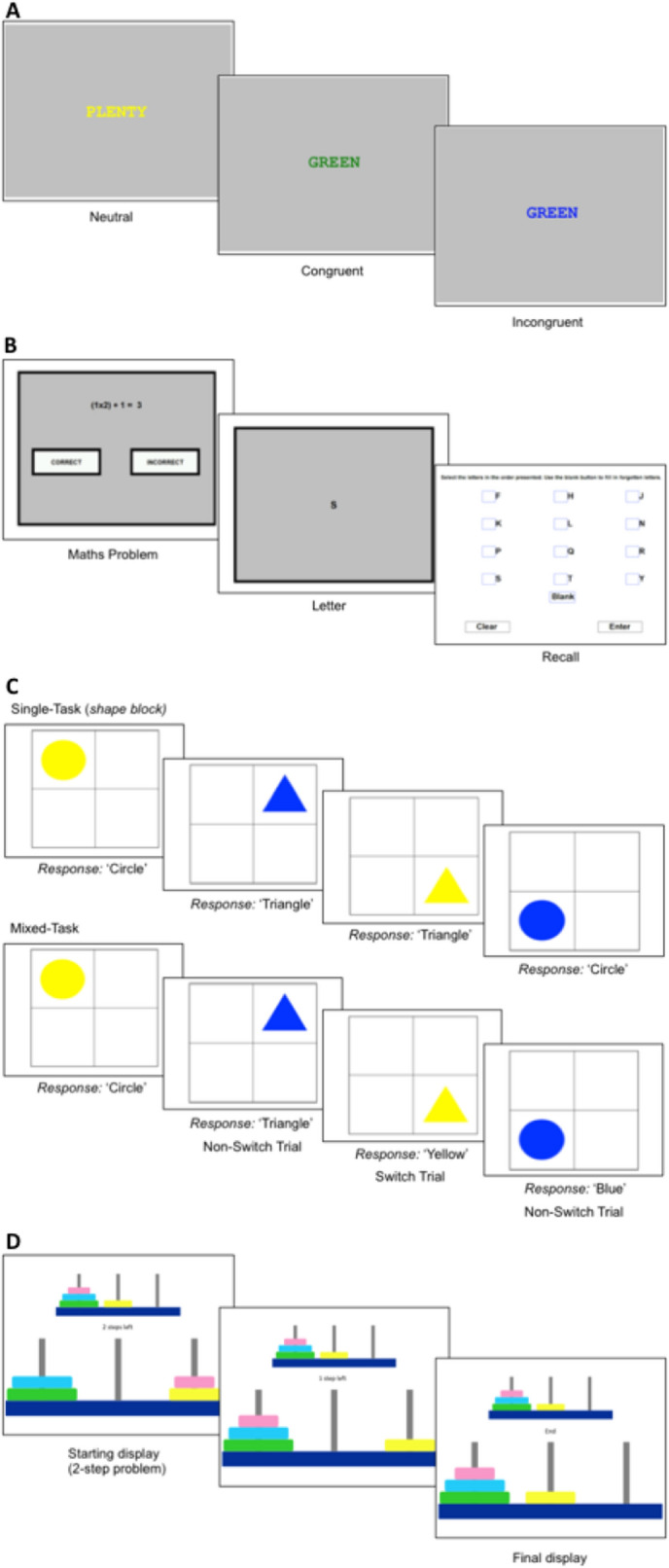
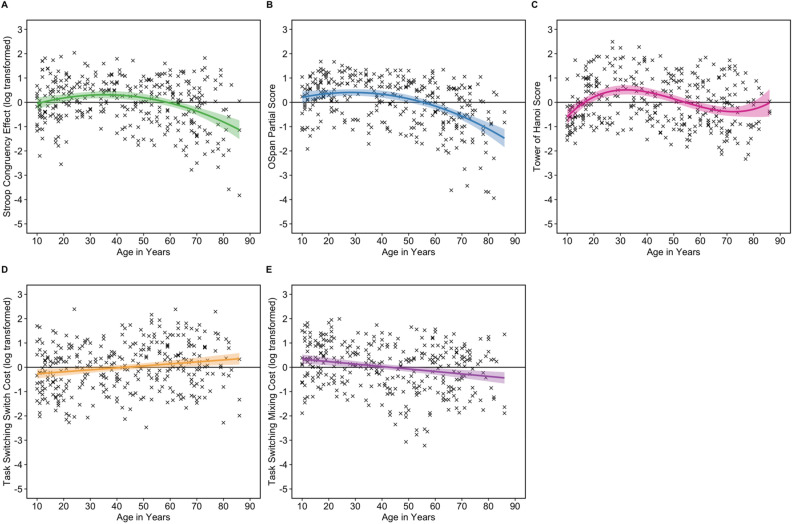
Executive functions demonstrate variable developmental and aging profiles, with protracted development into early adulthood and declines in older age. However, relatively few studies have specifically included middle-aged adults in investigations of age-related differences in executive functions. This study explored the age-related differences in executive function from late childhood through to old age, allowing a more informed understanding of executive functions across the lifespan. Three hundred and fifty participants aged 10 to 86 years-old completed a battery of tasks assessing the specific roles of inhibitory control, working memory, cognitive flexibility, and planning. Results highlighted continued improvement in working memory capacity across adolescence and into young adulthood, followed by declines in both working memory and inhibitory control, beginning from as early as 30–40 years old and continuing into older age. Analyses of planning abilities showed continued improvement across adolescence and into young adulthood, followed by a decline in abilities across adulthood, with a small (positive) change in older age. Interestingly, a dissociation was found for cognitive flexibility; switch costs decreased, yet mixing costs increased across the lifespan. The results provide a description of the developmental differences in inhibitory control, working memory, cognitive flexibility and planning, above any effects of IQ or SES, and highlight the importance of including middle-aged adults in studies seeking to establish a more comprehensive picture of age-related differences in executive function.
Overview
The claims and statistics of this paper haven’t been checked yet.
Free: it reads the open-access text and checks the first 5 claims that cite a source we can check. Create a free account to check every claim.
Integrity signals
Registry
Cites
Statistics
Figures
Verification
Claims the paper makes
The claims and statistics of this paper haven’t been checked yet.
Free: it reads the open-access text and checks the first 5 claims that cite a source we can check. Create a free account to check every claim.
Claims other papers make about this one
Each is checked against this paper’s own text: does it say what the citing paper says it does?
The cited source says what the claim attributes to it.
In the citing paper
“A recent study by (Ferguson et al., 2021) examined EF in a large, community-based sample aged from 10 to 86 years old, demonstrating that planning ability and WM capacity continue to develop throughout adolescence as well as in early adulthood.”
From Assessment of executive functions in school-aged children: A narrative review (2022) · cites this paper as Ferguson et al., 2021
Self-check
Percentages, sums and reported differences re-computed from the paper’s own numbers.
The self-check needs the paper’s full text.
Citations
Cites
Studies of interference in serial verbal reactions
Stroop, J. R. (1935) · Journal of Experimental Psychology · doi:10.1037/h0054651 · Cited by 18,622
Miyake, A., Friedman, N. P., Emerson, M. J., Witzki, A. H., Howerter, A., & Wager, T. D. (2000) · Cognitive Psychology · doi:10.1006/cogp.1999.0734 · Cited by 15,798
Diamond, A. (2013) · Annual Review of Psychology · doi:10.1146/annurev-psych-113011-143750 · Cited by 13,268
Dynamic mapping of human cortical development during childhood through early adulthood
Gogtay, N., Giedd, J. N., Lusk, L., Hayashi, K. M., Greenstein, D., Vaituzis, A. C., Nugent, T. F., Herman, D. H., Clasen, L. S., Toga, A. W., et al. (2004) · Proceedings of the National Academy of Sciences · doi:10.1073/pnas.0402680101 · Cited by 5,604
Wechsler Abbreviated Scale of Intelligence
Dumont, R., Willis, J. O., Veizel, K., & Zibulsky, J. (2014) · Encyclopedia of Special Education · doi:10.1002/9781118660584.ese2519 · Cited by 5,521
Wechsler Abbreviated Scale of Intelligence
Wechsler, D. (2012) · PsycTESTS Dataset · doi:10.1037/t15170-000 · Cited by 4,596
Miyake, A., & Friedman, N. P. (2012) · Current Directions in Psychological Science · doi:10.1177/0963721411429458 · Cited by 3,944
Costs of a predictible switch between simple cognitive tasks.
Rogers, R. D., & Monsell, S. (1995) · Journal of Experimental Psychology: General · doi:10.1037/0096-3445.124.2.207 · Cited by 3,170
Regional Brain Changes in Aging Healthy Adults: General Trends, Individual Differences and Modifiers
Raz, N., Lindenberger, U., Rodrigue, K. M., Kennedy, K. M., Head, D., Williamson, A., Dahle, C., Gerstorf, D., & Acker, J. D. (2005) · Cerebral Cortex · doi:10.1093/cercor/bhi044 · Cited by 2,875
Executive function in preschoolers: A review using an integrative framework.
Garon, N., Bryson, S. E., & Smith, I. M. (2008) · Psychological Bulletin · doi:10.1037/0033-2909.134.1.31 · Cited by 2,695
A Developmental Perspective on Executive Function
Best, J. R., & Miller, P. H. (2010) · Child Development · doi:10.1111/j.1467-8624.2010.01499.x · Cited by 2,692
Synaptic density in human frontal cortex —Developmental changes and effects of aging
Peter R., H. (1979) · Brain Research · doi:10.1016/0006-8993(79)90349-4 · Cited by 2,645
Is working memory capacity task dependent?
Turner, M. L., & Engle, R. W. (1989) · Journal of Memory and Language · doi:10.1016/0749-596x(89)90040-5 · Cited by 2,299
The Cambridge handbook of thinking and reasoning
Holyoak, K. J., & Morrison, B. (2005) · Virtual Defense Library (Ministerio de Defensa) · Cited by 2,257
Assessment and Development of Executive Function (EF) During Childhood
Anderson, P. (2002) · Child Neuropsychology · doi:10.1076/chin.8.2.71.8724 · Cited by 2,218
An application of prefrontal cortex function theory to cognitive aging.
West, R. L. (1996) · Psychological Bulletin · doi:10.1037//0033-2909.120.2.272 · Cited by 2,052
An automated version of the operation span task
Unsworth, N., Heitz, R. P., Schrock, J. C., & Engle, R. W. (2005) · Behavior Research Methods · doi:10.3758/bf03192720 · Cited by 1,861
When does age-related cognitive decline begin?
Salthouse, T. A. (2009) · Neurobiology of Aging · doi:10.1016/j.neurobiolaging.2008.09.023 · Cited by 1,848
Models of visuospatial and verbal memory across the adult life span.
Park, D. C., Lautenschlager, G. J., Hedden, T., Davidson, N. S., Smith, A. D., & Smith, P. K. (2002) · Psychology and Aging · doi:10.1037//0882-7974.17.2.299 · Cited by 1,803
The Structure of Working Memory From 4 to 15 Years of Age
Gathercole, S. E., Pickering, S. J., Ambridge, B., & Wearing, H. (2004) · Developmental Psychology · doi:10.1037/0012-1649.40.2.177 · Cited by 1,795
Motor control and aging: Links to age-related brain structural, functional, and biochemical effects
Seidler, R. D., Bernard, J. A., Burutolu, T. B., Fling, B. W., Gordon, M. T., Gwin, J. T., Kwak, Y., & Lipps, D. B. (2010) · Neuroscience & Biobehavioral Reviews · doi:10.1016/j.neubiorev.2009.10.005 · Cited by 1,791
Cardiovascular fitness, cortical plasticity, and aging
Colcombe, S. J., Kramer, A. F., Erickson, K. I., Scalf, P., McAuley, E., Cohen, N. J., Webb, A., Jerome, G. J., Marquez, D. X., & Elavsky, S. (2004) · Proceedings of the National Academy of Sciences · doi:10.1073/pnas.0400266101 · Cited by 1,648
Broidy, L. M., Nagin, D. S., Tremblay, R. E., Bates, J. E., Brame, B., Dodge, K. A., Fergusson, D., Horwood, J. L., Loeber, R., Laird, R., et al. (2003) · Developmental Psychology · doi:10.1037//0012-1649.39.2.222 · Cited by 1,637
The Handbook of aging and cognition
(1993) · Choice Reviews Online · doi:10.5860/choice.30-3520 · Cited by 1,587
Socioeconomic status and the developing brain
Hackman, D. A., & Farah, M. J. (2009) · Trends in Cognitive Sciences · doi:10.1016/j.tics.2008.11.003 · Cited by 1,550
Mapping brain maturation and cognitive development during adolescence
Paus, T. (2005) · Trends in Cognitive Sciences · doi:10.1016/j.tics.2004.12.008 · Cited by 1,348
Not All Executive Functions Are Related to Intelligence
Friedman, N. P., Miyake, A., Corley, R. P., Young, S. E., DeFries, J. C., & Hewitt, J. K. (2006) · Psychological Science · doi:10.1111/j.1467-9280.2006.01681.x · Cited by 1,293
Raz, N. (1997) · Cerebral Cortex · doi:10.1093/cercor/7.3.268 · Cited by 1,240
Executive Functioning as a Potential Mediator of Age-Related Cognitive Decline in Normal Adults.
Salthouse, T. A., Atkinson, T. M., & Berish, D. E. (2003) · Journal of Experimental Psychology: General · doi:10.1037/0096-3445.132.4.566 · Cited by 1,057
Socioeconomic gradients predict individual differences in neurocognitive abilities.
Noble, K. G., McCandliss, B. D., & Farah, M. J. (2007) · Developmental Science · doi:10.1111/j.1467-7687.2007.00600.x · Cited by 1,041
Neurocognitive correlates of socioeconomic status in kindergarten children
Noble, K. G., Norman, M. F., & Farah, M. J. (2005) · Developmental Science · doi:10.1111/j.1467-7687.2005.00394.x · Cited by 1,038
Sowell, E. R., Thompson, P. M., Tessner, K. D., & Toga, A. W. (2001) · The Journal of Neuroscience · doi:10.1523/jneurosci.21-22-08819.2001 · Cited by 983
What has fMRI told us about the Development of Cognitive Control through Adolescence?
Luna, B., Padmanabhan, A., & O’Hearn, K. (2010) · Brain and Cognition · doi:10.1016/j.bandc.2009.08.005 · Cited by 892
Development of inhibitory control across the life span.
Williams, B. R., Ponesse, J. S., Schachar, R. J., Logan, G. D., & Tannock, R. (1999) · Developmental Psychology · doi:10.1037/0012-1649.35.1.205 · Cited by 889
Evaluating the theory of executive dysfunction in autism
Hill, E. L. (2004) · Developmental Review · doi:10.1016/j.dr.2004.01.001 · Cited by 846
Childhood poverty: specific associations with neurocognitive development
Farah, M. J., Shera, D. M., Savage, J. H., Betancourt, L., Giannetta, J. M., Brodsky, N. L., Malmud, E. K., & Hurt, H. (2006) · Brain Research · doi:10.1016/j.brainres.2006.06.072 · Cited by 835
Hartshorne, J. K., & Germine, L. T. (2015) · Psychological Science · doi:10.1177/0956797614567339 · Cited by 788
Normative data from the CANTAB I: development of executive function over the lifespan
De Luca, C. R., Wood, S. J., Anderson, V., Buchanan, J.-A., Proffitt, T. M., Mahony, K., & Pantelis, C. (2003) · Journal of Clinical and Experimental Neuropsychology · doi:10.1076/jcen.25.2.242.13639 · Cited by 710
Spieler, D. H., Balota, D. A., & Faust, M. E. (1996) · Journal of Experimental Psychology: Human Perception and Performance · doi:10.1037//0096-1523.22.2.461 · Cited by 697
Adult age differences in task switching.
Kray, J., & Lindenberger, U. (2000) · Psychology and Aging · doi:10.1037/0882-7974.15.1.126 · Cited by 691
Socioeconomic status and executive function: developmental trajectories and mediation
Hackman, D. A., Gallop, R., Evans, G. W., & Farah, M. J. (2015) · Developmental Science · doi:10.1111/desc.12246 · Cited by 682
Changes in executive control across the life span: Examination of task-switching performance.
Cepeda, N. J., Kramer, A. F., & Gonzalez de Sather, J. C. M. (2001) · Developmental Psychology · doi:10.1037/0012-1649.37.5.715 · Cited by 657
Carlson, S. M., Moses, L. J., & Claxton, L. J. (2004) · Journal of Experimental Child Psychology · doi:10.1016/j.jecp.2004.01.002 · Cited by 614
A Longitudinal Study of Cardiorespiratory Fitness and Cognitive Function in Healthy Older Adults
Barnes, D. E., Yaffe, K., Satariano, W. A., & Tager, I. B. (2003) · Journal of the American Geriatrics Society · doi:10.1046/j.1532-5415.2003.51153.x · Cited by 608
Interference Effects of Stroop Color-Word Test in Childhood, Adulthood, and Aging
Comalli, P. E., Wapner, S., & Werner, H. (1962) · The Journal of Genetic Psychology · doi:10.1080/00221325.1962.10533572 · Cited by 594
Executive function across the life span
Zelazo, P. D., Craik, F. I. M., & Booth, L. (2004) · Acta Psychologica · doi:10.1016/j.actpsy.2003.12.005 · Cited by 586
Lawson, G. M., Hook, C. J., & Farah, M. J. (2018) · Developmental Science · doi:10.1111/desc.12529 · Cited by 556
Jack, C. R., Wiste, H. J., Vemuri, P., Weigand, S. D., Senjem, M. L., Zeng, G., Bernstein, M. A., Gunter, J. L., Pankratz, V. S., Aisen, P. S., et al. (2010) · Brain · doi:10.1093/brain/awq277 · Cited by 531
Gunning-Dixon, F. M., & Raz, N. (2003) · Neuropsychologia · doi:10.1016/s0028-3932(03)00129-5 · Cited by 463
Age differences and changes in reaction time: the Baltimore Longitudinal Study of Aging.
Fozard, J. L., Vercruyssen, M., Reynolds, S. L., Hancock, P. A., & Quilter, R. E. (1994) · Journal of Gerontology · doi:10.1093/geronj/49.4.p179 · Cited by 408
Memory function in normal aging: Memory function in normal aging
Nilsson, L.-G. (2003) · Acta Neurologica Scandinavica · doi:10.1034/j.1600-0404.107.s179.5.x · Cited by 406
The Development of Selective Inhibitory Control Across the Life Span
Bedard, A.-C., Nichols, S., Barbosa, J. A., Schachar, R., Logan, G. D., & Tannock, R. (2002) · Developmental Neuropsychology · doi:10.1207/s15326942dn2101_5 · Cited by 378
Aging, Inhibition, Working Memory, and Speed
Salthouse, T. A., & Meinz, E. J. (1995) · The Journals of Gerontology Series B: Psychological Sciences and Social Sciences · doi:10.1093/geronb/50b.6.p297 · Cited by 377
Where cognitive development and aging meet: Face learning ability peaks after age 30
Germine, L. T., Duchaine, B., & Nakayama, K. (2011) · Cognition · doi:10.1016/j.cognition.2010.11.002 · Cited by 361
Denson, T. F., Pedersen, W. C., Friese, M., Hahm, A., & Roberts, L. (2011) · Personality and Social Psychology Bulletin · doi:10.1177/0146167211401420 · Cited by 357
A unitary executive function predicts intelligence in children
Brydges, C. R., Reid, C. L., Fox, A. M., & Anderson, M. (2012) · Intelligence · doi:10.1016/j.intell.2012.05.006 · Cited by 351
Messung des sozioökonomischen Status in der Studie zur Gesundheit Erwachsener in Deutschland (DEGS1)
Lampert, T., Kroll, L., Müters, S., & Stolzenberg, H. (2013) · Bundesgesundheitsblatt - Gesundheitsforschung - Gesundheitsschutz · doi:10.1007/s00103-012-1663-4 · Cited by 350
NIH Toolbox Cognition Battery (CB): Validation of Executive Function Measures in Adults
Zelazo, P. D., Anderson, J. E., Richler, J., Wallner-Allen, K., Beaumont, J. L., Conway, K. P., Gershon, R., & Weintraub, S. (2014) · Journal of the International Neuropsychological Society · doi:10.1017/s1355617714000472 · Cited by 350
Weintraub, S., Dikmen, S. S., Heaton, R. K., Tulsky, D. S., Zelazo, P. D., Slotkin, J., Carlozzi, N. E., Bauer, P. J., Wallner-Allen, K., Fox, N., et al. (2014) · Journal of the International Neuropsychological Society · doi:10.1017/s1355617714000320 · Cited by 342
Aging and Executive Control: Reports of a Demise Greatly Exaggerated
Verhaeghen, P. (2011) · Current Directions in Psychological Science · doi:10.1177/0963721411408772 · Cited by 333
Working memory and intelligence are highly related constructs, but why?
Colom, R., Abad, F. J., Quiroga, M. Á., Shih, P. C., & Flores-Mendoza, C. (2008) · Intelligence · doi:10.1016/j.intell.2008.01.002 · Cited by 320
Zaninotto, P., Batty, G. D., Allerhand, M., & Deary, I. J. (2018) · Journal of Epidemiology and Community Health · doi:10.1136/jech-2017-210116 · Cited by 314
Let’s call the whole thing off: evaluating gender and sex differences in executive function
Grissom, N. M., & Reyes, T. M. (2019) · Neuropsychopharmacology · doi:10.1038/s41386-018-0179-5 · Cited by 306
ARFFA, S. (2007) · Archives of Clinical Neuropsychology · doi:10.1016/j.acn.2007.08.001 · Cited by 303
Aging and task switching: A meta-analysis.
Wasylyshyn, C., Verhaeghen, P., & Sliwinski, M. J. (2011) · Psychology and Aging · doi:10.1037/a0020912 · Cited by 282
Task Switching Across the Life Span: Effects of Age on General and Specific Switch Costs.
Reimers, S., & Maylor, E. A. (2005) · Developmental Psychology · doi:10.1037/0012-1649.41.4.661 · Cited by 273
Socioeconomic Position Across the Lifecourse and Cognitive Function in Late Middle Age
Turrell, G., Lynch, J. W., Kaplan, G. A., Everson, S. A., Helkala, E.-L., Kauhanen, J., & Salonen, J. T. (2002) · The Journals of Gerontology Series B: Psychological Sciences and Social Sciences · doi:10.1093/geronb/57.1.s43 · Cited by 241
Executive processes in Asperger syndrome: Patterns of performance in a multiple case series
Hill, E. L., & Bird, C. M. (2006) · Neuropsychologia · doi:10.1016/j.neuropsychologia.2006.06.007 · Cited by 228
Self-control and Health Outcomes in a Nationally Representative Sample
Miller, H. (2011) · American Journal of Health Behavior · doi:10.5993/ajhb.35.1.2 · Cited by 226
High trait self-control predicts positive health behaviors and success in weight loss
Will Crescioni, A., Ehrlinger, J., Alquist, J. L., Conlon, K. E., Baumeister, R. F., Schatschneider, C., & Dutton, G. R. (2011) · Journal of Health Psychology · doi:10.1177/1359105310390247 · Cited by 225
Cognitive Accuracy and Intelligent Executive Function in the Brain and in Business
BAILEY, C. E. (2007) · Annals of the New York Academy of Sciences · doi:10.1196/annals.1412.011 · Cited by 217
Measurement of Executive Function: Considerations for Detecting Adult Age Differences
Bryan, J., & Luszcz, M. A. (2000) · Journal of Clinical and Experimental Neuropsychology · doi:10.1076/1380-3395(200002)22:1;1-8;ft040 · Cited by 214
The neural basis of task-switching in working memory: effects of performance and aging.
Smith, E. E., Geva, A., Jonides, J., Miller, A., Reuter-Lorenz, P., & Koeppe, R. A. (2001) · Proceedings of the National Academy of Sciences · doi:10.1073/pnas.98.4.2095 · Cited by 200
Age-Related Changes in Task-Switching Components: The Role of Task Uncertainty
Kray, J., Li, K. Z. H., & Lindenberger, U. (2002) · Brain and Cognition · doi:10.1006/brcg.2001.1505 · Cited by 192
The independent contribution of executive functions to health related quality of life in older women
Davis, J. C., Marra, C. A., Najafzadeh, M., & Liu-Ambrose, T. (2010) · BMC Geriatrics · doi:10.1186/1471-2318-10-16 · Cited by 191
Brydges, C. R., Fox, A. M., Reid, C. L., & Anderson, M. (2014) · Intelligence · doi:10.1016/j.intell.2014.08.010 · Cited by 176
Working memory and executive function: The influence of content and load on the control of attention
Hester, R., & Garavan, H. (2005) · Memory & Cognition · doi:10.3758/bf03195311 · Cited by 161
Brustio, P. R., Magistro, D., Zecca, M., Rabaglietti, E., & Liubicich, M. E. (2017) · PLoS ONE · doi:10.1371/journal.pone.0181698 · Cited by 156
Meiran, N., Gotler, A., & Perlman, A. (2001) · The Journals of Gerontology Series B: Psychological Sciences and Social Sciences · doi:10.1093/geronb/56.2.p88 · Cited by 151
Development and the epigenome: the ‘synapse’ of gene–environment interplay
Boyce, W. T., & Kobor, M. S. (2015) · Developmental Science · doi:10.1111/desc.12282 · Cited by 149
Predictors of ageing-related decline across multiple cognitive functions
Ritchie, S. J., Tucker-Drob, E. M., Cox, S. R., Corley, J., Dykiert, D., Redmond, P., Pattie, A., Taylor, A. M., Sibbett, R., Starr, J. M., et al. (2016) · Intelligence · doi:10.1016/j.intell.2016.08.007 · Cited by 147
V. NIH TOOLBOX COGNITION BATTERY (CB): MEASURING WORKING MEMORY
Tulsky, D. S., Carlozzi, N. E., Chevalier, N., Espy, K. A., Beaumont, J. L., & Mungas, D. (2013) · Monographs of the Society for Research in Child Development · doi:10.1111/mono.12035 · Cited by 146
Go or no‐go? Developmental improvements in the efficiency of response inhibition in mid‐childhood
Cragg, L., & Nation, K. (2008) · Developmental Science · doi:10.1111/j.1467-7687.2008.00730.x · Cited by 141
Switching between tasks and responses: a developmental study
Crone, E. A., Bunge, S. A., Van Der Molen, M. W., & Ridderinkhof, K. R. (2006) · Developmental Science · doi:10.1111/j.1467-7687.2006.00490.x · Cited by 136
Age-related changes in working memory and the ability to ignore distraction
McNab, F., Zeidman, P., Rutledge, R. B., Smittenaar, P., Brown, H. R., Adams, R. A., & Dolan, R. J. (2015) · Proceedings of the National Academy of Sciences · doi:10.1073/pnas.1504162112 · Cited by 134
Differential trajectories of age-related changes in components of executive and memory processes.
Goh, J. O., An, Y., & Resnick, S. M. (2012) · Psychology and Aging · doi:10.1037/a0026715 · Cited by 128
Bishop, D. V. M., Aamodt-Leeper, G., Creswell, C., McGurk, R., & Skuse, D. H. (2001) · Journal of Child Psychology and Psychiatry · doi:10.1017/s0021963001007247 · Cited by 126
Developmental trends in simple and selective inhibition of compatible and incompatible responses
van den Wildenberg, W. P. M., & van der Molen, M. W. (2004) · Journal of Experimental Child Psychology · doi:10.1016/j.jecp.2003.11.003 · Cited by 122
Independence of age-related influences on cognitive abilities across the life span.
Salthouse, T. A. (1998) · Developmental Psychology · doi:10.1037//0012-1649.34.5.851 · Cited by 115
Ghisletta, P., Rabbitt, P., Lunn, M., & Lindenberger, U. (2012) · Intelligence · doi:10.1016/j.intell.2012.02.008 · Cited by 115
The NIH Toolbox Pattern Comparison Processing Speed Test: Normative Data
Carlozzi, N. E., Beaumont, J. L., Tulsky, D. S., & Gershon, R. C. (2015) · Archives of Clinical Neuropsychology · doi:10.1093/arclin/acv031 · Cited by 115
Murre, J. M. J., Janssen, S. M. J., Rouw, R., & Meeter, M. (2012) · Acta Psychologica · doi:10.1016/j.actpsy.2012.10.005 · Cited by 108
Autobiographical Memory Across the Life-span
Fitzgerald, J. M., & Lawrence, R. (1984) · Journal of Gerontology · doi:10.1093/geronj/39.6.692 · Cited by 105
Johnson, W., Logie, R. H., & Brockmole, J. R. (2010) · Intelligence · doi:10.1016/j.intell.2010.06.005 · Cited by 102
Age-related effects on cognition between 20 and 50 years of age
Schroeder, D. H., & Salthouse, T. A. (2003) · Personality and Individual Differences · doi:10.1016/s0191-8869(03)00104-1 · Cited by 100
Clarifying Inhibitory Control: Diversity and Development of Attentional Inhibition
Howard, S. J., Johnson, J., & Pascual-Leone, J. (2014) · Cognitive Development · doi:10.1016/j.cogdev.2014.03.001 · Cited by 96
Correlates of cognitive change.
Salthouse, T. A. (2014) · Journal of Experimental Psychology: General · doi:10.1037/a0034847 · Cited by 93
Cognitive decline before the age of 50 can be detected with sensitive cognitive measures
Ferreira, D., Correia, R., Nieto, A., Machado, A., Molina, Y., & Barroso, J. (2015) · Psicothema · doi:10.7334/psicothema2014.192 · Cited by 92
Factor Analysis of Nineteen Executive Function Tests in a Healthy Adult Population
Testa, R., Bennett, P., & Ponsford, J. (2012) · Archives of Clinical Neuropsychology · doi:10.1093/arclin/acr112 · Cited by 84
An Internet study of prospective memory across adulthood.
Logie, R. H., & Maylor, E. A. (2009) · Psychology and Aging · doi:10.1037/a0015479 · Cited by 81
Cognitive decline is mediated by gray matter changes during middle age
Ferreira, D., Molina, Y., Machado, A., Westman, E., Wahlund, L., Nieto, A., Correia, R., Junqué, C., Díaz‐Flores, L., & Barroso, J. (2013) · Neurobiology of Aging · doi:10.1016/j.neurobiolaging.2013.10.095 · Cited by 74
Lee, T., Mosing, M. A., Henry, J. D., Trollor, J. N., Ames, D. J., Martin, N. G., Wright, M. J., & Sachdev, P. S. (2012) · Behavior Genetics · doi:10.1007/s10519-012-9526-1 · Cited by 74
Verhaeghen, P., Cerella, J., Bopp, K. L., & Basak, C. (2005) · Cambridge University Press eBooks · doi:10.1017/cbo9780511720413.008 · Cited by 72
The effect of lifestyle on late-life cognitive change under different socioeconomic status
Weng, P.-H., Chen, J.-H., Chiou, J.-M., Tu, Y.-K., Chen, T.-F., Chiu, M.-J., Tang, S.-C., Yeh, S.-J., & Chen, Y.-C. (2018) · PLOS ONE · doi:10.1371/journal.pone.0197676 · Cited by 70
Dendritic and Synaptic Development in Human Cerebral Cortex: Time Course and Critical Periods
Huttenlocher, P. R. (1999) · Developmental Neuropsychology · doi:10.1207/s15326942dn1603_12 · Cited by 57
Friedman, N. P. (2016) · Linguistic Approaches to Bilingualism · doi:10.1075/lab.15041.fri · Cited by 52
Social and biological determinants of cognitive aging
Brunner, E. J. (2005) · Neurobiology of Aging · doi:10.1016/j.neurobiolaging.2005.09.024 · Cited by 48
Normal Aging Delays and Compromises Early Multifocal Visual Attention during Object Tracking
Störmer, V. S., Li, S., Heekeren, H. R., & Lindenberger, U. (2013) · Journal of Cognitive Neuroscience · doi:10.1162/jocn_a_00303 · Cited by 47
Effects of Aging on Reasoning.
Salthouse, T. A. (2005) · Cited by 46
Davis, H. P., Trussell, L. H., & Klebe, K. J. (2001) · Brain and Cognition · doi:10.1016/s0278-2626(01)80043-9 · Cited by 43
Petrican, R., Taylor, M. J., & Grady, C. L. (2017) · NeuroImage · doi:10.1016/j.neuroimage.2017.09.025 · Cited by 43
Huff, M. J., Balota, D. A., Minear, M. E., Aschenbrenner, A. J., & Duchek, J. M. (2015) · Psychology and Aging · doi:10.1037/pag0000057 · Cited by 42
Age, working memory, and the Tower of London task
Phillips, L. H., Gilhooly, K. J., Logie, R. H., Sala, S. D., & Wynn, V. (2003) · The European Journal of Cognitive Psychology · doi:10.1080/09541440244000148 · Cited by 41
Davis, H. P., & Klebe, K. J. (2001) · Brain and Cognition · doi:10.1006/brcg.2000.1269 · Cited by 38
How planful is routine behavior? A selective-attention model of performance in the Tower of Hanoi.
Patsenko, E. G., & Altmann, E. M. (2010) · Journal of Experimental Psychology: General · doi:10.1037/a0018268 · Cited by 36
Ergometer cycling enhances executive control in task switching
Barenberg, J., Berse, T., & Dutke, S. (2015) · Journal of Cognitive Psychology · doi:10.1080/20445911.2015.1024256 · Cited by 22
Research works printed but not linked: 3
- 41. Jacques S Marcovitch S Overton WF Development of executive function across the lifespan Cognition, Biology, and Methods Across the Lifespan. The Handbook of Life-Span Development 2010 Hoboken, NJ Wiley 431 466
- 46. Delis DC Kaplan E Kramer JH Delis–Kaplan Executive Function System (D-KEFS) 2001 San Antonio, TX The Psychological Corporation
- 73. Lawson GM Hook CJ Hackman DA Farah MJ Griffin JA Freund LS McCardle P Socioeconomic status and neurocognitive development: Executive function Executive Function in Preschool Children: Integrating Measurement, Neurodevelopment, and Translational Research 2016 Washington, DC American Psychological Association Press
Cited by
Standards of Care for the Health of Transgender and Gender Diverse People, Version 8
Coleman, E., Radix, A. E., Bouman, W. P., Brown, G. R., de Vries, A. L. C., Deutsch, M. B., Ettner, R., Fraser, L., Goodman, M., Green, J., et al. (2022) · International Journal of Transgender Health · doi:10.1080/26895269.2022.2100644 · Cited by 2,698
Magnon, V., Vallet, G. T., Benson, A. C., Mermillod, M., Chaussé, P., Lacroix, A., Bouillon‐Minois, J., & Dutheil, F. (2022) · Cortex · doi:10.1016/j.cortex.2022.07.008 · Cited by 117
Scherer, R., Siddiq, F., Howard, S. K., & Tondeur, J. (2022) · Computers in Human Behavior · doi:10.1016/j.chb.2022.107530 · Cited by 114
Shi, P., Tang, Y., Zhang, Z., Feng, X., & Li, C. (2022) · Brain Sciences · doi:10.3390/brainsci12121734 · Cited by 88
“It is the process by which individuals coordinate divergent cognitive activities while undertaking a cognitive task, with the objective of enabling individuals to achieve set targets and produce intentional behavior in a flexible and efficient way [2].”
BackgroundAhmed, S. F., Ellis, A., Ward, K. P., Chaku, N., & Davis-Kean, P. E. (2022) · Developmental Psychology · doi:10.1037/dev0001396 · Cited by 84
Metadata
- Authors
- Ferguson, H. J., Brunsdon, V. E. A., & Bradford, E. E. F.
- Affiliations
- University of Kent (GB)
- University of Dundee (GB)
- Corresponding author
- Ferguson, Heather J.
- Venue
- Scientific Reports
- Published
- 2021-01-14
- Volume
- 11
- Issue
- 1
- Pages
- 1382-1382
- ISSN
- 2045-2322 (ISSN-L)
- PMC
- PMC7809200
- OpenAlex
- W3116908532
- Cited by
- 583
- References
- 116
- Citations by year
- 2026: 125 · 2025: 137 · 2024: 145 · 2023: 96 · 2022: 66 · 2021: 14
- FWCI
- 42.22
- Type
- journal article
- Language
- en
- Open access
- gold
- doi.org
- Licence
- cc-by
- creativecommons.org/licenses/by/4.0 (tdm)
- creativecommons.org/licenses/by/4.0 (vor)
- Locations
- Scientific Reports (publishedVersion, cc-by)
- PubMed Central (publishedVersion, cc-by)
- PubMed (publishedVersion)
- Kent Academic Repository (University of Kent) (acceptedVersion)
- St Andrews Research Repository (St Andrews Research Repository) (acceptedVersion, cc-by)
- Discovery Research Portal (University of Dundee) (submittedVersion, cc-by)
- DOAJ (DOAJ: Directory of Open Access Journals) (submittedVersion, cc-by-sa)
- OSF Preprints (OSF Preprints) (submittedVersion)
- Funders
- European Research Council (636458)
- Topics
- Life Sciences › Neuroscience › Cognitive Neuroscience › Neural and Behavioral Psychology Studies
- Social Sciences › Psychology › Experimental and Cognitive Psychology › Cognitive Abilities and Testing
- Social Sciences › Psychology › Experimental and Cognitive Psychology › Cognitive Functions and Memory
- Keywords
- executive function, lifespan development, aging, inhibitory control, working memory, cognitive flexibility, planning, switch costs, mixing costs, middle-aged adults, adolescence, cognitive decline
- MeSH terms
- Adolescent, Adult, Aged, Aged, 80 and over, Aging, Child, Female, Humans, Male, Memory, Short-Term, Middle Aged, Executive Function
About these checks
Registry, retraction, Cites and statistics results are computed, not judged, with one exception: a printed reference that no index lists is read once by a model before it counts as a citation error. Claims are extracted by a model and kept only when their quote appears verbatim in the text; each cited source is then checked, with a model’s help, for whether it says what the claim relies on. Those verdicts can be wrong — read the claim’s quote and the cited source before relying on one.
Statistics and arithmetic are recomputed, not judged.
Confidence bands are shown only for fields calibrated on our annotated test set. None is calibrated yet, so no band is shown.
What counts as a claim ›How we measure confidence ›How we check this ›
Are you an author, or do you see a problem with this page? Request a review
Data sources
Bibliographic data: Semantic Scholar, OpenAlex, Crossref.
Contains information from the Semantic Scholar Academic Graph Datasets, made available under the ODC Attribution License (ODC-BY 1.0).
Semantic Scholar’s data is described in: Kinney, R., et al. (2023). The Semantic Scholar Open Data Platform. arXiv:2301.10140.
