

Little evidence for sex or ovarian hormone influences on affective variability
Open accessThe DOI matches its Crossref record; 66 of the 70 references it cites were found in a registry or an index; 8 of the 35 sources its claims cite were checked for support.
Abstract
Women were historically excluded from research participation partly due to the assumption that ovarian hormone fluctuations lead to variation, especially in emotion, that could not be experimentally controlled. Although challenged in principle and practice, relevant empirical data are limited by single measurement occasions. The current paper fills this knowledge gap using data from a 75-day intensive longitudinal study. Three indices of daily affective variability-volatility, emotional inertia, and cyclicity-were evaluated using Bayesian inferential methods in 142 men, naturally cycling women, and women using three different oral contraceptive formulations (that "stabilize" hormone fluctuations). Results provided more evidence for similarities between men and women-and between naturally cycling women and oral contraceptive users-than for differences. Even if differences exist, effects are likely small. Thus, there is little indication that ovarian hormones influence affective variability in women to a greater extent than the biopsychosocial factors that influence daily emotion in men.
Overview
CoChat Summary
TL;DR
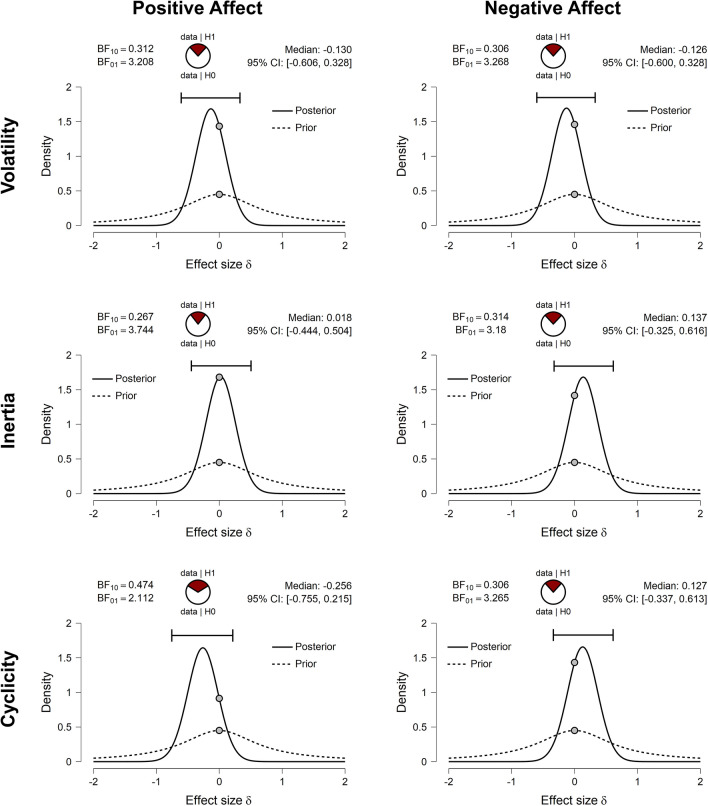
Using 75 days of daily emotion reports from 142 men, naturally cycling women, and women using three oral contraceptive formulations, the study found little evidence that sex or ovarian hormone status meaningfully affects affective variability. Across volatility, emotional inertia, and cyclicity, differences were generally small or absent, with Bayes factors favoring the null by about 2.1 to 3.7 times.
Key findings
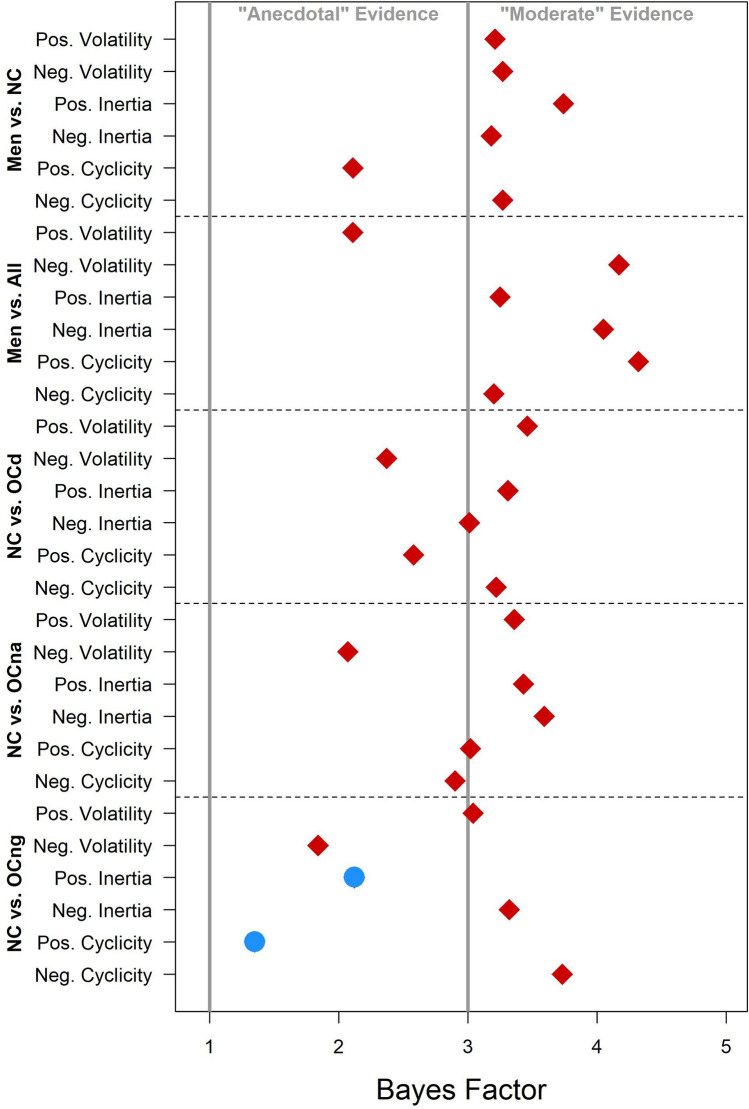
- For all affective variability indices, the point null hypothesis was more likely after considering the data; Bayes factors indicated the null was between 2.1 and 3.7 times more likely than a sex difference.
- Evidence against sex differences was summarized in the discussion as 3.3 times greater for similarity than difference.
- For comparisons of naturally cycling women vs oral contraceptive users, evidence for no group differences was on average 2.7 times greater than evidence for differences.
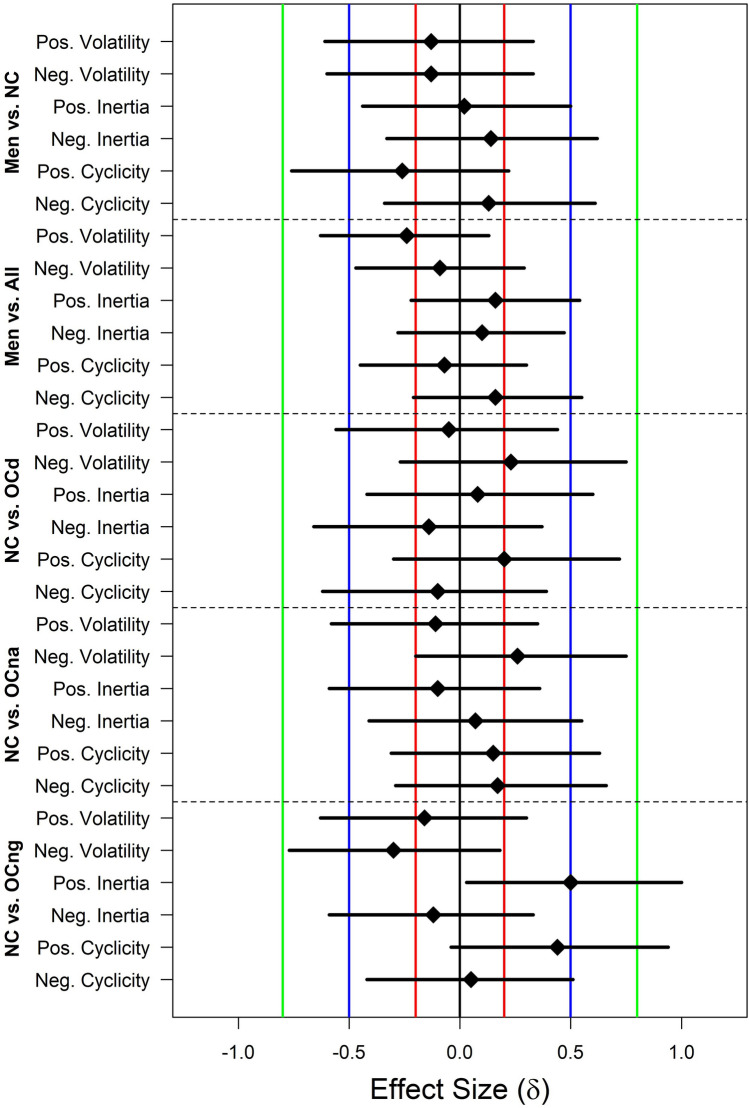
- One exception was women using triphasic norgestimate pills, where there was anecdotal/modest evidence for greater positive emotional inertia (BF10 = 2.12) and positive cyclicity (BF10 = 1.35); if differences exist, they were described as very small.
Methods
- Data came from a parent study and included 142 participants: 30 men, 28 naturally cycling women, and 84 oral contraceptive users aged 18–38; OC users were split into OCd (n = 22), OCna (n = 30), and OCng (n = 32).
- Participants completed 75 nightly online surveys over 75 days; daily affect was measured with the PANAS and averaged into positive and negative affect composites.
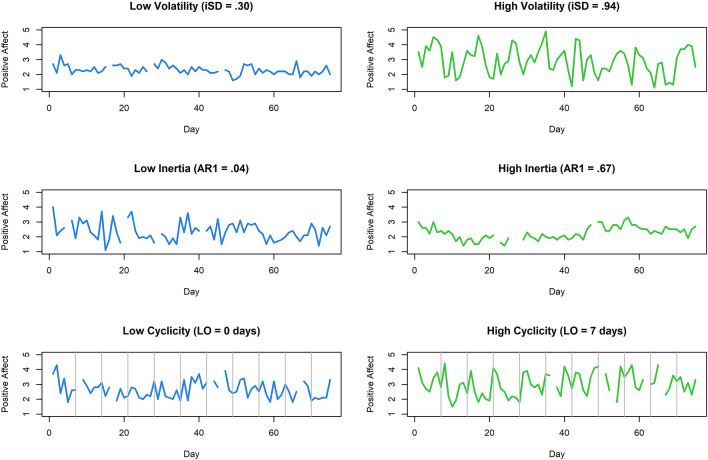
- The main analyses were Bayesian t-tests comparing men vs naturally cycling women, men vs all women, and naturally cycling women vs each OC subgroup on three variability indices: volatility, emotional inertia, and cyclicity.
Limitations
- The paper states that participants were mostly young, White, non-Hispanic, and university-affiliated from a Western, industrialized nation, limiting generalizability.
- The parent study did not include corroborating emotion measures, and the authors note that results may differ for clinical mood indicators, especially depression.
- The study did not assess daily hormone levels or granular OC pill-phase timing, so it cannot test direct cycle-phase or pill-phase effects; this is stated in the paper and is also evident from the methods.
Model-written summary. Check it against the paper before relying on it.
Integrity signals
Registry
Cites
Statistics
Figures
Verification
Claims the paper makes
4 Valid · 1 Not valid · 8 Not checked · 30 Own results and interpretations
Some cited sources support this claim and some don’t — read each source’s verdict below.
In the paper
“most studies of intra-individual emotion variability simply fail to consider gender or attempt to statistically “control” for it20–28.”
§ Little evidence for sex or ovarian hormone influences on affective variability > Introduction
What the sources say
- Could not verifycites [20] Brose A Scheibe S Schmiedek F Life contexts make a difference: Emotional stability in younger and older adults Psychol. Aging. 2013 28 1 148 159 10.1037/a0030047 23066802 sourceExperimental — accuracy not yet measured
Our copy of Brose, Scheibe & Schmiedek (2013) contains only repository/catalogue metadata (the 'Abstract' record at p. n/a lists keywords such as 'affect variability', 'INTRAINDIVIDUAL VARIABILITY', 'AGE-DIFFERENCES', volume/page numbers and citation formats), with no article body text. Searches for gender/sex differences in intra-individual emotion variability, statistical control for gender, and general limitations-of-prior-research phrasing returned no passages, so nothing in our copy either supports or contradicts the claim that most studies fail to consider gender or merely control for it statistically. (LLM, conf=0.70)
- Not checked — no full text of the sourcecites [21] Brose A Schmiedek F Lovden M Lindenberger U Normal aging dampens the link between intrusive thoughts and negative affect in reaction to daily stressors Psychol. Aging. 2011 26 2 488 502 10.1037/a0022287 21480717 source
- Not checked — no full text of the sourcecites [22] Kardum I Affect intensity and frequency: Their relation to mean level and variability of positive and negative affect and Eysenck's personality traits Pers. Individ. Differ. 1999 26 1 33 10.1016/S0191-8869(98)00157-3 source
- Not checked — no full text of the sourcecites [23] Timmermans T Van Mechelen I Kuppens P The relationship between individual differences in intraindividual variability in core affect and interpersonal behaviour Eur. J. Personal. 2010 24 8 623 638 10.1002/per.756 source
- Not checked — no full text of the sourcecites [24] Mill A Realo A Allik J Emotional variability predicts tiredness in daily life an experience sampling study J. Individ. Differ. 2016 37 3 181 193 10.1027/1614-0001/a000206 source
- Disputedcites [25] Sliwinski MJ Almeida DM Smyth J Stawski RS Intraindividual change and variability in daily stress processes: Findings from two measurement-burst diary studies Psychol. Aging. 2009 24 4 828 840 10.1037/a0017925 20025399 PMC2857711 sourceExperimental — accuracy not yet measured
The section “Modeling intraindividual variability in the stress-affect relationship” (page unavailable) says researchers often examine gender as a predictor of between-person differences in emotional reactivity. That runs contrary to the claim that most such studies either ignore gender or merely control for it. (LLM, conf=0.80)
Checked by a reasoning model — may be wrong.
- Could not verifycites [26] Stawski RS Almeida DM Sliwinski MJ Smyth JM Reported exposure and emotional reactivity to daily stressors: The roles of adult age and global perceived stress Psychol. Aging. 2008 23 1 52 61 10.1037/0882-7974.23.1.52 18361654 PMC3485068 sourceExperimental — accuracy not yet measured
Our copy of Stawski et al. (2008) contains no statement about how studies of intra-individual emotion variability handle gender. Its literature critique targets other gaps — inconsistent age differences in stressor-related negative/positive affect (Introduction/Abstract, 'Age Differences in Emotional Reactivity to Daily Stressors'; Discussion) and the neglect of intraindividual variability in stress-day characteristics such as number and severity of stressors ('Characterizing the Stress Day in Daily Stress Research'). Sex appears only descriptively: comparable male/female proportions in the two age groups (Method, Participants) and a note that the sample was 'comprised primarily of females' unlike van Eck's all-male sample (Discussion). Searches for gender/sex differences not considered, statistical control of sex, and critiques of IIV emotion studies returned nothing addressing the claim. (LLM, conf=0.70)
- Supportedcites [27] Ram N Gerstorf D Lindenberger U Smith J Developmental change and intraindividual variability: Relating cognitive aging to cognitive plasticity, cardiovascular lability, and emotional diversity Psychol. Aging. 2011 26 2 363 371 10.1037/a0021500 21443355 PMC3115405 source
The Method section measures intraindividual emotion variability as emotional diversity. The Results section, “Intraindividual Change Predicting Intraindividual Variability,” says the analyses of these dynamic characteristics controlled for gender, making this paper an example of the statistical-control practice identified in the citing sentence. (LLM, conf=0.88)
- Not checked — no full text of the sourcecites [28] Röcke C Li S Smith J Intraindividual variability in positive and negative affect over 45 days: Do older adults fluctuate less than young adults? Psychol. Aging. 2009 24 4 863 878 10.1037/a0016276 20025402 source
plain- Asserted: passes — The authors put it forward as true.
- Checkable: passes — It can be checked against evidence.
- Load-bearing: passes — The paper’s conclusions depend on it.
- Based: passes — The paper gives a reason why it holds.
- Could not verify
The cited sources support only part of this claim — read each source’s verdict below.
In the paper
“Women were historically excluded from research participation partly due to the assumption that ovarian hormone fluctuations lead to variation, especially in emotion, that could not be experimentally controlled.”
- Also stated in: § Introduction · plain
“Female animals and humans were excluded from biomedical, neurological, and social research for decades because cyclic fluctuations in ovarian hormones were assumed to induce variability that would undermine statistical inferences or experimental manipulations1,2.”
§ Little evidence for sex or ovarian hormone influences on affective variability > Abstract
What the sources say
- Partly supportedcites [1] Beery AK Zucker I Sex bias in neuroscience and biomedical research Neurosci. Biobehav. Rev. 2011 35 3 565 572 10.1016/j.neubiorev.2010.07.002 20620164 PMC3008499 sourceExperimental — accuracy not yet measured
The Introduction says women and female mammals were underrepresented partly because hormonal cycles were thought to reduce study-population homogeneity and confound experiments; the Conclusions describe perceived complications from ovarian hormone variation. The paper does not identify emotion as an especially variable outcome, and its Recommendations say hormone variation can be incorporated into study design, rather than establishing that it could not be experimentally controlled. The supplied passages have section labels but no page numbers. (LLM, conf=0.87)
- Not checked — no full text of the sourcecites [2] Kim AM Tingen CM Woodruff TK Sex bias in trials and treatment must end Nature 2010 465 7299 688 689 10.1038/465688a 20535184 source
plainstates a cause- Asserted: passes — The authors put it forward as true.
- Checkable: passes — It can be checked against evidence.
- Load-bearing: passes — The paper’s conclusions depend on it.
- Based: passes — The paper gives a reason why it holds.
- Also stated in: § Introduction · plain
A result the paper reports from its own data — it cites no other source for it, so there is none to check. The quote shows it is in the paper.
In the paper
“Specifically, evidence from Bayes factors for the lack of sex differences was an average of 3.3 times greater than evidence for the existence of sex differences.”
§ Little evidence for sex or ovarian hormone influences on affective variability > Discussion
plain- Asserted: passes — The authors put it forward as true.
- Checkable: passes — It can be checked against evidence.
- Load-bearing: passes — The paper’s conclusions depend on it.
- Based: passes — The paper gives a reason why it holds.
A result the paper reports from its own data — it cites no other source for it, so there is none to check. The quote shows it is in the paper.
In the paper
“In comparisons between NC women and women using OCs with different formulations (i.e., varying in progestin androgenicity) and doses (i.e., monophasic versus triphasic administrations), evidence for the lack of group differences was an average of 2.7 times greater than evidence for differences.”
§ Little evidence for sex or ovarian hormone influences on affective variability > Discussion
plain- Asserted: passes — The authors put it forward as true.
- Checkable: passes — It can be checked against evidence.
- Load-bearing: passes — The paper’s conclusions depend on it.
- Based: passes — The paper gives a reason why it holds.
A result the paper reports from its own data — it cites no other source for it, so there is none to check. The quote shows it is in the paper.
In the paper
“To the naked eye, the means and ranges appear similar across groups, especially for volatility and inertia.”
§ Little evidence for sex or ovarian hormone influences on affective variability > Results > Descriptive statistics
hedged- Asserted: passes — The authors put it forward as true.
- Checkable: passes — It can be checked against evidence.
- Load-bearing: passes — The paper’s conclusions depend on it.
- Based: passes — The paper gives a reason why it holds.
12 more claims
Create a free account to see all 43 claims and to verify the 1 reference still open.
- It may state two separate claims as one. 21
- Probably not a substantial claim. 12
Statistics recomputed
Every reported test result, recomputed from its test statistic and degrees of freedom. A result shows as not adding up only once an independent check has confirmed it.
- ConsistentF(2, 140) = 0.62reported p = .542 · recomputed p = .539
“F(2, 140) = 0.62, p = .542”
- Consistentχ²(2) = 1.89reported p = .389 · recomputed p = .389
“χ2(2) = 1.89, p = .389”
- Consistentχ²(6) = 12.97reported p = .044 · recomputed p = .044
“χ2(6) = 12.97, p = .044”
- Consistentt(110) = 0.29reported p = .772 · recomputed p = .772
“t(110) = 0.29, p = .772”
Self-check
Percentages, sums and reported differences re-computed from the paper’s own numbers.
Self-check results appear here once an independent check has confirmed them.
Citations
Cites
Development and validation of brief measures of positive and negative affect: The PANAS scales.
Watson, D., Clark, L. A., & Tellegen, A. (1988) · Journal of Personality and Social Psychology · doi:10.1037/0022-3514.54.6.1063 · Cited by 32,433
Epidemiology of women and depression
Kessler, R. (2003) · Journal of Affective Disorders · doi:10.1016/s0165-0327(02)00426-3 · Cited by 2,006
Meehl, P. E. (1978) · Journal of Consulting and Clinical Psychology · doi:10.1037/0022-006x.46.4.806 · Cited by 1,947
Sex bias in neuroscience and biomedical research
Beery, A. K., & Zucker, I. (2011) · Neuroscience & Biobehavioral Reviews · doi:10.1016/j.neubiorev.2010.07.002 · Cited by 1,763
Bayesian inference for psychology. Part II: Example applications with JASP
Wagenmakers, E.-J., Love, J., Marsman, M., Jamil, T., Ly, A., Verhagen, J., Selker, R., Gronau, Q. F., Dropmann, D., Boutin, B., et al. (2018) · Psychonomic Bulletin & Review · doi:10.3758/s13423-017-1323-7 · Cited by 1,715
Sex differences in emotion: Expression, experience, and physiology.
Kring, A. M., & Gordon, A. H. (1998) · Journal of Personality and Social Psychology · doi:10.1037/0022-3514.74.3.686 · Cited by 1,067
Age-related differences and change in positive and negative affect over 23 years.
Charles, S. T., Reynolds, C. A., & Gatz, M. (2001) · Journal of Personality and Social Psychology · doi:10.1037/0022-3514.80.1.136 · Cited by 1,049
The relation between short-term emotion dynamics and psychological well-being: A meta-analysis.
Houben, M., Van Den Noortgate, W., & Kuppens, P. (2015) · Psychological Bulletin · doi:10.1037/a0038822 · Cited by 1,043
Abandon Statistical Significance
McShane, B. B., Gal, D., Gelman, A., Robert, C., & Tackett, J. L. (2019) · The American Statistician · doi:10.1080/00031305.2018.1527253 · Cited by 791
Female mice liberated for inclusion in neuroscience and biomedical research
Prendergast, B. J., Onishi, K. G., & Zucker, I. (2014) · Neuroscience & Biobehavioral Reviews · doi:10.1016/j.neubiorev.2014.01.001 · Cited by 788
Association of Hormonal Contraception With Depression
Skovlund, C. W., Mørch, L. S., Kessing, L. V., & Lidegaard, Ø. (2016) · JAMA Psychiatry · doi:10.1001/jamapsychiatry.2016.2387 · Cited by 675
Intraindividual variability in affect: Reliability, validity, and personality correlates.
Eid, M., & Diener, E. (1999) · Journal of Personality and Social Psychology · doi:10.1037/0022-3514.76.4.662 · Cited by 571
Eckert-Lind, C., Busch, A. S., Petersen, J. H., Biro, F. M., Butler, G., Bräuner, E. V., & Juul, A. (2020) · JAMA Pediatrics · doi:10.1001/jamapediatrics.2019.5881 · Cited by 481
Female rats are not more variable than male rats: a meta-analysis of neuroscience studies
Becker, J. B., Prendergast, B. J., & Liang, J. W. (2016) · Biology of Sex Differences · doi:10.1186/s13293-016-0087-5 · Cited by 473
Abandon Statistical SignificancePreprint
McShane, B. B., Gal, D., Gelman, A., Robert, C. P., & Tackett, J. L. (2019) · HAL · Cited by 449
Everyday stressors and gender differences in daily distress
Almeida, D. M., & Kessler, R. C. (1998) · Journal of Personality and Social Psychology · doi:10.1037/0022-3514.75.3.670 · Cited by 406
The case for the inclusion of female subjects in basic science studies of pain
Mogil, J. S., & Chanda, M. L. (2005) · Pain · doi:10.1016/j.pain.2005.06.020 · Cited by 376
Mazure, C. M., & Jones, D. P. (2015) · BMC Women's Health · doi:10.1186/s12905-015-0251-9 · Cited by 305
Stawski, R. S., Sliwinski, M. J., Almeida, D. M., & Smyth, J. M. (2008) · Psychology and Aging · doi:10.1037/0882-7974.23.1.52 · Cited by 289
Röcke, C., Li, S.-C., & Smith, J. (2009) · Psychology and Aging · doi:10.1037/a0016276 · Cited by 288
Kuppens, P., Van Mechelen, I., Nezlek, J. B., Dossche, D., & Timmermans, T. (2007) · Emotion · doi:10.1037/1528-3542.7.2.262 · Cited by 285
To what extent do oral contraceptives influence mood and affect?
Oinonen, K. A., & Mazmanian, D. (2002) · Journal of Affective Disorders · doi:10.1016/s0165-0327(01)00356-1 · Cited by 268
Gruber, J., Kogan, A., Quoidbach, J., & Mauss, I. B. (2013) · Emotion · doi:10.1037/a0030262 · Cited by 261
Sex bias in trials and treatment must end
Kim, A. M., Tingen, C. M., & Woodruff, T. K. (2010) · Nature · doi:10.1038/465688a · Cited by 254
Sliwinski, M. J., Almeida, D. M., Smyth, J., & Stawski, R. S. (2009) · Psychology and Aging · doi:10.1037/a0017925 · Cited by 241
Assessing Temporal Emotion Dynamics Using Networks
Bringmann, L. F., Pe, M. L., Vissers, N., Ceulemans, E., Borsboom, D., Vanpaemel, W., Tuerlinckx, F., & Kuppens, P. (2016) · Assessment · doi:10.1177/1073191116645909 · Cited by 236
The stability of mood variability: A spectral analytic approach to daily mood assessments.
Larsen, R. J. (1987) · Journal of Personality and Social Psychology · doi:10.1037//0022-3514.52.6.1195 · Cited by 224
Investigating inter-individual differences in short-term intra-individual variability.
Wang, L. (., Hamaker, E., & Bergeman, C. S. (2012) · Psychological Methods · doi:10.1037/a0029317 · Cited by 212
Gingnell, M., Engman, J., Frick, A., Moby, L., Wikström, J., Fredrikson, M., & Poromaa, I. S. (2012) · Psychoneuroendocrinology · doi:10.1016/j.psyneuen.2012.11.006 · Cited by 169
Lundin, C., Danielsson, K. G., Bixo, M., Moby, L., Bengtsdotter, H., Jawad, I., Marions, L., Brynhildsen, J., Malmborg, A., Lindh, I., et al. (2017) · Psychoneuroendocrinology · doi:10.1016/j.psyneuen.2016.11.033 · Cited by 167
Testosterone and human behavior: the role of individual and contextual variables
Carré, J. M., & Archer, J. E. (2017) · Current Opinion in Psychology · doi:10.1016/j.copsyc.2017.03.021 · Cited by 151
Hampson, E. (2020) · Hormones and Behavior · doi:10.1016/j.yhbeh.2019.104655 · Cited by 136
Analysis of sex differences in pre-clinical and clinical data sets
Beltz, A. M., Beery, A. K., & Becker, J. B. (2019) · Neuropsychopharmacology · doi:10.1038/s41386-019-0524-3 · Cited by 130
Self-citationProspective and cross-sectional mood reports offer no evidence of a "blue Monday" phenomenon.
Stone, A. A., Hedges, S. M., Neale, J. M., & Satin, M. S. (1985) · Journal of Personality and Social Psychology · doi:10.1037/0022-3514.49.1.129 · Cited by 127
Oral contraceptives and premenstrual symptoms: Comparison of a 21/7 and extended regimen
Coffee, A. L., Kuehl, T. J., Willis, S., & Sulak, P. J. (2006) · American Journal of Obstetrics and Gynecology · doi:10.1016/j.ajog.2006.05.012 · Cited by 125
Beltz, A. M., & Moser, J. S. (2019) · Annals of the New York Academy of Sciences · doi:10.1111/nyas.14255 · Cited by 123
Self-citationLife contexts make a difference: Emotional stability in younger and older adults.
Brose, A., Scheibe, S., & Schmiedek, F. (2013) · Psychology and Aging · doi:10.1037/a0030047 · Cited by 114
Emotional experience in daily life: Valence, variability, and rate of change.
Eaton, L. G., & Funder, D. C. (2001) · Emotion · doi:10.1037/1528-3542.1.4.413 · Cited by 113
Individual differences in intraperson variability in mood.
Penner, L. A., Shiffman, S., Paty, J. A., & Fritzsche, B. A. (1994) · Journal of Personality and Social Psychology · doi:10.1037/0022-3514.66.4.712 · Cited by 112
Hormonal Contraceptives and Mood: Review of the Literature and Implications for Future Research
Robakis, T., Williams, K. E., Nutkiewicz, L., & Rasgon, N. L. (2019) · Current Psychiatry Reports · doi:10.1007/s11920-019-1034-z · Cited by 103
Houben, M., Claes, L., Vansteelandt, K., Berens, A., Sleuwaegen, E., & Kuppens, P. (2017) · Journal of Abnormal Psychology · doi:10.1037/abn0000229 · Cited by 96
Oral contraceptives and cognition: A role for ethinyl estradiol
Beltz, A. M., Hampson, E., & Berenbaum, S. A. (2015) · Hormones and Behavior · doi:10.1016/j.yhbeh.2015.06.012 · Cited by 94
Self-citationMood Fluctuations: Women Versus Men and Menstrual Versus Other Cycles
McFarlane, J., Martin, C. L., & Williams, T. M. (1988) · Psychology of Women Quarterly · doi:10.1111/j.1471-6402.1988.tb00937.x · Cited by 93
Are females more variable than males in gene expression? Meta-analysis of microarray datasets
Itoh, Y., & Arnold, A. P. (2015) · Biology of Sex Differences · doi:10.1186/s13293-015-0036-8 · Cited by 92
Ram, N., Gerstorf, D., Lindenberger, U., & Smith, J. (2011) · Psychology and Aging · doi:10.1037/a0021500 · Cited by 82
Jasieńska, G., & Jasieński, M. (2007) · American Journal of Human Biology · doi:10.1002/ajhb.20686 · Cited by 79
Brose, A., Schmiedek, F., Lövdén, M., & Lindenberger, U. (2011) · Psychology and Aging · doi:10.1037/a0022287 · Cited by 79
Sex differences in variability across timescales in BALB/c mice
Smarr, B. L., Grant, A. D., Zucker, I., Prendergast, B. J., & Kriegsfeld, L. J. (2017) · Biology of Sex Differences · doi:10.1186/s13293-016-0125-3 · Cited by 76
Incorporating sex as a biological variable in neuroscience: what do we gain?
McCarthy, M. M., Woolley, C. S., & Arnold, A. P. (2017) · Nature reviews. Neuroscience · doi:10.1038/nrn.2017.137 · Cited by 75
The Influence of Hormonal Contraception on Mood and Sexual Interest among Adolescents
Ott, M. A., Shew, M. L., Ofner, S., Tu, W., & Fortenberry, J. D. (2008) · Archives of Sexual Behavior · doi:10.1007/s10508-007-9302-0 · Cited by 63
The contribution of neuroethics to international brain research initiatives
Evers, K. (2016) · Nature reviews. Neuroscience · doi:10.1038/nrn.2016.143 · Cited by 46
Kardum, I. (1998) · Personality and Individual Differences · doi:10.1016/s0191-8869(98)00157-3 · Cited by 43
Eckert‐Lind, C., Busch, A. S., Petersen, J. H., et al. (2020) · Yearbook of pediatric endocrinology · doi:10.1530/ey.17.13.11 · Cited by 42
Effects of oral contraceptives on daily self-ratings of positive and negative affect
Oinonen, K. A., & Mazmanian, D. (2001) · Journal of Psychosomatic Research · doi:10.1016/s0022-3999(01)00240-9 · Cited by 41
Oral contraceptives positively affect mood in healthy PMS-free women: A longitudinal study
Hamstra, D. A., de Kloet, E. R., de Rover, M., & Van der Does, W. (2017) · Journal of Psychosomatic Research · doi:10.1016/j.jpsychores.2017.10.011 · Cited by 41
Personality correlates of variable moods
McConville, C., & Cooper, C. (1998) · Personality and Individual Differences · doi:10.1016/s0191-8869(98)00139-1 · Cited by 39
Timmermans, T., Van Mechelen, I., & Kuppens, P. (2010) · European Journal of Personality · doi:10.1002/per.756 · Cited by 39
Hengartner, M. P., Krüger, T. H. C., Geraedts, K., Tronci, E., Mancini, T., Ille, F., Egli, M., Röblitz, S., Ehrig, R. M., Saleh, L., et al. (2017) · Journal of Psychosomatic Research · doi:10.1016/j.jpsychores.2017.05.018 · Cited by 39
Do oral contraceptives act as mood stabilizers? Evidence of positive affect stabilization
Jarva, J. A., & Oinonen, K. A. (2007) · Archives of Women's Mental Health · doi:10.1007/s00737-007-0197-5 · Cited by 36
Daily gender expression is associated with psychological adjustment for some people, but mainly men
Beltz, A. M., Loviska, A. M., & Weigard, A. S. (2021) · Scientific Reports · doi:10.1038/s41598-021-88279-4 · Cited by 35
Self-citationAge Differences in the Heritability of Mean and Intraindividual Variation of Psychological Distress
Neiss, M. B., & Almeida, D. M. (2003) · Gerontology · doi:10.1159/000074385 · Cited by 27
Marriott, A., & Faragher, E. B. (1986) · Journal of Psychosomatic Research · doi:10.1016/0022-3999(86)90064-4 · Cited by 26
Effects of missing data on the statistical analysis of clinical time series
Rankin, E. D., & Marsh, J. C. (1985) · Social Work Research and Abstracts · doi:10.1093/swra/21.2.13 · Cited by 25
How are you doing? The person-specificity of daily links between neuroticism and physical health
Kelly, D. P., Weigard, A. S., & Beltz, A. M. (2020) · Journal of Psychosomatic Research · doi:10.1016/j.jpsychores.2020.110194 · Cited by 25
Self-citationOvulation disturbances and mood across the menstrual cycles of healthy women
Harvey, A. T., Hitchcock, C. L., & Prior, J. C. (2009) · Journal of Psychosomatic Obstetrics & Gynecology · doi:10.3109/01674820903276438 · Cited by 24
Emotional Variability Predicts Tiredness in Daily Life: An Experience Sampling Study
Mill, A., Realo, A., & Allik, J. (2016) · Journal of Individual Differences · doi:10.1027/1614-0001/a000206 · Cited by 6
Cited by
Why the estrous cycle matters for neuroscience
Rocks, D., Cham, H., & Kundaković, M. (2022) · Biology of Sex Differences · doi:10.1186/s13293-022-00466-8 · Cited by 121
“This frequently touted misconception states that it is now proven that the estrous and menstrual cycles do not make females more variable than males, and that this means that (a) females deserve to be studied and that (b) ovarian cycles are not important experimental considerations [24, 46, 47].”
BackgroundThe brain in flow: a systematic review on the neural basis of the flow state
Alameda, C., Sanabria, D., & Ciria, L. F. (2022) · Cortex · doi:10.1016/j.cortex.2022.06.005 · Cited by 75
Beltz, A. M. (2022) · Frontiers in Neuroendocrinology · doi:10.1016/j.yfrne.2022.101037 · Cited by 42
Self-citationThe brain in flow: a systematic review on the neural basis of the flow statePreprint
Alameda, C., Sanabria, D., & Ciria, L. F. (2021) · doi:10.31234/osf.io/3zh9y · Cited by 28
Tracking Women’s Reproductive Data in Sport: Practical Limitations, Perils and Pitfalls
Casto, K. V. (2022) · Sports Medicine · doi:10.1007/s40279-022-01671-6 · Cited by 28
Metadata
- Authors
- Weigard, A., Loviska, A. M., & Beltz, A. M.
- Affiliations
- University of Michigan (US)
- Corresponding author
- Beltz, Adriene M.
- Venue
- Scientific Reports
- Published
- 2021-10-22
- Volume
- 11
- Issue
- 1
- Pages
- 20925-20925
- ISSN
- 2045-2322 (ISSN-L)
- PMC
- PMC8536752
- OpenAlex
- W3204974025
- Cited by
- 32
- References
- 70
- Citations by year
- 2026: 2 · 2025: 7 · 2024: 6 · 2023: 6 · 2022: 9 · 2021: 2
- FWCI
- 5.55
- Type
- journal article
- Language
- en
- Open access
- gold
- doi.org
- Licence
- cc-by
- creativecommons.org/licenses/by/4.0 (tdm)
- creativecommons.org/licenses/by/4.0 (vor)
- Locations
- Scientific Reports (publishedVersion, cc-by)
- Europe PMC (PubMed Central) (publishedVersion, other-oa)
- PubMed Central (publishedVersion, cc-by)
- PubMed (publishedVersion)
- DOAJ (DOAJ: Directory of Open Access Journals) (submittedVersion, cc-by-sa)
- Funders
- National Institute on Alcohol Abuse and Alcoholism (T32 AA007477)
- Jacobs Foundation,Germany
- Topics
- Social Sciences › Psychology › Experimental and Cognitive Psychology › Mental Health Research Topics
- Health Sciences › Medicine › Endocrinology, Diabetes and Metabolism › Menopause: Health Impacts and Treatments
- Social Sciences › Psychology › Experimental and Cognitive Psychology › Evolutionary Psychology and Human Behavior
- Keywords
- affective variability, ovarian hormones, sex differences, oral contraceptives, menstrual cycle, emotional inertia, emotional volatility, daily emotions, intensive longitudinal data, Bayesian analysis
- MeSH terms
- Adolescent, Adult, Bayes Theorem, Contraceptives, Oral, Hormonal, Emotions, Female, Humans, Longitudinal Studies, Male, Ovary, Gonadal Steroid Hormones, Young Adult
About these checks
Registry, retraction, Cites and statistics results are computed, not judged, with one exception: a printed reference that no index lists is read once by a model before it counts as a citation error. Claims are extracted by a model and kept only when their quote appears verbatim in the text; each cited source is then checked, with a model’s help, for whether it says what the claim relies on. Those verdicts can be wrong — read the claim’s quote and the cited source before relying on one.
The claim verdicts this report counts are experimental: their accuracy is not yet measured.
A language model drew the claims from the paper on 2026-10-10, under version 3 of the claim definition (model deepseek-v4.1-flash, prompt extract-v3).
A second model labelled each claim on 2026-10-10 (model jev-1.13-20260917, definition revision gold-guideline-v0.2).
Cited sources are checked with a language model’s help (qwen3.8-omni-flash and gpt-6-sol).
Statistics and arithmetic are recomputed, not judged.
Confidence bands are shown only for fields calibrated on our annotated test set. None is calibrated yet, so no band is shown.
What counts as a claim ›How we measure confidence ›How we check this ›
Are you an author, or do you see a problem with this page? Request a review
Data sources
Bibliographic data: Semantic Scholar, OpenAlex, Crossref.
Contains information from the Semantic Scholar Academic Graph Datasets, made available under the ODC Attribution License (ODC-BY 1.0).
Semantic Scholar’s data is described in: Kinney, R., et al. (2023). The Semantic Scholar Open Data Platform. arXiv:2301.10140.
