

More than 50 long-term effects of COVID-19: a systematic review and meta-analysis
Open accessPublished version of a preprint
The DOI matches its Crossref record; 51 of the 51 references it cites were found in a registry or an index; 5 of the 23 sources its claims cite were checked for support.
Abstract
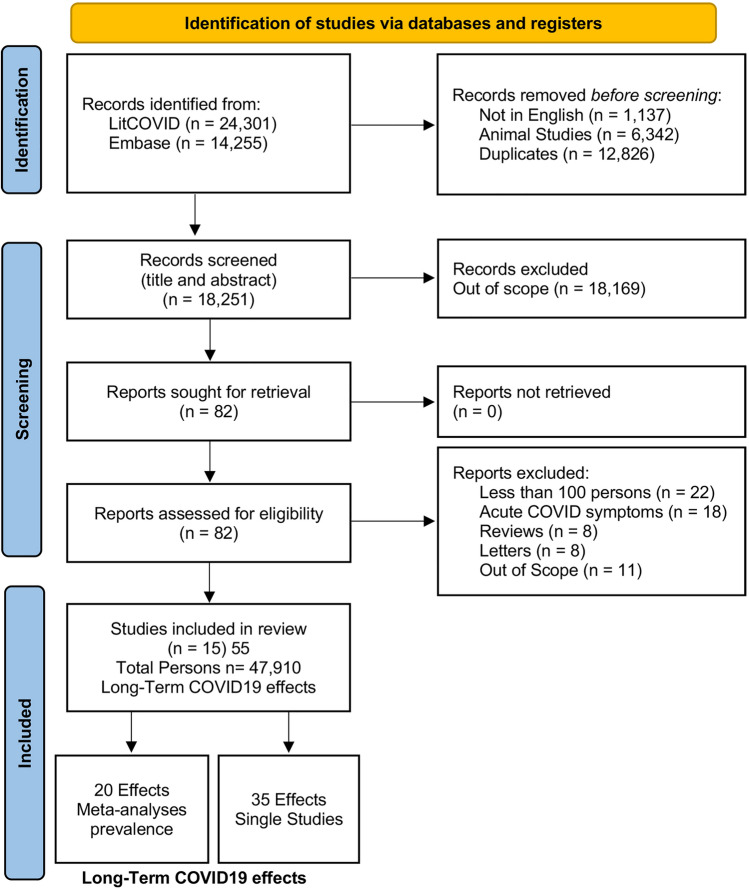
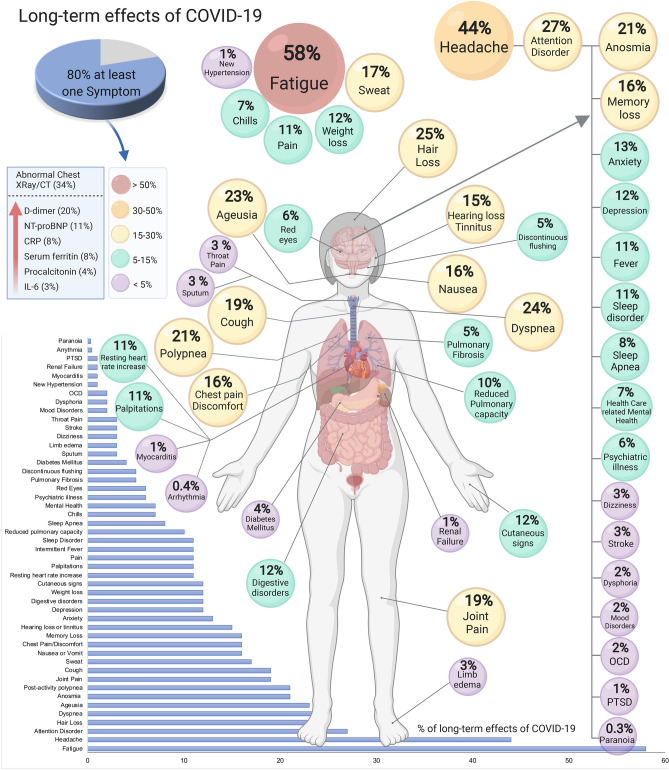
COVID-19 can involve persistence, sequelae, and other medical complications that last weeks to months after initial recovery. This systematic review and meta-analysis aims to identify studies assessing the long-term effects of COVID-19. LitCOVID and Embase were searched to identify articles with original data published before the 1st of January 2021, with a minimum of 100 patients. For effects reported in two or more studies, meta-analyses using a random-effects model were performed using the MetaXL software to estimate the pooled prevalence with 95% CI. PRISMA guidelines were followed. A total of 18,251 publications were identified, of which 15 met the inclusion criteria. The prevalence of 55 long-term effects was estimated, 21 meta-analyses were performed, and 47,910 patients were included (age 17-87 years). The included studies defined long-COVID as ranging from 14 to 110 days post-viral infection. It was estimated that 80% of the infected patients with SARS-CoV-2 developed one or more long-term symptoms. The five most common symptoms were fatigue (58%), headache (44%), attention disorder (27%), hair loss (25%), and dyspnea (24%). Multi-disciplinary teams are crucial to developing preventive measures, rehabilitation techniques, and clinical management strategies with whole-patient perspectives designed to address long COVID-19 care.
Overview
CoChat Summary
## TL;DR
This systematic review and meta-analysis identified 55 long-term effects of COVID-19 across 15 studies including 47,910 patients, estimating that 80% of infected patients developed one or more long-term symptoms. The most common reported effects were fatigue (58%), headache (44%), attention disorder (27%), hair loss (25%), and dyspnea (24%).
## Key findings
- The review screened 18,251 publications and included 15 studies; together they covered 47,910 patients aged 17–87 years.
- The authors identified 55 long-term effects of COVID-19 and performed 21 meta-analyses.
- Overall, an estimated 80% (95% CI 65–92) of COVID-19 patients had at least one long-term symptom.
- The five most common manifestations were fatigue (58%, 95% CI 42–73), headache (44%, 95% CI 13–78), attention disorder (27%, 95% CI 19–36), hair loss (25%, 95% CI 17–34), and dyspnea (24%, 95% CI 14–36).
- Among laboratory/imaging findings, abnormal chest X-ray/CT was observed in 34% (95% CI 27–42), with elevated D-dimer in 20% (95% CI 6–39) and NT-proBNP in 11% (95% CI 6–17).
## Methods
- Systematic review and meta-analysis following PRISMA guidelines; searches were run in LitCOVID and Embase for original studies published before January 1, 2021.
- Inclusion criteria required peer-reviewed English-language human studies with at least 100 patients and post-COVID-19 outcomes assessed 2 weeks or more after initial symptoms.
- Data extraction and study quality assessment were done by multiple reviewers; pooled prevalences were estimated with random-effects meta-analysis in MetaXL for outcomes reported in at least two studies, with heterogeneity assessed using I².
## Limitations
- The paper states that some outcomes had small sample sizes, limiting generalizability to the general population.
- It notes substantial heterogeneity across studies, mainly due to different follow-up times and mixed severity groups; it was also impossible to determine how long each symptom lasted.
- The paper states that many studies used self-reported questionnaires, creating possible reporting bias, and that outcomes may have been missed because studies used internally pre-defined symptom lists.
- Evident from the text: only English-language studies with at least 100 patients were included, so the review may miss smaller or non-English studies.
Model-written summary. Check it against the paper before relying on it.
Integrity signals
Registry
Cites
Statistics
Figures
Verification
Claims the paper makes
5 Valid · 0 Not valid · 8 Not checked · 41 Own results and interpretations
Every source the paper cites for this claim was checked and supports it.
In the paper
“a study reported high levels of depression, anxiety, and post-traumatic stress disorder (PTSD)37 in the long term in patients previously infected with other coronaviruses.”
§ More than 50 long-term effects of COVID-19: a systematic review and meta-analysis > Discussion
What the sources say
- Supportedcites [37] Rogers, J. P. et al. Psychiatric and neuropsychiatric presentations associated with severe coronavirus infections: A systematic review and meta-analysis with comparison to the COVID-19 pandemic. Lancet Psychiatry 7, 611–627. https://doi.org/10.1016/S2215-0366(20)30203-0 (2020). source
The Results report post-illness prevalence of anxiety disorders (14.8%), depression (14.9%), and PTSD (32.2%) among people who recovered from SARS or MERS, with mean follow-up times of 11.6, 22.6, and 33.6 months, respectively. The Discussion describes these prevalences as high, while cautioning that the studies could not clearly separate effects of infection from other factors. Page numbers were not provided in our copy. (LLM, conf=0.93)
plainstates an association- Asserted: passes — The authors put it forward as true.
- Checkable: passes — It can be checked against evidence.
- Load-bearing: unclear — It is unclear whether the paper’s conclusions depend on it.
- Based: passes — The paper gives a reason why it holds.
- Supported
The cited sources support only part of this claim — read each source’s verdict below.
In the paper
“Fatigue (58%) is the most common symptom of long and acute COVID-1923.”
§ More than 50 long-term effects of COVID-19: a systematic review and meta-analysis > Discussion
What the sources say
- Partly supportedcites [23] Townsend, L. et al. Persistent fatigue following SARS-CoV-2 infection is common and independent of severity of initial infection. PLoS One 15, e0240784. https://doi.org/10.1371/journal.pone.0240784 (2020). sourceExperimental — accuracy not yet measured
Townsend et al. (2020) support only that fatigue is common: the Introduction states it is 'recognised as one of the most common presenting complaints' in SARS-CoV-2 infection, with 44–69.6% in early case series and 34–46% in meta-analyses — figures the paper credits to other works it cites, and it never ranks fatigue as THE most common symptom of acute disease. For the convalescent/'long' COVID side, the Results (Prevalence of post-COVID fatigue) report 52.3% (67/128) meeting the CFQ-11 case definition at a median of 10 weeks, and the paper reports no symptom-prevalence comparison, so it does not establish fatigue as the most common long-COVID symptom either. The specific 58% magnitude attributed here matches nothing in our copy (the only nearby percentages are 52.3% fatigued cases and 57% of those offered an appointment who attended), so both the superlative and the number are unsupported. (LLM, conf=0.80)
plain- Asserted: passes — The authors put it forward as true.
- Checkable: passes — It can be checked against evidence.
- Load-bearing: unclear — It is unclear whether the paper’s conclusions depend on it.
- Based: passes — The paper gives a reason why it holds.
- Partly supported
The cited sources support only part of this claim — read each source’s verdict below.
In the paper
“It is present even after 100 days of the first symptom of acute COVID-194,23.”
§ More than 50 long-term effects of COVID-19: a systematic review and meta-analysis > Discussion
What the sources say
- Not checked yetcites [4] Townsend, L. et al. Persistent poor health post-COVID-19 is not associated with respiratory complications or initial disease severity. Ann. Am. Thorac. Soc. https://doi.org/10.1513/AnnalsATS.202009-1175OC (2021). source
- Partly supportedcites [23] Townsend, L. et al. Persistent fatigue following SARS-CoV-2 infection is common and independent of severity of initial infection. PLoS One 15, e0240784. https://doi.org/10.1371/journal.pone.0240784 (2020). sourceExperimental — accuracy not yet measured
Townsend et al. (2020) confirm persistent fatigue after the acute phase of SARS-CoV-2 infection, but at a median of 10 weeks (~70 days) from symptom onset (Abstract; Results, Participant characteristics: median interval 72 days, IQR 62-87; Table 2 'Days since Symptom Onset' medians 71 and 73). The only passage reaching beyond ~84 days is Table 1's follow-up band '>84 days (12 weeks)' (38 participants, 22 fatigued), and the Discussion explicitly frames the report as a 'medium time point' and calls for future longitudinal work 'to describe the persistence of fatigue at six months and beyond'. No passage in our copy states fatigue at or beyond 100 days from first symptom, so that specific qualifier of the citing sentence is not supported by this source. (LLM, conf=0.72)
plain- Asserted: passes — The authors put it forward as true.
- Checkable: passes — It can be checked against evidence.
- Load-bearing: unclear — It is unclear whether the paper’s conclusions depend on it.
- Based: passes — The paper gives a reason why it holds.
A result the paper reports from its own data — it cites no other source for it, so there is none to check. The quote shows it is in the paper.
In the paper
“The prevalence of 55 long-term effects was estimated”
- Also stated in: § Prevalence of long-term effects in COVID-19 patients · plain
“We identified a total of 55 long-term effects associated with COVID-19 in the literature reviewed”
§ More than 50 long-term effects of COVID-19: a systematic review and meta-analysis > Abstract
plainstates an associationn = 47,910- Asserted: passes — The authors put it forward as true.
- Checkable: passes — It can be checked against evidence.
- Load-bearing: passes — The paper’s conclusions depend on it.
- Based: passes — The paper gives a reason why it holds.
- Rests on an assumption not shown here.
- Also stated in: § Prevalence of long-term effects in COVID-19 patients · plain
A result the paper reports from its own data — it cites no other source for it, so there is none to check. The quote shows it is in the paper.
In the paper
“It was estimated that 80% of the infected patients with SARS-CoV-2 developed one or more long-term symptoms.”
- Also stated in: § Prevalence of long-term effects in COVID-19 patients · plain
“The meta-analysis of the studies (n = 7) that included an estimate for one symptom or more reported that 80% (95% CI 65–92) of the patients with COVID-19 have long-term symptoms.”
- Also stated in: § Discussion · boosted
“This systematic review and meta-analysis shows that 80% (95% CI 65–92) of individuals with a confirmed COVID-19 diagnosis continue to have at least one overall effect beyond 2 weeks following acute infection.”
§ More than 50 long-term effects of COVID-19: a systematic review and meta-analysis > Abstract
boostedn = 7- Asserted: passes — The authors put it forward as true.
- Checkable: passes — It can be checked against evidence.
- Load-bearing: passes — The paper’s conclusions depend on it.
- Based: passes — The paper gives a reason why it holds.
- Rests on an assumption not shown here.
- Also stated in: § Prevalence of long-term effects in COVID-19 patients · plain
27 more claims
Create a free account to see all 54 claims and to verify the 18 references still open.
- It may state two separate claims as one. 7
- Probably not a substantial claim. 17
Claims other papers make about this one
Each is checked against this paper’s own text: does it say what the citing paper says it does?
The source backs part of the claim, not all of it — or backs it for a different population, condition or comparison.
In the citing paper
“Mental health symptoms such as depression, anxiety and sleep problems are commonly observed in individuals suffering from acute COVID-19 infection to post-COVID-19 syndrome.”
From Psychological treatments for the mental health symptoms among individuals infected with COVID-19: a scoping review protocol (2023) · cites this paper as [4]
Experimental — accuracy not yet measuredThe cited source says what the claim attributes to it.
In the citing paper
“These mental health symptoms persist even after the acute stage of the disease.”
From Psychological treatments for the mental health symptoms among individuals infected with COVID-19: a scoping review protocol (2023) · cites this paper as [4]
The cited source says what the claim attributes to it.
In the citing paper
“Mental health symptoms are common in reports of a post-covid syndrome (4, 6).”
Citations
Cites
PRISMA-P Group, Moher, D., Shamseer, L., Clarke, M., Ghersi, D., Liberati, A., Petticrew, M., Shekelle, P., & Stewart, L. A. (2015) · Systematic Reviews · doi:10.1186/2046-4053-4-1 · Cited by 26,223
Shamseer, L., Moher, D., Clarke, M., Ghersi, D., Liberati, A., Petticrew, M., Shekelle, P., Stewart, L. A., & the PRISMA-P Group (2015) · BMJ · doi:10.1136/bmj.g7647 · Cited by 13,120
Persistent Symptoms in Patients After Acute COVID-19
Carfì, A., Bernabei, R., Landi, F., & for the Gemelli Against COVID-19 Post-Acute Care Study Group (2020) · JAMA · doi:10.1001/jama.2020.12603 · Cited by 4,561
Rogers, J. P., Chesney, E., Oliver, D., Pollak, T. A., McGuire, P., Fusar-Poli, P., Zandi, M. S., Lewis, G., & David, A. S. (2020) · The Lancet Psychiatry · doi:10.1016/s2215-0366(20)30203-0 · Cited by 2,407
Barendregt, J. J., Doi, S. A., Lee, Y. Y., Norman, R. E., & Vos, T. (2013) · Journal of Epidemiology and Community Health · doi:10.1136/jech-2013-203104 · Cited by 2,169
Cytokine release syndrome in severe COVID-19
Moore, J. B., & June, C. H. (2020) · Science · doi:10.1126/science.abb8925 · Cited by 1,912
Management of post-acute covid-19 in primary care
Greenhalgh, T., Knight, M., A’Court, C., Buxton, M., & Husain, L. (2020) · BMJ · doi:10.1136/bmj.m3026 · Cited by 1,689
Taquet, M., Luciano, S., Geddes, J. R., & Harrison, P. J. (2021) · The Lancet Psychiatry · doi:10.1016/s2215-0366(20)30462-4 · Cited by 1,484
Tenforde, M. W., Kim, S. S., Lindsell, C. J., Billig Rose, E., Shapiro, N. I., Files, D. C., Gibbs, K. W., Erickson, H. L., Steingrub, J. S., Smithline, H. A., et al. (2020) · MMWR. Morbidity and Mortality Weekly Report · doi:10.15585/mmwr.mm6930e1 · Cited by 1,319
Garrigues, E., Janvier, P., Kherabi, Y., Le Bot, A., Hamon, A., Gouze, H., Doucet, L., Berkani, S., Oliosi, E., Mallart, E., et al. (2020) · Journal of Infection · doi:10.1016/j.jinf.2020.08.029 · Cited by 1,157
Cited by
Items 501–600 of 1,003
Long COVID: sustained and multiplied disadvantage
de Leeuw, E., Yashadhana, A., & Hitch, D. (2022) · The Medical Journal of Australia · doi:10.5694/mja2.51435 · Cited by 26
Ortelli, P., Benso, F., Ferrazzoli, D., Scarano, I., Saltuari, L. L., Sebastianelli, L., Versace, V., & Maestri, R. (2022) · Scientific Reports · doi:10.1038/s41598-022-17463-x · Cited by 27
D’Ávila, K. G., Monaiar, L. R., Dantas, L. D. P., Freitas, A. A., Loureiro, M. M., Bonamigo, R. R., Filho, F. F. D., & Silva, D. R. (2022) · Journal of Occupational and Environmental Medicine · doi:10.1097/jom.0000000000002727 · Cited by 26
Health-related quality of life in survivors of severe COVID-19 infection
d’Ettorre, G., Vassalini, P., Coppolelli, V., Cacciola, E. G., Sanitinelli, L., Maddaloni, L., Fabris, S., Mastroianni, C. M., d’Ettorre, G., & Ceccarelli, G. (2022) · Pharmacological Reports · doi:10.1007/s43440-022-00433-5 · Cited by 29
Ferrara, M. C., Zarcone, C., Tassistro, E., Rebora, P., Rossi, E., Luppi, F., Foti, G., Squillace, N., Lettino, M., Strepparava, M. G., et al. (2022) · Aging Clinical and Experimental Research · doi:10.1007/s40520-022-02308-4 · Cited by 26
Neurological complications of COVID-19
Dai, X., Cao, X., Jiang, Q., Wu, B., Lou, T., Shao, Y., Hu, Y., & Lan, Q. (2022) · QJM · doi:10.1093/qjmed/hcac272 · Cited by 28
Hyaluronan in the pathogenesis of acute and post-acute COVID-19 infection
Barnes, H. W., Demirdjian, S., Haddock, N. L., Kaber, G., Martinez, H. A., Nagy, N., Karmouty‐Quintana, H., & Bollyky, P. L. (2023) · Matrix Biology · doi:10.1016/j.matbio.2023.02.001 · Cited by 29
“A recent meta-analysis found that up to 80% of patients display one or more post-acute COVID-19 symptoms, with fatigue and shortness of breath (dyspnea) being among the most common [173].”
BackgroundSzarvas, Z., Fekete, M., Horvath, R., Shimizu, M., Tsuhiya, F., Choi, H. E., Kup, K., Fazekas‐Pongor, V., Pete, K. N., Cserjési, R., et al. (2023) · Annals of Palliative Medicine · doi:10.21037/apm-22-1143 · Cited by 29
Long COVID Incidence in a Large US Ambulatory Electronic Health Record System
Sedgley, R., Winer-Jones, J. P., & Bonafede, M. (2023) · American Journal of Epidemiology · doi:10.1093/aje/kwad095 · Cited by 28
The politicized pandemic: Ideological polarization and the behavioral response to COVID-19
Grimalda, G. F., Murtin, F., Pipke, D., Putterman, L. G., & Sutter, M. (2023) · European Economic Review · doi:10.1016/j.euroecorev.2023.104472 · Cited by 30
“…this background, it is not surprising that conservatives engage less in protective behaviors as their worldview is incompatible with the government mandating masks or stay-at-home requirements, which was also apparent in Republican politicians refusing to introduce them (Lyons and Fowler, 2021).”
BackgroundThe roles of the kynurenine pathway in COVID-19 neuropathogenesis
Dehhaghi, M., Heydari, M., Panahi, H. K. S., Lewin, S. R., Heng, B., Brew, B. J., & Guillemin, G. J. (2024) · Infection · doi:10.1007/s15010-024-02293-y · Cited by 27
“A recent meta-analysis study [100] involving 47,910 patients (aged 17–87 years) reported that more than 80% of individuals experienced at least one long-term effect more than 2 weeks after acute infection.”
BackgroundEberhardt, J., Gibson, B., Portman, R. M., Carthy, N., Rowlands, S., Batchelor, R., Kane, L., & Kılınç, S. (2024) · Health Expectations · doi:10.1111/hex.70071 · Cited by 28
Joseph, G., Margalit, I., Weiss-Ottolenghi, Y., Rubin, C., Murad, H., Gardner, R. C., Barda, N., Ben-Shachar, E., Indenbaum, V., Gilboa, M., et al. (2024) · Viruses · doi:10.3390/v16121955 · Cited by 26
“Previous research has indicated elevated levels of serum NfL in individuals at different time points (1 week to a few months) following SARS-CoV-2 infection [16,17,19,44].”
“Post-COVID syndrome”: The focus is on musculoskeletal pain
Karateev, A. E., Amirdzhanova, V. N., Nasonov, E. L., Lila, A. M., Алексеева, Л. И., Pogozheva, Е. Y., Филатова, Е. С., & Nesterenko, V. А. (2021) · Rheumatology Science and Practice · doi:10.47360/1995-4484-2021-255-262 · Cited by 26
Efectos a largo plazo de la COVID-19: una revisión de la literatura
Wong‐Chew, R. M., Angel-Ambrocio, A. H., Carbajal, P. B., León, M. L. G., Velázquez, X. V., Maldonado, L. A. C., Ramírez, J. B. D., González, Y. V., Martínez, L. M. V., Osorno, Z. R. G., et al. (2021) · Acta Médica Grupo Ángeles · doi:10.35366/101741 · Cited by 25
Mancuzo, E. V., Marinho, C. C., Machado-Coelho, G. L. L., Batista, A. P., de Oliveira, J. F., Andrade, B. H., Brandão, Á. L. T., Leite, A. S. M., Ferreira, P. C., Roveda, J. R. C., et al. (2021) · LA Referencia (Red Federada de Repositorios Institucionales de Publicaciones Científicas) · doi:10.36416/1806-3756/e20210162
“with the chronic fatigue syndrome/encephalomyelitis syndrome (CFS/EMS) were described.(38) CFS/EMS can be associated with viral infections, such as Epstein-Barr virus, cytomegalovirus, enterovirus, and herpesvirus.”
Sakurada, Y., Sunada, N., Honda, H., Tokumasu, K., Otsuka, Y., Nakano, Y., Hanayama, Y., Furukawa, M., Hagiya, H., & Otsuka, F. (2022) · Journal of Clinical Medicine · doi:10.3390/jcm11051309 · Cited by 26
“Long COVID” results after hospitalization for SARS-CoV-2 infection
Rigoni, M., Torri, E., Nollo, G., Donne, L. D., Rizzardo, S., Lenzi, L., Falzone, A., & Cozzio, S. (2022) · Scientific Reports · doi:10.1038/s41598-022-13077-5 · Cited by 28
Straudi, S., Manfredini, F., Baroni, A., Milani, G., Fregna, G., Schincaglia, N., Androni, R., Occhi, A., Sivan, M., & Lamberti, N. (2022) · International Journal of Environmental Research and Public Health · doi:10.3390/ijerph19116696 · Cited by 29
Association Between the LZTFL1 rs11385942 Polymorphism and COVID-19 Severity in Colombian Population
Angulo-Aguado, M., Corredor-Orlandelli, D., Carrillo-Martínez, J. C., Gonzalez-Cornejo, M., Pineda-Mateus, E., Rojas, C., Triana-Fonseca, P., Bravo, N. C. C., Morel, A., Abaunza, K. P., et al. (2022) · Frontiers in Medicine · doi:10.3389/fmed.2022.910098 · Cited by 28
Mobile primary healthcare for post-COVID patients in rural areas: a proof-of-concept study
Stallmach, A., Katzer, K., Besteher, B., Finke, K., Giszas, B., Gremme, Y., Hamdan, R. A., Lehmann-Pohl, K., Legen, M., Lewejohann, J.-C., et al. (2022) · Infection · doi:10.1007/s15010-022-01881-0 · Cited by 27
“Overall, more than 50 different symptoms have been reported by patients diagnosed with post-COVID syndrome.(5,6) The most common symptoms include, but are not limited to fatigue, shortness of breath, depression, and cognitive dysfunction.”
BackgroundZasadzka, E., Tobis, S., Trzmiel, T., Marchewka, R., Kozak, D., Roksela, A., Pieczyńska, A., & Hojan, K. (2022) · International Journal of Environmental Research and Public Health · doi:10.3390/ijerph191610398 · Cited by 27
“Most patients recover completely; however, approximately 20% experience long-term adverse effects, including fatigue (58%), headaches (44%), cognitive impairment (27%), excessive hair loss (25%), and dyspnoea (24%) [7].”
BackgroundMateo, A. C., Ciuró, A. H., Núñez, J. M., Hernández, S. H., Reychler, G., López‐López, L., & Valenza, M. C. (2023) · Healthcare · doi:10.3390/healthcare11182519 · Cited by 26
Scheppke, K. A., Pepe, P. E., Jui, J., Crowe, R. P., Scheppke, E. K., Klimas, N. G., & Marty, A. M. (2023) · The American Journal of Emergency Medicine · doi:10.1016/j.ajem.2023.09.051 · Cited by 25
Beyond the acute illness: Exploring long COVID and its impact on multiple organ systems
Bhattacharjee, N., Sarkar, P., & Sarkar, T. (2023) · Physiology International · doi:10.1556/2060.2023.00256 · Cited by 29
Rofail, D., Somersan-Karakaya, S., Choi, J. Y., Przydzial, K., Zhao, Y., Hussein, M. A., Norton, T. D., Podolanczuk, A. J., Mylonakis, E. E., & Geba, G. P. (2024) · BMJ Open · doi:10.1136/bmjopen-2023-076992 · Cited by 26
Zhang, Y., Chinchilli, V. M., Ssentongo, P., & Ba, D. M. (2024) · BMJ Open · doi:10.1136/bmjopen-2023-079267 · Cited by 29
“…of the exposure may underestimate the strength of the association of COVID-19 with the onset of MHD. Lastly, we acknowledge the potential for information bias in the diagnosis of MHD for two key reasons: (1) There may be an underestimation of MHD prevalence due to limited access to…”
BackgroundBusatto, G. F., de Araújo, A. L., Castaldelli-Maia, J. M., Damiano, R. F., Imamura, M., Guedes, B. F., Pinna, F. R., Sawamura, M. V. Y., Mancini, M. C., da Silva, K. R., et al. (2022) · Psychological Medicine · doi:10.1017/s0033291722001374 · Cited by 33
“…disease 2019 (COVID-19) (Al-Aly, Xie, & Bowe, 2021; Bell et al., 2021; Blomberg et al., 2021; Davis et al., 2021; Huang et al., 2021a, 2021b; Lopez-Leon et al., 2021; Menges et al., 2021; Nasserie, Hittle, & Goodman, 2021; Sudre et al., 2021; Writing Committee for the COMEBAC Study Group et…”
InfluentialTöpfner, N., (DGPI), D. G. F. P. I. E. V., Alberer, M., Ankermann, T., (GPP), G. F. P. P. E. V., Bender, S., Deutsche Gesellschaft für Kinder- und Jugendpsychiatrie, P. U. P. E. V. (., Berner, R., de Laffolie, J., (GPGE), G. F. P. G. U. E. E. V., et al. (2022) · Monatsschrift Kinderheilkunde · doi:10.1007/s00112-021-01408-1 · Cited by 25
Inhibition of amyloid formation of the Nucleoprotein of SARS-CoV-2Preprint
Tayeb-Fligelman, E., Cheng, X., Tai, C. E., Bowler, J. T., Griner, S. L., Sawaya, M. R., Seidler, P. M., Jiang, Y. X., Lu, J., Rosenberg, G. M., et al. (2021) · bioRxiv (Cold Spring Harbor Laboratory) · doi:10.1101/2021.03.05.434000 · Cited by 25
Silva, L. S., João, R. B., Nogueira, M. H., Aventurato, Í. K., de Campos, B. M., de Brito, M. R., Alvim, M. K. M., Ludwig, G., Rocha, C. S., Souza, T. K. A. S., et al. (2021) · medRxiv · doi:10.1101/2021.03.20.21253414 · Cited by 29
“Two months after the acute period of COVID-19 infection, the most frequently reported symptoms were fatigue (43.7%), headache (40%), and memory difficulties (33%), similarly to the results from a preprint meta-analysis 28 .”
BackgroundResultInfluentialPrevalência e principais manifestações do long Covid: um desafio para a medicina atual
Villacis, N. D. L., Montesinos, C. E. F., González, A. F. M., & Garzón, M. D. M. (2023) · Brazilian Journal of Health Review · doi:10.34119/bjhrv6n2-032 · Cited by 27
Carod-Artal, F. J., & García‐Moncó, J. C. (2021) · Neurology Perspectives · doi:10.1016/j.neurop.2021.07.005 · Cited by 26
Long‐term upper aerodigestive sequelae as a result of infection with COVID‐19
Arrighi‐Allisan, A. E., Rapoport, S. K., Laitman, B. M., Bahethi, R., Mori, M. C., Woo, P., Genden, E. M., Courey, M. S., & Kirke, D. N. (2022) · Laryngoscope Investigative Otolaryngology · doi:10.1002/lio2.763 · Cited by 26
Trafficking and retention of protein antigens across systems and immune cell types
Doan, T. A., Forward, T. S., & Tamburini, B. A. J. (2022) · Cellular and Molecular Life Sciences · doi:10.1007/s00018-022-04303-4 · Cited by 27
Fernández-de-las-Peñas, C., Ryan, P., Rodríguez-Jiménez, J., Palacios-Ceña, M., Arendt‐Nielsen, L., & Torres‐Macho, J. (2022) · Respiration · doi:10.1159/000524042 · Cited by 24
Fernández‐de‐las‐Peñas, C., Parás‐Bravo, P., Pargada, D. J. F., Cancela‐Cilleruelo, I., Rodríguez‐Jiménez, J., Nijs, J., Arendt‐Nielsen, L., & Herrero‐Montes, M. (2022) · Pain Practice · doi:10.1111/papr.13146 · Cited by 25
Musculoskeletal symptoms in patients with long COVID: A cross-sectional study on Iranian patients
Azadvari, M., Haghparast, A., Nakhostin-Ansari, A., Razavi, S. Z. E., & Hosseini, M. (2022) · Heliyon · doi:10.1016/j.heliyon.2022.e10148 · Cited by 27
Mikuteit, M., Heinemann, S., Roder, S., Niewolik, J., Schröder, D., Vahldiek, K., Klawitter, S., Cossmann, A., Bergemann, T., Degen, C. V., et al. (2022) · JMIR Research Protocols · doi:10.2196/38718 · Cited by 25
“The symptoms after a SARS-CoV-2 infection are various; a study from the United Kingdom reported 55 different long-term effects [3].”
Alvarez, M., Trent, E., Gonçalves, B. D. S., Pereira, D. G., Puri, R., Frazier, N. A., Sodhi, K., & Pillai, S. S. (2022) · Frontiers in Aging Neuroscience · doi:10.3389/fnagi.2022.1020092 · Cited by 26
“It was initially detected in Wuhan, China, which triggered a severe acute respiratory syndrome, contaminating more than 175 million people after one year and leading to the death of 3.8 million people worldwide (Huang et al., 2020; Hui et al., 2020; Wu et al., 2020a; Lopez-Leon et al., 2021).”
BackgroundInfluentialFunctional consequences of SARS-CoV-2 infection in pregnant women, fetoplacental unit, and neonate
Jorge Carvajal, C., Casanello, P. C., Toso, A., Farías, M., Carrasco‐Negüe, K., Araujo, K., Valero, P., Fuenzalida, J., Solari, C., & Sobrevía, L. (2022) · Biochimica et Biophysica Acta (BBA) - Molecular Basis of Disease · doi:10.1016/j.bbadis.2022.166582 · Cited by 26
“post-covid alterations, have been reported [57-62].”
Porter, N. S., & Jason, L. A. (2022) · Neuropsychiatric Disease and Treatment · doi:10.2147/ndt.s379653 · Cited by 24
Wang, L., Foer, D., Zhang, Y., Karlson, E. W., Bates, D. W., & Zhou, L. (2022) · The Journal of Allergy and Clinical Immunology In Practice · doi:10.1016/j.jaip.2022.12.003 · Cited by 27
Islam, M. S., Wang, Z., Abdel‐Mohsen, M., Chen, X., & Montaner, L. J. (2023) · Journal of Leukocyte Biology · doi:10.1093/jleuko/qiac001 · Cited by 29
pH-dependent endocytosis mechanisms for influenza A and SARS-coronavirus
Aganović, A. (2023) · Frontiers in Microbiology · doi:10.3389/fmicb.2023.1190463 · Cited by 24
Long COVID and possible preventive options
Sebők, S., & Gyires, K. (2023) · Inflammopharmacology · doi:10.1007/s10787-023-01204-1 · Cited by 27
“Consequently, it may be concluded that hospitalized COVID-19 patients with more severe symptoms in the acute phase may have higher risk of developing Long Covid symptoms (Lopez-Leon et al. 2021).”
BackgroundMontini, F., Nozzolillo, A., Tedone, N., Mistri, D., Rancoita, P. M. V., Zanetta, C., Mandelli, A., Furlan, R., Moiola, L., Martinelli, V., et al. (2023) · Journal of Neurology Neurosurgery & Psychiatry · doi:10.1136/jnnp-2023-332073 · Cited by 25
Scott, A., Ansari, W., Khan, F. L., Chambers, R. B., Benigno, M., Fusco, M. D., McGrath, L. J., Malhotra, D., Draica, F., Nguyen, J. L., et al. (2024) · BMC Medicine · doi:10.1186/s12916-023-03234-6 · Cited by 24
“The World Health Organization reports a range from 10% to 20% of patients diagnosed with COVID-19 [2], and other studies have reported rates of up to 57% 6 months after diagnosis [8, 11–14].”
BackgroundPaterson, C. C., Davis, D. L., Roche, M. A., Bissett, B., Roberts, C., Turner, M. R., Baldock, E., & Mitchell, I. (2022) · Journal of Medical Virology · doi:10.1002/jmv.28086 · Cited by 25
“treatments, requirement for supplemental oxygen, ventilation, and so forth, (3) lack of healthy age‐matched controls, (4) absent control for change over time, (5) racial differences, (6) gender, (7) pregnancy, (8) frequency, severity, and burden of symptoms at the time of disease onset, (9) influence of biological fac…”
BackgroundMethodGhram, A., Ayadi, H., Knechtle, B., & Saad, H. B. (2022) · Postgraduate Medicine · doi:10.1080/00325481.2022.2035589 · Cited by 24
Asthenic and cognitive disorders after the COVID-19 infection
Kamchatnov, P. R., Solov’eva, E. Y., Khasanova, D. R., & Fateeva, V. V. (2021) · Russian Medical Inquiry · doi:10.32364/2587-6821-2021-5-10-636-641 · Cited by 44
Muyambo, S., Ndadza, A., Soko, N. D., Kruger, B., Kadzirange, G., Chimusa, E. R., Masimirembwa, C. M., Ntsekhe, M., Nhachi, C. F. B., & Dandara, C. (2021) · OMICS A Journal of Integrative Biology · doi:10.1089/omi.2021.0199 · Cited by 23
COVID-19 in German Competitive Sports: Protocol for a Prospective Multicenter Cohort Study (CoSmo-S)
Niess, A. M., Widmann, M., Gaidai, R., Gölz, C., Schubert, I., Castillo, K., Sachs, J. P., Bizjak, D. A., Vollrath, S., Wimbauer, F., et al. (2022) · International Journal of Public Health · doi:10.3389/ijph.2022.1604414 · Cited by 23
Understanding and addressing long-COVID among migrants and ethnic minorities in Europe
Nørredam, M. L., Hayward, S. E., Deal, A., Agyemang, C. O., & Hargreaves, S. (2022) · The Lancet Regional Health - Europe · doi:10.1016/j.lanepe.2022.100427 · Cited by 24
Franke, C., Berlit, P., & Prüß, H. (2022) · Neurological Research and Practice · doi:10.1186/s42466-022-00191-y · Cited by 28
Spanos, M., Shachar, S., Sweeney, T., Lehmann, H. I., Gokulnath, P., Li, G., Sigal, G. B., Nagaraj, R., Bathala, P., Rana, F., et al. (2022) · iScience · doi:10.1016/j.isci.2022.104833 · Cited by 24
“However, reports of neurologic, pulmonary, cardiac, and gastrointestinal symptoms that persist, 14 to 110 days after recovery, have been described as a ‘‘post-acute COVID-19 syndrome’’ (Lopez-Leon et al., 2021).”
Ogungbe, O., Gilotra, N. A., Davidson, P. M., Farley, J. E., Himmelfarb, C. D., Post, W. S., & Commodore-Mensah, Y. Y. (2022) · Open Heart · doi:10.1136/openhrt-2022-002084 · Cited by 25
“001 Days on admission, Median (Range) 5 (1-117) 4 (1-42) 6 (1-117) 0.”
Impact of SARS-CoV-2 infection on the profiles and responses of innate immune cells after recovery
Ruenjaiman, V., Sodsai, P., Kueanjinda, P., Bunrasmee, W., Klinchanhom, S., Reantragoon, R., Tunvirachaisakul, C., Manothummetha, K., Mejun, N., Liengswangwong, K., et al. (2022) · Journal of Microbiology Immunology and Infection · doi:10.1016/j.jmii.2022.09.001 · Cited by 25
McEwan, K., Collett, H., Nairn, J., Bird, J., Faghy, M. A., Pfeifer, E., Jackson, J. E., Cook, C., & Bond, A. (2022) · International Journal of Environmental Research and Public Health · doi:10.3390/ijerph192214905 · Cited by 23
Mental health among children with long COVID during the COVID-19 pandemic
Shachar‐Lavie, I., Shorer, M., Segal, H., Fennig, S., & Ashkenazi‐Hoffnung, L. (2023) · European Journal of Pediatrics · doi:10.1007/s00431-023-04854-z · Cited by 27
Interventions to support mental health in people with long COVID: a scoping review
Al‐Jabr, H., Hawke, L. D., Thompson, D. R., Clifton, A., Shenton, M., Castle, D. J., & Ski, C. F. (2023) · BMC Public Health · doi:10.1186/s12889-023-16079-8 · Cited by 24
McCarthy, A., Galvin, R., Dockery, F., McLoughlin, K., O’Connor, M., Corey, G., Whiston, A., Carey, L., Steed, F., Tierney, A. C., et al. (2023) · BMC Geriatrics · doi:10.1186/s12877-023-04098-4 · Cited by 25
Leitlinie S1 für das Management postviraler Zustände am Beispiel Post-COVID-19
Rabady, S., Hoffmann, K., Aigner, M., Altenberger, J., Brose, M., Costa, U. M., Denk‐Linnert, D., Gruber, S., Götzinger, F., Helbok, R., et al. (2023) · Wiener klinische Wochenschrift · doi:10.1007/s00508-023-02242-z · Cited by 24
Ruiz-Pablos, M., Paiva, B., & Zabaleta, A. (2023) · Journal of Translational Medicine · doi:10.1186/s12967-023-04515-7 · Cited by 25
Slurink, I. A. L., van den Houdt, S. C. M., & Mertens, G. (2024) · International Journal of Infectious Diseases · doi:10.1016/j.ijid.2024.107048 · Cited by 25
Maes, M. H. J., Almulla, A. F., Tang, X., Stoyanova, K., & Vojdani, A. (2024) · Journal of Medical Virology · doi:10.1002/jmv.29864 · Cited by 24
Fernández‐de‐las‐Peñas, C., Herrero‐Montes, M., Cancela‐Cilleruelo, I., Rodríguez‐Jiménez, J., Parás‐Bravo, P., Varol, U., Loarte, P. D. V., Flox-Benítez, G., Arendt‐Nielsen, L., & Valera‐Calero, J. A. (2022) · Diagnostics · doi:10.3390/diagnostics12071538 · Cited by 25
Jaago, M., Rähni, A., Pupina, N., Pihlak, A., Sadam, H., Tuvikene, J., Avarlaid, A., Planken, A., Planken, M., Haring, L., et al. (2022) · Scientific Reports · doi:10.1038/s41598-022-20849-6 · Cited by 24
Understanding the Post COVID-19 Condition (Long COVID) in Adults and the Expected Burden for Ontario
Quinn, K. L., Katz, G. M., Bobos, P., Sander, B., McNaughton, C. D., Cheung, A. M., Herridge, M. S., Atzema, C. L., Born, K. B., Chan, C., et al. (2022) · doi:10.47326/ocsat.2022.03.65.1.0 · Cited by 31
Gómez‐Sánchez, L., Tamayo‐Morales, O., Suárez-Moreno, N., Bermejo-Martín, J. F., Domínguez-Martín, A., Martín-Oterino, J.-Á., Martín‐González, J. I., Calle, D. G., García-García, Á., Lugones‐Sánchez, C., et al. (2023) · Frontiers in Physiology · doi:10.3389/fphys.2023.1236430 · Cited by 22
“, 2023); the most accepted terms are persistent COVID and long COVID (Lopez-Leon et al., 2021; Mandal et al., 2021; Abrignani et al., 2022; Sugiyama et al., 2022), and a large number of organisations have attempted to provide a validated definition that is accepted by the scientific community.”
Post-infection symptoms up to 24 months after COVID-19: a matched cohort study in Berlin, Germany
Meierkord, A., Schulze, D., Gertler, M., Seybold, J., Mall, M. A., Kurth, T., Mockenhaupt, F. P., & Theuring, S. (2025) · Frontiers in Public Health · doi:10.3389/fpubh.2025.1513664 · Cited by 23
Bastola, A., Nepal, R., Shrestha, B., Maharjan, K., Shrestha, S. B., Chalise, B. S., & Neupane, J. (2021) · Tropical Medicine and Infectious Disease · doi:10.3390/tropicalmed6030113 · Cited by 22
COVID-19 Vaccine: Between Myth and Truth
Piccaluga, P. P., Guardo, A. D., Lagni, A., Lotti, V., Diani, E., Navari, M., & Gibellini, D. (2022) · Vaccines · doi:10.3390/vaccines10030349 · Cited by 23
Trapp, W., Heid, A., Röder, S., Wimmer, F., & Hajak, G. (2022) · Brain Sciences · doi:10.3390/brainsci12060683 · Cited by 24
Application of Kampo Medicines for Treatment of General Fatigue Due to Long COVID
Tokumasu, K., Ueda, K., Honda, H., Sunada, N., Sakurada, Y., Matsuda, Y., Nakano, Y., Hasegawa, T., Otsuka, Y., Obika, M., et al. (2022) · Medicina · doi:10.3390/medicina58060730 · Cited by 22
Manhas, K. P., O’Connell, P., Krysa, J. A., Henderson, I., Ho, C., & Papathanassoglou, E. (2022) · Physical Therapy · doi:10.1093/ptj/pzac090 · Cited by 22
Tay, W. W. Y., Jesuthasan, J., Wan, K. S., Ong, T., & Mustapha, F. I. (2022) · Frontiers in Public Health · doi:10.3389/fpubh.2022.863323 · Cited by 24
A systematic review and meta‐analysis of neuropathic pain associated with coronavirus disease 2019
Stefano, G. D., Falco, P., Galosi, E., Pietro, G. D., Leone, C. M., & Truini, A. (2022) · European Journal of Pain · doi:10.1002/ejp.2055 · Cited by 23
Quality of Life and Persistence of Symptoms in Outpatients after Recovery from COVID-19
Gutiérrez-Canales, L. G., Muñoz-Corona, C., Barrera-Chávez, I., Viloria-Álvarez, C., Macías, A. E., & Guaní-Guerra, E. (2022) · Medicina · doi:10.3390/medicina58121795 · Cited by 22
Nuñez-Gil, I. J., Feltes, G. I., Viana-Llamas, M. C., Raposeiras‐Roubín, S., Romero, R., Alfonso‐Rodríguez, E., Uribarri, A., Santoro, F., Becerra‐Muñoz, V. M., Pepe, M., et al. (2023) · Journal of Clinical Medicine · doi:10.3390/jcm12020706 · Cited by 22
“Existing evidence has been reviewed and summarized in meta-analyses [2,3] and indicates frequent lasting effects after the acute phase of COVID-19 [2].”
BackgroundMethodInfluentialReyes-Long, S., Cortes-Altamirano, J. L., Bandala, C., Avendaño-Ortiz, K., Bonilla‐Jaime, H., Bueno-Nava, A., Ávila-Luna, A., Sánchez-Aparicio, P., Clavijo‐Cornejo, D., Dotor-Llerena, A. L., et al. (2023) · International Journal of Molecular Sciences · doi:10.3390/ijms24043574 · Cited by 23
Animal models for COVID-19 and tuberculosis
Corleis, B., Bastian, M., Hoffmann, D., Beer, M., & Dorhoi, A. (2023) · Frontiers in Immunology · doi:10.3389/fimmu.2023.1223260 · Cited by 25
Ebbesen, B. D., Giordano, R., Valera‐Calero, J. A., Hedegaard, J. N., Fernández‐de‐las‐Peñas, C., & Arendt‐Nielsen, L. (2023) · Journal of Pain · doi:10.1016/j.jpain.2023.08.011 · Cited by 23
Weber, D. J., Rutala, W. A., & Sickbert-Bennett, E. E. (2023) · American Journal of Infection Control · doi:10.1016/j.ajic.2023.02.006 · Cited by 22
Azzam, A., Khaled, H., Refaey, N., Mohsen, S., El-Emam, O., Dawood, N., Ahmed, H. A., Soliman, O., Mostafa, S., Ramadan, H., et al. (2024) · Virology Journal · doi:10.1186/s12985-024-02284-3 · Cited by 26
Leitner, M., Pötz, G., Berger, M., Fellner, M., Spat, S., & Koini, M. (2024) · PLoS ONE · doi:10.1371/journal.pone.0297207 · Cited by 23
Weigel, B., Eaton-Fitch, N., Thapaliya, K., & Marshall‐Gradisnik, S. (2024) · Quality of Life Research · doi:10.1007/s11136-024-03710-3 · Cited by 23
Johansson, J., Levi, R., Jakobsson, M., Gunnarsson, S., & Samuelsson, K. (2022) · Archives of Rehabilitation Research and Clinical Translation · doi:10.1016/j.arrct.2022.100184 · Cited by 22
“However, high percentages of headache and light sensitivity have been reported in the acute phase 40 and as part of the long-term symptoms 23,24,41 ; therefore, further study may be warranted to explore the association.”
Neurologisch-psychiatrische Begutachtung des Post-COVID-Syndroms
Tegenthoff, M., Drechsel-Schlund, C., & Widder, B. (2022) · Der Nervenarzt · doi:10.1007/s00115-022-01292-4 · Cited by 24
Case, K. R., Wang, C., Hosek, M. G., Lill, S., Howell, A. B., Taylor, B. S., Bridges, J. W., MacCarthy, D., Winkler, P., & Tsevat, J. (2022) · Journal of Patient-Reported Outcomes · doi:10.1186/s41687-022-00473-8 · Cited by 24
Bergmans, R. S., Chambers‐Peeple, K., Aboul‐Hassan, D., Dell’Imperio, S., Martin, A., Wegryn‐Jones, R., Xiao, L. Z., Yu, C. Y., Williams, D. A., Clauw, D. J., et al. (2022) · Patient · doi:10.1007/s40271-022-00594-8 · Cited by 24
Daboin, B. E. G., Bezerra, Í. M. P., Morais, T. C., Portugal, I., Echeimberg, J. D. O., CESAR, A. E. M., Cavalcanti, M. P. E., Jacintho, L. C., Raimundo, R. D., Elmusharaf, K., et al. (2022) · International Journal of Environmental Research and Public Health · doi:10.3390/ijerph19031153 · Cited by 24
Hamazaki, K., Nishigaki, T., Kuramoto, N., Oh, K., & Konishi, H. (2022) · Cureus · doi:10.7759/cureus.23021 · Cited by 21
Conjuntura política brasileira e saúde: do golpe de 2016 à pandemia de Covid-19
Méllo, L. M. B. D. D. E., de Albuquerque, P. C., & dos Santos, R. C. (2022) · Saúde em Debate · doi:10.1590/0103-1104202213418 · Cited by 21
Characteristics of Long COVID: Cases from the First to the Fifth Wave in Greater Tokyo, Japan
Hirahata, K., Nawa, N., & Fujiwara, T. (2022) · Journal of Clinical Medicine · doi:10.3390/jcm11216457 · Cited by 22
Stress, anxiety, depression and long COVID symptoms
Bautista, E., Cortés-Álvarez, N. Y., Vuelvas-Olmos, C. R., Reyes‐Meza, V., González-López, T., Ángeles, C. F. D. L., Pérez‐Silva, N. B., Aguirre‐Alarcón, H., Cortez-Sánchez, J. L., Rocha–Rocha, V. M., et al. (2022) · Fatigue Biomedicine Health & Behavior · doi:10.1080/21641846.2022.2154500 · Cited by 22
Post acute CoViD-19 syndrome (PACS) - Long CoViD
Chiappelli, F., & Fotovat, L. (2022) · Bioinformation · doi:10.6026/97320630018908 · Cited by 21
Neuropsychiatric post-acute sequelae of COVID-19: prevalence, severity, and impact of vaccination
Elmazny, A. N., Magdy, R., Hussein, M., Elsebaie, E. H., Ali, S. H., Fattah, A. M. A., Hassan, M. O., Yassin, A., Mahfouz, N. A., Elsayed, R. M., et al. (2023) · European Archives of Psychiatry and Clinical Neuroscience · doi:10.1007/s00406-023-01557-2 · Cited by 25
Adler, L., Israel, M., Yehoshua, I., Azuri, J., Hoffman, R., Shahar, A., Reuveni, M. M., & Grossman, Z. (2023) · BMJ Open · doi:10.1136/bmjopen-2022-064155 · Cited by 24
Impairments following COVID-19 infection: manifestations and investigations of related factors
Badinlou, F., Forsström, D., Jansson‐Fröjmark, M., Abzhandadze, T., & Lundgren, T. (2023) · Scientific Reports · doi:10.1038/s41598-023-33810-y · Cited by 22
“…for the purpose of this study, based on previous questionnaires developed to examine long-term impacts of COVID-19 infection such as the ClinFIT COVID-19 29 and the Functional Compass COVID-19 questionnaire 30 and comprehensive literature review of the long-term effects of COVID-19 2,4,5,7,13,14 .”
Metadata
- Authors
- Lopez-Leon, S., Wegman-Ostrosky, T., Perelman, C., Sepulveda, R., Rebolledo, P. A., Cuapio, A., & Villapol, S.
- Affiliations
- Universidad Nacional Autónoma de México (MX)
- Emory University (US)
- Houston Methodist (US)
- Corresponding author
- Villapol, Sonia
- ORCID
- Venue
- Scientific Reports
- Published
- 2021-08-09
- Volume
- 11
- Issue
- 1
- Pages
- 16144-16144
- ISSN
- 2045-2322 (ISSN-L)
- PMC
- PMC8352980
- OpenAlex
- W3133517424
- Cited by
- 2,757
- References
- 51
- Citations by year
- 2026: 130 · 2025: 278 · 2024: 510 · 2023: 728 · 2022: 776 · 2021: 331
- FWCI
- 75.19
- Type
- journal article
- Language
- en
- Open access
- gold
- doi.org
- Licence
- cc-by
- creativecommons.org/licenses/by/4.0 (tdm)
- creativecommons.org/licenses/by/4.0 (vor)
- Locations
- Scientific Reports (publishedVersion, cc-by)
- medRxiv (acceptedVersion, cc-by-nc-nd)
- PubMed Central (publishedVersion, cc-by)
- PubMed (publishedVersion)
- Europe PMC (PubMed Central) (submittedVersion, cc-by-nc-nd)
- PubMed Central (submittedVersion, cc-by-nc-nd)
- DOAJ (DOAJ: Directory of Open Access Journals) (submittedVersion, cc-by-sa)
- Funders
- Houston Methodist Research Institute
- Topics
- Health Sciences › Medicine › Clinical Neurology › Long-Term Effects of COVID-19
- Health Sciences › Medicine › Infectious Diseases › COVID-19 Clinical Research Studies
- Social Sciences › Psychology › Clinical Psychology › COVID-19 and Mental Health
- Keywords
- long COVID, long-term effects of COVID-19, SARS-CoV-2, post-acute sequelae, fatigue, headache, attention disorders, hair loss, dyspnea, prevalence, multidisciplinary care, rehabilitation
About these checks
Registry, retraction, Cites and statistics results are computed, not judged, with one exception: a printed reference that no index lists is read once by a model before it counts as a citation error. Claims are extracted by a model and kept only when their quote appears verbatim in the text; each cited source is then checked, with a model’s help, for whether it says what the claim relies on. Those verdicts can be wrong — read the claim’s quote and the cited source before relying on one.
The claim verdicts this report counts are experimental: their accuracy is not yet measured.
A language model drew the claims from the paper on 2026-10-11, under version 3 of the claim definition (model deepseek-v4.1-flash, prompt extract-v3).
A second model labelled each claim on 2026-10-11 (model jev-1.13-20260917, definition revision gold-guideline-v0.2).
Cited sources are checked with a language model’s help (gpt-6-sol and qwen3.8-omni-flash).
Statistics and arithmetic are recomputed, not judged.
Confidence bands are shown only for fields calibrated on our annotated test set. None is calibrated yet, so no band is shown.
What counts as a claim ›How we measure confidence ›How we check this ›
Are you an author, or do you see a problem with this page? Request a review
Data sources
Bibliographic data: Semantic Scholar, OpenAlex, Crossref.
Contains information from the Semantic Scholar Academic Graph Datasets, made available under the ODC Attribution License (ODC-BY 1.0).
Semantic Scholar’s data is described in: Kinney, R., et al. (2023). The Semantic Scholar Open Data Platform. arXiv:2301.10140.
