

Mindfulness-based online intervention increases well-being and decreases stress after Covid-19 lockdown
Open accessPublished version of a preprint
The DOI matches its Crossref record; 81 of the 83 references it cites were found in a registry or an index; 34 of the 61 sources its claims cite were checked for support.
Abstract
Mindfulness interventions were shown to be effective in improving well-being and reducing perceived stress in several conditions. These effects were also found in online mindfulness-based training, especially in employees in organizational environments. The aim of this study was to test the effectiveness of an online mindfulness intervention on healthy employees, especially after the first Italian Covid-19 lockdown. Participants in the intervention group underwent an 8-week mindfulness online training program based on the Mindfulness-Based Stress Reduction (MBSR) protocol compared to a control (no-intervention) group. All participants filled in weekly surveys for the whole intervention duration via online questionnaires to measure their habits, mindfulness (FFMQ-15), emotion regulation (ERQ), positive and negative affect (PANAS), depression, anxiety and stress (DASS-21), resilience (RSA) and insomnia (ISI). 69 participants in the intervention group and 63 in the no-treatment control group were considered in the longitudinal analyses. We found significant differences between the intervention and control groups over time in the measures of mindfulness (in particular the nonreactivity subscale), positive affect, depression, and insomnia. Moreover, we found that the frequency of practice and ease perceived in practicing were positively correlated to several indices of well-being (mindfulness, positive affect, cognitive reappraisal) and negatively correlated to several indices of stress (negative affect, depression, anxiety, stress, insomnia, expressive suppression). These results show the importance and effectiveness of online mindfulness training programs to cope with stress among employees, especially after the Covid-19 lockdown. © 2022, The Author(s).
Overview
CoChat Summary
## TL;DR
This 8-week guided online mindfulness-based intervention, delivered after the first Italian COVID-19 lockdown, was associated with improved mindfulness and lower depression, with additional indications of better positive affect and insomnia than a no-treatment control group. The paper also found that more frequent practice was linked to better well-being, while greater perceived difficulty in practice was linked to more stress.
## Key findings
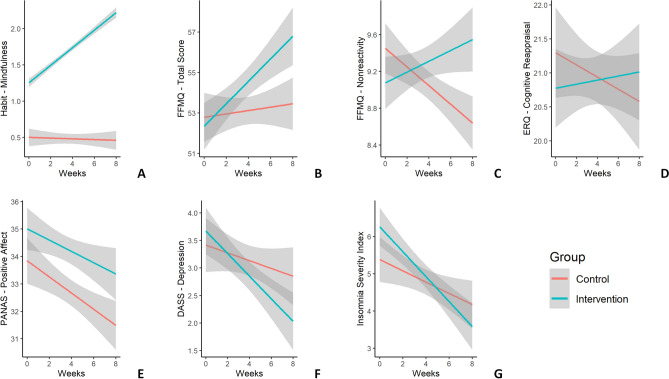
- In longitudinal mixed-effects analyses, the intervention group showed a significant time × group interaction for mindfulness total score: F(1, 109) = 10.64, p = 0.001, with a significant increase over time in the intervention group (b = 0.356, t(119) = 4.18, p < 0.001) and no significant change in controls (b = −0.024, t(103) = −0.30, p = 0.764).
- For mindfulness subscales, nonreactivity showed a significant time × group interaction: F(1, 109) = 8.83, p = 0.004; the control group decreased over time (b = −0.117, p = 0.001) while the intervention group did not change significantly (b = 0.032, p = 0.380). Depression on DASS-21 also showed a significant interaction: F(1, 108) = 4.026, p = 0.047, with depression decreasing in the intervention group (b = −0.169, p < 0.001) and not in controls (b = −0.041, p = 0.350).
- Positive affect showed a trend toward a time × group interaction: F(1, 106.08) = 3.72, p = 0.056; both groups declined, but the control group declined more strongly (b = −0.367, p < 0.001 vs. intervention b = −0.163, p = 0.039). Insomnia also showed a non-significant interaction (F(1, 103) = 2.53, p = 0.115), but the intervention group had a significant decrease over time (b = −0.245, p < 0.001).
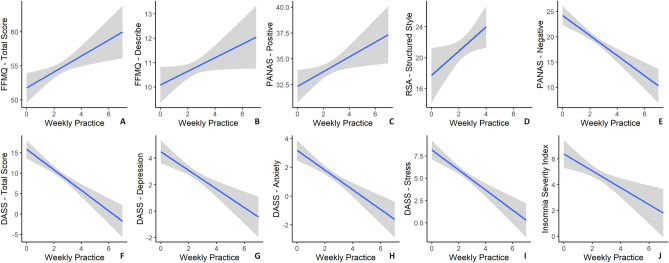
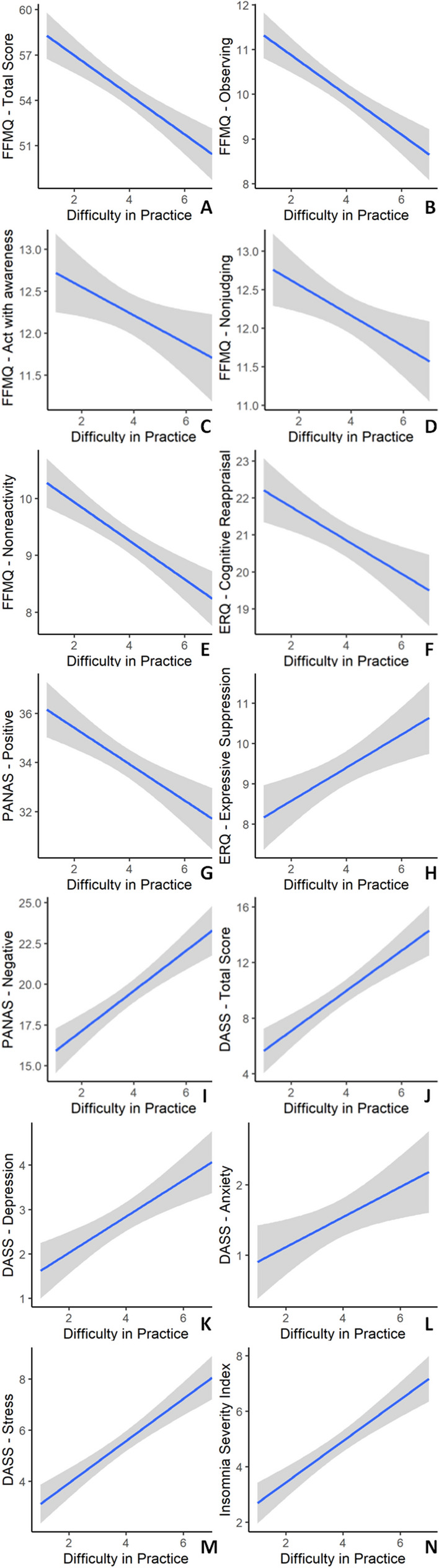
- In the intervention group, frequency of practice was positively correlated with FFMQ total score, FFMQ-Describe, PANAS positive affect, and RSA structured style, and negatively correlated with PANAS negative affect, DASS total score, DASS depression, DASS anxiety, DASS stress, and ISI. Perceived difficulty in weekly practice showed the opposite pattern, and frequency and difficulty were strongly negatively correlated (r = −0.521, p < 0.001).
## Methods
- Design: 8-week online mindfulness-based intervention based on the MBSR protocol, compared with a no-treatment control group; weekly online surveys were collected during the intervention, with pre/post surveys and weekly assessments.
- Sample/data: 132 participants initially; longitudinal analyses included 69 intervention participants and 63 control participants. Participants were recruited from a large-scale banking group, post-graduate university students, and acquaintances; inclusion required no psychiatric record.
- Main analysis: Mixed-effects linear models tested the time × group interaction for habits and questionnaire subscales, controlling for participant origin and baseline differences in FFMQ acting with awareness; within the intervention group, Pearson correlations examined links between practice frequency/difficulty and outcome measures.
## Limitations
- The paper states there was no follow-up measure, so it could not test whether effects lasted through the second COVID-19 wave.
- The paper states there was no direct comparison with an in-person mindfulness program, limiting generalizability across delivery modes.
- The paper states the sampling was not fully randomized because 28 participants recruited from outside the banking group were added to the control group to balance sample sizes; this could bias results.
- Evident from the text: the control group was no-treatment, so the study cannot separate mindfulness effects from non-specific effects of receiving structured weekly trainer contact and guided practice in the intervention group.
Model-written summary. Check it against the paper before relying on it.
Integrity signals
Registry
Cites
Statistics
Figures
Verification
Claims the paper makes
26 Valid · 0 Not valid · 14 Not checked · 61 Own results and interpretations
The cited sources support only part of this claim — read each source’s verdict below.
In the paper
“an extensive meta-analysis24 demonstrated significantly larger effect sizes for guided online mindfulness-based interventions compared to unguided ones.”
§ Mindfulness-based online intervention increases well-being and decreases stress after Covid-19 lockdown > Introduction > Online mindfulness training programs and Covid-19 pandemic
What the sources say
- Partly supportedcites [24] Spijkerman MPJ Pots WTM Bohlmeijer ET Effectiveness of online mindfulness-based interventions in improving mental health: A review and meta-analysis of randomised controlled trials Clin. Psychol. Rev. 2016 45 102 114 10.1016/j.cpr.2016.03.009 27111302 sourceExperimental — accuracy not yet measured
Section 4.1 (Main findings) reports significantly larger effect sizes with therapist guidance for stress and mindfulness. It found no significant influence of guidance on depression, anxiety, or well-being, so the unqualified claim is too broad; the authors also caution that the subgroup analyses were underpowered. (LLM, conf=0.90)
boostedstates a cause- Asserted: passes — The authors put it forward as true.
- Checkable: passes — It can be checked against evidence.
- Load-bearing: unclear — It is unclear whether the paper’s conclusions depend on it.
- Based: passes — The paper gives a reason why it holds.
- Partly supported
The cited sources support only part of this claim — read each source’s verdict below.
In the paper
“This result is in line with previous literature showing analogous results17,18 and supports thus the hypothesis of overlap between “mindfulness” and “emotion regulation” theoretical constructs14”
§ Mindfulness-based online intervention increases well-being and decreases stress after Covid-19 lockdown > Discussion
What the sources say
- Partly supportedcites [17] Fazia T Short-term meditation training fosters mindfulness and emotion regulation: A pilot study Front. Psychol. 2020 11 558803 10.3389/fpsyg.2020.558803 33192816 PMC7649763 sourceExperimental — accuracy not yet measured
The Discussion (page unavailable) says self-awareness and emotion regulation are closely related and suggests that meditation may affect both. The Results report improvements in mindfulness and cognitive reappraisal, but the paper does not establish overlap between the two theoretical constructs; that is a broader interpretation of its findings. (LLM, conf=0.78)
- Not checked — no full text of the sourcecites [18] Patel NK Nivethitha L Mooventhan A Effect of a Yoga based meditation technique on emotional regulation, self-compassion and mindfulness in college students Explore 2018 14 443 447 10.1016/j.explore.2018.06.008 30366832 source
- Not checked — no full text of the sourcecites [14] Roemer L Williston SK Rollins LG Mindfulness and emotion regulation Curr. Opin. Psychol. 2015 3 52 57 10.1016/j.copsyc.2015.02.006 source
plainstates an association- Asserted: passes — The authors put it forward as true.
- Checkable: passes — It can be checked against evidence.
- Load-bearing: unclear — It is unclear whether the paper’s conclusions depend on it.
- Based: passes — The paper gives a reason why it holds.
- Partly supported
The cited sources support only part of this claim — read each source’s verdict below.
In the paper
“The effects of mindfulness training on mindfulness, depression and insomnia are now quite renowned8,10,21,53 and the mechanism guiding all these changes seems to be the increase in mindful attitude towards one’s own experience, in particular in terms of acceptance, nonreactivity and nonjudgment54–57.”
§ Mindfulness-based online intervention increases well-being and decreases stress after Covid-19 lockdown > Discussion
What the sources say
- Not checked — no full text of the sourcecites [54] Alsubaie M Mechanisms of action in mindfulness-based cognitive therapy (MBCT) and mindfulness-based stress reduction (MBSR) in people with physical and/or psychological conditions: A systematic review Clin. Psychol. Rev. 2017 55 74 91 10.1016/j.cpr.2017.04.008 28501707 source
- Partly supportedcites [55] Chin B Psychological mechanisms driving stress resilience in mindfulness training: A randomized controlled trial Health Psychol. 2019 38 759 768 10.1037/hea0000763 31120272 PMC6681655 sourceExperimental — accuracy not yet measured
The Discussion reports that acceptance training increased non-judgment and may help explain mindfulness training’s stress-reduction benefits. It does not establish this mechanism for changes in depression or insomnia; the Discussion also says the study could not test whether non-judgment mediated the stress effect. (LLM, conf=0.88)
- Not checked — no full text of the sourcecites [56] Gu J Strauss C Bond R Cavanagh K How do mindfulness-based cognitive therapy and mindfulness-based stress reduction improve mental health and wellbeing? A systematic review and meta-analysis of mediation studies Clin. Psychol. Rev. 2015 37 1 12 10.1016/j.cpr.2015.01.006 25689576 source
- Partly supportedcites [57] Nyklíček I Kuijpers KF Effects of mindfulness-based stress reduction intervention on psychological well-being and quality of life: Is increased mindfulness indeed the mechanism? Ann. Behav. Med. 2008 35 331 340 10.1007/s12160-008-9030-2 18535870 PMC2517090 sourceExperimental — accuracy not yet measured
The Discussion (page unavailable) reports that increased general mindfulness mediated improvements in perceived stress and quality of life, partly in vital exhaustion. It explicitly found no mediation by accepting without judgment, and the paper does not establish this mechanism for depression or insomnia or assess nonreactivity as a mediator. (LLM, conf=0.87)
hedgedstates a possible cause- Asserted: passes — The authors put it forward as true.
- Checkable: passes — It can be checked against evidence.
- Load-bearing: unclear — It is unclear whether the paper’s conclusions depend on it.
- Based: passes — The paper gives a reason why it holds.
Every source the paper cites for this claim was checked and supports it.
In the paper
“However, recent literature40 compared online vs. in-person mindfulness-based interventions during Covid-19 lockdown, finding comparable effects on stress from the two categories of training.”
§ Mindfulness-based online intervention increases well-being and decreases stress after Covid-19 lockdown > Discussion > Limitations
What the sources say
- Supportedcites [40] Lim, J., Leow, Z., Ong, J., Pang, L.-S. & Lim, E. Effects of Web-Based Group Mindfulness Training on Stress and Sleep Quality in Singapore During the COVID-19 Pandemic: Retrospective Equivalence Analysis (Preprint). http://preprints.jmir.org/preprint/21757 (2020) 10.2196/preprints.21757. PMC7962857 33482627 source
The Results > Perceived Stress section reports that web-based training during the pandemic was equivalent to in-person training in reducing stress. The Methods > Aim and Hypotheses section places the web-based group in the partial-lockdown period and identifies the in-person comparison groups as trained earlier, during or before the pandemic. (LLM, conf=0.91)
plain- Asserted: passes — The authors put it forward as true.
- Checkable: passes — It can be checked against evidence.
- Load-bearing: unclear — It is unclear whether the paper’s conclusions depend on it.
- Based: passes — The paper gives a reason why it holds.
- Supported
The cited sources support only part of this claim — read each source’s verdict below.
In the paper
“The presence of trainers for weekly practice presentations is another crucial aspect of online interventions that was acknowledged in our research since guided online mindfulness-based interventions showed a larger effect size compared to unguided ones24.”
§ Mindfulness-based online intervention increases well-being and decreases stress after Covid-19 lockdown > Discussion
What the sources say
- Partly supportedcites [24] Spijkerman MPJ Pots WTM Bohlmeijer ET Effectiveness of online mindfulness-based interventions in improving mental health: A review and meta-analysis of randomised controlled trials Clin. Psychol. Rev. 2016 45 102 114 10.1016/j.cpr.2016.03.009 27111302 sourceExperimental — accuracy not yet measured
Section 4.1 (Main findings) reports significantly larger effect sizes for guided online MBIs on stress and mindfulness. It found no significant influence of guidance on depression, anxiety, or well-being, and cautions that the subgroup analyses were underpowered. The unqualified claim is therefore broader than the findings. (LLM, conf=0.88)
plainstates a cause- Asserted: passes — The authors put it forward as true.
- Checkable: passes — It can be checked against evidence.
- Load-bearing: unclear — It is unclear whether the paper’s conclusions depend on it.
- Based: passes — The paper gives a reason why it holds.
- Partly supported
19 more claims
Create a free account to see all 101 claims and to verify the 2 references still open.
- Probably not a substantial claim. 37
- It may state two separate claims as one. 55
- The quote only partly states this claim. 1
Claims other papers make about this one
Each is checked against this paper’s own text: does it say what the citing paper says it does?
The cited source doesn’t support the claim as written.
In the citing paper
“In contrast, Bossi et al. (2022) found that an online mindfulness intervention implemented in Italy during the COVID-19 lockdown strongly improved the nonreactivity facet compared to the other facets.”
From RESILIENCE, COPING, AND THE COVID-19 PANDEMIC ACROSS THE GLOBE – AN UPDATE: WHAT HAVE WE LEARNED? (2023) · doi:10.36131/cnfioritieditore20230411 · cites this paper as Bossi et al., 2022
Checked by a reasoning model — may be wrong.
Experimental — accuracy not yet measuredThe source backs part of the claim, not all of it — or backs it for a different population, condition or comparison.
In the citing paper
“For PANAS score, previous trials indicate that mindfulness intervention might improve positive affect (Bossi et al. 2022) and negative affect (Glück & Maercker 2011).”
From Changes in Mental Health and EEG Biomarkers of Undergraduates Under Different Patterns of Mindfulness (2024) · cites this paper as Bossi et al. 2022
Experimental — accuracy not yet measuredThe source backs part of the claim, not all of it — or backs it for a different population, condition or comparison.
In the citing paper
“Mindfulness-based Intervention (MBI) has been found to be effective in improving patients’ level of trait mindfulness, including mindfulness assessed with self-report measures26–28”
From Rational thinking as a mediator of the relationship between mindfulness and dental anxiety (2023) · cites this paper as [27]
Experimental — accuracy not yet measured
Statistics that don’t add up
Each reported p-value recomputed from its test statistic and degrees of freedom, each partial η² from its F, and each ratio, mean difference or B printed with a p checked against its own confidence interval.
Rated minor: it would not touch a result — a value no result rests on, a p-value that stays on the same side of the significance level, or a conflict that is clerical, resolved elsewhere in the paper, or outside its own findings.
In the paper
“F(1, 111) = 0.38, p = 0.845”
§ Mindfulness-based online intervention increases well-being and decreases stress after Covid-19 lockdown > Results > Longitudinal analyses
Reported p = .845 · recomputed p = .539
Statistics recomputed
Every reported test result, recomputed from its test statistic and degrees of freedom. A result shows as not adding up only once an independent check has confirmed it.
- Doesn’t add upF(1, 111) = 0.38reported p = .845 · recomputed p = .539
“F(1, 111) = 0.38, p = .845”
- ConsistentF(1, 112) = 44.3reported p < .001 · recomputed p < .001
“F(1, 112) = 44.30, p < .001”
- Consistentt(127) = 8.95reported p < .001 · recomputed p < .001
“t(127) = 8.95, p < .001”
- Consistentt(102) = -0.03reported p = .976 · recomputed p = .976
“t(102) = − 0.03, p = .976”
- ConsistentF(1, 112) = 4.35reported p = .039 · recomputed p = .039
“F(1, 112) = 4.35, p = .039”
27 more recomputed tests
Create a free account to see every test the Stats check recomputed.
Self-check
Percentages, sums and reported differences re-computed from the paper’s own numbers.
Self-check results appear here once an independent check has confirmed them.
Citations
Cites
Development and validation of brief measures of positive and negative affect: The PANAS scales.
Watson, D., Clark, L. A., & Tellegen, A. (1988) · Journal of Personality and Social Psychology · doi:10.1037/0022-3514.54.6.1063 · Cited by 32,433
lmerTest Package: Tests in Linear Mixed Effects Models
Kuznetsova, A., Brockhoff, P. B., & Christensen, R. H. B. (2017) · Journal of Statistical Software · doi:10.18637/jss.v082.i13 · Cited by 24,346
ggplot2: Elegant Graphics for Data Analysis
Wickham, H. (2009) · doi:10.1007/978-0-387-98141-3 · Cited by 14,447
Gross, J. J., & John, O. P. (2003) · Journal of Personality and Social Psychology · doi:10.1037/0022-3514.85.2.348 · Cited by 11,929
Estimating the reproducibility of psychological science
Open Science Collaboration (2015) · Science · doi:10.1126/science.aac4716 · Cited by 8,515
Antony, M. M., Bieling, P. J., Cox, B. J., Enns, M. W., & Swinson, R. P. (1998) · Psychological Assessment · doi:10.1037/1040-3590.10.2.176 · Cited by 4,874
Morin, C. M., Belleville, G., Bélanger, L., & Ivers, H. (2011) · Sleep · doi:10.1093/sleep/34.5.601 · Cited by 4,620
Mindfulness-based stress reduction and health benefits
Grossman, P., Niemann, L., Schmidt, S., & Walach, H. (2004) · Journal of Psychosomatic Research · doi:10.1016/s0022-3999(03)00573-7 · Cited by 3,958
The effect of mindfulness based therapy on anxiety and depression: A meta analytic review
Hofmann, S. G., Sawyer, A. T., Witt, A. A., & Oh, D. (2010) · Journal of Consulting and Clinical Psychology · doi:10.1037/a0018555 · Cited by 3,846
Mindfulness-based therapy: a comprehensive meta-analysis
Khoury, B., Lecomte, T., Fortin, G., Masse, M., Therien, P., Bouchard, V., Chapleau, M.-A., Paquin, K., & Hofmann, S. G. (2013) · Clinical Psychology Review · doi:10.1016/j.cpr.2013.05.005 · Cited by 2,003
SARS control and psychological effects of quarantine, Toronto, Canada
Hawryluck, L., Gold, W. L., Robinson, S., Pogorski, S., Galea, S., & Styra, R. (2004) · Emerging Infectious Diseases · doi:10.3201/eid1007.030703 · Cited by 1,929
Carmody, J., & Baer, R. A. (2008) · Journal of Behavioral Medicine · doi:10.1007/s10865-007-9130-7 · Cited by 1,823
Gu, J., Strauss, C., Bond, R., & Cavanagh, K. (2015) · Clinical Psychology Review · doi:10.1016/j.cpr.2015.01.006 · Cited by 1,712
Chiesa, A., & Serretti, A. (2009) · The Journal of Alternative and Complementary Medicine · doi:10.1089/acm.2008.0495 · Cited by 1,681
Mindfulness-based stress reduction for healthy individuals: A meta-analysis
Khoury, B., Sharma, M., Rush, S. E., & Fournier, C. (2015) · Journal of Psychosomatic Research · doi:10.1016/j.jpsychores.2015.03.009 · Cited by 1,617
Van Dam, N. T., van Vugt, M. K., Vago, D. R., Schmalzl, L., Saron, C. D., Olendzki, A., Meissner, T., Lazar, S. W., Kerr, C. E., Gorchov, J., et al. (2018) · Perspectives on Psychological Science · doi:10.1177/1745691617709589 · Cited by 1,506
Mindfulness-based stress reduction and health benefits: A meta-analysis
Grossman, P., Niemann, L., Schmidt, S., & Walach, H. (2003) · Focus on Alternative and Complementary Therapies · doi:10.1111/j.2042-7166.2003.tb04008.x · Cited by 1,394
Mindful emotion regulation: an integrative review
Chambers, R., Gullone, E., & Allen, N. B. (2009) · Clinical Psychology Review · doi:10.1016/j.cpr.2009.06.005 · Cited by 1,360
Friborg, O., Hjemdal, O., Rosenvinge, J. H., & Martinussen, M. (2003) · International Journal of Methods in Psychiatric Research · doi:10.1002/mpr.143 · Cited by 1,348
Mental health status of people isolated due to Middle East Respiratory Syndrome
Jeong, H., Yim, H. W., Song, Y.-J., Ki, M., Min, J.-A., Cho, J., & Chae, J.-H. (2016) · Epidemiology and Health · doi:10.4178/epih.e2016048 · Cited by 1,103
Bates, D. M., Kliegl, R. M., Vasishth, S., & Baayen, R. H. (2015) · arXiv (Cornell University) · doi:10.48550/arxiv.1506.04967 · Cited by 1,008
Spijkerman, M. P. J., Pots, W. T. M., & Bohlmeijer, E. T. (2016) · Clinical Psychology Review · doi:10.1016/j.cpr.2016.03.009 · Cited by 975
Preventing problematic internet use during the COVID-19 pandemic: Consensus guidance
Király, O., Potenza, M. N., Stein, D. J., King, D. L., Hodgins, D. C., Saunders, J. B., Griffiths, M. D., Gjoneska, B., Billieux, J., Brand, M., et al. (2020) · Comprehensive Psychiatry · doi:10.1016/j.comppsych.2020.152180 · Cited by 820
Understanding the Intention-to-treat Principle in Randomized Controlled Trials
McCoy, E. (2017) · Western Journal of Emergency Medicine · doi:10.5811/westjem.2017.8.35985 · Cited by 767
Mindfulness-Based Interventions for Anxiety and Depression
Hofmann, S. G., & Gómez, A. F. (2017) · Psychiatric Clinics of North America · doi:10.1016/j.psc.2017.08.008 · Cited by 756
Bottesi, G., Ghisi, M., Altoè, G., Conforti, E., Melli, G., & Sica, C. (2015) · Comprehensive Psychiatry · doi:10.1016/j.comppsych.2015.04.005 · Cited by 701
Mindfulness meditation and the immune system: a systematic review of randomized controlled trials
Black, D. S., & Slavich, G. M. (2016) · Annals of the New York Academy of Sciences · doi:10.1111/nyas.12998 · Cited by 599
Parsons, C. E., Crane, C., Parsons, L. J., Fjorback, L. O., & Kuyken, W. (2017) · Behaviour Research and Therapy · doi:10.1016/j.brat.2017.05.004 · Cited by 550
Weekly change in mindfulness and perceived stress in a mindfulness-based stress reduction program
Baer, R. A., Carmody, J., & Hunsinger, M. (2012) · Journal of Clinical Psychology · doi:10.1002/jclp.21865 · Cited by 546
Nyklíček, I., & Kuijpers, K. F. (2008) · Annals of Behavioral Medicine · doi:10.1007/s12160-008-9030-2 · Cited by 532
Huberty, J., Green, J., Glissmann, C., Larkey, L., Puzia, M., & Lee, C. (2019) · JMIR mHealth and uHealth · doi:10.2196/14273 · Cited by 488
Factorial and Construct Validity of the Italian Positive and Negative Affect Schedule (PANAS)
Terracciano, A., McCrae, R. R., & Costa, P. T., Jr. (2003) · European Journal of Psychological Assessment · doi:10.1027//1015-5759.19.2.131 · Cited by 476
Mindfulness on-the-go: Effects of a mindfulness meditation app on work stress and well-being
Bostock, S., Crosswell, A. D., Prather, A. A., & Steptoe, A. (2019) · Journal of Occupational Health Psychology · doi:10.1037/ocp0000118 · Cited by 465
Mindfulness Meditation and Psychopathology
Wielgosz, J., Goldberg, S. B., Kral, T. R. A., Dunne, J. D., & Davidson, R. J. (2019) · Annual Review of Clinical Psychology · doi:10.1146/annurev-clinpsy-021815-093423 · Cited by 435
Effects of Mindfulness-Based Stress Reduction on employees’ mental health: A systematic review
Janssen, M., Heerkens, Y., Kuijer, W., van der Heijden, B., & Engels, J. (2018) · PLOS ONE · doi:10.1371/journal.pone.0191332 · Cited by 415 · cited 1×
“, no changes over time) when the control group experienced a worsening of psychological well-being and higher stress; (3) positive correlation between frequency of practice and indices of well-being, and difficulty perceived in practicing and indices of stress; negative correlation between frequency of practice and in…”
BackgroundMindfulness and emotion regulation
Roemer, L., Williston, S. K., & Rollins, L. G. (2015) · Current Opinion in Psychology · doi:10.1016/j.copsyc.2015.02.006 · Cited by 411
An Italian Adaptation of the Emotion Regulation Questionnaire
Balzarotti, S., John, O. P., & Gross, J. J. (2010) · European Journal of Psychological Assessment · doi:10.1027/1015-5759/a000009 · Cited by 403
Students’ mental health problems before, during, and after COVID-19 lockdown in Italy
Meda, N., Pardini, S., Slongo, I., Bodini, L., Zordan, M. A., Rigobello, P., Visioli, F., & Novara, C. (2021) · Journal of Psychiatric Research · doi:10.1016/j.jpsychires.2020.12.045 · Cited by 398
Alsubaie, M., Abbott, R., Dunn, B., Dickens, C., Keil, T. F., Henley, W., & Kuyken, W. (2017) · Clinical Psychology Review · doi:10.1016/j.cpr.2017.04.008 · Cited by 383
Sharma, M., & Rush, S. E. (2014) · Journal of Evidence-Based Complementary & Alternative Medicine · doi:10.1177/2156587214543143 · Cited by 342
Mindfulness Goes to Work: Impact of an Online Workplace Intervention
Aikens, K. A., Astin, J., Pelletier, K. R., Levanovich, K., Baase, C. M., Park, Y. Y., & Bodnar, C. M. (2014) · Journal of Occupational & Environmental Medicine · doi:10.1097/jom.0000000000000209 · Cited by 338
Gotink, R. A., Meijboom, R., Vernooij, M. W., Smits, M., & Hunink, M. G. M. (2016) · Brain and Cognition · doi:10.1016/j.bandc.2016.07.001 · Cited by 338
Caldwell, K., Harrison, M., Adams, M., Quin, R. H., & Greeson, J. (2010) · Journal of American College Health · doi:10.1080/07448480903540481 · Cited by 335
A Randomized Controlled Trial of Mindfulness Meditation for Chronic Insomnia
Ong, J. C., Manber, R., Segal, Z., Xia, Y., Shapiro, S., & Wyatt, J. K. (2014) · Sleep · doi:10.5665/sleep.4010 · Cited by 332
Meditation Programs for Psychological Stress and Well-being: A Systematic Review and Meta-analysis
Goyal, M., Singh, S., Sibinga, E., Gould, N., Rowland-Seymour, A., Sharma, R., Berger, Z., Sleicher, D., Maron, D., Shihab, H., et al. (2014) · Deutsche Zeitschrift für Akupunktur · doi:10.1016/j.dza.2014.07.007 · Cited by 298
The Effects of Mindfulness-Based Stress Reduction on Sleep Disturbance: A Systematic Review
Winbush, N. Y., Gross, C. R., & Kreitzer, M. J. (2007) · EXPLORE · doi:10.1016/j.explore.2007.08.003 · Cited by 271
Validation study of the Italian version of the Insomnia Severity Index (ISI)
Castronovo, V., Galbiati, A., Marelli, S., Brombin, C., Cugnata, F., Giarolli, L., Anelli, M. M., Rinaldi, F., & Ferini-Strambi, L. (2016) · Neurological Sciences · doi:10.1007/s10072-016-2620-z · Cited by 217
Online Learning during the COVID- 19 Pandemic and Academic Stress in University Students
Moawad, R. A. (2020) · Revista Romaneasca pentru Educatie Multidimensionala · doi:10.18662/rrem/12.1sup2/252 · Cited by 217
Matiz, A., Fabbro, F., Paschetto, A., Cantone, D., Paolone, A. R., & Crescentini, C. (2020) · International Journal of Environmental Research and Public Health · doi:10.3390/ijerph17186450 · Cited by 204
Mindful emotion regulation: Exploring the neurocognitive mechanisms behind mindfulness
Grecucci, A., Pappaianni, E., Siugzdaite, R., Theuninck, A., & Job, R. (2015) · BioMed Research International · doi:10.1155/2015/670724 · Cited by 201
The future of mindfulness training is digital, and the future is now
Mrazek, A. J., Mrazek, M. D., Cherolini, C. M., Cloughesy, J. N., Cynman, D. J., Gougis, L. J., Landry, A. P., Reese, J. V., & Schooler, J. W. (2019) · Current Opinion in Psychology · doi:10.1016/j.copsyc.2018.11.012 · Cited by 201
Does mindfulness improve outcomes in patients with chronic pain? Systematic review and meta-analysis
Bawa, F. L. M., Mercer, S. W., Atherton, R. J., Clague, F., Keen, A., Scott, N. W., & Bond, C. M. (2015) · British Journal of General Practice · doi:10.3399/bjgp15x685297 · Cited by 197
Happier Healers: Randomized Controlled Trial of Mobile Mindfulness for Stress Management
Yang, E., Schamber, E., Meyer, R. M. L., & Gold, J. I. (2018) · The Journal of Alternative and Complementary Medicine · doi:10.1089/acm.2015.0301 · Cited by 194
Krusche, A., Cyhlarova, E., & Williams, J. M. G. (2013) · BMJ Open · doi:10.1136/bmjopen-2013-003498 · Cited by 192
Wei, N., Huang, B.-C., Lu, S.-J., Hu, J.-B., Zhou, X.-Y., Hu, C.-C., Chen, J.-K., Huang, J.-W., Li, S.-G., Wang, Z., et al. (2020) · Journal of Zhejiang University-SCIENCE B · doi:10.1631/jzus.b2010013 · Cited by 173
Mindfulness-based interventions for chronic pain: evidence and applications
Majeed, M. H., Ali, A. A., & Sudak, D. M. (2018) · Asian Journal of Psychiatry · doi:10.1016/j.ajp.2017.11.025 · Cited by 173
Effects of Mindfulness Meditation on Chronic Pain: A Randomized Controlled Trial
la Cour, P., & Petersen, M. (2015) · Pain Medicine · doi:10.1111/pme.12605 · Cited by 163
Effects of mindfulness meditation on mindfulness, mental well-being, and perceived stress
Zollars, I., Poirier, T. I., & Pailden, J. (2019) · Currents in Pharmacy Teaching and Learning · doi:10.1016/j.cptl.2019.06.005 · Cited by 151
Psychological distress associated with the COVID-19 lockdown: A two-wave network analysis
Di Blasi, M., Gullo, S., Mancinelli, E., Freda, M. F., Esposito, G., Gelo, O. C. G., Lagetto, G., Giordano, C., Mazzeschi, C., Pazzagli, C., et al. (2021) · Journal of Affective Disorders · doi:10.1016/j.jad.2021.02.016 · Cited by 143
The Italian five facet mindfulness questionnaire: A contribution to its validity and reliability
Giovannini, C., Giromini, L., Bonalume, L., Tagini, A., Lang, M., & Amadei, G. (2014) · Journal of Psychopathology and Behavioral Assessment · doi:10.1007/s10862-013-9403-0 · Cited by 142
Linardon, J. (2020) · Behavior Therapy · doi:10.1016/j.beth.2019.10.002 · Cited by 133
Prasada, K. D. V., Vaidyab, R. W., & Mangipudic, M. R. (2020) · Indian Journal of Commerce & Management Studies · doi:10.18843/ijcms/v11i2/01 · Cited by 129
Psychological Impact of the COVID-19 Pandemic on Adults and Their Children in Italy
Davico, C., Ghiggia, A., Marcotulli, D., Ricci, F., Amianto, F., & Vitiello, B. (2021) · Frontiers in Psychiatry · doi:10.3389/fpsyt.2021.572997 · Cited by 122
Psychological Impact of the COVID-19 Pandemic on Adults and Their Children in Italy
Davico, C., Ghiggia, A., Marcotulli, D., Ricci, F., Amianto, F., & Vitiello, B. (2020) · doi:10.2139/ssrn.3576933 · Cited by 122
Yuan, Y. (2021) · Personality and Individual Differences · doi:10.1016/j.paid.2020.110560 · Cited by 107
Chin, B., Lindsay, E. K., Greco, C. M., Brown, K. W., Smyth, J. M., Wright, A. G. C., & Creswell, J. D. (2019) · Health Psychology · doi:10.1037/hea0000763 · Cited by 103
Goldberg, S. B., Imhoff-Smith, T., Bolt, D. M., Wilson-Mendenhall, C. D., Dahl, C. J., Davidson, R. J., & Rosenkranz, M. A. (2020) · JMIR Mental Health · doi:10.2196/23825 · Cited by 97
Goldberg, S. B., Imhoff-Smith, T., Bolt, D. M., Wilson-Mendenhall, C. D., Dahl, C. J., Davidson, R. J., & Rosenkranz, M. A. (2020) · doi:10.2196/preprints.23825 · Cited by 97
Mak, W. W., Chio, F. H., Chan, A. T., Lui, W. W., & Wu, E. K. (2017) · Journal of Medical Internet Research · doi:10.2196/jmir.6737 · Cited by 94
Encouraging Mindfulness in Medical House Staff via Smartphone App: A Pilot Study
Wen, L., Sweeney, T. E., Welton, L., Trockel, M., & Katznelson, L. (2017) · Academic Psychiatry · doi:10.1007/s40596-017-0768-3 · Cited by 94
The Italians in the Time of Coronavirus: Psychosocial Aspects of the Unexpected COVID-19 Pandemic
Favieri, F., Forte, G., Tambelli, R., & Casagrande, M. (2021) · Frontiers in Psychiatry · doi:10.3389/fpsyt.2021.551924 · Cited by 94
Patel, N. K., Nivethitha, L., & Mooventhan, A. (2018) · EXPLORE · doi:10.1016/j.explore.2018.06.008 · Cited by 86
Nadler, R., Carswell, J. J., & Minda, J. P. (2020) · Frontiers in Psychology · doi:10.3389/fpsyg.2020.00255 · Cited by 83
Mindfulness buffers the impact of COVID-19 outbreak information on sleep duration.
Zheng, M. X., Yao, J., & Narayanan, J. (2020) · doi:10.31234/osf.io/wuh94 · Cited by 77
Lai, K. S. P., Watt, C., Ionson, E., Baruss, I., Forchuk, C., Sukhera, J., Burhan, A. M., & Vasudev, A. (2020) · Trials · doi:10.1186/s13063-020-04583-w · Cited by 56
The Italians in the Time of Coronavirus: Psychosocial Aspects of Unexpected COVID-19 Pandemic
Favieri, F., Forte, G., Tambelli, R., & Casagrande, M. (2020) · doi:10.2139/ssrn.3576804 · Cited by 50
What is mindfulness, and why should organizations care about it?
Shapiro, S. L., Wang, M. C., & Peltason, E. H. (2015) · Mindfulness in Organizations · doi:10.1017/cbo9781107587793.004 · Cited by 48
Bäuerle, A., Graf, J., Jansen, C., Musche, V., Schweda, A., Hetkamp, M., Weismüller, B., Dörrie, N., Junne, F., Teufel, M., et al. (2020) · BMJ Open · doi:10.1136/bmjopen-2020-039646 · Cited by 47
Lim, J., Leow, Z., Ong, J., Pang, L.-S., & Lim, E. (2020) · doi:10.2196/preprints.21757 · Cited by 33
O’Donnell, K. T., Dunbar, M., & Speelman, D. L. (2020) · Trials · doi:10.1186/s13063-020-04935-6 · Cited by 25
Orfei, M. D., Bossi, F., D'Arcangelo, S., Maggi, F., Lattanzi, N., Malizia, A. P., & Ricciardi, E. (2022) · Acta Psychologica · doi:10.1016/j.actpsy.2022.103555 · Cited by 23
Self-citationShort-Term Meditation Training Fosters Mindfulness and Emotion Regulation: A Pilot Study
Fazia, T., Bubbico, F., Iliakis, I., Salvato, G., Berzuini, G., Bruno, S., & Bernardinelli, L. (2020) · Frontiers in Psychology · doi:10.3389/fpsyg.2020.558803 · Cited by 22
Gallucci, F. (2021) · Catalysis Today · doi:10.1016/j.cattod.2021.01.001
Research works printed but not linked: 1
- Capanna C Stratta P Hjemdal O Collazzoni A Rossi A The Italian validation study of the resilience scale for adults (RSA) BPA Appl. Psychol. Bull. Boll. Psicol. Appl. 2015 63 272 16 24
Cited by
Mindfulness-based interventions for anxiety and depression
Bhattacharya, S., & Hofmann, S. G. (2023) · Clinics in Integrated Care · doi:10.1016/j.intcar.2023.100138 · Cited by 36
Tang, L., Yu, X., Wu, Y., Zhao, N., Liang, R.-L., Gao, X., Jiang, W., Chen, Y.-F., & Yang, W. (2023) · Frontiers in Public Health · doi:10.3389/fpubh.2022.1019635 · Cited by 54
“In another pilot study, researchers chose mindfulness therapy based on an online app, which has also been shown to help reduce the stress and negative emotions of medical and non-medical participants, thereby improving burnout (52, 53).”
BackgroundKaring, C. (2022) · Applied Psychology Health and Well-Being · doi:10.1111/aphw.12408 · Cited by 41
Poetar, C.-R., Bradley, N., & Voinescu, A. (2023) · Frontiers in Psychology · doi:10.3389/fpsyg.2023.1157469 · Cited by 28
Porter, N. S., & Jason, L. A. (2022) · Neuropsychiatric Disease and Treatment · doi:10.2147/ndt.s379653 · Cited by 24
“This intervention was effective in facilitating mindfulness practice, as well as reducing stress,(178) and increasing well-being.(183) However, there are limitations to the research available, as the above findings are restricted to positive responses on self-report questionnaires of perceived well-being in relatively…”
Background
Metadata
- Authors
- Bossi, F., Zaninotto, F., D’Arcangelo, S., Lattanzi, N., Malizia, A. P., & Ricciardi, E.
- Affiliations
- IMT School for Advanced Studies Lucca (IT)
- Intesa Sanpaolo (Italy) (IT)
- Corresponding author
- Bossi, Francesco
- Venue
- Scientific Reports
- Published
- 2022-04-20
- Volume
- 12
- Issue
- 1
- Pages
- 6483-6483
- ISSN
- 2045-2322 (ISSN-L)
- PMC
- PMC9019542
- OpenAlex
- W4225884591
- Semantic Scholar
- 7fa8158d80f8902584cf5f0ebaae1edc2f7bba05
- Cited by
- 74
- References
- 81
- Citations by year
- 2026: 6 · 2025: 20 · 2024: 19 · 2023: 22 · 2022: 7
- FWCI
- 15.51
- Type
- journal article
- Language
- en
- Open access
- gold
- doi.org
- Licence
- cc-by
- creativecommons.org/licenses/by/4.0 (tdm)
- creativecommons.org/licenses/by/4.0 (vor)
- Locations
- Scientific Reports (publishedVersion, cc-by)
- Research Square (acceptedVersion, cc-by)
- PubMed Central (publishedVersion, cc-by)
- PubMed (publishedVersion)
- BOA (University of Milano-Bicocca) (submittedVersion, cc-by)
- DOAJ (DOAJ: Directory of Open Access Journals) (submittedVersion, cc-by-sa)
- Funders
- Intesa Sanpaolo Innovation Center S.p.A.
- Topics
- Social Sciences › Psychology › Clinical Psychology › Mindfulness and Compassion Interventions
- Social Sciences › Psychology › Applied Psychology › Digital Mental Health Interventions
- Social Sciences › Psychology › Clinical Psychology › COVID-19 and Mental Health
- Keywords
- mindfulness-based stress reduction, COVID-19 lockdown, employee well-being, stress, resilience, insomnia, positive affect, negative affect, depression, anxiety, emotion regulation, cognitive reappraisal, expressive suppression, non-reactivity, healthy employees
- MeSH terms
- Internet-Based Intervention, COVID-19, Anxiety, Communicable Disease Control, Depression, Humans, Sleep Initiation and Maintenance Disorders, Stress, Psychological, Mindfulness
About these checks
Registry, retraction, Cites and statistics results are computed, not judged, with one exception: a printed reference that no index lists is read once by a model before it counts as a citation error. Claims are extracted by a model and kept only when their quote appears verbatim in the text; each cited source is then checked, with a model’s help, for whether it says what the claim relies on. Those verdicts can be wrong — read the claim’s quote and the cited source before relying on one.
The claim verdicts this report counts are experimental: their accuracy is not yet measured.
A language model drew the claims from the paper on 2026-10-11, under version 3 of the claim definition (model deepseek-v4.1-flash, prompt extract-v3).
A second model labelled each claim on 2026-10-11 (model jev-1.13-20260917, definition revision gold-guideline-v0.2).
Cited sources are checked with a language model’s help (gpt-6-sol).
Statistics and arithmetic are recomputed, not judged.
Confidence bands are shown only for fields calibrated on our annotated test set. None is calibrated yet, so no band is shown.
What counts as a claim ›How we measure confidence ›How we check this ›
Are you an author, or do you see a problem with this page? Request a review
Data sources
Bibliographic data: Semantic Scholar, OpenAlex, Crossref.
Contains information from the Semantic Scholar Academic Graph Datasets, made available under the ODC Attribution License (ODC-BY 1.0).
Semantic Scholar’s data is described in: Kinney, R., et al. (2023). The Semantic Scholar Open Data Platform. arXiv:2301.10140.
