

A large language model for electronic health records
Open accessThe DOI matches its Crossref record; 77 of the 78 references it cites were found in a registry or an index.
Abstract
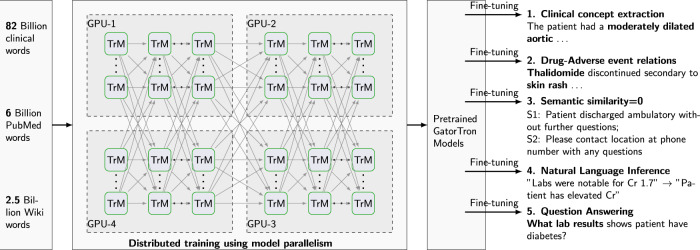
There is an increasing interest in developing artificial intelligence (AI) systems to process and interpret electronic health records (EHRs). Natural language processing (NLP) powered by pretrained language models is the key technology for medical AI systems utilizing clinical narratives. However, there are few clinical language models, the largest of which trained in the clinical domain is comparatively small at 110 million parameters (compared with billions of parameters in the general domain). It is not clear how large clinical language models with billions of parameters can help medical AI systems utilize unstructured EHRs. In this study, we develop from scratch a large clinical language model—GatorTron—using >90 billion words of text (including >82 billion words of de-identified clinical text) and systematically evaluate it on five clinical NLP tasks including clinical concept extraction, medical relation extraction, semantic textual similarity, natural language inference (NLI), and medical question answering (MQA). We examine how (1) scaling up the number of parameters and (2) scaling up the size of the training data could benefit these NLP tasks. GatorTron models scale up the clinical language model from 110 million to 8.9 billion parameters and improve five clinical NLP tasks (e.g., 9.6% and 9.5% improvement in accuracy for NLI and MQA), which can be applied to medical AI systems to improve healthcare delivery. The GatorTron models are publicly available at: https://catalog.ngc.nvidia.com/orgs/nvidia/teams/clara/models/gatortron_og .
Overview
The claims and statistics of this paper haven’t been checked yet.
Free: it reads the open-access text and checks the first 5 claims that cite a source we can check. Create a free account to check every claim.
Integrity signals
Registry
Cites
Statistics
Figures
Verification
Claims the paper makes
The claims and statistics of this paper haven’t been checked yet.
Free: it reads the open-access text and checks the first 5 claims that cite a source we can check. Create a free account to check every claim.
Claims other papers make about this one
Each is checked against this paper’s own text: does it say what the citing paper says it does?
The source backs part of the claim, not all of it — or backs it for a different population, condition or comparison.
In the citing paper
“As 1 example, Wu et al.25 developed and disseminated clinical LLMs such as GatorTron27 and GatorTronGPT28 to address limitations of traditional rule-based machine learning methods, which often lack scalability and transportability across data networks.”
From Advancing methodological development of artificial intelligence in patient-centered comparative clinical effectiveness research: Patient-Centered Outcomes Research Institute’s unique contribution to research done differently (2025) · cites this paper as [27]
Experimental — accuracy not yet measuredThe source backs part of the claim, not all of it — or backs it for a different population, condition or comparison.
In the citing paper
“Recent studies have demonstrated that large transformer models, such as ChatGPT, trained using massive text data, exhibit significant improvements over previous NLP models in terms of emergence and homogenization, which could contribute to enhancing critical thinking skills in students (Yang et al., 2022).”
From Investigating the Use of chatGPT as a Tool for Enhancing Critical Thinking and Argumentation Skills in International Relations Debates among Undergraduate Students (2024) · cites this paper as Yang et al., 2022
Experimental — accuracy not yet measuredThe cited source says what the claim attributes to it.
In the citing paper
“LLMs can be used for EHR analysis and as a clinical decision support tool [40].”
From Generative AI in healthcare: an implementation science informed translational path on application, integration and governance (2024) · cites this paper as [40]
The cited source says what the claim attributes to it.
In the citing paper
“The success of LLMs in the field of neural language processing, as well as their remarkable ability to solve complex tasks, has inspired researchers’ enthusiasm for adapting these models in the biomedical field [185].”
From Challenges in AI-driven Biomedical Multimodal Data Fusion and Analysis (2025) · cites this paper as [185]
The cited source says what the claim attributes to it.
In the citing paper
“AI using EHR data has become much more general and accurate in the last few years,35,36 allowing prediction of perioperative events37–41 and learning effective treatment strategies.42”
From Potential uses of AI for perioperative nursing handoffs: a qualitative study (2023) · cites this paper as [35]
3 more claims about this paper
Create a free account to see every claim other papers make about this one.
Self-check
Percentages, sums and reported differences re-computed from the paper’s own numbers.
The self-check needs the paper’s full text.
Citations
Cites
Vaswani, A., Shazeer, N., Parmar, N., Uszkoreit, J., Jones, L., Gomez, A. N., Kaiser, L., & Polosukhin, I. (2017) · arXiv · doi:10.48550/arxiv.1706.03762 · Cited by 120,404
LeCun, Y., Bengio, Y., & Hinton, G. (2015) · Nature · doi:10.1038/nature14539 · Cited by 84,126
Exploring the Limits of Transfer Learning with a Unified Text-to-Text Transformer
Raffel, C., Shazeer, N., Roberts, A., Lee, K., Narang, S., Matena, M., Zhou, Y., Li, W., & Liu, P. J. (2019) · arXiv · doi:10.48550/arxiv.1910.10683 · Cited by 31,859 · cited 3×
“On both datasets, pretrained transformer models achieved state-of-the-art performances 27,29 .”
BackgroundAdvances in neural information processing systems 7
Cios, K., & Shields, M. (1997) · Neurocomputing · doi:10.1016/s0925-2312(97)90018-7 · Cited by 22,059
Advances in neural information processing systems 7
(1996) · Computers & Mathematics with Applications · doi:10.1016/s0898-1221(96)90463-0 · Cited by 14,281
MIMIC-III, a freely accessible critical care database
Johnson, A. E. W., Pollard, T. J., Shen, L., Lehman, L.-W. H., Feng, M., Ghassemi, M., Moody, B., Szolovits, P., Anthony Celi, L., & Mark, R. G. (2016) · Scientific Data · doi:10.1038/sdata.2016.35 · Cited by 8,141 · cited 3×
“37 The ClinicalBERT model was developed by further training the BioBERT (base version; 110 million parameters with 12 layers, 768 hidden units, and 12 attention heads) using clinical text from the MIMIC-III 38 corpus.”
MethodInfluentialBioBERT: a pre-trained biomedical language representation model for biomedical text mining
Lee, J., Yoon, W., Kim, S., Kim, D., Kim, S., So, C. H., & Kang, J. (2020) · Bioinformatics · doi:10.1093/bioinformatics/btz682 · Cited by 7,218
XLNet: Generalized Autoregressive Pretraining for Language Understanding
Yang, Z., Dai, Z., Yang, Y., Carbonell, J., Salakhutdinov, R., & Le, Q. V. (2019) · arXiv · doi:10.48550/arxiv.1906.08237 · Cited by 6,687
SQuAD: 100,000+ Questions for Machine Comprehension of Text
Rajpurkar, P., Zhang, J., Lopyrev, K., & Liang, P. (2016) · Proceedings of the 2016 Conference on Empirical Methods in Natural Language Processing · doi:10.18653/v1/d16-1264 · Cited by 6,208
Natural Language Processing (almost) from Scratch
Collobert, R., Weston, J., Bottou, L., Karlen, M., Kavukcuoglu, K., & Kuksa, P. P. (2011) · arXiv (Cornell University) · doi:10.48550/arxiv.1103.0398 · Cited by 4,962 · cited 3×
“…concept extract are often rule-based, yet, most recent systems are based on machine learning models such as conditional random fields (CRFs) 50,51 , convolutional neural networks (CNN) 9,52 , and recurrent neural networks (RNN) implemented with long short-term memory strategy (LSTM) 10,53 .”
BackgroundMethod
Research works printed but not linked: 3
- Adoption of Electronic Health Record Systems among U.S. Non-Federal Acute Care Hospitals: 2008–2015. ONC Data Brief. https://www.healthit.gov/sites/default/files/briefs/2015_hospital_adoption_db_v17.pdf (2016). 40127322
- Yang X Identifying relations of medications with adverse drug events using recurrent convolutional neural networks and gradient boosting J. Am. Med. Inform. Assoc. 2020 27 65 72 10.1093/jamia/ocz144 31504605 PMC7489076 · DOI · Paper page
- Lv X Guan Y Yang J Wu J Clinical relation extraction with deep learning Int. J. Hybrid. Inf. Technol. 2016 9 237 248
Cited by
Items 901–1,000 of 1,005
Ding, Z., Li, Z., Li, X., & Li, H. (2024) · Mathematics · doi:10.3390/math12030488 · Cited by 1
Annotation d'entités cliniques en utilisant les Larges Modèles de Langue
Méoni, S., Ryffel, T., & de la Clergerie, É. V. (2023) · HAL · Cited by 1
Relation Extraction Based on Dual-Path Graph Convolutional Networks
Wang, J., Wu, J., Zhou, L., Zhang, Q., & Zhang, X. (2023) · IEEE International Conference on Internet of Things (iThings) and IEEE Green Computing and Communications (GreenCom) and IEEE Cyber, Physical and Social Computing (CPSCom) and IEEE Smart Data (SmartData) · doi:10.1109/ithings-greencom-cpscom-smartdata-cybermatics60724.2023.00108 · Cited by 1
“The applications of relation extraction are broad and diverse, encompassing but not limited to knowledge graphs [1], news analysis [2], social media monitoring [3], medical diagnosis [4], and knowledge question answering [5].”
BackgroundShaping the Future of Healthcare With BERT in Clinical Text Analytics
Chaudhari, A. K. (2024) · Advances in medical diagnosis, treatment, and care (AMDTC) book series · doi:10.4018/979-8-3693-3629-8.ch012 · Cited by 1
The Point of View of a Sentiment: Towards Clinician Bias Detection in Psychiatric Notes
Valentine, A. A., Lepow, L., Chan, L., Charney, A. W., & Landi, I. (2026) · Language Resources and Evaluation Conference (LREC) · doi:10.63317/2dxaipemahpd · Cited by 1
CTDataHub: An Empowering Solution for Health Data Workers in Oncology Clinical Trials
Kim, B. Y., Yuravlivker, L., Buckley, M. T., Bouvier, N., & Lengfellner, J. M. (2024) · Designing Interactive Systems Conference · doi:10.1145/3656156.3663701 · Cited by 1
Sengupta, S., Rao, R., Kaufman, Z. A., Stuhlmiller, T. J., Wong, K. K., Kesari, S., Shapiro, M. A., & Kramer, G. A. (2024) · North Carolina Medical Journal · doi:10.18043/001c.120572 · Cited by 1
“Following the public release of the LLM known as GPT-3, many organizations have generated models based on similar architecture to create bespoke LLMs trained on health care data to extract and interpret EMR, enabling more personalized clinical recommendations [6–7].”
InfluentialAutomatic Extraction of Disease Risk Factors from Medical Publications
Rubchinsky, M., Rabinovich, E., Shribman, A., Golan, N., Sahar, T., & Shweiki, D. (2024) · Workshop on Biomedical Language Processing (BioNLP) · doi:10.18653/v1/2024.bionlp-1.38 · Cited by 1
Wu, W., Diaz, I. M., & Horwitz, L. I. (2025) · Health Services and Outcomes Research Methodology · doi:10.1007/s10742-025-00355-8 · Cited by 1
“Additionally, they can be utilized to directly extract performance metrics for hospital quality reporting (Yang et al. 2022).”
Frisoni, G. B. (2023) · Nature Reviews Neurology · doi:10.1038/s41582-023-00799-x · Cited by 1
BioLLMBench: A Comprehensive Benchmarking of Large Language Models in BioinformaticsPreprint
Mangul, S., Sarwal, V., Munteanu, V., Suhodolschi, T., Ciorbă, D., Eskin, E., & Wang, W. W. (2024) · Research Square · doi:10.21203/rs.3.rs-3780193/v1 · Cited by 2
Ahmed, A., Rispoli, A., Wasieloski, C., Khurram, I., Zamora‐Resendiz, R., Morrow, D., Dong, A., & Crivelli, S. N. (2024) · medRxiv · doi:10.1101/2024.04.19.24306084 · Cited by 1
“…extraction (e.g., BioBert by Lee et al. (2020), and Blue-Bert by Peng et al. (2019)), medical question answering and inference (e.g., GatorTron by Yang et al. (2022), and Med-PaLM by Singhal et al. (2023)), discharge summaries (e.g., ChatGPT by Patel and Lam (2023)), diagnosis classification…”
BackgroundMethodBian, J., Peng, Y., Mendonça, E. A., Banerjee, I., Xu, H., Sun, H. F., Ye, Y., Taylor, C. O., Lourenço, A. M. G., Rodríguez‐González, A., et al. (2024) · Journal of Biomedical Informatics · doi:10.1016/j.jbi.2024.104703 · Cited by 1
Self-citationRebaud, L., Capobianco, N., Captier, N., Escobar, T., Spottiswoode, B. S., & Buvat, I. (2024) · medRxiv · doi:10.1101/2024.09.03.24312994 · Cited by 1
Rebaud, L., Capobianco, N., Sarkozy, C., Cottereau, A., Vercellino, L., Casasnovas, O., Thiéblemont, C., Spottiswoode, B. S., & Buvat, I. (2024) · medRxiv · doi:10.1101/2024.09.09.24313059 · Cited by 1
MedAutoCorrect: Image-Conditioned Autocorrection in Medical ReportingPreprint
Asiimwe, A. C., Surís, D., Rajpurkar, P., & Vondrick, C. (2024) · arXiv (Cornell University) · doi:10.48550/arxiv.2412.02971 · Cited by 1
Can large language models be privacy preserving and fair medical coders?Preprint
Dadsetan, A., Soleymani, D., Zeng, X., & Rudzicz, F. (2024) · arXiv (Cornell University) · doi:10.48550/arxiv.2412.05533 · Cited by 1
Using Large Language Models to Obtain Quantitative DataPreprint
Moore, T. M. (2025) · PsyArXiv (OSF Preprints) · doi:10.31234/osf.io/aqu9x · Cited by 1
Venkataraman, A. V., Wright, P., Jewell, A., Webb, C., Zhang, Y., Patil, S. K., Cardoso, M. J., Cole, J. H., Kempton, M. J., Marshall, C. R., et al. (2025) · medRxiv · doi:10.1101/2025.01.07.25319950 · Cited by 1
Self-citationCai, N., Verhulst, B., Andreassen, O. A., Buitelaar, J. K., Edenberg, H. J., Hettema, J. M., Gandal, M. J., Grotzinger, A. D., Jonas, K. G., Lee, P., et al. (2025) · Molecular Psychiatry · doi:10.1038/s41380-025-02914-4 · Cited by 1
Chen, Z., Liu, Y., Prosperi, M., Vaddiparti, K., Cook, R. L., Bian, J., Guo, Y., & Wu, Y. (2025) · SSRN Electronic Journal · doi:10.2139/ssrn.5334140 · Cited by 1
Self-citationHarnessing Large Language Models for Scientific Innovation and Broader Impact
Cao, H. (2025) · doi:10.14711/thesis-hdl151246 · Cited by 1
Zhao, S., Feng, Q., He, Z., Sun, P., Wang, Y., Tao, X., Lü, X., Cheng, M., Wu, X., Wang, Y., et al. (2025) · arXiv (Cornell University) · doi:10.48550/arxiv.2504.16448 · Cited by 1
“In recent years, the rise of large language models (LLMs) [9] has opened new opportunities for medical text processing.”
FEDERATED LARGE LANGUAGE MODELS IN HEALTHCARE: A SYSTEMATIC REVIEW, OPPORTUNITIES AND CHALLENGESPreprint
Nascimento, L. D. F., Awaysheh, F. M., Alwadi, S., Cheddad, A., Zomaya, A. Y., & Guizani, M. (2026) · Engineering Archive (engrXiv) · doi:10.31224/5584 · Cited by 2
Lee, G., Chay, W., Kwak, H., Kim, Y. H., Yoo, H., Jeong, O. S., Son, M. H., & Choi, E. (2025) · arXiv (Cornell University) · doi:10.48550/arxiv.2509.23415 · Cited by 1
Zaki, N., Akor, A., Aburuz, S., & ZainAlAbdin, S. (2025) · medRxiv · doi:10.1101/2025.10.14.25338039 · Cited by 1
Kuerbanjiang, W., Wang, X., Jiamaliding, Y., Maimaitiaili, M., & Yi, Y. (2025) · medRxiv · doi:10.1101/2025.10.30.25339199 · Cited by 1
Turki, H., Pasha, N. A., Altammami, A., & Alzahrani, A. (2025) · Research Square · doi:10.21203/rs.3.rs-7660197/v1 · Cited by 1
Li, L., Duan, Z., Li, X., Xu, X., Xue, Z., Ma, S., & Jin, J. (2025) · arXiv (Cornell University) · doi:10.48550/arxiv.2511.00818 · Cited by 1
“…of tasks, including but not limited to biomedical literature and knowledge mining (e.g., information extraction from electronic health records [Yang et al., 2022]), drug discovery and genomics (e.g., deciphering protein structures [Valentini et al., 2023]), and clinical diagnoses and decision…”
Leveraging Local LLMs in Medtech: Smaller, Effective and Private Gen AI for healthcare solutions
Marques, A. L. F. (2025) · Portuguese National Funding Agency for Science, Research and Technology (RCAAP Project by FCT) · doi:10.34626/75w0-3y20 · Cited by 1
Evaluation of Large Language Models on MedQUAD Dataset
Shakeel, M. H. (2024) · NORMA · Cited by 1
AlDahoul, N., & Zaki, Y. (2025) · arXiv (Cornell University) · doi:10.48550/arxiv.2508.15797 · Cited by 1
Lee, D. S., Haedo-Cruz, M. S., Jiang, C., Miranda, O., & Wang, L. (2025) · arXiv (Cornell University) · doi:10.48550/arxiv.2511.04998 · Cited by 1
“Transformer models have demonstrated efficacy in learning complex interdependencies within sequence data, a strength attributed to their attention mechanism [5, 10, 11].”
A Comparative Performance Study of Retrieval-Augmented Generation Systems in Gynecologic OncologyPreprint
Peng, S., Kuerbanjiang, W., Xiao, H., He, X., & Yi, Y. (2025) · Research Square · doi:10.21203/rs.3.rs-8221196/v1 · Cited by 1
Yan, J., Zhang, J. G., & Tian, T. (2025) · medRxiv · doi:10.64898/2025.12.24.25342988 · Cited by 1
MedGPT-oss: Training a General-Purpose Vision-Language Model for BiomedicinePreprint
Zhang, K., Yuan, Z., Peng, C., Zhao, S., Lyu, M., Chen, Z., Ye, Y., Liu, W. C., Zhang, Y., Smith, K. E., et al. (2026) · arXiv (Cornell University) · doi:10.48550/arxiv.2603.00842 · Cited by 1
“Across these silos, recurring bottlenecks include limited cross-task transfer, weak multimodal integration, and unreliable long-form generation (Yang et al., 2022).”
Self-citationRabaey, P. (2026) · Ghent University Academic Bibliography (Ghent University) · Cited by 1
Akbar, A., Wales-McGrath, S., Levya, A., Gokhale, L., Singh, R., Chen, W., Parwani, A. V., & Niazi, M. K. K. (2026) · arXiv (Cornell University) · doi:10.48550/arxiv.2603.08935 · Cited by 1
AI in Variant Analysis: Fast Track to Genetic DiagnosesPreprint
Wilk, E. J., Taluri, S., Howton, T. C., Crumley, A. B., Mrug, M. M., & Lasseigne, B. N. (2026) · Preprints.org · doi:10.20944/preprints202603.1025.v1 · Cited by 1
Improving Automatic Summarization of Radiology Reports through Mid-Training of Large Language ModelsPreprint
Lyu, M., Peng, C., Chen, Z., Zhang, M., Lu, J. L., & Wu, Y. (2026) · arXiv (Cornell University) · doi:10.48550/arxiv.2603.19275 · Cited by 1
“Models like GatorTron[4] or ClinicalT5[5] are typically pre-trained on broad biomedical corpora (e.g., PubMed abstracts) or heterogeneous clinical notes (e.g., discharge summaries, nursing notes).”
Self-citationRD-Embed: Unified representations of rare-disease knowledge from clinical recordsPreprint
Groza, T., Tan, F., Lim, N. T. R., Shanmugasundar, M. W., Kappaganthu, J., Lieviant, J. A., Karnani, N., Chen, H., Wong, T. Y., & Jamuar, S. S. (2026) · medRxiv · doi:10.64898/2026.04.02.26350083 · Cited by 1
Detecting HIV-Related Stigma in Clinical Narratives Using Large Language ModelsPreprint
Chen, Z., Khan, Y., Zhang, M., Peng, C., Lyu, M., Liu, Y., Vaddiparti, K., Cook, R. L., Prosperi, M., & Wu, Y. (2026) · arXiv (Cornell University) · doi:10.48550/arxiv.2604.07717 · Cited by 1
Self-citationPredicting Post-Traumatic Epilepsy from Clinical Records using Large Language Model EmbeddingsPreprint
Cui, W., Swingle, N., Joshi, A. A., Nair, D. R., & Leahy, R. M. (2026) · arXiv (Cornell University) · doi:10.48550/arxiv.2604.14547 · Cited by 1
“These models can process variable length input and capture contextual relationships within unstructured clinical records, enabling the effective integration of incomplete or inconsistently formatted clinical information (Thirunavukarasu et al., 2023; Yang et al., 2022).”
LLM-Extracted Covariates for Clinical Causal Inference: Rethinking Integration StrategiesPreprint
Liu, L., Chen, J., & Macropol, K. (2026) · arXiv (Cornell University) · doi:10.48550/arxiv.2604.16763 · Cited by 1
“Hager et al. (Hager et al., 2024) vances in extraction capability (Nori et al., 2023; Agrawal et al., 2022; Alsentzer et al., 2023; Yang et al., 2022; Sivarajkumar et al., 2024), existing work focuses on evaluating whether LLMs can extract clinical information accurately.”
Pathak, A., Peng, C., Lyu, M., Chen, Z., Solan, R., Talankar, S., Khan, Y., Mehta, H., Chen, A., Guo, Y., et al. (2026) · arXiv (Cornell University) · doi:10.48550/arxiv.2606.19852 · Cited by 1
Self-citationSafe Inference-Time Alignment via Lagrangian Reward AugmentationPreprint
Chittepu, Y., Joshi, A., Chintala, S., & Niekum, S. (2026) · arXiv (Cornell University) · doi:10.48550/arxiv.2607.02781 · Cited by 1
“…however, usefulness alone is insufficient: modern assistants must also avoid harmful behavior, especially in sensitive domains such as medical consultation (Yang et al., 2022; Moor et al., 2023), legal reasoning (Katz et al., 2024), and educational support (Kasneci et al., 2023; Kung et al., 2023).”
Feng, S., Zhang, Y., & Li, S. (2026) · arXiv (Cornell University) · doi:10.48550/arxiv.2607.09749 · Cited by 1
“More recently, foundation models have begun integrating multiple clinical modalities, jointly representing structured records, physiological signals, clinical narratives, medical imaging, and biological measurements [25 ?”
Self-citationProtecting patient privacy in clinical foundation models: Technical and legal perspectivesPreprint
Tonekaboni, S., Stempfle, L., Ronaghi, S., Coupette, C., Cohen, I. G., Alsentzer, E., & Ghassemi, M. (2026) · arXiv (Cornell University) · doi:10.48550/arxiv.2608.07705 · Cited by 1
Cao, L., Chen, Q., & Guo, Y. (2026) · arXiv · doi:10.48550/arxiv.2601.21340
“Additional efforts explore training or adapting LLMs for specific downstream healthcare tasks (Lin et al., 2025; Jiang et al., 2023; 2024; Yang et al., 2022), and recent work introduces LLM-driven agents to assist with clinical reasoning and EHR interaction (Cui et al., 2025; Shi et al., 2024).”
Mitigating Unintended Memorization with LoRA in Federated Learning for LLMs
Bossy, T., Vignoud, J., Rabbani, T., Pastoriza, J. R. T., & Jaggi, M. (2025) · arXiv · doi:10.48550/arxiv.2502.05087
“There is an emerging and significant interest in fine-tuning LLMs to conduct tasks over specialized domains such as medicine (Thirunavukarasu et al., 2023; Yang et al., 2022) and finance (Wu et al., 2023b; Li et al., 2023a).”
Education in Obstetrics and Gynecology
Kotasek, A. (2024) · Frontiers research topics · doi:10.3389/978-2-8325-5697-9
Le, T., Duong, T. T., & Thieu, T. (2023) · arXiv (Cornell University) · doi:10.48550/arxiv.2312.10202
“• Gatortron [36]: A MLM pre-trained on a combined corpus comprising the University of Florida Health clinical dataset and a subset of MIMIC-III, PubMed, and Wikipedia.”
MethodHealth Prediction Web Application Using Flask Framework
(2024) · International Research Journal of Modernization in Engineering Technology and Science · doi:10.56726/irjmets50424
Concerns Over Prediction of Kidney Discard and Nonrecovery—Reply
Sageshima, J. (2024) · JAMA Surgery · doi:10.1001/jamasurg.2024.0210
INTELLIGENT MEDICAL SYSTEMS BASED ON ARTIFICIAL INTELLIGENCE
Коломоєць, С. (2024) · Scientific notes of Taurida National V I Vernadsky University Series Technical Sciences · doi:10.32782/2663-5941/2024.1.1/22
KI in der Medizin: Begrifflichkeiten, Chancen und Risiken
Widmer, C. (2024) · InFo Hämatologie + Onkologie · doi:10.1007/s15004-024-0567-4
(2024) · Compunet ( The Egyptian Information Journal ) · doi:10.21608/jstc.2024.355421
The Use of Clinical Language Models Pretrained on Institutional EHR Data for Downstream Tasks
Suvirat, K., Chairat, S., Horsiritham, K., Ingviya, T., Kongkamol, C., & Chaichulee, S. (2024) · International Joint Conference on Computer Science and Software Engineering · doi:10.1109/jcsse61278.2024.10613630
“Pretraining language models on institutional datasets enables the development of models tailored to the specific needs and characteristics of specific healthcare institutions [10].”
BackgroundLin, L., den Hout, M. S.-V., Wessels, L. F. A., Langen, A. J. D., Beijnen, J. H., & Huitema, A. D. R. (2024) · ESMO Real World Data and Digital Oncology · doi:10.1016/j.esmorw.2024.100059
Optimizing clinical operations with AI
Han, J. K. (2024) · Heart Rhythm · doi:10.1016/j.hrthm.2024.08.006
Identifying Hidden Patterns from Health Administrative Claims by Means of “HAC2Vec” Embedding
Tichopád, A., Donin, G., & Klempíř, O. (2024) · World Congress on Medical Physics and Biomedical Engineering, September 7 - 12, 2009, Munich, Germany · doi:10.1007/978-3-031-62520-6_6
Natural Language Processing Approaches for Monitoring Health Activities
Yu, D. (2024) · Deep Blue (University of Michigan) · doi:10.7302/23797
Saluja, S., Rao, M., Kumar, K. V., Apune, S., & Gutte, V. S. (2024) · Advances in computational intelligence and robotics book series · doi:10.4018/979-8-3693-9158-7.ch011
AIVE: accurate predictions of SARS-CoV-2 infectivity from comprehensive analysisPreprint
Park, J., Choi, W. J., Seong, D. Y., Jeong, S. P., Lee, J. Y., Park, H. J., Chung, D. S., Yi, K. J., Kim, U., Yoon, G., et al. (2024) · eLife · doi:10.7554/elife.99833.1
Improving clinical expertise in large language models using electronic medical recordsPreprint
Zhu, L., Liu, J., Wang, J., Zhang, W., Jiang, S., Yang, H., Wang, C., Ye, Q., Ruan, T., Rui, X., et al. (2024) · Research Square · doi:10.21203/rs.3.rs-5285540/v1 · Cited by 1
What's New in My Data? Novelty Exploration via Contrastive Generation
Isonuma, M., & Titov, I. (2024) · International Conference on Learning Representations · doi:10.48550/arxiv.2410.14765
“Fine-tuning on patient records enhances a model’s grasp of medical terminology and procedures (Yang et al., 2022; Thirunavukarasu et al., 2023).”
BackgroundDon't Pay Attention, PLANT It: Pretraining Attention via Learning-to-RankPreprint
Saharoy, D., Wallace, B. C., & Aslam, J. A. (2024) · arXiv (Cornell University) · doi:10.48550/arxiv.2410.23066
“…strong general (Team et al., 2023; Grattafiori et al., 2024; Jiang et al., 2024; Abdin et al., 2024) and domain-specific performance in ICD coding (Yang et al., 2022a, 2023c; Falis et al., 2024; Madan et al., 2024; Nerella et al., 2024; Asensio Blasco et al., 2025; He et al., 2025; Liu et al.,…”
Human-Level Knowledge and Concept Acquisition
Harada, T., Gu, L., Mukuta, Y., Suzuki, J., & Kurose, Y. (2024) · Springer eBooks · doi:10.1007/978-981-97-3752-9_4
Customer Retention in the Hospitality Sector: A Glimpse into Industry 4.0 Through AI Lens
Shameem, B. (2024) · Advances in hospitality, tourism and the services industry (AHTSI) book series · doi:10.4018/979-8-3693-6562-5.ch013
Author response: AIVE: accurate predictions of SARS-CoV-2 infectivity from comprehensive analysis
Park, J., Choi, W. J., Seong, D. Y., Jeong, S. P., Lee, J. Y., Park, H. J., Chung, D. S., Yi, K. J., Kim, U., Yoon, G., et al. (2024) · eLife · doi:10.7554/elife.99833.2.sa0
AIVE: accurate predictions of SARS-CoV-2 infectivity from comprehensive analysisPreprint
Park, J., Choi, W. J., Seong, D. Y., Jeong, S. P., Lee, J. Y., Park, H. J., Chung, D. S., Yi, K. J., Kim, U., Yoon, G., et al. (2024) · eLife · doi:10.7554/elife.99833.2
Testing Medical Rules Web Services in PracticePreprint
Laaber, C., Ali, S., Schwitalla, T., & Nygård, J. F. (2024) · arXiv (Cornell University) · doi:10.48550/arxiv.2412.11731
“…messages and cases to directly test GURI [25]; (2) using generated cancer messages and cases in EvoMaster either as seeds or when new requests are sampled; and (3) employing LLMs, possibly trained on electronic health records (EHRs) or medical text [35, 44, 49, 50], to generate variable values.”
Bolodurina, I. P., Grishina, L., & Zhigalov, A. (2025) · Lecture notes in electrical engineering · doi:10.1007/978-3-031-82494-4_27
Using ChatGPT for the Knowledge and Design of Power Electronics Converters
Liu, Q., Yuan, X., Busquets‐Monge, S., Jiang, F., Zhang, Y., & Wang, K. (2024) · IEEE Annual Southern Power Electronics Conference · doi:10.1109/spec62217.2024.10893269
“It is proven that the LLM has been developed in various scientific research, such as numerical modeling in geotechnical engineering [10] and assistance in electronic health records [11].”
Self-citationHofmeijer, E. I. S., Zu, X., van der Heijden, F., & Tan, C. O. (2025) · medRxiv · doi:10.1101/2025.05.01.25326784
“There has been a growing emphasis on the utility of generative models in the future of medicine 1 ranging from the use of electronic health records to predict patient outcomes 2 to drug development 3 .”
Lin, H.-Y., Chang, Y., Yang, P., & Huang, T.-Y. (2025) · Engineering Applications of Artificial Intelligence · doi:10.1016/j.engappai.2025.111094
NLP Inspired Bayesian-Optimized Random Forest Classifier for Adverse Drug Events Prediction
Butwall, M., & Vijay, R. K. (2025) · Lecture notes in networks and systems · doi:10.1007/978-981-96-1185-0_22
ChatGPT in Clinical Rheumatology
Alotaibi, A. B., Alammari, Y. M., Basendwah, A. A., Alzahrani, S., & Alanazi, H. M. H. (2025) · Annals of Rheumatology and Autoimmunity · doi:10.4103/ara.ara_15_24
ARTIFICIAL INTELLIGENCE IN HEALTHCARE: TRANSFORMING MEDICAL PRACTICE AND FUTURE PROSPECTS
Sharma, J., Shangpliang, P. W., & Kumari, A. (2025) · Iterative International Publishers eBooks · doi:10.58532/nbennuraith9
Florez, J. A. M., Raza, S., Ansell, R. L., Shakeri, Z., Smith, B. T., & Dolatabadi, E. (2025) · PLoS ONE · doi:10.1371/journal.pone.0326668
Olaimat, M. A. (2025) · University of North Texas Digital Library (University of North Texas) · doi:10.12794/metadc2443349
Integrating Vector Control: A Large Language Model Chatbot for Interdisciplinary Design Processes
Wood, O. S., & Farooq, M. (2026) · EAAE Joint Publishings · doi:10.51588/cye9wr48 · Cited by 1
“…Multilingual Language Model), an opensource model aimed to provide transparency over its 1.6TB of training data (Scao et al. 2022) or GatorTron, which is trained on over 90 billion words of text from health records, and has been tested to answer health related questions (Yang et al. 2022).”
Building Healthcare Educational Scenarios by Tagging Clinical Narratives Using Large Language Models
Buendía, F., Gayoso-Cabada, J., & Sierra, J. L. (2025) · Lecture notes in educational technology · doi:10.1007/978-981-96-5658-5_25
Guariso, D., Adewoyin, R. A., Aguilar, G. R., Guerrero, O. A., & Davies, A. R. (2025) · Artificial Intelligence in Medicine · doi:10.1016/j.artmed.2025.103203
Morris, R. J. T. (2025) · Elsevier eBooks · doi:10.1016/b978-0-443-28969-9.00012-1
Predicting Mental and Psychomotor Delay in Very Pre-term Infants using Large Language ModelsPreprint
Huang, Z., Flory, M. J., Kittler, P. M., Phan, H. T. T., Demirci, G. M., Gordon, A. D., Parab, S. M., & Tsai, C.-L. (2025) · medRxiv · doi:10.1101/2025.07.31.25332524
“GatorTron [12], an LLM with 8.9 billion parameters, outperforms transformer-based language models in predicting outcomes from electronic health records.”
InfluentialZhang, H. (2025) · Carleton University's Institutional Repository (MacOdrum Library, Carleton University) · doi:10.22215/etd/2025-16544
Differential diagnosis making with large language models and probabilistic logic program
Galitsky, B. A. (2025) · Elsevier eBooks · doi:10.1016/b978-0-443-30046-2.00010-7
Jang, Y. E., Chung, C. W., Kwon, M., Moon, J. H., Hwang, J. S., Kim, S. G., George, N. P., Basith, S., Nam, S.-W., Jang, I. S., et al. (2025) · SSRN Electronic Journal · doi:10.2139/ssrn.5412839
M 2 KD-Net: A multimodal multi-domain knowledge-driven framework for Parkinson's disease diagnosis
Teng, X., Li, X., & Wei, B. (2025) · Journal of X-Ray Science and Technology · doi:10.1177/08953996251358141
“Finally, the GatorTron large language model 29 is used to expand each template sentence into two semantically equivalent but structurally diverse sentences.”
A Review of Transformers in Medical Research and Health Care
Lin, C.-H., & Kuo, C. (2025) · Hand Clinics · doi:10.1016/j.hcl.2025.08.007
Tıbbi Akıl Yürütme için Gemma 3 Modellerinin CoT Destekli SFT ve GRPO ile İncelenmesi
İşeri, İ., Yıldırım, A., Öztorun, A., Tuna, T., & Turan, A. (2025) · Çukurova Üniversitesi Mühendislik Fakültesi Dergisi · doi:10.21605/cukurovaumfd.1755684
AI-supported extraction of functional tissue unit properties for Human Reference Atlas construction
Kong, Y., & Börner, K. (2026) · Communications Biology · doi:10.1038/s42003-026-10850-4
PRISM-Consult: A Panel-of-Experts Architecture for Clinician-Aligned DiagnosisPreprint
Levine, L., Santerre, J., Young, A. S., Levine, T. B., Campion, F. X., & Sarrafzadeh, M. (2025) · arXiv (Cornell University) · doi:10.48550/arxiv.2510.01114
“Generative clinical LMs have since emerged: BioGPT [5] brought GPT-style pretraining to biomedical literature, while GatorTron and GatorTronGPT scaled to billions of parameters using mixed corpora that include large EHR collections, improving a wide array of downstream tasks [6], [7].”
PANCDetect: Early Detection of Pancreatic Cancer from Multimodal EHR data with LLM EmbeddingsPreprint
Jin, Z., Guo, X., Wang, Z., Yang, Q., Yang, X., Zhang, X., Yin, R., & Garmire, L. X. (2025) · medRxiv · doi:10.1101/2025.10.03.25337210
“We further evaluated several LLMs pretrained on biomedical corpora, such as BioGPT 17 , which is trained on PubMed abstracts, and GatorTron 28 , which is trained on large-scale de-identified clinical notes of University of Florida (UF) Health, PubMed articles, and Wikipedia.”
Self-citationWu, H., Zhang, M., Wang, H., Jiang, X., Gao, Y., Huang, R. H., Fang, Z., Hu, X., & Fan, Y. (2025) · Frontiers in Artificial Intelligence · doi:10.3389/frai.2025.1663891
Metadata
- Authors
- Yang, X., Chen, A., PourNejatian, N., Shin, H. C., Smith, K. E., Parisien, C., Compas, C., Martin, C., Costa, A. B., Flores, M. G., Zhang, Y., Magoc, T., Harle, C. A., Lipori, G., Mitchell, D. A., Hogan, W. R., Shenkman, E. A., Bian, J., & Wu, Y.
- Affiliations
- University of Florida (US)
- Nvidia (United States) (US)
- University of Florida Health (US)
- Corresponding author
- Wu, Yonghui
- ORCID
- Venue
- npj Digital Medicine
- Published
- 2022-12-26
- Volume
- 5
- Issue
- 1
- Pages
- 194-194
- ISSN
- 2398-6352 (ISSN-L)
- PMC
- PMC9792464
- OpenAlex
- W4312220150
- Semantic Scholar
- 332dc8b2ca9d49fad607c7282f3360bb2a9aacf3
- Cited by
- 847
- References
- 73
- Citations by year
- 2026: 171 · 2025: 304 · 2024: 268 · 2023: 101 · 2022: 1
- FWCI
- 55.47
- Type
- journal article
- Language
- en
- Open access
- gold
- doi.org
- Licence
- cc-by
- creativecommons.org/licenses/by/4.0 (tdm)
- creativecommons.org/licenses/by/4.0 (vor)
- Locations
- npj Digital Medicine (publishedVersion, cc-by)
- PubMed Central (publishedVersion, cc-by)
- PubMed (publishedVersion)
- DOAJ (DOAJ: Directory of Open Access Journals) (submittedVersion)
- IUScholarWorks (Indiana University) (submittedVersion, cc-by)
- Funders
- Patient-Centered Outcomes Research Institute (ME-2018C3-14754)
- U.S. Department of Health & Human Services | NIH | National Cancer Institute (1R01CA246418)
- U.S. Department of Health & Human Services | NIH | National Institute on Aging (R56AG069880, R21AG062884)
- Topics
- Physical Sciences › Computer Science › Artificial Intelligence › Machine Learning in Healthcare
- Physical Sciences › Computer Science › Artificial Intelligence › Topic Modeling
- Health Sciences › Medicine › Health Informatics › Artificial Intelligence in Healthcare and Education
- Keywords
- electronic health records, clinical natural language processing, clinical concept extraction, semantic textual similarity, natural language inference, medical question answering, model scaling, training data size, clinical text
About these checks
Registry, retraction, Cites and statistics results are computed, not judged, with one exception: a printed reference that no index lists is read once by a model before it counts as a citation error. Claims are extracted by a model and kept only when their quote appears verbatim in the text; each cited source is then checked, with a model’s help, for whether it says what the claim relies on. Those verdicts can be wrong — read the claim’s quote and the cited source before relying on one.
Statistics and arithmetic are recomputed, not judged.
Confidence bands are shown only for fields calibrated on our annotated test set. None is calibrated yet, so no band is shown.
What counts as a claim ›How we measure confidence ›How we check this ›
Are you an author, or do you see a problem with this page? Request a review
Data sources
Bibliographic data: Semantic Scholar, OpenAlex, Crossref.
Contains information from the Semantic Scholar Academic Graph Datasets, made available under the ODC Attribution License (ODC-BY 1.0).
Semantic Scholar’s data is described in: Kinney, R., et al. (2023). The Semantic Scholar Open Data Platform. arXiv:2301.10140.
