

A large language model for electronic health records
Open accessThe DOI matches its Crossref record; 77 of the 78 references it cites were found in a registry or an index.
Abstract
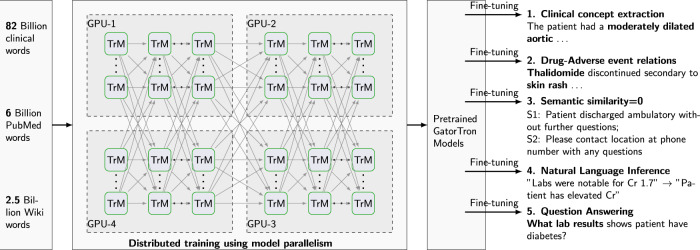
There is an increasing interest in developing artificial intelligence (AI) systems to process and interpret electronic health records (EHRs). Natural language processing (NLP) powered by pretrained language models is the key technology for medical AI systems utilizing clinical narratives. However, there are few clinical language models, the largest of which trained in the clinical domain is comparatively small at 110 million parameters (compared with billions of parameters in the general domain). It is not clear how large clinical language models with billions of parameters can help medical AI systems utilize unstructured EHRs. In this study, we develop from scratch a large clinical language model—GatorTron—using >90 billion words of text (including >82 billion words of de-identified clinical text) and systematically evaluate it on five clinical NLP tasks including clinical concept extraction, medical relation extraction, semantic textual similarity, natural language inference (NLI), and medical question answering (MQA). We examine how (1) scaling up the number of parameters and (2) scaling up the size of the training data could benefit these NLP tasks. GatorTron models scale up the clinical language model from 110 million to 8.9 billion parameters and improve five clinical NLP tasks (e.g., 9.6% and 9.5% improvement in accuracy for NLI and MQA), which can be applied to medical AI systems to improve healthcare delivery. The GatorTron models are publicly available at: https://catalog.ngc.nvidia.com/orgs/nvidia/teams/clara/models/gatortron_og .
Overview
The claims and statistics of this paper haven’t been checked yet.
Free: it reads the open-access text and checks the first 5 claims that cite a source we can check. Create a free account to check every claim.
Integrity signals
Registry
Cites
Statistics
Figures
Verification
Claims the paper makes
The claims and statistics of this paper haven’t been checked yet.
Free: it reads the open-access text and checks the first 5 claims that cite a source we can check. Create a free account to check every claim.
Claims other papers make about this one
Each is checked against this paper’s own text: does it say what the citing paper says it does?
The source backs part of the claim, not all of it — or backs it for a different population, condition or comparison.
In the citing paper
“As 1 example, Wu et al.25 developed and disseminated clinical LLMs such as GatorTron27 and GatorTronGPT28 to address limitations of traditional rule-based machine learning methods, which often lack scalability and transportability across data networks.”
From Advancing methodological development of artificial intelligence in patient-centered comparative clinical effectiveness research: Patient-Centered Outcomes Research Institute’s unique contribution to research done differently (2025) · cites this paper as [27]
Experimental — accuracy not yet measuredThe source backs part of the claim, not all of it — or backs it for a different population, condition or comparison.
In the citing paper
“Recent studies have demonstrated that large transformer models, such as ChatGPT, trained using massive text data, exhibit significant improvements over previous NLP models in terms of emergence and homogenization, which could contribute to enhancing critical thinking skills in students (Yang et al., 2022).”
From Investigating the Use of chatGPT as a Tool for Enhancing Critical Thinking and Argumentation Skills in International Relations Debates among Undergraduate Students (2024) · cites this paper as Yang et al., 2022
Experimental — accuracy not yet measuredThe cited source says what the claim attributes to it.
In the citing paper
“LLMs can be used for EHR analysis and as a clinical decision support tool [40].”
From Generative AI in healthcare: an implementation science informed translational path on application, integration and governance (2024) · cites this paper as [40]
The cited source says what the claim attributes to it.
In the citing paper
“The success of LLMs in the field of neural language processing, as well as their remarkable ability to solve complex tasks, has inspired researchers’ enthusiasm for adapting these models in the biomedical field [185].”
From Challenges in AI-driven Biomedical Multimodal Data Fusion and Analysis (2025) · cites this paper as [185]
The cited source says what the claim attributes to it.
In the citing paper
“AI using EHR data has become much more general and accurate in the last few years,35,36 allowing prediction of perioperative events37–41 and learning effective treatment strategies.42”
From Potential uses of AI for perioperative nursing handoffs: a qualitative study (2023) · cites this paper as [35]
3 more claims about this paper
Create a free account to see every claim other papers make about this one.
Self-check
Percentages, sums and reported differences re-computed from the paper’s own numbers.
The self-check needs the paper’s full text.
Citations
Cites
Vaswani, A., Shazeer, N., Parmar, N., Uszkoreit, J., Jones, L., Gomez, A. N., Kaiser, L., & Polosukhin, I. (2017) · arXiv · doi:10.48550/arxiv.1706.03762 · Cited by 120,404
LeCun, Y., Bengio, Y., & Hinton, G. (2015) · Nature · doi:10.1038/nature14539 · Cited by 84,126
Exploring the Limits of Transfer Learning with a Unified Text-to-Text Transformer
Raffel, C., Shazeer, N., Roberts, A., Lee, K., Narang, S., Matena, M., Zhou, Y., Li, W., & Liu, P. J. (2019) · arXiv · doi:10.48550/arxiv.1910.10683 · Cited by 31,859 · cited 3×
“On both datasets, pretrained transformer models achieved state-of-the-art performances 27,29 .”
BackgroundAdvances in neural information processing systems 7
Cios, K., & Shields, M. (1997) · Neurocomputing · doi:10.1016/s0925-2312(97)90018-7 · Cited by 22,059
Advances in neural information processing systems 7
(1996) · Computers & Mathematics with Applications · doi:10.1016/s0898-1221(96)90463-0 · Cited by 14,281
MIMIC-III, a freely accessible critical care database
Johnson, A. E. W., Pollard, T. J., Shen, L., Lehman, L.-W. H., Feng, M., Ghassemi, M., Moody, B., Szolovits, P., Anthony Celi, L., & Mark, R. G. (2016) · Scientific Data · doi:10.1038/sdata.2016.35 · Cited by 8,141 · cited 3×
“37 The ClinicalBERT model was developed by further training the BioBERT (base version; 110 million parameters with 12 layers, 768 hidden units, and 12 attention heads) using clinical text from the MIMIC-III 38 corpus.”
MethodInfluentialBioBERT: a pre-trained biomedical language representation model for biomedical text mining
Lee, J., Yoon, W., Kim, S., Kim, D., Kim, S., So, C. H., & Kang, J. (2020) · Bioinformatics · doi:10.1093/bioinformatics/btz682 · Cited by 7,218
XLNet: Generalized Autoregressive Pretraining for Language Understanding
Yang, Z., Dai, Z., Yang, Y., Carbonell, J., Salakhutdinov, R., & Le, Q. V. (2019) · arXiv · doi:10.48550/arxiv.1906.08237 · Cited by 6,687
SQuAD: 100,000+ Questions for Machine Comprehension of Text
Rajpurkar, P., Zhang, J., Lopyrev, K., & Liang, P. (2016) · Proceedings of the 2016 Conference on Empirical Methods in Natural Language Processing · doi:10.18653/v1/d16-1264 · Cited by 6,208
Natural Language Processing (almost) from Scratch
Collobert, R., Weston, J., Bottou, L., Karlen, M., Kavukcuoglu, K., & Kuksa, P. P. (2011) · arXiv (Cornell University) · doi:10.48550/arxiv.1103.0398 · Cited by 4,962 · cited 3×
“…concept extract are often rule-based, yet, most recent systems are based on machine learning models such as conditional random fields (CRFs) 50,51 , convolutional neural networks (CNN) 9,52 , and recurrent neural networks (RNN) implemented with long short-term memory strategy (LSTM) 10,53 .”
BackgroundMethod
Research works printed but not linked: 3
- Adoption of Electronic Health Record Systems among U.S. Non-Federal Acute Care Hospitals: 2008–2015. ONC Data Brief. https://www.healthit.gov/sites/default/files/briefs/2015_hospital_adoption_db_v17.pdf (2016). 40127322
- Yang X Identifying relations of medications with adverse drug events using recurrent convolutional neural networks and gradient boosting J. Am. Med. Inform. Assoc. 2020 27 65 72 10.1093/jamia/ocz144 31504605 PMC7489076 · DOI · Paper page
- Lv X Guan Y Yang J Wu J Clinical relation extraction with deep learning Int. J. Hybrid. Inf. Technol. 2016 9 237 248
Cited by
Items 601–700 of 1,005
Piya, F. L., & Beheshti, R. (2025) · Proceedings of the AAAI Conference on Artificial Intelligence · doi:10.1609/aaai.v39i28.35224 · Cited by 6
Ayesha, N., Mujahid, M., Mirdad, A. R., Alamri, F. S., & Khan, A. R. (2025) · Computers, materials & continua/Computers, materials & continua (Print) · doi:10.32604/cmc.2025.063560 · Cited by 6
Naidoo, C. M., Obi, C. L., & Mkolo, N. M. (2025) · Advances in computational intelligence and robotics book series · doi:10.4018/979-8-3693-9301-7.ch006 · Cited by 6
Areas of research focus and trends in the research on the application of AIGC in healthcare
Wang, C., Zhu, Y., Zhang, X., Chen, X., Li, Y., Tan, Y., & Qi, H. (2025) · Journal of Health Population and Nutrition · doi:10.1186/s41043-025-00947-7 · Cited by 6
“…Wikipedia (2.5 billion), and MIMIC III (0.5 billion), and varying numbers of parameters (including 345 million, 3.9 billion, and 8.9 billion) to develope the large-scale clinical model GatorTron for clinical decision support, identification of adverse events associated with drug exposure [28].”
InfluentialSaputra, E. D., Harahap, N. S., Jasril, J., & Yusra, Y. (2024) · Jutisi Jurnal Ilmiah Teknik Informatika dan Sistem Informasi · doi:10.35889/jutisi.v13i1.1879 · Cited by 6
“Hasil yang dihasilkan oleh LLM jauh lebih bagus dan berkualitas [23].”
BackgroundUbiquitous and Powerful Artificial Intelligence (AI)
Sargsyan, A., Hovsepyan, S., & Muradyan, A. A. (2024) · Sustainable development goals series · doi:10.1007/978-3-031-62332-5_26 · Cited by 6
Evaluation of Language Models in the Medical Context Under Resource-Constrained SettingsPreprint
Posada, A., Rueckert, D., Meissen, F., & Müller, P. (2024) · arXiv (Cornell University) · doi:10.48550/arxiv.2406.16611 · Cited by 7
“Generally, these models are derived from general-purpose LLMs, with exceptions like GatorTron [56], Galactica, and GatorTronGPT [57].”
MethodWei, Q., Cui, Y., Ding, M., Wang, Y., Xiang, L., Yao, Z., Chen, C., Long, Y., Jin, Z., & Xu, X. (2024) · arXiv (Cornell University) · doi:10.48550/arxiv.2407.15862 · Cited by 6
Artificial Intelligence Large Language Models in Cardiology
Chen, J. M., Liang, Y., & Ge, J. (2025) · Reviews in Cardiovascular Medicine · doi:10.31083/rcm39452 · Cited by 6
“Specialized medical LLMs, such as GatorTron, further emphasize their growing significance in medical applications [3].”
Generalist Foundation Models Are Not Clinical Enough for Hospital OperationsPreprint
Oermann, E. K., Jiang, L. Y., Chen, A., Han, X., Liu, C., Dua, R., Eaton, K., Wolff, F., Steele, R. J., Zhang, J., et al. (2026) · Research Square · doi:10.21203/rs.3.rs-9078142/v1 · Cited by 6
Self-citationUnderstanding Sarcoidosis Using Large Language Models and Social Media Data
Xi, N. M., Ji, H., & Wang, L. (2024) · Journal of Healthcare Informatics Research · doi:10.1007/s41666-024-00177-2 · Cited by 5
Zheleznova, E. A., Vlassov, V., Vlasova, A. V., Depui, T. I., & Владимирович, П. И. (2024) · CARDIOVASCULAR THERAPY AND PREVENTION · doi:10.15829/1728-8800-2024-4202 · Cited by 5
Deshmukh, S., & Pacharaney, U. S. (2025) · International Conference on Sentiment Analysis and Deep Learning (ICSADL) · doi:10.1109/icsadl65848.2025.10933272 · Cited by 5
“It has also been demonstrated that eliminating noise and quiet pauses still improves the performance of ML/DL models [7].”
Hoz, J. D. L., Frydman-Gani, C., Arias, A., Vallejo, M. P., Martínez, J. D. L., Mena, L., Seroussi, A., Service, S. K., Díaz‐Zuluaga, A. M., Ramirez-Diaz, A. M., et al. (2025) · Complex Psychiatry · doi:10.1159/000546480 · Cited by 5
“…models in terms of ef fi ciency, hardware requirements, cost, speed [46, 47], interpretability, and overall performance [47 – 49], the use of LLMs for psychiatric phenotyping [50 – 53] could improve fl exibility and generalizability, where pattern-based approaches are limited by their rigidity.”
Cohen, S. A., Chen, Z., Bian, J., Boucher, C. A., Wu, Y., & Prosperi, M. (2025) · Lecture notes in computer science · doi:10.1007/978-3-031-95838-0_7 · Cited by 6
Self-citationChang, Y., Hsiao, S.-H., Yeh, W.-C., Hsing, Y.-C., Wang, C.-C., & Chen, C.-Y. (2025) · Computers in Biology and Medicine · doi:10.1016/j.compbiomed.2025.110621 · Cited by 5
Shen, Y. (2025) · IEEE Access · doi:10.1109/access.2025.3587298 · Cited by 5
Niu, S., Ma, J., Lin, H., Bai, L., Wang, Z., W., V., Xu, R. Y. D., Guo, L., & Yang, X. (2025) · Findings of the Association for Computational Linguistics: ACL (Findings of ACL) · doi:10.18653/v1/2025.findings-acl.308 · Cited by 5
Self-citationFine-tuning LLMs to Extract Epilepsy Seizure Frequency Data from Health Records
Holgate, B., Davies, J., Fang, S., Winston, J. S., Teo, J., & Richardson, M. P. (2025) · Workshop on Biomedical Language Processing (BioNLP) · doi:10.18653/v1/2025.bionlp-1.5 · Cited by 5
AlDahoul, N., & Zaki, Y. (2025) · Arabic Natural Language Processing Workshop (WANLP) · doi:10.18653/v1/2025.arabicnlp-sharedtasks.19 · Cited by 5
Cohen, L., Gupta, A. R., Patel, P., Gill, G. S., Bains, H. K., & Gupta, S. K. (2025) · Cureus · doi:10.7759/cureus.97374 · Cited by 5
“In fields where multimodal data, such as histology, genetic markers, or electrophysiology, are important for diagnosis, these models often lack a strong understanding of the field, making it difficult to use them in practice [50,51].”
Yang, S., Jing, M., Wang, S., Huang, Z., Wang, J., Kou, J., Shi, M., Xia, Z., Wei, Q., Xing, W., et al. (2025) · Artificial Intelligence in Medicine · doi:10.1016/j.artmed.2025.103310 · Cited by 5
Moser, R., Buchecker, L. M., Nano, J., Mayr, N. A., Behzadi, S. T., Kiesl, S., Maier, S., Allwohn, L., Lammert, J., Adams, L. C., et al. (2025) · The Oncologist · doi:10.1093/oncolo/oyaf414 · Cited by 5
Chen, Z., Liu, Y., Prosperi, M., Vaddiparti, K., Cook, R. L., Bian, J., Guo, Y. M., & Wu, Y. (2026) · International Journal of Medical Informatics · doi:10.1016/j.ijmedinf.2026.106269 · Cited by 5
Self-citationYou, J., & Shin, H. (2026) · Journal of the American Medical Informatics Association · doi:10.1093/jamia/ocaf230 · Cited by 5
Self-citationUnified Supervision for Vision-Language Modeling in 3D Computed Tomography
Lee, H.-C., Liu, Z., Ahmed, H., Kim, S., Huver, S. D., Nath, V., Fayad, Z. A., Deyer, T. W., & Mei, X. (2025) · IEEE International Conference on Computer Vision Workshops · doi:10.1109/iccvw69036.2025.00700 · Cited by 5
“To demonstrate robustness, we observed similar patterns when replacing the pretrained attention layers with the first four layers of GatorTron-base [26], a model pretrained on clinical notes rather than scientific literature.”
Hasheminasab, S. A., Jamil, F., Afzal, M. U., Khan, A. H., Ilyas, S., Noor, A., Touseef, A., Abbas, S. M., Cheema, H. N., Shabbir, M. U., et al. (2026) · BMC Medical Informatics and Decision Making · doi:10.1186/s12911-026-03366-8 · Cited by 6
Multimodal Representation Learning for Parsing Biological Heterogeneity in Psychiatric Neuroimaging
Grosenick, L., & Liston, C. M. (2026) · Biological Psychiatry · doi:10.1016/j.biopsych.2026.01.023 · Cited by 5
A multimodal generative model for structured and unstructured electronic health records
Sivarajkumar, S., Zhang, H., Ji, Y., Bilalpur, M., Wu, X., Li, C., Kwak, M. G., Visweswaran, S., & Wang, Y. (2026) · npj Health Systems · doi:10.1038/s44401-026-00095-y · Cited by 5
Zhu, Q., Lin, Y., Fu, W., Tang, W. H., Li, J., Zhang, Y., Li, B., Guo, X., Wang, F. S., Qi, H., et al. (2026) · Nature Biomedical Engineering · doi:10.1038/s41551-026-01713-8 · Cited by 6
Self-citationLiao, C.-C., Kuo, W.-T., Hu, I.-H., Shih, Y.-C., Ding, J.-E., Liu, F., & Hung, F. (2024) · ACM International Conference on Information and Knowledge Management (CIKM) · doi:10.1145/3627673.3679227 · Cited by 5
Koon, Y. L., Lam, Y. T., Tan, H. X., Teo, D., Neo, J. W., Yap, A. J. Y., Ang, P. S., Loke, C. W. P., Tham, M. Y., Tan, S. H., et al. (2025) · Drug Safety · doi:10.1007/s40264-025-01525-w · Cited by 5
“This aligns with findings reported by other researchers [29, 30] where better performance is observed for the larger models.”
Hosseini, E., Srinivas, A., Nazari, N., Hale, C., Rafatirad, S., & Homayoun, H. (2025) · ACM Transactions on Computing for Healthcare · doi:10.1145/3712302 · Cited by 5
Semantically Encoding Activity Labels for Context-Aware Human Activity Recognition
Ge, W., Mou, G., Agu, E., & Lee, K. (2025) · IEEE International Conference on Pervasive Computing and Communications · doi:10.1109/percom64205.2025.00039 · Cited by 5
“Recent advancements in LMs have demonstrated their capabilities in understanding and processing natural language, in-spiring many applications in various other domains, including computer vision (CV) [23] and health applications [24].”
Gnatzy, R., Lacher, M., Cascio, S., Muensterer, O. J., Wagner, R., & Aubert, O. (2025) · Pediatric Surgery International · doi:10.1007/s00383-025-06104-9 · Cited by 5
Tran, H. H.-V., Thu, A., Twayana, A. R., Fuertes, A., Gonzalez, M., Basta, M., James, M., Frishman, W. H., & Aronow, W. S. (2025) · Cardiology in Review · doi:10.1097/crd.0000000000001042 · Cited by 5
De-Biased Disentanglement Learning for Pulmonary Embolism Survival Prediction on Multimodal Data
Zhong, Z., Li, J., Kulkarni, S., Zhang, H., Fayad, F. H., Yang, L., Collins, S., Bai, H. X., Ahn, S. H., Atalay, M. K., et al. (2024) · IEEE Journal of Biomedical and Health Informatics · doi:10.1109/jbhi.2024.3384848 · Cited by 5
“The large language model methods such as BERT [14] and ChatGPT [15], as a part of clinical features extraction show a great potential of comprehensive relevance from electronic health records (EHRs), leading to improved predictive models and fairer decision [16], [17].”
MethodPerspective Chapter: Integrating Large Language Models and Blockchain in Telemedicine
Heston, T. F. (2024) · Biomedical engineering · doi:10.5772/intechopen.1005063 · Cited by 5
Comments on Contemporary Uses of Machine Learning for Electronic Health Records
Bryan, J., & Li, D. (2024) · North Carolina Medical Journal · doi:10.18043/001c.120570 · Cited by 5
Cardiovascular Risk Assessment and Prevention in Cardio-Oncology
Makram, O. M., Nain, P., Vasbinder, A. L., Weintraub, N. L., & Guha, A. (2024) · Cardiology Clinics · doi:10.1016/j.ccl.2024.08.003 · Cited by 5
Clinical Text Summarization using NLP Pretrained Language Models: A Case Study of MIMIC-IV-Notes
Arokodare, O., Wimmer, H., & Du, J. (2025) · Journal of Information Systems Applied Research and Analytics · doi:10.62273/naka3054 · Cited by 5
LT3: Generating Medication Prescriptions with Conditional Transformer
Belkadi, S., Micheletti, N., Han, L., Del-Pinto, W., & Nenadić, G. (2025) · Workshop on Patient-Oriented Language Processing (CL4Health) · doi:10.18653/v1/2025.cl4health-1.17 · Cited by 5
Keyword-optimized template insertion for clinical note classification via prompt-based learning
Alleva, E., Landi, I., Shaw, L. J., Böttinger, E. P., Ensari, I., & Fuchs, T. J. (2025) · BMC Medical Informatics and Decision Making · doi:10.1186/s12911-025-03071-y · Cited by 5
“We compared the performance of two encoder models, GatorTron [19] and ClinicalBERT [20], a decoder-only model, BioGPT [21], as well as a encoder-decoder model, ClinicalT5 [22].”
Automated Software Testing through Large Language Models: Opportunities and Challenges
Fuente, J. A. D. (2022) · Qubahan Techno Journal · doi:10.48161/qtj.v1n3a15 · Cited by 5
Liu, D., Ding, C., Bold, D., Bouvier, M. J., Lu, J., Shickel, B., Jabaley, C. S., Zhang, W., Park, S., Young, M. J., et al. (2024) · arXiv (Cornell University) · doi:10.48550/arxiv.2401.13588 · Cited by 5
“To further improve the performance of LLMs on datasets from a specific healthcare enterprise, several institutions have trained LLMs using their own institutional EHR data 37-39 .”
MethodDoes your model understand genes? A benchmark of gene properties for biological and text modelsPreprint
Kan‐Tor, Y., Danziger, M. M., Zohar, E., Ninio, M., & Shimoni, Y. (2024) · arXiv (Cornell University) · doi:10.48550/arxiv.2412.04075 · Cited by 5
“…cohort of biological foundation models, either as specialized language models or new models trained on biological modalities such as DNA sequences (Ji et al., 2021), amino acid sequences (Rao et al., 2021), electronic health records (Yang et al., 2022) or other modalities (Thieme et al., 2023).”
Bridging Today and the Future of Humanity: AI Safety in 2024 and BeyondPreprint
Han, S. (2025) · Qeios · doi:10.32388/zhm9uq · Cited by 5
Multimodal AI-driven Biomarker for Early Detection of Cancer CachexiaPreprint
Ahmed, S., Parker, N. H., Park, M. M., Davis, E. W., Jeong, D. K., Permuth, J. B., Schabath, M. B., Yılmaz, Y., & Rasool, G. (2025) · medRxiv · doi:10.1101/2025.09.17.25336028 · Cited by 5
“Patients 2, 8, 18, 19, and 25 were correctly classified, but with low confidence, as no clinical notes were available to reinforce the prediction.”
InfluentialContext Matters: Comparison of commercial large language tools in veterinary medicinePreprint
Poore, T. J., Pinard, C. J., Shabbir, A., Lagree, A., Telfer, A., & Wu, K.-C. (2025) · arXiv (Cornell University) · doi:10.48550/arxiv.2510.01224 · Cited by 5
Scaling Clinician-Grade Feature Generation from Clinical Notes with Multi-Agent Language ModelsPreprint
Wang, J., Vallon, J., Kotha, N. V., Panjwani, N., Ling, X., Redfield, M. M., Vij, S., Srinivas, S., Leppert, J. T., Buyyounouski, M. K., et al. (2025) · arXiv (Cornell University) · doi:10.48550/arxiv.2508.01956 · Cited by 5
Trustworthy Agents for Electronic Health Records through Confidence EstimationPreprint
Song, Y., Jeong, M., & Sung, M. (2025) · arXiv (Cornell University) · doi:10.48550/arxiv.2508.19096 · Cited by 5
A Multimodal Data Processing Pipeline for MIMIC-IV DatasetPreprint
Adiba, F. I., Danduri, V., Piya, F. L., Abbasi, A., Gupta, M., & Beheshti, R. (2026) · arXiv (Cornell University) · doi:10.48550/arxiv.2601.11606 · Cited by 6
“Other advanced embedding models, including ModernBERT [47], BioSimCSE-BioLinkBERT [24], and GatorTron [48], are also available in the pipeline.”
Improving the Safety and Trustworthiness of Medical AI via Multi-Agent Evaluation LoopsPreprint
Ghafoor, Z., Islam, M. S., Howlader, K. C., Khondokar, M. R., Bhattacharjee, T., Chakraborty, S., Roy, A., Bhattacharjee, U., & Roy, T. (2026) · arXiv (Cornell University) · doi:10.48550/arxiv.2601.13268 · Cited by 5
“For example, GatorTron trained from scratch on a very large corpus that includes de-identified clinical notes and demonstrated gains across multiple clinical NLP tasks [27].”
Islam, S. (2024) · TSpace (University of Toronto) · Cited by 5
Wahl, B., Nassiri-Ansari, T., Redpath, D. D., Allotey, P., & Schwalbe, N. (2026) · PLOS Digital Health · doi:10.1371/journal.pdig.0001302 · Cited by 4
“For example, though not identified in our review, the broader literature indicates that health researchers have used deep learning algorithms to analyze electronic medical records [22], genomics data [23], and real-time surveillance data [24].”
Accurate predictions of SARS-CoV-2 infectivity from comprehensive analysis
Park, J., Choi, W., Seong, D. Y., Jeong, S., Lee, J. Y., Park, H. J., Chung, D. S., Yi, K., Kim, U., Yoon, G.-Y., et al. (2024) · eLife · doi:10.7554/elife.99833.3 · Cited by 4
“The importance of big data science has led to the accumulation of huge amounts of data, recently, a generative AI model with large language model (LLM) using various types of big data has further been emerging across various fields, including healthcare, omics research, and industry 1,2 .”
BackgroundArtificial intelligence approaches for anti-addiction drug discovery
董, C. 晨. D., Jiang, J. H., Hayes, N., Su, Z., & Wei, G. (2025) · Digital Discovery · doi:10.1039/d5dd00032g · Cited by 5
Manders, T. R., Tan, C. A., Kobayashi, Y., Wahl, A., Araya, C. L., Colavin, A., Facio, F. M., Metz, H. C., Reuter, J., Frésard, L., et al. (2025) · Human Genetics · doi:10.1007/s00439-025-02743-z · Cited by 4
“A transformer-based large clinical language model (Gator - tron-S, UNFLP) (Yang et al. 2022 ), pre-trained on MIMIC-III notes, PubMed, and other sources, was fine-tuned using curriculum learning, which performed better than direct .”
Thompson, D. C., & Mofidi, R. (2025) · Scientific Reports · doi:10.1038/s41598-025-11870-6 · Cited by 4
Generative Artificial Intelligence Methodology Reporting in Otolaryngology: A Scoping Review
Alter, I. L., Chan, K., Andreadis, K., & Rameau, A. (2025) · The Laryngoscope · doi:10.1002/lary.70165 · Cited by 4
“…to provide accurate patient-facing information within OHNS has its value, LLMs can also make real provider-facing contributions to clinical workflows, such as extraction and summarization of electronic health record data [36], writing notes [37], and providing clinical decision-making support [38].”
AI in Pediatric Spine Care: Clinical, Research, and Ethical Considerations
Nugraha, H. K., Rasmussen, A. P., Mulford, K. L., Yang, L., Wyles, C. C., & Larson, A. N. (2025) · Journal of Clinical Medicine · doi:10.3390/jcm14228115 · Cited by 5
“Recent studies have shown that LLMs can be employed to automatically extract structured data from unstructured EHR [41,42].”
The AIR·MS data platform for artificial intelligence in healthcare
Guerrero, P., Ernebjerg, M., Holst, T., Weese, D., DiBello, H., Ibing, S., Schmidt, L., Ungaro, R. C., Renard, B. Y., Lippert, C., et al. (2025) · JAMIA Open · doi:10.1093/jamiaopen/ooaf145 · Cited by 4
Talukdar, N., Zhang, X., Paithankar, S., Wang, H., & Chen, B. (2025) · Drug Discovery Today · doi:10.1016/j.drudis.2025.104552 · Cited by 5
Yaacoub, J.-P. A., Noura, H., Salman, O., & Pujolle, G. (2025) · Annals of Telecommunications · doi:10.1007/s12243-025-01134-9 · Cited by 4
Tang, G., Xu, Z., & Koyama, S. (2025) · Systems · doi:10.3390/systems13121070 · Cited by 4
Hierarchical RAG enhances a pharmacogenomic AI assistant in guideline related queries
Jeon, Y., Youn, M. S., Kang, S., Park, J., Kim, E. S., Kim, J., & Kim, J. H. (2025) · Computers in Biology and Medicine · doi:10.1016/j.compbiomed.2025.111323 · Cited by 4
Deng, L., Chen, L., Liu, M., Wang, X., Qi, Y., Shao, C., & Jiang, T. (2025) · Information Processing & Management · doi:10.1016/j.ipm.2025.104435 · Cited by 4
Is artificial intelligence a friend or foe to epidemiology?
Rashidi, E., Brooks, M. M., Hassoon, A., Mehta, S., Althoff, K., & Alexander, G. C. (2026) · Annals of Epidemiology · doi:10.1016/j.annepidem.2026.01.003 · Cited by 4
Benchmarking Foundation Models for Mitotic Figure Classification
Ammeling, J., Ganz, J., Rosbach, E., Lausser, L. M., Bertram, C., Breininger, K., & Aubreville, M. (2026) · The Journal of Machine Learning for Biomedical Imaging · doi:10.59275/j.melba.2026-a3eb · Cited by 5
Inherited risk of coronary artery disease: redefining care with imaging and genetics
Lan, N. S. R., Dwivedi, G., Hillis, G. S., Chew, D. P., Yeap, B. B., Figtree, G. A., Khera, A. V., Watts, G. F., & Ihdayhid, A. R. (2026) · Nature Reviews Cardiology · doi:10.1038/s41569-026-01254-2 · Cited by 4
“Although large language models can be used to analyse electronic health records, further research will need to evaluate their effectiveness in extracting and interpreting family history data to identify family members at elevated risk of CAD 267,268 .”
Wang, Y., Song, Y., Siu, R. K., Nimma, I. R., Yan, Y., Savage, T., Wang, Y., Li, Z., Ramai, D., Wang, J., et al. (2026) · Journal of the American Medical Informatics Association · doi:10.1093/jamia/ocag008 · Cited by 4
Das, A., Arora, D., Deswal, G., Grewal, A. S., & Bansal, S. (2026) · Journal of the National Medical Association · doi:10.1016/j.jnma.2026.02.007 · Cited by 5
From complexity to clarity: GPT-4 for patient-centered prostate cancer pathology reports
Fereydooni, S., Homer, R., & Chartash, D. (2026) · Patient Education and Counseling · doi:10.1016/j.pec.2026.109597 · Cited by 4
Wang, Z., Fang, Y., & Li, Q. (2026) · Journal of Translational Medicine · doi:10.1186/s12967-026-08211-0 · Cited by 4
Hier, D. B., Srinivasula, P. Y., & Carrithers, M. D. (2026) · Journal of Clinical Medicine · doi:10.3390/jcm15114092 · Cited by 4
A roadmap for medical large language models: a review of foundations, applications, and challenges
Sha, Y.-Y., Yu, L., Lin, Z.-H., Kaur, A., Lou, Y., Gornale, S. S., Zhang, T., Wong, L. S., Wang, Z., Yan, Y., et al. (2026) · Military Medical Research · doi:10.1016/j.mmr.2026.100050 · Cited by 4
“Table 3 [16,140-151] and Table 4 [26,28,66,68,106,112,120,152-176”
Ge, X., Murtaza, S., Cortez, A., & Alemzadeh, H. (2026) · Findings of the Association for Computational Linguistics: ACL (Findings of ACL) · doi:10.18653/v1/2026.findings-acl.1751 · Cited by 4
A Comprehensive Overview of Telemedicine
Heston, T. F., & Doarn, C. R. (2024) · Biomedical engineering · doi:10.5772/intechopen.1002138 · Cited by 4
Sun, S., Zack, T. I., Williams, C. Y. K., Butte, A. J., & Sushil, M. (2024) · JAMIA Open · doi:10.1093/jamiaopen/ooae073 · Cited by 4
Reimagining Multidisciplinary Teams: Challenges and Opportunities for LLMs in Cancer MDTs
Paulo, S., Neto, I., Figueiredo, N., Lopes, D. S., & Nicolau, H. (2025) · Proc. ACM Hum. Comput. Interact. · doi:10.1145/3711055 · Cited by 4
Kim, M. S., Lee, J. S., & Bae, H. (2025) · Healthcare Informatics Research · doi:10.4258/hir.2025.31.2.200 · Cited by 4
“For example, LLMs could aid in reviewing extensive electronic health records (EHRs) [30], summarizing crucial information to enhance review efficiency and quality.”
Evaluating fine-tuned GPT models on different datasets in the healthcare domain
Lim, Y. H., Yeoh, P. S. Q., & Lai, K. W. (2025) · Innovation and Emerging Technologies · doi:10.1142/s2737599425500124 · Cited by 4
AliceBot: Designing AI-Driven Applications for Mental Health Management
Zhao, M., Bai, Y., Zhong, W., Cun, W., Li, Y., Zhu, M., Feng, Y., & Chen, D. (2025) · Lecture notes in computer science · doi:10.1007/978-3-031-93712-5_16 · Cited by 4
MedHub – LLM-based Healthcare System
Mahendran, R. K., Shreenidhi, G. L., & Sowmiya, S. (2025) · International Conference on Augmented Intelligence and Sustainable Systems (ICAISS) · doi:10.1109/icaiss61471.2025.11042126 · Cited by 4
Bessa, R. F., de Oliveira, A. C., Bessa, R. F., Sousa, D. L., Alves, R., Barbosa, A., Carneiro, A., Soares, C., & Teles, A. S. (2025) · Applied Sciences · doi:10.3390/app15137134 · Cited by 4
The Current State and Future Prospects for Artificial Intelligence in Dermatology
Thang, C. J., Duffy, C., Khattab, S., & Semenov, Y. R. (2025) · Dermatologic Clinics · doi:10.1016/j.det.2025.05.001 · Cited by 4
Zhu, S., Xie, Y., Tang, Y., Zhou, Y., Zhao, R., & Dong, X. (2025) · European Journal of Pediatrics · doi:10.1007/s00431-025-06602-x · Cited by 4
Flying Into the Future With Large Language Models
Kanjilal, S. (2023) · Clinical Infectious Diseases · doi:10.1093/cid/ciad635 · Cited by 4
Eneva, Y., & Doğan, B. (2024) · Journal of Biosciences and Medicines · doi:10.4236/jbm.2024.1211021 · Cited by 4
Transformer models for Topic Extraction from narratives and biomedical text analysis
Avasthi, S., Sanwal, T., Tripathi, S. L., & Tyagi, M. (2024) · Elsevier eBooks · doi:10.1016/b978-0-443-15452-2.00013-3 · Cited by 4
Enhancing Healthcare Management: A Case Study of a Medical Chatbot in Egypt
Mustafa, S. I., Salem, L. A., El‐Shishtawy, T., & El-Attar, N. E. (2024) · Benha Journal of Applied Sciences · doi:10.21608/bjas.2024.317337.1499 · Cited by 4
Ramaswamy, A., Hung, M., Pelt, J., Iranmahboub, P., Calderon, L. P., Scherr, I., Wang, G., Green, D., Patel, N., McClure, T., et al. (2024) · PLoS ONE · doi:10.1371/journal.pone.0314989 · Cited by 4
Tommasel, A., & Assent, I. (2024) · IEEE International Conference on Big Data (BigData) · doi:10.1109/bigdata62323.2024.10826117 · Cited by 4
Hasan, A., Wu, J., Nguyen, Q., Andres, S., Guellil, I., Zhang, H., Casey, A., Alex, B., Guthrie, B., & Wu, H. (2025) · Computers in Biology and Medicine · doi:10.1016/j.compbiomed.2025.110747 · Cited by 4
Sarwar, T., Yepes, A. J., & Cavedon, L. (2025) · Journal of Medical Internet Research · doi:10.2196/73325 · Cited by 4
“Recognizing this limitation led to the development of domain-specific BERT (bidirectional encoder representations from transformers) models, such as BioBERT [19], ClinicalBERT [20], PubMedBERT [21], BioMed-RoBERTa [22], SciBERT [23], MedCPT [24], and GatorTron [25].”
Pesqueira, A. M., Sousa, M. J., Machado, A. D. B., Bolog, S., Vieira, L., & Bolog, I. (2024) · Advances in business information systems and analytics book series · doi:10.4018/979-8-3693-1210-0.ch008 · Cited by 4
Neuradicon: Operational representation learning of neuroimaging reports
Watkins, H., Gray, R., Julius, A., Mah, Y., Teo, J., Pinaya, W. H. L., Wright, P., Jha, A., Engleitner, H., Cardoso, M. J., et al. (2025) · Computer Methods and Programs in Biomedicine · doi:10.1016/j.cmpb.2025.108638 · Cited by 4
“Models such as GatorTron [24] and Med-PaLM[25] have shown strong performance in medical question answering tasks and text generation in a medical setting.”
Utilizing Semantic Textual Similarity for Clinical Survey Data Feature Selection
Warner, B. C., Xu, Z., Haroutounian, S., Kannampallil, T., & Lu, C. (2025) · Findings of the Association for Computational Linguistics: ACL (Findings of ACL) · doi:10.18653/v1/2025.findings-acl.27 · Cited by 4
Li, Q., Tang, K. L., Li, S., Zhang, K., Li, Z., Chang, L., Li, W., Shen, B., Ding, J., & Min, X. (2023) · medRxiv · doi:10.1101/2023.07.11.23292512 · Cited by 4
“These clinical texts encompass a wealth of medical knowledge and patient characteristics, which play a pivotal role in medical research, clinical assistive diagnosis, and healthcare quality evaluation [3, Error!”
Background
Metadata
- Authors
- Yang, X., Chen, A., PourNejatian, N., Shin, H. C., Smith, K. E., Parisien, C., Compas, C., Martin, C., Costa, A. B., Flores, M. G., Zhang, Y., Magoc, T., Harle, C. A., Lipori, G., Mitchell, D. A., Hogan, W. R., Shenkman, E. A., Bian, J., & Wu, Y.
- Affiliations
- University of Florida (US)
- Nvidia (United States) (US)
- University of Florida Health (US)
- Corresponding author
- Wu, Yonghui
- ORCID
- Venue
- npj Digital Medicine
- Published
- 2022-12-26
- Volume
- 5
- Issue
- 1
- Pages
- 194-194
- ISSN
- 2398-6352 (ISSN-L)
- PMC
- PMC9792464
- OpenAlex
- W4312220150
- Semantic Scholar
- 332dc8b2ca9d49fad607c7282f3360bb2a9aacf3
- Cited by
- 847
- References
- 73
- Citations by year
- 2026: 171 · 2025: 304 · 2024: 268 · 2023: 101 · 2022: 1
- FWCI
- 55.47
- Type
- journal article
- Language
- en
- Open access
- gold
- doi.org
- Licence
- cc-by
- creativecommons.org/licenses/by/4.0 (tdm)
- creativecommons.org/licenses/by/4.0 (vor)
- Locations
- npj Digital Medicine (publishedVersion, cc-by)
- PubMed Central (publishedVersion, cc-by)
- PubMed (publishedVersion)
- DOAJ (DOAJ: Directory of Open Access Journals) (submittedVersion)
- IUScholarWorks (Indiana University) (submittedVersion, cc-by)
- Funders
- Patient-Centered Outcomes Research Institute (ME-2018C3-14754)
- U.S. Department of Health & Human Services | NIH | National Cancer Institute (1R01CA246418)
- U.S. Department of Health & Human Services | NIH | National Institute on Aging (R56AG069880, R21AG062884)
- Topics
- Physical Sciences › Computer Science › Artificial Intelligence › Machine Learning in Healthcare
- Physical Sciences › Computer Science › Artificial Intelligence › Topic Modeling
- Health Sciences › Medicine › Health Informatics › Artificial Intelligence in Healthcare and Education
- Keywords
- electronic health records, clinical natural language processing, clinical concept extraction, semantic textual similarity, natural language inference, medical question answering, model scaling, training data size, clinical text
About these checks
Registry, retraction, Cites and statistics results are computed, not judged, with one exception: a printed reference that no index lists is read once by a model before it counts as a citation error. Claims are extracted by a model and kept only when their quote appears verbatim in the text; each cited source is then checked, with a model’s help, for whether it says what the claim relies on. Those verdicts can be wrong — read the claim’s quote and the cited source before relying on one.
Statistics and arithmetic are recomputed, not judged.
Confidence bands are shown only for fields calibrated on our annotated test set. None is calibrated yet, so no band is shown.
What counts as a claim ›How we measure confidence ›How we check this ›
Are you an author, or do you see a problem with this page? Request a review
Data sources
Bibliographic data: Semantic Scholar, OpenAlex, Crossref.
Contains information from the Semantic Scholar Academic Graph Datasets, made available under the ODC Attribution License (ODC-BY 1.0).
Semantic Scholar’s data is described in: Kinney, R., et al. (2023). The Semantic Scholar Open Data Platform. arXiv:2301.10140.
