

A large language model for electronic health records
Open accessThe DOI matches its Crossref record; 77 of the 78 references it cites were found in a registry or an index.
Abstract
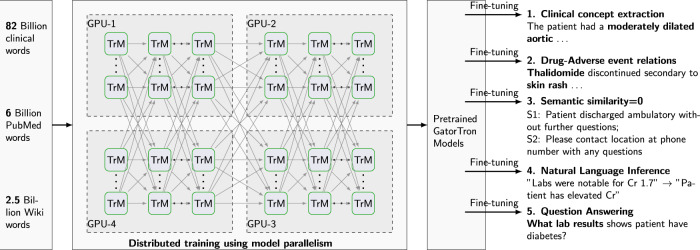
There is an increasing interest in developing artificial intelligence (AI) systems to process and interpret electronic health records (EHRs). Natural language processing (NLP) powered by pretrained language models is the key technology for medical AI systems utilizing clinical narratives. However, there are few clinical language models, the largest of which trained in the clinical domain is comparatively small at 110 million parameters (compared with billions of parameters in the general domain). It is not clear how large clinical language models with billions of parameters can help medical AI systems utilize unstructured EHRs. In this study, we develop from scratch a large clinical language model—GatorTron—using >90 billion words of text (including >82 billion words of de-identified clinical text) and systematically evaluate it on five clinical NLP tasks including clinical concept extraction, medical relation extraction, semantic textual similarity, natural language inference (NLI), and medical question answering (MQA). We examine how (1) scaling up the number of parameters and (2) scaling up the size of the training data could benefit these NLP tasks. GatorTron models scale up the clinical language model from 110 million to 8.9 billion parameters and improve five clinical NLP tasks (e.g., 9.6% and 9.5% improvement in accuracy for NLI and MQA), which can be applied to medical AI systems to improve healthcare delivery. The GatorTron models are publicly available at: https://catalog.ngc.nvidia.com/orgs/nvidia/teams/clara/models/gatortron_og .
Overview
The claims and statistics of this paper haven’t been checked yet.
Free: it reads the open-access text and checks the first 5 claims that cite a source we can check. Create a free account to check every claim.
Integrity signals
Registry
Cites
Statistics
Figures
Verification
Claims the paper makes
The claims and statistics of this paper haven’t been checked yet.
Free: it reads the open-access text and checks the first 5 claims that cite a source we can check. Create a free account to check every claim.
Claims other papers make about this one
Each is checked against this paper’s own text: does it say what the citing paper says it does?
The source backs part of the claim, not all of it — or backs it for a different population, condition or comparison.
In the citing paper
“As 1 example, Wu et al.25 developed and disseminated clinical LLMs such as GatorTron27 and GatorTronGPT28 to address limitations of traditional rule-based machine learning methods, which often lack scalability and transportability across data networks.”
From Advancing methodological development of artificial intelligence in patient-centered comparative clinical effectiveness research: Patient-Centered Outcomes Research Institute’s unique contribution to research done differently (2025) · cites this paper as [27]
Experimental — accuracy not yet measuredThe source backs part of the claim, not all of it — or backs it for a different population, condition or comparison.
In the citing paper
“Recent studies have demonstrated that large transformer models, such as ChatGPT, trained using massive text data, exhibit significant improvements over previous NLP models in terms of emergence and homogenization, which could contribute to enhancing critical thinking skills in students (Yang et al., 2022).”
From Investigating the Use of chatGPT as a Tool for Enhancing Critical Thinking and Argumentation Skills in International Relations Debates among Undergraduate Students (2024) · cites this paper as Yang et al., 2022
Experimental — accuracy not yet measuredThe cited source says what the claim attributes to it.
In the citing paper
“LLMs can be used for EHR analysis and as a clinical decision support tool [40].”
From Generative AI in healthcare: an implementation science informed translational path on application, integration and governance (2024) · cites this paper as [40]
The cited source says what the claim attributes to it.
In the citing paper
“The success of LLMs in the field of neural language processing, as well as their remarkable ability to solve complex tasks, has inspired researchers’ enthusiasm for adapting these models in the biomedical field [185].”
From Challenges in AI-driven Biomedical Multimodal Data Fusion and Analysis (2025) · cites this paper as [185]
The cited source says what the claim attributes to it.
In the citing paper
“AI using EHR data has become much more general and accurate in the last few years,35,36 allowing prediction of perioperative events37–41 and learning effective treatment strategies.42”
From Potential uses of AI for perioperative nursing handoffs: a qualitative study (2023) · cites this paper as [35]
3 more claims about this paper
Create a free account to see every claim other papers make about this one.
Self-check
Percentages, sums and reported differences re-computed from the paper’s own numbers.
The self-check needs the paper’s full text.
Citations
Cites
Vaswani, A., Shazeer, N., Parmar, N., Uszkoreit, J., Jones, L., Gomez, A. N., Kaiser, L., & Polosukhin, I. (2017) · arXiv · doi:10.48550/arxiv.1706.03762 · Cited by 120,404
LeCun, Y., Bengio, Y., & Hinton, G. (2015) · Nature · doi:10.1038/nature14539 · Cited by 84,126
Exploring the Limits of Transfer Learning with a Unified Text-to-Text Transformer
Raffel, C., Shazeer, N., Roberts, A., Lee, K., Narang, S., Matena, M., Zhou, Y., Li, W., & Liu, P. J. (2019) · arXiv · doi:10.48550/arxiv.1910.10683 · Cited by 31,859 · cited 3×
“On both datasets, pretrained transformer models achieved state-of-the-art performances 27,29 .”
BackgroundAdvances in neural information processing systems 7
Cios, K., & Shields, M. (1997) · Neurocomputing · doi:10.1016/s0925-2312(97)90018-7 · Cited by 22,059
Advances in neural information processing systems 7
(1996) · Computers & Mathematics with Applications · doi:10.1016/s0898-1221(96)90463-0 · Cited by 14,281
MIMIC-III, a freely accessible critical care database
Johnson, A. E. W., Pollard, T. J., Shen, L., Lehman, L.-W. H., Feng, M., Ghassemi, M., Moody, B., Szolovits, P., Anthony Celi, L., & Mark, R. G. (2016) · Scientific Data · doi:10.1038/sdata.2016.35 · Cited by 8,141 · cited 3×
“37 The ClinicalBERT model was developed by further training the BioBERT (base version; 110 million parameters with 12 layers, 768 hidden units, and 12 attention heads) using clinical text from the MIMIC-III 38 corpus.”
MethodInfluentialBioBERT: a pre-trained biomedical language representation model for biomedical text mining
Lee, J., Yoon, W., Kim, S., Kim, D., Kim, S., So, C. H., & Kang, J. (2020) · Bioinformatics · doi:10.1093/bioinformatics/btz682 · Cited by 7,218
XLNet: Generalized Autoregressive Pretraining for Language Understanding
Yang, Z., Dai, Z., Yang, Y., Carbonell, J., Salakhutdinov, R., & Le, Q. V. (2019) · arXiv · doi:10.48550/arxiv.1906.08237 · Cited by 6,687
SQuAD: 100,000+ Questions for Machine Comprehension of Text
Rajpurkar, P., Zhang, J., Lopyrev, K., & Liang, P. (2016) · Proceedings of the 2016 Conference on Empirical Methods in Natural Language Processing · doi:10.18653/v1/d16-1264 · Cited by 6,208
Natural Language Processing (almost) from Scratch
Collobert, R., Weston, J., Bottou, L., Karlen, M., Kavukcuoglu, K., & Kuksa, P. P. (2011) · arXiv (Cornell University) · doi:10.48550/arxiv.1103.0398 · Cited by 4,962 · cited 3×
“…concept extract are often rule-based, yet, most recent systems are based on machine learning models such as conditional random fields (CRFs) 50,51 , convolutional neural networks (CNN) 9,52 , and recurrent neural networks (RNN) implemented with long short-term memory strategy (LSTM) 10,53 .”
BackgroundMethod
Research works printed but not linked: 3
- Adoption of Electronic Health Record Systems among U.S. Non-Federal Acute Care Hospitals: 2008–2015. ONC Data Brief. https://www.healthit.gov/sites/default/files/briefs/2015_hospital_adoption_db_v17.pdf (2016). 40127322
- Yang X Identifying relations of medications with adverse drug events using recurrent convolutional neural networks and gradient boosting J. Am. Med. Inform. Assoc. 2020 27 65 72 10.1093/jamia/ocz144 31504605 PMC7489076 · DOI · Paper page
- Lv X Guan Y Yang J Wu J Clinical relation extraction with deep learning Int. J. Hybrid. Inf. Technol. 2016 9 237 248
Cited by
Large language models in medicine
Thirunavukarasu, A. J., Ting, D. S. J., Elangovan, K., Gutierrez, L., Tan, T. F., & Ting, D. S. W. (2023) · Nature Medicine · doi:10.1038/s41591-023-02448-8 · Cited by 3,944
“Alternative applications have been developed that can access the internet when generating responses, such as BlenderBot 3 and Sparrow 26,27 .”
BackgroundFoundation models for generalist medical artificial intelligence
Moor, M., Banerjee, O., Abad, Z. S. H., Krumholz, H. M., Leskovec, J., Topol, E. J., & Rajpurkar, P. (2023) · Nature · doi:10.1038/s41586-023-05881-4 · Cited by 2,028
BeaverTails: Towards Improved Safety Alignment of LLM via a Human-Preference Dataset
Ji, J., Liu, M., Dai, J., Pan, X., Zhang, C., Bian, C., Chen, B., Sun, R., Wang, Y., & Yang, Y. (2023) · neural information processing systems · doi:10.52202/075280-1072 · Cited by 70
The future landscape of large language models in medicine
Clusmann, J., Kolbinger, F. R., Muti, H. S., Carrero, Z. I., Eckardt, J.-N., Laleh, N. G., Löffler, C. M. L., Schwarzkopf, S.-C., Unger, M., Veldhuizen, G. P., et al. (2023) · Communications Medicine · doi:10.1038/s43856-023-00370-1 · Cited by 1,045
The Role of AI in Hospitals and Clinics: Transforming Healthcare in the 21st Century
Maleki Varnosfaderani, S., & Forouzanfar, M. (2024) · Bioengineering · doi:10.3390/bioengineering11040337 · Cited by 931
“An example of such a language model is the GatorTron [34].”
Reddy, S. (2024) · Implementation Science · doi:10.1186/s13012-024-01357-9 · Cited by 554
“LLMs can be used for EHR analysis and as a clinical decision support tool [40].”
BackgroundMethodInfluentialHealth system-scale language models are all-purpose prediction engines
Jiang, L. Y., Liu, X. C., Nejatian, N. P., Nasir-Moin, M., Wang, D., Abidin, A., Eaton, K., Riina, H. A., Laufer, I., Punjabi, P., et al. (2023) · Nature · doi:10.1038/s41586-023-06160-y · Cited by 460
“, followed followed by the H&P note of the subsequent readmission.”
MethodSelf-citationBarriers to and facilitators of artificial intelligence adoption in health care: scoping review
Hassan, M., Kushniruk, A., & Borycki, E. (2024) · JMIR Human Factors · doi:10.2196/48633 · Cited by 435
“This type of chatbot-style generative AI is being considered to enable extracting data from EMRs and converting them into meaningful outputs that can be useful for clinicians by lowering their administrative burden [6].”
BackgroundLarge language models in healthcare and medical domain: A review
Nazi, Z. A., & Peng, W. (2024) · Informatics · doi:10.3390/informatics11030057 · Cited by 415
The application of large language models in medicine: A scoping review
Meng, X., Yan, X., Zhang, K., Liu, D., Cui, X., Yang, Y., Zhang, M., Cao, C., Wang, J., Wang, X., et al. (2024) · iScience · doi:10.1016/j.isci.2024.109713 · Cited by 414
A study of generative large language model for medical research and healthcare
Peng, C., Yang, X., Chen, A., Smith, K. E., PourNejatian, N., Costa, A. B., Martin, C., Flores, M. G., Zhang, Y., Magoc, T., et al. (2023) · npj Digital Medicine · doi:10.1038/s41746-023-00958-w · Cited by 408
“Following our previous study 15 , we performed a minimal preprocessing procedure.”
InfluentialSelf-citationUsing AI-generated suggestions from ChatGPT to optimize clinical decision support
Liu, S., Wright, A. P., Patterson, B. L., Wanderer, J. P., Turer, R. W., Nelson, S. D., McCoy, A. B., Sittig, D. F., & Wright, A. (2023) · Journal of the American Medical Informatics Association · doi:10.1093/jamia/ocad072 · Cited by 397
“For example, using a publicly available clinical language model, GatorTron, based on 90 billion words of deidentified clinical notes from the University of Florida Health, PubMed articles, and Wikipedia, might be a good start.(36) Another example is BioGPT, a GPT-like model trained on PubMed articles.”
MethodLarge Language Models and Knowledge Graphs: Opportunities and Challenges
Pan, J. Z., Razniewski, S., Kalo, J.-C., Singhania, S., Chen, J., Dietze, S., Jabeen, H., Omeliyanenko, J., Zhang, W. C., Lissandrini, M., et al. (2023) · UvA-DARE (University of Amsterdam) · doi:10.4230/tgdk.1.1.2 · Cited by 74
Large language models in health care: Development, applications, and challenges
Yang, R., Tan, T. F., Lu, W., Thirunavukarasu, A. J., Ting, D. S. W., & Liu, N. (2023) · Health Care Science · doi:10.1002/hcs2.61 · Cited by 366
“In addition, GatorTron, the largest clinical language model available, was trained from scratch using over 90 billion words of text from the deidentified clinical notes of University of Florida Health, PubMed articles and Wikipedia [25].”
BackgroundMethodLarge Language Models in Medicine: The Potentials and Pitfalls: A Narrative Review
Omiye, J. A., Gui, H., Rezaei, S. J., Zou, J., & Daneshjou, R. (2024) · Annals of Internal Medicine · doi:10.7326/m23-2772 · Cited by 361
“In a short time, research has explored the usage of LLMs in medicine, ranging from answering patient questions in cardiology (9), to serving as a support tool in tumor boards (44), to aiding researchers in academia (45).”
BackgroundCurrent applications and challenges in large language models for patient care: a systematic review
Busch, F., Hoffmann, L., Rueger, C., van Dijk, E. H., Kader, R., Ortiz-Prado, E., Makowski, M. R., Saba, L., Hadamitzky, M., Kather, J. N., et al. (2025) · Communications Medicine · doi:10.1038/s43856-024-00717-2 · Cited by 358
Systematic Review of Large Language Models for Patient Care: Current Applications and Challenges
(2024) · doi:10.1101/2024.03.04.24303733 · Cited by 356
Multimodal Large Language Models in Health Care: Applications, Challenges, and Future Outlook.
AlSaad, R., Abd-alrazaq, A., Boughorbel, S., Ahmed, A., Renault, M.-A., Damseh, R., & Sheikh, J. (2024) · Journal of medical Internet research · doi:10.2196/59505 · Cited by 349
“M-LLMs are instrumental in extracting meaningful insights from EHRs, which encompass diverse and nonregularly timed medical events [89].”
A Complete Survey on LLM-based AI ChatbotsPreprint
Dam, S. K., Hong, C. S., Qiao, Y., & Zhang, C. (2024) · arXiv (Cornell University) · doi:10.13140/rg.2.2.19901.27368 · Cited by 286
Transforming Cardiovascular Care With Artificial Intelligence: From Discovery to Practice
Khera, R., Oikonomou, E. K., Nadkarni, G. N., Morley, J. R., Wiens, J., Butte, A. J., & Topol, E. J. (2024) · Journal of the American College of Cardiology · doi:10.1016/j.jacc.2024.05.003 · Cited by 264
Sezgin, E. (2023) · DIGITAL HEALTH · doi:10.1177/20552076231186520 · Cited by 261
“9 billion parameter LLM, is one of the first medical foundation models developed by an academic health system and medical data.(8) It is designed to improve five clinical natural language processing tasks, such as medical question answering and medical relation extraction.”
Deep learning-based approaches for multi-omics data integration and analysis
Ballard, J. L., Wang, Z., Li, W., Shen, L., & Long, Q. (2024) · BioData Mining · doi:10.1186/s13040-024-00391-z · Cited by 258
“However, other transformer-based methods have been applied to imaging modalities such as radiomics [56] or clinical text [99, 100].”
MethodLarge Language Models in Healthcare and Medical Applications: A Review
Maity, S., & Saikia, M. J. (2025) · Bioengineering · doi:10.3390/bioengineering12060631 · Cited by 249
“For instance, Stanford University researchers have employed LLMs to suggest potential treatments for cardiac conditions, while the National Institutes of Health (NIH)’s GatoTron LLM examines electronic health records to detect potential drug interactions [21].”
Large language models in medical and healthcare fields: applications, advances, and challenges
Wang, D., & Zhang, S. (2024) · Artificial Intelligence Review · doi:10.1007/s10462-024-10921-0 · Cited by 246
“To address these issues, several scholars have proposed feasible solutions, such as Zhongjing (Yang et al. 2023a), DoctorGLM (Xiong et al. 2023), Huatuo (Li et al. 2023a), among others.”
InfluentialLarge Models for Time Series and Spatio-Temporal Data: A Survey and Outlook
Jin, M., Kong, Y.-X., Liang, Y., Zhang, C.-L., Xue, S.-Q., Wang, X., Zhang, J., Wang, Y., Chen, H.-F., Li, X.-L., et al. (2023) · ACM Computing Surveys · doi:10.1145/3821637 · Cited by 222
Foundation Model for Advancing Healthcare: Challenges, Opportunities and Future Directions
He, Y., Huang, F., Jiang, X., Nie, Y., Wang, M., Wang, J., & Chen, H. (2024) · IEEE Reviews in Biomedical Engineering · doi:10.1109/rbme.2024.3496744 · Cited by 247
“It learned from large-scale medical language data, and has shown extraordinary performance in medical text processing [15] and dialogue [16] tasks. b) Vision foundation model [11] (VFM) has demonstrated remarkable potentialities in medical images.”
Large language models for disease diagnosis: a scoping review
Zhou, S., Xu, Z., Zhang, M., Xu, C., Guo, Y., Zhan, Z., Fang, Y., Ding, S., Wang, J., Xu, K., et al. (2025) · npj Artificial Intelligence · doi:10.1038/s44387-025-00011-z · Cited by 122
A Survey of Large Language Models in Medicine: Progress, Application, and Challenge
Zhou, H., Liu, F., Gu, B., Zou, X., Huang, J., Wu, J., Li, Y., Chen, S. S., Zhou, P., Liu, J., et al. (2023) · arXiv · doi:10.48550/arxiv.2311.05112 · Cited by 240
“The internal UF Health clinical corpus (EHRs) was further introduced in pre-training GatorTron [23] and GatorTronGPT [79].”
BackgroundMethodInfluentialLarge AI Models in Health Informatics: Applications, Challenges, and the Future
Qiu, J., Li, L., Sun, J., Peng, J., Shi, P., Zhang, R., Dong, Y., Lam, K., Lo, F. P.-W., Xiao, B., et al. (2023) · IEEE Journal of Biomedical and Health Informatics · doi:10.1109/jbhi.2023.3316750 · Cited by 233
“The recent GatorTron [122] model (8.9 billion parameters) pre-trained with de-identified clinical text (82 billion words) revealed that scaling up the size of clinical LLMs leads to improvements on different medical language tasks, and the improvements are more substantial for complex ones, such as…”
MethodInfluentialVision-language models for medical report generation and visual question answering: a review
Hartsock, I., & Rasool, G. (2024) · Frontiers in Artificial Intelligence · doi:10.3389/frai.2024.1430984 · Cited by 229
“Noteworthy examples of such LLMs include GatorTron [Yan+22], ChatDoctor [Li+23c], Med-PaLM (Medical Pathways Language Model) [Sin+23] and Med-Alpaca [Han+23].”
Foundation Models for Time Series Analysis: A Tutorial and Survey
Liang, Y., Wen, H., Nie, Y., Jiang, Y., Jin, M., Song, D., Pan, S., & Wen, Q. (2024) · Proceedings of the 30th ACM SIGKDD Conference on Knowledge Discovery and Data Mining · doi:10.1145/3637528.3671451 · Cited by 225
A Comprehensive Survey of Foundation Models in Medicine
Khan, W., Leem, S., See, K. B., Wong, J. K., Zhang, S., & Fang, R. (2025) · IEEE Reviews in Biomedical Engineering · doi:10.1109/rbme.2025.3531360 · Cited by 218
“These models outperform general models in medical NLP tasks like NER and QA because they are adapted to the nuances of biomedical text [48].”
Baião, A. R., Cai, Z., Poulos, R. C., Robinson, P. J., Reddel, R. R., Zhong, Q., Vinga, S., & Gonçalves, E. (2025) · Briefings in Bioinformatics · doi:10.1093/bib/bbaf355 · Cited by 211
“…molecular profiles, foundation models have been extended to integrate biological networks [187, 188], pathway-level information [189], and unstructured clinical information such as electronic health records [173] or digital pathology data [190], broadening their impact in translational medicine.”
A guide to artificial intelligence for cancer researchers
Perez-Lopez, R., Ghaffari Laleh, N., Mahmood, F., & Kather, J. N. (2024) · Nature Reviews Cancer · doi:10.1038/s41568-024-00694-7 · Cited by 211
“EHR systems are a particularly interesting data source for real-world AI-based systems 121,165,166 .”
Benefits and Risks of AI in Health Care: Narrative Review
Chustecki, M. (2024) · Interactive Journal of Medical Research · doi:10.2196/53616 · Cited by 208
“Furthermore, the advent of pretrained large language models, exemplified by models like BERT (Bidirectional Encoder Representations from Transformers), GPT (Generative Pre-trained Transformer), and their variants, has further expanded the capabilities of AI in health care [11-14].”
Large language model AI chatbots require approval as medical devices
Gilbert, S., Harvey, H., Melvin, T., Vollebregt, E., & Wicks, P. (2023) · Nature Medicine · doi:10.1038/s41591-023-02412-6 · Cited by 207
Zhang, Y., Chen, X., Jin, B., Wang, S., Ji, S., Wang, W., & Han, J. (2024) · Proceedings of the 2024 Conference on Empirical Methods in Natural Language Processing · doi:10.18653/v1/2024.emnlp-main.498 · Cited by 44
Self-citationThacharodi, A., Singh, P., Meenatchi, R., Tawfeeq Ahmed, Z. H., Kumar, R. R. S., V, N., Kavish, S., Maqbool, M., & Hassan, S. (2024) · Health Care Science · doi:10.1002/hcs2.115 · Cited by 201
“Nonetheless, newer iterations and models created specifically for medical use and trained on medical data demonstrate promising advancements in addressing these issues [59 – 61].”
MethodA comprehensive survey of large language models and multimodal large language models in medicine
Xiao, H., Zhou, F., Liu, X., Liu, T., Li, Z., Liu, X., & Huang, X. (2025) · Information Fusion · doi:10.1016/j.inffus.2024.102888 · Cited by 113
Advances in molecular pathology and therapy of non-small cell lung cancer
Huang, Q., Li, Y., Huang, Y., Wu, J., Bao, W., Xue, C., Li, X., Dong, S., Dong, Z., & Hu, S. (2025) · Signal Transduction and Targeted Therapy · doi:10.1038/s41392-025-02243-6 · Cited by 197
Transformers and large language models in healthcare: A review
Nerella, S., Bandyopadhyay, S., Zhang, J., Contreras, M., Siegel, S., Bumin, A., Silva, B., Sena, J., Shickel, B., Bihorac, A., et al. (2024) · Artificial Intelligence in Medicine · doi:10.1016/j.artmed.2024.102900 · Cited by 197
“GatorTron [41], a large clinical language model with 8.”
Fountzilas, E., Pearce, T., Baysal, M. A., Chakraborty, A., & Tsimberidou, A. M. (2025) · npj Digital Medicine · doi:10.1038/s41746-025-01471-y · Cited by 190
Friha, O., Amine Ferrag, M., Kantarci, B., Cakmak, B., Ozgun, A., & Ghoualmi-Zine, N. (2024) · IEEE Open Journal of the Communications Society · doi:10.1109/ojcoms.2024.3456549 · Cited by 189
Assessing the research landscape and clinical utility of large language models: a scoping review
Park, Y.-J., Pillai, A., Deng, J., Guo, E., Gupta, M., Paget, M., & Naugler, C. (2024) · BMC Medical Informatics and Decision Making · doi:10.1186/s12911-024-02459-6 · Cited by 187
Revolutionizing Health Care: The Transformative Impact of Large Language Models in Medicine
Zhang, K., Meng, X., Yan, X., Ji, J., Liu, J., Xu, H., Zhang, H., Liu, D., Wang, J., Wang, X., et al. (2025) · Journal of Medical Internet Research · doi:10.2196/59069 · Cited by 124
“The evolution of LLMs, like OpenAI’s GPT-3 and Google’s BERT, has been monumental, driven by advancements in AI chip computing power and large, high-quality datasets [31].”
A generalist medical language model for disease diagnosis assistance
Liu, X., Liu, H., Yang, G., Jiang, Z., Cui, S., Zhang, Z., Wang, H., Tao, L., Sun, Y., Song, Z., et al. (2025) · Nature Medicine · doi:10.1038/s41591-024-03416-6 · Cited by 183
Foundation models and intelligent decision-making: Progress, challenges, and perspectives
Huang, J., Xu, Y., Wang, Q., Wang, Q., Liang, X., Wang, F., Zhang, Z., Wei, W., Zhang, B., Huang, L., et al. (2025) · The Innovation · doi:10.1016/j.xinn.2025.100948 · Cited by 192
“462 Beyond straightforward information extraction, domain-fine-tuned LLMs facilitate classification tasks with impressive accuracy, including the categorization of specific conditions such as musculoskeletal pain, thereby streamlining triage and referral processes.”
Self-citationMesko, B. (2023) · Journal of Medical Internet Research · doi:10.2196/48392 · Cited by 154
“Examples include education and research [3], analyzing electronic health records [4], oncology [5], cardiology [6], writing discharge summaries [7], and medical journalism [8].”
Peer review of GPT-4 technical report and systems card
Gallifant, J., Fiske, A., Levites Strekalova, Y. A., Osorio-Valencia, J. S., Parke, R., Mwavu, R., Martinez, N., Gichoya, J. W., Ghassemi, M., Demner-Fushman, D., et al. (2024) · PLOS Digital Health · doi:10.1371/journal.pdig.0000417 · Cited by 111
Transformer models in biomedicine
Madan, S., Lentzen, M., Brandt, J., Rueckert, D., Hofmann-Apitius, M., & Fröhlich, H. (2024) · BMC Medical Informatics and Decision Making · doi:10.1186/s12911-024-02600-5 · Cited by 124
“Generative transformer models such as ChatGPT or its freely available variants (e.g., GPT4All; [203]) could in the future support many tasks in medical routine, such as generating synthetic clinical notes [32], writing discharge letters, or coding and billing diagnosis and medications.”
MethodKhalifa, M., Albadawy, M., & Iqbal, U. (2024) · Computer Methods and Programs in Biomedicine Update · doi:10.1016/j.cmpbup.2024.100142 · Cited by 122
RetractedAnalysis of large-language model versus human performance for genetics questions
Duong, D., & Solomon, B. D. (2024) · European Journal of Human Genetics · doi:10.1038/s41431-023-01396-8 · Cited by 159
Yang, Z., Mitra, A., Liu, W., Berlowitz, D., & Yu, H. (2023) · Nature Communications · doi:10.1038/s41467-023-43715-z · Cited by 158
A medical multimodal large language model for future pandemics
Liu, F., Zhu, T., Wu, X., Yang, B., You, C., Wang, C., Lu, L., Liu, Z., Zheng, Y., Sun, X., et al. (2023) · npj Digital Medicine · doi:10.1038/s41746-023-00952-2 · Cited by 155
“Meanwhile, we also explored a larger version of the language model 49,80 with 8.9 billion parameters, where the number of layers is 56, the number of attention heads is 56, and the dimensionality of the latent states is 3584.”
InfluentialThe promise of large language models in health care
Arora, A., & Arora, A. (2023) · The Lancet · doi:10.1016/s0140-6736(23)00216-7 · Cited by 153
Empowering Time Series Analysis with Large Language Models: A Survey
Jiang, Y., Pan, Z., Zhang, X., Garg, S., Schneider, A., Nevmyvaka, Y., & Song, D. (2024) · International Joint Conference on Artificial Intelligence · doi:10.24963/ijcai.2024/895 · Cited by 146
Generative Artificial Intelligence Through ChatGPT and Other Large Language Models in Ophthalmology
Tan, T. F., Thirunavukarasu, A. J., Campbell, J. P., Keane, P. A., Pasquale, L. R., Abramoff, M. D., Kalpathy-Cramer, J., Lum, F., Kim, J. E., Baxter, S. L., et al. (2023) · Ophthalmology Science · doi:10.1016/j.xops.2023.100394 · Cited by 116
AI in Rehabilitation Medicine: Opportunities and Challenges
Lanotte, F., O’Brien, M. K., & Jayaraman, A. (2023) · Annals of Rehabilitation Medicine · doi:10.5535/arm.23131 · Cited by 148
“Leading AI models can handle complex tasks, such as labeling unannotated data [89], generating new data [90], or interpreting unstructured text [91].”
BackgroundOniani, D., Hilsman, J., Peng, Y., Poropatich, R. K., Pamplin, J. C., Legault, G. L., & Wang, Y. (2023) · npj Digital Medicine · doi:10.1038/s41746-023-00965-x · Cited by 143
“The use and impact of AI in clinical Natural Language Processing (NLP) in the context of Electronic Health Records (EHRs) have been profound 10 – 13 .”
BackgroundShen, Y., Yu, J., Zhou, J., & Hu, G. (2025) · Journal of Medical Internet Research · doi:10.2196/59024 · Cited by 143
“One notable example of NLP’s application in health care is the development of GatorTron (University of Florida), a large clinical language model trained on >90 billion words from clinical notes, PubMed articles, and Wikipedia [210-212].”
Christophe, C., Kanithi, P., Munjal, P., Raha, T., Hayat, N., Rajan, R., Mahrooqi, A. A., Gupta, A., Salman, M., Gosal, G., et al. (2024) · arXiv (Cornell University) · doi:10.48550/arxiv.2404.14779 · Cited by 139
Taiyi: a bilingual fine-tuned large language model for diverse biomedical tasks
Luo, L., Ning, J., Zhao, Y., Wang, Z., Ding, Z., Chen, P., Fu, W., Han, Q., Xu, G., Qiu, Y., et al. (2024) · Journal of the American Medical Informatics Association · doi:10.1093/jamia/ocae037 · Cited by 83
Recent Advances in Large Language Models for Healthcare
Nassiri, K., & Akhloufi, M. (2024) · BioMedInformatics · doi:10.3390/biomedinformatics4020062 · Cited by 103
“In the clinical domain, these models could help make more accurate diagnoses by analyzing patient medical records [19].”
BackgroundLarge language models for medicine: a survey
Zheng, Y., Gan, W., Chen, Z., Qi, Z., Liang, Q., & Yu, P. S. (2024) · International Journal of Machine Learning and Cybernetics · doi:10.1007/s13042-024-02318-w · Cited by 132
“The advanced LLMs serve as instrumental tools in the realm of medical education, providing a rich repository of the most recent medical knowledge and comprehensive case studies tailored for both aspiring medical students and seasoned practitioners.”
Multimodal LLMs for Health Grounded in Individual-Specific Data
Belyaeva, A., Cosentino, J., Hormozdiari, F., Eswaran, K., Shetty, S., Corrado, G. S., Carroll, A. W., McLean, C. Y., & Furlotte, N. A. (2023) · Lecture notes in computer science · doi:10.1007/978-3-031-47679-2_7 · Cited by 129
A review on knowledge graphs for healthcare: Resources, applications, and promises
Cui, H., Lu, J., Xu, R., Wang, S.-Y., Ma, W., Yu, Y., Yu, S., Kan, X., Ling, C., Zhao, L., et al. (2025) · Journal of Biomedical Informatics · doi:10.1016/j.jbi.2025.104861 · Cited by 130
Al-Ashwal, F. Y., Zawiah, M., Gharaibeh, L., Abu-Farha, R., & Bitar, A. N. (2023) · Drug Healthcare and Patient Safety · doi:10.2147/dhps.s425858 · Cited by 125
“Several medical foundation models were developed for electronic health records data 26,27 and pathology, 28 but the complexity of medical datasets and the entanglement of many medically related issues render these models task-specific.”
A toolbox for surfacing health equity harms and biases in large language models
Pfohl, S. R., Cole-Lewis, H., Sayres, R., Neal, D., Asiedu, M., Dieng, A., Tomasev, N., Rashid, Q. M., Azizi, S., Rostamzadeh, N., et al. (2024) · Nature Medicine · doi:10.1038/s41591-024-03258-2 · Cited by 113
Gala, D., & Makaryus, A. N. (2023) · International Journal of Environmental Research and Public Health · doi:10.3390/ijerph20156438 · Cited by 88
Yang, J., Liu, C., Deng, W., Wu, D., Weng, C., Zhou, Y., & Wang, K. (2024) · Patterns · doi:10.1016/j.patter.2023.100887 · Cited by 68
Cheng, P., Yang, X., Smith, K. E., Yu, Z., Chen, A., Bian, J., & Wu, Y. (2024) · Journal of Biomedical Informatics · doi:10.1016/j.jbi.2024.104630 · Cited by 112
“[41].”
MethodSelf-citationSecurity and Privacy in E-Health Systems: A Review of AI and Machine Learning Techniques
Nankya, M., Mugisa, A., Usman, Y., Upadhyay, A., & Chataut, R. (2024) · IEEE Access · doi:10.1109/access.2024.3469215 · Cited by 112
CPLLM: Clinical prediction with large language models
Shoham, O. B., & Rappoport, N. (2023) · PLOS Digital Health · doi:10.1371/journal.pdig.0000680 · Cited by 76
“One of the main focus of applications of LLM in the clinic is on the chat capability of these models [27, 5] or using an LLM for medical texts [28, 29, 30, 31, 32, 33].”
Buess, L., Keicher, M., Navab, N., Maier, A., & Arasteh, S. T. (2025) · Biomedical Engineering Letters · doi:10.1007/s13534-025-00497-1 · Cited by 109
“…BioGPT [37] Classification, QA BioMistral [27] QA ChatDoctor [4] Dialogue ChestXRayBERT [3] Summarization DRG-LLaMA [38] Classification GatorTron [39] QA HuatuoGPT [30] Dialogue HuatuoGPT-o1 [30] Dialogue Johnson et al. [40] Deidentification Kresevic et al. [41] Summarization Mahendran and…”
Yuan, M., Bao, P., Yuan, J., Shen, Y., Chen, Z., Xie, Y., Zhao, J., Li, Q., Chen, Y., Zhang, L., et al. (2024) · Medicine Plus · doi:10.1016/j.medp.2024.100030 · Cited by 70
Parameter-Efficient Fine-Tuning of LLaMA for the Clinical Domain
Gema, A. P., Minervini, P., Daines, L., Hope, T., & Alex, B. (2024) · Clinical Natural Language Processing Workshop (ClinicalNLP) · doi:10.18653/v1/2024.clinicalnlp-1.9 · Cited by 108
Jung, K.-H. (2025) · Healthcare Informatics Research · doi:10.4258/hir.2025.31.2.114 · Cited by 106
“Examples of such tailored models include BioB-ERT [5], ClinicalBERT [6], GatorTron [7], Med-PaLM [8], and Med-Gemini [9].”
Choudhury, A., & Shamszare, H. (2024) · JMIR Human Factors · doi:10.2196/55399 · Cited by 104
BiomedRAG: A retrieval augmented large language model for biomedicine
Li, M., Kilicoglu, H., Xu, H., & Zhang, R. (2025) · Journal of Biomedical Informatics · doi:10.1016/j.jbi.2024.104769 · Cited by 106
Transforming wearable data into personal health insights using large language model agents
Merrill, M. A., Paruchuri, A., Rezaei, N., Kovacs, G., Perez, J., Liu, Y., Schenck, E., Hammerquist, N., Sunshine, J., Tailor, S. A., et al. (2026) · Nature Communications · doi:10.1038/s41467-025-67922-y · Cited by 106
EHRNoteQA: An LLM Benchmark for Real-World Clinical Practice Using Discharge Summaries
Kweon, S., Kim, J., Kwak, H., Cha, D., Yoon, H., Kim, K., Yang, J., Won, S., & Choi, E. (2024) · neural information processing systems · doi:10.52202/079017-3958 · Cited by 103
“With their capability to efficiently analyze extensive and complex information within EHRs [2, 15, 17, 46, 61, 65], LLMs have the potential to serve as question-answering (QA) agents within healthcare institutions, assisting healthcare professionals in obtaining answers to queries regarding patient…”
An overview and a roadmap for artificial intelligence in hematology and oncology
Rösler, W., Altenbuchinger, M., Baeßler, B., Beißbarth, T., Beutel, G., Bock, R., von Bubnoff, N. C. C., Eckardt, J., Foersch, S., Loeffler, C. M. L., et al. (2023) · Journal of Cancer Research and Clinical Oncology · doi:10.1007/s00432-023-04667-5 · Cited by 102
“In this context, NLP can be used to extract information from clinical reports or electronic health records (Yang et al. 2022; Thomas et al. 2014).”
BackgroundMethodLarge Language Models in Biomedical and Health Informatics: A Review with Bibliometric Analysis
Yu, H., Fan, L., Li, L., Zhou, J., Ma, Z., Xian, L., Hua, W., He, S., Jin, M., Zhang, Y., et al. (2024) · Journal of Healthcare Informatics Research · doi:10.1007/s41666-024-00171-8 · Cited by 101
Self-citationReddy, S. (2023) · Informatics in Medicine Unlocked · doi:10.1016/j.imu.2023.101304 · Cited by 99
Wan, P., Huang, Z., Tang, W., Nie, Y., Pei, D., Deng, S., Chen, J., Zhou, Y., Duan, H., Chen, Q., et al. (2024) · Nature Medicine · doi:10.1038/s41591-024-03148-7 · Cited by 97
“(4) We further applied a de-identification to remove protected health information (PHI) 29,30 from text manually.”
The Applications of Large Language Models in Mental Health: Scoping Review
Jin, Y., Liu, J., Li, P., Wang, B., Yan, Y., Zhang, H., Ni, C., Wang, J., Li, Y., Bu, Y., et al. (2025) · Journal of Medical Internet Research · doi:10.2196/69284 · Cited by 94
“These enhanced capabilities posit LLMs as potential tools for the detection and prediction of mental disorders through the analysis of extensive datasets, including social media content [30,32,33], EMRs [21,86], and counseling notes [87,88].”
Application of large language models in medicine
Liu, F., Zhou, H., Gu, B., Zou, X., Huang, J., Wu, J., Li, Y., Chen, S. S., Hua, Y., Zhou, P., et al. (2025) · Nature Reviews Bioengineering · doi:10.1038/s44222-025-00279-5 · Cited by 94
“…limitations remain: to begin with, many of these models mainly focus on medical dialogue and QA tasks, but their utility in clinical practice (such as electronic health records (EHRs) 20 , discharge summary generation 19 , health education 21 and care planning 10 ) is often overlooked 18 .”
Park, J., Oh, K., Han, K., & Lee, Y. H. (2024) · Scientific Reports · doi:10.1038/s41598-024-63824-z · Cited by 94
“The LLM has demonstrated potential in converting unstructured data into structured data, indicating encouraging outcomes for standardization and data extraction 31,32 .”
MethodKV Cache is 1 Bit Per Channel: Efficient Large Language Model Inference with Coupled Quantization
Zhang, T., Yi, J., Xu, Z., & Shrivastava, A. (2024) · neural information processing systems · doi:10.52202/079017-0109 · Cited by 98
GPT-4 for Information Retrieval and Comparison of Medical Oncology Guidelines
Ferber, D., Wiest, I. C., Wölflein, G., Ebert, M. P., Beutel, G., Eckardt, J.-N., Truhn, D., Springfeld, C., Jäger, D., & Kather, J. N. (2024) · NEJM AI · doi:10.1056/aics2300235 · Cited by 92
Assessing the Value of ChatGPT for Clinical Decision Support Optimization
Liu, S., Wright, A. P., Patterson, B. L., Wanderer, J. P., Turer, R. W., Nelson, S. D., McCoy, A. B., Sittig, D. F., & Wright, A. (2023) · doi:10.1101/2023.02.21.23286254 · Cited by 90
Artificial Intelligence in Head and Neck Cancer: Innovations, Applications, and Future Directions
Pham, T. D., Teh, M., Chatzopoulou, D., Holmes, S., & Coulthard, P. (2024) · Current Oncology · doi:10.3390/curroncol31090389 · Cited by 89
Shaw, J., Ali, J., Atuire, C., Cheah, P. Y., Español, A. G., Gichoya, J. W., Hunt, A., Jjingo, D., Littler, K., Paolotti, D., et al. (2024) · BMC Medical Ethics · doi:10.1186/s12910-024-01044-w · Cited by 89
“Beyond the growing number of AI applications being implemented in health care, capabilities of AI models such as Large Language Models (LLMs) expand the potential reach and significance of AI technologies across health-related fields [4, 5].”
BackgroundOniani, D., Wu, X., Visweswaran, S., Kapoor, S., Kooragayalu, S., Polanska, K., & Wang, Y. (2024) · IEEE International Conference on Healthcare Informatics (ICHI) · doi:10.1109/ichi61247.2024.00111 · Cited by 87
“Moreover, recent research produced powerful healthcare LLMs, such as GatorTron [6] and Med-PaLM [7].”
MethodHealthcare agent: eliciting the power of large language models for medical consultation
Ren, Z., Zhan, Y., Yu, B., Ding, L., Xu, P., & Tao, D. (2025) · npj Artificial Intelligence · doi:10.1038/s44387-025-00021-x · Cited by 86
Training Data Extraction From Pre-trained Language Models: A Survey
Ishihara, S. (2023) · Workshop on Trustworthy Natural Language Processing (TrustNLP) · doi:10.18653/v1/2023.trustnlp-1.23 · Cited by 85
Ji, Y., Gao, S., Nie, Y., Majić, I., & Janowicz, K. (2025) · International Journal of Geographical Information Science · doi:10.1080/13658816.2025.2511227 · Cited by 88
“These pre-trained foundation models have been applied directly or transferred to a wide range of cross-domain tasks after fine-tuning or few-shot/zero-shot learning, e.g. education (Kasneci et al., 2023), healthcare (Yang et al., 2022), transportation (Zheng et al., 2023), etc.”
Glicksberg, B. S., Timsina, P., Patel, D., Sawant, A., Vaid, A., Raut, G., Charney, A. W., Apakama, D., Carr, B. G., Freeman, R., et al. (2024) · Journal of the American Medical Informatics Association · doi:10.1093/jamia/ocae103 · Cited by 82
A Unified Review of Deep Learning for Automated Medical Coding
Ji, S., Li, X., Sun, W., Dong, H., Taalas, A., Zhang, Y., Wu, H., Pitkänen, E., & Marttinen, P. (2024) · ACM Computing Surveys · doi:10.1145/3664615 · Cited by 84
Self-citationMedical Ethics of Large Language Models in Medicine
Ong, J. C. L., Chang, S. Y.-H., William, W., Butte, A. J., Shah, N. H., Chew, L. S. T., Liu, N., Doshi-Velez, F., Lu, W., Savulescu, J., et al. (2024) · NEJM AI · doi:10.1056/aira2400038 · Cited by 58
Metadata
- Authors
- Yang, X., Chen, A., PourNejatian, N., Shin, H. C., Smith, K. E., Parisien, C., Compas, C., Martin, C., Costa, A. B., Flores, M. G., Zhang, Y., Magoc, T., Harle, C. A., Lipori, G., Mitchell, D. A., Hogan, W. R., Shenkman, E. A., Bian, J., & Wu, Y.
- Affiliations
- University of Florida (US)
- Nvidia (United States) (US)
- University of Florida Health (US)
- Corresponding author
- Wu, Yonghui
- ORCID
- Venue
- npj Digital Medicine
- Published
- 2022-12-26
- Volume
- 5
- Issue
- 1
- Pages
- 194-194
- ISSN
- 2398-6352 (ISSN-L)
- PMC
- PMC9792464
- OpenAlex
- W4312220150
- Semantic Scholar
- 332dc8b2ca9d49fad607c7282f3360bb2a9aacf3
- Cited by
- 847
- References
- 73
- Citations by year
- 2026: 171 · 2025: 304 · 2024: 268 · 2023: 101 · 2022: 1
- FWCI
- 55.47
- Type
- journal article
- Language
- en
- Open access
- gold
- doi.org
- Licence
- cc-by
- creativecommons.org/licenses/by/4.0 (tdm)
- creativecommons.org/licenses/by/4.0 (vor)
- Locations
- npj Digital Medicine (publishedVersion, cc-by)
- PubMed Central (publishedVersion, cc-by)
- PubMed (publishedVersion)
- DOAJ (DOAJ: Directory of Open Access Journals) (submittedVersion)
- IUScholarWorks (Indiana University) (submittedVersion, cc-by)
- Funders
- Patient-Centered Outcomes Research Institute (ME-2018C3-14754)
- U.S. Department of Health & Human Services | NIH | National Cancer Institute (1R01CA246418)
- U.S. Department of Health & Human Services | NIH | National Institute on Aging (R56AG069880, R21AG062884)
- Topics
- Physical Sciences › Computer Science › Artificial Intelligence › Machine Learning in Healthcare
- Physical Sciences › Computer Science › Artificial Intelligence › Topic Modeling
- Health Sciences › Medicine › Health Informatics › Artificial Intelligence in Healthcare and Education
- Keywords
- electronic health records, clinical natural language processing, clinical concept extraction, semantic textual similarity, natural language inference, medical question answering, model scaling, training data size, clinical text
About these checks
Registry, retraction, Cites and statistics results are computed, not judged, with one exception: a printed reference that no index lists is read once by a model before it counts as a citation error. Claims are extracted by a model and kept only when their quote appears verbatim in the text; each cited source is then checked, with a model’s help, for whether it says what the claim relies on. Those verdicts can be wrong — read the claim’s quote and the cited source before relying on one.
Statistics and arithmetic are recomputed, not judged.
Confidence bands are shown only for fields calibrated on our annotated test set. None is calibrated yet, so no band is shown.
What counts as a claim ›How we measure confidence ›How we check this ›
Are you an author, or do you see a problem with this page? Request a review
Data sources
Bibliographic data: Semantic Scholar, OpenAlex, Crossref.
Contains information from the Semantic Scholar Academic Graph Datasets, made available under the ODC Attribution License (ODC-BY 1.0).
Semantic Scholar’s data is described in: Kinney, R., et al. (2023). The Semantic Scholar Open Data Platform. arXiv:2301.10140.
