

A large language model for electronic health records
Open accessThe DOI matches its Crossref record; 77 of the 78 references it cites were found in a registry or an index.
Abstract
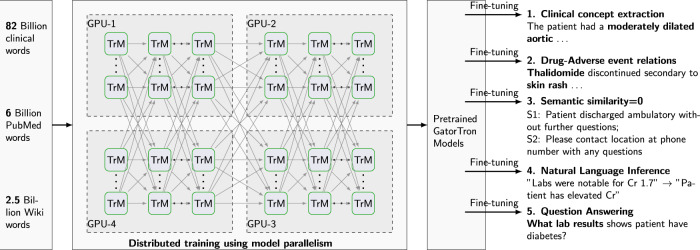
There is an increasing interest in developing artificial intelligence (AI) systems to process and interpret electronic health records (EHRs). Natural language processing (NLP) powered by pretrained language models is the key technology for medical AI systems utilizing clinical narratives. However, there are few clinical language models, the largest of which trained in the clinical domain is comparatively small at 110 million parameters (compared with billions of parameters in the general domain). It is not clear how large clinical language models with billions of parameters can help medical AI systems utilize unstructured EHRs. In this study, we develop from scratch a large clinical language model—GatorTron—using >90 billion words of text (including >82 billion words of de-identified clinical text) and systematically evaluate it on five clinical NLP tasks including clinical concept extraction, medical relation extraction, semantic textual similarity, natural language inference (NLI), and medical question answering (MQA). We examine how (1) scaling up the number of parameters and (2) scaling up the size of the training data could benefit these NLP tasks. GatorTron models scale up the clinical language model from 110 million to 8.9 billion parameters and improve five clinical NLP tasks (e.g., 9.6% and 9.5% improvement in accuracy for NLI and MQA), which can be applied to medical AI systems to improve healthcare delivery. The GatorTron models are publicly available at: https://catalog.ngc.nvidia.com/orgs/nvidia/teams/clara/models/gatortron_og .
Overview
The claims and statistics of this paper haven’t been checked yet.
Free: it reads the open-access text and checks the first 5 claims that cite a source we can check. Create a free account to check every claim.
Integrity signals
Registry
Cites
Statistics
Figures
Verification
Claims the paper makes
The claims and statistics of this paper haven’t been checked yet.
Free: it reads the open-access text and checks the first 5 claims that cite a source we can check. Create a free account to check every claim.
Claims other papers make about this one
Each is checked against this paper’s own text: does it say what the citing paper says it does?
The source backs part of the claim, not all of it — or backs it for a different population, condition or comparison.
In the citing paper
“As 1 example, Wu et al.25 developed and disseminated clinical LLMs such as GatorTron27 and GatorTronGPT28 to address limitations of traditional rule-based machine learning methods, which often lack scalability and transportability across data networks.”
From Advancing methodological development of artificial intelligence in patient-centered comparative clinical effectiveness research: Patient-Centered Outcomes Research Institute’s unique contribution to research done differently (2025) · cites this paper as [27]
Experimental — accuracy not yet measuredThe source backs part of the claim, not all of it — or backs it for a different population, condition or comparison.
In the citing paper
“Recent studies have demonstrated that large transformer models, such as ChatGPT, trained using massive text data, exhibit significant improvements over previous NLP models in terms of emergence and homogenization, which could contribute to enhancing critical thinking skills in students (Yang et al., 2022).”
From Investigating the Use of chatGPT as a Tool for Enhancing Critical Thinking and Argumentation Skills in International Relations Debates among Undergraduate Students (2024) · cites this paper as Yang et al., 2022
Experimental — accuracy not yet measuredThe cited source says what the claim attributes to it.
In the citing paper
“LLMs can be used for EHR analysis and as a clinical decision support tool [40].”
From Generative AI in healthcare: an implementation science informed translational path on application, integration and governance (2024) · cites this paper as [40]
The cited source says what the claim attributes to it.
In the citing paper
“The success of LLMs in the field of neural language processing, as well as their remarkable ability to solve complex tasks, has inspired researchers’ enthusiasm for adapting these models in the biomedical field [185].”
From Challenges in AI-driven Biomedical Multimodal Data Fusion and Analysis (2025) · cites this paper as [185]
The cited source says what the claim attributes to it.
In the citing paper
“AI using EHR data has become much more general and accurate in the last few years,35,36 allowing prediction of perioperative events37–41 and learning effective treatment strategies.42”
From Potential uses of AI for perioperative nursing handoffs: a qualitative study (2023) · cites this paper as [35]
3 more claims about this paper
Create a free account to see every claim other papers make about this one.
Self-check
Percentages, sums and reported differences re-computed from the paper’s own numbers.
The self-check needs the paper’s full text.
Citations
Cites
Vaswani, A., Shazeer, N., Parmar, N., Uszkoreit, J., Jones, L., Gomez, A. N., Kaiser, L., & Polosukhin, I. (2017) · arXiv · doi:10.48550/arxiv.1706.03762 · Cited by 120,404
LeCun, Y., Bengio, Y., & Hinton, G. (2015) · Nature · doi:10.1038/nature14539 · Cited by 84,126
Exploring the Limits of Transfer Learning with a Unified Text-to-Text Transformer
Raffel, C., Shazeer, N., Roberts, A., Lee, K., Narang, S., Matena, M., Zhou, Y., Li, W., & Liu, P. J. (2019) · arXiv · doi:10.48550/arxiv.1910.10683 · Cited by 31,859 · cited 3×
“On both datasets, pretrained transformer models achieved state-of-the-art performances 27,29 .”
BackgroundAdvances in neural information processing systems 7
Cios, K., & Shields, M. (1997) · Neurocomputing · doi:10.1016/s0925-2312(97)90018-7 · Cited by 22,059
Advances in neural information processing systems 7
(1996) · Computers & Mathematics with Applications · doi:10.1016/s0898-1221(96)90463-0 · Cited by 14,281
MIMIC-III, a freely accessible critical care database
Johnson, A. E. W., Pollard, T. J., Shen, L., Lehman, L.-W. H., Feng, M., Ghassemi, M., Moody, B., Szolovits, P., Anthony Celi, L., & Mark, R. G. (2016) · Scientific Data · doi:10.1038/sdata.2016.35 · Cited by 8,141 · cited 3×
“37 The ClinicalBERT model was developed by further training the BioBERT (base version; 110 million parameters with 12 layers, 768 hidden units, and 12 attention heads) using clinical text from the MIMIC-III 38 corpus.”
MethodInfluentialBioBERT: a pre-trained biomedical language representation model for biomedical text mining
Lee, J., Yoon, W., Kim, S., Kim, D., Kim, S., So, C. H., & Kang, J. (2020) · Bioinformatics · doi:10.1093/bioinformatics/btz682 · Cited by 7,218
XLNet: Generalized Autoregressive Pretraining for Language Understanding
Yang, Z., Dai, Z., Yang, Y., Carbonell, J., Salakhutdinov, R., & Le, Q. V. (2019) · arXiv · doi:10.48550/arxiv.1906.08237 · Cited by 6,687
SQuAD: 100,000+ Questions for Machine Comprehension of Text
Rajpurkar, P., Zhang, J., Lopyrev, K., & Liang, P. (2016) · Proceedings of the 2016 Conference on Empirical Methods in Natural Language Processing · doi:10.18653/v1/d16-1264 · Cited by 6,208
Natural Language Processing (almost) from Scratch
Collobert, R., Weston, J., Bottou, L., Karlen, M., Kavukcuoglu, K., & Kuksa, P. P. (2011) · arXiv (Cornell University) · doi:10.48550/arxiv.1103.0398 · Cited by 4,962 · cited 3×
“…concept extract are often rule-based, yet, most recent systems are based on machine learning models such as conditional random fields (CRFs) 50,51 , convolutional neural networks (CNN) 9,52 , and recurrent neural networks (RNN) implemented with long short-term memory strategy (LSTM) 10,53 .”
BackgroundMethod
Research works printed but not linked: 3
- Adoption of Electronic Health Record Systems among U.S. Non-Federal Acute Care Hospitals: 2008–2015. ONC Data Brief. https://www.healthit.gov/sites/default/files/briefs/2015_hospital_adoption_db_v17.pdf (2016). 40127322
- Yang X Identifying relations of medications with adverse drug events using recurrent convolutional neural networks and gradient boosting J. Am. Med. Inform. Assoc. 2020 27 65 72 10.1093/jamia/ocz144 31504605 PMC7489076 · DOI · Paper page
- Lv X Guan Y Yang J Wu J Clinical relation extraction with deep learning Int. J. Hybrid. Inf. Technol. 2016 9 237 248
Cited by
Items 801–900 of 1,005
Risk-conditioned Fine-tuning of Large Language Models
Liu, Z., Wu, F., Summa, B., & Zheng, Z. (2026) · Conference on Empirical Methods in Natural Language Processing (EMNLP) · doi:10.18653/2026.emnlp-main.956 · Cited by 2
Balaji, S., Campbell, K. S., Chen, R. C., Smith, D., Reyna, M. A., Sarker, A., Wallach, J. D., Parikh, R. B., & Bozkurt, S. (2026) · JMIR Cancer · doi:10.2196/99573 · Cited by 2
Computable longitudinal patient journeys from structured and unstructured EHR data
Kim, E., Foty, R. G., Thakor, A. S., Skyler, J. S., Robinson, L., Park, J. D., Kraft, M., Cairns, C. B., & Seyfert-Margolis, V. (2026) · Nature Medicine · doi:10.1038/s41591-026-04695-x · Cited by 3
Mahlaza, Z., & Khumalo, L. (2024) · doi:10.55492/dhasa.v5i1.5013 · Cited by 2
BioBridge: Unified Bio-Embedding With Bridging Modality in Code-Switched EMR
Jeon, J., Cho, S., Lee, D., Lee, C., & Kim, J. (2024) · IEEE Access · doi:10.1109/access.2024.3467251 · Cited by 2
“Traditional approaches to applying NLP to EMR data have focused on Machine Learning (ML) [14]– [16] and Word2Vec-based approaches to extract context-free word embeddings [17]–[19].”
Deciphering Abbreviations in Malaysian Clinical Notes Using Machine Learning
Sulaiman, I. M., Bulgiba, A. M., Kareem, S. A., & Latip, A. A. (2024) · Methods of Information in Medicine · doi:10.1055/a-2521-4372 · Cited by 2
“20 Additionally, Med-PaLM 2 is currently restricted to speci fi c countries, requiring approval for use via Google Cloud.”
Tully, J. L., Litake, O., Meineke, M. N., Simpson, S., Waterman, R. S., & Gabriel, R. A. (2025) · Anesthesia & Analgesia · doi:10.1213/ane.0000000000007408 · Cited by 2
Synchronous Condenser-Based Intelligent Question Answering System Based on Large Language Model
Zhang, D., Zhang, C., Zhao, W., Xu, L., Zhang, G., & Li, Z. (2024) · International Conference on Computing, Robotics and System Sciences (ICRSS) · doi:10.1109/icrss65752.2024.00043 · Cited by 2
Lee, J. K., Park, S., Hwang, S., Lee, J., Cho, D., & Choi, S. (2025) · Vox Sanguinis · doi:10.1111/vox.70050 · Cited by 3
“5 excelled in English but underperformed in Korean, which may reflect its limited multilingual training — its pre-training data includes approximately 50% English and only 0.65% Korean [ 24, 25].”
InfluentialChen, W., & McMillan, A. B. (2025) · Computers in Biology and Medicine · doi:10.1016/j.compbiomed.2025.110258 · Cited by 2
Predicting Chronic Kidney Disease Progression from Stage III to Stage V using Language Models
Awan, Z., Henkin, R., Reynolds, N. J., & Michael, B. (2025) · Workshop on Patient-Oriented Language Processing (CL4Health) · doi:10.18653/v1/2025.cl4health-1.20 · Cited by 2
Zhang, H., & Shafiq, M. O. (2025) · IEEE International Conference on Semantic Computing (ICSC) · doi:10.1109/icsc64641.2025.00032 · Cited by 2
“Med-PaLM 2 [6] and GatorTron [14] improve base models through fine-tuning with medical texts; Med-PaLM 2 uses ensemble refinement for high accuracy, whereas GatorTron broadens its utility across clinical tasks.”
Foundation Models for Generative AI in Time-Series Forecasting
Beltramin, D., & Cédric Bousquet, B. (2025) · Journal of Medical Internet Research · doi:10.2196/76964 · Cited by 2
Ridho, M. A. R., Bustamam, A., & Adnan, R. (2025) · Jambura Journal of Biomathematics (JJBM) · doi:10.37905/jjbm.v6i3.30506 · Cited by 2
Rethinking Ethics for an Era of Trusted Computational Tools
Kostick, K. M., Hurley, M. E., Herrington, J. D., & Storch, E. A. (2025) · Psychiatric Clinics of North America · doi:10.1016/j.psc.2025.08.016 · Cited by 2
Umar, M., Ali, V., Shamim, L., Musharaf, I., Hafsa, R., Ahsan, M. U., Ahmad, O., Sabhan, L. B., Saeed, M., Ahmed, S., et al. (2025) · Journal of intelligent medicine. · doi:10.1002/jim4.70015 · Cited by 2
“66”
Uncertainty-Aware Adaptation of Large Language Models for Protein-Protein Interaction Analysis
Jantre, S. R., Wang, T., Park, G., Chopra, K., Jeon, N., Qian, X., Urban, N. M., & Yoon, B.-J. (2025) · Annual International Conference of the IEEE Engineering in Medicine and Biology Society (EMBC) · doi:10.1109/embc58623.2025.11253873 · Cited by 2
Large language models for urban transportation
Ma, Z., Wang, L., Qin, Z., & Ling, Y. (2026) · Elsevier eBooks · doi:10.1016/b978-0-443-26789-5.00011-0 · Cited by 2
Large Language Models in Medical Education and Quality Concerns
Mishra, V. (2023) · Journal of Quality in Health Care & Economics · doi:10.23880/jqhe-16000319 · Cited by 2
Interpreting deep embeddings for disease progression clusteringPreprint
Munoz-Farre, A., Poulakakis-Daktylidis, A., Kothalawala, D. M., & Rodriguez‐Martinez, A. (2023) · arXiv (Cornell University) · doi:10.48550/arxiv.2307.06060 · Cited by 2
“…in healthcare applications, where large volumes of structured data (disease diagnoses, medication prescriptions, surgical procedures, laboratory results, etc) are collected and stored in the form of electronic health records (EHR) (Li et al., 2020; Steinberg et al., 2021; Yang et al., 2022).”
BackgroundOn the Impact of Cross-Domain Data on German Language ModelsPreprint
Dada, A., Chen, A.-K., Peng, C., Smith, K. E., Idrissi-Yaghir, A., Seibold, C., Li, J.-N., Heiliger, L., Yang, X., Friedrich, C. M., et al. (2023) · Conference on Empirical Methods in Natural Language Processing · doi:10.48550/arxiv.2310.07321 · Cited by 9
Self-citationBeyond Fine-tuning: Unleashing the Potential of Continuous Pretraining for Clinical LLMsPreprint
Christophe, C., Raha, T., Maslenkova, S., Salman, M., Kanithi, P., Pimentel, M. A., & Khan, S. (2024) · arXiv (Cornell University) · doi:10.48550/arxiv.2409.14988 · Cited by 2
Exploring Long-Term Prediction of Type 2 Diabetes Microvascular ComplicationsPreprint
Remfry, E., Henkin, R., Barnes, M. R., & Naik, A. (2024) · arXiv (Cornell University) · doi:10.48550/arxiv.2412.01331 · Cited by 2
Big Data Analysis in Personalized Medicine
Banu, A., Balyan, P., Nisamudheen, N. A., Velayutham, D., Balyan, M. K., & Jithesh, P. V. (2024) · Elsevier eBooks · doi:10.1016/b978-0-323-95502-7.00279-7 · Cited by 2
Large Language Models in Stroke Management: A Review of the LiteraturePreprint
Soffer, S., Mudrik, A., Efros, O., Omar, M., Nadkarni, G. N., & Klang, E. (2025) · medRxiv · doi:10.1101/2025.06.28.25330477 · Cited by 2
Park, J., Pang, C., Lee, T. Y., Berkowitz, J. S., Wei, A. Z., Hur, C., & Tatonetti, N. P. (2025) · Research Square · doi:10.21203/rs.3.rs-7426088/v1 · Cited by 2
Haroon, M., Wojcieszak, M., & Chhabra, A. (2025) · arXiv (Cornell University) · doi:10.48550/arxiv.2503.20797 · Cited by 2
Federated Timeline Synthesis: Scalable and Private Methodology For Model Training and DeploymentPreprint
Renc, P., Grzeszczyk, M. K., Qian, L., Oufattole, N., Rasley, J., & Sitek, A. (2025) · arXiv (Cornell University) · doi:10.48550/arxiv.2506.23358 · Cited by 2
“Early efforts such as BioBERT and ClinicalBERT focused on text; GatorTron later extended transformer capacity to 8.9B parameters using over 90 billion words of clinical text [29], achieving gains in concept extraction and inference tasks.”
Shi, J., Gan, Q., Hanchrow, E. E., Bowles, A., Stanley, J., Bress, A. P., Cohen, J. B., & Alba, P. R. (2025) · arXiv (Cornell University) · doi:10.48550/arxiv.2504.12494 · Cited by 2
Minimax Optimal Rates for Regression on Manifolds and DistributionsPreprint
Tang, R., & Yang, Y. (2025) · arXiv (Cornell University) · doi:10.48550/arxiv.2506.07504 · Cited by 2
Practical Considerations For the Deployment of Clinical NLP Systems
Lehman, E. (2024) · DSpace@MIT (Massachusetts Institute of Technology) · Cited by 2
Expert-guided Clinical Text Augmentation via Query-Based Model CollaborationPreprint
Cho, D., Zhang, M., & Chunara, R. (2025) · arXiv (Cornell University) · doi:10.48550/arxiv.2509.21530 · Cited by 3
“…language models to process biomedical and clinical texts, including ClinicalBert (Huang et al., 2019), BioBert (Lee et al., 2020), GatorTron (Yang et al., 2022), and NYUTron (Jiang et al., 2023), by domain-specific pre-training on large-scale electronic health records (EHRs) and medical…”
Qian, L., Giuffrè, M., Wang, Y., He, H., Xie, Q., Ai, X., Peng, X., Ma, F., Weng, R.-L., Wright, D., et al. (2026) · arXiv (Cornell University) · doi:10.48550/arxiv.2601.10020 · Cited by 2
“Beyond scaling with larger medical models to serve as backbones [41], our analysis reveals that existing LLMs still exhibit a fragmented understanding of complex temporal relationships between clinical events and patient visits.”
Safe RLHF Beyond Expectation: Stochastic Dominance for Universal Spectral Risk ControlPreprint
Chittepu, Y., Joshi, A., Bhattacharjee, R., & Niekum, S. (2026) · arXiv (Cornell University) · doi:10.48550/arxiv.2603.10938 · Cited by 2
“This need is especially acute in high-stakes domains such as legal reasoning (Katz et al. (2024)), medical consultation (Yang et al. (2022); Moor et al. (2023)), and educational support (Kasneci et al. (2023); Kung et al. (2023)), where harmful gen-erations—including toxicity and misinformation—can…”
Weissenbacher, D., Shabbir, M., Campbell, I. M., Berdahl, C. T., & Gonzalez‐Hernandez, G. (2026) · medRxiv · doi:10.64898/2026.04.02.26350065 · Cited by 2
A Hybrid Retrieval and Reranking Framework for Evidence-Grounded Retrieval-Augmented Generation
Irany, F. A., & Akwafuo, S. (2026) · Cureus Journal of Computer Science. · doi:10.48550/arxiv.2605.01664 · Cited by 2
“More recent large-scale clinical language models, such as GatorTron and GatorTronGPT, further demonstrate that scaling language models on clinical and biomedical text can improve clinical NLP and healthcare text generation tasks [22], [23].”
MedGuards: Multi-Agent System for Reliable Medical Error Detection and CorrectionPreprint
Ma, C., Wang, H., Zhang, Y., & Shamout, F. E. (2026) · arXiv (Cornell University) · doi:10.48550/arxiv.2606.25651 · Cited by 2
“Their capacity to generate coherent and contextually relevant medical text has attracted substantial interest for aiding healthcare delivery [46, 36, 26].”
Self-citationToward Automated Detection of Documentation Inconsistencies in Electronic Health RecordsPreprint
Lu, J., Chen, P., Treggiari, M., Blessing, R., Zhuo, D., Weng, C., Stead, W. W., & Zhang, A. R. (2026) · arXiv (Cornell University) · doi:10.48550/arxiv.2607.22954 · Cited by 2
“[20, 21] In clinical applications specifically, LLMs have been used for medical question answering at expert-level performance,[22, 23] clinical information extraction from unstructured notes,[24, 25] and clinical text summarization .”
Ou, J., & Holve, E. (2025) · JAMIA Open · doi:10.1093/jamiaopen/ooaf081 · Cited by 1
“26 As 1 example, Wu et al. 25 developed and disseminated clinical LLMs such as GatorTron 27 and GatorTronGPT 28 to address limitations of traditional rule-based machine learning methods, which often lack scalability and transportability across data networks.”
Improving Outcome Prediction of Pulmonary Embolism by De-biased Multi-modality Model
Zhong, Z., Li, J., Kulkarni, S., Li, Y., Fayad, F. H., Zhang, H., Ahn, S. H., Bai, H. X., Gao, X., Atalay, M. K., et al. (2023) · Lecture notes in computer science · doi:10.1007/978-3-031-43904-9_50 · Cited by 1
Semantic Annotation of Sensor Data Using a Sequential Possibilistic Clustering Methodology
Wu, W., Keller, J. M., Skubic, M., Popescu, M., Lane, K. R., & Rantz, M. (2023) · IEEE International Conference on Fuzzy Systems (FUZZ-IEEE) · doi:10.1109/fuzz52849.2023.10309714 · Cited by 1
“We note that while some large language models for parsing medical records such as GatorTron, BioBERT and PubMedBERT exist [24], a recent survey concludes that specialized NLP models, such as CLAMP, trained on specific (bio)medical datasets still represent the right direction to pursue for critical…”
Artificial Intelligence in Laryngology, Broncho-Esophagology, and Sleep Surgery
Nwosu, O. I., & Naunheim, M. R. (2024) · Otolaryngologic Clinics of North America · doi:10.1016/j.otc.2024.04.002 · Cited by 1
Intelligent Conversational Agent for Medical Information
Zeltsi, A., Tsourma, M., Alexiadis, A., Mavropoulos, A., Zamichos, A., Mastoras, V., Kontoulis, C.-G., Andreadis, S. T., Matonaki, A., Crisan, A., et al. (2024) · Lecture notes in computer science · doi:10.1007/978-3-031-70242-6_32 · Cited by 1
Empowering Nurses with Technology: A Practical Guide to Nurse Informatics
McGrow, K. (2024) · Productivity Press eBooks · doi:10.4324/9781003439721 · Cited by 1
Large language models for chart review: how machine learning can accelerate hematology research
Lam, B. D., Wang, P., Ma, S., Jafari, O., Kovalenko, I., & Li, A. (2025) · Blood Vessels Thrombosis & Hemostasis · doi:10.1016/j.bvth.2025.100052 · Cited by 1
Kumandaş, M. T., & Murat, N. (2025) · Expert Systems with Applications · doi:10.1016/j.eswa.2025.127042 · Cited by 1
Neo, S. H., Ke, Y., Lee, C. F., & Cheung, Y. B. (2025) · BMJ Open · doi:10.1136/bmjopen-2025-100581 · Cited by 1
Respostas a perguntas de clínica médica utilizando a Geração Aumentada por Recuperação (RAG)
Bencke, L. R. (2025) · doi:10.5753/sbc.16731.5.6 · Cited by 1
Sujitno, P. R., Rahman, M. A., & Antu, M. I. A. (2025) · PRIMA WIYATA HEALTH · doi:10.60050/pwh.v6i2.98 · Cited by 1
Cai, Q., Yang, L., Xiao, J., Ma, J., Liu, M., & Pan, X. (2025) · Diagnostics · doi:10.3390/diagnostics15141829 · Cited by 1
“LLMs, with powerful abilities in semantic understanding, knowledge representation, and logical reasoning, have advantages in error detection and correction in EMRs [9,10].”
Zohra, M. A. F., Meddah, F. G., & Ougouti, N. S. (2025) · International Conference on Artificial Intelligence, Computer, Data Sciences and Applications (ACDSA) · doi:10.1109/acdsa65407.2025.11166593 · Cited by 1
Dalli, L. L., Olaiya, M. T., Yu, A., Reeves, M. J., Cadilhac, D. A.-M., Nedkoff, L., Feigin, V. L., Norrving, B. G., Kapral, M. K., Whiteley, W. N., et al. (2025) · Neuroepidemiology · doi:10.1159/000548781 · Cited by 1
O USO DA INTELIGÊNCIA ARTIFICIAL NO AUXÍLIO DA TRIAGEM DE ADULTOS EM SERVIÇOS DE EMERGÊNCIA
Júnior, L. D. G. M., de Lima, G. M., Tavares, J. O., Mendonça, L. R. A., & Narciso, T. S. (2025) · RECIMA21 - Revista Científica Multidisciplinar · doi:10.47820/recima21.v6i10.6821 · Cited by 1
Ahmad, H. F., Sajid, J., Rasool, R. U., & Malik, A. W. (2025) · Cluster Computing · doi:10.1007/s10586-025-05793-0 · Cited by 1
“In particular, works such as [46, 47], and [48] partially discuss applications and architecture, but omit key areas such as requirements, security, or privacy.”
Alili, A., McKane, A. M., Demir, M. F., Emory, C. L., & Gürcan, M. N. (2026) · Journal of Medical Systems · doi:10.1007/s10916-026-02373-6 · Cited by 1
“To benchmark SHIELD’s performance, a base - line comparison was conducted using Gnull [ 39 ], a large clinical language model.”
Multimodal Vision-Language Transformer for Thermography Breast Cancer Classification
Pinto, G., León, J., Quintero, B., Villamizar, D., & Rueda-Chacón, H. (2025) · IEEE Colombian Conference on Applications of Computational Intelligence (ColCACI) · doi:10.1109/colcaci67437.2025.11230909 · Cited by 1
“For each pretrained text encoder ( Bio+ClinicalBERT [30], CLIP [32], GatorTron-Base [31]), we extracted embeddings for all prompts, trained a logistic regression probe, and repeated this procedure 10 times to compute mean and standard deviation of accuracy.”
InfluentialMulMed: Addressing Multiple Medical Tasks Utilizing LLMS
Cheng, N., Li, F., & Huang, L. (2025) · Academic Journal of Computing & Information Science · doi:10.25236/ajcis.2025.080904 · Cited by 1
Innovative Decision Making Through Artificial Intelligence in a Connected Healthcare System
Kabir, Z. S. (2025) · IGI Global eBooks · doi:10.4018/979-8-3373-5702-7.ch001 · Cited by 1
Silva, P. J., Rogers, S. L., Hassan-Toufique, Z., Tao, J., Bruce, S. A., Shireman, P. K., & Ramos, K. S. (2025) · Pharmacoepidemiology · doi:10.3390/pharma4040026 · Cited by 1
“Machine learning and deep learning have been used to interrogate drug safety in a research setting for over a decade [96].”
Amarsy, R., Thomas, C., Fournier, S., Jarlier, V., & Robert, J. (2025) · Antimicrobial Resistance and Infection Control · doi:10.1186/s13756-025-01678-4 · Cited by 1
“Rather than relying solely on structured but potentially incomplete or imprecisely coded datasets, AI algorithms can process and analyze rich narrative content from patient records, allowing for the generation of more accurate and contex-tually relevant indicators [37].”
Üçdal, M. T. (2025) · Academic Radiology · doi:10.1016/j.acra.2025.11.041 · Cited by 1
The Impact of Large Language Models on Healthcare
Kaur, U., Gupta, N., & Kaur, H. (2025) · BENTHAM SCIENCE PUBLISHERS eBooks · doi:10.2174/9798898813512125010012 · Cited by 1
Fine-Tuning Large Language Models for Structured Clinical Report Generation Using GRPO
Devulapalli, U., Satsangi, A., & Narayan, A. (2025) · Proceedings of the AAAI Symposium Series · doi:10.1609/aaaiss.v7i1.36923 · Cited by 1
The Role of Perioperative Artificial Intelligence in Colon and Rectal Surgery
Chen, K., Feroz, S. H., & Holubar, S. D. (2025) · Clinics in Colon and Rectal Surgery · doi:10.1055/a-2769-1052 · Cited by 1
Zhang, Y., Zhao, S., Ren, J., Li, Y., Zhao, X., Sun, J., Nie, C., Xie, S., Huang, X., Wen, J., et al. (2026) · BMJ Open Ophthalmology · doi:10.1136/bmjophth-2025-002385 · Cited by 1
“29 The results demonstrated that our model was able to capture the traditional predictors of ROP.”
Self-citationBoltaboyeva, A., Baigarayeva, Z., Иманбек, Б., Amangeldy, B., Tasmurzayev, N., Ozhikenov, K., Alimbayeva, Z. N., Alimbayev, C. A., & Karymsakova, N. (2026) · Algorithms · doi:10.3390/a19020099 · Cited by 1
Liu, Y., Fu, L., & Xia, X. (2026) · Computer Speech & Language · doi:10.1016/j.csl.2026.101949 · Cited by 1
Yuan, Q., Chen, J., & Shi, Z. (2026) · Displays · doi:10.1016/j.displa.2026.103359 · Cited by 1
Bootstrapping Large Language Models as Clinical Predictors for Multimodal Irregular Time Series
He, Y., Cai, J., & Zhao, G. (2025) · IEEE International Conference on Bioinformatics and Biomedicine (BIBM) · doi:10.1109/bibm66473.2025.11356732 · Cited by 1
“Recently, the application of large language models (LLMs) as clinical experts [1], [2] has increasingly attracted attention from the health informatics community.”
Qiang, Y., Dong, X., Liu, X., Hu, F., & Wang, R. (2025) · IEEE International Conference on Bioinformatics and Biomedicine (BIBM) · doi:10.1109/bibm66473.2025.11356067 · Cited by 1
AI Agents in Healthcare: A Survey of Applications, Resources, and Challenges
Rashid, S., Shahriar, F., Katha, S. K., Jubaer, E., Mazumder, A. M. R., Islam, A., Ashraf, M., Mahmud, A., & Amin, M. A. (2025) · IEEE Student Conference on Research and Development (SCOReD) · doi:10.1109/scored68498.2025.11398875 · Cited by 1
NLP in Support of Pharmacovigilance: QUality Adverse Drug Reaction AcTIve Control ( QUADRATIC )
Franchini, A., Noseda, R., Cornelius, J., Colombo, A., Mitrović, S., Bertoli, R., Ceschi, A., Ruinelli, L., & Rinaldi, F. (2026) · Clinical Pharmacology & Therapeutics · doi:10.1002/cpt.70250 · Cited by 1
“10,11 However, to date, real-world applications of NLP in the daily activities of pharmacovigilance remain limited, often due to a lack of or, at best, insufficient clinical integration.”
Lin, A., Zeng, M., Gan, W., Jiang, A., Liu, Y., Qi, C., Zhu, L., Mou, W., Zeng, D., Xiao, M., et al. (2026) · Journal of Translational Medicine · doi:10.1186/s12967-026-07912-w · Cited by 2
“AI systems based on LLMs, through systematic analysis of EHR data, can provide differential diagnostic suggestions with relatively high accuracy in complex cases [11, 38], thereby offering robust support for clinical decision-making.”
Ensemble-Based Multi-Class and Multi-Label Text Classification for Noisy Clinical Dialogues
Lucińska, M., Płaza, M., Kęczkowska, J., Kurek, K., Wykrota, K., Deniziak, S. R., Twardowski, K., Koruba, Z., & Płaza, M. (2026) · Applied Sciences · doi:10.3390/app16062645 · Cited by 1
Predicting Mortality and Readmission in Obstructive Sleep Apnea via LLM-Expanded Clinical Concepts
Ahmed, A., Rispoli, A., Wasieloski, C., Khurram, I., Zamora‐Resendiz, R., Morrow, D., Dong, A., & Crivelli, S. N. (2026) · Big Data and Cognitive Computing · doi:10.3390/bdcc10030097 · Cited by 1
“Noteworthy applications of LLMs in healthcare include named entity recognition and relation extraction (e.g., BioBERT [19] and BlueBERT [28]), medical question answering and inference (e.g., GatorTron [20] and Med-PaLM [21]), discharge summaries (e.g., ChatGPT-3.”
Predictive maintenance of biomedical devices using AI
Nangare, N. R., Gulhane, M., Jujar Komal, M., Rakesh, N., Mane, M. B., & Gupta, A. (2026) · AIP conference proceedings · doi:10.1063/5.0326239 · Cited by 1
Sun, J., Ma, S., Fan, Y., & Washington, P. Y. (2026) · Applied Sciences · doi:10.3390/app16073388 · Cited by 1
Alzyood, M. A. (2026) · International Health · doi:10.1093/inthealth/ihag033 · Cited by 1
Scroggins, J. K., Barcelona, V., Hulchafo, I. I., Harkins, S., Zhang, Z., Scharp, D., Cato, K., Moen, H., Davoudi, A., Tadiello, M., et al. (2026) · Nursing Outlook · doi:10.1016/j.outlook.2026.102757 · Cited by 1
Wang, Z., Daniel, K. E., Barnes, L. E., & Chow, P. I. (2026) · CHI Conference on Human Factors in Computing Systems · doi:10.1145/3772318.3791352 · Cited by 1
Predicting guide dog career success using machine learning and large language models
Solomon, A., Shamis, E., Racah, H., Toren, A., Weiss, C., Braun, O., & Zamansky, A. (2026) · Scientific Reports · doi:10.1038/s41598-026-48238-3 · Cited by 1
Evaluating Explainability: Metrics, Benchmarks, and Human-Centered Evaluation Methods
Yousefi, N., & Zamanifar, A. (2026) · Springer eBooks · doi:10.1007/978-3-032-15088-2_10 · Cited by 1
Kuijpers, S. M. E., Siepel, M., Schut, M. C., van Hest, R. M., Spijker, R., Schade, R. P., Sigaloff, K., & Prins, J. M. (2026) · Clinical Microbiology and Infection · doi:10.1016/j.cmi.2026.05.021 · Cited by 1
Clinical text embeddings: A systematic review of methods, applications, and future directions
Jo, H., Kim, S., Son, H., & Kim, J. (2026) · International Journal of Medical Informatics · doi:10.1016/j.ijmedinf.2026.106505 · Cited by 1
Kindt, R. M. B., dos Reis, T. S., da Silva, L. D., Duarte, R. C., Cassiolato, H. M. P., Carneiro, V., da Costa, J. C. T., Pinheiro, F. D. S., Simas, L., de Oliveira, Y. T. F. H., et al. (2026) · Derecho y cambio social. · doi:10.54899/dcs.v23i90.5717 · Cited by 1
Digital Twins: A Computational Realization of the Scientific Method in Dynamical Systems
Emmert‐Streib, F. (2026) · Machine Learning and Knowledge Extraction · doi:10.3390/make8060159 · Cited by 1
“The process begins with data acquisition from the patient, initially limited to electronic health records (EHR) [70,71].”
El-Enen, M. A. A., Ismail, S., & Nazmy, T. M. (2026) · Applied Sciences · doi:10.3390/app16126158 · Cited by 1
Configurable Clinical Information Extraction with Agentic RAG: What Works, What Breaks, and Why
Koraş, O. A., Bauer, M., Khattab, S., Engelke, M., Kim, M., Settelmeier, S., Sugawara, S., Freisleben, F., Nensa, F., & Kleesiek, J. (2026) · Conference on Empirical Methods in Natural Language Processing (EMNLP) · doi:10.18653/2026.emnlp-industry.50 · Cited by 1
Generative explainers in Spanish healthcare prognosis: a novel assessment framework
Lebeña, N., Casillas, A., & Pérez, A. (2026) · International Journal of Data Science and Analytics · doi:10.1007/s41060-026-01167-w · Cited by 1
“It was evaluated across several clinical NLP tasks, demonstrating improvements in clinical concept extraction, medical relation extraction, semantic textual similarity, natural language inference, and medical question answering due to its large size and extensive training [34].”
MV-MoE: A multi-view mixture-of-expert tuning method for medical LLMs
Zhang, W., Yan, Y., Wang, J., Wu, X., Yuan, C., & Ruan, T. (2026) · Expert Systems with Applications · doi:10.1016/j.eswa.2026.133593 · Cited by 1
A unified multi-modal foundation model for end-to-end emergency care
Huang, Z., Xu, Y., Nie, Z., Wang, H., Huang, X., Huang, L., Lai, J., Xi, X., Li, L., Wang, C., et al. (2026) · npj Digital Medicine · doi:10.1038/s41746-026-02981-z · Cited by 1
Bilal, K. H., Gibson, J., Kim, D., LEVI, A. W., Nassar, A., Oen, H. O., Robila, V., Saieg, M. A., Shi, Q., Torous, V. F., et al. (2026) · Cancer Cytopathology · doi:10.1002/cncy.70134 · Cited by 1
SciLENS: RL-Driven Autonomous Agents for Scientific Localized Evidence Navigation and Synthesis
Zheng, L., Su, J., Li, Y., Wang, C., Wang, W., Li, H., Zhang, J., Yan, S., Kang, Z., Fu, R., et al. (2026) · Conference on Empirical Methods in Natural Language Processing (EMNLP) · doi:10.18653/2026.emnlp-main.589 · Cited by 1
Arafin, P., Moniruzzaman, M., & Alkhateeb, A. (2026) · Applied Sciences · doi:10.3390/app16189148 · Cited by 1
MEDAL: Sequential adapter learning for privacy-preserving multicenter clinical language models
Bakr, A., García-Agúndez, A., Atkison, T., Rudrapatna, V. A., & Gupta, T. (2026) · Journal of Biomedical Informatics · doi:10.1016/j.jbi.2026.105101 · Cited by 1
Morfaki, C. (2026) · Hospitals · doi:10.3390/hospitals3040019 · Cited by 1
Fahim, S. H., surya, S. J., abdullah, P. S., Varshini, S., S.Venuharini, Mathesan, R., Palaniyappan, N., & Nataraj, E. (2026) · International Journal of Pharmacology and Clinical Research (IJPCR) · Cited by 1
Künstliche Intelligenz in der Neurologie: Anwendungen, Algorithmen, Anforderungen
Wiegand, T. L. T., Velezmoro, L., Jung, L., Wimbauer, F., Dimitriadis, K., & Koerte, I. K. (2023) · Nervenheilkunde · doi:10.1055/a-2050-0768 · Cited by 1
“arXiv preprint arXiv:221213138 2022 [20] Yang X, Chen A, PourNejatian N et al.”
BackgroundAnnotate French Clinical Data Using Large Language Model Predictions
Méoni, S., Ryffel, T., & de la Clergerie, É. V. (2023) · IEEE International Conference on Healthcare Informatics (ICHI) · doi:10.1109/ichi57859.2023.00099 · Cited by 1
“Nevertheless, some LLMs have been trained from scratch over clinical domain-specific notes such as GatorTron [20], BioGPT [21] or Clin-icalT5 [22] who achieved promising performance on several tasks.”
Background
Metadata
- Authors
- Yang, X., Chen, A., PourNejatian, N., Shin, H. C., Smith, K. E., Parisien, C., Compas, C., Martin, C., Costa, A. B., Flores, M. G., Zhang, Y., Magoc, T., Harle, C. A., Lipori, G., Mitchell, D. A., Hogan, W. R., Shenkman, E. A., Bian, J., & Wu, Y.
- Affiliations
- University of Florida (US)
- Nvidia (United States) (US)
- University of Florida Health (US)
- Corresponding author
- Wu, Yonghui
- ORCID
- Venue
- npj Digital Medicine
- Published
- 2022-12-26
- Volume
- 5
- Issue
- 1
- Pages
- 194-194
- ISSN
- 2398-6352 (ISSN-L)
- PMC
- PMC9792464
- OpenAlex
- W4312220150
- Semantic Scholar
- 332dc8b2ca9d49fad607c7282f3360bb2a9aacf3
- Cited by
- 847
- References
- 73
- Citations by year
- 2026: 171 · 2025: 304 · 2024: 268 · 2023: 101 · 2022: 1
- FWCI
- 55.47
- Type
- journal article
- Language
- en
- Open access
- gold
- doi.org
- Licence
- cc-by
- creativecommons.org/licenses/by/4.0 (tdm)
- creativecommons.org/licenses/by/4.0 (vor)
- Locations
- npj Digital Medicine (publishedVersion, cc-by)
- PubMed Central (publishedVersion, cc-by)
- PubMed (publishedVersion)
- DOAJ (DOAJ: Directory of Open Access Journals) (submittedVersion)
- IUScholarWorks (Indiana University) (submittedVersion, cc-by)
- Funders
- Patient-Centered Outcomes Research Institute (ME-2018C3-14754)
- U.S. Department of Health & Human Services | NIH | National Cancer Institute (1R01CA246418)
- U.S. Department of Health & Human Services | NIH | National Institute on Aging (R56AG069880, R21AG062884)
- Topics
- Physical Sciences › Computer Science › Artificial Intelligence › Machine Learning in Healthcare
- Physical Sciences › Computer Science › Artificial Intelligence › Topic Modeling
- Health Sciences › Medicine › Health Informatics › Artificial Intelligence in Healthcare and Education
- Keywords
- electronic health records, clinical natural language processing, clinical concept extraction, semantic textual similarity, natural language inference, medical question answering, model scaling, training data size, clinical text
About these checks
Registry, retraction, Cites and statistics results are computed, not judged, with one exception: a printed reference that no index lists is read once by a model before it counts as a citation error. Claims are extracted by a model and kept only when their quote appears verbatim in the text; each cited source is then checked, with a model’s help, for whether it says what the claim relies on. Those verdicts can be wrong — read the claim’s quote and the cited source before relying on one.
Statistics and arithmetic are recomputed, not judged.
Confidence bands are shown only for fields calibrated on our annotated test set. None is calibrated yet, so no band is shown.
What counts as a claim ›How we measure confidence ›How we check this ›
Are you an author, or do you see a problem with this page? Request a review
Data sources
Bibliographic data: Semantic Scholar, OpenAlex, Crossref.
Contains information from the Semantic Scholar Academic Graph Datasets, made available under the ODC Attribution License (ODC-BY 1.0).
Semantic Scholar’s data is described in: Kinney, R., et al. (2023). The Semantic Scholar Open Data Platform. arXiv:2301.10140.
