

A large language model for electronic health records
Open accessThe DOI matches its Crossref record; 77 of the 78 references it cites were found in a registry or an index.
Abstract
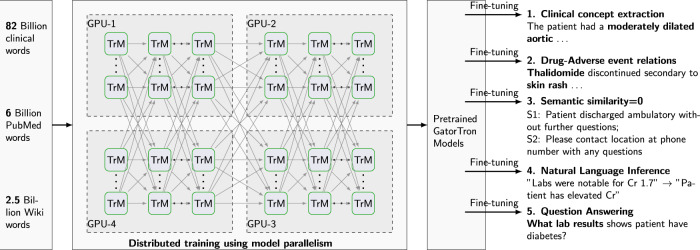
There is an increasing interest in developing artificial intelligence (AI) systems to process and interpret electronic health records (EHRs). Natural language processing (NLP) powered by pretrained language models is the key technology for medical AI systems utilizing clinical narratives. However, there are few clinical language models, the largest of which trained in the clinical domain is comparatively small at 110 million parameters (compared with billions of parameters in the general domain). It is not clear how large clinical language models with billions of parameters can help medical AI systems utilize unstructured EHRs. In this study, we develop from scratch a large clinical language model—GatorTron—using >90 billion words of text (including >82 billion words of de-identified clinical text) and systematically evaluate it on five clinical NLP tasks including clinical concept extraction, medical relation extraction, semantic textual similarity, natural language inference (NLI), and medical question answering (MQA). We examine how (1) scaling up the number of parameters and (2) scaling up the size of the training data could benefit these NLP tasks. GatorTron models scale up the clinical language model from 110 million to 8.9 billion parameters and improve five clinical NLP tasks (e.g., 9.6% and 9.5% improvement in accuracy for NLI and MQA), which can be applied to medical AI systems to improve healthcare delivery. The GatorTron models are publicly available at: https://catalog.ngc.nvidia.com/orgs/nvidia/teams/clara/models/gatortron_og .
Overview
The claims and statistics of this paper haven’t been checked yet.
Free: it reads the open-access text and checks the first 5 claims that cite a source we can check. Create a free account to check every claim.
Integrity signals
Registry
Cites
Statistics
Figures
Verification
Claims the paper makes
The claims and statistics of this paper haven’t been checked yet.
Free: it reads the open-access text and checks the first 5 claims that cite a source we can check. Create a free account to check every claim.
Claims other papers make about this one
Each is checked against this paper’s own text: does it say what the citing paper says it does?
The source backs part of the claim, not all of it — or backs it for a different population, condition or comparison.
In the citing paper
“As 1 example, Wu et al.25 developed and disseminated clinical LLMs such as GatorTron27 and GatorTronGPT28 to address limitations of traditional rule-based machine learning methods, which often lack scalability and transportability across data networks.”
From Advancing methodological development of artificial intelligence in patient-centered comparative clinical effectiveness research: Patient-Centered Outcomes Research Institute’s unique contribution to research done differently (2025) · cites this paper as [27]
Experimental — accuracy not yet measuredThe source backs part of the claim, not all of it — or backs it for a different population, condition or comparison.
In the citing paper
“Recent studies have demonstrated that large transformer models, such as ChatGPT, trained using massive text data, exhibit significant improvements over previous NLP models in terms of emergence and homogenization, which could contribute to enhancing critical thinking skills in students (Yang et al., 2022).”
From Investigating the Use of chatGPT as a Tool for Enhancing Critical Thinking and Argumentation Skills in International Relations Debates among Undergraduate Students (2024) · cites this paper as Yang et al., 2022
Experimental — accuracy not yet measuredThe cited source says what the claim attributes to it.
In the citing paper
“LLMs can be used for EHR analysis and as a clinical decision support tool [40].”
From Generative AI in healthcare: an implementation science informed translational path on application, integration and governance (2024) · cites this paper as [40]
The cited source says what the claim attributes to it.
In the citing paper
“The success of LLMs in the field of neural language processing, as well as their remarkable ability to solve complex tasks, has inspired researchers’ enthusiasm for adapting these models in the biomedical field [185].”
From Challenges in AI-driven Biomedical Multimodal Data Fusion and Analysis (2025) · cites this paper as [185]
The cited source says what the claim attributes to it.
In the citing paper
“AI using EHR data has become much more general and accurate in the last few years,35,36 allowing prediction of perioperative events37–41 and learning effective treatment strategies.42”
From Potential uses of AI for perioperative nursing handoffs: a qualitative study (2023) · cites this paper as [35]
3 more claims about this paper
Create a free account to see every claim other papers make about this one.
Self-check
Percentages, sums and reported differences re-computed from the paper’s own numbers.
The self-check needs the paper’s full text.
Citations
Cites
Vaswani, A., Shazeer, N., Parmar, N., Uszkoreit, J., Jones, L., Gomez, A. N., Kaiser, L., & Polosukhin, I. (2017) · arXiv · doi:10.48550/arxiv.1706.03762 · Cited by 120,404
LeCun, Y., Bengio, Y., & Hinton, G. (2015) · Nature · doi:10.1038/nature14539 · Cited by 84,126
Exploring the Limits of Transfer Learning with a Unified Text-to-Text Transformer
Raffel, C., Shazeer, N., Roberts, A., Lee, K., Narang, S., Matena, M., Zhou, Y., Li, W., & Liu, P. J. (2019) · arXiv · doi:10.48550/arxiv.1910.10683 · Cited by 31,859 · cited 3×
“On both datasets, pretrained transformer models achieved state-of-the-art performances 27,29 .”
BackgroundAdvances in neural information processing systems 7
Cios, K., & Shields, M. (1997) · Neurocomputing · doi:10.1016/s0925-2312(97)90018-7 · Cited by 22,059
Advances in neural information processing systems 7
(1996) · Computers & Mathematics with Applications · doi:10.1016/s0898-1221(96)90463-0 · Cited by 14,281
MIMIC-III, a freely accessible critical care database
Johnson, A. E. W., Pollard, T. J., Shen, L., Lehman, L.-W. H., Feng, M., Ghassemi, M., Moody, B., Szolovits, P., Anthony Celi, L., & Mark, R. G. (2016) · Scientific Data · doi:10.1038/sdata.2016.35 · Cited by 8,141 · cited 3×
“37 The ClinicalBERT model was developed by further training the BioBERT (base version; 110 million parameters with 12 layers, 768 hidden units, and 12 attention heads) using clinical text from the MIMIC-III 38 corpus.”
MethodInfluentialBioBERT: a pre-trained biomedical language representation model for biomedical text mining
Lee, J., Yoon, W., Kim, S., Kim, D., Kim, S., So, C. H., & Kang, J. (2020) · Bioinformatics · doi:10.1093/bioinformatics/btz682 · Cited by 7,218
XLNet: Generalized Autoregressive Pretraining for Language Understanding
Yang, Z., Dai, Z., Yang, Y., Carbonell, J., Salakhutdinov, R., & Le, Q. V. (2019) · arXiv · doi:10.48550/arxiv.1906.08237 · Cited by 6,687
SQuAD: 100,000+ Questions for Machine Comprehension of Text
Rajpurkar, P., Zhang, J., Lopyrev, K., & Liang, P. (2016) · Proceedings of the 2016 Conference on Empirical Methods in Natural Language Processing · doi:10.18653/v1/d16-1264 · Cited by 6,208
Natural Language Processing (almost) from Scratch
Collobert, R., Weston, J., Bottou, L., Karlen, M., Kavukcuoglu, K., & Kuksa, P. P. (2011) · arXiv (Cornell University) · doi:10.48550/arxiv.1103.0398 · Cited by 4,962 · cited 3×
“…concept extract are often rule-based, yet, most recent systems are based on machine learning models such as conditional random fields (CRFs) 50,51 , convolutional neural networks (CNN) 9,52 , and recurrent neural networks (RNN) implemented with long short-term memory strategy (LSTM) 10,53 .”
BackgroundMethod
Research works printed but not linked: 3
- Adoption of Electronic Health Record Systems among U.S. Non-Federal Acute Care Hospitals: 2008–2015. ONC Data Brief. https://www.healthit.gov/sites/default/files/briefs/2015_hospital_adoption_db_v17.pdf (2016). 40127322
- Yang X Identifying relations of medications with adverse drug events using recurrent convolutional neural networks and gradient boosting J. Am. Med. Inform. Assoc. 2020 27 65 72 10.1093/jamia/ocz144 31504605 PMC7489076 · DOI · Paper page
- Lv X Guan Y Yang J Wu J Clinical relation extraction with deep learning Int. J. Hybrid. Inf. Technol. 2016 9 237 248
Cited by
Items 201–300 of 1,005
Large Language Models as Instructors: A Study on Multilingual Clinical Entity Extraction
Meoni, S., de la Clergerie, E. V., & Ryffel, T. (2023) · Workshop on Biomedical Natural Language Processing · doi:10.18653/v1/2023.bionlp-1.15 · Cited by 29
Organizational preparedness for the use of large language models in pathology informatics
Hart, S. N., Hoffman, N. G., Gershkovich, P., Christenson, C., McClintock, D. S., Miller, L. J., Jackups, R., Azimi, V., Spies, N., & Brodsky, V. (2023) · Journal of Pathology Informatics · doi:10.1016/j.jpi.2023.100338 · Cited by 36
“18 These applications hold the potential to enhance diagnostic precision, identify patterns, and optimize patient treatment plans.”
BackgroundArtificial intelligence in pediatric surgery
Tsai, A., Carter, S. R., & Greene, A. C. (2024) · Seminars in Pediatric Surgery · doi:10.1016/j.sempedsurg.2024.151390 · Cited by 41
Prospective Human Validation of Artificial Intelligence Interventions in Cardiology
Moosavi, A., Huang, S., Vahabi, M., Motamedivafa, B., Tian, N., Mahmood, R., Liu, P. X., & Sun, C. L. F. (2024) · JACC Advances · doi:10.1016/j.jacadv.2024.101202 · Cited by 40
Multi-modal large language models in radiology: principles, applications, and potential
Shen, Y.-Q., Xu, Y.-Q., Ma, J.-J., Rui, W.-S., Zhao, C., Heacock, L., & Huang, C.-C. (2024) · Abdominal Radiology · doi:10.1007/s00261-024-04708-8 · Cited by 34
Li, C., Zhao, Y., Bai, Y., Zhao, B., Tola, Y. O., Chan, C. W. H., Zhang, M., & Fu, X. (2025) · Journal of Medical Internet Research · doi:10.2196/70535 · Cited by 41
“This adaptability is attributed to their advanced natural language processing abilities, which enable them to align closely with patient inquiries and medical contexts [15,16].”
Fleurence, R., Dawoud, D., Bian, J., Higashi, M. K., Wang, X., Xu, H., Chhatwal, J., & Ayer, T. (2025) · Value in Health · doi:10.1016/j.jval.2025.06.018 · Cited by 42
Self-citationAccelerating drug discovery, development, and clinical trials by artificial intelligence
Zhang, Y., Mastouri, M., & Zhang, Y. (2024) · Med · doi:10.1016/j.medj.2024.07.026 · Cited by 39
Self-citationNatural Language Processing for Digital Health in the Era of Large Language Models
Sarker, A., Zhang, R., Wang, Y., Xiao, Y., Das, S., Schutte, D., Oniani, D., Xie, Q., & Xu, H. (2024) · Yearbook of Medical Informatics · doi:10.1055/s-0044-1800750 · Cited by 39
“GatorTron [44] and GatorTronGPT [29] represent the few medical LLMs that have been trained from scratch.”
Safety challenges of AI in medicine in the era of large language modelsPreprint
Wang, X., Zhang, N. X., He, H., Nguyen, T. T. H., Yu, K., Deng, H., Brandt, C., Bitterman, D. S., Pan, L., Cheng, C., et al. (2024) · arXiv (Cornell University) · doi:10.48550/arxiv.2409.18968 · Cited by 38
Alter, I. L., Chan, K., Lechien, J. R., & Rameau, A. (2024) · European Archives of Oto-Rhino-Laryngology · doi:10.1007/s00405-024-08512-4 · Cited by 38
Al-hammuri, K., Gebali, F., & Kanan, A. (2024) · AI · doi:10.3390/ai5030055 · Cited by 38
“Models for ingesting and analyzing electronic health records (EHR) were investigated in [37].”
BackgroundA Survey on Unifying Large Language Models and Knowledge Graphs for Biomedicine and Healthcare
Xu, R., Jiang, P., Luo, L., Xiao, C., Cross, A., Pan, S., Sun, J., & Yang, C. (2025) · ACM SIGKDD Conference on Knowledge Discovery and Data Mining (KDD) · doi:10.1145/3711896.3736556 · Cited by 39
“In biomedicine and healthcare, extensive enthusiasm has been witnessed on the exploration and evaluation of LLMs in answering medical questions [2], extracting clinical information [3] and assisting clinical decisions [4].”
Yu, Z., Peng, C., Yang, X., Dang, C., Adekkanattu, P., Gopal Patra, B., Peng, Y., Pathak, J., Wilson, D. L., Chang, C.-Y., et al. (2024) · Journal of Biomedical Informatics · doi:10.1016/j.jbi.2024.104642 · Cited by 37
Self-citationCheng, P., Yang, X., Chen, A., Yu, Z., Smith, K. E., Costa, A. B., Flores, M. G., Bian, J., & Wu, Y. (2024) · Journal of the American Medical Informatics Association · doi:10.1093/jamia/ocae078 · Cited by 39
Self-citationPrivacy-by-Design with Federated Learning will drive future Rare Disease Research
Süwer, S., Ullah, M. S., Probul, N., Maier, A., & Baumbach, J. (2024) · Journal of Neuromuscular Diseases · doi:10.1177/22143602241296276 · Cited by 38
Contreras, M., Kapoor, S., Zhang, J., Davidson, A., Ren, Y., Guan, Z., Ozrazgat‐Baslanti, T., Sena, J., Nerella, S., Bihorac, A., et al. (2025) · Scientific Reports · doi:10.1038/s41598-025-22634-7 · Cited by 39
“To enhance their applicability in medical and clinical tasks, domain-specific LLMs have been developed 17–19 .”
InfluentialReinforcement Learning from Human Feedback with High-Confidence Safety ConstraintsPreprint
Chittepu, Y., Metevier, B., Schwarzer, W., Hoag, A., Niekum, S., & Thomas, P. S. (2025) · arXiv (Cornell University) · doi:10.48550/arxiv.2506.08266 · Cited by 37
“Large Language Models (LLMs) are increasingly being deployed in real-world applications, including medical consultation [Yang et al., 2022, Moor et al., 2023], legal reasoning [Katz et al., 2024], and educational support [Kasneci et al., 2023, Kung et al., 2022].”
Ding, J.-E., Thao, P. N. M., Peng, W.-C., Wang, J.-Z., Chug, C.-C., Hsieh, M.-C., Tseng, Y.-C., Chen, L., Luo, D., Wu, C., et al. (2024) · Scientific Reports · doi:10.1038/s41598-024-71020-2 · Cited by 36
“In recent years, large language models (LLMs) have been trained successfully using large corpuses and have shown significant effectiveness in natural language processing tasks 14,15 .”
BackgroundClinical risk prediction using language models: benefits and considerations
Acharya, A., Shrestha, S., Chen, A., Conte, J., Avramovic, S., Sikdar, S., Anastasopoulos, A., & Das, S. (2024) · Journal of the American Medical Informatics Association · doi:10.1093/jamia/ocae030 · Cited by 36
Self-citationA survey of datasets in medicine for large language models
Zhang, D., Xue, X., Gao, P., Jin, Z., Hu, M., Wu, Y., & Ying, X. (2024) · Intelligence & Robotics · doi:10.20517/ir.2024.27 · Cited by 37
Self-citationAdvancing the Robustness of Large Language Models through Self-Denoised Smoothing
Ji, J., Hou, B., Zhang, Z., Zhang, G., Fan, W., Li, Q., Zhang, Y., Liu, G., Liu, S., & Chang, S. (2024) · Conference of the North American Chapter of the Association for Computational Linguistics: Human Language Technologies (NAACL-HLT) · doi:10.18653/v1/2024.naacl-short.23 · Cited by 35
Self-citationLarge Language Models for Clinical Text Cleansing Enhance Medical Concept Normalization
Abdulnazar, A., Roller, R., Schulz, S., & Kreuzthaler, M. (2024) · IEEE Access · doi:10.1109/access.2024.3472500 · Cited by 35
“Current trends in large language models (LLMs) have shown strong performance across various NLP tasks without requiring extensive parameter tuning or training [7].”
BackgroundECGBERT: Understanding Hidden Language of ECGs with Self-Supervised Representation LearningPreprint
Choi, S., Mousavi, S., Si, P., Yhdego, H. G., Khadem, F., & Afghah, F. (2023) · arXiv (Cornell University) · doi:10.48550/arxiv.2306.06340 · Cited by 36
“GatorTron [Yang et al., 2022] develops a large clinical language model using more than 90 billion words of text, and performs five clinical NLP tasks such as medical relation extraction or semantic textual similarity.”
BackgroundGeneralization in Healthcare AI: Evaluation of a Clinical Large Language ModelPreprint
Rahman, S., Jiang, L. Y., Gabriel, S., Aphinyanaphongs, Y., Oermann, E. K., & Chunara, R. (2024) · arXiv (Cornell University) · doi:10.48550/arxiv.2402.10965 · Cited by 34
Large Language Model and Text Generation
Wu, Y. (2024) · Cognitive informatics in biomedicine and healthcare · doi:10.1007/978-3-031-55865-8_10 · Cited by 34
Self-citationLam, B. D., Chrysafi, P., Chiasakul, T., Khosla, H., Karagkouni, D., McNichol, M. C., Adamski, A., Reyes, N., Abe, K., Mantha, S. H., et al. (2024) · Blood Advances · doi:10.1182/bloodadvances.2023012200 · Cited by 34
“35-37 These large transformer models, such as GPT-4, 38 have been trained on vast amounts of data and can be fi ne-tuned to work on related but different tasks.”
Another look at statistical inference with machine learning-imputed dataPreprint
Gronsbell, J. L., Gao, J., McCaw, Z. R., Shi, Y., & Cheng, D. T.-Y. (2024) · arXiv (Cornell University) · doi:10.48550/arxiv.2411.19908 · Cited by 34
Ralevski, A., Taiyab, N., Nossal, M., Mico, L., Piekos, S. N., & Hadlock, J. (2024) · Journal of Medical Internet Research · doi:10.2196/63445 · Cited by 34
“Research using LLMs on EHR data is still in its early stages, and most work has focused on either fine-tuning models for medical relevance [27-30], comparing model performance to identify the presence or absence of SDoH statements [31,32], or using LLMs for disease diagnosis or phenotyping [33,34].”
AuditLLM: A Tool for Auditing Large Language Models Using Multiprobe Approach
Amirizaniani, M., Martin, E., Roosta, T. G., Chadha, A. R., & Shah, C. S. (2024) · ACM International Conference on Information and Knowledge Management (CIKM) · doi:10.1145/3627673.3679222 · Cited by 34
Pacheco, M. A. D. L. P., Torres, J., Troncoso, A. L. B., Murillo, H. J. G., & Carrascal, J. X. M. (2025) · Journal of Political Science Education · doi:10.1080/15512169.2025.2449936 · Cited by 33
“Yang et al. (2022) emphasize the technical advancements in LLMs, noting improvements in emergence and homogenization over previous NLP models.”
Younesi, A., Oustad, E., Ansari, M., Fahringer, T., & Buyya, R. (2025) · Internet of Things · doi:10.1016/j.iot.2025.101815 · Cited by 35
A Comprehensive Review of Multimodal Large Language Models for Medical Imaging and Omics Data
Vavekanand, R. (2026) · Archives of Computational Methods in Engineering · doi:10.1007/s11831-026-10504-y · Cited by 34
OLAPH: Improving Factuality in Biomedical Long-form Question AnsweringPreprint
Jeong, M., Hwang, H., Yoon, C., Lee, T., & Kang, J. (2024) · arXiv (Cornell University) · doi:10.48550/arxiv.2405.12701 · Cited by 34
“This includes scenarios such as question answering (multi-choice [10, 11, 12, 13, 14] or span-based [15]), reporting a patient’s Electronic Health Record [3, 16], and conversations based on patient inquiries [17].”
BackgroundSafe RLHF: Safe Reinforcement Learning from Human Feedback
Dai, J., Pan, X., Sun, R., Ji, J., Xu, X., Liu, M., Wang, Y., & Yang, Y. (2023) · arXiv · doi:10.48550/arxiv.2310.12773 · Cited by 32
“…that leverage LLMs are increasingly enhancing the efficiency of numerous human activities, such as coding (Chen et al., 2021; Gao et al., 2023b), medical assistance (Yang et al., 2022; Moor et al., 2023), education (Kasneci et al., 2023; Kung et al., 2023), law (Katz et al., 2023), and so forth.”
Question Answering for Electronic Health Records: Scoping Review of Datasets and Models
Bardhan, J., Roberts, K. E., & Wang, D. Z. (2024) · Journal of Medical Internet Research · doi:10.2196/53636 · Cited by 33
“However, since the year 2022, there has been a sharp rise in the number of studies introducing new large language models (besides BERT and other variants of BERT) for MRC tasks [48,68,69,73].”
Myers, S., Miller, T. A., Gao, Y., Churpek, M. M., Mayampurath, A. M., Dligach, D., & Afshar, M. (2024) · Journal of the American Medical Informatics Association · doi:10.1093/jamia/ocae308 · Cited by 35
“• Gatortron-large [23] (8.9B parameters): A clinical BERT model trained on a large amount of EHR and PubMed.”
Timilsina, M., Buosi, S., Razzaq, M. A., Haque, R., Judge, C. S., & Curry, E. (2025) · Computers in Biology and Medicine · doi:10.1016/j.compbiomed.2025.109925 · Cited by 32
DALL-M: Context-aware clinical data augmentation with large language models
Hsieh, C., Moreira, C., Nobre, I. B., Sousa, S. C., Ouyang, C., Brereton, M. F., Jorge, J. A., & Nascimento, J. C. (2025) · Computers in Biology and Medicine · doi:10.1016/j.compbiomed.2025.110022 · Cited by 34
A Review of Large Language Models in Healthcare: Taxonomy, Threats, Vulnerabilities, and Framework
Hamid, R., & Brohi, S. N. (2024) · Big Data and Cognitive Computing · doi:10.3390/bdcc8110161 · Cited by 32
Ravi, A., Neinstein, A., & Murray, S. G. (2023) · ATS Scholar · doi:10.34197/ats-scholar.2023-0036ps · Cited by 31
“Imagine a future LLM trained on clinical note text, discrete data, PubMed, and other medical references that is able to review draft clinical notes from trainees and provide additional recommendations to their differential diagnoses or plans and explain why with helpful references (35).”
BackgroundLiu, L., Yang, X., Lei, J., Shen, Y., Wang, J., Wei, P., Chu, Z., Qin, Z., & Ren, K. (2026) · IEEE Transactions on Knowledge and Data Engineering · doi:10.1109/tkde.2026.3709941 · Cited by 31
“A department-oriented strategy is utilized to select triples from a medical KG according to the patient queries.”
Self-citationAnghel, I. M., Cioara, T., Bevilacqua, R., Barbarossa, F., Grimstad, T., Hellman, R., Solberg, A., Boye, L. T., Anchidin, O., Nemes, A., et al. (2025) · Scientific Reports · doi:10.1038/s41598-025-03332-w · Cited by 34
“Therefore, the AI models will be pretrained using open-access datasets that can include heart failure patients’ data, vitals, and re-hospitalization outcomes 43,44 .”
Deep Transfer Learning for Kidney Cancer DiagnosisPreprint
Habchi, Y., Kheddar, H., Himeur, Y., Ghanem, M. C., Boukabou, A., Atalla, S., Mansoor, W., & Al-Ahmad, H. (2024) · arXiv (Cornell University) · doi:10.48550/arxiv.2408.04318 · Cited by 32
“Large language models (LLMs) and generative chatbots hold significant potential for transforming KC diagnosis in several ways [234], [235].”
Large language model trained on clinical oncology data predicts cancer progression
Zhu, M., Lin, H., Jiang, J., Jinia, A. J., Jee, J., Pichotta, K., Waters, M., Rose, D., Schultz, N., Chalise, S., et al. (2025) · npj Digital Medicine · doi:10.1038/s41746-025-01780-2 · Cited by 30
“In the medical domain, numerous studies have demonstrated the improved performance of domain-speci fi c foundation LLMs, including BioMedLM 13 , BioGPT 14 , GatorTron 15 , MedPaLM 16 , MedPalM2 17 , and BioMistral 18 .”
Al Olaimat, M., Bozdag, S., & Initiative, F. T. A. D. N. (2024) · Bioinformatics · doi:10.1093/bioinformatics/btae264 · Cited by 30
“…(RNN) models such as Long Short-Term Memory (LSTM) (Hochreiter and Schmidhuber 1997) and Gated Recurrent Unit (GRU) (Cho et al. 2014), along with Transformer (Vaswani et al. 2017) have been employed (Yadav et al. 2018, Xu et al. 2022, Yang et al. 2022, 2023, Herp et al. 2023, Hossain et al. 2023).”
BackgroundMethodMedConceptsQA: Open source medical concepts QA benchmark
Shoham, O. B., & Rappoport, N. (2024) · Computers in Biology and Medicine · doi:10.1016/j.compbiomed.2024.109089 · Cited by 30
Xu, T., Chen, L., Hu, Z., & Li, B. (2025) · Expert Systems with Applications · doi:10.1016/j.eswa.2025.127582 · Cited by 30
Discovery of predictive biomarkers for cancer therapy through computational approaches
Wang, X., Nguyen, J., Nader, K. M., Miihkinen, M., Wall, P., Singhal, A., Bedard, P. L., Ideker, T., Aittokallio, T. A., & Haibe‐Kains, B. (2026) · Nature Reviews Clinical Oncology · doi:10.1038/s41571-025-01109-8 · Cited by 31
“Several unimodal biomedical foundation models have been developed, including GatorTron 102 for EMRs; FMCIB 103 for radiomics; UNI 104 , Prov-GigaPath 105 and CHIEF 106 for pathology; scGPT 107 , Geneformer 108 and scFoundation 109 for single-cell transcriptomics; and scGPT-spatial 110 for spatial transcriptomics. scFo…”
BenchmarkCards: Standardized Documentation for Large Language Model Benchmarks
Sokol, A. A., Daly, E., Hind, M., Piorkowski, D., Zhang, X., Moniz, N., & Chawla, N. V. (2025) · neural information processing systems · doi:10.52202/085713-2748 · Cited by 30
“The rapid development of large language models has opened new horizons in many fields, such as translation [8, 33], programming [37, 11, 4], medicine [48, 13, 47, 52], law [9, 46, 27], or social sciences [1, 41, 39].”
Could an artificial intelligence approach to prior authorization be more human?
Lenert, L. A., Lane, S., & Wehbe, R. M. (2023) · Journal of the American Medical Informatics Association · doi:10.1093/jamia/ocad016 · Cited by 30
Lee, K., Paek, H., Huang, L., Hilton, C. B., Datta, S., Higashi, J., Ofoegbu, N., Wang, J., Rubinstein, S. M., Cowan, A. J., et al. (2024) · Informatics in Medicine Unlocked · doi:10.1016/j.imu.2024.101589 · Cited by 31
Cheligeer, K., Wu, G., Laws, A., Quan, M. L., Li, A., Brisson, A.-M., Xie, J., & Xu, Y. (2024) · BMC Medical Informatics and Decision Making · doi:10.1186/s12911-024-02677-y · Cited by 29
Reis, T. C. (2025) · Atención Primaria · doi:10.1016/j.aprim.2025.103228 · Cited by 29
Schaye, V. E., DiTullio, D. J., Guzman, B. V., Vennemeyer, S., Shih, H., Reinstein, I., Weber, D., Goodman, A., Wu, D. T. Y., Sartori, D. J., et al. (2025) · Journal of Medical Internet Research · doi:10.2196/67967 · Cited by 30
“…NYU development of NER, logic-based model with subsequent external validation at UC, NYU fine tune training of LLM NYUTron [37], NYU fine-tune training of LLM GatorTron [38], UC external validation and fine tune training of NYU fine-tuned GatorTron, and UC fine tune training of GatorTron.”
Clinical applications of large language models in medicine and surgery: A scoping review
Liang, E. N., Pei, S., Staibano, P., & van der Woerd, B. D. (2025) · Journal of International Medical Research · doi:10.1177/03000605251347556 · Cited by 29
Hu, C., Li, W., Ruan, M., Yu, X., Deshpande, S., Paul, L. K., Wang, S., & Li, X. (2025) · npj Digital Medicine · doi:10.1038/s41746-025-02133-9 · Cited by 29
MicroRNAs in oncology: a translational perspective in the era of AI
Jurj, A. M., Dragomir, M. P., Li, Z., & Calin, G. A. (2026) · Nature Reviews Clinical Oncology · doi:10.1038/s41571-025-01114-x · Cited by 29
Pan, J., Jian, B., Hager, P., Zhang, Y., Liu, C., Jungmann, F., Li, H., Canisius, J., You, C., Wu, J., et al. (2026) · Nature Health · doi:10.1038/s44360-026-00152-8 · Cited by 29
“Prior hallucination-elicitation strate-gies—fabricating laboratory results or symptoms 64,65 , introducing typos or reordered content 25,66 and embedding cognitive biases or misleading contextual cues 23,34,67 —overlap with the robustness and bias mutations already evaluated in Results.”
Self-citationThe Promises and Perils of Foundation Models in Dermatology
Gui, H., Omiye, J. A., Chang, C. T., & Daneshjou, R. (2024) · Journal of Investigative Dermatology · doi:10.1016/j.jid.2023.12.019 · Cited by 30
DrBERT: A Robust Pre-trained Model in French for Biomedical and Clinical domainsPreprint
Labrak, Y., Bazoge, A., Dufour, R., Rouvier, M., Morin, E., Daille, B., & Gourraud, P. (2023) · bioRxiv (Cold Spring Harbor Laboratory) · doi:10.1101/2023.04.03.535368 · Cited by 30
Path-BigBird: An AI-Driven Transformer Approach to Classification of Cancer Pathology Reports
Chandrashekar, M., Lyngaas, I., Hanson, H. A., Gao, S. B., Wu, X., & Gounley, J. P. (2024) · JCO Clinical Cancer Informatics · doi:10.1200/cci.23.00148 · Cited by 28
“10-13 By training on health care – speci fi c data sets, clinical transformers can capture domain-speci fi c patterns and terminology, thereby enabling them to perform tasks such as medical diagnosis, EHR analysis, clinical text classi fi cation, and entity recognition.”
MethodRen, W., Zhu, J., Liu, Z., Zhao, T., & Honavar, V. (2025) · arXiv (Cornell University) · doi:10.48550/arxiv.2507.12774 · Cited by 30
Potential uses of AI for perioperative nursing handoffs: a qualitative study
King, C. R., Shambe, A., & Abraham, J. (2023) · JAMIA Open · doi:10.1093/jamiaopen/ooad015 · Cited by 27
“AI using EHR data has become much more general and accurate in the last few years, 35,36 allowing prediction of perioperative events 37–41 and learning effective treatment strategies.”
MethodChakraborty, C., Bhattacharya, M., & Lee, S.-S. (2024) · Annals of Biomedical Engineering · doi:10.1007/s10439-023-03297-9 · Cited by 27
“Most importantly, the tool can write rapidly to generate intelligent text of about 90 billion words and form the HER (electronic health records) [4].”
Šuvalov, H., Lepson, M., Kukk, V., Malk, M., Ilves, N., Kuulmets, H.-A., & Kolde, R. (2025) · Journal of Medical Internet Research · doi:10.2196/66279 · Cited by 28
“The synthetic texts were generated by GPT-2, but newer model architectures with more parameters could outperform this and generate better data, while more specialized models for clinical texts, such as Me-LLaMA [32] and GatorTron [33], could improve annotation accuracy.”
Hondjeu, A. R. M., Zhao, Z. Y., Newton, L., Ajenkar, A., Hladkowicz, E., Ladha, K. S., Wijeysundera, D. N., & McIsaac, D. I. (2025) · Canadian Journal of Anesthesia/Journal canadien d anesthésie · doi:10.1007/s12630-025-02980-w · Cited by 27
“6 Moreover, LLMs can be versatile tools for supporting diagnosis or prognosis.”
Zeng, Q., Huang, C., & Zhu, J. (2026) · Frontiers in Public Health · doi:10.3389/fpubh.2025.1656603 · Cited by 28
“NLP-driven coaching systems and RL personalize lifestyle recommendations and education using longitudinal data (58, 64, 99).”
Integrating domain knowledge for biomedical text analysis into deep learning: A survey
Cai, L., Li, J., Lv, H., Liu, W., Niu, H., & Wang, Z. (2023) · Journal of Biomedical Informatics · doi:10.1016/j.jbi.2023.104418 · Cited by 28
Artificial Intelligence for Risk Assessment on Primary Prevention of Coronary Artery Disease
Chen, S., Loguercio, S., Chen, K., Lee, S. E., Park, J., Liu, S., Sadaei, H. J., & Torkamani, A. (2023) · Current Cardiovascular Risk Reports · doi:10.1007/s12170-023-00731-4 · Cited by 27
“Even larger clinical LLMs have been developed — for example, GatorTron [236] and Med-PaLM 2 [237].”
MethodMudrik, A., Nadkarni, G. N., Efros, O., Glicksberg, B. S., Klang, E., & Soffer, S. (2024) · British Journal of Haematology · doi:10.1111/bjh.19738 · Cited by 27
Du, X., Zhou, Z., Wang, Y., Chuang, Y.-W., Li, Y., Yang, R., Hong, P., Bates, D. W., & Zhou, L. (2026) · International Journal of Medical Informatics · doi:10.1016/j.ijmedinf.2025.106091 · Cited by 26
Lv, J., Słowik, A., Rani, S., Kim, B., Chen, C., Kumari, S., Li, K., Lyu, X., & Jiang, H. (2025) · Research · doi:10.34133/research.0616 · Cited by 26
“Additionally, large language models and text-to-image generators as generative AI technologies involve adding theoretical patients with temporal information to real patients, and this kind of synthesized data had to be integrated with actual patient data [ 12 – 16 ].”
Fuse, Y., Murphy, S. N., Ikari, H., Takahashi, A., Fuse, K., & Kawakami, E. (2025) · Allergology International · doi:10.1016/j.alit.2025.06.005 · Cited by 27
DrBERT: A Robust Pre-trained Model in French for Biomedical and Clinical domainsPreprint
Labrak, Y., Bazoge, A., Dufour, R., Rouvier, M., Morin, E., Daille, B., & Gourraud, P. (2023) · arXiv (Cornell University) · doi:10.48550/arxiv.2304.00958 · Cited by 26
A Survey of Pre-trained Language Models for Processing Scientific TextPreprint
Ho, X., Nguyen, A.-K. D., Dao, A., Jiang, J., Chida, Y., Sugimoto, K., To, H. Q., Boudin, F., & Aizawa, A. (2024) · arXiv · doi:10.48550/arxiv.2401.17824 · Cited by 26
MedPlan: A Two-Stage RAG-Based System for Personalized Medical Plan GenerationPreprint
Hsu, H.-L., Dao, C.-T., Wang, L., Shuai, Z., Phan, T. N. M., Ding, J.-E., Liao, C.-C., Hu, P., Han, X., Hsu, C.-H., et al. (2025) · arXiv (Cornell University) · doi:10.48550/arxiv.2503.17900 · Cited by 26
Zhang, A., Ding, T., Wagner, S., Tian, C., Lu, M. Y., Pettit, R., Lewis, J. E., Misrahi, A., Mo, D., Le, L. P., et al. (2026) · arXiv (Cornell University) · doi:10.48550/arxiv.2604.18570 · Cited by 26
Deeper evaluation of a single-cell foundation model
Boiarsky, R., Singh, N. M., Buendia, A., Amini, A. P., Getz, G., & Sontag, D. (2024) · Nature Machine Intelligence · doi:10.1038/s42256-024-00949-w · Cited by 25
“The ‘expression’ embedding transforms a given gene’s expression into 1 of 6 randomly initialized vectors based on its binned expression (the bins are [0, 1), [1–3), [3–7), [7–15), [15–31) and 31+ library size-normalized unique molecular identifier counts).”
Zou, S., Cao, Q., Huangqi, C., Huang, A., Li, Y., Wang, C., & Xu, G. (2024) · IEEE Internet of Things Journal · doi:10.1109/jiot.2024.3406561 · Cited by 25
Evaluation of performance of generative large language models for stroke care
Lee, J. T., Li, V. C.-S., Wu, J.-J., Chen, H.-H., Su, S. S.-Y., Chang, B. P.-H., Lai, R. L., Liu, C.-H., Chen, C.-T., Tanapima, V., et al. (2025) · npj Digital Medicine · doi:10.1038/s41746-025-01830-9 · Cited by 25
“While some LLMs, such as GatorTron, are speci fi cally designed to incorporate real-world healthcare knowledge, concerns remain regarding the clinical applicability of AI in medicine 19,20 .”
Kirchler, M., Ferro, M., Lorenzini, V., van de Water, R. P., FinnGen, Ganna, A., Lippert, C., & Ganna, A. (2026) · npj Digital Medicine · doi:10.1038/s41746-026-02363-5 · Cited by 26
Pillai, J. P., & Pillai, K. (2023) · Journal of Translational Autoimmunity · doi:10.1016/j.jtauto.2023.100213 · Cited by 25
“For instance, they have helped automating electronic health records and assisting in systematic reviews [3,4].”
BackgroundNatural Language Processing for Radiation Oncology: Personalizing Treatment Pathways
Lin, H., Ni, L., Phuong, C., & Hong, J. C. (2024) · Pharmacogenomics and Personalized Medicine · doi:10.2147/pgpm.s396971 · Cited by 26
“36 This study provided proof-of-concept for automated, detailed toxicity monitoring in expanded domains using NLP. Building on these advancements, LLMs such as the GatorTron, 37 with its extensive training on clinical notes, could be harnessed to detect and monitor symptoms and toxicities in real-time.”
BackgroundSathe, N., Deodhe, V., Sharma, Y., & Shinde, A. (2023) · International Conference on Advanced Computing & Communication Technologies (ICACCTech) · doi:10.1109/icacctech61146.2023.00108 · Cited by 25
DKEC: Domain Knowledge Enhanced Multi-Label Classification for Diagnosis Prediction
Ge, X., Satpathy, A., Williams, R. D., Stankovic, J. A., & Alemzadeh, H. (2024) · Conference on Empirical Methods in Natural Language Processing (EMNLP) · doi:10.18653/v1/2024.emnlp-main.712 · Cited by 25
LCD benchmark: long clinical document benchmark on mortality prediction for language models
Yoon, W., Chen, S., Gao, Y., Zhao, Z., Dligach, D., Bitterman, D. S., Afshar, M., & Miller, T. A. (2024) · Journal of the American Medical Informatics Association · doi:10.1093/jamia/ocae287 · Cited by 25
Advancing EHR analysis: Predictive medication modeling using LLMs
Alghamdi, H. M., & Mostafa, A. (2025) · Information Systems · doi:10.1016/j.is.2025.102528 · Cited by 26
AI for Biomedicine in the Era of Large Language ModelsPreprint
Bi, Z., Dip, S. A., Hajialigol, D., Kommu, S., Liu, H., Meng, L., & Wang, X. (2024) · arXiv (Cornell University) · doi:10.48550/arxiv.2403.15673 · Cited by 25
An evaluation of DeepSeek Models in Biomedical Natural Language ProcessingPreprint
Zhan, Z., Zhou, S., Zhou, H., Deng, J., Hou, Y., Yeung, J., & Zhang, R. (2025) · arXiv (Cornell University) · doi:10.48550/arxiv.2503.00624 · Cited by 25
Clinicians must participate in the development of multimodal AI
Banerji, C. R. S., Shah, A. B., Dabson, B., Chakraborti, T., Hellon, V., Harbron, C. G., & MacArthur, B. D. (2025) · EClinicalMedicine · doi:10.1016/j.eclinm.2025.103252 · Cited by 24
“Examples include diagnoses associated with electronic health records, 27 fracture sites associated with radiological images, 28 and tumour regions associated with histopathology slides.”
Zhu, Y., Gao, J., Wang, Z., Liao, W., Zheng, X., Liang, L., Bernabéu, M. O., Wang, Y., Yu, L., Pan, C., et al. (2026) · npj Digital Medicine · doi:10.1038/s41746-026-02539-z · Cited by 26
“For fi netunedmodels,weusethebest-performing unimodal encoders identi fi ed in our main experiments: (cid:129) For the in-hospital mortality task , based on their strong unimodal performance, we selected AdaCare as the encoder for structured EHR data and a fi netuned GatorTron for clinical notes.”
InfluentialHealthcare: A Growing Role for Large Language Models and Generative AI
Pahune, S. A., & Rewatkar, N. (2023) · International Journal for Research in Applied Science and Engineering Technology · doi:10.22214/ijraset.2023.55573 · Cited by 24
Large language modeling and classical AI methods for the future of healthcare
Banerjee, S. K., Dunn, P. J., Conard, S. E., & Ng, R. (2023) · Journal of Medicine Surgery and Public Health · doi:10.1016/j.glmedi.2023.100026 · Cited by 24
Language model and its interpretability in biomedicine: A scoping review
Lyu, D., Wang, X., Chen, Y., & Wang, F. (2024) · iScience · doi:10.1016/j.isci.2024.109334 · Cited by 26
“21,24,25,28,30,52,57,61,62,76 Since NLI requires sentence-level semantics, it is particularly useful in taskslikeparaphraseminingandinformationretrievalin thegeneraldomainandmedicalconceptnormalization, semantic relatedness,and question answering in the biomedical domain.”
BackgroundMiladi, F., Psyché, V., & Daniel Lemire, A. (2024) · Communications in computer and information science · doi:10.1007/978-3-031-64315-6_40 · Cited by 24
XMainframe: A Large Language Model for Mainframe ModernizationPreprint
Dau, A. T. V., Dao, H., Nguyễn, A. T., Tran, H., Nguyen, P., & Bui, N. (2024) · arXiv.org · doi:10.48550/arxiv.2408.04660 · Cited by 13
Siepmann, R. M., Baldini, G., Schmidt, C. S., Truhn, D., Müller‐Franzes, G. A., Dada, A., Kleesiek, J., Nensa, F., & Hosch, R. (2025) · Healthcare Analytics · doi:10.1016/j.health.2024.100378 · Cited by 23
Deep Learning in Digital Breast Tomosynthesis: Current Status, Challenges, and Future Trends
Wang, R., Chen, F., Chen, H., Lin, C. X., Shuai, J., Wu, Y., Ma, L., Hu, X., Wu, M. H., Wang, J., et al. (2025) · MedComm · doi:10.1002/mco2.70247 · Cited by 23
Self-citationBaluta, S., Suresh, V., Chmielowska, M., Smeesters, L., & Cabaj, J. (2026) · ACS Omega · doi:10.1021/acsomega.5c06072 · Cited by 24
Metadata
- Authors
- Yang, X., Chen, A., PourNejatian, N., Shin, H. C., Smith, K. E., Parisien, C., Compas, C., Martin, C., Costa, A. B., Flores, M. G., Zhang, Y., Magoc, T., Harle, C. A., Lipori, G., Mitchell, D. A., Hogan, W. R., Shenkman, E. A., Bian, J., & Wu, Y.
- Affiliations
- University of Florida (US)
- Nvidia (United States) (US)
- University of Florida Health (US)
- Corresponding author
- Wu, Yonghui
- ORCID
- Venue
- npj Digital Medicine
- Published
- 2022-12-26
- Volume
- 5
- Issue
- 1
- Pages
- 194-194
- ISSN
- 2398-6352 (ISSN-L)
- PMC
- PMC9792464
- OpenAlex
- W4312220150
- Semantic Scholar
- 332dc8b2ca9d49fad607c7282f3360bb2a9aacf3
- Cited by
- 847
- References
- 73
- Citations by year
- 2026: 171 · 2025: 304 · 2024: 268 · 2023: 101 · 2022: 1
- FWCI
- 55.47
- Type
- journal article
- Language
- en
- Open access
- gold
- doi.org
- Licence
- cc-by
- creativecommons.org/licenses/by/4.0 (tdm)
- creativecommons.org/licenses/by/4.0 (vor)
- Locations
- npj Digital Medicine (publishedVersion, cc-by)
- PubMed Central (publishedVersion, cc-by)
- PubMed (publishedVersion)
- DOAJ (DOAJ: Directory of Open Access Journals) (submittedVersion)
- IUScholarWorks (Indiana University) (submittedVersion, cc-by)
- Funders
- Patient-Centered Outcomes Research Institute (ME-2018C3-14754)
- U.S. Department of Health & Human Services | NIH | National Cancer Institute (1R01CA246418)
- U.S. Department of Health & Human Services | NIH | National Institute on Aging (R56AG069880, R21AG062884)
- Topics
- Physical Sciences › Computer Science › Artificial Intelligence › Machine Learning in Healthcare
- Physical Sciences › Computer Science › Artificial Intelligence › Topic Modeling
- Health Sciences › Medicine › Health Informatics › Artificial Intelligence in Healthcare and Education
- Keywords
- electronic health records, clinical natural language processing, clinical concept extraction, semantic textual similarity, natural language inference, medical question answering, model scaling, training data size, clinical text
About these checks
Registry, retraction, Cites and statistics results are computed, not judged, with one exception: a printed reference that no index lists is read once by a model before it counts as a citation error. Claims are extracted by a model and kept only when their quote appears verbatim in the text; each cited source is then checked, with a model’s help, for whether it says what the claim relies on. Those verdicts can be wrong — read the claim’s quote and the cited source before relying on one.
Statistics and arithmetic are recomputed, not judged.
Confidence bands are shown only for fields calibrated on our annotated test set. None is calibrated yet, so no band is shown.
What counts as a claim ›How we measure confidence ›How we check this ›
Are you an author, or do you see a problem with this page? Request a review
Data sources
Bibliographic data: Semantic Scholar, OpenAlex, Crossref.
Contains information from the Semantic Scholar Academic Graph Datasets, made available under the ODC Attribution License (ODC-BY 1.0).
Semantic Scholar’s data is described in: Kinney, R., et al. (2023). The Semantic Scholar Open Data Platform. arXiv:2301.10140.
