

Comparing scientific abstracts generated by ChatGPT to real abstracts with detectors and blinded human reviewers
Open accessPublished version of a preprint
The DOI matches its Crossref record; 34 of the 34 references it cites were found in a registry or an index.
Abstract
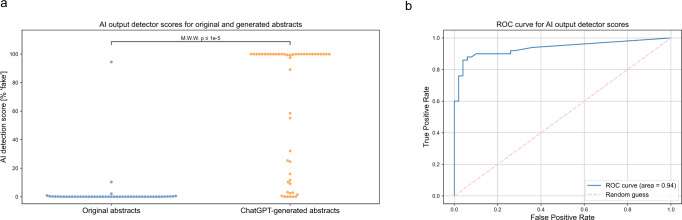
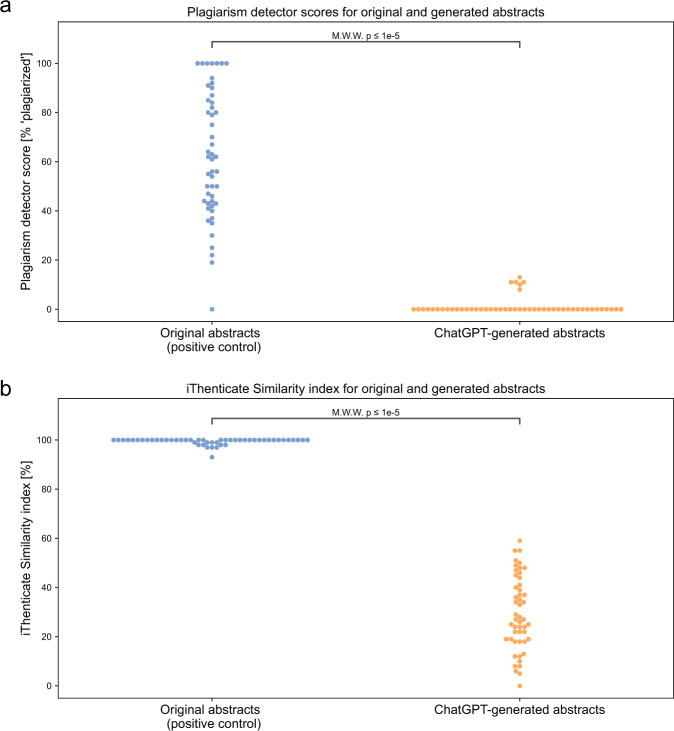
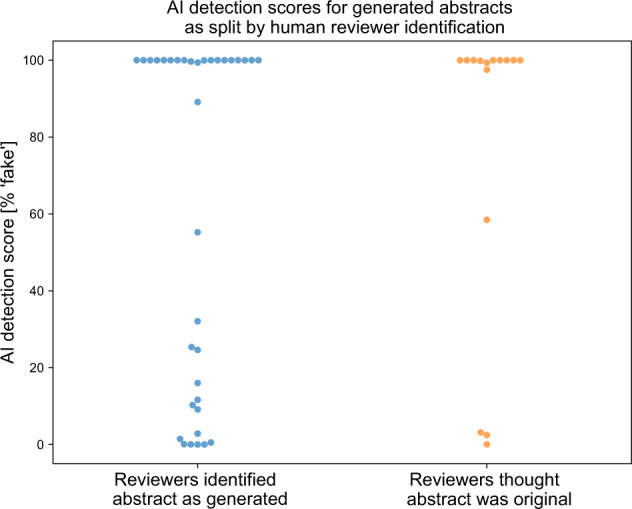
Large language models such as ChatGPT can produce increasingly realistic text, with unknown information on the accuracy and integrity of using these models in scientific writing. We gathered fifth research abstracts from five high-impact factor medical journals and asked ChatGPT to generate research abstracts based on their titles and journals. Most generated abstracts were detected using an AI output detector, ‘GPT-2 Output Detector’, with % ‘fake’ scores (higher meaning more likely to be generated) of median [interquartile range] of 99.98% ‘fake’ [12.73%, 99.98%] compared with median 0.02% [IQR 0.02%, 0.09%] for the original abstracts. The AUROC of the AI output detector was 0.94. Generated abstracts scored lower than original abstracts when run through a plagiarism detector website and iThenticate (higher scores meaning more matching text found). When given a mixture of original and general abstracts, blinded human reviewers correctly identified 68% of generated abstracts as being generated by ChatGPT, but incorrectly identified 14% of original abstracts as being generated. Reviewers indicated that it was surprisingly difficult to differentiate between the two, though abstracts they suspected were generated were vaguer and more formulaic. ChatGPT writes believable scientific abstracts, though with completely generated data. Depending on publisher-specific guidelines, AI output detectors may serve as an editorial tool to help maintain scientific standards. The boundaries of ethical and acceptable use of large language models to help scientific writing are still being discussed, and different journals and conferences are adopting varying policies.
Overview
The claims and statistics of this paper haven’t been checked yet.
Free: it reads the open-access text and checks the first 5 claims that cite a source we can check. Create a free account to check every claim.
Integrity signals
Registry
Cites
Statistics
Figures
Verification
Claims the paper makes
The claims and statistics of this paper haven’t been checked yet.
Free: it reads the open-access text and checks the first 5 claims that cite a source we can check. Create a free account to check every claim.
Claims other papers make about this one
Each is checked against this paper’s own text: does it say what the citing paper says it does?
The source backs part of the claim, not all of it — or backs it for a different population, condition or comparison.
In the citing paper
“ChatGPT’s GPT-3.5 iteration has already shown promise in several routine medical tasks and medical research [4-7], even raising ethical concerns in the literature [2,3,8].”
From Comparison of the Performance of GPT-3.5 and GPT-4 With That of Medical Students on the Written German Medical Licensing Examination: Observational Study (2024) · cites this paper as [7]
Experimental — accuracy not yet measuredThe source backs part of the claim, not all of it — or backs it for a different population, condition or comparison.
In the citing paper
“in practice, it takes a neural network to reliably catch another neural network.”
From Fine-Grained Detection of AI-Generated Writing in the Biomedical Literature (2026) · cites this paper as [6]
Experimental — accuracy not yet measuredThe source backs part of the claim, not all of it — or backs it for a different population, condition or comparison.
In the citing paper
“Rather than just copying ChatGPT output, many students seem to use it as a tool for brainstorming, refining ideas, or enhancing their writing style 16 .”
From Style, sentiment, and quality of undergraduate writing in the AI era: A cross-sectional and longitudinal analysis of 4,820 authentic empirical reports (2025) · cites this paper as [16]
Experimental — accuracy not yet measuredThe cited source says what the claim attributes to it.
In the citing paper
“Gao et al. (2023) found that ChatGPT can produce plausible scientific abstracts that humans often find difficult to distinguish from originals, though reviewers noted that AI abstracts tended to be 'vaguer and more formulaic'.”
From Metadiscourse Patterns in Human-Written vs. Generative AI-Authored Research Abstracts: A Comparative Corpus-Based Analysis (2026) · cites this paper as Gao et al. (2023)
The cited source says what the claim attributes to it.
In the citing paper
“Indeed, ChatGPT abstracts were noted by human reviewers as 'vague' or 'formulaic' , a qualitative impression that aligns with our finding of scant stance markers.”
From Metadiscourse Patterns in Human-Written vs. Generative AI-Authored Research Abstracts: A Comparative Corpus-Based Analysis (2026) · cites this paper as Gao et al. (2023)
3 more claims about this paper
Create a free account to see every claim other papers make about this one.
Self-check
Percentages, sums and reported differences re-computed from the paper’s own numbers.
The self-check needs the paper’s full text.
Citations
Cites
Scikit-learn: Machine Learning in Python
Pedregosa, F., Varoquaux, G., Gramfort, A., Michel, V., Thirion, B., Grisel, O., Blondel, M., Müller, A., Nothman, J., Louppe, G., et al. (2012) · arXiv · doi:10.48550/arxiv.1201.0490 · Cited by 71,016
Matplotlib: a 2D graphics environment
Hunter, J. D. (2007) · Computing in Science & Engineering · doi:10.1109/mcse.2007.55 · Cited by 39,249
SciPy 1.0: fundamental algorithms for scientific computing in Python
Virtanen, P., Gommers, R., Oliphant, T. E., Haberland, M., Reddy, T., Cournapeau, D., Burovski, E., Peterson, P., Weckesser, W., Bright, J., et al. (2020) · Nature Methods · doi:10.1038/s41592-019-0686-2 · Cited by 38,430
SciPy 1.0: fundamental algorithms for scientific computing in Python
Virtanen, P., Gommers, R., Oliphant, T. E., Haberland, M., Reddy, T., Cournapeau, D., Burovski, E., Peterson, P., Weckesser, W., Bright, J., et al. (2019) · Apollo - University of Cambridge Repository · doi:10.17863/cam.64134 · Cited by 10,460
seaborn: statistical data visualization
Waskom, M. (2021) · Journal of Open Source Software · doi:10.21105/joss.03021 · Cited by 7,310
NWChem: A comprehensive and scalable open-source solution for large scale molecular simulations
Valiev, M., Bylaska, E. J., Govind, N., Kowalski, K., Straatsma, T. P., Van Dam, H. J. J., Wang, D., Nieplocha, J., Apra, E., Windus, T. L., et al. (2010) · Computer Physics Communications · doi:10.1016/j.cpc.2010.04.018 · Cited by 5,779
Kung, T. H., Cheatham, M., Medenilla, A., Sillos, C., De Leon, L., Elepaño, C., Madriaga, M., Aggabao, R., Diaz-Candido, G., Maningo, J., et al. (2023) · PLOS Digital Health · doi:10.1371/journal.pdig.0000198 · Cited by 4,115 · cited 1×
“Articles are bemoaning the death of the traditional school essay assignment 4,6,7 , as ChatGPT has been shown to generate high-scoring papers 8 , correctly answer USMLE questions 9 , and even articulate critical thinking 10 .”
Kung, T. H., Cheatham, M., ChatGPT, Medenilla, A., Sillos, C., De Leon, L., Elepaño, C., Madriaga, M., Aggabao, R., Diaz-Candido, G., et al. (2022) · doi:10.1101/2022.12.19.22283643 · Cited by 4,115
ChatGPT is fun, but not an author
Thorp, H. H. (2023) · Science · doi:10.1126/science.adg7879 · Cited by 1,437 · cited 2×
“Different journals and publishers are developing their own policies on whether large language models can contribute to the writing of papers, ranging from not allowing any AI-generated text 12 to allowing its use as long as it is openly disclosed 13,14,28 .”
Artificial Intelligence in Medicine: Today and Tomorrow
Briganti, G., & Le Moine, O. (2020) · Frontiers in Medicine · doi:10.3389/fmed.2020.00027 · Cited by 743
Cited by
Items 901–1,000 of 1,018
HumanFR: Toward Text Authenticity Assessment Engine for Academic Integrity
Joglekar, P. S., Giramkar, A. A., Godse, S. R., Gupta, S., & Indulkar, P. M. (2025) · Lecture notes in networks and systems · doi:10.1007/978-981-96-3652-5_39 · Cited by 1
Can ChatGPT Recognize Its Own Writing in Scientific Abstracts?
Sebo, P. (2025) · Cureus · doi:10.7759/cureus.88774 · Cited by 2
“These findings align with a growing body of literature suggesting that AI-generated scientific writing is increasingly difficult to distinguish from human-authored content [4,10-16].”
Exploring authorial voice in English language medical journal abstracts in the age of AI
Doró, K. (2025) · Language Value · doi:10.6035/languagev.8812 · Cited by 2
Kavak, A., & Odabaş, H. (2025) · Journal of Information Science · doi:10.1177/01655515251353179 · Cited by 1
“Gao et al. [37] compared summaries generated by a conversational language model-based approach, such as ChatGPT, with summaries written by real researchers.”
Litvinova, M. B., Shtanko, O. D., Калініченко, І. В., Олегівна, К. С., & Zorina, I. (2025) · Lecture notes in networks and systems · doi:10.1007/978-3-032-00701-8_2 · Cited by 2
El‐Dakhs, D. A. S., Afzaal, M., & Siyanova‐Chanturia, A. (2025) · Corpus Pragmatics · doi:10.1007/s41701-025-00210-8 · Cited by 4
“For example, Gao et al (2023) deployed detec - tion tools and blinded human reviewers to compare machine-authored abstracts with human-produced ones.”
Trends of Generative AI in Scientific Writing: A Bibliometric Analysis (2014–2024)
Jaramillo, C. M. Z., Mejía, J., & Muñoz, M. (2025) · Lecture notes in networks and systems · doi:10.1007/978-3-032-01130-5_8 · Cited by 1
Gearing, N. (2025) · Journal of Open Flexible and Distance Learning · doi:10.61468/jofdl.v29i2.699 · Cited by 2
The Rise of Synthetic Reality: Exploring Generative AI's Creative Power and Ethical Dilemmas
Bhardwaj, I., Kaur, G., & Budhiraja, K. (2025) · National Conference on AI, IoT & Data-Driven Transformation (NCAIDT) · doi:10.63169/ncaidt2025.p2 · Cited by 1
Is AI only to Blame? Assessing Teachers’ Perceived Challenges in AI Detectability
Niloy, A. C., & Huda, T. (2025) · Asian Journal of Assessment in Teaching and Learning · doi:10.37134/ajatel.vol15.2.2.2025 · Cited by 1
Addressing Challenges and Seizing Opportunities with ChatGPT in Computer Programming Education
Tang, C. M., Ng, V. S. C., Leung, H. M. F., & Yuen, J. C. H. (2025) · Signals and communication technology · doi:10.1007/978-3-031-96855-6_11 · Cited by 1
Bendary, M. M., Ramzy, N., Khater, A. I., Nasif, M. M., & Atef, N. (2025) · Journal of Medical Systems · doi:10.1007/s10916-025-02323-8 · Cited by 1
Ethical Use of Artificial Intelligence in Academic Journal Writing: A Systematic Review Analysis
Affandi, L., Prasetya, D. D., & Elmunsyah, H. (2025) · International journal of research and scientific innovation · doi:10.51244/ijrsi.2025.12120001 · Cited by 1
De la imprenta al algoritmo: reconfiguración sistémica de la autoevaluación científica
Rogel-Salazar, R. (2025) · Revista MAD · doi:10.5354/0719-0527.2025.82301 · Cited by 1
The functioning of higher education in the network society: findings from a student survey
Aharkov, M. (2025) · Ukrainian society · doi:10.15407/socium2025.04.082 · Cited by 1
Chandiona, D. F. (2024) · International Journal of Education, Business and Economics Research. · doi:10.59822/ijeber.2024.4218 · Cited by 1
Generating Experimental Text Stimuli for Psychological Research Using ChatGPT
Lechuga, J., & Karle, N. N. (2026) · Advances in Methods and Practices in Psychological Science · doi:10.1177/25152459251407631 · Cited by 1
Schwarze, M., Mittelstädt, I., Gaidzik, P. W., Kanti, A.-K., & Schiltenwolf, M. (2026) · Die Orthopädie · doi:10.1007/s00132-026-04798-w · Cited by 1
Scientific publishing in the era of artificial intelligence
Ozbek, S. U. (2026) · Journal of Clinical Psychiatry · doi:10.5505/kpd.2026.94580 · Cited by 1
Jain, A., & Merchant, Y. P. (2026) · Oral and Maxillofacial Surgery · doi:10.1007/s10006-026-01550-8 · Cited by 1
Reyes, T. M. D. L., & Oraiz, C. (2026) · Psychology and Education A Multidisciplinary Journal · doi:10.70838/pemj.540501 · Cited by 1
Whose Knowledge Counts? Co-Designing Community-Centered AI Auditing Tools with Educators in Hawai'i
Zhao, D., Cha, H., Ryan, M. J., Wang, A., Baker-Ramos, R., Helekahi-Kaiwi, E.-B., Diego, R., Hester, J. D., & Yang, D. (2026) · CHI Conference on Human Factors in Computing Systems · doi:10.1145/3772318.3790958 · Cited by 2
Adoption of artificial intelligence tools for academic writing
Hoai, N. T., & Thuy, L. T. T. (2026) · International Journal of Evaluation and Research in Education (IJERE) · doi:10.11591/ijere.v15i2.37993 · Cited by 1
Alayyash, M. A. (2026) · Journal of Arts, Literature, Humanities and Social Sciences · doi:10.33193/jalhss.130.2026.1663 · Cited by 1
Abdulsalam, A. J., Alansari, A., & Özçakar, L. (2026) · The American Journal of the Medical Sciences · doi:10.1016/j.amjms.2026.04.012 · Cited by 1
Phillips, C., & Harrison, D. (2026) · JMIR Formative Research · doi:10.2196/87121 · Cited by 2
““AI-output detectors” detect the use of AI in academic work, with varying results against humans in detecting AI-generated questions [11], but they have successfully discriminated between most original and AI-generated abstracts [12].”
Can AI mirror the human voice? Stance in scholar-written and ChatGPT-generated medical abstracts
Zou, H., Sun, J., & Li, L. (2026) · English for Specific Purposes · doi:10.1016/j.esp.2026.04.002 · Cited by 1
When AI Becomes Its Own Biggest Fan: Self-Preference Bias in AI-Assisted Peer Review
Shi, J., Lee, J., Xu, L. Z., Ow, T. T., & Wang, Y. (2026) · IEEE Transactions on Engineering Management · doi:10.1109/tem.2026.3691360 · Cited by 1
“Prior work shows that LLMs can produce convincing academic and scholarly texts, including essays and scientific abstracts that can be difficult to distinguish from human-written outputs [6], [7].”
Schramm, R., & Mahltig, B. (2026) · Communications in development and assembling of textile products · doi:10.25367/cdatp.2026.7.p3-12 · Cited by 1
Rahman, M. M., Ali, R., & Yankouskaya, A. (2026) · Lecture notes in computer science · doi:10.1007/978-981-95-7141-3_2 · Cited by 1
Linguistic shifts in dental scientific writing in the large language model era
Better, H., Haim, D., Asbi, T., Chaushu, G., & Better, K. (2026) · Research Integrity and Peer Review · doi:10.1186/s41073-026-00226-x · Cited by 1
“We used vocabulary-based detection rather than commercial AI detection tools because research consistently shows these tools perform poorly on academic writing [4, 5].”
ChatGPT’s ability to imitate writing styles: an analysis guided by forensic text comparison
Ishihara, S. (2026) · Digital Scholarship in the Humanities · doi:10.1093/llc/fqag079 · Cited by 1
Turós, M., Soltész-Várhelyi, K., & Szűts, Z. (2026) · Education Sciences · doi:10.3390/educsci16060920 · Cited by 1
Schulz, M. S., Fenollosa, L. T., Dussauge‐Laguna, M. I., Fontanelli, Ó., Nedelcu, D. Q., Udave, J. A., & Andersen, J. W. (2026) · Methodological Innovations · doi:10.1177/20597991261454555 · Cited by 1
“At the same time, other studies highlighted the challenges human reviewers face in distinguishing between human-written and ChatGPT-generated abstracts (Gao et al., 2023).”
Blinded by the Bot: Benchmarking GPT and Gemini Against Human Authors in Otolaryngology Reviews
Hack, S., Attal, R., Nitro, L., Rosso, C., Urbanelli, A., Bulfamante, A. M., Vaira, L. A., Ahmed, O. G., & Takashima, M. (2026) · World Journal of Otorhinolaryngology - Head and Neck Surgery · doi:10.1002/wjo2.70131 · Cited by 1
Rethinking AI in Learning: Does It Strengthen or Erode Critical Digital Literacy?
Guermat, A. M. E., & Bekkaoui, M. (2026) · Springer eBooks · doi:10.1007/978-3-032-19585-2_17 · Cited by 1
A Systematic Literature Review on Impact of Artificial Intelligence on Academic Integrity
Gheisari, M., Pingmei, Z., Karimi, A., Ouariach, S., & Ouariach, F. Z. (2026) · Journal of Applied Social Sciences and Humanities · doi:10.71426/jassh.v2.i1.pp61-72 · Cited by 1
Renkema, M., & Tursunbayeva, A. (2026) · Information Technology and People · doi:10.1108/itp-11-2025-1654 · Cited by 1
Lexical Traces of AI : Linguistic Impact of Generative Tools in Academic Abstracts
Forgas, R. C., Torres, C. G., Garma, C. T., & Glynn, A. (2026) · Learned Publishing · doi:10.1002/leap.2067 · Cited by 2
Salamah, W. (2026) · Frontiers in Education · doi:10.3389/feduc.2026.1880283 · Cited by 3
Artificial intelligence as a pedagogical companion for STEM research learning in higher education
Valentine Joseph Owan, P. D. (2026) · Discover Education · doi:10.1007/s44217-026-01906-y · Cited by 2
“Large language models often provide answers that appear convincing but are inaccurate, fabricated, or misleading [40, 100].”
Generative AI in Higher Education: The Good, the Bad, and the Ugly
Berghel, H., & Berleant, D. (2026) · Computer · doi:10.1109/mc.2026.3705552 · Cited by 1
Moganadas, S. R., Marín-González, F., Nun, S. H., & Gan, C. L. (2026) · Frontiers in Education · doi:10.3389/feduc.2026.1856839 · Cited by 1
Damilola, I. M., & Aisagbonhi, H. O. (2026) · BMC Medical Education · doi:10.1186/s12909-026-10558-3 · Cited by 1
Agentic T-STROBE: a front-shifted STROBE paradigm for observational research
Bo, C., Li, R., 赵敬华, Feng, S., Ji, X., & Xue, F. (2026) · Statistics Innovation · doi:10.48130/stati-0026-0014 · Cited by 1
Fox, M. (2004) · La Ratonera: Revista asturiana de teatro · Cited by 5
AKADEMİK YAYINCILIĞIN YENİ YÜZÜ: CHATGPT VE ETİK TARTIŞMALARI
Okun, O., YÜKSEL, M., KARAHAN, M. O., & BOZKURT, R. (2023) · Zenodo (CERN European Organization for Nuclear Research) · doi:10.5281/zenodo.8176080 · Cited by 3
Smith, D. A., Burton, L. M., & Smith, S. A. (2024) · Xenobiotica · doi:10.1080/00498254.2023.2295361 · Cited by 2
Gomes, G. A., & de Lima, M. C. (2023) · Abec Meeting · doi:10.21452/abecmeeting2023.204 · Cited by 1
Writing abstracts in English: Guidelines for Serbian authors
Otanjac, M. I. (2023) · Reci Beograd · doi:10.5937/reci2316079i · Cited by 1
Unmasking the Source: Identifying Human Vs ChatGPT-Generated Text Through Machine Learning
Singh, P., Singh, A., Rathi, S., & Vasesi, S. (2023) · International Conference on Advanced Computing & Communication Technologies (ICACCTech) · doi:10.1109/icacctech61146.2023.00106 · Cited by 4
Accuracy and validity of common dental terms using chat GPT model: a cross-sectional study
Keerthanasree, V., Balasubramanian, K. R., D., M. K. P., & Sathish, M. (2024) · International Journal of Community Medicine and Public Health · doi:10.18203/2394-6040.ijcmph20240624 · Cited by 1
Costa, I. C. P., do Nascimento, M. C., Treviso, P., Chini, L. T., Roza, B. D. A., Barbosa, S. D. F. F., & Mendes, K. D. S. (2024) · Revista Latino-Americana de Enfermagem · doi:10.1590/1518-8345.7133.4193 · Cited by 1
Complexity and Similarity Analysis of ChatGPT-Generated Text
Durán, G. H., Chávez, R., Flores, R., Caraveo, C., Cervantes, L., & Noriega, A. D. R. (2023) · International Conference in Software Engineering Research and Innovation (CONISOFT) · doi:10.1109/conisoft58849.2023.00036 · Cited by 1
Baptista, J. P., & Gradim, A. (2024) · Lecture notes in educational technology · doi:10.1007/978-981-97-1814-6_96 · Cited by 2
AI-Empowered Knowledge Management in Primary and Higher Education
Chakraborty, S., Misra, B., & Dey, N. (2024) · SpringerBriefs in applied sciences and technology · doi:10.1007/978-981-97-2574-8_5 · Cited by 1
ChatGPT as a Source of Information about Russian Military Involvement in Ukraine (2014–Present)
Senekal, B. (2024) · Communicatio · doi:10.1080/02500167.2024.2405018 · Cited by 1
Baeza-Yates, R. A., Murgai, L., & Dudy, S. (2024) · ACM eBooks · doi:10.1145/3674127.3674138 · Cited by 1
Türkiye’de ChatGPT algısı: Bert modeli ile duygu analizi
GAZAZ, D. C., & Ayvaz, S. (2024) · Balıkesir Üniversitesi Sosyal Bilimler Enstitüsü Dergisi · doi:10.31795/baunsobed.1470846 · Cited by 2
Digital Technology for Medical Education
Freeburg, T., & Chang, T. P. (2025) · Springer eBooks · doi:10.1007/978-3-031-83526-1_16 · Cited by 1
Lamanauskas, V. (2024) · Pro Edu International Journal of Educational Sciences · doi:10.26520/peijes.2024.11.6.47-60 · Cited by 1
Undergraduate Students’ Journey with AI in the United Arab Emirates
Farouqa, G., Hysaj, A., Hatamleh, Z. M., Owais, A. K., Ibrahim, O., Hiasat, L., & Khan, S. A. (2025) · Lecture notes in computer science · doi:10.1007/978-3-031-93539-8_11 · Cited by 1
Singh, S. P., Kaur, S., Aggarwal, A. D., Walia, D. S., & Singh, P. (2024) · Journal of Punjab Academy of Forensic Medicine & Toxicology · doi:10.5958/0974-083x.2024.00048.2 · Cited by 1
Les données, le numérique et l’Anthropocène
Badin, F., & Mallarino, D. (2025) · Humanités numériques · doi:10.4000/1498t · Cited by 1
Singh, N., Neubronner, S., Kanayan, S., Illanes, S. E., Choolani, M. A., & Kemp, M. W. (2025) · Singapore Medical Journal · doi:10.4103/singaporemedj.smj-2024-173 · Cited by 3
Researchers’ Perspectives on AI in Higher Education: A Focus Group Study
Angelis, M. C. D. (2025) · Springer eBooks · doi:10.1007/978-3-031-99754-9_7 · Cited by 3
OBUA-Toolbox for Ombudspersons at Berlin Research Institutions
Olivieri, S., Ullmann, V., & Hazer, E. (2023) · Refubium (Universitätsbibliothek der Freien Universität Berlin) · doi:10.17169/refubium-40721 · Cited by 1
OBUA-Toolbox für Ombudspersonen an Berliner Forschungseinrichtungen
Olivieri, S., Ullmann, V., & Hazer, E. (2023) · Refubium (Universitätsbibliothek der Freien Universität Berlin) · doi:10.17169/refubium-40722 · Cited by 1
ҚАЗІРГІ СТУДЕНТТЕРДІҢ КОГНИТИВТІК ПРОЦЕСТЕРІНІҢ ДАМУЫНА ЖАСАНДЫ ИНТТЕЛЛЕКТІҢ ӘСЕРІ
Кудушева, Н. А., Тусубекова, К. К., Джармухамбетов, М., & Нуралиева, Д. М. (2025) · Habaršy. Psihologiâ seriâsy · doi:10.51889/2959-5967.2025.84.3.001 · Cited by 1
Curry, B., Kirpalani, A., Remington, M., Hooren, T. A. V., Shen, Y., & Peebles, E. R. (2025) · Canadian Medical Education Journal · doi:10.36834/cmej.81345 · Cited by 1
“9,10 However, the interpretation of this result was constrained by substantial variability in reviewer ratings.”
Kleespies, M. W., Schneider, S., Emge, D., Feucht, V., Hacke, J., Wenzel, V., & Dierkes, P. W. (2023) · Preprints.org · doi:10.20944/preprints202306.1607.v1 · Cited by 1
Intelligence artificielle : émergence et possible utilisation frauduleuse dans l’édition médicale
Jacques, T., Sleiman, R., Diaz, M. I., & Dаrtus, J. (2023) · Revue de Chirurgie Orthopédique et Traumatologique · doi:10.1016/j.rcot.2023.10.010 · Cited by 1
Is it possible for ChatGPT to mimic human annotator?Preprint
Kaszyca, O., Kazienko, P., Kocoń, J., Cichecki, I., Kochanek, M., & Szydło, D. (2023) · doi:10.36227/techrxiv.170259175.55207879/v1 · Cited by 2
The Assistance of Chatgpt-3.5 in Teaching English Academic WritingPreprint
Wang, M. (2024) · SSRN Electronic Journal · doi:10.2139/ssrn.4726032 · Cited by 1
de Antioquia, U., & Botero, M. A. G. (2024) · Revista Facultad de Ingeniería Universidad de Antioquia · doi:10.17533/udea.redin.20240307 · Cited by 1
Taught by a Robot: A Trainee Perspective on Artificial Intelligence in Medical School Education
Nguyen, L. T., Tran, V. T., Tran, J. T., & Oorjitham, N. S. (2024) · Academic Psychiatry · doi:10.1007/s40596-024-02081-8 · Cited by 1
Ballestero-Ribó, M., & Ortiz-Martínez, D. (2025) · arXiv (Cornell University) · doi:10.48550/arxiv.2501.17176 · Cited by 2
“Text summaries created with ChatGPT within the medical domain are analyzed in [Gao et al.(2023)].”
The Silent Author in Urology: Quantifying Large Language Model Influence at the Corpus LevelPreprint
Arezki, A., Tsui, J. M. G., & Kassouf, W. (2025) · medRxiv · doi:10.1101/2025.07.21.25331681 · Cited by 1
“[8].”
Holding Large Language Models to AccountPreprint
Miller, R. (2023) · PhilSci-Archive (University of Pittsburgh) · Cited by 4
Lupon, E., Bérard, Q., Migaud, H., Clavert, P., & Micicoi, G. (2026) · Orthopaedics & Traumatology: Surgery & Research · doi:10.1016/j.otsr.2026.104801
He, Q. (2025) · English Language Teaching and Linguistics Studies · doi:10.22158/eltls.v7n6p103
Reimagining biomedical science workflows in the age of large language models
Roberts, K. F., Koutarapu, S., Melendez, J., Landsness, E. C., Reese, J. T., Elbert, D. L., & Bateman, R. J. (2026) · npj Dementia · doi:10.1038/s44400-026-00126-3
Eminovic, S., Levita, B., Schmidt, R., Lindholz, M., Desser, D., Penzkofer, T., Wattjes, M. P., & Nawabi, J. (2026) · DIGITAL HEALTH · doi:10.1177/20552076261464745
Optical recognition of statistical patterns
Lee, S. H. (1981) · NASA STI Repository (National Aeronautics and Space Administration)
Форсайтовский цикл Д. Голсуорси как художественно-эстетическое целое
Васильевна, Б. Н. (2009) · Вестник Южно-Уральского государственного гуманитарно-педагогического университета
Нормы времени на противоэпизоотические мероприятия в Республике Чад
Араб, М. М. (2012) · Ученые записки Казанской государственной академии ветеринарной медицины им. Н.Э. Баумана
ChatGPT is not an author, but then, who is eligible for authorship?Preprint
Ueda, K., & Yamada, Y. (2023) · PsyArXiv (OSF Preprints) · doi:10.31234/osf.io/h5aj3
Conversing on orthodontics with an AI Chatbot
(2023) · Journal of the World Federation of Orthodontists · doi:10.1016/j.ejwf.2023.03.001
Unlocking the power of AI to accelerate scientific progress and global collaboration
Dalabih, A. R., & Aljabari, S. (2023) · Pediatric Research · doi:10.1038/s41390-023-02590-6
Ricchizzi, N., Ricchizzi, S., & Pelzl, J. (2023) · Zenodo (CERN European Organization for Nuclear Research) · doi:10.5281/zenodo.7837200
Generative AI and authorship: trends in international journals
Ide, K. (2023) · Folia Pharmacologica Japonica · doi:10.1254/fpj.23009
Laying an equitable data foundation for foundation models
Agrawal, A. (2023) · The Lancet Regional Health - Southeast Asia · doi:10.1016/j.lansea.2023.100221 · Cited by 1
Fighting the Tide—GPT and an Alarming Sense of Déjà Vu
Phippen, A., & Bond, E. (2023) · Advanced sciences and technologies for security applications · doi:10.1007/978-3-031-33627-0_2
AI-generated potential research paper: overview in cardiac surgery—Is this the future?
Shankar, S. A. (2023) · Indian Journal of Thoracic and Cardiovascular Surgery · doi:10.1007/s12055-023-01579-4
Keller, D. S., Behrns, K. E., & Wexner, S. D. (2023) · Surgery · doi:10.1016/j.surg.2023.08.028
Los tutús célebres de Solesmes, Machines, and the Limits of Scientific Knowledge
Llano, I. C. (2023) · Revista Historia Autónoma · doi:10.15366/rha2023.23.004
Du, T., & Li, A. (2023) · Software Engineering and Applications · doi:10.5121/csit.2023.131714
Na, H.-I., & Lee, B.-H. (2023) · The Journal of Korean Institute of Information Technology · doi:10.14801/jkiit.2023.21.10.171
The Impact of GB Chat on Education - A Comparative Theoretical Study
Awad, C. (2023) · International Journal of Computers and Informatics · doi:10.59992/ijci.2023.v2n6p5
Metadata
- Authors
- Gao, C. A., Howard, F. M., Markov, N. S., Dyer, E. C., Ramesh, S., Luo, Y., & Pearson, A. T.
- Affiliations
- Northwestern University (US)
- University of Chicago (US)
- Corresponding author
- Gao, Catherine A.
- ORCID
- Venue
- npj Digital Medicine
- Published
- 2023-04-26
- Volume
- 6
- Issue
- 1
- Pages
- 75-75
- ISSN
- 2398-6352 (ISSN-L)
- PMC
- PMC10133283
- OpenAlex
- W4367051110
- Cited by
- 1,099
- References
- 26
- Citations by year
- 2026: 189 · 2025: 235 · 2024: 342 · 2023: 326
- FWCI
- 273.24
- Type
- journal article
- Language
- en
- Open access
- gold
- doi.org
- Licence
- cc-by
- creativecommons.org/licenses/by/4.0 (tdm)
- creativecommons.org/licenses/by/4.0 (vor)
- Locations
- npj Digital Medicine (publishedVersion, cc-by)
- bioRxiv (Cold Spring Harbor Laboratory) (acceptedVersion, cc-by-nc-nd)
- PubMed Central (publishedVersion, cc-by)
- PubMed (publishedVersion)
- Knowledge@UChicago (University of Chicago) (submittedVersion, cc-by-nc-nd)
- DOAJ (DOAJ: Directory of Open Access Journals) (submittedVersion, cc-by-sa)
- University of Chicago (cc-by)
- Funders
- U.S. Department of Health and Human Services (U01-CA243075, R01LM013337, R56-DE030958, U01TR003528)
- Burroughs Wellcome Fund
- Conquer Cancer Foundation (2022YIA-6675470300)
- Breast Cancer Research Foundation (2022YIA-6675470300)
- Cancer Research Foundation
- Fanconi Anemia Research Fund
- American Society of Clinical Oncology (2022YIA-6675470300)
- Horizon Therapeutics
- National Institutes of Health (U01TR003528)
- Stand Up To Cancer
- National Heart, Lung, and Blood Institute (F32HL162377)
- National Cancer Institute (K12CA139160, U01CA243075)
- National Institute of Dental and Craniofacial Research (R56DE030958)
- U.S. National Library of Medicine (R01LM013337)
- National Center for Advancing Translational Sciences
- Topics
- Social Sciences › Education › Academic integrity and plagiarism
- Social Sciences › Library and Information Sciences › Academic Writing and Publishing
- Health Sciences › Medicine › Health Informatics › Artificial Intelligence in Healthcare and Education
- Keywords
- ChatGPT, large language models, AI-generated text detection, scientific abstracts, plagiarism detection, medical journal abstracts, scientific integrity, AI in scientific writing, editorial guidelines
About these checks
Registry, retraction, Cites and statistics results are computed, not judged, with one exception: a printed reference that no index lists is read once by a model before it counts as a citation error. Claims are extracted by a model and kept only when their quote appears verbatim in the text; each cited source is then checked, with a model’s help, for whether it says what the claim relies on. Those verdicts can be wrong — read the claim’s quote and the cited source before relying on one.
Statistics and arithmetic are recomputed, not judged.
Confidence bands are shown only for fields calibrated on our annotated test set. None is calibrated yet, so no band is shown.
What counts as a claim ›How we measure confidence ›How we check this ›
Are you an author, or do you see a problem with this page? Request a review
Data sources
Bibliographic data: Semantic Scholar, OpenAlex, Crossref.
Contains information from the Semantic Scholar Academic Graph Datasets, made available under the ODC Attribution License (ODC-BY 1.0).
Semantic Scholar’s data is described in: Kinney, R., et al. (2023). The Semantic Scholar Open Data Platform. arXiv:2301.10140.
