

Comparing scientific abstracts generated by ChatGPT to real abstracts with detectors and blinded human reviewers
Open accessPublished version of a preprint
The DOI matches its Crossref record; 34 of the 34 references it cites were found in a registry or an index.
Abstract
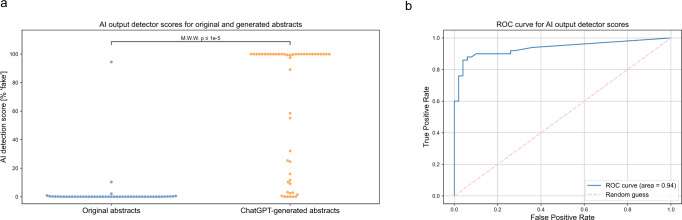
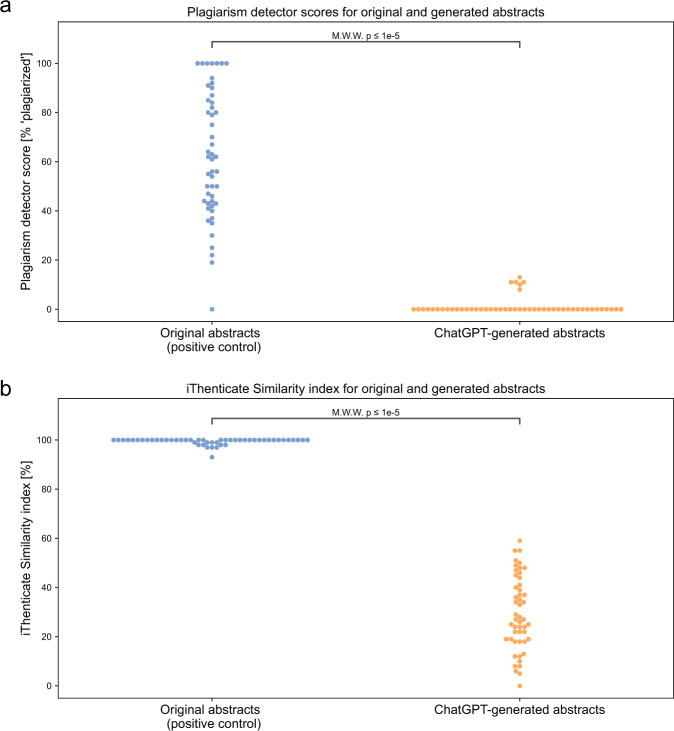
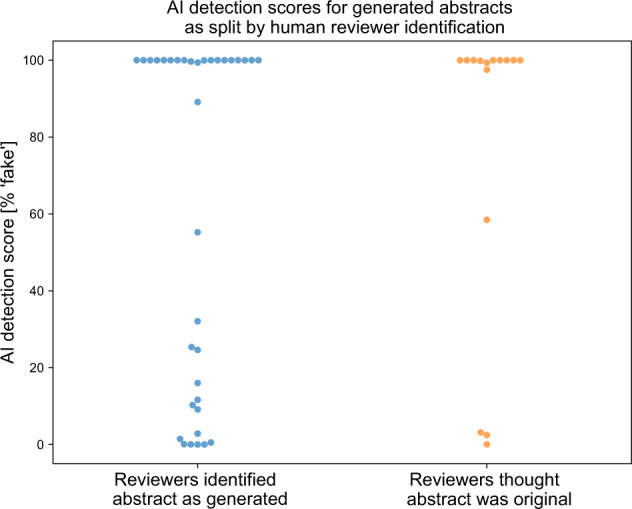
Large language models such as ChatGPT can produce increasingly realistic text, with unknown information on the accuracy and integrity of using these models in scientific writing. We gathered fifth research abstracts from five high-impact factor medical journals and asked ChatGPT to generate research abstracts based on their titles and journals. Most generated abstracts were detected using an AI output detector, ‘GPT-2 Output Detector’, with % ‘fake’ scores (higher meaning more likely to be generated) of median [interquartile range] of 99.98% ‘fake’ [12.73%, 99.98%] compared with median 0.02% [IQR 0.02%, 0.09%] for the original abstracts. The AUROC of the AI output detector was 0.94. Generated abstracts scored lower than original abstracts when run through a plagiarism detector website and iThenticate (higher scores meaning more matching text found). When given a mixture of original and general abstracts, blinded human reviewers correctly identified 68% of generated abstracts as being generated by ChatGPT, but incorrectly identified 14% of original abstracts as being generated. Reviewers indicated that it was surprisingly difficult to differentiate between the two, though abstracts they suspected were generated were vaguer and more formulaic. ChatGPT writes believable scientific abstracts, though with completely generated data. Depending on publisher-specific guidelines, AI output detectors may serve as an editorial tool to help maintain scientific standards. The boundaries of ethical and acceptable use of large language models to help scientific writing are still being discussed, and different journals and conferences are adopting varying policies.
Overview
The claims and statistics of this paper haven’t been checked yet.
Free: it reads the open-access text and checks the first 5 claims that cite a source we can check. Create a free account to check every claim.
Integrity signals
Registry
Cites
Statistics
Figures
Verification
Claims the paper makes
The claims and statistics of this paper haven’t been checked yet.
Free: it reads the open-access text and checks the first 5 claims that cite a source we can check. Create a free account to check every claim.
Claims other papers make about this one
Each is checked against this paper’s own text: does it say what the citing paper says it does?
The source backs part of the claim, not all of it — or backs it for a different population, condition or comparison.
In the citing paper
“ChatGPT’s GPT-3.5 iteration has already shown promise in several routine medical tasks and medical research [4-7], even raising ethical concerns in the literature [2,3,8].”
From Comparison of the Performance of GPT-3.5 and GPT-4 With That of Medical Students on the Written German Medical Licensing Examination: Observational Study (2024) · cites this paper as [7]
Experimental — accuracy not yet measuredThe source backs part of the claim, not all of it — or backs it for a different population, condition or comparison.
In the citing paper
“in practice, it takes a neural network to reliably catch another neural network.”
From Fine-Grained Detection of AI-Generated Writing in the Biomedical Literature (2026) · cites this paper as [6]
Experimental — accuracy not yet measuredThe source backs part of the claim, not all of it — or backs it for a different population, condition or comparison.
In the citing paper
“Rather than just copying ChatGPT output, many students seem to use it as a tool for brainstorming, refining ideas, or enhancing their writing style 16 .”
From Style, sentiment, and quality of undergraduate writing in the AI era: A cross-sectional and longitudinal analysis of 4,820 authentic empirical reports (2025) · cites this paper as [16]
Experimental — accuracy not yet measuredThe cited source says what the claim attributes to it.
In the citing paper
“Gao et al. (2023) found that ChatGPT can produce plausible scientific abstracts that humans often find difficult to distinguish from originals, though reviewers noted that AI abstracts tended to be 'vaguer and more formulaic'.”
From Metadiscourse Patterns in Human-Written vs. Generative AI-Authored Research Abstracts: A Comparative Corpus-Based Analysis (2026) · cites this paper as Gao et al. (2023)
The cited source says what the claim attributes to it.
In the citing paper
“Indeed, ChatGPT abstracts were noted by human reviewers as 'vague' or 'formulaic' , a qualitative impression that aligns with our finding of scant stance markers.”
From Metadiscourse Patterns in Human-Written vs. Generative AI-Authored Research Abstracts: A Comparative Corpus-Based Analysis (2026) · cites this paper as Gao et al. (2023)
3 more claims about this paper
Create a free account to see every claim other papers make about this one.
Self-check
Percentages, sums and reported differences re-computed from the paper’s own numbers.
The self-check needs the paper’s full text.
Citations
Cites
Scikit-learn: Machine Learning in Python
Pedregosa, F., Varoquaux, G., Gramfort, A., Michel, V., Thirion, B., Grisel, O., Blondel, M., Müller, A., Nothman, J., Louppe, G., et al. (2012) · arXiv · doi:10.48550/arxiv.1201.0490 · Cited by 71,016
Matplotlib: a 2D graphics environment
Hunter, J. D. (2007) · Computing in Science & Engineering · doi:10.1109/mcse.2007.55 · Cited by 39,249
SciPy 1.0: fundamental algorithms for scientific computing in Python
Virtanen, P., Gommers, R., Oliphant, T. E., Haberland, M., Reddy, T., Cournapeau, D., Burovski, E., Peterson, P., Weckesser, W., Bright, J., et al. (2020) · Nature Methods · doi:10.1038/s41592-019-0686-2 · Cited by 38,430
SciPy 1.0: fundamental algorithms for scientific computing in Python
Virtanen, P., Gommers, R., Oliphant, T. E., Haberland, M., Reddy, T., Cournapeau, D., Burovski, E., Peterson, P., Weckesser, W., Bright, J., et al. (2019) · Apollo - University of Cambridge Repository · doi:10.17863/cam.64134 · Cited by 10,460
seaborn: statistical data visualization
Waskom, M. (2021) · Journal of Open Source Software · doi:10.21105/joss.03021 · Cited by 7,310
NWChem: A comprehensive and scalable open-source solution for large scale molecular simulations
Valiev, M., Bylaska, E. J., Govind, N., Kowalski, K., Straatsma, T. P., Van Dam, H. J. J., Wang, D., Nieplocha, J., Apra, E., Windus, T. L., et al. (2010) · Computer Physics Communications · doi:10.1016/j.cpc.2010.04.018 · Cited by 5,779
Kung, T. H., Cheatham, M., Medenilla, A., Sillos, C., De Leon, L., Elepaño, C., Madriaga, M., Aggabao, R., Diaz-Candido, G., Maningo, J., et al. (2023) · PLOS Digital Health · doi:10.1371/journal.pdig.0000198 · Cited by 4,115 · cited 1×
“Articles are bemoaning the death of the traditional school essay assignment 4,6,7 , as ChatGPT has been shown to generate high-scoring papers 8 , correctly answer USMLE questions 9 , and even articulate critical thinking 10 .”
Kung, T. H., Cheatham, M., ChatGPT, Medenilla, A., Sillos, C., De Leon, L., Elepaño, C., Madriaga, M., Aggabao, R., Diaz-Candido, G., et al. (2022) · doi:10.1101/2022.12.19.22283643 · Cited by 4,115
ChatGPT is fun, but not an author
Thorp, H. H. (2023) · Science · doi:10.1126/science.adg7879 · Cited by 1,437 · cited 2×
“Different journals and publishers are developing their own policies on whether large language models can contribute to the writing of papers, ranging from not allowing any AI-generated text 12 to allowing its use as long as it is openly disclosed 13,14,28 .”
Artificial Intelligence in Medicine: Today and Tomorrow
Briganti, G., & Le Moine, O. (2020) · Frontiers in Medicine · doi:10.3389/fmed.2020.00027 · Cited by 743
Cited by
ChatGPT for Good? On Opportunities and Challenges of Large Language Models for Education
Kasneci, E., Seßler, K., Küchemann, S., Bannert, M., Dementieva, D., Fischer, F., Gasser, U., Groh, G., Günnemann, S., Hüllermeier, E., et al. (2023) · doi:10.35542/osf.io/5er8f · Cited by 7,552
ChatGPT for good? On opportunities and challenges of large language models for education
Kasneci, E., Sessler, K., Küchemann, S., Bannert, M., Dementieva, D., Fischer, F., Gasser, U., Groh, G., Günnemann, S., Hüllermeier, E., et al. (2023) · Learning and Individual Differences · doi:10.1016/j.lindif.2023.102274 · Cited by 15,365
Dwivedi, Y. K., Kshetri, N., Hughes, L., Slade, E. L., Jeyaraj, A., Kar, A. K., Baabdullah, A. M., Koohang, A., Raghavan, V., Ahuja, M., et al. (2023) · International Journal of Information Management · doi:10.1016/j.ijinfomgt.2023.102642 · Cited by 4,584
Sallam, M. (2023) · Healthcare · doi:10.3390/healthcare11060887 · Cited by 3,126
Chatting and cheating: Ensuring academic integrity in the era of ChatGPT
Cotton, D. R. E., Cotton, P. A., & Shipway, J. R. (2024) · Innovations in Education and Teaching International · doi:10.1080/14703297.2023.2190148 · Cited by 3,087
Chatting and Cheating. Ensuring academic integrity in the era of ChatGPT
Cotton, D., Cotton, P., & Shipway, J. R. (2023) · doi:10.35542/osf.io/mrz8h · Cited by 3,079
ChatGPT: Bullshit spewer or the end of traditional assessments in higher education?
(2023) · Journal of Applied Learning & Teaching · doi:10.37074/jalt.2023.6.1.9 · Cited by 1,806
Zhai, C., Wibowo, S., & Li, L. D. (2024) · Smart Learning Environments · doi:10.1186/s40561-024-00316-7 · Cited by 1,567
Artificial hallucinations in ChatGPT: implications in scientific writing
Alkaissi, H., & McFarlane, S. I. (2023) · Cureus · doi:10.7759/cureus.35179 · Cited by 1,540
A SWOT analysis of ChatGPT: Implications for educational practice and research
Farrokhnia, M., Banihashem, S. K., Noroozi, O., & Wals, A. (2024) · Innovations in Education and Teaching International · doi:10.1080/14703297.2023.2195846 · Cited by 1,384
A survey on large language model (LLM) security and privacy: The Good, The Bad, and The Ugly
Yao, Y., Duan, J., Xu, K., Cai, Y., Sun, Z., & Zhang, Y. (2024) · High-Confidence Computing · doi:10.1016/j.hcc.2024.100211 · Cited by 1,083
ChatGPT for Education and Research: Opportunities, Threats, and Strategies
Rahman, M. M., & Watanobe, Y. (2023) · Applied Sciences · doi:10.3390/app13095783 · Cited by 1,080
ChatGPT for Education and Research: Opportunities, Threats, and Strategies
Rahman, M. M., & Watanobe, Y. (2023) · doi:10.20944/preprints202303.0473.v1 · Cited by 1,080
The future landscape of large language models in medicine
Clusmann, J., Kolbinger, F. R., Muti, H. S., Carrero, Z. I., Eckardt, J.-N., Laleh, N. G., Löffler, C. M. L., Schwarzkopf, S.-C., Unger, M., Veldhuizen, G. P., et al. (2023) · Communications Medicine · doi:10.1038/s43856-023-00370-1 · Cited by 1,045
“For example, ChatGPT is capable of generating scienti fi c abstracts that humans struggle to differentiate from those written by human researchers 54 .”
BackgroundChatGPT: Jack of all trades, master of none
Kocoń, J., Cichecki, I., Kaszyca, O., Kochanek, M., Szydło, D., Baran, J., Bielaniewicz, J., Gruza, M., Janz, A., Kanclerz, K., et al. (2023) · Information Fusion · doi:10.1016/j.inffus.2023.101861 · Cited by 758
Ooi, K.-B., Tan, G. W.-H., Al-Emran, M., Al-Sharafi, M. A., Capatina, A., Chakraborty, A., Dwivedi, Y. K., Huang, T.-L., Kar, A. K., Lee, V.-H., et al. (2025) · Journal of Computer Information Systems · doi:10.1080/08874417.2023.2261010 · Cited by 746
“For example, if the output of generative AI tools goes unnoticed by standard plagiarism detection systems used by universities, 79 how can it be confirmed that a particular paper or essay represents the student’s original work rather than just the product of generative AI?”
Impact of ChatGPT on learners in a L2 writing practicum: an exploratory investigation
Yan, D. (2023) · Education and Information Technologies · doi:10.1007/s10639-023-11742-4 · Cited by 713
ChatGPT and the rise of large language models: the new AI-driven infodemic threat in public health
De Angelis, L., Baglivo, F., Arzilli, G., Privitera, G. P., Ferragina, P., Tozzi, A. E., & Rizzo, C. (2023) · Frontiers in Public Health · doi:10.3389/fpubh.2023.1166120 · Cited by 708
ChatGPT and the Rise of Large Language Models: The New AI-Driven Infodemic Threat in Public Health
De Angelis, L., Baglivo, F., Arzilli, G., Privitera, G. P., Ferragina, P., Tozzi, A. E., & Rizzo, C. (2023) · doi:10.2139/ssrn.4352931 · Cited by 708
Haleem, A., Javaid, M., & Singh, R. P. (2022) · BenchCouncil Transactions on Benchmarks, Standards and Evaluations · doi:10.1016/j.tbench.2023.100089 · Cited by 694
ChatGPT for (Finance) research: The Bananarama Conjecture
Dowling, M., & Lucey, B. (2023) · Finance Research Letters · doi:10.1016/j.frl.2023.103662 · Cited by 591
ChatGPT - Reshaping medical education and clinical management
Khan, R. A., Jawaid, M., Khan, A. R., & Sajjad, M. (2023) · Pakistan Journal of Medical Sciences · doi:10.12669/pjms.39.2.7653 · Cited by 628
Abstracts written by ChatGPT fool scientists
Else, H. (2023) · Nature · doi:10.1038/d41586-023-00056-7 · Cited by 611
Testing of detection tools for AI-generated text
Weber-Wulff, D., Anohina-Naumeca, A., Bjelobaba, S., Foltýnek, T., Guerrero-Dib, J., Popoola, O., Šigut, P., & Waddington, L. (2023) · International Journal for Educational Integrity · doi:10.1007/s40979-023-00146-z · Cited by 582
The role of ChatGPT in higher education: Benefits, challenges, and future research directions
(2023) · Journal of Applied Learning & Teaching · doi:10.37074/jalt.2023.6.1.29 · Cited by 561
Preiksaitis, C., & Rose, C. (2023) · JMIR Medical Education · doi:10.2196/48785 · Cited by 552
Peres, R., Schreier, M., Schweidel, D., & Sorescu, A. (2023) · International Journal of Research in Marketing · doi:10.1016/j.ijresmar.2023.03.001 · Cited by 535
The impact of ChatGPT on higher education
Dempere, J., Modugu, K., Hesham, A., & Ramasamy, L. K. (2023) · Frontiers in Education · doi:10.3389/feduc.2023.1206936 · Cited by 519
Evaluating large language models on medical evidence summarization
Tang, L., Sun, Z., Idnay, B., Nestor, J. G., Soroush, A., Elias, P. A., Xu, Z., Ding, Y., Durrett, G., Rousseau, J. F., et al. (2023) · npj Digital Medicine · doi:10.1038/s41746-023-00896-7 · Cited by 423
Evaluating Large Language Models on Medical Evidence Summarization
Tang, L., Sun, Z., Idnay, B., Nestor, J. G., Soroush, A., Elias, P. A., Xu, Z., Ding, Y., Durrett, G., Rousseau, J., et al. (2023) · doi:10.1101/2023.04.22.23288967 · Cited by 423
“While recent work has analyzed and evaluated this strategy for news summarization 6 and biomedical literature abstract generation 7 , there is no study yet on medical evidence summarization and appraisal.”
BackgroundImran, M., & Almusharraf, N. (2023) · Contemporary Educational Technology · doi:10.30935/cedtech/13605 · Cited by 421
““ There is an urgent need to determine if ChatGPT can write convincing medical research abstracts ” (Gao et al., 2023, p. 1).”
Background(2023) · Journal of Applied Learning & Teaching · doi:10.37074/jalt.2023.6.1.23 · Cited by 421
Yu, H. (2023) · Frontiers in Psychology · doi:10.3389/fpsyg.2023.1181712 · Cited by 409
Impact of ChatGPT on ESL students’ academic writing skills: a mixed methods intervention study
Mahapatra, S. (2024) · Smart Learning Environments · doi:10.1186/s40561-024-00295-9 · Cited by 398
Is ChatGPT Leading Generative AI? What is Beyond Expectations?
AYDIN, Ö., & KARAARSLAN, E. (2023) · Academic Platform Journal of Engineering and Smart Systems · doi:10.21541/apjess.1293702 · Cited by 311
Elkhatat, A. M., Elsaid, K., & Almeer, S. (2023) · International Journal for Educational Integrity · doi:10.1007/s40979-023-00140-5 · Cited by 392
Fosso Wamba, S., Queiroz, M. M., Chiappetta Jabbour, C. J., & Shi, C. (. (2023) · International Journal of Production Economics · doi:10.1016/j.ijpe.2023.109015 · Cited by 329
Luo (Jess), J. (2024) · Assessment & Evaluation in Higher Education · doi:10.1080/02602938.2024.2309963 · Cited by 366
Opportunities and Challenges for ChatGPT and Large Language Models in Biomedicine and Health
Tian, S., Jin, Q., Yeganova, L., Lai, P.-T., Zhu, Q., Chen, X., Yang, Y., Chen, Q., Kim, W., Comeau, D. C., et al. (2023) · Briefings in Bioinformatics · doi:10.1093/bib/bbad493 · Cited by 359
“In one report, humans detected 68% of generated abstracts, but also flagged 14% of human abstracts as machine generated [130].”
BackgroundA Survey of GPT-3 Family Large Language Models Including ChatGPT and GPT-4
Kalyan, K. S. (2024) · Natural Language Processing Journal · doi:10.1016/j.nlp.2023.100048 · Cited by 335
Generative AI Literacy: Twelve Defining Competencies
Annapureddy, R., Fornaroli, A., & Gatica-Perez, D. (2025) · Digital Government: Research and Practice · doi:10.1145/3685680 · Cited by 333
Hosseini, M., & Horbach, S. P. J. M. (2023) · Research Integrity and Peer Review · doi:10.1186/s41073-023-00133-5 · Cited by 328
Implications of large language models such as ChatGPT for dental medicine
Eggmann, F., Weiger, R., Zitzmann, N. U., & Blatz, M. B. (2023) · Journal of Esthetic and Restorative Dentistry · doi:10.1111/jerd.13046 · Cited by 312
Derakhshan, A., & Ghiasvand, F. (2024) · International Journal of Applied Linguistics · doi:10.1111/ijal.12561 · Cited by 234
Game of algorithms: ChatGPT implications for the future of tourism education and research
Ivanov, S., & Soliman, M. (2023) · Journal of Tourism Futures · doi:10.1108/jtf-02-2023-0038 · Cited by 241
Academic integrity and artificial intelligence: is ChatGPT hype, hero or heresy?
Currie, G. M. (2023) · Seminars in Nuclear Medicine · doi:10.1053/j.semnuclmed.2023.04.008 · Cited by 283
ChatGPT and Academic Research: A Review and Recommendations Based on Practical Examples
Rahman, M., Terano, H. J. R., Rahman, N., Salamzadeh, A., & Rahaman, S. (2023) · Journal of Education, Management and Development Studies · doi:10.52631/jemds.v3i1.175 · Cited by 220
Wang, H., Dang, A., Wu, Z., & Mac, S. (2024) · Computers and Education: Artificial Intelligence · doi:10.1016/j.caeai.2024.100326 · Cited by 272
“As GenAI tools have been widely available for academics and students, concerns regarding academic integrity and copyright in-fringement become prominent in the discussions (Eke, 2023; Gao et al., 2023; Baek and Kim, 2023; Peres et al., 2023).”
BackgroundGarg, R. K., Urs, V. L., Agrawal, A. A., Chaudhary, S. K., Paliwal, V., & Kar, S. K. (2023) · Health Promotion Perspectives · doi:10.34172/hpp.2023.22 · Cited by 202
Younis, H. A., Eisa, T. A. E., Nasser, M., Sahib, T. M., Noor, A. A., Alyasiri, O. M., Salisu, S., Hayder, I. M., & Younis, H. A. (2024) · Diagnostics · doi:10.3390/diagnostics14010109 · Cited by 242
“ChatGPT’s responses might not fully capture the nuances of real patient interactions.”
BackgroundAn exploratory survey about using ChatGPT in education, healthcare, and research
Hosseini, M., Gao, C. A., Liebovitz, D. M., Carvalho, A. M., Ahmad, F. S., Luo, Y., MacDonald, N., Holmes, K. L., & Kho, A. (2023) · doi:10.1101/2023.03.31.23287979 · Cited by 238
Self-citationAn exploratory survey about using ChatGPT in education, healthcare, and research
Hosseini, M., Gao, C. A., Liebovitz, D. M., Carvalho, A. M., Ahmad, F. S., Luo, Y., MacDonald, N., Holmes, K. L., & Kho, A. (2023) · PLOS ONE · doi:10.1371/journal.pone.0292216 · Cited by 238
Self-citationChatGPT for Automated Qualitative Research: Content Analysis
Bijker, R., Merkouris, S., Dowling, N. A., & Rodda, S. N. (2024) · Journal of Medical Internet Research · doi:10.2196/59050 · Cited by 265
“For example, ChatGPT has been used to conduct rapid literature reviews, translate and edit texts, structure manuscripts to increase readability and fulfill journal guidelines, write logically sound abstracts, and provide suggestions on how to address reviewer comments [26,30-32].”
Giannakopoulos, K., Kavadella, A., Aaqel Salim, A., Stamatopoulos, V., & Kaklamanos, E. G. (2023) · Journal of Medical Internet Research · doi:10.2196/51580 · Cited by 227
“Because it has been reported that ChatGPT may generate different responses to the same prompt if asked multiple times (or to a slightly modified prompt), by different users [15,40], or at different times [13], we chose not to complicate the research design by introducing additional parameters.”
Kim, J. K., Chua, M., Rickard, M., & Lorenzo, A. (2023) · Journal of Pediatric Urology · doi:10.1016/j.jpurol.2023.05.018 · Cited by 225
Gravel, J., D’Amours-Gravel, M., & Osmanlliu, E. (2023) · Mayo Clinic Proceedings: Digital Health · doi:10.1016/j.mcpdig.2023.05.004 · Cited by 222
Using ChatGPT in academic writing is (not) a form of plagiarism: What does the literature say?
Jarrah, A. M., Wardat, Y., & Fidalgo, P. (2023) · Online Journal of Communication and Media Technologies · doi:10.30935/ojcmt/13572 · Cited by 220
Gravel, J., D’Amours-Gravel, M., & Osmanlliu, E. (2023) · doi:10.1101/2023.03.16.23286914 · Cited by 220
Dalalah, D., & Dalalah, O. M. A. (2023) · The International Journal of Management Education · doi:10.1016/j.ijme.2023.100822 · Cited by 218
“We Need To Talk About ChatGPT”: The Future of AI and Higher Education
Neumann, M., Rauschenberger, M., & Schön, E.-M. (2023) · Hochschule Hannover · doi:10.25968/opus-2467 · Cited by 212
Entrepreneurship education in the era of generative artificial intelligence
Bell, R., & Bell, H. (2023) · Entrepreneurship Education · doi:10.1007/s41959-023-00099-x · Cited by 249
The Potential and Concerns of Using AI in Scientific Research: ChatGPT Performance Evaluation
Khlaif, Z. N., Mousa, A., Hattab, M. K., Itmazi, J., Hassan, A. A., Sanmugam, M., & Ayyoub, A. (2023) · JMIR Medical Education · doi:10.2196/47049 · Cited by 205
“Gao et al [44] examined the differences between the writing generated by human and AI-generated text, such as ChatGPT, and the style of writing.”
BackgroundWhy and how to embrace AI such as ChatGPT in your academic life
Lin, Z. (2023) · doi:10.31234/osf.io/sdx3j · Cited by 202
Why and how to embrace AI such as ChatGPT in your academic life
Lin, Z. (2023) · Royal Society Open Science · doi:10.1098/rsos.230658 · Cited by 202
Is Chatgpt a menace for creative writing ability? An experiment
Niloy, A. C., Akter, S., Sultana, N., Sultana, J., & Rahman, S. I. U. (2024) · Journal of Computer Assisted Learning · doi:10.1111/jcal.12929 · Cited by 198
AI-generated research paper fabrication and plagiarism in the scientific community
Elali, F. R., & Rachid, L. N. (2023) · Patterns · doi:10.1016/j.patter.2023.100706 · Cited by 197
The Use of Artificial Intelligence in Writing Scientific Review Articles
Kacena, M. A., Plotkin, L. I., & Fehrenbacher, J. C. (2024) · Current Osteoporosis Reports · doi:10.1007/s11914-023-00852-0 · Cited by 193
“It has already begun to fool some human reviewers by writing believable abstracts [11].”
BackgroundDahmen, J., Kayaalp, M. E., Ollivier, M., Pareek, A., Hirschmann, M. T., Karlsson, J., & Winkler, P. W. (2023) · Knee Surgery, Sports Traumatology, Arthroscopy · doi:10.1007/s00167-023-07355-6 · Cited by 193
Sohail, S. S., Farhat, F., Himeur, Y., Nadeem, M., Madsen, D. Ø., Singh, Y., Atalla, S., & Mansoor, W. (2023) · Journal of King Saud University - Computer and Information Sciences · doi:10.1016/j.jksuci.2023.101675 · Cited by 192
“Based on this evaluation, they constructed an LLM medical safety assessment framework to assess the safety of LLM responses (Bashshur et al., 2020; Howard et al., 2023).”
InfluentialBetter by You, better than Me? ChatGPT-3 as writing assistance in students’ essays.
Bašić, Ž., Banovac, A., Kružić, I., & Jerković, I. (2023) · doi:10.35542/osf.io/n5m7s · Cited by 189
Andersen, J. P., Degn, L., Fishberg, R., Graversen, E. K., Horbach, S. P. J. M., Schmidt, E. K., Schneider, J. W., & Sørensen, M. P. (2025) · Technology in Society · doi:10.1016/j.techsoc.2025.102813 · Cited by 119
Kavadella, A., Dias da Silva, M. A., Kaklamanos, E. G., Stamatopoulos, V., & Giannakopoulos, K. (2024) · JMIR Medical Education · doi:10.2196/51344 · Cited by 133
“They assessed the generated content as overall correct and sufficient [7,31], although often providing a general overview of the subject [5], as well as not demonstrating a deep understanding of the context [32-34] nor thinking critically [10,35].”
Role of activity-based learning and ChatGPT on students' performance in education
Al Shloul, T., Mazhar, T., Abbas, Q., Iqbal, M., Ghadi, Y. Y., Shahzad, T., Mallek, F., & Hamam, H. (2024) · Computers and Education: Artificial Intelligence · doi:10.1016/j.caeai.2024.100219 · Cited by 173
Xu, X., Chen, Y., & Miao, J. (2024) · Journal of Educational Evaluation for Health Professions · doi:10.3352/jeehp.2024.21.6 · Cited by 169
ChatGPT Performs on the Chinese National Medical Licensing Examination
Wang, X., Gong, Z., Wang, G., Jia, J., Xu, Y., Zhao, J., Fan, Q., Wu, S., Hu, W., & Li, X. (2023) · Journal of Medical Systems · doi:10.1007/s10916-023-01961-0 · Cited by 157
HS Kumar, A. (2023) · Biology, Engineering, Medicine and Science Reports · doi:10.5530/bems.9.1.5 · Cited by 165
Early applications of ChatGPT in medical practice, education and research
Sedaghat, S. (2023) · Clinical Medicine · doi:10.7861/clinmed.2023-0078 · Cited by 163
Kabir, S., Udo-Imeh, D. N., Kou, B., & Zhang, T. (2024) · Proceedings of the CHI Conference on Human Factors in Computing Systems · doi:10.1145/3613904.3642596 · Cited by 160
Masanneck, L., Schmidt, L., Seifert, A., Kölsche, T., Huntemann, N., Jansen, R., Mehsin, M., Bernhard, M., Meuth, S. G., Böhm, L., et al. (2024) · Journal of Medical Internet Research · doi:10.2196/53297 · Cited by 124
“The capabilities of text generation and summarization introduce numerous controversial research and clinical use cases such as creating discharge summaries [9] or crafting scientific abstracts [10].”
Leveraging ChatGPT to Aid Construction Hazard Recognition and Support Safety Education and Training
Uddin, S. M. J., Albert, A., Ovid, A., & Alsharef, A. (2023) · Sustainability · doi:10.3390/su15097121 · Cited by 158
Acceptance and use of ChatGPT in the academic community
Strzelecki, A., Cicha, K., Rizun, M., & Rutecka, P. (2024) · Education and Information Technologies · doi:10.1007/s10639-024-12765-1 · Cited by 104
“…titles, abstracts, paraphrases (Isaeva, 2022), introduce a better order of scientific literature and correct text structure, which could contribute to easier search and analysis of existing literature (Arif et al., 2023), as well as to its summarization (Arif et al., 2023; Gao et al., 2023).”
Impacts of ChatGPT-assisted writing for EFL English majors: Feasibility and challenges
Tsai, C.-Y., Lin, Y.-T., & Brown, I. K. (2024) · Education and Information Technologies · doi:10.1007/s10639-024-12722-y · Cited by 167
“Education and Information Technologies (2024) 29:22427–22445 Nonetheless, as powerful a language generation engine it is, it has also received criticism concerning academic ethics, plagiarism, cheating on assignments, etc. (Gao et al., 2023; Straume & Anson, 2022).”
Influence of believed AI involvement on the perception of digital medical advice
Reis, M., Reis, F., & Kunde, W. (2024) · Nature Medicine · doi:10.1038/s41591-024-03180-7 · Cited by 118
An explorative assessment of ChatGPT as an aid in medical education: Use it with caution
Han, Z., Battaglia, F., Udaiyar, A., Fooks, A., & Terlecky, S. R. (2024) · Medical Teacher · doi:10.1080/0142159x.2023.2271159 · Cited by 131
“Additionally, there’s a phenomenon known as "ChatGPT’s Hallucinations," which refers to the fact that ChatGPT has been found in various studies to provide factually incorrect information (Alkaissi and McFarlane 2023; De Angelis et al. 2023; Gao et al. 2023).”
BackgroundUsing ChatGPT for human–computer interaction research: a primer
Tabone, W., & de Winter, J. (2023) · Royal Society Open Science · doi:10.1098/rsos.231053 · Cited by 116
Desaire, H., Chua, A. E., Isom, M., Jarosova, R., & Hua, D. (2023) · Cell Reports Physical Science · doi:10.1016/j.xcrp.2023.101426 · Cited by 110
Kim, T. W. (2023) · Journal of Educational Evaluation for Health Professions · doi:10.3352/jeehp.2023.20.38 · Cited by 101
“Gao et al. [7] tested whether a scientist could detect 50 medical research abstracts produced by ChatGPT and found that a plagiarism checker found 0% of the abstracts, an AI output detector found 66%, and the scientist found 68%.”
ChatGPT in scientific and academic research: future fears and reassurances
Qasem, F. (2023) · Library Hi Tech News · doi:10.1108/lhtn-03-2023-0043 · Cited by 109
Nastasi, A. J., Courtright, K. R., Halpern, S. D., & Weissman, G. E. (2023) · Scientific Reports · doi:10.1038/s41598-023-45223-y · Cited by 93
Lukac, S., Dayan, D., Fink, V., Leinert, E., Hartkopf, A., Veselinovic, K., Janni, W., Rack, B., Pfister, K., Heitmeir, B., et al. (2023) · Archives of Gynecology and Obstetrics · doi:10.1007/s00404-023-07130-5 · Cited by 130
Wen, J., & Wang, W. (2023) · Clinical and Translational Medicine · doi:10.1002/ctm2.1207 · Cited by 105
Eger, S., Cao, Y., D'Souza, J., Geiger, A., Greisinger, C., Gross, S., Hou, Y.-F., Krenn, B., Lauscher, A., Li, Y.-Z., et al. (2025) · ACM Computing Surveys · doi:10.1145/3845596 · Cited by 67
Evaluating the authenticity of ChatGPT responses: a study on text-matching capabilities
Elkhatat, A. M. (2023) · International Journal for Educational Integrity · doi:10.1007/s40979-023-00137-0 · Cited by 93
Addressing 6 challenges in generative AI for digital health: A scoping review
Templin, T., Perez, M. W., Sylvia, S., Leek, J. T., & Sinnott-Armstrong, N. (2024) · PLOS Digital Health · doi:10.1371/journal.pdig.0000503 · Cited by 139
The Ethics of Using Artificial Intelligence in Qualitative Research
Marshall, D. T., & Naff, D. B. (2024) · Journal of Empirical Research on Human Research Ethics · doi:10.1177/15562646241262659 · Cited by 97
Best Practices for Using AI Tools as an Author, Peer Reviewer, or Editor
Leung, T. I., de Azevedo Cardoso, T., Mavragani, A., & Eysenbach, G. (2023) · Journal of Medical Internet Research · doi:10.2196/51584 · Cited by 127
“Plagiarism detection tools now must encompass AI plagiarism as well [38,40].”
Generalization bias in large language model summarization of scientific research
Peters, U., & Chin-Yee, B. (2025) · Royal Society Open Science · doi:10.1098/rsos.241776 · Cited by 126
“For the scientific texts to be summarized, abstracts (100 from multidisciplinary science journals and 100 from medical journals) were our primary focus as they provide an efficient format for testing summarization by LLMs [9].”
Do teachers spot AI? Evaluating the detectability of AI-generated texts among student essays
Fleckenstein, J., Meyer, J., Jansen, T., Keller, S. D., Köller, O., & Möller, J. (2024) · Computers and Education: Artificial Intelligence · doi:10.1016/j.caeai.2024.100209 · Cited by 126
Academic publisher guidelines on AI usage: A ChatGPT supported thematic analysis
Perkins, M., & Roe, J. (2024) · F1000Research · doi:10.12688/f1000research.142411.2 · Cited by 123
The limitations and ethical considerations of ChatGPT
Hua, S., Jin, S., & Jiang, S. (2024) · Data Intelligence · doi:10.1162/dint_a_00243 · Cited by 120
Metadata
- Authors
- Gao, C. A., Howard, F. M., Markov, N. S., Dyer, E. C., Ramesh, S., Luo, Y., & Pearson, A. T.
- Affiliations
- Northwestern University (US)
- University of Chicago (US)
- Corresponding author
- Gao, Catherine A.
- ORCID
- Venue
- npj Digital Medicine
- Published
- 2023-04-26
- Volume
- 6
- Issue
- 1
- Pages
- 75-75
- ISSN
- 2398-6352 (ISSN-L)
- PMC
- PMC10133283
- OpenAlex
- W4367051110
- Semantic Scholar
- 7d648061157109e8a1a8b382b15ded7ffe690c25
- Cited by
- 1,099
- References
- 26
- Citations by year
- 2026: 189 · 2025: 235 · 2024: 342 · 2023: 326
- FWCI
- 273.24
- Type
- journal article
- Language
- en
- Open access
- gold
- doi.org
- Licence
- cc-by
- creativecommons.org/licenses/by/4.0 (tdm)
- creativecommons.org/licenses/by/4.0 (vor)
- Locations
- npj Digital Medicine (publishedVersion, cc-by)
- bioRxiv (Cold Spring Harbor Laboratory) (acceptedVersion, cc-by-nc-nd)
- PubMed Central (publishedVersion, cc-by)
- PubMed (publishedVersion)
- Knowledge@UChicago (University of Chicago) (submittedVersion, cc-by-nc-nd)
- DOAJ (DOAJ: Directory of Open Access Journals) (submittedVersion, cc-by-sa)
- University of Chicago (cc-by)
- Funders
- U.S. Department of Health and Human Services (U01-CA243075, R01LM013337, R56-DE030958, U01TR003528)
- Burroughs Wellcome Fund
- Conquer Cancer Foundation (2022YIA-6675470300)
- Breast Cancer Research Foundation (2022YIA-6675470300)
- Cancer Research Foundation
- Fanconi Anemia Research Fund
- American Society of Clinical Oncology (2022YIA-6675470300)
- Horizon Therapeutics
- National Institutes of Health (U01TR003528)
- Stand Up To Cancer
- National Heart, Lung, and Blood Institute (F32HL162377)
- National Cancer Institute (K12CA139160, U01CA243075)
- National Institute of Dental and Craniofacial Research (R56DE030958)
- U.S. National Library of Medicine (R01LM013337)
- National Center for Advancing Translational Sciences
- Topics
- Social Sciences › Education › Academic integrity and plagiarism
- Social Sciences › Library and Information Sciences › Academic Writing and Publishing
- Health Sciences › Medicine › Health Informatics › Artificial Intelligence in Healthcare and Education
- Keywords
- ChatGPT, large language models, AI-generated text detection, scientific abstracts, plagiarism detection, medical journal abstracts, scientific integrity, AI in scientific writing, editorial guidelines
About these checks
Registry, retraction, Cites and statistics results are computed, not judged, with one exception: a printed reference that no index lists is read once by a model before it counts as a citation error. Claims are extracted by a model and kept only when their quote appears verbatim in the text; each cited source is then checked, with a model’s help, for whether it says what the claim relies on. Those verdicts can be wrong — read the claim’s quote and the cited source before relying on one.
Statistics and arithmetic are recomputed, not judged.
Confidence bands are shown only for fields calibrated on our annotated test set. None is calibrated yet, so no band is shown.
What counts as a claim ›How we measure confidence ›How we check this ›
Are you an author, or do you see a problem with this page? Request a review
Data sources
Bibliographic data: Semantic Scholar, OpenAlex, Crossref.
Contains information from the Semantic Scholar Academic Graph Datasets, made available under the ODC Attribution License (ODC-BY 1.0).
Semantic Scholar’s data is described in: Kinney, R., et al. (2023). The Semantic Scholar Open Data Platform. arXiv:2301.10140.
