

Comparing scientific abstracts generated by ChatGPT to real abstracts with detectors and blinded human reviewers
Open accessPublished version of a preprint
The DOI matches its Crossref record; 34 of the 34 references it cites were found in a registry or an index.
Abstract
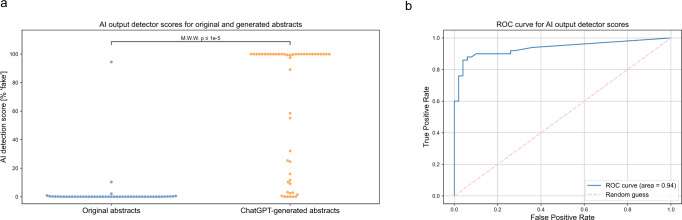
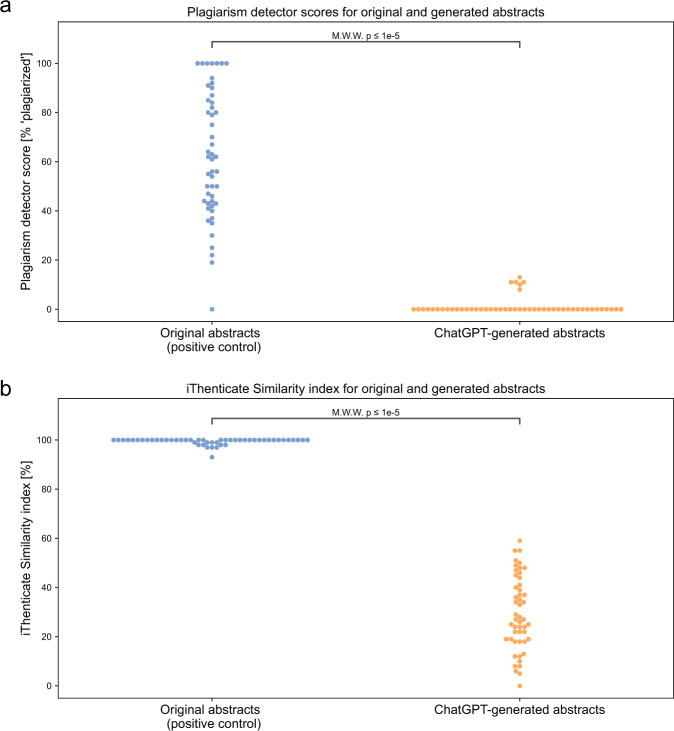
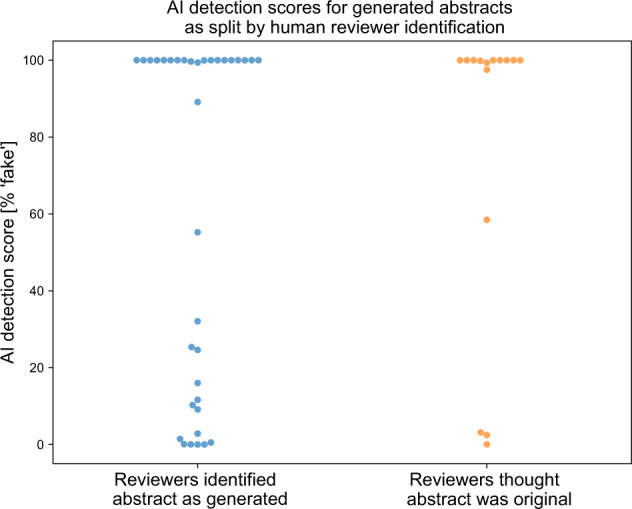
Large language models such as ChatGPT can produce increasingly realistic text, with unknown information on the accuracy and integrity of using these models in scientific writing. We gathered fifth research abstracts from five high-impact factor medical journals and asked ChatGPT to generate research abstracts based on their titles and journals. Most generated abstracts were detected using an AI output detector, ‘GPT-2 Output Detector’, with % ‘fake’ scores (higher meaning more likely to be generated) of median [interquartile range] of 99.98% ‘fake’ [12.73%, 99.98%] compared with median 0.02% [IQR 0.02%, 0.09%] for the original abstracts. The AUROC of the AI output detector was 0.94. Generated abstracts scored lower than original abstracts when run through a plagiarism detector website and iThenticate (higher scores meaning more matching text found). When given a mixture of original and general abstracts, blinded human reviewers correctly identified 68% of generated abstracts as being generated by ChatGPT, but incorrectly identified 14% of original abstracts as being generated. Reviewers indicated that it was surprisingly difficult to differentiate between the two, though abstracts they suspected were generated were vaguer and more formulaic. ChatGPT writes believable scientific abstracts, though with completely generated data. Depending on publisher-specific guidelines, AI output detectors may serve as an editorial tool to help maintain scientific standards. The boundaries of ethical and acceptable use of large language models to help scientific writing are still being discussed, and different journals and conferences are adopting varying policies.
Overview
The claims and statistics of this paper haven’t been checked yet.
Free: it reads the open-access text and checks the first 5 claims that cite a source we can check. Create a free account to check every claim.
Integrity signals
Registry
Cites
Statistics
Figures
Verification
Claims the paper makes
The claims and statistics of this paper haven’t been checked yet.
Free: it reads the open-access text and checks the first 5 claims that cite a source we can check. Create a free account to check every claim.
Claims other papers make about this one
Each is checked against this paper’s own text: does it say what the citing paper says it does?
The source backs part of the claim, not all of it — or backs it for a different population, condition or comparison.
In the citing paper
“ChatGPT’s GPT-3.5 iteration has already shown promise in several routine medical tasks and medical research [4-7], even raising ethical concerns in the literature [2,3,8].”
From Comparison of the Performance of GPT-3.5 and GPT-4 With That of Medical Students on the Written German Medical Licensing Examination: Observational Study (2024) · cites this paper as [7]
Experimental — accuracy not yet measuredThe source backs part of the claim, not all of it — or backs it for a different population, condition or comparison.
In the citing paper
“in practice, it takes a neural network to reliably catch another neural network.”
From Fine-Grained Detection of AI-Generated Writing in the Biomedical Literature (2026) · cites this paper as [6]
Experimental — accuracy not yet measuredThe source backs part of the claim, not all of it — or backs it for a different population, condition or comparison.
In the citing paper
“Rather than just copying ChatGPT output, many students seem to use it as a tool for brainstorming, refining ideas, or enhancing their writing style 16 .”
From Style, sentiment, and quality of undergraduate writing in the AI era: A cross-sectional and longitudinal analysis of 4,820 authentic empirical reports (2025) · cites this paper as [16]
Experimental — accuracy not yet measuredThe cited source says what the claim attributes to it.
In the citing paper
“Gao et al. (2023) found that ChatGPT can produce plausible scientific abstracts that humans often find difficult to distinguish from originals, though reviewers noted that AI abstracts tended to be 'vaguer and more formulaic'.”
From Metadiscourse Patterns in Human-Written vs. Generative AI-Authored Research Abstracts: A Comparative Corpus-Based Analysis (2026) · cites this paper as Gao et al. (2023)
The cited source says what the claim attributes to it.
In the citing paper
“Indeed, ChatGPT abstracts were noted by human reviewers as 'vague' or 'formulaic' , a qualitative impression that aligns with our finding of scant stance markers.”
From Metadiscourse Patterns in Human-Written vs. Generative AI-Authored Research Abstracts: A Comparative Corpus-Based Analysis (2026) · cites this paper as Gao et al. (2023)
3 more claims about this paper
Create a free account to see every claim other papers make about this one.
Self-check
Percentages, sums and reported differences re-computed from the paper’s own numbers.
The self-check needs the paper’s full text.
Citations
Cites
Scikit-learn: Machine Learning in Python
Pedregosa, F., Varoquaux, G., Gramfort, A., Michel, V., Thirion, B., Grisel, O., Blondel, M., Müller, A., Nothman, J., Louppe, G., et al. (2012) · arXiv · doi:10.48550/arxiv.1201.0490 · Cited by 71,016
Matplotlib: a 2D graphics environment
Hunter, J. D. (2007) · Computing in Science & Engineering · doi:10.1109/mcse.2007.55 · Cited by 39,249
SciPy 1.0: fundamental algorithms for scientific computing in Python
Virtanen, P., Gommers, R., Oliphant, T. E., Haberland, M., Reddy, T., Cournapeau, D., Burovski, E., Peterson, P., Weckesser, W., Bright, J., et al. (2020) · Nature Methods · doi:10.1038/s41592-019-0686-2 · Cited by 38,430
SciPy 1.0: fundamental algorithms for scientific computing in Python
Virtanen, P., Gommers, R., Oliphant, T. E., Haberland, M., Reddy, T., Cournapeau, D., Burovski, E., Peterson, P., Weckesser, W., Bright, J., et al. (2019) · Apollo - University of Cambridge Repository · doi:10.17863/cam.64134 · Cited by 10,460
seaborn: statistical data visualization
Waskom, M. (2021) · Journal of Open Source Software · doi:10.21105/joss.03021 · Cited by 7,310
NWChem: A comprehensive and scalable open-source solution for large scale molecular simulations
Valiev, M., Bylaska, E. J., Govind, N., Kowalski, K., Straatsma, T. P., Van Dam, H. J. J., Wang, D., Nieplocha, J., Apra, E., Windus, T. L., et al. (2010) · Computer Physics Communications · doi:10.1016/j.cpc.2010.04.018 · Cited by 5,779
Kung, T. H., Cheatham, M., Medenilla, A., Sillos, C., De Leon, L., Elepaño, C., Madriaga, M., Aggabao, R., Diaz-Candido, G., Maningo, J., et al. (2023) · PLOS Digital Health · doi:10.1371/journal.pdig.0000198 · Cited by 4,115 · cited 1×
“Articles are bemoaning the death of the traditional school essay assignment 4,6,7 , as ChatGPT has been shown to generate high-scoring papers 8 , correctly answer USMLE questions 9 , and even articulate critical thinking 10 .”
Kung, T. H., Cheatham, M., ChatGPT, Medenilla, A., Sillos, C., De Leon, L., Elepaño, C., Madriaga, M., Aggabao, R., Diaz-Candido, G., et al. (2022) · doi:10.1101/2022.12.19.22283643 · Cited by 4,115
ChatGPT is fun, but not an author
Thorp, H. H. (2023) · Science · doi:10.1126/science.adg7879 · Cited by 1,437 · cited 2×
“Different journals and publishers are developing their own policies on whether large language models can contribute to the writing of papers, ranging from not allowing any AI-generated text 12 to allowing its use as long as it is openly disclosed 13,14,28 .”
Artificial Intelligence in Medicine: Today and Tomorrow
Briganti, G., & Le Moine, O. (2020) · Frontiers in Medicine · doi:10.3389/fmed.2020.00027 · Cited by 743
Cited by
Items 301–400 of 1,018
How well can ChatGPT forecast tourism demand?
Wu, D. C., Li, W., Wu, J., Hu, M., & Shen, S. (2024) · Tourism Management · doi:10.1016/j.tourman.2024.105119 · Cited by 35
Can large language models fully automate or partially assist paper selection in systematic reviews?
Chen, H., Jiang, Z., Liu, X., Xue, C. C., Yew, S. M. E., Sheng, B., Zheng, Y., Wang, X., Wu, Y., Sivaprasad, S., et al. (2025) · British Journal of Ophthalmology · doi:10.1136/bjo-2024-326254 · Cited by 33
Yankouskaya, A., Babiker, A., Rizvi, S., Alshakhsi, S., Liebherr, M., & Ali, R. (2025) · ACM Transactions on the Web · doi:10.1145/3765895 · Cited by 32
Human, Do You Think This Painting is the Work of a Real Artist?
Park, J., Kang, H., & Kim, H. Y. (2023) · International Journal of Human-Computer Interaction · doi:10.1080/10447318.2023.2232978 · Cited by 39
“Several studies have been conducted to determine more reliable methods using AI algorithms (Gao et al., 2023; Mitrovi (cid”
Alzboon, M. S., Qawasmeh, S., Alqaraleh, M. K. S., Abuashour, A., Bader, A. F., & Al-Batah, M. S. (2023) · International Conference on Emerging Smart Technologies and Applications (eSmarTA) · doi:10.1109/esmarta59349.2023.10293294 · Cited by 38
Alanzi, T. M., Alsalem, A. A., Alzahrani, H., Almudaymigh, N., Alessa, A., Mulla, R., Alqahtani, L., Bajonaid, R., Alharthi, A. K. Z., Alnahdi, O. S., et al. (2023) · Cureus · doi:10.7759/cureus.49486 · Cited by 41
“According to multiple research [27-29], AI-based virtual assistants outperform earlier models in accuracy and efficiency when answering a variety of questions.”
Mathebula, M., Modupe, A., & Marivate, V. (2024) · IEEE Access · doi:10.1109/access.2024.3464374 · Cited by 19
“In the near term, the author in [60] instructed ChatGPT to construct research summaries based on the names and publications of research abstracts collected from five high-impact medical journals.”
BackgroundBaptista, J. P., Rivas-de-Roca, R., Gradim, A., & Curiel, C. P. (2025) · Humanities and Social Sciences Communications · doi:10.1057/s41599-025-04872-2 · Cited by 39
Biomedical publishing: Past historic, present continuous, future conditional
Sever, R. (2023) · PLoS Biology · doi:10.1371/journal.pbio.3002234 · Cited by 37
Dahal, N. (2024) · The Qualitative Report · doi:10.46743/2160-3715/2024.6637 · Cited by 49
Reacting to Generative AI: Insights from Student and Faculty Discussions on Reddit
Wu, C., Wang, X., Carroll, J., & Rajtmajer, S. (2024) · ACM Web Science Conference · doi:10.1145/3614419.3644014 · Cited by 24
ChatGPT in Brazilian K-12 science education
Monteiro, F. F., Souza, P. V. S., da Silva, M. C., Maia, J. R., da Silva, W. F., & Girardi, D. (2024) · Frontiers in Education · doi:10.3389/feduc.2024.1321547 · Cited by 42
Ozkan, E., Tekin, A., Ozkan, M. C., Cabrera, D., Niven, A. S., & Dong, Y. (2025) · JMIR Medical Education · doi:10.2196/58801 · Cited by 36
Science fact vs science fiction: A ChatGPT immunological review experiment gone awry
Wittmann, J. (2023) · Immunology Letters · doi:10.1016/j.imlet.2023.04.002 · Cited by 32
Ravi, A., Neinstein, A., & Murray, S. G. (2023) · ATS Scholar · doi:10.34197/ats-scholar.2023-0036ps · Cited by 31
Innovations in Medicine: Exploring ChatGPT’s Impact on Rare Disorder Management
Zampatti, S., Peconi, C., Megalizzi, D., Calvino, G., Trastulli, G., Cascella, R., Strafella, C., Caltagirone, C., & Giardina, E. (2024) · Genes · doi:10.3390/genes15040421 · Cited by 37
“The challenge in distinguishing between authentic and AI-generated abstracts highlights ChatGPT’s skill in creating persuasive scientific narratives [39,40].”
BackgroundExploring the use of ChatGPT as a virtual health coach for chronic disease management
Al-Anezi, F. (2024) · Learning Health Systems · doi:10.1002/lrh2.10406 · Cited by 36
A Comprehensive Survey of Fake Text Detection on Misinformation and LM-Generated Texts
Kwon, S.-C., & Jang, B. (2025) · IEEE Access · doi:10.1109/access.2025.3538805 · Cited by 37
Accuracy and Reliability of AI-Generated Text Detection Tools: A Literature Review
Gotoman, J. E. J., Luna, H. L. T., Sangria, J. C. S., Santiago, C. S., & Barbuco, D. D. (2025) · American Journal of IR 4 0 and Beyond · doi:10.54536/ajirb.v4i1.3795 · Cited by 37
CASSAI, A. D., Dost, B., Augoustides, J. G., Azamfirei, L., Alanoğlu, Z., Azi, L. M. T. D. A., Calvache, J. A., Černý, V., Hert, S. G. D., Eldawlatly, A. A., et al. (2026) · British Journal of Anaesthesia · doi:10.1016/j.bja.2026.01.029 · Cited by 37
Taloni, A., Scorcia, V., & Giannaccare, G. (2023) · Eye · doi:10.1038/s41433-023-02678-7 · Cited by 35
Utilization of ChatGPT-4 in Plastic and Reconstructive Surgery: A Narrative Review
Aljindan, F., Shawosh, M. H., Altamimi, L. A., Arif, S., & Mortada, H. H. (2023) · Plastic & Reconstructive Surgery Global Open · doi:10.1097/gox.0000000000005305 · Cited by 34
“15 Another potential use for ChatGPT-4 in research is its ability to effectively search for novel systematic review ideas in plastic surgery.”
BackgroundSafrai, M., & Orwig, K. E. (2024) · Journal of Assisted Reproduction and Genetics · doi:10.1007/s10815-024-03089-7 · Cited by 37
Kirwan, A. (2024) · Irish Educational Studies · doi:10.1080/03323315.2023.2284901 · Cited by 29
Miller, L. E., Bhattacharyya, D., Miller, V. M., & Bhattacharyya, M. (2023) · Cureus · doi:10.7759/cureus.39224 · Cited by 38
“Potential applications of AI in biomedical publishing include improving text clarity, AI-assisted peer review [6,7], and detection of AI-assisted writing [8].”
BackgroundGenerative artificial intelligence: implications for biomedical and health professions education
Hersh, W. (2025) · Annual Review of Biomedical Data Science · doi:10.1146/annurev-biodatasci-103123-094756 · Cited by 28
The Impact of Generative AI Images on Consumer Attitudes in Advertising
Zhang, L., & Hur, C. (2025) · Administrative Sciences · doi:10.3390/admsci15100395 · Cited by 28
“For instance, AI has been used to create magazine covers (Economist, 2022), award-winning artworks (Grierson, 2023), and scientific paper abstracts that are nearly indistinguishable from those written by humans (Gao et al., 2023).”
Pride, D., Cancellieri, M., & Knoth, P. (2023) · Lecture Notes in Computer Science · doi:10.1007/978-3-031-43849-3_13 · Cited by 28
Can we trust academic AI detective? Accuracy and limitations of AI-output detectors
Erol, G., Ergen, A., Gülşen Erol, B., Kaya Ergen, Ş., Bora, T. S., Çölgeçen, A. D., Araz, B., Şahin, C., Bostancı, G., Kılıç, İ., et al. (2025) · Acta Neurochirurgica · doi:10.1007/s00701-025-06622-4 · Cited by 28
Potentials and implications of ChatGPT for ESL writing instruction
Ibrahim, K., & Kirkpatrick, R. (2024) · The International Review of Research in Open and Distributed Learning · doi:10.19173/irrodl.v25i3.7820 · Cited by 28
“…research on the implications of ChatGPT for L2 writing has emphasized ethical challenges to traditional L2 writing assessments (Cotton et al., 2024; Francke & Alexander, 2019; Gao et al., 2023; Haque et al., 2022; King & ChatGPT, 2023; Khalil & Er, 2023; Susnjak, 2022; Yeadon et al., 2022).”
BackgroundEmerging Dynamics of ChatGPT in Academia: A Scoping Review
Mahrishi, M., Abbas, A., Radovanović, D., & Hosseini, S. (2024) · Journal of University Teaching and Learning Practice · doi:10.53761/b182ws13 · Cited by 28
“The US government's Commerce Department is considering regulating AI technologies like ChatGPT by holding formal public opinion hearings on accountability measures (Gao et al., 2023).”
BackgroundExploring ChatGPT's abilities in medical article writing and peer review
Kadı, G., & Aslaner, M. A. (2024) · Croatian Medical Journal · doi:10.3325/cmj.2024.65.93 · Cited by 32
ChatGPT: El dilema sobre la autoría de las actividades evaluables en educación universitaria
Consuegra‐Fernández, M., Aznar, J. S., Serra, J. G. B., & Caballero-Molina, J. J. (2024) · Revista de Investigación Educativa · doi:10.6018/rie.565391 · Cited by 30
Assessing students’ DRIVE: A framework to evaluate learning through interactions with generative AI
Oliveira, M., Zednik, C., Bombaerts, G. J. T., Sadowski, B. M., & Conijn, R. (2025) · Computers and Education Artificial Intelligence · doi:10.1016/j.caeai.2025.100497 · Cited by 46
Investigating Effective Ways to Use Artificial Intelligence in Teacher Education
Tunjera, N., & Chigona, A. (2023) · European Conference on e-Learning · doi:10.34190/ecel.22.1.1625 · Cited by 42
Garib, A., & Coffelt, T. A. (2024) · Computers & composition/Computers and composition · doi:10.1016/j.compcom.2024.102869 · Cited by 30
Gandhi Periaysamy, A., Satapathy, P., Neyazi, A., & Padhi, B. K. (2023) · Annals of Medicine & Surgery · doi:10.1097/ms9.0000000000000371 · Cited by 27
Estimating the use of ChatGPT in dental research publications
Uribe, S. E., & Maldupa, I. (2024) · Journal of Dentistry · doi:10.1016/j.jdent.2024.105275 · Cited by 27
Huespe, I. A., Echeverri, J., Khalid, A., Carboni Bisso, I., Musso, C. G., Surani, S., Bansal, V., & Kashyap, R. (2023) · Critical Care Explorations · doi:10.1097/cce.0000000000000975 · Cited by 27
Yang, W., Lee, H., Wu, R., Zhang, R., & Pan, Y. (2023) · Electronics · doi:10.3390/electronics12234813 · Cited by 30
Using GPT-4 to write a scientific review article: a pilot evaluation study
Wang, Z. P., Bhandary, P., Wang, Y., & Moore, J. H. (2024) · BioData Mining · doi:10.1186/s13040-024-00371-3 · Cited by 40
Benefits and risks of using ChatGPT in higher education: A theoretical review
Bermus, A. G. (2024) · Pedagogy Theory & Practice · doi:10.30853/ped20240099 · Cited by 35
Moglia, A., Georgiou, K. E., Cerveri, P., Mainardi, L. T., Satava, R. M., & Cuschieri, A. (2024) · Artificial Intelligence Review · doi:10.1007/s10462-024-10849-5 · Cited by 31
AI chatbots: A disguised enemy for academic integrity?
Niloy, A. C., Hafiz, R., Hossain, B. M., Gulmeher, F., Sultana, N., Islam, K. F., Bushra, F., Islam, S., Hoque, S. I., Rahman, M., et al. (2024) · International Journal of Educational Research Open · doi:10.1016/j.ijedro.2024.100396 · Cited by 26
Factors influencing patients’ engagement with ChatGPT for accessing health-related information
Alanezi, F. (2024) · Critical Public Health · doi:10.1080/09581596.2024.2348164 · Cited by 26
“According to research (Gao et al., 2022; Jiao et al., 2023; Shen et al., 2023), ChatGPT outperforms earlier models in terms of accuracy and efficiency when responding to a variety of queries.”
Stadler, R. D., Sudah, S. Y., Moverman, M. A., Denard, P. J., Duralde, X. A., Garrigues, G. E., Klifto, C. S., Levy, J. C., Namdari, S., Sánchez‐Sotelo, J., et al. (2024) · Arthroscopy The Journal of Arthroscopic and Related Surgery · doi:10.1016/j.arthro.2024.06.045 · Cited by 32
Scientific Article Writing: Will ChatGPT Help?
Zashikhina, I. M. (2023) · Высшее образование в России · doi:10.31992/0869-3617-2023-32-8-9-24-47 · Cited by 31
Can ChatGPT identify predatory biomedical and dental journals? A cross-sectional content analysis
Al‐Moghrabi, D., Arqub, S. A., Maroulakos, M. P., Pandis, N., & Fleming, P. S. (2024) · Journal of Dentistry · doi:10.1016/j.jdent.2024.104840 · Cited by 27
Bao, T., Zhao, Y., Mao, J., & Zhang, C. (2025) · Scientometrics · doi:10.1007/s11192-025-05341-y · Cited by 25
“Recent studies suggest that LLMs can be used for grammar correction, literature summarization, and the generation of abstracts and review papers, making them powerful tools for addressing the aforementioned challenges (Altmäe et al., 2023; Gao et al., 2023; Lozić & Štular, 2023).”
Rafi, M. A. A., & Amjad, I. (2025) · Discover Education · doi:10.1007/s44217-025-00503-9 · Cited by 29
Sağlam, R., & Kalanlar, B. (2025) · Nurse Education in Practice · doi:10.1016/j.nepr.2025.104530 · Cited by 28
EFL teachers and feedback fatigue: AI to the rescue?
Hyland, K. (2025) · Language Teaching · doi:10.1017/s0261444825101018 · Cited by 28
“Similarly, Gao et al. (2023) showed that human reviewers only identified 68% of research abstracts created by ChatGPT.”
CLARIN-Emo: Training Emotion Recognition Models Using Human Annotation and ChatGPT
Koptyra, B., Ngo, A., Radliński, Ł., & Kocoń, J. (2023) · Lecture notes in computer science · doi:10.1007/978-3-031-35995-8_26 · Cited by 39
Homolak, J. (2023) · Croatian Medical Journal · doi:10.3325/cmj.2023.64.205 · Cited by 25
Early Research Trends on ChatGPT: Insights from Altmetrics and Science Mapping Analysis
Raman, R., Lathabai, H. H., Diwakar, S., & Nedungadi, P. (2023) · International Journal of Emerging Technologies in Learning (iJET) · doi:10.3991/ijet.v18i19.41793 · Cited by 29
Enhancing Classroom Learning: ChatGPT's Integration and Educational Challenges
AlAli, R. M., & Wardat, Y. (2024) · International Journal of Religion · doi:10.61707/znwnxd43 · Cited by 33
Alanezi, F. (2025) · Nutrition and Health · doi:10.1177/02601060241244563 · Cited by 24
“Studies (Gao et al., 2023; Jiao et al., 2023; Shen et al., 2023) reveal that ChatGPT outperforms earlier models in accuracy and ef fi ciency.”
Detection of fake papers in the era of artificial intelligence
Dadkhah, M., Oermann, M. H., Hegedüs, M., Raman, R., & Dávid, L. D. (2023) · Diagnosis · doi:10.1515/dx-2023-0090 · Cited by 24
A survey on biomedical automatic text summarization with large language models
Huang, Z., Chen, X., Wang, Y., Huang, J., & Zhao, X. (2025) · Information Processing & Management · doi:10.1016/j.ipm.2025.104216 · Cited by 27
AI-generated text detection: A comprehensive review of methods, datasets, and applications
Kehkashan, T., Riaz, R. A., Al-Shamayleh, A. S., Akhunzada, A., Ali, N., Hamza, M., & Akbar, F. (2025) · Computer Science Review · doi:10.1016/j.cosrev.2025.100793 · Cited by 21
Preiksaitis, C. M., Nash, C. J., Gottlieb, M. A., Chan, T. M., Alvarez, A., & Landry, A. I. (2023) · AEM Education and Training · doi:10.1002/aet2.10924 · Cited by 25
Torres, J. M. (2024) · Journal of Business & Finance Librarianship · doi:10.1080/08963568.2024.2321729 · Cited by 25
“A study conducted by Gao et al. (2023) to determine the quality of scientific sources ChatGPT produced showed that Reviewers were able to correctly identify 68% of generated abstracts as being generated, and correctly identified 86% of original articles as being original.”
BackgroundChatGPT and Cheat Detection in CS1 Using a Program Autograding System
Pang, A., & Vahid, F. (2024) · ACM Conference on Innovation and Technology in Computer Science Education (ITiCSE) · doi:10.1145/3649217.3653558 · Cited by 27
Balta, K. Y., Javidan, A. P., Walser, E., Arntfield, R., & Prager, R. (2025) · Journal of Intensive Care Medicine · doi:10.1177/08850666241267871 · Cited by 26
How is ChatGPT acknowledged in academic publications?
Kousha, K. (2024) · Scientometrics · doi:10.1007/s11192-024-05193-y · Cited by 23
“…like ChatGPT can help with scientific writing and manuscript production such as editing and proofreading (Lechien et al., 2024), writing abstracts (Gao et al., 2023; Hwang et al., 2024), literature reviews (Kacena et al., 2024; Margetts et al., 2024), coding (Bucaioni et al., 2024; Coello et al.,…”
Chatgpt in Higher Education Malaysia: An Opportunity or Threat to The Education System?
Selvanathan, B., & Narayanan, S. (2024) · International Journal of Academic Research in Progressive Education and Development · doi:10.6007/ijarped/v13-i3/21455 · Cited by 29
Sonntagbauer, M., Haar, M., & Kluge, S. (2023) · Medizinische Klinik - Intensivmedizin und Notfallmedizin · doi:10.1007/s00063-023-01019-6 · Cited by 30
The Influence of ChatGPT on Student Learning and Academic Performance
Ayman, S. E., El-Seoud, S. A., Nagaty, K., & Karam, O. H. (2023) · International Conference on Computer and Applications (ICCA) · doi:10.1109/icca59364.2023.10401713 · Cited by 27
OPPORTUNITIES AND CHALLENGES OF USING ChatGPT IN THE ELT SCENARIO OF UTAS, NIZWA, OMAN
Govindarajan, R., & Christuraj, G. (2024) · Journal of Teaching English for Specific and Academic Purposes · doi:10.22190/jtesap230529046g · Cited by 27
AI or Human? Finding and Responding to Artificial Intelligence in Student Work
Fisk, G. D. (2024) · Teaching of Psychology · doi:10.1177/00986283241251855 · Cited by 29
“Although 1% to 5% errors may seem problematic, this must be interpreted from the perspective that these systems deliver better performance than human judges, such as the 14% false positives made by human experts in Gao et al. (2023).”
InfluentialKim, H. J., Yang, J. H., Chang, D., Lenke, L. G., Pizones, J., Castelein, R. M., Watanabe, K., Trobisch, P. D., Mundis, G. M., Suh, S. W., et al. (2024) · Journal of Medical Internet Research · doi:10.2196/52001 · Cited by 28
“…met with concern by many experts, and the challenges posed by LLM-based AI have become the subject of social and ethical debates beyond the fields of medicine and science [2-4 Controversies persist over whether AI-generated content itself has scientific value within ethical boundaries [5,9,12].”
InfluentialPerformance of ChatGPT and Dental Students on Concepts of Periodontal Surgery
Li, C., Zhang, J., Abdul‐Masih, J., Zhang, S., & Yang, J. (2024) · European Journal Of Dental Education · doi:10.1111/eje.13047 · Cited by 25
Albrecht, S. (2023) · Repository KITopen (Karlsruhe Institute of Technology) · doi:10.5445/ir/1000158070 · Cited by 46
ChatGPT: Detection in Academic Journals is Editors’ and Publishers’ Responsibilities
da Silva, J. A. T. (2023) · Annals of Biomedical Engineering · doi:10.1007/s10439-023-03247-5 · Cited by 24
Cao, X., Lin, Y.-J., Zhang, J.-H., Tang, Y.-P., Zhang, M.-P., & Gao, H.-Y. (2025) · Education and Information Technologies · doi:10.1007/s10639-025-13339-5 · Cited by 22
Awareness, perception, and adoption of ChatGPT in African HEIs: A multi-dimensional analysis
Ojubanire, O. A., Olaleye, S. A., Marhraoui, M. A., Kamihanda, M. W., Oke, O. I., & Ojubanire, O. A. (2025) · The Internet and Higher Education · doi:10.1016/j.iheduc.2025.100999 · Cited by 27
The Power of AI-Generated Content: Evidence From the Peer-to-Peer Accommodation Market
Fan, N., Li, X. R., Liu, C., & Fan, Z. (2025) · Journal of Travel Research · doi:10.1177/00472875251332951 · Cited by 26
“Similarly, Gao et al. (2023) reported that blinded human reviewers recognized only 68% of ChatGPT-produced text when presented with a mix of authentic and artificial medical science abstracts.”
The role of artificial intelligence in headache medicine: Potential and peril
Cohen, F. (2023) · Headache The Journal of Head and Face Pain · doi:10.1111/head.14495 · Cited by 22
Toward non-human-centered design: designing an academic article with ChatGPT
LİVBERBER, T. (2023) · El Profesional de la Informacion · doi:10.3145/epi.2023.sep.12 · Cited by 33
How to Detect AI-Generated Texts?
Nguyen, T. T., Hatua, A., & Sung, A. H. (2023) · IEEE Annual Ubiquitous Computing, Electronics & Mobile Communication Conference (UEMCON) · doi:10.1109/uemcon59035.2023.10316132 · Cited by 34
Powerful tool or too powerful? Early public discourse about ChatGPT across 4 million tweets
Ng, R., & Chow, T. Y. J. (2024) · PLoS ONE · doi:10.1371/journal.pone.0296882 · Cited by 26
Artificial Intelligence in Graduate Medical Education Applications
Mangold, S., & Ream, M. A. (2024) · Journal of Graduate Medical Education · doi:10.4300/jgme-d-23-00510.1 · Cited by 26
Wang, J., Huang, C., Yan, S., Xie, W., & He, D. (2024) · International Journal of Human-Computer Interaction · doi:10.1080/10447318.2024.2352919 · Cited by 26
Holland, A. M., Lorenz, W. R., Cavanagh, J. C., Smart, N. J., Ayuso, S. A., Scarola, G. T., Kercher, K. W., Jørgensen, L. N., Janis, J. E., Fischer, J. P., et al. (2024) · JAMA Network Open · doi:10.1001/jamanetworkopen.2024.25373 · Cited by 24
Kabir, A., Shah, S. S., Haddad, A. F., & Raper, D. M. S. (2024) · World Neurosurgery · doi:10.1016/j.wneu.2024.10.041 · Cited by 25
An Empirical Study of AI Generated Text Detection Tools
Akram, A. (2023) · arXiv · doi:10.48550/arxiv.2310.01423 · Cited by 22
Wang, J., Hu, H., Wang, Z., Yan, S., Sheng, Y., & He, D. (2024) · Proceedings of the CHI Conference on Human Factors in Computing Systems · doi:10.1145/3613904.3641917 · Cited by 21
Toward Robust Arabic AI-Generated Text Detection: Tackling Diacritics Challenges
Alshammari, H., & Elleithy, K. (2024) · Inf. · doi:10.3390/info15070419 · Cited by 26
A First Look at Financial Data Analysis Using ChatGPT-4o
Chou, W.-H., Feng, Z., Li, B.-X., & Liu, F.-L. (2025) · Journal of Risk and Financial Management · doi:10.3390/jrfm18020099 · Cited by 15
Yapay Zekâ Destekli Dil İşleme Teknolojisi Olan ChatGPT’nin Sağlık Hizmetlerinde Kullanımı
Yiğit, S., Berşe, S., & Dіrgar, E. (2023) · Eurasian Journal of Health Technology Assessment · doi:10.52148/ehta.1302000 · Cited by 27
Trends in research on ChatGPT and adoption-related issues discussed in articles: a narrative review
Kim, S.-J. (2023) · Science Editing · doi:10.6087/kcse.321 · Cited by 24
Gritti, M. N., AlTurki, H., Farid, P., & Morgan, C. T. (2024) · Pediatric Cardiology · doi:10.1007/s00246-023-03385-6 · Cited by 22
“…processing (NLP) models have already been used to help with various scientific research and medical endeavors, including writing medical abstracts [5], conducting literature reviews [6], helping with language barriers [7], simplifying medical reports [8], providing medical decision-making [9],…”
Nazzal, M. K., Morris, A. J., Parker, R. S., White, F. A., Natoli, R. M., Fehrenbacher, J. C., & Kacena, M. A. (2024) · Current Osteoporosis Reports · doi:10.1007/s11914-023-00854-y · Cited by 21
“If AI can write believable abstracts [8], is it currently capable of writing a publishable full-length scientific review?”
BackgroundZarei, M., Zarei, M., Hamzehzadeh, S., Oliyaei, S. S. B., & Hosseini, M. (2024) · Shiraz E-Medical Journal · doi:10.5812/semj-145840 · Cited by 26
Wang, Y., Liang, L., Li, R., Wang, Y., & Hao, C. (2024) · Journal of Multidisciplinary Healthcare · doi:10.2147/jmdh.s473680 · Cited by 22
Defining the Role of Large Language Models in Urologic Care and Research
Gupta, R., Pedraza, A. M., Gorin, M. A., & Tewari, A. K. (2023) · European Urology Oncology · doi:10.1016/j.euo.2023.07.017 · Cited by 22
Calderón, R., & Herrera, F. (2025) · Humanities and Social Sciences Communications · doi:10.1057/s41599-025-04650-0 · Cited by 24
Chen, J., Dai, J., Yu, T., & Wang, C. (2025) · International Journal of Logistics Research and Applications · doi:10.1080/13675567.2025.2520550 · Cited by 25
Zhang, Z., Wang, C., & Shang, Y. (2025) · The Asia-Pacific Education Researcher · doi:10.1007/s40299-025-01031-8 · Cited by 25
ChatGPT: Transcending Language Limitations in Scientific Research Using Artificial Intelligence
Osama, M., Afridi, S., & Maaz, M. (2023) · Journal of College of Physicians And Surgeons Pakistan · doi:10.29271/jcpsp.2023.10.1198 · Cited by 25
Metadata
- Authors
- Gao, C. A., Howard, F. M., Markov, N. S., Dyer, E. C., Ramesh, S., Luo, Y., & Pearson, A. T.
- Affiliations
- Northwestern University (US)
- University of Chicago (US)
- Corresponding author
- Gao, Catherine A.
- ORCID
- Venue
- npj Digital Medicine
- Published
- 2023-04-26
- Volume
- 6
- Issue
- 1
- Pages
- 75-75
- ISSN
- 2398-6352 (ISSN-L)
- PMC
- PMC10133283
- OpenAlex
- W4367051110
- Cited by
- 1,099
- References
- 26
- Citations by year
- 2026: 189 · 2025: 235 · 2024: 342 · 2023: 326
- FWCI
- 273.24
- Type
- journal article
- Language
- en
- Open access
- gold
- doi.org
- Licence
- cc-by
- creativecommons.org/licenses/by/4.0 (tdm)
- creativecommons.org/licenses/by/4.0 (vor)
- Locations
- npj Digital Medicine (publishedVersion, cc-by)
- bioRxiv (Cold Spring Harbor Laboratory) (acceptedVersion, cc-by-nc-nd)
- PubMed Central (publishedVersion, cc-by)
- PubMed (publishedVersion)
- Knowledge@UChicago (University of Chicago) (submittedVersion, cc-by-nc-nd)
- DOAJ (DOAJ: Directory of Open Access Journals) (submittedVersion, cc-by-sa)
- University of Chicago (cc-by)
- Funders
- U.S. Department of Health and Human Services (U01-CA243075, R01LM013337, R56-DE030958, U01TR003528)
- Burroughs Wellcome Fund
- Conquer Cancer Foundation (2022YIA-6675470300)
- Breast Cancer Research Foundation (2022YIA-6675470300)
- Cancer Research Foundation
- Fanconi Anemia Research Fund
- American Society of Clinical Oncology (2022YIA-6675470300)
- Horizon Therapeutics
- National Institutes of Health (U01TR003528)
- Stand Up To Cancer
- National Heart, Lung, and Blood Institute (F32HL162377)
- National Cancer Institute (K12CA139160, U01CA243075)
- National Institute of Dental and Craniofacial Research (R56DE030958)
- U.S. National Library of Medicine (R01LM013337)
- National Center for Advancing Translational Sciences
- Topics
- Social Sciences › Education › Academic integrity and plagiarism
- Social Sciences › Library and Information Sciences › Academic Writing and Publishing
- Health Sciences › Medicine › Health Informatics › Artificial Intelligence in Healthcare and Education
- Keywords
- ChatGPT, large language models, AI-generated text detection, scientific abstracts, plagiarism detection, medical journal abstracts, scientific integrity, AI in scientific writing, editorial guidelines
About these checks
Registry, retraction, Cites and statistics results are computed, not judged, with one exception: a printed reference that no index lists is read once by a model before it counts as a citation error. Claims are extracted by a model and kept only when their quote appears verbatim in the text; each cited source is then checked, with a model’s help, for whether it says what the claim relies on. Those verdicts can be wrong — read the claim’s quote and the cited source before relying on one.
Statistics and arithmetic are recomputed, not judged.
Confidence bands are shown only for fields calibrated on our annotated test set. None is calibrated yet, so no band is shown.
What counts as a claim ›How we measure confidence ›How we check this ›
Are you an author, or do you see a problem with this page? Request a review
Data sources
Bibliographic data: Semantic Scholar, OpenAlex, Crossref.
Contains information from the Semantic Scholar Academic Graph Datasets, made available under the ODC Attribution License (ODC-BY 1.0).
Semantic Scholar’s data is described in: Kinney, R., et al. (2023). The Semantic Scholar Open Data Platform. arXiv:2301.10140.
