

Comparing scientific abstracts generated by ChatGPT to real abstracts with detectors and blinded human reviewers
Open accessPublished version of a preprint
The DOI matches its Crossref record; 34 of the 34 references it cites were found in a registry or an index.
Abstract
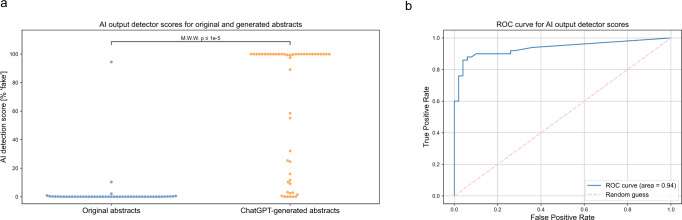
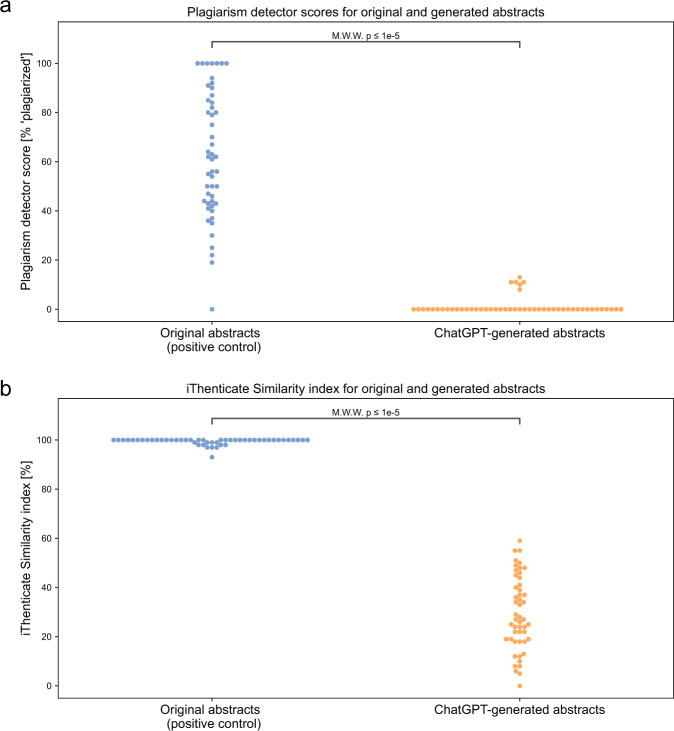
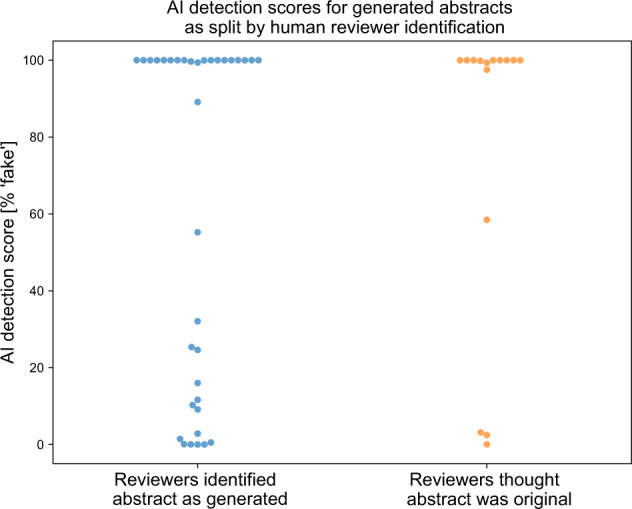
Large language models such as ChatGPT can produce increasingly realistic text, with unknown information on the accuracy and integrity of using these models in scientific writing. We gathered fifth research abstracts from five high-impact factor medical journals and asked ChatGPT to generate research abstracts based on their titles and journals. Most generated abstracts were detected using an AI output detector, ‘GPT-2 Output Detector’, with % ‘fake’ scores (higher meaning more likely to be generated) of median [interquartile range] of 99.98% ‘fake’ [12.73%, 99.98%] compared with median 0.02% [IQR 0.02%, 0.09%] for the original abstracts. The AUROC of the AI output detector was 0.94. Generated abstracts scored lower than original abstracts when run through a plagiarism detector website and iThenticate (higher scores meaning more matching text found). When given a mixture of original and general abstracts, blinded human reviewers correctly identified 68% of generated abstracts as being generated by ChatGPT, but incorrectly identified 14% of original abstracts as being generated. Reviewers indicated that it was surprisingly difficult to differentiate between the two, though abstracts they suspected were generated were vaguer and more formulaic. ChatGPT writes believable scientific abstracts, though with completely generated data. Depending on publisher-specific guidelines, AI output detectors may serve as an editorial tool to help maintain scientific standards. The boundaries of ethical and acceptable use of large language models to help scientific writing are still being discussed, and different journals and conferences are adopting varying policies.
Overview
The claims and statistics of this paper haven’t been checked yet.
Free: it reads the open-access text and checks the first 5 claims that cite a source we can check. Create a free account to check every claim.
Integrity signals
Registry
Cites
Statistics
Figures
Verification
Claims the paper makes
The claims and statistics of this paper haven’t been checked yet.
Free: it reads the open-access text and checks the first 5 claims that cite a source we can check. Create a free account to check every claim.
Claims other papers make about this one
Each is checked against this paper’s own text: does it say what the citing paper says it does?
The source backs part of the claim, not all of it — or backs it for a different population, condition or comparison.
In the citing paper
“ChatGPT’s GPT-3.5 iteration has already shown promise in several routine medical tasks and medical research [4-7], even raising ethical concerns in the literature [2,3,8].”
From Comparison of the Performance of GPT-3.5 and GPT-4 With That of Medical Students on the Written German Medical Licensing Examination: Observational Study (2024) · cites this paper as [7]
Experimental — accuracy not yet measuredThe source backs part of the claim, not all of it — or backs it for a different population, condition or comparison.
In the citing paper
“in practice, it takes a neural network to reliably catch another neural network.”
From Fine-Grained Detection of AI-Generated Writing in the Biomedical Literature (2026) · cites this paper as [6]
Experimental — accuracy not yet measuredThe source backs part of the claim, not all of it — or backs it for a different population, condition or comparison.
In the citing paper
“Rather than just copying ChatGPT output, many students seem to use it as a tool for brainstorming, refining ideas, or enhancing their writing style 16 .”
From Style, sentiment, and quality of undergraduate writing in the AI era: A cross-sectional and longitudinal analysis of 4,820 authentic empirical reports (2025) · cites this paper as [16]
Experimental — accuracy not yet measuredThe cited source says what the claim attributes to it.
In the citing paper
“Gao et al. (2023) found that ChatGPT can produce plausible scientific abstracts that humans often find difficult to distinguish from originals, though reviewers noted that AI abstracts tended to be 'vaguer and more formulaic'.”
From Metadiscourse Patterns in Human-Written vs. Generative AI-Authored Research Abstracts: A Comparative Corpus-Based Analysis (2026) · cites this paper as Gao et al. (2023)
The cited source says what the claim attributes to it.
In the citing paper
“Indeed, ChatGPT abstracts were noted by human reviewers as 'vague' or 'formulaic' , a qualitative impression that aligns with our finding of scant stance markers.”
From Metadiscourse Patterns in Human-Written vs. Generative AI-Authored Research Abstracts: A Comparative Corpus-Based Analysis (2026) · cites this paper as Gao et al. (2023)
3 more claims about this paper
Create a free account to see every claim other papers make about this one.
Self-check
Percentages, sums and reported differences re-computed from the paper’s own numbers.
The self-check needs the paper’s full text.
Citations
Cites
Scikit-learn: Machine Learning in Python
Pedregosa, F., Varoquaux, G., Gramfort, A., Michel, V., Thirion, B., Grisel, O., Blondel, M., Müller, A., Nothman, J., Louppe, G., et al. (2012) · arXiv · doi:10.48550/arxiv.1201.0490 · Cited by 71,016
Matplotlib: a 2D graphics environment
Hunter, J. D. (2007) · Computing in Science & Engineering · doi:10.1109/mcse.2007.55 · Cited by 39,249
SciPy 1.0: fundamental algorithms for scientific computing in Python
Virtanen, P., Gommers, R., Oliphant, T. E., Haberland, M., Reddy, T., Cournapeau, D., Burovski, E., Peterson, P., Weckesser, W., Bright, J., et al. (2020) · Nature Methods · doi:10.1038/s41592-019-0686-2 · Cited by 38,430
SciPy 1.0: fundamental algorithms for scientific computing in Python
Virtanen, P., Gommers, R., Oliphant, T. E., Haberland, M., Reddy, T., Cournapeau, D., Burovski, E., Peterson, P., Weckesser, W., Bright, J., et al. (2019) · Apollo - University of Cambridge Repository · doi:10.17863/cam.64134 · Cited by 10,460
seaborn: statistical data visualization
Waskom, M. (2021) · Journal of Open Source Software · doi:10.21105/joss.03021 · Cited by 7,310
NWChem: A comprehensive and scalable open-source solution for large scale molecular simulations
Valiev, M., Bylaska, E. J., Govind, N., Kowalski, K., Straatsma, T. P., Van Dam, H. J. J., Wang, D., Nieplocha, J., Apra, E., Windus, T. L., et al. (2010) · Computer Physics Communications · doi:10.1016/j.cpc.2010.04.018 · Cited by 5,779
Kung, T. H., Cheatham, M., Medenilla, A., Sillos, C., De Leon, L., Elepaño, C., Madriaga, M., Aggabao, R., Diaz-Candido, G., Maningo, J., et al. (2023) · PLOS Digital Health · doi:10.1371/journal.pdig.0000198 · Cited by 4,115 · cited 1×
“Articles are bemoaning the death of the traditional school essay assignment 4,6,7 , as ChatGPT has been shown to generate high-scoring papers 8 , correctly answer USMLE questions 9 , and even articulate critical thinking 10 .”
Kung, T. H., Cheatham, M., ChatGPT, Medenilla, A., Sillos, C., De Leon, L., Elepaño, C., Madriaga, M., Aggabao, R., Diaz-Candido, G., et al. (2022) · doi:10.1101/2022.12.19.22283643 · Cited by 4,115
ChatGPT is fun, but not an author
Thorp, H. H. (2023) · Science · doi:10.1126/science.adg7879 · Cited by 1,437 · cited 2×
“Different journals and publishers are developing their own policies on whether large language models can contribute to the writing of papers, ranging from not allowing any AI-generated text 12 to allowing its use as long as it is openly disclosed 13,14,28 .”
Artificial Intelligence in Medicine: Today and Tomorrow
Briganti, G., & Le Moine, O. (2020) · Frontiers in Medicine · doi:10.3389/fmed.2020.00027 · Cited by 743
Cited by
Items 201–300 of 1,018
Goulart, L., Matte, M. L., Mendoza, A., Alvarado, L., & Veloso, I. (2024) · Journal of Second Language Writing · doi:10.1016/j.jslw.2024.101160 · Cited by 64
Publication ethics in the era of artificial intelligence
Kocak, Z. (2024) · Journal of Korean Medical Science · doi:10.3346/jkms.2024.39.e249 · Cited by 56
“32 Gao et al. 34 evaluated the abstracts generated by ChatGPT for 50 scientific medical articles.”
BackgroundLiu, J. Q. J., Hui, K. T. K., Al Zoubi, F., Zhou, Z. Z. X., Samartzis, D., Yu, C. C. H., Chang, J. R., & Wong, A. Y. L. (2024) · International Journal for Educational Integrity · doi:10.1007/s40979-024-00155-6 · Cited by 56
“Importantly, the accuracy of universal AI detectors has shown inconsistencies across studies in different domains (Gao et al. 2023; Anderson et al. 2023; Walters 2023).”
BackgroundMethodInfluentialChatGPT and conversational artificial intelligence: Friend, foe, or future of research?
Gottlieb, M., Kline, J. A., Schneider, A. J., & Coates, W. C. (2023) · The American Journal of Emergency Medicine · doi:10.1016/j.ajem.2023.05.018 · Cited by 51
Applications of Large Language Models in Pathology
Cheng, J. (2024) · Bioengineering · doi:10.3390/bioengineering11040342 · Cited by 66
“The ethical boundaries and acceptability of using AI in writing is still being discussed [57].”
BackgroundImpact of Large Language Models on Medical Education and Teaching Adaptations
Zhui, L., Yhap, N., Liping, L., Wang, Z., Zhonghao, X., Xiaoshu, Y., Hong, C., Liu, X., & Wei, R. (2024) · JMIR Medical Informatics · doi:10.2196/55933 · Cited by 63
“LLMs also provide cross-lingual assistance to researchers from non-English-speaking countries, thereby improving the quality of research [28-30].”
BackgroundDunn, C., Hunter, J., Steffes, W. E., Whitney, Z., Foss, M., Mammino, J. J., Leavitt, A., Hawkins, S. D., Dane, A., Yungmann, M., et al. (2023) · Journal of the American Academy of Dermatology · doi:10.1016/j.jaad.2023.04.005 · Cited by 66
The impact of using ChatGPT on academic writing among medical undergraduates
Wang, J., Liao, Y., Liu, S., Zhang, D., Wang, N., Shu, J., & Wang, R. (2024) · Annals of Medicine · doi:10.1080/07853890.2024.2426760 · Cited by 59
Performance of AI chatbots on controversial topics in oral medicine, pathology, and radiology
Mohammad‐Rahimi, H., Khoury, Z. H., Alamdari, M. I., Rokhshad, R., Motie, P., Parsa, A., Tavares, T., Sciubba, J. J., Price, J. B., & Sultan, A. S. (2024) · Oral Surgery Oral Medicine Oral Pathology and Oral Radiology · doi:10.1016/j.oooo.2024.01.015 · Cited by 57
Human vs. AI: can ChatGPT improve tourism product descriptions?
Guttentag, D. A., Litvin, S. W., & Teixeira, R. (2024) · Current Issues in Tourism · doi:10.1080/13683500.2024.2402563 · Cited by 65
“…text has focused exclusively on responses to online reviews (Koc et al., 2023; Litvin & Tan, 2024), and much of the other research comparing ChatGPT-and human-generated text has been published in medical journals (e.g. Ariyaratne et al., 2023; Bernstein et al., 2023; Gao et al., 2023).”
Abi-Rafeh, J., Xu, H. H., Kazan, R., Tevlin, R., & Furnas, H. (2024) · Aesthetic Surgery Journal · doi:10.1093/asj/sjad260 · Cited by 49
Chinese University Students’ Attitudes and Perceptions in Learning English Using ChatGPT
Liu, B. (2023) · International Journal of Education and Humanities · doi:10.58557/(ijeh).v3i2.145 · Cited by 72
Generative Artificial Intelligence: Fundamentals
Corchado, J. M., Sebastian López, F., V., J., Raul Garcia, S., & Chamoso, P. (2023) · ADCAIJ ADVANCES IN DISTRIBUTED COMPUTING AND ARTIFICIAL INTELLIGENCE JOURNAL · doi:10.14201/adcaij.31704 · Cited by 64
Academic Surgery in the Era of Large Language Models: A Review
Rengers, T. A., Thiels, C. A., & Salehinejad, H. (2024) · JAMA Surgery · doi:10.1001/jamasurg.2023.6496 · Cited by 62
Empirical assessment of ChatGPT’s answering capabilities in natural science and engineering
Balhorn, L. S., Weber, J. M., Buijsman, S., Hildebrandt, J. R., Ziefle, M., & Schweidtmann, A. M. (2024) · Scientific Reports · doi:10.1038/s41598-024-54936-7 · Cited by 66
Kong, X., & Liu, C. (2024) · Journal of English for Academic Purposes · doi:10.1016/j.jeap.2024.101432 · Cited by 58
Sayed, B. T., Younes, Z. B. B., Alkhayyat, A., Adhamova, I., & Teferi, H. (2024) · Language Testing in Asia · doi:10.1186/s40468-024-00321-0 · Cited by 67
Jyothy, S. N., Kolil, V. K., Raman, R., & Achuthan, K. (2024) · Cogent Engineering · doi:10.1080/23311916.2024.2353494 · Cited by 54
AI-empowered scale development: Testing the potential of ChatGPT
Hoffmann, S., Lasarov, W., & Dwivedi, Y. K. (2024) · Technological Forecasting and Social Change · doi:10.1016/j.techfore.2024.123488 · Cited by 57
Do ChatGPT and Other AI Chatbots Pose a Cybersecurity Risk?: An Exploratory Study
Sebastian, G. (2023) · International Journal of Security and Privacy in Pervasive Computing · doi:10.4018/ijsppc.320225 · Cited by 51
Ahn, S. (2024) · The Korean Journal of Physiology & Pharmacology · doi:10.4196/kjpp.2024.28.5.393 · Cited by 51
“5 generated 50 fake research abstracts from titles, only 8% met specific formatting criteria, yet achieved a 100% originality score in plagiarism detectors [19].”
BackgroundBrameier, D. T., Alnasser, A. A., Carnino, J. M., Bhashyam, A. R., von Keudell, A. G., & Weaver, M. J. (2023) · Journal of Bone and Joint Surgery · doi:10.2106/jbjs.23.00473 · Cited by 46
Artificial intelligence in applied (linguistics): a content analysis and future prospects
Alaqlobi, O., Alduais, A. M. S., Qasem, F. A. A., & Alasmari, M. (2024) · Cogent Arts and Humanities · doi:10.1080/23311983.2024.2382422 · Cited by 64
Arabic ChatGPT Tweets Classification Using RoBERTa and BERT Ensemble Model
Mujahid, M., Kanwal, K., Rustam, F., Aljedaani, W., & Ashraf, I. (2023) · ACM Transactions on Asian and Low-Resource Language Information Processing · doi:10.1145/3605889 · Cited by 59
Lower, K., Seth, I., Lim, B., & Seth, N. (2023) · Indian Journal of Orthopaedics · doi:10.1007/s43465-023-00967-7 · Cited by 56
ChatGPT: Disruptive Educational Technology
Frith, K. H. (2023) · Nursing Education Perspectives · doi:10.1097/01.nep.0000000000001129 · Cited by 35
ChatGPT in Academia: University Students’ Attitudes Towards the use of ChatGPT and Plagiarism
Fajt, B., & Schiller, E. (2025) · Journal of Academic Ethics · doi:10.1007/s10805-025-09603-5 · Cited by 47
“…a systematic literature review by Jarrah et al. ( 2023 ), which highlights concerns raised by several stud - ies (Anderson et al., 2023; Bom, 2023; Gao et al., 2023; Kumar, 2023 ; Mijwil et al., 2023; Perkins, 2023 ) about the potential for AI to facilitate unreferenced, plagiarized writings with…”
Tracing the Influence of Large Language Models across the Most Impactful Scientific Works
Petroșanu, D.-M., Pîrjan, A., & Tăbușcă, A. (2023) · Electronics · doi:10.3390/electronics12244957 · Cited by 60
Metadiscursive nouns in academic argument: ChatGPT vs student practices
Jiang, F. K., & Hyland, K. (2025) · Journal of English for Academic Purposes · doi:10.1016/j.jeap.2025.101514 · Cited by 52
Zhang, Q., Huang, Z., Huang, Y., Wang, G., Zhang, R., Yang, J., Cheng, Y., Chen, B., Wang, H., Qiu, K., et al. (2025) · BMC Medical Education · doi:10.1186/s12909-025-08085-8 · Cited by 53
Detecting the corruption of online questionnaires by artificial intelligence
Lebrun, B., Temtsin, S., Vonasch, A. J., & Bartneck, C. (2024) · Frontiers in Robotics and AI · doi:10.3389/frobt.2023.1277635 · Cited by 54
“It is conceivable that participants in this study had already used ChatGPT and used their knowledge of it as a baseline in making their decisions.”
Ramoni, D., Sgura, C., Liberale, L., Montecucco, F., Ioannidis, J. P. A., & Carbone, F. (2024) · European Journal of Internal Medicine · doi:10.1016/j.ejim.2024.07.012 · Cited by 46
AI meets academia: transforming systematic literature reviews
Tomczyk, P., Brüggemann, P., & Vrontis, D. (2024) · EuroMed Journal of Business · doi:10.1108/emjb-03-2024-0055 · Cited by 55
Prandner, D., Wetzelhütter, D., & Hese, S. (2025) · Frontiers in Education · doi:10.3389/feduc.2024.1417900 · Cited by 56
Yeung, R. S. K., Tian, R., Chiu, D. K. W., & Choi, S. P. M. (2025) · The Journal of Academic Librarianship · doi:10.1016/j.acalib.2025.103082 · Cited by 50
Dubinski, D., Won, S.-Y., Trnovec, S., Behmanesh, B., Baumgarten, P., Dinc, N., Konczalla, J., Chan, A., Bernstock, J. D., Freiman, T. M., et al. (2024) · Acta Neurochirurgica · doi:10.1007/s00701-024-05908-3 · Cited by 45
Ofem, U. J., ARIKPO, I. M., Ovat, S. V., Nwogwugwu, C. E., Anake, P. M., Udeh, M. I., & Diwa, O. B. (2024) · Journal of Applied Learning & Teaching · doi:10.37074/jalt.2024.7.1.9 · Cited by 65
Large language models and medical education: a paradigm shift in educator roles
Zhui, L., Li, F., Fu, Q., Wang, X., Liu, H., Zhao, Y., & Wei, R. (2024) · Smart Learning Environments · doi:10.1186/s40561-024-00313-w · Cited by 51
“…data interpretation, recommend research methodologies and experimental designs, and bolster the writing of papers across languages, thus substantially enhancing the efficiency and quality of academic writing (Biswas, 2023; Gao et al., 2023; Kitamura, 2023; Shen et al., 2023; van Dis et al., 2023).”
BackgroundJain, R. K., & Jain, A. (2024) · Lecture notes in networks and systems · doi:10.1007/978-3-031-66329-1_42 · Cited by 55
Generative AI: hopes, controversies and the future of faculty roles in education
Aad, S. S., & Hardey, M. (2024) · Quality Assurance in Education · doi:10.1108/qae-02-2024-0043 · Cited by 60
Comprehensive Review of Natural Language Processing (NLP) in Vascular Surgery
Lareyre, F., Nasr, B., Chaudhuri, A., Lorenzo, G. D., Carlier, M., & Raffort, J. (2023) · EJVES Vascular Forum · doi:10.1016/j.ejvsvf.2023.09.002 · Cited by 51
CHEAT: A Large-scale Dataset for Detecting ChatGPT-writtEn AbsTracts
Yu, P., Chen, J., Feng, X., & Xia, Z. (2023) · arXiv · doi:10.48550/arxiv.2304.12008 · Cited by 45
“As an important part of the academic thesis, the abstract has been proven to be brilliantly synthesized by ChatGPT [3], [4].”
Rhetorical distinctions: Comparing metadiscourse in essays by ChatGPT and students
Jiang, F. (., & Hyland, K. (2025) · English for Specific Purposes · doi:10.1016/j.esp.2025.03.001 · Cited by 44
Cheng, M. W. T., & YIM, I. H. Y. (2024) · Discover Education · doi:10.1007/s44217-023-00081-8 · Cited by 44
Hakam, H. T., Prill, R., Korte, L., Lovreković, B., Ostojić, M., Ramadanov, N., & Muehlensiepen, F. (2024) · JMIR Formative Research · doi:10.2196/52164 · Cited by 53
“Furthermore, some journals are actively involved in the development of tools to spot AI-generated texts [10].”
BackgroundResultInfluentialGenerative AI as a Tool for Environmental Health Research Translation
Anderson, L. B., Kanneganti, D., Houk, M. B., Holm, R. H., & Smith, T. (2023) · GeoHealth · doi:10.1029/2023gh000875 · Cited by 38
“The current discourse in scientific writing presents concerns about the potential for AI to generate human-like responses, thus bringing up the need for writing source disclosure (Gao et al., 2023).”
BackgroundEthical Application of Generative Artificial Intelligence in Medicine
Hasan, S. S., Fury, M. S., Woo, J. J., Kunze, K. N., & Ramkumar, P. N. (2024) · Arthroscopy The Journal of Arthroscopic and Related Surgery · doi:10.1016/j.arthro.2024.12.011 · Cited by 52
Kim, S.-J. (2024) · Science Editing · doi:10.6087/kcse.343 · Cited by 42
The Effects of Perceived AI Use On Content Perceptions
Rae, I. (2024) · Proceedings of the CHI Conference on Human Factors in Computing Systems · doi:10.1145/3613904.3642076 · Cited by 42
ChatGPT Goes to College: Exploring Student Perspectives on Artificial Intelligence in the Classroom
Cavazos, J. T., Hauck, K. A., Baskin, H. M., & Bain, C. M. (2024) · Teaching of Psychology · doi:10.1177/00986283241268829 · Cited by 46
“Additionally, passages generated by ChatGPT are dif fi cult to differentiate from human text and are largely undetectable by current plagiarism detection programs (Cotton et al., 2024; Gao et al., 2023; Susnjak, 2022), creating a serious threat to academic integrity.”
Artificial Intelligence Use in Medical Education: Best Practices and Future Directions
Thompson, R. A. M., Shah, Y., Aguirre, F., Stewart, C., Lallas, C. D., & Shah, M. S. (2025) · Current Urology Reports · doi:10.1007/s11934-025-01277-1 · Cited by 46
“Research writing is also an area of growing interest due to the prevalence of AI-produced work being submitted for review in academic journals [26, 35, 36].”
Brainstorming Will Never Be the Same Again—A Human Group Supported by Artificial Intelligence
Lavrič, F., & Škraba, A. (2023) · Machine Learning and Knowledge Extraction · doi:10.3390/make5040065 · Cited by 51
A bibliometric analysis of publications on ChatGPT in education: Research patterns and topics
ZHELTUKHINA, M. R., Sergeeva, O. V., Masalimova, A. R., Budkevich, R. L., Kosarenko, N. N., & Nesterov, G. V. (2024) · Online Journal of Communication and Media Technologies · doi:10.30935/ojcmt/14103 · Cited by 47
Popkov, A. A., & Barrett, T. S. (2024) · Accountability in Research · doi:10.1080/08989621.2024.2331757 · Cited by 51
“Multiple studies, including those by Gao et al. (2023), Hutson (2022), Ray (2023) and Storey (2023), have highlighted the utility of LLMs in academic research for drafting narratives, enhancing clarity, and grammatical improvements.”
The Impact of Artificial Intelligence (AI) on Midwifery Education: A Scoping Review
Kranz, A., & Abele, H. (2024) · Healthcare · doi:10.3390/healthcare12111082 · Cited by 50
“Studies in the field of medicine demonstrate that ChatGPT can produce high-quality scientific abstracts, which are difficult for reviewers to distinguish [36].”
BackgroundIs use of ChatGPT cheating? Students of health professions perceptions
Kazley, A. S., Andresen, C., Mund, A., Blankenship, C., & Segal, R. (2025) · Medical Teacher · doi:10.1080/0142159x.2024.2385667 · Cited by 25
“[8].”
Unleashing the power of ChatGPT in finance research: opportunities and challenges
Feng, Z.-F., Hu, G.-Q., Li, B.-X., & Wang, J.-G. (2025) · Financial Innovation · doi:10.1186/s40854-025-00770-3 · Cited by 31
Human‐ and AI‐based authorship: Principles and ethics
Teixeira da Silva, J. A., & Tsigaris, P. (2023) · Learned Publishing · doi:10.1002/leap.1547 · Cited by 34
Lee, S.-W., & Choi, W.-J. (2023) · Anesthesia and Pain Medicine · doi:10.17085/apm.23056 · Cited by 35
Assessing the Current Limitations of Large Language Models in Advancing Health Care Education
Kim, J., & Vajravelu, B. N. (2025) · JMIR Formative Research · doi:10.2196/51319 · Cited by 46
ChatGPT in head and neck scientific writing: A precautionary anecdote.
Wu, R. T., & Dang, R. R. (2023) · American Journal of Otolaryngology · doi:10.1016/j.amjoto.2023.103980 · Cited by 39
Otterbacher, J. (2023) · Patterns · doi:10.1016/j.patter.2023.100796 · Cited by 45
“A recent study byGao et al.(5) found that academics could not consistently distinguish betweenmedical research abstracts generated by ChatGPT versus humans.”
BackgroundChatGPT: oportunidades y riesgos en la asistencia, docencia e investigación médica
Gutiérrez‐Cirlos, C., Carrillo‐Pérez, D. L., Bermudez‐Gonzalez, J. L., Hidrogo-Montemayor, I., Carrillo-Esper, R., & Mendiola, M. S. (2023) · Gaceta Médica de México · doi:10.24875/gmm.230001671 · Cited by 58
IA generativa y ChatGPT en Educación: Un reto para la evaluación y ¿una nueva pedagogía?
Ros, M. Z. (2024) · REVISTA PARAGUAYA DE EDUCACIÓN A DISTANCIA (REPED) · doi:10.56152/reped2024-vol5num1-art2 · Cited by 49
Human vs machine: identifying ChatGPT-generated abstracts in Gynecology and Urogynecology
Pan, E. T., & Rodriguez, M. E. F. (2024) · American Journal of Obstetrics and Gynecology · doi:10.1016/j.ajog.2024.04.045 · Cited by 48
Seran, C. E., Tan, M. J. T., Karim, H. B. A., & AlDahoul, N. (2025) · Frontiers in Artificial Intelligence · doi:10.3389/frai.2025.1573368 · Cited by 41
Katib, I., Assiri, F. Y., Abdushkour, H. A., Hamed, D., & Ragab, M. (2023) · Mathematics · doi:10.3390/math11153400 · Cited by 38
Griewing, S., Knitza, J., Boekhoff, J., Hillen, C., Lechner, F., Wagner, U., Wallwiener, M., & Kuhn, S. (2024) · Archives of Gynecology and Obstetrics · doi:10.1007/s00404-024-07565-4 · Cited by 38
“The quality of AI-generated abstracts has reached a level of medical appropriateness that leaves experts to find it challenging to distinguish them from specialist-written content in a blinded review process [32].”
BackgroundBreeding, T., Martinez, B., Patel, H. S., Nasef, H., Arif, H., Nakayama, D. K., & Elkbuli, A. (2023) · The American Surgeon · doi:10.1177/00031348231180950 · Cited by 40
Potentials and Challenges of Chatbot-Supported Thesis Writing: An Autoethnography
Schwenke, N., Söbke, H., & Kraft, E. (2023) · Trends in Higher Education · doi:10.3390/higheredu2040037 · Cited by 40
Howard, F. M., Li, A., Riffon, M., Garrett-Mayer, E. S., & Pearson, A. T. (2024) · JCO Clinical Cancer Informatics · doi:10.1200/cci.24.00077 · Cited by 48
“In an earlier report of 50 real and 50 ChatGPT-generated scienti fi c abstracts, Gao et al 14 demonstrated that a GPT-2 content detector could better distinguish the generated scienti fi c abstracts than human reviewers, but there was no threshold that perfectly distinguished the AI-generated…”
BackgroundInfluentialSelf-citationMapping the individual, social and biospheric impacts of Foundation Models
Hernández, A. D., Krishna, S., Perini, A., Katell, M. A., Bennett, S., Borda, A., Hashem, Y., Hadjiloizou, S., Mahomed, S., Jayadeva, S., et al. (2024) · ACM Conference on Fairness, Accountability, and Transparency (FAccT) · doi:10.1145/3630106.3658939 · Cited by 48
The Roles of Social Perception and AI Anxiety in Individuals’ Attitudes Toward ChatGPT in Education
Wang, C., Li, X., Liang, Z., Sheng, Y., Zhao, Q., & Chen, S. (2024) · International Journal of Human-Computer Interaction · doi:10.1080/10447318.2024.2365453 · Cited by 44
“In the realm of research, ChatGPT has proven valuable for identifying meaningful research questions (Lahat et al., 2023), summarizing content (Gao et al., 2023), and generating high-quality articles (Cooper, 2023; Yeadon et al., 2023).”
Using ChatGPT in Nursing: Scoping Review of Current Opinions
Zhou, Y. J., Li, S., Tang, X., He, Y.-C., Ma, H., Wang, A., Pei, R., & Piao, M. (2024) · JMIR Medical Education · doi:10.2196/54297 · Cited by 41
“In a study by Gao et al [14], reviewers indicated that it was difficult to distinguish between content generated by AI and human.”
Asy’ari, M., & Шаров, С. (2024) · International Journal of Essential Competencies in Education · doi:10.36312/ijece.v3i2.2424 · Cited by 68
Flitcroft, M. A., Sheriff, S. A., Wolfrath, N., Maddula, R., McConnell, L., Xing, Y., Haines, K. L., Wong, S. L., & Kothari, A. N. (2024) · Annals of Surgical Oncology · doi:10.1245/s10434-024-15549-6 · Cited by 28
“25 Similar to our findings with Originality.AI, the content detector tested was able to distinguish human and AI-generated text fairly reliably.”
Writing without borders: AI and cross-cultural convergence in academic writing quality
Prakash, A., Aggarwal, S., Varghese, J. J., & Varghese, J. J. (2025) · Humanities and Social Sciences Communications · doi:10.1057/s41599-025-05484-6 · Cited by 47
“More recently, large language models (LLMs) such as ChatGPT have emerged as powerful tools capable of generating fl uent, coherent text and assisting in manuscript preparation (Akhtom et al., 2023; Gao et al., 2023).”
Potential role of ChatGPT in clinical otolaryngology explained by ChatGPT
Park, I., Joshi, A. S., & Javan, R. (2023) · American Journal of Otolaryngology · doi:10.1016/j.amjoto.2023.103873 · Cited by 41
Reliability and Quality of the Nursing Care Planning Texts Generated by ChatGPT
Dağci, M., Çam, F., & Dost, A. (2024) · Nurse Educator · doi:10.1097/nne.0000000000001566 · Cited by 35
Dorta-González, P., López-Puig, A. J., Dorta-González, M. I., & González-Betancor, S. M. (2024) · Telematics and Informatics · doi:10.1016/j.tele.2024.102187 · Cited by 36
Inteligencia artificial vs.Turnitin: implicaciones para el plagio académico
Arce, D. D. (2023) · Revista Cognosis · doi:10.33936/cognosis.v8i1.5517 · Cited by 70
Stutz, P., Elixhauser, M., Grubinger-Preiner, J., Linner, V., Reibersdorfer-Adelsberger, E., Traun, C., Wallentin, G., Wöhs, K., & Zuberbühler, T. (2023) · GI_Forum · doi:10.1553/giscience2023_01_s140 · Cited by 36
Kunze, K. N., Jang, S. J., Fullerton, M. A., Vigdorchik, J. M., & Haddad, F. S. (2023) · The Bone & Joint Journal · doi:10.1302/0301-620x.105b6.bjj-2023-0156 · Cited by 38
Global retractions due to randomly generated content: Characterization and trends
Lei, F., Du, L., Dong, M., & Liu, X. (2024) · Scientometrics · doi:10.1007/s11192-024-05172-3 · Cited by 35
“ChatGPT/AI can generate text that is almost indistinguishable from human writing (Casal & Kessler, 2023; Gao et al., 2023).”
Van Wyk, M. M. (2024) · Journal of Applied Learning and Teaching · doi:10.37074/jalt.2024.7.1.15 · Cited by 35
AI-Generated Text Detector for Arabic Language Using Encoder-Based Transformer Architecture
Alshammari, H., El-Sayed, A., & Elleithy, K. (2024) · Big Data and Cognitive Computing · doi:10.3390/bdcc8030032 · Cited by 35
Shi, Y., Ren, P., Wang, J., Han, B., ValizadehAslani, T., Agbavor, F., Zhang, Y., Hu, M., Zhao, L., & Liang, H. (2023) · Journal of Biomedical Informatics · doi:10.1016/j.jbi.2023.104533 · Cited by 40
The opportunities and challenges of adopting ChatGPT in medical research
Alsadhan, A., Al-Anezi, F., Almohanna, A., Alnaim, N., Alzahrani, H., Shinawi, R., AboAlsamh, H., Bakhshwain, A., Alenazy, M., Arif, W., et al. (2023) · Frontiers in Medicine · doi:10.3389/fmed.2023.1259640 · Cited by 31
Xing, J., & Jiang, Q. (2024) · Kybernetes · doi:10.1108/k-10-2023-2237 · Cited by 39
ChatGPT or Gemini: Who Makes the Better Scientific Writing Assistant?
AlSagri, H. S., Farhat, F., Sohail, S. S., & Saudagar, A. K. J. (2024) · Journal of Academic Ethics · doi:10.1007/s10805-024-09549-0 · Cited by 39
“While existing works touch on Large Language Models (LLM) and AI-generated assisted content, they are discreet and do not consider all the specificities related to the scientific writing process (Gao et al., 2023; Labouchère & Raffoul, 2024; Moons & Van Bulck, 2023; Siad, 2023).”
InfluentialCountering AI-generated misinformation with pre-emptive source discreditation and debunking
Spearing, E. R., Gile, C. I., Fogwill, A. L., Prike, T., Swire‐Thompson, B., Lewandowsky, S., & Ecker, U. K. H. (2025) · Royal Society Open Science · doi:10.1098/rsos.242148 · Cited by 42
Salimi, A., & Saheb, H. (2023) · American Journal of Ophthalmology · doi:10.1016/j.ajo.2023.06.004 · Cited by 32
Doo, F. X., Cook, T. S., Siegel, E. L., Joshi, A., Parekh, V. S., Elahi, A., & Yi, P. H. (2023) · Journal of the American College of Radiology · doi:10.1016/j.jacr.2023.07.007 · Cited by 36
ChatGPT and its impact on education
Pokkakillath, S., & Suleri, J. I. (2023) · Research in Hospitality Management · doi:10.1080/22243534.2023.2239579 · Cited by 41
Lampropoulos, G., Ferdig, R. E., & Kaplan-Rakowski, R. (2023) · doi:10.2139/ssrn.4468181 · Cited by 33
Khalifa, A. A., & Ibrahim, M. A. (2024) · Arab Gulf Journal of Scientific Research · doi:10.1108/agjsr-09-2023-0423 · Cited by 43
Choi, M., Choi, Y., Bangura, E., & Kim, D. (2024) · International Journal of Hospitality Management · doi:10.1016/j.ijhm.2024.103852 · Cited by 36
Shahsavar, Z., Kafipour, R., Khojasteh, L., & Pakdel, F. (2024) · Frontiers in Education · doi:10.3389/feduc.2024.1457744 · Cited by 36
Generative artificial intelligence and academic writing: friend or foe?
Cohen, J. F., & Moher, D. (2024) · Journal of Clinical Epidemiology · doi:10.1016/j.jclinepi.2024.111646 · Cited by 36
Metadata
- Authors
- Gao, C. A., Howard, F. M., Markov, N. S., Dyer, E. C., Ramesh, S., Luo, Y., & Pearson, A. T.
- Affiliations
- Northwestern University (US)
- University of Chicago (US)
- Corresponding author
- Gao, Catherine A.
- ORCID
- Venue
- npj Digital Medicine
- Published
- 2023-04-26
- Volume
- 6
- Issue
- 1
- Pages
- 75-75
- ISSN
- 2398-6352 (ISSN-L)
- PMC
- PMC10133283
- OpenAlex
- W4367051110
- Semantic Scholar
- 7d648061157109e8a1a8b382b15ded7ffe690c25
- Cited by
- 1,099
- References
- 26
- Citations by year
- 2026: 189 · 2025: 235 · 2024: 342 · 2023: 326
- FWCI
- 273.24
- Type
- journal article
- Language
- en
- Open access
- gold
- doi.org
- Licence
- cc-by
- creativecommons.org/licenses/by/4.0 (tdm)
- creativecommons.org/licenses/by/4.0 (vor)
- Locations
- npj Digital Medicine (publishedVersion, cc-by)
- bioRxiv (Cold Spring Harbor Laboratory) (acceptedVersion, cc-by-nc-nd)
- PubMed Central (publishedVersion, cc-by)
- PubMed (publishedVersion)
- Knowledge@UChicago (University of Chicago) (submittedVersion, cc-by-nc-nd)
- DOAJ (DOAJ: Directory of Open Access Journals) (submittedVersion, cc-by-sa)
- University of Chicago (cc-by)
- Funders
- U.S. Department of Health and Human Services (U01-CA243075, R01LM013337, R56-DE030958, U01TR003528)
- Burroughs Wellcome Fund
- Conquer Cancer Foundation (2022YIA-6675470300)
- Breast Cancer Research Foundation (2022YIA-6675470300)
- Cancer Research Foundation
- Fanconi Anemia Research Fund
- American Society of Clinical Oncology (2022YIA-6675470300)
- Horizon Therapeutics
- National Institutes of Health (U01TR003528)
- Stand Up To Cancer
- National Heart, Lung, and Blood Institute (F32HL162377)
- National Cancer Institute (K12CA139160, U01CA243075)
- National Institute of Dental and Craniofacial Research (R56DE030958)
- U.S. National Library of Medicine (R01LM013337)
- National Center for Advancing Translational Sciences
- Topics
- Social Sciences › Education › Academic integrity and plagiarism
- Social Sciences › Library and Information Sciences › Academic Writing and Publishing
- Health Sciences › Medicine › Health Informatics › Artificial Intelligence in Healthcare and Education
- Keywords
- ChatGPT, large language models, AI-generated text detection, scientific abstracts, plagiarism detection, medical journal abstracts, scientific integrity, AI in scientific writing, editorial guidelines
About these checks
Registry, retraction, Cites and statistics results are computed, not judged, with one exception: a printed reference that no index lists is read once by a model before it counts as a citation error. Claims are extracted by a model and kept only when their quote appears verbatim in the text; each cited source is then checked, with a model’s help, for whether it says what the claim relies on. Those verdicts can be wrong — read the claim’s quote and the cited source before relying on one.
Statistics and arithmetic are recomputed, not judged.
Confidence bands are shown only for fields calibrated on our annotated test set. None is calibrated yet, so no band is shown.
What counts as a claim ›How we measure confidence ›How we check this ›
Are you an author, or do you see a problem with this page? Request a review
Data sources
Bibliographic data: Semantic Scholar, OpenAlex, Crossref.
Contains information from the Semantic Scholar Academic Graph Datasets, made available under the ODC Attribution License (ODC-BY 1.0).
Semantic Scholar’s data is described in: Kinney, R., et al. (2023). The Semantic Scholar Open Data Platform. arXiv:2301.10140.
