

Comparing scientific abstracts generated by ChatGPT to real abstracts with detectors and blinded human reviewers
Open accessPublished version of a preprint
The DOI matches its Crossref record; 34 of the 34 references it cites were found in a registry or an index.
Abstract
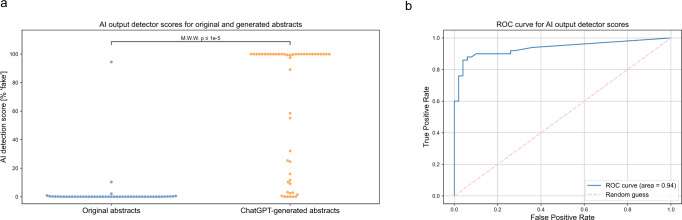
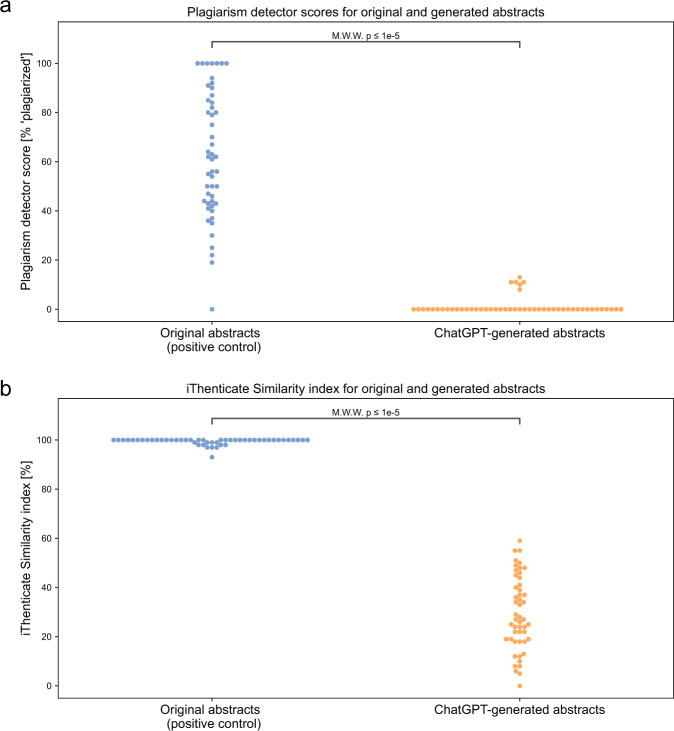
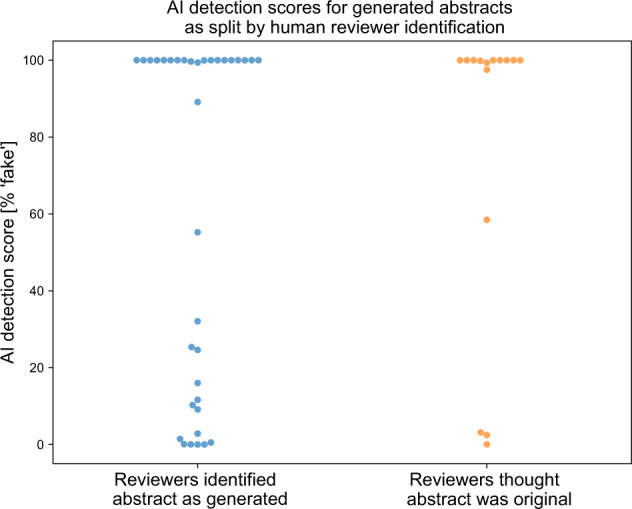
Large language models such as ChatGPT can produce increasingly realistic text, with unknown information on the accuracy and integrity of using these models in scientific writing. We gathered fifth research abstracts from five high-impact factor medical journals and asked ChatGPT to generate research abstracts based on their titles and journals. Most generated abstracts were detected using an AI output detector, ‘GPT-2 Output Detector’, with % ‘fake’ scores (higher meaning more likely to be generated) of median [interquartile range] of 99.98% ‘fake’ [12.73%, 99.98%] compared with median 0.02% [IQR 0.02%, 0.09%] for the original abstracts. The AUROC of the AI output detector was 0.94. Generated abstracts scored lower than original abstracts when run through a plagiarism detector website and iThenticate (higher scores meaning more matching text found). When given a mixture of original and general abstracts, blinded human reviewers correctly identified 68% of generated abstracts as being generated by ChatGPT, but incorrectly identified 14% of original abstracts as being generated. Reviewers indicated that it was surprisingly difficult to differentiate between the two, though abstracts they suspected were generated were vaguer and more formulaic. ChatGPT writes believable scientific abstracts, though with completely generated data. Depending on publisher-specific guidelines, AI output detectors may serve as an editorial tool to help maintain scientific standards. The boundaries of ethical and acceptable use of large language models to help scientific writing are still being discussed, and different journals and conferences are adopting varying policies.
Overview
The claims and statistics of this paper haven’t been checked yet.
Free: it reads the open-access text and checks the first 5 claims that cite a source we can check. Create a free account to check every claim.
Integrity signals
Registry
Cites
Statistics
Figures
Verification
Claims the paper makes
The claims and statistics of this paper haven’t been checked yet.
Free: it reads the open-access text and checks the first 5 claims that cite a source we can check. Create a free account to check every claim.
Claims other papers make about this one
Each is checked against this paper’s own text: does it say what the citing paper says it does?
The source backs part of the claim, not all of it — or backs it for a different population, condition or comparison.
In the citing paper
“ChatGPT’s GPT-3.5 iteration has already shown promise in several routine medical tasks and medical research [4-7], even raising ethical concerns in the literature [2,3,8].”
From Comparison of the Performance of GPT-3.5 and GPT-4 With That of Medical Students on the Written German Medical Licensing Examination: Observational Study (2024) · cites this paper as [7]
Experimental — accuracy not yet measuredThe source backs part of the claim, not all of it — or backs it for a different population, condition or comparison.
In the citing paper
“in practice, it takes a neural network to reliably catch another neural network.”
From Fine-Grained Detection of AI-Generated Writing in the Biomedical Literature (2026) · cites this paper as [6]
Experimental — accuracy not yet measuredThe source backs part of the claim, not all of it — or backs it for a different population, condition or comparison.
In the citing paper
“Rather than just copying ChatGPT output, many students seem to use it as a tool for brainstorming, refining ideas, or enhancing their writing style 16 .”
From Style, sentiment, and quality of undergraduate writing in the AI era: A cross-sectional and longitudinal analysis of 4,820 authentic empirical reports (2025) · cites this paper as [16]
Experimental — accuracy not yet measuredThe cited source says what the claim attributes to it.
In the citing paper
“Gao et al. (2023) found that ChatGPT can produce plausible scientific abstracts that humans often find difficult to distinguish from originals, though reviewers noted that AI abstracts tended to be 'vaguer and more formulaic'.”
From Metadiscourse Patterns in Human-Written vs. Generative AI-Authored Research Abstracts: A Comparative Corpus-Based Analysis (2026) · cites this paper as Gao et al. (2023)
The cited source says what the claim attributes to it.
In the citing paper
“Indeed, ChatGPT abstracts were noted by human reviewers as 'vague' or 'formulaic' , a qualitative impression that aligns with our finding of scant stance markers.”
From Metadiscourse Patterns in Human-Written vs. Generative AI-Authored Research Abstracts: A Comparative Corpus-Based Analysis (2026) · cites this paper as Gao et al. (2023)
3 more claims about this paper
Create a free account to see every claim other papers make about this one.
Self-check
Percentages, sums and reported differences re-computed from the paper’s own numbers.
The self-check needs the paper’s full text.
Citations
Cites
Scikit-learn: Machine Learning in Python
Pedregosa, F., Varoquaux, G., Gramfort, A., Michel, V., Thirion, B., Grisel, O., Blondel, M., Müller, A., Nothman, J., Louppe, G., et al. (2012) · arXiv · doi:10.48550/arxiv.1201.0490 · Cited by 71,016
Matplotlib: a 2D graphics environment
Hunter, J. D. (2007) · Computing in Science & Engineering · doi:10.1109/mcse.2007.55 · Cited by 39,249
SciPy 1.0: fundamental algorithms for scientific computing in Python
Virtanen, P., Gommers, R., Oliphant, T. E., Haberland, M., Reddy, T., Cournapeau, D., Burovski, E., Peterson, P., Weckesser, W., Bright, J., et al. (2020) · Nature Methods · doi:10.1038/s41592-019-0686-2 · Cited by 38,430
SciPy 1.0: fundamental algorithms for scientific computing in Python
Virtanen, P., Gommers, R., Oliphant, T. E., Haberland, M., Reddy, T., Cournapeau, D., Burovski, E., Peterson, P., Weckesser, W., Bright, J., et al. (2019) · Apollo - University of Cambridge Repository · doi:10.17863/cam.64134 · Cited by 10,460
seaborn: statistical data visualization
Waskom, M. (2021) · Journal of Open Source Software · doi:10.21105/joss.03021 · Cited by 7,310
NWChem: A comprehensive and scalable open-source solution for large scale molecular simulations
Valiev, M., Bylaska, E. J., Govind, N., Kowalski, K., Straatsma, T. P., Van Dam, H. J. J., Wang, D., Nieplocha, J., Apra, E., Windus, T. L., et al. (2010) · Computer Physics Communications · doi:10.1016/j.cpc.2010.04.018 · Cited by 5,779
Kung, T. H., Cheatham, M., Medenilla, A., Sillos, C., De Leon, L., Elepaño, C., Madriaga, M., Aggabao, R., Diaz-Candido, G., Maningo, J., et al. (2023) · PLOS Digital Health · doi:10.1371/journal.pdig.0000198 · Cited by 4,115 · cited 1×
“Articles are bemoaning the death of the traditional school essay assignment 4,6,7 , as ChatGPT has been shown to generate high-scoring papers 8 , correctly answer USMLE questions 9 , and even articulate critical thinking 10 .”
Kung, T. H., Cheatham, M., ChatGPT, Medenilla, A., Sillos, C., De Leon, L., Elepaño, C., Madriaga, M., Aggabao, R., Diaz-Candido, G., et al. (2022) · doi:10.1101/2022.12.19.22283643 · Cited by 4,115
ChatGPT is fun, but not an author
Thorp, H. H. (2023) · Science · doi:10.1126/science.adg7879 · Cited by 1,437 · cited 2×
“Different journals and publishers are developing their own policies on whether large language models can contribute to the writing of papers, ranging from not allowing any AI-generated text 12 to allowing its use as long as it is openly disclosed 13,14,28 .”
Artificial Intelligence in Medicine: Today and Tomorrow
Briganti, G., & Le Moine, O. (2020) · Frontiers in Medicine · doi:10.3389/fmed.2020.00027 · Cited by 743
Cited by
Items 801–900 of 1,018
Ufuk, F., Peker, H., Sağtaş, E., & Yağcı, B. (2023) · medRxiv · doi:10.1101/2023.04.28.23289283 · Cited by 4
What knowledge does ChatGPT have regarding open science, and can it provide good advice about it?Preprint
Nazarovets, S., & da Silva, J. A. T. (2023) · SocArXiv (OSF Preprints) · doi:10.31235/osf.io/awhuf · Cited by 3
Andes Pediatrica y publicaciones científicas en la era de la Inteligencia Artificial
Sch., F. C., Luisa Schonhaut, B., Harris, P. R., Teresa Millán, K., Patricia Mena, N., C, M. L., Carolina Heresi, V., Pablo Cruces, R., Zepeda, A., Lillian Bolte, M., et al. (2023) · Andes pediatrica · doi:10.32641/andespediatr.v94i6.4974 · Cited by 3
¿Cómo detectar textos científicos generados con inteligencia artificial?
Chávez-Martínez, O. (2025) · Revista Médica del Instituto Mexicano del Seguro Social · doi:10.5281/zenodo.17477983 · Cited by 3
ChatGPT as speechwriter for the French presidents
Labbé, D., Labbé, C., & Savoy, J. (2024) · arXiv · doi:10.48550/arxiv.2411.18382 · Cited by 3
Lin, A., Chen, Z., Jiang, A., Tang, B., Qi, C., Zhu, L., Mou, W., Gan, W., Zeng, D., Xiao, M., et al. (2026) · International Journal of Surgery · doi:10.1097/js9.0000000000003839 · Cited by 2
AI-driven abstract generating: evaluating LLMs with a tailored prompt under the PRISMA-A framework
Demi̇r, G. B., Gökmen, Ş., Süküt, Y., Topsakal, K. G., & Görgülü, S. (2025) · BMC Oral Health · doi:10.1186/s12903-025-06982-4 · Cited by 2
“Previous studies have evaluated the ability of LLMs to generate scientific abstracts without structured guidance [11, 12].”
AI Detection Tools: A Systematic Review of Empirical Evidence and Their Implications for Education
CANER, H. N. (2025) · Khazar Journal of Humanities and Social Sciences · doi:10.5782/2223-2621.1580 · Cited by 2
ARTIFICIAL INTELLIGENCE IN TERMINOLOGY PROCESSING: TESTING THE ROBUSTNESS OF A CUSTOM GPT
Nahod, B., & Nahod, P. V. (2024) · SWS International Scientific Conference on Arts and Humanities · doi:10.35603/sws.iscah.2024/fs11.21 · Cited by 2
Temporal Extraction and Retrieval
Alonso, O., & Spaniol, M. (2024) · ACM eBooks · doi:10.1145/3674127.3674137 · Cited by 2
Towards responsible use of Artificial Intelligence in academic writing
Elbah, Z. (2025) · STUDIES IN EDUCATION SCIENCES · doi:10.54019/sesv6n2-009 · Cited by 2
Mejheirkouni, A., Baxter, K., & Megheirkouni, M. (2025) · Lecture notes in computer science · doi:10.1007/978-3-031-92823-9_13 · Cited by 3
Academic Librarians as Catalysts of Innovation: AI Competencies for Transforming Education
Paiste, A., & Siago, S. (2025) · International Research and Innovation Journal on Education Engineering and Agriculture Journal · doi:10.62960/irijeea.v1i2.44 · Cited by 7
Fine, K. S., Zona, E. E., O’Shea, A. W., Via, E. C., Attaluri, P. K., Wirth, P. J., Dingle, A. M., & Poore, S. O. (2025) · Plastic & Reconstructive Surgery · doi:10.1097/prs.0000000000012242 · Cited by 2
Student Perspectives on the Impact of GenAI
Lewis, C., Funnell, P., Fisher, N., & Elston, P. (2025) · Springer eBooks · doi:10.1007/978-3-031-94809-1_2 · Cited by 2
A Bibliometric Analysis and Insights Into Artificial Intelligence Chatbots in Education
Dou, A., Xu, W., & Liu, R. (2025) · International Journal of Information and Communication Technology Education · doi:10.4018/ijicte.386591 · Cited by 2
AI-driven fabrication of healthcare survey data: methods, motivations, and ethical implications
Timothy, T. R. (2025) · Ethics & Behavior · doi:10.1080/10508422.2025.2552777 · Cited by 3
“Gao et al. (2023) asked scientists to identify which research abstracts were written by ChatGPT and which were real; one-third of the AI-created abstracts fooled the human reviewers (they were misclassified as genuine), and conversely 14% of real abstracts were mistaken as AI.”
InfluentialMaking Space for Real Conversations: AI Chatbots in the Language Classroom
Spirydovich, N. (2025) · The FLTmag. · doi:10.69732/yhrj4554 · Cited by 2
Ginting, D. S., Hartono, R., & Iskandar, I. (2025) · Asia Pacific Journal of Educators and Education · doi:10.21315/apjee2025.40.2.13 · Cited by 3
“For example, Gao et al. (2023) asked their respondents, comprising senior educators at a university, to distinguish between abstracts created by humans and machines to prove the language quality of the text generated by ChatGPT.”
Аркадьевна, Д. В. (2025) · Вестник Российского университета дружбы народов. Серия: Психология и педагогика · doi:10.22363/2313-1683-2025-22-1-144-174 · Cited by 4
Santhosh, V. N., Vas, R., Shreya, S., Kumar, V., Ragu, K., Venkatesh, U., & Bannur, S. (2025) · International Journal of Medical Informatics · doi:10.1016/j.ijmedinf.2025.106190 · Cited by 3
Menon, R., Solomon, D. H., Berenson, M., Kushnir, V., & Shapiro, Y. (2025) · Cureus · doi:10.7759/cureus.99202 · Cited by 2
“While some are skeptical of the quality of AI-generated writing, one study demonstrated that 32% of AI-generated abstracts were falsely graded by blinded human reviewers as human work, and reviewers cited the surprising difficulty of distinguishing between the two [6].”
Diagnostic performance of four AI tools in pharmacology MCQs: Accuracy, sensitivity, and specificity
Al-Rahahleh, A. J., Rizik, M., Al-Ashwal, F. Y., & Abu-Farha, R. K. (2025) · PLoS ONE · doi:10.1371/journal.pone.0337688 · Cited by 2
“…al. (2023) and Giannakopoulos et al. (2023), who concluded that the responses of Large Language Models (LLMs) are variable in time and context [14,27] Even though high reproducibility is often viewed as an opportunity, as has been seen, there can be a lethal paradox when low accuracy is paired…”
Šindlerová, J., Vejvodová, J., & Rohlíková, L. (2026) · Springer proceedings in complexity · doi:10.1007/978-3-032-09062-1_8 · Cited by 2
Critical ignoring reimagined: insights from STEM digital curation on Wikimedia platforms
Sigalov, S. E., & Tsybulsky, D. (2026) · Smart Learning Environments · doi:10.1186/s40561-026-00432-6 · Cited by 3
“Some examples include GenAI-powered summarization of large bodies of text, citation analysis tools that can identify patterns across sources, or flag potentially unreliable or contradictory claims (Aldreabi et al., 2025; Dadkhah et al., 2023; Gao et al., 2023).”
Dual-branch approach for AI-generated scientific content detection
Alhijawi, B., Jarrar, R., Awajan, S., & AbuAlRub, A. (2026) · Knowledge-Based Systems · doi:10.1016/j.knosys.2026.115440 · Cited by 2
Mammino, L. (2026) · Springer eBooks · doi:10.1007/978-3-031-97900-2_6 · Cited by 2
Comparing faculty and artificial intelligence in grading ophthalmology residency applications
Moon, J. A., Sorensen, O., Mazumdar, P., Iyoob, I., & Kim, G. (2025) · Academic Medicine · doi:10.1093/acamed/wvaf055 · Cited by 2
Using AI to control AI-assisted plagiarism in L2 writing: a critical review of the literature
Ibrahim, K. H. S. (2026) · Language Testing in Asia · doi:10.1186/s40468-026-00433-9 · Cited by 2
Kim, H. J., Yoon, J., Goh, T. S., Moon, J. K., Kim, H., & Lee, S.-H. (2026) · Postgraduate Medical Journal · doi:10.1093/postmj/qgag018 · Cited by 2
Jeon, K. (2026) · Journal of Korean Medical Association · doi:10.5124/jkma.25.0163 · Cited by 3
Designing life science assessments in the era of generative artificial intelligence
Kwong, A. C., Magnano, C., DeOliveira, C., Goglia, C., Loparo, J., & Peters, J. (2026) · PLoS ONE · doi:10.1371/journal.pone.0346127 · Cited by 3
“When challenged instead to write academic abstracts, the late 2022 version of ChatGPT produced responses that were believable yet demonstrated a tendency to be vague and more formulaic than published work [19].”
InfluentialMetadiscourse in AI-generated hotel review summaries
Radovanović, A. M., & Dimitrovski, D. (2026) · Journal of Hospitality and Tourism Technology · doi:10.1108/jhtt-06-2025-0492 · Cited by 4
Palmer, K., Landaverde, R. Q., Benitez, J. A., Apple, T. K., Norris-Parish, S., Leggette, H. R., & Dooley, K. E. (2026) · Natural sciences education · doi:10.1002/nse2.70054 · Cited by 2
AI-assisted academic writing: Balancing linguistic enhancement with legal and ethical oversight
Baltezarević, R., Stošić, L. V., & Mikhailova, O. B. (2026) · Russian Journal of Linguistics · doi:10.22363/2687-0088-44754 · Cited by 5
Silitonga, L. C., Tiatri, S., Beng, J. T., Dinatha, V. O. D., Nurkholiza, R., Salsabila, T. M., Mahmud, T. N., Bunarwan, E. A., & Azzahra, C. S. (2026) · JURNAL PENDIDIKAN MIPA · doi:10.37630/jpm.v16i3.4325 · Cited by 4
The power of the prompt: The linguistic effects of prompt engineering on GenAI and learners
Dixon, D. H., Kim, Y. J., & Kim, Y. (2026) · Research Methods in Applied Linguistics · doi:10.1016/j.rmal.2026.100327 · Cited by 4
The case for systematic reviews in religion: an under-used way of approaching previous research
Larsson, G., & Eidrup, M. (2026) · Religion · doi:10.1080/0048721x.2026.2690653 · Cited by 2
Nazarovets, S., & da Silva, J. A. T. (2026) · Journal of Ethics in Entrepreneurship and Technology · doi:10.1108/jeet-09-2025-0059 · Cited by 2
False Positive Risk in AI Detection of L2 Academic Writing: A Case Study
Za’rour, R., & Altakhaineh, A. R. M. (2026) · Discourses on Culture · doi:10.2478/doc-2026-0003 · Cited by 2
Who wrote this? An EAP think-aloud study on AI detection
Teraif, Z. (2026) · Language learning & technology · doi:10.64152/10125/73709 · Cited by 2
“For example, Gao et al. (2023) reported that reviewers found the AI detection task more challenging than anticipated, as AI-generated abstracts often appear less specific and follow a more predictable writing pattern.”
Searching the web for science: how small mistakes create big problems
Leeming, J. (2023) · Nature · doi:10.1038/d41586-023-01011-2 · Cited by 2
Hussein, S. M., & Khalifa, A. A. (2023) · The Egyptian Orthopaedic Journal · doi:10.4103/eoj.eoj_86_23 · Cited by 2
Verejan, V. S. (2023) · Romanian Journal of Ophthalmology · doi:10.22336/rjo.2023.62 · Cited by 5
Doró, K. (2023) · EduLingua · doi:10.14232/edulingua.2023.1.1 · Cited by 2
Algorithmic power and scientific knowledge
Signorini, I. (2023) · Language Culture and Society · doi:10.1075/lcs.00044.sig · Cited by 2
ChatGPT: The Good, The Bad, and Everything in Between
Manohar, N., Prasad, S. S., & Pise, G. A. (2023) · Indian Dermatology Online Journal · doi:10.4103/idoj.idoj_274_23 · Cited by 2
“[3] Therefore, the quality of the literature available online may not be up to the standards for evidence‑based medicine.”
BackgroundArshed, M. A., Gherghina, Ş. C., Dur-E-Zahra, & Manzoor, M. (2024) · Electronics · doi:10.3390/electronics13112222 · Cited by 2
“In recent years, natural language processing (NLP) has played an important role in improving computer systems’ performance for generating and understanding human content [1].”
BackgroundImpact and implications of AI methods and tools for the future of education
Okoye, K., Hosseini, S., Hiran, K. K., & Nganji, J. (2024) · Frontiers research topics · doi:10.3389/978-2-8325-5013-7 · Cited by 2
Uso do Chat Generative Pre-trained Transformer na escrita acadêmica em saúde: uma revisão do escopo
Costa, I. C. P., do Nascimento, M. C., Treviso, P., Chini, L. T., Roza, B. D. A., Barbosa, S. D. F. F., & Mendes, K. D. S. (2024) · Revista Latino-Americana de Enfermagem · doi:10.1590/1518-8345.7133.4195 · Cited by 3
Artificial Intelligence in Newborn Medicine
Huisman, T. A. G. M., & Huisman, T. A. G. M. (2024) · Newborn · doi:10.5005/jp-journals-11002-0095 · Cited by 2
The Performance of ChatGPT on Short-answer Questions in a Psychiatry Examination: A Pilot Study
Lin, C.-C., Plooy, K. D., Gray, A. R., Brown, D. A., Hobbs, L., Patterson, T., Tan, V., Fridberg, D., & Hsu, C.-W. (2024) · Taiwanese Journal of Psychiatry · doi:10.4103/tpsy.tpsy_19_24 · Cited by 2
ChatGPT trong khoa học và giáo dục
Quân, N. P. Q. N. P. (2024) · TẠP CHÍ KHOA HỌC TRƯỜNG ĐẠI HỌC QUỐC TẾ HỒNG BÀNG · doi:10.59294/hiujs.30.2024.653 · Cited by 2
Neural networks as an actor of socio-epistemic arenas: ethical problems
Tikhonova, S. V., & Artamonov, D. S. (2024) · Philosophy of Science and Technology · doi:10.21146/2413-9084-2024-29-1-73-83 · Cited by 2
GIS technologies in the intelligent systems as a training course on Cartography and Geoinformatics
Podolskaia, E. S. (2024) · Geodesy and Cartography · doi:10.22389/0016-7126-2024-1010-8-51-60 · Cited by 2
Abdullah, M. H. A., Aziz, N., Abdulkadir, S. J., Hussain, K., Alhussian, H., & Talpur, N. (2024) · Journal of Data and Information Science · doi:10.2478/jdis-2024-0029 · Cited by 2
SUN'IY INTELLEKTNING OLIY TA'LIM SIFATI VA SAMARADORLIGIGA TA'SIRI
Utkirov, A. (2024) · Ижтимоий-гуманитар фанларнинг долзарб муаммолари / Актуальные проблемы социально-гуманитарных наук / Actual Problems of Humanities and Social Sciences · doi:10.47390/spr1342v4i9y2024n52 · Cited by 2
Şensoy, E., & Çıtırık, M. (2024) · Oman Journal of Ophthalmology · doi:10.4103/ojo.ojo_19_24 · Cited by 2
Galuščáková, P., Oard, D. W., & Nair, S. (2024) · ACM eBooks · doi:10.1145/3674127.3674136 · Cited by 3
Gómez, E., Cuesta, H., Gkiokas, A., Gómez-Cañón, J. S., Porcaro, L., & Yesiler, F. (2024) · ACM eBooks · doi:10.1145/3674127.3702959 · Cited by 5
Privacy in Information Retrieval
Soboroff, I. M. (2024) · ACM eBooks · doi:10.1145/3674127.3674139 · Cited by 2
Designing for the Future of Information Access with Generative Information Retrieval
Murdock, V., Lee, C., & Hersh, W. (2024) · The information retrieval series · doi:10.1007/978-3-031-73147-1_9 · Cited by 2
Choi, J., Zhao, J., Ngo, T.-A., & Grierson, L. (2025) · Canadian Medical Education Journal · doi:10.36834/cmej.79690 · Cited by 2
Chain-of-thought enhanced content detection in large language models
Zou, C., Feng, Z., Guan, H., & Xing, C. (2024) · 2024 3rd International Conference on Cloud Computing, Big Data Application and Software Engineering (CBASE) · doi:10.1109/cbase64041.2024.10824407 · Cited by 2
“As a result, even though AI can mimic human writing styles on the surface, it still shows significant gaps in logical coherence and reasoning depth[6].”
Wilder, N., & Lordick, N. (2025) · Kieler Berichte · doi:10.38072/2751-1359/v28 · Cited by 2
“…ist es, wissenschaftliche Abstracts auf einem Niveau zu generieren, das durch menschliche Re-viewer*innen nicht mehr von von Menschen verfassten Abstracts unterschieden werden kann, und das, obwohl ChatGPT nicht einmal auf das Verfassen wissenschaftlicher Texte trainiert wurde (Gao et al., 2023).”
Gotlib, J., Cieślak, I., Jaworski, M., & Pańczyk, M. (2025) · Pielegniarstwo XXI wieku / Nursing in the 21st Century · doi:10.12923/pielxxiw-2025-0002 · Cited by 6
Artificial Intelligence in Personal Statements Within Orthopaedic Surgery Residency Applications
Ozdag, Y., Mahmoud, M., Klena, J. C., & Grandizio, L. C. (2025) · Journal of the American Academy of Orthopaedic Surgeons · doi:10.5435/jaaos-d-24-01285 · Cited by 4
“…moderately confident, ” or literature assessing AI utilization as part of scientific writing or the creation of PSs for postgraduate AI Personal 13,27-29 program directors to analyze AI-generated PS for anesthesiology residency applications, and 61% did not detect anything within the statements…”
An Evaluation of Current Trends in AI ‐Generated Text in Otolaryngology Publications
Kutler, R. B., Setzen, S. A., Tsai, S., & Rameau, A. (2025) · The Laryngoscope · doi:10.1002/lary.32202 · Cited by 3
“For instance, in a study of 50 peer-reviewed abstracts versus 50 ChatGPT-generated abstracts, blinded human reviewers were only able to correctly identify 68% of the generated abstracts as being generated [18].”
Mengfan, Z., & Osman, K. (2025) · Learning and analytics in intelligent systems · doi:10.1007/978-3-031-80388-8_1 · Cited by 2
Evaluating the Impact of Ai-Generated Outputs on Student Assessment: Educator's Perspective
Dolba, S. Q., Inoncillo, F. A., & Núñez, J. L. (2025) · International Journal of Artificial Intelligence Research · doi:10.29099/ijair.v9i1.1347 · Cited by 9
Comparison of Generative Artificial Intelligence and Student-Generated Veterinary Handouts
Gibson, R., Tomberlin, S. S., Mackay, L., & Foradori, C. D. (2025) · Journal of Veterinary Medical Education · doi:10.3138/jvme-2025-0003 · Cited by 2
Performance of artificial intelligence-generated vs human-authored abstracts in a real-world setting
Kresoja, K., Schöber, A. R., Lüscher, T. F., Thevathasan, T., Lurz, P. C., Papoutsis, K., Baldus, S. E., Blankenberg, S., Hinkel, R., & Thiele, H. (2025) · European Heart Journal · doi:10.1093/eurheartj/ehaf654 · Cited by 5
The FAIR framework: ethical hybrid peer review
Grunebaum, A. N., Dudenhausen, J. W., & Chervenak, F. A. (2025) · Journal of Perinatal Medicine · doi:10.1515/jpm-2025-0285 · Cited by 2
ChatGPT – maschinelle und menschliche Textsortenkompetenz
Schicker, S., & Akbulut, M. (2023) · Unipub UB Graz (Universität Graz) · doi:10.25364/978390337426311 · Cited by 4
For any disease a human can imagine, ChatGPT can generate a fake report
Yokokawa, D., Yanagita, Y., Li, Y., Yamashita, S., Shikino, K., Noda, K., Tsukamoto, T., Uehara, T., & Ikusaka, M. (2024) · Diagnosis · doi:10.1515/dx-2024-0007 · Cited by 2
Inteligencia artificial y lenguaje médico (III)
(2024) · Revista Española de Cardiología · doi:10.1016/j.recesp.2023.10.015 · Cited by 2
Selitskiy, S., & Inoue, C. (2024) · Conference on Cognitive and Computational Aspects of Situation Management · doi:10.1109/cogsima61085.2024.10554038 · Cited by 4
Kolokythas, A., & Dahan, M. H. (2024) · JBRA · doi:10.5935/1518-0557.20240050 · Cited by 2
Scientific papers and artificial intelligence. Brave new world?
Nexøe, J. (2023) · Scandinavian Journal of Primary Health Care · doi:10.1080/02813432.2023.2240114 · Cited by 2
“submitted to academic reviewers, who only caught 68% of these fakes [3].”
BackgroundEvaluación educativa, edición cientifica y ChatGPT ¿Qué hacer?Preprint
Ros, M. Z. (2023) · EdArXiv (OSF Preprints) · doi:10.35542/osf.io/squhy · Cited by 2
Artificial intelligence: The researcher's assistant or sheep in wolf's clothing?
Anthea, P., & Campani, C. (2024) · United European Gastroenterology Journal · doi:10.1002/ueg2.12689 · Cited by 3
Divergent LLM Adoption and Heterogeneous Convergence Paths in Research Writing *Preprint
Zhu, W., & Cong, L. (2025) · SSRN Electronic Journal · doi:10.2139/ssrn.5170513 · Cited by 4
DEDICAITE - DEtecting AI-generated TExts in a DIdactic ContextPreprint
Berger, M., Hessler, S., Busse, J. S., Doru, B., Heimgartner, S. A. C., Herzog, J., Schönhoff, J., Stein, J., Tokic, M. C., & Maier, C. (2025) · Research Square · doi:10.21203/rs.3.rs-7682039/v1 · Cited by 2
McLaughlin, L., Walz, M. S., & Arries, C. (2026) · medRxiv · doi:10.64898/2026.02.18.26346559 · Cited by 2
Sadigzade, Z. (2026) · Acta Globalis Humanitatis et Linguarum · doi:10.69760/aghel.026001005 · Cited by 1
“Gao et al. (2023) found that ChatGPT can produce plausible scientific abstracts that humans often find difficult to distinguish from originals, though reviewers noted that AI abstracts tended to be “vaguer and more formulaic”.”
An experiment on an automated literature survey of data-driven speech enhancement methods
dos Santos, A., Pereira, J., Nogueira, R. F., Masiero, B. S., Sander-Tavallaey, S., & Zea, E. (2024) · Acta Acustica · doi:10.1051/aacus/2023067 · Cited by 1
“Therefore, scanning 100 articles would take approximately one month of uninterrupted work to read through the literature.”
BackgroundOdri, G. A., & Yoon, D. J. Y. (2023) · Revue de Chirurgie Orthopédique et Traumatologique · doi:10.1016/j.rcot.2023.10.007 · Cited by 1
ChatGPT: A Revolutionary Tool?
Aggarwal, D., & Rathee, S. (2024) · Advances in business information systems and analytics book series · doi:10.4018/979-8-3693-0815-8.ch012 · Cited by 1
Large language models and artificial intelligence: the coming storm for academia
Murali, M., & Wiles, M. D. (2024) · Anaesthesia · doi:10.1111/anae.16441 · Cited by 1
“…easy for a subject matter expert to detect, this is far more dif fi cult when reviewers are looking at submissions outside their specialist area; for example, human reviewers were only able to correctly identify 68% of abstracts that had been produced using generative arti fi cial intelligence [25].”
Leonardo, C. J., Melcer, K., Liu, S. H., Komatsu, D. E., & Barsi, J. M. (2024) · Cureus · doi:10.7759/cureus.74574 · Cited by 3
Koordinuoti veiksmai sprendžiant DI sugeneruotus sintetinių medijų keliamus iššūkius
Šalaševičiūtė, V. (2024) · MOKSLO TAIKOMIEJI TYRIMAI LIETUVOS KOLEGIJOSE · doi:10.59476/mtt.v2i20.681 · Cited by 1
eCommerce Search and Discovery
Kallumadi, S. T., & King, T. H. (2024) · ACM eBooks · doi:10.1145/3674127.3674140 · Cited by 1
IMPACTO DA IA NA PRODUTIVIDADE CIENTÍFICA: UMA REVISÃO SISTEMATIZADA
Figueiredo, F. J. G., Marinho, D. F. P., Holanda, G. C., Pinto, N. B., de Lira, R. C., de Assis, E. V., & Nunes, M. A. P. (2025) · Revista Foco · doi:10.54751/revistafoco.v18n1-015 · Cited by 2
ERKILIÇ, E., & Çifçi, İ. (2025) · Journal of Multidisciplinary Academic Tourism · doi:10.31822/jomat.2025-10-1-111 · Cited by 2
Sun, C. (2025) · Ceramics - Silikaty · doi:10.13168/cs.2025.0023 · Cited by 1
Woodrow, J., Nassour, N., Kwon, J. Y., Ashkani‐Esfahani, S., & Harris, M. B. (2025) · PubMed Central · doi:10.22038/abjs.2024.80093.3669 · Cited by 6
Año, D., & Jalos, L. J. (2025) · Psychology and Education A Multidisciplinary Journal · doi:10.70838/pemj.370809 · Cited by 1
Transformer-Based Approach for Detecting LLM-Generated Scientific Text
Bader, A., & Alhijawi, B. (2025) · International Conference on New Trends in Computing Sciences (ICTCS) · doi:10.1109/ictcs65341.2025.10989343 · Cited by 4
“LLMs have been used to generate texts that mimic human writing in different domains, such as academia [14]–[18], [21], [22], [25], [26], news [28], and social media posts [27].”
Creative Learning Using Generative AI: Empowering Problem-Solving and Programming Skills
Elanwar, R. (2025) · Springer series on cultural computing · doi:10.1007/978-3-031-86551-0_7 · Cited by 2
Tracking Editorial Footprints: A Process-Oriented Analysis of ChatGPT Reliance in Student Writing
Kwon, J., & Lee, Y. (2025) · Forum for Linguistic Studies · doi:10.30564/fls.v7i6.9985 · Cited by 2
Metadata
- Authors
- Gao, C. A., Howard, F. M., Markov, N. S., Dyer, E. C., Ramesh, S., Luo, Y., & Pearson, A. T.
- Affiliations
- Northwestern University (US)
- University of Chicago (US)
- Corresponding author
- Gao, Catherine A.
- ORCID
- Venue
- npj Digital Medicine
- Published
- 2023-04-26
- Volume
- 6
- Issue
- 1
- Pages
- 75-75
- ISSN
- 2398-6352 (ISSN-L)
- PMC
- PMC10133283
- OpenAlex
- W4367051110
- Semantic Scholar
- 7d648061157109e8a1a8b382b15ded7ffe690c25
- Cited by
- 1,099
- References
- 26
- Citations by year
- 2026: 189 · 2025: 235 · 2024: 342 · 2023: 326
- FWCI
- 273.24
- Type
- journal article
- Language
- en
- Open access
- gold
- doi.org
- Licence
- cc-by
- creativecommons.org/licenses/by/4.0 (tdm)
- creativecommons.org/licenses/by/4.0 (vor)
- Locations
- npj Digital Medicine (publishedVersion, cc-by)
- bioRxiv (Cold Spring Harbor Laboratory) (acceptedVersion, cc-by-nc-nd)
- PubMed Central (publishedVersion, cc-by)
- PubMed (publishedVersion)
- Knowledge@UChicago (University of Chicago) (submittedVersion, cc-by-nc-nd)
- DOAJ (DOAJ: Directory of Open Access Journals) (submittedVersion, cc-by-sa)
- University of Chicago (cc-by)
- Funders
- U.S. Department of Health and Human Services (U01-CA243075, R01LM013337, R56-DE030958, U01TR003528)
- Burroughs Wellcome Fund
- Conquer Cancer Foundation (2022YIA-6675470300)
- Breast Cancer Research Foundation (2022YIA-6675470300)
- Cancer Research Foundation
- Fanconi Anemia Research Fund
- American Society of Clinical Oncology (2022YIA-6675470300)
- Horizon Therapeutics
- National Institutes of Health (U01TR003528)
- Stand Up To Cancer
- National Heart, Lung, and Blood Institute (F32HL162377)
- National Cancer Institute (K12CA139160, U01CA243075)
- National Institute of Dental and Craniofacial Research (R56DE030958)
- U.S. National Library of Medicine (R01LM013337)
- National Center for Advancing Translational Sciences
- Topics
- Social Sciences › Education › Academic integrity and plagiarism
- Social Sciences › Library and Information Sciences › Academic Writing and Publishing
- Health Sciences › Medicine › Health Informatics › Artificial Intelligence in Healthcare and Education
- Keywords
- ChatGPT, large language models, AI-generated text detection, scientific abstracts, plagiarism detection, medical journal abstracts, scientific integrity, AI in scientific writing, editorial guidelines
About these checks
Registry, retraction, Cites and statistics results are computed, not judged, with one exception: a printed reference that no index lists is read once by a model before it counts as a citation error. Claims are extracted by a model and kept only when their quote appears verbatim in the text; each cited source is then checked, with a model’s help, for whether it says what the claim relies on. Those verdicts can be wrong — read the claim’s quote and the cited source before relying on one.
Statistics and arithmetic are recomputed, not judged.
Confidence bands are shown only for fields calibrated on our annotated test set. None is calibrated yet, so no band is shown.
What counts as a claim ›How we measure confidence ›How we check this ›
Are you an author, or do you see a problem with this page? Request a review
Data sources
Bibliographic data: Semantic Scholar, OpenAlex, Crossref.
Contains information from the Semantic Scholar Academic Graph Datasets, made available under the ODC Attribution License (ODC-BY 1.0).
Semantic Scholar’s data is described in: Kinney, R., et al. (2023). The Semantic Scholar Open Data Platform. arXiv:2301.10140.
