

Comparing scientific abstracts generated by ChatGPT to real abstracts with detectors and blinded human reviewers
Open accessPublished version of a preprint
The DOI matches its Crossref record; 34 of the 34 references it cites were found in a registry or an index.
Abstract
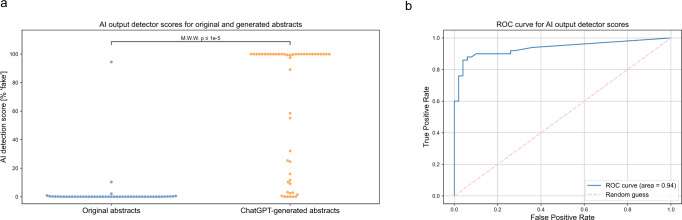
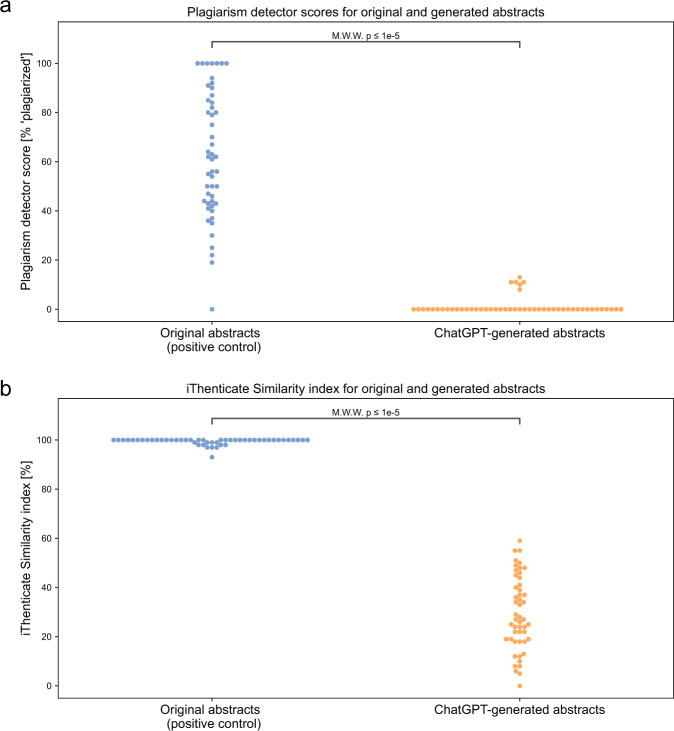
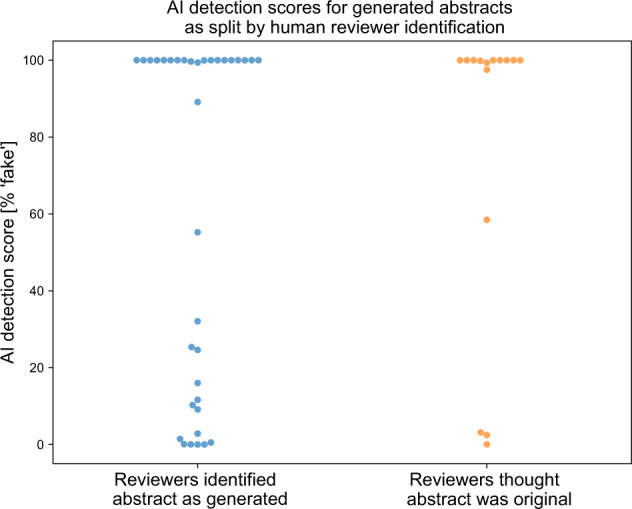
Large language models such as ChatGPT can produce increasingly realistic text, with unknown information on the accuracy and integrity of using these models in scientific writing. We gathered fifth research abstracts from five high-impact factor medical journals and asked ChatGPT to generate research abstracts based on their titles and journals. Most generated abstracts were detected using an AI output detector, ‘GPT-2 Output Detector’, with % ‘fake’ scores (higher meaning more likely to be generated) of median [interquartile range] of 99.98% ‘fake’ [12.73%, 99.98%] compared with median 0.02% [IQR 0.02%, 0.09%] for the original abstracts. The AUROC of the AI output detector was 0.94. Generated abstracts scored lower than original abstracts when run through a plagiarism detector website and iThenticate (higher scores meaning more matching text found). When given a mixture of original and general abstracts, blinded human reviewers correctly identified 68% of generated abstracts as being generated by ChatGPT, but incorrectly identified 14% of original abstracts as being generated. Reviewers indicated that it was surprisingly difficult to differentiate between the two, though abstracts they suspected were generated were vaguer and more formulaic. ChatGPT writes believable scientific abstracts, though with completely generated data. Depending on publisher-specific guidelines, AI output detectors may serve as an editorial tool to help maintain scientific standards. The boundaries of ethical and acceptable use of large language models to help scientific writing are still being discussed, and different journals and conferences are adopting varying policies.
Overview
The claims and statistics of this paper haven’t been checked yet.
Free: it reads the open-access text and checks the first 5 claims that cite a source we can check. Create a free account to check every claim.
Integrity signals
Registry
Cites
Statistics
Figures
Verification
Claims the paper makes
The claims and statistics of this paper haven’t been checked yet.
Free: it reads the open-access text and checks the first 5 claims that cite a source we can check. Create a free account to check every claim.
Claims other papers make about this one
Each is checked against this paper’s own text: does it say what the citing paper says it does?
The source backs part of the claim, not all of it — or backs it for a different population, condition or comparison.
In the citing paper
“ChatGPT’s GPT-3.5 iteration has already shown promise in several routine medical tasks and medical research [4-7], even raising ethical concerns in the literature [2,3,8].”
From Comparison of the Performance of GPT-3.5 and GPT-4 With That of Medical Students on the Written German Medical Licensing Examination: Observational Study (2024) · cites this paper as [7]
Experimental — accuracy not yet measuredThe source backs part of the claim, not all of it — or backs it for a different population, condition or comparison.
In the citing paper
“in practice, it takes a neural network to reliably catch another neural network.”
From Fine-Grained Detection of AI-Generated Writing in the Biomedical Literature (2026) · cites this paper as [6]
Experimental — accuracy not yet measuredThe source backs part of the claim, not all of it — or backs it for a different population, condition or comparison.
In the citing paper
“Rather than just copying ChatGPT output, many students seem to use it as a tool for brainstorming, refining ideas, or enhancing their writing style 16 .”
From Style, sentiment, and quality of undergraduate writing in the AI era: A cross-sectional and longitudinal analysis of 4,820 authentic empirical reports (2025) · cites this paper as [16]
Experimental — accuracy not yet measuredThe cited source says what the claim attributes to it.
In the citing paper
“Gao et al. (2023) found that ChatGPT can produce plausible scientific abstracts that humans often find difficult to distinguish from originals, though reviewers noted that AI abstracts tended to be 'vaguer and more formulaic'.”
From Metadiscourse Patterns in Human-Written vs. Generative AI-Authored Research Abstracts: A Comparative Corpus-Based Analysis (2026) · cites this paper as Gao et al. (2023)
The cited source says what the claim attributes to it.
In the citing paper
“Indeed, ChatGPT abstracts were noted by human reviewers as 'vague' or 'formulaic' , a qualitative impression that aligns with our finding of scant stance markers.”
From Metadiscourse Patterns in Human-Written vs. Generative AI-Authored Research Abstracts: A Comparative Corpus-Based Analysis (2026) · cites this paper as Gao et al. (2023)
3 more claims about this paper
Create a free account to see every claim other papers make about this one.
Self-check
Percentages, sums and reported differences re-computed from the paper’s own numbers.
The self-check needs the paper’s full text.
Citations
Cites
Scikit-learn: Machine Learning in Python
Pedregosa, F., Varoquaux, G., Gramfort, A., Michel, V., Thirion, B., Grisel, O., Blondel, M., Müller, A., Nothman, J., Louppe, G., et al. (2012) · arXiv · doi:10.48550/arxiv.1201.0490 · Cited by 71,016
Matplotlib: a 2D graphics environment
Hunter, J. D. (2007) · Computing in Science & Engineering · doi:10.1109/mcse.2007.55 · Cited by 39,249
SciPy 1.0: fundamental algorithms for scientific computing in Python
Virtanen, P., Gommers, R., Oliphant, T. E., Haberland, M., Reddy, T., Cournapeau, D., Burovski, E., Peterson, P., Weckesser, W., Bright, J., et al. (2020) · Nature Methods · doi:10.1038/s41592-019-0686-2 · Cited by 38,430
SciPy 1.0: fundamental algorithms for scientific computing in Python
Virtanen, P., Gommers, R., Oliphant, T. E., Haberland, M., Reddy, T., Cournapeau, D., Burovski, E., Peterson, P., Weckesser, W., Bright, J., et al. (2019) · Apollo - University of Cambridge Repository · doi:10.17863/cam.64134 · Cited by 10,460
seaborn: statistical data visualization
Waskom, M. (2021) · Journal of Open Source Software · doi:10.21105/joss.03021 · Cited by 7,310
NWChem: A comprehensive and scalable open-source solution for large scale molecular simulations
Valiev, M., Bylaska, E. J., Govind, N., Kowalski, K., Straatsma, T. P., Van Dam, H. J. J., Wang, D., Nieplocha, J., Apra, E., Windus, T. L., et al. (2010) · Computer Physics Communications · doi:10.1016/j.cpc.2010.04.018 · Cited by 5,779
Kung, T. H., Cheatham, M., Medenilla, A., Sillos, C., De Leon, L., Elepaño, C., Madriaga, M., Aggabao, R., Diaz-Candido, G., Maningo, J., et al. (2023) · PLOS Digital Health · doi:10.1371/journal.pdig.0000198 · Cited by 4,115 · cited 1×
“Articles are bemoaning the death of the traditional school essay assignment 4,6,7 , as ChatGPT has been shown to generate high-scoring papers 8 , correctly answer USMLE questions 9 , and even articulate critical thinking 10 .”
Kung, T. H., Cheatham, M., ChatGPT, Medenilla, A., Sillos, C., De Leon, L., Elepaño, C., Madriaga, M., Aggabao, R., Diaz-Candido, G., et al. (2022) · doi:10.1101/2022.12.19.22283643 · Cited by 4,115
ChatGPT is fun, but not an author
Thorp, H. H. (2023) · Science · doi:10.1126/science.adg7879 · Cited by 1,437 · cited 2×
“Different journals and publishers are developing their own policies on whether large language models can contribute to the writing of papers, ranging from not allowing any AI-generated text 12 to allowing its use as long as it is openly disclosed 13,14,28 .”
Artificial Intelligence in Medicine: Today and Tomorrow
Briganti, G., & Le Moine, O. (2020) · Frontiers in Medicine · doi:10.3389/fmed.2020.00027 · Cited by 743
Cited by
Items 501–600 of 1,018
Helgeson, S. A., Johnson, P. W., Gopikrishnan, N., Koirala, T., Franco, P. M., Carter, R. E., Quicksall, Z., & Burger, C. D. (2025) · Mayo Clinic Proceedings · doi:10.1016/j.mayocp.2024.08.029 · Cited by 14
Carruba, M. C., Caiazzo, A., Scuotto, C., Savioni, L., & Triberti, S. (2025) · Cyberpsychology Behavior and Social Networking · doi:10.1089/cyber.2024.0524 · Cited by 14
“21 For example, people tend to dislike art made by AI, 22 while they could be more positive toward content devoted to mere entertainment where the role of AI is declared.”
Epistemic trust in generative AI for higher education scale (ETGAI-HE scale)
Pandey, C. S., Mishra, P., Pandey, S., & Pandey, S. (2025) · AI & Society · doi:10.1007/s00146-025-02566-6 · Cited by 16
Pedagogical shifts in the age of GenAI: Faculty perspectives from a higher education context
Cespedes, A. A. (2025) · Journal of Pedagogical Sociology and Psychology · doi:10.33902/jpsp.202537244 · Cited by 17
Nguyen, Y., & Costedoat-Chalumeau, N. (2023) · La Revue de Médecine Interne · doi:10.1016/j.revmed.2023.03.017 · Cited by 13
How can ChatGPT be used to support healthcare communication research?
Menichetti, J., Hillen, M. A., Papageorgiou, A., & Pieterse, A. H. (2023) · Patient Education and Counseling · doi:10.1016/j.pec.2023.107947 · Cited by 13
Tasker, R. C. (2023) · Pediatric Critical Care Medicine · doi:10.1097/pcc.0000000000003356 · Cited by 13
“org 863 principles guiding AI use in health research been followed (9)? Is clinical science at threat (10)? Is there a risk of plagiarism (11)? How are the citations to references chosen (12)? So far, two critical care journals (Critical Care and Anaesthesia Critical Care & Pain Medicine) have published material about…”
BackgroundThe Impact of AI on Clinical Trial Management
Mohammed, S. (2024) · IJARCCE · doi:10.17148/ijarcce.2024.13610 · Cited by 23
ChatGPT: an editor’s perspective
Offiah, A. C., & Khanna, G. (2023) · Pediatric Radiology · doi:10.1007/s00247-023-05668-9 · Cited by 12
AI detecting AI in academic writing: Why most AI detector findings are false
Tsigaris, P., & Teixeira da Silva, J. A. (2026) · Next Research · doi:10.1016/j.nexres.2026.101396 · Cited by 11
Ethnography and Machine Learning: Synergies and New Directions
Li, Z., & Abramson, C. M. (2023) · Oxford University Press eBooks · doi:10.1093/oxfordhb/9780197653609.013.36 · Cited by 12
Inteligencia artificial en educación superior: una evaluación analítica
Bellomo, S. T. (2023) · Journal of Ethics in Higher Education · doi:10.26034/fr.jehe.2023.4626 · Cited by 14
Mehlenbacher, B., Balbon, A. P., & Kelly, A. R. (2024) · Journal of Technical Writing and Communication · doi:10.1177/00472816231226249 · Cited by 12
Crowds Improve Human Detection of AI ‐Synthesised Faces
Kramer, R. S. S., & Cartledge, C. (2024) · Applied Cognitive Psychology · doi:10.1002/acp.4245 · Cited by 14
Generative AI Decision-Making Attributes in Complex Health Services: A Rapid Review
Doreswamy, N., & Horstmanshof, L. (2025) · Cureus · doi:10.7759/cureus.78257 · Cited by 11
“Gao et al. [36] tested AI hallucinations in an experiment where they prompted ChatGPT to generate abstracts based on fifty articles across five journals.”
Pressman, S. M., Garcia, J. P., Borna, S., Gomez-Cabello, C. A., Haider, S. A., Haider, C. R., & Forte, A. J. (2025) · Aesthetic Plastic Surgery · doi:10.1007/s00266-025-04836-6 · Cited by 11
“Our evaluators were more successful and collectively identified two-thirds of the ChatGPT abstracts, which is comparable to the results of Gao et al. [9].”
InfluentialREFLECTIONS ON ARTIFICIAL INTELLIGENCE IN THE LIGHT OF THE FOUNDATIONS OF VOCATIONAL EDUCATION ;
Mossin, E. A., Martins, G. A., Gouveia, R. C., & Pantoni, R. P. (2025) · Educação em Revista · doi:10.1590/0102-469853835 · Cited by 12
Han, J., Yang, Y., & Liu, G. (2025) · European Journal of Education · doi:10.1111/ejed.70240 · Cited by 13
Li, Y., & Zhang, Y. (2023) · International Conference on Advanced Electronic Materials, Computers and Software Engineering (AEMCSE) · doi:10.1117/12.3004527 · Cited by 11
Accuracy of a Large Language Model as a new tool for optometry education
Cardona, G., Argilés, M., & Pérez-Mañá, L. (2023) · Clinical and Experimental Optometry · doi:10.1080/08164622.2023.2288174 · Cited by 12
AI tools vs AI text: Detecting AI-generated writing in foot and ankle surgery
Cooperman, S. R., & Brandão, R. A. (2024) · Foot & Ankle Surgery Techniques Reports & Cases · doi:10.1016/j.fastrc.2024.100367 · Cited by 17
Hsu, T., Tseng, P., Tsai, S., Ko, C., Thompson, T., Hsu, C., Yang, F., Tsai, C., Tu, Y., Yang, S., et al. (2024) · Psychiatry Research · doi:10.1016/j.psychres.2024.116145 · Cited by 15
Sahari, Y., Qasem, F. A. A., Asiri, E., Alasmri, I., Assiri, A., Alqahtani, S. S., & Mahdi, H. S. (2024) · CALR Linguistics Journal - Issue 15 · doi:10.60149/rtzq6644 · Cited by 14
Jurišević, N., Gordić, D., Nikolić, D., Nešović, A., & Kowalik, R. (2024) · Buildings · doi:10.3390/buildings14124038 · Cited by 12
Evaluating human ability to distinguish between ChatGPT-generated and original scientific abstracts
Nabata, K. J., AlShehri, Y., Mashat, A. A., & Wiseman, S. M. (2025) · Updates in Surgery · doi:10.1007/s13304-025-02106-3 · Cited by 14
“The use of AI chatbot technology in medicine has gained significant popularity in recent years, and researchers have reported on their various applications ranging from the generation of scientific abstracts to clinical documents such as discharge summaries and operative notes [6, 10].”
Sain, Z. H., & Kurniati, V. S. D. (2023) · TAMANSISWA INTERNATIONAL JOURNAL IN EDUCATION AND SCIENCE · doi:10.30738/tijes.v5i1.16274 · Cited by 12
Adam, D. (2023) · Proceedings of the National Academy of Sciences · doi:10.1073/pnas.2306000120 · Cited by 11
Barker, F. G., & Rutka, J. T. (2023) · Journal of neurosurgery · doi:10.3171/2023.4.jns23482 · Cited by 12
AI in Sensor Research: A Reality Check and the Underestimated Potential of ChatGPT
Ray, P. P. (2023) · ACS Sensors · doi:10.1021/acssensors.3c01045 · Cited by 11
Inteligencia artificial generativa y aprendizaje inteligentePreprint
Ros, M. Z. (2023) · EdArXiv (OSF Preprints) · doi:10.35542/osf.io/86ykm · Cited by 11
Mak, M. H. C., & Walasek, L. (2025) · Computers and Education: Artificial Intelligence · doi:10.1016/j.caeai.2025.100507 · Cited by 10
“…may not be inclined to disclose GenAI use, because of widespread awareness of the difficulty humans face in accurately detecting AI-generated text (Gao et al., 2023; Perkins et al., 2024; Scarfe et al., 2024) and the unreliability of current detection tools (Edwards, 2023; Fowler, 2023; Kelly,…”
Kousha, K., & Thelwall, M. (2026) · Scientometrics · doi:10.1007/s11192-026-05601-5 · Cited by 10
Jain, A., Nimonkar, P., & Jadhav, P. (2025) · Journal of Cranio-Maxillofacial Surgery · doi:10.1016/j.jcms.2025.08.004 · Cited by 10
Hallucination in AI-generated financial literature reviews: evaluating bibliographic accuracy
Erdem, O., Hassett, K., & Egriboyun, F. (2025) · International Journal of Data Science and Analytics · doi:10.1007/s41060-025-00731-0 · Cited by 10
“The data are collected between August 1, 2024, and September 14, 2024.”
THE EFFICACY OF DETECTING AI-GENERATED FAKE NEWS USING TRANSFER LEARNING
Stewart, J., Lyubashenko, N., & Stefanek, G. (2023) · Issues in Information Systems · doi:10.48009/2_iis_2023_114 · Cited by 10
Demirkol, M., & Malkoç, N. (2023) · Educational Process International Journal · doi:10.22521/edupij.2023.124.3 · Cited by 11
Precision of artificial intelligence in paediatric cardiology multimodal image interpretation
Gritti, M. N., Prajapati, R., Yissar, D., & Morgan, C. T. (2024) · Cardiology in the Young · doi:10.1017/s1047951124036035 · Cited by 10
“2 From performing literature searches and designing methodologies 2,4,5 to data analysis and article writing 6,7 , researchers have found great success in utilising artificial intelligence as a tool in their research efforts.”
Castells, P., & Jannach, D. (2024) · ACM eBooks · doi:10.1145/3674127.3674131 · Cited by 12
AL-Rawas, M., Qader, O. A. J. A., Othman, N. H., Ismail, N. H., Mamat, R., Halim, M. S., Abdullah, J. Y., & Noorani, T. Y. (2025) · Scientific Reports · doi:10.1038/s41598-025-95387-y · Cited by 13
“A total of four academicians was considered sufficient if compared to the previous studies 17,19 .”
InfluentialLiu, J., Zhang, T., Ma, Y., Hu, T., Lin, F., Liang, H., Yang, D., Pan, Y., Gao, D., Qiu, L., et al. (2025) · Landscape and Urban Planning · doi:10.1016/j.landurbplan.2025.105479 · Cited by 13
Zhang, R., Pan, Y., Liu, Y., Deng, Y., & Pow, E. (2025) · Journal of Prosthodontics · doi:10.1111/jopr.70068 · Cited by 10
Fontanelli, Ó., Schulz, M. S., Udave, J. A., Nedelcu, D. Q., Fenollosa, L. T., & Dussauge‐Laguna, M. I. (2025) · Perfiles Latinoamericanos · doi:10.18504/pl3366-013-2025 · Cited by 12
The Challenges of ChatGPT in Healthcare Scientific Writing
SeyedAlinaghi, S., Abbaspour, F., & Mehraeen, E. (2023) · Shiraz E-Medical Journal · doi:10.5812/semj-141861 · Cited by 11
ChatGPT and Moodle Walk into a Bar: Capabilities, Integration, Use Cases, and Challenges
Lin, J. (2023) · IEEE International Conference on Teaching, Assessment, and Learning for Engineering · doi:10.1109/tale56641.2023.10398369 · Cited by 13
Bresler, T. E., Pandya, S., Meyer, R., Htway, Z., & Fujita, M. (2024) · The American Surgeon · doi:10.1177/00031348241248801 · Cited by 10
Pinto, D. S., Noronha, S. M., Saigal, G. M., & Quencer, R. M. (2024) · Cureus · doi:10.7759/cureus.60461 · Cited by 18
ChatGPT-Aided Education Teaching
Wang, B., Li, S. W., Dong, Y., & Zhang, H. (2024) · International Conference on Computer Science and Technologies in Education (CSTE) · doi:10.1109/cste62025.2024.00033 · Cited by 12
Dumkrieger, G. M., Chiang, C., Zhang, P., Minen, M. T., Cohen, F., & Hranilovich, J. A. (2024) · Headache The Journal of Head and Face Pain · doi:10.1111/head.14880 · Cited by 11
Understanding generative AI output with embedding models
Vargas, M., Cannon, R., Engel, A., Sarwate, A. D., & Chiang, T. (2025) · Science Advances · doi:10.1126/sciadv.adx4082 · Cited by 11
“The release of ChatGPT quickly led to noticeable shifts in writing styles ( 60 ), and other studies have issued concerns for the ability of humans to detect articles produced by generative AI models ( 61 – 63 ).”
LEARNING ABOUT CONCRETE-FILLED TUBE USING CHATGPT
Ling, J. H., Lim, Y. T., Leong, W. K., & Sia, H. T. (2023) · Journal of Civil Engineering · doi:10.12962/j20861206.v38i1.16470 · Cited by 10
AI and Organizational Transformation:Anthropological Insights into Higher Education
Molek, N. (2023) · Izzivi prihodnosti · doi:10.37886/ip.2023.007 · Cited by 15
IS CHAT-GPT A SILVER BULLET FOR SCIENTIFIC MANUSCRIPT WRITING?
Shah, F. A. (2023) · Journal of Postgraduate Medical Institute · doi:10.54079/jpmi.37.1.3219 · Cited by 11
Analysis of LLMs vs Human Experts in Requirements EngineeringPreprint
Hymel, C., & Johnson, H. (2025) · arXiv (Cornell University) · doi:10.48550/arxiv.2501.19297 · Cited by 13
Artificial intelligence in senology—where do we stand and what are the future horizons?
Mundinger, A., & Mundinger, C. (2024) · European Journal of Breast Health · doi:10.4274/ejbh.galenos.2024.2023-12-13 · Cited by 9
“AI can analyse a patient’s basic feelings and emotions and respond appropriately (72).”
BackgroundMazzuchino, M. G. (2023) · Revista Estudios del Discurso Digital (REDD) · doi:10.24197/redd.6.2023.84-116 · Cited by 11
Kim, M., & Desaire, H. (2024) · Information · doi:10.3390/info15060307 · Cited by 10
“One research team found that when humans were given a sample of AI-generated scientific abstracts and the original abstracts, only 68% of AI-written abstracts were identified as being written by AI, and 14% of the original abstracts were mistaken to be AI-generated [12].”
BackgroundClinical Applications of Artificial Intelligence in Vascular Surgery
Joh, J. H. (2025) · Vascular Specialist International · doi:10.5758/vsi.240120 · Cited by 10
“Professionals embedded in clinical processes may lack foundational AI training to adequately address hallucinations [33].”
Human AI communication (HA-C): Transforming the role of technology in human interaction
Revolusi, P., & Febriandy, R. K. (2025) · Multidisciplinary Science Journal · doi:10.31893/multiscience.2026201 · Cited by 10
Challenges of integrating ChatGPT into EFL writing: an Activity Theory framework
Jung, J., Joo, S., Park, H., & Han, I. (2026) · Computer Assisted Language Learning · doi:10.1080/09588221.2026.2617386 · Cited by 9
Artificial intelligence dependency among educators: a scale development and validation study
Uyar, A., Karafil, B., & KARAKUYU, A. (2026) · Education and Information Technologies · doi:10.1007/s10639-025-13862-5 · Cited by 12
Taking a stance: AI generated versus student written argumentative essays
Jiang, F. K., & Hyland, K. (2026) · Applied Linguistics Review · doi:10.1515/applirev-2025-0188 · Cited by 12
“Texts created by ChatGPT ’ s statistical algorithms therefore appear to be “ vaguer and more formulaic ” (Gao et al. 2023, p. 1), reinforcing a reductionist view of writing where it might be seen as a fi xed structure following a system of grammatical rules (Vee 2023).”
InfluentialSecurity and Privacy of Large Language Models: Threat Taxonomy, Ethical Implications, and Governance
Pribisalić, M., & Martinčić-Ipšić, S. (2026) · AI · doi:10.3390/ai7050152 · Cited by 9
ChatGPT in Dermatology Clinical Practice: Potential Uses and Pitfalls
Reddy, S. M., Schwartzman, G. H., & Flowers, R. H. (2023) · Cutis · doi:10.12788/cutis.0843 · Cited by 10
Employing Large Language Models for Surgical Education: An In-depth Analysis of ChatGPT-4
Siu, A. H. Y., Gibson, D., Mu, X., Seth, I., Siu, A. C. W., Dooreemeah, D., & Lee, A. (2023) · Journal of Medical Education · doi:10.5812/jme-137753 · Cited by 15
The Effectiveness of Free Software for Detecting AI-Generated Writing
Price, G., & Sakellarios, M. D. (2023) · International Journal of Teaching Learning and Education · doi:10.22161/ijtle.2.6.4 · Cited by 11
Impact of ChatGPT on Medical Research Article Writing and Publication
Chandra, A., & Dasgupta, S. (2023) · Sultan Qaboos University medical journal · doi:10.18295/squmj.11.2023.068 · Cited by 11
A Review of Using Chatgpt for Scientific Manuscript Writing
Nafea, A. A., AL-Ani, M. M., Khalaf, M. A., & Alsumaidaie, M. S. I. (2024) · Babylonian Journal of Artificial Intelligence · doi:10.58496/bjai/2024/002 · Cited by 10
“Yet blind human critics correctly identified 68% of the abstracts generated as ChatGPT and 14% as ChatGPT [7].”
BackgroundArtificial Intelligence: A Help or Hindrance to Scientific Writing?
Kron, P., Farid, S. G., Ali, S., & Lodge, P. A. (2024) · Annals of Surgery · doi:10.1097/sla.0000000000006464 · Cited by 9
“8,10 However, they stated: “ deep human understanding of medical topics is always necessary to produce high quality scienti fi c papers ” ; scientists should consider ChatGPT as an additional tool to help them produce top-quality medical scienti fi c papers faster, rather than seeing it as a…”
Rise of the machines: trends and challenges of implementing AI in biomedical scientific writing
Fornalik, M., Makuch, M., Lemanska, A., Moska, S., Wiczuk-Wiczewska, M., Anderko, I., Stochaj, L., Szczygieł, M. B., & Zielińska, A. (2024) · Exploration of Digital Health Technologies · doi:10.37349/edht.2024.00024 · Cited by 13
Will ChatGPT-4 improve the quality of medical abstracts?
Gravel, J., Dion, C., Kermani, M. F., Mousseau, S., & Osmanlliu, E. (2024) · Paediatrics & Child Health · doi:10.1093/pch/pxae062 · Cited by 10
“As mentioned, Gao et al. demonstrated that human can difficultly discriminate real abstracts from those generated by ChatGPT (24).”
Loconte, R., Orrù, G., Tribastone, M., Pietrini, P., & Sartori, G. (2024) · Heliyon · doi:10.1016/j.heliyon.2024.e38911 · Cited by 18
“Interestingly, Gao et al. [27] found that ChatGPT writes believable and original scientific abstracts by overcoming plagiarism detection, and other researchers [28,29] published a scientific article giving credit to ChatGPT as a co-author, raising a heated debate among the scientific community.”
BackgroundComparison of algorithms for the recognition of ChatGPT paraphrased texts
Kartelj, A., Mladenović, M., & Stanković, S. V. (2025) · Journal Of Big Data · doi:10.1186/s40537-025-01082-0 · Cited by 13
Dhyaa Aldeen, S., Abbas, T., & Rodhan Abbas, A. (2025) · Diyala Journal of Engineering Sciences · doi:10.24237/djes.2025.18102 · Cited by 6
Williams, C., Zack, T., Miao, B., Sushil, M., Wang, M., & Butte, A. (2023) · medRxiv · doi:10.1101/2023.08.09.23293795 · Cited by 8
Yao, G., & Liu, Z. (2025) · Applied Linguistics · doi:10.1093/applin/amaf064 · Cited by 9
Assessing AI and Human Writing Skills: A Comparative Analysis of Pre-Service Teachers’ Perceptions
Navío-Inglés, M., Tirado‐Olivares, S., del Olmo‐Muñoz, J., & Mora, J. G. (2024) · Computers in the Schools · doi:10.1080/07380569.2024.2435306 · Cited by 9
“…an increasingly human-like expression (Dale, 2021; Lund & Wang, 2023), which has led to the emergence of studies focused on analyzing the ability of conversational AI to write human-like texts and discriminating AI-written texts from texts written by humans (Gao et al., 2023; Guo et al., 2023).”
AI detectors are poor western blot classifiers: a study of accuracy and predictive values
Gosselin, R.-D. (2025) · PeerJ · doi:10.7717/peerj.18988 · Cited by 8
“This result is in clear contrast to the high sensitivity and speci fi city reported for the detection of AI-generated text ( Gao et al., 2023 ; Miller et al., 2023 ), demonstrating the relative immaturity of free AI image detectors.”
Can AI Tools Reliably and Effectively Detect Plagiarism in Scientific Writing?
Murdock, M. G., & Tadinada, A. (2025) · Cureus · doi:10.7759/cureus.83924 · Cited by 12
“A review of the literature published between 2020 and 2023 noted a significant increase in the use of AI-assistance in peer-reviewed journals, even predating the widespread adoption of ChatGPT and similar tools [2].”
InfluentialDaraio, C. C., Leo, S. D., & Ferazzoli, F. (2025) · International Transactions in Operational Research · doi:10.1111/itor.70054 · Cited by 12
Esfandiari, R., & Allaf-Akbary, O. (2025) · Innoeduca International Journal of Technology and Educational Innovation · doi:10.24310/ijtei.111.2025.20896 · Cited by 11
“…feedback and invaluable data (Dai et al., 2023; Rudolph et al., 2023), promoting learners’ motivation (Ali et al., 2023), in creating fine texts (Gao et al., 2023), in developing learners’ writing skill (Mahapatra, 2021; Yan, 2023), thereby showing learners’ positive attitude towards AI, in…”
The Risks of AI-Generated, Hyper-Personalized Digital Advertisements
LeBrun, A. (2025) · Philosophy & Technology · doi:10.1007/s13347-025-00935-z · Cited by 9
Redefining Scientific Authorship in the Age of AI: Challenges for Editors and Institutions
Kotsis, K. Τ. (2025) · European Journal of Innovative Studies and Sustainability · doi:10.59324/ejiss.2025.1(5).03 · Cited by 8
Stack Overflow is not dead yet: Crowd answers still matter
Helić, D., & Santos, T. (2026) · Journal of Systems and Software · doi:10.1016/j.jss.2026.112988 · Cited by 15
Alif, H. A., Mashrafi, M. J., Islam, S. R., Fahim, A., Nath, A. D., & Ahmed, J. (2025) · Asian Conference on Innovation in Technology (ASIANCON) · doi:10.1109/asiancon66527.2025.11281210 · Cited by 9
“[15].”
Learning to detect AI texts and learning the limits
Milička, J., Marklová, A., Drobil, O., & Pospíšilová, E. (2025) · PLoS ONE · doi:10.1371/journal.pone.0333007 · Cited by 10
“As for prompting, for example, [10] created scientific abstracts by prompting ChatGPT with titles and the designated journal, whereas [8] generated poetry using initial lines of human-written poems.”
(How) ChatGPT—Artificial Intelligence Thinks It Can Help/Harm Physiatry
Jačiško, J., Veselý, V., Chang, K. C., & Özçakar, L. (2023) · American Journal of Physical Medicine & Rehabilitation · doi:10.1097/phm.0000000000002370 · Cited by 9
InterpreTutor: Using Large Language Models for Interpreter Assessment
Ünlü, C. (2023) · International Conference on Human-informed Translation and Interpreting Technology (HiT-IT) · doi:10.26615/issn.2683-0078.2023_007 · Cited by 11
Li, B., Chen, Q., Lin, J., Li, S., & Yen, J. (2024) · Communications in computer and information science · doi:10.1007/978-981-97-0837-6_12 · Cited by 9
Putra, F. R., & Ciptaningrum, D. S. (2024) · QALAMUNA Jurnal Pendidikan Sosial dan Agama · doi:10.37680/qalamuna.v16i1.3248 · Cited by 9
Benabed, A., Bujor, D., MANIȚA, A., & Ene, A. B. (2024) · Proceedings of the ... International Conference on Business Excellence · doi:10.2478/picbe-2024-0023 · Cited by 9
“One of the foremost ethical dilemmas pertains to the issue of bias inherent in AI algorithms (Chu et al ., 2023), (Gao et al ., 2023).”
The Impact of ChatGPT on Higher Education
Rai, N. K., Bansal, A., Arpita, A., Arya, M., & Shekhar, R. (2024) · International Journal of Computer Applications · doi:10.5120/ijca2024923998 · Cited by 9
Porto, J. R., Morgan, K. A., Hecht, C. J., Burkhart, R. J., & Liu, R. W. (2024) · Journal of the American Academy of Orthopaedic Surgeons · doi:10.5435/jaaos-d-24-00084 · Cited by 9
Using chatgpt to enhance student learning: a case study in a nursing curriculum
Elliott, M., Williams, J., Aldwikat, R. K., & Wong, P. (2024) · Teaching and learning in nursing · doi:10.1016/j.teln.2024.09.009 · Cited by 9
Chatgpt and operations research: evaluation on the shortest path problem
Luzzi, M., Guerriero, F., Maratea, M., Greco, G., & Garofalo, M. (2025) · Soft Computing · doi:10.1007/s00500-025-10505-2 · Cited by 10
ARTIFICIAL INTELLIGENCE IN WRITING SCIENTIFIC ARTICLES – A POSITIVE OR A HARMFUL FACTOR?
Ivanova, L. A. (2024) · Crede Experto Transport Society Education Language · doi:10.51955/2312-1327_2024_4_6 · Cited by 8
Requejo, S. M., Duarte, S. R., Jiménez-García, E., & Ruíz-Lázaro, J. (2025) · Advances in computational intelligence and robotics book series · doi:10.4018/979-8-3373-0122-8.ch010 · Cited by 11
The Use of Artificial Intelligence in Academic Writing: What is Ethical and What is Not
Mwita, K., & Mwilongo, N. H. (2025) · Journal of Digital Learning and Education · doi:10.52562/jdle.v5i1.1318 · Cited by 12
Student’s Perception of Chat GPT
Singh, P., Phutela, N., Grover, P., Sinha, D., & Sinha, S. (2023) · International Conference on Electrical, Communication, and Computer Engineering (ICECCE) · doi:10.1109/icecce61019.2023.10442033 · Cited by 9
Şensoy, E., & Çıtırık, M. (2024) · Contact Lens and Anterior Eye · doi:10.1016/j.clae.2024.102125 · Cited by 9
AI discernment in foot and ankle surgery research: A survey investigation
Cooperman, S. R., Olaniyan, A., & Brandão, R. A. (2024) · Foot and Ankle Surgery · doi:10.1016/j.fas.2024.10.001 · Cited by 8
Metadata
- Authors
- Gao, C. A., Howard, F. M., Markov, N. S., Dyer, E. C., Ramesh, S., Luo, Y., & Pearson, A. T.
- Affiliations
- Northwestern University (US)
- University of Chicago (US)
- Corresponding author
- Gao, Catherine A.
- ORCID
- Venue
- npj Digital Medicine
- Published
- 2023-04-26
- Volume
- 6
- Issue
- 1
- Pages
- 75-75
- ISSN
- 2398-6352 (ISSN-L)
- PMC
- PMC10133283
- OpenAlex
- W4367051110
- Semantic Scholar
- 7d648061157109e8a1a8b382b15ded7ffe690c25
- Cited by
- 1,099
- References
- 26
- Citations by year
- 2026: 189 · 2025: 235 · 2024: 342 · 2023: 326
- FWCI
- 273.24
- Type
- journal article
- Language
- en
- Open access
- gold
- doi.org
- Licence
- cc-by
- creativecommons.org/licenses/by/4.0 (tdm)
- creativecommons.org/licenses/by/4.0 (vor)
- Locations
- npj Digital Medicine (publishedVersion, cc-by)
- bioRxiv (Cold Spring Harbor Laboratory) (acceptedVersion, cc-by-nc-nd)
- PubMed Central (publishedVersion, cc-by)
- PubMed (publishedVersion)
- Knowledge@UChicago (University of Chicago) (submittedVersion, cc-by-nc-nd)
- DOAJ (DOAJ: Directory of Open Access Journals) (submittedVersion, cc-by-sa)
- University of Chicago (cc-by)
- Funders
- U.S. Department of Health and Human Services (U01-CA243075, R01LM013337, R56-DE030958, U01TR003528)
- Burroughs Wellcome Fund
- Conquer Cancer Foundation (2022YIA-6675470300)
- Breast Cancer Research Foundation (2022YIA-6675470300)
- Cancer Research Foundation
- Fanconi Anemia Research Fund
- American Society of Clinical Oncology (2022YIA-6675470300)
- Horizon Therapeutics
- National Institutes of Health (U01TR003528)
- Stand Up To Cancer
- National Heart, Lung, and Blood Institute (F32HL162377)
- National Cancer Institute (K12CA139160, U01CA243075)
- National Institute of Dental and Craniofacial Research (R56DE030958)
- U.S. National Library of Medicine (R01LM013337)
- National Center for Advancing Translational Sciences
- Topics
- Social Sciences › Education › Academic integrity and plagiarism
- Social Sciences › Library and Information Sciences › Academic Writing and Publishing
- Health Sciences › Medicine › Health Informatics › Artificial Intelligence in Healthcare and Education
- Keywords
- ChatGPT, large language models, AI-generated text detection, scientific abstracts, plagiarism detection, medical journal abstracts, scientific integrity, AI in scientific writing, editorial guidelines
About these checks
Registry, retraction, Cites and statistics results are computed, not judged, with one exception: a printed reference that no index lists is read once by a model before it counts as a citation error. Claims are extracted by a model and kept only when their quote appears verbatim in the text; each cited source is then checked, with a model’s help, for whether it says what the claim relies on. Those verdicts can be wrong — read the claim’s quote and the cited source before relying on one.
Statistics and arithmetic are recomputed, not judged.
Confidence bands are shown only for fields calibrated on our annotated test set. None is calibrated yet, so no band is shown.
What counts as a claim ›How we measure confidence ›How we check this ›
Are you an author, or do you see a problem with this page? Request a review
Data sources
Bibliographic data: Semantic Scholar, OpenAlex, Crossref.
Contains information from the Semantic Scholar Academic Graph Datasets, made available under the ODC Attribution License (ODC-BY 1.0).
Semantic Scholar’s data is described in: Kinney, R., et al. (2023). The Semantic Scholar Open Data Platform. arXiv:2301.10140.
