

Comparing scientific abstracts generated by ChatGPT to real abstracts with detectors and blinded human reviewers
Open accessPublished version of a preprint
The DOI matches its Crossref record; 34 of the 34 references it cites were found in a registry or an index.
Abstract
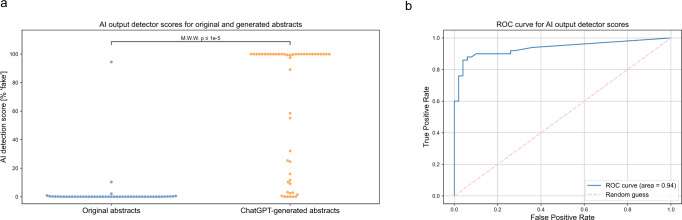
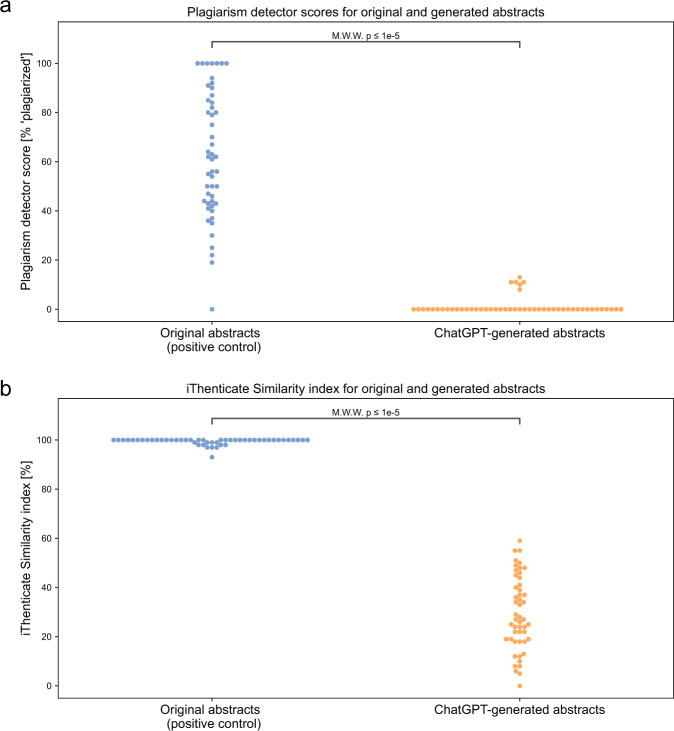
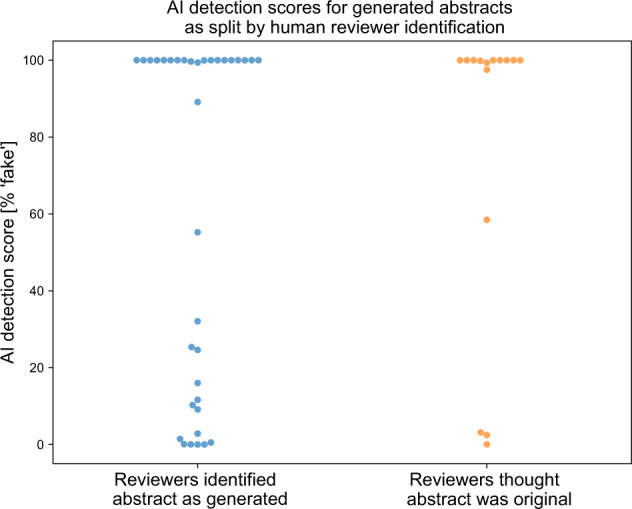
Large language models such as ChatGPT can produce increasingly realistic text, with unknown information on the accuracy and integrity of using these models in scientific writing. We gathered fifth research abstracts from five high-impact factor medical journals and asked ChatGPT to generate research abstracts based on their titles and journals. Most generated abstracts were detected using an AI output detector, ‘GPT-2 Output Detector’, with % ‘fake’ scores (higher meaning more likely to be generated) of median [interquartile range] of 99.98% ‘fake’ [12.73%, 99.98%] compared with median 0.02% [IQR 0.02%, 0.09%] for the original abstracts. The AUROC of the AI output detector was 0.94. Generated abstracts scored lower than original abstracts when run through a plagiarism detector website and iThenticate (higher scores meaning more matching text found). When given a mixture of original and general abstracts, blinded human reviewers correctly identified 68% of generated abstracts as being generated by ChatGPT, but incorrectly identified 14% of original abstracts as being generated. Reviewers indicated that it was surprisingly difficult to differentiate between the two, though abstracts they suspected were generated were vaguer and more formulaic. ChatGPT writes believable scientific abstracts, though with completely generated data. Depending on publisher-specific guidelines, AI output detectors may serve as an editorial tool to help maintain scientific standards. The boundaries of ethical and acceptable use of large language models to help scientific writing are still being discussed, and different journals and conferences are adopting varying policies.
Overview
The claims and statistics of this paper haven’t been checked yet.
Free: it reads the open-access text and checks the first 5 claims that cite a source we can check. Create a free account to check every claim.
Integrity signals
Registry
Cites
Statistics
Figures
Verification
Claims the paper makes
The claims and statistics of this paper haven’t been checked yet.
Free: it reads the open-access text and checks the first 5 claims that cite a source we can check. Create a free account to check every claim.
Claims other papers make about this one
Each is checked against this paper’s own text: does it say what the citing paper says it does?
The source backs part of the claim, not all of it — or backs it for a different population, condition or comparison.
In the citing paper
“ChatGPT’s GPT-3.5 iteration has already shown promise in several routine medical tasks and medical research [4-7], even raising ethical concerns in the literature [2,3,8].”
From Comparison of the Performance of GPT-3.5 and GPT-4 With That of Medical Students on the Written German Medical Licensing Examination: Observational Study (2024) · cites this paper as [7]
Experimental — accuracy not yet measuredThe source backs part of the claim, not all of it — or backs it for a different population, condition or comparison.
In the citing paper
“in practice, it takes a neural network to reliably catch another neural network.”
From Fine-Grained Detection of AI-Generated Writing in the Biomedical Literature (2026) · cites this paper as [6]
Experimental — accuracy not yet measuredThe source backs part of the claim, not all of it — or backs it for a different population, condition or comparison.
In the citing paper
“Rather than just copying ChatGPT output, many students seem to use it as a tool for brainstorming, refining ideas, or enhancing their writing style 16 .”
From Style, sentiment, and quality of undergraduate writing in the AI era: A cross-sectional and longitudinal analysis of 4,820 authentic empirical reports (2025) · cites this paper as [16]
Experimental — accuracy not yet measuredThe cited source says what the claim attributes to it.
In the citing paper
“Gao et al. (2023) found that ChatGPT can produce plausible scientific abstracts that humans often find difficult to distinguish from originals, though reviewers noted that AI abstracts tended to be 'vaguer and more formulaic'.”
From Metadiscourse Patterns in Human-Written vs. Generative AI-Authored Research Abstracts: A Comparative Corpus-Based Analysis (2026) · cites this paper as Gao et al. (2023)
The cited source says what the claim attributes to it.
In the citing paper
“Indeed, ChatGPT abstracts were noted by human reviewers as 'vague' or 'formulaic' , a qualitative impression that aligns with our finding of scant stance markers.”
From Metadiscourse Patterns in Human-Written vs. Generative AI-Authored Research Abstracts: A Comparative Corpus-Based Analysis (2026) · cites this paper as Gao et al. (2023)
3 more claims about this paper
Create a free account to see every claim other papers make about this one.
Self-check
Percentages, sums and reported differences re-computed from the paper’s own numbers.
The self-check needs the paper’s full text.
Citations
Cites
Scikit-learn: Machine Learning in Python
Pedregosa, F., Varoquaux, G., Gramfort, A., Michel, V., Thirion, B., Grisel, O., Blondel, M., Müller, A., Nothman, J., Louppe, G., et al. (2012) · arXiv · doi:10.48550/arxiv.1201.0490 · Cited by 71,016
Matplotlib: a 2D graphics environment
Hunter, J. D. (2007) · Computing in Science & Engineering · doi:10.1109/mcse.2007.55 · Cited by 39,249
SciPy 1.0: fundamental algorithms for scientific computing in Python
Virtanen, P., Gommers, R., Oliphant, T. E., Haberland, M., Reddy, T., Cournapeau, D., Burovski, E., Peterson, P., Weckesser, W., Bright, J., et al. (2020) · Nature Methods · doi:10.1038/s41592-019-0686-2 · Cited by 38,430
SciPy 1.0: fundamental algorithms for scientific computing in Python
Virtanen, P., Gommers, R., Oliphant, T. E., Haberland, M., Reddy, T., Cournapeau, D., Burovski, E., Peterson, P., Weckesser, W., Bright, J., et al. (2019) · Apollo - University of Cambridge Repository · doi:10.17863/cam.64134 · Cited by 10,460
seaborn: statistical data visualization
Waskom, M. (2021) · Journal of Open Source Software · doi:10.21105/joss.03021 · Cited by 7,310
NWChem: A comprehensive and scalable open-source solution for large scale molecular simulations
Valiev, M., Bylaska, E. J., Govind, N., Kowalski, K., Straatsma, T. P., Van Dam, H. J. J., Wang, D., Nieplocha, J., Apra, E., Windus, T. L., et al. (2010) · Computer Physics Communications · doi:10.1016/j.cpc.2010.04.018 · Cited by 5,779
Kung, T. H., Cheatham, M., Medenilla, A., Sillos, C., De Leon, L., Elepaño, C., Madriaga, M., Aggabao, R., Diaz-Candido, G., Maningo, J., et al. (2023) · PLOS Digital Health · doi:10.1371/journal.pdig.0000198 · Cited by 4,115 · cited 1×
“Articles are bemoaning the death of the traditional school essay assignment 4,6,7 , as ChatGPT has been shown to generate high-scoring papers 8 , correctly answer USMLE questions 9 , and even articulate critical thinking 10 .”
Kung, T. H., Cheatham, M., ChatGPT, Medenilla, A., Sillos, C., De Leon, L., Elepaño, C., Madriaga, M., Aggabao, R., Diaz-Candido, G., et al. (2022) · doi:10.1101/2022.12.19.22283643 · Cited by 4,115
ChatGPT is fun, but not an author
Thorp, H. H. (2023) · Science · doi:10.1126/science.adg7879 · Cited by 1,437 · cited 2×
“Different journals and publishers are developing their own policies on whether large language models can contribute to the writing of papers, ranging from not allowing any AI-generated text 12 to allowing its use as long as it is openly disclosed 13,14,28 .”
Artificial Intelligence in Medicine: Today and Tomorrow
Briganti, G., & Le Moine, O. (2020) · Frontiers in Medicine · doi:10.3389/fmed.2020.00027 · Cited by 743
Cited by
Items 601–700 of 1,018
The human cost of ethical artificial intelligence
Ruffle, J. K., Foulon, C., & Nachev, P. (2023) · Brain Structure and Function · doi:10.1007/s00429-023-02662-7 · Cited by 8
ChatGPT Is More Likely to Be Perceived as Male Than FemalePreprint
Wong, J., & Kim, J. (2023) · PsyArXiv (OSF Preprints) · doi:10.31234/osf.io/z8abp · Cited by 15
Can Artificial Intelligence Be My Coauthor?
Scerbo, M. W. (2023) · Simulation in Healthcare The Journal of the Society for Simulation in Healthcare · doi:10.1097/sih.0000000000000743 · Cited by 8
Transformers Can Outperform Humans in Short Creative Writing TasksPreprint
Marco, G., Gonzalo, J. A., & Rello, L. (2023) · SSRN Electronic Journal · doi:10.2139/ssrn.4673692 · Cited by 9
Morreale, M. K., Balon, R., Beresin, E. V., Seritan, A. L., Castillo, E. G., Thomas, L. A., Louie, A. K., Aggarwal, R., Guerrero, A. P. S., Coverdale, J., et al. (2024) · Academic Psychiatry · doi:10.1007/s40596-024-02071-w · Cited by 9
“In one study [21], 50 abstracts were gathered from five high-impact journals, and ChatGPT was asked to create an additional 50 more based on the titles of the abstracts and specific journals.”
Zhang, M., & Zhang, J. (2026) · Applied Linguistics · doi:10.1093/applin/amaf032 · Cited by 7
Applications and Challenges of Human Computer Interaction and AI Interfaces for Health Care
Hutch, M. R., & Luo, Y. (2024) · Cognitive informatics in biomedicine and healthcare · doi:10.1007/978-3-031-69947-4_4 · Cited by 11
Self-citationImpact of ChatGPT on Diabetes Mellitus Self-Management Among Patients in Saudi Arabia
Alanzi, T. M., Arif, W. M., Alotaibi, A., Alnafisi, A., Alhwaimal, R., Altowairqi, N., Alnifaie, A., Aldossari, K., Althumali, K., & Alanzi, N. (2025) · Cureus · doi:10.7759/cureus.81855 · Cited by 8
“Accordingly, Interviewee 23 stated that "It encouraged me to set goals for self-care, such as changing and adapting to new diet regime, increasing physical activity, regular monitoring of blood sugar levels.”
Xu, Z., & Zhang, X. (2025) · International Journal of Human-Computer Interaction · doi:10.1080/10447318.2025.2508311 · Cited by 8
“Powered by deep learning algorithms and memory capabilities, ChatGPT can generate natural human-like conversations and support continuous interaction (Gao et al., 2023; Jiao et al., 2023; Menon & Shilpa, 2023).”
Human-written vs. ChatGPT-generated texts: Stance in English research article abstracts
Zhang, M., & Zhang, J. (2025) · System · doi:10.1016/j.system.2025.103842 · Cited by 7
Wei, W., Xu, Y., & Wang, Z. (2026) · Humanities and Social Sciences Communications · doi:10.1057/s41599-025-06452-w · Cited by 9
“ChatGPT can generate human-like text, providing personalized learning content while offering an interactive learning experience based on users ’ input (Gao et al. 2023; Kung et al. 2023; Ryong et al. 2023; Berdejo-Espinola and Amano 2023).”
Alrefaie, Z. A., Alhazimi, A. M., Almarabheh, A. J., Madkhali, T., & Elsamanoudy, A. Z. (2026) · Medical Teacher · doi:10.1080/0142159x.2025.2604240 · Cited by 7
Erden, M., Chiappetti, A., & Kho, R. M. (2026) · Journal of Minimally Invasive Gynecology · doi:10.1016/j.jmig.2026.02.014 · Cited by 8
Bouteraa, M., Chekima, B., Al-Daihani, M., Benlahcene, A., Baddou, A., & Elhachemi, T. (2026) · Journal of Islamic marketing · doi:10.1108/jima-05-2025-0327 · Cited by 9
Charbonneau, D. H., & Zhang, M. (2026) · Accountability in Research · doi:10.1080/08989621.2026.2632083 · Cited by 9
“…concerns include the difficulty of discerning AI-generated content from human work, the improving sophistication of AI tools that hinders detection, and the critical need to prevent AI from replacing researchers’ expertise and judgment (Gao et al. 2023; Hu 2024; Salvagno, Taccone, and Gerli 2023).”
Seven governing principles in biology
Moon, T. S. (2023) · Frontiers in Synthetic Biology · doi:10.3389/fsybi.2023.1296513 · Cited by 7
Alam, M. S., Asmawi, A., Haque, M. H., Patwary, M. N., Ullah, M. M., & Fatema, S. (2024) · Iraqi Journal for Computer Science and Mathematics · doi:10.52866/ijcsm.2024.05.03.016 · Cited by 7
“Particularly, the task of identifying and distinguishing between texts generated by humans (e.g., students) and by ChatGPT has emerged as a formidable challenge for educators when assessing students’ essays and other written work, according to some recent studies [e.g., 7, 19, 30, 34].”
ResultSimister, S. K., Huish, E. G., Tsai, E. Y., Le, H. V., Halim, A., Tuason, D. A., Meehan, J. P., Leshikar, H. B., Saiz, A. M., & Lum, Z. C. (2024) · Journal of the American Academy of Orthopaedic Surgeons · doi:10.5435/jaaos-d-24-00438 · Cited by 7
Ragab, M., Ashary, E. B., Kateb, F., Hakeem, A., Mosli, R., Albogami, N., & Nooh, S. A. (2025) · Alexandria Engineering Journal · doi:10.1016/j.aej.2025.04.071 · Cited by 7
Artificial Intelligence in Academic Writing: Opportunities and Risks from Planning to Publication
Williams, A., Smith, H., & Raja, S. G. (2025) · Journal of The Best Available Evidence in Medicine · doi:10.63720/jqz1pdhl · Cited by 8
Advancing cancer diagnosis through surface plasmon resonance detection of extracellular vesicles
Zhou, Z., Tang, Q., Yao, B., & Ma, G. (2025) · TrAC Trends in Analytical Chemistry · doi:10.1016/j.trac.2025.118298 · Cited by 8
Ekmekçi, P. E., Buruk, B., Akar, B., & Akışın, Y. A. (2025) · Journal of Empirical Research on Human Research Ethics · doi:10.1177/15562646251370869 · Cited by 7
“; Christoforaki & Beyan, 2022; Else, 2023; Eti, 2025; Fardim et al., 2023; Gao et al., 2023; Resnik & Hosseini, 2025).”
ChatGPT: Optimizing text generation model for knowledge creation
Sanjay, M. B., Vikas, S., & Dahiwale, P. (2023) · i-manager’s Journal on Software Engineering · doi:10.26634/jse.17.3.19469 · Cited by 8
Is ChatGPT a friend or foe in the war on misinformation?: A South African perspective
Senekal, B., & Brokensha, S. (2023) · Communicare: Journal for Communication Studies in Africa · doi:10.36615/jcsa.v42i2.2437 · Cited by 7
The Limits of AI Content Detectors
Wu, H., & Flanagan, T. (2023) · Journal of Student Research · doi:10.47611/jsrhs.v12i3.5064 · Cited by 10
Unveiling Chat GPT’s Educational Prospects: A SWOT Analysis
Dar, M. A., Khursheed, T., Ahmad, A., & Fayaz, R. (2024) · International Conference on Computing for Sustainable Global Development · doi:10.23919/indiacom61295.2024.10499038 · Cited by 9
“Comprehension is not sufficient: The words that ChatGPT interprets have meanings that it does not fully understand [14].”
BackgroundVenerito, V., Fornaro, M., Sabbagh, S. E., Ghosh, S., Chinoy, H., Gupta, L., MyoLLM Investigators, Chandrasekhar, S., Leclair, V., Young-Glazer, J. J., et al. (2024) · Rheumatology · doi:10.1093/rheumatology/keae233 · Cited by 7
Identifying Whether a Short Essay was written by a University Student or ChatGPT
Saarna, C. (2024) · International Journal of Technology in Education · doi:10.46328/ijte.773 · Cited by 7
“This result is further supported by Gao et al. (2023) who found that humans raters were not able to reliably identify the differences between human written and ChatGPT generated essays.”
BackgroundMethodResultInfluentialChatGPT in Teaching-Learning and Research: A Systematic Review
Aziz, S., Mir, M. I., Dar, M. A., & Masoodi, F. S. (2024) · Asia Pacific Journal of Educators and Education · doi:10.21315/apjee2024.39.1.8 · Cited by 8
A Machine Walks into an Exhibit: A Technical Analysis of Art Curation
von Davier, T. Ş., Herman, L. M., & Moruzzi, C. (2024) · Arts · doi:10.3390/arts13050138 · Cited by 12
Şensoy, E., & Çıtırık, M. (2024) · Journal of Current Ophthalmology · doi:10.4103/joco.joco_192_23 · Cited by 7
Alencar‐Palha, C., Ocampo, T. S. C., Silva, T. P., Neves, F. S., & Oliveira, M. L. (2024) · European Journal Of Dental Education · doi:10.1111/eje.13057 · Cited by 8
Noda, M., Takahara, S., Hayashi, S., Inui, A., Oe, K., & Matsushita, T. (2025) · Cureus · doi:10.7759/cureus.78068 · Cited by 7
Analysis of ChatGPT as a Question-Answering Tool
Pichappan, P., Krishnamurthy, M., & Vijayakumar, P. (2023) · Journal of Digital Information Management · doi:10.6025/jdim/2023/21/2/50-61 · Cited by 8
Crossing the Rubicon? The future impact of artificial intelligence on headache medicine
Peng, K., & May, A. (2023) · Cephalalgia · doi:10.1177/03331024231157379 · Cited by 7
Artificial intelligence: Emergence and possible fraudulent use in medical publishing
Jacques, T., Sleiman, R., Diaz, M. I., & Dаrtus, J. (2023) · Orthopaedics & Traumatology Surgery & Research · doi:10.1016/j.otsr.2023.103709 · Cited by 7
Writing in the era of large language models: a bibliometric analysis of research field
Litvinova, T., Mikros, G. K., & Dekhnich, O. V. (2024) · RESEARCH RESULT Theoretical and Applied Linguistics · doi:10.18413/2313-8912-2024-10-4-0-1 · Cited by 12
AI in orthopedics: how to measure one’s real contribution and avoid cheating?
Micicoi, G., Ollivier, M. P., & Argenson, J. (2026) · Orthopaedics & Traumatology Surgery & Research · doi:10.1016/j.otsr.2026.104616 · Cited by 8
Ilic, P., & Carr, N. (2023) · 2023 IEEE Frontiers in Education Conference (FIE) · doi:10.1109/fie58773.2023.10343337 · Cited by 6
“Common suggestions to aid in the detection of plagiarism via AI language models include the use of AI output detectors [25], fake references and inaccurate information [9], using plagiarism software [26], and assessing drafts rather than solely the final product [9].”
Yao, M., Wei, Y., & Liu, H. (2026) · Ethics & Behavior · doi:10.1080/10508422.2025.2549310 · Cited by 6
“Although their use in scientific writing is still relatively new, several studies have reported promising outcomes (Benichou, 2023; Gao et al., 2023; Macdonald et al., 2023; Májovský et al., 2023).”
Sørensen, C. B., Gram‐Hanssen, A., Rosenberg, J., & Baker, J. J. (2025) · Cureus · doi:10.7759/cureus.82525 · Cited by 6
“ChatGPT has previously been demonstrated as an effective research tool, helping researchers write cover letters, introduction sections, and abstracts for scientific papers [12-15].”
Is Gen AI a professor in creativity? A case study in postgraduate students
Zhang, H., & Ge, S. (2025) · Education and Information Technologies · doi:10.1007/s10639-025-13644-z · Cited by 8
The Impact of Generative AI Characteristics on Users' Experiential Value and Product Involvement
Wang, S., Yuan, C., Yin, Y., Zhang, Z., & Wang, T. (2025) · International Journal of Consumer Studies · doi:10.1111/ijcs.70125 · Cited by 8
Zhao, N., & Lei, L. (2026) · Journal of English for Academic Purposes · doi:10.1016/j.jeap.2026.101629 · Cited by 7
Yuan, C., Wei, T., Li, C., Yi, X., Liu, S., Zhang, Z., Cai, Y., & Du, X. (2026) · Journal of King Saud University - Computer and Information Sciences · doi:10.1007/s44443-026-00708-4 · Cited by 10
User Experiences of ChatGPT among Engineering Students, Teachers and Working Professionals in India
Prakasha, G. S. (2024) · The Journal of Educators Online · doi:10.9743/jeo.2024.21.2.12 · Cited by 11
Reshaping Higher Education in MENA with Generative AI: A Systematic Review
Abubaker, N. M. N., Kashani, S., Alshalwy, A. M., & Garib, A. (2024) · Advances in higher education and professional development book series · doi:10.4018/979-8-3693-3904-6.ch010 · Cited by 13
Goodman, M. A., Lee, A., Schreck, Z., & Hollman, J. H. (2025) · Journal of Physical Therapy Education · doi:10.1097/jte.0000000000000396 · Cited by 9
Radhwan, M. G. (2025) · Advances in computational intelligence and robotics book series · doi:10.4018/979-8-3693-7332-3.ch007 · Cited by 8
Pan-indexicality and prompt: developing a teaching model for AI-mediated academic writing
Zhu, J. J., & Duan, C. (2025) · Language and Semiotic Studies · doi:10.1515/lass-2025-0008 · Cited by 8
Automated detection of ChatGPT-generated text vs. human text using gannet-optimized deep learning
Alshareef, A. M., Alsobhi, A. Y., Khadidos, A. O., Alyoubi, K. H., Khadidos, A. O., & Ragab, M. (2025) · Alexandria Engineering Journal · doi:10.1016/j.aej.2025.03.139 · Cited by 8
Detecting LLM-Generated Short Answers and Effects on Learner Performance
Bhushan, S., Thomas, D. R., Borchers, C., Raghuvanshi, I., Abboud, R., Gatz, E., Gupta, S., & Koedinger, K. R. (2025) · Lecture notes in computer science · doi:10.1007/978-3-032-03870-8_4 · Cited by 7
El impacto de la Inteligencia Artificial generativa: clínica jurídica e innovación docente
Fraguío, M. P. D. (2024) · Revista Jurídica de Investigación e Innovación Educativa (REJIE Nueva Época) · doi:10.24310/rejie.30.2024.18080 · Cited by 12
Fadel, C., Milanova, A., Šuran, J., Šitovs, A., Kim, T., Bello, A., Abay, S. M., der Horst, S. F. V., Mileva, R., Amadori, M., et al. (2024) · Journal of Veterinary Pharmacology and Therapeutics · doi:10.1111/jvp.13448 · Cited by 6
Advancing scientific writing with artificial intelligence: expanding the research toolkit
Atkinson, A. G., Lia, H., & Navarro, S. M. (2024) · Global Surgical Education - Journal of the Association for Surgical Education · doi:10.1007/s44186-024-00271-4 · Cited by 6
“Plagiarism is a commonly cited concern when using generative AI in scientific writing, though many generative AI outputs pass plagiarism checks [21, 22].”
Principles and challenges of generative artificial intelligence detection
Cheng, K., Li, W., Zhang, N., Liu, X., & Wu, H. (2024) · British Journal of Anaesthesia · doi:10.1016/j.bja.2024.06.037 · Cited by 8
Laquintano, T., & Vee, A. (2024) · PMLA/Publications of the Modern Language Association of America · doi:10.1632/s0030812924000609 · Cited by 6
Hazim, L. R., & Ata, O. (2024) · International Symposium on Electronics and Telecommunications (ISETC) · doi:10.1109/isetc63109.2024.10797291 · Cited by 6
The Effect of Simulation Games in Entrepreneurship Education
Polydorou, E. (2025) · IGI Global eBooks · doi:10.4018/979-8-3693-9040-5.ch020 · Cited by 9
Example Evaluations of Plagiarism Cases Using FAIR Metrics and the PDP-DREAM Ontology
Craig, A., Athreya, A., & Taswell, C. (2023) · IEEE International Conference on eScience · doi:10.1109/e-science58273.2023.10254806 · Cited by 6
Deep dive into language traits of AI-generated Abstracts
Kumar, V., Bharti, A., Verma, D., & Bhatnagar, V. (2024) · Joint International Conference on Data Science & Management of Data (CODS-COMAD) · doi:10.1145/3632410.3632471 · Cited by 8
“Recent interest in the detection of AI-generated abstracts of scientific papers is reflected in [11, 18].”
BackgroundChatGPT as the Transportation Equity Information Source for Scientific WritingPreprint
Kutela, B., Li, S., Das, S., & Liu, J. (2023) · arXiv (Cornell University) · doi:10.48550/arxiv.2303.11158 · Cited by 6
Exploring the Benefits and Challenges of ChatGPT in Enhancing ESL Learners Writing Skills
Seelro, S., & Khan, M. A. (2024) · Academy of Education and Social Sciences Review · doi:10.48112/aessr.v4i4.885 · Cited by 8
Matalon, J., Spurzem, A., Ahsan, S., White, E., Kothari, R., & Varma, M. (2024) · Frontiers in Artificial Intelligence · doi:10.3389/frai.2024.1477535 · Cited by 6
Abduljawad, S. A. (2024) · Erudita Journal of English Language Teaching · doi:10.28918/erudita.v4i2.8784 · Cited by 6
Erdat, E. C., Köksoy, E. B., & Utkan, G. (2025) · Acta haematologica oncologica Turcica. · doi:10.4274/ahot.galenos.2024.2024-8-2 · Cited by 7
“Additionally, since it is not connected to the Internet and trained on Q4 2021 information, it may deliver outdated or wrong information about anything, and the fabricated abstracts can even fool experienced researchers [6,7,10].”
Ayad, O., Yassa, A., Patel, A. M., Vengsarkar, V. A., Ayad, S., Ayad, S., & Mikhael, M. (2025) · International Ophthalmology · doi:10.1007/s10792-025-03611-5 · Cited by 5
Murad, H. A., & Qudah, M. (2025) · Frontiers in Communication · doi:10.3389/fcomm.2025.1552520 · Cited by 5
Khaw, L. L. (2025) · Innovations in Education and Teaching International · doi:10.1080/14703297.2025.2530766 · Cited by 5
Lei, F., Du, L., Wang, W., Dong, M., & Liu, X. (2025) · Journal of Information Science · doi:10.1177/01655515251359771 · Cited by 5
CM-SQL: A cross-model consistency framework for text-to-SQL
Li, X., You, J., Li, H., Peng, J., Chen, X., & Guo, Z. (2025) · Neurocomputing · doi:10.1016/j.neucom.2025.131708 · Cited by 8
Goh, S. S. N., Mariappan, R., Tan, G. S. W., Yao, J., Hew, F. M., Yeo, Y., Ow, S. G. W., Koh, W. Y., Kumarakulasinghe, N. B., Tan, T. H., et al. (2025) · JCO Clinical Cancer Informatics · doi:10.1200/cci-24-00243 · Cited by 10
Promotion of medical research: Stance in AI-generated and scholar-written highlights
Zou, H., & Fan, Y. (2025) · Journal of English for Academic Purposes · doi:10.1016/j.jeap.2025.101593 · Cited by 5
Comparing Ophthalmologist and Artificial Intelligence Chatbot Responses to Patient Questions
Bondok, M., Selvakumar, R., Law, C., Ing, E. B., Bakshi, N. K., & Felfeli, T. (2025) · Clinical ophthalmology · doi:10.2147/opth.s549820 · Cited by 5
Shamsi, A., Wang, T., Amraei, M., & Raju, N. V. (2025) · Acta Informatica Pragensia · doi:10.18267/j.aip.293 · Cited by 5
Gökalp, M. G., & Yücel, Ş. Ç. (2026) · BMC Nursing · doi:10.1186/s12912-026-04295-7 · Cited by 5
Assessing data extraction in randomized clinical trials with large language models
Yisha, Z., Zou, P., Li, S., Zhang, L., Guo, L., Gu, A., Liu, G., Liu, T., & Wang, X. (2026) · BMC Medical Research Methodology · doi:10.1186/s12874-025-02729-5 · Cited by 9
“Second, both models are sensitive to prompt variations, resulting in different responses to the same prompt across multiple attempts (see the varied Pacc in Figure S11) [15, 16].”
Watermark in the Classroom: A Conformal Framework for Adaptive AI Usage Detection
Xie, Y., Chen, X., Ren, Z., & Su, W. (2026) · Harvard Data Science Review · doi:10.1162/99608f92.072aebb0 · Cited by 5
Ibrahim, S. A., & Mahmoud, Z. A. Z. (2026) · Humanities and Social Sciences Communications · doi:10.1057/s41599-026-06956-z · Cited by 8
Zou, Y., Kuek, F., Ng, K. H., & Cheng, X. (2026) · PLoS ONE · doi:10.1371/journal.pone.0343163 · Cited by 6
“Furthermore, AI often employs complex vocabulary, while humans typically use simpler, more precise language [30].”
Lodhwal, V., & Choudhary, G. (2023) · International Journal for Research in Applied Science and Engineering Technology · doi:10.22214/ijraset.2023.49713 · Cited by 5
Meşe, İ., Kuzan, B. N., & Kuzan, T. Y. (2024) · Anatolian Current Medical Journal · doi:10.38053/acmj.1367414 · Cited by 5
La geografia umana secondo un' intelligenza artificiale. Un piccolo esperimento
Vanolo, A. (2023) · RIVISTA GEOGRAFICA ITALIANA · doi:10.3280/rgioa2-2023oa15936 · Cited by 5
Ethical Considerations in the Educational Use of Generative AI Technologies
Tomak, B., & Virlan, A. Y. (2024) · Advances in computational intelligence and robotics book series · doi:10.4018/979-8-3693-1565-1.ch004 · Cited by 6
Beyond Copy Paste: Plagiarism Detection using Machine Learning
Vasuteja, A., Reddy, A. V., & Pravin, A. (2024) · International Conference on Inventive Computation Technologies (ICICT) · doi:10.1109/icict60155.2024.10544470 · Cited by 6
Istiqomah, F., & Basthomi, Y. (2024) · Englisia Journal of language education and humanities · doi:10.22373/ej.v11i2.20390 · Cited by 6
“Although with the advance of technology, writers may be helped by the generated AI such as ChatGPT to write abstracts, yet this remains detectable (Gao et al., 2023).”
BackgroundAn Information-Theoretic Approach for Detecting Edits in AI-Generated Text
Kashtan, I., & Kipnis, A. (2024) · Harvard Data Science Review · doi:10.1162/99608f92.5dbf3265 · Cited by 9
Ethical Considerations for Companies Implementing LLMs in Education Software
Steve, M. K. (2024) · International Journal of Innovative Science and Research Technology (IJISRT) · doi:10.38124/ijisrt/ijisrt24aug1297 · Cited by 7
Şensoy, E., & Çıtırık, M. (2023) · Middle East African Journal of Ophthalmology · doi:10.4103/meajo.meajo_199_23 · Cited by 5
Verberne, S. (2024) · ACM eBooks · doi:10.1145/3674127.3674141 · Cited by 5
Trippas, J. R. (2024) · ACM eBooks · doi:10.1145/3674127.3674135 · Cited by 6
Camlet, A., Kusiak, A., & Świetlik, D. (2025) · AI · doi:10.3390/ai6010003 · Cited by 7
“ChatGPT formed credible content that was predominantly synthetic [53].”
Deep Learning Strategies for Identifying Machine-Generated Text
Yadagiri, A., & Pakray, P. (2025) · International Conference on Ubiquitous Information Management and Communication (IMCOM) · doi:10.1109/imcom64595.2025.10857545 · Cited by 7
Fajt, B., & Kállai, B. J. (2024) · Iskolakultúra · doi:10.14232/iskkult.2024.12.75 · Cited by 6
Can Residency Programs Detect Artificial Intelligence Use in Personal Statements?
Cumbo, N., Williams, W., CANTERINO, J. C., Aikman, N. M., & Baum, J. D. (2025) · Cureus · doi:10.7759/cureus.88969 · Cited by 6
“Studies suggest that AI-generated personal statements may be indistinguishable from original work, and may give applicants an advantage as they have high acceptability to residency programs [4-6].”
Tinajero, C. A. C. (2025) · European Journal of Pediatric Surgery · doi:10.1055/a-2722-3871 · Cited by 6
“33,34 Editorial policies re fl ect this: in a 2024 review of the top 100 medical journals, most had explicit AI guidance, many prohibited LLM use in peer review, and some allowed limited, fully disclosed use.”
Alharthi, R. S., Ojo, S., Nathaniel, T. I., Samee, N. M. A., Umer, M., Jamjoom, M. M., Alsubai, S., & Khan, J. (2025) · International Journal of Computational Intelligence Systems · doi:10.1007/s44196-025-01025-w · Cited by 5
Hallock, G. G., & Hallock, G. G. (2023) · Annals of Plastic Surgery · doi:10.1097/sap.0000000000003672 · Cited by 5
Yingxia Li, W. D. (2023) · Frontiers in Educational Research · doi:10.25236/fer.2023.062809 · Cited by 7
Surgeon or Bot? The Risks of Using Artificial Intelligence in Surgical Journal Publications
Shaffrey, E. C., Eftekari, S. C., Wilke, L. G., & Poore, S. O. (2023) · Annals of Surgery Open · doi:10.1097/as9.0000000000000309 · Cited by 5
Metadata
- Authors
- Gao, C. A., Howard, F. M., Markov, N. S., Dyer, E. C., Ramesh, S., Luo, Y., & Pearson, A. T.
- Affiliations
- Northwestern University (US)
- University of Chicago (US)
- Corresponding author
- Gao, Catherine A.
- ORCID
- Venue
- npj Digital Medicine
- Published
- 2023-04-26
- Volume
- 6
- Issue
- 1
- Pages
- 75-75
- ISSN
- 2398-6352 (ISSN-L)
- PMC
- PMC10133283
- OpenAlex
- W4367051110
- Semantic Scholar
- 7d648061157109e8a1a8b382b15ded7ffe690c25
- Cited by
- 1,099
- References
- 26
- Citations by year
- 2026: 189 · 2025: 235 · 2024: 342 · 2023: 326
- FWCI
- 273.24
- Type
- journal article
- Language
- en
- Open access
- gold
- doi.org
- Licence
- cc-by
- creativecommons.org/licenses/by/4.0 (tdm)
- creativecommons.org/licenses/by/4.0 (vor)
- Locations
- npj Digital Medicine (publishedVersion, cc-by)
- bioRxiv (Cold Spring Harbor Laboratory) (acceptedVersion, cc-by-nc-nd)
- PubMed Central (publishedVersion, cc-by)
- PubMed (publishedVersion)
- Knowledge@UChicago (University of Chicago) (submittedVersion, cc-by-nc-nd)
- DOAJ (DOAJ: Directory of Open Access Journals) (submittedVersion, cc-by-sa)
- University of Chicago (cc-by)
- Funders
- U.S. Department of Health and Human Services (U01-CA243075, R01LM013337, R56-DE030958, U01TR003528)
- Burroughs Wellcome Fund
- Conquer Cancer Foundation (2022YIA-6675470300)
- Breast Cancer Research Foundation (2022YIA-6675470300)
- Cancer Research Foundation
- Fanconi Anemia Research Fund
- American Society of Clinical Oncology (2022YIA-6675470300)
- Horizon Therapeutics
- National Institutes of Health (U01TR003528)
- Stand Up To Cancer
- National Heart, Lung, and Blood Institute (F32HL162377)
- National Cancer Institute (K12CA139160, U01CA243075)
- National Institute of Dental and Craniofacial Research (R56DE030958)
- U.S. National Library of Medicine (R01LM013337)
- National Center for Advancing Translational Sciences
- Topics
- Social Sciences › Education › Academic integrity and plagiarism
- Social Sciences › Library and Information Sciences › Academic Writing and Publishing
- Health Sciences › Medicine › Health Informatics › Artificial Intelligence in Healthcare and Education
- Keywords
- ChatGPT, large language models, AI-generated text detection, scientific abstracts, plagiarism detection, medical journal abstracts, scientific integrity, AI in scientific writing, editorial guidelines
About these checks
Registry, retraction, Cites and statistics results are computed, not judged, with one exception: a printed reference that no index lists is read once by a model before it counts as a citation error. Claims are extracted by a model and kept only when their quote appears verbatim in the text; each cited source is then checked, with a model’s help, for whether it says what the claim relies on. Those verdicts can be wrong — read the claim’s quote and the cited source before relying on one.
Statistics and arithmetic are recomputed, not judged.
Confidence bands are shown only for fields calibrated on our annotated test set. None is calibrated yet, so no band is shown.
What counts as a claim ›How we measure confidence ›How we check this ›
Are you an author, or do you see a problem with this page? Request a review
Data sources
Bibliographic data: Semantic Scholar, OpenAlex, Crossref.
Contains information from the Semantic Scholar Academic Graph Datasets, made available under the ODC Attribution License (ODC-BY 1.0).
Semantic Scholar’s data is described in: Kinney, R., et al. (2023). The Semantic Scholar Open Data Platform. arXiv:2301.10140.
