

Comparing scientific abstracts generated by ChatGPT to real abstracts with detectors and blinded human reviewers
Open accessPublished version of a preprint
The DOI matches its Crossref record; 34 of the 34 references it cites were found in a registry or an index.
Abstract
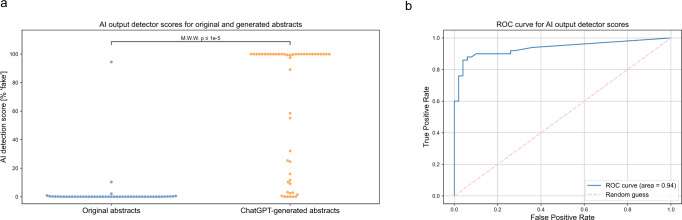
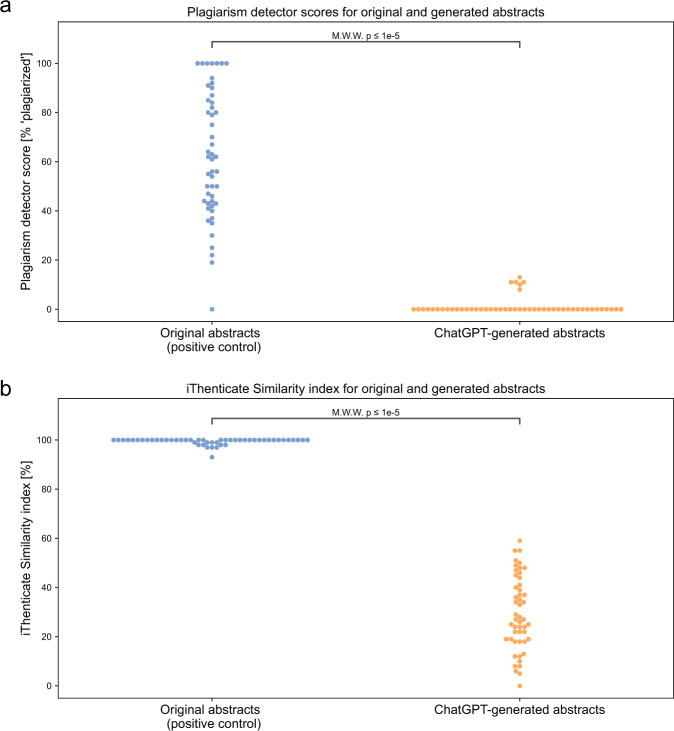
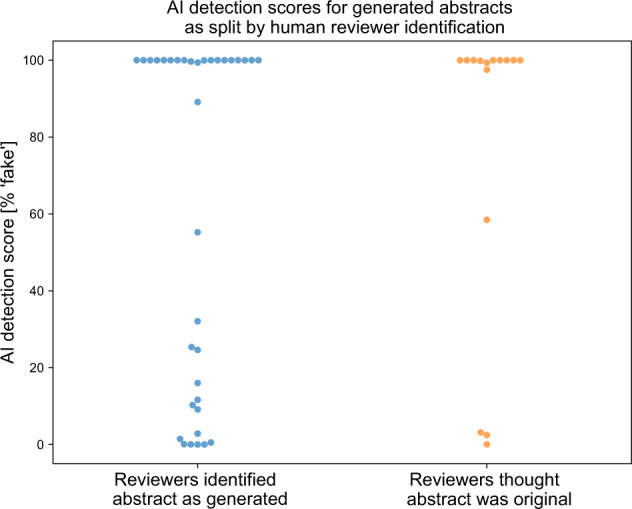
Large language models such as ChatGPT can produce increasingly realistic text, with unknown information on the accuracy and integrity of using these models in scientific writing. We gathered fifth research abstracts from five high-impact factor medical journals and asked ChatGPT to generate research abstracts based on their titles and journals. Most generated abstracts were detected using an AI output detector, ‘GPT-2 Output Detector’, with % ‘fake’ scores (higher meaning more likely to be generated) of median [interquartile range] of 99.98% ‘fake’ [12.73%, 99.98%] compared with median 0.02% [IQR 0.02%, 0.09%] for the original abstracts. The AUROC of the AI output detector was 0.94. Generated abstracts scored lower than original abstracts when run through a plagiarism detector website and iThenticate (higher scores meaning more matching text found). When given a mixture of original and general abstracts, blinded human reviewers correctly identified 68% of generated abstracts as being generated by ChatGPT, but incorrectly identified 14% of original abstracts as being generated. Reviewers indicated that it was surprisingly difficult to differentiate between the two, though abstracts they suspected were generated were vaguer and more formulaic. ChatGPT writes believable scientific abstracts, though with completely generated data. Depending on publisher-specific guidelines, AI output detectors may serve as an editorial tool to help maintain scientific standards. The boundaries of ethical and acceptable use of large language models to help scientific writing are still being discussed, and different journals and conferences are adopting varying policies.
Overview
The claims and statistics of this paper haven’t been checked yet.
Free: it reads the open-access text and checks the first 5 claims that cite a source we can check. Create a free account to check every claim.
Integrity signals
Registry
Cites
Statistics
Figures
Verification
Claims the paper makes
The claims and statistics of this paper haven’t been checked yet.
Free: it reads the open-access text and checks the first 5 claims that cite a source we can check. Create a free account to check every claim.
Claims other papers make about this one
Each is checked against this paper’s own text: does it say what the citing paper says it does?
The source backs part of the claim, not all of it — or backs it for a different population, condition or comparison.
In the citing paper
“ChatGPT’s GPT-3.5 iteration has already shown promise in several routine medical tasks and medical research [4-7], even raising ethical concerns in the literature [2,3,8].”
From Comparison of the Performance of GPT-3.5 and GPT-4 With That of Medical Students on the Written German Medical Licensing Examination: Observational Study (2024) · cites this paper as [7]
Experimental — accuracy not yet measuredThe source backs part of the claim, not all of it — or backs it for a different population, condition or comparison.
In the citing paper
“in practice, it takes a neural network to reliably catch another neural network.”
From Fine-Grained Detection of AI-Generated Writing in the Biomedical Literature (2026) · cites this paper as [6]
Experimental — accuracy not yet measuredThe source backs part of the claim, not all of it — or backs it for a different population, condition or comparison.
In the citing paper
“Rather than just copying ChatGPT output, many students seem to use it as a tool for brainstorming, refining ideas, or enhancing their writing style 16 .”
From Style, sentiment, and quality of undergraduate writing in the AI era: A cross-sectional and longitudinal analysis of 4,820 authentic empirical reports (2025) · cites this paper as [16]
Experimental — accuracy not yet measuredThe cited source says what the claim attributes to it.
In the citing paper
“Gao et al. (2023) found that ChatGPT can produce plausible scientific abstracts that humans often find difficult to distinguish from originals, though reviewers noted that AI abstracts tended to be 'vaguer and more formulaic'.”
From Metadiscourse Patterns in Human-Written vs. Generative AI-Authored Research Abstracts: A Comparative Corpus-Based Analysis (2026) · cites this paper as Gao et al. (2023)
The cited source says what the claim attributes to it.
In the citing paper
“Indeed, ChatGPT abstracts were noted by human reviewers as 'vague' or 'formulaic' , a qualitative impression that aligns with our finding of scant stance markers.”
From Metadiscourse Patterns in Human-Written vs. Generative AI-Authored Research Abstracts: A Comparative Corpus-Based Analysis (2026) · cites this paper as Gao et al. (2023)
3 more claims about this paper
Create a free account to see every claim other papers make about this one.
Self-check
Percentages, sums and reported differences re-computed from the paper’s own numbers.
The self-check needs the paper’s full text.
Citations
Cites
Scikit-learn: Machine Learning in Python
Pedregosa, F., Varoquaux, G., Gramfort, A., Michel, V., Thirion, B., Grisel, O., Blondel, M., Müller, A., Nothman, J., Louppe, G., et al. (2012) · arXiv · doi:10.48550/arxiv.1201.0490 · Cited by 71,016
Matplotlib: a 2D graphics environment
Hunter, J. D. (2007) · Computing in Science & Engineering · doi:10.1109/mcse.2007.55 · Cited by 39,249
SciPy 1.0: fundamental algorithms for scientific computing in Python
Virtanen, P., Gommers, R., Oliphant, T. E., Haberland, M., Reddy, T., Cournapeau, D., Burovski, E., Peterson, P., Weckesser, W., Bright, J., et al. (2020) · Nature Methods · doi:10.1038/s41592-019-0686-2 · Cited by 38,430
SciPy 1.0: fundamental algorithms for scientific computing in Python
Virtanen, P., Gommers, R., Oliphant, T. E., Haberland, M., Reddy, T., Cournapeau, D., Burovski, E., Peterson, P., Weckesser, W., Bright, J., et al. (2019) · Apollo - University of Cambridge Repository · doi:10.17863/cam.64134 · Cited by 10,460
seaborn: statistical data visualization
Waskom, M. (2021) · Journal of Open Source Software · doi:10.21105/joss.03021 · Cited by 7,310
NWChem: A comprehensive and scalable open-source solution for large scale molecular simulations
Valiev, M., Bylaska, E. J., Govind, N., Kowalski, K., Straatsma, T. P., Van Dam, H. J. J., Wang, D., Nieplocha, J., Apra, E., Windus, T. L., et al. (2010) · Computer Physics Communications · doi:10.1016/j.cpc.2010.04.018 · Cited by 5,779
Kung, T. H., Cheatham, M., Medenilla, A., Sillos, C., De Leon, L., Elepaño, C., Madriaga, M., Aggabao, R., Diaz-Candido, G., Maningo, J., et al. (2023) · PLOS Digital Health · doi:10.1371/journal.pdig.0000198 · Cited by 4,115 · cited 1×
“Articles are bemoaning the death of the traditional school essay assignment 4,6,7 , as ChatGPT has been shown to generate high-scoring papers 8 , correctly answer USMLE questions 9 , and even articulate critical thinking 10 .”
Kung, T. H., Cheatham, M., ChatGPT, Medenilla, A., Sillos, C., De Leon, L., Elepaño, C., Madriaga, M., Aggabao, R., Diaz-Candido, G., et al. (2022) · doi:10.1101/2022.12.19.22283643 · Cited by 4,115
ChatGPT is fun, but not an author
Thorp, H. H. (2023) · Science · doi:10.1126/science.adg7879 · Cited by 1,437 · cited 2×
“Different journals and publishers are developing their own policies on whether large language models can contribute to the writing of papers, ranging from not allowing any AI-generated text 12 to allowing its use as long as it is openly disclosed 13,14,28 .”
Artificial Intelligence in Medicine: Today and Tomorrow
Briganti, G., & Le Moine, O. (2020) · Frontiers in Medicine · doi:10.3389/fmed.2020.00027 · Cited by 743
Cited by
Items 401–500 of 1,018
AI-Generated Content Detectors: Boon or Bane for Scientific Writing
Ladha, N., Yadav, K., & Rathore, P. (2023) · Indian Journal of Science and Technology · doi:10.17485/ijst/v16i39.1632 · Cited by 23
Norms for Academic Writing in the Era of Advanced Artificial Intelligence
Friederich, S., & Symons, J. (2023) · Digital Society · doi:10.1007/s44206-023-00079-7 · Cited by 25
“Systems to detect AI use in writing based on statistical regularities have been developed, but, based on findings for current systems (Casal & Kessler, 2023; Gao et al., 2023), we suspect that at least for shorter passages, the signal of AI use will be too weak for conclusive detection.”
BackgroundPitfalls (and advantages) of sophisticated large language models
Strasser, A. (2024) · Elsevier eBooks · doi:10.1016/b978-0-443-18851-0.00007-x · Cited by 20
Xu, T., & Jumaat, N. F. (2024) · International Journal of Interactive Mobile Technologies (iJIM) · doi:10.3991/ijim.v18i15.49219 · Cited by 19
Participant Use of Artificial Intelligence in Online Focus Groups: An Experiential Account
Stafford, L., Preston, C., & Pike, A. C. (2024) · International Journal of Qualitative Methods · doi:10.1177/16094069241286417 · Cited by 15
“The fourth sign a participant may be using an LLM is that they give vague, general answers that do not draw on any concrete, lived experience (Cotton et al., 2024; Gao et al., 2023; Gibson & Beattie, 2024; Rahman & Watanobe, 2023).”
Zhang, W., Zhang, Q., Wang, P., Zhou, X., & Wu, Y. (2025) · Asian Journal of Psychiatry · doi:10.1016/j.ajp.2025.104596 · Cited by 22
Leveraging Generative AI for Public Service Innovation: A Path to Smart Government in Indonesia
Alamsyah, A., & Aryfiyanto, H. (2025) · Digital Government Research and Practice · doi:10.1145/3761820 · Cited by 22
“Formulating mapping questions was crucial for creating effective search queries [Mengist et al. 2020 ] and identifying fundamental concepts tied to generative AI [Cascella et al. 2023 ; Cheng et al. 2023 ; Gao et al. 2023 ; Pavlik 2023 ; Qadir 2023 ; Sallam 2023 ; Temsah et al. 2023 ].”
Using Artificial Intelligence for Scholarly Writing
Oermann, M. H., Owens, J. K., Carter‐Templeton, H., Peterson, G. M., & Bailey, H. E. (2025) · AJN American Journal of Nursing · doi:10.1097/ajn.0000000000000179 · Cited by 23
“25 Without transparency, articles may be disseminating content produced using AI tools that is not accurate, among other concerns.”
“Hey AI, should I buy this stock?” – Trust, technology, and the rise of the young investor
Phan, T. A., Tran, H. P., Ninh, T. T., & Nguyễn, H. M. H. (2025) · Strategic Business Research · doi:10.1016/j.sbr.2025.100014 · Cited by 21
ChatGPT: a tool for scientific writing or a threat to integrity?
Silva, T. P., Ocampo, T. S. C., Alencar‐Palha, C., Oliveira‐Santos, C., Takeshita, W. M., & Oliveira, M. L. (2023) · British Journal of Radiology · doi:10.1259/bjr.20230430 · Cited by 27
Slow Writing with ChatGPT: Turning the Hype into a Right Way Forward
Sirisathitkul, C. (2023) · Postdigital Science and Education · doi:10.1007/s42438-023-00441-5 · Cited by 19
“Efforts to uphold academic integrity include developing systems designed to detect AI-generated content (Chaka 2023; Gao et al. 2023) and, more importantly, proposing ethical guidelines for the responsible use of AI tools.”
Lawrence, K. W., Habibi, A. A., Ward, S. A., Lajam, C. M., Schwarzkopf, R. M., & Rozell, J. C. (2024) · International Journal of Medical Robotics and Computer Assisted Surgery · doi:10.1002/rcs.2621 · Cited by 19
ChatGPT and dental education: Opportunities and challenges
Elnagar, M. H., Yadav, S. K., Venugopalan, S. R., Lee, M. K., Oubaidin, M., Rampa, S., & Allareddy, V. (2024) · Seminars in Orthodontics · doi:10.1053/j.sodo.2024.03.004 · Cited by 24
Inteligencia artificial en la redacción y producción científica
Muñoz, G. F. R., Pindo, A. D. L. Á. O., Delgado, J. C. V., & Obando, K. E. R. (2025) · Revista Social Fronteriza · doi:10.59814/resofro.2025.5(3)705 · Cited by 24
AI Emergence in Education: Exploring Formative Tensions Across Scholarly and Popular Discourse
Cain, W. (2023) · The Journal of Interactive Learning Research · doi:10.70725/749605omikun · Cited by 19
Ng, J., Tong, M., Tsang, E. Y. M., Chu, K., & Tsang, W. (2025) · SN Computer Science · doi:10.1007/s42979-025-04010-4 · Cited by 18
Opportunities, Challenges, Strategies, and Reforms for ChatGPT in Higher Education
Xie, X., & Ding, S. (2023) · 2023 International Conference on Educational Knowledge and Informatization (EKI) · doi:10.1109/eki61071.2023.00010 · Cited by 18
Fried, A. J., Dorn, S. D., Leland, W. J., Mullen, E., Williams, D. M., Zaas, A. K., MacGuire, J., & Bynum, D. L. (2024) · Discover Artificial Intelligence · doi:10.1007/s44163-024-00173-w · Cited by 21
“…research has shown GPT powered algorithms can pass United States Medical Licensing Exam question sets, generate accurate differential diagnoses, and produce clinical documentation and scientific abstracts that are difficult to distinguish from those written by physicians and researchers [5–8].”
Emerging plagiarism in peer-review evaluation reports: a tip of the iceberg?
Piniewski, M., Jarić, I., Koutsoyiannis, D., & Kundzewicz, Z. W. (2024) · Scientometrics · doi:10.1007/s11192-024-04960-1 · Cited by 18
“Gao et al. (2023) provide results of a human-reviewer scoring for whether the document carefully inspected by them (in their case— paper abstract) was bot-generated.”
Levin, G., Pareja, R., Viveros-Carreño, D. A., Díaz, E. S., Yates, E. M., Zand, B., & Ramirez, P. T. (2024) · International Journal of Gynecological Cancer · doi:10.1136/ijgc-2023-005162 · Cited by 23
“14 Moreover, the study evaluated abstracts originally published in high impact general medicine journals so the reviewers might have been exposed to these abstracts before the study, possibly biasing their discrimination.”
BackgroundExploring the Impact of Artificial Intelligence on Research Ethics - A Systematic Review
Andrade-Hidalgo, G., Mio-Cango, P., & Iparraguirre-Villanueva, O. (2024) · Journal of Academic Ethics · doi:10.1007/s10805-024-09579-8 · Cited by 21
“One study showed that when using "GPT-2 Output Detector", a tool that identifies the use of AI in writing, in test texts, 99.98% were identified as "false", while the remaining 0.02% remained true to the original human-written summaries (Gao et al., 2023).”
InfluentialMacchia, A., Valentini, F., Colasanti, I. A., & Zaratti, C. (2025) · Sustainability · doi:10.3390/su17072944 · Cited by 18
Lee, Y., Oh, J. H., Lee, D., Kang, M., & Lee, S. (2025) · Scientific Reports · doi:10.1038/s41598-025-99423-9 · Cited by 20
English, R., Nash, R., & Mackenzie, H. (2026) · Innovations in Education and Teaching International · doi:10.1080/14703297.2024.2446236 · Cited by 17
“However, elsewhere, researchers have found AI-generated work to be either inaccurate (Gregorcic & Pendrill, 2023) or easily detected by existing plagiarism software (Aydin & Karaarslan, 2022; Gao et al., 2023).”
Zhang, M., & Zhang, J. (2025) · Journal of English for Academic Purposes · doi:10.1016/j.jeap.2025.101540 · Cited by 17
ChatGPT as Co-author: Are researchers impressed or distressed?
Bhatia, G., & Kulkarni, A. (2023) · Asian Journal of Psychiatry · doi:10.1016/j.ajp.2023.103564 · Cited by 17
Rutecka, P., Cicha, K., Rizun, M., & Strzelecki, A. (2025) · IEEE Transactions on Learning Technologies · doi:10.1109/tlt.2025.3587081 · Cited by 22
“[30] investigated the ability of ChatGPT to generate abstracts for scientific articles.”
Yao, G., & Liu, Z. (2025) · Journal of Pragmatics · doi:10.1016/j.pragma.2025.07.018 · Cited by 17
Levin, G., Meyer, R., Yasmeen, A., Yang, B., Guigue, P., Bar-Noy, T., Tatar, A., Brezinov, O. P., & Brezinov, Y. (2023) · American Journal of Obstetrics & Gynecology MFM · doi:10.1016/j.ajogmf.2023.100993 · Cited by 18
ChatGPT and scientific papers in veterinary neurology; is the genie out of the bottle?
Abani, S., Volk, H. A., Decker, S. D., Fenn, J., Rusbridge, C., Charalambous, M., Gonçalves, R., Gutierrez‐Quintana, R., Loderstedt, S., Flegel, T., et al. (2023) · Frontiers in Veterinary Science · doi:10.3389/fvets.2023.1272755 · Cited by 19
Şensoy, E., & Çıtırık, M. (2023) · International Ophthalmology · doi:10.1007/s10792-023-02893-x · Cited by 19
Makiev, K. G., Asimakidou, M., Vasios, I. S., Keskinis, A., Petkidis, G., Tilkeridis, K. E., Ververidis, A. N., & Iliopoulos, E. (2023) · Cureus · doi:10.7759/cureus.49166 · Cited by 22
“Although the methodology and design of this study differ, the conclusion stays the same; It is exceptionally hard to differentiate between AI-and human-written abstracts, as both human reviewers and AI detectors were not able to reliably detect an AI-generated abstract [19].”
Clause complexing in research-article abstracts: Comparing human- and AI-generated texts
Leong, A. P. (2023) · ExELL · doi:10.2478/exell-2023-0008 · Cited by 17
“…a month after its launch, Gao et al. (2022) reported in bioR χ iv that scientists themselves were able to detect ChatGPT-generated abstracts only about two thirds of the time, and about one in ten original abstracts were incorrectly identified as being ChatGPT-generated (see also Gao et al., 2023).”
Assessing the Impact of ChatGPT in a PHP Programming Course
Hajj, J. A., & Şah, M. (2023) · International Symposium on Innovative Approaches in Smart Technologies (ISAS) · doi:10.1109/isas60782.2023.10391549 · Cited by 18
Cai, J., Yuan, Y., Sui, X., Lin, Y., Zhuang, K., Xu, Y. P., Zhang, Q., Ukrainczyk, N., & Xie, T. (2024) · Construction and Building Materials · doi:10.1016/j.conbuildmat.2024.135965 · Cited by 18
Decook, R., Muffly, B. T., Mahmood, S., Holland, C. T., Ayeni, A. M., Ast, M. P., Bolognese, M. P., Guild, G. N., Sheth, N. P., Pean, C. A., et al. (2024) · Arthroplasty Today · doi:10.1016/j.artd.2024.101412 · Cited by 17
El impacto de la inteligencia artificial en la producción científica
Solís, A. K. G., Muñoz, G. F. R., González, D. A. Y., & Sánchez-Lascano, M. N. (2025) · Multidisciplinary Latin American Journal (MLAJ) · doi:10.62131/mlaj-v3-n1-031 · Cited by 24
Claude AI and Literature Reviews: An Experiment in Utility and Ethical Use
Sparkman, M., & Witt, A. (2025) · Library trends · doi:10.1353/lib.2025.a961199 · Cited by 25
Diagnosis Reliability of ChatGPT for Journal Evaluation
Dadkhah, M., Oermann, M. H., Hegedüs, M., Raman, R., & Dávid, L. D. (2023) · Advanced Pharmaceutical Bulletin · doi:10.34172/apb.2024.020 · Cited by 23
Addressing the Novel Implications of Generative AI for Academic Publishing, Education, and Research
Roberts, L. W. (2024) · Academic Medicine · doi:10.1097/acm.0000000000005667 · Cited by 17
How good are large language models for automated data extraction from randomized trials?Preprint
Sun, Z., Zhang, R., Doi, S. A. R., Furuya‐Kanamori, L., Yu, T., Lin, L., & Xu, C. (2024) · medRxiv · doi:10.1101/2024.02.20.24303083 · Cited by 26
“) 31 .”
Plagiarism, Academic Ethics, and the Utilization of Generative AI in Academic Writing
Koplin, J., & Philosophy Documentation Center (2023) · International Journal of Applied Philosophy · doi:10.5840/ijap2023372202 · Cited by 16
(2024) · Journal of Applied Learning & Teaching · doi:10.37074/jalt.2024.7.1.33 · Cited by 16
Campo, L., Delgado, N., Urbieta, J. M. E., Kanso, H., & Gueye, M. L. (2025) · Innovative Higher Education · doi:10.1007/s10755-025-09830-z · Cited by 18
Oleck, N. C., Naga, H. I., Nichols, D. S., Morris, M. X., Dhingra, B., & Patel, A. (2023) · Plastic & Reconstructive Surgery Global Open · doi:10.1097/gox.0000000000005290 · Cited by 18
Artificial Intelligence in Physical Education and Sports: New Horizons with ChatGPT
GENÇ, N. (2023) · Akdeniz Spor Bilimleri Dergisi · doi:10.38021/asbid.1291604 · Cited by 37
VanderLinde, G., & Cury, T. M. (2024) · Cuaderno de Pedagogía Universitaria · doi:10.29197/cpu.v21i41.564 · Cited by 35
Text Analysis on Early Reactions to ChatGPT as a Tool for Academic Progress or Exploitation
Bukar, U. A., Sayeed, M. S., Razak, A., Yogarayan, S., Amodu, O. A., & Mahmood, R. A. R. (2024) · SN Computer Science · doi:10.1007/s42979-024-02714-7 · Cited by 16
Byun, J., Kim, B., Cha, K.-A., & Lee, E. (2024) · Applied Sciences · doi:10.3390/app14177995 · Cited by 21
Evaluating science: A comparison of human and AI reviewers
Shcherbiak, A., Habibnia, H., BOHM, R. M., & Fiedler, S. (2024) · Judgment and Decision Making · doi:10.1017/jdm.2024.24 · Cited by 22
“The recent body of literature suggests that humans are generally capable of differentiating human-written from AI-generated scientific text (e.g., Gao et al., 2023; Ma et al., 2023).”
Hammour, A. M. A., Hammour, K. A., Alhamad, H., Nassar, R. I., El‐Dahiyat, F., Sawaqed, M., Allan, A., Manaseer, Q., Hammour, M. A., Halboup, A. M., et al. (2024) · Journal of Pharmaceutical Policy and Practice · doi:10.1080/20523211.2024.2429000 · Cited by 17
“Additionally, its utility extends to aiding research endeavours and promoting cross-cultural communication among healthcare professionals (Gao et al., 2023; King, 2023; Kung et al., 2023; Sallam et al., 2023; Temsah et al., 2023).”
ChatGPT and Other Natural Language Processing Artificial Intelligence Models in Adult Reconstruction
Magruder, M. L., Delanois, R. E., Nace, J., & Mont, M. A. (2023) · The Journal of Arthroplasty · doi:10.1016/j.arth.2023.06.030 · Cited by 18
Naing, S. Z. S., & Udomwong, P. (2024) · Data Intelligence · doi:10.1162/dint_a_00250 · Cited by 15
Generative AI can effectively manipulate data
Kim, J. J. H., Srivatsa, A. V., Nahass, G. R., Rusanov, T., Hwang, S., Kim, S., Solomon, I., Lee, T. H., Kadkol, S., Ajilore, O., et al. (2025) · AI and Ethics · doi:10.1007/s43681-024-00546-y · Cited by 15
Zhui, L., Fu, Q., Zhao, Y., & Wei, R. (2025) · Annals of Medicine · doi:10.1080/07853890.2025.2516695 · Cited by 20
“LLMs can cultivate residents’ research capabilities; however, previous studies have reported that peer reviewers can identify only 68% of LLM-generated abstracts, thus indicating that the quality of LLM-generated texts is approaching or even reaching professional levels [64].”
Linde, P., Fichter, F., Dietlein, M., Sudbrock, F., Afshar, K., Dapper, H., Fokas, E., Hillebrecht, A., Raupach, T., & Laupichler, M. C. (2026) · npj Digital Medicine · doi:10.1038/s41746-025-02313-7 · Cited by 16
“Emerging evidence from adjacent domains suggests that modern models can emulate expert output to a degree that eludes naive detection 14 , but rigorous, domain-speci fi c validation with learners and clinicians remains limited.”
An active aigiarism declaration for manuscript submission
Yeo-Teh, N. S. L., & Tang, B. L. (2025) · Accountability in Research · doi:10.1080/08989621.2023.2185776 · Cited by 15
Prognosis of exploration on Chat GPT with artificial intelligence ethics
Vidhya, N. G., Devi, D., A, N., & Manju, T. (2023) · Brazilian Journal of Science · doi:10.14295/bjs.v2i9.372 · Cited by 10
ChatGPT Artificial Intelligence Integration in Science Learning Media: Systematic Literature Review
Prananta, A. W., Susanto, N., Purwantoro, A., & Fuadah, N. (2023) · Jurnal Penelitian Pendidikan IPA · doi:10.29303/jppipa.v9i7.4386 · Cited by 19
“, 2023); (Gao et al., 2023) Generating text (He & Garner, 2023); (Ray, 2023); (Moqbel & Al-Kadi, 2023) Language understanding (Pan et al.”
ChatGPT for Teachers and Students in Science Learning: A Systematic Literature Review
Purnama, I., Edi, F., Ruth Rize Paas Megahati, S., & Wijanarko, T. (2023) · Jurnal Penelitian Pendidikan IPA · doi:10.29303/jppipa.v9i10.5259 · Cited by 18
“The main function of ChatGPT (Roumeliotis & Tselikas, 2023); (Dwivedi et al., 2023); (Gao et al., 2023) Generating text (He & Garner, 2023); (Ray, 2023); (Moqbel & Al-Kadi, 2023) Language understanding (Pan et al., 2023); (Lewis, 2023) Dialogue systems (Jiao et al., 2023); (Lyu et al., 2023); (Siu,…”
Examining the Capabilities of GPT-4 to Write an APA-Style School Psychology Paper
Lockwood, A. B., & Castleberry, J. J. (2024) · Contemporary School Psychology · doi:10.1007/s40688-024-00500-z · Cited by 20
Is ChatGPT a source to enhance firms’ strategic value and business sustainability?
AlQershi, N. A., Thursamy, R., Alzoraiki, M., Ali, G. A., Emam, A. S., & Nasir, M. D. B. M. (2024) · Journal of Science and Technology Policy Management · doi:10.1108/jstpm-05-2023-0064 · Cited by 17
GKG-LLM: A unified framework for generalized knowledge graph construction
Zhang, J., Qi, S., Dong, Y., Li, Y., Shen, T., Fu, W., Wei, B., Zhu, H., & Liu, J. (2025) · Information Fusion · doi:10.1016/j.inffus.2025.103956 · Cited by 21
Heck, T. G. (2023) · Cell Stress and Chaperones · doi:10.1007/s12192-023-01340-1 · Cited by 15
Yasmar, R., Suja, A., & Hidayat, A. F. S. (2023) · Al-Jawhar · doi:10.69493/ajoal.v1i2.28 · Cited by 37
Kılıç, M. E. (2023) · medRxiv · doi:10.1101/2023.07.12.23292564 · Cited by 16
ChatGPT Giving Relationship Advice – How Reliable Is It?
Hou, H., Leach, K., & Huang, Y. (2024) · Proceedings of the International AAAI Conference on Web and Social Media · doi:10.1609/icwsm.v18i1.31338 · Cited by 14
“This is because the officially announced cutoff date of ChatGPT’s training data is September 2021 (Gao et al. 2023).”
BackgroundXu, X., Liu, J., Zheng, R., Lei, V. N.-L., & An, Q. (2025) · Acta Psychologica · doi:10.1016/j.actpsy.2025.105491 · Cited by 17
Sollini, M., Pini, C., Lazăr, A. M., Gelardi, F., Ninatti, G., Bauckneht, M., Chiti, A., & Kirienko, M. (2025) · Scientific Reports · doi:10.1038/s41598-025-28993-5 · Cited by 21
ChatGPT: An Evaluation of AI-Generated Responses to Commonly Asked Pregnancy Questions
Wan, C. J. K., Cadiente, A., Khromchenko, K., Friedricks, N., Rana, R., & Baum, J. D. (2023) · Open Journal of Obstetrics and Gynecology · doi:10.4236/ojog.2023.139129 · Cited by 18
Artificial Intelligence and Academic Research: An Exploratory Study with Master's Students
Gouveia, T., Raposo, R., & Morais, N. S. (2023) · International Symposium on Computers in Education · doi:10.1109/siie59826.2023.10423679 · Cited by 16
Artificially generated academic text (а linguopragmatic aspect)
Cherkasova, M. N., & Taktarova, A. V. (2024) · Philology Theory & Practice · doi:10.30853/phil20240363 · Cited by 17
Ofem, U. J., Ene, E. I., Ajuluchukwu, E. N., Neji, H. A., Edam-Agbor, I. B., Orim, F. S., Nwogwugwu, C. E., Ovat, S. V., Ukatu, J. O., Ekpang, P. O., et al. (2024) · Computers and Education Artificial Intelligence · doi:10.1016/j.caeai.2024.100337 · Cited by 17
Transforming education: Navigating the human-AI ecosystem in psychological training and beyond
Lushyn, P., & Sukhenko, Y. (2024) · IOP Conference Series Earth and Environmental Science · doi:10.1088/1755-1315/1415/1/012011 · Cited by 16
Zero-shot detection of LLM-generated text via text reorder
Sun, J., & Lv, Z. (2025) · Neurocomputing · doi:10.1016/j.neucom.2025.129829 · Cited by 21
Murch, H. E., Worley, M., & Volk, F. A. (2025) · Journal of Academic Ethics · doi:10.1007/s10805-025-09634-y · Cited by 14
Callanan, T. C., Marquez, J., Pisani, C., Schmitt, P. R., Pietro, J., Chen, M., Milner, J., Daher, M., Katz, L., Liu, J., et al. (2025) · Journal of Bone and Joint Surgery · doi:10.2106/jbjs.24.01462 · Cited by 15
Tomorrowland? Technical Innovation and Feedback on Writing
Hyland, K. (2025) · RELC Journal · doi:10.1177/00336882251357675 · Cited by 15
“The worry is that students might submit AI-generated texts as their own – and so far it has proved impossible to identify these texts with any certainty (Gao et al., 2023).”
Rasionalitas Implementasi Chat GPT dalam Pembelajaran Keterampilan Menulis Karya Ilmiah
Veddayana, C., Romadhon, S., Aldresti, F., & Suyono, S. (2023) · GHANCARAN Jurnal Pendidikan Bahasa dan Sastra Indonesia · doi:10.19105/ghancaran.vi.11778 · Cited by 27
Chat GPT sebagai Era Baru dalam Transformasi Pembelajaran: Systematic Literature Review
Kusworo, K., Goreta, G., Hanafi, I., Susanto, T. T. D., & Astuti, I. A. D. (2024) · SAP (Susunan Artikel Pendidikan) · doi:10.30998/sap.v8i3.17991 · Cited by 25
Spennemann, D. H. R. (2023) · Preprints.org · doi:10.20944/preprints202308.1271.v1 · Cited by 14
ChatGPT -Boon or Bane: A Study from Students Perspective
Wagholikar, S., Chandani, A., Atiq, R., Pathak, M., & Wagholikar, O. (2023) · 2023 International Conference on Advancement in Computation & Computer Technologies (InCACCT) · doi:10.1109/incacct57535.2023.10141820 · Cited by 13
Uses and Misuses of ChatGPT by Academic Community: An Overview and Guidelines
Abbas, M. (2023) · doi:10.2139/ssrn.4402510 · Cited by 13
Toward Value Scenario Generation Through Large Language Models
Jung, H., Seo, W., Song, S., & Na, S. (2023) · ACM Conference on Computer Supported Cooperative Work (CSCW) · doi:10.1145/3584931.3606960 · Cited by 17
“Although ChatGPT is known to have the potential to threaten academic integrity [3, 12, 18, 33, 35], prior studies showed how LLMs can be used to assist scientific writing [2, 11, 18, 22, 24, 37, 41].”
BackgroundMethodSchneider, K., Tomchuk, D., Snyder, B., Bisch, T., & Koch, G. (2024) · Athletic Training Education Journal · doi:10.4085/1062-6050-028.23 · Cited by 16
Pesante, B. D., Mauffrey, C. P., & Parry, J. A. (2024) · Journal of the American Academy of Orthopaedic Surgeons · doi:10.5435/jaaos-d-24-00318 · Cited by 13
The art of deception: humanizing AI to outsmart detection
Ayub, T., Malla, R. A., Khan, M. Y., & Ganaie, S. A. (2024) · Global Knowledge, Memory and Communication · doi:10.1108/gkmc-03-2024-0133 · Cited by 15
Chiasson, R. M., Goodboy, A. K., Vendemia, M. A., Beer, N., Meisz, G. C., Cooper, L., Arnold, A., Lincoski, A., George, W., Zuckerman, C., et al. (2024) · Communication Education · doi:10.1080/03634523.2024.2398105 · Cited by 14
“The potential utility of ChatGPT includes, but is certainly not limited to, utilizing the technology for personalized learning (Kasneci et al., 2023), summarizing complex learning material for better comprehension (Gao et al., 2023), and assisting in creating lessons (Han et al., 2023).”
Lum, Z. C., Guntupalli, L., Saiz, A. M., Leshikar, H., Le, H. V., Meehan, J. P., & Huish, E. G. (2024) · JBJS Open Access · doi:10.2106/jbjs.oa.24.00028 · Cited by 14
Exploring ChatGPT Practices and User Experiences in Learning English Skills
Khzouz, A., Salaita, O., Al-Issawi, J. M., AlTaher, B. B., & Alkhenizan, H. H. (2024) · Theory and Practice in Language Studies · doi:10.17507/tpls.1412.31 · Cited by 15
Bonnet, S., & Teuteberg, F. (2025) · International Journal of Knowledge Management · doi:10.4018/ijkm.368223 · Cited by 18
Keppler, S. M., Sinchaisri, W. P., & Snyder, C. (2025) · Proceedings of the ACM on Human-Computer Interaction · doi:10.1145/3711026 · Cited by 14
“In controlled experiments, ChatGPT performs nearly as well as, and in some cases better than, its human counterparts for both creative, subjective tasks and objective tasks [19, 24, 25, 27, 30, 44].”
Kashiha, H. (2025) · Journal of Second Language Writing · doi:10.1016/j.jslw.2025.101254 · Cited by 14
‘Arms race with automation’: professors fret about AI-generated coursework
Heidt, A. (2023) · Nature · doi:10.1038/d41586-023-00204-z · Cited by 13
The role of ChatGPT in scholarly editing and publishing
Tsigaris, P., & da Silva, J. A. T. (2023) · European Science Editing · doi:10.3897/ese.2023.e101121 · Cited by 13
DEMASQ: Unmasking the ChatGPT Wordsmith
Kumari, K., Pegoraro, A., Fereidooni, H., & Sadeghi, A. (2024) · Network and Distributed System Security Symposium · doi:10.14722/ndss.2024.241190 · Cited by 15
Experimenting with ChatGPT: Concerns for academic medicine
Hirani, R., Farabi, B., & Marmon, S. (2023) · Journal of the American Academy of Dermatology · doi:10.1016/j.jaad.2023.04.045 · Cited by 13
Using the Chat Generative Pre-trained Transformer in academic writing in health: a scoping review
Costa, I. C. P., do Nascimento, M. C., Treviso, P., Chini, L. T., Roza, B. D. A., Barbosa, S. D. F. F., & Mendes, K. D. S. (2024) · Revista Latino-Americana de Enfermagem · doi:10.1590/1518-8345.7133.4194 · Cited by 20
Gotcha GPT: Ensuring the Integrity in Academic Writing
Gralha, J. G., & Pimentel, A. S. (2024) · Journal of Chemical Information and Modeling · doi:10.1021/acs.jcim.4c01203 · Cited by 15
The acceptability and validity of AI-generated psycholinguistic stimuli
Alzahrani, A. A. (2025) · Heliyon · doi:10.1016/j.heliyon.2025.e42083 · Cited by 13
Metadata
- Authors
- Gao, C. A., Howard, F. M., Markov, N. S., Dyer, E. C., Ramesh, S., Luo, Y., & Pearson, A. T.
- Affiliations
- Northwestern University (US)
- University of Chicago (US)
- Corresponding author
- Gao, Catherine A.
- ORCID
- Venue
- npj Digital Medicine
- Published
- 2023-04-26
- Volume
- 6
- Issue
- 1
- Pages
- 75-75
- ISSN
- 2398-6352 (ISSN-L)
- PMC
- PMC10133283
- OpenAlex
- W4367051110
- Cited by
- 1,099
- References
- 26
- Citations by year
- 2026: 189 · 2025: 235 · 2024: 342 · 2023: 326
- FWCI
- 273.24
- Type
- journal article
- Language
- en
- Open access
- gold
- doi.org
- Licence
- cc-by
- creativecommons.org/licenses/by/4.0 (tdm)
- creativecommons.org/licenses/by/4.0 (vor)
- Locations
- npj Digital Medicine (publishedVersion, cc-by)
- bioRxiv (Cold Spring Harbor Laboratory) (acceptedVersion, cc-by-nc-nd)
- PubMed Central (publishedVersion, cc-by)
- PubMed (publishedVersion)
- Knowledge@UChicago (University of Chicago) (submittedVersion, cc-by-nc-nd)
- DOAJ (DOAJ: Directory of Open Access Journals) (submittedVersion, cc-by-sa)
- University of Chicago (cc-by)
- Funders
- U.S. Department of Health and Human Services (U01-CA243075, R01LM013337, R56-DE030958, U01TR003528)
- Burroughs Wellcome Fund
- Conquer Cancer Foundation (2022YIA-6675470300)
- Breast Cancer Research Foundation (2022YIA-6675470300)
- Cancer Research Foundation
- Fanconi Anemia Research Fund
- American Society of Clinical Oncology (2022YIA-6675470300)
- Horizon Therapeutics
- National Institutes of Health (U01TR003528)
- Stand Up To Cancer
- National Heart, Lung, and Blood Institute (F32HL162377)
- National Cancer Institute (K12CA139160, U01CA243075)
- National Institute of Dental and Craniofacial Research (R56DE030958)
- U.S. National Library of Medicine (R01LM013337)
- National Center for Advancing Translational Sciences
- Topics
- Social Sciences › Education › Academic integrity and plagiarism
- Social Sciences › Library and Information Sciences › Academic Writing and Publishing
- Health Sciences › Medicine › Health Informatics › Artificial Intelligence in Healthcare and Education
- Keywords
- ChatGPT, large language models, AI-generated text detection, scientific abstracts, plagiarism detection, medical journal abstracts, scientific integrity, AI in scientific writing, editorial guidelines
About these checks
Registry, retraction, Cites and statistics results are computed, not judged, with one exception: a printed reference that no index lists is read once by a model before it counts as a citation error. Claims are extracted by a model and kept only when their quote appears verbatim in the text; each cited source is then checked, with a model’s help, for whether it says what the claim relies on. Those verdicts can be wrong — read the claim’s quote and the cited source before relying on one.
Statistics and arithmetic are recomputed, not judged.
Confidence bands are shown only for fields calibrated on our annotated test set. None is calibrated yet, so no band is shown.
What counts as a claim ›How we measure confidence ›How we check this ›
Are you an author, or do you see a problem with this page? Request a review
Data sources
Bibliographic data: Semantic Scholar, OpenAlex, Crossref.
Contains information from the Semantic Scholar Academic Graph Datasets, made available under the ODC Attribution License (ODC-BY 1.0).
Semantic Scholar’s data is described in: Kinney, R., et al. (2023). The Semantic Scholar Open Data Platform. arXiv:2301.10140.
